
Last Updated May 5, 2026
Fuxi occupies a foundational place in Chinese mythology because he stands at the threshold where the world becomes not only habitable, but intelligible, social, technical, and symbolically ordered. If figures such as Pangu dramatize the separation of heaven and earth, and Nüwa dramatizes creation, repair, and the restoration of a broken cosmos, Fuxi belongs to another decisive moment in the mythic imagination: the formation of cultural order. He is associated not simply with beginnings in a physical sense, but with the emergence of patterned life—marriage, kinship regulation, hunting and fishing techniques, symbolic knowledge, and the arts by which human beings begin to inhabit the world as a civilization rather than as scattered creatures within an unfinished cosmos.
Fuxi therefore clarifies a central truth of Chinese myth: cosmic order alone is not enough. A world may be separated, repaired, stabilized, and made livable, but it must also become readable. Human beings must learn how to form relations, identify patterns, organize labor, regulate reproduction, observe heaven and earth, draw symbolic correspondences, and translate cosmic structure into cultural practice. Fuxi is one of the great figures through whom Chinese tradition imagines this transition from existence to civilization.
Series context: This article is part of the Chinese Myth, Folklore & Legend knowledge series. It builds on the articles on Chaos, Cosmos, and the Origins of the World in Chinese Myth, Pangu and the Separation of Heaven and Earth, and Nüwa: Creation, Repair, and the Human World by focusing on Fuxi as culture hero, symbolic teacher, civilizational ancestor, and mediator between cosmic pattern and human order.
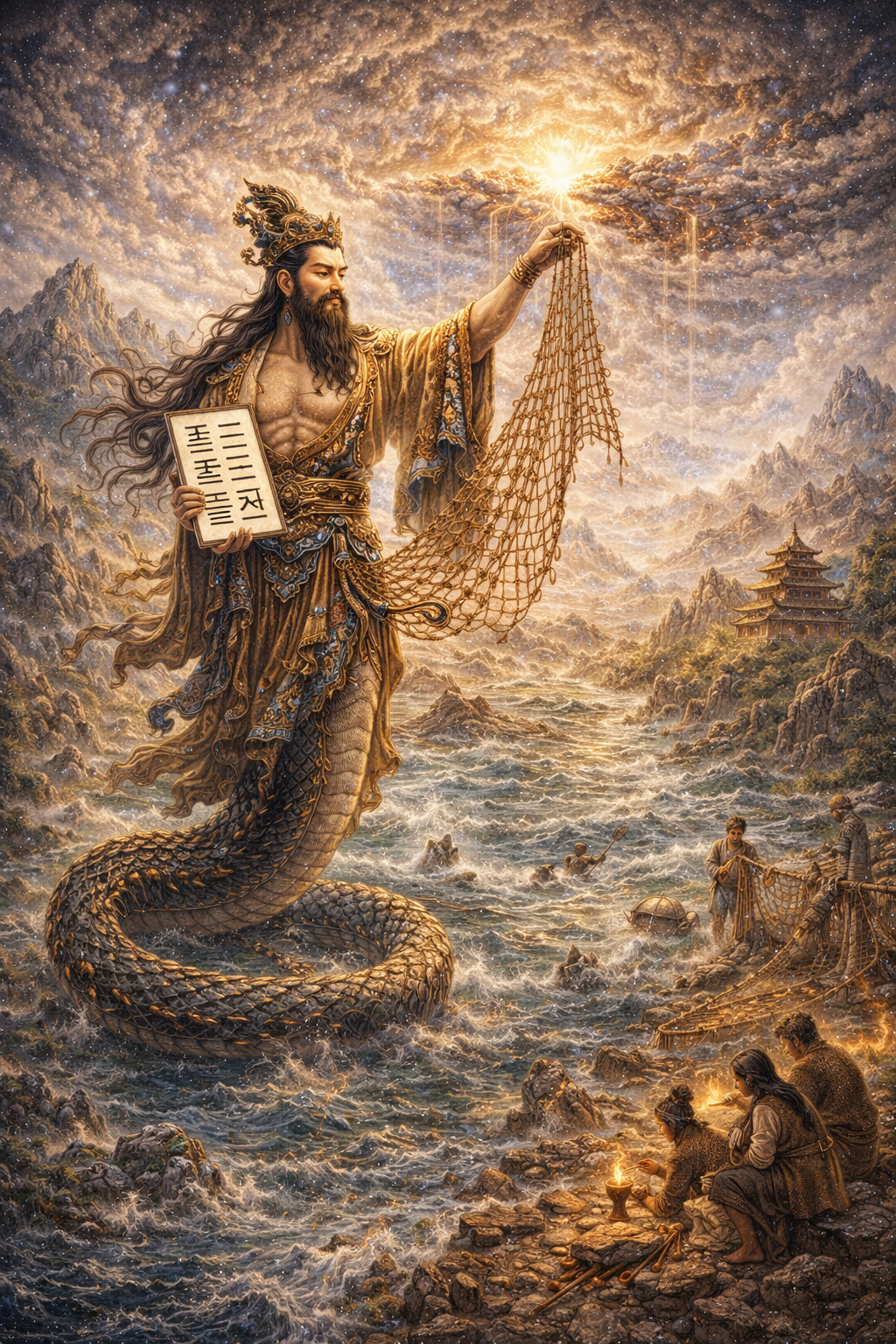
That is why Fuxi matters so much. He is one of the great mythic figures through whom Chinese tradition imagines the transition from primal or restored existence into structured society. In later summaries of the tradition, he is associated with marriage regulation, hunting and fishing techniques, the making of nets, and above all with symbolic ordering, especially through his connection to the trigrams and the deeper patterned intelligibility of the world. Whether read as primordial ruler, culture hero, or civilizational ancestor, Fuxi represents the emergence of a human order that reflects, translates, and stabilizes cosmic order.
Fuxi is also important because he helps broaden the meaning of creation. Creation is not only the separation of heaven and earth, nor only the repair of a broken sky. Creation is also the invention of social form. It is the movement from unstructured life into kinship, technique, divination, symbolic literacy, and cultural memory. Fuxi’s myth teaches that a world becomes fully human only when it becomes patterned.
Who Is Fuxi?
Fuxi is one of the great primordial or civilizational figures of Chinese myth. He is often remembered as a culture hero, an early ruler, or one of the foundational beings associated with the ordering of human life after the world has become structurally possible. In many later traditional accounts, he appears alongside Nüwa, and in some cases the two are paired as sibling or spousal figures whose relationship anchors the beginning of human society. He is also frequently associated with techniques and institutions that mark the beginning of civilization: the making of nets, the ordering of marriage, and the discovery or revelation of symbolic patterns that allow the world to be read and governed.
What makes Fuxi especially important is that he is not simply remembered as a strong or sacred ancestor. He is remembered as an organizer. His mythic role is bound up with articulation, distinction, and pattern. If Nüwa restores the conditions for life, Fuxi helps give that life social and symbolic form. He is not merely a figure of biological beginning. He is a figure of cultural intelligibility.
In this respect, Fuxi belongs to the class of culture heroes who make human life durable by introducing forms. These forms may be technological, such as nets; social, such as marriage regulation; symbolic, such as the trigrams; or political, such as early rulership. The key point is that Fuxi does not only live in mythic time. He marks the moment when mythic time becomes civilizational memory.
Fuxi’s importance therefore lies in the transition he represents. Before him, the world may be present, but human society remains incomplete. With him, the world begins to be structured through tools, signs, rules, and relations. Fuxi is the mythic figure of pattern becoming culture.
Fuxi and the Threshold of Civilization
The myth of Fuxi belongs to a crucial threshold in Chinese mythology: the passage from world-order to cultural order. A cosmos may be separated, repaired, and made stable, but this does not yet amount to civilization. Human beings must still learn how to live in relation to one another, how to structure kinship, how to procure sustenance, how to recognize patterns, and how to translate the world’s larger order into forms of social life.
Fuxi represents that transition. His significance lies in showing that mythic origin in China is never only about physical creation. It is also about the emergence of techniques, institutions, and symbolic systems that make collective life durable. With Fuxi, the world becomes not just livable, but legible and organized.
This distinction is central. A habitable world is not necessarily a meaningful world. Meaning requires patterned interpretation. People must recognize cycles, forms, signs, obligations, and relations. They must know how to gather, hunt, fish, marry, remember, consult, rule, and respond to change. Fuxi embodies this movement from mere survival into civilization.
He therefore stands at the beginning of a specifically human order. Pangu’s separation makes space. Nüwa’s repair makes life possible again. Fuxi’s cultural inventions make shared life intelligible. The sequence is not strictly chronological; it is conceptual. It shows how Chinese myth imagines world-making as a layered process: cosmos, repair, society, symbol, and technique.
Fuxi Within Chinese Cosmogony
Fuxi should be read within the larger plurality of Chinese cosmogony rather than isolated from it. Chinese mythology does not move in a straight line from one universally fixed beginning to a complete civilization. Instead, different figures and traditions illuminate different dimensions of becoming. Pangu represents differentiation and vertical structure. Nüwa represents creation, repair, and the safeguarding of the human world. Fuxi represents the ordering of culture within an already structured cosmos.
This progression is not merely sequential. It is conceptual. Fuxi’s myth helps reveal that Chinese cosmogony is concerned not only with how the world begins, but how order deepens. A habitable world must become a meaningful world. The cosmos must be interpreted, patterned, and embodied in human institutions. Fuxi is therefore one of the figures who transforms cosmology into civilization.
His myth also prevents a narrow definition of creation. If creation means only the first appearance of matter, Fuxi is not a creator. But if creation includes the formation of social and symbolic order, then Fuxi is one of the essential makers of the human world. He is a culture-making figure whose inventions turn nature into a field of patterned human practice.
This is why Fuxi belongs in the same cosmogonic sequence as Pangu and Nüwa. Chinese world-origin myth is not only about the physical origin of the universe. It is also about the conditions under which human beings can live meaningfully within it. Fuxi marks the emergence of those conditions as culture.
Fuxi, Nüwa, and the Human Order
Fuxi is frequently linked to Nüwa, and this pairing is one of the most important symbolic structures in Chinese mythic memory. Nüwa is associated with creation, restoration, and the preservation of the conditions of life; Fuxi is associated with ordering, relation, and the establishment of culture. Together they represent complementary aspects of the human beginning. One helps make a world possible; the other helps make it social.
This pairing also suggests that Chinese mythology does not sharply separate cosmic and human concerns. The ordering of marriage, kinship, and patterned life is not secondary to world-formation. It is part of what world-formation means when the world is made for human inhabitation. Fuxi and Nüwa together therefore form one of the great mythic dyads of creation and civilization.
Their paired forms are often shown with human upper bodies and serpentine lower bodies, sometimes intertwined. This imagery is important because it presents them as beings of mediation: partly human, partly primordial, associated with both nature and culture. They stand between the raw powers of the early world and the ordered human society that emerges from it.
Read together, Fuxi and Nüwa also complicate gendered assumptions about mythic agency. Nüwa is not merely a companion to Fuxi; she repairs the sky and safeguards the conditions of life. Fuxi is not merely a patriarchal founder; he is a figure of ordering, symbolic mediation, and technical instruction. The pair is strongest when read as a doubled image of civilizational formation: repair and pattern, life and rule, creation and intelligibility.
The Invention of Marriage, Kinship, and Social Regulation
One of the most important aspects of the Fuxi tradition is his association with marriage and the regulation of human relations. In later traditional summaries, Fuxi is linked to the establishment of marriage customs and the distinction of socially ordered unions from undifferentiated or chaotic mating. This is a profoundly important mythic move. It suggests that the beginning of civilization lies not only in tools or knowledge, but in the formalization of human relation itself.
Marriage in this context is not merely a private institution. It is a mythic sign that social life has entered a new stage of order. Kinship becomes regulated, descent becomes intelligible, and the human world becomes structured through rules rather than impulse alone. Fuxi’s role in this process makes him a foundational figure of social intelligibility.
This social dimension also reveals how Chinese myth links cosmic pattern to human conduct. The same imagination that asks how heaven and earth are separated also asks how people should relate to one another. A world without ordered relations remains unfinished, even if its physical structure is stable. Civilization requires not only sky, earth, water, and land, but also norms, obligations, and recognized forms of kinship.
At the same time, this material should be read critically. Myths of marriage regulation often encode later social norms and may naturalize arrangements that were historically constructed. Fuxi’s association with marriage tells us less about a literal single invention of marriage than about the mythic need to ground social order in sacred antiquity. The myth makes culture feel ancient, necessary, and cosmically meaningful.
Nets, Hunting, Fishing, and Technique
Another major strand of the Fuxi tradition links him to the invention of nets and to techniques of hunting and fishing. These associations are often treated as simple markers of material culture, but they carry a larger symbolic meaning. Nets are technologies of pattern. They transform human relation to the natural world by imposing form, anticipation, and structure upon it. Through the net, nature is no longer approached only through immediate struggle or accident; it becomes something engaged by method.
This is why Fuxi belongs not only to myth but to the myth of technique. His inventions do not merely make survival easier. They express a deeper transformation in the human condition. The world becomes something that can be read, patterned, and acted within according to recognized forms. Technique becomes an extension of intelligibility.
Primary Source
作結繩而為罔罟,以佃以漁,蓋取諸離。He made knotted cords into nets and traps, in order to hunt and to fish; this was likely taken from the pattern of Li.Yijing, “Xici xia” 繫辭下.
The passage links Fuxi’s culture-making to patterned technique. Nets are not only practical tools; they show how symbolic pattern becomes material technology.
The net is one of the most revealing symbols associated with Fuxi. It captures, but it also orders. It is made of crossing lines, intervals, knots, and openings. It works because it has structure. In that sense, the net is a practical analogue to the trigram: both are systems of patterned relation. One reads the world; the other acts within it.
This makes Fuxi one of the foundational figures of culture heroism in Chinese tradition. He does not simply rule over the world. He teaches humanity how to inhabit it. His techniques translate cosmic pattern into bodily practice, sustenance, and social survival.
Fuxi, the Trigrams, and Symbolic Intelligibility
Perhaps the most intellectually far-reaching aspect of Fuxi’s mythic profile is his association with the trigrams and the patterned symbolic order later linked to the Yijing tradition. Whether understood as inventor, discoverer, or revealer of the trigrams, Fuxi becomes a figure of profound importance because he stands at the threshold between myth and symbol system. With him, the world is not only experienced. It is encoded.
This connection is decisive for understanding why Fuxi matters beyond folklore. The trigrams represent a way of reading transformation, polarity, relation, and change. To associate Fuxi with them is to present him as a mediator between cosmic order and human interpretation. He is not merely the founder of custom but of intelligibility itself. Through him, the patterned world becomes something that can be symbolized, consulted, and brought into correspondence with human action.
Primary Source
古者包犧氏之王天下也,仰則觀象於天,俯則觀法於地,觀鳥獸之文與地之宜,近取諸身,遠取諸物,於是始作八卦,以通神明之德,以類萬物之情。In ancient times, when Baoxi ruled all under heaven, he looked upward and observed the images in heaven; he looked downward and observed the patterns on earth. He observed the markings of birds and beasts and the suitability of the land; nearby he took from his own body, and far away he took from things. Thereupon he first made the eight trigrams, to communicate with the powers of the numinous and to classify the conditions of the myriad things.Yijing, “Xici xia” 繫辭下.
Baoxi is a traditional name associated with Fuxi. The passage makes Fuxi a primordial observer who translates heaven, earth, animals, land, body, and things into symbolic order.
This passage is one of the most important witnesses to Fuxi’s symbolic role. He does not invent arbitrarily. He observes. He looks upward and downward, near and far, at celestial images, earthly patterns, animal markings, bodily forms, and environmental suitability. The trigrams emerge from patterned attention. They are not imposed on the world from outside; they arise from reading the world’s own structures.
This is also where Fuxi speaks most strongly to the concerns developed in the article on the Huainanzi and the philosophical ordering of myth. The same civilization that philosophically ordered myth also remembered a primordial figure who first discerned or instituted patterned symbolic order. Fuxi links mythic and philosophical China at a deep level.
Observing Heaven, Earth, and Pattern
Fuxi’s association with observation is crucial. He does not merely receive signs; he discerns them. The world is already patterned, but that pattern must be recognized. This makes Fuxi a figure not only of invention but of interpretation. His greatness lies in perceiving that heaven, earth, animals, bodies, and things are not random collections of phenomena. They disclose structures that can be translated into symbolic form.
The act of looking upward and downward is especially important. It places human knowledge between heaven and earth. Fuxi observes both realms and turns their relation into a symbolic system. This makes him a mediator of vertical order. Unlike Pangu, who physically separates heaven and earth, Fuxi interprets their relation. He turns separation into correspondence.
Nearby and far away also matter. The Yijing passage says that he took from his own body and from things at a distance. This establishes a principle of analogy: the body and the cosmos can illuminate one another. Human beings can read the larger world because patterns recur across scale. The body becomes a microcosmic reference; the world becomes a field of signs.
This observational model gives Fuxi enduring intellectual significance. He represents a mode of knowledge grounded in pattern recognition, analogy, correspondence, and symbolic abstraction. His mythic function is therefore not only civilizational but epistemological. He teaches humanity how to know.
Culture Heroism and the Patterning of the World
Fuxi is one of the clearest examples of the culture hero in Chinese myth. Culture heroes do not usually create the cosmos from nothing. Rather, they transform existence by introducing institutions, techniques, classifications, and systems of meaning. They bridge the gap between raw life and ordered civilization. Fuxi does exactly this.
His importance lies in showing that Chinese mythology is not only interested in first things, but in formative things: the first net, the first marriage regulation, the first symbolic pattern, the first recognition that reality is structured and that human life must be aligned with that structure. These are civilizational beginnings rather than merely physical beginnings.
That distinction matters because it broadens the scope of myth. A myth of cultural order is no less fundamental than a myth of cosmic origin. In fact, in the Chinese tradition, the two are inseparable. A properly ordered world and a properly ordered society mirror each other. Fuxi’s culture heroism shows that civilization begins when human action learns to imitate, translate, and stabilize cosmic pattern.
Culture heroism also turns memory into instruction. Stories about Fuxi do not merely tell readers that something happened long ago. They teach that tools, institutions, symbols, and social forms are sacred achievements. Culture is not accidental decoration on top of nature. It is a form of world-completion.
The Serpent-Bodied Pair and Symbolic Form
Fuxi and Nüwa are often represented as hybrid beings with human upper bodies and serpentine lower bodies, sometimes intertwined. This visual and symbolic tradition matters because it expresses the transitional status of both figures. They are not ordinary human rulers, yet they are not wholly remote cosmic abstractions. They stand at the boundary between primordial life and human civilization.
The serpent-bodied form suggests continuity with earth, water, vitality, and archaic power. The human upper body suggests intelligence, craft, speech, and social order. The hybrid body therefore becomes a visual theology of mediation. Fuxi and Nüwa belong to the world they organize, yet they exceed it. Their forms make visible the passage from primal vitality into patterned culture.
Their pairing also suggests that civilization requires more than one kind of sacred agency. Nüwa repairs and protects. Fuxi observes and orders. Nüwa restores life after rupture. Fuxi gives life form through relation, technique, and symbol. In later imagery, their intertwined bodies can be read as an image of complementarity: generation and order, repair and pattern, nature and culture, female and male, earth and heaven, body and sign.
This symbolic form should not be reduced to decorative mythology. It carries the logic of the larger cosmogonic sequence. The human world emerges from beings who are themselves composite. They stand across categories because they are responsible for making categories usable.
Fuxi and the Problem of Sources
Fuxi is also a revealing case for the problem of sources in Chinese mythology. Like Nüwa and Pangu, he is not preserved in one single, unmediated, universally original account. His figure appears across layered traditions, different textual strata, and later civilizational summaries. This means that Fuxi must be read historically as well as mythically. His meaning was shaped by repeated acts of transmission, interpretation, and retrospective ordering.
This does not diminish his significance. It clarifies the kind of significance he has. Fuxi is not simply an archaic fossil from an inaccessible past. He is a figure whose mythic life expanded as later Chinese tradition continued to reflect on the origins of civilization, symbolism, social regulation, and cultural technique. The source problem is therefore part of the story of his endurance.
The Yijing tradition is especially important because it gives Fuxi a role in symbolic intelligibility. The Fengsu tongyi tradition helps place him among primordial civilizational rulers. Later summaries, commentaries, ritual memory, visual art, and popular retellings extend his figure further still. Each layer emphasizes a different Fuxi: observer, inventor, ruler, culture hero, trigram-maker, spouse or counterpart of Nüwa, and ancestor of ordered human life.
This is precisely why the article belongs in close relation to The Problem of Sources in Chinese Mythology and From Classical Text to Folkloric Archive: How Chinese Myth Survived. Fuxi survived because his figure could carry meanings central to Chinese civilizational self-understanding.
Fuxi in Later Civilizational Memory
Fuxi’s later importance in Chinese cultural memory reflects the breadth of his mythic role. He becomes not merely a figure of ancient lore, but a civilizational ancestor. Once associated with the trigrams, marriage regulation, culture-making, and early rulership, he could be remembered as a foundational being whose significance extended into philosophy, governance, ritual memory, visual culture, and historical imagination.
This later memory matters because it reveals the durability of his symbolic function. Fuxi remained important not simply because he belonged to a mythic past, but because he continued to answer a persistent cultural question: how did human life become ordered? The answer Chinese tradition repeatedly gave was not only through force or accident, but through patterned invention, symbolic insight, and civilizational form.
Fuxi’s place among the Three Sovereigns also contributes to this memory. Such classifications are not merely lists of ancient names. They are ways of organizing cultural origins. By placing Fuxi among primordial rulers, later tradition positioned him at the foundation of civilizational continuity. He becomes part of a mythic genealogy of order.
This is why Fuxi remains useful for understanding how mythology becomes civilizational memory. A figure once associated with techniques, symbols, and early order becomes a point of orientation for later reflections on what civilization is. He helps answer not only “what happened first?” but “what makes human life ordered?”
Modern Afterlives of Fuxi
Fuxi’s modern afterlives are shaped by the same features that made him durable in earlier tradition: visual distinctiveness, association with Nüwa, symbolic connection to the trigrams, and his role as a civilizing ancestor. He appears in educational accounts of Chinese mythology, comparative mythology, cultural-history summaries, temple and heritage contexts, visual art, online encyclopedias, and modern retellings of Chinese origin traditions.
In modern presentations, Fuxi is often simplified as the inventor of the trigrams or one of the legendary Three Sovereigns. These summaries are useful, but they can obscure the deeper logic of his figure. Fuxi is not simply a mythic inventor with a list of achievements. He is the figure through whom invention, interpretation, social regulation, and cosmic correspondence become unified.
His myth also has renewed relevance in an age concerned with systems, signs, and pattern recognition. Fuxi’s association with observing heaven and earth, deriving symbols, and creating tools makes him a powerful ancient figure for thinking about the relationship between knowledge and world-order. He reminds readers that symbolic systems are never merely abstract. They arise from attempts to live within patterned reality.
At the same time, modern readers should avoid making Fuxi into a simple mascot of technology or data. His significance is older and broader. He represents technique embedded in cosmology, symbols embedded in ethics, and cultural order embedded in the living relation between heaven, earth, body, and society.
Why Fuxi Still Matters
Fuxi still matters because he embodies one of the deepest insights in Chinese mythology: the human world must be patterned if it is to endure. Creation alone does not produce civilization. A repaired or habitable cosmos still requires institutions, relations, techniques, and symbols. Fuxi is the figure through whom those things begin to emerge.
He also matters because he expands the meaning of mythic power. His greatness lies not primarily in conquest or destruction, but in ordering. He invents, distinguishes, encodes, and stabilizes. He is a figure of form. In a mythic archive concerned with chaos and cosmos, rupture and repair, he reminds us that civilization is itself a sacred achievement.
Fuxi matters, too, because he links observation to responsibility. He looks at heaven, earth, animals, bodies, and things, then turns that observation into symbols and techniques that serve human life. Knowledge is not detached contemplation. It becomes civilization-building. Pattern recognition becomes social order.
Finally, Fuxi matters because he shows that Chinese mythic origins are not only about the universe coming into being. They are about human beings learning to live meaningfully within it. A world becomes human when it can be read, patterned, cultivated, regulated, and shared. Fuxi stands at that threshold: the mythic teacher of order after creation.
Related Reading
- Chinese Myth, Folklore & Legend
- What Is Chinese Myth, Folklore & Legend?
- The Problem of Sources in Chinese Mythology
- Chaos, Cosmos, and the Origins of the World in Chinese Myth
- Pangu and the Separation of Heaven and Earth
- Nüwa: Creation, Repair, and the Human World
- The Huainanzi and the Philosophical Ordering of Myth
- Chinese Thought
Primary Sources
- Chinese Text Project (n.d.) Yijing 易經 / Book of Changes. Available at: https://ctext.org/book-of-changes
- Chinese Text Project (n.d.) Yijing: Xici xia 易經:繫辭下. Available at: https://ctext.org/book-of-changes/xi-ci-xia
- Chinese Text Project (n.d.) Yijing: Xici shang 易經:繫辭上. Available at: https://ctext.org/book-of-changes/xi-ci-shang
- Chinese Text Project (n.d.) Fengsu tongyi: San Huang 風俗通義:三皇. Available at: https://ctext.org/fengsutongyi/huang-ba/san-huang/ens
- Chinese Text Project (n.d.) Huainanzi 淮南子. Available at: https://ctext.org/huainanzi
- Chinese Text Project (n.d.) Shanhaijing 山海經 / Classic of Mountains and Seas. Available at: https://ctext.org/shan-hai-jing
Further Reading
- Birrell, A. (1993) Chinese Mythology: An Introduction. Baltimore: Johns Hopkins University Press. Available at: https://archive.org/details/chinesemythology0000birr
- Yang, L. and An, D. (2005) Handbook of Chinese Mythology. Santa Barbara: ABC-CLIO. Available at: https://archive.org/details/handbookofchines0000yang
- Chinese Text Project (n.d.) Yijing. Available at: https://ctext.org/book-of-changes
- Chinese Text Project (n.d.) Yijing: Xici xia. Available at: https://ctext.org/book-of-changes/xi-ci-xia
- Chinese Text Project (n.d.) Fengsu tongyi: San Huang. Available at: https://ctext.org/fengsutongyi/huang-ba/san-huang/ens
- Encyclopaedia Britannica (n.d.) “Fu Xi.” Available at: https://www.britannica.com/topic/Fu-Xi
- Encyclopaedia Britannica (n.d.) “I Ching.” Available at: https://www.britannica.com/topic/Yijing
- Stanford Encyclopedia of Philosophy (2015) “Chinese Philosophy of Change.” Available at: https://plato.stanford.edu/entries/chinese-change/
References
- Birrell, A. (1993) Chinese Mythology: An Introduction. Baltimore: Johns Hopkins University Press. Available at: https://archive.org/details/chinesemythology0000birr
- Chinese Text Project (n.d.) Fengsu tongyi: San Huang. Available at: https://ctext.org/fengsutongyi/huang-ba/san-huang/ens
- Chinese Text Project (n.d.) Huainanzi. Available at: https://ctext.org/huainanzi
- Chinese Text Project (n.d.) Shanhaijing. Available at: https://ctext.org/shan-hai-jing
- Chinese Text Project (n.d.) Yijing. Available at: https://ctext.org/book-of-changes
- Chinese Text Project (n.d.) Yijing: Xici shang. Available at: https://ctext.org/book-of-changes/xi-ci-shang
- Chinese Text Project (n.d.) Yijing: Xici xia. Available at: https://ctext.org/book-of-changes/xi-ci-xia
- Encyclopaedia Britannica (n.d.) “Fu Xi.” Available at: https://www.britannica.com/topic/Fu-Xi
- Encyclopaedia Britannica (n.d.) “I Ching.” Available at: https://www.britannica.com/topic/Yijing
- Stanford Encyclopedia of Philosophy (2015) “Chinese Philosophy of Change.” Available at: https://plato.stanford.edu/entries/chinese-change/
- Yang, L. and An, D. (2005) Handbook of Chinese Mythology. Santa Barbara: ABC-CLIO. Available at: https://archive.org/details/handbookofchines0000yang