
Last Updated May 5, 2026
The Chu ci, or Songs of Chu, occupies a central place in the study of Chinese myth, folklore, and legend because it preserves mythic material in a mode very different from the spatial and catalogic world of the Shanhaijing. If the Shanhaijing stores myth in landscapes, routes, mountains, seas, substances, strange beings, and boundary zones, the Chu ci stores myth in lyric movement, allusion, visionary ascent, ritual longing, divine encounter, sacred fragrance, and cosmological imagination. It does not present a systematic mythology in the form of a single narrative canon. Instead, it preserves a poetic world saturated with celestial travel, sacred presences, numinous landscapes, ritual mediation, and symbolic references to divine or semi-divine beings.
In this sense, the Chu ci is indispensable not because it explains Chinese mythology directly, but because it shows how mythic consciousness lives inside poetic form. Myth here is not only a story about gods, spirits, or origins. It is a mode of perception. The speaker moves through a world where heaven, river, mountain, fragrance, chariot, dragon, cloud, deity, exile, longing, and moral rupture are woven together. The sacred is not organized into a stable pantheon. It is approached through voice, movement, address, estrangement, and yearning.
Series context: This article is part of the Chinese Myth, Folklore & Legend knowledge series. Read together with the articles on Chinese mythic source problems and the Shanhaijing, it helps clarify how early Chinese myth survives not only in geography and catalog, but also in voice, image, invocation, ritual address, and cosmological yearning.
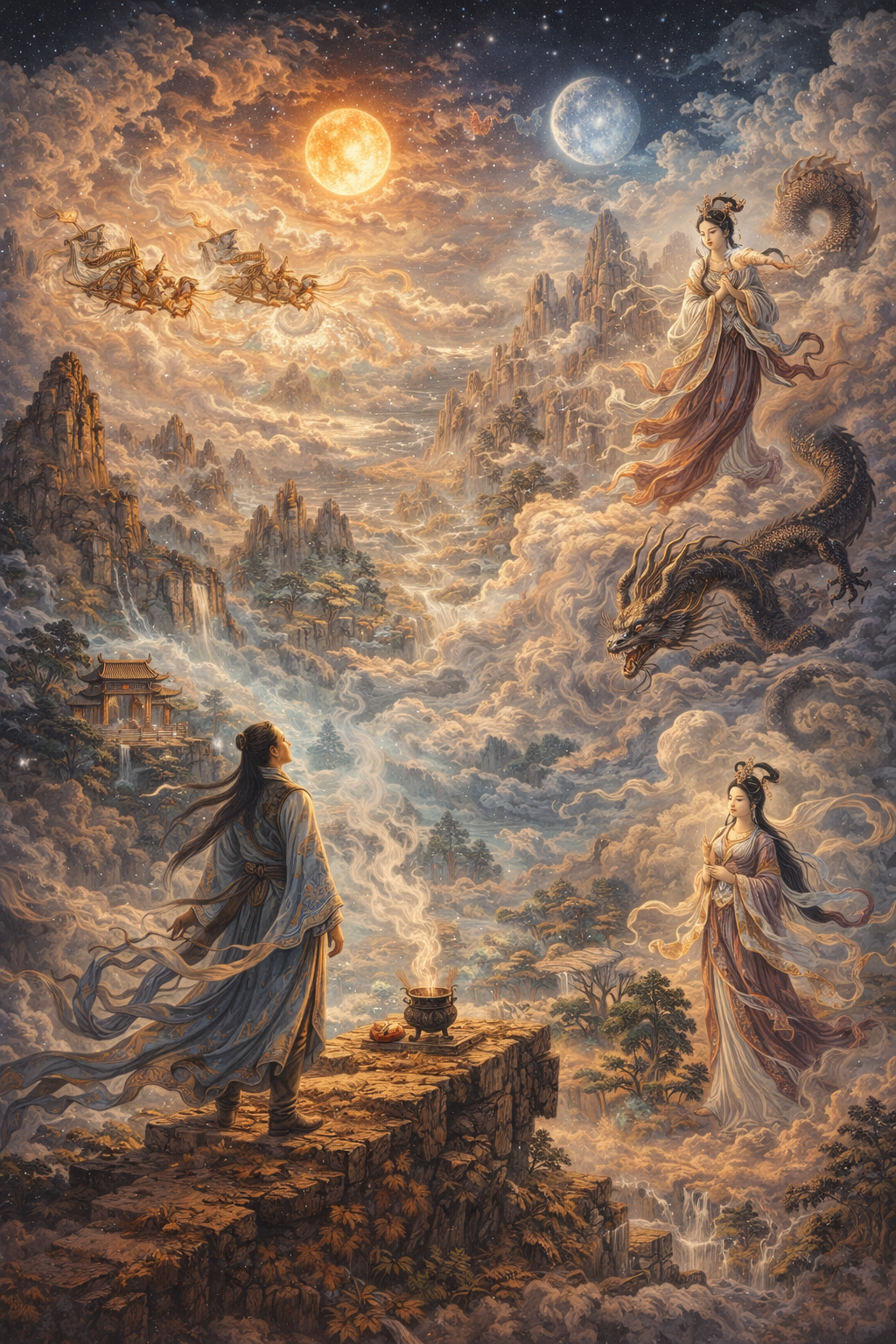
The importance of the Chu ci is amplified by its association with the southern cultural sphere of Chu and its later compilation and transmission within classical literary history. Its poems preserve a world of unusual density: gods and spirits appear through invocation; celestial regions are reached through visionary travel; fragrant plants become signs of ritual and moral refinement; rivers and distances become emotional and cosmological spaces. The methodological consequence is significant: myth in the Chu ci is not simply content. It is a poetic atmosphere, a symbolic grammar, and a way of experiencing the world as permeable to divine forces, cosmic movement, ritual mediation, and otherworldly travel.
For Chinese myth studies, this means the Chu ci must be read differently from a mythological handbook. Its mythic materials are not arranged as a list of gods or a sequence of episodes. They are embedded in repeated gestures of ascent, invocation, questioning, adornment, searching, wandering, exile, and return. The poems do not give readers a closed map of the sacred world. They give readers a voice moving through that world, longing for order, recognition, purity, justice, and cosmic alignment.
Why the Chu ci Matters for Chinese Mythology
The study of Chinese mythology can be distorted if readers expect myth to survive only in explicitly narrative or catalogic forms. The Chu ci shows another mode of survival. Here myth endures through poetic allusion, symbolic density, visionary motion, ritual speech, sacred address, and cosmological atmosphere. The text is therefore one of the clearest demonstrations that early Chinese mythic culture was not confined to stories about gods, monsters, or legendary rulers. It also inhabited lyric utterance, sacred longing, and the imaginative crossing of visible and invisible realms.
This is crucial for the larger study of Chinese myth, folklore, and legend. If the Shanhaijing reveals mythic geography, the Chu ci reveals mythic interiority. It gives access to a voice that moves among divine beings, celestial signs, fragrant plants, sacred journeys, and cosmic dislocation. Myth here is not static description. It is experienced as pursuit, invocation, estrangement, desire, mourning, and transport.
The Chu ci also matters because it preserves mythic material in a form that resists reduction. A modern reader may want to identify a god, assign a function, summarize an episode, or extract a belief. But the poems ask for a different kind of attention. Their mythic power lies in the movement among images: chariots, dragons, clouds, orchids, deities, rivers, gates of heaven, ancestral names, cosmic questions, and the speaker’s refusal to accept a world out of moral order.
Primary Source
帝高陽之苗裔兮,朕皇考曰伯庸。I am a distant descendant of the Thearch Gaoyang; my honored father was called Boyong.Chu ci, “Li Sao” 離騷.
The opening of “Li Sao” frames poetic identity through mythic ancestry. The speaker’s self-presentation is not merely personal biography; it places the voice within sacred lineage, antiquity, and cosmic-moral inheritance.
Through such passages, the Chu ci shows that myth can function as identity, not only as story. The speaker’s voice becomes meaningful because it is attached to ancestry, ritual refinement, moral vocation, and a cosmological horizon larger than the political world that has failed him.
What Kind of Text Is the Chu ci?
The Chu ci is not a single-authored book in the modern sense, nor is it a doctrinal treatise on mythology. It is a transmitted poetic collection associated with the cultural world of Chu, later compiled, arranged, commented upon, and received within classical literary history. Its authority comes not from presenting a single mythological system, but from preserving a poetic record of ritualized voice, mythic allusion, southern landscape, divine encounter, and cosmological movement.
That transmission history matters because mythic materials in the Chu ci come to us through literary preservation. They are mediated by genre, voice, performance history, commentary, and canon formation. The text therefore should not be read as a transparent archive of untouched archaic belief. It is better read as a layered poetic repository in which older ritual, cosmological, and mythic motifs were preserved, transformed, and intensified through literary art.
The collection is especially important because it stands between several categories. It is literary, but not merely aesthetic. It is religiously charged, but not a simple ritual manual. It is mythic, but not a mythology textbook. It is political, but not reducible to court complaint. Its greatest poems move across all of these zones, turning personal anguish into cosmic dislocation and ritual imagination into literary form.
For this reason, the Chu ci should be read as a source that preserves myth by transforming it. A mythic figure, sacred plant, celestial route, or divine name may appear within the poem not as an explained object, but as part of a living symbolic field. The reader reconstructs meaning by following the poem’s movement, recurrence, atmosphere, and structure of desire.
Myth as Allusion Rather than System
One of the defining features of the Chu ci is that myth appears less as orderly exposition than as allusive intensity. Divine figures, celestial regions, mythic beings, fragrant substances, ritual vehicles, and extraordinary journeys are invoked rather than cataloged. The poems assume a symbolic world that is already meaningful, even when they do not pause to explain it discursively. This makes the Chu ci especially important for the study of mythic allusion. It preserves not a textbook mythology, but a densely resonant mythological field.
Such allusion demands a different reading practice from the one often used with catalogic texts. The reader must attend to repeated images, directional symbolism, sacred flora, celestial references, named beings, ritual gestures, and shifting layers of emotional and sacred address. Mythic meaning in the Chu ci is cumulative. It builds through recurrence, tonal pressure, and patterned imagery rather than through linear plot alone.
This is also why the Chu ci belongs at the center of any serious discussion of source problems in Chinese mythology. It is an exemplary case of a source that preserves myth in indirect form. Without careful attention to allusion, one risks mistaking the text for merely decorative lyricism when in fact it is one of the richest witnesses to the mythic and cosmological imagination of early China.
Allusion also protects plurality. Because the poems do not systematize every reference, they allow multiple layers of meaning to remain active: regional, ritual, literary, political, cosmological, and personal. The same image may carry emotional, ethical, and sacred force at once. The Chu ci therefore teaches readers that Chinese mythic sources often preserve meaning through density rather than explanation.
Visionary Travel and Celestial Ascent
Among the most striking features of the Chu ci is its recurrent structure of travel: ascent, wandering, searching, crossing, chariot movement, encounter, and exclusion. These are not simply literary ornaments. They represent a world in which movement through cosmic space becomes a major form of meaning. The speaker journeys toward divine realms, ideal order, ritual purity, or sacred encounter, often through a landscape no longer bounded by ordinary human limitations.
This visionary mobility gives the Chu ci a cosmological dimension that is fundamental to Chinese myth studies. The heavens are not abstract. They are traversed, imagined, addressed, and desired. Sacred travel in the poems often dramatizes both aspiration and failure: the search for order, recognition, purity, or right relation to the cosmos may culminate in exclusion, estrangement, or return. Mythic travel thus becomes an ethical as well as cosmological form.
Primary Source
朝發軔於太儀兮,夕始臨乎於微閭。
駕八龍之婉婉兮,載雲旗之逶蛇。At dawn I set my carriage in motion from Taiyi; by evening I began to arrive at Weilü. I drove eight dragons winding and graceful, bearing cloud-banners that streamed and coiled.Chu ci, “Yuan You” 遠遊.
The passage shows how visionary travel becomes cosmic motion. Chariot, dragon, cloud-banner, dawn, evening, and distant places turn poetic movement into mythic ascent.
In this respect, the Chu ci complements the spatial archive of the Shanhaijing. Both texts imagine charged worlds, but the Chu ci internalizes that charge within motion, yearning, invocation, and visionary perspective. The sacred landscape is not merely described. It is traveled through, sought, entered, and sometimes lost.
The motif of travel also gives the Chu ci its emotional power. The speaker’s movement is never only geographical. It is moral and spiritual movement: away from corruption, toward purity, beyond the failed court, into realms where cosmic order might be recovered. Yet the poems rarely allow easy arrival. The journey becomes a form of longing that may never find a stable resting place.
Ritual Voice, Shamanic Mediation, and Sacred Address
The Chu ci has long been associated with ritual and religious imagination, in part because many of its most powerful poems operate through invocation, lament, address, and mediation between human and divine worlds. Even where modern scholarship debates the exact ritual history of individual poems, the corpus clearly preserves a style of utterance in which the speaker moves within a sacredly animated universe. Divine beings are summoned, addressed, pursued, or mourned; separation from cosmic or moral order becomes a central emotional fact.
This ritualized voice helps explain why the Chu ci remains so important to mythology. Myth is not only represented here. It is activated through address. The poems create a zone in which the act of speaking becomes itself a crossing between domains. This is one reason the text has been so influential in later literary, religious, and interpretive traditions: it demonstrates how poetic language can function as cosmological mediation.
Primary Source
吉日兮辰良,穆將愉兮上皇。
蕙餚蒸兮蘭藉,奠桂酒兮椒漿。Auspicious is the day and fine the hour; in reverence we shall delight the Lord above. Steamed offerings of hui herbs lie upon orchid mats; cassia wine and peppered drink are set forth.Chu ci, “Jiu Ge: Donghuang Taiyi” 九歌:東皇太一.
The passage preserves a ritual atmosphere of offering, fragrance, music, and sacred address. Mythic presence is approached through ceremony rather than narrative explanation.
The ritual voice of the Chu ci also complicates the distinction between poetry and worship. The poems may be literary artifacts in their transmitted form, but they preserve a language of invocation, offering, adornment, and sacred contact. Mythic meaning emerges through performance-like intensity: the poem speaks as though divine presence might enter the space of language.
This is why fragrance, music, gesture, and offering are not ornamental details. They are part of the ritual grammar through which the human world approaches the numinous. The Chu ci does not merely mention gods and spirits. It stages conditions under which they may be addressed.
Cosmology in the Chu ci
The cosmological importance of the Chu ci lies in its integration of directionality, celestial reference, elemental movement, sacred landscape, and the instability of human placement within a wider order. The poems repeatedly imagine a universe that is animate, stratified, directional, and morally charged. Heaven is not a distant abstraction. It is a field of signs, powers, thresholds, journeys, and possible relations. The human speaker exists within tension: drawn upward, driven outward, or cast into estrangement from a larger and more ordered cosmos.
This symbolic universe aligns the Chu ci with broader currents in early Chinese thought in which the world is understood through patterned correspondences rather than through inert mechanism. Although the poems are literary rather than philosophical treatises, they preserve a worldview in which cosmic order matters and in which rupture from right relation to that order becomes existentially devastating. The result is a poetics of cosmological displacement.
The Chu ci therefore helps show why Chinese myth cannot be reduced to isolated narrative episodes. It also includes symbolic systems through which heaven, earth, movement, fragrance, ritual, season, sovereignty, and moral integrity become interconnected. To be displaced politically is also to be displaced cosmologically. To seek divine encounter is also to seek a world in which value and order might be restored.
Cosmology in the Chu ci is especially powerful because it is felt rather than merely described. The poems do not explain a cosmological system in abstract terms. They dramatize what it is like to move through one: the gates, winds, clouds, rivers, chariots, dragons, deities, and thresholds become a lived symbolic environment.
Gods, Spirits, and Mythic Presence
The Chu ci preserves a world crowded with divine or numinous presence, but rarely in a simple catalogic way. Gods, spirits, celestial powers, and mythic beings appear through flashes of invocation, encounter, distance, and desire. They are less often fixed characters in a straightforward plot than poles of attraction, mediation, and symbolic force.
This is why the text is so important for reading Chinese myth beyond modern genre expectations. Mythic presence in the Chu ci is relational. It becomes visible in the speaker’s longing, the structure of the journey, the invocation of sacred names, and the atmosphere of numinous nearness or loss. The poems preserve myth less as doctrine than as charged contact with a world in which the sacred remains possible but not securely possessed.
The Jiu Ge sequence is especially important here because it preserves ritualized address to divine figures in a language of offering, music, longing, and sensory intensity. Divine presence is not simply described. It is awaited, invited, adorned, and approached. The mood is often one of nearness and distance at once: the god or spirit is present enough to address, but never fully possessed by the human speaker.
This relational quality gives the Chu ci unusual interpretive depth. It suggests that mythic presence is not always a stable object of belief. It may be an event of address, an atmosphere of expectation, or a wound of absence. The sacred world appears through desire as much as through doctrine.
Landscape Symbolism and the Southern Imagination
The association of the Chu ci with the southern world of Chu matters for mythology because it points to regional texture within the Chinese archive. The Chu ci is not just a generic anthology of early poetry. It is linked to a cultural sphere with its own ritual, aesthetic, and imaginative force. This matters not only formally but symbolically: the southern imagination preserved in the corpus often feels lush, fluid, fragrant, liminal, and visionary.
Its landscapes are full of rivers, crossings, heights, clouds, chariots, fragrant plants, and sacred presences. The poems do not simply describe external scenery. They transform landscape into a symbolic field through which moral dislocation, cosmic aspiration, and sacred desire are rendered legible. In this respect, the Chu ci differs from the Shijing as well as from the topographic densities of the Shanhaijing. Its world is lyrical, visionary, and cosmologically animated.
Landscape in the Chu ci is therefore not merely picturesque. It is the medium through which the speaker’s inner and outer worlds become inseparable. River distance can become political exile. Fragrance can become moral refinement. Ascent can become spiritual aspiration. Wandering can become the condition of a person who seeks cosmic order in a disordered human world.
This regional and symbolic texture also matters for plural readings of Chinese myth. The Chinese mythic archive was never only one center, one court, one ritual system, or one literary style. The Chu ci preserves a southern poetic imagination that complicates any overly unified account of Chinese antiquity.
Fragrance, Plants, and Moral Symbolism
One of the most distinctive symbolic patterns in the Chu ci is its recurring use of fragrant plants, herbs, blossoms, and adornments. Orchids, cassia, angelica, pepper, and other aromatic substances are not merely decorative. They participate in a moral and ritual vocabulary. Fragrance signifies refinement, purity, offering, cultivated identity, and proximity to sacred order. The body of the speaker is repeatedly imagined through adornment, gathering, wearing, or offering of fragrant things.
This symbolism is important for mythology because it links the human person to ritual ecology. The speaker does not approach the sacred world as a bare individual. He approaches it through cultivated signs: garments, plants, chariots, offerings, and names. The outer world of flora becomes an inner language of virtue, longing, and separation from corruption.
Fragrance also has social force. In “Li Sao,” the speaker’s self-fashioning through fragrant plants can be read as an assertion of moral difference in a corrupt world. The noble fragrance becomes a way to remain aligned with a higher order when political society has become polluted. Mythic and ethical imagination converge: purity is not abstract, but sensuous, botanical, ritual, and poetic.
This plant symbolism also connects the Chu ci to wider Chinese traditions of landscape, medicine, ritual, and moral cultivation. Plants are not passive background. They are bearers of meaning, efficacy, and ethical atmosphere.
Tianwen and the Mythology of Questioning
Among the most important sections of the Chu ci for mythology is “Tianwen,” often rendered “Heavenly Questions” or “Questions to Heaven.” Its importance lies not only in the mythic material it preserves, but in the form it gives that material. The poem does not organize myth into a settled narrative system. It questions origins, cosmic structure, heavenly formation, darkness, light, divine ancestry, flood, rulership, violence, and transmission.
This makes “Tianwen” one of the most powerful examples of Chinese mythic source material precisely because it refuses easy closure. Its questions preserve fragments of mythic memory while also exposing the difficulty of knowing the beginning. Myth appears not as unquestioned doctrine, but as a field of inquiry.
Primary Source
曰:遂古之初,誰傳道之?
上下未形,何由考之?
冥昭瞢暗,誰能極之?It asks: at the beginning of ancient time, who handed down the way? Before above and below had taken form, how could it be examined? In dimness, brightness, obscurity, and darkness, who could fathom it completely?Chu ci, “Tianwen” 天問.
The opening of “Tianwen” makes questioning itself a mythic act. The poem preserves cosmology through inquiry, uncertainty, and the refusal to treat origins as simple or fully knowable.
For the study of Chinese myth, this is crucial. “Tianwen” shows that a mythic source need not give answers in order to preserve mythic knowledge. It may preserve the questions a culture asks about heaven, earth, time, darkness, power, and origin. Those questions are themselves part of the archive.
The poem also helps explain why Chinese mythology often survives in fragmentary and distributed form. The tradition does not always hand down a single authorized story. Sometimes it hands down a structure of inquiry: who transmitted the beginning, how can one examine what came before form, what forces shaped the world, and how should human beings live beneath a heaven whose origins remain mysterious?
The Chu ci and the Problem of Sources
The Chu ci exemplifies why source criticism is indispensable in Chinese myth studies. Because the text preserves mythic material through literary allusion, later compilation, and commentarial transmission, it cannot simply be mined for “facts” about ancient belief. One must ask what the poems preserve, how they preserve it, and how later transmission shaped the form in which it survives.
This does not reduce the text’s authority. It clarifies its kind of authority. The Chu ci is a major source not because it presents a systematic mythology, but because it offers one of the richest surviving poetic records of a mythic and cosmological imagination. It is authoritative as witness to symbolic life, not as a singular doctrinal code.
This is precisely why it should be read in conversation with other source types. Alongside the Shanhaijing, it shows that Chinese myth survives through different media: landscape catalogue in one case, lyric and ritualized voice in another. Alongside the Huainanzi, it shows how mythic materials can be philosophically ordered or poetically intensified. Alongside folklore and performance traditions, it shows how sacred presence can be transmitted through voice, rhythm, gesture, and memory.
The Chu ci therefore trains readers in methodological humility. It reminds us that mythic material may be present even when it is not explained, and that symbolic density may preserve more than linear exposition can.
Afterlives and Interpretive Importance
The continuing importance of the Chu ci lies in both scholarship and cultural memory. Its recognized place in literary history, its preservation in digital textual projects, and its role in interpretations of early Chinese religion, poetics, and myth all confirm its enduring status. It remains one of the most powerful entry points into a world where poetry, cosmology, ritual address, moral exile, and sacred imagination intersect.
It also matters because it expands the modern understanding of mythology itself. The Chu ci reminds readers that myth can endure not only through tales of gods and monsters, but through lyric voice, sacred longing, ritual address, and imaginative movement across cosmic thresholds. In that sense, it is one of the deepest archives of mythic consciousness in early Chinese literature.
Its afterlives also extend into later poetry, painting, ritual imagination, political memory, and modern cultural interpretation. Qu Yuan became far more than a historical or literary figure; he became a symbolic figure of integrity, exile, loyalty, and moral refusal. The wider Chu ci tradition likewise preserved a language in which personal grief could become cosmic journey, and political betrayal could be imagined as rupture from sacred order.
For readers of Chinese myth, folklore, and legend, the Chu ci is therefore indispensable. It preserves a different archive from the Shanhaijing: less geographic, more lyric; less catalogic, more visionary; less explanatory, more allusive. Together, they show that Chinese myth survives not in one form, but across many: place, voice, ritual, question, journey, image, and memory.
Related Reading
- Chinese Myth, Folklore & Legend
- What Is Chinese Myth, Folklore & Legend?
- The Problem of Sources in Chinese Mythology
- Reading the Shanhaijing: Mythic Geography, Strange Beings, and Sacred Space
- The Huainanzi and the Philosophical Ordering of Myth
- From Classical Text to Folkloric Archive: How Chinese Myth Survived
- Chinese Literature and Classical Memory
- Chinese Thought
Primary Sources
- Chinese Text Project (n.d.) Chu ci 楚辭 / Songs of Chu. Available at: https://ctext.org/chu-ci
- Chinese Text Project (n.d.) Chu ci: Li Sao jing 楚辭:離騷經. Available at: https://ctext.org/chu-ci/li-sao-jing/zh
- Chinese Text Project (n.d.) Chu ci: Tianwen 楚辭:天問. Available at: https://ctext.org/chu-ci/tian-wen/zh
- Chinese Text Project (n.d.) Chu ci: Jiu Ge 楚辭:九歌. Available at: https://ctext.org/chu-ci/jiu-ge/zh
- Chinese Text Project (n.d.) Chu ci: Donghuang Taiyi 楚辭:東皇太一. Available at: https://ctext.org/chu-ci/dong-huang-tai-yi/zh
- Chinese Text Project (n.d.) Chu ci: Yuan You 楚辭:遠遊. Available at: https://ctext.org/chu-ci/yuan-you/zh
Further Reading
- Hawkes, D. (1985) The Songs of the South: An Ancient Chinese Anthology of Poems by Qu Yuan and Other Poets. London: Penguin Classics.
- Owen, S. (1996) An Anthology of Chinese Literature: Beginnings to 1911. New York: W. W. Norton.
- Chinese Text Project (n.d.) Chu ci. Available at: https://ctext.org/chu-ci
- Chinese Text Project (n.d.) Chu ci English interface. Available at: https://ctext.org/chu-ci/ens
- Encyclopaedia Britannica (n.d.) “Chuci.” Available at: https://www.britannica.com/topic/Chu-Tzu
- Encyclopaedia Britannica (n.d.) “Chinese literature: Literary use of myths.” Available at: https://www.britannica.com/art/Chinese-literature/Literary-use-of-myths
- The Metropolitan Museum of Art (2011) “Daoism and Daoist Art.” Available at: https://www.metmuseum.org/essays/daoism-and-daoist-art
- The Metropolitan Museum of Art (n.d.) “The Moon Goddess Chang E.” Available at: https://www.metmuseum.org/art/collection/search/45754
- UNESCO Intangible Cultural Heritage (n.d.) “China.” Available at: https://ich.unesco.org/en/state/china-CN?info=elements-on-the-lists
References
- Chinese Text Project (n.d.) Chu ci. Available at: https://ctext.org/chu-ci
- Chinese Text Project (n.d.) Chu ci English interface. Available at: https://ctext.org/chu-ci/ens
- Chinese Text Project (n.d.) Chu ci: Li Sao jing. Available at: https://ctext.org/chu-ci/li-sao-jing/zh
- Chinese Text Project (n.d.) Chu ci: Tianwen. Available at: https://ctext.org/chu-ci/tian-wen/zh
- Chinese Text Project (n.d.) Chu ci: Jiu Ge. Available at: https://ctext.org/chu-ci/jiu-ge/zh
- Chinese Text Project (n.d.) Chu ci: Donghuang Taiyi. Available at: https://ctext.org/chu-ci/dong-huang-tai-yi/zh
- Chinese Text Project (n.d.) Chu ci: Yuan You. Available at: https://ctext.org/chu-ci/yuan-you/zh
- Encyclopaedia Britannica (n.d.) “Chuci.” Available at: https://www.britannica.com/topic/Chu-Tzu
- Encyclopaedia Britannica (n.d.) “Chinese literature: Literary use of myths.” Available at: https://www.britannica.com/art/Chinese-literature/Literary-use-of-myths
- Hawkes, D. (1985) The Songs of the South: An Ancient Chinese Anthology of Poems by Qu Yuan and Other Poets. London: Penguin Classics.
- Owen, S. (1996) An Anthology of Chinese Literature: Beginnings to 1911. New York: W. W. Norton.
- The Metropolitan Museum of Art (2011) “Daoism and Daoist Art.” Available at: https://www.metmuseum.org/essays/daoism-and-daoist-art
- The Metropolitan Museum of Art (n.d.) “The Moon Goddess Chang E.” Available at: https://www.metmuseum.org/art/collection/search/45754
- UNESCO Intangible Cultural Heritage (n.d.) “China.” Available at: https://ich.unesco.org/en/state/china-CN?info=elements-on-the-lists