
Last Updated May 4, 2026
Tea, Ritual & Everyday Philosophy examines the cultural, aesthetic, ethical, and contemplative traditions through which tea becomes more than a beverage: a disciplined practice of preparation, attention, hospitality, atmosphere, simplicity, seasonal awareness, material meaning, and cultivated everyday life. As a major category within the Healing Traditions knowledge series, it studies tea first through specific textual traditions, ritual practices, material cultures, social settings, aesthetic lineages, and regional histories, and only after that through comparative philosophy, museum interpretation, living heritage, and modern cultural analysis.
Tea is never only a drink in the traditions that gather around it most fully. It becomes a medium through which societies express ideals of refinement, humility, sociability, restraint, perception, hospitality, and relation to nature. The tea bowl, the kettle, the whisk, the caddy, the garden, the tearoom, the pause before drinking, the placement of flowers, the selection of utensils, and the awareness of season all become part of a larger language of cultivated form. In this sense, tea belongs not only to culinary history, but also to the history of aesthetics, ethics, ritual, philosophy, healing, and ordinary life.
This category explores Lu Yu’s Classic of Tea, Chinese literati tea culture, Buddhist and monastic tea practice, Japanese chanoyu, Sen no Rikyū, wabi-cha, Okakura Kakuzō’s The Book of Tea, the aesthetics of simplicity and incompleteness, tea rooms, utensils, bowls, jars, kettles, scrolls, flowers, hospitality, atmosphere, connoisseurship, gender, social order, cultural authority, living heritage, and the place of tea within broader practices of nourishment, attention, and care. It treats tea as a historically specific and comparative field of everyday philosophy rather than as a timeless spiritual essence.
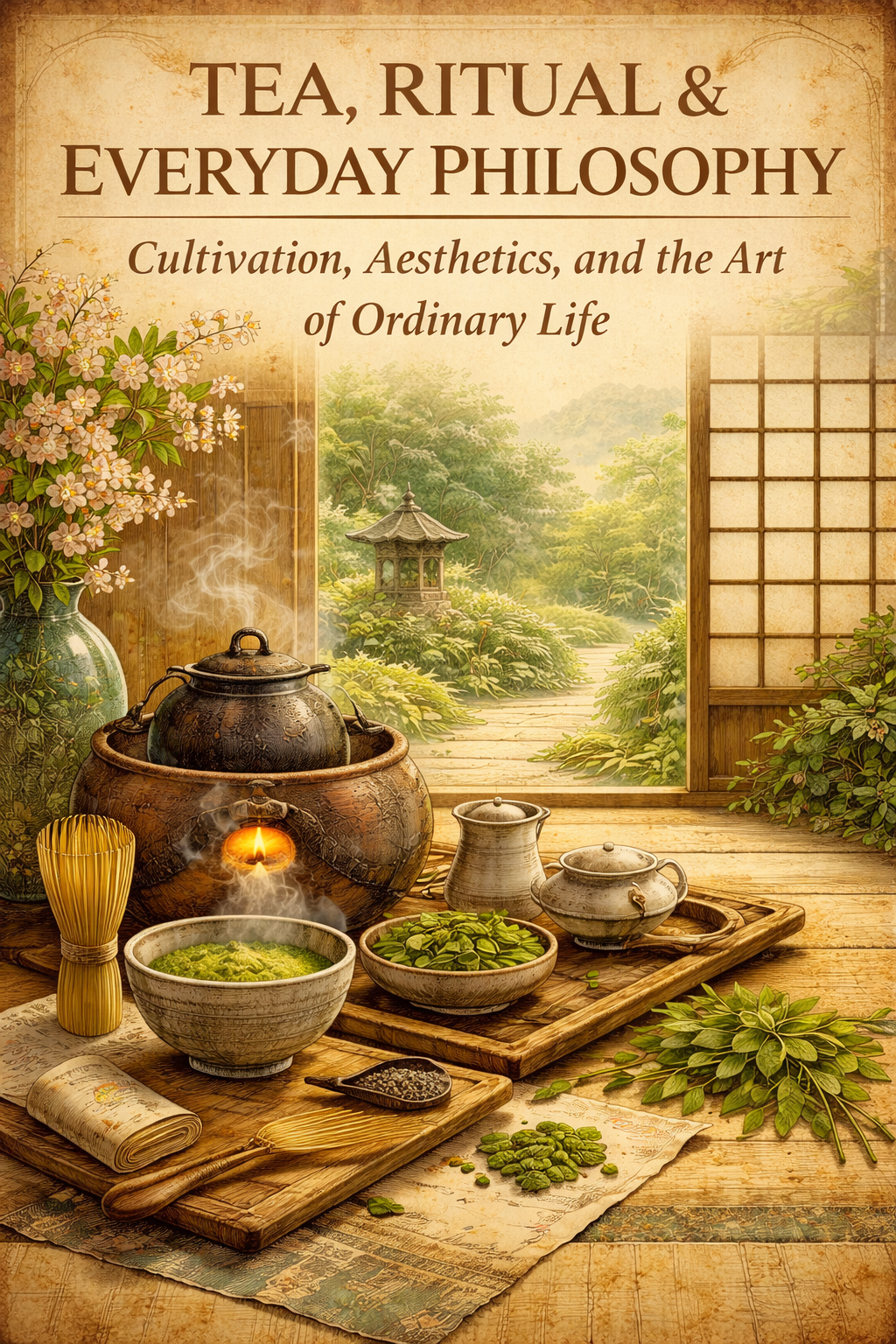
Tea, ritual, and everyday philosophy form a distinctive field of cultural and intellectual inquiry because ordinary acts of preparation and consumption can become vehicles of cultivation, attentiveness, hospitality, discipline, and meaning. Tea traditions show how thought can be embedded in repeated action. A philosophical ideal need not appear only as an argument. It may also appear as a gesture, a pause, a vessel, a room, a season, a form of hosting, or a practiced way of receiving another person.
This category is especially important within the wider study of healing traditions because it connects Healing Traditions to Diet, Nourishment & Food as Medicine, East Asian Traditions, Chinese Thought, Japanese Literature & Poetic Memory, Religion and Ecology, Tea, Ritual & Everyday Philosophy, Healing Spaces, Baths & Sacred Environments, Cultural Anthropology, and Ethics & Moral Philosophy. It shows that care may be organized not only through intervention against illness, but also through rhythm, atmosphere, nourishment, restraint, perception, and the quiet ordering of daily life.
The goal of this pillar is not to romanticize tea as a universal spiritual cure, nor to collapse Chinese, Japanese, Korean, British, and global tea practices into one undifferentiated tradition. It is to study tea as a historically layered cultural field: material, aesthetic, ethical, ritual, ecological, social, and philosophical. A serious treatment must attend to beauty and discipline, but also to class, gender, connoisseurship, institutional schools, cultural nationalism, political authority, commerce, colonial exchange, and the historical conditions through which tea acquired meaning.
Why This Series Matters
Tea matters because it reveals how civilizations embed philosophy in repeated practice. The act of preparing tea can become a discipline of timing, perception, restraint, care, and hospitality. The act of receiving tea can become a discipline of attention, gratitude, silence, relation, and presence. In this sense, tea shows that philosophy is not always abstract. It can be lived through gesture, sequence, texture, taste, and social form.
Tea traditions also matter because they illuminate the boundary between ritual and ordinary life. Tea may be consumed casually, but in many traditions it also becomes formalized through utensils, spatial arrangement, seasonal attention, etiquette, aesthetic judgment, and host-guest relation. The ordinary act does not cease to be ordinary; rather, it becomes more perceptible. Tea ritual teaches that everyday life can be shaped without being grandiose.
The field also matters for comparative healing studies. Tea does not replace medicine, nor should it be presented as a cure-all. Its importance lies elsewhere: in the quiet disciplines of nourishment, atmosphere, social relation, attention, and balance. Tea can help clarify how care sometimes enters through repeated practice rather than acute intervention. It reveals a dimension of healing associated with rhythm, order, rest, hospitality, sensory refinement, and cultivated presence.
A serious series must therefore hold together beauty and history. Tea traditions contain extraordinary aesthetic and philosophical depth, but they are also socially situated. They have been shaped by monasteries, courts, merchants, schools, gender roles, museums, colonial routes, commodity systems, national identity, and taste-making institutions. Tea should be studied as both cultivated form and historical practice.
Scope and Orientation
Tea, ritual, and everyday philosophy are best approached as an interconnected cultural field rather than a narrow culinary topic. The subject includes cultivation, preparation, utensils, gesture, atmosphere, hospitality, etiquette, symbolic form, aesthetic judgment, sensory awareness, and the philosophical significance of ordinary acts. It also includes the social worlds through which tea has been transmitted: monasteries, literati circles, merchant culture, households, schools of practice, museums, craft lineages, and curated gatherings.
The field requires historical and regional discrimination. Chinese tea culture, Japanese chanoyu, Korean tea practices, British tea ritual, and later global tea forms should not be collapsed into one undifferentiated tradition. This pillar is primarily concerned with the East Asian and philosophical archive in which tea becomes a disciplined art of cultivation, relation, aesthetic form, and everyday life. Within that archive, China and Japan are especially important, but they are not interchangeable.
Chinese traditions often emphasize literary cultivation, seasonal attunement, connoisseurship, Buddhist and Daoist inflections, manual skill, and the long history of tea as social and civilizational practice. Japanese tea traditions, especially those associated with chanoyu, intensify attention to atmosphere, material selection, host-guest relation, spatial discipline, and the formal choreography of the gathering.
The category also requires attention to material culture. Tea is inseparable from the objects through which it is prepared and shared. Bowls, jars, kettles, trays, scoops, scrolls, flowers, textiles, and the architecture of the tea space are not accessories to meaning. They are among its primary carriers.
Tea as Everyday Philosophy
Tea occupies an unusual position in the history of philosophy because it makes thought visible in action. Simplicity, harmony, asymmetry, impermanence, humility, attentiveness, and relation are not merely described; they are staged and embodied. The practice of tea teaches not by proposition alone, but by setting, pacing, sequence, and atmosphere.
This is why tea has attracted philosophical reflection beyond technical discourse on preparation. In refined tea traditions, the act of making and receiving tea becomes a pedagogy of perception. The practitioner learns to notice temperature, sound, texture, placement, silence, season, gesture, and the presence of others. Philosophy becomes a disciplined refinement of attention.
Tea also shows that everyday philosophy is not necessarily verbal. A host may express care through the selection of utensils, the preparation of water, the arrangement of flowers, or the pacing of the gathering. A guest may respond through silence, posture, attentiveness, and respectful reception. Ethical relation becomes embedded in form.
This does not mean that tea traditions are free of hierarchy or social control. Formal practice can cultivate humility and attention, but it can also mark distinction, refinement, status, and authority. The philosophical richness of tea lies partly in this tension: it is at once ordinary and formal, humble and elite, simple and highly codified.
Ordinary Life and Ritual Form
Tea reveals how ritual may enter ordinary life without removing it from the everyday. A cup of tea is a small act. Yet it can be formalized through repeated gestures, spatial order, seasonal awareness, and rules of hospitality. The ordinary becomes meaningful because it is approached with care.
This is one reason tea traditions are valuable for thinking about ritual more broadly. Ritual does not always require spectacle, grandeur, or doctrinal complexity. It may involve a bowl, a kettle, a quiet room, a shared pause, and a sequence of actions performed well. Ritual form can intensify perception by slowing ordinary life down.
The ordering of tea also changes time. Instead of being swallowed quickly, tea is prepared, waited for, received, tasted, and remembered. This pacing matters. It creates a temporary structure in which attention is gathered and ordinary consumption becomes a cultivated event.
For healing traditions, this is important because many forms of care depend on rhythm. Not all restoration is dramatic. Some forms of repair emerge through repeated acts that structure the day, calm the senses, invite relation, and make attention possible.
China, Lu Yu, and the Classic of Tea
Chinese tea culture occupies a foundational place in the intellectual history of tea. Lu Yu’s Classic of Tea, or Cha Jing, is one of the major textual monuments of tea culture. Traditionally associated with the Tang period, it elevated tea from practical beverage to object of disciplined knowledge, refined preparation, and cultural reflection.
The importance of Lu Yu lies not only in the text’s technical content, but in its intellectual gesture. Tea becomes worthy of classification, description, comparison, preparation, and aesthetic judgment. The plant, the water, the utensils, the method, and the social act of drinking all become part of a cultivated field of knowledge.
This matters because tea culture emerges here as a serious practice of attention. The drink is not detached from its conditions. Where it is grown, how it is processed, how water is chosen, how utensils are used, and how tea is prepared all matter. Tea becomes a form of disciplined relation to material conditions.
A dedicated article on Lu Yu should therefore treat the Classic of Tea as more than an early manual. It is a foundational statement of tea as cultural knowledge: technical, aesthetic, ecological, and philosophical.
Chinese Literati Tea Culture
Chinese literati tea culture gives tea an especially important role in the history of cultivation, friendship, poetry, calligraphy, painting, retreat, connoisseurship, and refined sociability. Tea became associated with learned leisure, aesthetic judgment, seasonal awareness, and the ethical cultivation of perception.
The literati world matters because it situates tea within a broader culture of objects, texts, landscapes, and companionship. A tea gathering could involve poetry, conversation, painting, music, scholarly friendship, or retreat from official life. Tea was not merely consumed; it helped create an atmosphere of cultivated exchange.
This tradition also links tea to nature. Mountains, streams, gardens, weather, seasonal change, and water quality all enter the imagination of tea. The drink becomes a way of perceiving the environment through taste, fragrance, and setting.
A strong article on literati tea culture should avoid treating it only as elite refinement. It should ask how aesthetic cultivation, social distinction, withdrawal, friendship, and ecological sensitivity were all organized through the practice of tea.
Tea, Buddhism, and the Discipline of Attention
Tea has long been linked to Buddhist practice, especially in East Asian monastic contexts. Its association with wakefulness, discipline, seated practice, hospitality, restraint, and attentiveness helped make it more than ordinary refreshment. Tea could support the conditions of practice: alertness, presence, moderation, and communal rhythm.
This does not mean that tea is simply Buddhist in essence. Tea traditions are plural and have also been shaped by Daoist sensibility, Confucian social form, literati culture, courtly practice, merchant patronage, household custom, and later secular aesthetics. Yet Buddhist contexts were crucial for the circulation and ritual refinement of tea in East Asia.
Tea’s relationship to attention is especially important. Preparation requires presence. Drinking requires receptivity. The ritual setting discourages distraction and creates conditions for noticing what is often overlooked: steam, silence, gesture, texture, season, and shared time.
For this pillar, tea and Buddhism should be treated as a major bridge between ritual, philosophy, and embodied practice. Tea becomes one of the ways ordinary action can be shaped into contemplative discipline.
Japan, Chanoyu, and Wabi-cha
Japanese chanoyu, often translated as the tea ceremony or the way of tea, represents one of the most highly formalized and philosophically interpreted tea traditions in the world. It developed through monastic transmission, aristocratic and warrior patronage, merchant culture, material connoisseurship, and the formation of schools of practice.
Within this history, wabi-cha became especially influential. It emphasized simplicity, restraint, rusticity, humility, asymmetry, imperfection, and quiet depth. Rather than treating luxury and polish as the highest forms of refinement, wabi-cha cultivated a sensibility in which modest materials and incomplete forms could carry profound meaning.
Chanoyu is important because it makes philosophy spatial and procedural. The tearoom, the entrance, the utensils, the host’s movement, the guest’s posture, the seasonal scroll, the flower arrangement, and the sound of water are all part of the event. Meaning is distributed across the whole setting.
A dedicated article should treat chanoyu as a historical practice rather than a timeless essence of Japanese culture. It is an art, a discipline, a social form, a material culture, and a historically changing institution.
Sen no Rikyū and the Formation of Tea Aesthetics
Sen no Rikyū is one of the central figures in the history of Japanese tea. Associated with the refinement of wabi-cha, he helped shape an aesthetic of disciplined simplicity, humility, intimacy, and material restraint. His influence remains foundational in later understandings of the way of tea.
Rikyū’s importance lies not only in biography but in the formation of a sensibility. Tea becomes a discipline of atmosphere and relation. A small room, a weathered object, a humble bowl, a seasonal flower, or a quiet pause may carry more force than display or luxury.
At the same time, Rikyū should not be treated only as a romantic figure of simplicity. He operated within complex social and political worlds involving patronage, warrior elites, cultural authority, and the politics of taste. The aesthetics of humility could exist within structures of power.
A serious article on Rikyū should therefore hold together aesthetics and history. His legacy is not only the beauty of wabi, but the social and political conditions through which tea became a disciplined cultural authority.
Okakura Kakuzō and The Book of Tea
Okakura Kakuzō’s The Book of Tea, first published in 1906, remains one of the most philosophically resonant modern interpretations of tea. Written for an English-language audience, it presents tea as an art of simplicity, incompleteness, perception, and cultivated life. It helped introduce tea aesthetics to global readers while also participating in modern debates about Japanese culture, Asian art, and civilizational identity.
The text is important because it interprets tea not merely as custom, but as philosophy. Okakura uses tea to discuss art, life, imperfection, emptiness, hospitality, and the relation between beauty and everyday practice. Tea becomes a way of thinking about how humans inhabit the world.
At the same time, The Book of Tea should be read historically. It is not a transparent window into all tea practice. It is a modern, literary, interpretive, and cross-cultural text shaped by its moment. Its philosophical elegance should be studied alongside its role in cultural translation.
A dedicated article should therefore treat Okakura as both interpreter and constructor of tea philosophy. His work is indispensable, but it should be read critically as well as appreciatively.
Simplicity, Incompleteness, and Imperfection
Tea traditions, especially in the Japanese archive, are deeply connected to aesthetics of simplicity, incompleteness, asymmetry, weathered beauty, and restrained form. These values are often described through concepts associated with wabi and related aesthetic vocabularies. A chipped surface, muted glaze, small room, rough texture, or sparse arrangement may carry more meaning than elaborate display.
This aesthetic matters because it changes how value is perceived. Beauty is not only in perfection, novelty, symmetry, or wealth. It may appear in age, use, incompletion, irregularity, and quiet presence. Tea trains perception toward subtlety.
Such aesthetics also have ethical implications. Simplicity can cultivate humility, restraint, and attention to what is small. Yet simplicity can itself become a sophisticated marker of taste, distinction, and cultural authority. A rough bowl may be materially humble but socially prestigious.
A scholarly treatment should therefore avoid reducing tea aesthetics to inspirational slogans. The beauty of imperfection is philosophically rich, but it is also historically produced, taught, collected, named, and valued within specific social worlds.
Atmosphere, Season, and Sensory Intelligence
Tea is shaped not only by ingredients and utensils, but by atmosphere. Light, silence, temperature, season, architecture, sound, flowers, scent, texture, pacing, and social awareness all contribute to the experience. Tea is one of the clearest examples of atmosphere as an intellectual and aesthetic category.
Seasonal awareness is especially important. A tea gathering may be shaped by the time of year through utensils, flowers, scrolls, sweets, hearth arrangement, water temperature, garden path, and mood. The event becomes an interpretation of season rather than a neutral act of consumption.
This sensory intelligence matters because it shows how knowledge can be embodied and environmental. Tea practitioners learn not only rules, but attunement. They learn to notice what is appropriate to time, place, guest, occasion, and material condition.
For healing traditions, atmosphere is significant because environments affect perception, emotion, relation, and rest. Tea shows how care can be distributed across a setting rather than located in one object or technique.
Hospitality, Hosting, and Ethical Relation
Tea is a social art. The host-guest relation is one of its central ethical structures. The host prepares, selects, arranges, and serves. The guest receives, attends, appreciates, and responds. The gathering depends on mutual awareness. Hospitality becomes a disciplined form rather than a casual courtesy.
This ethical relation is subtle. The host does not merely provide a beverage; the host creates conditions for presence. The guest does not merely consume; the guest honors the labor, objects, atmosphere, and occasion. Both roles require restraint, attention, and responsiveness.
Tea therefore offers a philosophy of relation. It asks how one person should receive another. It asks how material care can express respect. It asks how social hierarchy, etiquette, humility, and mutual attention are negotiated through form.
A serious article should also recognize that hospitality traditions can encode social power. Who hosts, who serves, who is admitted, who is trained, and whose taste counts are historical questions. Ethical form and social hierarchy often coexist.
Objects, Utensils, and Material Meaning
Tea is inseparable from material culture. Bowls, caddies, jars, kettles, scoops, trays, whisks, cloths, scrolls, flowers, water vessels, and architectural elements all participate in meaning. Objects are not merely tools. They can carry history, memory, touch, provenance, taste, status, and aesthetic judgment.
Tea objects often become meaningful through use. A bowl is handled, turned, admired, named, passed down, displayed, repaired, or remembered. A jar may gather value through its history of ownership. A kettle may shape sound and atmosphere. A scroll may define the philosophical tone of the gathering.
This makes tea an important field for object-philosophy. Meaning is not only in ideas, but in surfaces, textures, forms, and repeated handling. The object mediates relation between past and present, host and guest, craft and use, humility and prestige.
A dedicated article on tea objects should bring together material culture, aesthetics, connoisseurship, museum interpretation, and the lived meaning of things in practice.
Tea Rooms, Space, and Architecture
The tea room is one of the most important spaces in the philosophy of tea. It is not simply a container for the gathering; it shapes the gathering itself. Scale, entrance, path, light, floor, alcove, hearth, door, garden, and seating all organize perception and relation.
In Japanese tea practice, the tea room can cultivate humility and intimacy. Its smallness may require bodily adjustment. Its entrance may lower the guest physically and symbolically. Its emptiness may heighten attention to a few carefully chosen elements. Space becomes ethical instruction.
Architecture also controls transition. The path to the tea room, the waiting, the movement from outside to inside, and the separation from ordinary social space all help create a different atmosphere. Tea space is therefore both physical and ritual.
A serious article should treat tea architecture as a discipline of attention. The room teaches through constraint, proportion, material, and silence.
Connoisseurship and Cultural Authority
Tea traditions have often involved connoisseurship: the ability to judge leaves, water, bowls, jars, utensils, preparation, atmosphere, and appropriateness. This refined judgment can cultivate perception, but it can also create cultural authority. Those who know how to recognize, name, and value tea objects may gain status.
Connoisseurship matters because it shows how taste becomes social power. A humble object may become prestigious when recognized by an authoritative lineage or collector. A tea gathering may appear simple while depending on deep knowledge of provenance, form, season, and social expectation.
Museums help reveal this dimension because tea objects often enter collections through histories of naming, display, ownership, and interpretation. A tea jar or bowl may become a cultural artifact whose value exceeds its practical function.
A scholarly treatment should therefore study connoisseurship with both appreciation and critique. It is a discipline of perception, but also a system of distinction.
Tea, Social Order, and the Politics of Refinement
Tea has been shaped by social order. It has moved through monasteries, imperial and courtly settings, warrior elites, merchant culture, domestic practice, schools, museums, and national cultural narratives. The ritual of tea can express humility, but it can also express status, discipline, authority, and belonging.
This political dimension is important because aesthetic forms do not exist outside society. Tea objects can become gifts of power. Tea gatherings can establish hierarchy. Schools can codify practice. National and cultural narratives can use tea as a symbol of identity, refinement, or tradition.
At the same time, tea can create spaces of intimacy and temporary equality. A small room, shared utensils, and disciplined hospitality may soften social distance, even when they do not erase it. Tea’s social meaning is therefore complex.
A serious article should avoid treating tea as only serene. Tea is also historical: shaped by patronage, class, gender, commerce, cultural politics, and institutions of taste.
Living Heritage and Transmission
Tea traditions persist not only in texts but in living transmission. Teachers, schools, families, museums, craftspeople, farmers, tea masters, hosts, guests, exhibitions, ceremonies, and community practices all preserve and reinterpret tea culture. Tea remains a living form rather than a historical curiosity.
UNESCO’s recognition of traditional tea processing techniques and associated social practices in China is important because it frames tea as a field of knowledge, manual skill, social sharing, and cultural continuity. Tea is not only an agricultural product; it is a set of practices that link cultivation, processing, preparation, drinking, and social life.
Living heritage, however, is not neutral. Once a practice is recognized as heritage, it may be preserved, displayed, standardized, marketed, or reinterpreted. Heritage status can support continuity, but it can also reshape how a tradition is performed and explained.
A dedicated article should therefore study tea as living heritage with care: as practice, transmission, preservation, institutional recognition, and modern cultural negotiation.
Tea, Healing, and the Care of Ordinary Life
Tea belongs in a healing-traditions context because it broadens the meaning of care. It is not medicine in the narrow sense, and it should not be presented as a substitute for medical treatment. Its relevance lies in the cultivation of rhythm, nourishment, social relation, attention, sensory calm, hospitality, and everyday order.
Many forms of healing involve restoration of conditions under which life can be received more fully. Tea can create such conditions through small acts: warming water, preparing a cup, sitting with another person, marking a pause, recognizing season, and slowing time. These acts are modest, but they can shape the atmosphere of care.
Tea also connects body and mind through sensory experience. Taste, warmth, aroma, sound, texture, and gesture can draw attention back into the present. In this way, tea offers a philosophy of attention that is practical rather than abstract.
A serious treatment should remain careful. Tea is not inherently therapeutic in every context, and tea culture can be commercialized or aestheticized superficially. But as a disciplined practice of ordinary life, tea remains an important example of how nourishment, ritual, and care can meet.
Core Themes in This Series
One major theme in this field is cultivation: tea as a practice of attention, restraint, perception, and care. A second is ritual form: the ordering of gesture, sequence, space, and social relation around an ordinary act. A third is atmosphere: the role of light, silence, season, architecture, sound, and pacing in shaping meaning.
A fourth theme is hospitality: the ethical relation between host and guest. A fifth is material culture: the bowl, kettle, jar, caddy, scroll, flower, and room as carriers of history and meaning. A sixth is aesthetic discipline: simplicity, incompleteness, asymmetry, humility, and restrained beauty.
Additional themes include living heritage, the transmission of tea practices across generations; social order, including class, gender, schools, connoisseurship, and cultural authority; religious-philosophical context, especially Buddhist, Daoist, literati, and Japanese aesthetic worlds; and care, the quiet restoration of ordinary life through rhythm, nourishment, relation, and cultivated presence.
Tea, Ritual & Everyday Philosophy Pillar Map
The following article map is designed as a research agenda for the Tea, Ritual & Everyday Philosophy pillar, with emphasis on Chinese and Japanese tea traditions, everyday philosophy, material culture, hospitality, aesthetics, ritual form, living heritage, and the relationship between tea, attention, and care.
Tea, Ritual & Everyday Philosophy is organized to move from foundational questions into Chinese tea culture, Japanese chanoyu, tea aesthetics, material objects, space, hospitality, social order, living heritage, and the quiet forms of care embedded in ordinary practice. The goal is to treat tea as a serious field of cultural knowledge: philosophical, aesthetic, ritual, material, social, ecological, and historically situated.
Foundations, Scope, and Method
- What Is Tea, Ritual & Everyday Philosophy? (planned)
Introduces tea as a cultural field where beverage, ritual, aesthetics, hospitality, attention, and everyday philosophy converge. - Tea as a Philosophy of Everyday Life (planned)
Explores tea as a practice through which thought becomes embodied in gesture, rhythm, attention, and ordinary care. - Tea, Ritual, and the Ordering of Ordinary Time (planned)
Studies how tea transforms an ordinary act into a structured moment of pause, sequence, and cultivated presence. - Tea in Comparative Cultural History (planned)
Compares tea traditions across Chinese, Japanese, Korean, British, and global contexts while preserving historical difference. - How to Study Tea Without Romanticizing It (planned)
Establishes a scholarly method attentive to beauty, history, class, gender, politics, commerce, and cultural authority. - Tea Between Nourishment, Ritual, and Care (planned)
Introduces tea as a field where food, medicine, hospitality, atmosphere, and emotional restoration overlap.
Chinese Tea Culture and Classical Sources
- Lu Yu and the Classic of Tea (planned)
Studies Lu Yu’s foundational text as a work of technical knowledge, aesthetic judgment, and early tea philosophy. - The Classic of Tea and the Making of Tea Knowledge (planned)
Examines classification, water, utensils, preparation, cultivation, and the textual formation of tea as disciplined knowledge. - Tea in Chinese Literati Culture (planned)
Explores tea in relation to poetry, calligraphy, friendship, retreat, connoisseurship, and cultivated scholarly life. - Tea, Buddhism, and the Discipline of Attention (planned)
Studies tea’s relation to monastic wakefulness, contemplation, hospitality, and disciplined presence. - Tea, Daoist Sensibility, and Naturalness (planned)
Explores tea through ideas of simplicity, natural process, withdrawal, water, mountain retreat, and unforced cultivation. - Chinese Tea Practices as Living Heritage (planned)
Examines tea processing, preparation, drinking, and social sharing as living cultural knowledge.
Japanese Tea, Chanoyu, and Aesthetic Discipline
- Chanoyu and the Philosophy of Form (planned)
Introduces Japanese tea practice as a disciplined art of space, gesture, utensil, hospitality, and atmosphere. - Sen no Rikyū and the Formation of Wabi-cha (planned)
Studies Rikyū’s influence on simplicity, humility, material restraint, and the aesthetics of tea. - Wabi-cha and the Aesthetics of Imperfection (planned)
Explores rusticity, asymmetry, incompleteness, weathered beauty, and the disciplined perception of modest forms. - Tea, Zen, and the Practice of Attention (planned)
Examines the relationship between tea, Zen-influenced discipline, presence, silence, and embodied practice. - Tea Schools, Lineages, and the Transmission of Practice (planned)
Studies how tea knowledge is preserved through schools, teachers, demonstration, repetition, and formal instruction. - Tea and Cultural National Identity in Modern Japan (planned)
Examines how tea became associated with cultural identity, modern representation, gendered training, and national aesthetics.
Okakura, Modern Interpretation, and Tea Philosophy
- Okakura Kakuzō and The Book of Tea (planned)
Studies Okakura’s modern interpretation of tea as art, life, incompleteness, and cultivated perception. - Teaism, Aesthetics, and the Ethics of Simplicity (planned)
Examines Okakura’s philosophical language of simplicity, humility, imperfection, hospitality, and everyday beauty. - The Book of Tea as Cultural Translation (planned)
Explores the text as a modern work written for global readers and shaped by cross-cultural interpretation. - Tea, Modernity, and the Invention of Cultural Tradition (planned)
Studies how modern institutions, museums, schools, and writers reframed tea as cultural philosophy.
Objects, Utensils, and Material Culture
- The Tea Bowl, the Kettle, and the Meaning of Objects (planned)
Studies tea utensils as carriers of touch, memory, history, use, connoisseurship, and aesthetic judgment. - Tea Caddies, Jars, and the Cultural Life of Containers (planned)
Examines tea containers as objects of storage, naming, display, ownership, prestige, and material memory. - Chigusa and the Art of Tea Objects (planned)
Uses the famous tea jar Chigusa to explore naming, circulation, connoisseurship, and the social life of tea objects. - Craft, Repair, and the Aesthetics of Use (planned)
Explores how tea objects gain meaning through making, handling, aging, repair, imperfection, and repeated use. - Scrolls, Flowers, and the Seasonal Language of the Tearoom (planned)
Studies the alcove, calligraphy, flowers, and seasonal arrangement as philosophical elements of tea practice. - Tea Objects in Museums and the Problem of Display (planned)
Examines how museums interpret tea practice through objects removed from their original performative setting.
Space, Atmosphere, and Sensory Intelligence
- Tea Rooms, Architecture, and the Discipline of Space (planned)
Studies the tearoom as a structured environment that shapes attention, humility, intimacy, and ritual sequence. - The Garden Path and the Transition into Tea (planned)
Examines approach, waiting, threshold, garden, washing, and movement as parts of ritual preparation. - Atmosphere, Season, and the Sensory Intelligence of Tea (planned)
Explores light, sound, scent, texture, temperature, flowers, weather, and seasonal timing as forms of meaning. - Silence, Pause, and the Temporal Form of Tea (planned)
Studies the rhythm of tea as a discipline of slowing, waiting, listening, and receiving. - Water, Fire, Steam, and the Elemental Life of Tea (planned)
Examines elemental materials as practical and symbolic foundations of tea preparation. - Tea as a Philosophy of Atmosphere (planned)
Develops tea as a case study in how environments shape thought, emotion, relation, and perception.
Hospitality, Ethics, and Social Form
- Tea, Hospitality, and the Ethics of Hosting (planned)
Studies the host-guest relation as an ethical form of care, attention, preparation, and reception. - Guesthood, Gratitude, and the Discipline of Receiving (planned)
Explores the guest’s role in tea as attentive reception, respect, silence, appreciation, and mutual awareness. - Tea, Ritual, and the Social Choreography of Everyday Life (planned)
Examines etiquette, posture, timing, gesture, and social coordination as ritualized everyday form. - Tea and the Politics of Refinement (planned)
Studies how tea aesthetics can express humility while also participating in status, taste, class, and authority. - Tea, Gender, and Cultural Discipline (planned)
Examines gendered instruction, domestic refinement, public performance, and the social training of tea practice. - Tea, Connoisseurship, and Cultural Authority (planned)
Explores taste, expertise, schools, collections, provenance, and the power to define refinement.
Living Heritage, Global Circulation, and Comparative Worlds
- Tea as Living Heritage (planned)
Studies tea processing, preparation, sharing, teaching, craft, and cultural continuity through heritage frameworks. - Chinese Tea Processing and Associated Social Practices (planned)
Examines UNESCO-recognized tea processing techniques and social practices in China as living knowledge. - Tea Across Cultures and Historical Worlds (planned)
Compares tea in East Asia, Britain, colonial trade, global commodity systems, and modern social practice. - Tea, Commerce, and the Global History of Exchange (planned)
Studies tea through trade, colonialism, plantation systems, markets, taste, and global circulation. - Tea in Museums, Demonstrations, and Public Culture (planned)
Explores how tea is interpreted through exhibitions, demonstrations, collections, and educational institutions. - Tea, Ritual, and Everyday Philosophy in Comparative Perspective (planned)
Concludes the comparative cluster by placing tea alongside other ritualized practices of nourishment, care, and attention.
Tea, Care, and the Healing of Ordinary Life
- Tea as a Healing Practice of Attention and Balance (planned)
Explores tea as a non-medical practice of rhythm, presence, sensory calm, and ordinary restoration. - Tea Between Aesthetics, Care, and Cultivation (planned)
Studies how beauty, nourishment, hospitality, and self-cultivation converge in tea practice. - Tea, Rest, and the Architecture of Pause (planned)
Examines tea as a practice that creates interruption, rest, reflection, and reorientation within daily life. - Tea, Nourishment, and the Philosophy of Small Acts (planned)
Explores the moral and philosophical importance of small repeated practices of care. - Tea and the Ethics of Attentive Living (planned)
Studies tea as a discipline of noticing, receiving, hosting, simplifying, and living with greater presence. - Tea, Ritual, and the Care of Everyday Worlds (planned)
Concludes the series by examining tea as a practice that gathers ordinary life into meaningful form.
This structure keeps the category scholarly, historically grounded, and non-promotional. It presents tea as a field of everyday philosophy shaped by ritual, cultivation, hospitality, material culture, atmosphere, social form, living heritage, and the quiet disciplines of care.
Closing Perspective
Tea, Ritual & Everyday Philosophy gives the Healing Traditions knowledge series one of its most delicate and philosophically rich fields of inquiry. It shows that care is not always dramatic, clinical, or doctrinal. Sometimes care appears in the way water is heated, a bowl is chosen, a room is arranged, a guest is welcomed, a season is acknowledged, and an ordinary act is performed with disciplined attention.
The strongest reason to study this field is that tea widens the meaning of philosophy. It asks how thought becomes gesture, how ethics becomes hospitality, how aesthetics becomes discipline, how objects carry memory, how atmosphere shapes relation, and how small practices can order daily life. Tea is not only consumed; it is prepared, shared, received, interpreted, and remembered.
As a field of study, tea is most valuable when approached with both appreciation and historical care. It should not be reduced to inspirational simplicity, exotic refinement, or universal spiritual calm. It should be studied as a complex cultural practice shaped by texts, objects, schools, rituals, social hierarchies, living heritage, and the ongoing human effort to make ordinary life meaningful.
Related Reading
- Healing Traditions
- Diet, Nourishment & Food as Medicine
- East Asian Traditions
- Chinese Thought
- Japanese Literature & Poetic Memory
- Religion and Ecology
- Healing Spaces, Baths & Sacred Environments
- Cultural Anthropology
- Ethics & Moral Philosophy
- Aesthetics
Primary Sources and Archives
Classical and Foundational Tea Texts
- Lu Yu, The Classic of Tea / Cha Jing: Foundational Chinese treatise on tea and tea culture, traditionally dated to the Tang period and central to the intellectual history of tea. Archive record available at: https://archive.org/details/classicofteaorig0000luyu (Accessed: 4 May 2026).
- Okakura Kakuzō, The Book of Tea: Major philosophical text connecting tea to aesthetics, culture, humility, incompleteness, and everyday cultivation. Available at: https://www.gutenberg.org/ebooks/769 (Accessed: 4 May 2026).
Tea Ceremony, Chanoyu, and Japanese Tea Practice
- Encyclopaedia Britannica, “Sen Rikyū”: Useful for the historical role of Sen no Rikyū in refining tea practice and shaping wabi-cha. Available at: https://www.britannica.com/biography/Sen-Rikyu (Accessed: 4 May 2026).
- Encyclopaedia Britannica, “Tea ceremony”: Useful for basic historical framing of chanoyu and its codification. Available at: https://www.britannica.com/topic/tea-ceremony (Accessed: 4 May 2026).
- National Museum of Asian Art, “Reasons to Gather: Japanese Tea Practice Unwrapped”: Useful for the object world, social choreography, and contemporary museum framing of chanoyu. Available at: https://asia.si.edu/whats-on/exhibitions/reasons-to-gather/ (Accessed: 4 May 2026).
- National Museum of Asian Art, “Chigusa and the Art of Tea”: Useful for the relation between tea practice, objects, naming, and connoisseurship. Available at: https://asia.si.edu/whats-on/exhibitions/chigusa-and-the-art-of-tea/ (Accessed: 4 May 2026).
- National Museum of Asian Art, “The Kinsey Chanoyu Collection”: Useful for contemporary museum interpretation of tea objects and the material culture of chanoyu. Available at: https://asia-archive.si.edu/collections/new/acquisitions-2019/the-kinsey-chanoyu-collection/ (Accessed: 4 May 2026).
Living Heritage and Social Practice
- UNESCO, “Traditional tea processing techniques and associated social practices in China”: Important for framing tea not merely as beverage production but as living knowledge, manual practice, drinking, and social sharing. Available at: https://ich.unesco.org/en/RL/traditional-tea-processing-techniques-and-associated-social-practices-in-china-01884 (Accessed: 4 May 2026).
- UNESCO, “Washoku, traditional dietary cultures of the Japanese”: Useful for the larger Japanese context of food, seasonality, and respect for nature in everyday cultural practice. Available at: https://ich.unesco.org/en/RL/washoku-traditional-dietary-cultures-of-the-japanese-notably-for-the-celebration-of-new-year-00869 (Accessed: 4 May 2026).
Internal Interpretive Traditions
- Chinese classical tea traditions: Lu Yu, the Classic of Tea, literati tea culture, seasonal attention, water, preparation, connoisseurship, and cultivated sociability.
- Buddhist and monastic tea traditions: Tea as wakefulness, discipline, hospitality, attention, and support for contemplative practice.
- Japanese chanoyu traditions: Tea ceremony, host-guest relation, tearoom architecture, utensils, seasonal arrangement, formal sequence, and schools of practice.
- Wabi-cha and aesthetic traditions: Simplicity, humility, irregularity, incompleteness, weathered beauty, and the disciplined perception of modest forms.
- Material-culture traditions: Tea bowls, kettles, jars, caddies, scrolls, flowers, textiles, gardens, and the object world of tea.
- Living heritage traditions: Tea processing, cultivation, craft, teaching, social sharing, museum interpretation, demonstration, and cultural preservation.
- Comparative everyday-philosophy traditions: Tea as ordinary ritual, hospitality, atmosphere, nourishment, and the care of daily life.
Modern Scholarship
- Okakura Kakuzō’s The Book of Tea as a modern philosophical and cultural interpretation of tea.
- Scholarship on Lu Yu, the Classic of Tea, and Chinese tea culture.
- Research on chanoyu, Sen no Rikyū, wabi-cha, Japanese aesthetics, and tea schools.
- Material-culture studies of tea bowls, tea jars, utensils, collections, museums, and object circulation.
- Anthropological and historical work on tea ritual, connoisseurship, gender, political authority, social form, and cultural identity.
- UNESCO and museum materials on tea as living heritage, craft, social practice, and cultural transmission.
Further Reading
- Cambridge University Press (2016) ‘The Shogun’s Tea Jar: Ritual, Material Culture, and Political Authority in Early Modern Japan’. Available at: https://www.cambridge.org/core/journals/historical-journal/article/shoguns-tea-jar-ritual-material-culture-and-political-authority-in-early-modern-japan/A148142EBF28F9DF90D1917157257B72 (Accessed: 4 May 2026).
- Kondo, D.K. (1985) ‘The Way of Tea: A Symbolic Analysis’, Man. Available at: https://www.jstor.org/stable/2802386 (Accessed: 4 May 2026).
- Lu Yu (trad.) The Classic of Tea. Archive record available at: https://archive.org/details/classicofteaorig0000luyu (Accessed: 4 May 2026).
- National Museum of Asian Art (n.d.) ‘Chigusa and the Art of Tea’. Available at: https://asia.si.edu/whats-on/exhibitions/chigusa-and-the-art-of-tea/ (Accessed: 4 May 2026).
- National Museum of Asian Art (2025) ‘Reasons to Gather: Japanese Tea Practice Unwrapped’. Available at: https://asia.si.edu/whats-on/exhibitions/reasons-to-gather/ (Accessed: 4 May 2026).
- Okakura, K. (1906/Project Gutenberg ed.) The Book of Tea. Available at: https://www.gutenberg.org/ebooks/769 (Accessed: 4 May 2026).
- Encyclopaedia Britannica (2026) ‘Sen Rikyū’. Available at: https://www.britannica.com/biography/Sen-Rikyu (Accessed: 4 May 2026).
- Encyclopaedia Britannica (2026) ‘Tea ceremony’. Available at: https://www.britannica.com/topic/tea-ceremony (Accessed: 4 May 2026).
- UNESCO (2022) ‘Traditional tea processing techniques and associated social practices in China’. Available at: https://ich.unesco.org/en/RL/traditional-tea-processing-techniques-and-associated-social-practices-in-china-01884 (Accessed: 4 May 2026).
References
- Cambridge University Press (2016) ‘The Shogun’s Tea Jar: Ritual, Material Culture, and Political Authority in Early Modern Japan’. Available at: https://www.cambridge.org/core/journals/historical-journal/article/shoguns-tea-jar-ritual-material-culture-and-political-authority-in-early-modern-japan/A148142EBF28F9DF90D1917157257B72 (Accessed: 4 May 2026).
- Kondo, D.K. (1985) ‘The Way of Tea: A Symbolic Analysis’, Man. Available at: https://www.jstor.org/stable/2802386 (Accessed: 4 May 2026).
- Lu Yu (trad.) The Classic of Tea. Archive record available at: https://archive.org/details/classicofteaorig0000luyu (Accessed: 4 May 2026).
- National Museum of Asian Art (2019) ‘The Kinsey Chanoyu Collection’. Available at: https://asia-archive.si.edu/collections/new/acquisitions-2019/the-kinsey-chanoyu-collection/ (Accessed: 4 May 2026).
- National Museum of Asian Art (n.d.) ‘Chigusa and the Art of Tea’. Available at: https://asia.si.edu/whats-on/exhibitions/chigusa-and-the-art-of-tea/ (Accessed: 4 May 2026).
- National Museum of Asian Art (2025) ‘Reasons to Gather: Japanese Tea Practice Unwrapped’. Available at: https://asia.si.edu/whats-on/exhibitions/reasons-to-gather/ (Accessed: 4 May 2026).
- Okakura, K. (1906/Project Gutenberg ed.) The Book of Tea. Available at: https://www.gutenberg.org/ebooks/769 (Accessed: 4 May 2026).
- Encyclopaedia Britannica (2026) ‘Sen Rikyū’. Available at: https://www.britannica.com/biography/Sen-Rikyu (Accessed: 4 May 2026).
- Encyclopaedia Britannica (2026) ‘Tea ceremony’. Available at: https://www.britannica.com/topic/tea-ceremony (Accessed: 4 May 2026).
- UNESCO (2013) ‘Washoku, traditional dietary cultures of the Japanese, notably for the celebration of New Year’. Available at: https://ich.unesco.org/en/RL/washoku-traditional-dietary-cultures-of-the-japanese-notably-for-the-celebration-of-new-year-00869 (Accessed: 4 May 2026).
- UNESCO (2022) ‘Traditional tea processing techniques and associated social practices in China’. Available at: https://ich.unesco.org/en/RL/traditional-tea-processing-techniques-and-associated-social-practices-in-china-01884 (Accessed: 4 May 2026).