
Last Updated May 7, 2026
Risk, shock, and fragility matter for sustainable development because development never unfolds under conditions of complete stability. It unfolds amid uncertainty, disturbance, exposure, and unequal capacity to absorb harm. Economic crises, climate hazards, food-price spikes, conflict, disease outbreaks, infrastructure failures, debt stress, and governance breakdown are not external interruptions to development. They are among the conditions through which development pathways are tested, redirected, or reversed.
Sustainable development therefore depends not only on expanding assets, services, income, infrastructure, and institutional capacity, but on whether those systems can withstand disturbance without losing their ability to support human wellbeing. Progress is more meaningful when it endures under pressure, and more fragile when it survives only under unusually favorable conditions.
Main Library
Publications
Article Map
Sustainable Development
Related Topic
Risk & Resilience
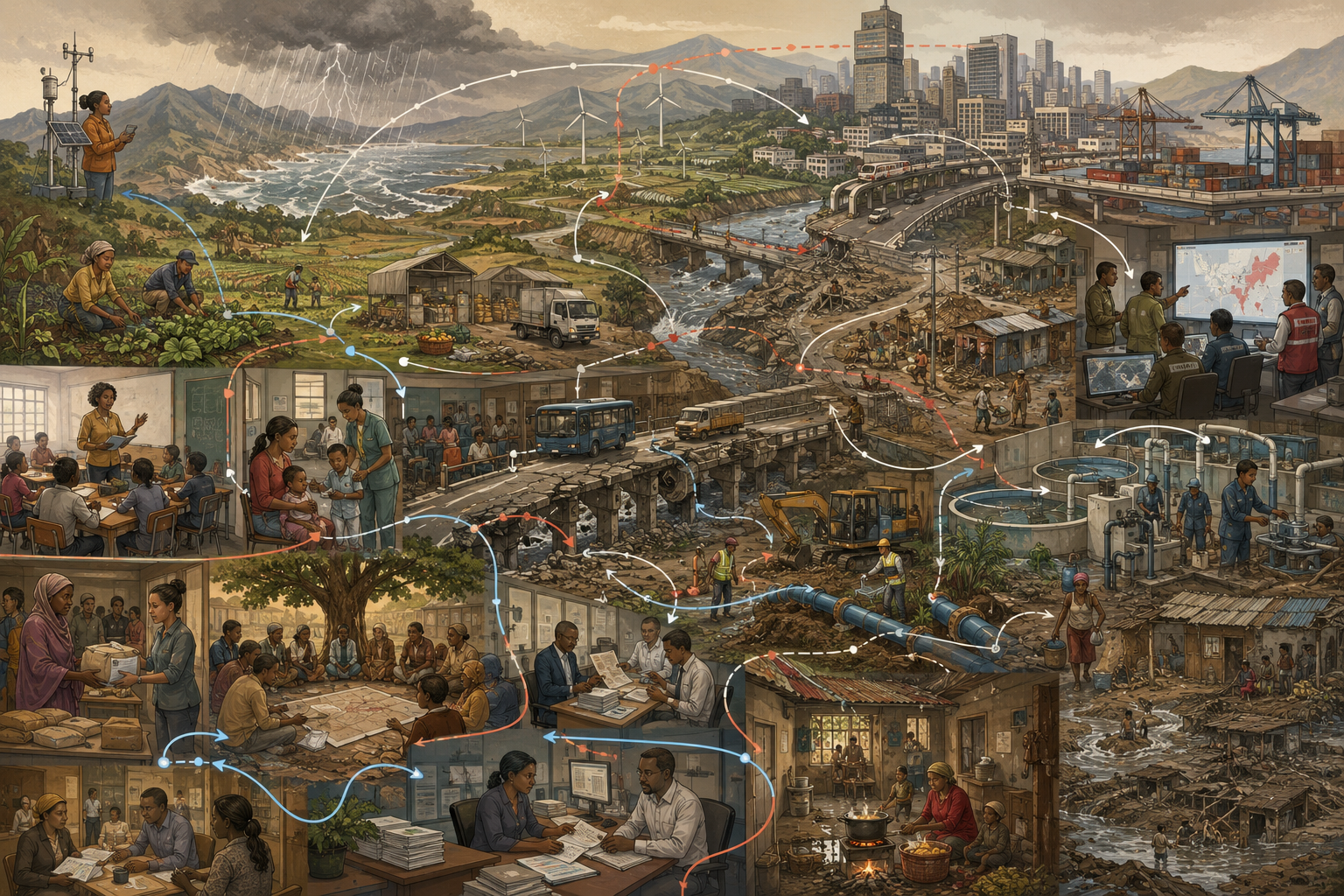
The deeper reason risk matters is that development gains are never secured once and for all. They remain exposed to events, pressures, and cumulative stresses that can weaken institutions, damage infrastructure, disrupt livelihoods, narrow fiscal space, and amplify inequality. Development becomes more durable when systems can preserve capability under strain, and more fragile when shock turns ordinary vulnerability into long-term reversal.
This article argues that risk, shock, and fragility should be treated as central development concepts rather than emergency-management afterthoughts. Progress is not only a matter of what societies build, but of how much they can prevent from being undone. Sustainable development depends on systems that are not only productive, but durable enough to function when stability disappears.
What Risk, Shock, and Fragility Mean in Development
Risk, in development terms, refers to the possibility that events, trends, or interacting pressures will harm the systems through which people secure livelihoods, services, safety, infrastructure, health, and institutional support. Shocks are specific manifestations of that risk, whether sudden or slow-moving, that disrupt normal functioning. Fragility is the condition in which systems lack sufficient resilience to manage such disruption without severe and lasting harm.
This is a more demanding way of thinking about development than the smoother language of progress often suggests. Development is frequently narrated as gradual improvement, while risk enters the picture only when something visibly breaks. But development systems are always operating in relation to possible shocks: fiscal shocks, ecological shocks, price shocks, political shocks, health shocks, infrastructure shocks, and security shocks. Risk is not an exception to development. It is one of the conditions under which development must be pursued.
Risk is also relational. A hazard does not become developmental harm in the same way everywhere. The consequences of a flood, drought, epidemic, recession, or political rupture depend on exposure, inequality, infrastructure quality, public trust, institutional capacity, social protection, fiscal space, and the ability to coordinate response. A disturbance that one society absorbs may push another into prolonged reversal.
Shock should therefore not be understood only as an event. It is also a test of system design. It reveals whether public services have backup capacity, whether households have buffers, whether infrastructure has redundancy, whether institutions can coordinate, and whether excluded groups are protected or left to absorb loss. Shocks make hidden fragility visible.
To ask what risk, shock, and fragility mean is therefore to ask how durable development really is once uncertainty and disruption are treated as normal rather than exceptional. This discussion sits naturally alongside Development Under Deep Uncertainty, where uncertainty is treated not as a temporary problem to be removed, but as a baseline condition of strategy.
Why Risk Matters for Sustainable Development
Risk matters because sustainable development requires gains that can endure under pressure. A country may improve access to education, health, energy, income, transport, water, digital systems, or infrastructure, yet remain developmentally fragile if those gains can be reversed quickly by drought, debt stress, pandemic disruption, conflict, food-price volatility, or institutional breakdown.
That shifts the meaning of success itself. Conventional development analysis often privileges average improvement over durability. But a system that advances quickly and then loses ground under routine stress is not robust in developmental terms. The question is no longer simply how much progress has been achieved, but how much of that progress can survive disturbance.
Risk also matters because development gains often depend on systems that become less visible when they are working: public finance, logistics, maintenance, water networks, health surveillance, emergency response, courts, local administration, social protection, community institutions, and ecological buffers. When these systems are underbuilt, development can look stronger than it really is because the hidden support structures are not tested until shock arrives.
Risk changes the time horizon of development policy. A program can improve short-term indicators while increasing long-term exposure if it ignores climate stress, settlement risk, infrastructure maintenance, fiscal vulnerability, or unequal access. Development that is not risk-aware may generate visible progress today while creating fragile commitments tomorrow.
This is why fragility and risk analysis have become so important. They place risk at the center of development rather than treating it as a secondary concern. That logic also connects directly with Resilience Thinking and Sustainable Development, where resilience gives developmental gains the capacity to endure rather than merely appear impressive in stable moments.
From Shock Events to Systemic Vulnerability
Development analysis often focuses on shock events such as floods, conflict outbreaks, financial crises, epidemic waves, heat emergencies, droughts, or supply-chain disruptions. But fragility cannot be explained by shock events alone. It also reflects systemic vulnerability: the underlying conditions that make the same disturbance manageable in one place and devastating in another.
A flood does not become catastrophic simply because water rises. Its effects depend on drainage systems, housing quality, public warning systems, fiscal capacity, emergency coordination, inequality, land-use planning, and institutional credibility. The same is true of financial crises, food-price spikes, health emergencies, or conflict-related disruption. Shocks reveal vulnerability, but vulnerability often precedes the shock and deepens its consequences.
This distinction matters because emergency response alone cannot solve fragility. If a system is repeatedly shocked because housing is unsafe, infrastructure is undermaintained, fiscal buffers are weak, food systems are exposed, or marginalized communities lack voice, then each emergency response treats the symptom while leaving the underlying vulnerability intact. Fragility accumulates when systems remain exposed faster than they are strengthened.
Systemic vulnerability is also cumulative. A household that loses income in one shock may sell assets, withdraw children from school, or accumulate debt, making the next shock harder to survive. A government that repeatedly diverts funds to disaster response may underinvest in maintenance and prevention, making future disasters more costly. An ecosystem repeatedly stressed by drought, extraction, or land conversion may lose buffering capacity. Vulnerability therefore deepens through time.
Sustainable development requires attention to exposure and structural weakness rather than only to emergency response once disruption is already visible. This links the argument to Boundary Transgression and Development Fragility, where environmental stress becomes developmentally significant precisely when it passes through already vulnerable systems.
Fragility as Exposure Plus Insufficient Resilience
One of the clearest ways to understand fragility is as the combination of exposure to risk and insufficient resilience of a state, system, or community to manage, absorb, or mitigate those risks. This framing is useful because it avoids equating fragility with crisis alone. Fragility exists before breakdown becomes fully visible.
That matters because systems can appear stable while carrying large amounts of hidden fragility. They may function adequately in ordinary times while lacking redundancy, fiscal room, institutional flexibility, social legitimacy, ecological buffering, infrastructural backup, or equitable protection under stress. Fragility is therefore better understood as a condition of inadequate capacity relative to the risks faced than as a label applied only after collapse.
This also means fragility can increase in two ways. Exposure can rise through climate change, conflict, debt stress, market volatility, ecological degradation, disease risk, or infrastructure aging. Resilience can fall through institutional weakening, underinvestment, inequality, fiscal compression, environmental loss, corruption, social fragmentation, or declining trust. A development system becomes more fragile when either side of the relationship deteriorates.
Fragility is also uneven across scales. A national system may appear stable while particular regions, neighborhoods, livelihoods, or groups experience high fragility. A city may have modern infrastructure while informal settlements remain exposed. A country may have aggregate fiscal capacity while local governments lack operational resources. Fragility often lives in the gaps between headline capacity and lived protection.
Sustainable development depends on reducing both sides of this equation: lowering exposure where possible and strengthening resilience where exposure cannot be eliminated. That dual logic makes this section sit naturally beside Climate Change as a Development Constraint, where exposure rises even as resilience remains unevenly distributed.
Multidimensional Fragility: Economic, Environmental, Political, Security, Societal, and Human
Current multidimensional fragility frameworks often identify six dimensions of fragility: economic, environmental, political, security, societal, and human. This is significant because it shows that fragility is not merely a security problem or a state-failure problem. It is a multidimensional condition that can emerge through different but interacting pathways.
Economic fragility may appear through weak livelihoods, debt stress, commodity dependence, inflation, unemployment, or lack of fiscal buffers. Environmental fragility may appear through climate exposure, water stress, land degradation, pollution, or biodiversity decline. Political fragility may involve weak legitimacy, polarization, corruption, exclusion, or ineffective public authority. Security fragility may involve violence, conflict, organized crime, or militarization. Societal fragility may involve low trust, social fragmentation, exclusion, or contested identity. Human fragility may involve health risk, poverty, hunger, displacement, limited education, and weak protection of life chances.
A society may be environmentally exposed but politically stable, or politically polarized but fiscally strong, or economically stressed but socially cohesive. Fragility becomes more severe when weaknesses compound across dimensions rather than remaining isolated. A drought in a strong institutional system may be manageable; a drought in a system with food insecurity, weak social protection, political distrust, and fiscal stress may become a broader development crisis.
The multidimensional view also helps explain why some countries or communities remain vulnerable even when one domain appears relatively strong. Infrastructure may expand while political trust deteriorates. Growth may continue while ecological exposure rises. Security may improve while human fragility remains deep. No single metric can capture the full condition.
This is why development analysis improves when fragility is treated as a patterned interaction among risks and capacities, not as a single headline condition. The argument resonates with How Sustainable Development Is Measured, where no single metric can capture the interacting dimensions of development strength or weakness.
Compound Risk and Cascading Failure
A major challenge for development systems is that risks increasingly compound rather than arrive singly. Climate stress can intensify food insecurity; food insecurity can fuel social unrest; social unrest can weaken institutions; weakened institutions can worsen public-service delivery and investor confidence; fiscal stress can then reduce the capacity to respond to all of the above. The important point is not simply that many risks exist, but that they interact across sectors and over time.
Systems built to manage one category of threat at a time may perform poorly when pressures arrive together or in sequence. In a world of interconnected risks, development systems are tested not only by the size of shocks, but by the way they propagate. What looks manageable at the point of first disruption can become much more serious once cross-sector dependencies begin to fail.
Cascading failure often travels through infrastructure and institutions. A power failure can affect hospitals, water pumps, communications, transport, food storage, and public administration. A fuel-price shock can affect food prices, household budgets, transport access, social unrest, and fiscal subsidies. A flood can damage housing, schools, clinics, sanitation, roads, and livelihoods at the same time. The system fails not only because one component breaks, but because connected components depend on one another.
Compound risk also changes planning. It is not enough to ask whether a system can survive one modeled hazard. The more important question may be whether it can survive multiple interacting pressures: heat plus drought, debt plus food prices, conflict plus displacement, flood plus disease outbreak, or infrastructure failure plus institutional distrust. Development planning must therefore account for interaction, not only isolated probability.
Sustainable development depends on institutions capable of recognizing and governing cascading effects rather than treating each disruption as separate from the rest. This is also why the article reads naturally alongside Policy Coordination Across Complex Systems, where the central issue is the management of interaction rather than isolated policy silos.
Climate Shocks, Conflict, and Development Reversal
Climate shocks and conflict are among the most visible ways development gains can be reversed. These pressures do not simply reduce output. They disrupt institutional continuity, damage infrastructure, displace populations, intensify poverty, weaken public services, and erode public trust. Once these effects accumulate, recovery becomes more difficult and more expensive, especially where fiscal space and administrative capacity are already weak.
Climate shocks matter because they affect several development systems at once. Drought can damage agriculture, water supplies, hydropower, food prices, rural income, and migration patterns. Flooding can damage housing, roads, schools, clinics, sanitation systems, and local tax bases. Heat can affect labor productivity, health systems, electricity demand, and urban habitability. Climate risk is not a sector; it is a pressure field across development.
Conflict matters because it directly attacks the systems through which development is sustained. It destroys infrastructure, interrupts education, reduces health access, forces displacement, undermines markets, weakens administration, and often leaves long institutional scars after violence declines. Conflict also makes data weaker, planning harder, and public trust more fragile.
Climate and conflict can also interact. Climate stress does not mechanically cause conflict, but it can worsen livelihood insecurity, displacement, resource pressure, and institutional strain in contexts already marked by inequality or weak governance. Conversely, conflict weakens adaptation capacity, disrupts land and water management, and prevents investment in resilience. The interaction deepens fragility.
Repeated shocks can gradually move systems from ordinary stress into persistent reversal. That is one reason fragility, conflict, and violence remain major threats to development outcomes, especially when combined with climate stress, displacement, and food insecurity. The climate dimension also places the article in close conversation with Scenario Planning for Sustainable Futures, since repeated climate-linked disturbances are exactly the sort of conditions under which linear planning assumptions begin to fail.
Institutions, Fiscal Space, and Crisis-Management Capacity
Fragility is deeply institutional. Systems are more resilient when governments and public institutions can coordinate, communicate credibly, mobilize resources, protect vulnerable people, revise strategy under pressure, and maintain legitimacy. They are more fragile when response is slow, fragmented, mistrusted, politicized, or fiscally constrained. Hazard does not automatically become developmental harm. Much depends on how institutions manage it.
Fiscal space is central because crisis response costs money. Governments need room to fund emergency logistics, repair infrastructure, stabilize food systems, support households, maintain public payrolls, finance health systems, and invest in recovery without sacrificing long-term development. When debt service, revenue weakness, or austerity narrows fiscal space, crisis management becomes more reactive and less protective.
Institutional coordination matters because shocks often cross administrative boundaries. A drought may require water agencies, agriculture ministries, health systems, local governments, finance ministries, and social-protection systems to act together. A pandemic requires health surveillance, logistics, communications, income support, education policy, procurement, local administration, and public trust. Fragmented institutions turn manageable stress into cascading weakness.
Legitimacy also matters. People are more likely to follow public guidance, cooperate with emergency measures, and accept difficult reforms when they trust institutions. Where public authority is corrupt, exclusionary, arbitrary, or ineffective, shocks can become legitimacy crises. Fragility is therefore not only technical capacity; it is also political trust under pressure.
Sustainable development depends not only on reducing hazard exposure, but on sustaining institutions capable of acting under pressure without losing coherence or legitimacy. This section pairs naturally with Debt, Fiscal Space, and Development Constraints and Why Institutions Matter for Sustainable Development, where the real issue is how much room states retain to govern when conditions worsen.
Inequality, Exposure, and Uneven Burden
Risk and shock are socially distributed. The same disturbance can impose radically different burdens depending on income, geography, race, gender, livelihood dependence, disability, age, housing quality, migration status, land tenure, and access to public support. Fragility is therefore not only a system-level condition. It is also a question of which groups are most exposed and least protected.
Development systems can appear broadly functional while leaving particular populations permanently near the edge of crisis. Low-income households, displaced people, informal workers, climate-exposed communities, indigenous peoples, racialized minorities, disabled people, and marginalized groups often absorb shocks with far less institutional buffering than others. What looks like manageable volatility from above may feel like continuous insecurity from below.
Inequality also affects recovery. Wealthier households may have insurance, savings, mobility, political access, and safer housing. Poorer households may lose assets, take on debt, reduce food consumption, withdraw children from school, or move into more dangerous work. The same shock can widen inequality because those with fewer buffers are forced into coping strategies that weaken future capacity.
Uneven burden is also political. Whose risk is recognized? Whose loss is compensated? Whose infrastructure is repaired first? Whose neighborhood is protected? Whose displacement becomes visible? Whose suffering is normalized as resilience? Sustainable development cannot treat these questions as secondary because they determine whether recovery reinforces justice or deepens exclusion.
Sustainable development requires treating exposure as unequal rather than assuming that shocks affect everyone in proportionate ways. This section belongs in conversation with Inequality and Inclusive Development and Gender, Exclusion, and Development Justice, where vulnerability is shown to be patterned by social position rather than by hazard alone.
Infrastructure Systems and Operational Brittleness
Infrastructure systems are central to fragility because they mediate how shocks move through development. Transport, electricity, water, sanitation, digital systems, logistics, schools, hospitals, and health facilities allow societies to function under normal conditions, but they can also become points of cascading failure when stressed. A system may appear efficient while lacking redundancy, maintenance, backup power, spare parts, repair capacity, or adaptive design.
Once infrastructure reliability declines, development losses spread outward into livelihoods, institutions, and public trust. A failed bridge can sever access to markets and clinics. A water-system failure can create disease risk, gendered labor burdens, and school disruption. A power outage can affect health care, refrigeration, communications, security, and economic activity. Infrastructure failure rarely remains technical.
Operational brittleness is often hidden during ordinary periods, which is precisely why it is dangerous. Systems can perform well in average conditions while lacking the capacity to withstand extremes. Deferred maintenance, fragile supply chains, weak local technical capacity, and dependence on single critical nodes can remain invisible until the moment of failure.
Infrastructure resilience is not only about stronger materials. It also involves governance, maintenance funding, local repair skills, redundancy, open access, emergency planning, and equitable service design. A technically advanced system can still be fragile if it is too centralized, unaffordable, poorly maintained, or inaccessible to vulnerable communities.
The strongest development systems are not only expansive and efficient; they also retain enough redundancy and flexibility to keep functioning when conditions worsen. This section extends arguments developed in Infrastructure as the Material Basis of Development and Water, Sanitation, and Public Infrastructure Systems, where system reliability is shown to be part of development itself rather than a technical detail at its edge.
Prevention, Risk Governance, and the Protection of Development Gains
If fragility is exposure plus insufficient resilience, then prevention and risk governance become central development tasks. Waiting until shocks become visible crises is developmentally costly. Prevention may involve diversification, social protection, resilient infrastructure, adaptive governance, early-warning systems, public-health surveillance, climate adaptation, fiscal buffers, ecosystem restoration, or institutional reform.
These investments can appear expensive in the short term, but they often preserve far greater value by reducing reversal later. A functioning early-warning system may prevent deaths and asset loss. Preventive health systems may reduce epidemic damage. Maintenance may avoid catastrophic infrastructure failure. Social protection may prevent households from selling productive assets. Climate adaptation may reduce future repair and displacement costs. Prevention protects development gains before they are lost.
Risk governance also requires coordination across time. Political incentives often favor visible projects over invisible prevention. A road opening is easier to celebrate than maintenance spending. A new clinic is more visible than emergency stockpiling. Disaster response is more dramatic than risk reduction. Fragility persists when institutions underinvest in the quiet systems that prevent harm.
Prevention also requires justice. Risk governance should not protect only high-value assets, central districts, or politically powerful groups. If prevention investments concentrate where property values are highest while poorer communities remain exposed, risk governance can deepen inequality. Protecting development gains means protecting the people and systems most likely to suffer reversal.
Sustainable development is stronger when it treats risk reduction as part of ordinary governance rather than as an emergency function activated only after disruption becomes undeniable. This is where the article links naturally to Sustainable Finance and Development Investment, because prevention often fails not for lack of logic but for lack of investment before crisis makes it unavoidable.
Fragility, Not Collapse
It is important to distinguish fragility from collapse. Fragility does not mean that systems fail all at once or that crisis is immediately visible everywhere. It describes a condition in which gains become easier to reverse, institutions become less able to absorb disruption, and ordinary governance becomes more costly and uncertain. The more relevant developmental question is how much margin societies retain before repeated shocks begin eroding the capacity to govern effectively.
Waiting for dramatic collapse as the only meaningful threshold is analytically misleading. By the time collapse is obvious, fragility has usually been accumulating for years through underinvestment, exposure, inequality, ecological strain, fiscal compression, and institutional brittleness. Standard performance metrics may miss what matters most: fragility can accumulate quietly long before visible crisis.
Fragility may show up as rising maintenance backlogs, declining service reliability, more frequent emergency spending, local displacement, repeated crop losses, higher food-price volatility, health-system overload, lower public trust, informal coping debt, or the slow erosion of household assets. These are not collapse, but they are signs that the margin of safety is narrowing.
This distinction matters for policy because collapse narratives can produce fatalism or sensationalism, while fragility analysis focuses attention on preventable erosion. It asks what can be strengthened now, before the system breaks visibly. It values early warning, buffers, maintenance, social protection, and institutional learning because these capacities preserve development before loss becomes irreversible.
Sustainable development should therefore be judged not only by current performance, but by whether gains remain durable under compound stress. This also makes the article a useful companion to SDG Indicators: Strengths, Gaps, and Political Uses, since many fragilities accumulate long before conventional indicators register anything resembling collapse.
Why Resilience Alone Is Not Enough
Resilience is indispensable, but it is not sufficient if the drivers of risk remain unchanged. Systems can become better at coping while still remaining locked into inequality, ecological degradation, debt dependence, conflict exposure, exploitative labor systems, unsafe settlement patterns, or institutional exclusion. Resilience without structural change can become a way of managing fragility without reducing it.
This matters because sustainable development requires more than the ability to survive shock. It also requires reducing avoidable exposure, transforming brittle systems, and expanding the substantive capacity of institutions and communities to live well under changing conditions. A household should not have to prove resilience by enduring repeated preventable harm. A community should not be praised for coping with disasters produced by neglect. A state should not be asked only to manage crisis while deeper fiscal, ecological, and political constraints remain untouched.
Resilience can also be unequal. Wealthier groups may build private buffers while poorer communities absorb the cost of systemic risk. A city may harden infrastructure in central districts while leaving informal settlements exposed. A country may strengthen emergency response while failing to protect marginalized people from everyday insecurity. Resilience that protects some while normalizing exposure for others is not sustainable development.
The deeper goal is therefore not merely to recover from shocks, but to reshape development systems so that fewer shocks become crises and fewer crises become traps. That is exactly where the argument meets Resilience Thinking and Sustainable Development: resilience matters most when it is joined to deeper change rather than treated as an end in itself.
Sustainable development therefore requires a dual approach: stronger resilience where risk cannot be avoided, and structural transformation where risk is produced by unjust, brittle, or ecologically destructive systems. Durability without justice is not enough. Recovery without prevention is not enough. Coping without transformation is not enough.
Why This Matters for Sustainable Development
Risk, shock, and fragility belong together because sustainable development depends not only on raising present levels of wellbeing, but on whether systems can withstand disturbance without severe reversal. Development remains fragile when exposure is high, resilience is insufficient, and institutions cannot absorb compound stress without losing function or legitimacy.
This is why risk matters so much for development. It reveals a truth that smoother narratives of progress often miss: gains are never secure simply because they have been achieved once. They remain dependent on the capacity of systems to cope, adapt, and avoid cascading breakdown under changing conditions.
The issue is also one of justice. Fragility is not distributed evenly. The people with the least responsibility for systemic risk often face the greatest exposure and the weakest protection. Sustainable development cannot be credible if it measures progress in averages while allowing marginalized communities to absorb repeated shocks as if insecurity were normal.
To take fragility seriously is therefore to take the durability of development seriously. Long-run progress depends not only on building more, but on building systems that can continue to function when uncertainty, disturbance, and stress are no longer exceptional, but normal.
Development becomes credible when risk governance protects gains before they are lost, when institutions maintain capacity under pressure, when infrastructure is built for reliability rather than only expansion, and when resilience is joined to structural change so that fewer people are forced to live permanently at the edge of crisis.
Mathematical Lens
Risk and fragility can be clarified by expressing fragility as a relationship between exposure and resilience. Let \(E\) represent exposure to risk and \(R\) represent resilience capacity:
F = \frac{E}{R}
\]
Interpretation: Fragility rises when exposure grows faster than resilience capacity.
This is not a literal universal law, but it captures a core idea in fragility analysis: systems become more fragile not simply because risk exists, but because resilience is too weak relative to the scale and interaction of the risks they face.
Shock transmission can also be represented dynamically. Suppose a shock of magnitude \(S_t\) enters a system with buffering capacity \(B_t\). Net developmental disruption \(D_t\) may be represented as:
D_t = \max(0, S_t – B_t)
\]
Interpretation: If buffering capacity is large enough, the shock is absorbed; if buffering capacity is weak, the same shock produces visible developmental harm.
Compound risk can be represented as the interaction of multiple shocks or stressors:
C = \sum_{i=1}^{n} s_i + \sum_{i \neq j}\phi_{ij}(s_i,s_j)
\]
Interpretation: Compound risk is not merely additive; interactions among stressors can amplify disruption beyond the sum of separate hazards.
A development-risk score can also be represented conceptually as:
F^{*} = w_1 E + w_2 C + w_3 I – w_4 R
\]
Interpretation: Adjusted fragility rises with exposure, compound risk, and inequality burden, and falls with resilience capacity.
| Term | Meaning | Interpretive role |
|---|---|---|
| \(F\) | Fragility | Represents vulnerability created when exposure is high relative to resilience. |
| \(E\) | Exposure | Represents the degree to which a system, community, or institution faces risk. |
| \(R\) | Resilience capacity | Represents the ability to absorb, adapt, recover, and reorganize under disturbance. |
| \(S_t\) | Shock magnitude | Represents the intensity of a shock at time \(t\). |
| \(B_t\) | Buffering capacity | Represents available shock-absorbing capacity at time \(t\), including institutions, infrastructure, savings, ecosystems, and social protection. |
| \(D_t\) | Net developmental disruption | Represents the remaining harm after buffering capacity is considered. |
| \(C\) | Compound risk | Represents combined risk from multiple interacting stressors. |
| \(F^{*}\) | Adjusted fragility | Represents fragility after compound risk and inequality burden are included. |
The equations are conceptual rather than predictive. Their value is to make visible the structure of the problem: fragility emerges when exposure, compound risk, inequality, institutional limits, and insufficient resilience interact across development systems.
Advanced Python Workflow: Shock Exposure, Fragility, and Development Risk Scoring
This Python workflow translates the article’s core argument into a structured analytical pipeline. Instead of treating fragility as a vague label, it models development risk as the interaction of exposure, resilience, institutional capacity, infrastructure resilience, fiscal space, and inequality-sensitive burden. That makes it possible to compare countries, regions, or districts in a more systematic way and identify where development gains are most likely to erode under pressure.
from __future__ import annotations

import pandas as pd
import numpy as np

INPUT_FILE = "development_fragility_risk_data.csv"
OUTPUT_FILE = "development_fragility_risk_scores.csv"


def load_data(path: str) -> pd.DataFrame:
    """Load fragility and development risk data from CSV."""
    df = pd.read_csv(path)

    required_columns = [
        "country",
        "region",
        "shock_exposure_index",
        "climate_risk_index",
        "food_system_stress_index",
        "institutional_capacity_index",
        "infrastructure_resilience_index",
        "social_protection_index",
        "inequality_burden_index",
        "fiscal_space_index",
    ]

    missing = [col for col in required_columns if col not in df.columns]

    if missing:
        raise ValueError(f"Missing required columns: {missing}")

    return df


def validate_indices(df: pd.DataFrame) -> pd.DataFrame:
    """Ensure normalized index fields are complete and bounded between 0 and 1."""
    index_columns = [
        "shock_exposure_index",
        "climate_risk_index",
        "food_system_stress_index",
        "institutional_capacity_index",
        "infrastructure_resilience_index",
        "social_protection_index",
        "inequality_burden_index",
        "fiscal_space_index",
    ]

    for col in index_columns:
        if df[col].isna().any():
            raise ValueError(f"Column '{col}' contains missing values.")

        if ((df[col] < 0) | (df[col] > 1)).any():
            raise ValueError(f"Column '{col}' contains values outside [0, 1].")

    return df


def compute_exposure_score(df: pd.DataFrame) -> pd.DataFrame:
    """Compute a combined exposure score."""
    df = df.copy()

    df["combined_exposure_score"] = (
        0.40 * df["shock_exposure_index"] +
        0.35 * df["climate_risk_index"] +
        0.25 * df["food_system_stress_index"]
    ).clip(lower=0, upper=1)

    return df


def compute_resilience_score(df: pd.DataFrame) -> pd.DataFrame:
    """Compute a combined resilience score."""
    df = df.copy()

    df["combined_resilience_score"] = (
        0.30 * df["institutional_capacity_index"] +
        0.25 * df["infrastructure_resilience_index"] +
        0.25 * df["social_protection_index"] +
        0.20 * df["fiscal_space_index"]
    ).clip(lower=0, upper=1)

    return df


def compute_fragility_score(df: pd.DataFrame) -> pd.DataFrame:
    """
    Compute fragility as exposure relative to resilience,
    adjusted for inequality burden.
    """
    df = df.copy()

    df["fragility_score"] = (
        0.60 * df["combined_exposure_score"] +
        0.40 * df["inequality_burden_index"] -
        0.50 * df["combined_resilience_score"]
    ).clip(lower=0, upper=1)

    df["compound_pressure_score"] = (
        0.35 * df["shock_exposure_index"] * df["climate_risk_index"] +
        0.30 * df["climate_risk_index"] * df["food_system_stress_index"] +
        0.20 * df["shock_exposure_index"] * df["inequality_burden_index"] +
        0.15 * df["food_system_stress_index"] * (1 - df["social_protection_index"])
    ).clip(lower=0, upper=1)

    df["adjusted_fragility_score"] = (
        0.75 * df["fragility_score"] +
        0.25 * df["compound_pressure_score"]
    ).clip(lower=0, upper=1)

    df["fragility_band"] = np.select(
        [
            df["adjusted_fragility_score"] >= 0.65,
            df["adjusted_fragility_score"] >= 0.45,
            df["adjusted_fragility_score"] >= 0.25,
        ],
        [
            "Severe fragility",
            "Elevated fragility",
            "Moderate fragility",
        ],
        default="Lower fragility",
    )

    df["risk_warning"] = np.select(
        [
            df["combined_exposure_score"] >= 0.75,
            df["combined_resilience_score"] <= 0.30,
            df["inequality_burden_index"] >= 0.70,
            df["fiscal_space_index"] <= 0.30,
        ],
        [
            "High exposure burden",
            "Weak resilience capacity",
            "High inequality-sensitive burden",
            "Limited fiscal space",
        ],
        default="Lower risk warning",
    )

    return df


def build_summary(df: pd.DataFrame) -> pd.DataFrame:
    """Build a compact summary table sorted by adjusted fragility."""
    summary_columns = [
        "country",
        "region",
        "combined_exposure_score",
        "combined_resilience_score",
        "inequality_burden_index",
        "compound_pressure_score",
        "adjusted_fragility_score",
        "fragility_band",
        "risk_warning",
    ]

    summary = df[summary_columns].copy()

    return summary.sort_values(
        by=["adjusted_fragility_score", "combined_exposure_score"],
        ascending=[False, False],
    )


def main() -> None:
    df = load_data(INPUT_FILE)
    df = validate_indices(df)
    df = compute_exposure_score(df)
    df = compute_resilience_score(df)
    df = compute_fragility_score(df)

    summary = build_summary(df)
    summary.to_csv(OUTPUT_FILE, index=False)

    print("Development fragility risk scoring complete.")
    print(summary.to_string(index=False))


if __name__ == "__main__":
    main()
The point of this workflow is not to reduce fragility to a single number in any absolute sense. It creates a transparent scoring logic that helps analysts move from narrative diagnosis to reproducible comparison. In practice, this kind of script is useful for prioritizing places where exposure is high, resilience is weak, inequality-sensitive burden is heavy, and institutional margins are thin, especially when multiple shocks can compound across infrastructure, livelihoods, and governance systems.
Advanced R Workflow: Multidimensional Fragility and Shock Burden Analysis
This R workflow is designed for comparative analysis across countries or regions where the goal is to track how fragility is distributed and how it changes through time. It works especially well when the analytical task is not just to measure average exposure, but to see how institutional weakness, fiscal constraints, infrastructure gaps, and unequal burden interact in ways that make some development systems more brittle than others.
library(readr)
library(dplyr)

input_file <- "multidimensional_fragility_panel.csv"
country_output_file <- "multidimensional_fragility_country_summary.csv"
region_output_file <- "multidimensional_fragility_region_summary.csv"

fragility_df <- read_csv(input_file, show_col_types = FALSE)

required_cols <- c(
  "country",
  "region",
  "year",
  "economic_fragility_index",
  "environmental_fragility_index",
  "political_fragility_index",
  "security_fragility_index",
  "societal_fragility_index",
  "human_fragility_index",
  "institutional_capacity_index",
  "infrastructure_resilience_index"
)

missing_cols <- setdiff(required_cols, names(fragility_df))

if (length(missing_cols) > 0) {
  stop(paste("Missing required columns:", paste(missing_cols, collapse = ", ")))
}

index_cols <- names(fragility_df)[grepl("_index$", names(fragility_df))]

invalid_index_cols <- index_cols[
  vapply(
    fragility_df[index_cols],
    function(x) any(is.na(x) | x < 0 | x > 1),
    logical(1)
  )
]

if (length(invalid_index_cols) > 0) {
  stop(
    paste(
      "Index columns must be complete and normalized to [0, 1]:",
      paste(invalid_index_cols, collapse = ", ")
    )
  )
}

fragility_df <- fragility_df %>%
  mutate(
    multidimensional_fragility_proxy = (
      economic_fragility_index +
        environmental_fragility_index +
        political_fragility_index +
        security_fragility_index +
        societal_fragility_index +
        human_fragility_index
    ) / 6,
    institutional_resilience_gap = institutional_capacity_index - infrastructure_resilience_index,
    institutional_buffer_proxy = (
      institutional_capacity_index +
        infrastructure_resilience_index
    ) / 2,
    adjusted_fragility_proxy = pmax(
      multidimensional_fragility_proxy -
        0.35 * institutional_buffer_proxy,
      0
    )
  )

country_summary <- fragility_df %>%
  group_by(country) %>%
  summarise(
    avg_fragility_proxy = mean(multidimensional_fragility_proxy, na.rm = TRUE),
    min_fragility_proxy = min(multidimensional_fragility_proxy, na.rm = TRUE),
    max_fragility_proxy = max(multidimensional_fragility_proxy, na.rm = TRUE),
    avg_adjusted_fragility = mean(adjusted_fragility_proxy, na.rm = TRUE),
    avg_institutional_resilience_gap = mean(institutional_resilience_gap, na.rm = TRUE),
    observations = n(),
    .groups = "drop"
  ) %>%
  mutate(
    fragility_band = case_when(
      avg_adjusted_fragility >= 0.70 ~ "Severe fragility",
      avg_adjusted_fragility >= 0.50 ~ "Elevated fragility",
      avg_adjusted_fragility >= 0.30 ~ "Moderate fragility",
      TRUE ~ "Lower fragility"
    )
  ) %>%
  arrange(desc(avg_adjusted_fragility))

region_summary <- fragility_df %>%
  group_by(region) %>%
  summarise(
    avg_fragility_proxy = mean(multidimensional_fragility_proxy, na.rm = TRUE),
    avg_adjusted_fragility = mean(adjusted_fragility_proxy, na.rm = TRUE),
    avg_economic_fragility = mean(economic_fragility_index, na.rm = TRUE),
    avg_environmental_fragility = mean(environmental_fragility_index, na.rm = TRUE),
    avg_political_fragility = mean(political_fragility_index, na.rm = TRUE),
    avg_security_fragility = mean(security_fragility_index, na.rm = TRUE),
    avg_societal_fragility = mean(societal_fragility_index, na.rm = TRUE),
    avg_human_fragility = mean(human_fragility_index, na.rm = TRUE),
    observations = n(),
    .groups = "drop"
  ) %>%
  arrange(desc(avg_adjusted_fragility))

write_csv(country_summary, country_output_file)
write_csv(region_summary, region_output_file)

cat("Country fragility summary exported to:", country_output_file, "\n")
print(country_summary)

cat("\nRegion fragility summary exported to:", region_output_file, "\n")
print(region_summary)
R is particularly useful here because fragility is multidimensional and often needs to be summarized across several domains at once. The workflow calculates a multidimensional fragility proxy, adjusts it by institutional and infrastructure buffers, identifies institutional-resilience gaps, and produces both country-level and regional summaries. In practice, this kind of analysis can support risk governance, comparative reporting, and structured monitoring of development durability under recurring stress.
Advanced Go Workflow: Lightweight Fragility Scoring Service
This Go workflow is useful when the article’s fragility logic needs to move from analysis into a lightweight operational service. Python and R are strong for diagnostics and comparative summaries, but Go is a good fit for a compact utility that can ingest country or regional records and return exposure, resilience, compound pressure, and fragility scores quickly. In practical terms, this kind of service could sit behind a monitoring dashboard, early-warning workflow, internal planning tool, or investment-prioritization system.
package main

import (
	"encoding/csv"
	"fmt"
	"os"
	"strconv"
)

type FragilityRecord struct {
	Country                  string
	Region                   string
	ShockExposure            float64
	ClimateRisk              float64
	FoodSystemStress         float64
	InstitutionalCapacity    float64
	InfrastructureResilience float64
	SocialProtection         float64
	InequalityBurden         float64
	FiscalSpace              float64
}

func parseIndex(value string) (float64, error) {
	parsed, err := strconv.ParseFloat(value, 64)
	if err != nil {
		return 0, err
	}

	if parsed < 0 || parsed > 1 {
		return 0, fmt.Errorf("index value outside [0, 1]: %f", parsed)
	}

	return parsed, nil
}

func parseRecord(row []string) (FragilityRecord, error) {
	if len(row) != 10 {
		return FragilityRecord{}, fmt.Errorf("invalid record length: expected 10 columns")
	}

	values := make([]float64, 8)

	for i, col := range row[2:] {
		value, err := parseIndex(col)
		if err != nil {
			return FragilityRecord{}, err
		}

		values[i] = value
	}

	return FragilityRecord{
		Country:                  row[0],
		Region:                   row[1],
		ShockExposure:            values[0],
		ClimateRisk:              values[1],
		FoodSystemStress:         values[2],
		InstitutionalCapacity:    values[3],
		InfrastructureResilience: values[4],
		SocialProtection:         values[5],
		InequalityBurden:         values[6],
		FiscalSpace:              values[7],
	}, nil
}

func clamp01(x float64) float64 {
	if x < 0 {
		return 0
	}

	if x > 1 {
		return 1
	}

	return x
}

func exposureScore(record FragilityRecord) float64 {
	return clamp01(
		0.40*record.ShockExposure +
			0.35*record.ClimateRisk +
			0.25*record.FoodSystemStress,
	)
}

func resilienceScore(record FragilityRecord) float64 {
	return clamp01(
		0.30*record.InstitutionalCapacity +
			0.25*record.InfrastructureResilience +
			0.25*record.SocialProtection +
			0.20*record.FiscalSpace,
	)
}

func compoundPressure(record FragilityRecord) float64 {
	return clamp01(
		0.35*record.ShockExposure*record.ClimateRisk +
			0.30*record.ClimateRisk*record.FoodSystemStress +
			0.20*record.ShockExposure*record.InequalityBurden +
			0.15*record.FoodSystemStress*(1-record.SocialProtection),
	)
}

func fragilityScore(record FragilityRecord) float64 {
	exposure := exposureScore(record)
	resilience := resilienceScore(record)
	compound := compoundPressure(record)

	baseFragility := clamp01(
		0.60*exposure +
			0.40*record.InequalityBurden -
			0.50*resilience,
	)

	return clamp01(0.75*baseFragility + 0.25*compound)
}

func fragilityBand(score float64) string {
	switch {
	case score >= 0.65:
		return "Severe fragility"
	case score >= 0.45:
		return "Elevated fragility"
	case score >= 0.25:
		return "Moderate fragility"
	default:
		return "Lower fragility"
	}
}

func main() {
	file, err := os.Open("development_fragility_risk_data_service.csv")
	if err != nil {
		fmt.Println("Error opening CSV:", err)
		return
	}
	defer file.Close()

	reader := csv.NewReader(file)

	rows, err := reader.ReadAll()
	if err != nil {
		fmt.Println("Error reading CSV:", err)
		return
	}

	for i, row := range rows {
		if i == 0 {
			continue
		}

		record, err := parseRecord(row)
		if err != nil {
			fmt.Println("Parse error:", err)
			continue
		}

		exposure := exposureScore(record)
		resilience := resilienceScore(record)
		compound := compoundPressure(record)
		fragility := fragilityScore(record)

		fmt.Printf(
			"country=%s region=%s exposure=%.3f resilience=%.3f compound=%.3f fragility=%.3f band=%s\n",
			record.Country,
			record.Region,
			exposure,
			resilience,
			compound,
			fragility,
			fragilityBand(fragility),
		)
	}
}
The point is not to build a full fragility-monitoring platform inside the article. The point is to show how the logic of shock exposure, resilience capacity, inequality-sensitive burden, compound pressure, and development fragility can be operationalized cleanly: validate normalized inputs, compute exposure and resilience scores, estimate compounding pressure, and return a readable fragility band. That gives the article’s systems argument a practical service layer while keeping the code compact and auditable.
GitHub Repository
Complete Code Repository
The full code distribution for this article, including fragility scoring workflows, multidimensional-risk diagnostics, shock-burden analysis, optional scoring-service tooling, SQL materials, supporting documentation, and repository structure, is available on GitHub.
Related Articles
- Sustainable Development
- Development Under Deep Uncertainty
- Boundary Transgression and Development Fragility
- Resilience Thinking and Sustainable Development
- Climate Change as a Development Constraint
- Scenario Planning for Sustainable Futures
- Policy Coordination Across Complex Systems
- Debt, Fiscal Space, and Development Constraints
- Infrastructure as the Material Basis of Development
- Water, Sanitation, and Public Infrastructure Systems
Further Reading
- Organisation for Economic Co-operation and Development (2025) States of Fragility 2025. Paris: OECD. Available at: https://www.oecd.org/en/publications/states-of-fragility-2025_81982370-en.html
- United Nations Development Programme (2025) Development at Risk: Protecting Gains and Unleashing Opportunities Amid Crisis. New York: UNDP. Available at: https://www.undp.org/publications/development-risk-protecting-gains-and-unleashing-opportunities-amid-crisis
- World Bank (2020) World Bank Group Strategy for Fragility, Conflict, and Violence 2020–2025. Washington, DC: World Bank. Available at: https://www.worldbank.org/en/topic/fragilityconflictviolence/publication/world-bank-group-strategy-for-fragility-conflict-and-violence-2020-2025
- Intergovernmental Panel on Climate Change (2022) Chapter 18: Climate Resilient Development Pathways. In: Climate Change 2022: Impacts, Adaptation and Vulnerability. Available at: https://www.ipcc.ch/report/ar6/wg2/chapter/chapter-18/
- United Nations Development Programme (n.d.) Offer on SDG Implementation in Fragile States. Available at: https://www.undp.org/publications/undp-offer-sdg-implementation-fragile-states
References
- Intergovernmental Panel on Climate Change (2022) Chapter 18: Climate Resilient Development Pathways. In: Climate Change 2022: Impacts, Adaptation and Vulnerability. Available at: https://www.ipcc.ch/report/ar6/wg2/chapter/chapter-18/
- Organisation for Economic Co-operation and Development (2025) States of Fragility 2025. Paris: OECD. Available at: https://www.oecd.org/en/publications/states-of-fragility-2025_81982370-en.html
- Organisation for Economic Co-operation and Development (2025) States of Fragility 2025, full report. Available at: https://www.oecd.org/en/publications/states-of-fragility-2025_81982370-en/full-report.html
- United Nations Development Programme (2025) Development at Risk: Protecting Gains and Unleashing Opportunities Amid Crisis. New York: UNDP. Available at: https://www.undp.org/publications/development-risk-protecting-gains-and-unleashing-opportunities-amid-crisis
- United Nations Development Programme (n.d.) Offer on SDG Implementation in Fragile States. Available at: https://www.undp.org/publications/undp-offer-sdg-implementation-fragile-states
- World Bank (2020) World Bank Group Strategy for Fragility, Conflict, and Violence 2020–2025. Washington, DC: World Bank. Available at: https://www.worldbank.org/en/topic/fragilityconflictviolence/publication/world-bank-group-strategy-for-fragility-conflict-and-violence-2020-2025
- World Bank (n.d.) Fragility, Conflict and Violence. Available at: https://www.worldbank.org/ext/en/topic/fragility-conflict-and-violence
- World Bank (2025) State of Social Protection Report 2025. Available at: https://www.worldbank.org/en/topic/socialprotectionandjobs/publication/state-of-social-protection-2025-2-billion-person-challenge