
Last Updated May 6, 2026
The Brundtland definition of sustainable development remains one of the most consequential formulations in modern political, developmental, and environmental thought because it joined present need, future responsibility, and developmental justice within a single normative frame. By defining sustainable development as development that meets the needs of the present without compromising the ability of future generations to meet their own needs, the World Commission on Environment and Development offered a formulation broad enough to travel across diplomacy, public policy, environmental governance, economics, and ethics, yet strong enough to preserve a core judgment: development cannot be considered legitimate if present gains are secured through the erosion of the ecological, social, and institutional conditions on which future wellbeing depends.
The durability of the Brundtland definition is not accidental. It emerged at a historical moment when postwar growth-centered development, mounting ecological concern, and widening awareness of global interdependence were colliding. Economic expansion had generated major advances in production, infrastructure, technological capacity, public health, and human survival, yet it had also intensified pollution, resource depletion, ecological degradation, uneven development, and persistent inequalities in exposure to risk. The central question was no longer whether development was necessary, but whether dominant forms of development were undermining the very conditions that made long-run development possible.
Main Library
Publications
Article Map
Sustainable Development
Related Topic
Planetary Boundaries
Related Topic
Risk & Resilience
Related Topic
Economic Systems
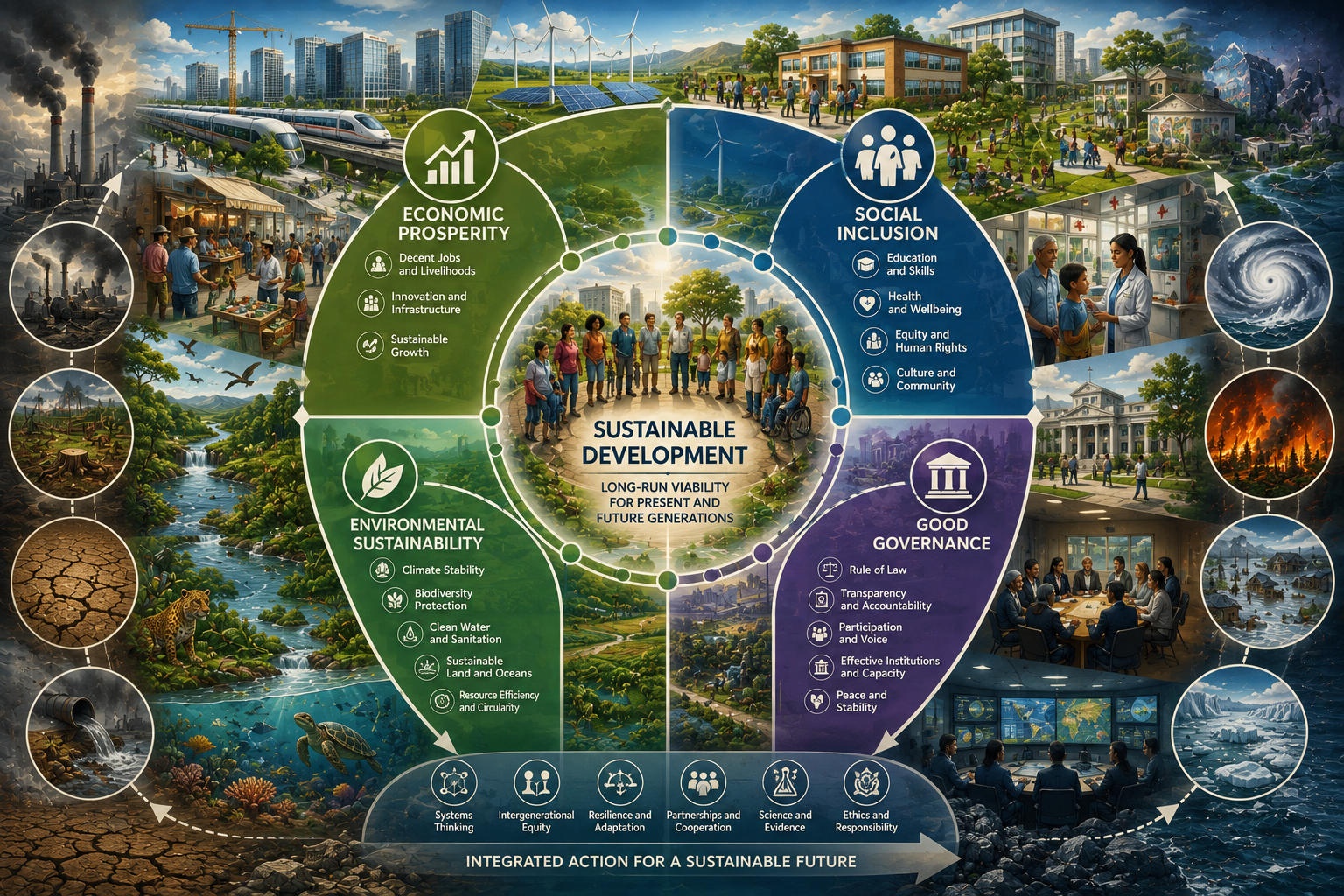
Our Common Future did not respond to this dilemma by abandoning development. Its more profound move was to insist that development itself had to be redefined. Poverty reduction, environmental stewardship, institutional capacity, economic transformation, technological change, and long-term human survival could no longer be governed as separate agendas. They had to be understood as mutually implicated dimensions of one historical problem. In that sense, the Brundtland definition marks a major threshold in the history of development thought: the point at which development ceased to be intelligible as a purely economic project and became a problem of justice across time, ecology, and political order.
The definition’s legacy lies not only in its rhetorical success, but in the long afterlife of interpretation, institutionalization, critique, and extension that followed from it. Later frameworks such as the Sustainable Development Goals preserved its insistence that poverty eradication, social inclusion, and environmental integrity belong to a common developmental horizon. Human development theory deepened that horizon by shifting attention from output to capability and freedom. Earth-system science later sharpened the ecological side of the argument by showing that sustainability cannot be discussed only in moral or political terms; it must also reckon with biophysical thresholds, boundary conditions, and the stability requirements of the Earth system itself. This larger field of interpretation is what gives Brundtland its continuing relevance.
The Brundtland Definition
The canonical definition appears in Our Common Future, the 1987 report of the World Commission on Environment and Development: sustainable development is development that meets the needs of the present without compromising the ability of future generations to meet their own needs. The endurance of this sentence lies partly in its elegance, but more importantly in the conceptual labor it performs. It binds together three propositions that had often been separated in public discourse: that development remains necessary, that the poor possess urgent and legitimate claims on development, and that the future imposes constraints on what counts as legitimate progress in the present.
The definition is often repeated as if it were merely a plea for moderation or balance. In fact, the report gives it sharper content. It emphasizes the essential needs of the world’s poor and argues that limitations arise not only from nature in the abstract, but from the state of technology, social organization, and the biosphere’s capacity to absorb the effects of human activity. This matters because it shows that Brundtland was never simply calling for environmental caution. It was attempting to redefine development by situating economic aspiration within social justice and ecological reality.
In this respect, the Brundtland definition is not a complete theory but a generative formulation. It does not provide a settled metric system, a binding theory of trade-offs, or a finished political economy of sustainability. What it provides instead is a normative pivot: development must be judged not only by present output or present welfare, but by the durability of the ecological, institutional, and social conditions it leaves behind. That formulation remains foundational to later debates over How Sustainable Development Is Measured, the politics of indicators, and the relationship between development performance and long-run resilience.
The definition also has an important negative implication. A development path may increase output, expand infrastructure, or raise consumption in the present while still failing the Brundtland test if it transfers ecological degradation, fiscal instability, institutional fragility, or social risk onto future people. The definition therefore distinguishes between apparent progress and legitimate development. The former may be visible in present indicators; the latter must also pass the test of future viability.
Historical Context
The Brundtland Report emerged from a period in which several lines of criticism were converging. Postwar development thought had often associated progress with industrialization, infrastructure buildout, modernization, technological diffusion, and rising national income. But by the 1970s and 1980s it had become increasingly difficult to ignore the environmental costs of this model. Pollution, deforestation, desertification, energy insecurity, species loss, toxic exposure, and transboundary degradation challenged the assumption that development could proceed indefinitely as a linear expansion of production and consumption.
At the same time, development itself remained morally unavoidable. Vast parts of the world still faced severe poverty, food insecurity, disease burden, inadequate housing, weak public institutions, and limited access to education, sanitation, transport, energy, and dignified work. This meant that ecological concern could not simply take the form of anti-development restraint. The political challenge was to articulate a concept capable of preserving the urgency of development while acknowledging that prevailing models of development were generating ecological instability and reproducing vulnerability.
Brundtland’s achievement was to refuse this false choice. It neither treated environmental protection as a luxury concern of affluent societies nor accepted that poverty reduction justified unlimited ecological damage. Instead, it argued that underdevelopment and environmental decline were mutually reinforcing conditions. Poverty could intensify unsustainable resource use; ecological degradation could deepen poverty; weak institutions could make both harder to govern. Sustainable development emerged, then, as a response to a crisis of fragmentation: the recognition that economy, society, environment, and governance had been treated as separate domains despite their continuous interaction.
This historical reframing matters because it explains why sustainable development quickly became more than an environmental slogan. It became a new language for thinking about development under conditions of interdependence, cumulative risk, and long time horizons. Much of the later literature on SDG Indicators: Strengths, Gaps, and Political Uses, development fragility, and the governance of uncertainty can be read as an attempt to specify the institutional consequences of this original shift.
The historical context also matters because the problem was never evenly distributed. Industrialized states had already accumulated wealth through high-resource, high-emission development pathways, while many poorer societies were being asked to develop under tightening ecological constraints. Brundtland’s language of common future therefore carried a tension from the beginning: the future is shared, but responsibility for past damage, present vulnerability, and future transition is not equally distributed.
The Conceptual Break Brundtland Introduced
The Brundtland definition mattered because it changed the grammar of development. It made it harder to speak of development as a purely present-tense accomplishment measured by growth alone. Once future generations enter the definition, development becomes accountable to time. Once needs enter the definition, sustainability becomes accountable to justice. Once limits enter the definition, economic activity becomes accountable to ecological and institutional conditions. This threefold shift was the concept’s real innovation.
Before Brundtland, development and environment could still be treated as distinct policy arenas with separate priorities. After Brundtland, that separation became conceptually unstable. A development model that generated income while degrading soils, intensifying freshwater stress, exhausting ecosystems, or locking societies into fragile infrastructures could no longer be taken at face value as progress. Likewise, environmental protection that ignored deprivation and material need could not be treated as a sufficient moral response. The legitimacy of development came to depend on whether it could be made compatible with the continuity of human possibility across time.
This was a major conceptual break because it transformed sustainability from a secondary concern with conservation into a criterion for judging development itself. Sustainability ceased to refer merely to the preservation of nature and became instead a test of whether development was consuming the future as a hidden subsidy for the present. That insight remains central to later work on Boundary Transgression and Development Fragility, which shows that developmental success cannot be separated from the stability of the ecological systems on which social and economic life ultimately depend.
Brundtland also shifted the ethical scale of development. It brought together local deprivation, national development strategy, international cooperation, and planetary responsibility. This made sustainable development a multi-scalar concept. A local water project, a national industrial policy, an international climate agreement, and a global biodiversity framework could all be interpreted through the same basic question: does present action expand legitimate human possibility while preserving the conditions of future wellbeing?
The conceptual break therefore lies not only in the famous sentence itself, but in the horizon it opened. Development could no longer be evaluated by growth, technology, or infrastructure alone. It had to be evaluated by the relationship among need, limit, responsibility, institution, and time.
Needs, Limits, and Intergenerational Responsibility
The conceptual center of the Brundtland definition lies in its treatment of needs and limits. The emphasis on needs prevents sustainability from becoming a politics of abstraction. Sustainable development begins from the fact that millions and indeed billions of people require food, shelter, sanitation, healthcare, education, energy, employment, and security. Development remains morally necessary because deprivation is not morally neutral. Any account of sustainability that treats human need as secondary fails at the outset.
The emphasis on limits places those needs within a temporal and material structure. Present societies cannot claim developmental success if they satisfy immediate wants by damaging the conditions under which future societies must also survive and flourish. This is where the Brundtland definition acquires philosophical depth. It implies that the future has moral standing in present decision-making, not because future persons are present to demand justice, but because present action creates the background conditions of their possibility. Development is therefore never only a distributive question in the present. It is also an inheritance question across time.
Intergenerational responsibility follows from this structure. The future is not simply a rhetorical horizon; it is a test of whether institutions, infrastructures, and patterns of production and consumption are durable. Sustainable development becomes, in this sense, a theory of transmission. It asks what ecological, economic, and political world is being passed forward, and whether present gains are being financed through hidden depletion or deferred instability. Contemporary work on Freshwater Change and Development Risk, Risk, Shock, and Fragility in Development Systems, and Development Under Deep Uncertainty makes explicit how strongly this temporal logic still governs sustainable development analysis.
The relationship between needs and limits is also politically difficult. Needs are urgent, visible, and unequally distributed. Limits are often cumulative, delayed, and easier for powerful actors to postpone. Brundtland’s enduring relevance lies in its insistence that neither can erase the other. Development that ignores need becomes unjust. Development that ignores limits becomes self-undermining. Sustainable development begins where both claims must be held together.
Developmental Justice and the Poor
One of the most important features of the Brundtland definition is its insistence that the needs of the poor are not peripheral to sustainability. This is frequently overlooked when sustainable development is reduced to environmental management, climate targets, or corporate sustainability language. In the Brundtland framework, poverty is not simply one issue among many. It is central because deprivation limits human freedom, weakens resilience, and can intensify environmental vulnerability.
This does not mean that poverty causes environmental degradation in a simple or blame-centered way. The relationship is structural. Poor communities often depend directly on local ecosystems for food, fuel, water, and livelihood. When institutions fail, land rights are insecure, public services are weak, or economic alternatives are limited, survival strategies may become environmentally costly. At the same time, ecological degradation often harms poor communities first and most severely. Soil erosion, water contamination, air pollution, climate shocks, crop failure, displacement, and disease burdens tend to concentrate where people have the least capacity to adapt.
Developmental justice therefore requires more than abstract concern for the future. It requires material attention to present deprivation and to the unequal power relations that shape exposure to risk. The Brundtland definition remains powerful because it refuses to sacrifice the poor in the name of the future and refuses to sacrifice the future in the name of present growth. Its moral force lies in holding both claims together.
This is also where the definition can be connected to broader questions of historical responsibility. Many societies now facing severe development constraints did not generate the bulk of historical ecological pressure, yet they face the demand to develop under tighter planetary limits. A serious Brundtland reading must therefore ask how finance, technology transfer, debt, trade, adaptation, and global governance can support development pathways that are both just and sustainable.
The Strength of the Brundtland Formulation
The enduring strength of the Brundtland definition lies in its combination of breadth and moral clarity. It is broad enough to remain useful across scales, sectors, and institutions. It can be applied to infrastructure, energy, trade, agriculture, public health, urban development, water governance, industrial policy, education, housing, climate adaptation, and international cooperation. Yet it is not morally neutral. It preserves two non-negotiable commitments: first, that development must address human need, especially poverty and deprivation; and second, that development loses legitimacy when it destroys the basis of future wellbeing.
Another strength is that the formulation is synthetic rather than reductive. It does not collapse sustainable development into environmental protection, economic growth, or social welfare alone. Instead, it insists that these domains must be judged together. This synthetic quality made the definition institutionally powerful. It could be adopted across the United Nations system, national governments, development agencies, universities, civil society, and policy institutions because it provided a common language without requiring a single doctrinal framework.
A further strength lies in its temporal discipline. The definition captures a structural truth that political systems often evade: development is never only about present consumption or present output. It always involves the shaping of future conditions, path dependencies, locked-in risks, and intergenerational inheritance. Brundtland made that temporality publicly legible. It turned the future from a vague afterthought into a criterion of legitimacy. This helps explain why the definition still underpins later work on Resilience Thinking and Sustainable Development, long-horizon planning, and the governance of cumulative environmental stress.
The Brundtland formulation also has pedagogical strength. It is easy to remember, but not shallow. It opens into questions of poverty, capability, ecological thresholds, institutional capacity, finance, technology, justice, and governance. A good definition does not have to resolve every question. It has to orient inquiry. Brundtland does that unusually well.
Ambiguities, Tensions, and Critiques
For all its power, the Brundtland definition is not analytically complete. Its first ambiguity is its breadth. Because it does not specify operational thresholds, binding trade-off rules, or institutional enforcement mechanisms, it can be appropriated by actors with radically different political and economic commitments. Governments, corporations, multilateral bodies, and advocacy organizations have all claimed the language of sustainable development, sometimes in ways that empty it of substantive constraint. Its universality is therefore both a strength and a vulnerability.
A second ambiguity concerns growth. Brundtland did not reject growth, particularly where growth was needed to meet basic needs and expand welfare. Yet it also did not offer a full theory of how growth itself should be transformed under ecological constraint. This left open questions later debated under the headings of green growth, ecological modernization, post-growth, degrowth, circular economy, and just transition. Can growth be sufficiently decoupled from material throughput and environmental damage? If not, what forms of development remain defensible within a finite biosphere? Brundtland posed these questions more effectively than it resolved them.
A third tension concerns the status of limits themselves. In Brundtland, limits are real, but they are mediated by technology, institutions, and social organization. This is an important insight because it avoids crude natural determinism. Yet it also leaves unresolved whether limits should be understood primarily as biophysical thresholds, institutional failures, political conflicts, or combinations of all three. Later Earth-system science, especially work on planetary boundaries, gave much greater precision to the ecological side of the problem, but Brundtland itself remained deliberately general and normative.
A final critique is that the definition can appear too consensual. By design, it brought development and environment into a shared moral vocabulary. But sustainable development in practice often involves struggle: struggle over who gets to develop, who bears ecological cost, whose time horizon governs policy, which institutions define legitimate trade-offs, and whose knowledge counts. A fuller reading of Brundtland must therefore recognize that its language of integration did not abolish politics. It relocated politics within a broader horizon of interdependence and intergenerational accountability.
The critique should not lead to dismissal. The definition’s ambiguity is partly what allowed it to become foundational. But that same ambiguity means the definition must be interpreted through stronger frameworks of measurement, justice, governance, ecological thresholds, and public accountability. Brundtland is best understood as the beginning of a field, not the end of one.
The Legacy of Brundtland
The Brundtland definition’s legacy is visible in nearly every major framework that followed. The 2030 Agenda inherits its integrated logic, its universal scope, and its insistence that poverty eradication remains indispensable. The Sustainable Development Goals translate Brundtland’s broad moral architecture into a target-based framework spanning poverty, health, education, gender equality, water, energy, work, inequality, cities, climate, biodiversity, peace, and partnership. Whether or not the Goals achieve coherence in practice, they are difficult to imagine without Brundtland’s earlier integration of development and sustainability.
Its legacy is equally visible in human development theory. The Human Development Reports shifted attention from national output to capability, freedom, agency, and lived wellbeing, thereby clarifying what development is ultimately for. This did not replace Brundtland; it specified one side of it more fully. If Brundtland linked present need to future responsibility, human development clarified the substantive content of those needs in terms of health, education, dignity, agency, and opportunity.
The legacy also extends into sustainability science. Later research on planetary boundaries, safe operating space, Earth-system stability, and resilience gave scientific structure to concerns that Brundtland had articulated in more general normative language. This development matters because it shows that the definition functioned as an enabling concept. It did not itself provide threshold science, but it created the intellectual space in which threshold science could become central to development thinking. That is one reason why later work on fragility, resilience, systems risk, and Scenario Planning for Sustainable Futures continues to operate inside a Brundtland-shaped horizon.
More broadly, Brundtland’s legacy is architectural. It did not solve the problem of sustainable development. It created the field within which the problem could be posed. Its importance therefore exceeds the precision of its wording. It made possible a new structure of argument in which poverty, ecology, infrastructure, justice, governance, uncertainty, and future responsibility must all be thought together. Even contemporary debates on AI, Data Systems, and the Future of Development Governance remain indebted to this integrated way of posing the developmental question.
Its legacy is also institutional. The definition helped make sustainable development a shared language for global policy, but institutionalization brought new tensions. Once the phrase entered diplomacy, corporate reporting, funding frameworks, and national planning, it became powerful but also vulnerable to dilution. The legacy of Brundtland is therefore double: it gave the world a durable framework, and it created an ongoing responsibility to defend that framework from becoming empty language.
From Brundtland to Earth-System Science
One of the most important developments after Brundtland was the rise of Earth-system science as a more precise account of ecological constraint. Brundtland argued that development must respect ecological limits, but it did not specify those limits in the language of planetary processes, thresholds, or safe operating space. Later work on planetary boundaries helped give scientific structure to the question Brundtland had opened: what biophysical conditions must remain stable if human development is to remain viable?
This transition matters because it shifts sustainability from generalized environmental concern toward system-level diagnosis. Climate change, biosphere integrity, land-system change, freshwater change, ocean acidification, biogeochemical flows, atmospheric aerosols, stratospheric ozone, and novel entities are not isolated environmental issues. They are part of the operating conditions of human civilization. When those systems are destabilized, development risks change in quality and scale.
Earth-system science therefore sharpens the Brundtland definition. It gives greater content to what it means not to compromise the ability of future generations to meet their needs. Future capacity depends not only on income, technology, or institutions, but also on the stability of Earth-system functions that support agriculture, water security, health, infrastructure, settlement patterns, and economic life.
At the same time, Earth-system science also needs Brundtland’s justice frame. Boundary thinking without developmental justice can become politically dangerous if it treats all human activity as equivalent or ignores historical responsibility. Brundtland reminds sustainability science that ecological limits must be interpreted alongside poverty, capability, institutional capacity, and unequal development. The strongest sustainable-development thinking joins both: the moral urgency of need and the biophysical seriousness of limits.
Governance, Institutions, and Implementation
The Brundtland definition is often discussed as an ethical statement, but its practical implications are institutional. Meeting present needs while protecting future capacity requires organizations capable of coordinating across sectors, time horizons, and political boundaries. Public administrations, legal systems, planning agencies, statistical offices, development banks, local governments, environmental regulators, courts, and international institutions all shape whether sustainable development can move from principle to practice.
This governance challenge is difficult because Brundtland problems are cross-sectoral. A water policy may affect agriculture, health, energy, ecosystems, cities, and regional conflict. An energy policy may affect emissions, jobs, industrial strategy, household welfare, debt, land use, and geopolitical dependency. A poverty-reduction policy may affect infrastructure demand, fiscal capacity, migration, and environmental pressure. Sustainable development requires institutions capable of seeing these interactions rather than governing through isolated silos.
Implementation also requires accountability. Without accountability, the language of sustainable development can become ceremonial. Governments may adopt plans without enforcement. Corporations may issue sustainability claims without meaningful transformation. International institutions may produce targets without adequate finance or remedy. Communities may be consulted without real power. Brundtland’s definition therefore depends on governance systems that can translate moral language into public capacity, measurable commitments, and rights-based participation.
Institutional durability is especially important because the Brundtland definition is temporal. It asks present institutions to protect the possibility of future wellbeing. That requires forms of policy discipline that outlast electoral cycles, project timelines, donor cycles, and quarterly reporting. Development legitimacy depends not only on what institutions promise, but on whether they can maintain commitments across time while learning from evidence and affected communities.
Why Brundtland Still Matters
The Brundtland definition still matters because the dual condition it identified has become more severe. Vast unmet developmental needs remain across the world, including poverty, food insecurity, educational exclusion, inadequate housing, weak health systems, infrastructure deficits, and institutional fragility. At the same time, climate instability, biodiversity loss, freshwater stress, pollution, and wider Earth-system pressures have made older development pathways more visibly unsustainable. The problem Brundtland named has therefore intensified rather than receded.
Its continuing relevance also lies in its temporal discipline. The definition reminds policymakers, institutions, and publics that present gains achieved through hidden ecological depletion, infrastructural lock-in, or deferred social cost are not genuinely developmental in the long run. In an era shaped by cumulative pressures, non-linear shocks, and delayed feedbacks, this temporal dimension is indispensable. Brundtland remains one of the clearest public formulations of the principle that future viability is not external to development, but internal to its legitimacy.
Most importantly, the definition preserves a morally serious middle ground. It resists the complacency of assuming that growth solves developmental problems on its own. It also resists the fatalism of assuming that ecological constraint invalidates the developmental claims of poorer societies. Brundtland still matters because it refuses both simplifications. It insists that development must continue, but under conditions that make the future more livable rather than less. That question remains central not only to sustainable development as a field, but also to its Future Directions in Sustainable Development Thought.
Brundtland still matters because it provides a standard against which contemporary claims can be tested. Does a policy meet present needs? Does it protect future capability? Does it reduce poverty without exporting ecological harm? Does it strengthen institutions or weaken them? Does it distribute transition costs fairly? Does it make future wellbeing more possible? These questions remain as urgent now as they were in 1987.
Mathematical Lens
The Brundtland formulation can be expressed as a problem of satisfying present need while preserving future viable conditions. Let \(B\) denote Brundtland legitimacy, \(N_p\) present needs met, \(N_f\) future needs capacity preserved, \(E\) ecological integrity, and \(I\) institutional durability. A simple conceptual form is:
B = \alpha N_p + \beta N_f + \gamma E + \delta I
\]
Interpretation: Brundtland legitimacy depends on meeting present needs while preserving future capacity, ecological integrity, and institutional durability.
The point is not that all dimensions are reducible to one metric, but that development loses legitimacy when present gains are purchased through the degradation of the conditions required for future wellbeing.
We can also express Brundtland failure risk as:
R_b = \lambda P + \mu D + \nu F
\]
Interpretation: Brundtland risk rises when present needs remain unmet, ecological degradation increases, or present choices transfer burdens into the future.
In this formulation, \(P\) is present-need deprivation, \(D\) is ecological degradation, and \(F\) is future-burden transfer. Higher \(R_b\) means a society is failing either the justice side, the ecological side, or both sides of the Brundtland condition.
Finally, intergenerational stewardship capacity can be represented as:
S = \theta G + \kappa T + \rho C
\]
Interpretation: Stewardship capacity depends on governance capacity, temporal policy discipline, and awareness of ecological carrying or absorptive capacity.
Here, \(G\) is governance capacity, \(T\) is temporal policy discipline, and \(C\) is ecological carrying or absorptive capacity awareness. This helps clarify why Brundtland remains foundational to later resilience and systems-governance work.
| Term | Meaning | Interpretive role |
|---|---|---|
| \(B\) | Brundtland legitimacy | Represents whether development satisfies present need without undermining future wellbeing capacity. |
| \(N_p\) | Present needs met | Captures poverty reduction, health, education, shelter, food, energy, and basic services. |
| \(N_f\) | Future needs capacity preserved | Represents whether future generations inherit viable conditions for meeting their own needs. |
| \(E\) | Ecological integrity | Represents climate stability, biodiversity, water systems, land, pollution control, and ecosystem function. |
| \(I\) | Institutional durability | Represents governance systems capable of sustaining commitments across time. |
| \(R_b\) | Brundtland failure risk | Represents the danger that development fails present justice, future responsibility, or both. |
| \(S\) | Stewardship capacity | Represents the ability to govern development in light of intergenerational responsibility. |
The equations are conceptual rather than predictive. Their value is to make Brundtland’s logic explicit: present needs, future needs, ecological conditions, and institutional durability must be evaluated together. A society that increases present output while degrading future capacity is not passing the Brundtland test. It is shifting costs across time.
Advanced Python Workflow: Brundtland Legitimacy Risk Scoring
This Python workflow translates the article’s core argument into a structured Brundtland model. Rather than treating sustainability as a slogan, it scores territories across present need pressure, future-burden transfer, ecological degradation, institutional durability, poverty-reduction support, and intergenerational stewardship. That makes it possible to compare not only where deprivation is severe, but where present development is most likely to undermine future viability.
from __future__ import annotations

import pandas as pd
import numpy as np

INPUT_FILE = "brundtland_definition_legacy_panel.csv"
OUTPUT_FILE = "brundtland_definition_legacy_scores.csv"


def load_data(path: str) -> pd.DataFrame:
    """
    Load a territory-level Brundtland legitimacy dataset.

    All *_index columns should be normalized to [0, 1].
    Higher values should mean more of the named property.

    Examples:
      - present_need_pressure_index: higher = more unmet present need
      - ecological_degradation_index: higher = more ecological degradation
      - institutional_durability_index: higher = stronger institutional durability
      - intergenerational_stewardship_index: higher = stronger stewardship
    """
    df = pd.read_csv(path)

    required_columns = [
        "territory_name",
        "country_or_region",
        "territory_type",
        "present_need_pressure_index",
        "poverty_reduction_support_index",
        "ecological_degradation_index",
        "future_burden_transfer_index",
        "institutional_durability_index",
        "intergenerational_stewardship_index",
        "absorptive_capacity_stress_index",
        "technology_organisation_constraint_index",
        "development_legitimacy_alignment_index",
    ]

    missing = [col for col in required_columns if col not in df.columns]

    if missing:
        raise ValueError(f"Missing required columns: {missing}")

    return df


def validate_indices(df: pd.DataFrame) -> pd.DataFrame:
    """Validate that all *_index fields are complete and normalized to [0, 1]."""
    index_columns = [col for col in df.columns if col.endswith("_index")]

    for col in index_columns:
        if df[col].isna().any():
            raise ValueError(f"Column '{col}' contains missing values.")

        if ((df[col] < 0) | (df[col] > 1)).any():
            raise ValueError(f"Column '{col}' contains values outside [0, 1].")

    return df


def compute_scores(df: pd.DataFrame) -> pd.DataFrame:
    """
    Compute Brundtland pressure, capacity, and legitimacy-risk scores.

    Pressure rises with unmet present need, ecological degradation,
    future-burden transfer, institutional weakness, stewardship weakness,
    absorptive stress, and technology or organization constraints.

    Capacity rises with poverty-reduction support, institutional durability,
    intergenerational stewardship, lower absorptive stress, and legitimacy alignment.
    """
    df = df.copy()

    df["brundtland_pressure_score"] = (
        0.16 * df["present_need_pressure_index"] +
        0.14 * (1 - df["poverty_reduction_support_index"]) +
        0.16 * df["ecological_degradation_index"] +
        0.14 * df["future_burden_transfer_index"] +
        0.12 * (1 - df["institutional_durability_index"]) +
        0.10 * (1 - df["intergenerational_stewardship_index"]) +
        0.10 * df["absorptive_capacity_stress_index"] +
        0.08 * df["technology_organisation_constraint_index"]
    ).clip(lower=0, upper=1)

    df["brundtland_capacity_score"] = (
        0.24 * df["poverty_reduction_support_index"] +
        0.20 * df["institutional_durability_index"] +
        0.20 * df["intergenerational_stewardship_index"] +
        0.18 * (1 - df["absorptive_capacity_stress_index"]) +
        0.18 * df["development_legitimacy_alignment_index"]
    ).clip(lower=0, upper=1)

    df["brundtland_legitimacy_risk_score"] = (
        0.50 * df["brundtland_pressure_score"] +
        0.30 * (1 - df["brundtland_capacity_score"]) +
        0.20 * df["future_burden_transfer_index"]
    ).clip(lower=0, upper=1)

    df["risk_band"] = np.select(
        [
            df["brundtland_legitimacy_risk_score"] >= 0.80,
            df["brundtland_legitimacy_risk_score"] >= 0.60,
            df["brundtland_legitimacy_risk_score"] >= 0.40,
        ],
        [
            "Extreme Brundtland legitimacy risk",
            "High Brundtland legitimacy risk",
            "Moderate Brundtland legitimacy risk",
        ],
        default="Lower Brundtland legitimacy risk",
    )

    return df


def build_summary(df: pd.DataFrame) -> pd.DataFrame:
    """Return a ranked summary table for review or reporting."""
    columns = [
        "territory_name",
        "country_or_region",
        "territory_type",
        "brundtland_pressure_score",
        "brundtland_capacity_score",
        "brundtland_legitimacy_risk_score",
        "risk_band",
    ]

    summary = df[columns].copy()

    summary = summary.sort_values(
        by=[
            "brundtland_legitimacy_risk_score",
            "brundtland_pressure_score",
            "brundtland_capacity_score",
        ],
        ascending=[False, False, True],
    ).reset_index(drop=True)

    return summary


def main() -> None:
    df = load_data(INPUT_FILE)
    df = validate_indices(df)
    scored = compute_scores(df)
    summary = build_summary(scored)

    summary.to_csv(OUTPUT_FILE, index=False)

    print("The Brundtland definition and legacy scoring complete.")
    print(summary.to_string(index=False))


if __name__ == "__main__":
    main()
This workflow is intentionally transparent. It does not claim that Brundtland legitimacy can be reduced to a final objective score. Instead, it makes assumptions visible: present need, ecological degradation, future-burden transfer, institutional durability, stewardship, and development legitimacy are treated as distinct components. In real use, the weights should be documented, sensitivity-tested, and interpreted with expert judgment and community input.
Advanced R Workflow: Intergenerational Need, Ecological Constraint, and Governance Risk
This R workflow is designed for the part of the article that emphasizes present need, future responsibility, and ecological constraint together. It compares settings across poverty pressure, ecological degradation, institutional durability, absorptive stress, and stewardship capacity, then builds grouped summaries that help show where development is most likely to fail the Brundtland test of legitimacy across time.
library(readr)
library(dplyr)

input_file <- "brundtland_definition_legacy_country_panel.csv"
region_output_file <- "cross_region_brundtland_summary.csv"
territory_output_file <- "cross_territory_brundtland_summary.csv"

br_df <- read_csv(input_file, show_col_types = FALSE)

required_cols <- c(
  "territory_name",
  "country_or_region",
  "territory_type",
  "present_need_pressure_index",
  "poverty_reduction_support_index",
  "ecological_degradation_index",
  "future_burden_transfer_index",
  "institutional_durability_index",
  "intergenerational_stewardship_index",
  "absorptive_capacity_stress_index",
  "technology_organisation_constraint_index",
  "development_legitimacy_alignment_index"
)

missing_cols <- setdiff(required_cols, names(br_df))

if (length(missing_cols) > 0) {
  stop(paste("Missing required columns:", paste(missing_cols, collapse = ", ")))
}

index_cols <- names(br_df)[grepl("_index$", names(br_df))]

invalid_index_cols <- index_cols[
  vapply(
    br_df[index_cols],
    function(x) any(is.na(x) | x < 0 | x > 1),
    logical(1)
  )
]

if (length(invalid_index_cols) > 0) {
  stop(
    paste(
      "Index columns must be complete and normalized to [0, 1]:",
      paste(invalid_index_cols, collapse = ", ")
    )
  )
}

br_df <- br_df %>%
  mutate(
    brundtland_proxy = (
      present_need_pressure_index +
      (1 - poverty_reduction_support_index) +
      ecological_degradation_index +
      future_burden_transfer_index +
      (1 - institutional_durability_index) +
      (1 - intergenerational_stewardship_index) +
      absorptive_capacity_stress_index +
      technology_organisation_constraint_index +
      (1 - development_legitimacy_alignment_index)
    ) / 9,
    stewardship_capacity = (
      institutional_durability_index +
      intergenerational_stewardship_index +
      development_legitimacy_alignment_index
    ) / 3,
    risk_band = case_when(
      brundtland_proxy >= 0.75 ~ "Extreme Brundtland legitimacy risk",
      brundtland_proxy >= 0.55 ~ "High Brundtland legitimacy risk",
      brundtland_proxy >= 0.35 ~ "Moderate Brundtland legitimacy risk",
      TRUE ~ "Lower Brundtland legitimacy risk"
    )
  )

region_summary <- br_df %>%
  group_by(country_or_region) %>%
  summarise(
    avg_brundtland_proxy = mean(brundtland_proxy, na.rm = TRUE),
    avg_stewardship_capacity = mean(stewardship_capacity, na.rm = TRUE),
    avg_present_need_pressure = mean(present_need_pressure_index, na.rm = TRUE),
    avg_ecological_degradation = mean(ecological_degradation_index, na.rm = TRUE),
    avg_future_burden_transfer = mean(future_burden_transfer_index, na.rm = TRUE),
    avg_absorptive_capacity_stress = mean(absorptive_capacity_stress_index, na.rm = TRUE),
    observations = n(),
    .groups = "drop"
  ) %>%
  mutate(
    regional_risk_band = case_when(
      avg_brundtland_proxy >= 0.75 ~ "Extreme Brundtland legitimacy risk",
      avg_brundtland_proxy >= 0.55 ~ "High Brundtland legitimacy risk",
      avg_brundtland_proxy >= 0.35 ~ "Moderate Brundtland legitimacy risk",
      TRUE ~ "Lower Brundtland legitimacy risk"
    )
  ) %>%
  arrange(desc(avg_brundtland_proxy))

territory_summary <- br_df %>%
  group_by(territory_type) %>%
  summarise(
    avg_brundtland_proxy = mean(brundtland_proxy, na.rm = TRUE),
    avg_stewardship_capacity = mean(stewardship_capacity, na.rm = TRUE),
    avg_present_need_pressure = mean(present_need_pressure_index, na.rm = TRUE),
    avg_ecological_degradation = mean(ecological_degradation_index, na.rm = TRUE),
    avg_future_burden_transfer = mean(future_burden_transfer_index, na.rm = TRUE),
    avg_absorptive_capacity_stress = mean(absorptive_capacity_stress_index, na.rm = TRUE),
    observations = n(),
    .groups = "drop"
  ) %>%
  arrange(desc(avg_brundtland_proxy))

write_csv(region_summary, region_output_file)
write_csv(territory_summary, territory_output_file)

cat("Cross-region Brundtland summary exported to:", region_output_file, "\n")
print(region_summary)

cat("\nCross-territory Brundtland summary exported to:", territory_output_file, "\n")
print(territory_summary)
This workflow corrects the common mistake of treating present need, ecological stress, and institutional capacity as separate dashboards with no shared interpretive frame. Brundtland’s definition requires them to be read together. A territory with high deprivation, ecological degradation, and weak stewardship capacity is not merely facing separate policy problems. It is facing a legitimacy crisis in the Brundtland sense: development is failing both present justice and future viability.
GitHub Repository
Complete Code Repository
The full code distribution for this article, including Brundtland-legitimacy scoring workflows, intergenerational diagnostics, SQL materials, optional monitoring support tooling, supporting documentation, and repository structure, is available on GitHub.
Related Articles
- What Is Sustainable Development? Meaning, Systems, and Long-Run Viability
- The Four Dimensions of Sustainable Development
- How Sustainable Development Is Measured
- SDG Indicators: Strengths, Gaps, and Political Uses
- Boundary Transgression and Development Fragility
- Freshwater Change and Development Risk
- Risk, Shock, and Fragility in Development Systems
- Resilience Thinking and Sustainable Development
- Scenario Planning for Sustainable Futures
- AI, Data Systems, and the Future of Development Governance
Further Reading
- World Commission on Environment and Development (1987) Our Common Future. Oxford: Oxford University Press. Available at: https://www.un-documents.net/our-common-future.pdf
- United Nations (2015) Transforming our world: the 2030 Agenda for Sustainable Development. New York: United Nations. Available at: https://sdgs.un.org/2030agenda
- Sachs, J.D. (2015) The Age of Sustainable Development. New York: Columbia University Press. Available at: https://cup.columbia.edu/book/the-age-of-sustainable-development/9780231173155
- Sen, A. (1999) Development as Freedom. Oxford: Oxford University Press. Available at: https://global.oup.com/academic/product/development-as-freedom-9780192893307
- Haq, M. ul (1995) Reflections on Human Development. Oxford: Oxford University Press. Available at: https://global.oup.com/academic/product/reflections-on-human-development-9780198292197
- Raworth, K. (2017) Doughnut Economics: Seven Ways to Think Like a 21st-Century Economist. London: Random House Business. Available at: https://www.penguinrandomhouse.com/books/533890/doughnut-economics-by-kate-raworth/
- Ostrom, E. (1990) Governing the Commons: The Evolution of Institutions for Collective Action. Cambridge: Cambridge University Press. Available at: https://www.cambridge.org/core/books/governing-the-commons/7AB7AE11BADA84409C34815CC288CD79
- Rockström, J. et al. (2009) ‘A safe operating space for humanity’, Nature, 461, pp. 472–475. Available at: https://www.nature.com/articles/461472a
- Steffen, W. et al. (2015) ‘Planetary Boundaries: Guiding Human Development on a Changing Planet’, Science, 347(6223). Available at: https://www.science.org/doi/10.1126/science.1259855
- Richardson, K. et al. (2023) ‘Earth beyond six of nine planetary boundaries’, Science Advances, 9(37), eadh2458. Available at: https://www.science.org/doi/10.1126/sciadv.adh2458
References
- World Commission on Environment and Development (1987) Our Common Future. Oxford: Oxford University Press. Available at: https://www.un-documents.net/our-common-future.pdf
- United Nations (1987) Report of the World Commission on Environment and Development: Our Common Future. New York: United Nations Digital Library. Available at: https://digitallibrary.un.org/record/139811
- United Nations (2015) Transforming our world: the 2030 Agenda for Sustainable Development. New York: United Nations. Available at: https://sdgs.un.org/2030agenda
- United Nations Development Programme (2025) Human Development Report 2025: A Matter of Choice: People and Possibilities in the Age of AI. New York: UNDP. Available at: https://hdr.undp.org/content/human-development-report-2025
- United Nations Development Programme (n.d.) Human Development Data Center. New York: UNDP. Available at: https://hdr.undp.org/data-center/country-insights
- Sen, A. (1999) Development as Freedom. Oxford: Oxford University Press. Available at: https://global.oup.com/academic/product/development-as-freedom-9780192893307
- Haq, M. ul (1995) Reflections on Human Development. Oxford: Oxford University Press. Available at: https://global.oup.com/academic/product/reflections-on-human-development-9780198292197
- Sachs, J.D. (2015) The Age of Sustainable Development. New York: Columbia University Press. Available at: https://cup.columbia.edu/book/the-age-of-sustainable-development/9780231173155
- Raworth, K. (2017) Doughnut Economics: Seven Ways to Think Like a 21st-Century Economist. London: Random House Business. Available at: https://www.penguinrandomhouse.com/books/533890/doughnut-economics-by-kate-raworth/
- Ostrom, E. (1990) Governing the Commons: The Evolution of Institutions for Collective Action. Cambridge: Cambridge University Press. Available at: https://www.cambridge.org/core/books/governing-the-commons/7AB7AE11BADA84409C34815CC288CD79
- Rockström, J. et al. (2009) ‘A safe operating space for humanity’, Nature, 461, pp. 472–475. Available at: https://www.nature.com/articles/461472a
- Steffen, W. et al. (2015) ‘Planetary Boundaries: Guiding Human Development on a Changing Planet’, Science, 347(6223). Available at: https://www.science.org/doi/10.1126/science.1259855
- Richardson, K. et al. (2023) ‘Earth beyond six of nine planetary boundaries’, Science Advances, 9(37), eadh2458. Available at: https://www.science.org/doi/10.1126/sciadv.adh2458
- Stockholm Resilience Centre (n.d.) Planetary boundaries. Stockholm: Stockholm University. Available at: https://www.stockholmresilience.org/research/planetary-boundaries.html