
Last Updated May 15, 2026
Cyber-physical infrastructure systems are infrastructure systems in which digital sensing, communication, computation, decision logic, and control are tightly coupled with physical assets and operational processes. They connect software, networks, data platforms, embedded devices, industrial control environments, human-machine interfaces, and automated or semi-automated decision pathways to material systems such as power grids, water networks, transportation systems, buildings, industrial facilities, environmental monitoring networks, and urban infrastructure.
In these settings, digital systems do not merely document the physical world after the fact. They participate directly in observing, coordinating, regulating, and sometimes controlling physical operations. Sensors capture flows, loads, pressures, temperatures, structural conditions, equipment state, environmental conditions, occupancy, traffic movement, chemical indicators, and device health. Communications systems transmit those signals across distributed environments. Software and control logic interpret the resulting data. Operators, controllers, algorithms, or automated mechanisms then intervene through switching actions, setpoint adjustments, dispatch decisions, routing changes, maintenance orders, safety responses, or emergency procedures. The infrastructure is therefore no longer simply physical with a digital layer added on top. It becomes a coupled cyber-physical system whose performance depends on the quality of interaction between informational and material processes.
This article develops Cyber-Physical Infrastructure Systems: Control, Risk and Resilience as an advanced article within the Intelligent Infrastructure Systems knowledge series. It examines cyber-physical infrastructure not as a generic “smart” technology category, but as a public-interest systems problem involving sensing, telemetry, control, dependency, timing, assurance, human oversight, cybersecurity, resilience, institutional capacity, and physical consequence. Selected Python and R examples appear here, while the companion GitHub repository can support reproducible workflows for cyber-physical asset inventories, telemetry records, control-loop reviews, dependency mapping, failure-mode analysis, resilience scoring, assurance documentation, SQL-backed evidence archives, embedded validation, hardware stream checks, and multi-language systems-engineering scaffolds.
Main Library
Publications
Article Map
Intelligent Infrastructure
Related Article Map
Data Systems
Related Article Map
Embedded & Edge
Related Article Map
Risk & Resilience
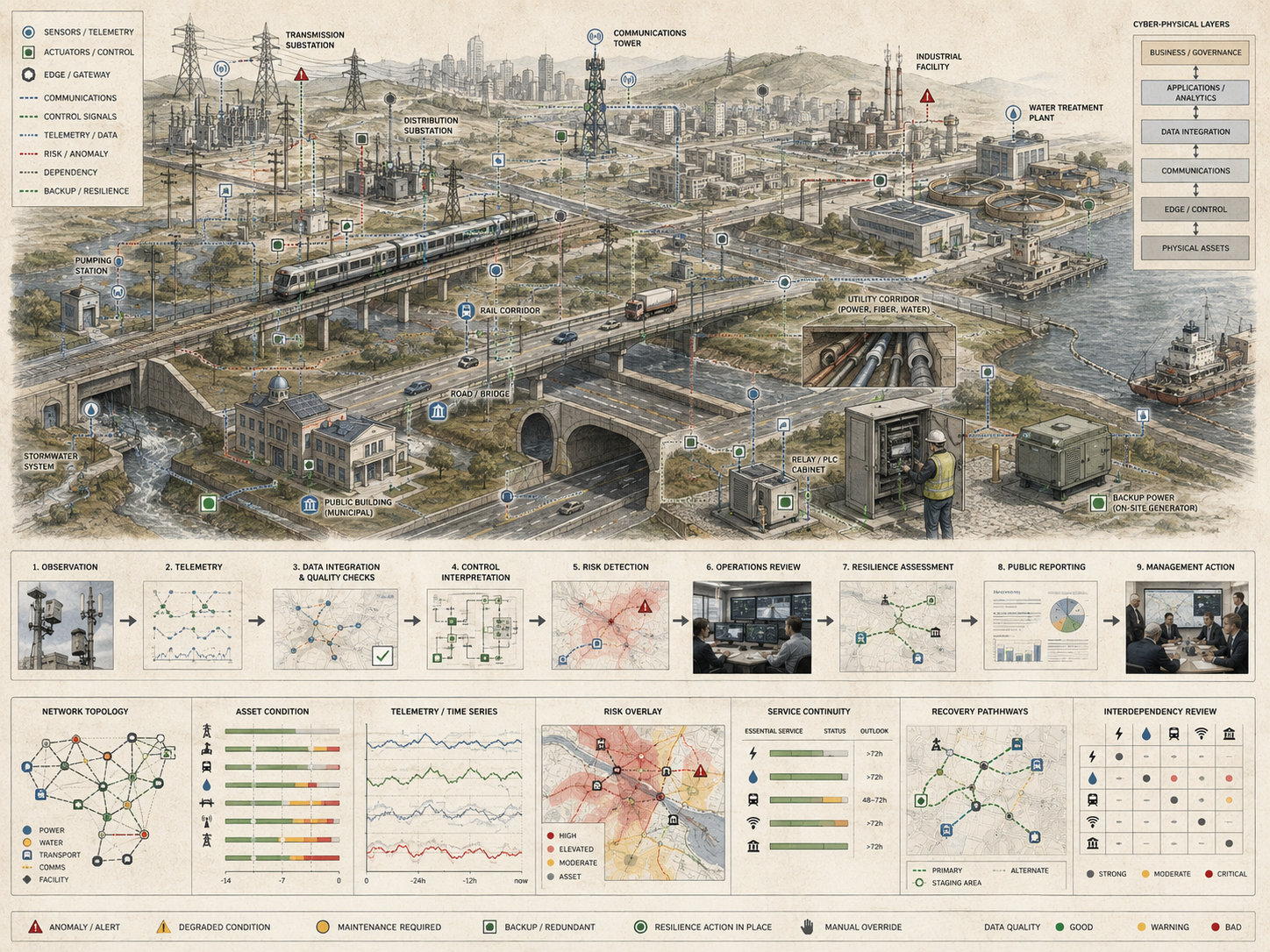
Cyber-physical infrastructure sits at the core of intelligent infrastructure more broadly. Digital Infrastructure Systems provide the enabling substrate of connectivity, computation, storage, interoperability, and communication. Infrastructure Monitoring and Sensor Integration makes physical conditions measurable. Infrastructure Data Platforms and Analytics make those measurements interpretable. Cyber-physical infrastructure takes the next step by coupling digital representation directly to operational consequence. It is here that measurement becomes action, communication becomes coordination, and data becomes materially consequential in the physical world.
This coupling expands capability while also increasing dependency. Once software, communications systems, telemetry, identity services, interfaces, remote access pathways, cloud systems, edge devices, and control logic become operationally embedded in essential infrastructure, the reliability of those digital components becomes inseparable from the reliability of the infrastructure itself. A timing fault, corrupted signal, interface failure, model error, configuration drift, software dependency, vendor compromise, or cyber intrusion can have physical consequences because the cyber and physical layers are no longer separable in practice. The central challenge is therefore not simply how to digitize infrastructure, but how to govern coupled digital-physical systems so they remain safe, interpretable, resilient, recoverable, and publicly accountable.
Engineering Problem
The engineering problem is how to design, operate, secure, and govern infrastructure systems in which digital processes can directly influence physical outcomes. In conventional information systems, software failures may disrupt records, communications, transactions, or administrative workflows. In cyber-physical infrastructure, software failures, timing errors, corrupted signals, invalid commands, misconfigured controllers, insecure remote access, or degraded interfaces can affect energy flows, traffic movement, water pressure, treatment processes, building systems, safety equipment, environmental warnings, industrial operations, or emergency response.
This problem is difficult because cyber-physical infrastructure crosses boundaries that are often managed separately. Physical assets may be designed by engineers, operated by field teams, monitored by control-room staff, networked by communications specialists, administered by IT teams, secured by cybersecurity teams, supplied by vendors, regulated by public authorities, and experienced by communities through service reliability or disruption. Yet the system behaves as one coupled operational environment. If responsibility remains fragmented while the infrastructure itself becomes integrated, risk can accumulate in the seams between disciplines.
A strong cyber-physical architecture must therefore solve more than automation. It must define what physical states matter, which digital signals represent them, how those signals are validated, how control logic interprets them, what interventions are permitted, what timing constraints apply, what happens when telemetry is missing or corrupted, how operators remain informed, how manual fallback works, how cyber compromise is contained, and how public institutions explain decisions when digital systems affect essential services. The central question is not whether digital control is possible, but whether the resulting cyber-physical loop is trustworthy under normal, degraded, adversarial, and emergency conditions.
| Engineering Tension | Why It Matters | Required Evidence |
|---|---|---|
| Digital representation versus physical reality | Control systems act on models, readings, and interfaces that may be incomplete, stale, noisy, or wrong. | Telemetry validation, calibration records, state-estimation review, field-verification logs |
| Automation versus human oversight | Automation can improve speed but may reduce operator understanding if interfaces, alerts, and fallback procedures are weak. | Human-machine interface review, operator training, manual override procedures, incident drills |
| Connectivity versus exposure | Remote access, interoperable platforms, vendor tools, cloud services, and connected devices improve coordination while expanding attack surfaces. | Asset inventory, access-control matrix, segmentation review, remote-access register, vendor-risk log |
| Efficiency versus resilience | Tightly optimized systems may lose slack, redundancy, or manual flexibility needed under disruption. | Resilience analysis, backup plan, degraded-mode procedure, dependency map |
| Real-time control versus uncertainty | Faster decisions can amplify error if data quality, timing, or control assumptions are weak. | Latency budget, control-loop validation, safety envelope, uncertainty review |
| Integration versus governability | Highly integrated systems can become difficult to audit, explain, repair, or safely override. | Architecture map, interface contracts, change logs, assurance documentation, governance register |
The practical test of cyber-physical infrastructure is whether digital-physical coupling improves service reliability, safety, resilience, and stewardship without creating opaque dependencies that institutions cannot realistically govern.
Reference Architecture
A practical reference architecture for cyber-physical infrastructure links physical assets, sensing, communications, computation, decision logic, actuation, human oversight, assurance, cybersecurity, and governance. The architecture should not begin with automation. It should begin with the public-service and operational functions the system must preserve: service continuity, safety, environmental quality, reliability, resilience, recoverability, accountability, and controlled intervention under uncertainty.
| Layer | Engineering Role | Primary Risk | Evidence Artifact |
|---|---|---|---|
| Service and control objective layer | Defines the physical service, operational goal, control boundary, decision authority, and valid-use limits. | The system automates behavior without clear purpose, authority, or safety envelope. | Control objective manifest, decision-use register, safety case, operating policy |
| Physical asset layer | Documents infrastructure assets, process variables, service zones, topology, physical constraints, and failure consequences. | Digital systems act without adequate physical-system context. | Asset registry, topology map, process diagram, criticality register |
| Sensing and telemetry layer | Captures physical state through sensors, meters, instruments, logs, inspections, and device-health signals. | Readings are stale, inaccurate, uncalibrated, spoofed, or detached from operational meaning. | Sensor inventory, telemetry records, calibration log, quality flags |
| Communications and integration layer | Moves signals through industrial networks, gateways, APIs, message buses, historians, edge nodes, and data platforms. | Latency, packet loss, integration gaps, interface failures, or insecure pathways degrade operations. | Network map, interface register, latency report, integration manifest |
| Computation and decision layer | Interprets state through control logic, analytics, rules, digital twins, optimization, anomaly detection, or operator interfaces. | Models, dashboards, or control logic produce outputs outside validated assumptions. | Model card, control logic review, validation report, interface review |
| Actuation and intervention layer | Translates decisions into setpoints, switching, dispatch, routing, maintenance orders, alarms, or physical control actions. | Digital commands produce unsafe, cascading, or poorly understood physical consequences. | Command register, actuator inventory, intervention log, safety limits |
| Assurance and resilience layer | Maintains trustworthiness through fallback procedures, segmentation, manual override, testing, recovery, logging, and governance. | The system cannot be safely degraded, isolated, audited, or recovered under failure or attack. | Assurance case, incident playbook, fallback plan, recovery test, governance log |
This architecture makes clear that cyber-physical infrastructure is not defined by a single technology. It is defined by operational coupling: the structured movement from physical condition to digital signal, from digital interpretation to decision, and from decision back into physical consequence.
Implementation Pattern
A rigorous implementation pattern begins by mapping the operational loop. What physical condition is observed? Which sensor or source records it? Which communication path carries it? Which software component interprets it? Which operator, controller, or automated rule can act on it? Which actuator, crew, procedure, or field response changes the physical state? What happens when any part of that loop fails?
For infrastructure owners and public agencies, this loop-based approach prevents cyber-physical design from becoming a collection of disconnected digital upgrades. It forces each digital component to be understood in relation to physical function, control authority, service impact, and failure consequence. A sensor is not merely a data source; it is part of an evidence chain. A controller is not merely software; it is part of a physical intervention pathway. A remote-access pathway is not merely convenience; it is a potential dependency and exposure point. A dashboard is not merely a display; it shapes operator perception.
| Artifact | Purpose | Suggested Format |
|---|---|---|
| Cyber-physical objective manifest | Defines operational goals, control boundaries, valid uses, prohibited uses, service objectives, and responsible institutions. | YAML, Markdown, architecture decision record |
| Cyber-physical asset inventory | Documents physical assets, sensors, actuators, controllers, gateways, HMIs, platforms, networks, and vendors. | CSV, SQL table, CMDB export, asset-management record |
| Control-loop register | Maps sensor, state variable, controller, decision logic, actuator, operator role, timing constraint, and safety envelope. | CSV, SQL table, systems diagram, control-loop catalog |
| Telemetry and command log | Stores timestamped readings, control signals, operator actions, commands, quality flags, and response status. | CSV, historian export, event stream, SQL table |
| Dependency and exposure map | Identifies upstream and downstream dependencies across power, communications, cloud, vendors, identity, and operational systems. | CSV, graph file, dependency matrix, architecture map |
| Assurance and fallback plan | Documents degraded modes, manual override, recovery, isolation, validation, logging, and incident response. | Markdown, YAML, safety case, incident playbook |
| Governance action log | Connects cyber-physical findings to engineering review, cybersecurity response, maintenance, training, procurement, or public reporting. | CSV, SQL table, work-order export, governance register |
The implementation goal is to make cyber-physical claims reconstructable. A reviewer should be able to trace an operational action back to the physical state, sensor reading, telemetry path, data-quality status, control logic, human decision, system command, safety boundary, dependency assumption, and governance authority that produced it.
Research-Grade Framing: Control, Coupling, and Public Consequence
A research-grade account of cyber-physical infrastructure begins by treating infrastructure control as a public systems problem rather than a narrow automation problem. Cyber-physical infrastructure is not simply “digital infrastructure plus physical infrastructure.” It is a coupled operating environment in which digital processes can alter physical reality and physical processes can alter digital state. That coupling can improve reliability, efficiency, responsiveness, and resilience. It can also create new forms of dependency, opacity, cascading failure, and public vulnerability.
This framing matters because cyber-physical systems shape institutional power and public consequence. They determine what conditions are visible, which interventions are automated, which operators retain authority, which vendors mediate access, which failures become diagnosable, which communities receive timely response, and which risks remain hidden until disruption occurs. Control logic, sensor placement, remote access, identity systems, data retention, alert thresholds, interface design, and procurement choices are not neutral technical details. They structure how public infrastructure is known, acted upon, and governed.
Strong cyber-physical systems therefore require humility as well as sophistication. More automation is not inherently better if it compresses decision windows, conceals assumptions, increases hidden dependencies, or reduces operator understanding. More connectivity is not inherently better if it expands exposure faster than institutions can govern it. More data is not inherently better if it lacks context, calibration, lineage, or actionability. The aim is not technological accumulation, but trustworthy coupling: physical systems and digital systems working together within boundaries that are validated, visible, recoverable, and accountable.
| Limited Pattern | Stronger Pattern | Why the Shift Matters |
|---|---|---|
| Add sensors and controllers | Map complete cyber-physical loops from sensing to intervention and recovery | Individual components do not reveal system-level control consequences. |
| Optimize operating efficiency | Preserve safety, slack, fallback, manual authority, resilience, and public accountability | Highly efficient systems can become brittle under abnormal conditions. |
| Secure IT systems separately | Integrate cybersecurity with engineering design, physical consequence analysis, and degraded-mode operation | Cyber compromise can create physical consequences in coupled infrastructure. |
| Use dashboards for awareness | Expose data quality, latency, calibration, uncertainty, dependency, and intervention limits | Interface clarity can conceal weak evidence or unsupported control assumptions. |
| Assume automation improves response | Validate human-machine coordination, override capacity, and operator situational awareness | Automation can fail dangerously if humans are not integrated into the control loop. |
The central research question is therefore: how can cyber-physical infrastructure improve visibility, coordination, control, and resilience without creating opaque dependencies, unsafe automation, ungovernable complexity, or new forms of public risk?
Formal Model: State, Control, Dependency, and Resilience
A useful formal model separates physical state, sensed state, estimated state, control action, dependency strength, control integrity, and resilience. Let \(x_t\) represent the physical system state at time \(t\), \(y_t\) the measured output, \(\hat{x}_t\) the estimated state, \(u_t\) the control action, \(D_c\) cyber-physical dependency, \(I_c\) control integrity, and \(R_{cp}\) cyber-physical resilience.
y_t = h(x_t) + \epsilon_t
\]
Interpretation: Sensors do not provide the physical state directly. They provide measurements shaped by a sensing function \(h(\cdot)\) and measurement error \(\epsilon_t\).
\hat{x}_t = f(y_t, m_t, c_t, q_t)
\]
Interpretation: Estimated system state depends on measurements, metadata, context, and quality signals. Weak metadata or poor data quality weakens state awareness.
u_t = g(\hat{x}_t, r_t, s_t, H_t)
\]
Interpretation: Control action depends on estimated state, rules or objectives, safety constraints, and human oversight. This keeps human authority and safety boundaries inside the model.
x_{t+1} = F(x_t, u_t, d_t)
\]
Interpretation: The next physical state depends on the current state, control action, and disturbance or demand conditions. Digital decisions become physically consequential through this transition.
D_c =
\frac{N_{\mathrm{functions\ dependent\ on\ cyber\ services}}}{N_{\mathrm{critical\ functions}}}
\]
Interpretation: Cyber-physical dependency measures how many critical physical functions rely on digital services such as telemetry, communications, identity, cloud, control software, or vendor systems.
I_c =
\alpha Q_s +
\beta T_r +
\gamma V_c +
\delta S_c +
\theta H_o –
\eta E_c
\]
Interpretation: Control integrity improves with signal quality, telemetry reliability, control validation, security controls, and human oversight, while cyber-physical exposure reduces integrity.
R_{cp} =
\lambda_1 I_c +
\lambda_2 B_f +
\lambda_3 M_o +
\lambda_4 R_e –
\lambda_5 D_c –
\lambda_6 E_c
\]
Interpretation: Cyber-physical resilience rises with control integrity, backup/fallback capability, manual override, and recovery effectiveness, while dependency and exposure reduce resilience.
This formal structure protects against a common mistake: treating cyber-physical infrastructure as a set of devices rather than a control system with physical consequences. The key unit of analysis is the loop: sensing, interpretation, decision, intervention, feedback, and recovery.
What Are Cyber-Physical Infrastructure Systems?
Cyber-physical infrastructure systems are infrastructure systems in which physical assets and processes are monitored, coordinated, and sometimes controlled through embedded digital components. These components may include sensors, actuators, programmable logic controllers, remote terminal units, industrial control systems, supervisory control platforms, communication networks, data historians, edge processors, digital twins, analytical models, operator dashboards, alarms, decision-support tools, and human-machine interfaces.
What makes a system cyber-physical is not merely the presence of digital technology. It is the fact that digital processes and physical processes interact in operational time. A conventional information system may record events, store documents, or support administration without directly altering the physical environment. A cyber-physical infrastructure system links digital representation to material consequence. A grid control environment influences electrical switching and balancing. A transport control system affects signaling, routing, and movement. A building automation system regulates heating, cooling, ventilation, lighting, access, and safety. A water utility control environment influences pumping, treatment, pressure, storage, and distribution. In each case, the digital layer becomes part of the infrastructure’s functional logic rather than a separate informational support layer.
This distinction matters because infrastructure is shaped by reliability, timing, safety, continuity, and public consequence. In cyber-physical environments, errors in data, communication, or software logic do not remain merely informational. They can alter physical systems, degrade service continuity, damage equipment, trigger unsafe conditions, or create cascading failures. Cyber-physical infrastructure therefore requires thinking simultaneously about engineering, computation, communication, human oversight, security, and institutional governance.
The Operational Logic of Cyber-Physical Infrastructure
The defining logic of cyber-physical infrastructure lies in coupling. Physical systems generate signals. Digital systems render those signals measurable, transmissible, storable, and interpretable. Decisions or control responses are then fed back into the physical environment, where they modify system state and generate new conditions to be measured again. This creates a recursive loop of observation, interpretation, intervention, and physical consequence.
That loop can increase visibility, responsiveness, and efficiency. It can allow infrastructure operators to detect faults earlier, optimize performance more precisely, coordinate distributed assets more effectively, allocate maintenance attention more intelligently, and respond to abnormal conditions more quickly. But coupling also creates new dependencies. If visibility depends on sensors, sensing becomes a critical infrastructure function. If coordination depends on communications links, those links become part of the infrastructure’s reliability envelope. If control depends on software, timing, and interface logic, digital errors can shape physical outcomes in ways that would not exist in a less integrated system.
For this reason, cyber-physical infrastructure should not be evaluated solely in terms of automation, data volume, or device sophistication. What matters is the integrity of the operational loop: whether the system measures meaningful conditions accurately, transmits them reliably, interprets them appropriately, protects them securely, and supports interventions that remain safe, explainable, recoverable, and resilient under changing conditions.
| Loop Stage | Function | Failure Mode |
|---|---|---|
| Physical state | Infrastructure produces conditions such as load, pressure, flow, temperature, stress, movement, quality, or occupancy. | Important physical conditions remain unobserved or misunderstood. |
| Sensing | Devices convert physical conditions into measurements. | Sensor drift, placement error, damage, spoofing, or calibration failure corrupts state awareness. |
| Telemetry | Signals move through communications networks and platforms. | Signals are delayed, lost, duplicated, manipulated, or unavailable during disruption. |
| Computation | Software interprets measurements through rules, models, analytics, or control logic. | Models or rules act outside validated assumptions. |
| Decision and control | Operators, algorithms, or controllers determine an intervention. | Automation bias, interface error, invalid setpoints, or poor escalation leads to unsafe action. |
| Physical intervention | Commands, actuators, crews, or procedures change the physical system. | Physical consequences cascade beyond the intended control boundary. |
| Feedback and recovery | The system observes the outcome and adjusts, stabilizes, or recovers. | The system cannot validate outcomes, fallback safely, or restore service. |
The quality of cyber-physical infrastructure depends on the quality of this loop, not on the sophistication of any single component within it.
Core Architecture of Cyber-Physical Infrastructure
Cyber-physical infrastructure can be understood through a layered architecture that links physical conditions to digital awareness and then back to physical intervention. Each layer performs a distinct role. Weakness at any layer can degrade the trustworthiness of the full system.
Physical Process Layer
The physical process layer includes the material assets and operating conditions being monitored or controlled: substations, feeders, pumps, pipes, valves, reservoirs, treatment systems, roads, signals, bridges, buildings, HVAC systems, industrial equipment, environmental stations, or public works assets. This layer contains the physical constraints, failure modes, service requirements, safety consequences, and environmental conditions that the digital system must respect.
Sensing Layer
The sensing layer captures physical signals from assets and environments. These may include voltage, current, frequency, pressure, flow, level, temperature, vibration, strain, chemical concentration, turbidity, speed, occupancy, humidity, air quality, rainfall, packet loss, device health, or equipment state. The quality of this layer determines what the system can observe, how frequently it can observe it, and with what confidence.
Communication Layer
Signals must move across communication networks that may include industrial protocols, fiber, wireless, cellular, radio, satellite, local gateways, edge devices, message brokers, or cloud interfaces. In cyber-physical infrastructure, communication quality is not just an IT matter. Latency, segmentation, continuity, authentication, and integrity directly affect operational coordination and, in some cases, safe physical behavior.
Computation and Coordination Layer
This layer includes supervisory control systems, control logic, data platforms, edge processing, historians, digital twins, analytical models, rules engines, optimization tools, and decision-support environments. It transforms measurements into operational awareness, warnings, recommendations, or commands. In some environments, these functions are centralized; in others, they are distributed across field devices, local controllers, regional platforms, and central operations centers.
Actuation and Intervention Layer
Cyber-physical systems affect the physical world through actuators, control commands, setpoint changes, switching decisions, routing logic, maintenance dispatch, crew instructions, alarm escalation, and operator action. Some interventions are automated. Others are human-supervised. In both cases, this is the point at which digital systems become materially consequential.
Assurance and Oversight Layer
Because cyber-physical infrastructure affects real-world operations, it depends on validation, monitoring, fallback procedures, auditability, redundancy, segmentation, incident response, manual override, change management, and structured human oversight. Assurance is not a separate compliance layer; it is part of the architecture that makes cyber-physical coupling trustworthy over time.
| Architecture Layer | Key Question | Evidence Artifact |
|---|---|---|
| Physical process | What physical state, service, or process is being monitored or controlled? | Process map, asset registry, topology diagram, criticality register |
| Sensing | How is physical state measured, calibrated, validated, and quality-flagged? | Sensor inventory, calibration log, telemetry-quality report |
| Communication | How do signals move, and what latency, continuity, and security constraints apply? | Network map, latency budget, packet-loss report, segmentation review |
| Computation | How are measurements interpreted, modeled, filtered, optimized, or converted into decisions? | Model card, control-logic review, validation report, rule registry |
| Intervention | How do digital decisions become physical action? | Actuator inventory, command log, intervention register, safety envelope |
| Oversight | How are failures detected, contained, overridden, recovered, and reviewed? | Fallback plan, incident playbook, assurance case, after-action review |
Taken together, these layers form an integrated system in which representation and intervention are tightly linked. The strength of cyber-physical infrastructure lies in the quality of that linkage. The weakness of cyber-physical infrastructure often lies there as well.
Feedback, Control, and Real-Time Operations
Cyber-physical infrastructure systems are fundamentally feedback systems. Sensors capture system state. Communications networks transmit the resulting signals. Software, controllers, or operators interpret those signals. Human operators or automated mechanisms intervene. Those interventions alter subsequent physical conditions, which are then measured again. This recursive structure is what gives cyber-physical infrastructure its adaptive potential.
But feedback quality matters more than digital sophistication alone. Faster feedback is not always better if the data is noisy, if controls are too tightly tuned to volatile local conditions, if optimization criteria are too narrow, or if temporal delays are poorly understood. A highly instrumented system can still become unstable if it reacts to incomplete information, ignores lag, lacks operational slack, or treats local optimization as system-wide improvement. Likewise, automation can reduce response times while eroding situational awareness if human operators are poorly integrated into the decision loop.
Real-time operation increases capability, but it also compresses decision windows and raises the consequences of poor design. This makes cyber-physical infrastructure a natural intersection point for systems modeling, control theory, decision science, resilience thinking, human factors, cybersecurity, and public governance. Delays, thresholds, nonlinear behavior, cascading interdependencies, manual override, escalation authority, and recovery procedures matter because infrastructure is rarely a simple machine. It is a coupled socio-technical system in which digital control interacts with physical constraints, institutional procedures, field conditions, and human judgment.
| Control Concern | Infrastructure Risk | Design Response |
|---|---|---|
| Latency | Delayed signals or commands may produce responses that are no longer appropriate to the current physical state. | Latency budget, timestamp validation, stale-data rejection, local fallback |
| Sensor noise | Control logic may respond to noise as though it were real physical change. | Filtering, validation, sensor fusion, confidence scoring |
| Threshold instability | Systems can oscillate if control thresholds are too tight or poorly damped. | Hysteresis, damping, deadbands, simulation testing |
| Automation bias | Operators may overtrust automated recommendations or fail to intervene under abnormal conditions. | Human-centered interface design, alert explanation, training, manual authority |
| Cascading effects | Local control actions may shift stress to another asset, network, zone, or sector. | Dependency modeling, system-level simulation, cross-domain escalation |
| Degraded operation | Systems may fail unsafely when telemetry, communications, cloud services, or control platforms degrade. | Safe-state rules, manual fallback, local autonomy, recovery procedures |
Control should therefore be evaluated not only by normal operating performance, but by how the system behaves when readings are wrong, networks are degraded, operators are overloaded, commands conflict, or adversarial conditions are present.
Major Infrastructure Domains
Cyber-physical infrastructure systems now span a wide range of essential sectors. The specific technologies differ, but the common pattern is the same: digital systems observe, interpret, coordinate, and sometimes control physical systems whose reliable operation matters to public life.
Energy Systems
Electric power infrastructure depends heavily on supervisory control, digital protection systems, telemetry, advanced metering, distributed sensing, inverter controls, storage coordination, distributed energy resource management, outage management, and grid-edge visibility. As grids integrate renewable generation, storage, flexible loads, electric vehicles, microgrids, and distributed resources, cyber-physical coordination becomes central to reliability and resilience. Digital compromise, telemetry degradation, or control failure can affect physical energy flows, restoration, voltage quality, and service continuity.
Transportation Systems
Transportation infrastructure increasingly relies on digital signaling, traffic management, routing systems, connected-vehicle data, rail control environments, aviation coordination, tolling systems, transit operations platforms, and logistics systems. These systems shape the movement of people and goods in real time. Their cyber-physical character is especially visible when digital signals influence physical routing, signal timing, crossing behavior, rail movement, incident response, or emergency detours.
Buildings and Facilities
Buildings have become dense cyber-physical environments integrating HVAC systems, lighting controls, access control, elevators, alarms, occupancy systems, energy-management platforms, indoor air-quality sensors, safety systems, and increasingly AI-assisted optimization. These environments show how cyber-physical integration can shape comfort, safety, efficiency, accessibility, security, and continuity simultaneously.
Water, Wastewater, and Environmental Infrastructure
Water systems use cyber-physical architectures for treatment, pumping, pressure management, tank levels, leak detection, sewer monitoring, stormwater response, and water-quality assurance. Environmental monitoring systems become cyber-physical when sensing and communication networks feed operational or public-warning systems. In these domains, the physical consequences of digital failure may include water-quality risk, service pressure loss, overflow events, delayed warnings, or poor emergency response.
Industrial and Public Works Infrastructure
Industrial facilities, ports, waste systems, public works operations, district energy systems, and civic infrastructure increasingly rely on connected devices, supervisory systems, robotics, condition monitoring, and digital coordination. These domains often contain legacy equipment and mixed-vendor systems, making cyber-physical governance especially important.
Urban and Civic Infrastructure
Cities increasingly rely on cyber-physical integration across transport, buildings, utilities, public safety, environmental monitoring, communications, and emergency operations. This creates opportunities for coordination and service improvement, but it also raises difficult questions about interoperability, procurement, accountability, privacy, community impact, and the concentration of operational visibility within digital platforms.
| Domain | Cyber-Physical Components | Physical Consequence of Failure |
|---|---|---|
| Energy | SCADA, protection systems, DER controls, meters, substations, sensors, grid analytics | Outages, voltage instability, equipment stress, restoration delays, service disruption |
| Transportation | Signals, control centers, vehicle detection, routing platforms, rail systems, transit dispatch | Congestion, unsafe movement, delayed emergency response, cascading mobility disruption |
| Water | Pumps, valves, treatment controls, pressure sensors, quality telemetry, SCADA systems | Pressure loss, treatment error, overflow, contamination risk, public-health concern |
| Buildings | BMS, HVAC controls, access control, alarms, elevators, occupancy sensors, energy systems | Comfort loss, safety issues, equipment damage, access disruption, indoor air-quality concerns |
| Environmental systems | Monitoring stations, warning systems, remote instruments, communication gateways, dashboards | Delayed warnings, poor hazard response, weak exposure assessment, public-risk communication failure |
| Urban systems | Integrated civic platforms, cameras, sensors, utility telemetry, emergency operations systems | Uneven visibility, governance opacity, privacy risk, system coordination failure |
Across all of these domains, physical infrastructure is no longer managed only through periodic inspection and manual control. It is increasingly rendered observable, coordinated, and in some respects governable through cyber-physical architectures.
Risk, Failure, and System Vulnerability
Cyber-physical infrastructure introduces distinctive risk patterns because failures can propagate across both digital and physical layers. These risks include sensor drift, corrupted telemetry, network outages, interface errors, model errors, control logic faults, insecure remote access, malicious intrusion, vendor compromise, software dependency, identity-service failure, cloud outage, configuration drift, unpatched firmware, poor segmentation, operator misunderstanding, and weak recovery procedures. In tightly coupled systems, such problems can escalate quickly because informational and material layers are no longer isolated from one another.
One of the most serious risks is hidden dependency. Infrastructure operators may understand the physical system well while underestimating how deeply operations now depend on software services, identity systems, communication links, cloud platforms, remote vendor maintenance, data historians, time synchronization, certificate management, or shared platforms. Another risk is cascading interdependence: failure in one subsystem can degrade others because infrastructure sectors increasingly rely on one another. Power supports communications. Communications support control. Control supports water, transport, buildings, and public works. Cloud or identity failures can affect multiple infrastructure functions at once.
Risk also emerges at the boundary between human operators and complex interfaces. A system may be technologically advanced yet institutionally fragile if operators lack usable displays, training, authority, documentation, recovery procedures, or time to intervene under abnormal conditions. Cyber-physical vulnerability therefore cannot be reduced to technical exposure alone. It is produced by the interaction of engineering design, operational governance, human factors, cybersecurity, procurement, maintenance, and institutional preparedness.
| Risk Pattern | Failure Mode | Mitigation |
|---|---|---|
| Telemetry compromise | Signals are spoofed, corrupted, delayed, replayed, or suppressed. | Integrity checks, authentication, anomaly detection, redundant sensing, field validation |
| Control logic failure | Rules, setpoints, algorithms, or models generate unsafe or invalid interventions. | Control validation, simulation testing, safety envelopes, staged deployment |
| Hidden digital dependency | Critical physical functions depend on overlooked cyber services or vendor pathways. | Dependency mapping, vendor-risk review, local fallback, service-continuity testing |
| Interface confusion | Operators misunderstand system state, alert priority, automation status, or override options. | Human factors review, training, drills, interface simplification, explainable alerts |
| Network and segmentation failure | Compromise or malfunction propagates across systems that should have been separated. | Network segmentation, access control, zero-trust principles, monitoring, incident response |
| Recovery gap | The system cannot safely degrade, isolate, restore, or operate manually during disruption. | Manual fallback, backup controls, recovery playbooks, tabletop and field exercises |
Cyber-physical risk analysis should therefore ask not only what can fail, but how digital failure can become physical consequence, how physical disruption can degrade digital control, and whether institutions can still act responsibly when the loop is broken.
Security, Assurance, and Resilience
Security in cyber-physical infrastructure cannot be reduced to conventional information security alone. Because cyber actions can produce physical consequences, cyber-physical security must combine cybersecurity with engineering design, segmentation, continuity planning, operational safeguards, safety logic, control validation, operator training, and resilience under degraded conditions. Confidentiality, integrity, and availability remain important, but they must be interpreted through physical consequence, service continuity, and recoverability.
This broader view is sometimes described as cyber-informed engineering: the practice of integrating cyber risk into engineering design so that cyber compromise does not easily escalate into catastrophic physical consequence. The conceptual shift is significant. Resilience is not only about preventing intrusion. It is also about limiting blast radius, preserving critical functions, sustaining visibility during degraded operation, isolating affected segments, enabling manual fallback, recovering safely, and ensuring that essential services can continue or return quickly even when digital components fail.
Cyber-physical assurance therefore includes safety, integrity, continuity, recoverability, and trustworthiness. A cyber-physical system should be able to answer practical questions: What happens if telemetry is unavailable? What happens if the control center loses connectivity? What happens if remote access is compromised? What happens if the model is wrong? What happens if the operator display is stale? What happens if a vendor system fails? What happens if commands are delayed? What happens if automated control must be suspended? These are not edge cases; they are central to resilience.
| Capability | Purpose | Evidence Artifact |
|---|---|---|
| Cyber-physical asset visibility | Identify physical assets, digital components, controllers, gateways, software, firmware, vendors, and dependencies. | Asset inventory, software bill of materials, firmware register, dependency map |
| Segmentation and access control | Limit the ability of compromise or malfunction to move across operational boundaries. | Network architecture, access-control matrix, remote-access register, audit log |
| Telemetry integrity | Confirm that sensed state is authentic, timely, calibrated, and valid for control use. | Quality flags, authentication, redundancy, validation tests, anomaly logs |
| Control validation | Ensure that control logic remains within safe operating constraints. | Simulation tests, safety envelope, control-logic review, change approval |
| Fallback and manual operation | Preserve physical service when digital systems degrade or fail. | Manual procedures, fallback mode, operator drills, backup controls |
| Incident response and recovery | Detect, contain, communicate, restore, and learn from cyber-physical incidents. | Incident playbook, tabletop exercise, recovery test, after-action review |
In cyber-physical infrastructure, assurance is not a one-time certification. It is an ongoing practice of maintaining trustworthy coupling between digital systems and physical operations under changing technical, environmental, organizational, and adversarial conditions.
Governance and Institutional Capacity
Cyber-physical infrastructure systems are governed as much as they are engineered. Their performance depends on procurement choices, standards adoption, maintenance regimes, vendor oversight, incident reporting practices, staffing, documentation, cybersecurity governance, engineering review, training, and the capacity of institutions to coordinate across technical and operational silos. Many infrastructure operators inherit legacy systems in which digital components were layered onto physical assets incrementally over years or decades. The result is often a patchwork environment where architectural complexity outpaces institutional clarity.
Governance matters because cyber-physical infrastructure brings together multiple professional worlds: civil engineers, electrical engineers, mechanical engineers, control engineers, operators, field crews, IT teams, cybersecurity teams, regulators, public agencies, contractors, and vendors. If coordination across these groups is weak, the system may become technically sophisticated but operationally fragile. Conversely, a less elaborate system may prove more resilient if it is well documented, well segmented, well maintained, and designed around realistic operating conditions rather than abstract technical ideals.
Institutional capacity is therefore part of cyber-physical architecture. A system that cannot be audited, maintained, understood, isolated, overridden, or recovered is not well designed, regardless of how advanced its components may be. Mature cyber-physical infrastructure requires technical integration, but it also requires governance structures capable of sustaining assurance over time.
| Capability | Purpose | Evidence Artifact |
|---|---|---|
| Architecture governance | Maintains a clear map of physical systems, digital systems, interfaces, dependencies, and control boundaries. | Architecture diagram, interface register, dependency map, change log |
| Operational governance | Defines who can act, when they can act, what authority they hold, and how interventions are reviewed. | Operating procedures, escalation matrix, control authority register, command log |
| Cybersecurity governance | Protects devices, networks, credentials, remote access, telemetry, logs, software, firmware, and vendors. | Security architecture, access matrix, incident plan, audit log |
| Vendor and procurement governance | Ensures cyber-physical requirements are built into procurement, maintenance, support, and lifecycle obligations. | Procurement requirements, vendor-risk review, support contracts, SBOM records |
| Assurance governance | Validates safety, reliability, security, resilience, fallback, and recovery across the cyber-physical loop. | Assurance case, test plan, recovery drill, after-action review |
| Public accountability | Supports transparent explanation of risks, incidents, outages, investments, recovery actions, and service claims. | Public evidence package, incident communication plan, reporting template |
The governance question is whether cyber-physical infrastructure strengthens public stewardship and resilience, or whether it creates complex systems that institutions cannot fully see, explain, or recover under stress.
Deployment Readiness Gate
Before cyber-physical infrastructure workflows are used for operations, automated control, remote intervention, safety response, resilience scoring, public reporting, regulatory claims, predictive maintenance, dispatch, outage restoration, water-system control, grid reliability, traffic management, building automation, or incident response, they should pass a readiness gate. The purpose is not to slow modernization. It is to confirm that cyber-physical coupling is supported by validated sensing, reliable telemetry, bounded control logic, cybersecurity, human oversight, fallback procedures, and governance authority.
| Readiness Check | Pass Condition | Evidence |
|---|---|---|
| Control purpose | Operational goals, service objectives, control boundaries, valid uses, prohibited uses, and responsible owners are defined. | Cyber-physical objective manifest, decision-use register, governance charter |
| Asset and dependency inventory | Physical assets, sensors, actuators, controllers, gateways, networks, software, vendors, and dependencies are documented. | Asset inventory, dependency map, vendor register, architecture diagram |
| Telemetry validation | Signals are calibrated, timestamped, quality-flagged, authenticated, and valid for intended decision use. | Telemetry record, calibration log, quality report, validation test |
| Control-loop validation | Control logic, thresholds, setpoints, timing constraints, safety boundaries, and intervention pathways are tested. | Control-loop register, simulation report, safety envelope, change record |
| Security and segmentation | Remote access, credentials, network zones, firmware, logs, APIs, and vendor pathways are protected and monitored. | Access matrix, segmentation review, audit log, incident playbook |
| Human oversight | Operators understand system state, automation status, alert meaning, override options, and escalation paths. | HMI review, training record, operating procedure, drill record |
| Fallback and recovery | The system can degrade safely, isolate affected components, continue critical functions, and recover service. | Fallback plan, manual procedures, recovery test, continuity plan |
| Public accountability | Assumptions, limitations, decision authority, incident reporting, service claims, and review cycles are documented. | Public evidence package, reporting template, after-action review |
A cyber-physical system that cannot pass this readiness gate may still be useful for research, prototyping, monitoring, or advisory use, but its outputs should be treated cautiously when used for automated intervention, public claims, safety decisions, or critical infrastructure operations.
Data and Configuration Artifacts
The companion repository can use a data-first structure so cyber-physical infrastructure claims can be examined rather than merely asserted. Each artifact has a specific role in making the control chain reconstructable across assets, sensors, telemetry, decision logic, interventions, dependencies, assurance controls, and governance actions.
| Artifact | File | Purpose |
|---|---|---|
| Cyber-physical objective manifest | config/cyber_physical_objective.yml |
Defines service purpose, control boundaries, decision uses, valid-use limits, and governance responsibilities. |
| Cyber-physical asset inventory | data/cyber_physical_asset_inventory.csv |
Documents physical assets, sensors, actuators, controllers, gateways, platforms, vendors, and criticality. |
| Control-loop register | data/control_loop_register.csv |
Maps sensing, state estimation, decision logic, human oversight, actuator action, timing, and safety constraints. |
| Telemetry and command records | data/telemetry_command_records.csv |
Stores timestamped readings, commands, setpoints, operator actions, latency, quality flags, and intervention status. |
| Dependency and exposure map | data/dependency_exposure_map.csv |
Documents reliance on power, communications, identity, cloud, vendors, software, firmware, and operational systems. |
| Assurance and fallback review | data/assurance_fallback_review.csv |
Tracks segmentation, validation, manual override, fallback capability, recovery testing, and assurance status. |
| Governance action log | data/cyber_physical_governance_action_log.csv |
Connects findings to engineering review, cybersecurity action, operator training, procurement, maintenance, or public reporting. |
| SQL schema | sql/schema.sql |
Creates a local SQLite database for cyber-physical evidence records. |
These artifacts are designed to make cyber-physical systems auditable. They can be replaced with institutional data sources later, but the scaffold makes the logic of sensing, control, dependency, assurance, and response explicit from the beginning.
Mathematical Lens: Control Integrity, Dependency, and Resilience
A lightweight mathematical lens helps distinguish cyber-physical infrastructure from generic digital infrastructure. The point is not to reduce system safety to a single score, but to make visible the relationships among signal quality, telemetry reliability, control validation, human oversight, dependency, exposure, fallback, and recovery.
D_c =
\frac{N_{\mathrm{functions\ dependent\ on\ cyber\ services}}}{N_{\mathrm{critical\ functions}}}
\]
Interpretation: Cyber-physical dependency measures how much of the critical physical service depends on digital services, communications, identity, software, platforms, vendors, or remote access.
Q_s =
w_1 A_{\mathrm{accuracy}} +
w_2 C_{\mathrm{calibration}} +
w_3 T_{\mathrm{timeliness}} +
w_4 V_{\mathrm{validity}} +
w_5 M_{\mathrm{metadata}}
\]
Interpretation: Signal quality depends on accuracy, calibration, timeliness, validity, and metadata. Control systems should not treat all readings as equally trustworthy.
T_r =
1 –
\frac{N_{\mathrm{missing}} + N_{\mathrm{late}} + N_{\mathrm{invalid}}}{N_{\mathrm{expected}}}
\]
Interpretation: Telemetry reliability declines when expected signals are missing, late, or invalid.
C_v =
\frac{N_{\mathrm{validated\ control\ loops}}}{N_{\mathrm{control\ loops}}}
\]
Interpretation: Control validation measures whether cyber-physical loops have been tested for timing, safety boundaries, degraded modes, and physical consequences.
I_c =
\alpha Q_s +
\beta T_r +
\gamma C_v +
\delta S_c +
\theta H_o –
\eta E_c
\]
Interpretation: Control integrity improves with signal quality, telemetry reliability, validation, security controls, and human oversight, and falls as exposure increases.
R_{cp} =
\lambda_1 I_c +
\lambda_2 F_b +
\lambda_3 M_o +
\lambda_4 R_e –
\lambda_5 D_c –
\lambda_6 E_c
\]
Interpretation: Cyber-physical resilience rises with control integrity, fallback capability, manual override, and recovery effectiveness, while dependency and exposure reduce resilience.
This mathematical framing should be used as a structured diagnostic, not as a substitute for control engineering, field testing, cybersecurity assessment, public governance, or operator judgment.
Python Workflow: Cyber-Physical Infrastructure Review
The Python workflow in the companion repository can read cyber-physical asset inventories, control-loop registers, telemetry-command records, dependency maps, assurance reviews, and governance logs; compute dependency intensity, signal quality, telemetry reliability, control validation, control integrity, fallback capacity, resilience, and review flags; and export a governance-ready cyber-physical watchlist.
from pathlib import Path
import pandas as pd

ARTICLE_DIR = Path("articles/cyber-physical-infrastructure-systems-control-risk-and-resilience")
DATA_DIR = ARTICLE_DIR / "data"
OUTPUT_DIR = ARTICLE_DIR / "outputs"
OUTPUT_DIR.mkdir(parents=True, exist_ok=True)

assets = pd.read_csv(DATA_DIR / "cyber_physical_asset_inventory.csv")
loops = pd.read_csv(DATA_DIR / "control_loop_register.csv")
telemetry = pd.read_csv(DATA_DIR / "telemetry_command_records.csv", parse_dates=["timestamp"])
dependencies = pd.read_csv(DATA_DIR / "dependency_exposure_map.csv")
assurance = pd.read_csv(DATA_DIR / "assurance_fallback_review.csv")
governance = pd.read_csv(DATA_DIR / "cyber_physical_governance_action_log.csv")

review = (
    telemetry
    .merge(loops, on="control_loop_id", how="left")
    .merge(assets, on="asset_id", how="left")
    .merge(dependencies, on="asset_id", how="left")
    .merge(assurance, on="control_loop_id", how="left")
)

review["signal_quality_score"] = (
    0.25 * review["accuracy_score"] +
    0.20 * review["calibration_score"] +
    0.20 * review["timeliness_score"] +
    0.20 * review["validity_score"] +
    0.15 * review["metadata_completeness_score"]
).clip(lower=0, upper=1)

review["telemetry_reliability_score"] = (
    1 -
    (
        review["missing_signals"] +
        review["late_signals"] +
        review["invalid_signals"]
    ) / review["expected_signals"].replace(0, pd.NA)
).fillna(0).clip(lower=0, upper=1)

review["dependency_intensity_score"] = (
    review["cyber_dependent_functions"] /
    review["critical_functions"].replace(0, pd.NA)
).fillna(0).clip(lower=0, upper=1)

review["control_validation_score"] = (
    review[
        [
            "timing_validated",
            "safety_boundary_validated",
            "degraded_mode_tested",
            "manual_override_tested",
            "recovery_tested"
        ]
    ]
    .astype(float)
    .mean(axis=1)
    .clip(lower=0, upper=1)
)

review["human_oversight_score"] = (
    review[
        [
            "operator_visibility",
            "override_authority",
            "training_current",
            "escalation_path_defined"
        ]
    ]
    .astype(float)
    .mean(axis=1)
    .clip(lower=0, upper=1)
)

review["control_integrity_score"] = (
    0.25 * review["signal_quality_score"] +
    0.20 * review["telemetry_reliability_score"] +
    0.20 * review["control_validation_score"] +
    0.15 * review["security_control_score"] +
    0.15 * review["human_oversight_score"] -
    0.10 * review["exposure_score"]
).clip(lower=0, upper=1)

review["cyber_physical_resilience_score"] = (
    0.30 * review["control_integrity_score"] +
    0.20 * review["fallback_capability_score"] +
    0.20 * review["manual_override_score"] +
    0.20 * review["recovery_effectiveness_score"] -
    0.10 * review["dependency_intensity_score"] -
    0.10 * review["exposure_score"]
).clip(lower=0, upper=1)

review["cyber_physical_review_flag"] = (
    (review["signal_quality_score"] < 0.80) |
    (review["telemetry_reliability_score"] < 0.85) |
    (review["control_validation_score"] < 0.75) |
    (review["human_oversight_score"] < 0.75) |
    (review["control_integrity_score"] < 0.75) |
    (review["cyber_physical_resilience_score"] < 0.70) |
    (review["dependency_intensity_score"] > 0.70) |
    (review["exposure_score"] > 0.40) |
    (review["quality_flag"].eq("review"))
)

watchlist = (
    review[review["cyber_physical_review_flag"]]
    .sort_values(
        ["cyber_physical_resilience_score", "control_integrity_score", "exposure_score"],
        ascending=[True, True, False]
    )
)

review.to_csv(OUTPUT_DIR / "cyber_physical_infrastructure_review.csv", index=False)
watchlist.to_csv(OUTPUT_DIR / "cyber_physical_infrastructure_watchlist.csv", index=False)

print(watchlist[[
    "control_loop_id",
    "asset_id",
    "asset_name",
    "infrastructure_domain",
    "signal_quality_score",
    "telemetry_reliability_score",
    "control_validation_score",
    "control_integrity_score",
    "cyber_physical_resilience_score",
    "dependency_intensity_score",
    "exposure_score"
]])
This workflow is intentionally transparent. It allows analysts to see whether cyber-physical concern arises from weak sensing, telemetry failure, inadequate validation, excessive dependency, poor oversight, missing fallback, high exposure, or weak recovery capacity.
R Workflow: Dependency, Control, and Resilience Reporting
The R workflow can summarize cyber-physical performance by infrastructure domain, service zone, control-loop type, asset class, owner, vendor, dependency category, or governance concern; identify weak control integrity, cyber-physical exposure, missing fallback, excessive dependency, and assurance gaps; and create stewardship-oriented reports for infrastructure owners, utilities, agencies, engineers, operators, cybersecurity teams, and governance review groups.
library(readr)
library(dplyr)

article_dir <- "articles/cyber-physical-infrastructure-systems-control-risk-and-resilience"
data_dir <- file.path(article_dir, "data")
output_dir <- file.path(article_dir, "outputs")
dir.create(output_dir, recursive = TRUE, showWarnings = FALSE)

assets <- read_csv(file.path(data_dir, "cyber_physical_asset_inventory.csv"), show_col_types = FALSE)
loops <- read_csv(file.path(data_dir, "control_loop_register.csv"), show_col_types = FALSE)
telemetry <- read_csv(file.path(data_dir, "telemetry_command_records.csv"), show_col_types = FALSE)
dependencies <- read_csv(file.path(data_dir, "dependency_exposure_map.csv"), show_col_types = FALSE)
assurance <- read_csv(file.path(data_dir, "assurance_fallback_review.csv"), show_col_types = FALSE)

review <- telemetry %>%
  left_join(loops, by = "control_loop_id") %>%
  left_join(assets, by = "asset_id") %>%
  left_join(dependencies, by = "asset_id") %>%
  left_join(assurance, by = "control_loop_id") %>%
  mutate(
    signal_quality_score = pmax(
      0,
      pmin(
        1,
        0.25 * accuracy_score +
        0.20 * calibration_score +
        0.20 * timeliness_score +
        0.20 * validity_score +
        0.15 * metadata_completeness_score
      )
    ),
    telemetry_reliability_score = if_else(
      expected_signals > 0,
      pmax(0, pmin(1, 1 - (missing_signals + late_signals + invalid_signals) / expected_signals)),
      0
    ),
    dependency_intensity_score = if_else(
      critical_functions > 0,
      pmax(0, pmin(1, cyber_dependent_functions / critical_functions)),
      0
    ),
    control_validation_score = rowMeans(
      across(
        c(
          timing_validated,
          safety_boundary_validated,
          degraded_mode_tested,
          manual_override_tested,
          recovery_tested
        ),
        as.numeric
      ),
      na.rm = TRUE
    ),
    human_oversight_score = rowMeans(
      across(
        c(
          operator_visibility,
          override_authority,
          training_current,
          escalation_path_defined
        ),
        as.numeric
      ),
      na.rm = TRUE
    ),
    control_integrity_score = pmax(
      0,
      pmin(
        1,
        0.25 * signal_quality_score +
        0.20 * telemetry_reliability_score +
        0.20 * control_validation_score +
        0.15 * security_control_score +
        0.15 * human_oversight_score -
        0.10 * exposure_score
      )
    ),
    cyber_physical_resilience_score = pmax(
      0,
      pmin(
        1,
        0.30 * control_integrity_score +
        0.20 * fallback_capability_score +
        0.20 * manual_override_score +
        0.20 * recovery_effectiveness_score -
        0.10 * dependency_intensity_score -
        0.10 * exposure_score
      )
    ),
    cyber_physical_review_flag =
      signal_quality_score < 0.80 |
      telemetry_reliability_score < 0.85 |
      control_validation_score < 0.75 |
      human_oversight_score < 0.75 |
      control_integrity_score < 0.75 |
      cyber_physical_resilience_score < 0.70 |
      dependency_intensity_score > 0.70 |
      exposure_score > 0.40 |
      quality_flag == "review"
  )

domain_summary <- review %>%
  group_by(infrastructure_domain, service_zone_id, owner_operator) %>%
  summarise(
    control_loops = n_distinct(control_loop_id),
    assets = n_distinct(asset_id),
    mean_signal_quality = mean(signal_quality_score, na.rm = TRUE),
    mean_telemetry_reliability = mean(telemetry_reliability_score, na.rm = TRUE),
    mean_control_validation = mean(control_validation_score, na.rm = TRUE),
    mean_human_oversight = mean(human_oversight_score, na.rm = TRUE),
    mean_control_integrity = mean(control_integrity_score, na.rm = TRUE),
    mean_resilience = mean(cyber_physical_resilience_score, na.rm = TRUE),
    mean_dependency_intensity = mean(dependency_intensity_score, na.rm = TRUE),
    mean_exposure = mean(exposure_score, na.rm = TRUE),
    review_flags = sum(cyber_physical_review_flag, na.rm = TRUE),
    .groups = "drop"
  ) %>%
  arrange(desc(review_flags), mean_resilience)

write_csv(review, file.path(output_dir, "cyber_physical_infrastructure_review_report.csv"))
write_csv(domain_summary, file.path(output_dir, "cyber_physical_domain_summary.csv"))

print(domain_summary)
The purpose is not to produce a definitive cyber-physical grade. It is to demonstrate how control integrity, telemetry reliability, dependency intensity, exposure, fallback capability, human oversight, and resilience can be made reproducible and auditable.
Systems Code: Edge Validation, Control Assurance, and Stream Integrity
The companion repository can extend the article into a reproducible systems scaffold. Python and R support analytical review; SQL stores evidence; YAML files define objectives and policies; JSON schemas validate records; TypeScript can support interface models; Go can support cyber-physical status APIs; Rust can support strict record validation; C can support low-level control-integrity calculations; Fortran can support numerical resilience routines; MicroPython can support edge telemetry packaging; PYNQ and HDL can support hardware-assisted stream validation where appropriate.
| Directory | Role | Example Use |
|---|---|---|
python/ |
Cyber-physical review, dependency scoring, control-integrity scoring, resilience watchlists | Compute control integrity, dependency intensity, exposure, and resilience flags |
r/ |
Domain summaries, control-loop reporting, dependency and assurance review | Summarize cyber-physical readiness by domain, zone, owner, and control-loop type |
sql/ |
Evidence tables and auditable queries | Join assets, loops, telemetry, dependencies, assurance, and governance actions |
schemas/ |
Record validation and interoperability scaffolding | Validate asset inventories, control-loop records, telemetry-command records, and assurance reviews |
c/ and embedded_c/ |
Low-level control integrity and edge safety checks | Compute signal quality, telemetry reliability, command validity, and review flags |
rust/ |
Strict validation and CLI scaffolding | Validate control-loop records, units, timing constraints, commands, and required metadata |
go/ |
Cyber-physical status API scaffold | Expose control-loop status, dependency risk, fallback readiness, and resilience flags |
fortran/ |
Numerical control and resilience routines | Prototype control integrity, dependency, and resilience equations |
micropython/ |
Edge telemetry-node scaffold | Package device readings, command constraints, quality flags, and fallback status from field devices |
pynq/ and hdl/ |
Hardware-assisted stream validation | Prototype FPGA checks for command validity, latency, safety envelope, telemetry quality, and override flags |
typescript/ |
Dashboard/interface scaffold | Display control integrity, dependency, exposure, fallback readiness, and review status |
The code should be understood as an engineering scaffold for reproducible cyber-physical infrastructure workflows, not as a replacement for certified control engineering, public safety review, cybersecurity assessment, operational authority, field testing, or regulatory compliance.
GitHub Repository
The companion repository can house the reproducible data, code, schemas, validation tools, and systems-engineering examples that support this article’s cyber-physical infrastructure framework.
Testing and Validation
Testing cyber-physical infrastructure requires more than confirming that sensors, controllers, networks, or dashboards function individually. Validation should examine whether the entire loop works safely: physical state, sensing, telemetry, computation, decision logic, human oversight, actuation, fallback, recovery, and governance. The system must be tested not only under normal operation, but also under degraded, abnormal, adversarial, and emergency conditions.
| Validation Area | Test Question | Failure Signal |
|---|---|---|
| Sensing validation | Are sensors calibrated, placed correctly, authenticated, timestamped, and valid for control use? | Control decisions depend on stale, drifting, spoofed, or unrepresentative readings. |
| Telemetry validation | Do signals arrive within the required time window, with integrity and quality flags? | Commands are based on delayed, missing, duplicated, or invalid state estimates. |
| Control-loop validation | Are rules, setpoints, thresholds, algorithms, and safety boundaries tested against physical consequences? | Control logic performs well in normal cases but fails under boundary or degraded conditions. |
| Human oversight validation | Can operators understand state, automation status, alerts, override options, and escalation paths? | Operators are surprised by automation or unable to intervene effectively. |
| Dependency validation | Are power, communications, identity, cloud, vendor, software, firmware, and data dependencies mapped and tested? | Critical physical functions fail when hidden digital dependencies degrade. |
| Security validation | Are remote access, credentials, segmentation, logs, firmware, telemetry, and command pathways protected? | Cyber compromise can reach physical control functions or suppress visibility. |
| Fallback validation | Can the system degrade safely, isolate affected components, operate manually, and recover? | Loss of digital control produces unsafe or unrecoverable physical operation. |
| Governance validation | Are decisions, assumptions, changes, incidents, and public claims documented and reviewable? | The institution cannot explain how cyber-physical decisions were made or corrected. |
Validation should be repeated after control logic changes, firmware updates, network changes, vendor integrations, remote-access changes, sensor replacements, platform migrations, incident findings, new automation, and changes in decision use.
Operational Signals and Cyber-Physical Observability
Cyber-physical observability means being able to see whether the coupled digital-physical system itself is functioning as trustworthy infrastructure. This includes physical process state, sensor health, calibration status, telemetry latency, packet loss, command validity, actuator status, controller state, model freshness, operator acknowledgment, override readiness, remote-access activity, firmware version, network segmentation, identity-system status, dependency health, alert quality, fallback readiness, recovery status, and governance closure.
| Signal | What It Reveals | Operational Use |
|---|---|---|
| Telemetry freshness | Whether measured state is current enough for interpretation or control. | Stale-data rejection, alert confidence, control-loop safety |
| Command validity | Whether commands are within allowed ranges, safety envelopes, and operating authority. | Control assurance, unsafe-command prevention, auditability |
| Actuator status | Whether physical devices responded as expected to commands. | Closed-loop confirmation, fault detection, field response |
| Dependency health | Whether supporting power, communications, identity, cloud, vendor, or platform services are available. | Continuity planning, degraded-mode operation, escalation |
| Segmentation and access signals | Whether remote access, credentials, network zones, and logs show unusual activity. | Cybersecurity response, containment, audit review |
| Operator acknowledgment | Whether humans have seen, understood, and accepted responsibility for alerts or automated status. | Human oversight, escalation, response accountability |
| Fallback readiness | Whether manual, local, backup, or degraded modes remain available. | Resilience, continuity, incident response |
| Recovery progress | Whether service restoration and system integrity are improving after disruption. | Emergency management, public communication, after-action review |
Cyber-physical observability is strongest when institutions can monitor not only physical infrastructure and digital infrastructure, but the relationship between them: whether digital state reflects physical reality, whether digital decisions remain within safe boundaries, and whether physical interventions produce the intended results.
Engineer and Researcher Checklist
- Define the physical service, control purpose, valid-use limits, prohibited uses, responsible owners, and public-service goals before adding automation.
- Map the full cyber-physical loop: physical state, sensing, telemetry, computation, decision, actuation, feedback, fallback, and recovery.
- Document physical assets, sensors, actuators, controllers, gateways, platforms, networks, vendors, software, firmware, and dependencies.
- Track telemetry quality: latency, missingness, invalidity, calibration, timestamp source, metadata, quality flags, and field validation.
- Validate control logic against timing constraints, safety boundaries, abnormal conditions, degraded modes, and physical consequences.
- Assess dependency intensity across power, communications, identity, cloud, vendor, remote access, data platforms, and operational systems.
- Secure devices, telemetry, gateways, control platforms, credentials, firmware, remote access, logs, APIs, and operator interfaces.
- Design for degraded operation through safe states, manual override, local fallback, segmented recovery, and emergency procedures.
- Review human-machine interaction so operators understand system state, automation status, alert meaning, override options, and escalation paths.
- Connect cyber-physical findings to engineering action, cybersecurity response, maintenance, operator training, procurement, public reporting, or governance review.
This checklist is intentionally practical. It keeps cyber-physical infrastructure focused on trustworthy coupling, physical consequence, human oversight, recoverability, and public accountability rather than digital sophistication alone.
Where This Fits in the Series
Cyber-physical infrastructure systems connect several major threads within the Intelligent Infrastructure Systems knowledge series. They rely on embedded and edge systems to capture local signals, digital infrastructure to transmit and coordinate information, data platforms to integrate operational evidence, monitoring systems to observe physical state, digital twins to simulate system behavior, asset management to organize intervention, security systems to protect control pathways, and governance systems to translate technical capability into responsible institutional action.
This article therefore functions as a bridge between physical infrastructure, digital systems, control theory, cybersecurity, risk management, human oversight, and public governance. It shows that intelligent infrastructure is not only about sensing, data, automation, or dashboards. It is about whether essential systems can be observed, interpreted, controlled, protected, degraded, recovered, and explained under real operating conditions.
Future Directions
The future of cyber-physical infrastructure will likely be shaped by deeper integration of edge computing, AI-assisted monitoring, digital twins, distributed automation, more instrumented operational environments, hardware-assisted validation, secure-by-design procurement, and stronger pressure for resilient-by-design architectures. As infrastructure systems become more connected and more dependent on digital coordination, the boundary between cyber resilience and infrastructure resilience will continue to dissolve.
The central challenge, however, is not simply adding more intelligence. It is ensuring that cyber-physical systems remain interpretable, segmentable, governable, recoverable, and publicly accountable as complexity grows. Advanced automation can make infrastructure more adaptive, but it can also create dependencies that are difficult to see until disruption occurs. AI-assisted control can improve detection and coordination, but it can also introduce opacity, model drift, or overreliance if not carefully bounded. Digital twins can improve scenario reasoning, but only when connected to validated data, uncertainty, and operational reality.
The long-run task is therefore one of stewardship rather than technological accumulation alone. Cyber-physical infrastructure will matter most where it improves observability without sacrificing legibility, increases responsiveness without eroding safety, and deepens operational capability without creating brittle or opaque dependencies that institutions cannot realistically govern.
Related Articles
- Digital Infrastructure Systems
- Infrastructure Monitoring and Sensor Integration
- Infrastructure Data Platforms and Analytics
- Digital Twins and Infrastructure Simulation
- Asset Management and Predictive Maintenance Systems
- Infrastructure Security and Cyber Resilience
- Infrastructure Risk Management Systems
- Infrastructure Governance and Policy Systems
- Smart Energy Grids and Digital Power Systems
- Intelligent Water Infrastructure Systems
- Intelligent Transportation Networks
- Smart City Infrastructure Systems
These connections are substantive rather than decorative. Cyber-physical infrastructure is a bridging domain that connects digital systems, physical operations, security, control, risk, resilience, institutional capacity, and public consequence.
Further Reading
- Cybersecurity and Infrastructure Security Agency (CISA) (n.d.) Critical Infrastructure Security and Resilience. Available at: https://www.cisa.gov/topics/critical-infrastructure-security-and-resilience.
- Cybersecurity and Infrastructure Security Agency (CISA) (n.d.) Infrastructure Dependency Primer. Available at: https://www.cisa.gov/topics/critical-infrastructure-security-and-resilience/resilience-services/infrastructure-dependency-primer.
- Greer, C., Burns, M., Wollman, D. and Griffor, E. (2019) Cyber-Physical Systems and Internet of Things. Gaithersburg, MD: National Institute of Standards and Technology. Available at: https://nvlpubs.nist.gov/nistpubs/SpecialPublications/NIST.SP.1900-202.pdf.
- National Institute of Standards and Technology (NIST) (n.d.) Cyber-Physical Systems and Internet of Things Foundations. Available at: https://www.nist.gov/programs-projects/cyber-physical-systems-and-internet-things-foundations.
- National Institute of Standards and Technology (NIST) (n.d.) Cyber Physical Systems and Internet of Things Program. Available at: https://www.nist.gov/programs-projects/cyber-physical-systems-and-internet-things-program.
- National Institute of Standards and Technology, Computer Security Resource Center (NIST CSRC) (n.d.) Cyber-Physical Systems. Available at: https://csrc.nist.gov/topics/applications/cyber-physical-systems.
- National Academies of Sciences, Engineering, and Medicine (2025) Cyber Hard Problems: Focused Steps Toward a Resilient Digital Future. Washington, DC: The National Academies Press. Available at: https://nap.nationalacademies.org/resource/29056/CyberHardProblems-2025.pdf.
- U.S. Department of Energy, Office of Cybersecurity, Energy Security, and Emergency Response (CESER) (2022) The U.S. Department of Energy’s National Cyber-Informed Engineering Strategy Document. Available at: https://www.energy.gov/sites/default/files/2022-06/FINAL%20DOE%20National%20CIE%20Strategy%20-%20June%202022_0.pdf.
- U.S. Department of Energy, Office of Cybersecurity, Energy Security, and Emergency Response (CESER) (n.d.) Cyber-Informed Engineering. Available at: https://www.energy.gov/ceser/cyber-informed-engineering.
- U.S. Department of Energy, Office of Cybersecurity, Energy Security, and Emergency Response (CESER) (2024) Engineering a Cyber-Informed Energy Infrastructure. Available at: https://www.energy.gov/ceser/articles/engineering-cyber-informed-energy-infrastructure.
References
- Cybersecurity and Infrastructure Security Agency (CISA) (n.d.) Critical Infrastructure Security and Resilience. Available at: https://www.cisa.gov/topics/critical-infrastructure-security-and-resilience.
- Cybersecurity and Infrastructure Security Agency (CISA) (n.d.) Infrastructure Dependency Primer. Available at: https://www.cisa.gov/topics/critical-infrastructure-security-and-resilience/resilience-services/infrastructure-dependency-primer.
- Greer, C., Burns, M., Wollman, D. and Griffor, E. (2019) Cyber-Physical Systems and Internet of Things. Gaithersburg, MD: National Institute of Standards and Technology. Available at: https://nvlpubs.nist.gov/nistpubs/SpecialPublications/NIST.SP.1900-202.pdf.
- National Institute of Standards and Technology (NIST) (n.d.) Cyber-Physical Systems and Internet of Things Foundations. Available at: https://www.nist.gov/programs-projects/cyber-physical-systems-and-internet-things-foundations.
- National Institute of Standards and Technology (NIST) (n.d.) Cyber Physical Systems and Internet of Things Program. Available at: https://www.nist.gov/programs-projects/cyber-physical-systems-and-internet-things-program.
- National Institute of Standards and Technology, Computer Security Resource Center (NIST CSRC) (n.d.) Cyber-Physical Systems. Available at: https://csrc.nist.gov/topics/applications/cyber-physical-systems.
- National Academies of Sciences, Engineering, and Medicine (2025) Cyber Hard Problems: Focused Steps Toward a Resilient Digital Future. Washington, DC: The National Academies Press. Available at: https://nap.nationalacademies.org/resource/29056/CyberHardProblems-2025.pdf.
- U.S. Department of Energy, Office of Cybersecurity, Energy Security, and Emergency Response (CESER) (2022) The U.S. Department of Energy’s National Cyber-Informed Engineering Strategy Document. Available at: https://www.energy.gov/sites/default/files/2022-06/FINAL%20DOE%20National%20CIE%20Strategy%20-%20June%202022_0.pdf.
- U.S. Department of Energy, Office of Cybersecurity, Energy Security, and Emergency Response (CESER) (n.d.) Cyber-Informed Engineering. Available at: https://www.energy.gov/ceser/cyber-informed-engineering.
- U.S. Department of Energy, Office of Cybersecurity, Energy Security, and Emergency Response (CESER) (2024) Engineering a Cyber-Informed Energy Infrastructure. Available at: https://www.energy.gov/ceser/articles/engineering-cyber-informed-energy-infrastructure.