
Last Updated May 14, 2026
Monitoring environmental risk and resilience examines how environmental systems, communities, infrastructure, and institutions experience hazards, absorb disturbance, cross thresholds, recover from disruption, and adapt to changing conditions over time. It is not simply the measurement of hazards after they appear. It is the organized observation of vulnerability, exposure, adaptive capacity, recovery pathways, ecological stress, infrastructure dependence, and systemic feedback before, during, and after disruption. A serious monitoring system must therefore track not only what hazard is approaching, but who and what is exposed, where resilience is weakening, which thresholds may be crossed, how recovery is unfolding, and whether adaptation is reducing future risk or reproducing existing vulnerability.
Environmental risk is never produced by hazard alone. Floods, heat waves, droughts, storms, wildfire, contamination events, ecosystem degradation, and infrastructure failures become damaging through their interaction with exposed people, ecological systems, built assets, social vulnerability, institutional readiness, and unequal capacity to respond. A community with strong infrastructure, trusted communication channels, social support, emergency planning, and adaptive governance may experience the same hazard very differently from a community with aging infrastructure, weak public services, housing insecurity, limited mobility, or long histories of environmental injustice. Monitoring risk and resilience therefore requires a systems view that connects physical hazard signals with social, ecological, infrastructural, and institutional conditions.
The deeper purpose of resilience monitoring is to make recovery and adaptive capacity visible. Many monitoring systems detect disturbance but do not evaluate whether systems are becoming more resilient or more brittle afterward. A river basin may recover flow but lose ecological function. A city may restore power but leave heat-vulnerable neighborhoods exposed. A coastal region may rebuild after a storm while increasing future exposure. A forest may regenerate superficially while moving toward a different fire regime. Monitoring resilience means asking whether essential functions are preserved, whether recovery is equitable, whether thresholds are approaching, whether learning is occurring, and whether adaptation changes the conditions that made the disturbance harmful in the first place.
Main Library
Publications
Article Map
Environmental Monitoring
Related Topic
Risk & Resilience
Related Topic
Intelligent Infrastructure
Related Topic
Data Systems
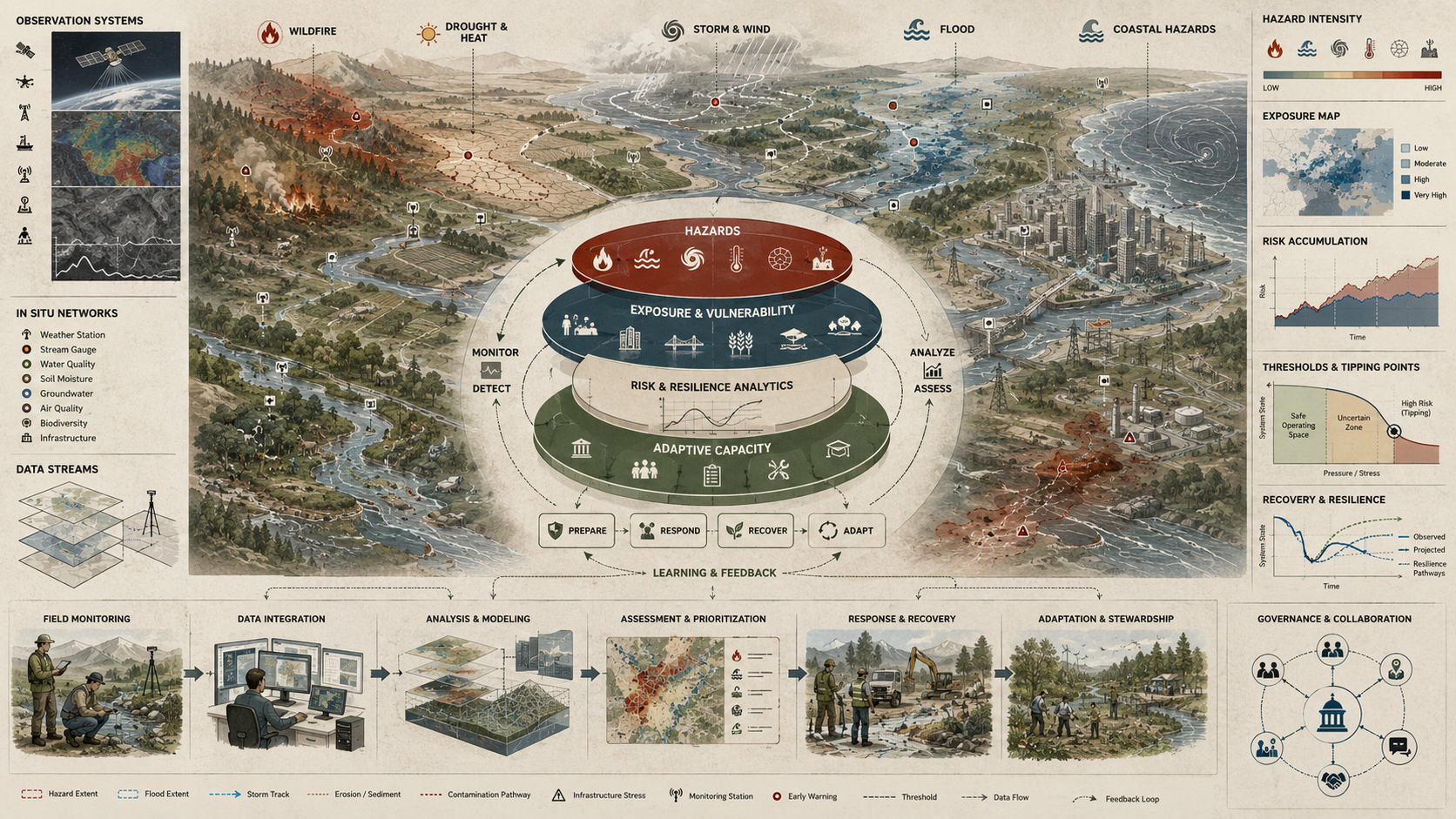
Monitoring environmental risk and resilience is an evidence problem, not only a prediction problem. Prediction asks what may happen. Resilience monitoring asks how prepared a system is, what functions are at risk, which groups are exposed, what thresholds are approaching, how recovery proceeds, and whether adaptive capacity improves after disturbance. A system that tracks rainfall but not floodplain exposure is incomplete. A system that measures temperature but not heat vulnerability is incomplete. A system that records wildfire extent but not ecological recovery is incomplete. A system that counts disaster losses but not recovery inequity is incomplete. Environmental resilience becomes visible only when monitoring connects hazard dynamics with system capacity, social vulnerability, ecological function, institutional learning, and long-term transformation.
Engineering Problem
The engineering problem is how to design monitoring systems that can observe environmental risk and resilience as dynamic system conditions rather than as isolated hazard events. A useful system must combine hazard signals, exposure data, vulnerability indicators, infrastructure dependencies, ecological condition, recovery metrics, adaptive capacity, uncertainty, and governance context. It must support decision-making across time: before disruption, during disruption, immediately after disruption, and through long-term recovery and adaptation.
This problem is technically difficult because risk and resilience are multi-dimensional. Hazards are often measurable through physical variables such as rainfall, streamflow, wind speed, temperature, soil moisture, pollutant concentration, fire weather, or sea level. Exposure requires spatial information about people, assets, ecosystems, infrastructure, services, and economic activity. Vulnerability requires social, ecological, institutional, and infrastructural indicators that are often unevenly measured. Capacity requires information about preparedness, redundancy, mobility, social support, emergency services, financial resources, governance, maintenance, and learning. Recovery requires longitudinal measurement after the event, not only impact assessment at the moment of damage.
Weak systems monitor the hazard and assume the rest. They may track storm intensity but not housing vulnerability; flood depth but not mobility constraints; wildfire perimeter but not smoke exposure; infrastructure outage but not service inequity; ecological disturbance but not recovery trajectory. Strong systems connect the hazard to the exposed system and then evaluate how that system absorbs, responds, recovers, adapts, or transforms.
| Engineering Tension | Why It Matters | Required Evidence |
|---|---|---|
| Hazard detection versus risk assessment | A hazard signal becomes risk only through exposure, vulnerability, and capacity. | Hazard layer, exposure map, vulnerability index, capacity indicators |
| Impact measurement versus recovery monitoring | Immediate damage does not reveal whether essential functions recover equitably or sustainably. | Recovery timeline, service restoration records, ecological function indicators |
| Single-event analysis versus cumulative stress | Repeated shocks and chronic stressors can erode resilience before a major event occurs. | Stress history, disturbance frequency, baseline degradation, compounding-risk log |
| Technical resilience versus social resilience | Infrastructure restoration may conceal uneven human recovery or community vulnerability. | Household recovery metrics, accessibility indicators, public service continuity |
| Threshold detection versus threshold governance | Detecting proximity to ecological or infrastructural thresholds is not enough without response rules. | Threshold registry, escalation protocol, trigger rationale, review log |
| Adaptation claims versus adaptive capacity | Adaptation actions can reduce future risk, shift risk, or reproduce inequity depending on implementation. | Adaptation evaluation, equity audit, residual-risk assessment |
The practical question is therefore: can the monitoring system show not only where hazards are occurring, but where resilience is strong or weak, where thresholds are approaching, how recovery is unfolding, and whether adaptation is actually reducing future risk?
Reference Architecture
A practical environmental risk and resilience monitoring architecture can be understood as a layered system that joins hazard observation, exposure mapping, vulnerability assessment, capacity monitoring, recovery tracking, threshold governance, and adaptive learning. The exact implementation may involve weather stations, river gauges, remote sensing, social vulnerability datasets, infrastructure monitoring, ecological indicators, public health data, emergency management systems, community reports, and decision-support dashboards. The underlying responsibilities remain consistent.
| Layer | Engineering Role | Primary Risk | Evidence Artifact |
|---|---|---|---|
| Hazard observation layer | Detects physical disturbance signals such as flood, heat, drought, wildfire, storm, contamination, or ecosystem stress. | Late detection, sparse coverage, sensor failure, false alarms | Hazard data stream, event catalog, sensor inventory, forecast record |
| Exposure layer | Maps people, infrastructure, ecosystems, assets, services, and economic activity located in hazard-prone areas. | Outdated exposure data, missing informal settlements, poor asset inventories | Exposure map, asset registry, population layer, ecosystem inventory |
| Vulnerability layer | Characterizes susceptibility to harm through social, ecological, institutional, and infrastructural conditions. | Oversimplified indices, missing marginalized populations, false comparability | Vulnerability profile, sensitivity indicators, social determinants dataset |
| Capacity layer | Tracks preparedness, redundancy, emergency services, financial resources, social support, governance, and adaptive capacity. | Invisible capacity gaps, untested plans, unequal ability to act | Capacity dashboard, preparedness record, service redundancy map |
| Threshold layer | Defines ecological, infrastructural, public-health, or operational thresholds that trigger review or action. | Thresholds chosen without context, delayed escalation, ungoverned triggers | Threshold registry, trigger log, escalation protocol, uncertainty band |
| Impact layer | Measures immediate environmental, social, economic, ecological, and infrastructure consequences after disruption. | Damage counts without distributional or functional context | Impact assessment, loss database, service interruption record |
| Recovery layer | Tracks return, restoration, reorganization, or transformation over time. | Premature closure of recovery tracking, hidden long-term harm | Recovery trajectory, restoration timeline, household/ecosystem recovery metrics |
| Adaptive learning layer | Uses post-event review and monitoring evidence to improve planning, design, governance, and future risk reduction. | Learning failure, rebuilding vulnerability, weak institutional memory | After-action review, adaptation plan, resilience investment log |
| Governance and equity layer | Ensures that monitoring systems are accountable, inclusive, reviewable, and sensitive to unequal risk. | Technocratic resilience claims that obscure injustice | Equity audit, public review record, community monitoring evidence |
This architecture treats resilience as a monitored condition rather than a rhetorical claim. It separates the physical hazard from the exposed system, the exposed system from its vulnerability, vulnerability from capacity, and immediate impact from recovery trajectory. Without those distinctions, monitoring systems may confuse hazard intensity with risk, restoration with resilience, or reconstruction with adaptation.
Implementation Pattern
A rigorous implementation begins by defining the hazard domain, affected system, decision context, spatial scale, time horizon, risk components, recovery functions, thresholds, and governance responsibilities. Engineers and researchers should specify what the system is intended to monitor: hazard probability, exposure, vulnerability, adaptive capacity, ecological resilience, infrastructure continuity, public health risk, recovery progress, or long-term transformation.
| Artifact | Purpose | Typical Format |
|---|---|---|
| Risk monitoring objective | Defines hazard type, affected system, decision context, scale, and users. | Markdown, YAML, design record |
| Hazard inventory | Documents monitored hazards, indicators, data sources, and forecast products. | CSV, database table, geospatial layer |
| Exposure registry | Maps people, assets, infrastructure, ecosystems, and services in hazard-prone areas. | GIS layer, SQL table, asset inventory |
| Vulnerability profile | Defines susceptibility indicators and social/ecological sensitivity measures. | CSV, index methodology, dashboard layer |
| Capacity profile | Tracks preparedness, redundancy, emergency resources, social support, and governance capacity. | YAML, survey data, preparedness registry |
| Threshold registry | Defines trigger values, uncertainty bands, escalation rules, and review responsibilities. | YAML, policy table, runbook |
| Impact assessment template | Captures damage, disruption, service loss, ecological harm, and affected populations. | Field form, database schema, incident report |
| Recovery trajectory table | Tracks restoration, reorganization, adaptation, and unresolved harm over time. | Time-series table, dashboard, longitudinal survey |
| Adaptive capacity assessment | Evaluates learning, flexibility, resources, institutions, and capacity to reduce future risk. | Scorecard, interview protocol, resilience assessment |
| Equity and coverage audit | Tests whether monitoring captures marginalized, vulnerable, and under-observed populations. | GIS overlay, audit report, community review record |
| Post-event learning record | Documents what changed after disturbance and whether future risk was reduced. | After-action review, adaptation log, governance update |
The implementation goal is to make resilience inspectable. A user should be able to see which hazards are monitored, who and what is exposed, which vulnerabilities matter, which capacities exist, what thresholds trigger action, how recovery is progressing, and whether adaptation is reducing risk or merely restoring the prior conditions that produced vulnerability.
Research-Grade Framing: Risk and Resilience as Dynamic System Conditions
A research-grade understanding of environmental risk and resilience begins by treating both as dynamic system conditions. Risk is not only the probability of a hazard. It is the relationship between hazardous conditions and the systems they affect. Resilience is not simply the speed of recovery. It is the capacity of a system to resist, absorb, accommodate, adapt, transform, and recover while preserving or renewing essential functions. These conditions change over time as infrastructure ages, ecosystems degrade or recover, communities move, institutions learn or fail to learn, and climate conditions shift.
This framing matters because resilience can be misunderstood as a return to normal. In many environmental contexts, normal conditions may already be unjust, degraded, or unsustainable. Returning a flood-prone neighborhood to the same housing insecurity, drainage limitations, and insurance vulnerability is not genuine resilience. Restoring a river to pre-disaster flow while ignoring habitat fragmentation, nutrient loading, or governance failure is not ecological resilience. Rebuilding infrastructure without accounting for future climate conditions can deepen future risk. Monitoring systems must therefore distinguish restoration from adaptation and adaptation from transformation.
Environmental resilience also has a threshold dimension. Systems may absorb stress for long periods and then shift abruptly when thresholds are crossed. A lake may move toward eutrophication. A forest may shift to a different fire regime. A wetland may lose buffering capacity. A drainage network may fail once rainfall intensity exceeds design assumptions. A community may appear to recover until repeated shocks exhaust savings, trust, labor, or institutional capacity. Monitoring must therefore detect not only average conditions but proximity to critical thresholds, loss of redundancy, cumulative stress, and declining recovery capacity.
| Limited Pattern | Resilience-Oriented Pattern | Why the Shift Matters |
|---|---|---|
| Track hazard intensity | Track hazard, exposure, vulnerability, and capacity together | Prevents physical hazard data from being mistaken for risk assessment |
| Measure damage | Measure functional disruption and recovery trajectory | Shows whether systems regain essential functions over time |
| Record event impacts | Track cumulative stress and repeated disturbance | Reveals erosion of resilience before catastrophic failure |
| Report aggregate recovery | Report differentiated recovery by community, ecosystem, and service | Prevents average recovery from hiding unequal harm |
| Assume rebuilding equals resilience | Evaluate whether reconstruction reduces future risk | Distinguishes recovery from risk reproduction |
| Use static indicators | Monitor adaptive capacity, learning, and threshold dynamics | Captures whether systems can respond to changing conditions |
Risk and resilience monitoring is therefore not only about environmental data. It is about whether environmental data can be connected to the social, ecological, infrastructural, and institutional conditions that determine harm, recovery, and future vulnerability.
Formal Model: Hazard, Exposure, Vulnerability, Capacity, and Recovery
A useful formal model separates hazard, exposure, vulnerability, capacity, impact, recovery, and adaptive capacity. Let \(H\) represent hazard intensity or probability, \(E\) exposure, \(V\) vulnerability, \(C\) coping and adaptive capacity, \(I\) impact, \(R\) recovery, and \(A\) adaptive capacity. Risk can be represented as a function of hazard, exposure, vulnerability, and capacity.
\mathrm{Risk} = f(H, E, V, C)
\]
Interpretation: Environmental risk depends on the interaction of hazard, exposure, vulnerability, and capacity. A strong monitoring system must observe all four dimensions rather than treating the hazard as the whole risk.
I_t = H_t \times E_t \times V_t \times (1 – C_t)
\]
Interpretation: Impact at time \(t\) can be approximated as a function of hazard intensity, exposure, vulnerability, and insufficient capacity. This simplified form highlights why capacity can reduce realized harm.
R_t = \frac{F_t}{F_0}
\]
Interpretation: Recovery can be measured as the proportion of essential function \(F_t\) restored relative to pre-event function \(F_0\). This should be interpreted carefully when pre-event conditions were already unjust or degraded.
T_{\mathrm{proximity}} = \frac{X_t}{X_{\mathrm{threshold}}}
\]
Interpretation: Threshold proximity compares current stress \(X_t\) to a critical threshold. Values near or above 1 indicate that a system may be approaching a regime shift, failure point, or escalation condition.
A_{\mathrm{capacity}} = g(L, R_d, S, G, M, P)
\]
Interpretation: Adaptive capacity depends on learning \(L\), redundancy \(R_d\), social support \(S\), governance \(G\), material resources \(M\), and planning capacity \(P\). These are not purely technical variables.
\Delta \mathrm{Risk} = \mathrm{Risk}_{\mathrm{post}} – \mathrm{Risk}_{\mathrm{pre}}
\]
Interpretation: Post-event monitoring should evaluate whether recovery and adaptation reduce, reproduce, or increase future risk. A negative value indicates risk reduction; a positive value indicates worsening risk.
This formal structure prevents resilience from becoming vague. It shows that monitoring must capture hazard signals, exposed systems, vulnerability conditions, capacity indicators, recovery functions, threshold proximity, and post-event change in risk. The equations are not meant to eliminate judgment. They make explicit what must be measured, documented, and debated.
What Is Environmental Risk and Resilience Monitoring?
Environmental risk and resilience monitoring is the systematic observation of hazards, exposed systems, vulnerability, capacity, disturbance impacts, recovery trajectories, thresholds, and adaptive responses. Its purpose is to support decisions that reduce harm, protect ecosystems, strengthen infrastructure, improve public health, and help communities prepare for and recover from environmental disruption. It is used in climate adaptation, disaster risk reduction, ecosystem management, public health, infrastructure planning, watershed governance, coastal resilience, wildfire management, urban heat planning, and sustainability strategy.
The field sits at the intersection of environmental monitoring, risk analysis, resilience science, disaster management, ecological systems thinking, infrastructure governance, and social vulnerability assessment. It requires data from many sources: physical sensors, remote sensing, field surveys, social indicators, ecological datasets, infrastructure systems, emergency response records, insurance data, public health surveillance, community reports, and administrative records. No single dataset can describe resilience. Resilience is relational, functional, temporal, and unevenly distributed.
A monitoring system becomes resilience-oriented when it moves beyond event detection and asks how systems behave under stress. Does the community have protective capacity? Are critical services redundant? Are vulnerable populations reached by warnings? Does the ecosystem recover structure and function? Are repeated shocks eroding resilience? Are adaptation investments reducing future risk? Are monitoring gaps concentrated among already marginalized communities? These are not secondary questions. They are central to whether environmental monitoring serves public protection and long-term stewardship.
Hazards, Exposure, Vulnerability, and Capacity
Hazard monitoring is the foundation of many risk systems, but hazard alone does not determine disaster or ecological harm. A severe rainfall event becomes a flood disaster through watershed condition, drainage capacity, land cover, infrastructure, housing location, warning systems, mobility, governance, and social vulnerability. Heat becomes deadly through exposure, housing quality, tree canopy, air conditioning access, labor conditions, health status, social isolation, and public response. Wildfire risk depends not only on fire weather but also on vegetation, land management, ignition sources, building practices, evacuation capacity, smoke exposure, and ecosystem condition.
Exposure describes who or what is located where harm can occur. It includes people, housing, roads, hospitals, schools, power systems, water systems, ecosystems, farms, cultural sites, industrial facilities, and economic activity. Exposure data must be current, spatially precise, and sensitive to informal or under-documented conditions. A monitoring system that excludes informal settlements, unhoused populations, undocumented workers, subsistence livelihoods, or under-mapped ecological assets may systematically underestimate risk.
Vulnerability describes susceptibility to harm. It may arise from poverty, health burdens, age, disability, housing insecurity, ecological degradation, infrastructure fragility, social isolation, institutional neglect, limited access to information, or historical injustice. Capacity describes the ability to prepare, cope, respond, recover, adapt, and transform. Capacity may include emergency services, social networks, financial resources, governance, infrastructure redundancy, local knowledge, ecosystem buffering, and institutional learning. Risk monitoring must hold these dimensions together.
| Component | Monitoring Question | Example Indicators |
|---|---|---|
| Hazard | What environmental disturbance is possible, emerging, or occurring? | Rainfall intensity, river stage, heat index, drought index, fire weather, pollutant concentration |
| Exposure | Who and what are located in harm’s way? | Population, buildings, roads, utilities, ecosystems, hospitals, schools, agricultural land |
| Vulnerability | Which conditions increase susceptibility to harm? | Income, age, disability, housing quality, ecological degradation, infrastructure fragility |
| Capacity | Which resources reduce harm or support response and recovery? | Emergency access, social support, redundancy, savings, governance, public trust, ecosystem buffers |
| Risk | How do hazard, exposure, vulnerability, and capacity interact? | Composite risk score, scenario loss estimate, hotspot map, risk pathway profile |
Risk monitoring becomes useful when it shows how the same hazard produces different consequences across places and populations. That is where environmental monitoring becomes a tool for justice, preparedness, and risk reduction rather than only physical observation.
Thresholds, Tipping Points, and Regime Shifts
Many environmental systems do not change smoothly. They may absorb stress for long periods and then shift rapidly when thresholds are crossed. Monitoring resilience therefore requires attention to thresholds, tipping points, nonlinear feedbacks, and regime shifts. A lake may cross a nutrient threshold and become dominated by algal blooms. A forest may shift toward a more fire-prone state. A coral reef may lose resilience after repeated heat stress. A drainage system may fail when rainfall exceeds design capacity. A community may lose recovery capacity after repeated displacement or economic shocks.
Threshold monitoring is difficult because thresholds are often uncertain, context-specific, and difficult to observe directly. Some thresholds are biophysical, such as water temperature, soil moisture, flood stage, pollutant concentration, or vegetation stress. Others are infrastructural, such as drainage capacity, power-load limits, road access, or treatment-plant capacity. Others are social or institutional, such as shelter capacity, public trust, household savings, staffing limits, or emergency response fatigue.
A strong threshold system should document the monitored variable, threshold rationale, uncertainty band, escalation rule, and response protocol. It should also recognize that thresholds can be contested. A technical threshold for infrastructure failure may differ from a public-health threshold for harm. An ecological threshold may be uncertain but still require precaution. A community may experience unacceptable harm before official thresholds are crossed. Threshold governance is therefore as important as threshold detection.
| Threshold Type | Example | Monitoring Need |
|---|---|---|
| Hydrological threshold | River stage exceeds flood-warning or flood-damage level | Gauge data, rainfall forecasts, exposure map, evacuation triggers |
| Ecological threshold | Nutrient loading pushes a lake toward eutrophication | Water chemistry, algal indicators, oxygen levels, land-use pressure |
| Public-health threshold | Heat index or air pollution reaches dangerous levels for vulnerable groups | Exposure monitoring, vulnerability overlay, cooling or shelter capacity |
| Infrastructure threshold | Stormwater, power, or transport system exceeds design capacity | Load monitoring, outage records, asset condition, redundancy assessment |
| Social-capacity threshold | Repeated shocks exhaust household, institutional, or emergency-response capacity | Recovery surveys, assistance uptake, staffing, displacement, financial stress |
| Governance threshold | Institutional trust, coordination, or response capacity breaks down | After-action review, communications audit, service-delivery monitoring |
Threshold monitoring helps systems act before damage becomes irreversible or recovery becomes much more difficult. It turns environmental monitoring into anticipatory governance.
Recovery Monitoring and Post-Disturbance Trajectories
Recovery monitoring asks what happens after disturbance. It tracks whether essential functions return, whether ecological conditions recover, whether infrastructure services are restored, whether displaced people can return safely, whether livelihoods stabilize, and whether future risk is reduced. Recovery is not a single event. It is a trajectory that may unfold over days, months, years, or decades.
Post-event monitoring is often too short. Damage assessments may occur quickly, but long-term recovery is uneven. Some neighborhoods regain services quickly while others face prolonged disruption. Some ecosystems show visible regrowth while losing biodiversity or function. Some households return to housing but remain financially destabilized. Some infrastructure is rebuilt while future climate risk remains unaddressed. A resilience-oriented monitoring system must therefore continue after immediate emergency response has ended.
Recovery should also be evaluated against function, not only replacement. Reopening a road, restoring power, or rebuilding a facility does not necessarily mean resilience has improved. The question is whether the system can provide essential functions under future stress, whether recovery reduces vulnerability, and whether reconstruction avoids reproducing the same risk conditions.
| Recovery Dimension | Monitoring Question | Example Indicators |
|---|---|---|
| Service recovery | Are essential services restored? | Power restoration, water service, healthcare access, transport availability |
| Household recovery | Can affected people return, rebuild, and stabilize? | Housing security, displacement duration, income recovery, assistance access |
| Infrastructure recovery | Are damaged systems restored or upgraded? | Asset condition, repair progress, redundancy, design-standard updates |
| Ecological recovery | Are ecological functions, habitats, and species recovering? | Vegetation recovery, water quality, habitat condition, biodiversity indicators |
| Institutional recovery | Are agencies learning, coordinating, and improving? | After-action review, policy updates, staffing, funding, preparedness improvements |
| Risk reduction | Does recovery reduce future risk? | Mitigation investments, exposure reduction, adaptation actions, residual risk |
Recovery monitoring makes resilience visible over time. It asks whether systems return, reorganize, improve, or deteriorate. Without this longitudinal view, resilience becomes a claim rather than an observable condition.
Adaptive Capacity, Learning, and Transformation
Adaptive capacity is the ability to adjust to changing conditions, learn from disturbance, reorganize resources, and reduce future vulnerability. It includes technical capacity, financial capacity, governance capacity, social capacity, ecological capacity, and institutional memory. A system may recover from one event but lack adaptive capacity if it does not change the conditions that produced harm.
Monitoring adaptive capacity requires indicators that are not always captured in environmental datasets. These may include planning quality, maintenance investment, public trust, social networks, emergency training, redundancy, local knowledge, funding flexibility, institutional coordination, and the ability to revise policy after evidence changes. Adaptive capacity is often weakest where it is most needed: in under-resourced communities, degraded ecosystems, aging infrastructure systems, and jurisdictions facing repeated shocks without adequate support.
Transformation is sometimes necessary when adaptation within the existing system is insufficient. A settlement may need relocation from a high-risk floodplain. A water system may need new governance under long-term drought. A fire-prone landscape may require changed land-management practices. A city may need to redesign heat resilience around housing, labor, health, and tree canopy rather than emergency response alone. Monitoring systems should be able to distinguish incremental adaptation from transformational change.
| Capacity Dimension | Monitoring Question | Example Evidence |
|---|---|---|
| Learning capacity | Does the system incorporate post-event evidence? | After-action review, updated plans, changed thresholds, training records |
| Resource capacity | Are financial, technical, and human resources available? | Funding, staffing, technical support, maintenance capacity |
| Governance capacity | Can institutions coordinate across sectors and scales? | Interagency agreements, planning processes, public accountability mechanisms |
| Social capacity | Can communities organize, communicate, and support one another? | Social networks, community organizations, trust, mutual aid, local leadership |
| Ecological capacity | Can ecosystems absorb stress and recover function? | Habitat connectivity, biodiversity, soil health, water quality, buffer capacity |
| Transformative capacity | Can the system change when existing arrangements are no longer viable? | Managed retreat planning, governance reform, land-use change, infrastructure redesign |
Adaptive capacity monitoring is essential because resilience is not simply what happens during a shock. It is also what a system learns, changes, and becomes afterward.
Resilience Indicators and Measurement Design
Resilience indicators must be designed carefully because poor indicators can make systems appear stronger than they are. A single resilience score may be useful for communication, but it can also hide uncertainty, unequal exposure, social vulnerability, and ecological complexity. Good indicator systems preserve the underlying dimensions so that users can see why a place, ecosystem, or infrastructure system appears resilient or fragile.
Indicators should be tied to essential functions. For a watershed, those functions may include flood buffering, water quality, habitat support, and reliable flow. For a city, they may include safe housing, mobility, cooling, emergency response, power, water, healthcare, and public communication. For an ecosystem, they may include biodiversity, regeneration, nutrient cycling, habitat connectivity, and resistance to invasive species. For infrastructure, they may include service continuity, redundancy, repairability, and safe failure.
Indicator design should also distinguish resilience inputs, processes, outputs, and outcomes. A city may have a resilience plan as an input, but that does not mean vulnerable residents experience reduced heat exposure as an outcome. A community may receive adaptation funding, but that does not guarantee recovery capacity. A wetland restoration project may be completed, but the ecological function may not yet have returned. Monitoring systems must track the whole chain.
| Indicator Type | Example | Interpretation Risk |
|---|---|---|
| Input indicator | Adaptation funding, emergency staff, restoration budget | Resources may not produce effective outcomes. |
| Process indicator | Planning meetings, drills, maintenance cycles, public engagement | Activity may not equal preparedness or trust. |
| Output indicator | Plans completed, infrastructure repaired, sensors deployed | Outputs may not reduce actual risk. |
| Outcome indicator | Reduced flood losses, faster service restoration, lower heat mortality | Outcomes may be hard to attribute to one intervention. |
| Equity indicator | Differential recovery by neighborhood, income, age, disability, or exposure group | Aggregate improvement may hide unequal harm. |
| Ecological function indicator | Habitat connectivity, water quality, species recovery, soil stability | Visible recovery may not mean functional recovery. |
The strongest resilience indicators are not merely easy to measure. They are meaningful, interpretable, disaggregated, time-sensitive, and linked to decisions. They make resilience open to review rather than reducing it to a branding term.
Risk Signals, Early Warning, and Anticipatory Governance
Risk and resilience monitoring supports early warning by detecting not only immediate hazard signals but also preconditions of harm. In many situations, the most important warning is not the first detection of a hazard but the recognition that exposure, vulnerability, or capacity conditions have made the system fragile. A moderate storm can be catastrophic if drainage is blocked, emergency shelters are inaccessible, communications are mistrusted, or recovery capacity is already exhausted.
Anticipatory governance uses monitoring to act before harm fully unfolds. It may involve pre-positioning resources, issuing public-health alerts, lowering reservoir levels, opening cooling centers, inspecting infrastructure, shifting operations, supporting vulnerable households, or delaying activities that increase exposure. The value of monitoring is therefore not only informational. It is temporal. It creates time for protective action.
Risk signals should be layered. A flood-monitoring system should combine rainfall forecasts, river stage, soil saturation, drainage capacity, exposure, evacuation constraints, and vulnerable populations. A heat-risk system should combine forecast temperature, humidity, night-time cooling, urban heat islands, housing quality, health vulnerability, labor exposure, and cooling access. A wildfire-risk system should combine vegetation conditions, weather, ignition probability, evacuation routes, smoke exposure, and ecological recovery. The stronger the integration, the more useful the warning.
| Signal Type | Example | Possible Action |
|---|---|---|
| Hazard signal | Forecast rainfall, heat index, fire weather, pollutant spike | Issue watch, increase monitoring, activate response protocol |
| Exposure signal | Population or assets in affected zone | Target warnings, prioritize inspections, stage resources |
| Vulnerability signal | High-risk households, medically vulnerable groups, degraded ecosystems | Direct outreach, social support, protective service deployment |
| Capacity signal | Shelter limits, outage repair backlog, low staffing, poor access | Mutual aid, resource mobilization, operational adjustment |
| Threshold signal | Approaching ecological, hydrological, or infrastructural trigger | Escalate warning, restrict activity, implement protective action |
| Recovery signal | Slow restoration or unequal recovery after event | Extend assistance, revise recovery strategy, address residual risk |
Early warning becomes more powerful when it is grounded in resilience evidence. It is not enough to warn that a hazard is coming. Institutions must understand who is at risk, why they are at risk, and what protective capacity exists.
Equity, Unequal Exposure, and Environmental Justice
Environmental risk and resilience are unevenly distributed. Communities facing poverty, racial exclusion, colonial dispossession, environmental racism, housing insecurity, poor infrastructure, limited mobility, inadequate healthcare, or political neglect often experience higher exposure and lower recovery capacity. Monitoring systems that ignore these conditions can reproduce injustice by making some risks visible while leaving others under-measured.
Equity-centered resilience monitoring asks who is exposed, who receives warnings, who can act, who recovers, who is displaced, who receives assistance, who is excluded from decision-making, and who benefits from adaptation investments. It also asks whether monitoring itself is uneven. Some neighborhoods may have dense sensor coverage while others are absent from official datasets. Some environmental harms may be measurable only because communities have fought to document them. Some recovery metrics may count infrastructure restoration while ignoring renters, informal workers, migrants, disabled residents, or Indigenous communities.
Environmental justice requires monitoring systems to be disaggregated, participatory where appropriate, and accountable to affected communities. This does not mean abandoning scientific rigor. It means expanding rigor to include coverage audits, community validation, lived exposure, historical context, unequal recovery, and the limits of official data. A resilience system that cannot see unequal harm cannot support just adaptation.
| Equity Dimension | Monitoring Question | Evidence Needed |
|---|---|---|
| Exposure inequality | Are some groups more exposed to hazards? | Hazard overlays, demographic data, housing and infrastructure maps |
| Warning inequality | Do warnings reach all affected communities in usable form? | Communication audit, language access, disability access, channel coverage |
| Response inequality | Can exposed groups take protective action? | Mobility, shelter access, transport, caregiving burdens, work constraints |
| Recovery inequality | Who recovers quickly and who remains harmed? | Disaggregated recovery metrics, assistance access, displacement duration |
| Data inequality | Which harms or communities are missing from monitoring systems? | Coverage audit, community reports, participatory monitoring, gap assessment |
| Adaptation inequality | Who benefits from resilience investments? | Investment map, benefit distribution, residual-risk analysis |
Equity is not an add-on to resilience monitoring. It is part of whether resilience exists at all. A system that recovers for some while abandoning others is not resilient in a morally serious or analytically complete sense.
Applications Across Environmental Domains
Risk and resilience monitoring applies across many environmental domains. In flood systems, it connects rainfall, river stage, drainage, land cover, exposure, evacuation capacity, and recovery. In heat systems, it connects temperature, humidity, urban form, housing quality, tree canopy, public health, cooling access, and labor exposure. In wildfire systems, it connects vegetation, fire weather, ignition risk, evacuation routes, smoke exposure, housing vulnerability, and ecological recovery. In water systems, it connects drought, contamination, infrastructure reliability, ecosystem flows, and public access. In biodiversity systems, it connects habitat loss, fragmentation, disturbance, species decline, and ecological adaptive capacity.
The same conceptual architecture applies across scales. A neighborhood resilience system may monitor heat exposure and social vulnerability. A watershed resilience system may monitor flood buffering, water quality, land use, and ecological recovery. A coastal resilience system may monitor sea-level rise, storm surge, wetland condition, infrastructure exposure, and relocation capacity. A national resilience system may track climate hazards, public infrastructure, disaster losses, adaptive capacity, and investment outcomes.
| Domain | Risk Signals | Resilience Signals |
|---|---|---|
| Flood and watershed systems | Rainfall, streamflow, soil saturation, impervious cover, floodplain exposure | Floodplain restoration, drainage capacity, evacuation access, recovery time |
| Urban heat | Heat index, night-time temperatures, tree canopy gaps, vulnerable populations | Cooling access, shade investment, public-health outreach, reduced heat illness |
| Wildfire and smoke | Fire weather, fuel conditions, ignition risk, smoke dispersion, housing exposure | Defensible space, evacuation readiness, ecological recovery, smoke protection |
| Drought and water security | Precipitation deficits, reservoir levels, groundwater decline, demand stress | Demand flexibility, ecosystem flows, water reuse, governance coordination |
| Coastal systems | Sea-level rise, surge exposure, erosion, wetland loss, infrastructure vulnerability | Wetland buffering, adaptive land use, relocation planning, service continuity |
| Ecosystem resilience | Habitat fragmentation, invasive species, pollution, warming, hydrological change | Biodiversity, connectivity, regeneration, ecological function, adaptive management |
Across these domains, resilience monitoring is strongest when it links physical signals to functional outcomes. The question is not only whether the hazard occurred, but whether the affected system retained, recovered, or renewed the functions that matter.
Common Failure Modes
Risk and resilience monitoring can fail in several characteristic ways. The most common is hazard reductionism: treating hazard measurement as if it were the same as risk measurement. A system that monitors rainfall, heat, wildfire, or pollution without exposure, vulnerability, and capacity data may be scientifically useful but incomplete for decision-making. Another failure is recovery blindness: ending monitoring after immediate impact assessment and failing to track long-term restoration, displacement, ecological recovery, and residual risk.
A third failure is resilience theater. Institutions may publish resilience dashboards, plans, or scores that appear sophisticated but do not reveal unequal exposure, weak capacity, threshold proximity, or post-event learning. Resilience can become a branding term unless monitoring systems connect claims to evidence. A fourth failure is aggregation bias. Regional recovery may look strong on average while particular neighborhoods, ecosystems, or social groups remain harmed. A fifth failure is adaptation misclassification. Actions labeled adaptive may shift risk elsewhere, deepen inequality, or lock in future vulnerability.
| Failure Mode | Consequence | Prevention |
|---|---|---|
| Hazard reductionism | Hazard signals are mistaken for complete risk assessment. | Integrate exposure, vulnerability, and capacity indicators. |
| Recovery blindness | Long-term harm and unequal recovery remain invisible. | Maintain longitudinal recovery tracking after events. |
| Resilience theater | Dashboards or plans substitute for evidence of functional resilience. | Tie indicators to essential functions, thresholds, and outcomes. |
| Aggregation bias | Average improvement hides localized or marginalized harm. | Disaggregate by place, population, ecosystem, and service. |
| Threshold neglect | Systems cross critical limits before governance responds. | Maintain threshold registries and escalation rules. |
| Adaptation misclassification | Projects labeled as adaptation reproduce or shift future risk. | Evaluate residual risk, equity, and long-term outcomes. |
| Data inequality | Under-observed communities or ecosystems remain under-protected. | Conduct coverage audits and include community evidence where appropriate. |
The deepest failure is confusing restoration with justice. A system can restore infrastructure while leaving people vulnerable, restore services while ignoring ecological degradation, or rebuild quickly while increasing future exposure. Resilience monitoring must be capable of seeing those failures.
Deployment Readiness Gate
Before an environmental risk and resilience monitoring system is used for planning, public communication, early warning, funding decisions, adaptation evaluation, or recovery governance, it should pass a deployment readiness gate. This gate should test whether the system is conceptually complete, technically reliable, socially accountable, and fit for the decisions it is expected to support.
| Readiness Area | Required Question | Pass Evidence |
|---|---|---|
| Hazard readiness | Are hazard signals valid, timely, and spatially appropriate? | Sensor validation, forecast skill, hazard-data quality report |
| Exposure readiness | Are exposed populations, assets, services, and ecosystems mapped? | Exposure registry, asset inventory, population and ecosystem layers |
| Vulnerability readiness | Are susceptibility indicators justified and disaggregated? | Vulnerability methodology, equity review, sensitivity analysis |
| Capacity readiness | Are preparedness, redundancy, and adaptive capacity represented? | Capacity profile, emergency resource inventory, governance assessment |
| Threshold readiness | Are triggers, uncertainty bands, and escalation rules defined? | Threshold registry, trigger rationale, response protocol |
| Recovery readiness | Can the system track long-term recovery and residual risk? | Recovery indicators, follow-up schedule, post-event review plan |
| Equity readiness | Does the system identify unequal exposure, warning, response, and recovery? | Coverage audit, disaggregated indicators, community review pathway |
| Governance readiness | Are responsibilities, data stewardship, and review mechanisms clear? | Governance policy, access rules, accountability log |
This readiness gate prevents risk and resilience systems from becoming visually impressive but analytically shallow. A system should not claim to monitor resilience unless it can show what functions are at risk, who is affected, what capacity exists, how recovery is measured, and whether future risk is being reduced.
Data and Configuration Artifacts
A reproducible risk and resilience monitoring workflow should include explicit artifacts for hazards, exposure, vulnerability, capacity, thresholds, impacts, recovery, adaptive capacity, and equity. These artifacts make the monitoring system auditable and reusable across events, places, and planning cycles.
| Artifact | Purpose | Suggested Path |
|---|---|---|
| Risk monitoring manifest | Defines monitored hazards, spatial scale, decision use, and affected systems. | config/risk_monitoring_manifest.yml |
| Hazard inventory | Lists hazard indicators, sensors, forecasts, and event records. | data/hazard_inventory.csv |
| Exposure registry | Documents exposed populations, assets, services, ecosystems, and infrastructure. | data/exposure_registry.csv |
| Vulnerability and capacity table | Combines susceptibility, coping capacity, and adaptive capacity indicators. | data/vulnerability_capacity_profile.csv |
| Threshold registry | Defines monitored thresholds, warning bands, uncertainty ranges, and action triggers. | config/threshold_registry.yml |
| Recovery trajectory table | Tracks functional recovery over time after disturbance. | data/recovery_trajectories.csv |
| Adaptive capacity assessment | Documents learning, redundancy, governance, social support, and transformation capacity. | outputs/adaptive_capacity_assessment.md |
| Equity and coverage audit | Identifies monitoring gaps and unequal risk conditions. | outputs/equity_coverage_audit.md |
These artifacts support a monitoring system that can be inspected before, during, and after disruption. They make clear that resilience is not simply an outcome label but a chain of evidence.
Mathematical Lens: Risk, Recovery, Threshold Proximity, and Adaptive Capacity
Several simple metrics can help evaluate environmental risk and resilience monitoring systems. These metrics are not substitutes for local knowledge or domain expertise, but they make system assumptions explicit.
R_{\mathrm{risk}} = H \times E \times V \times (1 – C)
\]
Interpretation: Risk increases with hazard, exposure, and vulnerability, and decreases as coping or adaptive capacity improves. The formula is simplified, but it forces monitoring systems to observe more than the hazard.
P_{\mathrm{threshold}} = \frac{X_t}{X_{\mathrm{critical}}}
\]
Interpretation: Threshold proximity compares current stress or system state to a critical threshold. Values near 1 require review because small changes may produce disproportionate harm.
R_{\mathrm{recovery}}(t) = \frac{F(t)}{F_{\mathrm{target}}}
\]
Interpretation: Recovery ratio measures restored function over time relative to a target function. The target should be chosen carefully when pre-event conditions were already fragile or unjust.
S_{\mathrm{resilience}} = w_1C + w_2R_d + w_3L + w_4G + w_5E_c – w_6V
\]
Interpretation: A resilience score can combine capacity \(C\), redundancy \(R_d\), learning \(L\), governance \(G\), ecological condition \(E_c\), and vulnerability \(V\). Composite scores should remain transparent and disaggregated.
\Delta R_{\mathrm{risk}} = R_{\mathrm{risk,post}} – R_{\mathrm{risk,pre}}
\]
Interpretation: Post-event evaluation should ask whether risk decreased or increased after recovery and adaptation. Rebuilding is not enough if future risk rises.
These metrics help translate resilience language into measurable structure. They also reveal where judgment is required: choosing thresholds, weighting indicators, defining essential functions, and deciding what level of residual risk is acceptable.
Python Workflow: Risk and Resilience Indicator Scoring
A Python workflow can demonstrate how hazard, exposure, vulnerability, capacity, threshold proximity, and recovery indicators can be combined into a transparent monitoring table. The purpose is not to create a universal risk score, but to show how risk and resilience components can be evaluated together while keeping the underlying dimensions visible.
from dataclasses import dataclass
from typing import List
import pandas as pd

@dataclass
class ResilienceUnit:
    unit_id: str
    domain: str
    hazard_score: float
    exposure_score: float
    vulnerability_score: float
    capacity_score: float
    redundancy_score: float
    learning_score: float
    governance_score: float
    ecological_condition_score: float
    threshold_proximity: float
    recovery_ratio: float

def risk_score(unit: ResilienceUnit) -> float:
    """
    Simplified risk score.
    Higher hazard, exposure, and vulnerability increase risk.
    Higher capacity reduces risk.
    """
    return (
        unit.hazard_score *
        unit.exposure_score *
        unit.vulnerability_score *
        (1 - unit.capacity_score)
    )

def resilience_score(unit: ResilienceUnit) -> float:
    """
    Simplified resilience score.
    Composite scores should always remain disaggregated in reporting.
    """
    return (
        0.20 * unit.capacity_score +
        0.15 * unit.redundancy_score +
        0.15 * unit.learning_score +
        0.15 * unit.governance_score +
        0.15 * unit.ecological_condition_score +
        0.10 * unit.recovery_ratio -
        0.10 * unit.vulnerability_score
    )

def review_priority(unit: ResilienceUnit, risk: float, resilience: float) -> str:
    if unit.threshold_proximity >= 0.90:
        return "threshold_escalation_review"
    if risk >= 0.20 and resilience < 0.55:
        return "high_risk_low_resilience_review"
    if unit.recovery_ratio < 0.60:
        return "recovery_delay_review"
    if unit.capacity_score < 0.50:
        return "capacity_gap_review"
    return "routine_monitoring"

units: List[ResilienceUnit] = [
    ResilienceUnit("urban-heat-zone-001", "urban_heat", 0.86, 0.82, 0.74, 0.42, 0.35, 0.52, 0.58, 0.40, 0.91, 0.55),
    ResilienceUnit("watershed-002", "flood_risk", 0.78, 0.65, 0.55, 0.62, 0.58, 0.64, 0.67, 0.72, 0.82, 0.70),
    ResilienceUnit("coastal-wetland-003", "coastal_resilience", 0.70, 0.60, 0.48, 0.66, 0.70, 0.60, 0.64, 0.78, 0.74, 0.76),
    ResilienceUnit("forest-fire-zone-004", "wildfire", 0.88, 0.58, 0.62, 0.46, 0.44, 0.50, 0.55, 0.52, 0.93, 0.50),
]

records = []
for unit in units:
    risk = risk_score(unit)
    resilience = resilience_score(unit)
    records.append({
        "unit_id": unit.unit_id,
        "domain": unit.domain,
        "risk_score": round(risk, 3),
        "resilience_score": round(resilience, 3),
        "threshold_proximity": unit.threshold_proximity,
        "recovery_ratio": unit.recovery_ratio,
        "review_priority": review_priority(unit, risk, resilience)
    })

df = pd.DataFrame(records)
print(df.sort_values(["review_priority", "risk_score"], ascending=[True, False]))
This workflow keeps risk and resilience dimensions visible rather than hiding them inside a single unexplained number. In production, each score would require domain-specific validation, uncertainty bands, and governance review.
R Workflow: Recovery Trajectories and Resilience Reporting
An R workflow can support recovery reporting by tracking function restoration over time and comparing recovery trajectories across places, services, or ecosystems. This is especially useful for post-event analysis, equity review, and longitudinal resilience assessment.
library(dplyr)
library(readr)

recovery <- tribble(
  ~unit_id, ~domain, ~days_after_event, ~function_restored, ~target_function, ~vulnerability_score,
  "urban-heat-zone-001", "urban_heat", 7, 0.35, 1.00, 0.74,
  "urban-heat-zone-001", "urban_heat", 30, 0.55, 1.00, 0.74,
  "urban-heat-zone-001", "urban_heat", 90, 0.68, 1.00, 0.74,
  "watershed-002", "flood_risk", 7, 0.42, 1.00, 0.55,
  "watershed-002", "flood_risk", 30, 0.70, 1.00, 0.55,
  "watershed-002", "flood_risk", 90, 0.86, 1.00, 0.55,
  "coastal-wetland-003", "coastal_resilience", 7, 0.25, 1.00, 0.48,
  "coastal-wetland-003", "coastal_resilience", 30, 0.46, 1.00, 0.48,
  "coastal-wetland-003", "coastal_resilience", 90, 0.63, 1.00, 0.48
)

recovery_summary <- recovery %>%
  mutate(
    recovery_ratio = function_restored / target_function,
    delayed_recovery = recovery_ratio < 0.60 & days_after_event >= 30
  ) %>%
  group_by(unit_id, domain) %>%
  summarise(
    latest_day = max(days_after_event),
    latest_recovery_ratio = recovery_ratio[which.max(days_after_event)],
    highest_vulnerability = max(vulnerability_score),
    recovery_status = case_when(
      latest_recovery_ratio >= 0.85 ~ "substantial_recovery",
      latest_recovery_ratio >= 0.60 ~ "partial_recovery",
      TRUE ~ "delayed_recovery"
    ),
    .groups = "drop"
  )

print(recovery_summary)

write_csv(recovery_summary, "outputs/recovery_trajectory_summary.csv")
The R workflow emphasizes that recovery is temporal. A single post-event snapshot cannot show whether systems are recovering, stagnating, reorganizing, or becoming more fragile. Longitudinal monitoring is essential for meaningful resilience assessment.
Systems Code: Sensors, Recovery Dashboards, Risk APIs, and Resilience Evidence
Environmental risk and resilience monitoring is a full-stack systems problem. It includes hazard sensors, geospatial exposure models, vulnerability datasets, recovery surveys, ecological monitoring, infrastructure telemetry, early warning systems, public dashboards, and governance records. A companion repository should therefore include both analytical workflows and systems-code scaffolding.
| Language / Tool | Role in Companion Repository | Example Use |
|---|---|---|
| Python | Risk scoring, geospatial overlays, threshold monitoring, recovery analytics | Hazard-exposure-vulnerability-capacity scoring workflow |
| R | Recovery reporting, resilience indicators, uncertainty summaries | Longitudinal recovery trajectory analysis |
| SQL | Risk registry, event records, recovery tables, threshold logs | Disaster-risk and resilience-monitoring database schema |
| Go | Risk API and operational health service | Serve current risk status or monitoring-system health checks |
| Rust | Safe validation CLI for thresholds and records | Validate threshold registry and recovery-data completeness |
| C / C++ | Embedded hazard-sensor or infrastructure telemetry examples | Flood gauge, heat sensor, or offline event buffer |
| MicroPython | Low-power field sensor demonstration | Local environmental threshold alert node |
| TinyML | On-device anomaly detection | Detect rapid change in water level, heat, smoke, or sensor behavior |
| Bash | Validation, reproducible runs, repository setup | Run workflows and generate outputs |
This breadth is appropriate because resilience monitoring requires more than a model. It requires connected evidence infrastructure: sensing, storage, validation, analytics, reporting, and governance.
Testing and Validation
Testing risk and resilience monitoring systems requires validation of hazard data, exposure layers, vulnerability indicators, capacity assessments, threshold rules, recovery trajectories, and equity claims. Code tests alone are not enough. The system must be tested against real decision needs and known failure modes.
| Test Type | Purpose | Example Test |
|---|---|---|
| Hazard-data validation | Ensure monitored hazard variables are accurate and timely. | Compare sensor readings, forecasts, and event records against reference data. |
| Exposure validation | Ensure exposed assets and populations are current and complete. | Check asset registries, population layers, and infrastructure maps for gaps. |
| Vulnerability sensitivity test | Evaluate how vulnerability methods affect risk ranking. | Run sensitivity analysis on indicator weights and missing data. |
| Threshold test | Ensure thresholds trigger review or action appropriately. | Simulate threshold crossing and verify escalation logic. |
| Recovery-data test | Ensure recovery trajectories are tracked beyond immediate impact. | Verify follow-up records at required intervals. |
| Equity audit | Identify uneven monitoring coverage and unequal recovery. | Disaggregate risk, warning, response, and recovery by population and place. |
| Decision-use validation | Ensure outputs support appropriate decisions and do not overclaim certainty. | Review dashboard labels, uncertainty display, and action guidance. |
Validation should be iterative. Risk and resilience systems must learn from events, false alarms, missed impacts, slow recovery, and community feedback. A monitoring system that does not improve after disturbance is itself a resilience failure.
Operational Signals and Resilience-System Observability
A risk and resilience monitoring system must observe its own performance. It should track whether hazard feeds are current, exposure layers are outdated, vulnerability data are missing, threshold registries are approved, recovery surveys are completed, and dashboards are being used correctly. System observability matters because outdated or incomplete monitoring can create false confidence.
| Signal | Why It Matters | Failure Indicator |
|---|---|---|
| Hazard-data freshness | Determines whether risk signals are current enough for action. | Latest observation exceeds freshness threshold. |
| Exposure-layer currency | Determines whether people, assets, and ecosystems are accurately represented. | Population, infrastructure, or land-use layer is outdated. |
| Vulnerability-data completeness | Determines whether susceptibility is being measured fairly. | Missing data concentrated in vulnerable areas. |
| Threshold-status monitoring | Determines whether critical triggers are being approached or exceeded. | Threshold proximity exceeds review band without action. |
| Recovery-follow-up completion | Determines whether long-term recovery is being tracked. | Post-event follow-up records are missing or delayed. |
| Equity-audit status | Determines whether unequal risk and recovery are visible. | No disaggregated analysis or community review. |
| Governance-review status | Determines whether indicators, thresholds, and outputs remain accountable. | Expired review, unapproved methodology, unresolved challenge. |
System observability helps prevent resilience dashboards from becoming static displays. It keeps the monitoring system accountable to changing environmental conditions, changing social vulnerability, and changing institutional responsibilities.
Trade-Offs in Risk and Resilience Monitoring
Risk and resilience monitoring requires difficult trade-offs. More complete monitoring may require more data sharing, but data sharing can raise privacy, security, and sovereignty concerns. Composite indicators can simplify communication, but they can hide uncertainty and political judgment. Real-time monitoring can support rapid response, but it can also produce false alarms or premature decisions. Long-term recovery tracking is essential, but it can be expensive and institutionally difficult. Community monitoring can reveal overlooked harms, but it requires careful validation, support, and respectful data governance.
| Trade-Off | Benefit | Risk |
|---|---|---|
| Composite resilience scores | Easy to communicate and compare. | May hide uncertainty, weighting choices, and unequal conditions. |
| Real-time risk dashboards | Support timely decisions and early warning. | May create false confidence if exposure or vulnerability layers are stale. |
| Open recovery data | Improves transparency and accountability. | May expose sensitive household, community, or infrastructure information. |
| High-resolution exposure mapping | Improves local risk assessment. | Raises privacy concerns and requires frequent updating. |
| Community-generated evidence | Reveals under-monitored harms and lived exposure. | Requires validation, support, and fair data stewardship. |
| Threshold-based triggers | Clarify escalation and action. | May oversimplify complex or uncertain conditions. |
The purpose of monitoring is not to eliminate judgment. It is to make judgment better informed, better documented, and more accountable.
Engineer and Researcher Checklist
- Define whether the system is monitoring hazards, risk, resilience, recovery, adaptive capacity, or all of these together.
- Separate hazard, exposure, vulnerability, and capacity indicators before combining them into risk outputs.
- Maintain threshold registries with uncertainty bands, escalation rules, and governance responsibility.
- Track recovery longitudinally rather than stopping after initial impact assessment.
- Disaggregate risk and recovery by place, population, service, ecosystem, and infrastructure system.
- Evaluate whether adaptation investments reduce future risk or reproduce exposure.
- Represent cumulative stress and repeated disturbance, not only single-event impacts.
- Include ecological function, not only built-infrastructure restoration.
- Audit monitoring coverage for marginalized, under-resourced, or under-observed communities.
- Keep composite resilience scores transparent and disaggregated.
- Document uncertainty, data gaps, and methodological choices.
- Use post-event learning to update indicators, thresholds, plans, and governance structures.
GitHub Repository
A companion repository for this article should translate the risk and resilience framework into reproducible technical scaffolding. The repository should include hazard inventories, exposure registries, vulnerability and capacity profiles, threshold policies, recovery trajectories, risk scoring workflows, resilience reporting scripts, SQL schemas, and systems-code examples for monitoring pipelines.
Complete Code RepositoryThe companion repository provides reproducible examples for monitoring environmental risk and resilience, including hazard-exposure-vulnerability-capacity scoring, threshold registries, recovery trajectory analysis, adaptive-capacity assessment, equity and coverage audits, and multi-language scaffolding for environmental resilience evidence systems.
Where This Fits in the Series
This article connects the Environmental Monitoring Systems series to the broader question of how observation supports protection, recovery, and adaptation. It sits near disaster detection, early warning, climate monitoring, environmental data platforms, flood monitoring, smart water systems, ecosystem monitoring, land-use change detection, and sustainability strategy. Its role is to make explicit that monitoring is not only about environmental condition. It is also about environmental consequence.
Risk and resilience monitoring provides the bridge between environmental signals and institutional action. It asks whether monitoring systems can identify where harm is likely, where systems are fragile, where thresholds are approaching, where recovery is unequal, and where adaptation is reducing or reproducing future risk. That makes it one of the series’ most integrative articles: it connects physical observation, social vulnerability, ecological resilience, infrastructure systems, governance, and justice into one analytical framework.
Related articles
- Disaster Detection and Early Warning Networks
- Climate Early Warning Systems
- Flood Monitoring Systems and Hydrological Risk Detection
- Environmental Data Platforms and Decision Support Systems
- Environmental Analytics and Monitoring Dashboards
- Ecosystem Monitoring and Ecological Observation
- Land Use Monitoring and Environmental Change Detection
- The Future of Environmental Monitoring Systems
Further reading
- United Nations Office for Disaster Risk Reduction (2026) Sendai Framework Terminology on Disaster Risk Reduction. Available at: https://www.undrr.org/drr-glossary/terminology
- United Nations Office for Disaster Risk Reduction (2026) Definition: Disaster risk. Available at: https://www.undrr.org/terminology/disaster-risk
- United Nations Office for Disaster Risk Reduction (2026) Definition: Resilience. Available at: https://www.undrr.org/terminology/resilience
- Intergovernmental Panel on Climate Change (2022) Climate Change 2022: Impacts, Adaptation and Vulnerability. Available at: https://www.ipcc.ch/report/ar6/wg2/
- Federal Emergency Management Agency (2025) National Disaster Recovery Framework, Third Edition. Available at: https://www.fema.gov/sites/default/files/documents/fema_national-disaster-recovery-framework-third-edition_05062025_0.pdf
- Resilience Alliance (2026) Adaptive Cycle. Available at: https://www.resalliance.org/adaptive-cycle
- Resilience Alliance (2026) Panarchy. Available at: https://www.resalliance.org/panarchy
- NOAA Climate Program Office (2024) Implementing the Steps to Resilience. Available at: https://repository.library.noaa.gov/view/noaa/66743/noaa_66743_DS1.pdf
References
- Federal Emergency Management Agency (2025) National Disaster Recovery Framework, Third Edition. Available at: https://www.fema.gov/sites/default/files/documents/fema_national-disaster-recovery-framework-third-edition_05062025_0.pdf (Accessed: 14 May 2026).
- Intergovernmental Panel on Climate Change (2022) Climate Change 2022: Impacts, Adaptation and Vulnerability. Available at: https://www.ipcc.ch/report/ar6/wg2/ (Accessed: 14 May 2026).
- National Academies of Sciences, Engineering, and Medicine (2012) Disaster Resilience: A National Imperative. Available at: https://nap.nationalacademies.org/catalog/13457/disaster-resilience-a-national-imperative (Accessed: 14 May 2026).
- NOAA Climate Program Office (2024) Implementing the Steps to Resilience. Available at: https://repository.library.noaa.gov/view/noaa/66743/noaa_66743_DS1.pdf (Accessed: 14 May 2026).
- Resilience Alliance (2026) Adaptive Cycle. Available at: https://www.resalliance.org/adaptive-cycle (Accessed: 14 May 2026).
- Resilience Alliance (2026) Panarchy. Available at: https://www.resalliance.org/panarchy (Accessed: 14 May 2026).
- United Nations Office for Disaster Risk Reduction (2026) Definition: Disaster. Available at: https://www.undrr.org/terminology/disaster (Accessed: 14 May 2026).
- United Nations Office for Disaster Risk Reduction (2026) Definition: Disaster risk. Available at: https://www.undrr.org/terminology/disaster-risk (Accessed: 14 May 2026).
- United Nations Office for Disaster Risk Reduction (2026) Definition: Exposure. Available at: https://www.undrr.org/terminology/exposure (Accessed: 14 May 2026).
- United Nations Office for Disaster Risk Reduction (2026) Definition: Resilience. Available at: https://www.undrr.org/terminology/resilience (Accessed: 14 May 2026).
- United Nations Office for Disaster Risk Reduction (2026) Definition: Vulnerability. Available at: https://www.undrr.org/terminology/vulnerability (Accessed: 14 May 2026).
- United Nations Office for Disaster Risk Reduction (2026) Sendai Framework Terminology on Disaster Risk Reduction. Available at: https://www.undrr.org/drr-glossary/terminology (Accessed: 14 May 2026).