
Last Updated May 14, 2026
Disaster detection and early warning networks are infrastructures of anticipatory protection through which hazardous environmental signals are detected, interpreted, communicated, and converted into timely action capable of reducing loss of life, disruption, and damage. They connect observing systems, forecast models, institutional protocols, communications pathways, public agencies, infrastructure operators, and community response capacities into a warning chain whose success is measured not by technical detection alone but by whether it produces usable time for protective action. In this sense, an early warning network is not merely a sensor array, a forecast office, or an alerting platform. It is a socio-technical system for turning uncertain environmental knowledge into coordinated response before harm fully unfolds.
Disaster warning presents a distinctive systems problem because hazard detection is only one part of risk reduction. Flood, storm, heat, wildfire, tsunami, drought, landslide, coastal surge, contamination, and cascading compound events become disastrous through the interaction of physical magnitude, exposure, vulnerability, timing, institutional readiness, infrastructure dependence, and public capacity to respond. A network may identify a signal accurately and still fail if forecasts are delayed, thresholds are poorly chosen, warnings are misunderstood, communications break down, shelters are inaccessible, evacuation routes are inadequate, or the people most at risk are unable to act. Early warning therefore cannot be understood as a narrow technical output. It is a chain of interpretation and action whose weakest social or institutional link can nullify upstream scientific strength.
The deeper significance of disaster detection and early warning networks lies in the fact that they create governable time. They produce the interval in which evacuation, sheltering, shutdown, mobilization, anticipatory finance, infrastructure protection, mutual aid, and community self-protection become possible. But that interval is never merely a gift of physics or technology. It is socially and institutionally constructed through coverage, model skill, interoperability, communication design, public trust, drills, preparedness, and readiness. Exceptional warning systems are therefore not those that simply notice hazards earliest, but those that convert imperfect signals into credible, inclusive, and actionable time under real conditions of uncertainty.
Main Library
Publications
Article Map
Environmental Monitoring
Related Topic
Risk & Resilience
Related Topic
Intelligent Infrastructure
Related Topic
Data Systems
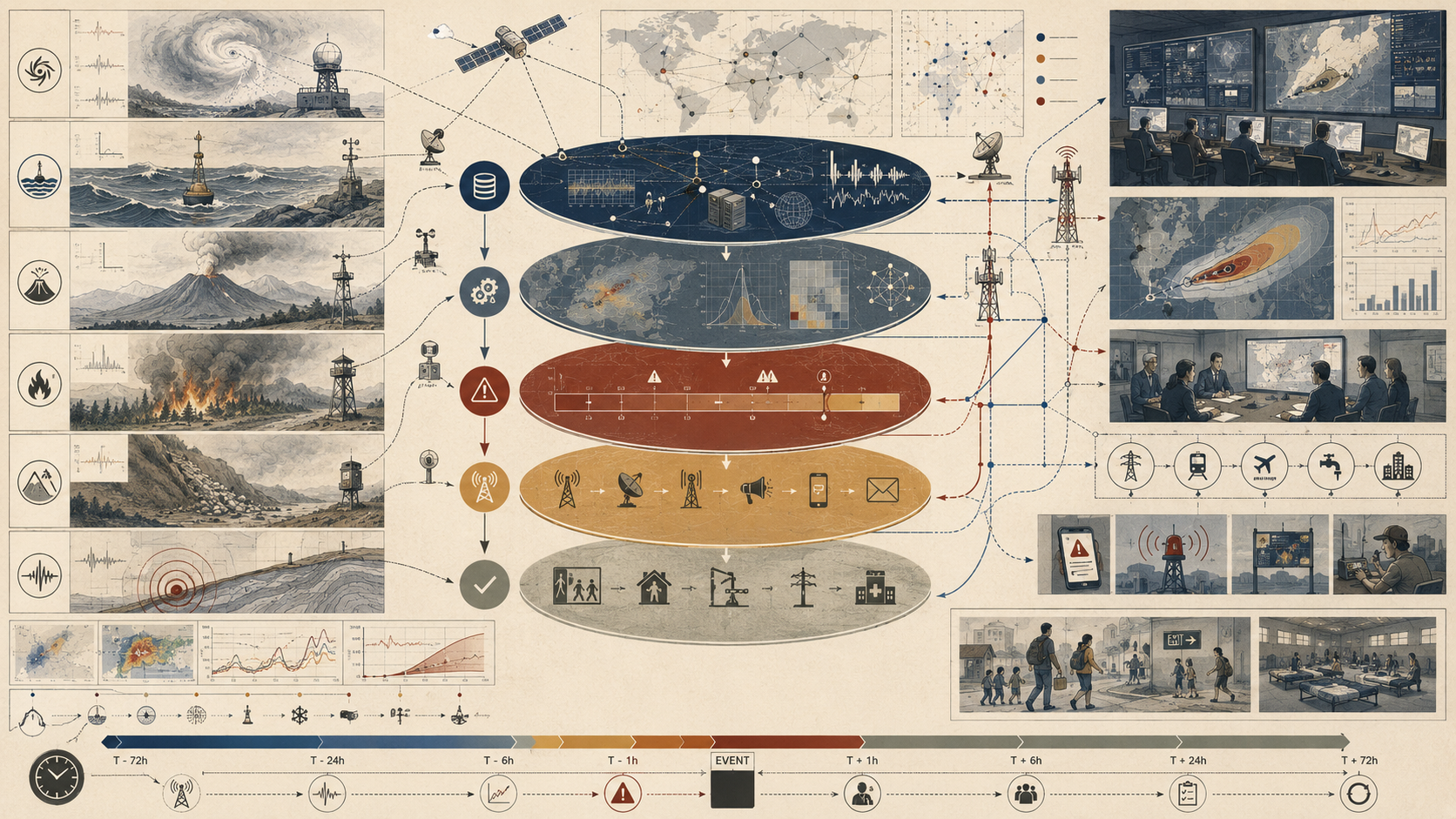
For environmental monitoring systems, disaster warning is one of the clearest examples of why observation alone is not enough. A warning network must preserve the full pathway from environmental signal to protective behavior. It must detect the hazard, evaluate the risk, decide whether and how to warn, communicate the message through channels that people can actually receive, and support action by communities and institutions with unequal resources. The quality of the network therefore depends on the integrity of the entire chain: sensors, models, protocols, institutions, communications, preparedness, response, and post-event learning.
Engineering Problem
The engineering problem is how to design warning networks that can convert uncertain environmental signals into timely, trusted, inclusive, and actionable protective behavior. This requires more than sensing hazards. It requires an end-to-end architecture that links observation, interpretation, threshold logic, message generation, dissemination, last-mile communication, response capacity, and learning. A system that detects danger but cannot reach people in time is not a successful warning system. A system that issues accurate alerts but leaves vulnerable populations unable to act is not a successful warning system. A system that sends warnings but cannot reconstruct why they were issued is not an accountable warning system.
Early warning systems are difficult because they operate under time pressure, uncertainty, and unequal social conditions. Hazard signals are often incomplete or ambiguous. Forecasts change as new data arrive. Institutions must decide when uncertainty is sufficient to justify escalation. Messages must be clear enough to prompt action without exaggerating certainty. Communications infrastructure may fail during the event itself. People may receive warnings through uneven channels, in different languages, with different levels of trust, mobility, resources, and preparedness. Warning quality therefore cannot be reduced to model accuracy or alert speed alone.
A rigorous disaster detection and early warning network must answer several engineering questions. What hazards are being detected? Which sensors, satellites, gauges, radars, buoys, models, or field observations support detection? What thresholds trigger assessment or warning? Who has authority to issue warnings? Which channels deliver messages? Which communities may be missed? What actions are expected? What evidence is retained? How are false alarms, missed events, and post-event lessons reviewed? The warning chain is only as strong as its ability to answer these questions under operational stress.
| Engineering Tension | Why It Matters | Required Evidence |
|---|---|---|
| Speed versus certainty | Waiting for more certainty can reduce lead time; warning too early can increase false alarms. | Forecast confidence, threshold rationale, lead-time analysis, false-alarm review |
| Detection versus action | A detected hazard does not reduce harm unless people and institutions can act. | Response protocols, evacuation capacity, shelter readiness, community drills |
| Coverage versus reach | A warning footprint may include an area without reaching all people inside it. | Channel audit, language access, disability access, mobile/broadcast/siren coverage |
| Automation versus judgment | Automated triggers can accelerate warning but may miss context or amplify false certainty. | Human review path, escalation rules, model validation, decision log |
| Multi-hazard integration versus message complexity | Compound events require integrated warning, but messages can become confusing. | Hazard interaction map, message templates, scenario tests, public comprehension review |
| Technical performance versus social trust | Warnings fail when they are accurate but distrusted, inaccessible, or impractical. | Public trust assessment, community engagement, last-mile review, post-event feedback |
The practical question is therefore: can the warning network produce enough credible, inclusive, and actionable time for protective action before harm escalates?
Reference Architecture
A practical early warning architecture can be understood as a layered warning chain. The exact implementation may involve seismic stations, river gauges, weather radar, satellites, ocean buoys, air-quality sensors, wildfire cameras, forecast models, emergency operations centers, alerting platforms, sirens, mobile alerts, broadcast media, community networks, and after-action review systems. The underlying responsibilities remain consistent: detect, interpret, decide, communicate, support response, and learn.
| Layer | Engineering Role | Primary Risk | Evidence Artifact |
|---|---|---|---|
| Hazard observation layer | Detects physical signals from sensors, satellites, radars, gauges, buoys, seismic stations, cameras, and field reports. | Sparse coverage, sensor failure, delayed telemetry, false signal | Sensor inventory, station health report, observation stream, event catalog |
| Data integration layer | Combines heterogeneous observations into usable hazard and risk inputs. | Latency, format mismatch, missing metadata, inconsistent timestamps | Ingestion log, data schema, interoperability profile, quality flags |
| Forecast and assessment layer | Interprets signals through models, thresholds, expert review, scenarios, and impact estimates. | Model error, uncertainty miscommunication, poor impact translation | Forecast record, uncertainty report, threshold rationale, impact assessment |
| Warning decision layer | Determines whether, when, and how to issue watches, warnings, advisories, evacuation triggers, or public messages. | Delayed escalation, unclear authority, inconsistent criteria | Decision log, escalation protocol, approval trail, warning category registry |
| Communication layer | Disseminates warnings through mobile alerts, sirens, broadcast, web, social media, agencies, and local networks. | Channel failure, inaccessible language, weak last-mile delivery | Channel audit, message log, delivery report, accessibility checklist |
| Preparedness and response layer | Enables people, agencies, and infrastructure operators to act on warning information. | Unclear action guidance, insufficient shelters, mobility barriers, low trust | Preparedness plan, drill record, shelter inventory, evacuation route map |
| Equity and inclusion layer | Evaluates whether warnings reach and support vulnerable, marginalized, disabled, linguistically diverse, or digitally excluded groups. | Warning inequality, inaccessible alerts, unequal capacity to act | Equity audit, language-access plan, disability-access review, community feedback |
| Learning layer | Uses exercises, events, false alarms, missed events, and after-action reviews to improve the warning chain. | Repeated failure, institutional memory loss, unreviewed thresholds | After-action report, improvement backlog, threshold update, training record |
This architecture makes early warning visible as an end-to-end public safety capability. It separates signal detection from risk interpretation, risk interpretation from warning decision, warning decision from communication, and communication from protective action. Without those distinctions, warning systems may appear technically strong while failing socially, institutionally, or operationally.
Implementation Pattern
A rigorous implementation begins by defining the hazard domain, exposed population, warning objective, required lead time, decision authority, threshold logic, communication channels, response options, accessibility requirements, evidence-retention policy, and review cycle. Engineers and public agencies should specify not only how warnings are generated, but how warnings are received, understood, trusted, and acted upon.
| Artifact | Purpose | Typical Format |
|---|---|---|
| Warning objective manifest | Defines hazard type, warning purpose, exposed population, required lead time, and expected protective action. | YAML, Markdown, emergency operations plan |
| Hazard observation inventory | Lists sensors, stations, satellites, gauges, radars, buoys, models, and field reports. | CSV, GIS layer, database table |
| Threshold and escalation registry | Defines watch, advisory, warning, evacuation, or shelter triggers with uncertainty bands. | YAML, policy table, runbook |
| Forecast and uncertainty report | Documents model outputs, confidence, forecast horizon, uncertainty, and limitations. | Notebook, forecast product, HTML report |
| Message template library | Provides clear warning language for hazards, severity levels, actions, and audiences. | Markdown, JSON, emergency communications library |
| Communication channel matrix | Maps warning channels to populations, geographies, failure modes, and accessibility requirements. | CSV, dashboard, GIS layer, operational checklist |
| Last-mile reach assessment | Evaluates whether warnings reach vulnerable and hard-to-reach populations. | Equity audit, survey, delivery analytics, community feedback record |
| Preparedness and response inventory | Tracks shelters, evacuation routes, transport, medical support, operators, and response capacity. | GIS layer, resource registry, emergency plan |
| Event evidence package | Preserves what was observed, interpreted, decided, communicated, and acted upon. | Incident archive, decision log, message log, telemetry bundle |
| After-action review | Documents warning performance, failures, public response, equity gaps, and improvement actions. | Report, lessons-learned registry, threshold update log |
The implementation goal is to make warning capability inspectable. A user should be able to reconstruct which signals were observed, why a warning was issued or withheld, which messages were sent, which channels were used, which populations were likely reached, which actions were expected, which failures occurred, and what the system learned afterward.
Research-Grade Framing: Early Warning as Actionable Time
A research-grade understanding of disaster warning begins by treating early warning networks as infrastructures of actionable time. Their central function is not simply to know earlier, but to create a usable interval between signal and impact within which protective action becomes possible. That interval is the real product of the system. It is where evacuation routes are used, shelters are opened, resources are pre-positioned, hospitals prepare, infrastructure operators shift modes, schools close, vulnerable people are contacted, and exposure is actively reduced.
This makes warning networks epistemically powerful but structurally fragile. They transform uncertain environmental signals into time-pressured decisions. That transformation requires balancing speed, accuracy, interpretability, inclusion, and trust. A warning delivered too late is a failure of time. A warning delivered too ambiguously is a failure of meaning. A warning delivered accurately but to people who cannot act is a failure of social design. A warning ignored because of prior false alarms or institutional distrust is a failure of legitimacy. A warning delivered through channels that exclude disabled, linguistically isolated, unhoused, elderly, rural, or digitally disconnected populations is a failure of justice.
Early warning networks therefore do more than observe hazards. They organize the conversion of uncertain environmental knowledge into practical temporal advantage. This is why warning quality must be judged by the integrity of the full chain. The decisive question is not whether the system noticed danger, but whether it rendered that knowledge actionable before harm escalated beyond prevention.
| Limited Pattern | Warning-Chain Pattern | Why the Shift Matters |
|---|---|---|
| Detect the hazard | Detect, interpret, communicate, support action, and learn | Prevents monitoring systems from stopping at signal recognition |
| Measure lead time | Measure usable time for protective action | Distinguishes minutes on paper from time people can actually use |
| Issue public alert | Deliver accessible, trusted, action-specific warning messages | Connects communication design to behavior and harm reduction |
| Evaluate forecast accuracy | Evaluate end-to-end warning effectiveness | Prevents model performance from concealing downstream failure |
| Review events technically | Review events technically, socially, institutionally, and equitably | Identifies warning inequality and preparedness gaps |
Actionable time is therefore a systems achievement. It is created by observation, science, institutions, communication, trust, preparedness, and response capacity working together under uncertainty.
Formal Model: Signal, Lead Time, Trust, Reach, and Protective Action
A useful formal model separates detection, interpretation, warning, reach, trust, response capacity, and protective action. Let \(S_t\) represent a hazard signal at time \(t\), \(D_t\) detection confidence, \(L\) lead time, \(R\) reach, \(T\) trust, \(C\) response capacity, and \(A\) protective action. Warning effectiveness depends on more than whether the hazard was detected.
L_{\mathrm{usable}} = t_{\mathrm{impact}} – t_{\mathrm{actionable\ warning}}
\]
Interpretation: Usable lead time is the interval between an actionable warning and hazard impact. It is not simply the time between first detection and impact if the early signal was not interpretable or communicated.
W_{\mathrm{effectiveness}} = f(D, L, R, T, C, A)
\]
Interpretation: Warning effectiveness depends on detection confidence, usable lead time, population reach, trust, response capacity, and actual protective action.
P_{\mathrm{action}} = R \times T \times C \times M
\]
Interpretation: The probability of protective action depends on whether the warning reaches people, whether it is trusted, whether people have capacity to act, and whether the message is meaningful.
FAR = \frac{N_{\mathrm{false\ alarms}}}{N_{\mathrm{warnings}}}
\]
Interpretation: The false-alarm ratio measures the share of warnings not followed by the forecast event. It should be interpreted alongside missed events, uncertainty, and protective value.
POD = \frac{N_{\mathrm{hits}}}{N_{\mathrm{hits}} + N_{\mathrm{misses}}}
\]
Interpretation: Probability of detection measures how often events are successfully warned. Warning evaluation should balance false alarms, misses, lead time, and consequences.
E_{\mathrm{equity}} = 1 – \left|R_{\mathrm{served}} – R_{\mathrm{underserved}}\right|
\]
Interpretation: A simplified equity score can compare warning reach across well-served and underserved groups. Large reach gaps indicate warning inequality even if aggregate coverage appears high.
This formal structure helps prevent narrow evaluation. A warning network can have high detection skill and still fail if warnings are not trusted, not understood, not accessible, or not connected to response capacity. End-to-end warning evaluation must include both technical and social performance.
What Are Disaster Detection and Early Warning Networks?
Disaster detection and early warning networks are coordinated systems that combine sensing, surveillance, modeling, institutional interpretation, communication channels, and response protocols in order to identify hazardous conditions and deliver timely warnings to those at risk. They may monitor meteorological, hydrological, oceanographic, geological, wildfire, climatic, public-health, or compound hazards and increasingly are designed as multi-hazard systems rather than single-hazard instruments.
Such systems may include sensor networks, satellite observations, stream gauges, weather radar, seismic stations, ocean buoys, wildfire cameras, air-quality monitors, forecast models, decision thresholds, emergency operations centers, warning authorities, alerting platforms, public messaging systems, community networks, preparedness drills, and post-event review mechanisms. The defining feature is end-to-end function. A detection network alone is not enough. A forecast product alone is not enough. A messaging platform alone is not enough. The system becomes an early warning network only when the chain from hazard signal to protective action remains sufficiently intact that warning changes outcomes rather than merely documenting risk in advance.
Early warning systems are therefore part of environmental monitoring, but they are also part of public safety, infrastructure governance, disaster risk reduction, public health, and environmental justice. Their value lies in the ability to make environmental change actionable before harm fully unfolds.
Why Early Warning Networks Matter
Early warning networks matter because disaster losses are shaped not only by the intensity of the hazard but by the availability of usable time for protective action. When detection, interpretation, and communication occur early enough, people can evacuate, emergency managers can mobilize, infrastructure operators can shift into protective modes, hospitals can prepare, agencies can pre-position resources, and institutions can reduce exposure before impact. The strategic value of an early warning system therefore lies in temporal leverage: the ability to alter the relationship between hazard onset and social consequence.
They also matter because contemporary hazards increasingly interact across systems. Extreme rainfall may trigger flood, landslide, infrastructure disruption, contamination, or displacement. Heat may combine with drought, wildfire, air pollution, public-health stress, and power demand. Earthquake may become tsunami, and coastal surge may interact with river flooding, communications outages, or industrial release. Warning systems designed around single, isolated hazard logics often underperform when real risk propagates through cascading and compound pathways.
Most importantly, warning networks matter because disaster risk is irreducibly social. Even excellent detection has limited value if warnings do not reach those at risk, if messages are not trusted, or if recipients lack the means to respond. Early warning is therefore not a problem of prediction alone. It is a problem of institutional legitimacy, communication design, preparedness, equity, and practical capacity. A system succeeds when it changes behavior and reduces harm, not when it merely proves that the hazard was scientifically recognized in time.
Core Components of Disaster Detection and Early Warning Networks
Disaster warning networks typically integrate several interdependent components. These components should not be treated as modular add-ons around a central forecast core. They form a single action architecture. A strong forecast with weak dissemination is a weak warning network. High-end sensors with poor institutional coordination are a weak warning network. Rapid alerts without prepared communities are a weak warning network. The quality of the system lies in the continuity of the chain, not in the technical excellence of one node in isolation.
| Component | Function | Evidence of Readiness |
|---|---|---|
| Detection and observation | Identify potentially hazardous conditions through sensors, stations, satellites, gauges, buoys, radars, cameras, and surveillance systems. | Station inventory, telemetry health, coverage map, observation latency report |
| Interpretation and forecasting | Assess likely severity, timing, location, uncertainty, and impact potential. | Forecast record, model validation, impact assessment, uncertainty report |
| Warning decision | Translate interpreted risk into alert categories, advisories, warnings, evacuation triggers, or protective actions. | Threshold registry, authority matrix, decision log, escalation protocol |
| Dissemination | Move warnings through broadcast, mobile, internet, sirens, partner agencies, and community networks. | Channel matrix, delivery logs, redundancy plan, accessibility review |
| Preparedness and response | Enable communities, agencies, and operators to act through preplanned or adaptive measures. | Drill records, shelter inventory, evacuation routes, public education material |
| Review and improvement | Use exercises, false alarms, missed events, and post-event analysis to improve the system. | After-action review, lessons-learned log, threshold updates, training plan |
Each component must be evaluated as part of the whole. A warning chain can fail at detection, forecasting, authorization, message design, channel delivery, interpretation, capacity to act, or post-event learning.
System Architecture: From Hazard Signal to Protective Action
Disaster detection and early warning networks operate as layered action architectures. Every layer transforms uncertainty differently: from measurement into assessment, from assessment into warning, from warning into interpretation, and from interpretation into behavior. The system fails if any one transformation is treated as somebody else’s problem. Warning quality is therefore inseparable from cross-layer coordination.
| Layer | Transformation | Failure Risk |
|---|---|---|
| Signal layer | Environmental change is detected through monitoring and observation systems. | Signal missed, delayed, noisy, or spatially incomplete |
| Assessment layer | Models and analysts interpret hazard likelihood, timing, magnitude, and impact potential. | Severity, location, timing, or uncertainty misjudged |
| Warning layer | Institutions translate interpreted risk into alert categories, messages, and operational triggers. | Warning delayed, unclear, inconsistent, or unauthorized |
| Communication layer | Warnings are disseminated through multiple channels to those exposed. | Channels fail, messages exclude groups, alerts are not understood |
| Response layer | Individuals, communities, operators, and agencies take protective action. | People cannot act, agencies are unprepared, resources are unavailable |
| Learning layer | Exercises and post-event review improve future detection, messaging, and readiness. | Lessons are not captured, thresholds remain wrong, trust erodes |
This architecture matters because the real output of an early warning network is not information in the abstract but harm reduction through time-sensitive action. The chain must be evaluated from end to end.
Multi-Hazard Design, Cascading Risk, and Network Integration
Modern early warning strategy increasingly centers on multi-hazard design because hazards rarely unfold in isolation. Flood may interact with contamination, coastal surge with power failure, drought with wildfire, heat with air pollution, and severe convection with infrastructure and communications breakdown. A warning architecture designed around one-signal, one-message logic may underperform where real risk propagates across domains.
Multi-hazard design matters because integrated risks create timing, prioritization, and communication challenges that single-hazard frameworks often miss. Warnings may need to communicate not only the primary hazard but also likely secondary and cascading effects. Response pathways may need coordination across agencies that would otherwise operate separately. Forecasting capacity may need to connect meteorological, hydrological, oceanographic, geological, ecological, infrastructural, and social vulnerability information within one interpretive frame.
Exceptional warning networks therefore do not simply multiply hazard feeds. They integrate observation, interpretation, and communication in ways that recognize compound impacts and allow protective action to be coordinated under conditions where one hazard amplifies another. Multi-hazard capability is less about volume of inputs than about coherence of the warning logic that joins them.
| Hazard Interaction | Warning Challenge | Design Response |
|---|---|---|
| Extreme rainfall, flood, and contamination | Water depth, water quality, evacuation, and infrastructure warnings may conflict or arrive separately. | Integrated flood-water-quality warning scenario and agency coordination protocol |
| Heat, drought, wildfire, and smoke | Public-health, fire, air-quality, and power-system risks compound across agencies. | Joint heat-smoke-fire messaging and vulnerable-population outreach plan |
| Earthquake and tsunami | Seismic detection must connect rapidly to coastal warning, evacuation, and community readiness. | End-to-end tsunami warning and evacuation drill architecture |
| Storm surge and river flooding | Coastal and inland flood dynamics interact across time and geography. | Compound flood model, shared inundation products, unified public messaging |
| Hazard and communications outage | The event itself may damage the channels needed for warning. | Redundant alerting channels, sirens, radio, community networks, offline protocols |
Multi-hazard warning systems must therefore integrate data and institutions. Without institutional interoperability, technical integration alone will not produce coherent action.
Warning Communication, Last-Mile Delivery, and Social Reach
Communication is often the most socially decisive part of the warning chain because even a technically strong upstream system can fail at the last mile. Warning messages must be timely, understandable, trusted, accessible, and matched to the response options available to the audience. This includes not only message transmission but also message design: language, urgency, specificity, credibility, location relevance, and the practical clarity of what people should do next.
Last-mile delivery matters because risk is unevenly distributed across language, disability, housing status, mobility, digital access, media habits, legal status, institutional trust, and social support. A message that reaches one group quickly may reach another late or not at all. A warning that assumes private transport, broadband access, English-language fluency, stable housing, or prior familiarity with hazard protocols may fail populations whose exposure is already high and whose protective options are constrained. The “last mile” is therefore not merely a delivery problem. It is a problem of social inclusion and differential capability.
| Requirement | Question | Evidence |
|---|---|---|
| Timeliness | Did the message arrive with enough usable time? | Send time, receipt time, impact time, lead-time analysis |
| Clarity | Did people understand what was happening and what to do? | Message testing, plain-language review, post-event survey |
| Accessibility | Were language, disability, and digital-access barriers addressed? | Translation plan, accessible formats, channel diversity, community review |
| Location relevance | Was the warning specific enough to support local action? | Geotargeting record, warning footprint, local hazard map |
| Trust | Was the warning source credible to the affected audience? | Trusted messenger network, community partnership, historical trust assessment |
| Actionability | Did the warning specify feasible protective action? | Action guidance, shelter/route information, response option mapping |
This means early warning is not just a forecasting problem. It is a communication design problem grounded in the real heterogeneity of publics. A warning network succeeds only when the message reaches the right people in forms they can understand and act on within the actual constraints of their lives.
Preparedness, Response Capacity, and Community Readiness
Preparedness is what turns warning into reduced harm. Without community readiness, evacuation routes, drills, institutional protocols, trusted messengers, shelters, transport, and public understanding, lead time may exist in theory but not in practice. Warning systems are strongest where detection, communication, and preparedness reinforce one another rather than being developed separately.
This is why exercises, public education, community drills, anticipatory planning, and response resources are not peripheral add-ons. They are part of the warning network itself. Preparedness establishes what the warning means before the event occurs. It gives institutions and communities a repertoire of action so that messages can be translated into response under stress rather than decoded from scratch in the moment of crisis.
Preparedness also reveals the social dimension of warning quality. Communities differ in mobility, resources, social support, trust, exposure, and prior experience. A warning system that treats all recipients as equally able to act may appear technically comprehensive while remaining practically unequal. Readiness is therefore not just operational maturity. It is part of distributive justice in risk reduction.
| Capacity Dimension | Monitoring Question | Example Evidence |
|---|---|---|
| Evacuation readiness | Can people leave affected areas safely and quickly? | Route maps, traffic plans, transport support, drill records |
| Shelter readiness | Are shelters accessible, sufficient, and known? | Shelter inventory, accessibility review, capacity status |
| Institutional readiness | Can agencies coordinate under time pressure? | Incident command plans, mutual aid agreements, exercise results |
| Community readiness | Do residents understand warnings and know what to do? | Public education, community drills, trusted messenger networks |
| Infrastructure readiness | Can critical systems shift into protective modes? | Operator protocols, shutdown plans, redundancy status |
| Vulnerable-population support | Are those with constrained ability to act supported? | Direct outreach lists, medical support plans, mobility assistance |
Preparedness is the difference between a warning that is merely heard and a warning that can be used.
Uncertainty, False Alarms, Missed Events, and Trust
Early warning networks operate under uncertainty because hazards are inferred from evolving signals, incomplete data, and model-based judgment. That means the system must navigate false alarms, missed events, forecast revisions, ambiguous precursors, and changing hazard pathways without destroying credibility or delaying protective action excessively.
This is a hard balance. Excessive false alarms can erode compliance and attentiveness. Excessive reluctance to warn can shorten lead time and increase harm. But the issue is not simply statistical optimization. It is relational. Public trust depends not only on whether warnings are always correct, which is impossible, but on whether uncertainty is managed in ways that remain intelligible, proportionate, and visibly oriented toward protection rather than institutional self-protection.
Trustworthy warning networks therefore do not eliminate uncertainty; they stage it responsibly. They preserve enough transparency about risk levels, possible outcomes, and reasons for escalation that institutions can act under imperfect knowledge without presenting that imperfection as incompetence. In warning systems, trust is not the absence of uncertainty. It is the social capacity to act despite uncertainty because the warning chain remains credible.
| Condition | Risk | Good Warning Practice |
|---|---|---|
| Forecast uncertainty | Users may misread probabilistic risk as certainty or unreliability. | Plain-language explanation of possible outcomes and confidence. |
| False alarm | Repeated warnings without visible impact may reduce future compliance. | Post-event explanation and transparent threshold review. |
| Missed event | Harm occurs without adequate warning, eroding trust and protection. | After-action review, model improvement, public accountability. |
| Rapidly changing forecast | Frequent revisions can confuse users. | Consistent update cadence and clear explanation of changes. |
| Low public trust | Accurate warnings may be ignored. | Trusted messengers, community partnerships, prior preparedness work. |
The strongest warning systems treat uncertainty communication as part of the warning itself, not as an optional technical caveat.
Equity, Warning Justice, and Unequal Capacity to Act
Warning systems can reproduce inequality if they assume that all people are equally visible, reachable, mobile, resourced, and trusted by institutions. Disaster risk is often concentrated among communities already facing environmental injustice, poverty, disability exclusion, housing insecurity, language barriers, digital exclusion, historical neglect, or weak public infrastructure. If early warning systems do not explicitly monitor these conditions, they may protect those easiest to reach while leaving those most at risk least able to act.
Warning justice requires more than equal message distribution. It requires attention to unequal exposure, unequal communication access, unequal preparedness, unequal mobility, unequal shelter access, and unequal trust. A text alert may be useful for some residents and useless for those without stable mobile service, accessible language, or the ability to leave work, housing, or caregiving responsibilities. A siren may alert a coastal community but fail people indoors, people with hearing impairments, tourists unfamiliar with signals, or communities without evacuation options. A web dashboard may inform agencies while remaining inaccessible to the public most affected.
| Equity Dimension | Monitoring Question | Evidence Needed |
|---|---|---|
| Exposure inequality | Are some groups more likely to be in harm’s way? | Hazard overlays, demographic data, housing and infrastructure maps |
| Warning reach inequality | Do warnings reach all affected groups through usable channels? | Delivery analytics, language access, disability access, channel audit |
| Action capacity inequality | Can recipients act on warnings? | Transport access, shelter access, mobility support, caregiving constraints |
| Trust inequality | Are warning authorities credible to affected communities? | Community partnerships, public feedback, trusted messenger networks |
| Preparedness inequality | Do communities have knowledge, drills, resources, and support? | Training records, drills, public education, preparedness surveys |
| Recovery inequality | Do warning failures create unequal long-term harm? | Post-event review, disaggregated impact and recovery metrics |
Equity is therefore not an external ethical add-on to warning systems. It is part of whether warning systems work. A warning that protects only those already able to protect themselves is not an adequate public warning system.
Failure Modes in Disaster Warning Networks
Disaster warning networks can fail in several characteristic ways. Detection may be weak or sparse. Models may misjudge severity, timing, or location. Institutional thresholds may delay escalation. Communication channels may break down or exclude key groups. Messages may be too vague, too technical, or too late. Communities may lack the routes, resources, or social confidence needed to respond. Post-event learning may be weak, allowing vulnerabilities to recur.
Another major failure mode is partial success mistaken for overall success. A hazard may be detected accurately and even communicated promptly, yet if protective action does not occur the network has not succeeded in its core purpose. Upstream performance can conceal downstream failure. This is one reason end-to-end evaluation is indispensable: it prevents technically sophisticated systems from being judged successful merely because they were scientifically impressive.
| Failure Mode | Consequence | Prevention |
|---|---|---|
| Detection gap | Hazard is not observed early enough or in the right place. | Coverage audit, redundant sensing, station health monitoring |
| Interpretation error | Severity, timing, location, or impact potential is misjudged. | Model validation, uncertainty reporting, expert review, post-event comparison |
| Threshold delay | Warning is issued too late because escalation criteria are too conservative or unclear. | Threshold registry, scenario exercises, decision-time review |
| Message failure | Recipients do not understand the hazard, location, urgency, or required action. | Plain-language testing, template review, multilingual messaging |
| Channel failure | Warnings do not reach exposed people. | Redundant channels, delivery monitoring, last-mile assessment |
| Action failure | People receive warnings but cannot act. | Preparedness planning, shelters, transport, mobility support, public education |
| Learning failure | Warning weaknesses recur across events. | After-action review, improvement backlog, governance accountability |
The deepest failure, however, is warning inequality. Some populations are better served by observing networks, communications infrastructure, official attention, evacuation resources, and institutional trust than others. In such cases, a network may be strong in aggregate while leaving severe vulnerability structurally intact. Warning justice is therefore part of warning quality.
Governance, Global Frameworks, and Evidentiary Accountability
Disaster warning networks have a governance dimension because they shape what risks become visible, who is warned, how warnings are authorized, and what evidence justifies disruptive protective action. Warning decisions can affect evacuation, transport, public trust, economic continuity, emergency powers, infrastructure operations, school closures, public health, and institutional legitimacy. They are therefore not neutral technical outputs. They are decisions made within political, legal, scientific, and organizational frameworks.
This makes evidentiary accountability central. A network needs not only technical competence but methodological clarity: what was observed, how it was interpreted, why a threshold was crossed, why a warning was issued or not issued, which messages were sent, which populations were reached, and how the chain will be reviewed afterward. The stronger the warning system’s authority, the stronger the obligation to keep that chain intelligible.
Global frameworks matter because they make warning-system quality comparable beyond one jurisdiction. International efforts around multi-hazard early warning, warning access, community preparedness, and end-to-end warning systems do more than share best practices. They create pressure to treat warning as a public safety capability that includes observation, communication, preparedness, and inclusion rather than as a narrow forecast function alone. Governance quality, in this sense, is part of the warning network’s protective power.
| Governance Responsibility | Question | Evidence |
|---|---|---|
| Authority | Who can issue, update, cancel, or escalate warnings? | Authority matrix, emergency operations plan, approval log |
| Accountability | Can warning decisions be reviewed after the event? | Decision log, event evidence package, after-action report |
| Transparency | Are thresholds, uncertainty, and limitations explained? | Threshold registry, public guidance, uncertainty statement |
| Inclusion | Are vulnerable and marginalized groups included in warning design? | Equity audit, community consultation, accessibility review |
| Coordination | Do agencies, operators, and communities know their roles? | Interagency agreements, drills, communication protocols |
| Learning | Does the system improve after exercises and events? | Improvement backlog, threshold updates, training records |
Warning governance should make clear that technical speed without public accountability is insufficient. A warning network is a public trust infrastructure.
Future Directions
The future of disaster detection and early warning networks lies in stronger multi-hazard integration, improved forecast support, more resilient communication pathways, better last-mile inclusion, and tighter coupling between detection and anticipatory action. The most important advances are likely to come not only from better sensing or faster alerts, but from better coordination among science, institutions, infrastructure operators, and communities.
Artificial intelligence may help detect anomalies, fuse sensor streams, prioritize analyst attention, estimate impacts, and support warning scenarios. Earth observation may improve wide-area assessment for floods, fires, storms, drought, landslides, and post-event damage. Edge computing may support local detection and communication when central networks are degraded. Interoperable data platforms may make multi-agency warning coordination more feasible. But none of these tools will make warning systems effective unless they are embedded in trusted institutions, clear protocols, inclusive communication, and prepared communities.
The deeper challenge is not simply to detect hazards earlier. It is to build warning systems that remain actionable, trusted, equitable, and reviewable under real-world conditions of uncertainty and social inequality. Future networks will need stronger integration across hazards, clearer communication design, more inclusive preparedness practices, and better post-event learning so that warning quality is judged by reduced harm rather than technological sophistication alone.
Disaster detection and early warning networks matter because they convert environmental observability into time for action. Where they are strong, hazards become not merely seen but governable in ways that reduce loss. Where they are weak, even accurate detection may still end in preventable harm. In that sense, early warning networks are not merely systems for noticing danger. They are infrastructures for turning uncertain knowledge into collective protection.
Deployment Readiness Gate
Before a disaster detection and early warning network is used for public alerting, evacuation, infrastructure shutdown, anticipatory action, emergency coordination, or high-stakes environmental response, it should pass a readiness gate. This gate should test whether the system is technically reliable, institutionally governed, socially inclusive, operationally rehearsed, and evidence-preserving.
| Readiness Area | Required Question | Pass Evidence |
|---|---|---|
| Observation readiness | Are hazard signals monitored with adequate coverage, redundancy, and freshness? | Sensor inventory, station health, coverage audit, telemetry latency report |
| Forecast readiness | Are models, thresholds, and uncertainty practices validated? | Forecast skill report, threshold registry, uncertainty documentation |
| Decision readiness | Are warning authority, escalation rules, and cancellation procedures clear? | Authority matrix, decision log template, escalation protocol |
| Communication readiness | Can warnings reach exposed populations through redundant and accessible channels? | Channel matrix, language plan, accessibility review, delivery test |
| Preparedness readiness | Can people and institutions act on warnings? | Drill records, shelter inventory, evacuation route map, response protocol |
| Equity readiness | Are vulnerable and hard-to-reach populations included? | Last-mile audit, community feedback, targeted outreach plan |
| Evidence readiness | Can the warning chain be reconstructed after the event? | Event evidence package, message log, telemetry archive, decision record |
| Learning readiness | Will exercises, false alarms, misses, and events improve the system? | After-action process, improvement backlog, governance review cycle |
This readiness gate prevents early warning systems from being evaluated only by whether they can issue an alert. The stronger standard is whether they can produce, deliver, and support warning action in ways that reduce harm and remain accountable afterward.
Data and Configuration Artifacts
A reproducible early warning workflow should include explicit artifacts for hazard signals, thresholds, warning decisions, message delivery, last-mile reach, protective actions, and post-event learning. These artifacts make the warning chain auditable and reusable across exercises, events, and system upgrades.
| Artifact | Purpose | Suggested Path |
|---|---|---|
| Warning objective manifest | Defines hazard type, exposed population, required lead time, and expected protective action. | config/warning_objective.yml |
| Hazard signal inventory | Lists sensors, gauges, forecasts, satellites, buoys, radars, and field reports. | data/hazard_signal_inventory.csv |
| Threshold registry | Defines watches, advisories, warnings, escalation levels, uncertainty bands, and action triggers. | config/threshold_registry.yml |
| Message template library | Stores warning messages by hazard, severity, location, audience, and action. | data/message_templates.csv |
| Communication channel matrix | Maps channels to populations, accessibility needs, failure modes, and redundancy. | data/communication_channel_matrix.csv |
| Warning event log | Records detection, assessment, decision, dissemination, and action milestones. | data/warning_event_log.csv |
| Last-mile reach audit | Evaluates whether warnings reached all affected populations in usable form. | outputs/last_mile_reach_audit.md |
| After-action review | Documents warning performance, failures, equity gaps, and improvement actions. | outputs/after_action_review.md |
These artifacts turn warning capability into inspectable evidence. They help agencies avoid relying on memory, assumptions, or dashboard impressions after an event.
Mathematical Lens: Lead Time, Reach, Trust, False Alarms, and Protective Action
Several simple metrics can help evaluate warning networks. These metrics do not replace qualitative review, community feedback, or expert judgment, but they make warning-chain assumptions visible.
L_{\mathrm{usable}} = t_{\mathrm{impact}} – t_{\mathrm{actionable\ warning}}
\]
Interpretation: Usable lead time measures the time people and institutions actually have to act after receiving an actionable warning.
R_{\mathrm{reach}} = \frac{N_{\mathrm{reached}}}{N_{\mathrm{exposed}}}
\]
Interpretation: Warning reach measures the share of exposed people who received the warning through a usable channel.
A_{\mathrm{protective}} = \frac{N_{\mathrm{acted}}}{N_{\mathrm{warned}}}
\]
Interpretation: Protective action rate measures how many warned recipients took the recommended action. It must be interpreted alongside capacity constraints.
FAR = \frac{N_{\mathrm{false\ alarms}}}{N_{\mathrm{warnings}}}
\]
Interpretation: False-alarm ratio measures the share of warnings not followed by the forecast event. It should not be minimized without considering missed-event risk.
POD = \frac{N_{\mathrm{hits}}}{N_{\mathrm{hits}} + N_{\mathrm{misses}}}
\]
Interpretation: Probability of detection measures how often actual events were successfully warned.
S_{\mathrm{warning}} = w_1D + w_2L + w_3R + w_4T + w_5C + w_6A – w_7M
\]
Interpretation: A warning-system score can combine detection confidence \(D\), lead time \(L\), reach \(R\), trust \(T\), response capacity \(C\), protective action \(A\), and missed-event penalty \(M\). Composite scores should remain transparent and disaggregated.
These measures help evaluate the full warning chain. A warning system should not be judged only by whether it issued an alert. It should be judged by whether the alert was timely, received, understood, trusted, actionable, equitable, and effective.
Python Workflow: Warning Chain Readiness Scoring
A Python workflow can demonstrate how detection confidence, lead time, reach, trust, response capacity, and protective action can be combined into a transparent warning-chain readiness assessment. The purpose is not to create a universal score, but to keep the warning-chain dimensions visible.
from dataclasses import dataclass
from typing import List
import pandas as pd

@dataclass
class WarningScenario:
    scenario_id: str
    hazard_type: str
    detection_confidence: float
    usable_lead_time_score: float
    reach_score: float
    trust_score: float
    response_capacity_score: float
    protective_action_score: float
    missed_event_penalty: float
    equity_gap_score: float

def warning_effectiveness(scenario: WarningScenario) -> float:
    """
    Estimate end-to-end warning effectiveness.
    All inputs should remain visible in reporting.
    """
    return (
        0.18 * scenario.detection_confidence
        + 0.16 * scenario.usable_lead_time_score
        + 0.16 * scenario.reach_score
        + 0.14 * scenario.trust_score
        + 0.14 * scenario.response_capacity_score
        + 0.14 * scenario.protective_action_score
        - 0.04 * scenario.missed_event_penalty
        - 0.04 * scenario.equity_gap_score
    )

def classify_review_priority(scenario: WarningScenario, score: float) -> str:
    if scenario.equity_gap_score >= 0.30:
        return "equity_and_last_mile_review"
    if scenario.usable_lead_time_score < 0.50:
        return "lead_time_review"
    if scenario.reach_score < 0.60:
        return "communication_reach_review"
    if scenario.response_capacity_score < 0.55:
        return "preparedness_capacity_review"
    if score < 0.65:
        return "end_to_end_warning_review"
    return "routine_monitoring"

scenarios: List[WarningScenario] = [
    WarningScenario("flood-urban-001", "flood", 0.84, 0.72, 0.68, 0.61, 0.57, 0.52, 0.12, 0.28),
    WarningScenario("heat-city-002", "heat", 0.88, 0.80, 0.74, 0.66, 0.48, 0.46, 0.10, 0.36),
    WarningScenario("tsunami-coast-003", "tsunami", 0.91, 0.62, 0.82, 0.76, 0.70, 0.64, 0.08, 0.18),
    WarningScenario("wildfire-smoke-004", "wildfire_smoke", 0.79, 0.58, 0.55, 0.60, 0.52, 0.45, 0.16, 0.32),
]

records = []
for scenario in scenarios:
    score = warning_effectiveness(scenario)
    records.append({
        "scenario_id": scenario.scenario_id,
        "hazard_type": scenario.hazard_type,
        "warning_effectiveness": round(score, 3),
        "usable_lead_time_score": scenario.usable_lead_time_score,
        "reach_score": scenario.reach_score,
        "response_capacity_score": scenario.response_capacity_score,
        "equity_gap_score": scenario.equity_gap_score,
        "review_priority": classify_review_priority(scenario, score)
    })

df = pd.DataFrame(records)
print(df.sort_values(["review_priority", "warning_effectiveness"]))
This workflow treats warning as an end-to-end chain. A high detection score cannot compensate for failed reach, low trust, poor preparedness, or large equity gaps.
R Workflow: Warning Reach and Response Reporting
An R workflow can support reporting on warning reach, protective action, and last-mile gaps. This is useful for exercises, post-event review, and equity audits.
library(dplyr)
library(readr)

warning_reach <- tribble(
  ~scenario_id, ~hazard_type, ~population_group, ~exposed, ~reached, ~acted,
  "flood-urban-001", "flood", "general_population", 50000, 39000, 24500,
  "flood-urban-001", "flood", "limited_mobility", 4200, 2600, 1100,
  "heat-city-002", "heat", "general_population", 82000, 68000, 36000,
  "heat-city-002", "heat", "older_adults", 9600, 6100, 2900,
  "wildfire-smoke-004", "wildfire_smoke", "general_population", 30000, 21000, 13000,
  "wildfire-smoke-004", "wildfire_smoke", "outdoor_workers", 3800, 1900, 760
)

reach_summary <- warning_reach %>%
  mutate(
    reach_rate = reached / exposed,
    protective_action_rate = acted / reached,
    last_mile_gap = 1 - reach_rate
  ) %>%
  group_by(scenario_id, hazard_type) %>%
  summarise(
    total_exposed = sum(exposed),
    total_reached = sum(reached),
    total_acted = sum(acted),
    overall_reach_rate = total_reached / total_exposed,
    overall_action_rate = total_acted / total_reached,
    largest_group_gap = max(last_mile_gap),
    review_priority = case_when(
      largest_group_gap >= 0.40 ~ "high_last_mile_gap",
      overall_reach_rate < 0.70 ~ "communication_review",
      overall_action_rate < 0.50 ~ "response_capacity_review",
      TRUE ~ "routine_monitoring"
    ),
    .groups = "drop"
  )

print(reach_summary)

write_csv(reach_summary, "outputs/warning_reach_response_summary.csv")
This workflow shows why aggregate warning delivery is insufficient. A scenario may have acceptable overall reach while specific groups remain poorly reached or unable to act.
Systems Code: Warning APIs, Sensor Gateways, Edge Alerts, and Message Evidence
Disaster detection and early warning networks are full-stack systems. They include field sensors, satellite feeds, forecast services, edge gateways, alerting APIs, communications infrastructure, message logs, public dashboards, emergency operations systems, and after-action evidence archives. A serious companion repository should include both analytical workflows and systems-code scaffolding.
| Language / Tool | Role in Companion Repository | Example Use |
|---|---|---|
| Python | Warning-chain readiness scoring, hazard signal evaluation, event evidence packaging | End-to-end warning effectiveness workflow |
| R | Warning reach, response-rate, and equity reporting | Last-mile warning reach summaries |
| SQL | Warning event logs, thresholds, message delivery records, after-action review tables | Auditable warning database schema |
| Go | Lightweight warning API and health-check service | Serve current warning-system operational status |
| Rust | Safe validation CLI for warning thresholds and message templates | Validate escalation registry and message completeness |
| C / C++ | Embedded hazard-sensor and local alert examples | Flood gauge, heat sensor, siren trigger, offline event buffer |
| MicroPython | Low-power environmental threshold alert node | Local sensor warning prototype |
| TinyML | On-device anomaly detection | Rapid water-level, smoke, vibration, or heat anomaly detection |
| PYNQ / HDL | Streaming threshold and signal-processing demonstrations | Hardware-accelerated signal screening |
| Bash | Validation, reproducible runs, and repository setup | Run workflows, validate manifests, generate outputs |
This breadth is appropriate because early warning is not only a forecasting system. It is an operational evidence infrastructure that must function under uncertainty, time pressure, infrastructure stress, and public accountability.
GitHub Repository
A companion repository for this article should translate the warning-chain framework into reproducible technical scaffolding. The repository should include hazard signal inventories, threshold registries, message templates, communication channel matrices, warning event logs, reach and response reporting scripts, SQL schemas, and systems-code examples for warning APIs, field devices, edge alerts, and evidence archives.
Testing and Validation
Testing early warning systems requires more than verifying that alerts can be sent. It requires testing detection coverage, telemetry latency, forecast skill, threshold logic, message clarity, channel redundancy, accessibility, public understanding, preparedness, and post-event evidence retention. Exercises should test the full warning chain rather than one technical layer in isolation.
| Test Type | Purpose | Example Test |
|---|---|---|
| Sensor and telemetry test | Ensure hazard observations arrive reliably and quickly. | Simulate sensor outage, delayed telemetry, and redundant feed failover. |
| Forecast and threshold test | Validate warning triggers against historical and simulated events. | Backtest warning categories, false alarms, misses, and lead time. |
| Message comprehension test | Ensure people understand the warning and protective action. | Plain-language review, multilingual testing, public survey. |
| Channel redundancy test | Ensure warnings still reach people if one channel fails. | Disable mobile/web channel and test siren, radio, agency, and community pathways. |
| Last-mile equity test | Identify groups not reached or unable to act. | Disaggregate reach by language, age, disability, housing, mobility, and digital access. |
| Preparedness exercise | Test whether institutions and communities can act on warnings. | Evacuation drill, shelter activation, public-health response, operator shutdown exercise. |
| Evidence reconstruction test | Ensure the warning chain can be reviewed after the event. | Reconstruct detection, decision, message, delivery, and response timeline. |
Validation should include exercises and real-event review. A warning system that cannot learn from false alarms, missed events, communication breakdowns, or unequal response is not operationally mature.
Operational Signals and Warning-System Observability
Early warning networks must monitor their own operational condition. A system that warns the public about environmental hazards but cannot see its own degradation is fragile. It should track sensor health, telemetry latency, model freshness, threshold status, decision-log completeness, message delivery, channel uptime, public reach, accessibility, and after-action closure.
| Signal | Why It Matters | Failure Indicator |
|---|---|---|
| Observation latency | Determines whether hazard signals arrive early enough for warning. | Telemetry delay exceeds warning-chain threshold. |
| Station health | Determines whether detection coverage is reliable. | Sensor outage, missing feed, calibration failure, power issue. |
| Forecast freshness | Determines whether warning decisions use current information. | Forecast product older than update requirement. |
| Threshold status | Determines whether escalation conditions are approaching. | Threshold proximity exceeds review band without decision log. |
| Message delivery | Determines whether warnings reach exposed populations. | Delivery failure, low confirmation, channel outage. |
| Last-mile reach | Determines whether vulnerable groups are reached in usable form. | Reach gaps by language, disability, age, housing, or geography. |
| Evidence retention | Determines whether warning decisions can be reviewed. | Missing decision record, missing message log, incomplete telemetry archive. |
Warning-system observability protects against silent degradation. It helps agencies detect when the warning network itself is becoming unreliable before a hazard tests it under real conditions.
Engineer and Researcher Checklist
- Define the hazard domain, exposed populations, required lead time, and expected protective action.
- Inventory observation systems, forecast products, thresholds, communication channels, and response protocols.
- Measure usable lead time, not just detection lead time.
- Evaluate warning reach by population group, language, disability access, geography, and digital access.
- Keep warnings plain-language, location-specific, action-oriented, and accessible.
- Preserve uncertainty without making messages unusable.
- Document who has warning authority and how escalation decisions are made.
- Test redundant communication channels under failure conditions.
- Run preparedness exercises that involve agencies, infrastructure operators, and communities.
- Evaluate false alarms and missed events together rather than optimizing one in isolation.
- Maintain an event evidence package for detection, decision, message, delivery, response, and review.
- Use after-action reviews to update thresholds, messages, training, and governance.
Where This Fits in the Series
This article connects Environmental Monitoring Systems to public safety, disaster risk reduction, resilience, infrastructure governance, climate adaptation, and community protection. It sits near climate early warning, flood monitoring, weather sensing, environmental risk and resilience monitoring, data platforms, sensor networks, remote sensing, and satellite observation. Its role is to show that monitoring becomes protective only when environmental signals are converted into timely, trusted, and actionable warning chains.
Disaster detection and early warning networks are among the most consequential applications of environmental monitoring because their success or failure can directly affect life, health, displacement, infrastructure damage, ecological harm, and institutional legitimacy. They reveal why the broader series must treat monitoring not simply as measurement, but as evidence, interpretation, communication, governance, and action.
Related articles
- Environmental Sensor Networks
- Climate Early Warning Systems
- Weather Sensing and Atmospheric Data Systems
- Flood Monitoring Systems and Hydrological Risk Detection
- Environmental Data Platforms and Decision Support Systems
- Monitoring Environmental Risk and Resilience
- Satellite Observation and Earth System Monitoring
- The Future of Environmental Monitoring Systems
Further reading
- World Meteorological Organization (2026) Early Warnings for All. Available at: https://wmo.int/site/early-warnings-all
- World Meteorological Organization (2026) WMO and the Early Warnings for All Initiative. Available at: https://wmo.int/activities/early-warnings-all/wmo-and-early-warnings-all-initiative
- United Nations Office for Disaster Risk Reduction (2023) Words into Action guidelines: Multi-hazard early warning systems. Available at: https://www.undrr.org/words-into-action/guide-multi-hazard-early-warning
- United Nations Office for Disaster Risk Reduction (2026) Early Warnings for All. Available at: https://www.undrr.org/implementing-sendai-framework/sendai-framework-action/early-warnings-for-all
- UNESCO Intergovernmental Oceanographic Commission (2026) End-to-End Warning Systems. Available at: https://tsunami.ioc.unesco.org/en/warningsystems
- UNESCO Intergovernmental Oceanographic Commission (2026) Tsunami Ready. Available at: https://tsunami.ioc.unesco.org/en/tsunami-ready
- National Oceanic and Atmospheric Administration (2026) U.S. tsunami warning system. Available at: https://www.noaa.gov/explainers/us-tsunami-warning-system
- National Oceanic and Atmospheric Administration (2026) NOAA Tsunami Program. Available at: https://www.tsunami.gov/
- National Weather Service (2026) Tsunami Warning Centers. Available at: https://www.weather.gov/safety/tsunami-twc
References
- National Oceanic and Atmospheric Administration (2026) U.S. tsunami warning system. Available at: https://www.noaa.gov/explainers/us-tsunami-warning-system (Accessed: 14 May 2026).
- National Oceanic and Atmospheric Administration (2026) NOAA Tsunami Program. Available at: https://www.tsunami.gov/ (Accessed: 14 May 2026).
- National Weather Service (2026) Tsunami Warning Centers. Available at: https://www.weather.gov/safety/tsunami-twc (Accessed: 14 May 2026).
- UNESCO Intergovernmental Oceanographic Commission (2026) End-to-End Warning Systems. Available at: https://tsunami.ioc.unesco.org/en/warningsystems (Accessed: 14 May 2026).
- UNESCO Intergovernmental Oceanographic Commission (2026) Tsunami Ready. Available at: https://tsunami.ioc.unesco.org/en/tsunami-ready (Accessed: 14 May 2026).
- United Nations Office for Disaster Risk Reduction (2023) Words into Action guidelines: Multi-hazard early warning systems. Available at: https://www.undrr.org/words-into-action/guide-multi-hazard-early-warning (Accessed: 14 May 2026).
- United Nations Office for Disaster Risk Reduction (2026) Early Warnings for All. Available at: https://www.undrr.org/implementing-sendai-framework/sendai-framework-action/early-warnings-for-all (Accessed: 14 May 2026).
- United Nations Office for Disaster Risk Reduction (2026) Definition: Early warning system. Available at: https://www.undrr.org/terminology/early-warning-system (Accessed: 14 May 2026).
- World Meteorological Organization (2026) Early Warnings for All. Available at: https://wmo.int/site/early-warnings-all (Accessed: 14 May 2026).
- World Meteorological Organization (2026) WMO and the Early Warnings for All Initiative. Available at: https://wmo.int/activities/early-warnings-all/wmo-and-early-warnings-all-initiative (Accessed: 14 May 2026).