
Last Updated May 14, 2026
Ecosystem monitoring and ecological observation are infrastructures of selective ecological visibility through which dynamic, partially observable living systems become measurable, interpretable, and governable across time and space. They combine field observation, repeated surveys, automated sensors, remote sensing, ecological indicators, community and Indigenous knowledge where appropriate, and analytical models in order to track change in ecosystem extent, condition, structure, function, integrity, disturbance, resilience, and recovery. In this sense, ecosystem monitoring is not simply the recording of environmental variables. It is the disciplined construction of system-level evidence from incomplete observation: a way of making ecological change legible enough to support conservation, restoration, land and water management, climate adaptation, environmental reporting, and public accountability.
Ecosystems present a distinctive monitoring problem because they are not single variables but interacting wholes. They include organisms, habitats, trophic relationships, hydrological dynamics, soils, nutrient cycles, disturbance regimes, ecological memory, spatial structures, and feedback processes that change at different rates and are only partially visible to any one method. Ecosystem extent may persist while ecological condition erodes. Structural fragmentation may accumulate while some functions temporarily continue. Productivity may remain stable while composition, integrity, or resilience declines. Effective ecosystem monitoring therefore depends not only on what is measured, but on how proxies, indicators, baselines, repeated observations, and uncertainty statements are assembled into defensible ecological inference.
The deeper significance of ecosystem monitoring lies in the fact that it mediates between ecological reality and institutional claim. A policy may claim that an ecosystem is protected, improving, restored, resilient, or sustainably managed, but those claims only become credible when they are anchored in repeated, ecologically meaningful observation. Where monitoring is strong, ecological change becomes harder to ignore and easier to govern. Where it is weak, uncertainty can shelter degradation behind mapped persistence, administrative optimism, underfunded field observation, or overly simplified indicators. Ecosystem monitoring is therefore not merely descriptive science. It is part of the infrastructure of environmental truth.
Main Library
Publications
Article Map
Environmental Monitoring
Related Topic
Biodiversity Monitoring
Related Topic
Land Use Monitoring
Related Topic
Remote Sensing
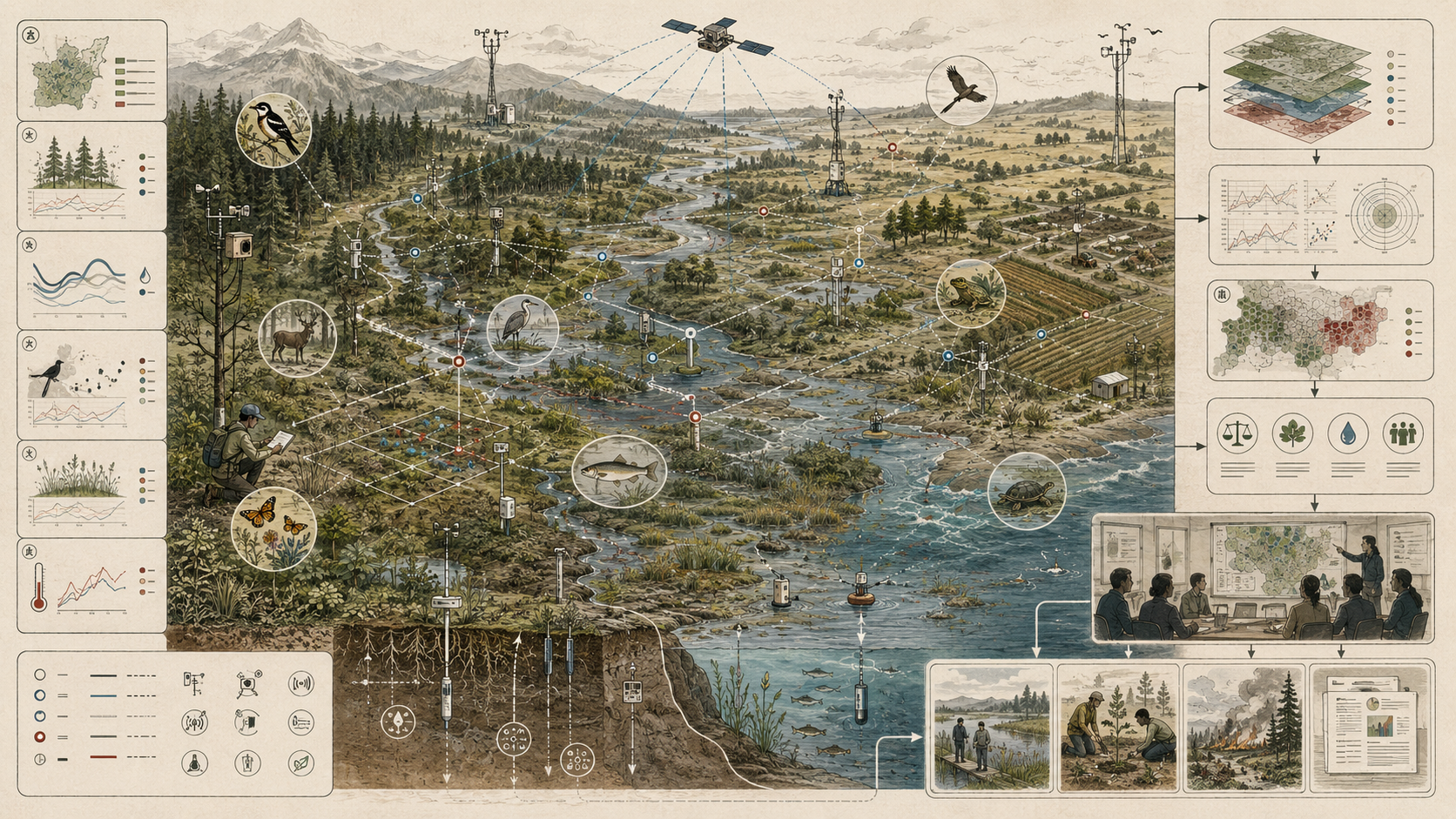
Ecosystem monitoring is where environmental observation becomes ecological evidence. It asks not only whether an ecosystem is present, but whether it is functioning, connected, recovering, degrading, reorganizing, or approaching a threshold. A single habitat map, species count, water-quality reading, or vegetation index rarely answers those questions alone. The central task is to assemble multiple partial observations into a defensible account of ecological condition and trajectory without pretending that indicators are the ecosystem itself.
Engineering Problem
The engineering problem is how to design ecosystem monitoring systems that can transform incomplete, uneven, and method-dependent observations into defensible evidence about ecosystem condition, function, integrity, disturbance, recovery, and resilience. Unlike many monitoring tasks that focus on a single variable, ecosystem monitoring must infer system-level state from multiple partial signals. It must distinguish ecological change from observational noise, indicator instability, sampling bias, seasonal variation, disturbance history, and scale mismatch.
This problem is difficult because ecosystems change through interacting processes. Vegetation structure may recover while species composition remains altered. Water quality may improve while habitat connectivity remains poor. A wetland may retain mapped extent while hydrological function declines. A forest may retain canopy cover while losing old-growth structure, native composition, or resilience to fire and drought. A stream may satisfy selected chemical thresholds while biological assemblages remain impaired. Ecosystem monitoring therefore cannot be reduced to one map, one indicator, one taxonomic group, or one time period.
Weak ecosystem monitoring treats measurable proxies as if they directly represent ecosystem health. Strong ecosystem monitoring treats observation as an evidence chain. It asks which dimensions of the ecosystem are being measured, which remain inferred, how indicators relate to ecological process, what baselines or reference conditions are being used, how sampling bias is handled, how uncertainty is reported, how disturbance and recovery trajectories are interpreted, and whether the final assessment can support the governance claim attached to it.
| Engineering Tension | Why It Matters | Required Evidence |
|---|---|---|
| Extent versus condition | An ecosystem may remain mapped while its ecological quality declines. | Condition indicators, field reference data, integrity metrics, uncertainty statement |
| Structure versus function | Habitat structure can persist while ecological processes weaken, or functions can temporarily persist despite structural decline. | Structure metrics, function indicators, process observations, temporal trend |
| Indicator simplicity versus ecological complexity | Indicators make ecosystems reportable but can flatten complexity and hide important change. | Indicator rationale, proxy limits, ecological interpretation, caveat note |
| Site-level depth versus landscape coverage | Detailed field studies can be ecologically rich but spatially narrow; remote sensing can be broad but less process-sensitive. | Scale statement, method integration plan, representativeness assessment |
| Short-term signal versus long-term trajectory | Temporary variation, disturbance, or seasonal dynamics can be mistaken for durable ecological change. | Time-series design, disturbance history, persistence rules, recovery trajectories |
| Monitoring visibility versus governance response | Seeing ecological degradation does not guarantee institutions can respond effectively or fairly. | Decision-use statement, response pathway, stewardship owner, public evidence package |
| Scientific rigor versus operational continuity | Monitoring must be ecologically defensible while also sustainable across budgets, staff turnover, and policy cycles. | Protocol documentation, data stewardship plan, maintenance budget, revision governance |
The practical question is therefore: can the monitoring system make a defensible claim about ecosystem condition, function, integrity, or resilience from partial observations, and can that claim remain accountable over time?
Reference Architecture
A practical ecosystem monitoring architecture can be understood as an ecological evidence system. The exact implementation may include field plots, transects, stream surveys, habitat assessments, sensor nodes, water-quality records, soil measurements, biodiversity observations, acoustic recorders, camera traps, satellite imagery, land-cover products, ecological indicators, Essential Biodiversity Variables, integrity scores, restoration metrics, disturbance histories, risk assessments, and public reporting dashboards. The responsibilities remain consistent: observe, contextualize, validate, integrate, infer, assess, report, revise, and govern.
| Layer | Engineering Role | Primary Risk | Evidence Artifact |
|---|---|---|---|
| Monitoring objective layer | Defines ecosystem type, geography, baseline, monitoring purpose, temporal horizon, decision use, and evidence standard. | Monitoring design optimized around available data rather than ecological question. | Monitoring objective manifest, ecosystem definition, decision-use statement |
| Ecosystem dimension layer | Specifies which dimensions are being assessed: extent, condition, structure, function, integrity, resilience, disturbance, or recovery. | One dimension is mistaken for the whole ecosystem. | Dimension matrix, indicator-to-dimension crosswalk, proxy rationale |
| Observation layer | Collects field, sensor, remote-sensing, ecological, hydrological, biological, and contextual observations. | Sampling bias, method inconsistency, missing taxa, inaccessible sites, weak temporal continuity. | Field protocol, sensor registry, imagery inventory, observation records |
| Indicator and proxy layer | Translates observations into indicators of condition, structure, function, stress, recovery, or risk. | Indicators become administratively elegant but ecologically thin. | Indicator registry, proxy-limit statement, baseline or reference condition |
| Validation and QA/QC layer | Checks observation quality, protocol consistency, reference validity, method comparability, and uncertainty. | Ecological assessments become difficult to audit or reproduce. | QA/QC policy, validation report, uncertainty statement, data-quality flags |
| Integration and assessment layer | Combines multiple observations and indicators into condition, integrity, resilience, recovery, or risk assessments. | Composite scores hide ecological disagreement among components. | Assessment model, weighting logic, sensitivity analysis, confidence score |
| Disturbance and trajectory layer | Interprets change over time, including disturbance, lag, recovery, hysteresis, threshold behavior, and regime shift risk. | Short-term variation is mistaken for recovery or stability. | Trajectory records, disturbance history, threshold registry, recovery metric |
| Governance and accountability layer | Connects ecosystem evidence to conservation, restoration, permitting, public reporting, climate adaptation, and stewardship decisions. | Ecological claims exceed evidence quality or omit public caveats. | Governance log, public evidence package, revision history, response pathway |
This architecture makes clear that ecosystem monitoring is not only a collection of ecological methods. It is a structured system for turning partial observations into accountable ecological judgment.
Implementation Pattern
A rigorous ecosystem-monitoring implementation begins with the ecological question and the governance claim. The correct design depends on whether the system is intended to assess protected-area condition, restoration recovery, watershed integrity, wetland function, forest resilience, coastal habitat change, stream biological condition, invasive-species pressure, ecosystem collapse risk, or climate adaptation. Each purpose implies different indicators, spatial scales, temporal horizons, baselines, field methods, remote-sensing products, statistical models, and uncertainty requirements.
| Artifact | Purpose | Suggested Format |
|---|---|---|
| Monitoring objective manifest | Defines ecosystem type, geography, baseline, temporal window, decision use, and evidence standard. | YAML, Markdown, architecture decision record |
| Ecosystem dimension matrix | Maps extent, condition, structure, function, integrity, resilience, disturbance, and recovery to measurable indicators. | CSV, Markdown table, SQL table |
| Field observation protocol | Documents plot, transect, survey, sampling, measurement, and quality procedures. | Markdown, PDF, field manual |
| Observation and sensor registry | Lists sites, sensors, methods, observed variables, units, sampling frequency, ownership, and data-quality status. | CSV, SQL table, geospatial registry |
| Indicator registry | Defines ecological indicators, dimensions represented, proxy limits, baselines, thresholds, and intended uses. | CSV, YAML, data dictionary |
| Disturbance and recovery log | Tracks fire, flood, drought, pollution, invasion, restoration action, management intervention, and recovery trajectory. | CSV, SQL table, event log |
| Condition and integrity assessment | Stores scores, uncertainty, component indicators, weighting logic, confidence, and assessment status. | CSV, SQL table, notebook output |
| Representativeness audit | Assesses whether monitoring covers ecosystem types, habitat gradients, marginalized landscapes, inaccessible sites, and priority risk zones. | CSV, map, governance memo |
| Public evidence package | Explains methods, indicators, uncertainty, caveats, valid-use limits, and stewardship responsibilities. | Markdown, HTML, PDF, dashboard note |
| Governance and revision log | Records indicator changes, restoration claims, public caveats, disputed assessments, and updates. | CSV, SQL table, changelog |
The implementation goal is to make ecological claims reconstructable. Users should be able to move from an assessment statement such as “recovering,” “impaired,” “resilient,” or “at risk” back to the observations, indicators, baselines, validation methods, uncertainty statements, and governance decisions that produced it.
Research-Grade Framing: Ecosystem Monitoring as Ecological Knowledge Infrastructure
A research-grade account of ecosystem monitoring begins by treating it as ecological knowledge infrastructure rather than as a set of disconnected methods. Monitoring systems determine what dimensions of an ecosystem become visible, what temporal scales of change can be detected, how uncertainty is handled, and which observations are elevated into indicators, condition assessments, restoration claims, risk categories, or management triggers. In that sense, ecosystem monitoring organizes the very conditions under which ecological change becomes knowable.
This role is especially demanding because ecosystems resist neat measurement. Structure, function, extent, integrity, and resilience do not change in the same way or at the same speed. Some changes are spatially visible but ecologically ambiguous; others are ecologically significant but difficult to detect remotely. A strong monitoring system therefore does not simply accumulate more data. It constructs an observational bridge between ecological complexity and institutional use.
That bridge is always selective. Monitoring systems choose which ecosystem dimensions to privilege, which proxies to rely upon, which reference conditions to compare against, which disturbances to record, which thresholds are judged meaningful, and which restoration trajectories are recognized as credible. Those choices are partly scientific, but they are also institutional. What becomes standardized and reported gains governance weight. What remains difficult to observe, compare, or fund may remain ecologically important yet administratively weak. Ecosystem monitoring thus does not merely reveal ecological reality. It helps shape the institutional reality within which ecosystems are understood and governed.
| Limited Pattern | Stronger Pattern | Why the Shift Matters |
|---|---|---|
| Measure selected variables | Build an evidence system linking observations to ecological dimensions and governance claims | Prevents raw measurements from being mistaken for ecosystem assessment. |
| Map ecosystem extent | Assess extent alongside condition, structure, function, integrity, and resilience | Prevents mapped persistence from being mistaken for ecological health. |
| Use ecological indicators | Document indicator meaning, proxy limits, baseline, threshold, and uncertainty | Prevents indicators from becoming administratively useful but ecologically thin. |
| Record disturbance events | Track disturbance history, recovery trajectory, lag, hysteresis, and threshold behavior | Prevents short-term variation from being mistaken for resilience or recovery. |
| Report ecosystem status | Expose method, evidence strength, uncertainty, caveats, and public accountability | Allows ecological claims to be tested and contested. |
| Prioritize what is easy to observe | Audit representativeness across ecosystem types, regions, marginalized landscapes, and ecological processes | Reduces observational inequality and hidden degradation. |
The central research question is not “Can this ecosystem be monitored?” but “What kind of ecosystem reality does this monitoring system make visible, what remains inferred or hidden, and what claims can responsibly be made from the evidence?”
Formal Model: Extent, Condition, Function, Integrity, Resilience, and Evidence Quality
A useful formal model separates ecosystem extent, condition, structure, function, integrity, resilience, representativeness, and evidence readiness. Let \(E_x\) represent extent visibility, \(C_d\) condition evidence, \(S_t\) structure evidence, \(F_n\) function evidence, \(I_g\) integrity evidence, \(R_s\) resilience evidence, \(B_r\) baseline/reference strength, \(U_c\) uncertainty communication, and \(G_r\) governance readiness. Ecosystem evidence quality depends on these dimensions together, not on one indicator alone.
C_{\mathrm{condition}} = \frac{\sum_{i=1}^{n} w_i I_i}{\sum_{i=1}^{n} w_i}
\]
Interpretation: Ecosystem condition can be represented as a weighted synthesis of indicators, but the result depends on indicator choice, weights, baseline, and ecological interpretation.
D_{\mathrm{disturbance}} = f(F_{\mathrm{frequency}}, I_{\mathrm{intensity}}, A_{\mathrm{extent}}, T_{\mathrm{duration}})
\]
Interpretation: Disturbance regime depends on frequency, intensity, spatial extent, and duration rather than on occurrence alone.
R_{\mathrm{recovery}} = \frac{C_{t+k} – C_t}{C_{\mathrm{reference}} – C_t}
\]
Interpretation: Recovery ratio compares observed condition improvement with the gap between disturbed condition and reference condition.
I_{\mathrm{integrity}} = g(S_{\mathrm{structure}}, F_{\mathrm{function}}, B_{\mathrm{biotic}}, P_{\mathrm{process}}, C_{\mathrm{connectivity}})
\]
Interpretation: Ecosystem integrity is a synthetic judgment about structure, function, biotic composition, ecological processes, and connectivity.
Q_{\mathrm{ecosystem\ evidence}} = w_1E_x + w_2C_d + w_3S_t + w_4F_n + w_5I_g + w_6R_s + w_7B_r + w_8U_c + w_9G_r
\]
Interpretation: Ecosystem evidence quality depends on extent, condition, structure, function, integrity, resilience, baseline strength, uncertainty communication, and governance readiness.
This formal structure protects against a common error in ecological reporting: treating a single visible dimension as the ecosystem itself. A map of extent, a biodiversity index, a water-quality metric, a vegetation score, or a restoration output may be useful, but each is partial. Ecosystem monitoring becomes stronger when indicators are situated within a multi-dimensional evidence model.
What Are Ecosystem Monitoring and Ecological Observation?
Ecosystem monitoring refers to the repeated observation, measurement, and interpretation of ecosystem properties in order to understand status, change, and trajectory. Ecological observation is the broader evidentiary practice through which ecosystem conditions become knowable, whether through field plots, stream surveys, habitat mapping, biological inventories, automated sensors, remote sensing, long-term ecological research, or assessment programs. Together, they form the observational basis for judging whether ecosystems are intact, stressed, reorganizing, recovering, losing function, or approaching risk thresholds.
Such systems may include field plots, transects, repeated ecological surveys, long-term observation sites, water and soil monitoring, vegetation and habitat monitoring, biodiversity observation, remote sensing of land cover and structure, sensor-based tracking of ecological drivers and responses, indicator frameworks for ecological condition and integrity, restoration monitoring systems, and assessment platforms that connect observation to management and reporting.
The defining feature of ecosystem monitoring is that it is intrinsically synthetic. Ecosystems are not directly observable as complete wholes. What monitoring systems actually observe are traces, surrogates, components, relationships, and repeated patterns from which broader ecosystem judgments are inferred. A vegetation map may reveal structure without process. A dissolved-oxygen record may reveal stress without showing full ecological consequence. A condition index may summarize multiple variables without exhausting the ecological system it represents. Ecosystem monitoring is therefore not the direct reading of nature, but the disciplined inference of system state from partial evidence.
| Monitoring Form | Primary Question | Typical Evidence | Main Risk |
|---|---|---|---|
| Extent monitoring | Where does the ecosystem occur and how much area remains? | Maps, remote sensing, land-cover products, ecosystem-type delineation | Spatial presence is mistaken for ecological health. |
| Condition monitoring | What is the state of the ecosystem relative to a benchmark? | Condition indices, field plots, water quality, vegetation metrics, habitat scores | Indicators flatten ecological complexity. |
| Structure monitoring | How are ecological components physically and spatially arranged? | Canopy structure, habitat complexity, patch metrics, vertical layering, fragmentation | Structure is treated as equivalent to function. |
| Function monitoring | What ecological processes are occurring and changing? | Productivity, nutrient cycling, hydrological behavior, decomposition, carbon flux | Processes are inferred from weak proxies. |
| Integrity monitoring | Does the ecosystem retain coherent biotic, structural, and functional character? | Composite indicators, reference comparisons, native composition, process continuity | A synthetic judgment is treated as a direct measurement. |
| Resilience monitoring | How does the ecosystem absorb disturbance, recover, adapt, or reorganize? | Disturbance records, recovery trajectories, thresholds, regime-shift indicators | Short-term persistence is mistaken for long-term resilience. |
Ecosystem monitoring is therefore more than environmental measurement. It is a structured method for producing evidence about ecological state, change, vulnerability, and accountability.
Why Ecosystem Monitoring Matters
Ecosystem monitoring matters because ecosystem change is often cumulative, distributed, and difficult to perceive without systematic observation. Ecosystems can remain spatially present while becoming ecologically thinner, less connected, less resilient, or more functionally impaired. A forest can remain mapped as forest while losing structural complexity. A wetland can remain delineated while losing hydrological integrity. A river network can remain continuous while ecological condition deteriorates. This is why the distinction between ecosystem extent and ecosystem condition is not technical trivia. It is central to environmental accountability.
Monitoring also matters because ecosystem governance increasingly depends on measurable evidence. Conservation, restoration, climate adaptation, watershed management, risk assessment, land-use governance, and environmental reporting all require ways to assess whether ecosystems are degrading, stabilizing, reorganizing, or improving. Without repeated ecological observation, restoration claims can remain rhetorical, integrity claims can remain vague, and resilience claims can become little more than hopeful language. Monitoring gives temporal depth to ecological judgment.
It matters, finally, because ecosystems mediate many human outcomes: water regulation, carbon storage, flood buffering, soil protection, habitat provision, productivity, climate moderation, and landscape resilience. Monitoring ecosystems is therefore not only about tracking nature. It is about understanding the changing ecological systems that shape human safety, infrastructure performance, public health, economic livelihoods, and long-term environmental viability. Where ecosystem monitoring is weak, both ecological loss and social vulnerability are easier to underestimate.
| Need | Monitoring Contribution | Risk Without Monitoring |
|---|---|---|
| Conservation | Assesses whether protected ecosystems retain condition, structure, function, and integrity. | Protection is treated as success even if ecological quality declines. |
| Restoration | Tracks recovery trajectories, reference conditions, function, and long-term persistence. | Restoration claims remain project-based rather than evidence-based. |
| Climate adaptation | Reveals ecosystem vulnerability, recovery capacity, threshold risks, and resilience dynamics. | Adaptation planning ignores ecological limits and nonlinear change. |
| Watershed management | Links land, water, habitat, biotic condition, disturbance, and hydrological function. | Water-management decisions overlook ecological process and biological response. |
| Biodiversity protection | Connects species observations to habitat condition, structure, function, and ecosystem context. | Species data are isolated from the systems that sustain them. |
| Public accountability | Makes ecological claims testable through repeated, documented, uncertainty-aware observation. | Degradation remains easier to deny, delay, or obscure. |
Ecosystem monitoring matters because ecosystems are not merely backdrops for human activity. They are living infrastructures whose deterioration can remain invisible until thresholds have already been crossed.
Ecosystem Monitoring as Ecological Knowledge Infrastructure
A rigorous treatment of ecosystem monitoring requires treating it as ecological knowledge infrastructure rather than as a set of disconnected methods. Monitoring systems determine what dimensions of an ecosystem become visible, what temporal scales of change can be detected, how uncertainty is handled, and which observations are elevated into indicators, status assessments, or management triggers. In that sense, ecosystem monitoring organizes the very conditions under which ecosystem change becomes knowable.
This role is especially demanding because ecosystems resist neat measurement. Structure, function, extent, integrity, and resilience do not change in the same way or at the same speed. Some changes are spatially visible but ecologically ambiguous; others are ecologically significant but hard to detect remotely. A strong monitoring system therefore does not simply accumulate more data. It constructs an observational bridge between ecological complexity and institutional use.
That bridge is always selective. Monitoring systems choose which ecosystem dimensions to privilege, which proxies to rely upon, which baselines to compare against, and which thresholds are judged meaningful. Those choices are partly scientific, but they are also institutional. What becomes standardized and reported gains governance weight. What remains difficult to observe or compare may remain ecologically important yet administratively weak. Ecosystem monitoring thus does not merely reveal ecological reality. It helps shape the institutional reality within which ecosystems are understood and governed.
| Monitoring Choice | What Becomes More Visible | What May Remain Less Visible |
|---|---|---|
| Extent-focused mapping | Spatial distribution, area change, broad ecosystem presence. | Condition, function, integrity, species composition, hydrological impairment. |
| Field-condition assessment | Site-level ecological quality, habitat state, biotic response, local process. | Landscape-scale context, inaccessible sites, long-term regional change. |
| Remote sensing | Structure, extent, fragmentation, canopy, productivity, broad spatial patterns. | Below-canopy processes, biotic interactions, ecological integrity, local stressors. |
| Indicator frameworks | Reportable status, trend, target alignment, management communication. | Unmeasured ecological relationships and uncertainty behind composite scores. |
| Automated sensing | High-frequency drivers, stress events, environmental variability, threshold behavior. | Species composition, habitat quality, interpretation of ecological meaning. |
| Restoration metrics | Project progress, recovery signals, management outcomes. | Long-term integrity, unintended tradeoffs, recovery lag, reference mismatch. |
Ecosystem monitoring is powerful because it turns ecological change into public evidence. It is risky when the evidence chain is forgotten and indicators are mistaken for ecological reality itself.
Extent, Condition, Structure, Function, Integrity, and Resilience
Robust ecosystem monitoring requires holding several ecological dimensions together rather than treating them as interchangeable.
Extent refers to the area or spatial distribution of an ecosystem. It is often the easiest dimension to represent through mapping and remote sensing, which is one reason it is frequently privileged in global reporting.
Condition refers to the state of the ecosystem relative to a benchmark, reference, or expected quality. It concerns whether the system is ecologically healthy, impaired, recovering, or degraded.
Structure refers to the arrangement of ecological components, including habitat complexity, vertical layering, spatial configuration, physical organization, patch structure, and connectivity.
Function refers to the processes occurring within the ecosystem, including production, nutrient cycling, hydrological behavior, decomposition, carbon exchange, and other forms of ecological throughput.
Integrity is a higher-order judgment about whether an ecosystem retains the coherence, native biotic structure, ecological processes, and functional organization associated with a viable system. It is not just another measured variable; it is an interpretive synthesis of multiple variables and relationships.
Resilience refers to the capacity of an ecosystem to absorb disturbance, reorganize, adapt, recover, or persist without losing essential ecological character. It is not simply “bouncing back.” Depending on context, it may involve persistence, partial adaptation, transformation, or transition into a new regime.
| Dimension | Core Meaning | Possible Evidence | Analytical Risk |
|---|---|---|---|
| Extent | Area, distribution, and mapped presence of an ecosystem type. | Remote sensing, land-cover products, ecosystem maps, spatial inventories. | Mapped presence is mistaken for ecological health. |
| Condition | Ecological state relative to a benchmark or expected quality. | Condition indices, biotic metrics, water/soil variables, vegetation health, habitat scores. | Composite scores hide disagreement among components. |
| Structure | Physical, spatial, and compositional organization of ecological components. | Canopy structure, patch metrics, habitat complexity, fragmentation, vertical layering. | Structure is assumed to imply function without direct process evidence. |
| Function | Ecological processes and throughput within the system. | Productivity, decomposition, nutrient cycling, hydrological behavior, carbon flux. | Processes are inferred from weak or indirect proxies. |
| Integrity | Synthetic judgment about coherent ecological organization and native system character. | Reference condition, native composition, structure, function, connectivity, disturbance regime. | Integrity is treated as directly measurable rather than interpretive. |
| Resilience | Capacity to absorb, recover, adapt, or reorganize after disturbance. | Disturbance history, recovery trajectory, threshold indicators, lag and hysteresis patterns. | Short-term persistence is mistaken for long-term resilience. |
The power of these distinctions lies in how they relate. Extent can persist while condition weakens. Condition can erode before function visibly collapses. Structure can fragment while some functions continue temporarily through ecological inertia. Resilience can mask chronic degradation by allowing systems to absorb repeated pressure until thresholds are crossed. Integrity is what allows these dimensions to be judged together rather than as isolated signals.
Key Analytical Distinctions
Ecosystem extent is not the same as ecosystem condition. A mapped ecosystem can remain spatially present while its ecological quality degrades substantially. This distinction is central because monitoring what is easiest to map can overstate ecological security.
Ecosystem structure is not the same as ecosystem function. Structural complexity or continuity may support function, but structure and process are not interchangeable observational categories.
Species monitoring is not the same as ecosystem monitoring. Species data are often crucial, but ecosystems are broader relational systems involving habitat, process, integrity, disturbance dynamics, and cross-scale interactions beyond taxa alone.
Ecological indicators are not the same as ecosystems themselves. Indicators are selective representations designed for interpretation and reporting. They are indispensable, but always partial.
Observation is not the same as assessment. Monitoring produces evidence; assessment interprets that evidence in relation to baselines, ecological meaning, thresholds, uncertainty, and policy targets.
Pattern is not the same as process. What can be mapped or classified spatially does not automatically reveal the underlying ecological processes that sustain or undermine system condition.
| Distinction | Why It Matters | Design Implication |
|---|---|---|
| Extent versus condition | Spatial persistence can conceal degradation. | Track condition and integrity alongside extent. |
| Structure versus function | Physical pattern does not guarantee ecological process. | Pair structural metrics with process indicators where possible. |
| Indicator versus ecosystem | Indicators simplify complex systems for reporting. | Document proxy limits and use multiple indicators. |
| Monitoring versus assessment | Observation requires interpretation before it becomes an ecological claim. | Separate raw observations, indicators, assessment logic, and governance statements. |
| Disturbance versus degradation | Not all disturbance is degradation; not all degradation is abrupt. | Track disturbance regime, recovery trajectory, and reference context. |
| Recovery versus resilience | Apparent recovery may be partial, delayed, or reorganized into a different state. | Monitor trajectories, lag, thresholds, and function, not only visible greening. |
These distinctions prevent ecosystem monitoring from being reduced to map production, species counts, or simple indicator dashboards. The ecosystem is a relational system, and monitoring must preserve enough of that relational character to support credible assessment.
System Architecture: From Ecological Observation to Ecosystem Intelligence
Ecosystem monitoring systems operate as layered architectures that transform scattered ecological observations into interpretable ecosystem intelligence. Field surveys, plots, sensor systems, habitat measurements, and remote sensing collect ecologically relevant signals. Records are time-stamped, georeferenced, classified, and linked to metadata on method and context. Measurements are checked for comparability, methodological consistency, and observational quality. Observations from different methods and scales are harmonized into analyzable ecological information. Indicators, models, and assessment frameworks infer condition, trend, disturbance, integrity, or resilience. Managers, agencies, researchers, and communities then use results for protection, restoration, reporting, and policy.
| Stage | Transformation | Failure Risk |
|---|---|---|
| Ecosystem process | Ecological change occurs through biological, hydrological, structural, functional, and disturbance dynamics. | The selected variables fail to represent the process of concern. |
| Observation | Field, sensor, remote-sensing, and biological methods collect partial ecological evidence. | Sampling bias, inaccessible sites, method inconsistency, or missing ecosystem dimensions. |
| Metadata and context | Observations are tied to method, place, time, scale, baseline, unit, observer, and protocol. | Values arrive without enough context to interpret or compare them. |
| Validation and QA/QC | Records are checked for quality, comparability, completeness, and protocol consistency. | Noise, bias, or method change is mistaken for ecological change. |
| Indicator construction | Observations become indicators of extent, condition, structure, function, integrity, disturbance, or resilience. | Proxy indicators are treated as full representations of ecosystems. |
| Assessment and integration | Multiple indicators are synthesized into ecological status, trend, recovery, or risk judgments. | Composite scores hide uncertainty, disagreement, or weak evidence. |
| Governance use | Assessment outputs support protection, restoration, adaptation, permitting, investment, or public reporting. | Ecological claims exceed evidence strength or omit caveats. |
This architecture matters because ecosystem intelligence does not arise directly from raw observation. It depends on cross-scale integration, indicator design, and ecologically defensible interpretation. A canopy map, a dissolved-oxygen record, a habitat-fragmentation score, or a biological-assemblage index becomes governance-relevant only when inserted into a broader logic of ecosystem meaning. Monitoring systems are therefore not just observational arrangements; they are interpretive machines.
Field Surveys, Sensor Networks, Remote Sensing, and Long-Term Observation
Ecosystem monitoring is methodologically plural because different ecological properties require different modes of observation. Field surveys remain indispensable for direct ecological assessment, habitat-condition evaluation, species composition, biological integrity, and many forms of restoration review. Long-term sites are particularly valuable where trend detection depends on sustained repeat measurement rather than one-time classification.
Sensor networks contribute by measuring ecological drivers and responses such as water quality, soil moisture, temperature, dissolved oxygen, canopy microclimate, hydrological status, acoustic activity, and related variables that help reveal ecosystem stress, process, or disturbance response. These systems are especially useful when ecological change occurs quickly, episodically, or between field visits. But sensor records require ecological interpretation. A high-frequency environmental time series does not automatically reveal ecosystem condition without linking it to biological response, habitat context, and process knowledge.
Remote sensing is especially powerful for ecosystem extent, habitat structure, fragmentation, canopy dynamics, productivity, surface-water change, disturbance, and broad-scale landscape change. It allows repeated observation over large areas and is often the only feasible route to consistent regional or global monitoring. But remote sensing is strongest for some ecological questions and weaker for others. It can reveal spatial pattern more readily than process, and extent more readily than integrity. The best ecosystem monitoring systems therefore combine remote sensing with field-based ecological observation rather than assuming that either alone is sufficient.
| Method Family | Strength | Limitation | Best Use |
|---|---|---|---|
| Field surveys | Direct ecological detail, species composition, habitat quality, local condition. | Costly, labor-intensive, spatially limited, vulnerable to access bias. | Condition assessment, validation, restoration review, biological integrity. |
| Long-term ecological plots | Temporal depth and repeated measurement under consistent protocols. | May not represent wider landscape variation. | Trend detection, recovery trajectory, disturbance response. |
| Sensor networks | High-frequency observation of drivers and stressors. | Often indirect relative to biological condition. | Stress events, threshold behavior, water/soil/habitat drivers. |
| Remote sensing | Broad coverage, repeated landscape observation, structure and extent metrics. | Limited visibility into many biological processes and under-canopy dynamics. | Extent, fragmentation, canopy, disturbance, productivity, land-cover context. |
| Acoustic and camera monitoring | Repeated biological evidence with lower continuous field labor. | Detection bias, model uncertainty, partial taxonomic visibility. | Activity patterns, biodiversity signals, habitat use, restoration screening. |
| Ecological indicators | Translate complex observations into reportable status and trend. | Can oversimplify or obscure uncertainty. | Reporting, management targets, assessment dashboards, public communication. |
Method integration is not an optional enhancement. It is the heart of ecosystem monitoring, because no single method observes the ecosystem as a whole.
Indicators, Proxies, and the Problem of Representation
Ecological indicators are the governance-facing outputs of ecosystem monitoring. They make ecological complexity reportable by summarizing selected dimensions of ecosystem condition, structure, function, stress, recovery, or risk. Indicators are indispensable because ecosystems are too complex to govern through raw observations alone. But indicators are also proxies, and proxies have limits.
A proxy can stand in for some dimension of ecological change while missing others. A vegetation-cover metric may indicate persistence while missing structural simplification. A water-quality measure may detect stress without revealing full biotic consequence. A fragmentation index may reveal pattern without explaining functional outcome. A species-occupancy metric may reveal presence while missing demographic viability. A restoration score may show visible recovery while overlooking process, composition, or resilience. Indicators can therefore become administratively elegant while ecologically thin if they are treated as the ecosystem rather than as partial representations of it.
This is one of the core philosophical and practical problems of ecosystem monitoring: ecosystems exceed their indicators. The task is not to avoid proxies altogether, which is impossible, but to use them critically, in combination, and with an explicit awareness of what they reveal and what they leave out. The strongest monitoring systems preserve enough ecological depth that reporting simplification does not sever the connection to system reality.
| Indicator or Proxy | Possible Ecological Meaning | Limit | Evidence Requirement |
|---|---|---|---|
| Ecosystem extent | Spatial persistence or loss of ecosystem type. | Does not necessarily reveal condition, function, or integrity. | Condition indicators and field/remote validation. |
| Vegetation index | Productivity, greenness, canopy stress, recovery, disturbance. | Multiple ecological and seasonal processes can produce similar signals. | Time-series context, field data, disturbance history. |
| Water-quality metric | Aquatic stressor, habitat suitability, disturbance response. | Chemistry alone does not equal biological integrity. | Biotic condition, habitat context, hydrological data. |
| Habitat fragmentation | Patch dissection, connectivity decline, edge effects, habitat isolation. | Pattern does not automatically establish process or species response. | Species or process context, scale sensitivity, connectivity model. |
| Species detection | Presence, activity, habitat use, community response. | Detection probability, seasonality, observer/model bias, absence ambiguity. | Detection model, repeated sampling, taxonomic and habitat context. |
| Restoration progress score | Movement toward target condition or reference trajectory. | Visible recovery may not equal restored function or integrity. | Reference condition, trajectory metrics, process indicators, uncertainty note. |
Proxy variables are useful when they are treated as evidence with boundaries. They become dangerous when they are treated as direct knowledge of the whole ecosystem.
Disturbance, Recovery, Hysteresis, and Resilience Monitoring
Ecosystems are shaped not only by current condition but by disturbance history, recovery pathways, and nonlinear change. Fire, drought, flood, acidification, eutrophication, fragmentation, pollution, invasive spread, land-use conversion, hydrological alteration, and repeated chronic pressures can all alter ecological systems in ways that unfold through time rather than appearing as immediate one-step shifts.
This makes disturbance monitoring theoretically serious, not merely descriptive. Pulse disturbances and chronic pressures do not affect ecosystems in the same way. Some disturbances produce abrupt change; others erode condition cumulatively. Some systems recover along roughly reversible pathways; others exhibit lag, hysteresis, or reorganization into a different regime. Recovery is therefore not simply degradation in reverse. The path back, if one exists, may differ from the path down.
Resilience monitoring must grapple with this asymmetry. A resilient ecosystem is not simply one that shows no visible change. It may be one that absorbs stress while preserving key functions, one that adapts while changing configuration, or one that reorganizes without total collapse. Repeated ecological observation is what makes these distinctions empirically discussable rather than rhetorically assumed.
| Concept | Meaning | Monitoring Signal | Interpretive Risk |
|---|---|---|---|
| Pulse disturbance | Short-duration event with potentially large ecological effect. | Fire, flood, storm, heatwave, pollution spill, sudden canopy loss. | Event is treated as isolated without recovery tracking. |
| Chronic pressure | Persistent or repeated stress that erodes condition over time. | Nutrient loading, fragmentation, invasive pressure, altered flow, grazing, pollution. | Gradual degradation is normalized because no dramatic event occurs. |
| Lag | Delayed ecological response after disturbance or management change. | Condition changes after time delay, species response trails habitat change. | Early stability is mistaken for no impact. |
| Hysteresis | Recovery pathway differs from degradation pathway. | Improvement fails to follow reversal of stressor alone. | Restoration assumes simple return to prior state. |
| Threshold crossing | System shifts sharply after cumulative pressure or critical transition. | Rapid condition collapse, regime shift, persistent alternate state. | Linear trend methods miss nonlinear risk. |
| Recovery trajectory | Observed pathway of ecological improvement or reorganization. | Time series of condition, structure, function, composition, and resilience indicators. | Visible recovery is mistaken for restored integrity. |
Strong ecosystem monitoring asks not only whether change has occurred, but what kind of change it is: transient fluctuation, chronic erosion, threshold crossing, adaptive reorganization, partial recovery, or loss of integrity. Without this temporal and theoretical depth, resilience can become an empty label attached to systems whose long-term condition is actually weakening.
Bias, Scale, and Representativeness
One of the central problems in ecosystem monitoring is representativeness. Ecosystems are observed unevenly across geography, ecosystem type, funding context, and institutional capacity. Some systems, especially accessible, legally recognized, politically salient, or technically easy-to-monitor ones, receive dense observation. Others remain weakly monitored despite ecological importance. This unevenness matters because monitoring gaps can become governance gaps.
Scale complicates this further. A site-level condition metric may not scale cleanly to a basin, landscape, or national assessment. Local ecological integrity can coexist with wider landscape fragmentation. Large-scale habitat persistence can mask local ecological simplification. Remote sensing can provide broad spatial continuity while missing crucial ground-level condition differences. Monitoring systems must therefore be explicit about the spatial and temporal scales at which their observations remain meaningful.
Bias also enters through method choice. Remote sensing privileges what is structurally visible. Field programs privilege what is accessible and fundable. Indicator systems privilege what is standardizable and reportable. Automated sensors privilege continuous physical or chemical signals. A monitoring system can thus appear comprehensive while remaining ecologically selective. Strong ecosystem monitoring does not deny this. It designs around it, combines methods strategically, audits representativeness, and communicates remaining limits honestly.
| Bias or Scale Problem | Consequence | Mitigation |
|---|---|---|
| Accessible-site bias | Monitoring overrepresents easy-to-reach ecosystems. | Stratified sampling, remote sensing support, explicit access-bias statement. |
| Protected-area bias | Legally recognized systems receive more attention than unprotected or marginalized ecosystems. | Coverage audit across protected and unprotected landscapes. |
| Taxonomic bias | Visible, charismatic, or easier-to-detect species dominate ecological interpretation. | Multi-taxa design, habitat/process indicators, detection-probability methods. |
| Remote-sensing visibility bias | Structurally visible variables are overrepresented relative to processes and interactions. | Integrate field, sensor, and biological observations. |
| Scale mismatch | Local observations are overgeneralized or broad maps conceal local degradation. | State valid scale, use nested monitoring design, compare site and landscape metrics. |
| Funding and institutional bias | Monitoring reflects institutional capacity more than ecological priority. | Prioritize under-monitored ecosystems and public-interest monitoring gaps. |
Representativeness is not only a statistical problem. It is an ecological justice and governance problem, because poorly monitored ecosystems are often easier to degrade without accountability.
Governance, Reporting, and Ecological Accountability
Ecosystem monitoring has a governance dimension because what is monitored shapes what can be protected, restored, reported, regulated, financed, or contested. Global and national environmental frameworks increasingly depend on measurable evidence of progress, while agencies rely on ecological indicators and condition frameworks to support restoration, permitting, conservation, and risk decisions. Monitoring systems are therefore part of how ecosystems become administratively real.
This makes them infrastructures of ecological accountability. A restoration claim without repeated monitoring may remain rhetorical. A conservation target without ecosystem observation may be difficult to verify. A statement about resilience or integrity without defensible indicators may sound principled while remaining evidentially weak. Monitoring turns ecological claims into propositions that can be tested against observed change.
Weak ecosystem monitoring is therefore a governance vulnerability, not just a scientific limitation. When condition is poorly observed, mapped persistence can be mistaken for health. When indicators are overly simplified, degradation can remain hidden behind stable administrative categories. When long-term monitoring is sparse, institutions are more likely to discover ecological loss late, after thresholds have already been crossed. In this sense, uncertainty does not fall evenly: it often shelters deterioration more effectively than it shelters ecological integrity.
| Governance Responsibility | Question | Evidence |
|---|---|---|
| Indicator governance | Who defines indicators, baselines, thresholds, and valid-use limits? | Indicator registry, baseline statement, threshold rationale, public method note |
| Protocol governance | Are field, sensor, remote-sensing, and assessment protocols documented and versioned? | Protocol manual, method manifest, revision history |
| Validation governance | Are observations, proxies, and composite assessments validated against reference evidence? | Validation report, QA/QC records, confidence statements |
| Reporting governance | Are ecological claims matched to evidence quality and uncertainty? | Assessment methodology, caveat statement, evidence package |
| Restoration governance | Are restoration claims assessed through trajectory, function, and integrity, not only visible improvement? | Recovery metrics, reference condition, monitoring timeline, stewardship record |
| Public accountability | Can affected publics, researchers, managers, and communities understand and contest ecological claims? | Accessible methods, public caveats, data availability, governance owner |
| Revision governance | How are new evidence, method changes, errors, and disputed assessments handled? | Changelog, correction log, reassessment triggers, review schedule |
Governance is how ecosystem monitoring remains trustworthy after ecological evidence enters reports, plans, permits, conservation targets, restoration claims, dashboards, and public narratives.
Future Directions
The future of ecosystem monitoring lies in deeper integration across field observation, automated sensing, remote sensing, ecological indicators, biodiversity observation networks, ecosystem accounting, and public reporting frameworks. The opportunity is not only to collect more ecological data, but to build monitoring systems that are structurally aware, functionally meaningful, condition-sensitive, and institutionally durable without collapsing ecosystem complexity into administratively convenient proxies.
Artificial intelligence and cloud geospatial platforms will expand the scale and speed of ecosystem classification, habitat mapping, species detection, acoustic interpretation, image analysis, anomaly detection, and condition assessment. But they will also make governance more important. If models infer ecosystem condition or resilience from large-scale data streams, the monitoring system must preserve training data, model version, ecological baseline, indicator meaning, uncertainty, and valid-use limits. Otherwise automated assessment may amplify visibility bias or turn weak proxies into authoritative claims.
The deeper challenge is not simply to monitor more, but to monitor better: to link local ecological reality with broader indicator systems, to treat disturbance and recovery as dynamic trajectories, to integrate structure and function, to make uncertainty visible, and to prioritize under-monitored ecosystems where ecological risk and institutional invisibility overlap.
Ecosystems are rarely directly visible as coherent wholes. Their degradation is often distributed, cumulative, and easily obscured when monitoring remains sparse, overly structural, or too dependent on simplified proxies. Where ecosystem monitoring systems are strong, ecological change becomes more measurable, more discussable, and more governable. Where they are weak, uncertainty can politically shelter deterioration behind the appearance of persistence. In that sense, ecosystem monitoring and ecological observation are infrastructures of selective visibility, ecological accountability, and environmental truth.
Deployment Readiness Gate
Before an ecosystem monitoring system is used for conservation claims, restoration reporting, ecological risk assessment, climate adaptation, protected-area evaluation, watershed stewardship, ecosystem accounting, biodiversity strategy, or public communication, it should pass a deployment readiness gate. This gate should test whether the system is ecologically meaningful, methodologically documented, representative, uncertainty-aware, and fit for the governance claim attached to it.
| Readiness Area | Required Question | Pass Evidence |
|---|---|---|
| Purpose readiness | Does the system match the ecosystem type, geography, baseline, temporal horizon, and decision use? | Monitoring objective manifest, ecosystem definition, decision-use statement |
| Dimension readiness | Are extent, condition, structure, function, integrity, resilience, disturbance, and recovery clearly distinguished? | Dimension matrix, indicator crosswalk, proxy rationale |
| Protocol readiness | Are field, sensor, remote-sensing, biological, and assessment methods documented? | Field protocol, sensor registry, imagery inventory, method manifest |
| Indicator readiness | Are indicators linked to ecological dimensions, baselines, thresholds, and valid-use limits? | Indicator registry, baseline statement, threshold rationale, caveat note |
| Validation readiness | Are observations and assessments supported by QA/QC, reference evidence, and uncertainty statements? | Validation report, QA/QC record, confidence score, uncertainty statement |
| Trajectory readiness | Can the system track disturbance, recovery, lag, hysteresis, and threshold behavior through time? | Disturbance log, recovery metrics, time-series record, threshold registry |
| Representativeness readiness | Does monitoring cover relevant ecosystem types, gradients, under-monitored places, and priority risk zones? | Representativeness audit, site registry, coverage map, sampling plan |
| Reporting readiness | Are ecological claims matched to evidence quality and uncertainty? | Public evidence package, reporting methodology, valid-use statement |
| Governance readiness | Are stewardship, revision, public caveats, dispute review, and response pathways defined? | Governance log, review schedule, revision history, accountability owner |
This readiness gate prevents ecosystem monitoring from being treated as complete merely because data exist. The stronger standard is whether the monitoring system can support a defensible claim about ecosystem condition, function, integrity, resilience, or recovery.
Data and Configuration Artifacts
A reproducible ecosystem-monitoring workflow should include explicit artifacts for objectives, ecosystem dimensions, field protocols, observation records, indicator registries, disturbance logs, condition assessments, representativeness audits, public evidence, and governance. These artifacts make ecological claims auditable rather than hidden inside reports, dashboards, and composite indicators.
| Artifact | Purpose | Suggested Path |
|---|---|---|
| Monitoring objective manifest | Defines ecosystem type, geography, baseline, temporal window, decision use, and evidence standard. | config/monitoring_objective.yml |
| Ecosystem dimension matrix | Maps extent, condition, structure, function, integrity, resilience, disturbance, and recovery to indicators. | data/ecosystem_dimension_matrix.csv |
| Field observation protocol | Documents site, plot, transect, sensor, survey, and QA/QC methods. | docs/field_observation_protocol.md |
| Observation and site registry | Stores ecosystem sites, methods, observed variables, units, coordinates, frequency, and owners. | data/ecological_observation_registry.csv |
| Indicator registry | Defines indicators, ecological dimensions, proxy limits, baselines, thresholds, and intended uses. | data/ecological_indicator_registry.csv |
| Disturbance and recovery log | Tracks fire, flood, drought, pollution, invasion, restoration action, and recovery trajectory. | data/disturbance_recovery_log.csv |
| Condition and integrity assessments | Stores ecosystem assessment scores, component indicators, uncertainty, and review status. | data/ecosystem_assessment_scores.csv |
| Representativeness audit | Assesses coverage across ecosystem types, gradients, regions, under-monitored places, and risk zones. | data/representativeness_audit.csv |
| Public evidence package | Explains methods, indicators, baselines, uncertainty, caveats, and valid-use limits. | docs/public_evidence_package.md |
| Governance log | Tracks indicator changes, restoration claims, public caveats, disputed assessments, and revisions. | data/ecosystem_monitoring_governance_log.csv |
These artifacts turn ecosystem monitoring into a reproducible ecological evidence system rather than a loose collection of observations and indicators.
Mathematical Lens: Ecological Condition, Integrity, Function, Resilience, and Accountability
Several simple metrics can help evaluate ecosystem-monitoring readiness. These metrics are not substitutes for ecological expertise, field validation, community knowledge, or governance judgment, but they make ecosystem evidence quality more inspectable.
C_{\mathrm{condition}} = \frac{\sum_{i=1}^{n} w_i I_i}{\sum_{i=1}^{n} w_i}
\]
Interpretation: Ecosystem condition can be represented as a weighted synthesis of indicators, but the score depends on indicator choice, weighting, baseline, and ecological interpretation.
D_{\mathrm{disturbance}} = f(F_{\mathrm{frequency}}, I_{\mathrm{intensity}}, A_{\mathrm{extent}}, T_{\mathrm{duration}})
\]
Interpretation: Disturbance regime depends on how often disturbance occurs, how intense it is, how much area it affects, and how long it lasts.
R_{\mathrm{recovery}} = \frac{C_{t+k} – C_t}{C_{\mathrm{reference}} – C_t}
\]
Interpretation: Recovery ratio compares observed improvement with the gap between disturbed condition and reference condition.
I_{\mathrm{integrity}} = g(S_{\mathrm{structure}}, F_{\mathrm{function}}, B_{\mathrm{biotic}}, P_{\mathrm{process}}, C_{\mathrm{connectivity}})
\]
Interpretation: Ecosystem integrity is a synthetic judgment about structure, function, biotic composition, ecological processes, and connectivity.
Q_{\mathrm{ecosystem\ evidence}} = w_1E_x + w_2C_d + w_3S_t + w_4F_n + w_5I_g + w_6R_s + w_7B_r + w_8U_c + w_9G_r
\]
Interpretation: Ecosystem evidence quality depends on extent, condition, structure, function, integrity, resilience, baseline strength, uncertainty communication, and governance readiness.
These measures evaluate ecosystem monitoring as a system of ecological evidence. They ask whether the monitoring system is not only observing something, but observing enough of the right ecological dimensions to support the intended claim.
Python Workflow: Ecosystem Monitoring Readiness and Ecological Evidence Quality
A Python workflow can demonstrate how ecosystem monitoring systems might be evaluated for extent visibility, condition evidence, structure evidence, function evidence, integrity evidence, resilience evidence, baseline strength, uncertainty communication, and governance readiness. The purpose is not to create a universal ecological score, but to make evidence-quality dimensions visible.
from dataclasses import dataclass
from typing import List
import pandas as pd

@dataclass
class EcosystemMonitoringProgram:
    program_id: str
    ecosystem_type: str
    geography: str
    extent_visibility: float
    condition_evidence: float
    structure_evidence: float
    function_evidence: float
    integrity_evidence: float
    resilience_evidence: float
    baseline_strength: float
    uncertainty_communication: float
    governance_readiness: float
    high_stakes_use: bool

def ecosystem_evidence_quality(program: EcosystemMonitoringProgram) -> float:
    return (
        0.11 * program.extent_visibility +
        0.14 * program.condition_evidence +
        0.11 * program.structure_evidence +
        0.12 * program.function_evidence +
        0.13 * program.integrity_evidence +
        0.12 * program.resilience_evidence +
        0.10 * program.baseline_strength +
        0.08 * program.uncertainty_communication +
        0.09 * program.governance_readiness
    )

def classify_review_priority(program: EcosystemMonitoringProgram, score: float) -> str:
    if program.high_stakes_use and program.condition_evidence < 0.75:
        return "high_stakes_condition_review"
    if program.extent_visibility < 0.70:
        return "extent_visibility_review"
    if program.condition_evidence < 0.75:
        return "condition_evidence_review"
    if program.function_evidence < 0.70:
        return "function_evidence_review"
    if program.integrity_evidence < 0.70:
        return "integrity_evidence_review"
    if program.resilience_evidence < 0.70:
        return "resilience_evidence_review"
    if program.baseline_strength < 0.75:
        return "baseline_reference_review"
    if program.uncertainty_communication < 0.75:
        return "uncertainty_communication_review"
    if program.governance_readiness < 0.75:
        return "governance_readiness_review"
    if score < 0.75:
        return "ecosystem_evidence_quality_review"
    return "routine_monitoring"

programs: List[EcosystemMonitoringProgram] = [
    EcosystemMonitoringProgram(
        "wetland-integrity-monitoring",
        "wetland",
        "regional_watershed",
        0.86,
        0.78,
        0.74,
        0.72,
        0.76,
        0.70,
        0.82,
        0.78,
        0.84,
        True,
    ),
    EcosystemMonitoringProgram(
        "forest-condition-monitoring",
        "forest",
        "regional_forest",
        0.90,
        0.76,
        0.84,
        0.70,
        0.72,
        0.68,
        0.80,
        0.76,
        0.82,
        True,
    ),
    EcosystemMonitoringProgram(
        "stream-ecological-condition",
        "river_stream",
        "watershed_network",
        0.78,
        0.82,
        0.70,
        0.80,
        0.78,
        0.74,
        0.84,
        0.80,
        0.86,
        True,
    ),
    EcosystemMonitoringProgram(
        "restoration-recovery-program",
        "restoration_mosaic",
        "restoration_sites",
        0.74,
        0.70,
        0.72,
        0.66,
        0.68,
        0.64,
        0.70,
        0.68,
        0.72,
        False,
    ),
]

records = []
for program in programs:
    score = ecosystem_evidence_quality(program)
    records.append({
        "program_id": program.program_id,
        "ecosystem_type": program.ecosystem_type,
        "geography": program.geography,
        "extent_visibility": program.extent_visibility,
        "condition_evidence": program.condition_evidence,
        "structure_evidence": program.structure_evidence,
        "function_evidence": program.function_evidence,
        "integrity_evidence": program.integrity_evidence,
        "resilience_evidence": program.resilience_evidence,
        "baseline_strength": program.baseline_strength,
        "uncertainty_communication": program.uncertainty_communication,
        "governance_readiness": program.governance_readiness,
        "ecosystem_evidence_quality": round(score, 3),
        "review_priority": classify_review_priority(program, score),
    })

df = pd.DataFrame(records)
print(df.sort_values(["review_priority", "ecosystem_evidence_quality"]))
This workflow treats ecosystem monitoring programs as evidence systems. A program is not ready merely because it has observations. It must preserve enough evidence about extent, condition, structure, function, integrity, resilience, baseline, uncertainty, and governance to support the intended ecological claim.
R Workflow: Ecological Condition, Indicator, and Reporting Readiness
An R workflow can support ecosystem-monitoring governance by summarizing evidence quality across ecosystem types, dimensions, uncertainty, and review priorities. This is useful for ecological assessment, restoration review, public evidence packages, and monitoring-program audits.
library(dplyr)
library(readr)

ecosystem_programs <- tribble(
  ~program_id, ~ecosystem_type, ~geography, ~extent_visibility, ~condition_evidence, ~structure_evidence, ~function_evidence, ~integrity_evidence, ~resilience_evidence, ~baseline_strength, ~uncertainty_communication, ~governance_readiness, ~high_stakes_use,
  "wetland-integrity-monitoring", "wetland", "regional_watershed", 0.86, 0.78, 0.74, 0.72, 0.76, 0.70, 0.82, 0.78, 0.84, TRUE,
  "forest-condition-monitoring", "forest", "regional_forest", 0.90, 0.76, 0.84, 0.70, 0.72, 0.68, 0.80, 0.76, 0.82, TRUE,
  "stream-ecological-condition", "river_stream", "watershed_network", 0.78, 0.82, 0.70, 0.80, 0.78, 0.74, 0.84, 0.80, 0.86, TRUE,
  "restoration-recovery-program", "restoration_mosaic", "restoration_sites", 0.74, 0.70, 0.72, 0.66, 0.68, 0.64, 0.70, 0.68, 0.72, FALSE
)

ecosystem_summary <- ecosystem_programs %>%
  mutate(
    ecosystem_evidence_quality = round(
      0.11 * extent_visibility +
      0.14 * condition_evidence +
      0.11 * structure_evidence +
      0.12 * function_evidence +
      0.13 * integrity_evidence +
      0.12 * resilience_evidence +
      0.10 * baseline_strength +
      0.08 * uncertainty_communication +
      0.09 * governance_readiness,
      3
    ),
    review_priority = case_when(
      high_stakes_use & condition_evidence < 0.75 ~ "high_stakes_condition_review",
      extent_visibility < 0.70 ~ "extent_visibility_review",
      condition_evidence < 0.75 ~ "condition_evidence_review",
      function_evidence < 0.70 ~ "function_evidence_review",
      integrity_evidence < 0.70 ~ "integrity_evidence_review",
      resilience_evidence < 0.70 ~ "resilience_evidence_review",
      baseline_strength < 0.75 ~ "baseline_reference_review",
      uncertainty_communication < 0.75 ~ "uncertainty_communication_review",
      governance_readiness < 0.75 ~ "governance_readiness_review",
      ecosystem_evidence_quality < 0.75 ~ "ecosystem_evidence_quality_review", TRUE ~ "routine_monitoring" ) ) %>%
  arrange(review_priority, ecosystem_evidence_quality)

print(ecosystem_summary)

write_csv(
  ecosystem_summary,
  "outputs/ecosystem_monitoring_readiness_summary.csv"
)
The R workflow emphasizes that ecosystem-monitoring review should account for multiple ecological dimensions rather than treating one indicator as sufficient. These dimensions help prevent monitoring programs from being judged by data availability alone.
Systems Code: Indicators, Field Records, Ecological Assessment, and Governance Logs
Ecosystem monitoring depends on full-stack ecological and analytical systems code. The stack includes observation registries, field protocols, sensor data, ecological indicators, assessment schemas, disturbance logs, spatial products, validation reports, uncertainty fields, dashboards, and governance records. A serious companion repository should therefore include both analytical workflows and systems-code scaffolding.
| Language / Tool | Role in Companion Repository | Example Use |
|---|---|---|
| Python | Ecosystem readiness scoring, indicator synthesis, assessment triage, and uncertainty summaries | Evidence-quality scoring and review prioritization |
| R | Ecological-condition reporting, indicator summaries, and assessment tables | Monitoring-program audit outputs and public evidence summaries |
| SQL | Observation registries, indicator definitions, condition scores, disturbance logs, and governance records | Auditable ecosystem-monitoring database schema |
| GeoJSON | Site, plot, transect, ecosystem extent, and monitoring-area records | Spatial registry for ecological observation sites |
| TypeScript | Dashboard and platform data models | Indicator cards, ecosystem-status panels, uncertainty displays |
| Go | Lightweight monitoring-program status endpoint | Expose indicator, validation, and reporting readiness status |
| Rust | Safe validation CLI for ecological assessment records | Validate required dimensions, indicators, baseline, and uncertainty fields |
| C / C++ | Low-level ecological indicator and event-record examples | Demonstrate efficient status and disturbance-record processing concepts |
| Shell scripts | Reproducible directory, validation, and export workflows | One-command scaffold validation and output generation |
This breadth is appropriate because ecosystem monitoring is not only ecological fieldwork. It is evidence infrastructure spanning observation, data engineering, indicator design, assessment, uncertainty reporting, stewardship, and governance.
GitHub Repository
A companion repository for this article should translate the ecosystem-monitoring framework into reproducible technical scaffolding. The repository should include monitoring objective manifests, ecosystem dimension matrices, observation registries, indicator registries, disturbance and recovery logs, assessment-score tables, representativeness audits, validation workflows, SQL schemas, dashboard data types, and governance logs.
Testing and Validation
Testing ecosystem monitoring systems requires more than confirming that indicators can be calculated. It requires validating ecological relevance, field protocol consistency, observation quality, indicator meaning, baseline strength, representativeness, disturbance records, uncertainty reporting, composite assessment logic, and governance use. A monitoring program can appear sophisticated while producing weak ecological evidence if any part of the chain is undocumented or untested.
| Test Type | Purpose | Example Test |
|---|---|---|
| Ecosystem-definition test | Ensure the ecosystem type, geography, and assessment boundary are clear. | Review ecosystem definition, spatial boundary, and classification rules. |
| Dimension-coverage test | Ensure monitoring covers relevant dimensions beyond extent alone. | Compare indicators against extent, condition, structure, function, integrity, and resilience matrix. |
| Protocol-consistency test | Ensure repeated observations remain comparable over time. | Review field protocols, observer methods, sensor calibration, and method changes. |
| Indicator-validity test | Ensure indicators meaningfully represent the ecological dimension they claim to represent. | Assess indicator rationale, proxy limits, baseline, and validation evidence. |
| Baseline and reference test | Ensure condition and recovery claims have a defensible comparison point. | Review reference condition, benchmark, historical data, or control sites. |
| Disturbance-history test | Ensure disturbance, recovery, and resilience claims account for ecological history. | Compare condition trends with fire, drought, flood, pollution, restoration, or management logs. |
| Representativeness test | Ensure observed sites represent ecosystem gradients, under-monitored places, and priority risks. | Audit sampling distribution across ecosystem types, geography, and accessibility. |
| Composite-score test | Ensure integrated assessments do not hide weak dimensions. | Run sensitivity analysis and report component scores alongside composite values. |
| Uncertainty-communication test | Ensure users can see confidence, caveats, and valid-use limits. | Review public evidence package for uncertainty, proxy limits, and evidence strength. |
| Governance-use test | Ensure conservation, restoration, resilience, or integrity claims match evidence strength. | Compare public claims against monitoring readiness and validation status. |
Validation should test the monitoring system as an ecological evidence chain. The decisive question is not only whether observations exist, but whether they can support the ecosystem claim being made.
Operational Signals and Ecosystem-Monitoring Observability
Ecosystem monitoring systems must observe themselves. A system that monitors ecosystems but cannot report site coverage, protocol changes, indicator status, data gaps, sensor health, field-survey completeness, reference-condition strength, disturbance logs, uncertainty status, and governance decisions is operationally fragile. Monitoring-system observability should track both technical workflow health and ecological evidence health.
| Signal | Why It Matters | Failure Indicator |
|---|---|---|
| Site coverage | Determines whether monitoring represents ecosystem types, gradients, and risk zones. | Unmonitored habitats, accessible-site bias, missing reference areas. |
| Protocol continuity | Determines whether observations remain comparable across years. | Undocumented method change, observer shift, sensor replacement without calibration note. |
| Indicator completeness | Determines whether core ecosystem dimensions are represented. | Extent measured but condition, function, or resilience missing. |
| Data-quality status | Determines whether observations are usable for assessment. | Missing QA/QC flags, unresolved anomalies, incomplete metadata. |
| Baseline strength | Determines whether condition and recovery can be interpreted meaningfully. | No reference condition, weak benchmark, short time series. |
| Disturbance-log completeness | Determines whether condition changes can be interpreted in ecological context. | Known fire, flood, drought, invasive, restoration, or management events missing. |
| Composite-score transparency | Determines whether assessment outputs hide component weaknesses. | Single status score with no component, weighting, or uncertainty breakdown. |
| Uncertainty reporting | Determines whether users can interpret confidence and limits. | No confidence fields, no caveats, no valid-use statement. |
| Governance revision status | Determines whether method changes and disputed assessments are traceable. | Unversioned indicators, undocumented revisions, unresolved public caveats. |
| Public evidence readiness | Determines whether ecological claims can be understood and contested. | No public methods, no baseline statement, no indicator definitions, no review owner. |
Operational observability protects ecosystem monitoring from silent evidence degradation. It helps ensure that the appearance of ecological reporting does not outlast the quality and accountability of the monitoring system beneath it.
Engineer and Researcher Checklist
- Define ecosystem type, monitoring geography, baseline, temporal window, decision use, and evidence standard before selecting indicators.
- Distinguish ecosystem extent, condition, structure, function, integrity, resilience, disturbance, and recovery rather than treating them as interchangeable.
- Document field protocols, remote-sensing methods, sensor specifications, observation frequency, QA/QC rules, and method changes.
- Maintain an observation registry with sites, ecosystem type, variables, units, methods, owners, and data-quality status.
- Use an indicator registry that documents ecological dimension, proxy limits, baseline, threshold, uncertainty, and valid-use limits.
- Track disturbance history, recovery trajectories, lag, hysteresis, and threshold behavior where resilience or restoration claims are being made.
- Audit representativeness across ecosystem types, habitats, geography, accessibility, marginalized landscapes, and priority risk zones.
- Report component scores and uncertainty rather than only composite condition or integrity values.
- Integrate field observation, sensors, remote sensing, biological evidence, and local ecological context where possible.
- Provide public evidence packages that explain methods, indicators, baselines, uncertainty, caveats, and valid-use limits.
- Maintain governance records for indicator revisions, disputed assessments, public caveats, restoration claims, and reporting decisions.
- Ensure ecological claims are matched to evidence quality, not merely to the availability of data or the elegance of a dashboard.
Where This Fits in the Series
This article connects Environmental Monitoring Systems to biodiversity monitoring, land-use monitoring, remote sensing, satellite observation, water-quality monitoring, environmental sensor networks, risk and resilience, restoration ecology, and ecological governance. It sits at the ecosystem-assessment layer of the series: the point where repeated observations become evidence about ecological condition, function, integrity, disturbance, recovery, and accountability.
Within the broader series, this article provides the ecosystem framework that supports biodiversity monitoring systems, land use monitoring and environmental change detection, remote sensing systems in environmental monitoring, satellite observation and Earth system monitoring, water quality monitoring systems, environmental data platforms, and monitoring environmental risk and resilience. Its role is to show that ecosystem intelligence does not emerge from observation alone. It emerges from the relationship among field evidence, indicators, baselines, disturbance history, validation, uncertainty, and governance.
Related articles
- Environmental Monitoring Systems
- Biodiversity Monitoring Systems
- Land Use Monitoring and Environmental Change Detection
- Remote Sensing Systems in Environmental Monitoring
- Satellite Observation and Earth System Monitoring
- Environmental Sensor Networks
- Water Quality Monitoring Systems
- Environmental Data Platforms and Decision Support Systems
- Monitoring Environmental Risk and Resilience
Further reading
- Intergovernmental Science-Policy Platform on Biodiversity and Ecosystem Services (2019) Global Assessment Report on Biodiversity and Ecosystem Services. Available at: https://ipbes.net/global-assessment
- Intergovernmental Science-Policy Platform on Biodiversity and Ecosystem Services (2019) Summary for Policymakers of the Global Assessment Report on Biodiversity and Ecosystem Services. Available at: https://files.ipbes.net/ipbes-web-prod-public-files/inline/files/ipbes_global_assessment_report_summary_for_policymakers.pdf
- Intergovernmental Science-Policy Platform on Biodiversity and Ecosystem Services (2026) Monitoring Assessment. Available at: https://www.ipbes.net/monitoring-assessment
- GEO BON (2026) What Are Essential Biodiversity Variables? Available at: https://geobon.org/ebvs/what-are-ebvs/
- GEO BON (2026) Ecosystem Structure. Available at: https://geobon.org/ebvs/working-groups/ecosystem-structure/
- GEO BON (2026) Ecosystem Function. Available at: https://geobon.org/ebvs/working-groups/ecosystem-function/
- U.S. Environmental Protection Agency (2026) Ecological Indicators. Available at: https://www.epa.gov/rps/ecological-indicators
- U.S. Environmental Protection Agency Science Advisory Board (2002) A Framework for Assessing and Reporting on Ecological Condition. Available at: https://www.epa.gov/system/files/documents/2022-03/a-framework-for-assessing-and-reporting-on-ecological-condition.pdf
- U.S. Environmental Protection Agency (1998) Guidelines for Ecological Risk Assessment. Available at: https://www.epa.gov/sites/default/files/2014-11/documents/eco_risk_assessment1998.pdf
- International Union for Conservation of Nature (2026) IUCN Red List of Ecosystems. Available at: https://iucn.org/resources/conservation-tool/iucn-red-list-ecosystems
- IUCN Red List of Ecosystems (2026) RLE Categories & Criteria. Available at: https://iucnrle.org/rle-categ-and-criteria
- Henriksen, S. et al. (2024) Guidelines for the application of IUCN Red List of Ecosystems Categories and Criteria. Available at: https://portals.iucn.org/library/sites/library/files/documents/2024-021-En.pdf
References
- GEO BON (2026) Ecosystem Function. Available at: https://geobon.org/ebvs/working-groups/ecosystem-function/ (Accessed: 14 May 2026).
- GEO BON (2026) Ecosystem Structure. Available at: https://geobon.org/ebvs/working-groups/ecosystem-structure/ (Accessed: 14 May 2026).
- GEO BON (2026) What Are Essential Biodiversity Variables? Available at: https://geobon.org/ebvs/what-are-ebvs/ (Accessed: 14 May 2026).
- Henriksen, S. et al. (2024) Guidelines for the application of IUCN Red List of Ecosystems Categories and Criteria. Available at: https://portals.iucn.org/library/sites/library/files/documents/2024-021-En.pdf (Accessed: 14 May 2026).
- Intergovernmental Science-Policy Platform on Biodiversity and Ecosystem Services (2019) Global Assessment Report on Biodiversity and Ecosystem Services. Available at: https://ipbes.net/global-assessment (Accessed: 14 May 2026).
- Intergovernmental Science-Policy Platform on Biodiversity and Ecosystem Services (2019) Summary for Policymakers of the Global Assessment Report on Biodiversity and Ecosystem Services. Available at: https://files.ipbes.net/ipbes-web-prod-public-files/inline/files/ipbes_global_assessment_report_summary_for_policymakers.pdf (Accessed: 14 May 2026).
- Intergovernmental Science-Policy Platform on Biodiversity and Ecosystem Services (2026) Monitoring Assessment. Available at: https://www.ipbes.net/monitoring-assessment (Accessed: 14 May 2026).
- International Union for Conservation of Nature (2026) IUCN Red List of Ecosystems. Available at: https://iucn.org/resources/conservation-tool/iucn-red-list-ecosystems (Accessed: 14 May 2026).
- IUCN Red List of Ecosystems (2026) RLE Categories & Criteria. Available at: https://iucnrle.org/rle-categ-and-criteria (Accessed: 14 May 2026).
- U.S. Environmental Protection Agency (1998) Guidelines for Ecological Risk Assessment. Available at: https://www.epa.gov/sites/default/files/2014-11/documents/eco_risk_assessment1998.pdf (Accessed: 14 May 2026).
- U.S. Environmental Protection Agency (2026) Ecological Indicators. Available at: https://www.epa.gov/rps/ecological-indicators (Accessed: 14 May 2026).
- U.S. Environmental Protection Agency Science Advisory Board (2002) A Framework for Assessing and Reporting on Ecological Condition. Available at: https://www.epa.gov/system/files/documents/2022-03/a-framework-for-assessing-and-reporting-on-ecological-condition.pdf (Accessed: 14 May 2026).