
Last Updated May 12, 2026
Low-power embedded system design examines how embedded devices reduce energy consumption while preserving acceptable responsiveness, reliability, measurement quality, and functional capability. In embedded systems, power is not merely a hardware specification. It is an architectural constraint that shapes processor choice, clocking strategy, peripheral use, memory retention, communications policy, firmware structure, wake-up behavior, and the temporal rhythm of the device itself.
Many embedded systems operate under severe energy constraints. A field sensor may need to run for months or years on a battery. A wearable device may have to balance small form factor with continuous sensing and user expectations. A remote monitoring node may depend on energy harvesting, solar variability, or infrequent maintenance. Even mains-powered systems benefit from lower power because reduced energy use can improve thermal behavior, extend component life, reduce enclosure demands, and support denser or more reliable system integration.
Low-power design is therefore not an optimization applied after the fact. It is often one of the central design premises from the beginning. A system that chooses the wrong processor, radio, clock tree, sensor interface, regulator, sleep mode, storage strategy, or firmware execution model may lock in an energy profile that later tuning cannot repair. Power is architectural because it determines what kind of sensing, computation, communication, autonomy, recovery, and field maintenance are feasible.
Low-power design is also a systems problem. No single component determines total energy behavior. A low-power microcontroller can still be embedded in a wasteful system if clocks run unnecessarily fast, peripherals remain active when idle, radios transmit too often, regulators leak more than expected, memory is retained without need, sensors are powered before they stabilize, or firmware keeps the processor awake through poor scheduling. Conversely, a modest device can often achieve substantial efficiency gains through disciplined sleep-state management, duty cycling, peripheral gating, event-driven firmware, and careful wake-up strategy.
For that reason, low-power embedded design is best understood as the architecture of selective activity. The goal is not simply to consume less energy in the abstract. It is to ensure that the system is fully active only when meaningful work requires it, and otherwise retains just enough state, timing awareness, diagnostic visibility, and wake capability to remain useful.
Main Library
Publications
Article Map
Embedded & Edge Systems
Related Topic
Environmental Monitoring
Related Topic
Data Systems & Analytics
Related Topic
Intelligent Infrastructure
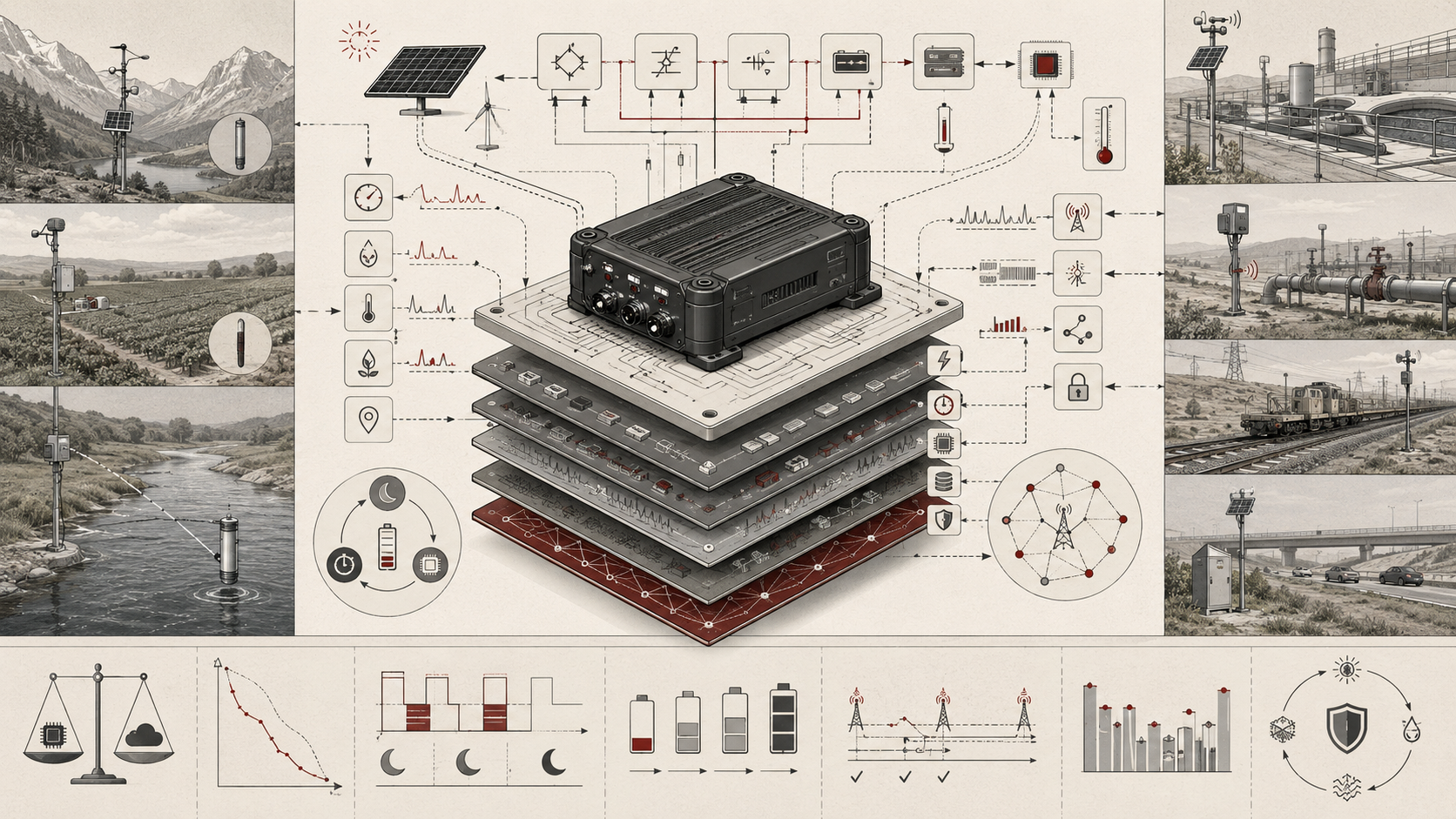
The engineering question is therefore not merely how little current a processor can draw in a datasheet sleep mode. It is how the entire device spends energy across time: when to wake, what to retain, which peripherals to power, which clocks and regulators remain enabled, which events justify radio transmission, how to preserve responsiveness, and how to avoid energy savings that quietly undermine reliability or measurement quality.
Engineering Problem
The engineering problem is how to minimize energy consumption while preserving the device’s required sensing, computation, communication, responsiveness, reliability, and recovery behavior. A low-power embedded device is not successful merely because it can enter a low-current state. It is successful when the full system spends energy only when useful work requires it, wakes for the right events, resumes correctly, communicates proportionately, protects state under low-energy conditions, and remains diagnosable over its intended life.
This makes low-power design a temporal architecture problem. The device moves through states: boot, active sensing, local processing, communication, idle, sleep, deep sleep, wake, recovery, degraded operation, brownout protection, and maintenance. Each state consumes power, takes time, retains or loses different information, and changes what the device can notice. Poor architecture wastes energy by keeping too much active. Overaggressive architecture saves energy while missing events, corrupting state, delaying response, or making failures hard to diagnose.
A rigorous design should be able to answer several questions. What work must the device perform? How often must it sense, compute, and transmit? What deadlines must it meet after wake? Which peripherals are required in each operating mode? What state must be retained? What can be reconstructed after wake? What events justify leaving sleep? How much energy does each event cost? What battery, regulator, or harvesting budget is available? What reserve margin exists for temperature, aging, retries, leakage, and firmware changes? What happens when energy reserves are low?
The core challenge is not merely lower current. It is disciplined energy scheduling under functional constraints. In engineering terms, low-power design aligns energy expenditure with meaningful work, valid measurements, reliable communication, and safe recovery.
Reference Architecture
A practical low-power embedded architecture can be understood as a set of coordinated power domains, timing policies, wake paths, firmware states, and observability mechanisms. The exact implementation may use a low-power MCU, Cortex-M-class microcontroller, application processor with low-power modes, Zephyr runtime power management, bare-metal sleep states, sensor interrupts, RTC wakeups, radio duty cycling, energy harvesting, external supervisor ICs, or dedicated always-on domains. The responsibilities remain consistent.
| Layer | Engineering Role | Low-Power Concern | Evidence Artifact |
|---|---|---|---|
| Energy requirement | Defines lifetime, responsiveness, sensing, communications, reliability, and maintenance targets | Battery life, service interval, wake latency, event capture, reserve margin | Power requirement, lifetime target, energy budget |
| Power-source layer | Provides battery, solar, harvesting, regulator, storage, or mains-backed supply | Capacity, voltage range, pulse current, regulator efficiency, quiescent current, temperature behavior, brownout risk | Battery model, solar profile, regulator notes, reserve calculation |
| Processing layer | Selects MCU, SoC, clock domains, and compute modes | Active current, sleep current, wake time, frequency scaling, retained state | Processor profile, clock policy, sleep-mode map |
| Peripheral layer | Controls ADC, timers, radios, sensors, buses, displays, memory, and accelerators | Clock gating, runtime PM, leakage, wake-capable peripherals, reinitialization cost | Peripheral power manifest, runtime PM policy, dependency map |
| Firmware scheduling layer | Defines active work, sleep entry, wake handling, idle policy, and background tasks | Polling, task wakeups, interrupt behavior, idle residency, wake storms | State machine, RTOS policy, idle-residency report |
| Sensing layer | Coordinates sensor power, sampling cadence, threshold wake, and measurement quality | Sensor warm-up, sampling interval, event sensitivity, calibration, data freshness | Sampling policy, sensor duty-cycle plan, measurement-quality notes |
| Communications layer | Schedules radio use and data movement | Transmit energy, receive windows, retries, batching, compression, offline buffering, gateway behavior | Telemetry policy, link report, retry counters, batching plan |
| Retention layer | Determines which state survives sleep and deep sleep | RAM retention, RTC state, GPIO configuration, calibration data, cryptographic context, local logs | Retention manifest, wake-path validation, last-known-good state |
| Reliability layer | Protects against brownout, unsafe sleep transitions, failed wakeups, and corrupted state | Brownout detection, watchdog behavior, reset cause, safe degradation, power-fail recovery | Reset log, brownout counter, recovery policy, safe-state rule |
| Observability layer | Reports power and energy behavior after deployment | Battery voltage, sleep residency, wake cause, radio cost, low-energy events, uptime | Telemetry schema, fleet report, power audit, maintenance threshold |
This architecture makes power behavior visible. A device is not low power because one component has a low-current mode. It is low power when the whole system coordinates active work, sleep states, wake causes, peripheral lifecycles, communications, retention, power-source behavior, and reliability evidence.
Implementation Pattern
A rigorous implementation begins with an energy budget and operating-state model. The design should define what the device does during active sensing, processing, communications, idle, sleep, deep sleep, wake, recovery, low-battery, brownout, and maintenance states.
| Artifact | Purpose | Typical Format |
|---|---|---|
| Energy budget | Defines current, voltage, duration, and energy for each major system state | CSV, spreadsheet, Python model, design report |
| Power-state model | Defines active, idle, sleep, deep sleep, communication, wake, brownout, and degraded states | State machine, YAML, firmware design note |
| Wake-source policy | Defines which events can wake the device from each low-power state | YAML, interrupt map, RTC schedule, GPIO trigger list |
| Retention manifest | Defines which memory, registers, peripherals, clocks, GPIO states, and security context survive each mode | Markdown, YAML, hardware notes |
| Peripheral power manifest | Defines when sensors, ADCs, radios, buses, displays, regulators, and memory are enabled or disabled | YAML, driver policy, runtime PM configuration |
| Communication policy | Defines transmission frequency, receive windows, batching, retry behavior, offline buffering, and data priority | YAML, telemetry contract, network runbook |
| Low-energy mode policy | Defines reduced sampling, delayed transmission, emergency heartbeat, safe storage behavior, and maintenance thresholds | Runbook, firmware state machine, telemetry rule |
| Power telemetry schema | Defines battery voltage, charge estimate, wake cause, sleep residency, transmit count, radio retries, and brownout indicators | SQL, JSON Schema, CSV, telemetry record |
| Validation plan | Tests current draw, sleep entry, wake latency, retained state, radio energy, regulator behavior, and brownout recovery | Test plan, bench log, HIL procedure |
| Fleet power report | Tracks battery-risk trends, sleep residency, wake storms, power drift, and maintenance priority across deployed devices | R report, CSV summary, dashboard |
The implementation goal is to make power use accountable. Engineers should know where energy is spent, why it is spent, which work caused it, whether it was necessary, and whether the device remains within its lifetime, responsiveness, and reliability requirements.
Research-Grade Framing: Low Power as Selective Activity
Low-power embedded design should be framed as selective activity rather than simple minimization. A device is not useful because it is asleep. It is useful because it wakes at the right time, performs meaningful work, preserves necessary state, and returns to a lower-energy condition without losing reliability or interpretability.
This framing matters because power optimization can become technically narrow. Teams may focus on processor sleep current while ignoring radio behavior, sensor warm-up, regulator quiescent current, failed retries, polling loops, leakage paths, pull-up current, or wake storms. They may also chase the deepest sleep state even when wake latency, retention loss, sensor reinitialization, or radio reconnection cost makes the system less dependable.
| Power Dimension | Question | Required Evidence |
|---|---|---|
| Purposeful activity | Is active time tied to sensing, computation, communication, diagnostics, or recovery that matters? | State timeline, active-duration report, task profile |
| Sleep effectiveness | Does the device actually spend enough time in low-power states? | Sleep-residency metrics, current trace, wake-cause log |
| Wake discipline | Does the device wake only for justified events? | Wake-source policy, wake-count report, false-wake analysis |
| Retention discipline | Is only necessary state retained? | Retention manifest, resume validation, memory-domain map |
| Communication proportionality | Is radio use matched to data value and urgency? | Transmit-count log, receive-window log, retry rate, batching policy |
| Measurement integrity | Do energy savings preserve sampling quality and calibration assumptions? | Sensor warm-up test, data-freshness check, quality flags |
| Power-source realism | Do battery, regulator, pulse-load, and harvesting assumptions match field conditions? | Battery derating model, regulator profile, pulse-load test, solar/harvesting record |
| Lifecycle reliability | Does low-power behavior support long deployment without hidden failure? | Battery trend, brownout log, low-energy-mode report |
In this framing, low power is not only electrical efficiency. It is disciplined participation in time. The device must know when to be present, when to disappear into low energy, and how to return without losing its role in the system.
Formal Model: Energy, Duty Cycle, Wake Cost, and Lifetime
A useful formal model separates active work, sleep residency, wake overhead, communication cost, regulator behavior, and available energy. Let \(P_a\) be active power, \(P_s\) sleep power, \(d\) duty cycle, \(E_w\) wake energy, \(n_w\) wake count over a period, \(E_c\) communication energy, \(P_q\) regulator and board quiescent power, and \(B\) usable battery energy.
P_{\mathrm{avg}} = dP_a + (1-d)P_s + P_q
\]
Interpretation: Average power depends on active power, sleep power, duty cycle, and quiescent system losses. In very low-power devices, regulator quiescent current, pull-ups, sensors, or leakage can dominate the sleep budget.
E_{\mathrm{period}} = E_{\mathrm{sense}} + E_{\mathrm{compute}} + E_{\mathrm{comm}} + E_{\mathrm{wake}} + E_{\mathrm{sleep}} + E_{\mathrm{retain}}
\]
Interpretation: A full energy budget should account for sensing, computation, communications, wake overhead, sleep energy, and retained domains. Radio or sensor warm-up energy can dominate even when processor energy is small.
E_{\mathrm{wake,total}} = n_w E_w
\]
Interpretation: Wake overhead accumulates. A system that wakes too often can waste energy even if each wake event is individually inexpensive.
T_{\mathrm{life}} \approx \frac{\eta B}{P_{\mathrm{avg}}}
\]
Interpretation: Expected lifetime is usable energy divided by average power. The derating factor \(\eta\) should account for temperature, aging, regulator efficiency, end-of-life voltage, pulse loads, and reserve margin.
E_{\mathrm{useful}} = \frac{E_{\mathrm{total}}}{N_{\mathrm{valid\ events}}}
\]
Interpretation: Energy per useful event asks how much energy the system spends for each valid measurement, alert, transmission, or decision. This discourages optimizing for low current while producing low-value wakeups or invalid data.
These equations are intentionally simple. Their purpose is to make hidden design assumptions visible: duty cycle, sleep current, wake frequency, communication cost, regulator losses, and battery capacity are coupled. Low-power design is strongest when those relationships are measured, modeled, and validated together.
What Is Low-Power Embedded System Design?
Low-power embedded system design is the practice of structuring hardware and software so that a device minimizes energy use while still meeting functional, temporal, reliability, and measurement requirements. It involves far more than selecting a low-power processor. It includes choosing which parts of the system remain active, which can be suspended, what state must be retained, how fast the system must run, how often it must wake, which events justify spending energy, and how the device behaves when energy reserves decline.
In practical terms, low-power design usually combines several strategies:
- placing the processor into idle, sleep, deep-sleep, standby, or shutdown states when active computation is unnecessary
- gating clocks or turning off peripherals that are not currently needed
- reducing system or peripheral frequency when full performance is unnecessary
- duty cycling sensing, computation, storage, and communications so they occur only as often as needed
- using event-driven wake sources rather than continuous polling where appropriate
- retaining only the minimum state required for useful wake-up and recovery
- structuring firmware so idle time is preserved rather than accidentally consumed
- validating brownout behavior, persistent-state integrity, and resume paths
- tracking power behavior in field telemetry rather than treating it as a bench-only concern
The important point is that low power is an operating model. The device must be designed around a rhythm of attention: mostly quiet, selectively awake, and fully active only when justified by the job it performs.
Why Power Is an Architectural Constraint
Power matters because embedded devices often inhabit environments where energy is limited, costly, or operationally consequential. A battery-powered environmental monitor that wastes power may require frequent maintenance visits. A medical wearable with poor energy discipline may be physically impractical. A smart meter or distributed sensor network designed without careful duty cycling may compromise deployment scale or service life. Even in larger systems, excess power can increase heat, reduce reliability margins, and complicate packaging and lifecycle management.
Power is architectural because it changes what kinds of systems are feasible. It shapes processor selection, clock hierarchy, peripheral configuration, memory strategy, communications schedule, and software execution model. A low-power system may favor interrupt-driven or event-driven behavior over continuous polling. It may prefer local thresholding to constant radio transmission. It may use lower clock rates and deeper sleep states at the cost of longer wake-up or reduced throughput.
Energy constraints also shape product and maintenance realities. A device that lasts three months may require an entirely different operating model than a device that lasts three years. A network of ten devices may tolerate battery replacement; a network of ten thousand may not. A remote ecological station, industrial sensor, or infrastructure node may be constrained less by battery price than by the cost and risk of field service.
This is why low-power design should not be treated as a last-stage optimization pass. By the time the board, firmware, sensors, radio, regulator, and communications assumptions are fixed, much of the system’s energy behavior is already locked in.
Sleep States, Deep Sleep, and Retention
One of the central mechanisms of low-power embedded design is the use of sleep states. In a light sleep state, the processor may stop active execution while preserving enough context to resume quickly. In deeper states, more of the system is turned off, often with greater energy savings but also greater wake-up cost and reduced retained context. The architecture of these modes varies by processor and platform, but the governing principle is similar: deactivate what is not needed, retain only what must persist, and provide controlled paths back to useful operation.
The real architectural issue is retention. When a system sleeps, some combination of RAM, registers, RTC state, GPIO configuration, interrupt sources, backup domain, sensor configuration, or selected peripheral domains may remain powered while other parts are lost. A good low-power design makes these retention decisions explicitly. It identifies which information must survive without full reinitialization, which state can be reconstructed cheaply, and which forms of state loss would turn wake-up into an unstable pseudo-boot path.
Deep sleep is not automatically better. A device that enters the deepest mode but wakes too slowly, loses necessary calibration state, resets communication context, or increases radio reconnection cost may consume more energy at the system level than a device that uses a shallower but more coherent low-power state. The correct mode is the deepest mode compatible with timing, retention, measurement, and recovery obligations.
A robust sleep design should therefore include a mode table: what remains powered, what is lost, what can wake the system, how long wake takes, what must be reinitialized, what must be validated, and what faults can occur during the transition.
Clocking, Frequency Scaling, and Peripheral Gating
Energy consumption in embedded systems is strongly shaped by clocking strategy. Clocks drive processor and peripheral activity, so unnecessary frequency or unnecessary active domains often translate directly into wasted energy. One of the most practical low-power techniques is therefore to run the system no faster than its workload requires.
Peripheral gating is equally important. A UART, ADC, timer, radio, display block, sensor interface, memory bus, DMA engine, reference source, or external sensor rail that remains active when not needed can dominate the power budget, especially in systems whose processor sleeps much of the time. Good low-power architecture treats every peripheral as a power-domain question: when must it be enabled, what work justifies its activation, and how quickly can it be suspended or resumed without destabilizing the rest of the system?
Clocking also affects temporal behavior. Lower frequency can save power, but it may increase execution time, alter interrupt latency, change bus timing, extend active residency, and complicate timing relationships among peripherals. Frequency scaling is therefore not a matter of indiscriminately slowing the system. It is a matter of proportionate performance: enough speed to satisfy deadlines, no more speed than the workload actually demands.
The best clocking policies are workload-aware. They distinguish between short bursts that should finish quickly and return to sleep, background work that can run slowly, sensor acquisition that requires stable timing, and communications windows where radio cost may dominate processor savings.
Duty Cycling and Selective Activity
Duty cycling is one of the most important ideas in low-power design. Rather than remaining continuously active, the system wakes periodically or in response to events, performs the work that is required, and then returns to a low-power state. This strategy is especially effective in monitoring systems, wearables, wireless nodes, and environmental sensors, where meaningful events may be sparse relative to total elapsed time.
A well-designed duty-cycled system treats active time as expensive. Sensing should happen at justified intervals, not by default. Communications should be batched or filtered where possible. Computation should occur only when it creates value, not simply because the processor is awake. The resulting device is not “always on” in the naive sense. It is selectively active in ways that preserve both usefulness and energy.
Duty cycling only works well when sensing, timing, wake-up sources, software scheduling, retained state, and data handling are planned together. Otherwise, wake frequency, wake overhead, sensor warm-up, radio association, or resume complexity can erase the intended savings.
A strong duty-cycle design should distinguish baseline sampling, event sampling, maintenance wakeups, telemetry windows, fault recovery, and low-battery operation. Each mode should have a reason to exist, an energy cost, a data-quality implication, and a rule for exiting.
Wake-Up Sources, Latency, and Responsiveness
A sleeping system is only useful if it can wake for the right reasons and resume meaningful work quickly enough. Wake-up sources may include timers, RTC alarms, GPIO events, communications activity, sensor thresholds, watchdog recovery, comparator triggers, accelerometer interrupts, or power-management events. The architecture must define which of these remain available in each power state and what portions of the system they can reactivate.
Wake-up latency is central. Deep sleep usually saves more energy, but it often lengthens recovery time and may require more extensive reinitialization. Lighter sleep preserves more immediate responsiveness but at higher standby cost. This means low-power design is always a negotiation between energy and time. Some applications can tolerate long sleep and slower resume. Others need near-immediate response and therefore accept a shallower low-power state.
Good low-power architecture makes this trade-off explicit. It identifies which events are important enough to wake the system, which deadlines must still be met after wake, and which state must be preserved to avoid turning every resume into a costly pseudo-reboot. In more advanced designs, wake-up strategy also becomes a policy question: should the system wake on every possible signal, or only on events filtered through comparators, threshold logic, subordinate controllers, or low-power sensor hubs that reduce false activations?
Wake discipline also prevents wake storms. A poorly debounced input, noisy sensor threshold, unstable radio signal, misconfigured interrupt, or maintenance timer can wake the device repeatedly and destroy the energy budget while appearing superficially functional.
Firmware Design for Low Power
Firmware often determines whether low-power features are actually realized. A capable MCU can still waste energy if firmware polls instead of sleeping, leaves peripherals enabled, schedules unnecessary wake-ups, blocks in drivers, performs work too frequently, or prevents the processor from entering idle states. Low-power firmware is therefore not a matter of sprinkling sleep calls into otherwise unchanged code. It requires structuring software so idle time remains visible and exploitable.
This usually means favoring interrupt-driven or event-driven models where appropriate, reducing unnecessary background work, coordinating peripheral lifecycles carefully, and making power-state transitions part of normal software design rather than exceptional cases. In RTOS-based systems, tasks and drivers must cooperate so that no component blocks entry into lower power states without a justified reason.
Firmware must also treat resume paths as first-class behavior. A device that can enter low power but not reliably return from it is not energy efficient in any meaningful engineering sense. The wake path should be considered part of the normal execution model, complete with explicit sequencing, validation, and recovery logic.
Low-power firmware also needs strong error handling. Brownout, partial wake, failed peripheral resume, invalid retained state, missed RTC alarms, stale sensor data, and radio reconnect failure should be expected cases, not surprises. Energy savings become fragile when firmware assumes that every wake begins from a clean, ideal context.
Runtime Power Management and Platform Support
Modern embedded platforms increasingly provide formal runtime power management facilities. Rather than leaving every driver or subsystem to handle power in isolation, the platform offers APIs and policies for suspending idle devices, coordinating dependencies, and managing transitions among system states.
Platform support matters because low-power behavior often spans multiple layers: processor sleep states, board regulators, peripheral clocks, device drivers, and application timing policy. Without a structured framework, these layers can work against each other. With one, the system has a better chance of enforcing consistent device and subsystem behavior.
Still, no framework eliminates the need for design judgment. Runtime power management can save energy, but poorly chosen dependencies or over-aggressive transitions may add wake overhead, complexity, or latency that outweigh the benefit. A sensor driver that suspends too aggressively may increase warm-up cost. A radio stack that sleeps at the wrong time may increase retries. A device dependency that remains active unnecessarily may block system-level low-power entry.
Runtime power management is therefore best understood as a coordination mechanism. It does not replace the energy budget, state model, dependency audit, or measurement of real current behavior.
Communications, Radios, and Energy-Dominant Subsystems
In many low-power embedded systems, communications dominate energy consumption. A processor can sleep efficiently, but a radio transmission, association attempt, cellular reconnect, failed packet retry, receive window, or high-power listening interval can consume far more energy than local computation. This is why communications policy is central to low-power architecture.
Good communication design asks what data are worth transmitting, how urgent they are, whether they can be batched, whether local thresholds can reduce traffic, whether compression is worthwhile, and how retries should be limited. It also asks what should happen during poor link quality. Infinite or aggressive retries can destroy the energy budget while still failing to deliver useful data.
The communications strategy should distinguish heartbeat telemetry, routine measurements, event alerts, firmware updates, diagnostics, and high-priority fault reports. Not all messages deserve the same energy budget. A low-battery warning may deserve transmission even when routine measurements are deferred. A large diagnostic upload may be delayed until link quality improves.
A low-power device should therefore treat the radio as a scarce resource. It should wake it deliberately, transmit proportionately, limit retries, preserve enough local storage to avoid wasting energy on repeated failed delivery, and expose communication energy in diagnostics.
Sensing, Measurement Quality, and Energy Discipline
Low-power design must preserve measurement quality. Sensing less often, powering sensors intermittently, or using threshold-based wakeups can save energy, but those choices can also introduce stale data, missed events, inadequate warm-up time, sensor drift, calibration instability, or invalid measurements.
Some sensors require warm-up before measurements are valid. Others consume meaningful current while stabilizing. Some require periodic excitation or cleaning. Some lose accuracy if duty cycled without attention to thermal, optical, chemical, or electrochemical behavior. A low-power design that treats sensors as instantly available digital values can produce misleading data even while meeting its battery target.
The sensing policy should therefore be tied to the environmental or operational process being measured. Slow-changing variables may tolerate sparse sampling. Fast events may require interrupt-driven wake or adaptive burst sampling. Critical measurements may require retained calibration state, sensor health checks, or periodic validation even when the device is trying to conserve energy.
A strong low-power sensing architecture optimizes energy per valid measurement, not merely energy per sample. Invalid, stale, or poorly conditioned measurements are wasted energy.
Batteries, Energy Harvesting, Regulators, and Power Budgets
Many embedded devices rely on batteries, solar cells, vibration harvesters, thermal gradients, or other constrained energy sources. These systems require explicit power budgets because the available energy may vary with temperature, season, light exposure, usage pattern, battery aging, and maintenance intervals.
A battery capacity printed on a datasheet is not the same as usable energy in the field. Temperature can reduce effective capacity. High pulse currents can reduce available energy. Regulators have efficiency curves and quiescent current. Self-discharge matters over long deployments. Solar panels may be shaded, dusty, snow-covered, or seasonally underperforming. Energy harvesting can extend life, but it also introduces variability that must be managed with storage and degraded modes.
Regulators and board-level leakage deserve explicit treatment. A low-power MCU in deep sleep can be undermined by a regulator with excessive quiescent current, always-on sensors, pull-up resistors, leakage through protection networks, level shifters, displays, external memory, or debug circuitry left populated in production. Board-level current is the quantity that matters, not just MCU current.
A robust power budget should include active energy, sleep energy, wake energy, retention energy, sensor warm-up, radio transmission, receive windows, failed retries, maintenance wakeups, firmware updates, brownout reserve, and low-energy behavior. It should include margin rather than assuming ideal conditions.
Low-power devices should also define energy-aware degradation. When reserves are low, the device may reduce sampling, delay nonessential transmissions, disable expensive sensors, send only heartbeat telemetry, or enter a protective mode. These degraded states should be intentional, visible, and reversible when energy recovers.
Brownout, Persistent State, and Low-Energy Recovery
Low-power systems often operate close to the edge of their supply envelope. Battery voltage may sag under radio pulse load. Solar input may fall below expectation. Harvested energy may arrive intermittently. Regulators may drop out. If the system does not handle these conditions deliberately, low-power behavior can become a source of data loss, corrupted persistent state, repeated resets, and field failure.
Brownout behavior should therefore be part of the low-power architecture. The design should define voltage thresholds, degraded-mode entry, storage-write inhibition, safe shutdown, reset-cause preservation, and recovery behavior. It should also define what happens after a brownout: which state is trusted, which state is rebuilt, which logs are preserved, and which services resume only after validation.
Persistent storage is a common weak point. Flash writes, filesystem updates, local logs, configuration changes, and firmware updates should not be performed casually near low-voltage thresholds. Atomic writes, versioned records, CRCs, last-known-good configuration, and rollback paths are reliability mechanisms as much as software conveniences.
A low-power device should not merely survive energy scarcity. It should transition through scarcity in a controlled, diagnosable, and recoverable way.
Mathematical Lens: Duty Cycle, Average Power, Battery Life, and Energy per Useful Event
The companion mathematical lens helps connect design decisions with measurable energy behavior. A system’s lifetime is rarely determined by a single current number. It depends on how often the device wakes, how long it remains active, what peripherals are enabled, how often it transmits, how much board-level leakage exists, and how much energy each useful event consumes.
I_{\mathrm{avg}} = dI_a + (1-d)I_s + I_q
\]
Interpretation: Average current is a weighted combination of active current, sleep current, and quiescent current from regulators or always-on board elements. In ultra-low-power devices, \(I_q\) can dominate.
E_{\mathrm{comm}} = n_{\mathrm{tx}}E_{\mathrm{tx}} + n_{\mathrm{rx}}E_{\mathrm{rx}} + n_{\mathrm{retry}}E_{\mathrm{retry}}
\]
Interpretation: Communications energy depends on transmissions, receive windows, and retries. Failed retries can dominate the budget in weak-link environments.
T_{\mathrm{life}} \approx \frac{\eta B}{P_{\mathrm{avg}}}
\]
Interpretation: Expected lifetime depends on usable energy \(B\), derating or efficiency factor \(\eta\), and average power. Practical designs should include temperature, regulator efficiency, self-discharge, pulse loads, and reserve margin.
E_{\mathrm{event}} = E_{\mathrm{wake}} + E_{\mathrm{sense}} + E_{\mathrm{compute}} + E_{\mathrm{store}} + E_{\mathrm{comm}} + E_{\mathrm{return}}
\]
Interpretation: Event energy includes wake, sensing, computation, storage, communication, and return-to-sleep cost. A low-power system should optimize the full event path, not only the processor current.
U = \frac{N_{\mathrm{valid}}}{E_{\mathrm{total}}}
\]
Interpretation: Energy utility \(U\) measures valid useful outputs per unit energy. It favors designs that produce meaningful measurements, alerts, or decisions rather than merely low raw current.
These equations help prevent a common design mistake: optimizing a single mode while ignoring the system’s actual energy rhythm.
Python Workflow: Power Budget, Duty Cycle, and Lifetime Simulation
The companion Python workflow models a low-power embedded device across operating states: sleep, wake, sensing, computation, storage, communication, retry, degraded low-energy mode, and brownout protection. It estimates average current, average power, battery life, energy per measurement, energy per valid event, and the effect of duty-cycle changes on lifetime.
The workflow is designed to answer practical engineering questions. What happens if sampling interval doubles? How much do radio retries reduce lifetime? Does deeper sleep matter if wake events are too frequent? Which subsystem dominates energy use? How much reserve remains after seasonal derating? Which devices in a fleet are at battery risk? Does regulator quiescent current dominate the sleep budget? What happens when sensor warm-up is included?
Useful outputs include a state-level energy budget, daily energy estimate, expected lifetime, radio-cost sensitivity, wake-frequency sensitivity, regulator/leakage sensitivity, and plots comparing different sampling and communication policies. In a production setting, this workflow could support design review, field deployment planning, firmware policy tuning, or postdeployment battery-risk analysis.
The purpose is not to produce a perfect lifetime prediction. It is to make assumptions visible, testable, and adjustable before the device fails early in the field.
R Workflow: Fleet Power Reporting and Battery-Risk Review
The companion R workflow treats power as a fleet-observability problem. It summarizes battery voltage, estimated charge, wake counts, sleep residency, radio transmissions, retry counts, brownout events, low-energy-mode entries, firmware versions, and device lifetime risk across deployed nodes.
This matters because low-power failures often appear only after deployment. One node may wake too often because of a noisy interrupt. Another may suffer radio retries because of poor placement. Another may have lower battery reserve because of shade or cold temperature. Another may remain technically online while slowly losing the ability to transmit at expected intervals.
Useful R outputs include battery-risk rankings, wake-count distributions, sleep-residency summaries, communication-energy estimates, low-power-mode trends, brownout counts, firmware comparisons, and maintenance priority tables. These reports support field service, firmware tuning, solar-panel review, communications policy changes, and lifecycle planning.
A low-power fleet is not only designed once. It is measured continuously.
Systems Code: Sleep Policies, Power State Machines, Telemetry, PYNQ, HDL, and Bash
The companion systems stack demonstrates how low-power concerns appear across embedded and edge implementation layers.
The C example focuses on firmware-adjacent power policy: deciding whether the device can enter sleep, which wake sources are enabled, whether peripherals are idle, whether retained state is valid, and whether low-battery behavior should override normal operation. The C++ example models a power-state machine with active, sensing, communication, sleep, deep sleep, wake, low-energy, brownout-protection, and recovery states. The Rust example validates power manifests and ensures that each peripheral, wake source, retention requirement, and brownout threshold is explicit. The Go example sketches a fleet telemetry utility that aggregates battery and wake behavior.
MicroPython provides a prototype for duty-cycled sensing, sleep scheduling, local thresholding, and low-battery behavior. TinyML may support local event screening when it reduces unnecessary transmissions, but it should not replace explicit power policy or measurement-quality checks. PYNQ support can demonstrate hardware-assisted wake filtering, timestamping, or low-level event counting. HDL examples can model wake counters, sleep-state timers, peripheral-enable gates, pulse-load guards, or low-power event filters.
The Bash scripts tie the workflow together by validating manifests, running Python and R workflows, generating outputs, and checking repository structure. The goal is to provide an engineering scaffold that reflects real low-power design work: state modeling, energy accounting, measurement quality, brownout protection, and operational evidence.
Technical Verification Gates
Low-power design should pass explicit verification gates before deployment and during operation. These gates prevent the device from being judged only by nominal current measurements.
| Gate | Verification Question | Evidence Required |
|---|---|---|
| Energy-budget gate | Does the measured state-level current match the design budget? | Bench current trace, state-duration report, budget comparison |
| Sleep-entry gate | Can the device reliably enter intended low-power states? | Sleep-residency log, blocked-sleep analysis, driver dependency review |
| Wake gate | Can the device wake for required events within required latency? | Wake-source test, latency measurement, event-capture test |
| Retention gate | Does the required state survive each sleep mode and validate after wake? | Retention manifest, resume validation, CRC or state-integrity check |
| Peripheral gate | Are sensors, buses, radios, memory, displays, references, and regulators powered only when needed? | Peripheral enable log, runtime PM test, current trace |
| Communication gate | Are transmissions, receive windows, retries, and reconnects proportional to data value? | Radio-energy report, retry summary, telemetry policy review |
| Power-source gate | Do battery, regulator, leakage, pulse-load, and harvesting assumptions hold under field-like conditions? | Battery derating model, regulator measurement, pulse-load test, solar/harvesting log |
| Reliability gate | Does low-power operation preserve brownout recovery, watchdog behavior, and diagnostics? | Brownout test, reset-cause log, low-energy-mode validation |
| Fleet gate | Can deployed devices report battery, wake, sleep, communication, and brownout health? | Power telemetry schema, fleet report, maintenance threshold |
These gates reinforce the central principle: low-power operation is not valid until it is measured under real state transitions, wake paths, communications behavior, power-source behavior, and field-like conditions.
Testing and Validation
Testing low-power systems requires more than reading a datasheet current value. The device should be measured across real operating states: boot, active sensing, computation, communication, retry, idle, sleep, deep sleep, wake, low-battery, brownout, and recovery. The timing of those states matters as much as current level.
A useful validation plan includes at least six layers. First, bench validation measures current in each power state, including board-level leakage and regulator quiescent current. Second, timing validation measures wake latency, active duration, and return-to-sleep behavior. Third, retention validation checks that required state survives sleep and deep sleep. Fourth, communications validation measures transmit, receive, retry, reconnect, and offline buffering cost. Fifth, field validation tests solar exposure, battery behavior, pulse loads, temperature effects, and real wake sources. Sixth, fleet validation tracks battery trends, wake storms, sleep residency, power drift, and maintenance risk.
Negative testing is essential. The device should be tested under noisy interrupts, weak radio links, low battery, cold temperature, missed RTC alarms, failed sensor resume, brownout during write, repeated wake attempts, and firmware update under low-energy conditions. A low-power system that works only on the bench may fail once environmental and communications conditions become realistic.
The final test is not simply “How low is the sleep current?” It is “Does the device meet its lifetime, responsiveness, measurement, and reliability requirements under the duty cycle it will actually experience?”
Operational Signals and Power Observability
A low-power embedded system should report enough telemetry to show whether its energy model remains valid after deployment. Otherwise, power failures appear only when devices disappear from the network.
Useful signals include battery voltage, estimated state of charge, sleep residency, wake count, wake cause, active duration, transmit count, receive-window duration, retry count, brownout count, reset cause, low-energy-mode entries, solar input where available, temperature, firmware version, configuration version, and maintenance status. These signals help engineers distinguish battery aging, poor siting, radio retries, wake storms, sensor faults, regulator or leakage drift, and firmware regressions.
Power observability also supports design improvement. A fleet may reveal that one firmware version wakes too frequently, one site has poor solar exposure, one radio policy causes excessive retries, one hardware revision leaks more than expected, or one sensor driver blocks deep sleep. Without observability, those patterns remain hidden until maintenance costs rise or devices fail early.
The device should not only conserve energy. It should explain how it spends energy.
Common Failure Modes
Low-power failures often appear as mysteries: batteries drain too quickly, wakeups are missed, devices disappear after brownout, or field nodes behave differently from bench prototypes. The underlying causes are usually architectural rather than accidental.
Common failure modes include excessive polling, blocked sleep entry, noisy wake sources, radio retry storms, unused peripherals left active, sensors powered continuously, regulator quiescent current that exceeds expectations, board-level leakage, deep sleep used without valid retention planning, slow wake paths that miss deadlines, and firmware tasks that prevent idle residency. Other failures include brownout during flash writes, corrupted retained state, inaccurate battery estimates, poor solar exposure, cold-temperature capacity loss, and overaggressive sampling reduction that undermines measurement quality.
A particularly important failure mode is false low power. The device demonstrates excellent sleep current in isolation, but the deployed system wakes too frequently, transmits too often, spends too much time reconnecting, or leaks through external circuitry. The measured field behavior then diverges sharply from the theoretical budget.
Good low-power engineering treats those failures as design signals. They indicate where the power model, firmware schedule, communications policy, board design, or field assumptions need correction.
Trade-Offs in Low-Power Architecture
Low-power embedded design is defined by trade-offs that cannot all be optimized at once. Deeper sleep reduces standby energy but may increase wake latency. Lower clock speeds save power but may lengthen active execution. More aggressive duty cycling reduces average consumption but may sacrifice temporal granularity or data freshness. More retained state improves resume behavior but increases standby cost. Richer communications increase functionality but often dominate the power budget.
These trade-offs explain why low-power design is not reducible to a checklist. It requires judgment about what the device must notice, how quickly it must respond, how long it must survive, and what work is truly worth spending energy on. Energy efficiency is not merely a matter of pushing the device toward the deepest idle state. It is a matter of aligning activity, responsiveness, retention, measurement quality, reliability, and system purpose.
The right architecture depends on the use case. A medical wearable, environmental sensor, smart meter, remote asset tracker, industrial monitor, and edge gateway all face different combinations of energy, latency, reliability, communications, and maintenance constraints. A good design is proportional to those constraints rather than maximal in any one dimension.
Applications in Embedded and Edge Systems
Low-power design appears across environmental sensors, smart meters, medical wearables, asset trackers, remote controls, industrial monitors, wireless nodes, battery-backed gateways, agricultural sensing, wildlife monitoring, building systems, and edge devices that must balance local intelligence with constrained energy budgets.
In very small devices, low power may primarily mean long battery life and sparse wake intervals. In larger platforms, it may also mean managing multiple domains, selective subsystem retention, and richer standby strategies such as deep sleep or MCU-only operation. In remote field systems, it may define whether maintenance is practical at all. In distributed sensor networks, it may determine how dense a deployment can be and how often measurements can be collected.
This makes low-power design foundational to embedded and edge systems more broadly. It determines how often devices can observe the world, how long they can remain deployed, how much local computation can be sustained, how much communication can be afforded, and whether the system can remain reliable under real energy constraints.
Engineer Checklist
| Question | Why It Matters |
|---|---|
| Is there a measured state-level energy budget? | Prevents lifetime claims from relying on a single ideal current number. |
| Are sleep states matched to wake latency and retention requirements? | Ensures deep sleep does not break responsiveness or resume behavior. |
| Are wake sources justified, debounced, and monitored? | Prevents wake storms and unnecessary active time. |
| Are unused peripherals, regulators, references, and sensor rails actually disabled or suspended? | Reduces hidden energy drain from sensors, buses, radios, displays, memory, and board-level support circuits. |
| Is communication energy explicitly budgeted? | Accounts for transmissions, receive windows, retries, reconnects, and offline buffering. |
| Does the sensing schedule preserve measurement quality? | Prevents energy savings from producing stale, invalid, or poorly conditioned data. |
| Are brownout and low-energy modes defined? | Protects persistent state and allows graceful degradation before energy collapse. |
| Can deployed devices report power health? | Supports fleet maintenance, firmware tuning, and early battery-risk detection. |
GitHub Repository
This article is supported by a companion workflow that treats low-power embedded design as a full energy architecture: power budgets, duty-cycle models, sleep-state policies, wake-source manifests, peripheral power control, communication-energy analysis, battery-risk reporting, Python simulation, R fleet analysis, SQL evidence schemas, systems-code examples, tests, manifests, and runbooks.
The companion repository includes Python, R, SQL, C, C++, Rust, Go, MicroPython, TinyML, PYNQ, HDL, Bash, YAML/JSON configuration, notebooks, tests, docs, data, outputs, and article-specific engineering workflows.
Where This Fits in the Series
This article extends the foundation established in Embedded Systems Architecture, Microcontrollers and System-on-Chip Design, Real-Time Operating Systems in Embedded Computing, and Firmware, Hardware Abstraction, and Device Control by focusing on how embedded systems minimize energy use without losing the ability to sense, compute, communicate, recover, and respond.
It prepares the way for later work on Environmental Sensor Networks, Reliability and Fault Tolerance in Embedded Devices, Cyber-Physical Systems and Hardware Integration, and Edge Computing Architectures.
Related articles
- Embedded Systems Architecture
- Microcontrollers and System-on-Chip Design
- Real-Time Operating Systems in Embedded Computing
- Firmware, Hardware Abstraction, and Device Control
- Environmental Sensor Networks
- Reliability and Fault Tolerance in Embedded Devices
Further reading
- Arm (n.d.) M-Profile Architectures. Available at: https://www.arm.com/architecture/cpu/m-profile.
- Arm (n.d.) Cortex-M4 Product Support. Available at: https://developer.arm.com/Processors/Cortex-M4.
- Lee, E.A. and Seshia, S.A. (2017) Introduction to Embedded Systems: A Cyber-Physical Systems Approach. 2nd edn. Cambridge, MA: MIT Press.
- Texas Instruments (2022) MSPM0 L-Series MCUs Power Optimization Guide. Available at: https://www.ti.com/lit/pdf/slaae72.
- Texas Instruments (2024) MSPM0 Low Power Optimization Guide. Available at: https://www.ti.com/lit/pdf/slaaeo9.
- Zephyr Project (n.d.) Device Power Management. Available at: https://docs.zephyrproject.org/latest/services/pm/device.html.
References
- Arm (n.d.) Cortex-M0. Available at: https://www.arm.com/products/silicon-ip-cpu/cortex-m/cortex-m0.
- Arm (n.d.) Cortex-M4 Product Support. Available at: https://developer.arm.com/Processors/Cortex-M4.
- Arm (n.d.) M-Profile Architectures. Available at: https://www.arm.com/architecture/cpu/m-profile.
- Lee, E.A. and Seshia, S.A. (2017) Introduction to Embedded Systems: A Cyber-Physical Systems Approach. 2nd edn. Cambridge, MA: MIT Press.
- Texas Instruments (2022) Enabling Low Power Embedded Systems With AM62x Processors. Available at: https://www.ti.com/lit/SPRAD41.
- Texas Instruments (2022) MSPM0 L-Series MCUs Power Optimization Guide. Available at: https://www.ti.com/lit/pdf/slaae72.
- Texas Instruments (2023) Low Power Modes — Processor SDK AM62x. Available at: https://software-dl.ti.com/processor-sdk-linux/esd/AM62X/09_00_00_03/exports/docs/linux/Foundational_Components/Kernel/Kernel_Drivers/Power_Management/pm_low_power_modes.html.
- Texas Instruments (2024) Low Power Modes — Processor SDK AM62Ax. Available at: https://software-dl.ti.com/processor-sdk-linux/esd/AM62AX/10_00_00/exports/docs/linux/Foundational_Components/Power_Management/pm_low_power_modes.html.
- Texas Instruments (2024) MSPM0 Low Power Optimization Guide. Available at: https://www.ti.com/lit/pdf/slaaeo9.
- Zephyr Project (n.d.) Device Power Management. Available at: https://docs.zephyrproject.org/latest/services/pm/device.html.
- Zephyr Project (n.d.) Introduction. Available at: https://docs.zephyrproject.org/latest/introduction/index.html.