
Last Updated May 11, 2026
Descriptive analytics and data exploration provide the first serious layer of analytical understanding in any data system. Before organizations can build predictive models, estimate causal effects, forecast future values, optimize decisions, or govern analytical products, they must first understand what their data contains, how it is distributed, where it is incomplete or irregular, which patterns are stable or surprising, and what kinds of questions the data can credibly support. Descriptive analytics summarizes what has been observed. Data exploration investigates how the data is structured, where it varies, which assumptions may fail, and what hidden relationships or anomalies deserve closer scrutiny.
This topic matters because later analytics inherits the strengths and weaknesses of early understanding. Weak exploratory work leads to misread variables, hidden outliers, misleading averages, unexamined missingness, mistaken distributional assumptions, and false confidence in downstream models. Strong exploratory work reveals the contours of the data-generating process itself. Exploratory data analysis is not simply a preliminary checklist before “real” analytics begins. It is one of the principal ways analysts learn what their data actually means, what it can and cannot support, and where caution is required before stronger claims are built on top of it.
Main Library
Publications
Article Map
Data Systems & Analytics
Related Topic
Artificial Intelligence Systems
Related Topic
Risk & Resilience
Related Topic
Institutions & Governance
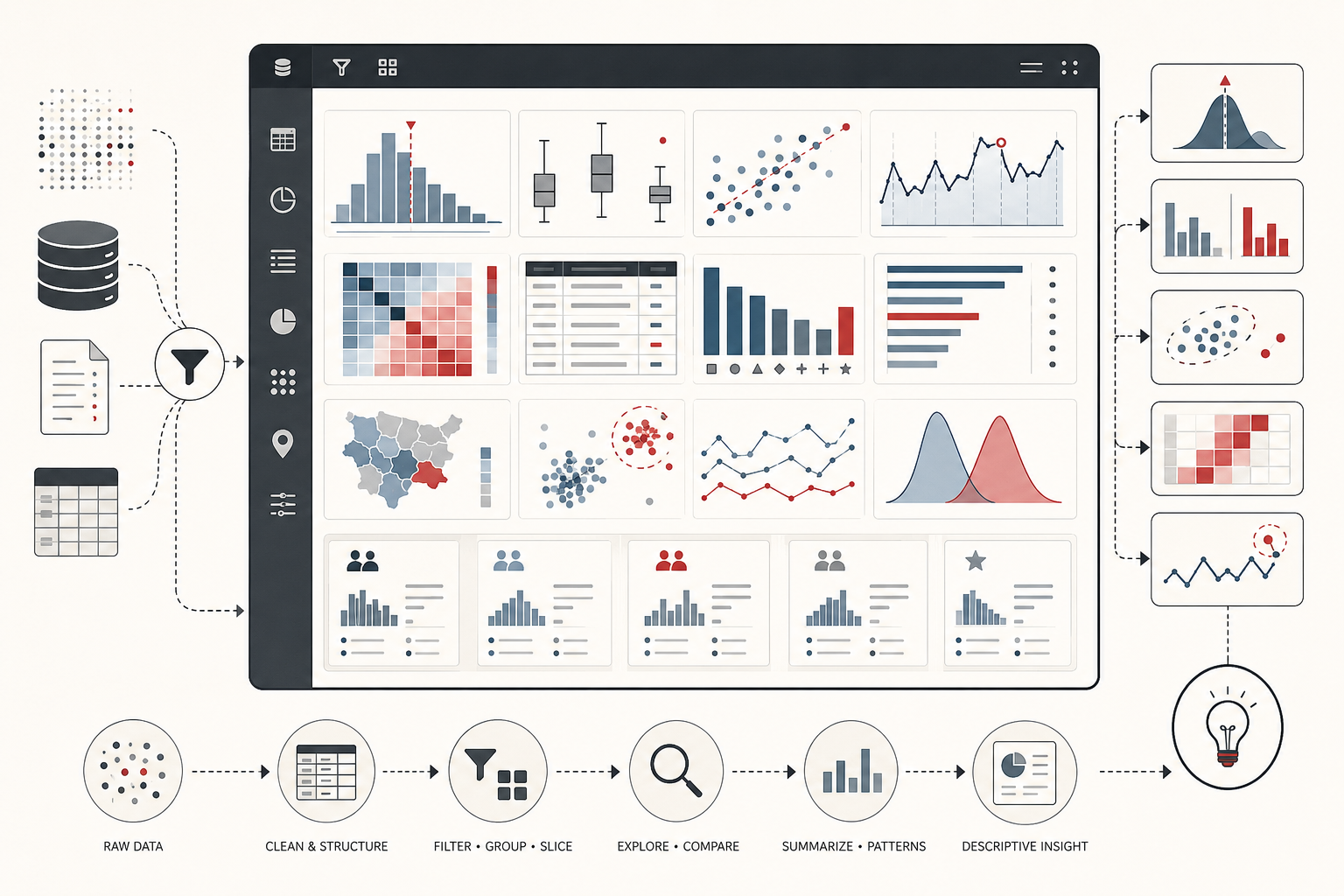
Historically, this orientation owes much to John Tukey’s Exploratory Data Analysis, which helped establish the importance of looking at data directly rather than moving too quickly into formal modeling. NIST’s handbook preserves the same spirit by describing EDA as an approach that seeks to maximize insight, uncover structure, detect outliers and anomalies, test assumptions, and guide model development. More recent applied treatments preserve that iterative posture. R for Data Science describes EDA as a cycle of generating questions, searching for answers by visualizing and transforming data, and refining those questions as new patterns emerge.
This article should therefore be read alongside Data Cleaning and Data Quality Management, Data Quality Metrics and Observability, Statistical Modeling and Inference, Experimental Design and Causal Inference, Time Series Analysis and Forecasting, Predictive Analytics and Machine Learning Models, Model Training and Validation, and Reproducible Analytics and Versioned Data Workflows. Descriptive exploration is where the analyst first learns whether the data is legible enough to support the stronger claims those later articles examine.
Descriptive exploration as analytical grounding
The strongest way to understand descriptive analytics and data exploration is as analytical grounding. These practices establish the first disciplined relationship between the analyst and the data. They make variables, distributions, missingness, categories, subgroups, relationships, anomalies, and time structure visible before stronger analytical claims are made.
This is more than a beginner step. It is the stage at which analysts discover whether the dataset behaves the way its documentation suggests. A field labeled “revenue” may contain refunds, tax, or currency mixing. A timestamp may reflect ingestion time rather than event time. A category may be stable in one system and inconsistently coded in another. A mean may be dominated by one extreme observation. A trend may disappear when broken apart by subgroup. Exploration is where these risks first become visible.
Good descriptive exploration therefore has an ethical and institutional role. It slows down premature certainty. It keeps analysts in contact with the observed record before models, dashboards, forecasts, or causal claims abstract that record into more authoritative-looking forms.
What descriptive analytics and data exploration mean
Descriptive analytics is the practice of summarizing and visualizing data to understand what has happened, what patterns characterize the observed record, and how outcomes vary across time, categories, or populations. It is concerned with observed states and recorded outcomes rather than with forecasting, intervention, optimization, or causal explanation.
Data exploration, and especially exploratory data analysis, goes further. It is not limited to reporting known measures. It actively probes the data to learn how variables behave, whether assumptions are plausible, whether unusual points or structures exist, and which questions merit deeper analysis. Descriptive analytics often answers questions such as: what happened, how much, how often, and where? Exploratory analysis asks: what else might be going on here, what structure is hidden, what assumptions fail, and what do these data suggest about the process beneath the records?
That distinction is not trivial. Descriptive analytics creates legibility. EDA creates insight. The two are deeply connected, but they are not identical, and treating them as interchangeable often produces shallower analytical work than the data deserves.
Why these activities matter
These activities matter because later analytics inherits the strengths and weaknesses of early understanding. If variables are misread, distributions are assumed rather than inspected, or missingness is ignored, downstream models may appear sophisticated while resting on a shallow grasp of the data itself. Exploratory work is where an analyst notices that one variable is badly skewed, that two systems define the same category differently, that outliers are driving averages, or that a time series contains regime shifts rather than one stable process.
Good descriptive and exploratory work also protects against premature formalism. EDA deliberately postpones stronger modeling assumptions so that the data itself can reveal its structure first. This matters in organizational settings where data is often messy, heterogeneous, and historically contingent. Exploration is not academic hesitation. It is one of the main ways analysts avoid building elegant explanations on top of misunderstood records.
In practical terms, descriptive exploration is where many costly mistakes are prevented early: the wrong unit is discovered before aggregation, the broken feed is identified before dashboard publication, the unexpected subgroup is noticed before pooled modeling, and the hidden missingness pattern is detected before anyone treats the dataset as complete.
Profiling, descriptive reporting, and EDA
It is useful to distinguish three related but non-identical practices: data profiling, descriptive reporting, and exploratory data analysis. Profiling usually focuses on structural and quality-oriented facts about a dataset: field types, null rates, distinct counts, cardinality, domain violations, duplicates, or schema conformity. Descriptive reporting focuses on summarizing observed historical patterns through counts, rates, averages, grouped comparisons, and temporal summaries. EDA is broader and more inquisitive. It uses summaries, transformations, and graphics to ask what hidden structure, instability, or irregularity the data may contain.
This distinction matters because organizations often mistake profiling output for true exploration. A profiling report may reveal that a column has 12 percent missing values, but it does not by itself show whether missingness is concentrated in one region, one period, or one subgroup. A descriptive report may show that average revenue increased, but it may not reveal whether that increase was driven by one segment or accompanied by widening volatility. EDA begins where those structural or descriptive findings are turned into questions rather than treated as finished insight.
Seen in this way, profiling is often about structural legibility, descriptive reporting about historical legibility, and EDA about analytical discovery.
| Practice | Primary question | Typical outputs | Common failure if used alone |
|---|---|---|---|
| Data profiling | What is structurally present? | Types, nulls, distinct counts, domains, duplicates, schema checks | Treating structural facts as substantive insight |
| Descriptive reporting | What happened in the observed record? | Counts, rates, averages, totals, rankings, time summaries | Compressing heterogeneous data into oversimple summaries |
| Exploratory data analysis | What structure, irregularity, or question emerges? | Distributions, plots, subgroup views, anomalies, relationships, questions | Stopping at interesting patterns without validating later claims |
Descriptive analytics as historical understanding
Descriptive analytics is often introduced as the most basic layer of analytics, but its importance should not be understated. It creates the common factual ground on which organizations interpret performance, trends, and current state. Counts, rates, averages, distributions, rankings, proportions, variances, and temporal summaries all help answer the first analytical question: what does the observed record say has occurred?
In many institutions, descriptive analytics powers executive dashboards, operational reports, compliance summaries, inventory views, financial rollups, customer segmentation summaries, and monitoring systems. Even when more advanced modeling exists, descriptive analytics remains essential because it anchors interpretation in observable history. Predictive or causal claims that contradict descriptive reality without explanation are often signs of error, leakage, misspecification, or overfitting rather than insight.
This is why descriptive analytics should not be treated merely as lower-order analytics. It is the disciplined act of rendering historical and current state legible enough for more advanced analysis to proceed responsibly.
Exploratory data analysis as iterative inquiry
Exploratory data analysis is best understood as disciplined curiosity. It is an iterative cycle in which analysts generate questions, search for answers by visualizing and transforming data, and then use what they learn to refine or generate new questions. This description is valuable because it emphasizes that exploration is not a one-pass checklist. It is a recursive process of seeing, questioning, transforming, and re-seeing.
Tukey’s legacy matters here. EDA was never meant to replace formal statistics altogether; it was meant to restore attention to the data itself before heavy model commitment. That spirit remains essential. EDA encourages analysts to look for unexpected distributional shapes, structural heterogeneity, nonlinear relationships, category imbalances, clusters, outliers, temporal breaks, and anomalies that standardized reporting may conceal.
In this sense, EDA is both practical and epistemic. It improves technical understanding of the dataset, but it also disciplines the analyst against unwarranted certainty by forcing continued contact with the data rather than with abstractions alone.
Univariate, bivariate, and multivariate exploration
Exploration deepens as analysts move from univariate to bivariate to multivariate structure. Univariate exploration asks how one variable behaves: its distribution, spread, skewness, concentration, outliers, missingness, or category balance. Bivariate exploration asks how two variables co-vary: whether there is association, nonlinearity, segmentation, subgroup dependence, or temporal instability. Multivariate exploration asks how several variables interact together: whether apparent patterns persist once conditioned on other fields, whether clusters or latent structures emerge, whether interactions matter, and whether pooled relationships break apart under stratification.
This progression matters because many analytical misreadings occur when analysts stop too early. A univariate summary may suggest stability, while a bivariate view reveals dependence on another variable. A bivariate pattern may look compelling until multivariate conditioning reveals that the relationship is mediated by subgroup composition or confounded by a third process. Strong EDA therefore moves between levels rather than treating one mode of inspection as sufficient.
Multivariate exploration is especially important because many real datasets are structured by overlapping systems of difference: time, geography, category, user type, cohort, seasonality, and operational regime. Looking only at one or two variables can easily understate this complexity. Multivariate exploration does not necessarily require advanced models at the outset, but it does require a willingness to ask whether patterns survive when more structure is brought into view.
Summary measures and distributional thinking
Descriptive analysis often begins with summary measures: counts, minima, maxima, means, medians, quartiles, variance, standard deviation, proportions, and rates. These are indispensable, but they are only useful when interpreted in relation to the shape of the data. Summary statistics do not replace exploratory analysis. The same mean can arise from very different distributions, and those differences often matter more than the average itself.
A mean may conceal skew. A median may better capture central tendency in long-tailed data. A low variance may hide multimodality. A simple count may conceal severe class imbalance. A stable average may conceal rising dispersion. Distributional thinking therefore matters more than rote summary generation. Analysts need to ask how values are spread, whether tails are heavy, whether categories are sparse, whether a process is stable across time, and whether a small number of influential cases is shaping the entire summary.
Good descriptive analytics therefore does not stop at producing summary statistics. It asks what those summaries are hiding and which features of the underlying distribution remain invisible unless inspected directly.
Visualization and the role of graphics
One of the defining commitments of exploratory data analysis is the centrality of graphics. Histograms reveal shape and skew. Density plots show smoothed distributional form. Box plots highlight spread, asymmetry, and outliers. Scatter plots reveal dependence, clustering, and curvature. Faceting and small multiples reveal subgroup differences without flattening them into one pooled summary. Time-series plots reveal drift, breaks, seasonality, and volatility. Heat maps and pairwise views help make multivariate structure more legible.
Graphics matter because many important properties of data are visual before they are formal: skew, clustering, outliers, nonlinearity, multimodality, heteroskedasticity, sudden breaks, and unusual sparsity patterns. A purely tabular summary can miss these or render them far less intelligible. Visualization is one of the main engines of question generation during EDA, not merely a way to present finished findings.
At a higher level, graphical reasoning disciplines the analyst against over-compression. A single descriptive table may force unlike cases into one average, whereas a plot can reveal that the same average is being produced by several very different underlying patterns. The value of graphics is therefore not decorative. It is epistemic: good visuals preserve structure that aggregation would otherwise erase.
Patterns, relationships, and anomalies
Descriptive exploration often advances by asking whether variables co-vary, whether some groups behave differently from others, whether time reveals trend or seasonality, and whether certain records or regions of the data appear unusual. This is where analysts begin to identify relationships, even if they do not yet assign causal interpretation to them.
Scatter plots may reveal correlation, but they may also reveal curvature, clusters, or heteroskedasticity. Grouped summaries may reveal that an overall trend disappears when categories are separated. Time-series inspection may show trend, cyclicality, drift, or structural breaks. Outlier inspection may reveal either true rare cases or errors in measurement and encoding. The distinction between variation within one variable and covariation between variables is especially useful because it gives analysts a disciplined way to move from one variable at a time toward relationships among variables.
These patterns matter because they shape every later analytical choice. A variable that behaves differently across subgroups may require stratified analysis. A skewed response may need transformation or robust methods. A cluster may suggest segmentation rather than one pooled model. Exploration is where these possibilities first become visible.
Aggregation, subgroup masking, and descriptive misreading
One of the major dangers in descriptive work is over-summary: the tendency to compress heterogeneous data into one average, one rate, or one trend line and then treat that compressed view as representative. This can lead to subgroup masking, where important differences across regions, cohorts, classes, systems, or periods disappear inside an aggregate statistic.
This is not a minor reporting flaw. It is one of the main reasons descriptive analytics can mislead when done carelessly. A global increase may conceal subgroup decline. A stable average may conceal rising variance. A favorable overall trend may reverse when the data is partitioned differently. Temporal aggregation may hide bursts, instability, and structural breaks. In some cases, pooled descriptive patterns can even move in the opposite direction of subgroup patterns, a family of problems classically associated with Simpson-type reversals.
The analytic lesson is not that summaries are useless, but that summaries must be tested against disaggregation, conditioning, and multiple views of the same data. Exploratory discipline therefore requires asking: what happens if this summary is broken by subgroup, period, or category? What pattern disappears or reverses when conditioning changes? What looks stable only because incompatible cases have been averaged together? This is one of the clearest places where EDA protects against false confidence.
Data quality, missingness, and exploratory skepticism
Exploration is also one of the first serious opportunities to discover data quality problems. Missingness, duplicates, unexpected category levels, impossible values, inconsistent timestamps, unit mismatches, and identifier instability often become visible during exploratory work before they become formalized in downstream quality rules. This is one reason EDA and data quality management belong close together in the broader series.
Missing data, in particular, should be explored rather than silently ignored. The important question is not only how much is missing, but whether missingness is patterned. If certain groups, periods, or systems are more incomplete than others, descriptive conclusions may already be biased before any predictive model is built. Likewise, outliers should not be dismissed automatically as noise. Some are entry errors. Others are rare but real events. Exploration is where that distinction begins to be made.
Exploratory skepticism therefore matters. Analysts should assume neither that the data is clean nor that the observed structure is immediately substantive. Some irregularities are real features of the world. Others are artifacts of measurement, coding, or data movement. Exploration is where those possibilities begin to be distinguished.
Limits of descriptive analytics
Descriptive analytics is powerful, but it has clear limits. It can summarize what has been observed; it does not by itself explain why those patterns occurred, what would happen under intervention, or what is likely to happen next. Descriptive work concerns observed structure, while predictive, inferential, forecasting, and causal work ask different kinds of questions.
Similarly, exploratory relationships should not be mistaken for causal explanations. A strong correlation may still be spurious, confounded, or contingent on subgroup structure. Visual patterns can guide inquiry, but they do not substitute for identification, design, or validation. Descriptive work can show that something is interesting, unstable, or suspicious. It cannot by itself settle why.
This limitation does not diminish descriptive work. It clarifies its role. Descriptive analytics and EDA provide orientation, structure, and disciplined questioning. They are the precondition for stronger inferential work, not a replacement for it.
A mathematical lens for descriptive exploration
A dataset can be understood as a collection of observations and variables:
X = \{x_{ij}: i = 1,\ldots,n;\; j = 1,\ldots,p\}
\]
Interpretation: The dataset \(X\) contains \(n\) records and \(p\) variables. Descriptive exploration begins by asking what each variable represents, how complete it is, and how it behaves across records.
A mean summarizes central tendency but can be sensitive to outliers:
\bar{x} = \frac{1}{n}\sum_{i=1}^{n}x_i
\]
Interpretation: The mean compresses many values into one number. It is useful, but it can hide skew, heavy tails, and influential observations.
Variance summarizes spread around the mean:
s^2 = \frac{1}{n-1}\sum_{i=1}^{n}(x_i – \bar{x})^2
\]
Interpretation: Variance measures dispersion. A stable average can still conceal rising spread, subgroup divergence, or volatility.
Missingness should be treated as a measurable pattern:
m_j = \frac{1}{n}\sum_{i=1}^{n}\mathbf{1}(x_{ij}\ \text{is missing})
\]
Interpretation: The missingness rate \(m_j\) for variable \(j\) should be checked overall and by subgroup. Patterned missingness can bias descriptive conclusions.
Subgroup comparison helps detect aggregation masking:
\Delta_g = \bar{x}_g – \bar{x}
\]
Interpretation: The subgroup deviation \(\Delta_g\) compares a subgroup mean with the overall mean. Large deviations suggest that pooled summaries may be hiding important structure.
Correlation summarizes linear covariation between two variables:
r_{xy} = \frac{\sum_{i=1}^{n}(x_i-\bar{x})(y_i-\bar{y})}{\sqrt{\sum_{i=1}^{n}(x_i-\bar{x})^2}\sqrt{\sum_{i=1}^{n}(y_i-\bar{y})^2}}
\]
Interpretation: Correlation measures linear association. It does not prove causation, and it may conceal nonlinear or subgroup-specific relationships.
An exploration-readiness score can combine profile completeness, distribution review, missingness review, subgroup review, anomaly review, and question generation:
E_d = w_P P_d + w_M M_d + w_D D_d + w_S S_d + w_A A_d + w_Q Q_d
\]
Interpretation: Exploration readiness \(E_d\) for dataset \(d\) can combine profiling \(P_d\), missingness review \(M_d\), distributional review \(D_d\), subgroup review \(S_d\), anomaly review \(A_d\), and active question generation \(Q_d\).
The point of this mathematical lens is not to reduce EDA to formulas. It is to make visible the basic analytical operations that descriptive exploration performs: summarizing, comparing, measuring missingness, identifying spread, detecting subgroup structure, and generating questions before stronger claims are made.
Python Workflow: Descriptive Analytics and EDA Scorecard
The following Python workflow demonstrates how an EDA review can produce numeric profiles, categorical summaries, subgroup comparisons, missingness checks, bivariate relationships, aggregation-risk flags, and an exploration-readiness score.
#!/usr/bin/env python3
"""
Python Workflow: Descriptive Analytics and EDA Scorecard

This compact example treats EDA as evidence infrastructure:
profiling, missingness, distributions, subgroups, relationships,
outliers, and question generation.
"""

from __future__ import annotations

import math
import statistics
from collections import Counter, defaultdict


def mean(values: list[float]) -> float:
    return sum(values) / len(values) if values else 0.0


def quantile(values: list[float], q: float) -> float:
    vals = sorted(values)
    if not vals:
        return 0.0

    pos = (len(vals) - 1) * q
    lower = math.floor(pos)
    upper = math.ceil(pos)

    if lower == upper:
        return vals[int(pos)]

    return vals[lower] * (upper - pos) + vals[upper] * (pos - lower)


def numeric_profile(values: list[float | None]) -> dict[str, float]:
    present = [value for value in values if value is not None]
    missing = len(values) - len(present)

    q1 = quantile(present, 0.25)
    q3 = quantile(present, 0.75)
    iqr = q3 - q1

    lower_fence = q1 - 1.5 * iqr
    upper_fence = q3 + 1.5 * iqr

    outliers = [
        value for value in present
        if value < lower_fence or value > upper_fence
    ]

    return {
        "n": len(values),
        "non_missing": len(present),
        "missing": missing,
        "missing_rate": missing / len(values),
        "mean": mean(present),
        "median": quantile(present, 0.50),
        "sd": statistics.stdev(present) if len(present) > 1 else 0.0,
        "min": min(present),
        "q1": q1,
        "q3": q3,
        "max": max(present),
        "outlier_count_iqr": len(outliers),
    }


def correlation(x: list[float], y: list[float]) -> float:
    x_mean = mean(x)
    y_mean = mean(y)

    numerator = sum((a - x_mean) * (b - y_mean) for a, b in zip(x, y))
    denominator = math.sqrt(
        sum((a - x_mean) ** 2 for a in x) *
        sum((b - y_mean) ** 2 for b in y)
    )

    return numerator / denominator if denominator else 0.0


def exploration_readiness_score(
    profiling_complete: float,
    missingness_review: float,
    distribution_review: float,
    subgroup_review: float,
    anomaly_review: float,
    question_generation: float,
) -> float:
    return round(
        0.18 * profiling_complete
        + 0.18 * missingness_review
        + 0.18 * distribution_review
        + 0.18 * subgroup_review
        + 0.14 * anomaly_review
        + 0.14 * question_generation,
        3,
    )


def main() -> None:
    records = [
        {"segment": "A", "region": "North", "value": 120, "volume": 44, "quality": 0.92},
        {"segment": "A", "region": "North", "value": 128, "volume": 48, "quality": 0.91},
        {"segment": "A", "region": "South", "value": 95, "volume": 35, "quality": 0.84},
        {"segment": "A", "region": "South", "value": None, "volume": 38, "quality": 0.81},
        {"segment": "B", "region": "North", "value": 180, "volume": 60, "quality": 0.88},
        {"segment": "B", "region": "North", "value": 196, "volume": 64, "quality": 0.89},
        {"segment": "B", "region": "South", "value": 155, "volume": 54, "quality": 0.78},
        {"segment": "C", "region": "South", "value": 500, "volume": 21, "quality": 0.61},
    ]

    values = [record["value"] for record in records]
    print({
        key: round(value, 3) if isinstance(value, float) else value
        for key, value in numeric_profile(values).items()
    })

    segment_counts = Counter(record["segment"] for record in records)
    print({"segment_counts": dict(segment_counts)})

    subgroup_values: dict[tuple[str, str], list[float]] = defaultdict(list)
    for record in records:
        if record["value"] is not None:
            subgroup_values[(record["segment"], record["region"])].append(record["value"])

    subgroup_summary = {
        f"{segment}_{region}": round(mean(vals), 3)
        for (segment, region), vals in subgroup_values.items()
    }
    print({"subgroup_mean_values": subgroup_summary})

    pairs = [
        (record["value"], record["volume"])
        for record in records
        if record["value"] is not None
    ]
    x = [pair[0] for pair in pairs]
    y = [pair[1] for pair in pairs]

    print({"value_volume_correlation": round(correlation(x, y), 3)})

    print({
        "exploration_readiness_score": exploration_readiness_score(
            profiling_complete=1.00,
            missingness_review=0.80,
            distribution_review=0.85,
            subgroup_review=0.90,
            anomaly_review=0.60,
            question_generation=0.90,
        )
    })


if __name__ == "__main__":
    main()
This workflow treats EDA as a record of analytical readiness. It does not only generate averages. It checks missingness, outliers, subgroup structure, categorical balance, bivariate relationships, and the quality of the questions generated by exploration.
R Workflow: Descriptive Analytics, Missingness, Subgroups, and EDA Checks
The following R workflow summarizes numeric variables, subgroup patterns, missingness, category frequencies, bivariate relationships, EDA checks, and exploration questions.
#!/usr/bin/env Rscript

# R Workflow: Descriptive Analytics, Missingness,
# Subgroup Summaries, and EDA Checks

records <- data.frame(
  segment = c(
    "A", "A", "A", "A",
    "B", "B", "B", "B",
    "C", "C", "C", "C"
  ),
  region = c(
    "North", "North", "South", "South",
    "North", "North", "South", "South",
    "North", "North", "South", "South"
  ),
  value = c(120, 128, 95, NA, 180, 196, 140, 155, 72, 75, 61, 500),
  volume = c(44, 48, 35, 38, 60, 64, 50, 54, 25, 27, 20, 21),
  quality_score = c(0.92, 0.91, 0.84, 0.81, 0.88, 0.89, 0.80, 0.78, 0.70, 0.68, 0.64, 0.61),
  response_time = c(15, 16, 22, 25, 18, 19, 27, 31, 38, 41, 49, 55)
)

checks <- data.frame(
  check_type = c(
    "unique_record_id",
    "missing_primary_value",
    "outlier_detection",
    "subgroup_masking",
    "skewness_review",
    "category_domain"
  ),
  status = c("pass", "warn", "warn", "warn", "warn", "pass"),
  severity = c("high", "high", "high", "medium", "medium", "medium"),
  stringsAsFactors = FALSE
)

numeric_vars <- c("value", "volume", "quality_score", "response_time")

numeric_summary <- data.frame()

for (var in numeric_vars) {
  x <- records[[var]]

  numeric_summary <- rbind(
    numeric_summary,
    data.frame(
      variable_name = var,
      n = length(x),
      non_missing = sum(!is.na(x)),
      missing = sum(is.na(x)),
      missing_rate = mean(is.na(x)),
      mean = mean(x, na.rm = TRUE),
      median = median(x, na.rm = TRUE),
      sd = sd(x, na.rm = TRUE),
      min = min(x, na.rm = TRUE),
      q1 = quantile(x, 0.25, na.rm = TRUE),
      q3 = quantile(x, 0.75, na.rm = TRUE),
      max = max(x, na.rm = TRUE)
    )
  )
}

subgroup_summary <- aggregate(
  value ~ segment + region,
  data = records,
  FUN = function(x) c(
    n = length(x),
    mean = mean(x, na.rm = TRUE),
    median = median(x, na.rm = TRUE)
  )
)
subgroup_summary <- do.call(data.frame, subgroup_summary)
names(subgroup_summary) <- c(
  "segment",
  "region",
  "n",
  "mean_value",
  "median_value"
)

records$missing_value <- ifelse(is.na(records$value), 1, 0)

missingness_summary <- aggregate(
  missing_value ~ segment + region,
  data = records,
  FUN = mean
)
names(missingness_summary) <- c(
  "segment",
  "region",
  "missing_value_rate"
)

relationship_summary <- data.frame(
  left_variable = c("value", "value", "value", "volume"),
  right_variable = c("volume", "quality_score", "response_time", "quality_score"),
  correlation = c(
    cor(records$value, records$volume, use = "complete.obs"),
    cor(records$value, records$quality_score, use = "complete.obs"),
    cor(records$value, records$response_time, use = "complete.obs"),
    cor(records$volume, records$quality_score, use = "complete.obs")
  )
)

check_summary <- aggregate(
  check_type ~ status + severity,
  data = checks,
  FUN = length
)
names(check_summary) <- c(
  "status",
  "severity",
  "check_count"
)

dir.create("outputs", showWarnings = FALSE, recursive = TRUE)

write.csv(numeric_summary, "outputs/numeric_summary_r.csv", row.names = FALSE)
write.csv(subgroup_summary, "outputs/subgroup_summary_r.csv", row.names = FALSE)
write.csv(missingness_summary, "outputs/missingness_summary_r.csv", row.names = FALSE)
write.csv(relationship_summary, "outputs/relationship_summary_r.csv", row.names = FALSE)
write.csv(check_summary, "outputs/exploration_check_summary_r.csv", row.names = FALSE)

cat("Wrote numeric, subgroup, missingness, relationship, and EDA check summaries.\n")
This workflow treats descriptive analysis as an auditable exploration record. It shows why the overall mean is not enough: missingness, subgroup structure, outliers, and bivariate relationships all change the meaning of the observed data.
Descriptive exploration across the analytical lifecycle
In a serious analytical workflow, descriptive analytics and exploration are not single front-loaded tasks that disappear once modeling begins. They recur throughout the lifecycle of analysis. Analysts revisit descriptive summaries to validate assumptions, compare training and test behavior, inspect residuals, understand feature distributions, diagnose model failure, and detect data drift after deployment.
This iterative role is consistent with Tukey’s exploratory ethos and with modern treatments of exploration as a cycle rather than a one-time ritual. Exploration belongs not only at the beginning of analysis, but anywhere understanding needs to be renewed. Before modeling, it helps determine whether variables are usable and which transformations may be necessary. During modeling, it helps identify residual structure, leakage, subgroup instability, or misspecification. After deployment, it helps assess whether live data still resembles the data on which the system was built.
In mature organizations, this also means descriptive layers should remain visible. Profiling reports, exploratory notebooks, grouped summaries, and visual diagnostics are not merely support materials. They are part of the evidence trail that makes deeper analysis accountable. They show not only what a model concluded, but what the underlying data looked like before and after analytical abstraction.
Governance and institutional accountability
Descriptive analytics and EDA should be governed because they influence what an institution believes about its data. A dashboard, model, policy analysis, or forecast may look authoritative, but if the underlying exploratory layer was weak, the later product may rest on misunderstood fields, unexamined missingness, hidden outliers, or masked subgroup differences.
Governance does not mean turning exploration into rigid bureaucracy. It means preserving the evidence trail: dataset profile, variable definitions, missingness patterns, outlier review, subgroup summaries, visual diagnostics, exploratory questions, and decisions about what to investigate next. This is especially important when descriptive findings become the basis for public reporting, operational decisions, or automated systems.
Exploration also helps protect against institutional blindness. If only aggregate metrics are tracked, the organization may miss harm, decline, or instability concentrated in marginalized groups, smaller regions, less visible categories, or operational edge cases. Good EDA keeps disaggregation and differentiated perspective available before one polished summary becomes the official story.
Applications across domains
Descriptive analytics and data exploration appear across nearly every domain because every serious data workflow begins with the need to understand observed structure. In business settings they support reporting, trend review, segmentation, and performance monitoring. In science they help reveal measurement patterns, outliers, and experimental irregularities. In healthcare and public administration they support operational visibility and population-level summaries. In engineering and infrastructure they help identify drift, anomaly patterns, and process variability. In machine learning they are essential for feature inspection, target understanding, train-test comparison, and post-deployment drift detection.
Environmental monitoring systems use descriptive exploration to reveal seasonal patterns, sensor failures, extreme values, and regional variability. Economic and policy analysis uses it to understand distributions, inequality, subgroup divergence, and temporal shifts before stronger inference is attempted. AI systems use it to inspect training data, target imbalance, missingness, distribution shift, and evaluation slices.
Across all these settings, the underlying goal is the same: to make data legible before stronger claims are built on top of it.
Implementation principles for high-integrity EDA
Start with the unit of analysis. Know what each row represents before summarizing anything.
Profile before modeling. Field types, domains, nulls, distinct counts, duplicates, and schema expectations should be visible early.
Summarize distributions, not only averages. Report spread, shape, tails, skew, and robust summaries where needed.
Treat missingness as evidence. Missing data may reveal system failure, exclusion, measurement gaps, or subgroup bias.
Investigate outliers before removing them. Extreme values may be errors, rare events, or the most important cases in the dataset.
Compare aggregates with subgroups. Pooled summaries should be tested against segment, region, period, category, and cohort views.
Use graphics to generate questions. Visualization is not decoration; it is a way of preserving structure that tables may erase.
Distinguish description from explanation. Observed patterns do not automatically identify causes or future behavior.
Preserve exploration records. Notebooks, profiles, summaries, checks, and questions should remain part of the evidence trail.
Let exploration guide later methods. Inference, prediction, forecasting, and causal analysis should inherit what EDA reveals, not ignore it.
| Control | Purpose | Failure it prevents |
|---|---|---|
| Variable profile | Defines fields, types, domains, and expected meaning | Misreading columns or treating system artifacts as substantive variables |
| Missingness profile | Shows where values are absent overall and by subgroup | Assuming incomplete data is representative |
| Distribution summary | Reports center, spread, skew, tails, and robust summaries | False confidence from averages alone |
| Outlier review | Distinguishes errors, rare events, and influential cases | Deleting meaningful extremes or letting errors dominate summaries |
| Subgroup comparison | Tests whether aggregates mask heterogeneous patterns | Over-summary and subgroup invisibility |
| Bivariate exploration | Reviews covariation, nonlinearity, and subgroup dependence | Assuming variables are independent or relationships are simple |
| Visual diagnostics | Makes structure visible through plots and small multiples | Tabular summaries erasing shape, drift, clusters, or breaks |
| Exploration question log | Preserves questions generated by patterns and irregularities | Losing analytical insight before formal modeling begins |
GitHub Repository
This article can be paired with a companion code workflow that models descriptive analytics and EDA as evidence infrastructure. The example includes exploratory datasets, variable profiles, exploration checks, question registries, missingness summaries, numeric profiles, categorical profiles, subgroup comparisons, bivariate relationship checks, aggregation-risk records, SQL schemas, Python and R workflows, Julia scoring, typed contracts, governance checklists, Quarto report templates, and multi-language examples across Python, R, Julia, SQL, Go, Rust, C, C++, TypeScript, and Terraform placeholders.
Conclusion
Descriptive analytics and data exploration are foundational to trustworthy analytics because they make the observed record legible before stronger claims are made. They summarize what has happened, reveal distributions, expose missingness, identify anomalies, test assumptions, compare subgroups, and generate the questions that later inference, forecasting, prediction, and causal analysis must answer.
The deeper point is that EDA is not preliminary busywork. It is a form of analytical discipline. It protects against premature modeling, false precision, aggregation masking, and overconfident interpretation. In data-intensive organizations, descriptive exploration is therefore not only a technical practice. It is part of the infrastructure of responsible evidence: a way to understand what the data shows, what it hides, and what it cannot yet support.
Related articles
- Data Systems and Analytics knowledge series
- Data Cleaning and Data Quality Management
- Data Quality Metrics and Observability
- Statistical Modeling and Inference
- Experimental Design and Causal Inference
- Time Series Analysis and Forecasting
- Predictive Analytics and Machine Learning Models
- Reproducible Analytics and Versioned Data Workflows
Further reading
- Cleveland, W.S. (1993) Visualizing Data. Summit, NJ: Hobart Press.
- Tukey, J.W. (1977) Exploratory Data Analysis. Reading, MA: Addison-Wesley.
- Wickham, H., Çetinkaya-Rundel, M. and Grolemund, G. (2023) R for Data Science. 2nd edn. Sebastopol, CA: O’Reilly Media. Available at: https://r4ds.hadley.nz/
- Wilkinson, L. (2005) The Grammar of Graphics. 2nd edn. New York: Springer.
- Chambers, J.M. (2020) ‘S, R, and Data Science’, The R Journal, 12(1), pp. 47–55. Available at: https://journal.r-project.org/archive/2020/RJ-2020-028/index.html
- McKinney, W. (2022) Python for Data Analysis. 3rd edn. Sebastopol, CA: O’Reilly Media.
References
- National Institute of Standards and Technology and SEMATECH (2012) Exploratory Data Analysis. Available at: https://www.itl.nist.gov/div898/handbook/eda/eda.htm
- National Institute of Standards and Technology and SEMATECH (2012) What is EDA? Available at: https://www.itl.nist.gov/div898/handbook/eda/section1/eda11.htm
- National Institute of Standards and Technology and SEMATECH (2012) How Does Exploratory Data Analysis Differ from Classical Data Analysis? Available at: https://www.itl.nist.gov/div898/handbook/eda/section1/eda12.htm
- National Institute of Standards and Technology and SEMATECH (2012) How Does Exploratory Data Analysis Differ from Summary Statistics? Available at: https://www.itl.nist.gov/div898/handbook/eda/section1/eda13.htm
- pandas developers (2026) pandas.DataFrame.describe. Available at: https://pandas.pydata.org/docs/reference/api/pandas.DataFrame.describe.html
- pandas developers (2026) How to Calculate Summary Statistics. Available at: https://pandas.pydata.org/docs/getting_started/intro_tutorials/06_calculate_statistics.html
- Tukey, J.W. (1977) Exploratory Data Analysis. Reading, MA: Addison-Wesley.
- Wickham, H., Çetinkaya-Rundel, M. and Grolemund, G. (2023) Exploratory Data Analysis. In: R for Data Science. 2nd edn. Available at: https://r4ds.hadley.nz/EDA.html
- Wickham, H., Çetinkaya-Rundel, M. and Grolemund, G. (2023) Data Visualization. In: R for Data Science. 2nd edn. Available at: https://r4ds.hadley.nz/data-visualize.html