
Last Updated May 11, 2026
Predictive analytics and machine learning models are the disciplines through which analysts use historical data to estimate patterns that may generalize to unseen cases. Where descriptive analytics clarifies what has happened and statistical inference helps quantify uncertainty about parameters, relationships, or effects, predictive modeling asks a different question: given available features, labels, and context, how well can future, hidden, or unobserved outcomes be predicted? Machine learning extends this predictive orientation by providing flexible algorithmic methods for learning patterns from data, often with strong emphasis on out-of-sample performance rather than on closed-form explanatory structure.
This topic matters because many real-world analytical systems are judged not by how elegantly they summarize the past, but by how well they perform when new cases arrive. Credit scoring, demand forecasting, churn prediction, fraud screening, risk classification, recommendation systems, quality-control flagging, anomaly detection, triage support, and many operational decision systems depend on the ability to generalize from historical observations to unseen cases. But predictive analytics is not synonymous with causal explanation, and machine learning is not a shortcut to truth. A model can predict well without revealing why an outcome occurs, and a flexible learner can fit training data impressively while failing badly on future data. Predictive systems therefore belong inside a larger discipline of data quality, feature representation, validation, evaluation, calibration, monitoring, governance, and evidentiary restraint.
Main Library
Publications
Article Map
Data Systems & Analytics
Related Topic
Artificial Intelligence Systems
Related Topic
Institutions & Governance
Related Topic
Risk & Resilience
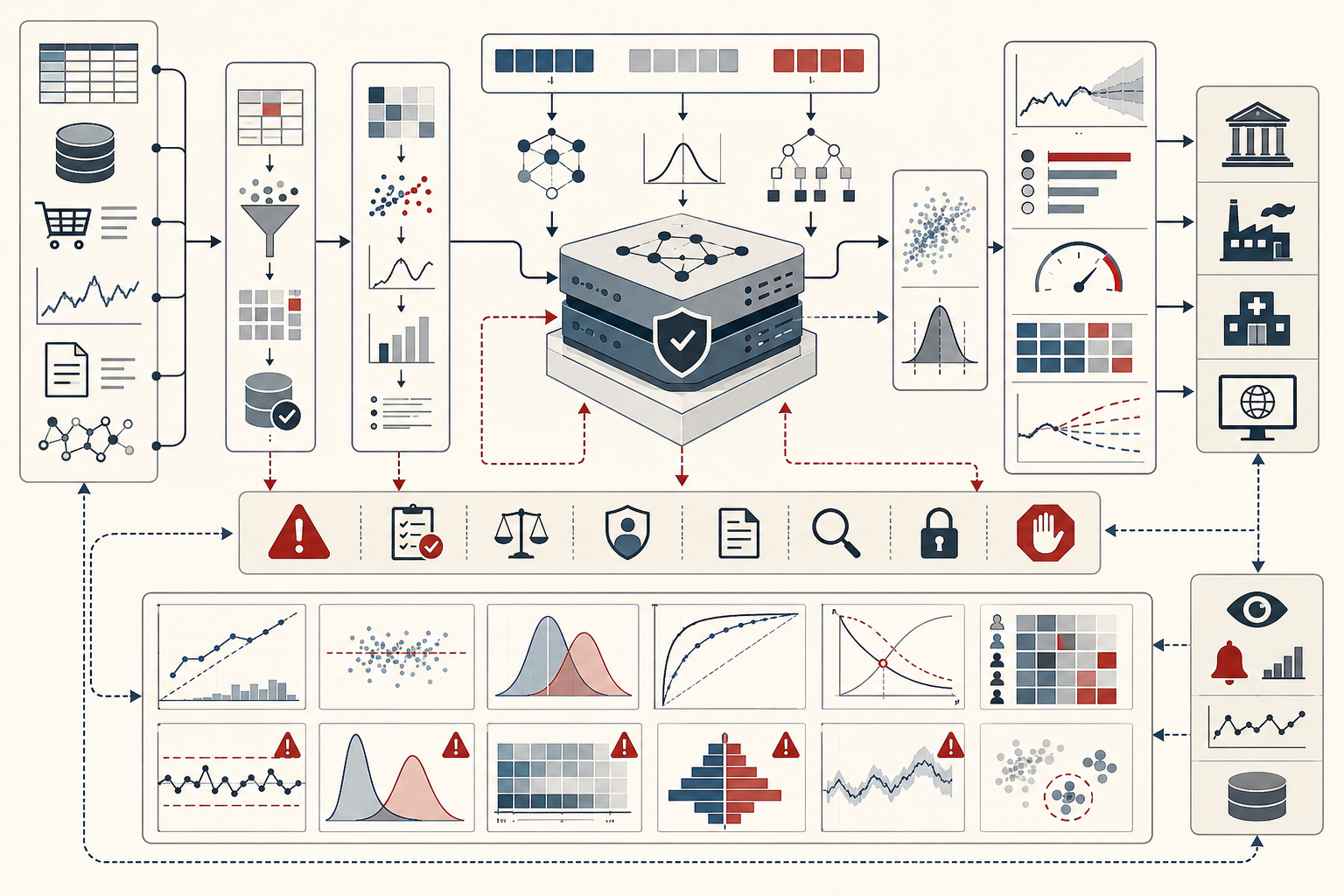
This article builds on the themes developed in Descriptive Analytics and Data Exploration, Statistical Modeling and Inference, Experimental Design and Causal Inference, Feature Engineering and Data Representation, Model Training and Validation, Model Evaluation and Performance Metrics, Reproducible Analytics and Versioned Data Workflows, and Data Governance and Stewardship. If descriptive analytics clarifies observed patterns, predictive analytics asks whether patterns can be used responsibly to estimate what is not yet known.
Prediction as generalization under uncertainty
The strongest way to understand predictive analytics is as generalization under uncertainty. A predictive model learns from examples whose outcomes are already known and then applies what it has learned to cases whose outcomes are hidden, future, delayed, or otherwise unobserved. The model does not know the future. It estimates it from structure in historical data.
This makes prediction different from description. Descriptive analytics summarizes observed records. Predictive analytics makes a wager that some structure in those records will remain useful when the next case arrives. That wager may be reasonable, but it is never automatic. It depends on data quality, representation, the stability of the relationship between inputs and outcomes, the validation design, the evaluation metric, the operating threshold, and the monitoring system that watches the model after deployment.
Prediction also differs from explanation. A model may be useful because it ranks high-risk cases well, even if it does not reveal the underlying causal mechanism. Conversely, a model may support an elegant explanation yet predict poorly. Predictive analytics therefore needs its own discipline: not a discipline of storytelling about the past, and not a discipline of causal proof, but a discipline of estimating unseen outcomes with appropriate humility about error, shift, and uncertainty.
What predictive analytics and machine learning models mean
Predictive analytics is the use of historical data, statistical methods, and computational models to estimate unknown, future, or otherwise unobserved outcomes. Machine learning models are computational models that learn patterns from data rather than being programmed with one fixed rule for every possible case. In practical data science, this often means fitting a model to examples of inputs and outputs so it can generate predictions for new inputs.
The distinction between predictive analytics and machine learning is partly one of scope. Predictive analytics is the broader decision-oriented practice: defining a prediction problem, assembling data, creating features, training models, validating generalization, selecting metrics, calibrating probabilities, setting thresholds, monitoring performance, and deciding whether prediction is useful in context. Machine learning provides many of the methods that make this practice scalable, adaptive, and flexible.
A predictive model may produce a class label, probability, score, ranking, forecast, expected value, interval, anomaly score, or recommendation. Each output type has a different evidentiary meaning. A probability is not the same as a rank. A rank is not the same as a decision. A forecast is not the same as a causal explanation. Good predictive analytics begins by naming exactly what kind of output the system produces and how that output will be used.
Why predictive modeling matters
Predictive modeling matters because institutions often need to act before outcomes are known. A bank may want to estimate default risk before issuing credit. A utility may need to forecast demand before load arrives. A hospital may want to identify elevated risk before deterioration becomes obvious. A logistics system may need to anticipate delay before it disrupts a route. A manufacturer may want to detect failure risk before equipment breaks. A public agency may need to prioritize inspections before harms occur.
In these settings, the value of prediction is not abstract accuracy. It is earlier, better, or more efficient action under uncertainty. Predictive models often feed triage, ranking, prioritization, screening, scheduling, personalization, recommendation, anomaly detection, human review, or intervention workflows. The quality of those workflows depends not only on whether a model can generate a score, but on whether that score generalizes, is calibrated, fits the decision context, and can be monitored responsibly over time.
This is why predictive analytics belongs inside data systems and governance. A predictive model is not just a file, notebook, or algorithmic artifact. It is part of a sociotechnical system that connects data collection, feature engineering, training, validation, evaluation, deployment, monitoring, feedback, and accountability.
Statistical learning and the predictive frame
Statistical learning frames predictive modeling as the problem of learning relationships from data in order to predict outcomes or understand structure. This framing matters because it places machine learning inside a longer statistical tradition rather than treating it as a purely computational fashion. A predictive model is a learned approximation to an unknown relationship between inputs and outputs, fitted under limited data and subject to error on new samples.
The statistical-learning perspective also clarifies that predictive success is inseparable from model complexity. Very simple models may miss genuine structure and underfit. Very flexible models may memorize quirks, noise, or artifacts specific to the training data and overfit. Good predictive modeling therefore depends on a principled balance among flexibility, bias, variance, sample size, feature representation, regularization, and out-of-sample error.
This means prediction should be understood as controlled approximation. The model is not the data-generating process itself. It is a functional compromise among expressiveness, learnability, stability, interpretability, computational cost, and future error. The best predictive model is not always the most complex model. It is the one whose error behavior is most acceptable for the task, data, and decision environment.
Supervised learning: regression, classification, and ranking
Much of predictive analytics is organized under supervised learning: learning from examples that include both input features and known targets. In regression, the target is numeric, such as demand, price, duration, temperature, wait time, cost, or count. In classification, the target is categorical, such as fraud versus non-fraud, churn versus retention, defective versus acceptable, approved versus denied, or high risk versus low risk. In ranking, the model orders cases by likely relevance, risk, preference, or priority.
This distinction matters because the target structure affects loss functions, metrics, validation design, calibration, thresholding, interpretation, and deployment. Predicting a numeric value is not the same as ranking cases by risk. Ranking cases is not the same as assigning a calibrated probability. Assigning a probability is not the same as making an automatic decision.
Even inside classification, tasks differ sharply. Some systems care mainly about ranking the highest-risk cases. Others need calibrated probabilities. Others care about high recall because missing true cases is costly. Others care about high precision because false alarms impose harm or review burden. Predictive analytics is therefore not one uniform activity. It is a family of predictive tasks with distinct operational meanings.
| Task type | Typical output | Key evaluation concerns |
|---|---|---|
| Regression | Numeric forecast or estimate | MAE, RMSE, bias, tail error, residual patterns, temporal stability |
| Binary classification | Class label, probability, or score | Precision, recall, ROC-AUC, PR-AUC, calibration, threshold costs |
| Multiclass classification | One class among several | Class-specific error, macro/micro averaging, confusion patterns |
| Ranking | Ordered list or priority score | Top-k precision, lift, average precision, actionability of high-ranked cases |
| Anomaly detection | Anomaly score or flag | False alarms, detection delay, rarity, investigation capacity, drift |
| Recommendation | Item ranking or personalization score | Relevance, diversity, novelty, feedback loops, exposure bias |
Features, labels, and the representation problem
Predictive models do not learn directly from “reality.” They learn from features and labels: formal representations of inputs and outcomes. Features may encode demographics, transactions, telemetry, timestamps, text, images, spatial records, event histories, domain-derived ratios, temporal lags, embeddings, or learned representations. Labels may be direct observations, delayed outcomes, human judgments, administrative categories, sensor states, or proxy targets.
This means predictive performance depends not only on algorithm choice but on how the problem is represented. If labels are noisy, delayed, biased, or misaligned with the actual decision objective, the model may learn the wrong target well. If features are unstable, unavailable at prediction time, or contaminated by future information, validation performance may be misleading. If the representation omits important structure, the model may underperform even when the algorithm is sophisticated.
The representation problem is therefore central. Predictive systems learn from what is encoded, not from what analysts vaguely intend. A predictive model may solve the formal task it was given while failing the human or institutional problem it was supposed to support. This is why feature engineering, data quality, label governance, and prediction-time availability are not preprocessing details. They are conditions of predictive validity.
Loss functions, objectives, and decision context
Predictive models are trained to optimize some objective function, typically derived from a loss function that penalizes errors. Mean squared error penalizes large regression errors heavily. Mean absolute error treats each unit of error more linearly. Log loss rewards probability quality and penalizes confident wrong predictions. Hinge-style losses favor margin-based separation. Ranking objectives emphasize relative order rather than absolute probability.
This is one of the most important conceptual points in machine learning: the training objective defines what the model is trying to do during fitting. But the training objective and the real decision objective are not always the same. A model optimized for one statistical loss may be misaligned with the operational cost structure of the domain. In fraud detection, false negatives may be more costly than false positives. In medical screening, missing a rare but dangerous case may matter more than overall accuracy. In demand forecasting, underprediction may be more costly than overprediction if shortages are severe.
Predictive analytics therefore benefits from explicit linkage between model training and decision context. The right question is not only “what loss did the algorithm minimize?” It is “does minimizing that loss produce behavior appropriate to the task, the institution, the affected population, and the risk of error?”
Training, validation, test sets, and generalization
The central practical goal of predictive modeling is generalization: useful performance on data not seen during training. The training set is used to fit parameters. The validation set or validation folds help tune model choices and hyperparameters. The test set provides a final assessment of the selected approach on untouched data. These distinctions are not bureaucratic conventions. They are one of the main defenses against self-deception in predictive modeling.
Performance on training data is not enough. A model can fit examples it has already seen and still fail on new cases. Validation estimates whether learned structure transfers beyond the training set. Testing provides final development-stage evidence after model selection is complete. If the test set is repeatedly used for tuning, it becomes part of the development process and loses its evidentiary force.
Generalization also depends on whether the split resembles the deployment setting. Random splits may be inappropriate for time-series forecasting, grouped observations, repeated users, related patients, machine histories, document families, households, or facilities. If the partitioning strategy does not match the real prediction environment, reported performance can be badly inflated.
Overfitting, underfitting, and the bias–variance tradeoff
One of the central conceptual tensions in predictive modeling is the relationship among underfitting, overfitting, bias, and variance. Underfitting occurs when a model is too rigid to capture important structure. Overfitting occurs when a model becomes so flexible that it learns noise, quirks, artifacts, or accidental patterns specific to the training data. The bias–variance tradeoff explains why increasing flexibility can reduce bias while increasing sensitivity to the training sample.
This matters because predictive analytics is sometimes framed as a competition to maximize training performance. In reality, the relevant objective is future or held-out performance. The model that looks best in-sample may not survive contact with deployment. Regularization, early stopping, pruning, shrinkage, simpler model families, cross-validation, feature selection, and larger or better data can all help manage this tension.
Overfitting is not only a mathematical issue. It is also a governance issue. A model that overfits may appear authoritative while failing the people, systems, or decisions it is meant to support. Validation, monitoring, and lifecycle review exist partly to prevent training-set success from becoming institutional overconfidence.
Model selection, hyperparameters, and cross-validation
Model selection is the process of choosing among candidate model structures, feature sets, complexity levels, and algorithm families. Hyperparameters are the configuration choices that govern how a learning algorithm behaves: tree depth, regularization strength, number of neighbors, learning rate, number of estimators, kernel settings, class weights, and stopping criteria.
Cross-validation provides a disciplined way to estimate out-of-sample performance by repeatedly partitioning the data into training and validation folds. This reduces dependence on one lucky split and allows analysts to observe performance variability across folds. But cross-validation is not magic. It must be paired with leakage-safe preprocessing, appropriate fold design, and care about groups, time, duplicates, and class imbalance.
Model selection is therefore best understood as a controlled search for generalizable structure rather than a race toward the most complex learner. A model should be selected because validation evidence, error analysis, calibration, threshold behavior, interpretability, stability, and deployment constraints support its use—not because it wins a narrow leaderboard by a small margin.
Class imbalance, rare events, and threshold design
Many predictive tasks involve rare but important outcomes: fraud, failure, disease, default, churn, safety incidents, security events, abuse, or severe deterioration. In such settings, class imbalance becomes central. A model can achieve high overall accuracy by predicting almost everything as the majority class while failing on the cases that matter most.
This is why rare-event prediction must be examined through precision, recall, confusion patterns, ranking performance, calibration, threshold behavior, and review capacity rather than through accuracy alone. A fraud model that catches many true cases but overwhelms reviewers with false positives may be operationally unusable. A screening model that avoids false alarms but misses serious cases may be unacceptable. A churn model may require a different tradeoff because outreach has lower cost.
Threshold design matters because many classification models output scores or probabilities rather than direct decisions. A threshold converts score into action. Lowering the threshold usually increases recall but may reduce precision. Raising the threshold usually improves precision but may miss more true cases. Thresholds are therefore decision policies, not merely mathematical settings. They should be documented, reviewed, and governed.
Prediction metrics, calibration, and probability quality
Predictive models must be judged with metrics appropriate to the task. Regression models may require MAE, RMSE, bias, tail error, or interval coverage. Classification models may require accuracy, precision, recall, F1, ROC-AUC, average precision, log loss, Brier score, calibration curves, and threshold-specific metrics. Ranking models may require top-k precision, lift, mean reciprocal rank, or average precision.
No single metric tells the whole story. A model may rank cases well but produce poor probabilities. It may have high accuracy yet fail on a rare class. It may look strong under one threshold and weak under another. It may minimize average error while producing unacceptable tail errors. Metric choice should therefore follow the prediction task and decision context.
Calibration deserves special emphasis. A calibrated model is one whose predicted probabilities correspond meaningfully to observed frequencies. If a model says a group of cases has 80 percent probability, roughly 80 percent of comparable cases should experience the event. This matters because risk-sensitive systems often use probability magnitudes to allocate resources or communicate uncertainty. A poorly calibrated model can be operationally misleading even when its discrimination looks good.
Major model families
Predictive analytics uses many model families, each with characteristic strengths and limitations. Linear and logistic models offer interpretability, regularization, and stable baselines. Tree-based methods capture nonlinearities and interactions with relatively little manual feature engineering. Ensemble methods such as random forests and gradient boosting often improve performance by combining multiple learners. Support vector machines provide margin-based classification and regression. Neural networks provide expressive power for high-dimensional, unstructured, or representation-learning-heavy tasks.
No model family is universally best. The right choice depends on data structure, sample size, feature representation, interpretability requirements, computational constraints, deployment environment, monitoring needs, and evaluation evidence. Simpler models may be preferable when stability, transparency, and governance matter. More flexible models may be preferable when the relationship is genuinely complex and there is enough data and monitoring capacity to support them.
The practical lesson is that model families should be treated as tools with tradeoffs, not as prestige categories. Evaluation, not fashion, should decide.
Data leakage, distribution shift, and generalization failure
Some of the most serious failures in predictive modeling arise not from weak algorithms but from flawed evaluation conditions. Data leakage occurs when information outside the legitimate prediction setting enters training or validation. Leakage can come from future information, duplicated records across splits, target-derived features, full-dataset preprocessing, resampling before splitting, repeated test-set tuning, or feature selection before partitioning.
Leakage is dangerous because it produces the illusion of predictive competence. A leaked model may look excellent during development and fail abruptly in deployment. Even simple mistakes—fitting a scaler on all data, imputing before splitting, using post-outcome variables, or allowing related records to cross partitions—can inflate reported performance.
Distribution shift is a different but equally important problem. A model may generalize well within historical test data and then degrade because the population, behavior, economy, policy environment, source system, label process, or operational workflow changes. Predictive performance is therefore always conditional: a model is “good” only relative to a defined task, evaluation procedure, deployment context, and data-generating environment that has not changed beyond recognition.
Prediction, interpretation, and explanation
Predictive performance does not automatically provide causal or substantive explanation. A model can exploit strong correlates without identifying mechanisms. Prediction asks whether future or hidden outcomes can be estimated accurately. Explanation asks why those outcomes occur. Causal inference asks what would change under intervention. These objectives overlap, but they are not the same.
This does not make interpretation irrelevant. Feature importance summaries, partial dependence views, local explanation tools, calibration plots, residual diagnostics, confusion matrices, subgroup error analysis, and counterfactual stress tests can all help analysts understand how a predictive system behaves. But such tools should not be confused with causal proof. A predictive model may be operationally useful while remaining only partially interpretable in substantive terms.
This distinction is especially important in policy, healthcare, finance, employment, education, public services, and risk-sensitive settings. A model that predicts risk may be useful for triage, but it does not necessarily tell us which intervention will reduce that risk. Conflating prediction with explanation is one of the recurring conceptual errors in applied machine learning.
A mathematical lens for predictive modeling
Predictive modeling can be expressed as learning a function from features to outcomes:
\hat{f}: X \rightarrow \hat{Y}
\]
Interpretation: A predictive model \(\hat{f}\) maps input features \(X\) to predicted outcomes \(\hat{Y}\). The central question is whether that mapping generalizes to unseen cases.
Training is often framed as empirical risk minimization:
\hat{f} = \arg\min_{f \in \mathcal{F}} \frac{1}{n}\sum_{i=1}^{n} L(y_i, f(x_i))
\]
Interpretation: The fitted model is selected from a model family \(\mathcal{F}\) to minimize average training loss. This optimizes historical fit, not future performance by itself.
Expected prediction error can be decomposed conceptually:
EPE(x) = Bias^2(\hat{f}(x)) + Var(\hat{f}(x)) + \sigma^2
\]
Interpretation: Prediction error can be understood through bias, variance, and irreducible noise. More flexible models may reduce bias but increase variance.
For classification, confusion-matrix metrics show the structure of decision error:
Precision = \frac{TP}{TP + FP}, \quad
Recall = \frac{TP}{TP + FN}, \quad
F_1 = \frac{2 \cdot Precision \cdot Recall}{Precision + Recall}
\]
Interpretation: Precision asks whether predicted positives are credible. Recall asks whether actual positives are found. F1 balances them when both matter.
Threshold choice can be treated as a cost-sensitive decision:
C(t) = c_{FP}FP(t) + c_{FN}FN(t)
\]
Interpretation: Threshold \(t\) should be evaluated by the false positives and false negatives it creates, weighted by the domain-specific costs of those errors.
Calibration can be measured by comparing predicted and observed event rates:
CalGap_b = \left|\frac{1}{n_b}\sum_{i \in b}p_i – \frac{1}{n_b}\sum_{i \in b}y_i\right|
\]
Interpretation: Calibration gap compares average predicted probability with observed event rate inside bin \(b\). A probability model should have small gaps across bins.
A governance-oriented predictive readiness score can combine technical and institutional evidence:
P_m = w_S S_m + w_E E_m + w_C C_m + w_T T_m + w_L L_m + w_M M_m + w_G G_m
\]
Interpretation: Predictive readiness \(P_m\) for model \(m\) can combine split integrity \(S_m\), evaluation evidence \(E_m\), calibration \(C_m\), threshold policy \(T_m\), leakage and shift controls \(L_m\), monitoring \(M_m\), and governance review \(G_m\).
The point of this mathematical lens is not to reduce prediction to one score. It is to make the assumptions explicit: what the model optimizes, how it is evaluated, which errors matter, and what controls make the prediction trustworthy enough for use.
Python Workflow: Predictive Model Scorecard
The following Python workflow demonstrates how a predictive analytics review can combine classification metrics, threshold policies, calibration, regression error, leakage checks, and monitoring flags.
#!/usr/bin/env python3
"""
Python Workflow: Predictive Model Scorecard

This compact workflow evaluates predictive behavior across classification,
regression, calibration, thresholds, leakage controls, and monitoring.
"""

from __future__ import annotations

import math
from dataclasses import dataclass


@dataclass
class Confusion:
    tp: int
    fp: int
    tn: int
    fn: int


def safe_div(num: float, den: float) -> float:
    return num / den if den else 0.0


def confusion_at_threshold(y_true: list[int], scores: list[float], threshold: float) -> Confusion:
    y_pred = [1 if score >= threshold else 0 for score in scores]

    return Confusion(
        tp=sum(1 for y, p in zip(y_true, y_pred) if y == 1 and p == 1),
        fp=sum(1 for y, p in zip(y_true, y_pred) if y == 0 and p == 1),
        tn=sum(1 for y, p in zip(y_true, y_pred) if y == 0 and p == 0),
        fn=sum(1 for y, p in zip(y_true, y_pred) if y == 1 and p == 0),
    )


def classification_metrics(conf: Confusion) -> dict[str, float]:
    precision = safe_div(conf.tp, conf.tp + conf.fp)
    recall = safe_div(conf.tp, conf.tp + conf.fn)
    accuracy = safe_div(conf.tp + conf.tn, conf.tp + conf.fp + conf.tn + conf.fn)
    f1 = safe_div(2 * precision * recall, precision + recall)

    return {
        "accuracy": accuracy,
        "precision": precision,
        "recall": recall,
        "f1": f1,
        "false_positive_rate": safe_div(conf.fp, conf.fp + conf.tn),
        "false_negative_rate": safe_div(conf.fn, conf.fn + conf.tp),
    }


def brier_score(y_true: list[int], scores: list[float]) -> float:
    return sum((score - y) ** 2 for y, score in zip(y_true, scores)) / len(y_true)


def log_loss(y_true: list[int], scores: list[float], eps: float = 1e-15) -> float:
    clipped = [min(max(score, eps), 1 - eps) for score in scores]
    return -sum(
        y * math.log(score) + (1 - y) * math.log(1 - score)
        for y, score in zip(y_true, clipped)
    ) / len(y_true)


def regression_metrics(y_true: list[float], y_pred: list[float]) -> dict[str, float]:
    errors = [pred - actual for actual, pred in zip(y_true, y_pred)]
    abs_errors = [abs(error) for error in errors]
    sq_errors = [error ** 2 for error in errors]

    return {
        "mae": sum(abs_errors) / len(abs_errors),
        "rmse": math.sqrt(sum(sq_errors) / len(sq_errors)),
        "bias": sum(errors) / len(errors),
        "max_absolute_error": max(abs_errors),
    }


def predictive_readiness_score(
    split_integrity: float,
    evaluation_quality: float,
    calibration_quality: float,
    threshold_policy: float,
    leakage_control: float,
    monitoring_readiness: float,
    governance_review: float,
) -> float:
    return round(
        0.15 * split_integrity
        + 0.20 * evaluation_quality
        + 0.15 * calibration_quality
        + 0.15 * threshold_policy
        + 0.15 * leakage_control
        + 0.10 * monitoring_readiness
        + 0.10 * governance_review,
        3,
    )


def main() -> None:
    y_true = [1, 1, 0, 0, 1, 0, 1, 0]
    scores = [0.91, 0.83, 0.72, 0.40, 0.67, 0.62, 0.58, 0.30]

    for threshold in [0.50, 0.70]:
        conf = confusion_at_threshold(y_true, scores, threshold)
        metrics = classification_metrics(conf)
        expected_cost = 1.0 * conf.fp + 2.0 * conf.fn

        print({
            "threshold": threshold,
            "confusion": conf,
            "metrics": {k: round(v, 3) for k, v in metrics.items()},
            "expected_error_cost": expected_cost,
        })

    print({
        "brier_score": round(brier_score(y_true, scores), 3),
        "log_loss": round(log_loss(y_true, scores), 3),
    })

    demand_actual = [120, 132, 141, 90, 95, 110]
    demand_predicted = [118, 129, 150, 84, 100, 102]

    print({
        "regression": {
            k: round(v, 3)
            for k, v in regression_metrics(demand_actual, demand_predicted).items()
        }
    })

    print({
        "predictive_readiness_score": predictive_readiness_score(
            split_integrity=0.90,
            evaluation_quality=0.78,
            calibration_quality=0.82,
            threshold_policy=0.70,
            leakage_control=1.00,
            monitoring_readiness=0.65,
            governance_review=0.70,
        )
    })


if __name__ == "__main__":
    main()
This workflow separates predictive performance from predictive readiness. A model may have useful scores while still needing better calibration, threshold policy, leakage control, monitoring, or governance review before use.
R Workflow: Predictive Model Registry, Metrics, Thresholds, and Monitoring Summary
The following R workflow summarizes predictive model inventory, split strategy, metric families, threshold policies, leakage and shift checks, and monitoring windows. It supports recurring review: which models are approved, which metrics are only in review, which thresholds lack policy approval, and which monitoring windows require escalation?
#!/usr/bin/env Rscript

# R Workflow: Predictive Model Registry, Metrics, Thresholds,
# and Monitoring Summary

models <- data.frame(
  model_id = c(
    "model_churn_v1",
    "model_fraud_v2",
    "model_demand_v1",
    "model_recommend_v1",
    "model_legacy_v0"
  ),
  task_type = c(
    "binary_classification",
    "binary_classification",
    "regression",
    "ranking",
    "binary_classification"
  ),
  model_family = c(
    "regularized_logistic_regression",
    "gradient_boosting",
    "random_forest",
    "matrix_factorization",
    "decision_tree"
  ),
  status = c("in_review", "approved", "in_review", "planned", "needs_revision"),
  risk_level = c("medium", "high", "medium", "medium", "medium"),
  stringsAsFactors = FALSE
)

splits <- data.frame(
  model_id = models$model_id,
  split_strategy = c(
    "stratified_random",
    "nested_stratified_kfold",
    "time_series_split",
    "grouped_temporal_split",
    "random_split"
  ),
  stratified = c(TRUE, TRUE, FALSE, FALSE, FALSE),
  time_ordered = c(FALSE, FALSE, TRUE, TRUE, FALSE),
  group_aware = c(FALSE, FALSE, FALSE, TRUE, FALSE),
  test_set_protected = c(TRUE, TRUE, TRUE, TRUE, FALSE),
  status = c("in_review", "approved", "in_review", "planned", "needs_revision"),
  stringsAsFactors = FALSE
)

metrics <- data.frame(
  model_id = c(
    "model_churn_v1", "model_churn_v1", "model_fraud_v2",
    "model_fraud_v2", "model_demand_v1", "model_legacy_v0"
  ),
  metric_name = c(
    "roc_auc", "brier_score", "recall_at_threshold",
    "precision_at_threshold", "mae", "accuracy"
  ),
  metric_family = c(
    "ranking", "calibration", "threshold", "threshold", "regression", "threshold"
  ),
  observed_value = c(0.72, 0.19, 0.67, 0.50, 7.10, 0.50),
  status = c("in_review", "watch", "watch", "approved", "approved", "needs_revision"),
  stringsAsFactors = FALSE
)

thresholds <- data.frame(
  model_id = c("model_churn_v1", "model_churn_v1", "model_fraud_v2", "model_legacy_v0"),
  threshold = c(0.50, 0.70, 0.50, 0.50),
  review_status = c("in_review", "in_review", "approved", "needs_revision"),
  stringsAsFactors = FALSE
)

checks <- data.frame(
  model_id = c("model_churn_v1", "model_fraud_v2", "model_demand_v1", "model_legacy_v0"),
  check_type = c(
    "preprocessing_leakage",
    "resampling_before_split",
    "temporal_shift",
    "test_set_reuse"
  ),
  status = c("pass", "pass", "warn", "fail"),
  severity = c("critical", "critical", "high", "critical"),
  stringsAsFactors = FALSE
)

monitoring <- data.frame(
  model_id = c(
    "model_churn_v1", "model_churn_v1",
    "model_fraud_v2", "model_fraud_v2",
    "model_demand_v1", "model_demand_v1"
  ),
  production_metric = c(
    "roc_auc", "roc_auc", "average_precision",
    "average_precision", "mae", "mae"
  ),
  metric_value = c(0.72, 0.68, 0.49, 0.45, 9.7, 12.0),
  validation_reference = c(0.735, 0.735, 0.502, 0.502, 9.567, 9.567),
  drift_index = c(0.08, 0.17, 0.09, 0.19, 0.08, 0.20),
  status = c("watch", "escalate", "approved", "escalate", "approved", "watch"),
  stringsAsFactors = FALSE
)

model_summary <- aggregate(
  model_id ~ task_type + model_family + status + risk_level,
  data = models,
  FUN = length
)
names(model_summary) <- c(
  "task_type",
  "model_family",
  "status",
  "risk_level",
  "model_count"
)

split_summary <- aggregate(
  model_id ~ split_strategy + stratified + time_ordered + group_aware + test_set_protected + status,
  data = splits,
  FUN = length
)
names(split_summary) <- c(
  "split_strategy",
  "stratified",
  "time_ordered",
  "group_aware",
  "test_set_protected",
  "status",
  "split_count"
)

metric_summary <- aggregate(
  model_id ~ metric_family + metric_name + status,
  data = metrics,
  FUN = length
)
names(metric_summary) <- c(
  "metric_family",
  "metric_name",
  "status",
  "metric_count"
)

threshold_summary <- aggregate(
  threshold ~ model_id + review_status,
  data = thresholds,
  FUN = length
)
names(threshold_summary) <- c(
  "model_id",
  "review_status",
  "threshold_policy_count"
)

check_summary <- aggregate(
  model_id ~ check_type + status + severity,
  data = checks,
  FUN = length
)
names(check_summary) <- c(
  "check_type",
  "status",
  "severity",
  "check_count"
)

monitoring_summary <- aggregate(
  drift_index ~ model_id + production_metric + status,
  data = monitoring,
  FUN = mean
)
names(monitoring_summary) <- c(
  "model_id",
  "production_metric",
  "status",
  "mean_drift_index"
)

dir.create("outputs", showWarnings = FALSE, recursive = TRUE)

write.csv(model_summary, "outputs/model_summary_r.csv", row.names = FALSE)
write.csv(split_summary, "outputs/split_summary_r.csv", row.names = FALSE)
write.csv(metric_summary, "outputs/metric_summary_r.csv", row.names = FALSE)
write.csv(threshold_summary, "outputs/threshold_summary_r.csv", row.names = FALSE)
write.csv(check_summary, "outputs/leakage_shift_check_summary_r.csv", row.names = FALSE)
write.csv(monitoring_summary, "outputs/monitoring_summary_r.csv", row.names = FALSE)

cat("Wrote predictive model registry, split, metric, threshold, check, and monitoring summaries.\n")
This workflow treats predictive modeling as a lifecycle system. It does not only ask which model exists or which score is highest. It asks whether the model has the right task framing, split design, metric family, threshold policy, leakage review, and monitoring posture.
Evaluation, monitoring, and predictive governance
Predictive models require measurement across the lifecycle, not only at the moment of training. A model may degrade as data distributions drift, labels change meaning, source systems change, class balance shifts, user behavior responds to the model, or operating conditions evolve. A validation score is a snapshot. It is not a permanent license to trust the system.
Predictive governance includes documentation of data sources, features, labels, split logic, evaluation metrics, calibration, thresholds, assumptions, risks, and failure modes. It also includes monitoring, recalibration, retraining, rollback, and retirement. If a model’s performance deteriorates, drift grows, calibration worsens, or subgroup performance changes, the system should trigger review.
Governance also includes fairness, robustness, and domain-fit considerations. A model that generalizes statistically may still be unsuitable if it fails asymmetrically across groups, uses problematic proxies, is unstable under distribution shift, or is used in a decision context for which its label or metric is poorly aligned. Trustworthy predictive systems require more than strong scores. They require disciplined lifecycle oversight.
Applications across domains
Predictive analytics and machine learning models appear across nearly every empirical domain. In finance, they support credit scoring, fraud detection, market surveillance, and risk ranking. In healthcare, they support readmission risk, triage support, diagnostic assistance, capacity forecasting, and clinical deterioration alerts. In marketing and customer analytics, they support churn prediction, segmentation, targeting, personalization, and recommendation. In operations, they support demand forecasting, maintenance planning, quality control, anomaly detection, scheduling, and logistics optimization. In public systems, they may support workload prioritization, service-risk flagging, inspection planning, and resource allocation.
What changes across domains is the cost of error, the meaning of the label, the acceptability of false positives and false negatives, the degree of interpretability required, the risk of proxy use, the monitoring burden, and the governance threshold for deployment. Predictive modeling is not one technique applied everywhere unchanged. It is a family of practices whose adequacy depends on context, consequences, and evaluative discipline.
The same model score can mean different things in different settings. A false alarm in a marketing campaign may waste money. A false alarm in healthcare may create burden or anxiety. A missed case in fraud, safety, or public health may be far more consequential. Prediction is therefore always embedded in a value-laden decision environment, even when the model itself appears technical.
Failure modes in predictive analytics
Predictive analytics fails in recognizable ways. One failure mode is training-score optimism: treating in-sample fit as evidence of future performance. Another is metric mismatch: evaluating a model with a metric that does not match the task. A third is threshold invisibility: allowing scores to trigger decisions without explicit threshold policy. A fourth is calibration neglect: using probabilities that are not meaningful as probabilities.
A fifth failure mode is leakage, where future, target-derived, or held-out information contaminates training or evaluation. A sixth is distribution-shift blindness, where historical validation is treated as permanent proof. A seventh is aggregate masking, where overall performance hides subgroup, class, temporal, or tail failure. An eighth is prediction-explanation confusion, where predictive association is mistaken for causal knowledge.
These failures are not merely technical. They are failures of evidentiary discipline. They allow predictive systems to look more certain, more objective, or more general than the evidence supports.
Implementation principles for responsible predictive modeling
Start with the prediction task. Define the target, prediction time, intended use, action, and acceptable error behavior before choosing a model.
Clarify the output type. Distinguish class labels, probabilities, scores, rankings, forecasts, intervals, and recommendations.
Represent the problem carefully. Features and labels define what the model can learn. Review label quality, feature availability, leakage risk, and proxy concerns.
Protect generalization evidence. Use appropriate train, validation, and test structures, and avoid repeated test-set tuning.
Match metrics to the decision context. Accuracy, AUC, precision, recall, calibration, log loss, MAE, RMSE, and tail error answer different questions.
Treat thresholds as policy. Thresholds should reflect error costs, review capacity, intervention burden, and institutional responsibility.
Separate discrimination from calibration. A model can rank well while assigning misleading probabilities.
Inspect rare classes and subgroups. Do not let aggregate performance hide failures where consequences are concentrated.
Monitor after deployment. Track drift, performance, calibration, threshold volume, and operational feedback over time.
Document governance decisions. Connect models to owners, stewards, review status, monitoring plans, escalation paths, and retirement criteria.
| Control | Purpose | Failure it prevents |
|---|---|---|
| Task definition | Names the prediction target, prediction time, and intended use | Models that solve the wrong formal problem |
| Feature and label review | Checks representation, availability, proxy risk, and label quality | Learning from unstable, unavailable, or misaligned signals |
| Train-validation-test discipline | Preserves evidence about unseen cases | Training-set optimism and test-set erosion |
| Metric alignment | Matches evaluation to task and decision context | Misleading model comparison through inappropriate scores |
| Calibration review | Checks whether probabilities match observed frequencies | Confident but numerically misleading risk estimates |
| Threshold policy | Connects scores to operational action through explicit rules | Unreviewed decision behavior hidden behind model scores |
| Leakage and shift checks | Reviews future information, full-dataset preprocessing, duplicate leakage, and drift | Inflated validation results and deployment failure |
| Monitoring and revalidation | Tracks whether model behavior remains trustworthy after deployment | Static validation being treated as permanent proof |
| Governance review | Links models to owners, documentation, review status, escalation, and lifecycle controls | Predictive systems with no accountable oversight |
GitHub Repository
This article can be paired with a companion code workflow that models predictive analytics as evidence infrastructure. The example includes predictive model registries, classification predictions, regression predictions, train-validation-test split records, threshold policies, metric scorecards, leakage and shift checks, monitoring windows, SQL schemas, scorecard scripts, typed contracts, Quarto report templates, predictive modeling checklists, calibration review guidance, and multi-language examples across Python, R, Julia, SQL, Go, Rust, C, C++, TypeScript, and Terraform placeholders.
Complete Code RepositoryThe companion repository provides a vendor-neutral predictive analytics and machine learning scaffold with supervised-learning registries, classification and regression metrics, calibration bins, threshold-policy review, leakage and shift checks, monitoring windows, SQL governance queries, reproducible reporting templates, typed contracts, documentation, and CI smoke-test patterns.
Conclusion
Predictive analytics and machine learning models are central to modern data systems because they convert historical evidence into estimates about unseen cases. Their promise is not that they reveal truth automatically, but that they can support earlier and more informed action when their data, representations, validation design, metrics, calibration, thresholds, and monitoring systems are sound.
The deeper point is that prediction is a disciplined form of uncertainty management. A model is not trustworthy because it is complex, automated, or fashionable. It becomes trustworthy only when it generalizes, when its errors are understood, when its probabilities are calibrated, when its thresholds match the decision context, when leakage and shift are controlled, and when lifecycle governance can detect degradation over time. In data-intensive organizations, predictive modeling is therefore not only a machine-learning technique. It is a system of evidence, risk, and accountability.
Related articles
- Data Systems and Analytics knowledge series
- Descriptive Analytics and Data Exploration
- Statistical Modeling and Inference
- Experimental Design and Causal Inference
- Feature Engineering and Data Representation
- Model Training and Validation
- Model Evaluation and Performance Metrics
- Reproducible Analytics and Versioned Data Workflows
- Data Governance and Stewardship
Further reading
- Bishop, C.M. (2006) Pattern Recognition and Machine Learning. New York: Springer.
- Fawcett, T. (2006) ‘An introduction to ROC analysis’, Pattern Recognition Letters, 27(8), pp. 861–874.
- Gneiting, T. and Raftery, A.E. (2007) ‘Strictly proper scoring rules, prediction, and estimation’, Journal of the American Statistical Association, 102(477), pp. 359–378.
- Hastie, T., Tibshirani, R. and Friedman, J. (2009) The Elements of Statistical Learning. 2nd edn. New York: Springer.
- James, G., Witten, D., Hastie, T. and Tibshirani, R. (2021) An Introduction to Statistical Learning. 2nd edn. New York: Springer.
- Molnar, C. (2024) Interpretable Machine Learning. 2nd edn. Available at: https://christophm.github.io/interpretable-ml-book/
- Murphy, K.P. (2012) Machine Learning: A Probabilistic Perspective. Cambridge, MA: MIT Press.
- NIST (2023) Artificial Intelligence Risk Management Framework (AI RMF 1.0). Gaithersburg, MD: National Institute of Standards and Technology.
References
- scikit-learn developers (n.d.) User Guide. Available at: https://scikit-learn.org/stable/user_guide.html
- scikit-learn developers (n.d.) Supervised learning. Available at: https://scikit-learn.org/stable/supervised_learning.html
- scikit-learn developers (n.d.) Model selection and evaluation. Available at: https://scikit-learn.org/stable/model_selection.html
- scikit-learn developers (n.d.) Cross-validation: evaluating estimator performance. Available at: https://scikit-learn.org/stable/modules/cross_validation.html
- scikit-learn developers (n.d.) Metrics and scoring: quantifying the quality of predictions. Available at: https://scikit-learn.org/stable/modules/model_evaluation.html
- scikit-learn developers (n.d.) Probability calibration. Available at: https://scikit-learn.org/stable/modules/calibration.html
- Google for Developers (2025) Dividing the original dataset. Available at: https://developers.google.com/machine-learning/crash-course/overfitting/dividing-datasets
- Google for Developers (2025) Datasets, generalization, and overfitting. Available at: https://developers.google.com/machine-learning/crash-course/overfitting
- Google for Developers (2026) Classification: Accuracy, recall, precision, and related metrics. Available at: https://developers.google.com/machine-learning/crash-course/classification/accuracy-precision-recall
- Google for Developers (2026) Classification: ROC and AUC. Available at: https://developers.google.com/machine-learning/crash-course/classification/roc-and-auc
- Google for Developers (2025) Class-imbalanced datasets. Available at: https://developers.google.com/machine-learning/crash-course/overfitting/imbalanced-datasets
- NIST (n.d.) AI Test, Evaluation, Validation and Verification (TEVV). Available at: https://www.nist.gov/ai-test-evaluation-validation-and-verification-tevv
- NIST (2023) Artificial Intelligence Risk Management Framework (AI RMF 1.0). Available at: https://nvlpubs.nist.gov/nistpubs/ai/nist.ai.100-1.pdf
- NIST AI Resource Center (n.d.) AI RMF Core. Available at: https://airc.nist.gov/airmf-resources/airmf/5-sec-core/
- NIST AI RMF Playbook (n.d.) MEASURE. Available at: https://airc.nist.gov/airmf-resources/playbook/measure/
- Hastie, T., Tibshirani, R. and Friedman, J. (2009) The Elements of Statistical Learning. Available at: https://hastie.su.domains/ElemStatLearn/
- James, G., Witten, D., Hastie, T. and Tibshirani, R. (2021) An Introduction to Statistical Learning. 2nd edn. New York: Springer.