
Last Updated May 11, 2026
Model training and validation are the disciplines through which a predictive system moves from fitted artifact to credible analytical instrument. A model is not trustworthy merely because it can optimize a loss function on historical data. It becomes analytically meaningful only when its training process, validation strategy, and final evaluation design are structured to estimate how it will behave on genuinely unseen cases. This is why modern machine learning treats training and validation not as minor implementation details, but as central components of model credibility.
The core problem is simple: a model can fit the data it has already seen and still fail badly on new data. A model may memorize examples, adapt to artifacts of the training set, exploit leakage, overfit to repeated validation feedback, or appear strong because the partitioning strategy does not resemble deployment. Training and validation therefore sit at the center of predictive rigor. They determine how examples are partitioned, how preprocessing is fitted, how hyperparameters are tuned, how generalization is estimated, how leakage is controlled, how final evidence is protected, and how post-deployment revalidation is organized.
Main Library
Publications
Article Map
Data Systems & Analytics
Related Topic
Artificial Intelligence Systems
Related Topic
Data Systems & Analytics
Related Topic
Institutions & Governance
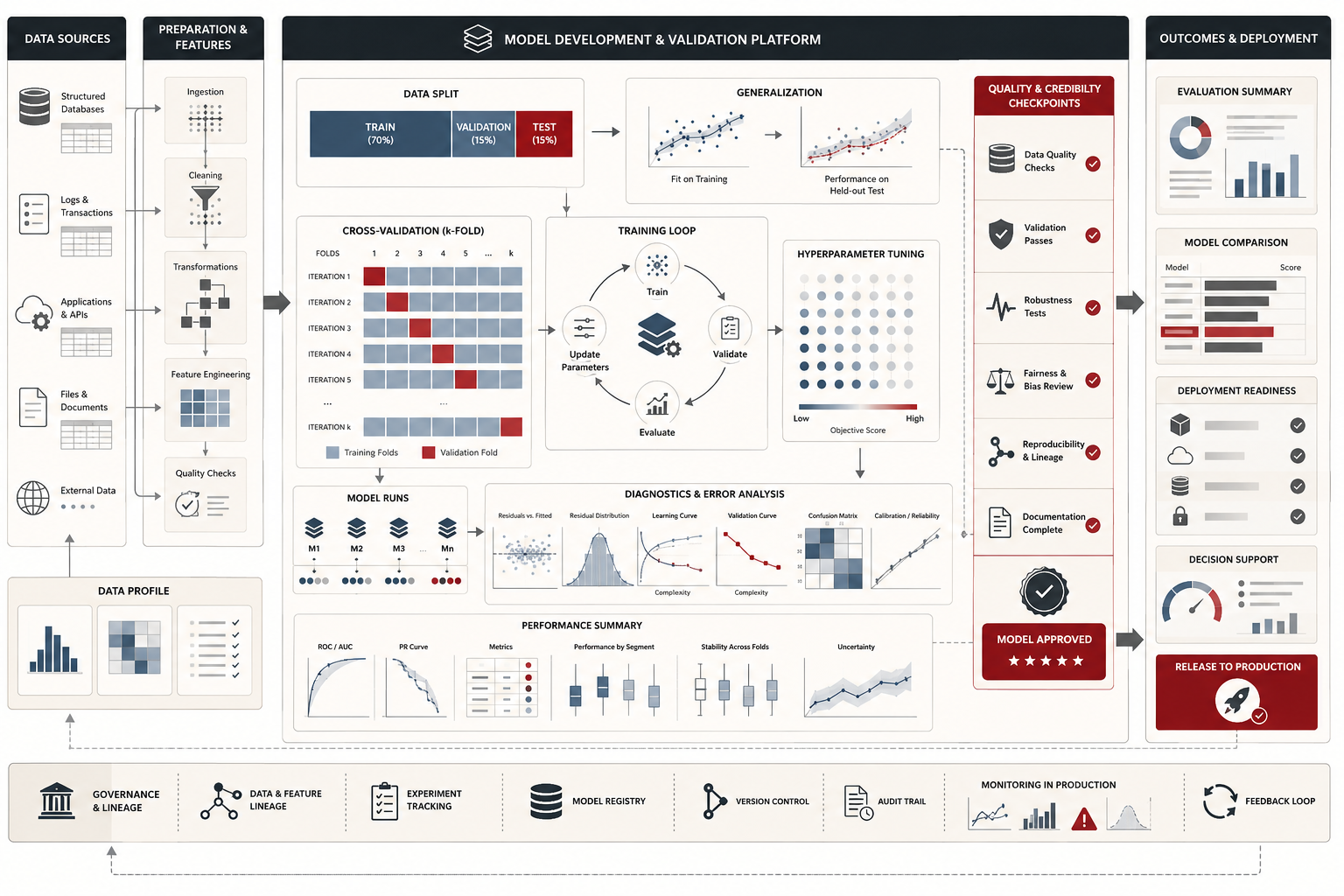
This article builds on the themes developed in Predictive Analytics and Machine Learning Models, Feature Engineering and Data Representation, Model Evaluation and Performance Metrics, Statistical Modeling and Inference, Data Cleaning and Data Quality Management, Reproducible Analytics and Versioned Data Workflows, and Data Governance and Stewardship. If feature engineering determines what the model can perceive, and model evaluation determines whether the final predictive system is fit for use, training and validation define the evidentiary process by which candidate models are developed, selected, tested, and prepared for operational scrutiny.
Training and validation as generalization evidence
The strongest way to understand model training and validation is as generalization evidence. Training fits a predictive function to observed examples. Validation estimates whether that fitted function is likely to remain useful on cases the model has not already seen. These are not merely software steps. They are the evidentiary structure that separates historical fit from predictive credibility.
This distinction matters because fitted models can be persuasive even when they are not reliable. A model can produce a clean score, a polished dashboard, or a confident ranking while having learned idiosyncrasies, shortcuts, leakage, temporal artifacts, or duplicate patterns that will not hold in deployment. Training and validation are the mechanisms that test whether the model is learning transferable structure or merely adapting to the development environment.
A strong validation design therefore asks several questions at once. Was the data split in a way that resembles the prediction setting? Were preprocessing steps fitted only on training data? Were hyperparameters tuned without contaminating final evidence? Was model selection separated from final testing? Was fold variance reported? Were temporal, grouped, or imbalanced structures handled correctly? Was the final test set protected? Will the model be monitored and revalidated after deployment?
Training and validation are not guarantees of truth. They are disciplined procedures for producing more credible evidence under uncertainty.
What model training and validation mean
Model training is the process of fitting a predictive model to data so that its parameters are adjusted to reduce error according to a chosen loss function. Validation is the process of assessing model behavior on data that was not used to fit those parameters, usually to estimate generalization performance, compare model variants, select hyperparameters, or diagnose overfitting.
Training and validation are related but not interchangeable. Training asks the model to learn from examples. Validation asks whether that learning appears to transfer beyond those examples. The training set is where model parameters are fit. The validation set or validation folds are where modeling choices are compared. The test set is where the selected approach receives final development-stage evidence. If these roles collapse into one another, performance claims become harder to trust.
This means that validation is not a ritual performed after model development is finished. It is part of the development process itself. Every major modeling decision—feature representation, preprocessing, algorithm family, regularization, hyperparameters, threshold strategy, early stopping, and model-selection rule—should be made within an evaluation structure that preserves the distinction between fitting, selection, and final evidence.
Why training and validation matter
Training and validation matter because predictive systems are judged by out-of-sample behavior, not by how well they memorize the past. A model that sees a training example twice is not demonstrating predictive intelligence when it predicts that example well. It is demonstrating recall. What analysts need to know is whether the learned mapping will remain useful when the next case arrives and the true label is not yet known.
This is why validation operationalizes epistemic restraint. It forces the analyst to ask not “how well can this model fit the data?” but “how much evidence do we have that this fit will survive contact with new data, new cohorts, new time periods, or changed operating conditions?” That question is the difference between development optimism and predictive evidence.
Validation also matters because models often inform decisions that allocate attention, resources, scrutiny, interventions, services, risk scores, or human review. In those settings, weak validation is not merely a technical inconvenience. It can produce overconfident systems that appear objective while failing in precisely the contexts where they are supposed to help. Training and validation are therefore both statistical and institutional responsibilities.
Training, validation, and test sets
The classical split logic distinguishes three roles. The training set is used to fit model parameters. The validation set is used to compare alternatives, tune hyperparameters, choose preprocessing decisions, and guide model development. The test set is reserved for the final evaluation of the selected approach.
These roles should remain separate because each use of held-out data consumes evidentiary freedom. If a validation set is used repeatedly, the development process gradually adapts to it. That is acceptable if the validation set is explicitly treated as part of model selection. It is not acceptable if the same set is later presented as untouched evidence of future performance. Once the test set steers feature selection, threshold tuning, hyperparameter choice, or model-family comparison, it stops being a clean test.
The epistemic roles are therefore simple but strict: training is for learning, validation is for selection, and testing is for final development-stage evidence. A serious model-development process protects those roles through code, workflow design, documentation, and governance review.
| Partition | Primary role | Common misuse |
|---|---|---|
| Training set | Fits model parameters and training-only preprocessing steps | Used to report model quality as if in-sample fit were generalization evidence |
| Validation set or folds | Guides feature choices, hyperparameters, model selection, and diagnostics | Treated as final evidence after repeated tuning has adapted to it |
| Test set | Provides final evidence for the selected development procedure | Consulted repeatedly until the model appears acceptable |
| Production monitoring data | Checks whether deployed behavior remains consistent with validation evidence | Ignored until model drift or operational failure becomes obvious |
Generalization as the central goal
Generalization is the ability of a model to make useful predictions on new data drawn from the same or related process as the training data. It is the central goal of predictive modeling. The training objective may minimize empirical loss, but the analytical objective is expected performance on cases not yet observed.
This distinction is one of the deepest insights in statistical learning. Training error and future error are not the same thing. A sufficiently flexible model can reduce training error by fitting idiosyncratic patterns, noise, duplicates, artifacts, or leakage. That can make the model look powerful during development while making it fragile in deployment.
A model-training workflow is therefore successful not when the training score approaches perfection, but when the model captures structure that persists beyond the examples it has already seen. Generalization is the difference between historical fit and predictive usefulness. Validation is the process that tries to estimate that difference before the model is trusted in practice.
Empirical risk and the generalization gap
Training is often framed as empirical risk minimization: the model is selected to reduce average loss on observed training examples. But the true target is expected risk on future examples. The gap between these two quantities is the central anxiety of model validation.
A low training loss can mean that the model has learned meaningful structure. It can also mean that the model has learned the peculiarities of the training data too well. Validation helps distinguish these possibilities by measuring performance on examples withheld from fitting. The difference between training and validation performance is often called a generalization gap.
A small gap does not prove the model will work forever, and a large gap does not always prove the model is unusable. But the gap is diagnostically important. It can indicate overfitting, data leakage, model instability, insufficient regularization, train-validation distribution mismatch, or an overly flexible model. A mature workflow tracks this gap across folds, time periods, subgroups, and model variants rather than treating it as a single final number.
The iterative training workflow
In practice, model training is iterative. Analysts choose an initial representation, fit a baseline model, inspect errors, alter features, compare algorithms, tune hyperparameters, revisit preprocessing, adjust regularization, inspect residuals or confusion patterns, and refine the workflow. This experimentation is not a flaw. It is how practical modeling usually proceeds.
The problem is not iteration. The problem is contaminated iteration. If every experiment is evaluated against the final test set, the test set becomes a development resource. If preprocessing is refit differently across partitions, the validation estimate becomes incoherent. If model selection continues until a validation score looks good by chance, the final claim becomes too optimistic.
Good workflows therefore separate experimentation from final evidence. Iteration belongs inside a training-validation regime. Final testing belongs after the modeling procedure has been selected. Reproducible pipelines, frozen test sets, audit logs, and model-development records help enforce that separation.
Cross-validation and more efficient use of data
Cross-validation exists because fixed validation splits can be wasteful and unstable, especially when sample sizes are limited. In k-fold cross-validation, the training data is partitioned into \(k\) folds. The model is trained on \(k-1\) folds and validated on the remaining fold. The process repeats so each fold serves as validation once, and the resulting scores are aggregated.
This procedure uses data more efficiently than a single validation split and gives a better sense of how performance varies across partitions. It is not a magical guarantee of truth. If preprocessing is done before splitting, leakage can still occur. If folds ignore groups or time, generalization can still be exaggerated. If hyperparameters are overfit to cross-validation results, optimism can still enter the process.
Cross-validation should therefore be understood as an estimation tool, not a moral guarantee. It helps estimate performance under a particular partitioning logic. The value of that estimate depends on whether the partitioning logic resembles the real prediction problem.
Nested validation and honest model comparison
Nested validation is used when model selection itself needs to be evaluated honestly. In ordinary cross-validation, hyperparameters may be tuned using the same resampling structure that is later summarized as evidence of performance. That can produce optimistic estimates because the selection process has adapted to the validation signal.
Nested validation separates the problem into two loops. The inner loop is used for hyperparameter tuning and model selection. The outer loop estimates how the entire selected procedure performs on data not used for that tuning decision. This is especially useful when many model families, hyperparameter grids, feature sets, or preprocessing variants are being compared.
The underlying principle is broader than nested cross-validation itself. Every time an analyst uses validation feedback to make another modeling decision, some evidentiary independence is consumed. Nested validation is one way of protecting performance estimation from that consumption. It reminds teams that evaluating a modeling procedure is not the same as evaluating one already-fixed model.
Hyperparameters, tuning, and validation logic
Hyperparameters govern how a learning algorithm behaves: regularization strength, tree depth, learning rate, number of estimators, class weights, kernel settings, stopping criteria, and similar controls. They are not learned automatically in the same way as model parameters and therefore require selection through external evaluation logic.
Hyperparameter tuning should happen inside the training-validation process. Validation scores should guide tuning; final test scores should only assess the chosen configuration after tuning is complete. If final test feedback is used to keep tuning, the final test set becomes part of development.
Tuning also needs proportionality. A small dataset and a large hyperparameter search can produce instability. A model may win because it happened to match validation noise. Search procedures should therefore be paired with fold dispersion, nested validation where appropriate, performance uncertainty, and practical judgment. Hyperparameter optimization is useful, but without evaluation discipline it becomes another form of overfitting.
Grouped, stratified, and temporal splits
Not all data can be split randomly without distorting the evaluation logic. Stratified splits preserve class proportions across partitions, which is especially important for imbalanced classification. Grouped splits prevent related observations from the same entity from appearing in both training and validation. Temporal splits preserve chronological order so that a model is evaluated on later cases after training on earlier cases.
The split strategy is itself part of model design. If multiple records from the same customer, patient, machine, household, facility, or document family are scattered across train and validation sets, the model may appear to generalize when it is actually recognizing related records. If future observations appear in training folds for a forecasting problem, the validation design violates the prediction setting. If class imbalance is ignored, a validation fold may not represent the rare class reliably.
The right split depends on the structure of the problem. Validation is not simply about withholding some data. It is about withholding the right data in the right way.
Data leakage and inconsistent preprocessing
Some of the most damaging failures in model validation arise from data leakage. Leakage occurs when information from validation, test, future, or post-outcome data influences training. It can happen through full-dataset preprocessing, duplicate records crossing splits, target-derived encodings, future aggregation windows, resampling before splitting, feature selection before partitioning, or repeated test-set consultation.
Leakage matters because it produces the illusion of predictive competence. A leaked model may look excellent during development and fail abruptly in deployment because the evaluation setting was never a fair proxy for future use. Leakage can be especially subtle: a scaler fit on all rows, an imputer trained before splitting, a target encoder fit globally, or a lag feature that accidentally includes future records can all inflate validation performance.
Inconsistent preprocessing creates a related problem. If transformations are fitted differently on training and held-out data, or if held-out data influences transformation statistics, the validation procedure no longer corresponds to the deployment procedure. Preprocessing is not a side step. It is part of the model and must be fitted, versioned, and evaluated accordingly.
Pipelines, reproducibility, and safer evaluation
Pipelines are one of the most important practical protections against leakage and inconsistent preprocessing. A pipeline binds preprocessing steps and the estimator into one executable object so that transformations are fitted only on training partitions and then applied consistently to held-out partitions. This matters during cross-validation because each fold must fit its own training-only transformation before evaluating on the validation fold.
Pipelines also support reproducibility. They make it easier to document exactly which transformations, hyperparameters, feature selectors, encoders, imputers, scalers, and estimators were used. They reduce the chance that manual notebook steps, hidden local files, or ad hoc preprocessing choices invalidate the evaluation logic.
This is why pipeline discipline is not merely software neatness. It is methodological integrity. If preprocessing changes the data the model learns from, then preprocessing belongs inside the validated workflow. A model report should not describe only the estimator. It should describe the full training and preprocessing procedure that produced the estimator.
Learning curves, loss curves, and early stopping
Training and validation are not only about final scalar scores. They are also about dynamics. Learning curves show how performance changes as training data increases. Loss curves show how training and validation loss evolve during optimization. Together, these curves help diagnose underfitting, overfitting, optimization instability, data insufficiency, and the point at which additional training stops improving generalization.
Early stopping uses validation behavior as a regularization signal. In iterative learners, the model may continue reducing training loss while validation loss stops improving or begins to worsen. Stopping at the right point can prevent the model from fitting noise more aggressively than structure.
These curves are especially useful because they reveal behavior a final score can hide. A model with a decent final score may still show widening train-validation gaps, unstable validation loss, insufficient data, or a plateau suggesting limited benefit from additional complexity. Training dynamics are therefore part of validation evidence, not visual decoration.
Model instability, fold variance, and error analysis
A model may have an acceptable average validation score while behaving very differently across folds, groups, or time windows. Fold variance can signal sensitivity to partition choice, insufficient sample size, subgroup heterogeneity, brittle features, unstable preprocessing, or a model family that is too sensitive for the available data.
This is why validation should not stop at a mean score. Analysts should inspect fold dispersion, class-specific errors, subgroup performance, calibration differences, validation residuals, and failure modes on consequential cases. Error analysis often reveals more about deployment risk than a headline metric does.
In practical terms, a stable but slightly weaker model may be preferable to a high-scoring but erratic one. Validation is not only about maximizing expected performance. It is about understanding the fragility of that performance and the conditions under which it breaks.
A mathematical lens for training and validation integrity
Training can be expressed as empirical risk minimization:
\hat{f} = \arg\min_{f \in \mathcal{F}} \frac{1}{n}\sum_{i=1}^{n} L\left(y_i, f(x_i)\right)
\]
Interpretation: The fitted model \(\hat{f}\) is selected from a model family \(\mathcal{F}\) to minimize average training loss. This optimizes fit on observed examples, not future performance by itself.
The generalization gap can be represented as:
G = R_{validation}(\hat{f}) – R_{train}(\hat{f})
\]
Interpretation: The generalization gap \(G\) compares validation risk with training risk. A large gap may indicate overfitting, leakage, distribution mismatch, or insufficient regularization.
Cross-validation estimates expected validation performance across folds:
CV_k = \frac{1}{k}\sum_{j=1}^{k} R_j(\hat{f}_{-j})
\]
Interpretation: In \(k\)-fold cross-validation, each fold \(j\) is held out once while the model is trained on the other folds. The average \(CV_k\) estimates performance across partition choices.
Fold stability can be summarized by dispersion:
\sigma_{CV} = \sqrt{\frac{1}{k}\sum_{j=1}^{k}\left(R_j – \bar{R}\right)^2}
\]
Interpretation: Fold dispersion \(\sigma_{CV}\) shows how unstable validation results are across folds. A model with high average performance but high fold variance may be fragile.
Nested validation separates tuning from outer-loop evidence:
\widehat{R}_{nested} = \frac{1}{K}\sum_{o=1}^{K} R_o\left(\hat{f}_{\lambda_o^{*}}\right)
\]
Interpretation: The inner loop chooses hyperparameters \(\lambda_o^{*}\); the outer loop estimates how the selected procedure performs on held-out data not used for that tuning decision.
Training and validation integrity can be scored as a governance-oriented function:
V_m = w_S S_m + w_C C_m + w_P P_m + w_L L_m + w_T T_m + w_R R_m
\]
Interpretation: Validation integrity \(V_m\) for model \(m\) can combine split design \(S_m\), cross-validation stability \(C_m\), pipeline integrity \(P_m\), leakage control \(L_m\), final test protection \(T_m\), and revalidation readiness \(R_m\).
The purpose of this mathematical lens is not to make validation seem mechanical. It is to make the logic explicit. Training optimizes a model. Validation estimates whether the optimization produced something likely to generalize. Governance asks whether the evidence is strong enough to justify use.
Python Workflow: Model Training and Validation Scorecard
The following Python workflow demonstrates how a validation process can inspect split integrity, fold stability, hyperparameter-search discipline, preprocessing and pipeline safety, leakage control, final test evidence, and revalidation readiness.
#!/usr/bin/env python3
"""
Python Workflow: Model Training and Validation Scorecard

This compact example treats validation as evidence infrastructure:
split design, fold stability, leakage control, pipeline integrity,
final testing, and post-deployment revalidation.
"""

from __future__ import annotations

import statistics
from dataclasses import dataclass


@dataclass
class FoldScore:
    fold: int
    training_score: float
    validation_score: float


@dataclass
class ValidationSignals:
    split_integrity: float
    fold_stability: float
    search_discipline: float
    pipeline_integrity: float
    leakage_control: float
    learning_curve_diagnostics: float
    final_test_integrity: float
    revalidation_readiness: float


def fold_stability_score(folds: list[FoldScore]) -> float:
    validation_scores = [fold.validation_score for fold in folds]
    gaps = [
        abs(fold.training_score - fold.validation_score)
        for fold in folds
    ]

    validation_sd = statistics.pstdev(validation_scores)
    mean_gap = statistics.mean(gaps)

    return round(max(0.0, min(1.0, 1.0 - validation_sd * 5.0 - mean_gap * 0.5)), 3)


def validation_integrity_score(signals: ValidationSignals) -> float:
    return round(
        0.16 * signals.split_integrity
        + 0.16 * signals.fold_stability
        + 0.13 * signals.search_discipline
        + 0.16 * signals.pipeline_integrity
        + 0.16 * signals.leakage_control
        + 0.08 * signals.learning_curve_diagnostics
        + 0.09 * signals.final_test_integrity
        + 0.06 * signals.revalidation_readiness,
        3,
    )


def main() -> None:
    folds = [
        FoldScore(1, training_score=0.82, validation_score=0.74),
        FoldScore(2, training_score=0.84, validation_score=0.72),
        FoldScore(3, training_score=0.83, validation_score=0.73),
        FoldScore(4, training_score=0.82, validation_score=0.75),
    ]

    signals = ValidationSignals(
        split_integrity=0.90,
        fold_stability=fold_stability_score(folds),
        search_discipline=0.80,
        pipeline_integrity=1.00,
        leakage_control=1.00,
        learning_curve_diagnostics=0.85,
        final_test_integrity=0.90,
        revalidation_readiness=0.65,
    )

    print({
        "fold_stability_score": signals.fold_stability,
        "validation_integrity_score": validation_integrity_score(signals),
        "validation_integrity_gap": round(1 - validation_integrity_score(signals), 3),
    })


if __name__ == "__main__":
    main()
This workflow separates model fitting from validation integrity. A model can have a respectable validation score while the process around it remains weak. Split design, leakage checks, preprocessing discipline, fold variance, final test protection, and revalidation readiness are part of the evidence.
R Workflow: Split, Fold, Hyperparameter, Leakage, and Revalidation Summary
The following R workflow summarizes split strategies, fold behavior, hyperparameter-search discipline, preprocessing checks, leakage checks, final test evidence, and revalidation windows. It supports a recurring review process: which runs have protected test sets, which folds show instability, which preprocessing steps violate fold discipline, which searches lack nested validation, and which production windows require revalidation?
#!/usr/bin/env Rscript

# R Workflow: Split, Fold, Hyperparameter, Leakage,
# and Revalidation Summary

runs <- data.frame(
  run_id = c("run001", "run002", "run003", "run004"),
  task_type = c(
    "binary_classification",
    "binary_classification",
    "regression",
    "binary_classification"
  ),
  algorithm = c(
    "regularized_logistic_regression",
    "gradient_boosting",
    "random_forest",
    "decision_tree"
  ),
  validation_design = c(
    "stratified_kfold",
    "nested_stratified_kfold",
    "time_series_split",
    "random_split"
  ),
  status = c("in_review", "approved", "in_review", "needs_revision"),
  stringsAsFactors = FALSE
)

splits <- data.frame(
  run_id = runs$run_id,
  partition_strategy = c(
    "stratified_random",
    "nested_stratified_kfold",
    "time_series_split",
    "random_split"
  ),
  stratified = c(TRUE, TRUE, FALSE, FALSE),
  group_aware = c(FALSE, FALSE, FALSE, FALSE),
  time_ordered = c(FALSE, FALSE, TRUE, FALSE),
  test_set_touched = c(FALSE, FALSE, FALSE, TRUE),
  status = c("in_review", "approved", "in_review", "needs_revision"),
  stringsAsFactors = FALSE
)

folds <- data.frame(
  run_id = c("run001", "run001", "run001", "run001", "run004", "run004"),
  metric_name = c("roc_auc", "roc_auc", "roc_auc", "roc_auc", "accuracy", "accuracy"),
  training_score = c(0.82, 0.84, 0.83, 0.82, 0.95, 0.96),
  validation_score = c(0.74, 0.72, 0.73, 0.75, 0.61, 0.58),
  score_gap = c(0.08, 0.12, 0.10, 0.07, 0.34, 0.38),
  stringsAsFactors = FALSE
)

preprocessing <- data.frame(
  run_id = c("run001", "run001", "run004", "run004"),
  component = c("standard_scaler", "one_hot_encoder", "target_encoder", "imputer"),
  fit_scope = c("training_fold_only", "training_fold_only", "full_dataset", "full_dataset"),
  uses_pipeline = c(TRUE, TRUE, FALSE, FALSE),
  status = c("pass", "pass", "fail", "fail"),
  severity = c("high", "high", "critical", "high"),
  stringsAsFactors = FALSE
)

leakage <- data.frame(
  run_id = c("run001", "run002", "run003", "run004", "run004"),
  leakage_type = c(
    "duplicate_across_splits",
    "resampling_before_split",
    "future_information",
    "test_set_reuse",
    "preprocessing_before_split"
  ),
  status = c("pass", "pass", "pass", "fail", "fail"),
  severity = c("high", "critical", "critical", "critical", "critical"),
  stringsAsFactors = FALSE
)

revalidation <- data.frame(
  run_id = c("run001", "run001", "run002", "run002", "run003", "run003"),
  production_metric = c("roc_auc", "roc_auc", "average_precision", "average_precision", "mae", "mae"),
  metric_value = c(0.72, 0.68, 0.49, 0.45, 9.7, 12.0),
  validation_reference = c(0.735, 0.735, 0.502, 0.502, 9.567, 9.567),
  drift_index = c(0.08, 0.17, 0.09, 0.19, 0.08, 0.20),
  status = c("watch", "escalate", "approved", "escalate", "approved", "watch"),
  stringsAsFactors = FALSE
)

run_summary <- aggregate(
  run_id ~ task_type + algorithm + validation_design + status,
  data = runs,
  FUN = length
)
names(run_summary) <- c(
  "task_type",
  "algorithm",
  "validation_design",
  "status",
  "run_count"
)

split_summary <- aggregate(
  run_id ~ partition_strategy + stratified + group_aware + time_ordered + test_set_touched + status,
  data = splits,
  FUN = length
)
names(split_summary) <- c(
  "partition_strategy",
  "stratified",
  "group_aware",
  "time_ordered",
  "test_set_touched",
  "status",
  "split_count"
)

fold_summary <- aggregate(
  cbind(validation_score, score_gap) ~ run_id + metric_name,
  data = folds,
  FUN = mean
)
names(fold_summary) <- c(
  "run_id",
  "metric_name",
  "mean_validation_score",
  "mean_score_gap"
)

fold_sd <- aggregate(
  validation_score ~ run_id + metric_name,
  data = folds,
  FUN = sd
)
names(fold_sd) <- c("run_id", "metric_name", "validation_score_sd")

fold_summary <- merge(
  fold_summary,
  fold_sd,
  by = c("run_id", "metric_name"),
  all.x = TRUE
)

preprocessing_summary <- aggregate(
  component ~ run_id + fit_scope + uses_pipeline + status + severity,
  data = preprocessing,
  FUN = length
)
names(preprocessing_summary) <- c(
  "run_id",
  "fit_scope",
  "uses_pipeline",
  "status",
  "severity",
  "component_count"
)

leakage_summary <- aggregate(
  leakage_type ~ run_id + status + severity,
  data = leakage,
  FUN = length
)
names(leakage_summary) <- c(
  "run_id",
  "status",
  "severity",
  "leakage_check_count"
)

revalidation_summary <- aggregate(
  drift_index ~ run_id + production_metric + status,
  data = revalidation,
  FUN = mean
)
names(revalidation_summary) <- c(
  "run_id",
  "production_metric",
  "status",
  "mean_drift_index"
)

dir.create("outputs", showWarnings = FALSE, recursive = TRUE)

write.csv(run_summary, "outputs/run_summary_r.csv", row.names = FALSE)
write.csv(split_summary, "outputs/split_summary_r.csv", row.names = FALSE)
write.csv(fold_summary, "outputs/fold_summary_r.csv", row.names = FALSE)
write.csv(preprocessing_summary, "outputs/preprocessing_summary_r.csv", row.names = FALSE)
write.csv(leakage_summary, "outputs/leakage_summary_r.csv", row.names = FALSE)
write.csv(revalidation_summary, "outputs/revalidation_summary_r.csv", row.names = FALSE)

cat("Wrote split, fold, preprocessing, leakage, and revalidation summaries.\n")
This workflow treats validation as an auditable system. It does not only ask which model scored highest. It asks how the split was designed, whether preprocessing was fitted safely, whether folds were stable, whether leakage was controlled, and whether production behavior still resembles validation evidence.
Model selection, final testing, and evidentiary discipline
Model selection should be understood as a disciplined search for a procedure likely to generalize, not as an opportunity to maximize one convenient validation score. Once candidate models have been explored using training and validation logic, the final selected approach should be evaluated on an untouched test set. That test result should be preserved as evidence of the chosen procedure, not used as another feedback loop.
This final test is important because it functions as the closest available analogue to future deployment evidence during development. It is still only an estimate. It may be limited by sample size, cohort representativeness, label quality, temporal drift, or operational mismatch. But it is more credible when protected from the model-development loop.
Final testing is therefore less a ceremonial last step than a safeguard for evidentiary honesty. It answers not “which model looked best while we were building?” but “how strong is the evidence that the chosen modeling procedure will generalize beyond development?”
Validation beyond development: monitoring and revalidation
Validation does not end at deployment. A model that performed well on historical test data may degrade when source systems change, user behavior changes, label definitions shift, economic conditions change, policies change, or the model itself affects the environment it predicts. A validated model is not permanently validated.
Post-deployment revalidation should compare production performance with validation expectations. Monitoring should track prediction distributions, input drift, missingness, out-of-vocabulary rates, calibration drift, error rates, subgroup behavior, threshold suitability, and operational feedback. When drift or performance degradation crosses a limit, the model should trigger review, recalibration, retraining, rollback, or retirement.
This lifecycle perspective is especially important in institutional settings. Training and validation are not simply a development ritual. They are part of a broader system of predictive governance. A model’s credibility must be maintained, not only declared at launch.
Governance and institutional accountability
Training and validation become meaningful at organizational scale only when they connect to governance. Split design, preprocessing fit scope, fold scores, hyperparameter searches, leakage checks, final test evidence, monitoring windows, and revalidation decisions should be documented and linked to owners, reviewers, model versions, and intended uses.
This matters because weak validation can hide inside polished model artifacts. A model registry entry may say “approved,” but without split records, pipeline evidence, leakage checks, final test results, and monitoring conditions, later reviewers cannot know what the approval actually meant. Governance turns validation from a private notebook practice into an institutional record.
The level of governance should be proportionate to consequence. A low-stakes exploratory model may need lightweight documentation. A high-impact model used for triage, fraud review, healthcare screening, credit assessment, public services, safety monitoring, or resource allocation should require stronger validation evidence, final test protection, subgroup review, monitoring, and revalidation procedures.
Applications across domains
Model training and validation matter across every domain that uses predictive systems. In healthcare, weak validation can produce fragile risk models that fail on new patient populations. In finance, leakage can inflate credit, fraud, or risk-performance estimates. In public systems, poor validation logic can create overconfident triage tools. In operations, weak temporal partitioning can make forecasting systems look stronger in development than in real deployment. In marketing and customer analytics, repeated test-set tuning can produce campaign models that fail outside the development cohort.
Across all these settings, the underlying problem is the same: a model must be evaluated under conditions that resemble the decisions it will actually face. Training and validation are therefore not coding details attached after a model has been chosen. They are among the primary mechanisms by which predictive claims become evidence rather than aspiration.
Failure modes in training and validation
Training and validation fail in recognizable ways. One failure mode is in-sample optimism: reporting training performance as if it were evidence of future behavior. Another is test-set erosion: repeatedly consulting the test set until it becomes part of development. A third is preprocessing leakage: fitting scalers, imputers, selectors, encoders, or resamplers before splitting the data. A fourth is wrong split design: using random splits when grouped or temporal structure requires a different partitioning strategy.
A fifth failure mode is validation overfitting: trying many model variants until one wins by chance. A sixth is fold-variance neglect: reporting only average performance while ignoring instability. A seventh is final-test theater: presenting a final score even though final evidence was not actually protected. An eighth is post-deployment neglect: treating a historical validation result as permanent proof.
These are not merely technical mistakes. They are failures of evidentiary discipline. They make models look more credible than the development process justifies.
Implementation principles for high-integrity training and validation
Define the prediction setting first. Know what is being predicted, when the prediction is made, and what data is available at that time.
Protect the test set. Use training and validation data for development; preserve the test set for final evidence.
Choose the split design to match the data structure. Use stratified, grouped, temporal, or nested strategies when the problem requires them.
Fit preprocessing inside the training workflow. Scaling, imputation, encoding, feature selection, resampling, and transformation must not peek at held-out data.
Use pipelines where possible. Pipelines make leakage-safe evaluation executable and reproducible.
Report fold dispersion. Mean validation score is not enough; variance across folds matters.
Use nested validation when tuning is heavy. Separate model selection from performance estimation when many alternatives are compared.
Document hyperparameter search. Record candidate ranges, search method, validation logic, and selected configuration.
Inspect learning curves and loss curves. Training dynamics reveal underfitting, overfitting, data limits, and early-stopping behavior.
Revalidate after deployment. Monitor drift, performance, calibration, and operational mismatch over time.
| Control | Purpose | Failure it prevents |
|---|---|---|
| Split registry | Documents train, validation, and test roles, counts, and partition strategy | Ambiguous or contaminated evaluation evidence |
| Test-set protection | Prevents final evidence from steering development | Test-set erosion and over-optimistic final scores |
| Pipeline-based preprocessing | Fits transformations only inside training folds | Preprocessing leakage and inconsistent transformations |
| Grouped, stratified, or temporal split review | Matches partition logic to data structure | Near-duplicate leakage, class imbalance distortion, or future information leakage |
| Cross-validation dispersion report | Shows stability across folds | Mean-score optimism hiding fragile performance |
| Nested validation | Separates hyperparameter tuning from outer-loop performance estimation | Model-selection bias and validation overfitting |
| Learning-curve diagnostics | Reveals underfitting, overfitting, and data insufficiency | Misreading final scores without training dynamics |
| Revalidation monitoring | Checks whether production behavior still matches validation evidence | Static validation being treated as permanent trust |
GitHub Repository
This article can be paired with a companion code workflow that models training and validation as generalization-evidence infrastructure. The example includes model training runs, split registries, fold scores, hyperparameter searches, preprocessing checks, leakage checks, learning curves, final test evidence, revalidation windows, SQL schemas, scorecard scripts, typed contracts, Quarto report templates, validation checklists, split-design guides, and multi-language examples across Python, R, Julia, SQL, Go, Rust, C, C++, TypeScript, and Terraform placeholders.
Conclusion
Model training and validation are central to trustworthy predictive analytics because they determine whether a fitted model becomes credible evidence or merely historical fit. Training optimizes a model on observed examples. Validation estimates whether the modeling procedure is likely to generalize beyond those examples. Final testing protects the selected approach from development optimism. Monitoring and revalidation test whether deployment still resembles the conditions under which the model was approved.
The deeper point is that validation is not a mechanical afterthought. It is the discipline that separates model development from model belief. Split design, cross-validation, nested validation, leakage control, pipeline integrity, learning curves, fold dispersion, final test protection, and post-deployment monitoring all shape the strength of predictive claims. In data-intensive organizations, these practices are not only machine-learning techniques. They are conditions of responsible evidence, governance, and institutional trust.
Related articles
- Data Systems and Analytics knowledge series
- Predictive Analytics and Machine Learning Models
- Feature Engineering and Data Representation
- Model Evaluation and Performance Metrics
- Statistical Modeling and Inference
- Data Cleaning and Data Quality Management
- Reproducible Analytics and Versioned Data Workflows
- Data Governance and Stewardship
Further reading
- Bishop, C.M. (2006) Pattern Recognition and Machine Learning. New York: Springer.
- Hastie, T., Tibshirani, R. and Friedman, J. (2009) The Elements of Statistical Learning. 2nd edn. New York: Springer.
- James, G., Witten, D., Hastie, T. and Tibshirani, R. (2021) An Introduction to Statistical Learning. 2nd edn. New York: Springer.
- Molnar, C. (2024) Interpretable Machine Learning. 2nd edn. Available at: https://christophm.github.io/interpretable-ml-book/
- Murphy, K.P. (2012) Machine Learning: A Probabilistic Perspective. Cambridge, MA: MIT Press.
- NIST (2023) Artificial Intelligence Risk Management Framework (AI RMF 1.0). Gaithersburg, MD: National Institute of Standards and Technology.
References
- scikit-learn developers (n.d.) Cross-validation: evaluating estimator performance. Available at: https://scikit-learn.org/stable/modules/cross_validation.html
- scikit-learn developers (n.d.) Nested versus non-nested cross-validation. Available at: https://scikit-learn.org/stable/auto_examples/model_selection/plot_nested_cross_validation_iris.html
- scikit-learn developers (n.d.) Visualizing cross-validation behavior in scikit-learn. Available at: https://scikit-learn.org/stable/auto_examples/model_selection/plot_cv_indices.html
- scikit-learn developers (n.d.) Common pitfalls and recommended practices. Available at: https://scikit-learn.org/stable/common_pitfalls.html
- scikit-learn developers (n.d.) Pipelines and composite estimators. Available at: https://scikit-learn.org/stable/modules/compose.html
- Google for Developers (2025) Datasets, generalization, and overfitting. Available at: https://developers.google.com/machine-learning/crash-course/overfitting
- Google for Developers (2025) Dividing the original dataset. Available at: https://developers.google.com/machine-learning/crash-course/overfitting/dividing-datasets
- Google for Developers (2025) Interpreting loss curves. Available at: https://developers.google.com/machine-learning/crash-course/overfitting/interpreting-loss-curves
- Google for Developers (2025) L2 regularization and early stopping. Available at: https://developers.google.com/machine-learning/crash-course/overfitting/regularization
- NIST (n.d.) AI Test, Evaluation, Validation and Verification (TEVV). Available at: https://www.nist.gov/ai-test-evaluation-validation-and-verification-tevv
- NIST (2023) Artificial Intelligence Risk Management Framework (AI RMF 1.0). Available at: https://nvlpubs.nist.gov/nistpubs/ai/nist.ai.100-1.pdf
- NIST AI RMF Playbook (n.d.) MEASURE. Available at: https://airc.nist.gov/airmf-resources/playbook/measure/
- Hastie, T., Tibshirani, R. and Friedman, J. (2009) The Elements of Statistical Learning. Available at: https://hastie.su.domains/pub.htm
- James, G., Witten, D., Hastie, T. and Tibshirani, R. (2021) An Introduction to Statistical Learning. 2nd edn. New York: Springer.