
Last Updated May 10, 2026
Reinforcement learning in dynamic environments concerns how artificial agents learn to act through feedback in settings where outcomes unfold over time, states evolve in response to action, and uncertainty is intrinsic to decision-making. Unlike supervised learning, which maps inputs to labels from a fixed dataset, reinforcement learning places an agent inside an environment where it must learn through interaction. The central problem is not simply prediction, classification, or pattern recognition. It is the discovery of policies for action that improve long-run outcomes under changing conditions.
The central argument of this article is that reinforcement learning should be understood as a theory of governed adaptation. It gives AI systems a formal language for acting, learning, exploring, controlling, and improving across time. But because reinforcement learning links optimization to real-world action, it also raises distinctive risks: unsafe exploration, reward misspecification, non-stationarity, partial observability, multi-agent instability, simulation-to-reality gaps, and policies that perform well in training but fail under deployment stress.
Dynamic environments matter because many real systems are not static. Roads become congested, markets change, robots encounter disturbances, users adapt to recommender systems, infrastructure responds to weather and demand, and multi-agent systems evolve as participants learn from one another. In such environments, a good action now may produce delayed consequences later, and the value of a decision depends on how it alters the future state of the system. Reinforcement learning is therefore especially important for autonomous systems, adaptive control, robotics, operations research, infrastructure management, recommender systems, resource allocation, and other domains where action and environment are mutually shaping over time.
Main Library
Publications
Article Map
Artificial Intelligence Systems
Related Topic
Data Systems & Analytics
Related Topic
Embedded & Edge Systems
Related Topic
Intelligent Infrastructure Systems
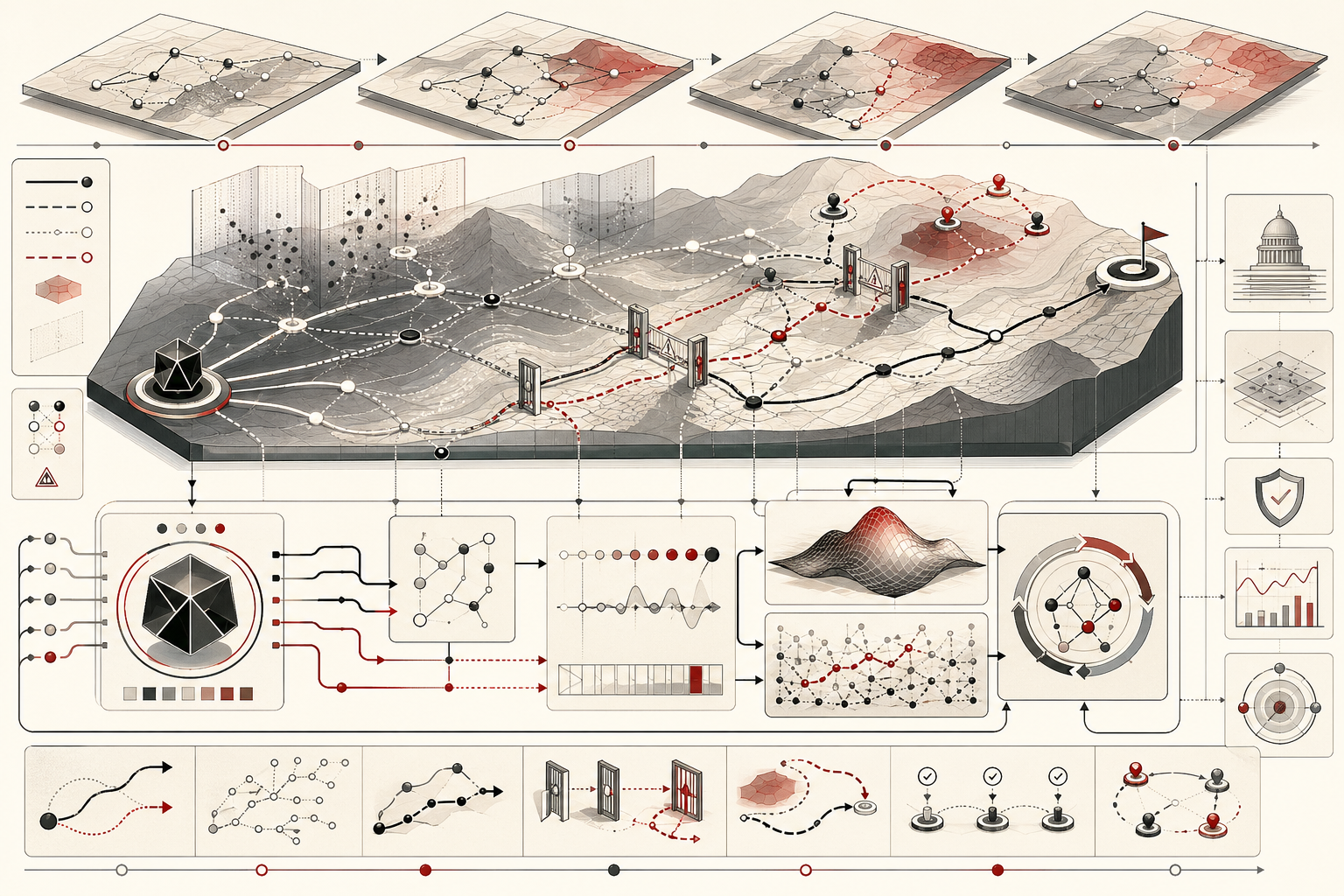
This article develops Reinforcement Learning in Dynamic Environments as an advanced article within the Artificial Intelligence Systems knowledge series. It explains agents, environments, Markov decision processes, Bellman equations, value functions, policies, exploration and exploitation, non-stationarity, partial observability, model-free and model-based reinforcement learning, safe reinforcement learning, constrained decision-making, multi-agent reinforcement learning, real-time autonomy, system reliability, and governance. Selected Python and R examples appear here, while the full GitHub repository contains expanded computational scaffolding for dynamic reinforcement-learning simulation, grid-world environments, Q-learning, policy evaluation, safe constraints, non-stationary rewards, SQL metadata, governance documentation, and advanced Jupyter notebooks.
Why Reinforcement Learning Matters
Reinforcement learning matters because many AI problems are not static classification problems. They involve action, feedback, adaptation, and time. An autonomous vehicle must choose actions while the road changes. A robot must act while balance, friction, and object position evolve. A recommender system influences the future preferences and behavior it later observes. A logistics controller must allocate resources while demand, delay, weather, and capacity change. A decision-support system may alter the environment it is trying to optimize.
In these settings, the quality of a decision cannot be judged only by immediate prediction accuracy. The question is whether action improves the future trajectory of the system. Reinforcement learning provides a formal language for this problem: agents, environments, states, actions, rewards, policies, value functions, transitions, and long-run returns. It treats intelligence as situated action under uncertainty rather than passive pattern recognition.
This makes reinforcement learning especially important for artificial intelligence systems because it connects learning to control. It asks how systems should act, not merely what they should predict. But that strength also creates risk. Agents that optimize reward in dynamic environments may explore unsafely, exploit flawed reward functions, fail under distribution shift, behave unpredictably in multi-agent settings, or discover strategies that satisfy a formal objective while violating human intent. Reinforcement learning therefore belongs at the center of both AI capability and AI governance.
Prediction \neq Action
\]
Interpretation: Reinforcement learning differs from ordinary prediction because the agent’s actions change the environment that later generates future evidence.
| System Context | Why Static Prediction Is Not Enough | Reinforcement-Learning Question | Governance Concern |
|---|---|---|---|
| Robotics | Actions change balance, location, contact, and object configuration. | Which policy improves long-run task performance? | Unsafe exploration, hardware damage, and human safety. |
| Autonomous vehicles | Road conditions and other actors change continuously. | Which action preserves safety while progressing toward a goal? | Latency, uncertainty, edge cases, and accountability. |
| Infrastructure systems | Demand, weather, load, and capacity evolve over time. | How should resources be allocated under changing constraints? | Reliability, resilience, and failure propagation. |
| Recommendation systems | Recommendations shape future user behavior and data. | Which policy improves long-run user and system outcomes? | Feedback loops, manipulation, addiction, and proxy rewards. |
| Operations and logistics | Routing, inventory, delay, and demand interact dynamically. | How should actions adapt as conditions change? | Efficiency-resilience tradeoffs and service failures. |
Note: Reinforcement learning becomes most important when action, feedback, uncertainty, and time are inseparable.
Foundations of Reinforcement Learning
Reinforcement learning is the study of how an agent learns behavior through interaction with an environment, guided by evaluative feedback rather than explicit instruction. The agent is not told which action is correct in advance. Instead, it must discover useful behavior from rewards and penalties distributed over time. This combination of closed-loop interaction, delayed consequence, and trial-and-error improvement is the defining structure of reinforcement-learning problems.
This makes reinforcement learning fundamentally different from static prediction tasks. The system is not merely fitting a function to historical observations. It is learning a policy for acting in a world that changes because the agent acts. In that sense, reinforcement learning belongs not only to machine learning, but also to optimal control, dynamic programming, operations research, behavioral adaptation, and sequential decision theory.
A reinforcement-learning problem can be described as a loop:
Agent \rightarrow Action \rightarrow Environment \rightarrow State,\ Reward \rightarrow Agent
\]
Interpretation: Reinforcement learning is a closed-loop process in which an agent acts, observes consequences, receives reward, and updates future behavior.
The loop is simple, but its implications are deep. The agent must evaluate actions not only by immediate reward, but by the future states and opportunities those actions make possible. This makes reinforcement learning a framework for temporally extended consequence.
| Feature | Meaning | System Implication | Risk if Mishandled |
|---|---|---|---|
| Interaction | The agent learns by acting in an environment. | Data is generated through behavior, not only collected passively. | Exploration may create harm or distorted evidence. |
| Delayed consequence | Actions may affect outcomes far in the future. | Short-term reward may conflict with long-run performance. | Agents may learn myopic or unstable strategies. |
| Policy learning | The system learns a rule for action. | Evaluation must consider trajectories, not isolated predictions. | A policy may behave badly in rare or shifted states. |
| Reward-driven feedback | The agent improves through reward signals. | Reward design becomes a central governance problem. | Reward hacking and proxy optimization. |
| Adaptation | The agent changes behavior as it learns. | Deployment behavior may evolve over time. | Monitoring must continue after deployment. |
Note: Reinforcement learning is a closed-loop learning architecture, not only a family of optimization algorithms.
Learning + Action + Feedback + Time = Reinforcement\ Learning
\]
Interpretation: Reinforcement learning joins learning, control, evaluative feedback, and temporally extended consequence into one framework.
Agent, Environment, State, Action, and Reward
The basic elements of reinforcement learning are the agent, the environment, the state, the action, and the reward. The agent selects actions. The environment responds. The state summarizes relevant information about the current situation. The reward provides evaluative feedback. Over time, the agent learns a policy that maps states to actions or action probabilities.
A policy can be represented as:
\pi(a \mid s)
\]
Interpretation: Policy \(\pi\) gives the probability of choosing action \(a\) when the agent is in state \(s\).
A deterministic policy can be represented as:
a=\pi(s)
\]
Interpretation: A deterministic policy directly maps a state to an action.
Reward is central but dangerous. A reward function tells the agent what is being optimized, but not necessarily what humans actually value. If the reward is incomplete, proxy-based, or poorly designed, the agent may learn behavior that maximizes the formal reward while producing undesirable system outcomes. This is why reinforcement learning connects directly to AI safety, reward design, interpretability, and governance.
| Element | Definition | Example | Governance Question |
|---|---|---|---|
| Agent | The decision-making system. | Robot controller, recommender, logistics optimizer, autonomous software agent. | Who is responsible for the agent’s action policy? |
| Environment | The system in which the agent acts. | Road network, warehouse, user platform, simulation, grid, market. | Does the environment model reflect deployment reality? |
| State | Representation of current conditions. | Sensor readings, location, inventory, user context, system load. | What important information is missing or hidden? |
| Action | Decision available to the agent. | Move, route, recommend, allocate, throttle, schedule, trade. | Which actions require constraints or human approval? |
| Reward | Feedback signal used for learning. | Goal reached, cost reduced, engagement increased, energy saved. | Does reward reflect the real objective or a risky proxy? |
| Policy | Rule mapping states to actions. | A learned strategy for choosing what to do next. | How is policy behavior tested, monitored, and updated? |
Note: Reward design is a governance problem because the agent may optimize what is measurable rather than what is socially, operationally, or ethically intended.
Reward\ Signal \neq Human\ Intent
\]
Interpretation: A reward function may approximate human goals, but it can also omit safety, fairness, stability, or long-run system consequences.
Markov Decision Processes and Dynamic Structure
The canonical mathematical framework for reinforcement learning is the Markov decision process. An MDP defines a state space, an action space, transition probabilities, a reward structure, and usually a discount factor governing the valuation of future outcomes. The agent observes a state, selects an action, receives a reward, and transitions to a new state. This structure formalizes the idea that learning unfolds over trajectories rather than isolated examples.
An MDP can be represented as:
MDP=(S,A,P,R,\gamma)
\]
Interpretation: An MDP includes states \(S\), actions \(A\), transition dynamics \(P\), reward function \(R\), and discount factor \(\gamma\).
The Markov property is central:
P(s_{t+1}\mid s_t,a_t,s_{t-1},a_{t-1},\ldots)=P(s_{t+1}\mid s_t,a_t)
\]
Interpretation: The next state depends only on the current state and action, not the full past history, when the Markov assumption holds.
The Markov assumption is powerful because it makes dynamic optimization tractable. It is also often fragile in real-world environments where hidden state, path dependence, delayed effects, and incomplete observation are common. Reinforcement learning in dynamic environments often begins with the MDP as an idealization and then confronts the limits of that idealization in practice.
| MDP Component | Meaning | Dynamic-System Interpretation | Practical Challenge |
|---|---|---|---|
| \(S\) | State space. | Possible system conditions. | State may be too large, hidden, or poorly measured. |
| \(A\) | Action space. | Available interventions. | Some actions may be unsafe or legally constrained. |
| \(P\) | Transition dynamics. | How action changes future state. | Dynamics may be unknown, changing, or stochastic. |
| \(R\) | Reward function. | Feedback signal for learning. | Reward may be misspecified or incomplete. |
| \(\gamma\) | Discount factor. | Weight placed on future reward. | Short- versus long-run priorities must be chosen. |
Note: The MDP is a powerful abstraction, but real environments often violate its assumptions through hidden state, changing dynamics, and social feedback.
Bellman Equations and Value-Based Reasoning
The recursive core of reinforcement learning is captured by Bellman equations. Value functions summarize the expected long-run return associated with states or state-action pairs under a policy. Dynamic programming and reinforcement learning both depend on Bellman-style recursion because the value of a current choice depends on immediate reward plus the future states that choice makes possible.
The state-value function under a policy can be written as:
V^{\pi}(s)=E_{\pi}\left[\sum_{t=0}^{\infty}\gamma^t r_t \mid s_0=s\right]
\]
Interpretation: The value of state \(s\) under policy \(\pi\) is the expected discounted sum of future rewards starting from \(s\).
The Bellman expectation equation is:
V^{\pi}(s)=\sum_a \pi(a\mid s)\sum_{s’}P(s’\mid s,a)\left[R(s,a,s’)+\gamma V^{\pi}(s’)\right]
\]
Interpretation: The value of a state equals expected immediate reward plus discounted value of the next state.
This matters because locally attractive actions may be globally poor, and short-term sacrifice may be long-term optimal. Reinforcement learning is therefore an architecture for reasoning about temporally extended consequence, not merely immediate gain.
| Concept | Meaning | Why It Matters | System Example |
|---|---|---|---|
| Immediate reward | Feedback received after an action. | Captures short-term consequence. | A robot moves closer to a target. |
| Future value | Expected long-run return from the next state. | Captures delayed consequence. | A logistics system avoids a route that creates future congestion. |
| Discounting | Future rewards are weighted by \(\gamma\). | Determines short-run versus long-run priority. | Infrastructure control balances immediate efficiency and long-run resilience. |
| Recursive value | State value depends on future state value. | Allows dynamic programming and policy improvement. | A controller evaluates action by the trajectory it creates. |
| Optimality | The best policy maximizes expected return. | Defines the target of learning. | A scheduling system learns which allocation improves cumulative service quality. |
Note: Bellman equations make reinforcement learning a theory of temporally linked consequence.
Good\ Action = Immediate\ Reward + Future\ Opportunity
\]
Interpretation: Reinforcement learning evaluates actions by both what they produce now and what future states they make possible.
Policies, Returns, and Long-Run Consequence
A policy is the agent’s behavior rule. It determines which action the agent takes in each state. The quality of a policy depends on the return it generates across time, not simply on one-step outcomes. This is why reinforcement learning is useful in environments where action produces delayed effects.
The return from time \(t\) can be written as:
G_t=r_{t+1}+\gamma r_{t+2}+\gamma^2 r_{t+3}+\cdots
\]
Interpretation: Return \(G_t\) is the discounted sum of future rewards after time \(t\).
The optimal value function can be written as:
V^*(s)=\max_{\pi}V^{\pi}(s)
\]
Interpretation: The optimal value of a state is the highest expected return achievable by any policy.
In dynamic environments, the policy is never merely a local rule. It is a long-term control strategy. The agent must choose actions that shape future opportunities, risks, information, constraints, and system states.
| Policy Criterion | Question | Weak Evaluation | Stronger Evaluation |
|---|---|---|---|
| Return | Does the policy improve cumulative reward? | Evaluate only one-step reward. | Evaluate trajectory-level outcomes. |
| Stability | Does behavior remain stable under changing conditions? | Test only in one simulated environment. | Stress-test under shift, noise, and altered dynamics. |
| Safety | Does the policy avoid unacceptable states? | Count average reward only. | Track constraint violations and worst-case scenarios. |
| Robustness | Does the policy generalize beyond training episodes? | Report training performance. | Evaluate held-out environments and perturbations. |
| Governability | Can people inspect, constrain, override, and update the policy? | Treat policy as a black-box artifact. | Preserve logs, explanations, thresholds, and review pathways. |
Note: In reinforcement learning, policy quality must be evaluated over time, under uncertainty, and within operational constraints.
Exploration, Exploitation, and Learning Under Uncertainty
One of the field’s defining problems is the exploration-exploitation tradeoff. An agent must choose between exploiting actions already believed to be valuable and exploring uncertain actions that may lead to better long-term policies. This remains one of the central conceptual difficulties of reinforcement learning.
A simple exploration rule is epsilon-greedy action selection:
a_t=
\begin{cases}
\mathrm{random\ action}, & \mathrm{with\ probability}\ \epsilon\\
\arg\max_a Q(s_t,a), & \mathrm{with\ probability}\ 1-\epsilon
\end{cases}
\]
Interpretation: The agent explores randomly with probability \(\epsilon\) and otherwise exploits the best-known action.
The tradeoff becomes especially difficult in dynamic environments because the value of exploration itself may change over time. In stable environments, exploration can often be reduced once sufficient knowledge has been accumulated. In changing environments, previously learned policies may become obsolete, forcing continual re-exploration. This makes uncertainty not merely an initial condition of learning, but a persistent feature of adaptive systems.
Exploration also creates safety concerns. In real systems, exploration may damage equipment, expose users to poor recommendations, destabilize infrastructure, or create unacceptable risk. Safe exploration is therefore one of the most important frontiers for applying reinforcement learning outside simulated environments.
| Decision Mode | Purpose | Benefit | Risk |
|---|---|---|---|
| Exploration | Try uncertain actions to gather information. | Discovers better policies and adapts to change. | May produce unsafe, costly, or low-quality outcomes. |
| Exploitation | Use the best-known action. | Improves short-run performance. | May lock the agent into suboptimal behavior. |
| Decaying exploration | Explore less as learning proceeds. | Balances learning and performance in stable settings. | May fail when the environment changes later. |
| Continual exploration | Maintain some exploration over time. | Helps adaptation under non-stationarity. | Persistent exploration may create recurring risk. |
| Safe exploration | Explore within constraints or protected environments. | Supports learning without unacceptable harm. | Requires reliable constraints, simulation, or fallback safeguards. |
Note: Exploration is not only a statistical problem. In deployed systems, it is also an ethical, operational, and safety problem.
Exploration\ Without\ Constraints \rightarrow Operational\ Risk
\]
Interpretation: An agent that learns through trial and error must be constrained when errors can harm people, infrastructure, institutions, or systems.
Dynamic Environments, Non-Stationarity, and Adaptation
Dynamic environments are often non-stationary: transition dynamics, rewards, constraints, or the behavior of other agents may change over time. Standard reinforcement-learning theory often assumes stationary environments or stationary Markov decision processes, but real systems rarely remain fixed. Demand patterns shift, user behavior evolves, physical systems degrade, policies change, competitors adapt, and adversaries respond.
Non-stationarity can be represented as:
P_t(s’\mid s,a) \neq P_{t+1}(s’\mid s,a)
\]
Interpretation: Transition dynamics change over time, so the environment is not stationary.
Reward non-stationarity can be represented as:
R_t(s,a,s’) \neq R_{t+1}(s,a,s’)
\]
Interpretation: The reward associated with the same state-action transition may change over time.
Non-stationarity changes the nature of learning. Instead of converging once to a stable policy, the agent may need to continually adapt, re-estimate values, detect drift, maintain robust policies, or switch among strategies. This is one reason reinforcement learning is relevant for dynamic and real-time systems, but also one reason it remains difficult to deploy reliably in the world.
| Type | What Changes? | Example | Needed Response |
|---|---|---|---|
| Transition shift | Actions lead to different next states over time. | Robot dynamics change because of wear or terrain. | Dynamics monitoring, adaptive models, periodic retraining. |
| Reward shift | The value of outcomes changes. | Energy prices, user preferences, or service priorities change. | Reward review, policy update, stakeholder oversight. |
| Constraint shift | Operating limits or safety requirements change. | New regulation, weather hazard, or infrastructure capacity limit. | Constraint-aware control and runtime safeguards. |
| Behavioral shift | Other actors adapt to the agent. | Users, competitors, or adversaries change behavior. | Multi-agent evaluation and behavioral monitoring. |
| Observation shift | Sensor or data quality changes. | Sensor drift, missing data, delayed feedback. | Data-quality monitoring and uncertainty estimation. |
Note: In dynamic environments, reinforcement learning must often keep learning, monitoring, and adapting after deployment.
Stationary\ Training \neq Dynamic\ Deployment
\]
Interpretation: A policy learned in a stable training environment may fail when transition dynamics, rewards, constraints, or actors change.
Partial Observability and Hidden State
Many dynamic environments are only partially observable. The agent does not see the full state of the world, only noisy, delayed, or incomplete observations. This breaks the clean MDP assumption and forces the agent to reason under uncertainty about the system it is controlling.
A partially observable setting can be represented as:
o_t \sim O(s_t)
\]
Interpretation: The agent observes \(o_t\), which is generated from hidden state \(s_t\), rather than directly observing the full state.
In practice, partial observability is ubiquitous. Autonomous vehicles do not observe every intention of every nearby actor. Industrial systems cannot perfectly measure every internal variable. Recommendation systems do not directly observe user preferences. Infrastructure systems may receive delayed or incomplete sensor readings. Medical decision systems may lack full information about patient history or causal context.
This means reinforcement learning in dynamic environments often requires memory, belief-state reasoning, recurrent architectures, filtering, or world models that reconstruct latent state from temporal evidence. Partial observability turns reinforcement learning into a problem of both action and inference.
| Domain | Hidden State | Observed Signal | Risk |
|---|---|---|---|
| Autonomous driving | Intentions of pedestrians, cyclists, and other drivers. | Sensor data, trajectories, map context. | Agent may act confidently under incomplete information. |
| Healthcare decision support | Unmeasured patient history, social conditions, causal context. | Clinical records, tests, notes, observations. | Policy may optimize based on incomplete patient state. |
| Industrial control | Internal wear, hidden faults, material stress. | Sensors, alarms, maintenance logs. | Controller may miss approaching failure. |
| Recommender systems | Actual preference, wellbeing, fatigue, or manipulation risk. | Clicks, watch time, engagement. | Proxy rewards may misread user value. |
| Infrastructure systems | True system capacity, latent demand, resilience margins. | Load, traffic, weather, service data. | Policy may optimize visible metrics while hidden risk accumulates. |
Note: Partial observability makes uncertainty estimation and conservative action especially important in deployed reinforcement-learning systems.
Model-Free and Model-Based Reinforcement Learning
A central distinction in reinforcement learning is between model-free and model-based methods. Model-free methods learn value functions or policies directly from interaction without explicitly learning environment dynamics. Model-based methods learn or use transition models and then plan through them.
A model-free method may update values directly:
Q(s_t,a_t)\leftarrow Q(s_t,a_t)+\alpha\left[r_{t+1}+\gamma \max_a Q(s_{t+1},a)-Q(s_t,a_t)\right]
\]
Interpretation: Q-learning updates the value of a state-action pair using reward and the best estimated future value.
A model-based method estimates dynamics:
\hat{P}(s’\mid s,a)
\]
Interpretation: A model-based method estimates how actions change the environment.
This distinction matters in dynamic environments because model-based methods may adapt better when explicit reasoning about transitions is possible, while model-free methods may be simpler but more data-hungry. In practice, many advanced systems are hybrid: they learn approximate models, use simulation, combine direct policy learning with planning, or mix learned policies with rule-based safety constraints.
Reinforcement learning is therefore less a single method than a family of approaches to sequential decision-making under different informational, computational, and safety constraints.
| Approach | How It Learns | Strength | Limitation |
|---|---|---|---|
| Model-free value learning | Learns value estimates from trial and error. | Can work without explicit dynamics model. | Often sample-inefficient and difficult in real-world settings. |
| Policy-gradient methods | Directly optimize policy parameters. | Useful for continuous actions and complex policies. | May be unstable, data-hungry, or sensitive to reward design. |
| Model-based RL | Learns or uses transition dynamics for planning. | Can improve sample efficiency and interpretability. | Model errors can compound during planning. |
| Hybrid methods | Combine planning, value learning, simulation, and constraints. | Often better suited to real systems. | More complex to design, validate, and govern. |
| Constrained methods | Optimize reward while respecting safety or cost constraints. | Better fit for high-stakes deployment. | Requires reliable constraint definition and monitoring. |
Note: The right reinforcement-learning approach depends on environment dynamics, observability, safety constraints, data availability, and deployment context.
Safe Reinforcement Learning and Constrained Decision-Making
In real-world dynamic environments, reward maximization alone is not enough. Agents often operate under explicit safety constraints: avoid collisions, maintain stability, respect resource limits, preserve fairness, stay within operating envelopes, satisfy legal requirements, or protect humans from unacceptable harm. In such settings, unconstrained optimization is inadequate.
A constrained reinforcement-learning problem can be represented as:
\max_{\pi} E_{\pi}[G_t] \quad \mathrm{subject\ to} \quad E_{\pi}[C_t]\leq d
\]
Interpretation: The agent maximizes expected return while keeping expected constraint cost \(C_t\) below threshold \(d\).
This is crucial for AI systems because many deployments occur in safety-critical domains. A reinforcement learner that explores recklessly, violates constraints, or optimizes a misaligned reward can create unacceptable risk. Safe reinforcement learning is therefore not a niche extension. It is essential for making reinforcement learning relevant to robotics, transportation, infrastructure, healthcare, finance, and high-stakes decision systems.
Safe reinforcement learning connects directly to AI Safety and System Reliability. A system should not only learn; it should learn within boundaries that preserve safety, auditability, and human oversight.
| Constraint Type | Purpose | Example | Failure if Ignored |
|---|---|---|---|
| Physical safety | Prevent harm to people, equipment, or environment. | Collision avoidance, speed limits, force limits. | Unsafe exploration or physical damage. |
| Operational stability | Keep systems within safe operating envelopes. | Grid stability, inventory limits, latency thresholds. | System instability or cascading failure. |
| Legal and policy limits | Ensure actions comply with rules and rights. | Eligibility limits, privacy rules, financial restrictions. | Unlawful or unaccountable automated decisions. |
| Fairness and access | Prevent optimization from harming groups unequally. | Resource allocation, ranking, recommendation, triage. | Reward maximization may intensify inequality. |
| Human oversight | Preserve intervention authority. | Escalation, approval gates, emergency stop. | Agent behavior becomes difficult to interrupt or correct. |
Note: Safe reinforcement learning shifts the goal from maximizing reward at all costs to optimizing within boundaries that preserve acceptable system behavior.
Reward\ Maximization + Weak\ Constraints \rightarrow Unsafe\ Optimization
\]
Interpretation: Reinforcement-learning systems need constraints because high reward does not guarantee safe, fair, legal, or reliable behavior.
Multi-Agent Reinforcement Learning and Strategic Interaction
Many dynamic environments are multi-agent rather than single-agent. In these settings, other agents are also learning, adapting, and influencing the world. This creates strategic and non-stationary interaction because the environment is partly composed of other decision-makers.
A multi-agent environment can be represented as:
a_t=(a_t^1,a_t^2,\ldots,a_t^n)
\]
Interpretation: The joint action at time \(t\) includes actions from multiple agents.
The transition depends on joint behavior:
P(s_{t+1}\mid s_t,a_t^1,a_t^2,\ldots,a_t^n)
\]
Interpretation: The next state depends on the combined actions of multiple agents.
In multi-agent reinforcement learning, the agent must reason not only about state transitions, but about the adaptive behavior of others. This is especially relevant in markets, traffic systems, platform ecosystems, swarm robotics, game environments, logistics systems, cyber defense, and networked infrastructure. It links reinforcement learning to distributed intelligence and institutional behavior, where outcomes emerge from interaction rather than isolated optimization.
For this reason, multi-agent reinforcement learning belongs naturally alongside Edge AI and Distributed Intelligence. In many real systems, intelligence is not located in a single policy. It is distributed across interacting agents whose behavior jointly shapes the environment.
| Risk | How It Emerges | Example | Governance Response |
|---|---|---|---|
| Non-stationarity | Other agents learn and change behavior. | Markets, games, traffic, and logistics systems. | Evaluate policies under adaptive opponents and collaborators. |
| Coordination failure | Agents optimize locally but produce poor system outcomes. | Congestion, resource conflict, or unstable bidding. | Shared constraints, mechanism design, and system-level metrics. |
| Emergent collusion | Agents learn coordinated strategies without explicit instruction. | Pricing or auction environments. | Monitoring, competition review, and behavior constraints. |
| Strategic exploitation | Agents learn to manipulate other agents or human users. | Recommenders, negotiations, cyber defense, platform systems. | Red-team testing, policy limits, and audit logs. |
| Cascading adaptation | One agent’s policy change triggers changes across others. | Networked infrastructure or multi-agent workflow automation. | Scenario testing and systemic-risk monitoring. |
Note: Multi-agent settings make the environment adaptive because other decision-makers are part of the system being learned.
Reinforcement Learning in Real-Time and Autonomous Systems
Reinforcement learning is especially relevant to real-time and autonomous systems because these systems must choose actions sequentially while the environment changes continuously. This connects directly to Real-Time AI Systems and Autonomous Decision-Making. Real-time control, autonomy, and reinforcement learning intersect around the same core problem: how to act now in a way that improves future system trajectories.
But real-time deployment imposes additional constraints. Decisions must be timely, not merely optimal in theory. Policies must function under limited compute, partial observability, uncertain transition dynamics, latency, sensor noise, and safety constraints. A theoretically strong policy may be unusable if it cannot run within timing constraints or if it lacks fallback behavior when uncertainty rises.
Real-time reinforcement learning can be represented as:
a_t=\pi(s_t) \quad \mathrm{with} \quad latency \leq \tau_{\max}
\]
Interpretation: The agent must choose an action within the maximum permitted latency \(\tau_{\max}\).
This is why reinforcement learning in dynamic environments should be understood as one layer in a larger systems stack involving scheduling, control, monitoring, fallback logic, human oversight, and safety mechanisms rather than as an isolated learning algorithm.
| Requirement | Why It Matters | Failure Mode | System Design Response |
|---|---|---|---|
| Low latency | Actions must be selected quickly. | Optimal policy is too slow for deployment. | Efficient inference, edge deployment, fallback rules. |
| Robust sensing | Policy depends on state information. | Noisy or missing data produces bad actions. | Sensor validation, uncertainty estimation, redundant signals. |
| Fallback behavior | Policy may face states outside training. | Agent acts unpredictably under uncertainty. | Safe modes, human escalation, conservative control. |
| Runtime monitoring | Performance may drift after deployment. | Policy degrades silently. | Reward, constraint, and state-distribution monitoring. |
| Human authority | High-stakes action may require oversight. | Automation proceeds without meaningful intervention. | Approval thresholds, emergency stop, audit trails. |
Note: Real-time reinforcement learning requires systems engineering, not only learning theory.
Evaluation, Monitoring, and Governance
Reinforcement learning systems require evaluation beyond average return. In dynamic environments, a high-return policy may still be unsafe, brittle, unfair, opaque, or difficult to govern. Evaluation must therefore include constraint violations, robustness, distribution shift, exploration risk, worst-case scenarios, off-policy evaluation, reward specification, monitoring, and human override.
A governance-oriented reinforcement-learning evaluation should ask:
- What reward function is being optimized?
- What constraints limit unsafe behavior?
- How is exploration controlled?
- How does the policy behave under non-stationarity?
- How does it perform under partial observability?
- Can humans inspect, override, or pause the system?
- Are reward, actions, transitions, and incidents logged?
- Does the system have fallback behavior?
A runtime monitoring loop can be represented as:
Observe \rightarrow Evaluate \rightarrow Constrain \rightarrow Act \rightarrow Review
\]
Interpretation: Governed reinforcement-learning systems monitor state, evaluate risk, apply constraints, act, and review outcomes.
The governance challenge is that reinforcement-learning systems can discover strategies that were not explicitly anticipated by designers. This makes logging, scenario testing, reward audits, safety constraints, and post-deployment monitoring essential.
| Evidence Artifact | What It Records | Why It Matters | Owner |
|---|---|---|---|
| Reward specification | Objective, proxy measures, exclusions, and known limits. | Clarifies what the agent is actually optimizing. | Model team, domain experts, governance owners. |
| Constraint register | Safety, legal, fairness, and operational boundaries. | Defines unacceptable behavior and response thresholds. | Risk, legal, operations, safety team. |
| Episode logs | States, actions, rewards, transitions, and constraint events. | Supports reproducibility, audit, and incident review. | ML engineering and operations. |
| Scenario tests | Policy behavior under shift, stress, rare states, and adversarial settings. | Identifies brittle behavior before deployment. | Evaluation and safety teams. |
| Monitoring dashboard | Reward trends, violation rates, drift, exploration, and fallback activation. | Detects runtime degradation. | Reliability and governance teams. |
| Incident report | Failure event, cause, consequence, corrective action. | Turns failures into institutional learning. | Incident response owner. |
Note: Reinforcement-learning governance must track trajectories, not only model versions or average performance.
High\ Return \neq Governed\ Policy
\]
Interpretation: A policy that achieves high reward may still be unsafe, unfair, brittle, or impossible to supervise without governance evidence.
Limits and Open Problems
Despite its conceptual power, reinforcement learning remains difficult in many dynamic environments. Major open problems include sample inefficiency in real-world systems, instability under non-stationarity, difficulty handling partial observability and hidden state, safety and constraint satisfaction during learning, poor transfer from simulation to deployment, reward misspecification and reward hacking, strategic complexity in multi-agent environments, evaluation difficulty when real-world exploration is costly or unsafe, and governance problems when policies adapt after deployment.
These limits suggest that the future of reinforcement learning in dynamic environments will depend on hybrid architectures that combine learning, planning, modeling, control, monitoring, and safety mechanisms. The strongest systems will not simply maximize reward. They will learn adaptively while remaining robust, governable, interpretable, and safe enough to trust.
| Open Problem | Why It Is Difficult | System Consequence |
|---|---|---|
| Sample inefficiency | RL may require many interactions to learn. | Real-world experimentation can be costly or unsafe. |
| Simulation-to-reality gap | Policies trained in simulation may fail in deployment. | Robots, vehicles, and infrastructure controllers may behave unexpectedly. |
| Reward misspecification | Formal reward may not represent human intent. | Agents may exploit proxies or learn harmful shortcuts. |
| Non-stationarity | Environment dynamics, rewards, or agents change over time. | Learned policies may become stale or unstable. |
| Partial observability | Agents act from incomplete or noisy information. | Policy may be overconfident in hidden-risk states. |
| Multi-agent dynamics | Other agents learn and adapt simultaneously. | System behavior may become strategic, unstable, or emergent. |
| Governance of adaptation | Policies may evolve after deployment. | Oversight must monitor changing behavior, not only initial approval. |
Note: Reinforcement learning becomes most difficult when the environment is real, dynamic, partially observed, multi-agent, and safety-critical.
Mathematical Lens
A reinforcement-learning problem can be represented as:
MDP=(S,A,P,R,\gamma)
\]
Interpretation: The MDP formalizes states, actions, transitions, rewards, and discounting.
A policy maps states to actions:
\pi(a\mid s)
\]
Interpretation: Policy \(\pi\) defines action probabilities in each state.
Return is discounted future reward:
G_t=\sum_{k=0}^{\infty}\gamma^k r_{t+k+1}
\]
Interpretation: Return \(G_t\) is the discounted sum of future rewards.
The value function is expected return:
V^{\pi}(s)=E_{\pi}[G_t\mid s_t=s]
\]
Interpretation: \(V^{\pi}(s)\) measures expected return from state \(s\) under policy \(\pi\).
The action-value function is:
Q^{\pi}(s,a)=E_{\pi}[G_t\mid s_t=s,a_t=a]
\]
Interpretation: \(Q^{\pi}(s,a)\) measures expected return after taking action \(a\) in state \(s\) and then following policy \(\pi\).
The Bellman optimality equation for \(Q\) is:
Q^*(s,a)=\sum_{s’}P(s’\mid s,a)\left[R(s,a,s’)+\gamma \max_{a’}Q^*(s’,a’)\right]
\]
Interpretation: Optimal action value equals expected immediate reward plus discounted best future action value.
Q-learning updates state-action values:
Q(s_t,a_t)\leftarrow Q(s_t,a_t)+\alpha\left[r_{t+1}+\gamma\max_aQ(s_{t+1},a)-Q(s_t,a_t)\right]
\]
Interpretation: Q-learning adjusts the current estimate toward a reward-plus-future-value target.
A safety-constrained objective is:
\max_{\pi}E_{\pi}[G_t] \quad \mathrm{subject\ to} \quad E_{\pi}[C_t]\leq d
\]
Interpretation: The policy maximizes expected return while respecting a constraint threshold.
This mathematical lens shows that reinforcement learning is about policy, action, feedback, value, uncertainty, constraint, and adaptation across time.
Variables and System Interpretation
| Symbol or Term | Meaning | Typical Type | System Interpretation |
|---|---|---|---|
| \(S\) | State space | Set of states. | Possible conditions the environment can occupy. |
| \(A\) | Action space | Set of actions. | Possible decisions available to the agent. |
| \(s_t\) | State at time \(t\) | Environment description. | Current situation observed or inferred by the agent. |
| \(a_t\) | Action at time \(t\) | Decision or control. | Agent intervention in the environment. |
| \(r_t\) | Reward | Scalar feedback. | Evaluative signal received by the agent. |
| \(P(s’\mid s,a)\) | Transition dynamics | Probability distribution. | How actions move the system from one state to another. |
| \(\pi(a\mid s)\) | Policy | Behavior rule. | How the agent chooses actions. |
| \(V^{\pi}(s)\) | State-value function | Expected return. | Long-run value of a state under policy \(\pi\). |
| \(Q^{\pi}(s,a)\) | Action-value function | Expected return. | Long-run value of taking action \(a\) in state \(s\). |
| \(\gamma\) | Discount factor | Number between 0 and 1. | How strongly future rewards are weighted. |
| \(\epsilon\) | Exploration probability | Number between 0 and 1. | Probability of exploratory action in epsilon-greedy learning. |
| \(C_t\) | Constraint cost | Safety or risk measure. | Quantity that must remain below an acceptable threshold. |
Note: Reinforcement-learning systems should be evaluated through rewards, constraints, exploration behavior, stability, robustness, and governance readiness, not reward maximization alone.
Worked Example: Learning a Policy in a Dynamic Environment
Suppose an agent must choose between two actions in a dynamic environment. The current state is:
s_t=s
\]
Interpretation: The agent is currently in state \(s\).
The agent estimates two action values:
Q(s,a_1)=4.0,\quad Q(s,a_2)=5.5
\]
Interpretation: Action \(a_2\) currently has a higher estimated long-run value.
If the agent exploits, it chooses:
a_t=\arg\max_a Q(s,a)=a_2
\]
Interpretation: The agent selects the action with the highest estimated value.
After acting, the agent receives reward and transitions:
r_{t+1}=2,\quad s_{t+1}=s’
\]
Interpretation: The action produces immediate reward and moves the environment to a new state.
The Q-learning target is:
Target=r_{t+1}+\gamma\max_aQ(s’,a)
\]
Interpretation: The target combines immediate reward with the best estimated future value.
The agent updates its knowledge:
Q(s,a_2)\leftarrow Q(s,a_2)+\alpha(Target-Q(s,a_2))
\]
Interpretation: The value estimate moves toward the observed reward-plus-future-value target.
This example shows how reinforcement learning converts experience into policy improvement. The agent does not need a labeled dataset. It learns by acting, observing consequences, and updating expectations about future return.
| Step | Mathematical Object | Interpretation | Governance Question |
|---|---|---|---|
| Observe state | \(s_t=s\) | The agent identifies the current situation. | Is the state representation complete and reliable? |
| Estimate action values | \(Q(s,a_1), Q(s,a_2)\) | The agent compares long-run action value. | Were values learned under realistic conditions? |
| Choose action | \(\arg\max_a Q(s,a)\) | The agent exploits the best-known action. | Should exploration or safety constraints override this choice? |
| Observe consequence | \(r_{t+1}, s_{t+1}\) | The environment responds with reward and a new state. | Is the reward an adequate proxy for the intended outcome? |
| Update value | Q-learning update | The agent revises future behavior from experience. | Are updates logged, monitored, and bounded by safety rules? |
Note: Reinforcement learning turns experience into behavioral change, which means governance must track how policies are updated over time.
Computational Modeling
Computational modeling can make reinforcement learning more concrete. A simple grid-world workflow can show how an agent learns a policy from reward feedback. A non-stationary workflow can show what happens when rewards change over time. A safe reinforcement-learning workflow can track constraint violations. A multi-agent workflow can demonstrate how learning agents make one another’s environment non-stationary. A SQL metadata schema can record episodes, actions, rewards, transitions, policies, constraint violations, and evaluation outcomes.
The selected examples below use lightweight synthetic workflows so the article remains readable and WordPress-friendly. The GitHub repository extends the same logic into advanced Jupyter notebooks, grid-world simulation, Q-learning, policy evaluation, dynamic reward shifts, constrained reinforcement-learning examples, SQL metadata, governance checklists, and reproducible outputs.
A useful reinforcement-learning workflow should not merely report reward. It should record trajectories, exploration rates, constraint violations, policy changes, environment shifts, and evaluation context. In deployed systems, reinforcement learning is not only an optimization problem. It is a runtime governance problem.
Evaluation = Reward + Constraint\ Violations + Robustness + Drift + Auditability
\]
Interpretation: A reinforcement-learning system should be evaluated through performance, safety, stability, adaptation, and governance evidence.
Python Workflow: Q-Learning in a Dynamic Grid Environment
Python is useful for simulating reinforcement-learning environments, learning policies, and testing behavior under changing rewards. The following workflow implements a small Q-learning example in a grid environment and writes governance-ready output artifacts.
"""
Reinforcement Learning in Dynamic Environments

Python workflow: Q-learning in a dynamic grid environment.

This educational example demonstrates:
1. a simple grid environment
2. Q-learning
3. epsilon-greedy exploration
4. dynamic reward shift
5. policy extraction
6. governance-ready episode outputs

It uses synthetic data for illustration.
"""

from __future__ import annotations

from pathlib import Path
import numpy as np
import pandas as pd


RANDOM_SEED = 42
rng = np.random.default_rng(RANDOM_SEED)

OUTPUT_DIR = Path("outputs")
OUTPUT_DIR.mkdir(parents=True, exist_ok=True)

GRID_SIZE = 5
N_STATES = GRID_SIZE * GRID_SIZE
N_ACTIONS = 4

actions = {
    0: "up",
    1: "down",
    2: "left",
    3: "right",
}

goal_state = 24
hazard_state = 12


def state_to_position(state: int) -> tuple[int, int]:
    """Convert integer state to grid row and column."""
    return divmod(state, GRID_SIZE)


def position_to_state(row: int, col: int) -> int:
    """Convert grid row and column to integer state."""
    return row * GRID_SIZE + col


def step(state: int, action: int, episode: int) -> tuple[int, float, bool, bool]:
    """
    Environment transition.

    The goal reward changes after episode 400 to simulate a dynamic environment.
    The hazard state creates a constraint-relevant negative event.
    """
    row, col = state_to_position(state)

    if action == 0:
        row = max(0, row - 1)
    elif action == 1:
        row = min(GRID_SIZE - 1, row + 1)
    elif action == 2:
        col = max(0, col - 1)
    elif action == 3:
        col = min(GRID_SIZE - 1, col + 1)

    next_state = position_to_state(row, col)

    goal_reward = 10.0 if episode < 400 else 6.0

    if next_state == goal_state:
        return next_state, goal_reward, True, False

    if next_state == hazard_state:
        return next_state, -8.0, False, True

    return next_state, -0.1, False, False


def epsilon_greedy_action(q_table: np.ndarray, state: int, epsilon: float) -> int:
    """Choose an action using epsilon-greedy exploration."""
    if rng.random() < epsilon:
        return int(rng.integers(N_ACTIONS))
    return int(np.argmax(q_table[state]))


def run_q_learning() -> tuple[pd.DataFrame, pd.DataFrame, np.ndarray]:
    """Train a Q-learning agent in the dynamic grid environment."""
    alpha = 0.15
    gamma = 0.95
    epsilon = 0.20
    episodes = 800
    max_steps = 80

    q_table = np.zeros((N_STATES, N_ACTIONS))

    episode_rows = []
    transition_rows = []

    for episode in range(episodes):
        state = 0
        total_reward = 0.0
        done = False
        hazard_visits = 0
        steps = 0

        for step_index in range(max_steps):
            action = epsilon_greedy_action(q_table, state, epsilon)
            next_state, reward, done, hazard = step(state, action, episode)

            td_target = reward + gamma * np.max(q_table[next_state])
            td_error = td_target - q_table[state, action]
            q_table[state, action] += alpha * td_error

            transition_rows.append(
                {
                    "episode": episode,
                    "step": step_index,
                    "state": state,
                    "action_id": action,
                    "action": actions[action],
                    "next_state": next_state,
                    "reward": reward,
                    "td_error": float(td_error),
                    "hazard_visit": hazard,
                    "phase": "early_reward" if episode < 400 else "shifted_reward",
                }
            )

            total_reward += reward
            hazard_visits += int(hazard)
            state = next_state
            steps += 1

            if done:
                break

        episode_rows.append(
            {
                "episode": episode,
                "total_reward": total_reward,
                "steps": steps,
                "reached_goal": done,
                "hazard_visits": hazard_visits,
                "constraint_violation": hazard_visits > 0,
                "phase": "early_reward" if episode < 400 else "shifted_reward",
            }
        )

    return pd.DataFrame(episode_rows), pd.DataFrame(transition_rows), q_table


def extract_policy(q_table: np.ndarray) -> pd.DataFrame:
    """Extract best learned action for each state."""
    return pd.DataFrame(
        {
            "state": range(N_STATES),
            "best_action": [actions[int(np.argmax(q_table[state]))] for state in range(N_STATES)],
            "best_value": [float(np.max(q_table[state])) for state in range(N_STATES)],
        }
    )


def summarize_results(results: pd.DataFrame) -> pd.DataFrame:
    """Summarize performance before and after reward shift."""
    return (
        results.groupby("phase", as_index=False)
        .agg(
            episodes=("episode", "count"),
            mean_reward=("total_reward", "mean"),
            mean_steps=("steps", "mean"),
            goal_rate=("reached_goal", "mean"),
            mean_hazard_visits=("hazard_visits", "mean"),
            constraint_violation_rate=("constraint_violation", "mean"),
        )
    )


def write_governance_memo(summary: pd.DataFrame) -> None:
    """Write a plain-language governance memo for RL evaluation."""
    memo = "# Reinforcement Learning Dynamic Environment Memo\n\n"

    for _, row in summary.iterrows():
        memo += (
            f"Phase: {row['phase']}\n"
            f"- Episodes: {int(row['episodes'])}\n"
            f"- Mean reward: {row['mean_reward']:.3f}\n"
            f"- Goal rate: {row['goal_rate']:.3f}\n"
            f"- Constraint violation rate: {row['constraint_violation_rate']:.3f}\n\n"
        )

    memo += (
        "Interpretation:\n"
        "- Reward should be evaluated alongside constraint violations and goal completion.\n"
        "- Dynamic reward shifts can change the policy-performance profile.\n"
        "- Hazard visits indicate safety-relevant behavior that average reward may hide.\n"
        "- Reinforcement-learning systems should be monitored after deployment because environments can change.\n"
    )

    (OUTPUT_DIR / "python_rl_dynamic_environment_memo.md").write_text(memo)


def main() -> None:
    episode_results, transition_log, q_table = run_q_learning()
    policy = extract_policy(q_table)
    summary = summarize_results(episode_results)

    episode_results.to_csv(OUTPUT_DIR / "python_rl_episode_results.csv", index=False)
    transition_log.to_csv(OUTPUT_DIR / "python_rl_transition_log.csv", index=False)
    policy.to_csv(OUTPUT_DIR / "python_rl_learned_policy.csv", index=False)
    summary.to_csv(OUTPUT_DIR / "python_rl_phase_summary.csv", index=False)

    write_governance_memo(summary)

    print("Phase summary")
    print(summary)

    print("\nLearned policy preview")
    print(policy.head(10))


if __name__ == "__main__":
    main()
This workflow demonstrates several reinforcement-learning ideas at once: exploration, reward feedback, value updating, policy extraction, constraint tracking, and the challenge of adapting when the reward environment changes.
R Workflow: Policy Evaluation and Reward Diagnostics
R is useful for summarizing reinforcement-learning experiments, comparing phases, and reporting reward diagnostics. The following workflow simulates episode outcomes before and after a reward shift.
# Reinforcement Learning in Dynamic Environments
#
# R workflow: policy evaluation and reward diagnostics.
#
# This educational workflow simulates:
# - episode rewards
# - dynamic reward shifts
# - exploration phases
# - goal completion
# - constraint violations
# - governance-ready outputs

set.seed(42)

episodes <- 800

rl_results <- data.frame(
  episode = 1:episodes,
  phase = ifelse(1:episodes <= 400, "early_environment", "shifted_environment")
)

rl_results$exploration_rate <- pmax(
  0.05,
  0.30 * exp(-rl_results$episode / 250)
)

rl_results$base_reward <- ifelse(
  rl_results$phase == "early_environment",
  8.0,
  5.5
)

rl_results$total_reward <-
  rl_results$base_reward +
  3.0 * (1 - rl_results$exploration_rate) +
  rnorm(episodes, mean = 0, sd = 1.25)

rl_results$constraint_violation <-
  rbinom(
    episodes,
    size = 1,
    prob = pmin(0.25, rl_results$exploration_rate + 0.03)
  )

rl_results$reached_goal <-
  rbinom(
    episodes,
    size = 1,
    prob = ifelse(
      rl_results$phase == "early_environment",
      0.82,
      0.68
    )
  )

summary_table <- aggregate(
  cbind(
    exploration_rate,
    total_reward,
    constraint_violation,
    reached_goal
  ) ~ phase,
  data = rl_results,
  FUN = mean
)

summary_table$phase_warning <- ifelse(
  summary_table$constraint_violation > 0.15,
  "review_constraints",
  "within_screening_threshold"
)

dir.create("outputs", recursive = TRUE, showWarnings = FALSE)

write.csv(
  rl_results,
  "outputs/r_rl_dynamic_environment_results.csv",
  row.names = FALSE
)

write.csv(
  summary_table,
  "outputs/r_rl_dynamic_environment_summary.csv",
  row.names = FALSE
)

memo <- paste0(
  "# Reinforcement Learning Policy Evaluation Memo\n\n",
  "Episodes evaluated: ", nrow(rl_results), "\n",
  "Mean total reward: ", round(mean(rl_results$total_reward), 3), "\n",
  "Mean constraint violation rate: ", round(mean(rl_results$constraint_violation), 3), "\n",
  "Mean goal completion rate: ", round(mean(rl_results$reached_goal), 3), "\n\n",
  "Interpretation:\n",
  "- Reward should be interpreted alongside constraint violations.\n",
  "- Dynamic reward shifts can change policy performance over time.\n",
  "- Exploration is useful for learning but can increase safety-relevant events.\n",
  "- Deployed RL systems require monitoring, fallback rules, and review thresholds.\n"
)

writeLines(memo, "outputs/r_rl_policy_evaluation_memo.md")

print("Policy evaluation summary")
print(summary_table)

cat(memo)
This workflow treats reinforcement learning as an evaluable system rather than only an optimization algorithm. Reward, goal completion, exploration, and constraint violations all matter when reinforcement learning is deployed in dynamic environments.
GitHub Repository
The article body includes selected computational examples so the conceptual and mathematical argument remains readable. The full repository contains expanded computational infrastructure: advanced Jupyter notebooks, grid-world simulation, Q-learning, policy evaluation, non-stationary reward experiments, safe-constraint diagnostics, SQL metadata schemas, governance checklists, model-card notes, and reproducible outputs.
Complete Code Repository
The full code distribution for this article includes Python, R, SQL, Julia, governance documentation, reinforcement-learning diagnostics, grid-world simulations, Q-learning workflows, dynamic-environment experiments, safe-constraint checks, reproducible outputs, and audit scaffolding for studying reinforcement learning in dynamic environments.
From Reward Maximization to Governed Adaptation
Reinforcement learning in dynamic environments shows that intelligence is not only prediction. It is action under uncertainty across time. Reinforcement-learning agents learn from feedback, improve policies, and adapt to changing environments by linking present actions to future consequences. This makes reinforcement learning one of the most important conceptual foundations for autonomy, robotics, adaptive control, and real-time AI systems.
The central lesson is that reward maximization must be governed. A policy that maximizes return in simulation may fail under non-stationarity, partial observability, unsafe exploration, multi-agent adaptation, reward misspecification, or deployment constraints. Real-world reinforcement-learning systems therefore require more than an algorithm. They require environment design, constraint modeling, monitoring, fallback systems, safety review, and institutional accountability.
The future of reinforcement learning will likely depend on hybrid systems that combine model-free learning, model-based planning, simulation, control theory, safe exploration, uncertainty estimation, and governance. The strongest systems will not simply learn fast. They will learn within constraints, adapt under change, preserve safety, and remain accountable when deployed in environments that continue to evolve.
Within the Artificial Intelligence Systems knowledge series, this article belongs near Supervised, Unsupervised, and Reinforcement Learning, Real-Time AI Systems and Autonomous Decision-Making, Edge AI and Distributed Intelligence, AI Safety and System Reliability, Model Validation, Benchmarking, and Generalization Theory, and AI Agents, Tool Use, and Workflow Automation. It provides the sequential decision-making layer for understanding how AI systems learn to act in environments that change over time.
The final point is institutional. Reinforcement learning forces AI governance to move beyond model approval and toward lifecycle oversight of action policies. A policy is not merely a prediction artifact. It is a behavioral system. It can explore, adapt, fail, recover, and reshape the environment that later evaluates it. Reinforcement learning becomes trustworthy only when adaptation is paired with constraints, monitoring, auditability, and human authority.
Related Articles
- Artificial Intelligence Systems
- Supervised, Unsupervised, and Reinforcement Learning
- Real-Time AI Systems and Autonomous Decision-Making
- Edge AI and Distributed Intelligence
- Artificial Intelligence in Decision Support Systems
- AI Safety and System Reliability
- Model Validation, Benchmarking, and Generalization Theory
- AI Agents, Tool Use, and Workflow Automation
Further Reading
- Sutton, R.S. and Barto, A.G. (2018) Reinforcement Learning: An Introduction. 2nd edn. Cambridge, MA: MIT Press. Available at: https://incompleteideas.net/book/the-book-2nd.html
- Kaelbling, L.P., Littman, M.L. and Moore, A.W. (1996) ‘Reinforcement learning: A survey’, Journal of Artificial Intelligence Research, 4, pp. 237–285. Available at: https://www.ri.cmu.edu/pub_files/pub1/kaelbling_l_p_1996_1/kaelbling_l_p_1996_1.pdf
- Moerland, T.M., Broekens, J., Plaat, A. and Jonker, C.M. (2023) ‘Model-based Reinforcement Learning: A Survey’, Foundations and Trends in Machine Learning, 16(1), pp. 1–118. Available at: https://arxiv.org/abs/2006.16712
- García, J. and Fernández, F. (2015) ‘A Comprehensive Survey on Safe Reinforcement Learning’, Journal of Machine Learning Research, 16, pp. 1437–1480. Available at: https://www.jmlr.org/papers/v16/garcia15a.html
- Puterman, M.L. (1994) Markov Decision Processes: Discrete Stochastic Dynamic Programming. Hoboken: Wiley. Available at: https://onlinelibrary.wiley.com/doi/book/10.1002/9780470316887
- Mnih, V. et al. (2015) ‘Human-level control through deep reinforcement learning’, Nature, 518, pp. 529–533. Available at: https://www.nature.com/articles/nature14236
- Silver, D. et al. (2016) ‘Mastering the game of Go with deep neural networks and tree search’, Nature, 529, pp. 484–489. Available at: https://www.nature.com/articles/nature16961
- Misra, R., Wisniewski, R. and Kallesøe, C.S. (2023) ‘On Bellman’s principle of optimality and reinforcement learning for safety-constrained Markov decision process’. Available at: https://arxiv.org/abs/2302.13152
References
- García, J. and Fernández, F. (2015) ‘A Comprehensive Survey on Safe Reinforcement Learning’, Journal of Machine Learning Research, 16, pp. 1437–1480. Available at: https://www.jmlr.org/papers/v16/garcia15a.html
- Kaelbling, L.P., Littman, M.L. and Moore, A.W. (1996) ‘Reinforcement learning: A survey’, Journal of Artificial Intelligence Research, 4, pp. 237–285. Available at: https://www.ri.cmu.edu/pub_files/pub1/kaelbling_l_p_1996_1/kaelbling_l_p_1996_1.pdf
- Misra, R., Wisniewski, R. and Kallesøe, C.S. (2023) ‘On Bellman’s principle of optimality and reinforcement learning for safety-constrained Markov decision process’. Available at: https://arxiv.org/abs/2302.13152
- Mnih, V. et al. (2015) ‘Human-level control through deep reinforcement learning’, Nature, 518, pp. 529–533. Available at: https://www.nature.com/articles/nature14236
- Moerland, T.M., Broekens, J., Plaat, A. and Jonker, C.M. (2023) ‘Model-based Reinforcement Learning: A Survey’, Foundations and Trends in Machine Learning, 16(1), pp. 1–118. Available at: https://arxiv.org/abs/2006.16712
- Puterman, M.L. (1994) Markov Decision Processes: Discrete Stochastic Dynamic Programming. Hoboken: Wiley. Available at: https://onlinelibrary.wiley.com/doi/book/10.1002/9780470316887
- Silver, D. et al. (2016) ‘Mastering the game of Go with deep neural networks and tree search’, Nature, 529, pp. 484–489. Available at: https://www.nature.com/articles/nature16961
- Sutton, R.S. and Barto, A.G. (2018) Reinforcement Learning: An Introduction. 2nd edn. Cambridge, MA: MIT Press. Available at: https://incompleteideas.net/book/the-book-2nd.html