
Last Updated June 3, 2026
Climate futures and environmental change examine how Earth systems may evolve under anthropogenic pressure, institutional uncertainty, technological transition, ecological feedback, and long-term social transformation. Futures thinking provides tools for exploring these trajectories, assessing risk, comparing pathways, and designing strategies that remain viable across a wide range of possible environmental conditions. Climate change is not a single-variable problem. It is a systemic transformation involving atmospheric dynamics, ocean circulation, cryosphere change, ecological systems, land use, food systems, infrastructure, finance, public health, migration, political decision-making, and unequal human vulnerability.
Its future trajectory remains uncertain because it depends on emissions pathways, technological change, policy decisions, social adaptation, land-use choices, economic systems, geopolitical coordination, and feedback mechanisms within the Earth system itself. This means climate futures cannot be reduced to one forecast, one model, one temperature target, or one global average. They must be understood as a field of interacting possibilities shaped by both physical processes and human choices.
The defining challenge is this: climate futures emerge from the interaction of Earth-system dynamics and human systems operating under deep uncertainty, long time horizons, unequal exposure, and irreversible risk. Futures thinking helps decision-makers engage that challenge by exploring multiple pathways rather than relying on a single projection, and by connecting climate science to adaptation, mitigation, resilience, governance, justice, finance, infrastructure, and long-term transformation.
This article examines climate futures and environmental change through complex systems, deep uncertainty, emissions pathways, tipping points, planetary boundaries, adaptation, mitigation, systemic risk, technology, governance, climate justice, environmental change, scenario analysis, and institutional preparedness. It also includes mathematical and computational workflows for comparing climate futures, modeling stress pathways, and simulating environmental risk under divergent assumptions.
Main Library
Publications
Article Map
Futures Thinking
Related Topic
Systems Thinking
Related Topic
Resilience Thinking
Related Topic
Environmental Monitoring
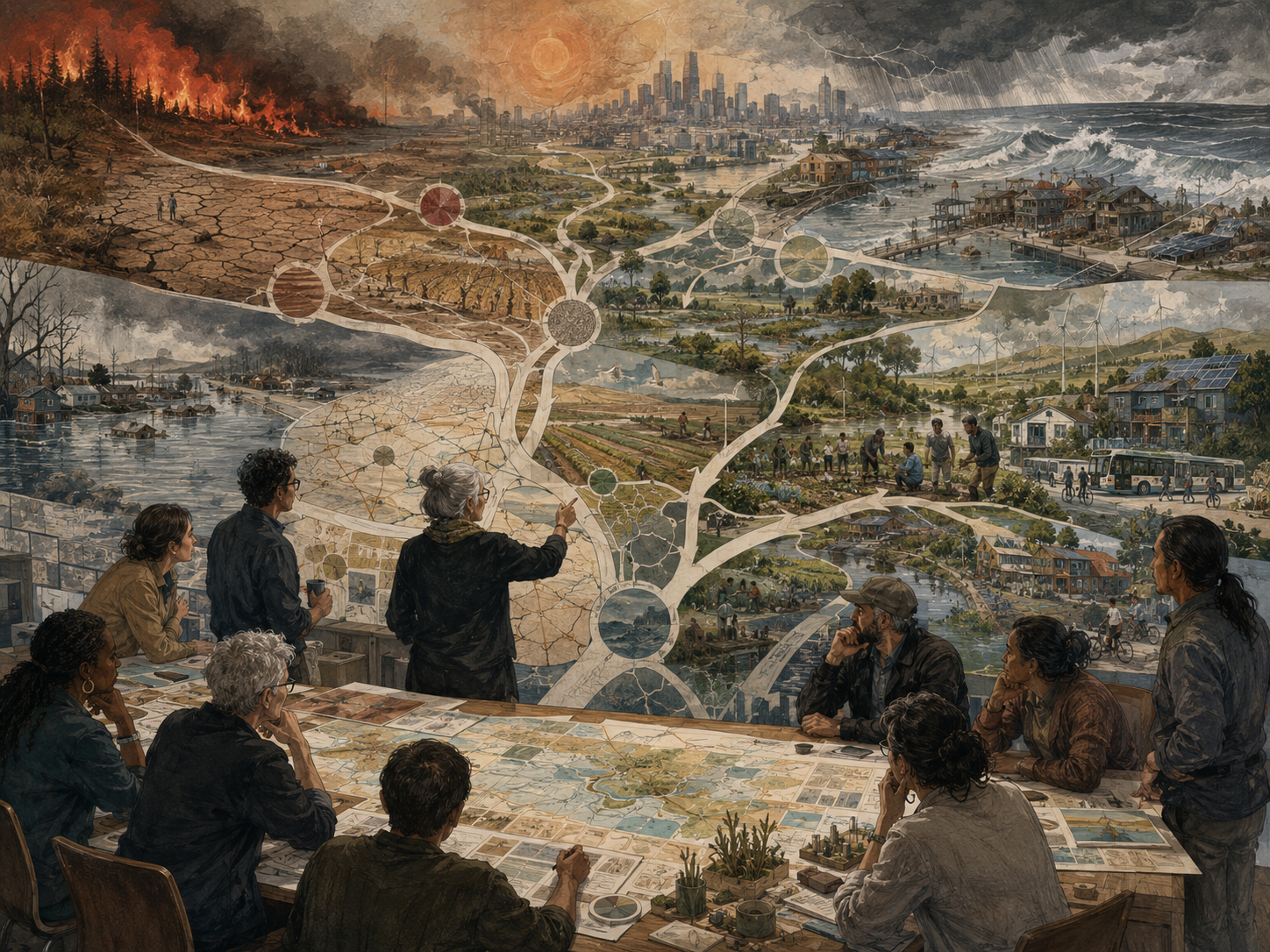
Climate Change as a Complex System
Climate change operates within a complex Earth system characterized by interaction, feedback, delay, nonlinearity, thresholds, and cross-scale dependence. Atmospheric chemistry, ocean heat uptake, cryosphere dynamics, hydrological cycles, land systems, ecological processes, carbon sinks, energy systems, agriculture, infrastructure, and human economic activity interact across multiple spatial and temporal scales. This aligns directly with Systems Modeling, where system behavior emerges from interconnected components rather than isolated variables.
Several features make climate futures especially difficult to treat through simple linear projection. Feedback loops such as ice-albedo effects, permafrost carbon release, forest dieback, ocean heat uptake, and hydrological disruption can amplify or dampen change. Nonlinear responses mean that gradual forcing may produce abrupt system shifts. Thresholds and tipping points introduce the possibility that some changes become effectively irreversible on human timescales. Meanwhile, the climate system is interdependent with economic, political, infrastructural, financial, and ecological systems that both influence and are influenced by environmental transformation.
Climate change is therefore not just an environmental trend. It is a systemic reorganization of the conditions under which societies, ecosystems, infrastructures, economies, and institutions operate.
| Complex-System Feature | Climate Meaning | Futures Implication |
|---|---|---|
| Feedback loops | Warming can activate processes that amplify or dampen further change. | Scenarios must consider reinforcing and stabilizing dynamics, not only direct forcing. |
| Time delays | Atmospheric accumulation, ocean heat uptake, infrastructure lock-in, and policy lag unfold over decades. | Waiting for full damage visibility can make action too late. |
| Thresholds | Systems can shift abruptly after critical conditions are crossed. | Risk analysis must include tipping behavior and irreversible change. |
| Interdependence | Climate interacts with food, water, health, finance, migration, infrastructure, and security. | Climate strategy must be cross-sectoral, not isolated inside environmental agencies. |
| Unequal exposure | Risks vary by geography, income, race, class, age, health, labor, and political power. | Climate futures require distributional and justice analysis. |
| Path dependence | Energy systems, buildings, transport, land use, debt, and institutions lock in future risk. | Present investment decisions shape decades of climate vulnerability or resilience. |
A complex-systems view prevents climate futures from being reduced to temperature alone. Temperature matters, but so do vulnerability, exposure, infrastructure, public capacity, ecological stability, governance, inequality, and the ability of institutions to learn.
Climate Futures and Deep Uncertainty
Climate futures are shaped by deep uncertainty. This means not only that exact outcomes are unknown, but that probabilities may be contested, model assumptions incomplete, feedback strength uncertain, and human responses politically variable. This connects directly to Scenario Planning, where multiple futures are explored without assuming one definitive outcome.
Sources of uncertainty include future emissions, technology adoption, policy choices, land use, carbon-cycle feedbacks, demographic change, behavioral change, climate sensitivity, ocean circulation, methane release, aerosol dynamics, biodiversity loss, adaptation capacity, and Earth-system response to warming. Some aspects of climate science are highly robust, including the direction of warming under continued greenhouse gas accumulation. But many impacts remain uncertain in magnitude, timing, spatial distribution, interaction effects, and social consequences.
Deep uncertainty does not mean ignorance about climate risk. It means that the most consequential questions concern pathways, thresholds, interaction effects, and institutional readiness rather than one precise forecast.
| Uncertainty Type | Climate Futures Example | Strategic Response |
|---|---|---|
| Physical uncertainty | Regional precipitation, sea-level rise, ice-sheet response, extreme weather intensity. | Use scenario ranges, stress tests, and adaptive planning. |
| Feedback uncertainty | Permafrost thaw, forest dieback, carbon sink weakening, ocean circulation shifts. | Monitor slow variables and include tail-risk pathways. |
| Socioeconomic uncertainty | Energy demand, land use, population, consumption, inequality, development pathways. | Use socioeconomic scenarios and distributional analysis. |
| Technological uncertainty | Storage, carbon removal, grid modernization, electrification, industrial decarbonization. | Assess technological maturity, deployment speed, governance, and material constraints. |
| Political uncertainty | Climate policy, international cooperation, regulation, public trust, conflict, backlash. | Use institutional scenario analysis and governance stress testing. |
| Adaptation uncertainty | Public finance, infrastructure capacity, community preparedness, insurance availability. | Evaluate adaptive capacity, social vulnerability, and implementation readiness. |
Futures thinking helps address deep uncertainty by structuring possibility space rather than pretending that uncertainty can be eliminated. It helps decision-makers ask which strategies remain useful across many futures, which risks require precautionary action, and which thresholds should never be approached casually.
Emissions Pathways and Climate Scenarios
Climate futures are often represented through emissions pathways and broader scenario architectures that describe different trajectories of greenhouse gas concentrations, policy effort, technological change, land use, economic development, and social organization. These scenarios show how different assumptions about growth, energy systems, institutions, consumption, inequality, and land use lead to different environmental outcomes.
This reflects the broader logic of scenario thinking. Rather than predicting one future, climate scenarios help decision-makers understand the range of plausible outcomes and the consequences of different strategic choices. Low-emissions pathways imply aggressive mitigation, rapid energy transition, industrial transformation, land-use change, and shifts in consumption and infrastructure. High-emissions pathways imply deeper warming, greater adaptation burdens, higher residual loss, and greater exposure to nonlinear risk.
Scenarios do not tell us which future will occur. They clarify how present choices shape the environmental conditions of future life.
| Pathway Type | Core Assumption | Likely Climate Futures Concern |
|---|---|---|
| Rapid mitigation pathway | Emissions fall quickly through coordinated policy, electrification, efficiency, and land-use change. | Transition governance, affordability, labor transition, minerals, infrastructure, and legitimacy. |
| Delayed transition pathway | Action accelerates only after climate impacts intensify or political pressure grows. | Higher warming, more locked-in damage, greater adaptation costs, and stranded assets. |
| Fragmented regional pathway | Some regions decarbonize while others remain constrained by finance, conflict, or development needs. | Unequal transition, climate migration, debt pressure, and geopolitical tension. |
| High-emissions pathway | Fossil dependence, consumption growth, weak policy, and poor coordination persist. | Severe warming, cascading risk, ecosystem stress, food and water insecurity. |
| Technology-heavy pathway | Climate strategy relies heavily on innovation, carbon removal, storage, and digital optimization. | Deployment risk, false confidence, material bottlenecks, and governance gaps. |
| Justice-centered transition pathway | Mitigation and adaptation are coordinated with public investment, labor protection, and vulnerability reduction. | Requires institutional capacity, democratic legitimacy, finance, and social coordination. |
Scenario architecture also helps prevent a narrow climate imagination. A future can be low-carbon but unjust, technologically advanced but ecologically extractive, adaptive but unequal, or resilient for some while abandoning others. Climate futures should therefore be evaluated through multiple dimensions: emissions, ecological integrity, social equity, adaptive capacity, governance, finance, and residual loss.
Tipping Points and Irreversibility
One of the most critical aspects of climate futures is the possibility of tipping points: thresholds beyond which system change becomes rapid, nonlinear, self-reinforcing, and difficult or impossible to reverse on relevant human timescales. Examples often discussed in climate science include large-scale ice sheet loss, biome collapse, disruption of major ocean circulation systems, permafrost carbon release, coral reef decline, and abrupt changes in regional ecological stability.
This connects directly to Resilience Thinking, where systems may shift into different regimes once buffering capacity is exhausted. Tipping points matter because they transform climate risk from gradual deterioration into discontinuous change. They also undermine the false comfort that environmental damage will always be incremental and therefore manageable through late response.
The most dangerous climate futures are not only hotter futures, but futures in which warming activates reinforcing processes that accelerate change beyond easy policy correction.
| Tipping or Threshold Concern | Systemic Meaning | Governance Implication |
|---|---|---|
| Ice sheet instability | Large-scale ice loss can contribute to long-term sea-level rise. | Coastal planning must account for long time horizons and irreversible exposure. |
| Permafrost thaw | Stored carbon can be released as warming progresses. | Carbon budgets should include feedback uncertainty and tail risk. |
| Forest dieback | Carbon sinks may weaken or become sources under heat, drought, and fire stress. | Land-use policy must protect ecological resilience and reduce degradation. |
| Ocean circulation change | Large-scale circulation shifts can alter regional climate patterns. | Risk planning must include regional disruptions, not only global averages. |
| Coral reef collapse | Marine ecosystems may lose biodiversity and protective functions. | Adaptation must include fisheries, coastal protection, and livelihoods. |
| Hydrological regime shift | Rainfall, drought, and water availability patterns can reorganize. | Water, food, energy, and migration planning must be integrated. |
Irreversibility changes the ethics of decision-making. If some losses cannot be easily undone, climate policy cannot rely only on retrospective correction. It requires precaution, early warning, monitoring, adaptive governance, and the willingness to act before damage becomes fully visible.
Planetary Boundaries and System Limits
The concept of planetary boundaries provides a framework for thinking about the limits within which human societies can operate without destabilizing Earth-system processes. Climate change is one of the central boundaries, but it interacts with others including biosphere integrity, land-system change, freshwater disruption, nitrogen and phosphorus loading, ocean acidification, atmospheric aerosol loading, and novel entities such as synthetic chemicals and persistent pollutants.
This matters because climate futures cannot be separated cleanly from wider environmental systems. The climate problem is embedded in a larger question of whether economic and political systems remain compatible with the safe operating conditions that made complex civilization possible. Exceeding boundaries increases the risk of destabilizing the Earth system in ways that multiply uncertainty and constrain development.
Climate futures are therefore not only about temperature. They are about whether human systems remain within the ecological conditions that make long-run social, economic, and institutional stability possible.
| Environmental Boundary or System | Climate Relationship | Futures Concern |
|---|---|---|
| Biosphere integrity | Biodiversity supports carbon storage, ecosystem function, food systems, and resilience. | Climate action that ignores biodiversity can weaken long-term sustainability. |
| Freshwater systems | Climate alters drought, flood, groundwater recharge, and water availability. | Water futures become central to food, energy, cities, health, and conflict risk. |
| Land-system change | Forests, agriculture, wetlands, and soils affect carbon, albedo, biodiversity, and hydrology. | Land use becomes a climate, food, rights, and ecological stability issue. |
| Ocean systems | Oceans absorb heat and carbon while supporting weather patterns and marine life. | Ocean warming and acidification reshape fisheries, storms, coastlines, and biodiversity. |
| Nitrogen and phosphorus flows | Agricultural systems contribute to emissions, water pollution, and ecological stress. | Climate-compatible food futures require nutrient governance and soil health. |
| Novel entities and pollution | Chemicals and pollutants interact with ecosystems already stressed by warming. | Environmental change becomes cumulative rather than single-cause. |
A planetary-boundaries perspective prevents climate policy from becoming carbon tunnel vision. Carbon reduction is essential, but climate futures must also account for biodiversity, water, soil, pollution, land, oceans, food systems, and the cumulative degradation of the living systems that support human life.
Adaptation, Mitigation, and Residual Loss
Climate futures require mitigation, adaptation, and recognition of residual loss. Mitigation aims to reduce greenhouse gas emissions and limit future warming. Adaptation aims to adjust systems so they can cope with unavoidable impacts that are already unfolding or locked in by past emissions. Residual loss refers to damage that remains even after mitigation and adaptation efforts.
These are not substitutes. They are complementary responses to a shared systemic challenge. Weak mitigation intensifies adaptation demand. Weak adaptation increases losses even if mitigation improves later. Insufficient attention to residual loss can create false optimism, especially for communities facing sea-level rise, extreme heat, ecological collapse, repeated disasters, and livelihood disruption.
The central strategic question is not whether to mitigate or adapt, but how to coordinate mitigation, adaptation, and loss reduction across uncertain futures without locking societies into higher long-term vulnerability.
| Climate Response | Primary Goal | Failure if Isolated |
|---|---|---|
| Mitigation | Reduce greenhouse gas emissions and limit future warming. | If isolated from justice and adaptation, it can ignore present vulnerability and transition harms. |
| Adaptation | Reduce harm from climate impacts that are unavoidable or already emerging. | If isolated from mitigation, it becomes endless adjustment to worsening conditions. |
| Residual loss planning | Recognize and address damage that cannot be fully avoided. | If ignored, vulnerable communities absorb losses without adequate support. |
| Transformation | Redesign systems that cannot remain viable under climate stress. | If avoided, societies may preserve fragile systems until collapse forces change. |
| Just transition | Protect workers, communities, and vulnerable groups during structural change. | If missing, climate policy can lose legitimacy and deepen inequality. |
Futures thinking supports this coordination by exploring possible climate outcomes, identifying robust options across scenarios, clarifying where delay increases risk, and distinguishing between incremental adaptation and deeper transformation.
Climate Risk and Systemic Decision-Making
Climate change introduces multiple forms of risk. Physical risks include extreme heat, flooding, drought, wildfire, crop failure, sea-level rise, disease ecology, water scarcity, ecosystem disruption, and infrastructure stress. Transition risks arise from policy changes, energy revaluation, stranded assets, litigation, regulatory shifts, market restructuring, and technology substitution. Systemic risks emerge when environmental stress interacts with finance, migration, public health, food systems, insurance, geopolitics, and institutional failure.
Futures thinking enables decision-makers to assess these risks in structured ways and integrate them into strategy under uncertainty. This is particularly important for public policy, business strategy, financial governance, insurance, infrastructure planning, urban development, international development, and public health. A climate-informed decision framework asks not only what is likely under median assumptions, but what remains viable under more severe, unequal, or interacting conditions.
Climate risk is not reducible to isolated hazards. It is the risk that interacting physical, economic, ecological, and institutional systems become harder to govern under stress.
| Risk Type | Example | Systemic Consequence |
|---|---|---|
| Physical risk | Heat, wildfire, flood, drought, storm, sea-level rise. | Infrastructure damage, health stress, insurance losses, displacement, service disruption. |
| Transition risk | Policy change, stranded assets, carbon pricing, litigation, technology substitution. | Asset repricing, job transition, regional economic stress, investment shifts. |
| Ecological risk | Biodiversity loss, forest dieback, soil degradation, fisheries decline. | Food insecurity, livelihood loss, carbon sink weakening, ecosystem-service decline. |
| Financial risk | Insurance retreat, mortgage exposure, municipal debt pressure, climate asset mispricing. | Household insecurity, public finance stress, bank exposure, uneven adaptation. |
| Public health risk | Heat illness, vector-borne disease, smoke exposure, food and water contamination. | Health-system burden and unequal mortality risk. |
| Governance risk | Institutional fragmentation, public distrust, weak enforcement, coordination failure. | Delayed action, maladaptation, legitimacy crisis, and unmanaged loss. |
| Security and migration risk | Displacement, resource conflict, food price shocks, border pressure. | Human insecurity, geopolitical tension, and social instability. |
Systemic decision-making requires moving beyond the question “What climate hazard will occur?” toward “How will this hazard interact with vulnerability, infrastructure, finance, ecology, governance, and public capacity?” That broader question is where futures thinking becomes indispensable.
Environmental Change Beyond Climate
Climate change is central, but environmental change is broader than climate. Biodiversity loss, land degradation, ocean acidification, freshwater stress, chemical pollution, soil depletion, nutrient loading, plastic waste, deforestation, invasive species, and habitat fragmentation all shape future conditions. These processes often interact with climate change, making environmental futures more complex than temperature pathways alone.
For example, drought can weaken forests and increase fire risk. Forest loss can reduce carbon storage and alter regional hydrology. Soil degradation can reduce food resilience. Biodiversity loss can weaken ecosystem stability. Water stress can intensify public health, agriculture, energy, and migration pressures. Pollution can worsen ecosystem vulnerability and human disease burden.
Climate futures must therefore be embedded inside broader environmental futures. A low-carbon future that destroys biodiversity, degrades water systems, or shifts extraction onto vulnerable communities is not a sustainable future.
| Environmental Change | Interaction with Climate Futures | Strategic Implication |
|---|---|---|
| Biodiversity loss | Weakens ecosystem resilience and carbon storage. | Mitigation and adaptation must protect living systems. |
| Soil degradation | Reduces food resilience and carbon sequestration. | Agricultural futures must include soil health and land stewardship. |
| Freshwater stress | Interacts with drought, heat, food, energy, and migration. | Water governance becomes a central climate-adaptation priority. |
| Ocean change | Warming, acidification, and deoxygenation affect fisheries and coastlines. | Marine systems must be included in climate resilience planning. |
| Pollution and novel entities | Compound ecological and human health vulnerability. | Environmental health requires cumulative-risk governance. |
| Land-use change | Alters carbon, biodiversity, hydrology, food, and community rights. | Land futures must balance mitigation, food, ecology, and justice. |
Environmental futures work therefore demands a wider systems frame: climate, biodiversity, food, water, land, oceans, health, infrastructure, finance, and justice must be analyzed together rather than as separate policy silos.
Technology and Climate Futures
Technological innovation plays a major role in shaping climate futures. Renewable energy, storage, grids, carbon capture, industrial electrification, building efficiency, precision agriculture, materials innovation, environmental monitoring, climate analytics, early warning systems, and digital optimization all influence what forms of transition are technically and economically possible. This connects directly to Technology Foresight.
Yet technology does not automatically deliver a favorable climate future. Its impact depends on adoption speed, financing, infrastructure, governance, public legitimacy, distributional politics, labor systems, land use, and system integration. Some technologies reduce emissions but create new dependencies, material bottlenecks, extraction pressures, or geopolitical vulnerabilities. Others may promise future fixes that encourage present delay.
Technology shapes climate futures, but only through the institutional, financial, ecological, and political systems that govern its deployment.
| Technology Area | Climate Futures Contribution | Risk if Poorly Governed |
|---|---|---|
| Renewable energy | Reduces dependence on fossil fuel combustion. | Grid bottlenecks, mineral demand, land conflict, unequal access. |
| Energy storage | Supports reliability and renewable integration. | Critical mineral dependency, waste, cost, and supply concentration. |
| Grid modernization | Enables electrification, distributed generation, and resilience. | Cyber risk, underinvestment, slow permitting, and inequitable reliability. |
| Carbon capture and removal | May address hard-to-abate emissions or residual carbon. | Can delay mitigation if treated as a future escape hatch. |
| Environmental monitoring | Improves detection of climate, biodiversity, water, and infrastructure risk. | Data gaps, surveillance, unequal access, and false precision. |
| AI and modeling | Supports forecasting, optimization, early warning, and scenario analysis. | Energy demand, opacity, bias, and overconfidence in models. |
| Climate-resilient infrastructure | Reduces exposure and maintains essential services under stress. | Can reinforce unequal protection if investment is uneven. |
A futures approach asks not only whether climate technology works, but under which future conditions it remains responsible. Who owns it? Who benefits? What materials does it require? What labor systems support it? What risks does it shift? What governance makes it legitimate?
Policy, Governance, and Global Coordination
Climate futures are shaped by governance systems and international coordination. Climate agreements, national transition strategies, adaptation plans, public finance, industrial policy, city planning, environmental regulation, local governance capacity, and institutional enforcement all affect whether action remains symbolic, fragmented, or transformative. The challenge is that climate change is global in cause but uneven in consequence, while decision-making remains fragmented across jurisdictions, sectors, and time horizons.
This creates a profound coordination problem. States face asymmetric vulnerability, unequal historical responsibility, different developmental priorities, and conflicting political incentives. Short-term domestic pressures frequently undermine long-term collective interest. Yet effective governance is indispensable for aligning incentives, scaling mitigation, mobilizing adaptation finance, governing shared risks, and protecting those most exposed.
Climate futures depend not only on scientific knowledge, but on whether institutions can coordinate action at the scale and speed that Earth-system change demands.
| Governance Domain | Climate Futures Role | Failure Mode |
|---|---|---|
| International coordination | Aligns mitigation, finance, adaptation, technology transfer, and loss response. | Fragmentation, free-riding, underfunding, and geopolitical distrust. |
| National policy | Sets energy, transport, land, industrial, and adaptation strategy. | Policy reversal, weak enforcement, capture, and short-termism. |
| Local governance | Implements heat, flood, housing, infrastructure, public health, and emergency planning. | Capacity gaps, unequal protection, and unfunded mandates. | Public finance | Funds adaptation, resilience, transition, research, infrastructure, and social protection. | Debt stress, austerity, and underinvestment in prevention. |
| Regulation and standards | Shapes emissions, disclosure, land use, building codes, industry, and risk management. | Symbolic compliance, greenwashing, and delayed enforcement. |
| Participatory governance | Includes affected communities in climate futures and transition design. | Loss of legitimacy, unjust transition, and resistance. |
Climate governance must be adaptive because future conditions will change. Institutions need the ability to monitor, learn, revise, coordinate, fund, and remain accountable as climate risks evolve. Static plans will be insufficient for dynamic environmental change.
Climate Justice, Vulnerability, and Contested Futures
Climate futures are not experienced equally. Exposure, vulnerability, adaptive capacity, and political voice are distributed unevenly across countries, regions, classes, races, genders, generations, occupations, and communities. Some groups have contributed least to greenhouse gas accumulation while facing the greatest risks. Others have greater capacity to adapt, insure, relocate, retrofit, and influence policy.
A serious climate futures analysis must therefore include justice. It must ask whose futures are being protected, whose losses are treated as acceptable, whose land becomes a site of transition, whose labor is displaced, whose knowledge counts, and whose risks remain invisible. Without those questions, climate foresight can become a technocratic exercise that manages risk for the powerful while leaving vulnerable communities exposed.
Climate justice is not an optional moral add-on to climate futures. It is central to whether climate action is legitimate, durable, and socially sustainable.
| Justice Dimension | Climate Futures Question | Why It Matters |
|---|---|---|
| Historical responsibility | Who benefited from emissions-intensive development? | Responsibility and capacity are unevenly distributed. |
| Unequal vulnerability | Who faces the greatest exposure with the fewest resources? | Climate risk is shaped by poverty, racism, geography, age, health, labor, and housing. |
| Just transition | How are workers and communities protected during decarbonization? | Transition without social protection can generate backlash and harm. |
| Loss and damage | How are unavoidable harms recognized, financed, and addressed? | Some impacts exceed adaptation capacity. |
| Procedural justice | Who participates in decisions about land, energy, infrastructure, and adaptation? | Legitimacy depends on voice, consent, and accountability. |
| Intergenerational justice | What obligations do present institutions have to future people? | Delayed action shifts risk onto those who cannot yet vote or object. |
Climate futures are contested because they involve choices about energy, land, infrastructure, finance, labor, consumption, development, migration, conservation, and public responsibility. Futures thinking becomes stronger when it makes those conflicts visible rather than hiding them behind neutral-sounding scenario language.
Core Dimensions of Climate Futures
Climate futures can be evaluated across several interacting dimensions. These dimensions should not be treated separately. Emissions shape warming. Warming shapes hazards. Hazards interact with exposure and vulnerability. Adaptation depends on governance and finance. Technology depends on materials, infrastructure, and legitimacy. Justice affects public trust. Ecological integrity affects resilience. A strong climate futures framework integrates these dimensions rather than reducing climate strategy to one metric.
1. Emissions Trajectory
Emissions trajectory refers to the pace, scale, and distribution of greenhouse gas reduction. It includes energy, transport, buildings, industry, agriculture, land use, and consumption systems. The trajectory determines the scale of future warming pressure.
2. Earth-System Feedbacks
Earth-system feedbacks include processes that amplify or dampen climate change, such as ice-albedo dynamics, carbon sink changes, permafrost thaw, forest dieback, ocean heat uptake, and hydrological shifts.
3. Hazard Intensity and Exposure
Hazard intensity includes heat, flood, drought, wildfire, storms, sea-level rise, and disease ecology. Exposure refers to people, infrastructure, ecosystems, and assets located in harm’s way.
4. Social Vulnerability
Social vulnerability includes poverty, housing insecurity, health status, age, race, labor conditions, disability, migration status, access to services, and political marginalization. Climate harm is shaped by social structure.
5. Adaptive Capacity
Adaptive capacity is the ability to prepare, adjust, recover, and transform under climate stress. It depends on public finance, infrastructure, knowledge, governance, community networks, monitoring, and institutional trust.
6. Ecological Integrity
Ecological integrity refers to the health of biodiversity, soils, forests, freshwater systems, oceans, wetlands, and carbon sinks. Climate resilience depends on living systems, not only engineered systems.
7. Governance and Coordination
Governance and coordination determine whether climate action is planned, funded, enforced, revised, and made accountable. Climate futures depend on institutions capable of learning across uncertainty.
8. Justice and Legitimacy
Justice and legitimacy require fair distribution of costs and benefits, public participation, protection for vulnerable groups, intergenerational responsibility, and recognition of unequal historical responsibility.
| Dimension | Core Question | Failure if Ignored |
|---|---|---|
| Emissions trajectory | How fast and fairly are emissions reduced? | Future warming intensifies and adaptation burdens grow. |
| Feedbacks | What reinforcing processes could accelerate change? | Risk is underestimated and thresholds are missed. |
| Hazard and exposure | Who and what are in harm’s way? | Plans miss where damage will occur. |
| Social vulnerability | Who is least able to absorb or recover from climate harm? | Climate policy reproduces inequality. |
| Adaptive capacity | Can institutions and communities prepare and adjust? | Impacts become disasters through weak capacity. |
| Ecological integrity | Are ecosystems resilient enough to support life and adaptation? | Climate strategy becomes carbon-focused but ecologically weak. |
| Governance | Can decisions be coordinated across time, sectors, and jurisdictions? | Fragmentation delays action and multiplies risk. |
| Justice | Are costs, benefits, risks, and voice distributed fairly? | Transition loses legitimacy and vulnerable groups absorb harm. |
Climate futures are strongest when mitigation, adaptation, ecological integrity, governance, and justice reinforce one another rather than being treated as separate agendas.
Climate Futures Scenarios
Climate futures may unfold across several plausible pathways. These scenarios are not predictions. They are structured contexts for testing assumptions about emissions, adaptation, technology, governance, ecological feedback, public finance, and justice.
| Scenario | Description | Climate Risk | Strategic Opportunity |
|---|---|---|---|
| Managed Low-Carbon Transition | Institutions coordinate mitigation, adaptation, investment, and social protection. | Requires sustained governance, finance, legitimacy, and implementation. | Reduces future warming and strengthens resilience together. |
| Delayed High-Stress Transition | Climate action accelerates late after severe impacts and mounting losses. | Higher residual loss, stranded assets, adaptation overload, and public distrust. | Emergency mobilization can still reduce worst-case outcomes if institutions respond. |
| Fragmented Unequal Adaptation | Wealthier regions and groups adapt while vulnerable communities face underprotection. | Climate apartheid, displacement, public health burden, and legitimacy crisis. | Justice-centered adaptation can redirect resources toward exposed communities. |
| Technology-Heavy Climate Strategy | Transition relies heavily on innovation, carbon removal, AI, storage, and optimization. | False confidence, material bottlenecks, land conflict, and delayed mitigation. | Responsible technology governance can accelerate real reductions and monitoring. |
| Ecological Feedback Acceleration | Warming weakens sinks or triggers reinforcing Earth-system processes. | Climate change accelerates beyond expected pathways. | Precautionary mitigation and ecosystem protection reduce feedback risk. |
| Climate Shock Governance Crisis | Extreme events overwhelm institutions, budgets, infrastructure, and emergency systems. | Reactive crisis management replaces planned adaptation. | Preparedness, early warning, and public investment reduce cascading harm. |
| Just Climate Transformation | Decarbonization, adaptation, public finance, ecological restoration, and justice are integrated. | Requires deep institutional capacity and democratic legitimacy. | Builds a durable climate future grounded in resilience and public value. |
Scenario analysis helps reveal that climate futures are not only physical pathways. They are institutional, social, technological, ecological, and political pathways as well.
Strategic Questions for Climate Futures
Climate futures analysis should guide strategic questions for governments, cities, infrastructure planners, researchers, businesses, insurers, public health systems, financial institutions, community organizations, and civil society. These questions reveal hidden assumptions about climate risk, transition pathways, adaptation capacity, and justice.
| Strategic Question | What It Reveals | Why It Matters |
|---|---|---|
| What climate future does this plan assume? | Embedded assumptions about warming, hazards, policy, technology, and social response. | Plans fail when climate assumptions remain implicit. |
| Which risks are physical, transitional, ecological, financial, or social? | The pathways through which climate stress becomes system stress. | Different risks require different governance tools. |
| Where are thresholds or irreversible losses possible? | Points where delayed action becomes dangerous. | Precaution is most important where recovery is limited. |
| Who is most exposed and least protected? | Distribution of vulnerability across people and places. | Climate futures are unequal unless vulnerability is addressed directly. |
| What adaptation options remain robust across scenarios? | Strategies useful under multiple possible futures. | Robust action reduces overreliance on one forecast. |
| Which mitigation choices create new dependencies? | Material, land, labor, infrastructure, and supply-chain risks. | Low-carbon transition must avoid new extractive lock-ins. |
| What should be transformed rather than protected in place? | Systems that cannot remain viable under climate stress. | Resilience should not preserve unsustainable or unjust systems. |
| What signals indicate the pathway is failing? | Early warning indicators for ecological, social, financial, and institutional stress. | Monitoring allows correction before harm escalates. |
Climate futures work is strongest when it connects Earth-system science to institutional decision-making, public finance, social vulnerability, ecological integrity, and democratic accountability.
Limitations and Failure Modes
Futures thinking in climate contexts faces real limits. Earth-system behavior is complex and not fully knowable in advance. Some feedbacks remain difficult to quantify. Models simplify reality and can miss interaction effects or understate tail risk. Political and economic systems may know what is necessary yet fail to act. Adaptation may be technically feasible but socially unequal. Mitigation may be scientifically justified but institutionally delayed.
There is also the challenge of interpretive distortion. Climate futures can be framed too narrowly as technical questions, ignoring justice, inequality, colonial legacies, labor, debt, migration, or the differentiated vulnerability of marginalized populations. A strong climate futures analysis must therefore combine scientific seriousness with political and ethical clarity.
| Failure Mode | Problem | Corrective Practice |
|---|---|---|
| Carbon tunnel vision | Climate strategy focuses only on carbon while ignoring biodiversity, water, land, health, and justice. | Use social-ecological systems analysis and planetary-boundaries thinking. |
| Scenario theater | Scenarios are produced but not connected to budgets, policy, infrastructure, or accountability. | Connect foresight to decisions, milestones, governance, and monitoring. |
| False precision | Models are treated as certainty rather than structured approximations. | Use uncertainty ranges, stress tests, qualitative judgment, and humility. |
| Technological solutionism | Future technology is used to delay present mitigation or justice obligations. | Assess deployment feasibility, governance, materials, labor, and risk shifting. |
| Maladaptation | Adaptation reduces risk for some while increasing risk for others or locking in vulnerability. | Use distributional analysis, community participation, and long-term evaluation. |
| Unequal protection | Adaptation investment follows wealth and political influence rather than vulnerability. | Prioritize social vulnerability, public finance, and climate justice. |
| Governance fragmentation | Institutions act separately while climate risk crosses sectors and borders. | Build cross-sector coordination and adaptive governance capacity. |
| Delay disguised as realism | Political caution becomes justification for inadequate action. | Use backcasting, risk thresholds, and robust near-term commitments. |
The point is not to eliminate uncertainty, but to make action more intelligent, just, and institutionally capable under uncertainty.
Mathematical Lens: Feedback, Risk, and Climate Pathways
A stylized climate forcing pathway can be represented as the interaction of emissions, sinks, and feedbacks:
C_{t+1} = C_t + E_t – S_t + F_t
\]
Interpretation: \(C_t\) is atmospheric carbon concentration at time \(t\), \(E_t\) is emissions, \(S_t\) is sink absorption, and \(F_t\) is net feedback contribution. This captures a central intuition: future climate conditions depend not only on annual emissions, but also on how Earth-system sinks and feedbacks evolve over time.
Temperature-related climate risk can be treated conceptually as a function of hazard, vulnerability, and exposure:
R_t = \alpha H_t + \beta V_t + \gamma X_t
\]
Interpretation: \(R_t\) is climate risk, \(H_t\) is hazard intensity, \(V_t\) is vulnerability, and \(X_t\) is exposure. This emphasizes that climate damage is not a function of hazard alone. Risk depends on social and infrastructural vulnerability as well as the location of people, assets, ecosystems, and services.
A scenario-based mitigation-adaptation comparison can be represented as:
\Pi_k = \{M_k, A_k, L_k\}
\]
Interpretation: Strategy \(k\) is evaluated through mitigation effect \(M_k\), adaptation capacity \(A_k\), and residual loss \(L_k\). This formalizes one of the most important insights of climate futures thinking: strategies should be judged not only by emissions reduction or adaptation in isolation, but by how they combine to reduce long-run loss across uncertain futures.
A robustness score across climate scenarios can be represented as:
B_k = \min(P_{k1}, P_{k2}, \dots, P_{kn})
\]
Interpretation: \(B_k\) is the robustness of climate strategy \(k\), and \(P_{ks}\) is its performance under scenario \(s\). A robust climate strategy should avoid catastrophic failure even under adverse scenarios.
An equity-adjusted climate resilience measure can be represented as:
Q^*_t = Q_t – \theta U_t
\]
Interpretation: \(Q^*_t\) is equity-adjusted resilience, \(Q_t\) is aggregate resilience, and \(U_t\) is unequal vulnerability or unequal protection. A climate pathway that improves average resilience while abandoning vulnerable groups is weaker than aggregate indicators suggest.
These equations are conceptual tools. They are not complete predictive models. Their purpose is to make assumptions explicit: climate futures depend on emissions, sinks, feedbacks, hazards, exposure, vulnerability, adaptation, mitigation, residual loss, robustness, and justice.
Computational Modeling for Climate Futures
Computational modeling can help compare climate futures, test assumptions, and make environmental risk more transparent. It should not be used to create false certainty or hide political choices behind technical language. Its value lies in clarifying pathways, comparing scenarios, identifying tradeoffs, testing robustness, and making uncertainty visible.
A professional climate futures workflow may include:
- Climate future profiles: emissions intensity, adaptation capacity, ecosystem stress, governance coordination, social vulnerability, transition speed, and residual loss.
- Scenario records: managed transition, delayed action, fragmented adaptation, technology-heavy transition, ecological feedback acceleration, and climate shock governance crisis.
- Risk indicators: heat exposure, flood risk, drought stress, wildfire risk, food-system vulnerability, water stress, insurance retreat, and ecological threshold risk.
- Strategy options: mitigation, adaptation, resilience, ecological restoration, public finance, early warning, just transition, and managed retreat where necessary.
- Outputs: climate futures scores, stress pathways, residual loss estimates, adaptation capacity rankings, robustness comparisons, and reproducibility reports.
Climate futures modeling should support judgment, accountability, and learning—not replace democratic deliberation, local knowledge, scientific caution, or ethical responsibility.
Advanced R Workflow: Comparing Climate Futures Profiles
The R workflow below compares several stylized climate futures across emissions intensity, adaptation capacity, ecosystem stress, governance coordination, social vulnerability, technology deployment, transition speed, and justice capacity. It is designed as an evergreen illustration of how climate futures can be analyzed as multidimensional system profiles rather than temperature change alone.
# ------------------------------------------------------------
# R Workflow: Comparing Climate Futures Profiles
# Purpose:
#   Build stylized climate futures profiles across key dimensions
#   relevant to mitigation, adaptation, environmental stress,
#   governance, vulnerability, transition, and justice.
#
# Optional dependency:
#   install.packages(c("tidyverse"))
# ------------------------------------------------------------

library(tidyverse)

climate_futures <- tibble(
  future_type = c(
    "Delayed Transition High Stress",
    "Managed Low-Carbon Transition",
    "Fragmented Unequal Adaptation",
    "Technological Rapid Decarbonization",
    "Ecological Feedback Acceleration",
    "Just Climate Transformation"
  ),
  emissions_intensity = c(0.84, 0.32, 0.61, 0.28, 0.74, 0.26),
  adaptation_capacity = c(0.38, 0.72, 0.56, 0.64, 0.42, 0.78),
  ecosystem_stress = c(0.81, 0.36, 0.68, 0.42, 0.88, 0.34),
  governance_coordination = c(0.34, 0.74, 0.41, 0.58, 0.38, 0.78),
  social_vulnerability = c(0.72, 0.42, 0.82, 0.58, 0.76, 0.34),
  technology_deployment = c(0.42, 0.66, 0.48, 0.88, 0.46, 0.70),
  transition_speed = c(0.27, 0.71, 0.39, 0.82, 0.30, 0.76),
  justice_capacity = c(0.34, 0.68, 0.28, 0.48, 0.32, 0.82)
)

climate_futures <- climate_futures %>%
  mutate(
    climate_readiness_profile =
      -0.18 * emissions_intensity +
       0.16 * adaptation_capacity -
       0.16 * ecosystem_stress +
       0.14 * governance_coordination -
       0.12 * social_vulnerability +
       0.10 * technology_deployment +
       0.14 * transition_speed +
       0.10 * justice_capacity,

    climate_fragility_profile =
       0.18 * emissions_intensity +
       0.18 * ecosystem_stress +
       0.16 * social_vulnerability +
       0.14 * (1 - adaptation_capacity) +
       0.14 * (1 - governance_coordination) +
       0.10 * (1 - transition_speed) +
       0.10 * (1 - justice_capacity),

    future_class = case_when(
      climate_readiness_profile >= 0.24 & climate_fragility_profile < 0.48 ~ "Stronger climate readiness",
      climate_fragility_profile >= 0.66 ~ "High climate fragility",
      TRUE ~ "Mixed or transitional climate future"
    )
  ) %>%
  arrange(desc(climate_readiness_profile))

print(climate_futures)

climate_long <- climate_futures %>%
  select(
    future_type,
    emissions_intensity,
    adaptation_capacity,
    ecosystem_stress,
    governance_coordination,
    social_vulnerability,
    technology_deployment,
    transition_speed,
    justice_capacity
  ) %>%
  pivot_longer(
    cols = -future_type,
    names_to = "dimension",
    values_to = "value"
  )

ggplot(climate_long, aes(x = dimension, y = value, fill = future_type)) +
  geom_col(position = "dodge") +
  labs(
    title = "Stylized Climate Futures Dimensions",
    x = "Dimension",
    y = "Value",
    fill = "Future Type"
  ) +
  theme_minimal(base_size = 12) +
  coord_flip()

ggplot(climate_futures, aes(x = reorder(future_type, climate_readiness_profile), y = climate_readiness_profile)) +
  geom_col() +
  coord_flip() +
  labs(
    title = "Stylized Climate Futures Readiness Profile",
    x = "Future Type",
    y = "Profile Score"
  ) +
  theme_minimal(base_size = 12)

ggplot(climate_futures, aes(x = climate_readiness_profile, y = climate_fragility_profile, label = future_type)) +
  geom_point(size = 3) +
  geom_text(nudge_y = 0.02, size = 3) +
  labs(
    title = "Climate Readiness vs Climate Fragility",
    x = "Climate Readiness Profile",
    y = "Climate Fragility Profile"
  ) +
  theme_minimal(base_size = 12)

dir.create("outputs", showWarnings = FALSE)
write_csv(climate_futures, "outputs/climate_futures_profiles.csv")
This workflow illustrates why climate futures should be evaluated through emissions, adaptation, ecosystem stress, governance, vulnerability, transition speed, and justice—not temperature alone.
Advanced Python Workflow: Simulating Climate Pathways Under Divergent Assumptions
The Python workflow below simulates stylized climate pathways under differing assumptions about emissions, sinks, feedbacks, adaptation, vulnerability reduction, and governance capacity. It is useful for showing why climate futures diverge even when short-term trends appear similar.
# ------------------------------------------------------------
# Python Workflow: Simulating Climate Pathways
# Purpose:
#   Compare stylized climate futures under differing assumptions
#   about emissions, sink strength, feedbacks, adaptation,
#   vulnerability reduction, and governance capacity.
#
# Optional dependencies:
#   pip install pandas numpy matplotlib
# ------------------------------------------------------------

from pathlib import Path

import numpy as np
import pandas as pd
import matplotlib.pyplot as plt

OUTPUT_DIR = Path("outputs")
OUTPUT_DIR.mkdir(exist_ok=True)

time_steps = np.arange(1, 41)

scenarios = [
    {
        "scenario": "High Emissions Delayed Action",
        "emissions": 0.12,
        "sink": 0.05,
        "adaptation": 0.03,
        "vulnerability_reduction": 0.02,
        "governance_capacity": 0.32
    },
    {
        "scenario": "Coordinated Transition",
        "emissions": 0.06,
        "sink": 0.06,
        "adaptation": 0.06,
        "vulnerability_reduction": 0.05,
        "governance_capacity": 0.72
    },
    {
        "scenario": "Adaptive but Uneven Future",
        "emissions": 0.09,
        "sink": 0.05,
        "adaptation": 0.05,
        "vulnerability_reduction": 0.03,
        "governance_capacity": 0.46
    },
    {
        "scenario": "Just Climate Transformation",
        "emissions": 0.05,
        "sink": 0.07,
        "adaptation": 0.07,
        "vulnerability_reduction": 0.07,
        "governance_capacity": 0.80
    }
]

def simulate_climate_pathway(
    emissions,
    sink,
    adaptation,
    vulnerability_reduction,
    governance_capacity,
    initial_stress=1.0
):
    climate_stress = np.zeros(len(time_steps))
    social_vulnerability = np.zeros(len(time_steps))
    adaptive_capacity = np.zeros(len(time_steps))

    climate_stress[0] = initial_stress
    social_vulnerability[0] = 0.70 - 0.35 * vulnerability_reduction
    adaptive_capacity[0] = 0.30 + 0.45 * adaptation + 0.25 * governance_capacity

    for t in range(1, len(time_steps)):
        feedback = 0.03 if (t + 1) % 10 != 0 else 0.08

        adaptive_capacity[t] = np.clip(
            adaptive_capacity[t - 1]
            + 0.03 * governance_capacity
            + 0.03 * adaptation
            - 0.02 * feedback,
            0,
            1.5
        )

        social_vulnerability[t] = np.clip(
            social_vulnerability[t - 1]
            - 0.03 * vulnerability_reduction
            - 0.02 * governance_capacity
            + 0.02 * climate_stress[t - 1],
            0,
            1.2
        )

        climate_stress[t] = np.clip(
            climate_stress[t - 1]
            + emissions
            - sink
            + feedback
            - 0.18 * adaptation
            - 0.08 * governance_capacity,
            0,
            3.0
        )

    return climate_stress, social_vulnerability, adaptive_capacity

rows = []

for scenario in scenarios:
    stress, vulnerability, capacity = simulate_climate_pathway(
        scenario["emissions"],
        scenario["sink"],
        scenario["adaptation"],
        scenario["vulnerability_reduction"],
        scenario["governance_capacity"]
    )

    for t, stress_value, vulnerability_value, capacity_value in zip(time_steps, stress, vulnerability, capacity):
        rows.append({
            "scenario": scenario["scenario"],
            "time": t,
            "climate_stress_index": stress_value,
            "social_vulnerability_index": vulnerability_value,
            "adaptive_capacity_index": capacity_value
        })

df = pd.DataFrame(rows)

summary = (
    df.groupby("scenario")
    .agg(
        final_climate_stress=("climate_stress_index", "last"),
        mean_climate_stress=("climate_stress_index", "mean"),
        final_social_vulnerability=("social_vulnerability_index", "last"),
        final_adaptive_capacity=("adaptive_capacity_index", "last")
    )
    .reset_index()
    .sort_values("final_climate_stress")
)

print(summary)

plt.figure(figsize=(10, 6))
for scenario_name in df["scenario"].unique():
    subset = df[df["scenario"] == scenario_name]
    plt.plot(subset["time"], subset["climate_stress_index"], label=scenario_name)

plt.xlabel("Time Step")
plt.ylabel("Climate Stress Index")
plt.title("Climate Pathways Under Divergent Assumptions")
plt.legend()
plt.tight_layout()
plt.savefig(OUTPUT_DIR / "climate_stress_pathways.png", dpi=150)
plt.close()

plt.figure(figsize=(10, 6))
for scenario_name in df["scenario"].unique():
    subset = df[df["scenario"] == scenario_name]
    plt.plot(subset["time"], subset["social_vulnerability_index"], label=scenario_name)

plt.xlabel("Time Step")
plt.ylabel("Social Vulnerability Index")
plt.title("Social Vulnerability Across Climate Futures")
plt.legend()
plt.tight_layout()
plt.savefig(OUTPUT_DIR / "climate_social_vulnerability_pathways.png", dpi=150)
plt.close()

df.to_csv(OUTPUT_DIR / "climate_futures_pathways.csv", index=False)
summary.to_csv(OUTPUT_DIR / "climate_futures_pathway_summary.csv", index=False)
This workflow illustrates why climate futures diverge through both Earth-system and human-system assumptions. Emissions, sinks, feedbacks, adaptation, vulnerability reduction, and governance capacity all affect whether climate stress accelerates, stabilizes, or becomes more socially destructive.
GitHub Repository
The companion repository for this article contains computational examples for climate futures, environmental change, emissions pathways, feedback dynamics, adaptation, mitigation, residual loss, vulnerability, governance capacity, scenario comparison, and reproducible climate foresight workflows.
Complete Code Repository
The companion code includes Python, R, Julia, SQL, Rust, Go, C++, Fortran, C, documentation, synthetic datasets, outputs, and notebook placeholders for applied climate futures and environmental change workflows.
Why This Matters
Climate change is one of the defining systemic challenges of the modern era. It requires understanding complex Earth-system behavior, managing uncertainty, and designing strategies that remain viable under long time horizons and potentially irreversible change. Futures thinking provides the framework for engaging these challenges because it links scientific uncertainty to strategic preparation, governance, resilience, public finance, justice, and long-term transformation.
Without futures thinking, climate policy can become reactive. Institutions respond after disasters, after infrastructure is exposed, after ecosystems are degraded, after insurance retreats, after food systems are stressed, after public health systems are overwhelmed, and after vulnerable communities have already absorbed preventable harm. Futures thinking helps societies act before options close.
Ultimately, climate futures are not predetermined. They are shaped by emissions decisions, institutional response, technological pathways, adaptation choices, ecological feedbacks, public finance, social vulnerability, and the unequal capacity of societies to manage transformation.
Climate futures matter because they determine the background conditions for all other futures: food, water, health, cities, infrastructure, migration, insurance, finance, labor, public security, ecological stability, and human wellbeing. A society cannot have a stable long-term future if the environmental conditions that support life, livelihoods, and institutions are destabilized.
A serious climate future must therefore be more than low-carbon. It must be adaptive, ecologically grounded, socially just, democratically legitimate, scientifically informed, and institutionally capable. It must reduce emissions while also reducing vulnerability. It must protect ecosystems while protecting people. It must build resilience without abandoning transformation. It must prepare for uncertainty without surrendering responsibility.
Futures thinking matters because climate change is not only a problem of prediction. It is a problem of responsibility under uncertainty.
Related Articles
- Futures Thinking
- Futures Thinking and Sustainability
- Urban Futures
- Infrastructure Futures
- Food, Water, and Land-Use Futures
- Planetary Boundaries and Future Pathways
- Scenario Planning
- Backcasting and Strategic Planning
- Technology Foresight
- Systems Modeling
- Resilience Thinking
- Environmental Monitoring Systems
Further Reading
- Intergovernmental Panel on Climate Change (IPCC) (2023) Climate Change 2023: Synthesis Report. Available at: https://www.ipcc.ch/report/ar6/syr/.
- Intergovernmental Panel on Climate Change (IPCC) (2022) Climate Change 2022: Impacts, Adaptation and Vulnerability. Available at: https://www.ipcc.ch/report/ar6/wg2/.
- Intergovernmental Panel on Climate Change (IPCC) (2022) Climate Change 2022: Mitigation of Climate Change. Available at: https://www.ipcc.ch/report/ar6/wg3/.
- United Nations Environment Programme (UNEP) (no date) Climate Action. Available at: https://www.unep.org/explore-topics/climate-action.
- World Meteorological Organization (WMO) (no date) State of the Global Climate. Available at: https://wmo.int/topics/state-of-climate.
- Stockholm Resilience Centre (no date) Planetary Boundaries. Available at: https://www.stockholmresilience.org/research/planetary-boundaries.html.
- Rockström, J. et al. (2009) ‘A safe operating space for humanity’, Nature, 461, pp. 472–475. Available at: https://www.nature.com/articles/461472a.
- Lenton, T.M. et al. (2008) ‘Tipping elements in the Earth’s climate system’, Proceedings of the National Academy of Sciences, 105(6), pp. 1786–1793. Available at: https://www.pnas.org/doi/10.1073/pnas.0705414105.
- Stern, N. (2007) The Economics of Climate Change: The Stern Review. Cambridge: Cambridge University Press.
- Oreskes, N. and Conway, E.M. (2010) Merchants of Doubt. New York: Bloomsbury Press.
References
- Intergovernmental Panel on Climate Change (IPCC) (2021) Climate Change 2021: The Physical Science Basis. Cambridge: Cambridge University Press. Available at: https://www.ipcc.ch/report/ar6/wg1/.
- Intergovernmental Panel on Climate Change (IPCC) (2022) Climate Change 2022: Impacts, Adaptation and Vulnerability. Cambridge: Cambridge University Press. Available at: https://www.ipcc.ch/report/ar6/wg2/.
- Intergovernmental Panel on Climate Change (IPCC) (2022) Climate Change 2022: Mitigation of Climate Change. Cambridge: Cambridge University Press. Available at: https://www.ipcc.ch/report/ar6/wg3/.
- Intergovernmental Panel on Climate Change (IPCC) (2023) Climate Change 2023: Synthesis Report. Geneva: IPCC. Available at: https://www.ipcc.ch/report/ar6/syr/.
- Lenton, T.M. et al. (2008) ‘Tipping elements in the Earth’s climate system’, Proceedings of the National Academy of Sciences, 105(6), pp. 1786–1793. Available at: https://www.pnas.org/doi/10.1073/pnas.0705414105.
- Oreskes, N. and Conway, E.M. (2010) Merchants of Doubt. New York: Bloomsbury Press.
- Rockström, J. et al. (2009) ‘A safe operating space for humanity’, Nature, 461, pp. 472–475. Available at: https://www.nature.com/articles/461472a.
- Steffen, W. et al. (2015) ‘Planetary boundaries: Guiding human development on a changing planet’, Science, 347(6223). Available at: https://www.science.org/doi/10.1126/science.1259855.
- Stern, N. (2007) The Economics of Climate Change: The Stern Review. Cambridge: Cambridge University Press.
- Stockholm Resilience Centre (no date) Planetary Boundaries. Available at: https://www.stockholmresilience.org/research/planetary-boundaries.html.
- United Nations Environment Programme (UNEP) (no date) Climate Action. Available at: https://www.unep.org/explore-topics/climate-action.
- World Meteorological Organization (WMO) (no date) State of the Global Climate. Available at: https://wmo.int/topics/state-of-climate.