
Last Updated May 19, 2026
Cognitive systems in artificial intelligence research examine how principles of human cognition—such as perception, attention, learning, memory, reasoning, decision making, explanation, and action—can be modeled, simulated, evaluated, and extended through computational systems. In cognitive psychology, these systems provide a framework for understanding intelligence as both a biological phenomenon and a computational design problem. They ask not only how intelligent behavior can be engineered, but also what the effort to engineer it reveals about the structure of cognition itself.
The relationship between cognitive psychology and artificial intelligence is foundational. Early AI research drew directly on theories of reasoning, search, memory, language, and problem solving in order to build systems that could simulate aspects of human intelligence. Contemporary AI has expanded through machine learning, large-scale neural networks, reinforcement learning, probabilistic modeling, retrieval-augmented systems, human-AI interaction, and hybrid architectures. Yet the central cognitive question remains: what kinds of structures and processes are required for intelligent behavior under conditions of uncertainty, limited information, dynamic environments, incomplete feedback, and human interpretation?
Cognitive systems research connects perception, attention, memory, working memory, learning, problem solving, decision making, human-computer interaction, and behavioral economics. Together, these domains show that intelligence is not a single faculty. It is a coordinated system of representation, memory, inference, prediction, valuation, action, feedback, and revision.
Main Library
Publications
Article Map
Cognitive Psychology
Related Topic
Artificial Intelligence Systems
Related Topic
Data Systems & Analytics
Related Topic
Human-Computer Interaction
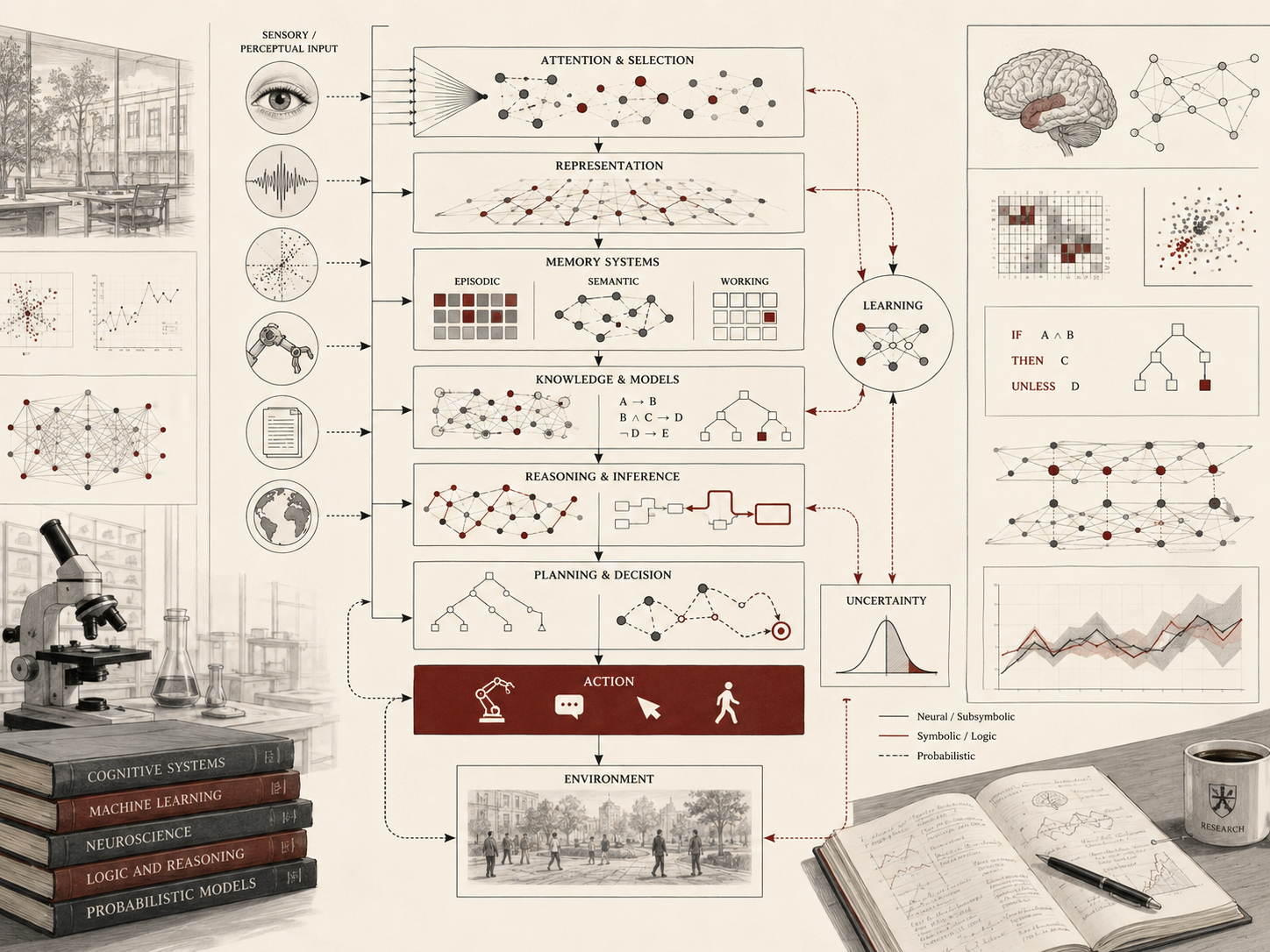
Cognitive systems research is not only about making machines perform tasks. It is also about making intelligence explicit enough to study. A cognitive system must represent a situation, preserve relevant context, retrieve prior knowledge, select actions, evaluate consequences, and adapt over time. In artificial intelligence, these functions may be implemented through symbolic rules, neural representations, probabilistic models, reinforcement-learning policies, memory systems, retrieval mechanisms, or hybrid architectures. In cognitive psychology, the same functions are studied as components of human thought.
From cognitive psychology to artificial intelligence
The relationship between cognitive psychology and artificial intelligence has been reciprocal from the beginning. Cognitive theories inspired early AI, and AI provided formal languages for stating cognitive hypotheses more precisely. Symbolic AI drew heavily on views of intelligence as rule-governed reasoning over structured representations. This helped make search, planning, inference, symbolic manipulation, memory organization, and problem solving central concerns in the early decades of the field.
This relationship was not accidental. Cognitive psychology and AI emerged within a broader cognitive revolution that treated mind as an information-processing system. Human cognition could be described in terms of inputs, representations, transformations, memory stores, decision rules, and outputs. AI systems, in turn, provided working models of those ideas. A program that solved a problem, searched a space, or manipulated symbols could be interpreted as both an engineering artifact and a cognitive hypothesis.
Over time, the field diversified. Statistical learning, neural networks, probabilistic inference, reinforcement learning, evolutionary methods, large-scale language models, retrieval-augmented generation, and multimodal architectures expanded what artificial systems could do. These developments changed the technical landscape, but they did not eliminate the cognitive question. They made it more complicated. Researchers no longer ask only whether machines can follow rules. They ask how systems perceive, learn, remember, generalize, explain, coordinate with humans, and act under real-world conditions of ambiguity and noise.
Cognitive systems research remains important because it treats intelligence as an integrated architecture rather than a single performance score. A model that classifies images, answers questions, or controls a robot may be impressive, but cognition requires more than isolated output. It requires structured representation, memory, adaptation, goal-directed action, and sensitivity to context.
What makes an AI system cognitive?
An AI system becomes cognitively interesting when it does more than map inputs to outputs. It must maintain some form of internal state, represent task-relevant structure, preserve or retrieve prior information, select among possible actions, and update behavior in response to feedback. These functions do not have to resemble human cognition in every detail, but they raise questions that are recognizably cognitive.
A cognitive system typically includes several interacting components:
- Perceptual processing, which converts input into structured information.
- Attention or selection, which determines what information receives computational priority.
- Representation, which encodes states, objects, relations, goals, or meanings.
- Memory, which stores and retrieves prior states, knowledge, examples, or context.
- Learning, which updates behavior from data, error, reward, or experience.
- Reasoning, which supports inference, planning, problem solving, and explanation.
- Decision policy, which maps internal states to actions.
- Feedback processing, which allows the system to evaluate and revise behavior.
These components may be implemented very differently across architectures. A symbolic system may represent knowledge explicitly through rules and structures. A neural system may represent knowledge through distributed parameters. A reinforcement-learning system may learn policies through reward. A retrieval-augmented system may combine generative output with external memory. A hybrid cognitive architecture may combine symbolic reasoning, subsymbolic activation, memory retrieval, and perceptual modules.
The cognitive question is not whether one implementation is universally superior. The question is how each architecture represents the world, what it can learn, what it can explain, what it forgets, how it handles uncertainty, and how reliably humans can interpret or govern its behavior.
Perception and representation in AI systems
Perception in AI involves transforming raw input into meaningful representations. This parallels human perception, where sensory input is not merely registered but organized into structured information that can support recognition, prediction, reasoning, and action.
In machine systems, perceptual processing may involve image recognition, speech processing, scene understanding, text interpretation, sensor fusion, multimodal integration, or environmental state estimation. Deep learning has been especially influential because it allows systems to extract increasingly abstract patterns from large amounts of data. But performance alone does not settle the cognitive issue. The deeper question is what kind of representation the system has formed.
A useful representation preserves the structure needed for future cognition. It should support memory, inference, action selection, generalization, and error correction. A visual system that identifies an object but cannot represent its relation to other objects is limited. A language system that produces fluent text but lacks stable grounding may be difficult to trust. A decision system that classifies risk but cannot represent uncertainty may be dangerous in high-stakes settings.
Representation also shapes failure. If a system represents the wrong features, it may appear competent under familiar conditions while failing under distribution shift. If it encodes biased historical patterns, it may reproduce social harm. If it compresses reality too aggressively, it may lose the information needed for ethical or contextual judgment.
For cognitive psychology, representation remains one of the most important bridges between biological and artificial intelligence. Human cognition depends on how experience is organized internally. Artificial cognition depends on the same problem, even when the representational substrate is computational rather than neural.
Attention, selection, and computational focus
Attention is central to cognition because no intelligent system can process everything equally. Human attention selects information for deeper processing, working memory, action, and learning. Artificial systems face an analogous problem: they must allocate computational focus across inputs, features, memory traces, possible actions, and environmental signals.
In AI, attention may refer to specific neural mechanisms, such as attention layers in transformer architectures. But the broader cognitive meaning is larger. Attention includes any mechanism that prioritizes some information over other information. This may involve salience weighting, feature selection, search control, retrieval cues, uncertainty sampling, anomaly detection, or task-directed filtering.
Attention shapes what a system can learn and what it can ignore. If attention is poorly allocated, important signals may be missed. If attention is too narrow, the system may become brittle. If attention is too diffuse, the system may become inefficient or noisy. In human-AI interaction, attentional design also matters for users. Dashboards, alerts, explanations, and recommendations direct human attention toward some features and away from others.
Cognitive systems research therefore treats attention as both an internal computational mechanism and a human-facing design concern. A system is not cognitively useful merely because it processes large amounts of data. It becomes useful when it helps allocate attention responsibly under constraints of time, uncertainty, and consequence.
Learning and knowledge acquisition
Learning is one of the central components of any cognitive system. In humans, learning involves integrating new information into existing knowledge structures, adjusting expectations, changing behavior, and improving action through experience. In AI, learning usually takes the form of algorithmic updating based on data, reward, error correction, prediction loss, environmental interaction, or human feedback.
These processes are closely related to cognitive learning, where knowledge is acquired, organized, generalized, and transferred across contexts. Supervised learning, unsupervised learning, reinforcement learning, self-supervised learning, transfer learning, imitation learning, and representation learning all offer different models of how systems can improve performance across time.
What unifies these approaches is the attempt to move beyond fixed programming toward systems that change as experience accumulates. Yet learning also introduces risk. A system may learn from biased data, spurious correlations, reward misspecification, narrow benchmarks, or feedback that reflects institutional incentives rather than truth. Human learning is also shaped by context, attention, motivation, and prior knowledge. Artificial learning is shaped by data distributions, objective functions, architecture, and training conditions.
For cognitive systems research, the question is not simply whether a system learns. It is what kind of learning occurs, what is preserved, what is forgotten, what generalizes, what fails under new conditions, and how the learning process can be inspected or governed.
Memory systems and information storage
Memory in AI concerns how information is stored, retrieved, updated, compressed, and used over time. This includes short-term contextual maintenance, long-term knowledge storage, episodic traces, semantic structures, retrieval mechanisms, external databases, vector stores, working-memory buffers, and persistent agent memory.
These mechanisms parallel human working memory, semantic memory, and episodic memory. A system that cannot maintain context, retrieve relevant prior information, or integrate stored knowledge into current reasoning will be sharply limited in what it can do. Memory makes continuity possible.
Artificial memory systems raise several cognitive questions. What counts as relevant prior knowledge? How should memories be indexed? What should be forgotten? How should retrieval be constrained by context? How should uncertainty or provenance be preserved? How can memory systems avoid amplifying outdated, biased, or incorrect information?
Retrieval-augmented systems make these questions especially visible. A system may generate better answers when it can retrieve relevant external documents, but retrieval introduces its own cognitive architecture: query formulation, memory search, ranking, context selection, conflict resolution, and source integration. These are not merely engineering details. They are computational versions of cognitive problems.
Effective memory systems support continuity, adaptation, and flexible action. Poorly governed memory systems can create false continuity, preserve errors, or give users the impression that a system understands more than it actually does.
Reasoning and problem solving
Reasoning in AI involves drawing inferences, solving problems, searching through alternatives, constructing action plans, generating explanations, and applying knowledge to novel situations. Some systems reason through symbolic rules and explicit representations. Others use probabilistic inference, learned policies, search procedures, neural representations, or hybrid structures that combine symbolic and learned components.
These processes are closely related to problem solving and analogical reasoning, where knowledge is applied to new situations rather than simply replayed. What matters cognitively is not only whether a system reaches a correct answer, but how it represents the problem space, what constraints it uses, what assumptions it makes, and how it selects among possible strategies.
Reasoning is difficult because problems are often underdefined. The system must decide what matters, what can be ignored, what rules apply, what evidence is sufficient, and when to stop searching. Human problem solving faces the same constraints. People rely on heuristics, analogies, schemas, external representations, working memory, and feedback. AI systems rely on architectures, search methods, model parameters, training distributions, retrieval systems, and objective functions.
Hybrid systems are especially important because complex environments rarely yield to a single reasoning mode. Symbolic reasoning may provide structure and interpretability. Neural models may provide pattern recognition and generalization. Probabilistic methods may represent uncertainty. Search may support planning. Retrieval may provide contextual grounding. Cognitive systems research asks how these components can be integrated without losing accountability or interpretability.
Decision making and uncertainty
Decision making in AI involves selecting actions under conditions of uncertainty, incomplete information, competing objectives, or delayed consequence. This often requires probabilistic models, utility estimation, policy optimization, reinforcement learning, planning, or confidence calibration.
These mechanisms are closely related to decision making and behavioral economics, where uncertainty, cost, value, risk, framing, and bounded rationality shape choice. Human systems remain bounded by attention, working memory, affect, social context, and cognitive effort. Artificial systems are constrained by training data, objective functions, state representations, reward design, computational resources, and deployment context.
Both biological and artificial agents must choose under uncertainty. Both depend on how states are represented, how values are assigned, how outcomes are predicted, and how feedback is interpreted. A system that misrepresents the state of the world may make poor decisions even if its optimization procedure is technically sophisticated. A system that is well calibrated may support better human oversight than one that is merely confident.
Decision making also raises governance questions. Who defines the reward? Who determines the acceptable error rate? Who is harmed by false positives or false negatives? Who can override the system? When should automation defer to human judgment? Cognitive systems research connects these questions to the architecture of intelligence itself, because action selection is never separate from representation, uncertainty, and accountability.
Formalizing cognitive systems: state, memory, policy, and representation
A cognitive system can be described formally as an agent that maintains an internal state, updates that state from input, retrieves relevant information, and selects actions. Let the internal state at time \(t\) be \(z_t\), the input be \(x_t\), memory be \(m_t\), and action be \(a_t\). A general state update can be written as:
z_{t+1} = f(z_t, x_t, m_t)
\]
Interpretation: The next internal state depends on the current state, new input, and retrieved memory. This makes cognition a dynamic process rather than a one-time input-output mapping.
Memory retrieval can be expressed as:
m_t = R(q_t, M)
\]
Interpretation: A retrieval function \(R\) uses a query \(q_t\), derived from the current state, to retrieve information from a stored memory structure \(M\).
Decision policy can then be written as:
a_t = \pi(z_t)
\]
Interpretation: A policy \(\pi\) maps internal state to action. The quality of action depends on the quality of the internal state representation.
Under uncertainty, one may instead write:
a_t = \arg\max_a \; \mathbb{E}[U(a \mid z_t)]
\]
Interpretation: The system selects the action with the highest expected utility given its current internal representation, not given the world directly.
Representation quality can also be expressed as a gap between world structure \(W\) and internal model \(\hat{W}\):
\epsilon = \| W – \hat{W} \|
\]
Interpretation: Representational error increases as the system’s internal model diverges from the structure of the world it must act within.
This formal framing is useful because it clarifies why cognition cannot be reduced to output alone. A system may produce a plausible answer while relying on an unstable or poorly grounded internal representation. It may select an action confidently while misestimating uncertainty. It may retrieve relevant information while failing to integrate it into the correct state. Cognitive systems research asks how these internal processes are organized and how their failure can be detected.
Cognitive architectures and integrated systems
Cognitive architectures aim to integrate perception, memory, learning, reasoning, and action into unified computational systems. Rather than optimizing one narrow task, they attempt to model how multiple cognitive components interact to produce flexible intelligent behavior.
ACT-R is one of the most important examples. Official ACT-R materials describe it as a cognitive architecture and a theory for simulating and understanding human cognition. ACT-R research focuses on how people organize knowledge and produce intelligent behavior across perception, thought, and action. It remains important because it treats cognition as an integrated system of memory, production rules, perceptual-motor modules, and learning mechanisms.
Soar is another major cognitive architecture. Official Soar materials describe it as a general cognitive architecture for developing systems that exhibit intelligent behavior. Soar is especially associated with state representation, operator selection, goal-directed problem solving, learning, and the integration of multiple cognitive capabilities within a unified architecture.
These architectures matter because they show a different path from benchmark-driven AI alone. They are designed not merely to perform tasks, but to model the organization of cognition. They ask how memory interacts with action, how goals structure problem solving, how learning modifies behavior, and how intelligent agents manage state across time.
Contemporary AI research has moved far beyond classical cognitive architectures in some respects, but the architectural question remains. Large models, retrieval systems, planning agents, tool-using agents, reinforcement-learning systems, and human-AI decision systems all require assumptions about state, memory, representation, policy, feedback, and control. Whether those assumptions are explicit or hidden, they are still architectural.
Artificial intelligence and human-computer interaction
The integration of cognitive systems into AI has major implications for human-computer interaction. Intelligent systems must not only perform well internally. They must interact with users in ways that support comprehension, trust, correction, and effective collaboration.
This makes explainability, transparency, usability, and cognitive legibility central design concerns. A system that is powerful but inscrutable may produce accurate outputs while still failing the human task of usable intelligence. Users need to understand what the system is doing, what evidence it used, how uncertain it is, where it may fail, and when human judgment should override automated output.
Human-AI interaction is also shaped by cognitive constraints. Users may overtrust fluent explanations, underweight uncertainty, defer to automation, ignore warnings, misinterpret probabilities, or fail to notice when a system is operating outside its reliable domain. The system’s interface can either support or distort human judgment.
Good cognitive-system design therefore requires attention to both artificial cognition and human cognition. It should help users form accurate mental models of system capabilities and limitations. It should support calibrated trust rather than blind reliance. It should make uncertainty visible, preserve provenance, allow challenge, and support meaningful human responsibility.
Ethics, explainability, and cognitive alignment
As AI systems become more powerful, ethical questions become more urgent. Cognitive systems research highlights the need for transparency, fairness, accountability, interpretability, and alignment with human understanding and public responsibility. These are not merely policy afterthoughts. They arise directly from the fact that humans must interpret and act on system outputs under uncertainty.
Explainable AI aims to make system outputs, evidence, reasoning, limitations, or decision processes more understandable. But explanation must be treated carefully. A fluent explanation is not necessarily a faithful explanation. A simplified explanation may improve usability while hiding uncertainty. A technical explanation may be accurate but unusable to the people who need to make decisions. Explanation quality must therefore be evaluated cognitively as well as computationally.
Cognitive alignment refers to the fit between system behavior and human comprehension, oversight, and values. It asks whether humans can understand what the system is doing well enough to use it responsibly. It also asks whether system outputs are aligned with the contexts, consequences, and ethical commitments of the decision environment.
These issues matter especially when AI systems affect employment, education, medicine, criminal justice, public administration, infrastructure, finance, environmental governance, and scientific research. A cognitive system can fail ethically when it represents people incorrectly, hides uncertainty, displaces accountability, excludes affected communities, or makes harmful classifications appear objective.
Responsible cognitive systems should be evaluated not only by accuracy, but also by interpretability, calibration, robustness, fairness, human oversight, and the capacity to support accountable decision making.
Contemporary research and interdisciplinary integration
Modern AI research integrates cognitive psychology, neuroscience, computer science, data science, linguistics, philosophy, human factors, robotics, and ethics. Cognitive architectures such as ACT-R and Soar remain important because they preserve the ambition of modeling intelligence as an integrated system. Newer AI research expands this terrain through machine learning, foundation models, retrieval systems, reinforcement learning, multimodal agents, and interactive systems.
At the same time, philosophical AI, logic-based AI, explainability, and ethics continue to expand the conceptual terrain. Questions about representation, embodiment, reasoning, agency, consciousness, accountability, and moral responsibility remain unresolved. They cannot be answered by benchmark performance alone.
The most important contemporary shift is that cognitive systems are increasingly embedded in real human environments. AI systems are no longer only laboratory artifacts or isolated software tools. They participate in workflows, decision systems, public institutions, education, scientific research, creative production, and social life. This makes cognitive psychology more important, not less, because deployment depends on human attention, trust, memory, interpretation, and decision making.
Cognitive systems research therefore remains one of the most important places where psychology and AI still directly inform one another. It helps explain how intelligence can be modeled, how computational systems can support human cognition, and how artificial systems can fail when their representations, explanations, or decisions are poorly aligned with reality and human responsibility.
R code for cognitive-systems data
The following R workflow illustrates analyses relevant to cognitive systems research, including architecture comparison, prediction accuracy, action success, explanation quality, human trust, override behavior, and uncertainty effects.
# Install packages if needed:
# pak::pak(c("tidyverse", "lme4", "lmerTest", "emmeans", "broom.mixed"))

library(tidyverse)
library(lme4)
library(lmerTest)
library(emmeans)
library(broom.mixed)

# Expected columns:
# agent_id, architecture, task_condition, input_noise,
# representation_quality, working_memory_load, retrieval_latency_ms,
# uncertainty_level, policy_entropy, prediction_accuracy,
# action_success, explanation_score, human_trust,
# override_decision, response_time_ms, calibration_error

dat <- read_csv("cognitive_systems_trials.csv") %>%
  mutate(
    agent_id = factor(agent_id),
    architecture = factor(architecture),
    task_condition = factor(task_condition),
    action_success = as.integer(action_success),
    override_decision = as.integer(override_decision),
    log_response_time = log(response_time_ms)
  )

# -----------------------------
# 1. Descriptive profile
# -----------------------------

architecture_summary <- dat %>%
  group_by(architecture) %>%
  summarise(
    n_trials = n(),
    agents = n_distinct(agent_id),
    mean_representation = mean(representation_quality, na.rm = TRUE),
    mean_retrieval_latency_ms = mean(retrieval_latency_ms, na.rm = TRUE),
    mean_uncertainty = mean(uncertainty_level, na.rm = TRUE),
    mean_policy_entropy = mean(policy_entropy, na.rm = TRUE),
    mean_prediction_accuracy = mean(prediction_accuracy, na.rm = TRUE),
    action_success_rate = mean(action_success, na.rm = TRUE),
    mean_explanation = mean(explanation_score, na.rm = TRUE),
    mean_human_trust = mean(human_trust, na.rm = TRUE),
    override_rate = mean(override_decision, na.rm = TRUE),
    mean_calibration_error = mean(calibration_error, na.rm = TRUE),
    .groups = "drop"
  )

print(architecture_summary)

# -----------------------------
# 2. Prediction-accuracy model
# -----------------------------

prediction_model <- lmer(
  prediction_accuracy ~
    architecture +
    task_condition +
    input_noise +
    representation_quality +
    working_memory_load +
    retrieval_latency_ms +
    uncertainty_level +
    policy_entropy +
    (1 | agent_id),
  data = dat,
  REML = FALSE
)

summary(prediction_model)
anova(prediction_model)
emmeans(prediction_model, ~ architecture)

# -----------------------------
# 3. Action-success model
# -----------------------------

success_model <- glmer(
  action_success ~
    architecture +
    task_condition +
    input_noise +
    representation_quality +
    working_memory_load +
    retrieval_latency_ms +
    uncertainty_level +
    policy_entropy +
    prediction_accuracy +
    (1 | agent_id),
  data = dat,
  family = binomial(),
  control = glmerControl(optimizer = "bobyqa")
)

summary(success_model)
emmeans(success_model, ~ architecture, type = "response")

# -----------------------------
# 4. Explanation-quality model
# -----------------------------

explanation_model <- lmer(
  explanation_score ~
    architecture +
    task_condition +
    representation_quality +
    uncertainty_level +
    policy_entropy +
    calibration_error +
    (1 | agent_id),
  data = dat,
  REML = FALSE
)

summary(explanation_model)
emmeans(explanation_model, ~ architecture)

# -----------------------------
# 5. Human-override model
# -----------------------------

override_model <- glmer(
  override_decision ~
    architecture +
    task_condition +
    explanation_score +
    human_trust +
    calibration_error +
    uncertainty_level +
    action_success +
    (1 | agent_id),
  data = dat,
  family = binomial(),
  control = glmerControl(optimizer = "bobyqa")
)

summary(override_model)
emmeans(override_model, ~ architecture, type = "response")

# -----------------------------
# 6. Response-time model
# -----------------------------

rt_model <- lmer(
  log_response_time ~
    architecture +
    task_condition +
    retrieval_latency_ms +
    working_memory_load +
    uncertainty_level +
    policy_entropy +
    (1 | agent_id),
  data = dat,
  REML = FALSE
)

summary(rt_model)

# -----------------------------
# 7. Visualization
# -----------------------------

ggplot(dat, aes(x = uncertainty_level, y = prediction_accuracy, color = architecture)) +
  geom_point(alpha = 0.25) +
  geom_smooth(method = "lm", se = FALSE) +
  labs(
    title = "Architecture performance under uncertainty",
    x = "Uncertainty level",
    y = "Prediction accuracy"
  ) +
  theme_minimal()
This workflow can be adapted for experimental cognitive-system comparisons, AI benchmark audits, human-AI collaboration studies, retrieval-augmented system evaluation, explanation-quality research, or applied decision-support analysis. Researchers should take special care to define architecture, explanation quality, calibration, uncertainty, and trust in ways that match the task domain.
Python code for cognitive-systems data
The Python workflow below parallels the R analysis and is useful for architecture comparison, uncertainty studies, explainability analysis, calibration assessment, and human-AI collaboration research.
import numpy as np
import pandas as pd
import statsmodels.formula.api as smf
import statsmodels.api as sm
import matplotlib.pyplot as plt

# Expected columns:
# agent_id, architecture, task_condition, input_noise,
# representation_quality, working_memory_load, retrieval_latency_ms,
# uncertainty_level, policy_entropy, prediction_accuracy,
# action_success, explanation_score, human_trust,
# override_decision, response_time_ms, calibration_error

df = pd.read_csv("cognitive_systems_trials.csv")

categorical_cols = ["agent_id", "architecture", "task_condition"]
for col in categorical_cols:
    df[col] = df[col].astype("category")

df["action_success"] = df["action_success"].astype(int)
df["override_decision"] = df["override_decision"].astype(int)
df["log_response_time"] = np.log(df["response_time_ms"])

# -----------------------------
# 1. Descriptive profile
# -----------------------------

architecture_summary = (
    df.groupby("architecture")
    .agg(
        n_trials=("prediction_accuracy", "size"),
        agents=("agent_id", "nunique"),
        mean_representation=("representation_quality", "mean"),
        mean_retrieval_latency_ms=("retrieval_latency_ms", "mean"),
        mean_uncertainty=("uncertainty_level", "mean"),
        mean_policy_entropy=("policy_entropy", "mean"),
        mean_prediction_accuracy=("prediction_accuracy", "mean"),
        action_success_rate=("action_success", "mean"),
        mean_explanation=("explanation_score", "mean"),
        mean_human_trust=("human_trust", "mean"),
        override_rate=("override_decision", "mean"),
        mean_calibration_error=("calibration_error", "mean"),
    )
    .reset_index()
)

print(architecture_summary)

# -----------------------------
# 2. Prediction-accuracy model
# -----------------------------

prediction_model = smf.ols(
    "prediction_accuracy ~ architecture + task_condition + input_noise "
    "+ representation_quality + working_memory_load + retrieval_latency_ms "
    "+ uncertainty_level + policy_entropy",
    data=df,
)

prediction_result = prediction_model.fit(
    cov_type="cluster",
    cov_kwds={"groups": df["agent_id"]},
)

print(prediction_result.summary())

# -----------------------------
# 3. Action-success model
# -----------------------------

success_model = smf.glm(
    "action_success ~ architecture + task_condition + input_noise "
    "+ representation_quality + working_memory_load + retrieval_latency_ms "
    "+ uncertainty_level + policy_entropy + prediction_accuracy",
    data=df,
    family=sm.families.Binomial(),
)

success_result = success_model.fit(
    cov_type="cluster",
    cov_kwds={"groups": df["agent_id"]},
)

print(success_result.summary())

# -----------------------------
# 4. Explanation-quality model
# -----------------------------

explanation_model = smf.ols(
    "explanation_score ~ architecture + task_condition + representation_quality "
    "+ uncertainty_level + policy_entropy + calibration_error",
    data=df,
)

explanation_result = explanation_model.fit(
    cov_type="cluster",
    cov_kwds={"groups": df["agent_id"]},
)

print(explanation_result.summary())

# -----------------------------
# 5. Human-override model
# -----------------------------

override_model = smf.glm(
    "override_decision ~ architecture + task_condition + explanation_score "
    "+ human_trust + calibration_error + uncertainty_level + action_success",
    data=df,
    family=sm.families.Binomial(),
)

override_result = override_model.fit(
    cov_type="cluster",
    cov_kwds={"groups": df["agent_id"]},
)

print(override_result.summary())

# -----------------------------
# 6. Response-time model
# -----------------------------

rt_model = smf.ols(
    "log_response_time ~ architecture + task_condition + retrieval_latency_ms "
    "+ working_memory_load + uncertainty_level + policy_entropy",
    data=df,
)

rt_result = rt_model.fit(
    cov_type="cluster",
    cov_kwds={"groups": df["agent_id"]},
)

print(rt_result.summary())

# -----------------------------
# 7. Visualization
# -----------------------------

fig, ax = plt.subplots(figsize=(8, 5))

for architecture, group in df.groupby("architecture"):
    ax.scatter(
        group["uncertainty_level"],
        group["prediction_accuracy"],
        alpha=0.35,
        label=str(architecture),
    )

ax.set_xlabel("Uncertainty level")
ax.set_ylabel("Prediction accuracy")
ax.set_title("Architecture performance under uncertainty")
ax.legend(title="Architecture")
plt.tight_layout()
plt.show()
The Python workflow is intentionally transparent and adaptable. It can be extended with mixed-effects models, Bayesian models, calibration curves, signal-detection analysis, representation-similarity measures, response-time distributions, or user-level trust models. For high-stakes AI research, the key task is not merely estimating performance. It is separating accuracy, calibration, explanation quality, uncertainty, and human reliance.
GitHub Repository
The companion repository provides reusable code and research scaffolding for studying cognitive systems in artificial intelligence, including workflows for architecture comparison, uncertainty modeling, action-success analysis, explanation-quality evaluation, calibration assessment, memory-retrieval simulation, and human-AI collaboration research.
Complete Code Repository
Access the full companion repository for this article, including reproducible analysis materials and multi-language code workflows for cognitive-systems research.
Applications of cognitive systems research
Cognitive systems research matters across robotics, decision support, educational technology, medical AI, scientific discovery, human-AI collaboration, explainable systems, autonomous agents, intelligent tutoring, cognitive modeling, adaptive interfaces, and interactive tools. It helps explain how systems can maintain context, reason under uncertainty, learn from experience, preserve memory, select actions, and remain intelligible to human users.
In robotics, cognitive systems connect perception, planning, action, and feedback in embodied environments. In education, they can support adaptive tutoring and learner modeling. In decision support, they can help organize evidence and highlight uncertainty. In scientific research, they can assist with hypothesis generation, literature retrieval, data analysis, and model comparison. In public institutions, they may help coordinate complex information while raising serious questions about accountability and oversight.
These applications matter because intelligence is not only about output quality. It is also about structure, adaptability, memory, explanation, calibration, and responsibility. A system that produces useful output but cannot be interpreted, audited, corrected, or governed remains cognitively and institutionally incomplete.
For cognitive psychology, AI systems offer a powerful comparative case. They allow researchers to ask which cognitive functions can be computationally modeled, which remain difficult, which are transformed by scale, and which require human interpretation, embodiment, culture, or social context. For AI research, cognitive psychology offers a reminder that intelligence is not reducible to prediction alone. It is an organized relation among perception, memory, reasoning, action, and meaning.
Conclusion
Cognitive systems in artificial intelligence research examine how perception, attention, learning, memory, reasoning, decision making, explanation, and action can be modeled and integrated within computational systems. They provide a bridge between cognitive psychology and AI by treating intelligence as both an empirical phenomenon of minds and a design problem for machines.
Cognitive psychology shows why this matters. Intelligence is not a single faculty, benchmark, or output. It is a coordination of representational, mnemonic, inferential, evaluative, and action-guiding processes. Understanding cognitive systems therefore helps explain how biological and artificial agents process information, adapt to complexity, and act in uncertain environments.
At the same time, AI makes the stakes of cognitive systems research more urgent. Artificial systems increasingly shape how people search, decide, learn, govern, diagnose, design, and communicate. If these systems are poorly represented, poorly calibrated, poorly explained, or poorly aligned with human understanding, they can produce harm even when they appear technically sophisticated.
The central question is therefore not only whether AI systems can behave intelligently. It is whether their intelligence can be understood, evaluated, corrected, governed, and responsibly integrated with human cognition and public accountability.
Related articles
- Cognitive Psychology
- Perception in Cognitive Psychology
- Attention in Cognitive Psychology
- Memory in Cognitive Psychology
- Working Memory in Cognitive Psychology
- Cognitive Learning Processes
- Problem Solving in Cognitive Psychology
- Decision Making in Cognitive Psychology
- Cognition and Human-Computer Interaction
Further reading
- Anderson, J.R. and Lebiere, C. (1998) The Atomic Components of Thought. Mahwah, NJ: Lawrence Erlbaum Associates. ACT-R overview available at: https://act-r.psy.cmu.edu/.
- Association for Computing Machinery (n.d.) ACM SIGAI. Available at: https://sigai.acm.org/main/aboutus/.
- Laird, J.E. (2012) The Soar Cognitive Architecture. Cambridge, MA: MIT Press. Soar overview available at: https://soar.eecs.umich.edu/.
- Russell, S. and Norvig, P. (2021) Artificial Intelligence: A Modern Approach. 4th edn. Hoboken, NJ: Pearson.
- Samet, J. and Schank, R. (2023) ‘Artificial intelligence’, Stanford Encyclopedia of Philosophy. Available at: https://plato.stanford.edu/entries/artificial-intelligence/.
- Müller, V.C. (2020) ‘Ethics of artificial intelligence and robotics’, Stanford Encyclopedia of Philosophy. Available at: https://plato.stanford.edu/entries/ethics-ai/.
References
- Anderson, J.R. and Lebiere, C. (1998) The Atomic Components of Thought. Mahwah, NJ: Lawrence Erlbaum Associates.
- Anderson, J.R. (2007) How Can the Human Mind Occur in the Physical Universe? Oxford: Oxford University Press.
- Association for Computing Machinery (n.d.) ACM SIGAI: About Us. Available at: https://sigai.acm.org/main/aboutus/.
- ACT-R Research Group (n.d.) ACT-R. Carnegie Mellon University. Available at: https://act-r.psy.cmu.edu/.
- Card, S.K., Moran, T.P. and Newell, A. (1983) The Psychology of Human-Computer Interaction. Hillsdale, NJ: Lawrence Erlbaum Associates.
- Laird, J.E. (2012) The Soar Cognitive Architecture. Cambridge, MA: MIT Press.
- Newell, A. (1990) Unified Theories of Cognition. Cambridge, MA: Harvard University Press.
- Russell, S. and Norvig, P. (2021) Artificial Intelligence: A Modern Approach. 4th edn. Hoboken, NJ: Pearson.
- Samet, J. and Schank, R. (2023) ‘Artificial intelligence’, Stanford Encyclopedia of Philosophy. Available at: https://plato.stanford.edu/entries/artificial-intelligence/.
- Soar Group (n.d.) Soar Cognitive Architecture. University of Michigan. Available at: https://soar.eecs.umich.edu/.
- Müller, V.C. (2020) ‘Ethics of artificial intelligence and robotics’, Stanford Encyclopedia of Philosophy. Available at: https://plato.stanford.edu/entries/ethics-ai/.