
Last Updated May 20, 2026
Language processing refers to the mental operations that allow humans to comprehend, produce, interpret, and use language in real time. These processes transform sounds, symbols, gestures, and written forms into structured meaning, making possible communication, reasoning, coordination, memory, learning, and the transmission of knowledge across individuals, cultures, and institutions. In cognitive psychology, language is not treated merely as a tool for expression. It is one of the most complex systems through which the mind organizes meaning and acts in the social world.
Language processing draws together multiple cognitive systems. Perception makes linguistic input available in speech, text, sign, or visual form. Attention selects relevant signals from noisy environments. Memory provides vocabulary, grammatical knowledge, conceptual knowledge, and prior discourse context. Working memory supports the temporary maintenance of words, phrases, dependencies, intentions, and partial interpretations while comprehension and production unfold. Semantic memory supplies the conceptual content that gives language meaning.
For that reason, language processing occupies a central place in cognitive psychology. It helps explain how the mind constructs meaning, organizes knowledge, coordinates abstract reasoning, and links internal representation to public communication. It is also one of the clearest points of contact among psychology, linguistics, neuroscience, philosophy, education, speech-language research, human-computer interaction, and artificial intelligence.
Main Library
Publications
Article Map
Cognitive Psychology
Related Topic
Artificial Intelligence Systems
Related Topic
Data Systems & Analytics
Related Topic
Behavioral Economics
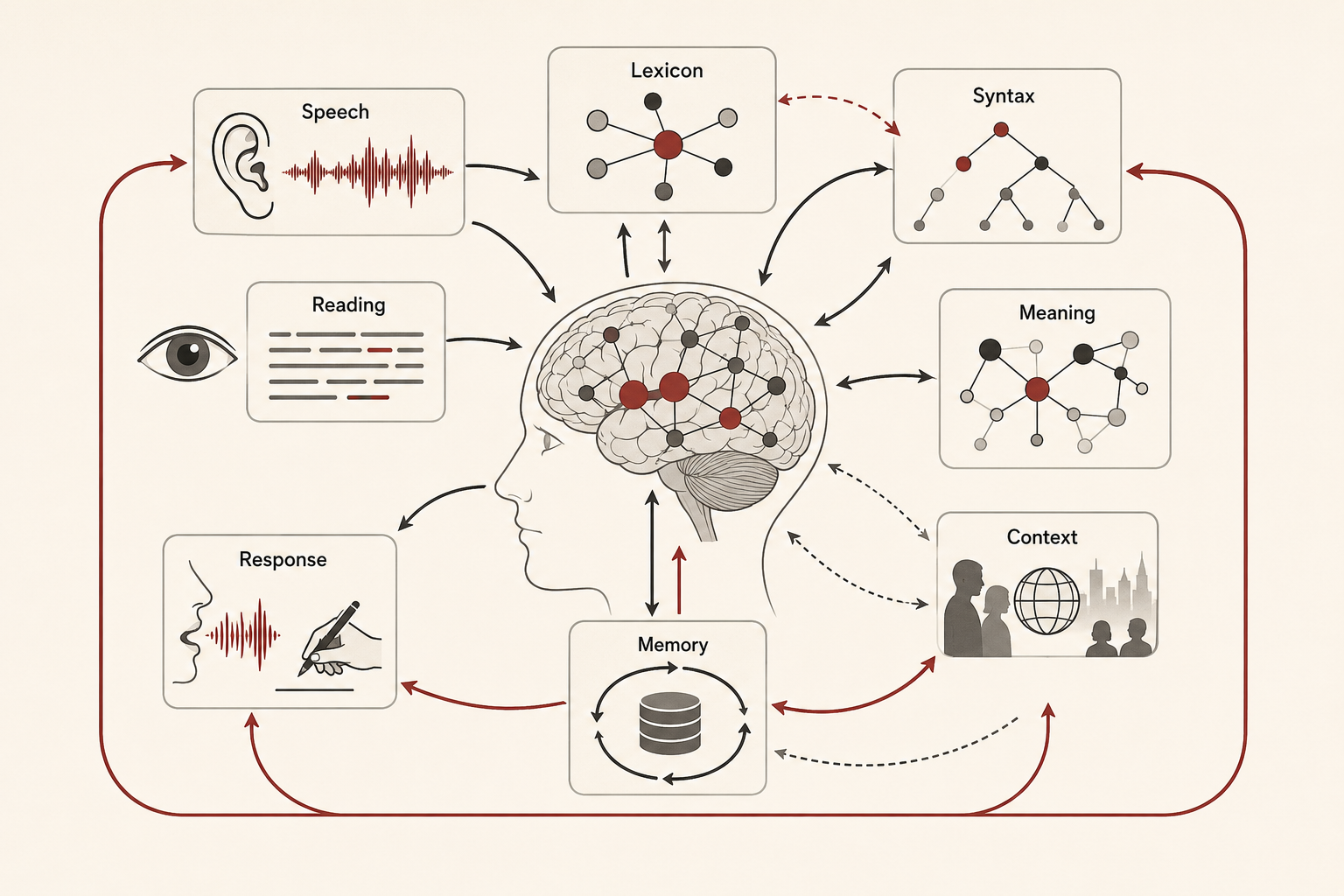
Language matters because it is both cognitive and social. It allows private thought to become public, lets communities preserve knowledge beyond individual memory, and gives institutions the capacity to define categories, coordinate action, issue obligations, explain evidence, and contest meaning. Language processing therefore is not only about recognizing words quickly. It is about how minds build meaning under time pressure, uncertainty, context, social expectation, and communicative purpose.
Core components of language processing
Language processing can be understood as a multi-layered system involving several interrelated components. These components do not function as isolated steps in a rigid chain. They interact dynamically and often in parallel, allowing the mind to construct meaning from linguistic input while also preparing possible responses.
- Phonological processing decodes sounds, sound patterns, syllables, stress, rhythm, and phonological structure.
- Orthographic processing recognizes written symbols, letters, spelling patterns, scripts, and visual word forms.
- Lexical processing identifies words and accesses stored information about their meanings, forms, grammatical roles, and associations.
- Syntactic processing analyzes grammatical structure and relations among words, phrases, clauses, and dependencies.
- Semantic processing constructs meaning from words, phrases, sentences, propositions, and conceptual relations.
- Pragmatic processing interprets utterances in context, including speaker intention, implication, social setting, discourse purpose, and shared background knowledge.
- Discourse processing integrates sentences into larger narratives, arguments, conversations, instructions, or institutional texts.
- Production planning transforms communicative intention into words, syntax, articulation, gesture, or written output.
Understanding even a simple sentence typically requires simultaneous access to sound or orthographic form, lexical meaning, grammatical structure, contextual interpretation, and working-memory support for intermediate structure. A listener or reader must not only decode the input but determine what it means in context.
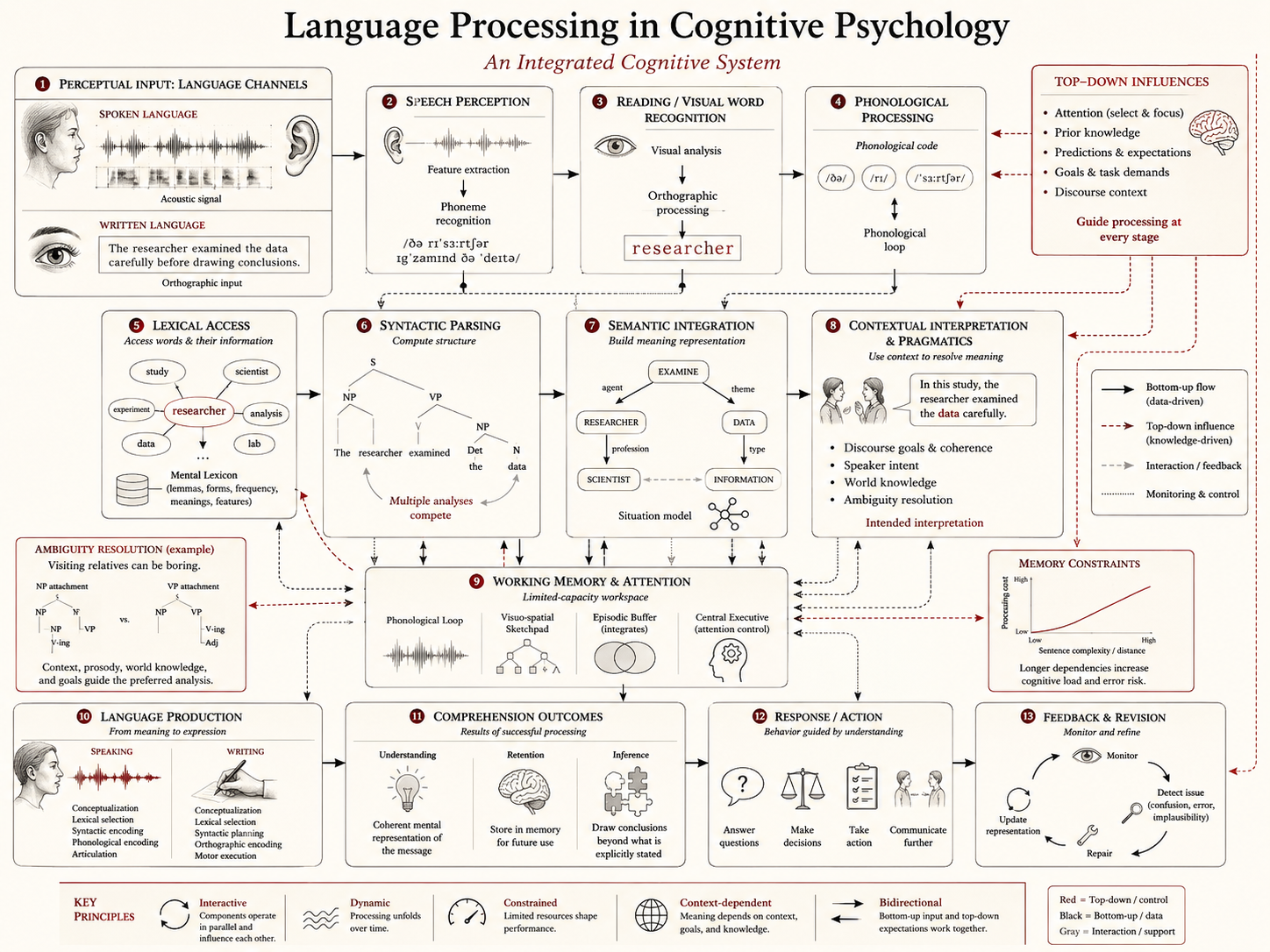
This layered organization is one reason language processing remains such an important topic in cognitive psychology. It reveals how multiple systems coordinate to transform linear input into structured thought.
Language comprehension
Language comprehension involves transforming linguistic input into meaning. For spoken language, this begins with auditory processing. For written language, it begins with visual recognition of orthographic forms. For signed languages, it begins with visual-spatial perception of manual and facial patterns. But comprehension is not exhausted by perception. Once the signal has been registered, the system must rapidly identify words, assign grammatical structure, retrieve conceptual content, integrate context, and construct a coherent interpretation.
Comprehension is incremental. People do not usually wait until a sentence is complete before interpreting it. They build expectations as input unfolds, revise interpretations when later material conflicts with earlier assumptions, and use context to resolve ambiguity. This is why reading-time, eye-tracking, lexical-decision, self-paced reading, and sentence-completion tasks are useful in psycholinguistic research: they reveal comprehension as a process unfolding over time.
Working memory is especially important because comprehension often depends on maintaining intermediate representations while later material arrives. Long or syntactically complex sentences require the listener or reader to preserve earlier structure until a coherent interpretation can be completed. Dependencies across long distances, embedded clauses, and temporarily ambiguous phrases all increase processing demand.
Comprehension is also active rather than passive. People interpret language using prior knowledge, expectations, discourse context, social knowledge, and likely communicative intention. Understanding therefore depends not only on what is said, but on what the listener or reader brings to the encounter.
This active nature of comprehension is visible in everyday language. The same sentence can mean different things depending on tone, speaker, setting, prior conversation, genre, institution, or shared history. Meaning is constructed from words, but not by words alone.
Language production
Language production involves transforming internal representations into spoken, written, signed, or otherwise externalized output. This process is cognitively demanding because speakers and writers must select what to say, choose how to say it, organize linguistic form, monitor output, and adapt to audience and context.
Production includes several coordinated operations:
- conceptualizing ideas, intentions, or communicative goals;
- selecting appropriate lexical items;
- constructing grammatical structure;
- ordering words and phrases into coherent sequences;
- encoding sound, sign, or orthographic form;
- articulating speech or producing written output;
- monitoring errors, ambiguity, tone, and coherence;
- repairing output when communication breaks down.
Production is not simply the reverse of comprehension. A listener may understand a word before being able to use it fluently. A person may know what they intend to say but struggle with word retrieval, sentence planning, or articulation. Production requires continual choice among competing options, making it closely connected to decision making under time pressure.
Speech production research has often emphasized the movement from communicative intention to articulation: a speaker begins with an intended message, selects concepts and words, builds grammatical structure, encodes phonological form, and coordinates motor output. Writing adds additional demands of planning, revision, orthographic control, audience awareness, and external memory.
The complexity of production shows that language is not merely expression. It is coordinated cognitive action. To produce language is to turn thought into form while anticipating interpretation by others.
Formalizing language processing: representation, parsing, and incremental meaning
Language processing can be described formally as the transformation of an input sequence into a structured interpretation. Let a linguistic input be represented as a sequence of units \(x_1, x_2, \dots, x_n\). A comprehension system can be described as constructing an evolving interpretation state \(I_t\):
I_t = f(I_{t-1}, x_t, K, C)
\]
Interpretation: Meaning is built incrementally as each new linguistic unit \(x_t\) is interpreted relative to prior interpretation \(I_{t-1}\), stored knowledge \(K\), and discourse context \(C\).
Syntactic parsing can be represented as a search over possible structural analyses. If \(S_i\) is a candidate structure, then parsing can be described as selecting the most plausible structure given the input:
\hat{S} = \arg\max_{S_i} P(S_i \mid X, C)
\]
Interpretation: Listeners and readers often resolve ambiguity by selecting the most plausible grammatical structure given the observed sequence \(X\) and context \(C\).
Semantic composition can be expressed abstractly as a function that combines word meanings with structural relations and context:
M = g(W, \hat{S}, C)
\]
Interpretation: Meaning \(M\) emerges from lexical meanings \(W\), selected syntactic structure \(\hat{S}\), and contextual information \(C\).
Production can be represented in reverse form, as a mapping from communicative intention \(G\) to output sequence \(Y\):
Y = h(G, K, C)
\]
Interpretation: Language production transforms communicative goals into linguistic output using stored lexical and grammatical knowledge and discourse context.
Processing difficulty can also be modeled as a function of lexical, syntactic, semantic, contextual, and memory demands:
\log(RT)=\beta_0-\beta_1F+\beta_2A+\beta_3S-\beta_4P-\beta_5C+\beta_6M
\]
Interpretation: Response time may decrease with word frequency \(F\), semantic predictability \(P\), and context support \(C\), while increasing with lexical ambiguity \(A\), syntactic complexity \(S\), and memory load \(M\).
These models are simplified, but they clarify the research problem. Language processing is not one operation. It is a coordinated set of transformations linking form, structure, meaning, context, intention, and response.
Language and meaning construction
Language processing is fundamentally concerned with meaning construction. Words do not carry fixed meaning independent of use. Meaning emerges through the interaction among linguistic form, conceptual structure, discourse setting, social context, and background knowledge.
This is one reason language is closely connected to mental models. To understand many utterances, individuals must construct internal representations of situations, relations, events, causes, obligations, possibilities, or social roles. A sentence about movement, threat, obligation, probability, justice, or causation is often understood by simulating a structured situation rather than by treating each word in isolation.
Meaning construction involves several layers:
- Lexical meaning, or the stored meaning associated with words.
- Compositional meaning, or how meanings combine through syntax.
- Contextual meaning, or how discourse and situation change interpretation.
- Pragmatic meaning, or what a speaker intends beyond literal wording.
- Social meaning, or what language signals about identity, authority, relationship, register, and institutional role.
Meaning therefore is not merely decoded. It is constructed. A listener must determine not only what words mean but what the utterance is doing: informing, requesting, warning, refusing, promising, persuading, joking, commanding, questioning, or implying.
This makes language processing deeply connected to reasoning, prediction, and problem solving. To understand language is often to build an internal model of what is being described and what response may be appropriate.
Language and memory systems
Language processing relies heavily on memory systems. Long-term memory stores vocabulary, grammatical regularities, idioms, phonological patterns, spelling patterns, discourse schemas, and conceptual knowledge. Working memory supports the maintenance of partial structures during ongoing comprehension and production.
Semantic memory is especially important because it stores knowledge about words, concepts, categories, and relations among meanings. Without semantic memory, language would be little more than a sequence of forms with no stable conceptual content. The word “tree” would not connect to plants, roots, trunks, leaves, shade, ecology, wood, forests, or metaphorical uses. The word “justice” would not connect to law, fairness, institutions, rights, accountability, or moral judgment.
Memory supports language processing in several ways:
- retrieving word meanings and forms;
- maintaining phrase and sentence structure;
- holding prior discourse context active;
- integrating new information with existing knowledge;
- supporting prediction of likely next words or meanings;
- preserving communicative goals during production;
- remembering what has already been said or written.
The interaction between language and memory is therefore foundational rather than incidental. Language depends on stored knowledge, but language also reorganizes memory by creating durable labels, narratives, categories, explanations, and shared records.
This relationship is especially important in education, law, science, governance, and public communication. Language does not merely transmit knowledge. It helps organize the knowledge that memory later retrieves.
Language, thought, and cognition
The relationship between language and thought remains one of the most enduring questions in cognitive science. Some traditions emphasize language as a system that expresses underlying cognition, while others argue that linguistic structure helps shape categorization, abstraction, memory, attention, and habitual interpretation.
Whatever the direction of influence in particular cases, language and cognition are deeply intertwined. Language provides a framework for articulating abstract ideas, organizing social coordination, preserving knowledge, and enabling cumulative cultural transmission. It functions both as a cognitive tool and as a social system.
Language helps cognition by making thought more stable, inspectable, shareable, and revisable. A vague intuition can become a sentence. A sentence can become an argument. An argument can become a law, theory, hypothesis, contract, diagnosis, lesson, method, or public claim. In this way, language externalizes cognition and allows it to be evaluated by others.
At the same time, language can constrain cognition. The available terms, categories, metaphors, institutional vocabularies, and narrative frames influence what problems are easy to name and what harms remain difficult to describe. A community may struggle to address an issue until the right language becomes available. Conversely, misleading language can stabilize false categories or obscure responsibility.
This is one reason the study of language processing belongs so centrally within cognitive psychology. Language is not merely added onto thought after the fact. It is one of the major ways thought is structured, externalized, shared, and contested.
Language processing and cognitive efficiency
Language processing often becomes more efficient with experience. Skilled readers and fluent speakers process familiar forms rapidly and with relatively low effort, whereas novices, developing learners, second-language users, and readers confronting unfamiliar domains may require more conscious attention and working-memory support.
This progression reflects general principles of skill acquisition. Repeated exposure and practice can reduce processing cost, increase fluency, strengthen lexical access, improve parsing expectations, and support more efficient integration of meaning. Efficiency in language processing is therefore not simply a matter of faster speed. It reflects deeper reorganization of representation, retrieval, prediction, and production.
Efficiency depends on several factors:
- word frequency and familiarity;
- orthographic and phonological regularity;
- syntactic predictability;
- semantic coherence;
- contextual support;
- reader or listener expertise;
- working-memory capacity and task demands;
- noise, distraction, accessibility, and fatigue.
Efficiency should not be confused with intelligence or worth. Language processing speed is shaped by education, exposure, disability, multilingualism, dialect, sensory access, cultural context, and institutional design. A text can be difficult because it is conceptually deep, poorly written, syntactically burdensome, inaccessible, or misaligned with a reader’s background knowledge.
Good communication design therefore reduces unnecessary processing burden without flattening meaning. It supports comprehension while preserving complexity where complexity is necessary.
Language acquisition, literacy, and development
Language processing develops across childhood and continues to change through education, literacy, specialization, multilingual experience, and aging. Children acquire comprehension and production through interaction among perception, social attention, memory, pattern learning, communicative intention, and feedback from caregivers and communities.
Acquisition is not simply imitation. Children must infer patterns from variable input, map words to meanings, learn grammatical regularities, coordinate comprehension and production, and gradually build pragmatic knowledge about how language is used in social life. This process shows that language learning is both cognitive and social.
Literacy adds another layer. Reading and writing require the coordination of visual recognition, phonological awareness, orthographic knowledge, vocabulary, syntax, semantic memory, background knowledge, and discourse comprehension. Learning to read is not merely learning letters. It is learning how written symbols connect to language, meaning, memory, and knowledge.
Developmental and educational research therefore matter for language processing because they reveal how linguistic systems are built. Skilled adult comprehension can look automatic, but that automaticity rests on years of learning, exposure, social interaction, and practice.
Language development also varies across communities, languages, dialects, access conditions, and learning environments. A serious account of language processing should avoid treating one variety of language experience as the universal standard for cognition.
Language, power, and social meaning
Language is processed by individual minds, but it is also shaped by social power. Words, accents, dialects, registers, categories, titles, and institutional vocabularies carry social meaning. They influence who is heard, who is trusted, what counts as expertise, and which experiences become publicly intelligible.
This matters for cognitive psychology because language processing is not detached from context. A listener’s interpretation may be shaped by expectations about speaker identity, authority, accent, education, race, class, gender, disability, nationality, or institutional role. Such expectations can distort comprehension and evaluation even when the linguistic content is clear.
Language can also make marginalized experience visible or invisible. Terms can name harms, organize collective memory, and create pathways for accountability. They can also obscure agency, soften violence, naturalize inequality, or frame social problems as individual deficits. Institutional language often determines how people are classified, served, disciplined, excluded, or protected.
For that reason, language-processing research has ethical significance. It should not treat language as a neutral signal passing through a neutral system. Language is a cognitive signal, but it is also a social act. The same sentence can function differently depending on who says it, who hears it, and what institutional structures surround it.
A serious account of language processing therefore must include meaning, context, power, and accessibility. Language is one of the primary ways cognition enters public life.
Language processing and artificial intelligence
Language processing is now one of the most active meeting points between human cognition and artificial intelligence. Computational systems can classify text, translate languages, generate summaries, answer questions, identify patterns, assist writing, transcribe speech, and produce fluent language. These systems raise important questions about what it means to process language.
Human language processing involves perception, memory, intention, embodiment, social context, pragmatics, accountability, and lived experience. Artificial systems process language through engineered architectures, statistical patterns, symbolic structures, embeddings, training data, retrieval systems, and optimization objectives. The comparison is useful, but not identical.
AI language systems can support human cognition by reducing search burden, helping organize information, offering drafts, translating across languages, and making some forms of text easier to access. But they can also create risks: plausible falsehoods, context collapse, bias reproduction, overconfident summaries, loss of provenance, and flattening of contested meaning.
Language-processing research helps evaluate these systems more carefully. It reminds us that fluency is not the same as understanding, that association is not the same as truth, and that generated language must be interpreted within social and institutional contexts.
The central question is not whether machines can produce language-like output. The deeper question is how human and artificial language systems should be designed, evaluated, and governed so that meaning, evidence, responsibility, and accessibility remain visible.
Language processing in contemporary research
Current research on language processing integrates cognitive psychology, neuroscience, linguistics, education, speech-language science, philosophy, artificial intelligence, and human-computer interaction. Reviews in psychology have long emphasized that comprehension, production, and acquisition draw on interacting systems rather than isolated modules. Psycholinguistics continues to study how these systems coordinate under real-time processing demands.
Language production research remains strongly shaped by models that explain how internal intentions become articulated speech or written output. Such models help distinguish conceptualization, lexical selection, grammatical encoding, phonological encoding, articulation, and monitoring.
Comprehension research examines lexical access, parsing, ambiguity resolution, semantic prediction, discourse processing, pragmatic inference, and working-memory constraints. Reading research studies word recognition, eye movements, fluency, syntactic complexity, comprehension monitoring, and literacy development. Neuroscience examines the distributed systems supporting speech perception, semantic integration, syntax, production, and language-related control.
Computational approaches now examine how artificial systems process and generate language, raising broader questions about whether linguistic competence can be modeled statistically, symbolically, or through hybrid architectures. These developments make language processing one of the most active bridges between human cognition and machine intelligence.
Across these traditions, one conclusion remains stable: language processing is not a single mechanism. It is a coordinated cognitive system that links form, meaning, memory, context, intention, social relation, and action.
R code for language-processing data
The following R workflow illustrates analyses relevant to language-processing research, including comprehension accuracy, lexical decision, production accuracy, reading time, lexical decision response time, production latency, syntactic complexity, semantic predictability, context support, working-memory load, and pragmatic inference.
# Install packages if needed:
# pak::pak(c("tidyverse", "lme4", "lmerTest", "emmeans", "broom.mixed"))

library(tidyverse)
library(lme4)
library(lmerTest)
library(emmeans)
library(broom.mixed)

# Expected columns:
# participant, condition, item_id, modality,
# word_frequency, lexical_ambiguity, syntactic_complexity,
# semantic_predictability, context_support, working_memory_load,
# pragmatic_inference_demand, discourse_coherence,
# comprehension_accuracy, lexical_decision_accuracy,
# production_accuracy, reading_time_ms,
# lexical_decision_rt_ms, production_latency_ms, confidence

dat <- read_csv("language_processing_trials.csv") %>%
  mutate(
    participant = factor(participant),
    condition = factor(condition),
    item_id = factor(item_id),
    modality = factor(modality),
    comprehension_accuracy = as.integer(comprehension_accuracy),
    lexical_decision_accuracy = as.integer(lexical_decision_accuracy),
    production_accuracy = as.integer(production_accuracy),
    log_reading_time = log(reading_time_ms),
    log_lexical_decision_rt = log(lexical_decision_rt_ms),
    log_production_latency = log(production_latency_ms)
  )

# -----------------------------
# 1. Descriptive profile
# -----------------------------

condition_summary <- dat %>%
  group_by(condition) %>%
  summarise(
    n_trials = n(),
    participants = n_distinct(participant),
    mean_word_frequency = mean(word_frequency, na.rm = TRUE),
    mean_lexical_ambiguity = mean(lexical_ambiguity, na.rm = TRUE),
    mean_syntactic_complexity = mean(syntactic_complexity, na.rm = TRUE),
    mean_semantic_predictability = mean(semantic_predictability, na.rm = TRUE),
    mean_context_support = mean(context_support, na.rm = TRUE),
    mean_working_memory_load = mean(working_memory_load, na.rm = TRUE),
    mean_pragmatic_demand = mean(pragmatic_inference_demand, na.rm = TRUE),
    mean_discourse_coherence = mean(discourse_coherence, na.rm = TRUE),
    comprehension_accuracy_rate = mean(comprehension_accuracy, na.rm = TRUE),
    lexical_decision_accuracy_rate = mean(lexical_decision_accuracy, na.rm = TRUE),
    production_accuracy_rate = mean(production_accuracy, na.rm = TRUE),
    mean_reading_time_ms = mean(reading_time_ms, na.rm = TRUE),
    mean_lexical_decision_rt_ms = mean(lexical_decision_rt_ms, na.rm = TRUE),
    mean_production_latency_ms = mean(production_latency_ms, na.rm = TRUE),
    mean_confidence = mean(confidence, na.rm = TRUE),
    .groups = "drop"
  )

print(condition_summary)

# -----------------------------
# 2. Comprehension accuracy model
# -----------------------------

comprehension_model <- glmer(
  comprehension_accuracy ~
    condition +
    modality +
    word_frequency +
    lexical_ambiguity +
    syntactic_complexity +
    semantic_predictability +
    context_support +
    working_memory_load +
    pragmatic_inference_demand +
    discourse_coherence +
    (1 | participant) +
    (1 | item_id),
  data = dat,
  family = binomial(),
  control = glmerControl(optimizer = "bobyqa")
)

summary(comprehension_model)
emmeans(comprehension_model, ~ condition, type = "response")

# -----------------------------
# 3. Lexical decision model
# -----------------------------

lexical_model <- glmer(
  lexical_decision_accuracy ~
    condition +
    word_frequency +
    lexical_ambiguity +
    semantic_predictability +
    working_memory_load +
    (1 | participant) +
    (1 | item_id),
  data = dat,
  family = binomial(),
  control = glmerControl(optimizer = "bobyqa")
)

summary(lexical_model)

# -----------------------------
# 4. Production accuracy model
# -----------------------------

production_model <- glmer(
  production_accuracy ~
    condition +
    modality +
    word_frequency +
    lexical_ambiguity +
    syntactic_complexity +
    context_support +
    working_memory_load +
    pragmatic_inference_demand +
    discourse_coherence +
    (1 | participant) +
    (1 | item_id),
  data = dat,
  family = binomial(),
  control = glmerControl(optimizer = "bobyqa")
)

summary(production_model)

# -----------------------------
# 5. Reading-time model
# -----------------------------

reading_model <- lmer(
  log_reading_time ~
    condition +
    modality +
    word_frequency +
    lexical_ambiguity +
    syntactic_complexity +
    semantic_predictability +
    context_support +
    working_memory_load +
    pragmatic_inference_demand +
    comprehension_accuracy +
    (1 | participant) +
    (1 | item_id),
  data = dat,
  REML = FALSE
)

summary(reading_model)
emmeans(reading_model, ~ condition)

# -----------------------------
# 6. Lexical decision RT model
# -----------------------------

lexrt_model <- lmer(
  log_lexical_decision_rt ~
    condition +
    word_frequency +
    lexical_ambiguity +
    semantic_predictability +
    working_memory_load +
    lexical_decision_accuracy +
    (1 | participant) +
    (1 | item_id),
  data = dat,
  REML = FALSE
)

summary(lexrt_model)

# -----------------------------
# 7. Production latency model
# -----------------------------

production_latency_model <- lmer(
  log_production_latency ~
    condition +
    modality +
    word_frequency +
    lexical_ambiguity +
    syntactic_complexity +
    context_support +
    working_memory_load +
    pragmatic_inference_demand +
    production_accuracy +
    (1 | participant) +
    (1 | item_id),
  data = dat,
  REML = FALSE
)

summary(production_latency_model)

# -----------------------------
# 8. Visualization
# -----------------------------

ggplot(dat, aes(x = syntactic_complexity, y = reading_time_ms, color = condition)) +
  geom_point(alpha = 0.25) +
  geom_smooth(method = "lm", se = FALSE) +
  labs(
    title = "Syntactic complexity and reading time",
    x = "Syntactic complexity",
    y = "Reading time (ms)"
  ) +
  theme_minimal()
This workflow can be adapted for lexical-decision tasks, self-paced reading experiments, eye-tracking studies, sentence comprehension, pragmatic inference, discourse coherence, language production, literacy research, speech-language assessment, and human-AI language interaction studies. Researchers should model participant and item effects whenever possible because words, sentences, passages, and speakers vary strongly in frequency, familiarity, complexity, and context.
Python code for language-processing data
The Python examples below parallel the R workflow and are useful for reading-time studies, lexical-decision tasks, comprehension experiments, production-latency research, discourse-context analysis, and language-processing simulations.
import numpy as np
import pandas as pd
import statsmodels.formula.api as smf
import statsmodels.api as sm
import matplotlib.pyplot as plt

# Expected columns:
# participant, condition, item_id, modality,
# word_frequency, lexical_ambiguity, syntactic_complexity,
# semantic_predictability, context_support, working_memory_load,
# pragmatic_inference_demand, discourse_coherence,
# comprehension_accuracy, lexical_decision_accuracy,
# production_accuracy, reading_time_ms,
# lexical_decision_rt_ms, production_latency_ms, confidence

df = pd.read_csv("language_processing_trials.csv")

categorical_cols = ["participant", "condition", "item_id", "modality"]
for col in categorical_cols:
    df[col] = df[col].astype("category")

df["comprehension_accuracy"] = df["comprehension_accuracy"].astype(int)
df["lexical_decision_accuracy"] = df["lexical_decision_accuracy"].astype(int)
df["production_accuracy"] = df["production_accuracy"].astype(int)
df["log_reading_time"] = np.log(df["reading_time_ms"])
df["log_lexical_decision_rt"] = np.log(df["lexical_decision_rt_ms"])
df["log_production_latency"] = np.log(df["production_latency_ms"])

# -----------------------------
# 1. Descriptive profile
# -----------------------------

condition_summary = (
    df.groupby("condition")
    .agg(
        n_trials=("comprehension_accuracy", "size"),
        participants=("participant", "nunique"),
        mean_word_frequency=("word_frequency", "mean"),
        mean_lexical_ambiguity=("lexical_ambiguity", "mean"),
        mean_syntactic_complexity=("syntactic_complexity", "mean"),
        mean_semantic_predictability=("semantic_predictability", "mean"),
        mean_context_support=("context_support", "mean"),
        mean_working_memory_load=("working_memory_load", "mean"),
        mean_pragmatic_demand=("pragmatic_inference_demand", "mean"),
        mean_discourse_coherence=("discourse_coherence", "mean"),
        comprehension_accuracy_rate=("comprehension_accuracy", "mean"),
        lexical_decision_accuracy_rate=("lexical_decision_accuracy", "mean"),
        production_accuracy_rate=("production_accuracy", "mean"),
        mean_reading_time_ms=("reading_time_ms", "mean"),
        mean_lexical_decision_rt_ms=("lexical_decision_rt_ms", "mean"),
        mean_production_latency_ms=("production_latency_ms", "mean"),
        mean_confidence=("confidence", "mean"),
    )
    .reset_index()
)

print(condition_summary)

# -----------------------------
# 2. Comprehension accuracy model
# -----------------------------

comprehension_model = smf.glm(
    "comprehension_accuracy ~ condition + modality + word_frequency "
    "+ lexical_ambiguity + syntactic_complexity + semantic_predictability "
    "+ context_support + working_memory_load + pragmatic_inference_demand "
    "+ discourse_coherence",
    data=df,
    family=sm.families.Binomial(),
)

comprehension_result = comprehension_model.fit(
    cov_type="cluster",
    cov_kwds={"groups": df["participant"]},
)

print(comprehension_result.summary())

# -----------------------------
# 3. Lexical decision model
# -----------------------------

lexical_model = smf.glm(
    "lexical_decision_accuracy ~ condition + word_frequency "
    "+ lexical_ambiguity + semantic_predictability + working_memory_load",
    data=df,
    family=sm.families.Binomial(),
)

lexical_result = lexical_model.fit(
    cov_type="cluster",
    cov_kwds={"groups": df["participant"]},
)

print(lexical_result.summary())

# -----------------------------
# 4. Production accuracy model
# -----------------------------

production_model = smf.glm(
    "production_accuracy ~ condition + modality + word_frequency "
    "+ lexical_ambiguity + syntactic_complexity + context_support "
    "+ working_memory_load + pragmatic_inference_demand + discourse_coherence",
    data=df,
    family=sm.families.Binomial(),
)

production_result = production_model.fit(
    cov_type="cluster",
    cov_kwds={"groups": df["participant"]},
)

print(production_result.summary())

# -----------------------------
# 5. Reading-time model
# -----------------------------

reading_model = smf.ols(
    "log_reading_time ~ condition + modality + word_frequency "
    "+ lexical_ambiguity + syntactic_complexity + semantic_predictability "
    "+ context_support + working_memory_load + pragmatic_inference_demand "
    "+ comprehension_accuracy",
    data=df,
)

reading_result = reading_model.fit(
    cov_type="cluster",
    cov_kwds={"groups": df["participant"]},
)

print(reading_result.summary())

# -----------------------------
# 6. Lexical decision RT model
# -----------------------------

lexrt_model = smf.ols(
    "log_lexical_decision_rt ~ condition + word_frequency "
    "+ lexical_ambiguity + semantic_predictability + working_memory_load "
    "+ lexical_decision_accuracy",
    data=df,
)

lexrt_result = lexrt_model.fit(
    cov_type="cluster",
    cov_kwds={"groups": df["participant"]},
)

print(lexrt_result.summary())

# -----------------------------
# 7. Production latency model
# -----------------------------

production_latency_model = smf.ols(
    "log_production_latency ~ condition + modality + word_frequency "
    "+ lexical_ambiguity + syntactic_complexity + context_support "
    "+ working_memory_load + pragmatic_inference_demand + production_accuracy",
    data=df,
)

production_latency_result = production_latency_model.fit(
    cov_type="cluster",
    cov_kwds={"groups": df["participant"]},
)

print(production_latency_result.summary())

# -----------------------------
# 8. Visualization
# -----------------------------

fig, ax = plt.subplots(figsize=(8, 5))

for condition, group in df.groupby("condition"):
    ax.scatter(
        group["syntactic_complexity"],
        group["reading_time_ms"],
        alpha=0.35,
        label=str(condition),
    )

ax.set_xlabel("Syntactic complexity")
ax.set_ylabel("Reading time (ms)")
ax.set_title("Syntactic complexity and reading time")
ax.legend(title="Condition")
plt.tight_layout()
plt.show()
The Python workflow is intentionally transparent and extensible. It can be expanded with mixed-effects models, eye-tracking measures, surprisal estimates, dependency-length predictors, speech-perception features, production-error coding, discourse embeddings, pragmatic-inference scores, multilingual comparisons, accessibility measures, or human-AI language-evaluation tasks.
GitHub Repository
The companion repository provides reusable code and research scaffolding for studying language processing in cognitive psychology, including workflows for comprehension accuracy, lexical decision, production accuracy, reading-time modeling, lexical-decision response time, production latency, syntactic complexity, semantic predictability, working-memory load, pragmatic inference, discourse coherence, and computational sentence-processing simulation.
Complete Code Repository
Access the full companion repository for this article, including reproducible analysis materials and multi-language code workflows for language-processing research.
Applications of language-processing research
Language-processing research matters across education, literacy, speech and language therapy, accessibility, interface design, translation systems, artificial intelligence, public communication, law, medicine, organizational communication, and human-computer interaction. It helps explain why some texts are easier to understand than others, why sentence structure can impose heavy working-memory demands, why context changes meaning, and how communication succeeds or fails under real cognitive constraints.
In education, language-processing research helps improve reading instruction, vocabulary development, writing support, multilingual learning, and disciplinary literacy. In speech-language pathology, it supports assessment and intervention for comprehension, production, fluency, aphasia, developmental language differences, and communication disorders. In interface design, it helps create instructions, warnings, forms, search systems, chat interfaces, and documentation that reduce unnecessary cognitive burden.
In law, medicine, public policy, and governance, language-processing research matters because institutional language often determines whether people understand rights, risks, procedures, obligations, and options. A poorly designed form, notice, consent document, or public-health message can fail not because people lack intelligence, but because the language imposes unnecessary processing demands or assumes background knowledge that many readers were never given.
In AI and digital systems, language-processing research helps evaluate whether tools support comprehension, preserve context, represent uncertainty, and avoid confusing fluent output with trustworthy meaning. It also supports accessibility for people working across languages, literacy levels, disabilities, dialects, and institutional contexts.
These applications matter because language is one of the primary ways knowledge is transmitted, organized, and made socially available. Understanding how it is processed helps explain how minds communicate, learn, coordinate action, and challenge meaning.
Conclusion
Language processing refers to the set of mental operations that transform sounds, symbols, gestures, and written forms into structured meaning and coherent expression. It depends on the coordinated interaction of perception, attention, memory, working memory, semantic knowledge, grammar, context, intention, and social interpretation.
Cognitive psychology shows that language processing is not a narrow communication mechanism but one of the mind’s major systems for constructing meaning, organizing knowledge, coordinating action, and linking individual cognition to collective life. Understanding language processing therefore helps explain how thought becomes communicable, how symbols become concepts, how context shapes interpretation, and how linguistic structure supports human cognition more broadly.
The central lesson is that language is not only a channel for thought. It is one of the systems through which thought becomes structured, shared, remembered, contested, and transformed.
Related articles
- Cognitive Psychology
- Semantic Memory in Cognitive Psychology
- Concept Formation in Cognitive Psychology
- Working Memory in Cognitive Psychology
- Attention in Cognitive Psychology
- Memory in Cognitive Psychology
- Mental Models in Cognitive Psychology
- Decision Making in Cognitive Psychology
- Cognitive Systems in Artificial Intelligence
Further reading
- American Psychological Association (n.d.) Neurolinguistics. APA Dictionary of Psychology. Available at: https://dictionary.apa.org/neurolinguistics.
- Clark, E.V. and Hecht, B.F. (1983) ‘Comprehension, production, and language acquisition’, Annual Review of Psychology, 34, pp. 325–349. Available at: https://www.annualreviews.org/content/journals/10.1146/annurev.ps.34.020183.001545.
- Levelt, W.J.M. (1989) Speaking: From Intention to Articulation. Cambridge, MA: MIT Press. Available at: https://direct.mit.edu/books/monograph/4300/SpeakingFrom-Intention-to-Articulation.
- Scholz, B.C. (2024) ‘Philosophy of linguistics’, Stanford Encyclopedia of Philosophy. Available at: https://plato.stanford.edu/entries/linguistics/.
- Treiman, R. and Kessler, B. (2014) How Children Learn to Write Words. Oxford: Oxford University Press.
- McMurray, B. (2023) ‘Understanding language processing in variable populations on their own terms: Towards a functionalist psycholinguistics of individual differences, development, and disorders’, Journal of Cognition. Available at: https://pmc.ncbi.nlm.nih.gov/articles/PMC11280349/.
References
- American Psychological Association (n.d.) Neurolinguistics. APA Dictionary of Psychology. Available at: https://dictionary.apa.org/neurolinguistics.
- Clark, E.V. and Hecht, B.F. (1983) ‘Comprehension, production, and language acquisition’, Annual Review of Psychology, 34, pp. 325–349. Available at: https://www.annualreviews.org/content/journals/10.1146/annurev.ps.34.020183.001545.
- Levelt, W.J.M. (1989) Speaking: From Intention to Articulation. Cambridge, MA: MIT Press. Available at: https://direct.mit.edu/books/monograph/4300/SpeakingFrom-Intention-to-Articulation.
- McMurray, B. (2023) ‘Understanding language processing in variable populations on their own terms: Towards a functionalist psycholinguistics of individual differences, development, and disorders’, Journal of Cognition. Available at: https://pmc.ncbi.nlm.nih.gov/articles/PMC11280349/.
- Scholz, B.C. (2024) ‘Philosophy of linguistics’, Stanford Encyclopedia of Philosophy. Available at: https://plato.stanford.edu/entries/linguistics/.
- Treiman, R. and Kessler, B. (2014) How Children Learn to Write Words. Oxford: Oxford University Press.