
Last Updated June 10, 2026
Myths do more than entertain. They help people encounter mystery, picture the cosmos, organize social life, and move through the crises of human existence. In Joseph Campbell’s account, myth performs four major functions: the mystical or metaphysical function, the cosmological function, the sociological function, and the pedagogical or psychological function. Each function describes a different kind of cultural work that story can do.
The Four Functions of Myth and the Cultural Work of Story examines myth not only as symbolic narrative, but as cultural infrastructure. Myth can awaken awe before existence, give shape to a worldview, authorize social order, and guide individuals through birth, childhood, maturity, suffering, responsibility, aging, and death. This article explains Campbell’s four functions, shows how they overlap, and asks how they should be used responsibly in modern storytelling, education, institutions, public narrative, and media interpretation.
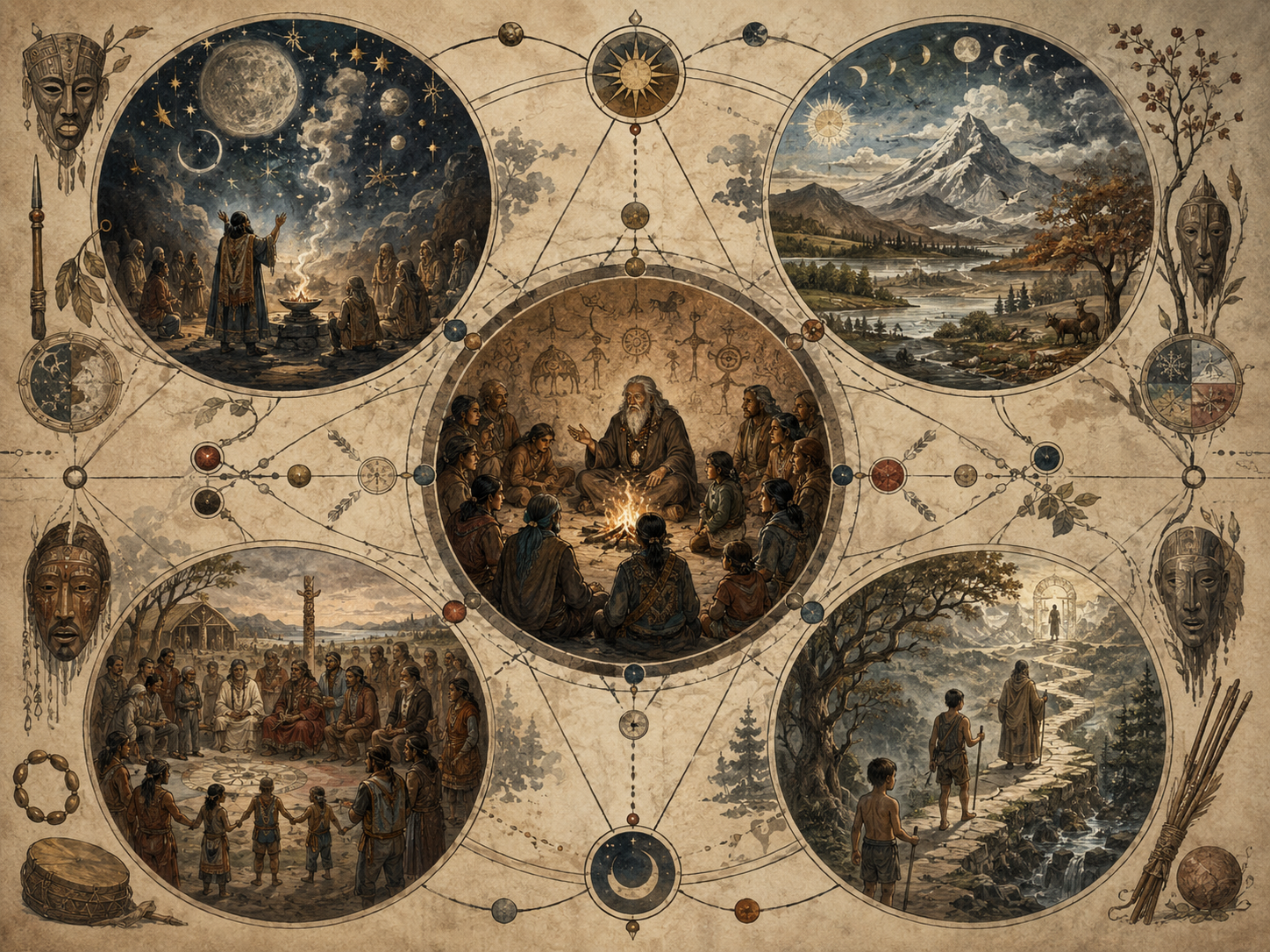
This article treats Campbell’s four functions as a framework for understanding the cultural work of story rather than a rigid taxonomy. It examines mystical awe, cosmological world-picture, sociological order, pedagogical life guidance, ritual meaning, cultural authority, ethical risk, institutional storytelling, secular mythmaking, and narrative responsibility. It also includes computational workflows for auditing how stories perform multiple functions, where functions overlap, where social order becomes coercive, and where mythic language supports or distorts public meaning.
Why the Four Functions Matter
The four functions of myth matter because they move myth analysis beyond plot. A myth is not only a sequence of events, a heroic adventure, a sacred tale, or an inherited symbol system. It is also a cultural tool. It helps people interpret existence, imagine reality, organize community, and understand the stages of life.
Campbell’s four-function framework is useful because it asks what myth does. A story may awaken awe, explain why the world is ordered as it is, justify a moral or social code, or guide individuals through fear, maturity, grief, obligation, and death. In many myths, these functions operate together. A creation story may describe the cosmos, authorize ritual, define social roles, and teach human beings how to live within limits.
The framework also matters because myths continue to operate in modern life. Nations tell origin stories. Institutions tell founding stories. Brands tell transformation stories. Movements tell stories of calling, ordeal, and renewal. Families tell stories about who “we” are. Scientific, civic, technological, religious, and political communities all depend on narratives that organize meaning.
| Function | Core question | Cultural work |
|---|---|---|
| Mystical | How does the story awaken awe before existence? | Connects human life to mystery, wonder, reverence, and limits. |
| Cosmological | What picture of reality does the story provide? | Places people inside an ordered world. |
| Sociological | What social order does the story authorize? | Validates norms, roles, obligations, laws, and belonging. |
| Pedagogical | How does the story guide a person through life? | Helps individuals interpret growth, crisis, maturity, suffering, and death. |
The four functions matter because they show that myth is not only remembered. Myth works.
Myth as Cultural Work
To say that myth does cultural work is to say that story helps a community maintain meaning across time. Myth does not merely explain what happened long ago. It tells people what kind of world they inhabit, what powers matter, what obligations are binding, what behaviors are honorable or forbidden, and what human life is for.
This does not mean that every myth is socially good. Myths can sustain courage, solidarity, reverence, and care. They can also justify hierarchy, exclusion, conquest, gender control, violence, or inherited privilege. A functional analysis should therefore be descriptive and ethical. It should ask what work the myth performs and whether that work should be trusted, revised, resisted, or preserved.
The phrase “cultural work of story” is especially useful for modern narrative analysis. It allows us to ask how stories operate in schools, media, churches, courts, movements, nations, companies, families, and digital platforms. Stories do not simply express culture. They help build and maintain it.
| Cultural work | Story mechanism | Review question |
|---|---|---|
| Meaning-making | Connects events to a larger order. | What does the story make meaningful? |
| Memory | Preserves origins, losses, victories, and warnings. | What is remembered, and what is omitted? |
| Authority | Links present rules to sacred, ancestral, historical, or symbolic order. | Who gains legitimacy? |
| Identity | Defines “we,” “they,” belonging, and difference. | Who is included or excluded? |
| Orientation | Shows how to act in crisis, transition, or uncertainty. | What conduct does the story teach? |
| Continuity | Links past, present, and future through narrative pattern. | What future does the story make imaginable? |
Myth is cultural work because it gives structure to memory, authority, identity, and action.
The Mystical Function: Awe Before Mystery
The mystical function of myth awakens awe before the mystery of existence. It does not merely explain the world. It opens the listener or reader to wonder, reverence, terror, gratitude, humility, and the sense that reality exceeds ordinary control. This function points toward what cannot be fully reduced to information.
The mystical function may appear through creation, sacred encounter, miracle, divine presence, cosmic scale, death, birth, silence, landscape, dream, ancestor, ritual, or symbolic image. A story may remind people that life is not exhausted by practical concerns. It may place human beings before forces larger than themselves.
This function is important because not all meaning is instrumental. Communities need stories that do not only tell people what to do, but also deepen the sense that existence is strange, fragile, magnificent, and not entirely mastered. Myth can create a language for reverence where ordinary explanation falls short.
| Mystical feature | How it appears in story | Interpretive question |
|---|---|---|
| Awe | Creation, cosmic vision, sacred presence, overwhelming scale. | What does the story invite people to revere? |
| Mystery | Unanswered origin, sacred silence, paradox, hidden order. | What remains beyond explanation? |
| Humility | Human limits before gods, nature, death, time, or destiny. | What does the story teach about limits? |
| Wonder | Strangeness, beauty, transformation, miracle, symbolic image. | What makes the world feel charged with meaning? |
| Reverence | Ritual respect, taboo, offering, blessing, sacred relation. | What should not be treated casually? |
| Terror | Chaos, death, divine danger, underworld, judgment. | What kind of fear becomes meaningful? |
The mystical function gives story its vertical dimension: the sense that human life stands before mystery.
The Cosmological Function: A Picture of the World
The cosmological function gives a picture of the universe. It helps people imagine how reality is ordered: where the world came from, how the heavens and earth relate, what forces govern life, why seasons change, why death exists, why human beings occupy a particular place, and how nature, gods, ancestors, spirits, animals, and humans fit together.
This function does not operate only as primitive science. A cosmology is a worldview. It may include origin, structure, hierarchy, cycle, relation, and moral ecology. A story of the world’s creation can explain not only physical reality, but also why humans owe respect to land, water, animals, ancestors, or divine law.
Modern societies also tell cosmological stories. Scientific cosmology, ecological crisis narratives, technological progress stories, planetary boundary discourse, space exploration narratives, and systems-thinking frameworks all shape how people imagine reality. These may not be myths in the same sense as sacred narratives, but they still perform orienting work by picturing the world.
| Cosmological feature | Story function | Review question |
|---|---|---|
| Origin | Explains where the world, people, or order came from. | What beginning does the story authorize? |
| Structure | Shows how heavens, earth, underworld, nature, and society relate. | What map of reality is being offered? |
| Cycle | Explains seasons, death, fertility, renewal, or recurrence. | What rhythms organize life? |
| Relation | Places humans among gods, animals, land, ancestors, or cosmos. | What obligations follow from belonging to this world? |
| Limit | Defines boundaries, taboos, mortality, and danger. | What should humans not overstep? |
| Modern worldview | Frames reality through science, ecology, technology, or systems. | What image of the world guides action? |
The cosmological function gives story its world-picture: the imagined order inside which life makes sense.
The Sociological Function: Order, Authority, and Belonging
The sociological function of myth validates and maintains social order. It explains who belongs, who rules, what laws matter, what roles are expected, what duties bind the community, what taboos protect the group, and what forms of behavior are praised or condemned. Myth can make social arrangements feel sacred, ancestral, natural, heroic, or inevitable.
This function is powerful and dangerous. Myth can sustain community, moral responsibility, law, kinship, hospitality, justice, reciprocity, and shared identity. It can also justify inequality, caste, patriarchy, conquest, exclusion, punishment, or inherited power. A story that authorizes social order must always be examined ethically.
The sociological function matters for institutional storytelling as well. Nations, universities, corporations, religions, professions, and social movements all tell stories about origins, founders, trials, values, and mission. These stories do not merely decorate institutional life. They shape belonging, authority, loyalty, and legitimacy.
| Sociological feature | How it works | Ethical question |
|---|---|---|
| Belonging | Defines who counts as part of the group. | Who is excluded? |
| Authority | Links power to origin, ancestry, divine will, sacrifice, or law. | Who benefits from legitimacy? |
| Role | Defines obligations by age, gender, status, kinship, vocation, or office. | Are roles life-giving or coercive? |
| Norm | Names right conduct and wrong conduct. | What behavior is being regulated? |
| Boundary | Separates sacred/profane, insider/outsider, lawful/unlawful. | What violence or care does the boundary produce? |
| Institution | Gives organizations continuity and mission. | Does the story reveal or hide power? |
The sociological function gives myth its institutional force: it turns story into order.
The Pedagogical Function: Guidance Through Life
The pedagogical function of myth helps individuals move through the stages, crises, and responsibilities of life. It teaches people how to face birth, childhood, maturity, sexuality, vocation, failure, marriage, parenthood, grief, aging, death, loss, initiation, and return. It gives narrative form to human passage.
This function is sometimes called psychological because it concerns inner life, development, identity, and meaning. But “pedagogical” is useful because myth teaches. It does not teach only by instruction. It teaches through pattern, image, ordeal, role, ritual, and example. It shows what courage, humility, care, sacrifice, restraint, loyalty, and wisdom may look like under pressure.
The pedagogical function is central to storytelling beyond ancient myth. Coming-of-age stories, memoirs, religious narratives, recovery stories, family stories, school stories, films, games, and public narratives all guide audiences through models of growth and crisis. They show how a person might endure, change, forgive, resist, return, or begin again.
| Life passage | Mythic guidance | Review question |
|---|---|---|
| Childhood | Stories teach wonder, fear, rules, kinship, and belonging. | What world is the child invited to inhabit? |
| Initiation | Trials mark passage into responsibility. | What must be learned before new status is granted? |
| Love and relation | Stories model loyalty, desire, sacrifice, care, and failure. | What kind of relationship does the story honor? |
| Vocation | Calling stories connect work to purpose. | Does calling liberate or exploit? |
| Suffering | Descent stories help interpret pain, grief, exile, and loss. | Does the story avoid romanticizing harm? |
| Death | Afterlife, ancestor, and return stories face mortality. | What does the story make possible in the presence of death? |
The pedagogical function gives myth its developmental power: it helps people learn how to live.
How the Functions Overlap
The four functions rarely operate in isolation. A single myth may awaken awe, picture the world, authorize social order, and guide life passage at the same time. A creation story may be mystical because it evokes wonder, cosmological because it explains the structure of reality, sociological because it authorizes law or kinship, and pedagogical because it teaches humans how to live within limits.
This overlap is important because the functions are analytic lenses, not separate compartments. A myth does not need to be assigned to one function only. Instead, the analyst should ask which functions are strongest, how they interact, and where they come into tension.
For example, a myth’s sociological function may conflict with its pedagogical function. A story may guide individuals toward maturity while also enforcing a social hierarchy that limits them. A cosmological picture may generate ecological responsibility, or it may authorize domination over nature. A mystical story may deepen reverence, or it may be used by institutions to block questioning.
| Functional overlap | Example interaction | Analytic question |
|---|---|---|
| Mystical + cosmological | A creation myth evokes awe while picturing reality. | How does the story connect wonder to world-order? |
| Cosmological + sociological | A world-picture authorizes a social hierarchy or law. | How does the cosmos legitimize society? |
| Sociological + pedagogical | A role story teaches individuals how to inhabit social duties. | Does guidance support growth or enforce compliance? |
| Mystical + pedagogical | A sacred encounter teaches humility, courage, or surrender. | What life lesson emerges from mystery? |
| All four functions | A major myth organizes awe, world, society, and life passage. | What total cultural work does the story perform? |
The functions are strongest when used as a layered reading system rather than a sorting exercise.
Myth, Ritual, and Cultural Memory
Myths often work through ritual. A myth may tell a story of origin, sacrifice, death, renewal, covenant, creation, exile, return, or transformation. Ritual can make that story present in embodied form. It turns memory into practice.
Ritual helps the four functions operate socially. It can awaken awe, align participants with a cosmological order, reinforce communal roles, and guide individuals through transitions. Birth rites, initiation rites, marriage rites, mourning rites, seasonal rites, civic ceremonies, memorials, and institutional rituals all connect story to repeated action.
Cultural memory is the long-term field in which myth and ritual operate. Stories are retold, performed, revised, contested, forgotten, revived, and institutionalized. A functional analysis should ask not only what a myth means in abstraction, but how it is remembered, by whom, for what purpose, and under whose authority.
| Memory practice | Mythic function | Review question |
|---|---|---|
| Ritual performance | Embodies story through action. | Who performs, witnesses, and authorizes the ritual? |
| Seasonal repetition | Aligns human life with cosmic or ecological cycles. | What cycle is being remembered? |
| Commemoration | Preserves loss, sacrifice, victory, or warning. | What memory becomes official? |
| Initiation | Guides status change through ordeal or instruction. | What responsibility follows passage? |
| Institutional ceremony | Connects present members to origin and mission. | Does the ceremony reveal or conceal institutional power? |
| Counter-memory | Challenges dominant myths through alternative remembrance. | Whose suppressed story returns? |
Myth becomes durable when story, ritual, and memory reinforce one another across time.
Myth and Social Power
Because myth can authorize social order, it is inseparable from power. Myths can legitimate kingship, nationhood, kinship, gender roles, property, war, law, caste, occupation, profession, territory, or moral code. They can also resist domination by preserving counter-memory, sustaining oppressed communities, or imagining liberation.
A functional analysis should therefore ask not only what function a myth performs, but for whom. A sociological myth may create solidarity for insiders while excluding outsiders. A pedagogical myth may teach courage while also demanding obedience. A cosmological myth may inspire ecological care or justify human domination. A mystical myth may open awe or be used to silence critique.
The cultural work of myth is never neutral. Stories produce orientation. Orientation shapes action. Action shapes institutions. Institutions shape who has power, whose memory is preserved, whose suffering is recognized, and whose future becomes imaginable.
| Power question | Why it matters | Example concern |
|---|---|---|
| Who tells the story? | Narrative authority shapes interpretation. | Official myth may suppress local memory. |
| Who benefits? | Functional myths often distribute legitimacy. | Founding stories can authorize unequal power. |
| Who is excluded? | Belonging stories create boundaries. | Outsiders may become threats or impurities. |
| What is naturalized? | Myth can make social arrangements seem inevitable. | Hierarchy may be framed as cosmic order. |
| What is forgotten? | Memory is selective. | Violence may disappear from origin stories. |
| What is resisted? | Counter-myths can open alternative futures. | Liberation stories challenge official legitimacy. |
Myth can hold communities together, but it can also hold unjust orders in place.
Modern Secular Myths
Modern societies often imagine themselves as beyond myth, yet secular stories frequently perform mythic functions. National founding stories provide origin and belonging. Scientific narratives offer cosmological orientation. Technological progress stories promise transformation and future redemption. Market stories define value, agency, and success. Organizational stories explain mission and identity. Personal development stories guide individuals through crisis and growth.
These stories may not involve gods or sacred rituals, but they still organize meaning. They provide images of the world, social roles, moral expectations, and life guidance. They tell people what to admire, what to fear, what to pursue, and what to become.
The phrase “secular myth” should be used carefully. It does not mean falsehood. It means a meaning-making story that performs myth-like cultural work. A secular myth may be partly true, partly symbolic, partly ideological, and partly aspirational. The task is not to dismiss it, but to examine its functions and consequences.
| Modern story | Mythic function | Risk |
|---|---|---|
| National founding story | Origin, belonging, sacrifice, destiny. | May erase violence or excluded groups. |
| Technological progress story | Cosmology of innovation and future transformation. | May hide extraction, inequality, or ecological cost. |
| Market success story | Pedagogy of ambition, discipline, and self-making. | May individualize structural conditions. |
| Institutional origin story | Mission, values, continuity, legitimacy. | May turn branding into sacred history. |
| Science communication story | World-picture, evidence, humility before complexity. | May become triumphalist if uncertainty disappears. |
| Public movement story | Collective trial, hope, memory, and transformation. | May overcenter one hero or flatten internal difference. |
Modern life has not escaped myth. It has multiplied the places where mythic functions appear.
Storytelling and Institutions
Institutions depend on stories. A university tells stories about knowledge, service, tradition, and public purpose. A court tells stories about justice, evidence, order, and legitimacy. A hospital tells stories about care, expertise, and healing. A company tells stories about mission, innovation, customer transformation, and values. A government tells stories about sovereignty, public good, and responsibility.
These stories perform mythic functions. They awaken reverence for a mission, offer a picture of the world, authorize roles and rules, and guide members through institutional life. They can strengthen commitment and continuity. They can also mask failure, hide harm, or demand loyalty without accountability.
Institutional storytelling is most responsible when it admits complexity. A strong institutional story does not merely glorify founders, celebrate triumph, and repeat values. It also acknowledges harm, limitation, learning, repair, and accountability. Mythic language becomes dangerous when it makes an institution seem beyond critique.
| Institutional function | Story form | Governance question |
|---|---|---|
| Mystical | Mission, calling, service, vocation, higher purpose. | Does reverence become immunity from critique? |
| Cosmological | Institutional worldview or theory of change. | What reality does the institution claim to understand? |
| Sociological | Roles, norms, values, codes, ceremonies, hierarchy. | Who is empowered or silenced? |
| Pedagogical | Training, mentorship, professional identity, advancement. | What kind of person is the institution forming? |
| Memory | Founders, milestones, crises, reforms, traditions. | What is remembered and what is omitted? |
| Accountability | Repair stories, governance records, public explanation. | Does the institution narrate responsibility honestly? |
Institutions need stories, but institutional stories need governance.
Ethical Risks in Functional Myth Analysis
The four functions can be misused if they make analysts too comfortable with what myths do. Saying that a myth performs a sociological function does not mean the social order it supports is just. Saying that a myth performs a pedagogical function does not mean the lessons it teaches are humane. Saying that a myth performs a cosmological function does not mean its world-picture should be accepted without question.
Another risk is reducing sacred stories to functions. A myth may perform cultural work, but for a community it may also be sacred history, living memory, ritual truth, divine revelation, ancestral relation, or restricted knowledge. Functional analysis should not flatten sacred meaning into external explanation.
A third risk is romanticizing myth itself. Myths are not automatically wise. They can be profound, beautiful, and life-giving. They can also be coercive, exclusionary, manipulative, or violent. Responsible analysis holds both possibilities together.
| Risk | How it appears | Responsible response |
|---|---|---|
| Functional approval | The analyst treats “serves a function” as “is good.” | Separate descriptive function from ethical judgment. |
| Sacred reduction | Living religious stories become analytic objects only. | Respect community meaning, authority, and access limits. |
| Power blindness | Sociological function hides domination. | Ask who benefits, who is excluded, and who is harmed. |
| Romanticizing myth | Myth is treated as inherently healing or wise. | Examine both life-giving and coercive uses. |
| Modern arrogance | Ancient myth is treated as naïve explanation. | Attend to symbolic, ritual, ecological, and social meaning. |
| Institutional mythmaking | Organizations use mythic story to avoid accountability. | Audit omissions, harm, and governance responsibility. |
Functional analysis is useful only when it remains ethically awake.
Examples of the Four Functions in Story
The examples below show how the four functions can be used as layered interpretive lenses rather than as a rigid sorting tool.
Creation story
Weak: The story is treated only as an old explanation of nature.
Stronger: The analysis asks how the story awakens awe, pictures the cosmos, authorizes relation, and teaches humans how to live within limits.
Why it works: It reads cosmology and ethics together.
Hero myth
Weak: The story is reduced to adventure structure.
Stronger: The analysis asks how the hero’s ordeal reveals mystery, restores order, defines communal value, and models life passage.
Why it works: It connects transformation to cultural work.
National founding story
Weak: The story is accepted as shared patriotic memory.
Stronger: The analysis asks what the story remembers, what it forgets, who gains legitimacy, and who is excluded from belonging.
Why it works: It treats sociological function as ethically consequential.
Institutional origin story
Weak: The origin story is treated as brand heritage.
Stronger: The analysis asks how the story defines mission, roles, authority, values, and accountability.
Why it works: It connects storytelling with governance.
Coming-of-age narrative
Weak: The story is treated only as personal growth.
Stronger: The analysis asks how the story teaches life passage, social role, moral choice, and relation to a wider world.
Why it works: It treats pedagogy as cultural, not merely individual.
Technology progress story
Weak: The story is treated as neutral innovation messaging.
Stronger: The analysis asks what future it imagines, what worldview it assumes, whose authority it validates, and what harms it obscures.
Why it works: It identifies modern mythic functions.
The four functions are most useful when they reveal what a story does culturally, ethically, and institutionally.
Mathematics, Computation, and Modeling
The four functions of myth can be modeled as an interpretive audit. A computational workflow cannot decide what a myth means, but it can help track which functions are present, where they overlap, where sociological authority becomes ethically risky, and where modern institutional stories are using mythic structures without accountability.
A myth-function balance score can estimate how evenly the four functions operate:
F_b = 1 – \frac{\sigma(M_y, C_o, S_o, P_e)}{\mu(M_y, C_o, S_o, P_e) + \epsilon}
\]
Interpretation: Function balance \(F_b\) rises when mystical \(M_y\), cosmological \(C_o\), sociological \(S_o\), and pedagogical \(P_e\) functions are all meaningfully present.
A cultural-work score can estimate the overall functional density of a story:
C_w = \frac{M_y + C_o + S_o + P_e + R_m + A_c}{6}
\]
Interpretation: Cultural work \(C_w\) averages the four mythic functions with ritual-memory \(R_m\) and authority-clarity \(A_c\).
A sociological-risk score can estimate whether social-order storytelling requires ethical review:
S_r = H_pw_h + E_xw_e + C_cw_c + O_mw_o + P_iw_p + (1 – A_m)w_a
\]
Interpretation: Sociological risk \(S_r\) rises with hierarchy protection \(H_p\), exclusion \(E_x\), coercive compliance \(C_c\), omission \(O_m\), power invisibility \(P_i\), and weak accountability marking \(A_m\).
An interpretation-readiness score can estimate whether a functional analysis is responsible enough to publish:
I_r = \frac{S_c + C_x + M_l + E_g + A_m + U_n}{6}
\]
Interpretation: Interpretation readiness \(I_r\) averages source context \(S_c\), counterexamples \(C_x\), method limits \(M_l\), ethics governance \(E_g\), accountability marking \(A_m\), and uncertainty notes \(U_n\).
| Modeling task | Interpretive question | Example output |
|---|---|---|
| Function audit | Which of the four functions are active? | Function profile table. |
| Overlap audit | Where do mystical, cosmological, sociological, and pedagogical functions reinforce one another? | Function-overlap matrix. |
| Power audit | Does the sociological function authorize exclusion or hierarchy? | Sociological-risk score. |
| Memory audit | What does the story preserve, omit, or ritualize? | Cultural-memory notes. |
| Institutional audit | Does an organization use mythic language responsibly? | Governance queue. |
| Readiness audit | Are source context, limits, and accountability visible? | Interpretation-readiness score. |
Computation can help make interpretive judgments explicit. It cannot replace cultural knowledge, ethical reflection, or community authority.
Python Workflow: Four-Function Myth Audit
The Python workflow below evaluates mythic function profiles by mystical function, cosmological function, sociological function, pedagogical function, cultural-memory strength, authority clarity, sociological risk, interpretation readiness, and governance priority. The companion repository version extends this into a Catalyst Canvas-ready module with schemas, package-style Python, tests, JSON exports, Canvas cards, markdown governance queues, and reusable four-function analysis templates.
# four_function_myth_audit.py
# Dependency-light workflow for auditing the four functions of myth.

from __future__ import annotations

from dataclasses import dataclass
from pathlib import Path
import csv
import json
from statistics import mean, pstdev

ARTICLE_ROOT = Path(__file__).resolve().parents[1]
OUTPUTS = ARTICLE_ROOT / "outputs"
TABLES = OUTPUTS / "tables"
JSON_DIR = OUTPUTS / "json"
MARKDOWN = OUTPUTS / "markdown"


@dataclass
class MythFunctionClaim:
    item: str
    claim_context: str
    mystical_function: float
    cosmological_function: float
    sociological_function: float
    pedagogical_function: float
    ritual_memory: float
    authority_clarity: float
    hierarchy_protection: float
    exclusion_risk: float
    coercive_compliance: float
    omission_risk: float
    power_invisibility: float
    accountability_marking: float
    source_context: float
    counterexample_inclusion: float
    method_limits: float
    ethics_governance: float
    uncertainty_notes: float
    community_sensitivity: float
    public_consequence: float
    owner: str
    status: str

    def function_balance(self) -> float:
        functions = [
            self.mystical_function,
            self.cosmological_function,
            self.sociological_function,
            self.pedagogical_function,
        ]
        return max(0.0, 1 - (pstdev(functions) / (mean(functions) + 0.0001)))

    def cultural_work(self) -> float:
        return mean([
            self.mystical_function,
            self.cosmological_function,
            self.sociological_function,
            self.pedagogical_function,
            self.ritual_memory,
            self.authority_clarity,
        ])

    def sociological_risk(self) -> float:
        return min(
            1.0,
            self.hierarchy_protection * 0.20
            + self.exclusion_risk * 0.20
            + self.coercive_compliance * 0.18
            + self.omission_risk * 0.16
            + self.power_invisibility * 0.16
            + (1 - self.accountability_marking) * 0.10,
        )

    def interpretation_readiness(self) -> float:
        return mean([
            self.source_context,
            self.counterexample_inclusion,
            self.method_limits,
            self.ethics_governance,
            self.accountability_marking,
            self.uncertainty_notes,
        ])

    def governance_priority_score(self) -> float:
        return min(
            1.0,
            self.sociological_risk() * 0.34
            + self.community_sensitivity * 0.22
            + self.public_consequence * 0.18
            + (1 - self.interpretation_readiness()) * 0.16
            + (1 - self.source_context) * 0.10,
        )

    def review_priority(self) -> str:
        risk = self.sociological_risk()
        readiness = self.interpretation_readiness()
        priority = self.governance_priority_score()

        if self.status == "revise" or risk >= 0.55 or priority >= 0.62 or readiness < 0.55:
            return "high"
        if self.status == "review" or risk >= 0.40 or priority >= 0.48 or readiness < 0.68:
            return "medium"
        return "standard"


def write_csv(path: Path, rows: list[dict[str, object]]) -> None:
    path.parent.mkdir(parents=True, exist_ok=True)
    if not rows:
        raise ValueError(f"No rows to write: {path}")
    with path.open("w", encoding="utf-8", newline="") as handle:
        writer = csv.DictWriter(handle, fieldnames=list(rows[0].keys()))
        writer.writeheader()
        writer.writerows(rows)


def write_json(path: Path, payload: object) -> None:
    path.parent.mkdir(parents=True, exist_ok=True)
    path.write_text(json.dumps(payload, indent=2), encoding="utf-8")


def write_markdown_queue(path: Path, rows: list[dict[str, object]]) -> None:
    path.parent.mkdir(parents=True, exist_ok=True)
    lines = [
        "# Four-Function Myth Governance Queue",
        "",
        "| Item | Context | Cultural work | Balance | Sociological risk | Readiness | Priority |",
        "|---|---|---:|---:|---:|---:|---|",
    ]

    for row in rows:
        lines.append(
            f"| {row['item']} | {row['claim_context']} | "
            f"{row['cultural_work']} | {row['function_balance']} | "
            f"{row['sociological_risk']} | {row['interpretation_readiness']} | "
            f"{row['review_priority']} |"
        )

    path.write_text("\n".join(lines) + "\n", encoding="utf-8")


def main() -> None:
    claims = [
        MythFunctionClaim(
            "Creation story",
            "sacred cosmological narrative",
            0.92, 0.96, 0.72, 0.78, 0.86, 0.82,
            0.34, 0.28, 0.24, 0.36, 0.30, 0.78,
            0.84, 0.76, 0.72, 0.78, 0.70,
            0.82, 0.70,
            "editorial", "active"
        ),
        MythFunctionClaim(
            "National founding story",
            "civic origin narrative",
            0.54, 0.62, 0.92, 0.66, 0.88, 0.86,
            0.70, 0.64, 0.58, 0.78, 0.72, 0.42,
            0.62, 0.50, 0.58, 0.56, 0.54,
            0.88, 0.92,
            "civic review", "review"
        ),
        MythFunctionClaim(
            "Coming-of-age myth",
            "life-passage teaching narrative",
            0.68, 0.58, 0.62, 0.92, 0.72, 0.66,
            0.28, 0.24, 0.30, 0.34, 0.26, 0.80,
            0.76, 0.78, 0.74, 0.72, 0.78,
            0.54, 0.62,
            "story review", "active"
        ),
        MythFunctionClaim(
            "Institutional origin story",
            "organizational mission narrative",
            0.50, 0.58, 0.88, 0.74, 0.80, 0.86,
            0.62, 0.48, 0.56, 0.68, 0.74, 0.38,
            0.52, 0.46, 0.50, 0.54, 0.48,
            0.70, 0.86,
            "governance", "review"
        ),
        MythFunctionClaim(
            "Technology progress myth",
            "secular future narrative",
            0.46, 0.84, 0.76, 0.70, 0.58, 0.74,
            0.58, 0.52, 0.50, 0.72, 0.86, 0.34,
            0.50, 0.42, 0.48, 0.44, 0.50,
            0.76, 0.90,
            "technology ethics", "revise"
        ),
    ]

    rows = []

    for claim in claims:
        rows.append({
            "item": claim.item,
            "claim_context": claim.claim_context,
            "mystical_function": round(claim.mystical_function, 3),
            "cosmological_function": round(claim.cosmological_function, 3),
            "sociological_function": round(claim.sociological_function, 3),
            "pedagogical_function": round(claim.pedagogical_function, 3),
            "function_balance": round(claim.function_balance(), 3),
            "cultural_work": round(claim.cultural_work(), 3),
            "sociological_risk": round(claim.sociological_risk(), 3),
            "interpretation_readiness": round(claim.interpretation_readiness(), 3),
            "governance_priority_score": round(claim.governance_priority_score(), 3),
            "review_priority": claim.review_priority(),
            "owner": claim.owner,
            "status": claim.status,
        })

    priority_order = {"high": 3, "medium": 2, "standard": 1}
    rows = sorted(
        rows,
        key=lambda row: (
            priority_order.get(str(row["review_priority"]), 0),
            float(row["sociological_risk"])
        ),
        reverse=True,
    )

    governance_queue = [row for row in rows if row["review_priority"] != "standard"]

    write_csv(TABLES / "four_function_myth_audit.csv", rows)
    write_csv(TABLES / "four_function_myth_governance_queue.csv", governance_queue)

    write_json(JSON_DIR / "four_function_myth_canvas_cards.json", rows)
    write_json(JSON_DIR / "four_function_myth_governance_queue.json", governance_queue)

    write_markdown_queue(MARKDOWN / "four_function_myth_governance_queue.md", governance_queue)

    print("Four-function myth audit complete.")


if __name__ == "__main__":
    main()
This workflow helps distinguish functional myth analysis from uncritical approval, institutional mythology, power blindness, and sacred reduction.
R Workflow: Myth Function Diagnostics
The R workflow below creates a synthetic four-function myth dataset, calculates function balance, cultural work, sociological risk, interpretation readiness, governance priority, and review priority, then exports summary tables and base R plots. It is intentionally portable and uses only base R.
# four_function_myth_diagnostics.R
# Base R workflow for auditing the four functions of myth.

args <- commandArgs(trailingOnly = FALSE)
file_arg <- grep("^--file=", args, value = TRUE)

if (length(file_arg) > 0) {
  script_path <- normalizePath(sub("^--file=", "", file_arg[1]), mustWork = TRUE)
  article_root <- normalizePath(file.path(dirname(script_path), ".."), mustWork = TRUE)
} else {
  article_root <- getwd()
}

setwd(article_root)

tables_dir <- file.path(article_root, "outputs", "tables")
figures_dir <- file.path(article_root, "outputs", "figures")
dir.create(tables_dir, recursive = TRUE, showWarnings = FALSE)
dir.create(figures_dir, recursive = TRUE, showWarnings = FALSE)

claims <- data.frame(
  item = c(
    "Creation story",
    "National founding story",
    "Coming-of-age myth",
    "Institutional origin story",
    "Technology progress myth"
  ),
  claim_context = c(
    "sacred cosmological narrative",
    "civic origin narrative",
    "life-passage teaching narrative",
    "organizational mission narrative",
    "secular future narrative"
  ),
  mystical_function = c(0.92, 0.54, 0.68, 0.50, 0.46),
  cosmological_function = c(0.96, 0.62, 0.58, 0.58, 0.84),
  sociological_function = c(0.72, 0.92, 0.62, 0.88, 0.76),
  pedagogical_function = c(0.78, 0.66, 0.92, 0.74, 0.70),
  ritual_memory = c(0.86, 0.88, 0.72, 0.80, 0.58),
  authority_clarity = c(0.82, 0.86, 0.66, 0.86, 0.74),
  hierarchy_protection = c(0.34, 0.70, 0.28, 0.62, 0.58),
  exclusion_risk = c(0.28, 0.64, 0.24, 0.48, 0.52),
  coercive_compliance = c(0.24, 0.58, 0.30, 0.56, 0.50),
  omission_risk = c(0.36, 0.78, 0.34, 0.68, 0.72),
  power_invisibility = c(0.30, 0.72, 0.26, 0.74, 0.86),
  accountability_marking = c(0.78, 0.42, 0.80, 0.38, 0.34),
  source_context = c(0.84, 0.62, 0.76, 0.52, 0.50),
  counterexample_inclusion = c(0.76, 0.50, 0.78, 0.46, 0.42),
  method_limits = c(0.72, 0.58, 0.74, 0.50, 0.48),
  ethics_governance = c(0.78, 0.56, 0.72, 0.54, 0.44),
  uncertainty_notes = c(0.70, 0.54, 0.78, 0.48, 0.50),
  community_sensitivity = c(0.82, 0.88, 0.54, 0.70, 0.76),
  public_consequence = c(0.70, 0.92, 0.62, 0.86, 0.90),
  owner = c("editorial", "civic review", "story review", "governance", "technology ethics"),
  status = c("active", "review", "active", "review", "revise"),
  stringsAsFactors = FALSE
)

function_matrix <- claims[, c(
  "mystical_function",
  "cosmological_function",
  "sociological_function",
  "pedagogical_function"
)]

claims$function_balance <- apply(function_matrix, 1, function(row) {
  avg <- mean(row)
  sd_value <- sqrt(mean((row - avg)^2))
  max(0, 1 - (sd_value / (avg + 0.0001)))
})

claims$cultural_work <- rowMeans(claims[, c(
  "mystical_function",
  "cosmological_function",
  "sociological_function",
  "pedagogical_function",
  "ritual_memory",
  "authority_clarity"
)])

claims$sociological_risk <- pmin(
  1,
  claims$hierarchy_protection * 0.20 +
    claims$exclusion_risk * 0.20 +
    claims$coercive_compliance * 0.18 +
    claims$omission_risk * 0.16 +
    claims$power_invisibility * 0.16 +
    (1 - claims$accountability_marking) * 0.10
)

claims$interpretation_readiness <- rowMeans(claims[, c(
  "source_context",
  "counterexample_inclusion",
  "method_limits",
  "ethics_governance",
  "accountability_marking",
  "uncertainty_notes"
)])

claims$governance_priority_score <- pmin(
  1,
  claims$sociological_risk * 0.34 +
    claims$community_sensitivity * 0.22 +
    claims$public_consequence * 0.18 +
    (1 - claims$interpretation_readiness) * 0.16 +
    (1 - claims$source_context) * 0.10
)

claims$review_priority <- ifelse(
  claims$status == "revise" | claims$sociological_risk >= 0.55 | claims$governance_priority_score >= 0.62 | claims$interpretation_readiness < 0.55,
  "high",
  ifelse(
    claims$status == "review" | claims$sociological_risk >= 0.40 | claims$governance_priority_score >= 0.48 | claims$interpretation_readiness < 0.68,
    "medium",
    "standard"
  )
)

claims <- claims[order(claims$sociological_risk, decreasing = TRUE), ]

write.csv(
  claims,
  file.path(tables_dir, "four_function_myth_diagnostics.csv"),
  row.names = FALSE
)

governance_queue <- claims[claims$review_priority != "standard", ]

write.csv(
  governance_queue,
  file.path(tables_dir, "four_function_myth_governance_queue.csv"),
  row.names = FALSE
)

png(file.path(figures_dir, "four_function_cultural_work_scores.png"), width = 1200, height = 700)
barplot(
  claims$cultural_work,
  names.arg = claims$item,
  las = 2,
  ylab = "Cultural work",
  main = "Four-Function Myth Cultural Work Scores"
)
grid()
dev.off()

png(file.path(figures_dir, "four_function_sociological_risk_scores.png"), width = 1200, height = 700)
barplot(
  claims$sociological_risk,
  names.arg = claims$item,
  las = 2,
  ylab = "Sociological risk",
  main = "Four-Function Myth Sociological Risk Scores"
)
grid()
dev.off()

png(file.path(figures_dir, "four_function_balance_scores.png"), width = 1200, height = 700)
barplot(
  claims$function_balance,
  names.arg = claims$item,
  las = 2,
  ylab = "Function balance",
  main = "Four-Function Myth Balance Scores"
)
grid()
dev.off()

print(claims[, c(
  "item",
  "claim_context",
  "function_balance",
  "cultural_work",
  "sociological_risk",
  "interpretation_readiness",
  "review_priority"
)])
This workflow turns myth-function analysis into a reviewable diagnostic process while preserving the central point: the question is not only what a myth means, but what cultural work it performs.
GitHub Repository
The companion repository for this article supports four-function myth analysis as a Catalyst Canvas-ready module. It includes function-profile scoring, cultural-work diagnostics, sociological-risk review, interpretation-readiness checks, source-context review, counterexample tracking, institutional-story analysis, JSON schemas, package-style Python, R workflows, SQL structures, Canvas cards, markdown governance queues, synthetic datasets, documentation, and reusable myth-function templates.
Complete Code Repository
Companion repository for the article, including Catalyst Canvas-ready code for four-function myth analysis, cultural-work scoring, sociological-risk review, institutional myth audits, governance queues, JSON exports, Canvas cards, and reproducible research workflows.
articles/the-four-functions-of-myth-and-the-cultural-work-of-story/
├── canvas/
│   ├── canvas_manifest.json
│   ├── input_schema.json
│   ├── output_schema.json
│   ├── canvas_cards.json
│   └── governance_queue.json
├── html/
├── css/
├── php/
├── java/
├── python/
│   ├── four_function_myth_canvas/
│   │   ├── __init__.py
│   │   ├── __main__.py
│   │   ├── cli.py
│   │   ├── models.py
│   │   ├── scoring.py
│   │   ├── validation.py
│   │   ├── governance.py
│   │   └── exporters.py
│   ├── tests/
│   │   └── test_four_function_myth_canvas.py
│   └── run_four_function_myth_canvas_audit.py
├── r/
│   ├── four_function_myth_diagnostics.R
│   └── run_all_four_function_myth_workflows.R
├── sql/
│   ├── canvas_schema.sql
│   └── canvas_queries.sql
├── docs/
│   ├── article_notes.md
│   ├── modeling_principles.md
│   ├── mystical_function.md
│   ├── cosmological_function.md
│   ├── sociological_function.md
│   ├── pedagogical_function.md
│   ├── cultural_work.md
│   ├── institutional_myth.md
│   ├── ethical_risk.md
│   ├── responsible_use.md
│   └── governance_notes.md
├── data/
│   ├── four_function_myth_claims.csv
│   ├── function_profiles.csv
│   ├── cultural_work_notes.csv
│   ├── sociological_risk_notes.csv
│   ├── institutional_myth_notes.csv
│   └── four_function_governance_notes.csv
├── outputs/
│   ├── figures/
│   ├── json/
│   ├── markdown/
│   └── tables/
├── notebooks/
├── shared/
│   ├── schemas/
│   ├── narrative-templates/
│   ├── story-archetypes/
│   ├── character-models/
│   ├── plot-structures/
│   ├── rhetorical-frameworks/
│   ├── cultural-memory/
│   ├── myth-functions/
│   └── governance/
├── tests/
└── README.md
Related Articles
- Myth, Ritual, and the Symbolic Work of Story
- Joseph Campbell and the Comparative Study of Myth
- The Monomyth: What Campbell Actually Argued
- The Hero’s Journey: Departure, Initiation, and Return
- Thresholds, Trials, and Transformative Ordeals
- Sacred History and Revelatory Narrative
A Practical Method for Analyzing Mythic Functions
1. Identify the story and its context
Document tradition, community, source, performance context, ritual use, historical setting, and interpretive authority.
2. Evaluate the mystical function
Ask how the story awakens awe, mystery, reverence, humility, terror, wonder, or awareness of limits.
3. Evaluate the cosmological function
Ask what world-picture the story offers: origin, structure, relation, cycle, order, nature, cosmos, or reality.
4. Evaluate the sociological function
Ask what social order, role, norm, hierarchy, boundary, obligation, or institution the story validates.
5. Evaluate the pedagogical function
Ask how the story guides individuals through growth, crisis, responsibility, suffering, aging, death, or return.
6. Look for overlap
Most myths perform multiple functions at once. Identify reinforcement and tension between functions.
7. Audit power
Ask who benefits from the story’s authority, who is excluded, what is omitted, and what social order becomes naturalized.
8. Preserve sacred and cultural specificity
Do not reduce living sacred stories, oral traditions, or community narratives to external analytic categories only.
9. Compare modern uses
Ask whether national, institutional, technological, or brand stories are performing myth-like functions.
10. Mark limits
State what the functional lens reveals, what it hides, and where other interpretive frameworks are needed.
This method treats Campbell’s four functions as a disciplined reading tool, not a final explanation of myth.
Common Pitfalls
Several pitfalls appear when the four functions are used carelessly.
- Sorting instead of interpreting: The analyst assigns one function and stops reading.
- Functional approval: The analyst assumes that because a myth performs a function, the function is ethically good.
- Sacred reduction: Living religious or oral narratives are flattened into analytic categories.
- Power blindness: The sociological function is described without asking who benefits or who is harmed.
- Cosmology as naïve science: World-picture stories are treated only as failed scientific explanation.
- Pedagogy as compliance: Life guidance is confused with obedience to social order.
- Institutional mythmaking: Organizations use origin stories to avoid accountability.
- Modern myth denial: Secular stories are assumed to be free of mythic function.
- Overgeneralization: Campbell’s framework is treated as sufficient for all myth analysis.
- Ignoring counter-myths: Alternative memories, suppressed stories, and resistance narratives are overlooked.
The central pitfall is treating cultural function as cultural innocence.
Why the Cultural Work of Myth Still Matters
The four functions of myth still matter because stories continue to organize life. People need stories that awaken awe, picture reality, define belonging, and guide human passage. These needs have not disappeared in modern society. They have moved into new forms: national narratives, institutional missions, scientific world-pictures, technological futures, social movements, media franchises, family memories, and personal identity stories.
Campbell’s framework is valuable because it asks what myth does. It shows that story is not only aesthetic or symbolic. Story can orient a community toward mystery, world, order, and life. It can preserve memory, authorize institutions, teach conduct, and guide people through crisis.
But the framework must be used responsibly. Mythic function can sustain dignity, courage, and reverence. It can also justify exclusion, hierarchy, coercion, and power. The cultural work of story is never ethically neutral. The task is not to abandon myth, but to read it with care: what does this story make sacred, what world does it picture, what order does it authorize, what life does it teach, and what responsibility follows from believing it?
Further Reading
- Campbell, J. (1949) The Hero with a Thousand Faces. New York: Pantheon Books.
- Campbell, J. (1964) The Masks of God: Occidental Mythology. New York: Viking Press.
- Campbell, J. and Moyers, B. (1988) The Power of Myth. New York: Doubleday.
- Joseph Campbell Foundation (n.d.) Joseph Campbell’s Four Functions of Myth. Available at: https://www.jcf.org/learn/joseph-campbell-four-functions-of-myth
- Britannica (2026) Joseph Campbell. Available at: https://www.britannica.com/biography/Joseph-Campbell-American-author
- Eliade, M. (1959) The Sacred and the Profane: The Nature of Religion. New York: Harcourt.
- Jung, C.G. (1969) The Archetypes and the Collective Unconscious. 2nd edn. Princeton: Princeton University Press.
- Segal, R.A. (1999) Theorizing About Myth. Amherst: University of Massachusetts Press.
- Turner, V. (1969) The Ritual Process: Structure and Anti-Structure. Chicago: Aldine.
References
- Campbell, J. (1949) The Hero with a Thousand Faces. New York: Pantheon Books.
- Campbell, J. (1964) The Masks of God: Occidental Mythology. New York: Viking Press.
- Campbell, J. and Moyers, B. (1988) The Power of Myth. New York: Doubleday.
- Joseph Campbell Foundation (n.d.) Joseph Campbell’s Four Functions of Myth. Available at: https://www.jcf.org/learn/joseph-campbell-four-functions-of-myth
- Britannica (2026) Joseph Campbell. Available at: https://www.britannica.com/biography/Joseph-Campbell-American-author
- Eliade, M. (1959) The Sacred and the Profane: The Nature of Religion. New York: Harcourt.
- Jung, C.G. (1969) The Archetypes and the Collective Unconscious. 2nd edn. Princeton: Princeton University Press.
- Segal, R.A. (1999) Theorizing About Myth. Amherst: University of Massachusetts Press.
- Turner, V. (1969) The Ritual Process: Structure and Anti-Structure. Chicago: Aldine.