
Last Updated June 3, 2026
Planetary boundaries and future pathways examine whether human development can remain within the biophysical conditions that make stable civilization, ecological resilience, and long-term human wellbeing possible. The planetary-boundaries framework reframes sustainability as a question of Earth-system operating space rather than isolated environmental management. It asks whether climate, biodiversity, land systems, freshwater, nutrient cycles, ocean chemistry, atmospheric systems, pollution, and novel entities are being pushed beyond thresholds where ecological feedbacks become harder to predict, govern, or reverse.
Future pathways are the strategic choices societies make inside that constrained operating space. They include energy transition, land-use change, food systems, water governance, biodiversity protection, circular economy, infrastructure planning, public finance, trade, technology, social protection, consumption patterns, democratic participation, and global cooperation. A pathway is not merely a scenario. It is a structured trajectory of decisions, investments, institutions, incentives, and social priorities that either reduce systemic pressure or deepen long-term fragility.
The central challenge is that planetary limits are not external to economics, politics, technology, or social justice. They are the material conditions within which all future development must operate. A society can ignore planetary boundaries temporarily, but it cannot escape the consequences of degrading climate stability, biosphere integrity, freshwater systems, soils, nutrient cycles, oceans, and atmospheric functions. Futures thinking helps translate those limits into strategic choices before ecological thresholds narrow the range of humane options.
This article examines planetary boundaries and future pathways through Earth-system stability, ecological thresholds, climate change, biosphere integrity, land-system change, freshwater stress, nutrient loading, ocean acidification, atmospheric aerosols, novel entities, social foundations, development pathways, justice, governance, risk, scenario planning, and reproducible computational workflows for evaluating pathway pressure and resilience.
Main Library
Publications
Article Map
Futures Thinking
Related Topic
Systems Thinking
Related Topic
Resilience Thinking
Related Topic
Environmental Monitoring
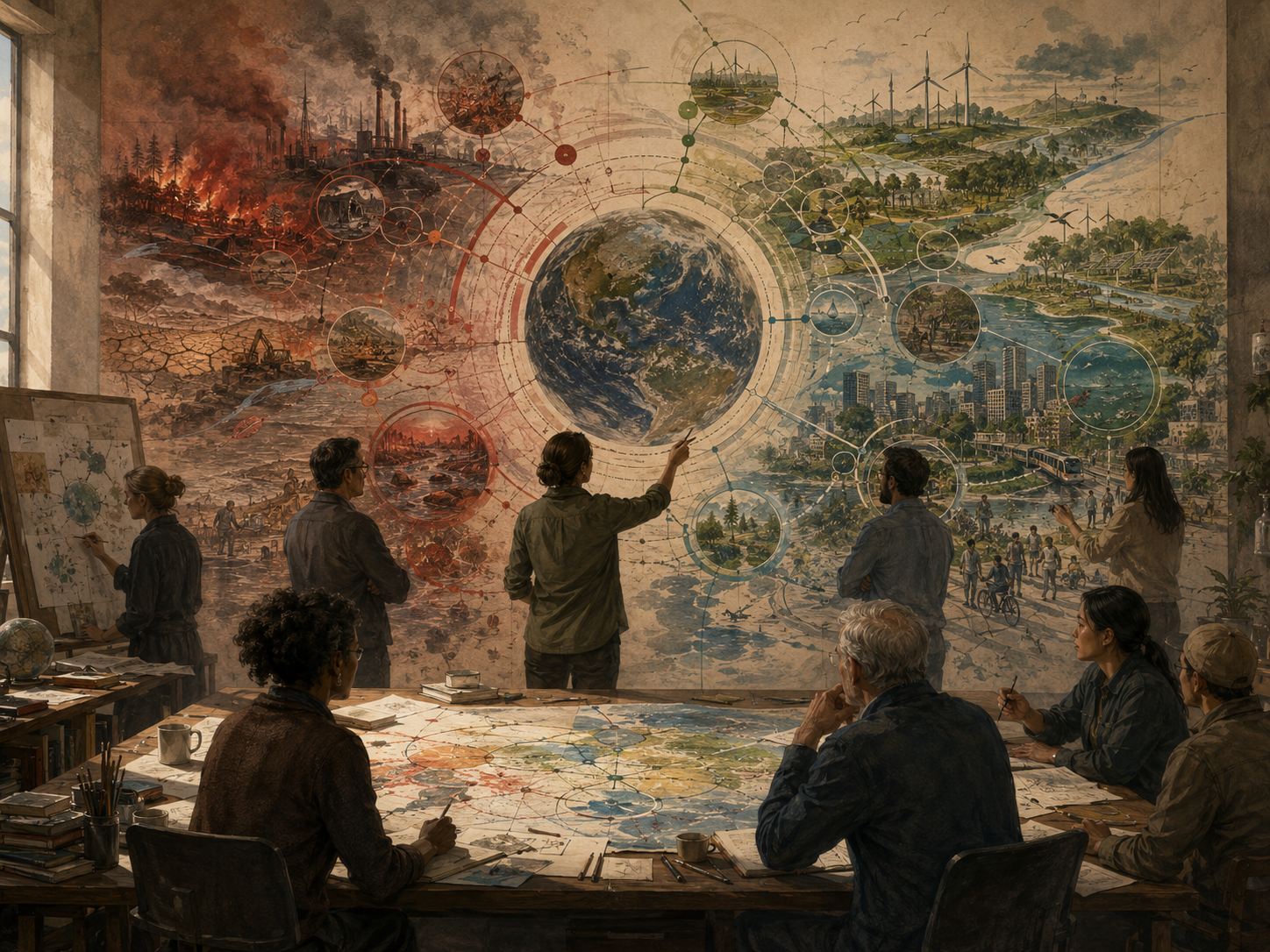
Planetary Boundaries as Earth-System Guardrails
The planetary-boundaries framework identifies critical Earth-system processes that regulate the stability, resilience, and habitability of the planet. These processes are not isolated environmental variables. They are interdependent conditions that support climate regulation, freshwater cycling, biosphere function, soil formation, nutrient circulation, ocean chemistry, atmospheric composition, and ecological feedback.
The framework’s central contribution is that it shifts sustainability analysis from damage accounting to systemic risk. Instead of asking only how much pollution, deforestation, species loss, emissions, or extraction has occurred, it asks whether human activity is pushing Earth systems beyond thresholds where feedbacks may become nonlinear, irreversible on human timescales, or difficult to manage through ordinary institutions.
Planetary boundaries are not arbitrary environmental preferences. They are risk thresholds for the Earth systems that support human societies. They do not imply that every place experiences risk in the same way. Local and regional conditions matter. But they make clear that cumulative human pressure can destabilize the biophysical systems upon which food, water, health, infrastructure, economies, and political stability depend.
| Planetary Boundary | Earth-System Function | Future Risk if Transgressed |
|---|---|---|
| Climate change | Regulates temperature, hydrology, sea level, weather patterns, and energy balance. | Heat stress, extreme events, sea-level rise, food disruption, migration, tipping risk. |
| Biosphere integrity | Supports biodiversity, ecological resilience, pollination, food webs, and ecosystem function. | Extinction, ecosystem collapse, reduced resilience, disease shifts, food-system vulnerability. |
| Land-system change | Maintains forests, grasslands, wetlands, soils, carbon storage, and hydrological regulation. | Deforestation, habitat fragmentation, carbon loss, flood risk, soil degradation. |
| Freshwater change | Supports rivers, lakes, aquifers, wetlands, agriculture, cities, sanitation, and ecosystems. | Scarcity, groundwater depletion, flood volatility, ecosystem decline, allocation conflict. |
| Biogeochemical flows | Regulates nitrogen and phosphorus cycles essential to life and agriculture. | Eutrophication, dead zones, water pollution, soil imbalance, ecological disruption. |
| Ocean acidification | Maintains marine chemistry necessary for corals, shell-forming organisms, and ocean food webs. | Marine ecosystem disruption, fishery stress, coral loss, coastal livelihood risk. |
| Atmospheric aerosols | Affect air quality, climate forcing, monsoons, health, and regional atmospheric systems. | Respiratory illness, altered rainfall, regional climate disruption, unequal health burden. |
| Novel entities | Tracks synthetic chemicals, plastics, pollutants, radioactive materials, and industrial compounds. | Toxic accumulation, unknown ecological effects, health risk, governance overload. |
| Stratospheric ozone | Protects life from harmful ultraviolet radiation. | Human health impacts, crop damage, ecosystem stress if protection fails. |
Planetary boundaries are best understood as a systems-warning framework. They do not provide a complete political program, but they identify where human systems are increasing the probability of destabilizing Earth-system functions. Future pathways are the governance, economic, technological, and social choices that either reduce those pressures or intensify them.
Future Pathways and the Safe Operating Space
The idea of a safe operating space is not a promise of perfect safety. It is a risk-management concept. It means that societies should organize development in ways that avoid pushing Earth-system processes into zones of heightened instability. Inside that operating space, human flourishing is still shaped by justice, politics, culture, technology, institutions, and economics. But outside it, ecological feedbacks become more dangerous, expensive, and difficult to govern.
Future pathways describe how societies move through time in relation to that operating space. A pathway includes energy systems, food systems, infrastructure, urbanization, land use, water management, consumption, technology, public finance, trade, labor, social protection, and governance. The same planetary outcome can rarely be achieved through one sector alone. Climate stabilization requires energy transition, land stewardship, industrial transformation, finance, behavior, infrastructure, and governance. Biodiversity recovery requires land-use change, food-system reform, protected areas, Indigenous rights, restoration, pollution control, and market redesign.
A future pathway is not merely a forecast of what might happen. It is a pattern of commitments that changes what remains possible later. Every pathway locks in infrastructure, incentives, skills, habits, expectations, and political coalitions. Fossil-intensive pathways produce one future option space. Regenerative land-use pathways produce another. Financialized, extractive pathways produce one distribution of risk. Rights-based, resilience-oriented pathways produce another.
| Pathway Type | Development Logic | Boundary Pressure | Social Risk |
|---|---|---|---|
| Extractive growth pathway | Expands production and consumption through material throughput, fossil energy, land conversion, and resource extraction. | High pressure across climate, land, biodiversity, water, nutrients, and novel entities. | Unequal benefit, ecological debt, future instability, vulnerability transfer. |
| Technological substitution pathway | Relies heavily on efficiency, clean technology, digital systems, and substitution without deep institutional change. | Can reduce some pressures while increasing mineral demand, rebound effects, and novel risks. | Unequal access, vendor dependency, false confidence, delayed structural reform. |
| Green growth pathway | Attempts to reconcile economic expansion with decarbonization, efficiency, and ecological protection. | May reduce climate pressure if rapid enough but can struggle with material throughput and land pressure. | Transition inequality if benefits and costs are unevenly distributed. |
| Regenerative development pathway | Centers ecological restoration, circular systems, low-carbon infrastructure, rights, sufficiency, and resilience. | Reduces multiple boundary pressures through systemic redesign. | Requires institutional capacity, political legitimacy, and fair transition support. |
| Fragmented crisis pathway | Responds reactively to shocks without coordinated transformation. | Boundary pressure remains high while adaptation becomes uneven and emergency-driven. | Authoritarian response, abandonment, migration stress, social conflict. |
| Just transition pathway | Links ecological transition with labor protections, social rights, public investment, and democratic participation. | Can reduce boundary pressure while maintaining social legitimacy. | Requires coordination, finance, trust, and anti-capture safeguards. |
The safe operating space must also be joined to social foundations. A pathway that reduces emissions by creating poverty, displacement, hunger, or authoritarian control is not a humane future. A pathway that improves human wellbeing while destroying Earth-system stability is not durable. The future challenge is to remain within ecological ceilings while securing the social foundations of dignity, health, food, water, shelter, education, participation, and livelihood.
Climate Change and Systemic Risk
Climate change is the most visible planetary boundary because it affects nearly every other future domain: food, water, health, infrastructure, cities, migration, biodiversity, insurance, public finance, labor productivity, conflict risk, and geopolitical stability. It is not only an environmental issue. It is a systemic risk multiplier.
Climate instability changes the operating conditions for human systems. Heat waves affect health and labor. Drought affects agriculture, water supply, hydropower, ecosystems, and food prices. Floods damage infrastructure, housing, transport, and public budgets. Wildfire affects forests, air quality, insurance, energy systems, and settlement patterns. Sea-level rise alters coastal land, ports, migration, property markets, wastewater systems, and national planning.
Climate change is a boundary because it destabilizes the background conditions that societies have treated as relatively stable. It turns historical design assumptions into unreliable guides for future infrastructure, agriculture, public health, finance, and emergency planning.
| Climate Impact Pathway | Connected Systems | Future Consequence |
|---|---|---|
| Extreme heat | Health, labor, energy, food production, cities, transport, schools. | Mortality, reduced productivity, cooling demand, grid stress, unequal exposure. |
| Drought | Agriculture, water supply, ecosystems, hydropower, food prices, migration. | Food insecurity, aquifer depletion, rural distress, allocation conflict. |
| Flooding | Housing, infrastructure, sanitation, transport, insurance, public finance. | Displacement, contamination, fiscal stress, unequal recovery. |
| Sea-level rise | Coasts, ports, wastewater, property, migration, national security. | Managed retreat, asset loss, salinization, coastal infrastructure crisis. |
| Wildfire | Forests, energy grids, air quality, housing, emergency response, insurance. | Evacuation, smoke exposure, grid failure, long-term settlement risk. |
| Compound events | Multiple systems under simultaneous stress. | Cascading failure across food, water, health, infrastructure, and governance. |
Future pathways must therefore reduce climate forcing while also adapting to the damage already locked in. Mitigation and adaptation are not substitutes. Mitigation reduces future planetary pressure. Adaptation protects communities under changed conditions. A just pathway must do both while preventing adaptation from becoming a privilege of wealthy communities and abandonment for everyone else.
Biosphere Integrity and Ecological Resilience
Biosphere integrity refers to the capacity of living systems to maintain ecological functions, species diversity, genetic diversity, food webs, habitat structure, and resilience under disturbance. It is one of the deepest planetary boundaries because biodiversity is not decorative. It is functional infrastructure for life: pollination, nutrient cycling, pest regulation, seed dispersal, soil formation, carbon storage, water filtration, disease regulation, fisheries, forests, and ecosystem recovery.
When biodiversity declines, ecosystems become less able to absorb shocks. A simplified agricultural landscape may appear productive in the short term but become vulnerable to pests, disease, soil depletion, water stress, and climate variability. A fragmented forest may store less carbon, support fewer species, regulate water poorly, and become more fire-prone. A depleted ocean may lose food-web stability, fishery productivity, and coastal protection.
Biosphere integrity is the resilience layer beneath human development. Without functioning ecosystems, human systems must spend more energy and capital replacing services that living systems once provided freely.
| Biosphere Function | Human Dependence | Risk Under Decline |
|---|---|---|
| Pollination | Fruit, nuts, vegetables, seed production, agricultural diversity. | Food-system vulnerability and nutrition decline. |
| Soil formation | Agricultural productivity, water retention, nutrient cycling. | Yield instability, erosion, input dependency. |
| Water regulation | Flood control, groundwater recharge, water quality, drought buffering. | Flood volatility, water scarcity, treatment costs. |
| Carbon storage | Climate regulation through forests, wetlands, soils, oceans. | Accelerated warming and feedback risk. |
| Disease regulation | Ecological balance affecting pathogens, vectors, and host species. | Changed disease ecology and public health risk. |
| Ecosystem recovery | Capacity to regenerate after fire, flood, drought, storm, or disturbance. | Regime shifts and degraded ecological states. |
Future pathways that protect biosphere integrity require more than protected-area percentages. They require habitat connectivity, land rights, Indigenous stewardship, regenerative agriculture, fisheries governance, pollution reduction, invasive species control, restoration finance, reduced overconsumption, and policy systems that value ecological function before collapse makes its value obvious.
Land-System Change and Human Development
Land-system change includes deforestation, wetland drainage, agricultural expansion, urbanization, mining, road building, pasture conversion, infrastructure corridors, and ecosystem fragmentation. Land is where human development becomes spatially visible. It is also where ecological capacity is often lost quietly through cumulative conversion.
Land-use decisions shape climate, biodiversity, water cycling, soil health, food systems, migration, housing, energy, extraction, conservation, and cultural survival. Forests regulate carbon and rainfall. Wetlands buffer floods and support biodiversity. Grasslands store carbon and support pastoral systems. Soils maintain food production and water retention. Urban expansion changes hydrology, heat, habitat, and infrastructure demand.
Land-system change is one of the main ways societies convert ecological resilience into short-term economic value. That conversion can produce growth, food, housing, energy, and infrastructure, but it can also reduce the resilience of the very systems that development depends on.
| Land-System Change | Development Driver | Boundary Pressure | Future Governance Need |
|---|---|---|---|
| Deforestation | Agriculture, timber, mining, roads, settlement, commodity markets. | Climate, biodiversity, freshwater, soil, regional rainfall. | Forest protection, Indigenous rights, supply-chain accountability. |
| Wetland loss | Urban expansion, agriculture, drainage, infrastructure. | Flood risk, biodiversity loss, water-quality decline, carbon release. | Wetland protection, restoration, floodplain governance. |
| Agricultural intensification | Food demand, commodity markets, mechanization, input systems. | Nutrients, water, biodiversity, soil, novel entities. | Regenerative practice, nutrient management, farmer support. |
| Urban expansion | Population growth, housing demand, land speculation, infrastructure. | Land conversion, heat islands, water runoff, habitat fragmentation. | Compact planning, affordable housing, green infrastructure. |
| Energy and mineral development | Fossil extraction, critical minerals, renewable deployment, transmission. | Land conflict, biodiversity pressure, water use, pollution. | Strategic siting, rights protection, lifecycle accountability. |
| Conservation and restoration | Biodiversity, carbon, water regulation, climate adaptation. | Can reduce pressure if rights-based and ecologically sound. | Community governance, anti-displacement safeguards, long-term finance. |
Future land pathways must integrate food, water, biodiversity, climate, housing, energy, livelihoods, and justice. Land cannot be governed as empty space for whichever economic demand is most powerful. It must be treated as a living system and a social foundation.
Freshwater Change and Hydrological Stability
Freshwater change includes alterations in river flows, groundwater, soil moisture, wetlands, lakes, water quality, and the timing and distribution of water across landscapes. It is deeply connected to land use, climate change, agriculture, cities, industry, ecosystems, and public health. Water stress is not only a supply problem. It is a governance, allocation, pollution, infrastructure, and ecological-flow problem.
Groundwater depletion is particularly important because it can hide future scarcity beneath present abundance. Irrigated agriculture, urban growth, and industry can rely on aquifers that recharge slowly or not at all on human timescales. A region may appear food-secure or economically productive while drawing down the water base that makes that productivity possible.
Freshwater stability is a planetary boundary because water is the circulatory system linking climate, land, food, ecosystems, cities, health, and livelihoods.
| Freshwater Pressure | Systemic Cause | Future Risk |
|---|---|---|
| Groundwater depletion | Irrigation, urban demand, industry, weak allocation rules. | Aquifer decline, land subsidence, food-system stress, conflict. |
| River-flow alteration | Dams, diversions, irrigation, hydropower, climate shifts. | Fisheries loss, ecosystem decline, downstream scarcity. |
| Water pollution | Agriculture, sewage, industry, mining, runoff, chemicals. | Public health risk, ecosystem damage, treatment burden. |
| Soil moisture decline | Heat, drought, land degradation, deforestation, poor soil management. | Crop stress, fire risk, reduced resilience. |
| Flood volatility | Extreme rainfall, land-cover change, drainage, floodplain development. | Infrastructure damage, displacement, contamination. |
| Wetland degradation | Drainage, development, pollution, altered hydrology. | Loss of flood buffering, biodiversity, carbon storage, water filtration. |
Freshwater futures require basin-scale governance, demand management, aquifer protection, pollution control, ecological-flow protections, urban water equity, watershed restoration, and transparent allocation before crisis forces emergency decisions. Water must be governed as a shared life-support system, not only as a commodity or engineering problem.
Biogeochemical Flows and Nutrient Overload
Biogeochemical flows refer especially to nitrogen and phosphorus cycles. These nutrients are essential for life and agriculture, but industrial fertilizer production, manure concentration, runoff, wastewater, and land-use change have greatly altered nutrient flows. Too little nutrient access can limit food production. Too much nutrient loading can damage rivers, lakes, coastal waters, soils, and atmospheric systems.
Nutrient overload creates eutrophication, algal blooms, oxygen depletion, dead zones, drinking-water contamination, biodiversity loss, and ecosystem disruption. It also reveals one of the recurring patterns of planetary-boundary risk: a system designed to solve one problem can create another when scaled without ecological feedback. Synthetic fertilizer has supported major increases in food production, but unmanaged nutrient flows can destabilize water systems and coastal ecosystems.
The nutrient boundary shows that sustainability is not only about scarcity. It is also about excess, leakage, and broken cycles.
| Nutrient Issue | Source | Impact | Future Response |
|---|---|---|---|
| Nitrogen runoff | Synthetic fertilizer, manure, intensive agriculture. | Water pollution, algal blooms, nitrous oxide emissions. | Precision nutrient management, soil health, buffers, circular nutrient systems. |
| Phosphorus loading | Fertilizer, manure, wastewater, erosion. | Eutrophication, freshwater and coastal dead zones. | Recovery, recycling, runoff control, wastewater reform. |
| Nutrient inequality | Some regions overapply nutrients while others lack access. | Pollution in some places and soil fertility constraints elsewhere. | Balanced nutrient governance and farmer support. |
| Soil nutrient depletion | Extraction without replenishment, erosion, low organic matter. | Yield decline and input dependency. | Agroecology, compost, cover crops, rotations, organic matter restoration. |
| Wastewater nutrient loss | Urban sanitation systems that treat nutrients as waste. | Pollution and lost circularity potential. | Nutrient recovery and circular sanitation systems. |
Future pathways must close nutrient loops while maintaining food security. This requires changes in fertilizer use, livestock systems, wastewater treatment, soil management, crop rotations, land buffers, public regulation, farmer incentives, and circular economy infrastructure.
Ocean Acidification and Marine Futures
Ocean acidification occurs as oceans absorb carbon dioxide, changing marine chemistry and making it harder for corals, shellfish, plankton, and other organisms to build calcium carbonate structures. This matters because marine ecosystems are not separate from human futures. They support fisheries, coastal protection, climate regulation, biodiversity, cultural life, and livelihoods for millions of people.
Ocean acidification interacts with warming, deoxygenation, pollution, overfishing, coral bleaching, coastal development, and changing currents. These pressures can combine to weaken marine food webs, reduce fishery productivity, damage coral reefs, and increase risk for coastal communities. Marine futures are therefore not only about oceans. They are about food security, trade, labor, culture, coastal infrastructure, tourism, and climate resilience.
Ocean acidification is a planetary-boundary issue because it alters the chemistry of one of Earth’s major life-support systems.
| Marine Pressure | Primary Driver | Future Risk |
|---|---|---|
| Acidification | CO₂ absorption by oceans. | Stress on shell-forming organisms, corals, plankton, and food webs. |
| Ocean warming | Climate change and heat uptake. | Coral bleaching, species migration, fishery disruption. |
| Deoxygenation | Warming, stratification, nutrient pollution. | Dead zones, habitat loss, marine-life stress. |
| Overfishing | Industrial fishing, weak governance, market demand. | Food-web disruption and livelihood loss. |
| Plastic and chemical pollution | Waste systems, industry, consumption, weak regulation. | Toxicity, ingestion, ecosystem stress, uncertain long-term effects. |
| Coastal habitat loss | Development, dredging, pollution, wetland destruction. | Reduced storm protection, nursery habitat loss, biodiversity decline. |
Marine pathways require emissions reduction, coastal protection, fisheries governance, pollution control, habitat restoration, marine protected areas, community rights, and international cooperation. Oceans absorb planetary pressure, but they cannot absorb limitless disruption without consequences.
Atmospheric Aerosols and Air-System Risk
Atmospheric aerosols include tiny particles in the air from combustion, industry, dust, fires, agriculture, and other sources. They affect human health, air quality, clouds, rainfall patterns, regional climate systems, and atmospheric circulation. Aerosols are not distributed evenly. Their harms often fall disproportionately on low-income communities, industrial corridors, workers, children, elderly people, and regions exposed to wildfire smoke, traffic, coal, biomass burning, or industrial pollution.
Aerosols complicate planetary futures because they have both health and climate effects. Some aerosols cool the atmosphere by reflecting sunlight, while others warm it or alter cloud dynamics. Reducing air pollution improves public health, but it must be paired with greenhouse-gas mitigation so that climate benefits are not delayed or confused by aerosol masking effects.
Air-system risk shows that planetary boundaries are also public-health boundaries. Atmospheric systems connect local pollution with regional climate, health inequality, and long-range environmental feedback.
| Aerosol Source | System Effect | Justice Concern |
|---|---|---|
| Fossil combustion | Particulate pollution, climate forcing, respiratory disease. | Communities near power plants, roads, ports, and industrial zones face unequal exposure. |
| Wildfire smoke | Particulate spikes, regional air-quality crises, health burden. | Outdoor workers, elderly people, children, and low-income households are more exposed. |
| Industrial emissions | Local pollution, toxic exposure, atmospheric chemistry effects. | Industrial zoning often concentrates harm in marginalized communities. |
| Agricultural burning | Smoke, particulate matter, regional haze. | Rural communities and workers face chronic exposure. |
| Dust and land degradation | Airborne particles, soil loss, visibility and health impacts. | Dryland communities face linked land and health stress. |
Future pathways should reduce air pollution as part of climate transition, not as a separate public-health issue. Clean energy, transport reform, industrial regulation, wildfire management, land restoration, worker protection, and environmental justice are all part of atmospheric futures.
Novel Entities and Industrial Complexity
Novel entities include synthetic chemicals, plastics, pesticides, pharmaceuticals, industrial compounds, radioactive materials, engineered materials, and other human-made substances that can disrupt ecological and biological systems. This boundary reflects the fact that modern industrial systems generate substances faster than governance systems can fully evaluate, monitor, regulate, or remediate them.
The risk is not only one chemical at a time. It is the scale, mixture, persistence, mobility, accumulation, and uncertainty of industrial material flows. Plastics move through oceans, soils, food webs, and human bodies. Persistent chemicals accumulate in water and tissues. Pesticides affect insects, birds, aquatic systems, soil organisms, and farmworker health. Pharmaceuticals can alter aquatic ecosystems. Industrial compounds can persist long after production stops.
The novel-entities boundary is a governance boundary as much as a pollution boundary. It asks whether societies can control what they create before complexity exceeds institutional capacity.
| Novel Entity Type | Potential System Risk | Governance Challenge |
|---|---|---|
| Plastics and microplastics | Persistence, ingestion, ecosystem contamination, uncertain health effects. | Production control, waste systems, material substitution, global regulation. |
| Persistent chemicals | Bioaccumulation, toxicity, water contamination, long-term exposure. | Precaution, monitoring, phaseout, cleanup liability. |
| Pesticides | Pollinator decline, aquatic toxicity, worker exposure, resistance. | Integrated pest management, farmer support, ecological safeguards. | Pharmaceutical residues | Aquatic effects, antimicrobial resistance, endocrine disruption. | Wastewater treatment, prescribing practices, manufacturing controls. |
| Industrial compounds | Soil, air, water, and biological contamination. | Chemical assessment, disclosure, enforcement, remediation funding. |
| Emerging materials | Unknown ecological and health effects at scale. | Pre-market evaluation and adaptive regulation. |
Future pathways must strengthen precaution, transparency, circular design, producer responsibility, chemical regulation, waste reduction, environmental monitoring, and public right-to-know. A society cannot claim to be sustainable while generating material flows it cannot understand, govern, or safely absorb.
Social Foundations and Just Pathways
Planetary boundaries identify ecological ceilings, but futures must also protect social foundations: food, water, shelter, health, education, energy access, safety, dignity, livelihood, participation, and rights. The challenge is to create pathways that remain within ecological limits while meeting human needs. This is where planetary-boundary thinking must be joined to justice.
Without justice, planetary policy can become coercive, elitist, or exclusionary. Conservation can displace communities. Climate policy can raise costs for poor households if transition support is absent. Land protection can ignore Indigenous sovereignty. Energy transition can reproduce extraction through critical minerals. Carbon markets can create land pressure. Adaptation can protect wealthy assets while leaving vulnerable communities exposed.
A pathway is not sustainable if it reduces planetary pressure by transferring harm onto marginalized people. Just pathways reduce ecological pressure while expanding dignity, capability, participation, and protection for those least responsible for planetary damage and most exposed to its consequences.
| Social Foundation | Planetary Link | Justice Requirement |
|---|---|---|
| Food security | Food systems depend on climate, water, soil, biodiversity, and land. | Nutrition, affordability, farmer livelihoods, rights, public protection. |
| Water and sanitation | Freshwater systems depend on hydrology, land cover, infrastructure, and governance. | Safe, affordable, reliable access for all communities. |
| Energy access | Energy transition affects climate, minerals, land, infrastructure, and livelihoods. | Clean, reliable, affordable energy with labor and community protections. |
| Housing and settlement | Urbanization affects land, water, heat, infrastructure, and emissions. | Affordable, resilient housing outside high-risk exposure where possible. |
| Health | Climate, pollution, food, water, disease ecology, and air quality shape health. | Public health capacity and environmental protection for vulnerable groups. |
| Participation and rights | Pathways require legitimacy, consent, and public accountability. | Communities must shape decisions that affect their futures. |
Just pathways require public finance, social protection, labor transition, community participation, Indigenous rights, anti-displacement safeguards, access to clean infrastructure, and democratic governance. The goal is not austerity for the many and adaptation for the wealthy. The goal is a viable future in which ecological limits and human dignity are treated as inseparable.
Economic Growth, Material Throughput, and Decoupling
One of the hardest questions in planetary-boundary futures is whether economic growth can be sufficiently decoupled from material throughput, energy demand, land pressure, emissions, waste, and ecological damage. Efficiency improvements can reduce pressure per unit of output, but total pressure can still rise if overall production and consumption grow faster than efficiency gains. This is the rebound problem.
Decoupling is not one thing. Carbon decoupling differs from material decoupling. Relative decoupling differs from absolute decoupling. Territorial emissions can fall while consumption-based emissions remain high through imports. A clean-energy transition can reduce fossil emissions while increasing demand for minerals, land, transmission, storage, and industrial processing. Digital systems can dematerialize some activities while expanding data centers, electricity demand, devices, and e-waste.
The future question is not whether efficiency matters. It does. The question is whether efficiency alone can reduce total planetary pressure fast enough, fairly enough, and across enough boundaries.
| Economic Pathway Issue | Risk | Strategic Response |
|---|---|---|
| Relative decoupling | Impact per unit falls while total impact still rises. | Track absolute impacts, not only intensity metrics. |
| Consumption displacement | Impacts are outsourced through imports and supply chains. | Use consumption-based accounting and supply-chain responsibility. |
| Rebound effects | Efficiency lowers cost and increases total use. | Pair efficiency with caps, standards, pricing, and sufficiency policies. |
| Green extraction | Low-carbon systems increase mineral, land, and water demand. | Circular design, recycling, rights protection, strategic material governance. |
| Unequal consumption | High-consuming groups drive disproportionate pressure. | Address luxury emissions and material inequality. |
| Development need | Low-income communities need material investment for dignity and resilience. | Differentiate essential development from wasteful throughput. |
Future pathways must distinguish between material needs that expand dignity and material throughput that deepens ecological instability without improving wellbeing. This requires more serious metrics than GDP alone: health, education, housing, nutrition, resilience, ecological integrity, public trust, inequality, and intergenerational capacity.
Governance Capacity and Planetary Risk
Planetary boundaries create governance challenges because Earth-system risks cross jurisdictions, sectors, time horizons, and political incentives. Climate, biodiversity, oceans, nutrient cycles, chemical pollution, land systems, and freshwater flows do not fit neatly within ministry boundaries, election cycles, property lines, or national borders. Governance systems built for short-term, sectoral decision-making struggle with slow variables, cumulative risk, cross-border externalities, and nonlinear thresholds.
Governance capacity includes monitoring, law, public finance, participation, scientific institutions, enforcement, transparency, coordination, conflict resolution, and the ability to adapt rules as conditions change. It also includes legitimacy. Planetary policy cannot succeed through technical expertise alone if communities experience transition as imposed, unfair, or extractive.
Planetary risk is partly ecological and partly institutional. The danger is not only that Earth systems change, but that governance systems fail to learn, coordinate, and act before thresholds are crossed.
| Governance Challenge | Planetary Boundary Relevance | Failure Mode |
|---|---|---|
| Sector fragmentation | Food, water, energy, land, climate, and biodiversity are governed separately. | Policies solve one problem while worsening another. |
| Short-term incentives | Boundary risks accumulate across decades. | Delayed action and future cost transfer. |
| Weak monitoring | Slow variables and thresholds require data and early warning. | Systems cross danger zones before institutions respond. |
| Unequal power | High-impact actors shape policy while vulnerable groups bear harm. | Capture, injustice, and legitimacy loss. |
| Global coordination gaps | Earth systems cross borders and supply chains. | Free-riding, leakage, conflict, and fragmented standards. |
| Implementation gap | Plans lack budgets, law, capacity, or enforcement. | Scenario theater and policy failure. |
Planetary governance must therefore be anticipatory, adaptive, accountable, and justice-centered. It must link science to policy, policy to finance, finance to implementation, and implementation to public legitimacy. Without that chain, planetary-boundary analysis remains a warning rather than a pathway.
Core Dimensions of Planetary Boundaries and Future Pathways
Planetary boundaries and future pathways can be evaluated across several interacting dimensions. These dimensions should not be treated separately. Climate change affects freshwater, land, food, biodiversity, and health. Biodiversity affects resilience, agriculture, disease ecology, and ecosystem recovery. Land use affects carbon, water, habitat, food, and settlement. Nutrient flows affect water quality, oceans, food production, and public health. A strong pathway is not merely low-carbon. It is ecologically coherent, socially just, institutionally capable, and robust across multiple Earth-system constraints.
1. Earth-System Pressure
Earth-system pressure measures cumulative stress across climate, biodiversity, freshwater, land, nutrients, oceans, aerosols, and novel entities. It asks whether human activity is reducing or increasing the risk of crossing destabilizing thresholds.
2. Pathway Direction
Pathway direction concerns whether a society is moving toward regenerative, circular, low-carbon, rights-based development—or toward extractive growth, crisis response, and delayed transition.
3. Social Foundation Security
Social foundation security evaluates whether people have food, water, energy, housing, health, education, livelihood, safety, and participation while ecological ceilings are respected.
4. Resilience and Adaptive Capacity
Resilience and adaptive capacity assess whether systems can absorb disturbance, learn from feedback, revise assumptions, and avoid collapse or abandonment under ecological stress.
5. Justice and Distribution
Justice and distribution examine who benefits from transition, who bears costs, whose rights are protected, and whether marginalized communities shape decisions affecting their futures.
6. Governance and Implementation
Governance and implementation include institutions, law, public finance, monitoring, enforcement, participation, coordination, and the capacity to convert foresight into action.
7. Technological and Material Realism
Technological and material realism asks whether pathway assumptions account for energy, minerals, land, water, waste, supply chains, rebound effects, and governance limits rather than relying on abstract optimism.
8. Intergenerational Responsibility
Intergenerational responsibility evaluates whether present choices preserve future options, ecological capacity, public institutions, and social foundations for people who inherit the consequences.
| Dimension | Core Question | Failure if Ignored |
|---|---|---|
| Earth-system pressure | Are planetary boundary pressures declining or rising? | Development proceeds while ecological stability erodes. |
| Pathway direction | Does the trajectory reduce extraction and regenerate capacity? | Transition rhetoric masks continued boundary transgression. |
| Social foundations | Are basic needs secured within ecological limits? | Environmental policy becomes unjust or socially unstable. |
| Resilience | Can systems adapt under climate and ecological stress? | Shocks become crises and crises become abandonment. |
| Justice | Who benefits, who pays, who decides, and who is protected? | Transition reproduces inequality and loses legitimacy. |
| Governance | Can institutions coordinate, finance, monitor, and enforce change? | Plans remain aspirational while pressures intensify. |
| Material realism | Are technology, energy, minerals, land, and waste constraints included? | Pathways rely on false substitution and hidden impacts. |
| Intergenerational responsibility | Do present choices preserve future options? | Current gains become future ecological and social debt. |
Planetary pathways are strongest when ecological ceilings, social foundations, justice, governance, resilience, technology, and intergenerational responsibility are evaluated together rather than optimized separately.
Scenario Planning for Planetary Pathways
Planetary futures involve deep uncertainty: climate sensitivity, ecological thresholds, technological adoption, political cooperation, social conflict, economic shocks, migration, financial stability, biodiversity response, food-system resilience, and governance performance. Scenario planning is therefore essential. It does not predict one future. It tests strategies across multiple plausible futures and reveals which assumptions are dangerous.
Scenario planning for planetary pathways should include both physical and social variables. A climate pathway is not only an emissions curve. It includes energy infrastructure, public finance, land politics, mineral supply chains, labor transition, consumption patterns, geopolitical cooperation, and social legitimacy. A biodiversity pathway is not only protected-area coverage. It includes land rights, food systems, restoration, pollution, trade, Indigenous governance, and enforcement.
Planetary scenario work must be linked to decisions. Otherwise, it becomes a sophisticated description of futures that institutions do not actually prepare for.
| Foresight Tool | Planetary Use | Example Application |
|---|---|---|
| Scenario planning | Explores alternative climate, biodiversity, food, water, land, technology, and governance futures. | Comparing green growth, regenerative transition, and crisis-fragmentation pathways. |
| Backcasting | Starts from desired safe-and-just futures and works backward. | Designing policy sequences for low-carbon, biodiversity-positive, socially secure development. |
| Stress testing | Tests systems under severe but plausible compound shocks. | Heat wave plus crop failure plus debt crisis plus migration pressure. |
| Systems mapping | Identifies feedbacks, dependencies, tradeoffs, and unintended consequences. | Mapping energy transition, mineral demand, land conflict, and biodiversity risk. |
| Early warning | Tracks signals of ecological, social, and institutional stress. | Monitoring groundwater, deforestation, food prices, emissions, species decline, and conflict. |
| Participatory foresight | Includes affected communities in defining desirable and unacceptable futures. | Co-designing transition pathways with workers, Indigenous peoples, farmers, and vulnerable communities. |
Good planetary foresight connects scenarios to budgets, law, infrastructure, public procurement, standards, social protection, restoration, monitoring, and accountability. It must shape what institutions do next, not merely how they describe risk.
Planetary Future Scenarios
Planetary futures can unfold across multiple pathways. These scenarios are not predictions. They are structured contexts for testing assumptions about development, technology, justice, governance, ecological pressure, and Earth-system resilience.
| Scenario | Description | Planetary Risk | Strategic Opportunity |
|---|---|---|---|
| Safe and Just Transformation | Ecological ceilings and social foundations are jointly governed through public investment, rights, restoration, and low-carbon systems. | Requires sustained legitimacy, coordination, and finance. | Reduces boundary pressure while expanding dignity and resilience. |
| Green Growth Acceleration | Clean energy, efficiency, technology, and markets reduce some impacts while economic expansion continues. | May understate material throughput, land pressure, rebound effects, and inequality. | Can rapidly reduce carbon if paired with justice, circularity, and biodiversity safeguards. |
| Technological Overshoot Management | Societies delay structural change and rely on future technologies to manage overshoot. | False confidence, lock-in, governance failure, and irreversible ecological damage. | Can be corrected by near-term mitigation, precaution, and realistic material accounting. |
| Fragmented Adaptation World | Regions adapt unevenly while planetary cooperation weakens and boundary pressures remain high. | Unequal protection, abandonment, migration stress, conflict, and authoritarian responses. | Regional resilience networks and rights-based adaptation can reduce harm. |
| Extractive Crisis Pathway | Resource extraction, fossil dependence, land conversion, and inequality continue until crises force reactive measures. | High risk of cascading ecological, economic, and political instability. | Early warning can reveal where emergency transition is becoming unavoidable. |
| Regenerative Regionalism | Regions rebuild food, water, energy, land, and infrastructure systems around restoration and local resilience. | Can become parochial or uneven without broader cooperation. | Strengthens adaptive capacity and reduces dependency on fragile global systems. |
| Global Commons Governance Renewal | International cooperation improves around climate, biodiversity, oceans, chemicals, finance, and technology transfer. | Requires legitimacy, trust, enforcement, and fair burden sharing. | Creates stronger institutional capacity for planetary risk governance. |
Scenario analysis reveals that planetary futures are not only environmental futures. They are development, governance, justice, technology, finance, and legitimacy futures.
Strategic Questions
Planetary-boundary analysis should guide strategic questions for governments, institutions, researchers, communities, businesses, civil society, public finance systems, and international organizations. These questions reveal hidden assumptions about growth, substitution, justice, risk, governance, and future responsibility.
| Strategic Question | What It Reveals | Why It Matters |
|---|---|---|
| Which planetary pressures does this pathway reduce? | Whether a strategy addresses one boundary while worsening others. | Single-issue sustainability can create hidden systemic risk. |
| Are social foundations protected? | Whether transition secures food, water, housing, energy, health, and livelihood. | Ecological policy fails politically and morally if it deepens insecurity. |
| What is being locked in? | Infrastructure, land use, energy systems, consumption patterns, and institutions. | Pathway choices narrow future options. |
| What assumptions about technology are being made? | Dependence on future innovation, scaling, minerals, energy, and governance. | Unrealistic assumptions delay necessary action. |
| Who benefits and who bears transition costs? | Distribution of risk, investment, protection, and sacrifice. | Justice determines legitimacy and resilience. |
| What early warning signals matter? | Indicators of boundary stress, social vulnerability, and governance failure. | Monitoring allows action before thresholds are crossed. |
| What institutions can actually implement this? | Law, finance, enforcement, coordination, knowledge, and trust. | Good pathways fail without capacity. |
| Does this preserve future options? | Intergenerational effects of present decisions. | Short-term gains can become future ecological and social debt. |
Planetary pathways work is strongest when ecological science, public finance, democratic legitimacy, social justice, technology assessment, and institutional implementation are treated as one integrated field of decision-making.
Limitations and Failure Modes
Planetary-boundary analysis is powerful, but it has limits. Boundaries are difficult to quantify precisely. Earth systems are complex and uncertain. Regional variation matters. Social and political dynamics cannot be reduced to global biophysical indicators. Metrics can obscure lived vulnerability, historical responsibility, colonial extraction, Indigenous governance, class inequality, and political power. A boundary framework can warn of risk, but it cannot by itself determine just policy.
There is also the danger of technocratic abstraction. Planetary boundaries can be presented as dashboards, charts, thresholds, or global control problems while ignoring who caused the pressure, who has benefited, who is exposed, and who has the right to decide pathways. A scientifically grounded future still requires democratic legitimacy and moral seriousness.
| Failure Mode | Problem | Corrective Practice |
|---|---|---|
| Boundary dashboard thinking | Planetary limits are reduced to visual metrics without institutional change. | Connect indicators to law, finance, planning, and accountability. |
| Single-boundary optimization | One pressure is reduced while others increase. | Use multi-boundary assessment and systems mapping. |
| Technological salvation narrative | Future innovation is assumed to solve overshoot without structural reform. | Use precaution, material accounting, and near-term action. |
| Justice blindness | Ecological goals are pursued without rights, participation, or distributional analysis. | Use safe-and-just pathway design. |
| Global abstraction | Local, regional, Indigenous, and community realities are erased by global metrics. | Pair planetary analysis with place-based governance and local knowledge. |
| Scenario theater | Foresight is produced but not implemented. | Tie scenarios to budgets, procurement, policy, and public accountability. |
| False decoupling | Impact is displaced through trade, supply chains, or hidden material flows. | Use consumption-based and lifecycle accounting. |
| Emergency authoritarianism | Ecological crisis is used to justify coercive or exclusionary governance. | Protect rights, democratic participation, and social foundations. |
The purpose of planetary-boundary thinking is not to create fear or technocratic control. It is to help societies act responsibly while there is still room to choose humane, just, and regenerative pathways.
Mathematical Lens: Boundary Pressure and Pathway Robustness
A planetary boundary pressure index can be represented conceptually as:
B_t = \sum_{i=1}^{n} w_i P_{i,t}
\]
Interpretation: \(B_t\) is total boundary pressure at time \(t\), \(P_{i,t}\) is pressure on boundary \(i\), and \(w_i\) is the relative weight assigned to that boundary in a specific analysis. The purpose is not to collapse planetary complexity into one number, but to make cumulative pressure visible.
A safe-and-just pathway can be represented as a balance between ecological ceiling pressure and social foundation security:
J_t = S_t – E_t
\]
Interpretation: \(J_t\) is safe-and-just pathway performance, \(S_t\) is social foundation security, and \(E_t\) is ecological ceiling pressure. A pathway improves when social foundations rise while ecological pressure falls.
Overshoot can be represented as:
O_{i,t} = \max(0, P_{i,t} – T_i)
\]
Interpretation: \(O_{i,t}\) is overshoot for boundary \(i\), \(P_{i,t}\) is current pressure, and \(T_i\) is the threshold or guardrail value. Overshoot is zero when pressure remains within the guardrail and positive when pressure exceeds it.
Pathway robustness across scenarios can be represented as:
R_k = \min(V_{k1}, V_{k2}, \dots, V_{kn})
\]
Interpretation: \(R_k\) is the robustness of pathway \(k\), and \(V_{ks}\) is pathway viability under scenario \(s\). A robust pathway avoids catastrophic failure across climate, biodiversity, food, water, financial, technological, and governance futures.
Adaptive capacity can be represented as:
A_t = G_t + M_t + L_t – C_t
\]
Interpretation: \(A_t\) is adaptive capacity, \(G_t\) is governance capacity, \(M_t\) is monitoring and knowledge capacity, \(L_t\) is legitimacy, and \(C_t\) is constraint pressure. Adaptation is not only technical; it depends on institutions, knowledge, trust, and social consent.
These equations are conceptual tools. They are not complete predictive models. Their purpose is to make assumptions explicit: planetary futures depend on cumulative boundary pressure, ecological overshoot, social foundations, robustness across scenarios, governance capacity, monitoring, legitimacy, and constraint pressure.
Computational Modeling for Planetary Pathways
Computational modeling can help compare planetary pathways, identify boundary-pressure tradeoffs, test robustness across scenarios, and make assumptions transparent. It should not be used to create false precision or hide political choices behind technical complexity. Its value lies in clarifying relationships among ecological pressure, social foundations, governance capacity, technology assumptions, and adaptive capacity.
A professional planetary-pathways workflow may include:
- Pathway profiles: climate pressure, biodiversity pressure, land pressure, freshwater pressure, nutrient pressure, novel-entity pressure, social foundation security, governance capacity, and justice capacity.
- Scenario records: safe and just transformation, green growth acceleration, technological overshoot management, fragmented adaptation, extractive crisis, regenerative regionalism, and global commons governance renewal.
- Risk indicators: emissions persistence, biodiversity decline, land conversion, groundwater depletion, nutrient overload, chemical pollution, social insecurity, and governance failure.
- Strategy options: decarbonization, regenerative land use, water governance, circular material systems, biodiversity protection, social protection, public finance, and institutional learning.
- Outputs: boundary-pressure scores, pathway resilience rankings, risk-priority tables, adaptation trajectories, overshoot diagnostics, and reproducibility reports.
Planetary-pathway modeling should support public judgment, democratic accountability, ecological monitoring, and institutional learning—not replace politics, ethics, local knowledge, or responsibility.
Advanced R Workflow: Comparing Planetary Pathway Profiles
The R workflow below compares stylized planetary pathways across ecological pressure, social foundations, governance, justice, technology dependence, and adaptive capacity. It illustrates how pathways can be evaluated as whole-system trajectories rather than single environmental indicators.
# ------------------------------------------------------------
# R Workflow: Comparing Planetary Pathway Profiles
# Purpose:
#   Compare stylized planetary pathways across boundary pressure,
#   social foundations, governance, justice, technology dependence,
#   and adaptive capacity.
#
# Optional dependency:
#   install.packages(c("tidyverse"))
# ------------------------------------------------------------

library(tidyverse)

pathways <- tibble(
  pathway = c(
    "Safe and Just Transformation",
    "Green Growth Acceleration",
    "Technological Overshoot Management",
    "Fragmented Adaptation World",
    "Extractive Crisis Pathway",
    "Regenerative Regionalism"
  ),
  climate_pressure = c(0.32, 0.42, 0.58, 0.68, 0.86, 0.40),
  biodiversity_pressure = c(0.30, 0.46, 0.62, 0.70, 0.88, 0.34),
  land_pressure = c(0.34, 0.50, 0.60, 0.66, 0.82, 0.38),
  freshwater_pressure = c(0.30, 0.44, 0.58, 0.72, 0.84, 0.36),
  nutrient_pressure = c(0.32, 0.48, 0.60, 0.64, 0.78, 0.40),
  novel_entity_pressure = c(0.36, 0.52, 0.70, 0.66, 0.82, 0.44),
  social_foundation_security = c(0.82, 0.68, 0.56, 0.42, 0.30, 0.74),
  governance_capacity = c(0.80, 0.64, 0.50, 0.36, 0.28, 0.70),
  justice_capacity = c(0.84, 0.58, 0.44, 0.34, 0.24, 0.78),
  technology_dependence = c(0.56, 0.72, 0.92, 0.60, 0.54, 0.50)
)

pathways <- pathways %>%
  mutate(
    total_boundary_pressure =
      0.18 * climate_pressure +
      0.18 * biodiversity_pressure +
      0.14 * land_pressure +
      0.14 * freshwater_pressure +
      0.12 * nutrient_pressure +
      0.12 * novel_entity_pressure +
      0.12 * technology_dependence,

    safe_and_just_pathway_score =
      0.24 * social_foundation_security +
      0.22 * governance_capacity +
      0.22 * justice_capacity -
      0.24 * total_boundary_pressure +
      0.08 * (1 - technology_dependence),

    pathway_class = case_when(
      safe_and_just_pathway_score >= 0.30 & total_boundary_pressure < 0.48 ~ "Stronger safe-and-just pathway",
      total_boundary_pressure >= 0.70 ~ "High planetary overshoot risk",
      TRUE ~ "Mixed or transitional pathway"
    )
  ) %>%
  arrange(desc(safe_and_just_pathway_score))

print(pathways)

pathways_long <- pathways %>%
  select(
    pathway,
    climate_pressure,
    biodiversity_pressure,
    land_pressure,
    freshwater_pressure,
    nutrient_pressure,
    novel_entity_pressure,
    social_foundation_security,
    governance_capacity,
    justice_capacity
  ) %>%
  pivot_longer(
    cols = -pathway,
    names_to = "dimension",
    values_to = "value"
  )

ggplot(pathways_long, aes(x = dimension, y = value, fill = pathway)) +
  geom_col(position = "dodge") +
  coord_flip() +
  labs(
    title = "Planetary Pathway Dimensions",
    x = "Dimension",
    y = "Value",
    fill = "Pathway"
  ) +
  theme_minimal(base_size = 12)

ggplot(pathways, aes(x = reorder(pathway, safe_and_just_pathway_score), y = safe_and_just_pathway_score)) +
  geom_col() +
  coord_flip() +
  labs(
    title = "Safe-and-Just Pathway Score",
    x = "Pathway",
    y = "Score"
  ) +
  theme_minimal(base_size = 12)

ggplot(pathways, aes(x = total_boundary_pressure, y = safe_and_just_pathway_score, label = pathway)) +
  geom_point(size = 3) +
  geom_text(nudge_y = 0.02, size = 3) +
  labs(
    title = "Boundary Pressure vs Safe-and-Just Performance",
    x = "Total Boundary Pressure",
    y = "Safe-and-Just Pathway Score"
  ) +
  theme_minimal(base_size = 12)

dir.create("outputs", showWarnings = FALSE)
write_csv(pathways, "outputs/planetary_pathway_profiles.csv")
This workflow illustrates why planetary futures should be evaluated across multiple boundaries and social foundations together rather than by carbon metrics alone.
Advanced Python Workflow: Simulating Boundary Pressure Pathways
The Python workflow below simulates stylized planetary pathways under repeated ecological and governance stress. It compares how boundary pressure, social foundation security, and adaptive capacity change over time under different pathway assumptions.
# ------------------------------------------------------------
# Python Workflow: Simulating Planetary Boundary Pathways
# Purpose:
#   Compare stylized pathways under ecological pressure,
#   social foundation stress, governance capacity, justice,
#   and technology-dependence assumptions.
#
# Optional dependencies:
#   pip install pandas numpy matplotlib
# ------------------------------------------------------------

from pathlib import Path

import numpy as np
import pandas as pd
import matplotlib.pyplot as plt

OUTPUT_DIR = Path("outputs")
OUTPUT_DIR.mkdir(exist_ok=True)

time_steps = np.arange(1, 41)

pathways = [
    {
        "pathway": "Safe and Just Transformation",
        "boundary_pressure": 0.34,
        "social_foundations": 0.82,
        "governance": 0.80,
        "justice": 0.84,
        "technology_dependence": 0.56,
        "regeneration": 0.78
    },
    {
        "pathway": "Green Growth Acceleration",
        "boundary_pressure": 0.48,
        "social_foundations": 0.68,
        "governance": 0.64,
        "justice": 0.58,
        "technology_dependence": 0.72,
        "regeneration": 0.54
    },
    {
        "pathway": "Technological Overshoot Management",
        "boundary_pressure": 0.64,
        "social_foundations": 0.56,
        "governance": 0.50,
        "justice": 0.44,
        "technology_dependence": 0.92,
        "regeneration": 0.38
    },
    {
        "pathway": "Extractive Crisis Pathway",
        "boundary_pressure": 0.84,
        "social_foundations": 0.30,
        "governance": 0.28,
        "justice": 0.24,
        "technology_dependence": 0.54,
        "regeneration": 0.18
    }
]

def simulate_pathway(
    boundary_pressure,
    social_foundations,
    governance,
    justice,
    technology_dependence,
    regeneration,
    initial_viability=1.0
):
    viability = np.zeros(len(time_steps))
    pressure = np.zeros(len(time_steps))
    adaptive_capacity = np.zeros(len(time_steps))

    viability[0] = initial_viability
    pressure[0] = boundary_pressure

    adaptive_capacity[0] = (
        0.26 * governance
        + 0.24 * justice
        + 0.22 * social_foundations
        + 0.18 * regeneration
        + 0.10 * (1 - technology_dependence)
    )

    for t in range(1, len(time_steps)):
        shock = 0.16 if (t + 1) % 8 == 0 else 0.06

        pressure[t] = np.clip(
            pressure[t - 1]
            + 0.04 * shock
            + 0.03 * technology_dependence
            - 0.04 * regeneration
            - 0.03 * governance
            - 0.02 * justice,
            0,
            1.5
        )

        adaptive_capacity[t] = np.clip(
            adaptive_capacity[t - 1]
            + 0.03 * governance
            + 0.03 * justice
            + 0.02 * social_foundations
            + 0.02 * regeneration
            - 0.03 * shock
            - 0.02 * pressure[t],
            0,
            1.6
        )

        viability[t] = np.clip(
            viability[t - 1]
            + 0.05 * adaptive_capacity[t]
            + 0.04 * social_foundations
            + 0.03 * regeneration
            - shock
            - 0.07 * pressure[t],
            0,
            1.8
        )

    return viability, pressure, adaptive_capacity

rows = []

for pathway in pathways:
    viability, pressure, capacity = simulate_pathway(
        pathway["boundary_pressure"],
        pathway["social_foundations"],
        pathway["governance"],
        pathway["justice"],
        pathway["technology_dependence"],
        pathway["regeneration"]
    )

    for t, v, p, c in zip(time_steps, viability, pressure, capacity):
        rows.append({
            "pathway": pathway["pathway"],
            "time": t,
            "pathway_viability": v,
            "boundary_pressure": p,
            "adaptive_capacity": c
        })

df = pd.DataFrame(rows)

summary = (
    df.groupby("pathway")
    .agg(
        final_viability=("pathway_viability", "last"),
        mean_viability=("pathway_viability", "mean"),
        mean_boundary_pressure=("boundary_pressure", "mean"),
        final_adaptive_capacity=("adaptive_capacity", "last")
    )
    .reset_index()
    .sort_values("final_viability", ascending=False)
)

print(summary)

plt.figure(figsize=(10, 6))
for pathway_name in df["pathway"].unique():
    subset = df[df["pathway"] == pathway_name]
    plt.plot(subset["time"], subset["pathway_viability"], label=pathway_name)

plt.xlabel("Time Step")
plt.ylabel("Pathway Viability")
plt.title("Planetary Pathway Viability Under Repeated Stress")
plt.legend()
plt.tight_layout()
plt.savefig(OUTPUT_DIR / "planetary_pathway_viability_paths.png", dpi=150)
plt.close()

plt.figure(figsize=(10, 6))
for pathway_name in df["pathway"].unique():
    subset = df[df["pathway"] == pathway_name]
    plt.plot(subset["time"], subset["boundary_pressure"], label=pathway_name)

plt.xlabel("Time Step")
plt.ylabel("Boundary Pressure")
plt.title("Boundary Pressure Across Planetary Pathways")
plt.legend()
plt.tight_layout()
plt.savefig(OUTPUT_DIR / "planetary_boundary_pressure_paths.png", dpi=150)
plt.close()

df.to_csv(OUTPUT_DIR / "planetary_pathway_simulation.csv", index=False)
summary.to_csv(OUTPUT_DIR / "planetary_pathway_summary.csv", index=False)
This workflow illustrates how planetary pathways can be modeled as dynamic trajectories rather than static labels. Pathways with stronger governance, justice, social foundations, and regeneration retain higher viability as boundary pressure and shocks accumulate.
GitHub Repository
The companion repository for this article contains computational examples for planetary boundaries, safe-and-just pathways, boundary pressure, overshoot risk, social foundations, governance capacity, justice, adaptive capacity, scenario comparison, and reproducible planetary foresight workflows.
Complete Code Repository
The companion code includes Python, R, Julia, SQL, Rust, Go, C++, Fortran, C, documentation, synthetic datasets, outputs, and notebook placeholders for applied planetary boundaries and future pathways workflows.
Why This Matters
Planetary boundaries and future pathways matter because they clarify that human development is not unlimited in its material foundations. Societies depend on climate stability, living ecosystems, freshwater, soils, oceans, nutrient cycles, atmospheric systems, and the ability to govern industrial complexity. When those foundations weaken, development itself becomes more fragile.
The planetary-boundaries framework does not say that human aspiration must shrink into fear. It says that aspiration must become more intelligent, more just, more ecologically literate, and more responsible. The future is not a choice between human wellbeing and ecological limits. Human wellbeing depends on ecological limits being respected. Food, water, shelter, health, infrastructure, livelihoods, public finance, and peace all become harder to secure in a destabilized Earth system.
The central task is to build safe and just pathways: futures that reduce ecological pressure while expanding the social foundations of dignity.
This requires more than clean technology. It requires public investment, democratic legitimacy, Indigenous and community rights, regenerative land use, circular material systems, biodiversity recovery, climate mitigation, adaptation, food security, water governance, social protection, and institutions capable of learning before crisis. It requires asking whether present systems are preserving future options or consuming them.
Planetary-boundary thinking is ultimately a discipline of responsibility. It reminds societies that delayed action is not neutral. Overshoot is not merely an environmental statistic. It is the transfer of risk to future generations, vulnerable communities, other species, and the Earth systems that make civilization possible.
The future pathway question is therefore not only what societies can build, consume, or grow. It is whether they can remain within the living conditions that make any durable future possible.
Related Articles
- Futures Thinking
- Food, Water, and Land-Use Futures
- Health Futures and Public Systems
- Climate Futures and Environmental Change
- Futures Thinking and Sustainability
- Infrastructure Futures
- Urban Futures
- Economic Futures and Global Development
- Global Governance Futures
- Ethics of Futures Thinking
- Future Generations and Long-Term Responsibility
- Systems Thinking
- Resilience Thinking
- Environmental Monitoring Systems
Further Reading
- Rockström, J. et al. (2009) ‘A safe operating space for humanity’, Nature, 461, pp. 472–475. Available at: https://www.nature.com/articles/461472a.
- Steffen, W. et al. (2015) ‘Planetary boundaries: Guiding human development on a changing planet’, Science, 347(6223). Available at: https://www.science.org/doi/10.1126/science.1259855.
- Richardson, K. et al. (2023) ‘Earth beyond six of nine planetary boundaries’, Science Advances, 9(37). Available at: https://www.science.org/doi/10.1126/sciadv.adh2458.
- Raworth, K. (2017) Doughnut Economics: Seven Ways to Think Like a 21st-Century Economist. London: Chelsea Green.
- Intergovernmental Panel on Climate Change (IPCC) (2023) AR6 Synthesis Report: Climate Change 2023. Available at: https://www.ipcc.ch/report/ar6/syr/.
- Intergovernmental Science-Policy Platform on Biodiversity and Ecosystem Services (IPBES) (2019) Global Assessment Report on Biodiversity and Ecosystem Services. Available at: https://ipbes.net/global-assessment.
- United Nations Environment Programme (UNEP) (no date) Global Environment Outlook. Available at: https://www.unep.org/resources/global-environment-outlook.
- Stockholm Resilience Centre (no date) Planetary Boundaries. Available at: https://www.stockholmresilience.org/research/planetary-boundaries.html.
- Future Earth (no date) Global Risks Scientists’ Perceptions. Available at: https://futureearth.org/.
- World Resources Institute (WRI) (no date) Insights and Data. Available at: https://www.wri.org/.
References
- Crutzen, P.J. (2002) ‘Geology of mankind’, Nature, 415, p. 23.
- Folke, C. et al. (2016) ‘Social-ecological resilience and biosphere-based sustainability science’, Ecology and Society, 21(3).
- Intergovernmental Panel on Climate Change (IPCC) (2023) Climate Change 2023: Synthesis Report. Geneva: IPCC. Available at: https://www.ipcc.ch/report/ar6/syr/.
- Intergovernmental Science-Policy Platform on Biodiversity and Ecosystem Services (IPBES) (2019) Global Assessment Report on Biodiversity and Ecosystem Services. Bonn: IPBES. Available at: https://ipbes.net/global-assessment.
- Raworth, K. (2017) Doughnut Economics: Seven Ways to Think Like a 21st-Century Economist. London: Chelsea Green.
- Richardson, K. et al. (2023) ‘Earth beyond six of nine planetary boundaries’, Science Advances, 9(37). Available at: https://www.science.org/doi/10.1126/sciadv.adh2458.
- Rockström, J. et al. (2009) ‘A safe operating space for humanity’, Nature, 461, pp. 472–475. Available at: https://www.nature.com/articles/461472a.
- Steffen, W. et al. (2015) ‘Planetary boundaries: Guiding human development on a changing planet’, Science, 347(6223). Available at: https://www.science.org/doi/10.1126/science.1259855.
- Stockholm Resilience Centre (no date) Planetary Boundaries. Available at: https://www.stockholmresilience.org/research/planetary-boundaries.html.
- United Nations Environment Programme (UNEP) (no date) Global Environment Outlook. Available at: https://www.unep.org/resources/global-environment-outlook.
- United Nations Environment Programme (UNEP) (2024) Global Resources Outlook 2024. Nairobi: UNEP. Available at: https://www.unep.org/resources/Global-Resource-Outlook-2024.
- World Resources Institute (WRI) (no date) World Resources Institute. Available at: https://www.wri.org/.