
Last Updated June 1, 2026
Food, water, and energy are not separate sectors. They are interdependent systems that shape one another through resource flows, infrastructure, climate, land use, technology, governance, markets, public health, livelihoods, and ecological limits. Food production requires water and energy. Water treatment, pumping, irrigation, desalination, and distribution require energy. Energy production often requires water, land, minerals, and infrastructure. Climate change intensifies stress across all three systems, while inequality determines who absorbs scarcity, price shocks, pollution, displacement, and service failure.
Food-Water-Energy Systems Thinking examines the nexus among food security, water security, energy security, ecological resilience, infrastructure, governance, and social justice. It asks how decisions in one system create consequences in another, why narrow optimization can shift burdens across sectors, how feedback loops amplify scarcity or resilience, and how public institutions can design integrated systems that support human wellbeing without exceeding ecological limits. The food-water-energy nexus is not only a technical planning problem. It is a systems problem of life, infrastructure, power, climate, equity, and long-term stewardship.
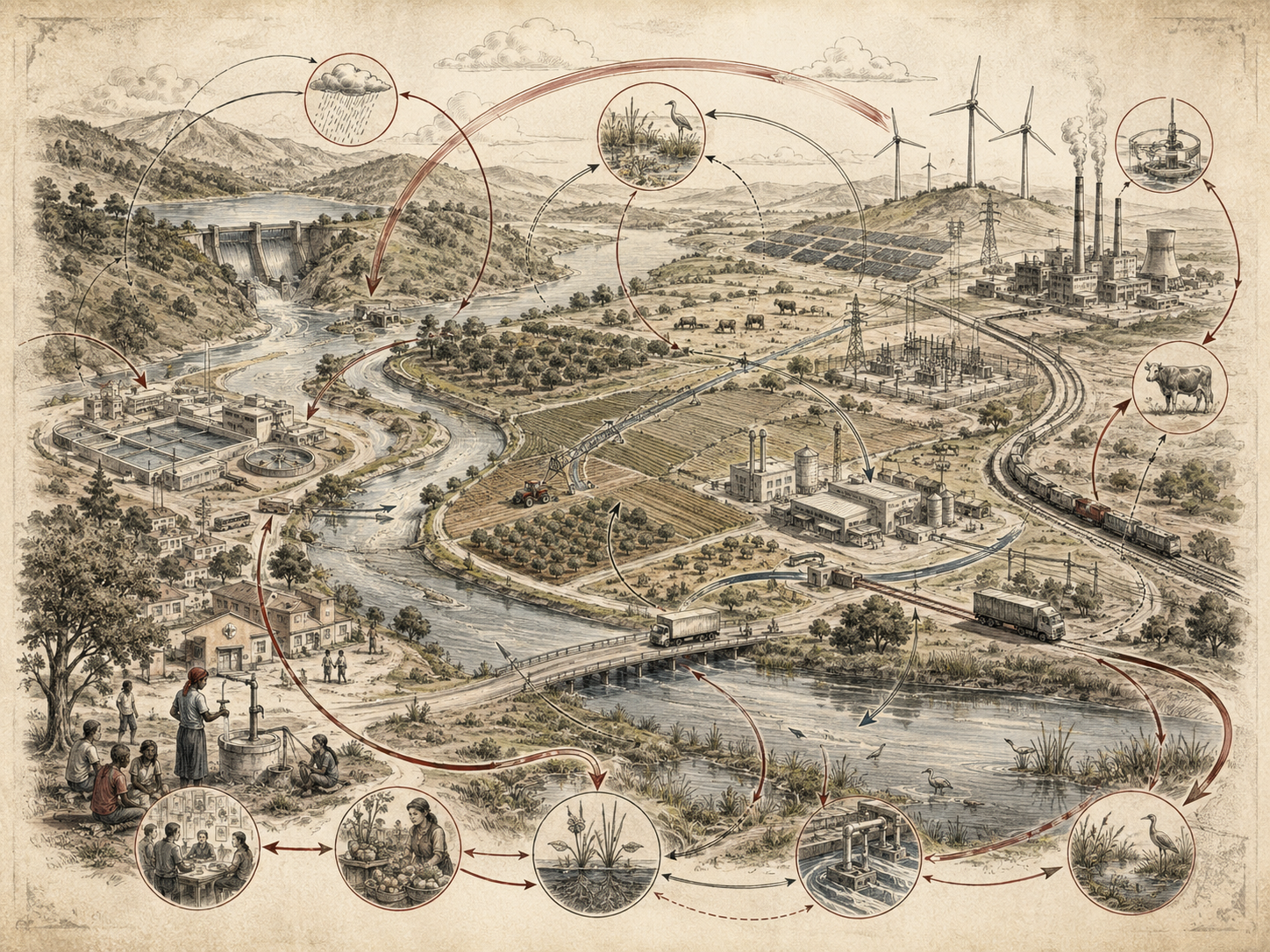
This article explains food-water-energy systems thinking as an approach to interdependent resource systems. It examines irrigation, agriculture, groundwater, energy demand, power generation, climate stress, land use, food supply chains, water infrastructure, renewable energy, public policy, and vulnerability. It shows why siloed planning can create unintended consequences, why resilience depends on cross-sector coordination, and why equity matters when scarcity, price shocks, climate risk, and infrastructure failure affect communities unevenly.
Why Food-Water-Energy Systems Thinking Matters
Food-water-energy systems thinking matters because resource systems are linked by flows. Food production depends on water for crops, livestock, processing, sanitation, and ecosystems. It depends on energy for irrigation, fertilizer production, cold chains, transport, storage, machinery, and processing. Water systems depend on energy for pumping, treatment, desalination, wastewater management, monitoring, and distribution. Energy systems depend on water for cooling, extraction, refining, hydropower, biofuels, hydrogen production, and some forms of manufacturing. Each system draws from and affects the others.
Siloed planning can create unintended consequences. A policy that expands irrigation may improve food production while depleting groundwater and increasing energy demand. A policy that promotes biofuels may support energy targets while increasing land and water pressure. A water-transfer project may support cities while weakening rural livelihoods or ecosystems. A renewable-energy project may reduce emissions while competing for land, minerals, water, or local consent. A food-security intervention may increase yields while increasing fertilizer runoff, soil degradation, or energy dependence.
Systems thinking helps reveal cross-sector trade-offs and synergies. It asks whether food security is being achieved by depleting groundwater, whether energy transition is increasing water stress, whether water management is increasing energy burden, whether land-use decisions are weakening biodiversity, and whether policies protect vulnerable communities from compounding scarcity.
| Nexus decision | Narrow interpretation | Systems-thinking interpretation |
|---|---|---|
| Expand irrigation | Increase crop yields and food supply. | Also examine groundwater depletion, energy demand, soil salinity, downstream flows, and farmer debt. |
| Build desalination | Increase water supply. | Also examine energy demand, emissions, brine disposal, affordability, and coastal ecology. |
| Promote biofuels | Replace fossil energy with renewable fuel. | Also examine land competition, water use, food prices, biodiversity, and lifecycle emissions. |
| Increase fertilizer use | Raise yields. | Also examine energy inputs, nitrous oxide, runoff, eutrophication, soil health, and farmer dependency. |
| Electrify agriculture | Reduce fossil-fuel dependence. | Also examine grid reliability, affordability, renewable supply, storage, and rural infrastructure. |
| Improve supply chains | Reduce food loss and improve distribution. | Also examine cold-chain energy demand, logistics emissions, resilience, labor, and access. |
Food-water-energy systems thinking is especially important under climate change. Drought, heat, flooding, wildfire, storms, sea-level rise, and changing rainfall can disrupt food production, water availability, energy demand, and infrastructure reliability at the same time. A heat wave can increase electricity demand, reduce thermal power efficiency, stress water supplies, harm crops, increase food prices, and threaten public health. A drought can reduce hydropower, irrigation water, crop yields, cooling water, ecosystem flows, and rural income. These are compounding risks, not separate problems.
Systems thinking makes the nexus visible before crisis. It helps policymakers, planners, researchers, farmers, utilities, public-health institutions, and communities see how decisions propagate across resource systems and how resilience can be built across boundaries.
The Food-Water-Energy Nexus
The food-water-energy nexus is the interdependent relationship among food systems, water systems, and energy systems. It emphasizes that resource security cannot be achieved by optimizing one sector alone. Food security can be undermined by water scarcity or energy shocks. Water security can be undermined by energy shortages, agricultural demand, pollution, and climate change. Energy security can be undermined by water scarcity, land conflict, infrastructure risk, and unstable supply chains.
The nexus lens also expands what security means. Food security is not only calorie supply. It includes nutrition, affordability, access, livelihoods, culture, land, supply-chain stability, and ecological foundations. Water security is not only total water volume. It includes quality, timing, affordability, sanitation, ecosystem flows, groundwater recharge, governance, and rights. Energy security is not only supply. It includes reliability, affordability, resilience, emissions, infrastructure, access, and justice.
The three systems are connected through material flows and institutional choices. Agriculture withdraws water and uses energy. Energy production withdraws or consumes water. Water infrastructure consumes energy. Food processing and cold chains depend on electricity and fuels. Hydropower depends on water flows affected by climate and land use. Fertilizer depends on energy and affects water quality. Land can be used for food, energy crops, conservation, housing, or infrastructure. Public policy shapes all of these relationships.
\text{Nexus Security} = f(\text{Food Security}, \text{Water Security}, \text{Energy Security}, \text{Ecosystem Integrity}, \text{Equity})
\]
Interpretation: Food-water-energy security depends on the interaction of resource systems, ecological integrity, and social equity rather than on one sector alone.
The nexus is not automatically harmonious. It includes trade-offs. Water for irrigation may reduce river flows. Hydropower may affect aquatic ecosystems and downstream water use. Energy crops may compete with food production or habitat. Desalination may increase water supply while raising energy demand. Cold chains may reduce food loss while increasing electricity demand. Solar farms may reduce emissions while competing with land uses unless designed carefully.
But the nexus also includes synergies. Efficient irrigation can reduce water and energy demand. Renewable energy can reduce emissions from water pumping and cold storage. Wastewater reuse can support agriculture and reduce pressure on freshwater. Agroecology can improve soil water retention, reduce fertilizer dependence, and support biodiversity. Distributed energy can strengthen rural food systems. Integrated planning can reduce conflict and build resilience.
The food-water-energy nexus is therefore a systems design challenge: how to reduce destructive trade-offs, strengthen beneficial feedback, protect ecological foundations, and ensure that resource systems support people fairly over time.
Stocks, Flows, and Resource Dependencies
Food-water-energy systems are shaped by stocks and flows. Groundwater is a stock. River flow is a flow. Soil organic matter is a stock. Crop production is a flow. Energy reserves, battery storage, grid capacity, and infrastructure condition can be treated as stocks. Electricity, fuel, irrigation water, fertilizer, food shipments, wastewater, and emissions are flows. Understanding the nexus requires asking which stocks are being depleted, which flows are increasing, and which feedback loops connect them.
Groundwater depletion is a classic stock-flow problem. Pumping is an outflow. Recharge is an inflow. If pumping exceeds recharge over time, the groundwater stock declines. Food production may continue temporarily because the system is drawing down stored water. The visible flow of crops can hide the depletion of the stock that supports future production. Energy subsidies can intensify this pattern by making pumping cheaper.
G_{t+1} = G_t + R_t – W_t
\]
Interpretation: Groundwater stock \(G\) increases through recharge \(R_t\) and decreases through withdrawals \(W_t\). If withdrawals exceed recharge, groundwater declines.
Soil health is another stock. Organic matter, structure, biodiversity, nutrients, and water-holding capacity accumulate or decline over time. High yields can be achieved temporarily through inputs while soil health declines. If the soil stock is depleted, food-system resilience weakens. Energy inputs can compensate for a while, but the system becomes more dependent on fertilizer, irrigation, machinery, and external supply chains.
Energy infrastructure also behaves as a stock. Transmission lines, pumps, cold storage, treatment plants, irrigation systems, grain storage, and processing facilities require maintenance and renewal. If infrastructure wears faster than it is maintained, reliability declines. Food and water systems then become vulnerable to power outages, fuel shocks, and climate extremes.
| Stock | Inflow | Outflow | Nexus risk |
|---|---|---|---|
| Groundwater | Recharge | Irrigation, urban use, industrial use | Food production becomes dependent on declining water reserves. |
| Soil health | Organic matter, regeneration, cover crops, reduced erosion | Erosion, nutrient mining, compaction, contamination | Yields become more dependent on water, fertilizer, and energy inputs. |
| Reservoir storage | Rainfall, snowmelt, inflow | Irrigation, hydropower, municipal demand, evaporation | Drought can force trade-offs among food, energy, cities, and ecosystems. |
| Grid reliability | Investment, maintenance, generation, storage | Demand growth, outages, climate stress, aging assets | Water pumping, refrigeration, and processing become vulnerable. |
| Public trust | Reliable service, fair allocation, transparent governance | Scarcity, corruption, exclusion, broken promises | Resource governance becomes harder during drought, price shocks, or crisis. |
Stock-flow thinking prevents false success. A system may produce more food while depleting groundwater. It may deliver cheap energy while increasing water stress. It may expand water supply while increasing emissions. It may reduce food loss while increasing electricity demand. Systems thinking asks whether the flow being optimized is degrading the stock that makes future security possible.
Feedback Loops in Food-Water-Energy Systems
Feedback loops explain why food-water-energy systems can become resilient or fragile. A reinforcing loop can amplify scarcity, dependency, debt, or degradation. A balancing loop can stabilize use through governance, pricing, conservation, restoration, or technological improvement. The challenge is that harmful reinforcing loops often operate quietly until a threshold is crossed.
One common reinforcing loop links irrigation, groundwater, energy, and production. As water scarcity increases, farmers may pump more groundwater. More pumping requires more energy. Lower water tables increase pumping energy requirements. Higher costs may pressure farmers to intensify production, which can increase water demand. The system becomes more dependent on a declining stock.
\text{Water Scarcity} \uparrow \Rightarrow \text{Groundwater Pumping} \uparrow \Rightarrow \text{Energy Demand} \uparrow \Rightarrow \text{Production Pressure} \uparrow \Rightarrow \text{Water Demand} \uparrow
\]
Interpretation: A reinforcing loop can connect scarcity, pumping, energy use, production pressure, and further water demand.
Another loop links food prices, land conversion, and ecological stress. Rising food prices can encourage land conversion. Land conversion can reduce biodiversity, carbon storage, water regulation, and soil resilience. Ecological degradation can make production more vulnerable to drought, pests, and climate extremes. Vulnerability can reduce yields, increasing price pressure again.
There are also beneficial loops. Soil restoration can increase water retention. Better water retention reduces irrigation demand. Lower irrigation demand reduces pumping energy. Lower energy demand reduces cost and emissions. Improved soil health can improve yield stability, reducing pressure to expand production into fragile ecosystems. A regenerative loop strengthens stocks rather than depleting them.
| Feedback loop | Direction | System effect | Possible leverage |
|---|---|---|---|
| Groundwater pumping loop | Reinforcing | Declining water tables increase energy demand and future vulnerability. | Groundwater governance, efficient irrigation, crop choice, recharge protection. |
| Food price-land conversion loop | Reinforcing | Food price pressure can drive land conversion and ecological degradation. | Yield stability, food loss reduction, land protection, agroecology, equitable markets. |
| Soil-water resilience loop | Reinforcing beneficial | Soil health improves water retention and yield resilience. | Cover crops, reduced erosion, organic matter, diversified farming systems. |
| Renewable pumping loop | Ambiguous | Clean energy can reduce emissions but may also enable overpumping if water governance is weak. | Pair renewable pumping with water allocation, metering, and recharge rules. |
| Trust-allocation loop | Reinforcing | Fair allocation builds trust; trust supports cooperation during scarcity. | Transparent governance, participation, rights protection, accountable monitoring. |
Feedback analysis helps avoid one-sided solutions. Solar-powered irrigation can reduce emissions but worsen groundwater depletion if it lowers pumping costs without water governance. Desalination can reduce water scarcity but increase energy demand if not powered cleanly and managed responsibly. Cold storage can reduce food loss but increase electricity demand unless energy systems are resilient and low-carbon. The question is always: what loop does the intervention strengthen?
Climate Stress and Compounding Risk
Climate change intensifies food-water-energy interdependence. Heat raises irrigation demand, increases evapotranspiration, stresses crops, reduces labor productivity, increases electricity demand for cooling, and can reduce thermal power efficiency. Drought reduces water availability, hydropower generation, crop yields, pasture productivity, and ecosystem flows. Floods damage crops, water infrastructure, energy systems, transport corridors, sanitation, and storage. Storms can disrupt ports, power grids, supply chains, and food distribution. Climate hazards do not respect sector boundaries.
Compounding risk occurs when multiple stresses interact. A drought can reduce hydropower while increasing irrigation demand and electricity demand for cooling. Lower hydropower may increase reliance on fossil generation, raising emissions and air pollution. Reduced crop yields may raise food prices. Higher food and energy prices may increase household vulnerability. Public institutions may face pressure to subsidize water, food, and energy simultaneously. A physical climate shock becomes an economic, institutional, and public-health shock.
\text{Nexus Risk} = f(\text{Hazard}, \text{Exposure}, \text{Vulnerability}, \text{Interdependence}, \text{Adaptive Capacity})
\]
Interpretation: Nexus risk depends on climate hazards, exposed systems, social vulnerability, cross-sector interdependence, and adaptive capacity.
Climate stress also affects timing. Water demand may peak when energy demand peaks. Crop stress may coincide with grid stress. Drought may reduce hydropower during heat waves. Floods may disrupt energy systems needed for water treatment. Storms may damage transport needed for food distribution. Timing matters because systems fail when multiple demands converge.
Climate adaptation in the nexus requires integrated planning. Water planning must consider energy demand and food production. Energy planning must consider water availability and climate extremes. Food planning must consider soil, water, energy, logistics, labor, nutrition, and climate risk. Public-health planning must consider food prices, water safety, heat, power outages, and sanitation. Treating these as separate plans creates blind spots.
Compounding risk is also unequal. Wealthier households and regions can often absorb higher prices, install backup systems, purchase insurance, or relocate. Lower-income households may face food insecurity, energy insecurity, unsafe water, heat exposure, and limited political voice simultaneously. Climate stress therefore turns the food-water-energy nexus into a justice issue.
Agriculture, Irrigation, and Groundwater
Agriculture sits at the center of the food-water-energy nexus. It uses land, water, energy, labor, seeds, fertilizer, machinery, transport, storage, and knowledge. Irrigated agriculture can support high yields and food security, but it can also deplete groundwater, increase energy demand, reduce river flows, alter ecosystems, and create dependency on infrastructure and subsidies.
Groundwater is especially important because it buffers agriculture during dry periods. But buffering can become depletion when withdrawals exceed recharge. Falling water tables increase pumping energy, which raises costs and links food production more tightly to energy systems. In some regions, cheap electricity or subsidized fuel can encourage overpumping. Renewable energy can reduce emissions from pumping, but without water governance it can also make pumping cheaper and intensify depletion.
Crop choice matters. Some crops require more water, energy, fertilizer, or cooling infrastructure than others. Market incentives, subsidies, trade, cultural preferences, processing infrastructure, and export demand shape crop choices. A farmer may make rational decisions within a market system that is collectively unsustainable. Systems thinking therefore avoids blaming individuals for patterns produced by incentives, infrastructure, finance, and policy.
| Agricultural decision | Food effect | Water effect | Energy effect |
|---|---|---|---|
| Expand irrigated acreage | May increase production. | May increase withdrawals and reduce downstream flows. | May increase pumping and treatment energy. |
| Shift to water-intensive crops | May raise income or export value. | May increase water stress in dry regions. | May increase pumping, cooling, or processing energy. |
| Adopt efficient irrigation | May stabilize yields. | Can reduce applied water but may not reduce total consumption if acreage expands. | May reduce or increase energy depending on pressure systems and pumping depth. |
| Improve soil health | May improve yield stability and resilience. | Can increase infiltration and water retention. | Can reduce input dependency and irrigation pressure. |
| Use controlled-environment agriculture | Can increase local production and reduce some land pressure. | May reduce water use per unit in some systems. | Can substantially increase electricity demand. |
A systems approach to agriculture asks how to improve food security without degrading the ecological and infrastructural foundations of food production. This includes soil restoration, water governance, crop diversification, efficient but accountable irrigation, renewable energy paired with withdrawal limits, farmer livelihoods, public investment, extension services, and food-system resilience.
Food security that depends on groundwater depletion is not secure. It is borrowed security. Systems thinking asks how to produce food while regenerating the stocks that future food production requires.
Energy Systems, Water Demand, and Transition
Energy systems depend on water in many ways. Thermal power plants may require water for cooling. Hydropower depends directly on water flows. Fossil fuel extraction and refining can require water and affect water quality. Bioenergy depends on land and water. Hydrogen production can require water and electricity. Mining for energy-transition minerals can affect water systems. Even renewable energy systems have land, material, and infrastructure footprints.
The energy transition can reduce climate risk, but it must be designed with water and land systems in mind. Solar and wind power generally have lower operational water use than many thermal power systems, but they require land, transmission, materials, storage, and grid integration. Hydropower can provide low-carbon electricity but is vulnerable to drought and can affect river ecosystems, sediment flows, fisheries, and communities. Bioenergy can compete with food, water, and biodiversity if expanded without careful governance.
Water systems also depend on energy. Pumping groundwater from greater depths increases energy demand. Moving water across long distances requires energy. Treating wastewater, desalinating seawater, and purifying contaminated water can be energy intensive. If water scarcity increases, societies may turn to more energy-intensive water sources, linking water security more tightly to energy systems.
\text{Water-for-Energy} + \text{Energy-for-Water} = \text{Nexus Coupling}
\]
Interpretation: Energy systems require water, and water systems require energy; this two-way dependency creates nexus coupling and cross-sector risk.
Energy planning must therefore include water stress, climate risk, infrastructure resilience, affordability, and justice. A power plant that depends on cooling water may be vulnerable during drought or heat. A hydropower system may become less reliable under changing rainfall and snowmelt. A desalination plant may increase water supply but create energy demand and brine-disposal issues. A renewable energy buildout may require transmission across land with ecological, cultural, or governance significance.
Systems thinking does not reject energy transition. It strengthens it by asking how transition can reduce emissions while protecting water, land, biodiversity, workers, and communities. A low-carbon energy system should also be water-aware, resilient, affordable, and publicly legitimate.
Food Supply Chains, Energy, and Infrastructure
Food systems extend far beyond farms. They include processing, storage, refrigeration, transport, packaging, retail, cooking, waste management, labor, finance, trade, and public infrastructure. Each stage uses energy and often water. Supply-chain resilience therefore depends on electricity, fuel, roads, ports, warehouses, cold storage, digital systems, public health standards, and labor conditions.
Cold chains are especially important. Refrigeration can reduce food loss, improve nutrition, and support food safety. But cold chains also require reliable electricity and refrigerants. If powered by high-emissions electricity or using harmful refrigerants, they can contribute to climate pressure. If unavailable, food losses rise and nutrition suffers. The systems challenge is not whether cold chains are good or bad, but how to design low-carbon, resilient, accessible cold chains that support public health and reduce waste.
Food supply chains are vulnerable to energy shocks. Fuel price increases can raise transport, fertilizer, machinery, processing, and retail costs. Electricity outages can disrupt irrigation, cold storage, processing, and water systems. Geopolitical shocks can affect fertilizer and fuel supply. Climate hazards can damage ports, roads, railways, storage facilities, and crops simultaneously.
| Supply-chain stage | Water dependency | Energy dependency | Resilience concern |
|---|---|---|---|
| Production | Irrigation, rainfall, soil moisture, livestock water | Machinery, pumping, fertilizer, heating, cooling | Drought, energy prices, soil degradation, labor stress |
| Processing | Cleaning, sanitation, ingredients, cooling | Heat, electricity, refrigeration, equipment | Power outages, contamination, water restrictions |
| Storage | Humidity and sanitation in some systems | Cooling, ventilation, monitoring | Electricity reliability and food loss |
| Transport | Indirect through infrastructure and fuel systems | Fuel, refrigeration, logistics systems | Fuel shocks, road damage, port disruption |
| Retail and access | Sanitation and food preparation | Refrigeration, lighting, digital systems | Affordability, outages, neighborhood access |
Food loss and waste are nexus issues. When food is lost, the water, energy, land, labor, fertilizer, and infrastructure used to produce it are also wasted. Reducing food loss can reduce pressure across the nexus. But loss-reduction strategies must be designed carefully: cold storage, packaging, processing, and logistics can reduce waste while increasing energy or material demand. The goal is whole-system improvement, not single-metric optimization.
Food supply-chain resilience therefore requires energy reliability, water safety, diversified logistics, public infrastructure, local and regional capacity, fair labor, low-carbon cold chains, emergency planning, and accessible food distribution. A food system is only as resilient as the infrastructure and social systems that move food from land and water to people.
Land Use, Biodiversity, and Ecosystem Services
Land is a shared foundation for food, water, energy, housing, biodiversity, climate regulation, culture, and livelihoods. Food-water-energy planning that ignores land systems can create serious trade-offs. Expanding cropland can reduce habitat and carbon storage. Expanding bioenergy can compete with food or ecosystems. Building reservoirs can alter river systems and displace communities. Building renewable infrastructure can reduce emissions but create land-use conflicts if siting is unjust or ecologically careless.
Ecosystem services are the benefits people receive from functioning ecosystems: water purification, pollination, flood buffering, soil formation, carbon storage, climate regulation, nutrient cycling, fisheries, cultural meaning, and biodiversity. These services are not external to the nexus. They are the ecological infrastructure that food, water, and energy systems depend on.
Wetlands can filter water, store carbon, buffer floods, and support biodiversity. Forests can regulate water cycles, store carbon, protect soils, and support livelihoods. Healthy soils can store water, support crops, reduce erosion, and sequester carbon. Pollinators support food production. Rivers support fisheries, water supply, culture, transport, and hydropower. When ecosystems degrade, food-water-energy systems become more expensive, fragile, and unequal.
\text{Nexus Resilience} = \text{Infrastructure Capacity} + \text{Ecosystem Function} + \text{Social Capacity}
\]
Interpretation: Resource resilience depends on built infrastructure, ecosystem function, and social capacity together.
Land-use decisions should therefore be evaluated across multiple functions. A hectare of land may produce food, store carbon, recharge water, protect biodiversity, support cultural practices, host energy infrastructure, or provide housing. Systems thinking asks which combinations of use preserve long-term capacity and which combinations create hidden depletion or conflict.
Integrated land-use planning should include food security, water flows, biodiversity, ecosystem services, energy transition, community rights, climate adaptation, and long-term stewardship. It should avoid treating land only as a surface for production. Land is a living system and a political system at once.
Governance, Coordination, and Policy Design
Food-water-energy systems often fall under separate agencies, laws, budgets, professional disciplines, and data systems. Agriculture ministries or departments may focus on production. Water agencies may focus on allocation, quality, and infrastructure. Energy agencies may focus on supply, affordability, and reliability. Environmental agencies may focus on ecosystems and pollution. Public-health institutions may focus on nutrition, sanitation, and heat risk. Local governments may manage land use and emergency response. Yet the systems they govern are interconnected.
Coordination failure is therefore common. One agency may subsidize irrigation while another worries about groundwater depletion. One policy may promote bioenergy while another seeks food affordability. A water utility may plan desalination without fully accounting for energy emissions or affordability. An energy planner may model demand without considering agricultural water stress. A food-security policy may ignore ecosystem degradation. These are not failures of intelligence alone; they are failures of institutional design.
Nexus governance requires shared data, integrated planning, cross-sector authority, participatory decision-making, and accountability for trade-offs. It also requires institutional memory. Resource systems have histories: prior allocations, harms, rights, infrastructure decisions, land dispossession, subsidies, drought responses, community warnings, and ecological degradation. Ignoring that history weakens legitimacy and repeats mistakes.
| Governance challenge | Failure mode | Systems-oriented response |
|---|---|---|
| Siloed agencies | Each sector optimizes its own metric. | Create shared indicators, joint planning, and cross-sector review. |
| Conflicting subsidies | Food, water, or energy policy unintentionally encourages depletion. | Align incentives with conservation, access, resilience, and equity. |
| Weak data integration | Resource decisions are made without seeing cross-sector effects. | Build interoperable, transparent, privacy-protective monitoring systems. |
| Unequal participation | Powerful users shape allocation while vulnerable communities absorb harm. | Include affected communities, small producers, workers, and Indigenous governance. |
| Crisis-driven decisions | Drought, price shocks, or outages trigger short-term fixes. | Use scenario planning, reserves, early warning systems, and adaptive rules. |
Policy design in the nexus should include feedback loops. If groundwater levels decline, allocation rules should respond. If food prices rise, safety nets should activate. If heat threatens grid reliability, water and food systems should have emergency plans. If water treatment energy demand rises, energy planners should know. If adaptation burdens fall unequally, public policy should correct distributional harm.
Nexus governance is not only coordination. It is the capacity to make trade-offs visible, legitimate, and accountable before scarcity forces decisions under crisis.
Equity, Access, and Vulnerability
Food, water, and energy insecurity are deeply connected. A household may face high food prices, unsafe water, and energy bills at the same time. A rural community may face groundwater decline, unreliable electricity, and crop loss. An urban neighborhood may face heat exposure, food deserts, high utility burden, and flooding. A farmer may face fuel price shocks, water restrictions, debt, and climate risk. These stresses interact, and their burdens are not evenly distributed.
Vulnerability is systemic. It is shaped by income, geography, race, caste, gender, age, disability, land tenure, legal status, infrastructure, public services, political power, and historical exclusion. A community with reliable infrastructure, savings, insurance, political voice, and institutional trust can adapt more easily than a community without those supports. The same drought or price shock produces different outcomes depending on social capacity.
Food-water-energy systems thinking must therefore include access, affordability, dignity, and rights. It is not enough to produce enough food nationally if many people cannot afford nutritious food. It is not enough to generate enough electricity if households cannot pay bills or outages are concentrated in vulnerable areas. It is not enough to have water infrastructure if water is unsafe, unaffordable, unreliable, or unequally distributed.
\text{Resource Security}_g = \text{Availability}_g \times \text{Access}_g \times \text{Affordability}_g \times \text{Reliability}_g \times \text{Dignity}_g
\]
Interpretation: Resource security for group \(g\) depends not only on availability, but also access, affordability, reliability, and dignified treatment.
Equity also affects system resilience. If vulnerability is concentrated, shocks become more damaging. If resource governance is perceived as unfair, cooperation declines. If small farmers lack support, food systems become less diverse. If low-income households cannot afford efficient appliances, clean energy, or safe water, transition benefits concentrate among those already advantaged. If Indigenous and local knowledge is excluded, ecological governance loses intelligence.
A just food-water-energy system should reduce vulnerability while preserving ecological foundations. This means targeted investment, fair pricing structures, public safeguards, rights-based water governance, energy affordability, nutrition support, climate adaptation, accessible infrastructure, and participation that affects decisions. Equity is not an add-on. It is part of whether the nexus system works.
Resilience, Redesign, and Transition
Resilience in food-water-energy systems means the capacity to maintain essential functions under disturbance: safe water, sufficient and nutritious food, reliable energy, ecosystem function, public health, livelihoods, and social stability. Resilience does not mean preserving every existing practice. Some current arrangements are unsustainable because they depend on groundwater depletion, fossil energy, soil degradation, ecological destruction, exploitative labor, or unequal access.
Resilient redesign involves changing the structures that produce vulnerability. It may include regenerative agriculture, water reuse, groundwater governance, renewable energy, distributed storage, low-carbon cold chains, demand management, watershed restoration, public food reserves, diversified supply chains, rural infrastructure, rights protection, and adaptive governance. It also includes changing incentives so that short-term production does not undermine long-term system capacity.
Redundancy and diversity matter. A food system dependent on one crop, one region, one supplier, one fuel, or one transport corridor is vulnerable. A water system dependent on one source is vulnerable. An energy system dependent on one fuel or centralized infrastructure is vulnerable. Diversity provides options when conditions change. Redundancy provides backup when systems fail. Modularity can prevent local failure from becoming systemic collapse.
| Resilience principle | Nexus application | Why it matters |
|---|---|---|
| Diversity | Crop diversity, energy mix, water sources, supply-chain options | Reduces dependence on one vulnerable pathway. |
| Redundancy | Backup power, emergency water, food reserves, local storage | Maintains essential services during disruption. |
| Modularity | Distributed energy, local food networks, decentralized treatment | Limits cascading failure across tightly coupled systems. |
| Learning | Monitoring, early warning, institutional memory, adaptive rules | Allows systems to adjust before crisis deepens. |
| Equity | Targeted support, affordability, rights, participation | Reduces concentrated vulnerability and strengthens cooperation. |
| Regeneration | Soil restoration, watershed protection, ecosystem repair | Builds the ecological stocks that food, water, and energy systems depend on. |
Transition must be managed carefully. Moving away from fossil energy affects workers, communities, public finance, food costs, and infrastructure. Changing water allocation affects farmers, cities, ecosystems, and industries. Shifting crop systems affects livelihoods, markets, culture, and nutrition. Systems thinking supports transition by making dependencies visible and designing policies that protect people during change.
Resilience is not only the ability to survive disruption. It is the ability to redesign before disruption becomes collapse.
Ethics: Stewardship, Security, and Shared Responsibility
Food, water, and energy systems raise ethical questions because they concern basic conditions for life. People need food, water, and energy not as luxuries, but as foundations for health, dignity, participation, safety, and freedom. When these systems fail, harm is immediate and profound. When they are governed unjustly, inequality becomes embodied in hunger, thirst, heat exposure, illness, debt, displacement, and insecurity.
Stewardship means managing resource systems so that present needs are met without depleting the foundations of future life. It means protecting watersheds, soils, aquifers, ecosystems, climate stability, infrastructure, public trust, and community capacity. It also means recognizing that food, water, and energy systems are not merely commodities. They are social and ecological responsibilities.
Security must be understood ethically. Food security cannot be achieved through labor exploitation or ecological depletion. Water security cannot be achieved by taking water from communities without consent or destroying ecosystems. Energy security cannot be achieved by sacrificing climate stability, public health, or vulnerable populations. A systems ethic asks whether resource security is being built by shifting harm elsewhere.
Ethical nexus questions include:
- Who has secure access to food, water, and energy?
- Who pays the highest share of income for basic resources?
- Who bears pollution, scarcity, infrastructure failure, and climate exposure?
- Whose land, labor, water, and knowledge support the system?
- Who has authority in allocation and transition decisions?
- What ecological stocks are being depleted for present consumption?
- What burdens are shifted to future generations?
- How are Indigenous, local, farmer, worker, and community knowledge included?
- When does efficiency become fragility?
- When does resource security for one group create insecurity for another?
Food-water-energy ethics requires connecting scarcity to power. Scarcity is not only physical. It is produced by allocation, infrastructure, markets, land tenure, governance, conflict, pollution, climate change, and inequality. A just nexus system must address both resource limits and social arrangements.
Ethical systems thinking does not treat trade-offs as purely technical. It asks who has the power to define the trade-off, who benefits, who loses, and what responsibilities remain after the decision is made.
Examples Across Food-Water-Energy Systems
Food-water-energy systems thinking applies across agriculture, cities, energy transition, water infrastructure, climate adaptation, and public policy. The examples below show how nexus analysis changes diagnosis.
Solar-powered irrigation
Solar-powered irrigation can reduce diesel dependence and emissions while improving farmer access to energy. But if lower pumping costs increase groundwater withdrawal, water stocks may decline faster. The intervention is beneficial only when paired with water governance, metering, recharge protection, crop planning, and community participation. Clean energy does not automatically produce water sustainability.
Hydropower and drought
Hydropower links energy security directly to water flows. During drought, hydropower output can decline just as irrigation demand, cooling demand, and water scarcity increase. This can force trade-offs among electricity, agriculture, cities, and ecosystems. Energy planning must include climate-variable water availability, not only installed capacity.
Desalination
Desalination can increase water supply for coastal regions, but it requires energy and creates brine-management challenges. If powered by fossil energy, it can increase emissions. If water is expensive, it may deepen inequality. If brine disposal is poorly managed, it can affect marine ecosystems. Desalination is a nexus intervention, not merely a water technology.
Food loss and cold chains
Cold chains can reduce food loss, improve food safety, and support nutrition. But they require electricity, refrigerants, infrastructure, maintenance, and affordability. Low-carbon, efficient, reliable cold chains can create nexus benefits; fragile or high-emissions cold chains can increase energy demand and climate pressure.
Biofuels
Biofuels can reduce some fossil fuel dependence, but they can compete with food crops, land, water, and biodiversity depending on feedstock and governance. Lifecycle emissions, land-use change, fertilizer use, water demand, and food-price effects must be evaluated together.
Urban food-water-energy planning
Cities depend on external food, distant water sources, and energy infrastructure. Urban planning affects heat, food access, water demand, stormwater, energy use, and waste. Green infrastructure, local food systems, building efficiency, water reuse, transit, and equitable utility policy can strengthen urban nexus resilience.
Wastewater reuse
Wastewater reuse can reduce freshwater demand, support agriculture, recover nutrients, and improve resilience. But it requires treatment energy, monitoring, public trust, governance, and safeguards for health and ecosystems. Done well, reuse can turn waste flows into resource loops.
Drought and food prices
Drought can reduce crop yields, increase irrigation pumping, reduce hydropower, raise energy prices, increase food prices, and stress household budgets. Public policy must respond across sectors: food assistance, water allocation, energy reliability, farmer support, ecosystem protection, and climate adaptation.
Across these examples, the central lesson is the same: a solution in one sector can become a problem in another unless the whole nexus is visible.
Mathematics, Computation, and Modeling
Food-water-energy systems can be modeled through stock-flow equations, resource-balance models, scenario analysis, network analysis, optimization, resilience indicators, vulnerability indices, and multi-criteria decision analysis. The goal is not to reduce complex resource systems to equations. It is to make dependencies, trade-offs, feedback loops, and thresholds visible enough for better decision-making.
A simple groundwater stock model can be represented as:
G_{t+1} = G_t + R_t – W_t
\]
Interpretation: Groundwater \(G\) changes through recharge \(R_t\) and withdrawals \(W_t\). Long-term depletion occurs when withdrawals exceed recharge.
Energy demand for pumped irrigation can be represented conceptually as:
E_{\text{pump}} = f(W, H, \eta)
\]
Interpretation: Pumping energy depends on water volume \(W\), pumping head \(H\), and system efficiency \(\eta\). Falling groundwater can increase pumping head and energy demand.
Food production can be represented as a function of water, energy, soil, and climate:
F_t = f(W_t, E_t, S_t, C_t, L_t)
\]
Interpretation: Food production \(F_t\) depends on water, energy, soil condition, climate, and labor or management capacity.
A nexus stress index can be represented as:
NSI = w_f F_s + w_w W_s + w_e E_s + w_c C_s + w_v V_s
\]
Interpretation: A nexus stress index can combine food stress, water stress, energy stress, climate stress, and vulnerability using transparent weights.
Cross-sector resilience can be represented as:
R_n = f(D, B, M, A, T, Q)
\]
Interpretation: Nexus resilience \(R_n\) can depend on diversity \(D\), buffers \(B\), monitoring \(M\), adaptive capacity \(A\), trust \(T\), and equity \(Q\).
| Modeling task | Nexus question | Example output |
|---|---|---|
| Stock-flow modeling | Are groundwater, soil, reservoir, or infrastructure stocks being depleted? | Resource trajectories and depletion warnings. |
| Scenario modeling | How do different policies affect food, water, and energy together? | Baseline, efficiency, regenerative, drought, and transition scenarios. |
| Trade-off analysis | Which decision improves one sector while stressing another? | Water-energy-food trade-off tables and risk flags. |
| Resilience diagnostics | Where are buffers, redundancy, and adaptive capacity weak? | Resilience indicators by region, system, or scenario. |
| Vulnerability modeling | Who faces food, water, and energy insecurity simultaneously? | Household, community, or regional vulnerability index. |
| Network analysis | Where are dependencies and cascade risks? | Infrastructure, supply-chain, watershed, and energy-network maps. |
Models should be transparent about assumptions, weights, data quality, and boundaries. A nexus model that counts crop yield but excludes groundwater depletion is incomplete. A water model that excludes energy demand is incomplete. An energy model that excludes water stress and land conflict is incomplete. A serious systems model should make trade-offs visible rather than hiding them behind a single efficiency metric.
Python Workflow: Food-Water-Energy Nexus Scenario Modeling and Resilience Diagnostics
The Python workflow below turns food-water-energy systems analysis into a small reproducible stock-flow and scenario model. It compares four scenarios: baseline depletion, drought stress, efficiency-only intervention, and regenerative resilience. It also includes one-at-a-time sensitivity analysis for the regenerative resilience scenario. The script uses only the Python standard library, writes CSV outputs relative to the article folder, and is designed as a clear starting point for companion repository work.
# food_water_energy_systems_thinking_workflow.py
# Dependency-light workflow for food-water-energy nexus diagnostics:
# groundwater stock-flow dynamics, irrigation demand, pumping energy, soil health,
# renewable transition, climate stress, household vulnerability, resource trade-offs,
# resilience, and policy scenario comparison.
# Writes outputs relative to the article root.

from __future__ import annotations

from dataclasses import dataclass, replace
from pathlib import Path
import csv
from statistics import mean

ARTICLE_ROOT = Path(__file__).resolve().parents[1]
TABLES = ARTICLE_ROOT / "outputs" / "tables"


@dataclass
class NexusScenario:
    name: str
    initial_groundwater: float
    annual_recharge: float
    irrigation_withdrawal: float
    water_efficiency_gain: float
    soil_regeneration: float
    renewable_energy_share: float
    climate_stress: float
    energy_price_pressure: float
    fertilizer_energy_intensity: float
    food_loss_rate: float
    infrastructure_reliability: float
    governance_coordination: float
    equity_capacity: float
    ecosystem_restoration: float
    policy_delay: float
    vulnerability_index: float


def clamp(value: float, low: float = 0.0, high: float = 140.0) -> float:
    return max(low, min(high, value))


def run_scenario(scenario: NexusScenario, years: int = 40) -> list[dict[str, object]]:
    groundwater_stock = scenario.initial_groundwater
    soil_health_stock = 58.0 + scenario.soil_regeneration * 12.0
    energy_security_stock = 42.0 + scenario.renewable_energy_share * 18.0
    food_security_stock = 45.0 + scenario.equity_capacity * 10.0
    ecosystem_stock = 42.0 + scenario.ecosystem_restoration * 18.0
    infrastructure_stock = 44.0 + scenario.infrastructure_reliability * 18.0
    governance_learning_stock = 34.0 + scenario.governance_coordination * 18.0
    vulnerability_stock = 44.0 + scenario.vulnerability_index * 0.30 - scenario.equity_capacity * 8.0
    cumulative_groundwater_deficit = 0.0
    rows: list[dict[str, object]] = []

    delay_years = int(round(scenario.policy_delay * 12.0))

    for year in range(years + 1):
        policy_active = year >= delay_years

        water_efficiency = scenario.water_efficiency_gain if policy_active else scenario.water_efficiency_gain * 0.20
        restoration_effort = scenario.ecosystem_restoration if policy_active else scenario.ecosystem_restoration * 0.25
        renewable_share = scenario.renewable_energy_share if policy_active else scenario.renewable_energy_share * 0.35
        coordination = scenario.governance_coordination if policy_active else scenario.governance_coordination * 0.30
        equity = scenario.equity_capacity if policy_active else scenario.equity_capacity * 0.35

        climate_multiplier = 1.0 + scenario.climate_stress * 0.65
        irrigation_demand = clamp(
            scenario.irrigation_withdrawal * climate_multiplier * (1.0 - water_efficiency * 0.55)
            + max(0.0, 60.0 - soil_health_stock) * 0.08
            - restoration_effort * 2.0,
            0.0,
            120.0,
        )

        recharge = clamp(
            scenario.annual_recharge
            + ecosystem_stock * 0.025
            + restoration_effort * 4.0
            - scenario.climate_stress * 5.0,
            0.0,
            120.0,
        )

        groundwater_stock = clamp(
            groundwater_stock + recharge - irrigation_demand,
            0.0,
            scenario.initial_groundwater * 1.10,
        )

        groundwater_ratio = groundwater_stock / max(1.0, scenario.initial_groundwater)
        groundwater_depletion = clamp(1.0 - groundwater_ratio, 0.0, 1.0)
        cumulative_groundwater_deficit += max(0.0, irrigation_demand - recharge)

        pumping_head_penalty = groundwater_depletion * 0.85
        pumping_energy = clamp(irrigation_demand * (1.0 + pumping_head_penalty), 0.0, 180.0)
        fossil_energy_exposure = clamp(pumping_energy * (1.0 - renewable_share), 0.0, 180.0)

        fertilizer_energy_pressure = clamp(
            scenario.fertilizer_energy_intensity * 15.0
            + scenario.energy_price_pressure * 8.0
            - soil_health_stock * 0.05
            - restoration_effort * 3.0,
            0.0,
            100.0,
        )

        water_security_index = clamp(
            groundwater_ratio * 65.0
            + recharge * 0.22
            + governance_learning_stock * 0.08
            + ecosystem_stock * 0.06
            - cumulative_groundwater_deficit * 0.008,
            0.0,
            100.0,
        )

        soil_health_stock = clamp(
            soil_health_stock
            + scenario.soil_regeneration * 1.2
            + restoration_effort * 1.0
            + ecosystem_stock * 0.025
            - scenario.climate_stress * 0.9
            - irrigation_demand * 0.018
            - fertilizer_energy_pressure * 0.025,
            0.0,
            120.0,
        )

        energy_security_stock = clamp(
            energy_security_stock
            + renewable_share * 1.5
            + infrastructure_stock * 0.035
            + coordination * 0.8
            - fossil_energy_exposure * 0.06
            - scenario.energy_price_pressure * 0.8
            - scenario.climate_stress * 0.4,
            0.0,
            120.0,
        )

        cold_chain_benefit = clamp(
            infrastructure_stock * 0.08
            + energy_security_stock * 0.06
            + (1.0 - scenario.food_loss_rate) * 12.0,
            0.0,
            30.0,
        )

        food_production_index = clamp(
            28.0
            + water_security_index * 0.25
            + soil_health_stock * 0.25
            + energy_security_stock * 0.12
            + cold_chain_benefit
            - scenario.climate_stress * 16.0
            - fertilizer_energy_pressure * 0.09
            - scenario.food_loss_rate * 18.0,
            0.0,
            100.0,
        )

        infrastructure_stock = clamp(
            infrastructure_stock
            + scenario.infrastructure_reliability * 1.0
            + coordination * 0.7
            + renewable_share * 0.5
            - scenario.climate_stress * 0.9
            - scenario.energy_price_pressure * 0.5,
            0.0,
            120.0,
        )

        ecosystem_stock = clamp(
            ecosystem_stock
            + restoration_effort * 1.5
            + soil_health_stock * 0.025
            - irrigation_demand * 0.025
            - scenario.climate_stress * 0.8
            - groundwater_depletion * 2.0,
            0.0,
            120.0,
        )

        governance_learning_stock = clamp(
            governance_learning_stock
            + coordination * 1.2
            + equity * 0.8
            + restoration_effort * 0.5
            - scenario.policy_delay * 0.5
            - max(0.0, 50.0 - water_security_index) * 0.025,
            0.0,
            120.0,
        )

        affordability_pressure = clamp(
            scenario.energy_price_pressure * 12.0
            + max(0.0, 55.0 - food_production_index) * 0.10
            + max(0.0, 55.0 - energy_security_stock) * 0.08
            + max(0.0, 55.0 - water_security_index) * 0.10
            - equity * 6.0,
            0.0,
            100.0,
        )

        vulnerability_stock = clamp(
            vulnerability_stock
            + affordability_pressure * 0.08
            + scenario.climate_stress * 0.8
            + scenario.vulnerability_index * 0.05
            - equity * 1.2
            - governance_learning_stock * 0.025
            - infrastructure_stock * 0.020,
            0.0,
            120.0,
        )

        nexus_stress_index = clamp(
            (100.0 - food_production_index) * 0.22
            + (100.0 - water_security_index) * 0.22
            + (100.0 - energy_security_stock) * 0.16
            + scenario.climate_stress * 18.0
            + vulnerability_stock * 0.13
            + cumulative_groundwater_deficit * 0.010
            + max(0.0, 55.0 - ecosystem_stock) * 0.10,
            0.0,
            100.0,
        )

        tradeoff_warning_score = clamp(
            groundwater_depletion * 30.0
            + fossil_energy_exposure * 0.12
            + fertilizer_energy_pressure * 0.12
            + max(0.0, food_production_index - water_security_index) * 0.18
            + max(0.0, renewable_share * 100.0 - water_security_index) * 0.05
            - coordination * 5.0,
            0.0,
            100.0,
        )

        resilience_index = clamp(
            food_production_index * 0.16
            + water_security_index * 0.18
            + energy_security_stock * 0.14
            + soil_health_stock * 0.12
            + ecosystem_stock * 0.12
            + infrastructure_stock * 0.10
            + governance_learning_stock * 0.10
            + equity * 8.0
            - nexus_stress_index * 0.14
            - tradeoff_warning_score * 0.10
            - vulnerability_stock * 0.10,
            0.0,
            100.0,
        )

        rows.append({
            "year": year,
            "scenario": scenario.name,
            "policy_active": policy_active,
            "groundwater_stock": round(groundwater_stock, 3),
            "groundwater_depletion_ratio": round(groundwater_depletion, 3),
            "annual_recharge": round(recharge, 3),
            "irrigation_demand": round(irrigation_demand, 3),
            "cumulative_groundwater_deficit": round(cumulative_groundwater_deficit, 3),
            "pumping_energy": round(pumping_energy, 3),
            "fossil_energy_exposure": round(fossil_energy_exposure, 3),
            "fertilizer_energy_pressure": round(fertilizer_energy_pressure, 3),
            "soil_health_stock": round(soil_health_stock, 3),
            "food_production_index": round(food_production_index, 3),
            "water_security_index": round(water_security_index, 3),
            "energy_security_index": round(energy_security_stock, 3),
            "ecosystem_stock": round(ecosystem_stock, 3),
            "infrastructure_stock": round(infrastructure_stock, 3),
            "governance_learning_stock": round(governance_learning_stock, 3),
            "vulnerability_stock": round(vulnerability_stock, 3),
            "affordability_pressure": round(affordability_pressure, 3),
            "nexus_stress_index": round(nexus_stress_index, 3),
            "tradeoff_warning_score": round(tradeoff_warning_score, 3),
            "resilience_index": round(resilience_index, 3),
        })

    return rows


def summarize(rows: list[dict[str, object]]) -> list[dict[str, object]]:
    output: list[dict[str, object]] = []
    for scenario_name in sorted({row["scenario"] for row in rows}):
        subset = [row for row in rows if row["scenario"] == scenario_name]
        final = subset[-1]
        avg_stress = mean(float(row["nexus_stress_index"]) for row in subset)
        avg_resilience = mean(float(row["resilience_index"]) for row in subset)
        avg_tradeoff = mean(float(row["tradeoff_warning_score"]) for row in subset)
        min_groundwater = min(float(row["groundwater_stock"]) for row in subset)
        years_high_stress = sum(float(row["nexus_stress_index"]) >= 60.0 for row in subset)

        if years_high_stress >= 10 or avg_stress >= 60:
            diagnostic = "high nexus fragility across food, water, and energy systems"
        elif avg_tradeoff >= 50:
            diagnostic = "cross-sector trade-offs are likely being hidden by sector success"
        elif float(final["groundwater_depletion_ratio"]) >= 0.35:
            diagnostic = "food production remains dependent on groundwater depletion"
        elif avg_resilience >= 65 and avg_stress <= 35:
            diagnostic = "comparatively resilient nexus pathway with stronger stocks and coordination"
        elif avg_resilience >= 55:
            diagnostic = "partial nexus improvement with remaining stress and trade-off risk"
        else:
            diagnostic = "weak evidence of durable nexus resilience"

        output.append({
            "scenario": scenario_name,
            "final_groundwater_stock": final["groundwater_stock"],
            "minimum_groundwater_stock": round(min_groundwater, 3),
            "final_food_production_index": final["food_production_index"],
            "final_water_security_index": final["water_security_index"],
            "final_energy_security_index": final["energy_security_index"],
            "final_ecosystem_stock": final["ecosystem_stock"],
            "final_vulnerability_stock": final["vulnerability_stock"],
            "average_nexus_stress_index": round(avg_stress, 3),
            "average_resilience_index": round(avg_resilience, 3),
            "average_tradeoff_warning_score": round(avg_tradeoff, 3),
            "years_high_stress": years_high_stress,
            "diagnostic": diagnostic,
        })

    return output


def one_at_a_time(base: NexusScenario, delta: float = 0.10) -> list[dict[str, object]]:
    base_score = float(run_scenario(base)[-1]["resilience_index"])
    parameters = [
        "water_efficiency_gain",
        "soil_regeneration",
        "renewable_energy_share",
        "climate_stress",
        "energy_price_pressure",
        "fertilizer_energy_intensity",
        "food_loss_rate",
        "infrastructure_reliability",
        "governance_coordination",
        "equity_capacity",
        "ecosystem_restoration",
        "policy_delay",
        "vulnerability_index",
    ]

    rows: list[dict[str, object]] = []
    for parameter in parameters:
        for direction in (-1, 1):
            current = getattr(base, parameter)
            revised_value = max(0.0, min(1.0, current + direction * delta))
            revised = replace(base, name=f"{base.name} {parameter} {direction * delta:+.2f}", **{parameter: revised_value})
            revised_score = float(run_scenario(revised)[-1]["resilience_index"])
            rows.append({
                "parameter": parameter,
                "delta": direction * delta,
                "base_value": current,
                "revised_value": revised_value,
                "base_final_resilience_index": round(base_score, 3),
                "revised_final_resilience_index": round(revised_score, 3),
                "score_change": round(revised_score - base_score, 3),
                "absolute_score_change": round(abs(revised_score - base_score), 3),
            })

    return sorted(rows, key=lambda row: float(row["absolute_score_change"]), reverse=True)


def write_csv(path: Path, rows: list[dict[str, object]]) -> None:
    path.parent.mkdir(parents=True, exist_ok=True)
    if not rows:
        raise ValueError(f"No rows to write: {path}")
    with path.open("w", newline="", encoding="utf-8") as handle:
        writer = csv.DictWriter(handle, fieldnames=list(rows[0].keys()))
        writer.writeheader()
        writer.writerows(rows)


def main() -> None:
    scenarios = [
        NexusScenario("Baseline depletion", 1000.0, 28.0, 55.0, 0.04, 0.20, 0.14, 0.20, 0.52, 0.62, 0.32, 0.34, 0.26, 0.28, 0.26, 0.90, 0.56),
        NexusScenario("Drought stress", 1000.0, 20.0, 62.0, 0.08, 0.16, 0.18, 0.34, 0.64, 0.66, 0.38, 0.30, 0.32, 0.32, 0.28, 0.62, 0.66),
        NexusScenario("Efficiency-only intervention", 1000.0, 28.0, 55.0, 0.32, 0.34, 0.36, 0.20, 0.44, 0.48, 0.32, 0.50, 0.42, 0.40, 0.36, 0.36, 0.50),
        NexusScenario("Regenerative resilience", 1000.0, 34.0, 50.0, 0.38, 0.76, 0.72, 0.16, 0.30, 0.28, 0.22, 0.76, 0.78, 0.82, 0.78, 0.18, 0.34),
    ]

    rows: list[dict[str, object]] = []
    for scenario in scenarios:
        rows.extend(run_scenario(scenario))

    write_csv(TABLES / "food_water_energy_nexus_timeseries.csv", rows)
    write_csv(TABLES / "food_water_energy_nexus_summary.csv", summarize(rows))
    write_csv(TABLES / "food_water_energy_sensitivity_analysis.csv", one_at_a_time(scenarios[-1]))

    print("Food-water-energy nexus workflow complete.")
    print(TABLES / "food_water_energy_nexus_timeseries.csv")


if __name__ == "__main__":
    main()
The workflow is intentionally simple enough to inspect. It shows how groundwater recharge, irrigation demand, water efficiency, soil regeneration, renewable energy, climate stress, energy prices, fertilizer energy intensity, food loss, infrastructure reliability, governance coordination, equity, ecosystem restoration, policy delay, and vulnerability interact over time. It also shows why a nexus system cannot be evaluated through one sector alone: apparent food gains can hide groundwater depletion, energy exposure, ecosystem decline, or household vulnerability. The model is synthetic and illustrative; it supports disciplined inquiry rather than replacing hydrology, agronomy, energy-system analysis, community knowledge, or public decision-making.
R Workflow: Nexus Indicators, Trade-Off Tables, and Resource-Stress Visualization
The R workflow reads the Python-generated time-series and sensitivity outputs, creates food-water-energy nexus summaries, and exports base R plots for groundwater, food production, water security, energy security, ecosystem condition, nexus stress, and resilience. It uses only base R so it remains portable across simple local environments.
# food_water_energy_systems_thinking_diagnostics.R
# Base R workflow for food-water-energy nexus summaries and trajectory visualization.

args <- commandArgs(trailingOnly = FALSE)
file_arg <- grep("^--file=", args, value = TRUE)

if (length(file_arg) > 0) {
  script_path <- normalizePath(sub("^--file=", "", file_arg[1]), mustWork = TRUE)
  article_root <- normalizePath(file.path(dirname(script_path), ".."), mustWork = TRUE)
} else {
  article_root <- getwd()
}

setwd(article_root)

tables_dir <- file.path(article_root, "outputs", "tables")
figures_dir <- file.path(article_root, "outputs", "figures")

if (!dir.exists(tables_dir)) {
  dir.create(tables_dir, recursive = TRUE)
}

if (!dir.exists(figures_dir)) {
  dir.create(figures_dir, recursive = TRUE)
}

timeseries_path <- file.path(tables_dir, "food_water_energy_nexus_timeseries.csv")
sensitivity_path <- file.path(tables_dir, "food_water_energy_sensitivity_analysis.csv")

if (!file.exists(timeseries_path)) {
  stop(paste("Missing", timeseries_path, "Run the Python workflow first."))
}

data <- read.csv(timeseries_path, stringsAsFactors = FALSE)

last_by_scenario <- do.call(
  rbind,
  lapply(split(data, data$scenario), function(df) df[nrow(df), ])
)

avg_stress <- aggregate(nexus_stress_index ~ scenario, data = data, FUN = mean)
avg_resilience <- aggregate(resilience_index ~ scenario, data = data, FUN = mean)
avg_tradeoff <- aggregate(tradeoff_warning_score ~ scenario, data = data, FUN = mean)
min_groundwater <- aggregate(groundwater_stock ~ scenario, data = data, FUN = min)
high_stress_years <- aggregate(nexus_stress_index ~ scenario, data = data, FUN = function(x) sum(x >= 60))

names(avg_stress)[2] <- "average_nexus_stress_index"
names(avg_resilience)[2] <- "average_resilience_index"
names(avg_tradeoff)[2] <- "average_tradeoff_warning_score"
names(min_groundwater)[2] <- "minimum_groundwater_stock"
names(high_stress_years)[2] <- "years_high_stress"

final_fields <- last_by_scenario[, c(
  "scenario",
  "groundwater_stock",
  "food_production_index",
  "water_security_index",
  "energy_security_index",
  "ecosystem_stock",
  "vulnerability_stock",
  "resilience_index",
  "nexus_stress_index"
)]

names(final_fields) <- c(
  "scenario",
  "final_groundwater_stock",
  "final_food_production_index",
  "final_water_security_index",
  "final_energy_security_index",
  "final_ecosystem_stock",
  "final_vulnerability_stock",
  "final_resilience_index",
  "final_nexus_stress_index"
)

summary_table <- Reduce(
  function(x, y) merge(x, y, by = "scenario"),
  list(avg_stress, avg_resilience, avg_tradeoff, min_groundwater, high_stress_years, final_fields)
)

summary_table$diagnostic <- ifelse(
  summary_table$years_high_stress >= 10 |
    summary_table$average_nexus_stress_index >= 60,
  "high nexus fragility across food, water, and energy systems",
  ifelse(
    summary_table$average_tradeoff_warning_score >= 50,
    "cross-sector trade-offs are likely being hidden by sector success",
    ifelse(
      summary_table$final_resilience_index >= 65 &
        summary_table$average_nexus_stress_index <= 35,
      "comparatively resilient nexus pathway with stronger stocks and coordination",
      ifelse(
        summary_table$average_resilience_index >= 55,
        "partial nexus improvement with remaining stress and trade-off risk",
        "weak evidence of durable nexus resilience"
      )
    )
  )
)

summary_table <- summary_table[order(summary_table$final_resilience_index, decreasing = TRUE), ]

write.csv(
  summary_table,
  file.path(tables_dir, "food_water_energy_nexus_r_summary.csv"),
  row.names = FALSE
)

if (file.exists(sensitivity_path)) {
  sensitivity <- read.csv(sensitivity_path, stringsAsFactors = FALSE)
  sensitivity_ranked <- sensitivity[order(sensitivity$absolute_score_change, decreasing = TRUE), ]
  write.csv(
    sensitivity_ranked,
    file.path(tables_dir, "food_water_energy_sensitivity_ranked_r.csv"),
    row.names = FALSE
  )
}

plot_metric <- function(metric, label, file_name) {
  png(file.path(figures_dir, file_name), width = 1200, height = 700)
  scenarios <- unique(data$scenario)
  plot(
    NA,
    xlim = range(data$year),
    ylim = range(data[[metric]], na.rm = TRUE),
    xlab = "Year",
    ylab = label,
    main = paste(label, "by Nexus Scenario")
  )
  for (scenario_name in scenarios) {
    subset_data <- data[data$scenario == scenario_name, ]
    lines(subset_data$year, subset_data[[metric]], lwd = 2)
  }
  legend("topright", legend = scenarios, lwd = 2, cex = 0.75, bty = "n")
  grid()
  dev.off()
}

plot_metric("groundwater_stock", "Groundwater stock", "groundwater_stock_trajectories.png")
plot_metric("food_production_index", "Food production index", "food_production_trajectories.png")
plot_metric("water_security_index", "Water security index", "water_security_trajectories.png")
plot_metric("energy_security_index", "Energy security index", "energy_security_trajectories.png")
plot_metric("ecosystem_stock", "Ecosystem stock", "ecosystem_stock_trajectories.png")
plot_metric("nexus_stress_index", "Nexus stress index", "nexus_stress_trajectories.png")
plot_metric("resilience_index", "Resilience index", "resilience_trajectories.png")

png(file.path(figures_dir, "final_resilience_scores.png"), width = 1200, height = 700)
barplot(
  summary_table$final_resilience_index,
  names.arg = summary_table$scenario,
  las = 2,
  ylab = "Final resilience index",
  main = "Final Food-Water-Energy Resilience by Scenario"
)
grid()
dev.off()

print(summary_table)
This workflow supports the article’s central methodological claim: food-water-energy systems should be evaluated through resource stocks, cross-sector dependencies, trade-offs, vulnerability, infrastructure, ecological condition, and governance learning, not through isolated production, supply, or efficiency metrics. The R outputs help readers compare depletion, drought stress, efficiency-only intervention, and regenerative-resilience pathways.
GitHub Repository
The companion repository for this article should help readers model food-water-energy systems through groundwater stocks, irrigation withdrawals, pumping energy, soil health, food production, energy security, climate stress, vulnerability, nexus stress, resilience, scenario comparison, and cross-sector trade-off diagnostics using synthetic datasets and reproducible workflows.
Complete Code Repository
Companion repository for the article, including food-water-energy nexus simulations, groundwater stock-flow models, irrigation and pumping-energy diagnostics, soil-health and ecosystem-resilience indicators, food-system stress scenarios, governance and equity workflows, Python and R workflow scripts, synthetic datasets, documentation assets, and multi-language scaffolds for systems analysis.
articles/food-water-energy-systems-thinking/
├── python/
│   ├── food_water_energy_systems_thinking_workflow.py
│   ├── food_water_energy_nexus_model.py
│   ├── groundwater_stock_flow_scenarios.py
│   ├── irrigation_energy_diagnostics.py
│   ├── food_system_resilience_index.py
│   ├── water_energy_tradeoff_analysis.py
│   ├── climate_stress_nexus_model.py
│   ├── vulnerability_and_access_index.py
│   ├── validation_checks.py
│   └── run_all_nexus_workflows.py
├── r/
│   ├── food_water_energy_systems_thinking_diagnostics.R
│   ├── food_water_energy_nexus_diagnostics.R
│   ├── groundwater_trajectory_visualization.R
│   ├── food_water_energy_tradeoff_tables.R
│   ├── nexus_stress_plots.R
│   ├── resilience_indicator_summary.R
│   ├── vulnerability_access_tables.R
│   └── run_all_nexus_workflows.R
├── julia/
│   ├── nonlinear_nexus_dynamics.jl
│   ├── groundwater_energy_feedback.jl
│   └── regenerative_resilience_model.jl
├── sql/
│   ├── schema_food_systems.sql
│   ├── schema_water_resources.sql
│   ├── schema_energy_systems.sql
│   ├── schema_irrigation_events.sql
│   ├── schema_groundwater_stocks.sql
│   ├── schema_soil_health_indicators.sql
│   ├── schema_nexus_tradeoffs.sql
│   ├── schema_vulnerability_indices.sql
│   ├── schema_policy_scenarios.sql
│   ├── schema_model_runs.sql
│   └── schema_outputs.sql
├── rust/
│   └── nexus_scenario_validator.rs
├── go/
│   └── nexus_scenario_runner.go
├── cpp/
│   ├── efficient_groundwater_depletion_scan.cpp
│   └── pumping_energy_solver.cpp
├── fortran/
│   └── recurrence_nexus_stock_flow_model.f90
├── c/
│   └── low_level_nexus_feedback_kernel.c
├── docs/
│   ├── modeling_principles.md
│   ├── article_notes.md
│   ├── food_water_energy_framework.md
│   ├── groundwater_stock_flow_notes.md
│   ├── irrigation_energy_tradeoffs.md
│   ├── nexus_resilience_and_equity.md
│   ├── python_workflow.md
│   ├── r_workflow.md
│   ├── diagnostic_questions.md
│   ├── ethics_and_stewardship.md
│   ├── assumptions_and_limitations.md
│   └── responsible_use.md
├── data/
│   ├── synthetic_food_systems.csv
│   ├── synthetic_water_resources.csv
│   ├── synthetic_energy_systems.csv
│   ├── synthetic_irrigation_events.csv
│   ├── synthetic_groundwater_stocks.csv
│   ├── synthetic_soil_health_indicators.csv
│   ├── synthetic_nexus_tradeoffs.csv
│   ├── synthetic_vulnerability_indices.csv
│   ├── synthetic_policy_scenarios.csv
│   ├── synthetic_model_runs.csv
│   └── synthetic_outputs.csv
├── outputs/
│   ├── README.md
│   ├── figures/
│   └── tables/
└── notebooks/
    ├── python_food_water_energy_walkthrough.ipynb
    └── r_nexus_indicator_visualization_placeholder.ipynb
This repository structure supports the article’s central argument: food, water, and energy systems must be analyzed dynamically, with attention to stocks, flows, feedback loops, climate stress, infrastructure, soil, groundwater, vulnerability, governance, and cross-sector trade-offs. The python/ folder supports stock-flow simulation and scenario diagnostics. The r/ folder supports visualization and interpretive summaries. The julia folder supports nonlinear nexus dynamics. The sql folder defines schemas for nexus data. The lower-level language folders provide scaffolds for groundwater scanning, nexus-stress solving, recurrence modeling, and low-level feedback simulation.
A Practical Method for Food-Water-Energy Systems Diagnosis
Food-water-energy systems diagnosis requires moving from sector planning to nexus behavior. The method below can be used by researchers, planners, public agencies, utilities, agricultural institutions, civil-society groups, and communities seeking to understand cross-sector risk and resilience.
1. Define the system boundary
Identify the food, water, energy, land, infrastructure, ecosystem, and governance systems included in the analysis. Include upstream and downstream dependencies where possible.
2. Identify critical stocks
Map groundwater, reservoir storage, soil health, grid reliability, infrastructure condition, ecosystem function, public trust, farmer capacity, and household resilience.
3. Map resource flows
Trace irrigation withdrawals, recharge, energy use, fertilizer inputs, food flows, wastewater, emissions, hydropower flows, supply-chain logistics, and waste streams.
4. Identify cross-sector dependencies
Ask where food depends on water and energy, where water depends on energy, where energy depends on water or land, and where ecosystems support all three.
5. Look for reinforcing loops
Identify loops that amplify depletion, scarcity, debt, price pressure, overpumping, land conversion, fertilizer dependency, infrastructure failure, or distrust.
6. Look for regenerative loops
Identify loops that strengthen soil, water retention, renewable energy, ecosystem function, food access, public trust, and adaptive capacity.
7. Analyze trade-offs and synergies
Ask whether a proposed intervention improves one sector while harming another. Look for designs that improve food, water, energy, ecology, and equity together.
8. Evaluate vulnerability and access
Identify who faces simultaneous food, water, and energy insecurity, who carries transition costs, and who has voice in allocation decisions.
9. Test scenarios
Compare baseline depletion, drought stress, efficiency-only intervention, regenerative redesign, renewable transition, and equity-centered resilience pathways.
10. Build adaptive governance
Create shared indicators, early warning systems, cross-sector review, public participation, institutional memory, and authority to revise policy when feedback changes.
This method treats the food-water-energy nexus as a living system. It asks whether resource security is being built by regenerating the stocks that future security depends on.
Common Pitfalls
Food-water-energy systems thinking can fail when nexus language becomes technical decoration rather than disciplined cross-sector analysis. Several pitfalls are common.
- Optimizing one sector while hiding damage in another: Food production can rise while groundwater, soil, energy affordability, or ecosystem health declines.
- Confusing efficiency with sustainability: Efficient irrigation, pumping, cooling, or processing can reduce input intensity while total withdrawals, production pressure, or energy use continue rising.
- Ignoring stocks beneath visible flows: Crop output, water deliveries, or electricity supply may look strong while groundwater, soil health, infrastructure, trust, or ecosystem function depletes.
- Treating clean energy as automatically water-sustainable: Renewable pumping can lower emissions but increase groundwater withdrawals if water governance is weak.
- Separating climate adaptation from resource governance: Drought, heat, flooding, and storms affect food, water, and energy together. Adaptation must be cross-sector.
- Reducing the nexus to technical optimization: Resource allocation involves rights, livelihoods, culture, public health, ecosystem stewardship, and political power, not only efficiency.
- Ignoring vulnerable households and communities: Aggregate resource security can hide simultaneous food, water, and energy insecurity among those with less income, infrastructure, or political voice.
- Neglecting ecosystem services: Wetlands, soils, forests, rivers, aquifers, pollinators, and biodiversity are not external to the nexus. They are part of the operating system.
The central pitfall is treating food, water, and energy as separate sectors rather than as interdependent systems whose trade-offs, stocks, flows, feedbacks, and justice questions must be governed together.
Why the Food-Water-Energy Nexus Requires Systems Thinking
The food-water-energy nexus requires systems thinking because food, water, and energy are mutually dependent. Food production draws on water, energy, soil, land, labor, and ecosystems. Water systems draw on energy, infrastructure, watersheds, and governance. Energy systems draw on water, land, minerals, infrastructure, and public legitimacy. Climate change stresses all three at once. Inequality determines who absorbs scarcity, price shocks, pollution, and infrastructure failure.
Systems thinking changes the resource-security question. It asks not only whether enough food, water, or energy exists in aggregate, but whether the systems that provide them are depleting critical stocks, shifting burdens, increasing vulnerability, or weakening future resilience. It asks whether solutions in one sector create problems in another. It asks whether efficiency is reducing total pressure or enabling more use. It asks whether resource governance is fair enough to sustain cooperation during stress.
A food-water-energy system can be productive and fragile at the same time. It can deliver high yields while depleting groundwater. It can produce energy while consuming scarce water. It can reduce food loss while increasing electricity demand. It can expand infrastructure while excluding vulnerable communities. Systems thinking makes these hidden dynamics visible.
The goal is not perfect optimization. The goal is responsible design: food systems that regenerate soil and water, water systems that protect ecosystems and public health, energy systems that reduce emissions and respect land and water limits, and governance systems that distribute resource security fairly. Food, water, and energy are basic conditions for life. Their interdependence demands systems intelligence, ethical stewardship, and public responsibility across generations.
Related Articles
- Climate Systems and Feedback Dynamics
- Systems Thinking and Sustainability
- Resilience, Thresholds, and Regime Shifts
- Public Health as a System
- Urban Systems: Congestion, Housing, and Infrastructure
- Stocks, Flows, and the Architecture of Change
- Networks, Dependencies, and Cascade Risk
- Leverage Points and Places to Intervene in a System
Further Reading
- Hoff, Holger. Understanding the Nexus: Background Paper for the Bonn2011 Conference. Stockholm Environment Institute.
- FAO. The Water-Energy-Food Nexus: A New Approach in Support of Food Security and Sustainable Agriculture. Food and Agriculture Organization of the United Nations.
- World Bank. Thirsty Energy. World Bank Water Partnership Program.
- International Energy Agency. World Energy Outlook. IEA.
- IPCC. Climate Change 2022: Impacts, Adaptation and Vulnerability. Working Group II contribution to the Sixth Assessment Report.
- UN-Water. Water and Climate Change. United Nations World Water Development Report.
- Rockström, Johan et al. “A Safe Operating Space for Humanity.” Nature.
- Ostrom, Elinor. Governing the Commons: The Evolution of Institutions for Collective Action. Cambridge University Press.
- Meadows, Donella H. Thinking in Systems: A Primer. Chelsea Green Publishing.
- Sterman, John D. Business Dynamics: Systems Thinking and Modeling for a Complex World. Irwin/McGraw-Hill.
References
- FAO (2014) The Water-Energy-Food Nexus: A New Approach in Support of Food Security and Sustainable Agriculture. Rome: Food and Agriculture Organization of the United Nations. Available at: https://www.fao.org/3/bl496e/bl496e.pdf
- Hoff, H. (2011) Understanding the Nexus: Background Paper for the Bonn2011 Conference: The Water, Energy and Food Security Nexus. Stockholm: Stockholm Environment Institute. Available at: https://www.sei.org/publications/understanding-the-nexus/
- International Energy Agency (2023) World Energy Outlook 2023. Paris: IEA. Available at: https://www.iea.org/reports/world-energy-outlook-2023
- IPCC (2022) Climate Change 2022: Impacts, Adaptation and Vulnerability. Cambridge: Cambridge University Press. Available at: https://www.ipcc.ch/report/ar6/wg2/
- Meadows, D.H. (2008) Thinking in Systems: A Primer. White River Junction, VT: Chelsea Green Publishing. Available at: https://www.chelseagreen.com/product/thinking-in-systems/
- Ostrom, E. (1990) Governing the Commons: The Evolution of Institutions for Collective Action. Cambridge: Cambridge University Press.
- Rockström, J. et al. (2009) “A Safe Operating Space for Humanity.” Nature, 461, pp. 472–475. Available at: https://doi.org/10.1038/461472a
- Sterman, J.D. (2000) Business Dynamics: Systems Thinking and Modeling for a Complex World. Boston: Irwin/McGraw-Hill.
- UN-Water (2020) United Nations World Water Development Report 2020: Water and Climate Change. Paris: UNESCO. Available at: https://www.unwater.org/publications/un-world-water-development-report-2020
- World Bank (2013) Thirsty Energy. Washington, DC: World Bank. Available at: https://www.worldbank.org/en/topic/water/brief/thirsty-energy