
Last Updated June 1, 2026
Resilience is not simply the ability of a system to return to normal after disturbance. In complex systems, resilience is the capacity to absorb shocks, reorganize, adapt, and sometimes transform without losing essential function, identity, or life-supporting capacity. A resilient system is not always stable in the ordinary sense. It may fluctuate, adapt, redistribute stress, or change form. What matters is whether the system can continue to support what is most important when conditions change.
Thresholds and regime shifts reveal why resilience matters. A system can appear stable for a long time while slowly losing the capacity to recover. A lake can absorb nutrient pollution until it suddenly shifts from clear water to algal dominance. A forest can absorb drought and fire until it reorganizes into grassland or shrubland. A public institution can absorb stress until trust collapses. A healthcare system can absorb demand until capacity breaks. A household, organization, ecosystem, city, or democracy can look functional until accumulated pressure pushes it across a threshold.
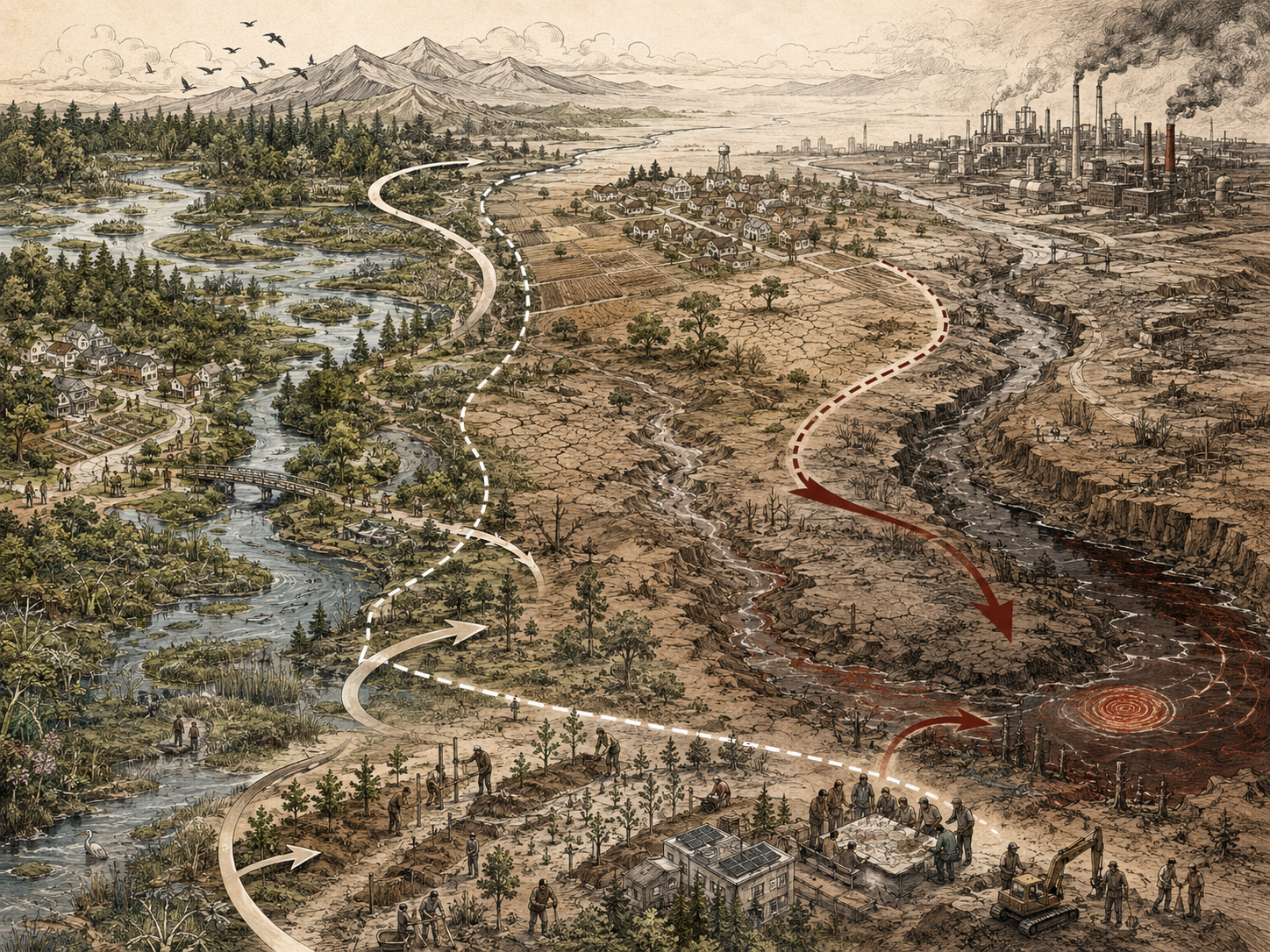
This article examines resilience, thresholds, and regime shifts as core concepts in systems thinking. It explains why systems can lose resilience before they visibly collapse, how thresholds create nonlinear change, why recovery may be difficult after a regime shift, and how social, ecological, technological, and institutional systems can be redesigned to build adaptive capacity. It also explores the ethical stakes of resilience: who is asked to absorb shocks, who benefits from fragile systems, who has authority to define recovery, and when resilience should mean transformation rather than return to an unjust or unsustainable normal.
Why Resilience Matters
Resilience matters because systems are exposed to disturbance. Ecological systems face drought, fire, invasive species, pollution, habitat fragmentation, and climate change. Cities face floods, heat waves, infrastructure failure, housing stress, fiscal shocks, and migration. Organizations face workload surges, turnover, technological disruption, market shifts, leadership change, and institutional forgetting. Public institutions face crises of trust, administrative overload, political pressure, misinformation, emergency response, and long-term legitimacy challenges. Families and communities face economic shocks, health crises, environmental exposure, displacement, and social disruption.
Systems thinking treats disturbance as normal rather than exceptional. A system that can function only under ideal conditions is fragile. A system that depends on perfect forecasting, flawless coordination, constant growth, uninterrupted supply chains, permanent trust, stable climate, or heroic human effort is not resilient. It may appear efficient, but its efficiency may depend on eliminating buffers, redundancy, slack, diversity, and recovery capacity.
Resilience becomes especially important when systems are tightly coupled and optimized for short-term output. A tightly coupled system has little room for delay, error, substitution, or local failure. A highly optimized system may minimize cost under ordinary conditions while becoming vulnerable under stress. Food supply chains, hospitals, electricity grids, digital platforms, water systems, public agencies, and financial systems can all become fragile when efficiency is pursued without resilience.
| System | Visible stressor | Hidden resilience question |
|---|---|---|
| Ecosystem | Drought, fire, pollution, invasive species | Does biodiversity, soil, water, connectivity, and regeneration capacity remain strong enough for recovery? |
| Public institution | Backlog, crisis, distrust, administrative overload | Does the institution have trust, capacity, memory, coordination, and authority to adapt? |
| Organization | Burnout, turnover, rework, delivery pressure | Is human capacity being replenished faster than it is depleted? |
| City | Flooding, heat, congestion, housing stress | Do land use, infrastructure, governance, and social support reduce vulnerability? |
| Supply chain | Disruption, shortage, price shock | Does the system have redundancy, visibility, substitution capacity, and adaptive coordination? |
| Community | Economic shock, environmental hazard, displacement pressure | Are social networks, resources, rights, public services, and trust strong enough to support recovery? |
Resilience also matters because collapse is often preceded by hidden weakening. A system may continue performing while its recovery capacity declines. A forest may remain green while soil moisture, species diversity, and seed banks weaken. A hospital may continue operating while staff burnout, bed capacity, and supply reserves decline. A public agency may continue processing applications while trust, staffing, and institutional memory erode. A democracy may continue formal procedures while legitimacy, civic norms, and public confidence weaken.
Systems thinking helps identify these hidden losses before crisis. It asks what stocks of resilience are being built or depleted: biodiversity, trust, memory, capacity, redundancy, skill, social cohesion, infrastructure condition, ecological function, public legitimacy, and adaptive authority. Resilience is not only what happens after shock. It is what the system has been building before the shock arrives.
What Resilience Means in Systems Thinking
In systems thinking, resilience is the capacity of a system to absorb disturbance, reorganize, adapt, and continue functioning without losing essential identity or purpose. This does not always mean returning exactly to a previous state. In many complex systems, returning to the old state may be impossible, undesirable, or unjust. A resilient system may recover, adjust, reorganize, or transform.
Resilience has several dimensions. Absorptive capacity is the ability to take a shock without major loss of function. Adaptive capacity is the ability to adjust behavior, structure, relationships, or rules in response to changing conditions. Transformative capacity is the ability to shift into a new structure when the old one is no longer viable. These dimensions matter because different disturbances require different responses.
\text{Resilience} = \text{Absorptive Capacity} + \text{Adaptive Capacity} + \text{Transformative Capacity}
\]
Interpretation: Resilience includes the ability to absorb shocks, adapt to changing conditions, and transform when existing structures are no longer viable.
Resilience is also relational. A system is resilient in relation to specific disturbances, functions, scales, and values. A wetland may be resilient to seasonal flooding but not to permanent drainage. A hospital may be resilient to routine demand fluctuations but not to a pandemic surge. A public agency may be resilient to normal workload variation but not to mass unemployment. A community may be resilient to economic shock because of strong social networks, but vulnerable to climate displacement because housing protections are weak.
Therefore, resilience analysis must ask four questions:
- Resilience of what? What system, community, institution, ecosystem, or function is being considered?
- Resilience to what? What disturbance, stressor, shock, or slow variable matters?
- Resilience for whom? Who benefits from resilience, and who is asked to absorb the burden?
- Resilience toward what future? Should the system recover, adapt, or transform?
These questions prevent resilience from becoming vague. They also expose power. A landlord may describe a housing market as resilient because property values recover. Tenants may experience the same recovery as displacement. A city may describe infrastructure resilience through asset protection while ignoring neighborhoods with weaker flood defenses. An organization may describe resilience as workforce endurance while ignoring burnout. Resilience must be evaluated from multiple positions inside the system.
Systems thinking treats resilience as a property of relationships, not merely parts. It depends on diversity, redundancy, feedback, memory, modularity, trust, learning, recovery, and adaptive governance. A system may have strong components and weak resilience if relationships are brittle. A system may have modest resources but strong resilience if it has trust, cooperation, distributed knowledge, and adaptive capacity.
Thresholds and Tipping Points
A threshold is a point at which a small additional change in system conditions produces a large shift in behavior. A tipping point is a threshold beyond which the system tends to move rapidly toward a new state. Thresholds matter because systems can absorb stress for a long time and then change suddenly. This makes linear reasoning dangerous. A system may appear stable because visible indicators remain acceptable, while slow variables are moving it closer to a threshold.
Thresholds occur when feedback loops change strength. A stabilizing feedback may weaken, allowing reinforcing feedback to dominate. A lake may absorb nutrient runoff until plant and microbial dynamics shift toward algal dominance. A forest may recover from periodic fire until drought, heat, invasive species, and soil degradation make recovery difficult. A public institution may handle delays until citizens lose trust and stop participating. An organization may absorb workload until turnover and burnout reinforce one another.
\text{Threshold Crossed When} \quad P_t > C_t
\]
Interpretation: A threshold may be crossed when pressure \(P_t\) exceeds the system’s adaptive or absorptive capacity \(C_t\). In real systems, both pressure and capacity change over time.
Thresholds can be ecological, social, institutional, technological, or economic. They may involve material limits, trust limits, capacity limits, legitimacy limits, financial limits, or cognitive limits. A threshold does not always produce immediate collapse. It may produce reorganization into a different regime. That regime may still function, but with different relationships, feedback loops, and possibilities.
| System | Slow variable | Possible threshold | Regime after threshold |
|---|---|---|---|
| Lake ecosystem | Nutrient loading | Algal dominance begins reinforcing itself | Eutrophic, turbid, low-oxygen regime |
| Forest | Drought, heat, fire frequency, soil moisture | Tree regeneration fails after disturbance | Shrubland, grassland, or degraded woodland |
| Public institution | Trust, backlog, burden, staffing | Public cooperation and legitimacy decline sharply | Avoidance, resistance, nonparticipation, crisis governance |
| Organization | Workload, burnout, turnover, memory loss | Remaining staff can no longer compensate | Chronic crisis, loss of quality, accelerated exit |
| Infrastructure | Deferred maintenance and climate exposure | Failures become frequent and cascading | Expensive emergency repair and reduced service reliability |
Thresholds are difficult because they are often easier to identify after they have been crossed. Early warning signals are imperfect, and systems may have multiple interacting thresholds. Still, systems thinking helps by focusing on slow variables, feedback strength, recovery capacity, variance, and repeated signs of weakening. It asks not only whether the system is currently functioning, but how close it may be to losing the capacity to recover.
Regime Shifts
A regime shift is a large, persistent change in the structure and behavior of a system. After a regime shift, the system operates according to different feedback loops, relationships, constraints, and recovery dynamics. It is not merely an event. It is a change in the system’s organizing pattern.
Regime shifts can occur in ecosystems, economies, organizations, public institutions, communities, infrastructure systems, and political systems. A coral reef may shift from coral dominance to algal dominance. A labor market may shift from stable employment to precarious work. A neighborhood may shift from affordable housing to displacement pressure. A public institution may shift from trusted service provider to distrusted bureaucracy. A platform may shift from useful information network to attention-amplifying misinformation system. A health system may shift from managed demand to chronic overload.
Regime shifts matter because returning to the prior state may be difficult. The new regime can become self-reinforcing. After trust declines, people may stop participating, reducing feedback and worsening service, which further lowers trust. After a lake becomes algal, the algae can block light, alter oxygen, and change ecological conditions in ways that preserve the algal state. After organizational burnout triggers turnover, memory loss and workload increases can make recovery harder. The system may need more than reversal of the original pressure. It may need active restoration, redesign, and rebuilding of lost capacity.
\text{Regime Shift} = \Delta \text{Feedback Structure} + \Delta \text{System Behavior} + \Delta \text{Recovery Conditions}
\]
Interpretation: A regime shift changes feedback structure, system behavior, and the conditions required for recovery.
Regime shifts are often associated with loss of resilience. The system loses its ability to absorb pressure while remaining in its old regime. But regime shifts can also be intentional. A sustainability transition, democratic reform, organizational redesign, or energy transformation may seek to shift a harmful regime into a better one. Systems thinking therefore treats regime shifts with care: some are dangerous, some are necessary, and some are contested.
Questions for regime-shift analysis include:
- What regime is the system currently in?
- What feedback loops stabilize the current regime?
- What slow variables are moving the system toward another regime?
- What threshold might trigger reorganization?
- What would become harder after the shift?
- Who benefits from the current regime?
- Who is vulnerable to the shift?
- Should the goal be recovery, adaptation, or transformation?
Regime shifts remind us that systems do not always change gradually. They can reorganize. They can lock into new patterns. They can become difficult to restore. They can also be redesigned deliberately when the existing regime is harmful. The task is to understand which kind of shift is occurring and what responsibility it demands.
Resilience versus Stability versus Robustness
Resilience is often confused with stability and robustness. These concepts overlap, but they are not the same. A stable system returns quickly to equilibrium after small disturbance. A robust system resists disturbance without changing much. A resilient system can absorb, adapt, reorganize, and continue functioning, sometimes through change rather than resistance.
Stability can be useful, but too much emphasis on stability can hide fragility. A system may suppress fluctuation until pressure accumulates. A fire-suppressed forest may look stable while fuel loads build. A public institution may avoid conflict while distrust grows. An organization may maintain output while human capacity is depleted. A financial system may appear stable because risk is hidden rather than reduced. Stability can be a sign of health, but it can also be a sign of delayed adjustment.
Robustness can also be valuable. Bridges, software systems, electrical grids, water infrastructure, and safety-critical institutions need robustness. But robustness against one stressor can create vulnerability to another if the system becomes rigid. A seawall may protect against routine flooding while encouraging development in exposed areas. A highly standardized organization may perform efficiently under normal conditions but struggle when novel problems require local adaptation.
| Concept | Core meaning | Strength | Risk if misunderstood |
|---|---|---|---|
| Stability | Returns quickly to a prior state after disturbance. | Useful for predictable, bounded variation. | May hide accumulated stress or suppress necessary adaptation. |
| Robustness | Resists disturbance without major change. | Useful for safety-critical protection and reliability. | May become rigid, expensive, or vulnerable to novel shocks. |
| Resilience | Absorbs, adapts, reorganizes, and continues essential function. | Useful for complex, changing, uncertain systems. | Can become vague or misused to demand endurance from vulnerable people. |
| Transformability | Creates a fundamentally new system when the old regime is untenable. | Useful when recovery would reproduce harm or fragility. | Can be destabilizing if pursued without legitimacy, participation, or care. |
A resilient system may intentionally allow some fluctuation. It may preserve diversity, redundancy, modularity, local adaptation, and learning capacity. It may avoid optimizing every buffer away. It may maintain multiple pathways rather than relying on one highly efficient path. It may value memory and trust as much as speed.
The distinction matters for policy and design. A flood policy focused only on robustness may build higher barriers. A resilience policy may also restore wetlands, reduce exposure, redesign land use, protect vulnerable households, improve warning systems, and build community capacity. A workplace policy focused on stability may suppress conflict. A resilience policy may create safer feedback, reduce overload, preserve recovery, and redesign work. Resilience asks whether the system can continue to support essential functions under change, not merely whether it can resist disturbance temporarily.
Adaptive Capacity and Transformability
Adaptive capacity is the ability of a system to adjust to changing conditions. It includes learning, flexibility, diversity, social trust, institutional memory, resource access, distributed knowledge, experimentation, participation, and authority to change course. A system with adaptive capacity can respond before disturbance becomes collapse. A system without adaptive capacity may continue old behavior even when conditions have changed.
Transformability is the ability to create a fundamentally different system when the existing one is no longer viable. This concept matters because not all systems should be preserved. A fossil-fuel-dependent energy system must transform. A public institution that repeatedly produces exclusion may need redesign, not mere recovery. An organization that depends on burnout should not be made resilient in the sense of enduring more burnout. A community facing unavoidable climate risk may need relocation support, land-use transformation, or new forms of governance.
Adaptive capacity and transformability differ from simple coping. Coping allows a system to endure pressure. Adaptation changes behavior in response to pressure. Transformation changes the system’s structure, goals, or regime. A household may cope with high energy bills by reducing heat. It may adapt through efficiency upgrades. The energy system transforms when housing, pricing, grid infrastructure, and income supports change so energy security is not dependent on personal sacrifice.
\text{Coping} \rightarrow \text{Adaptation} \rightarrow \text{Transformation}
\]
Interpretation: Coping absorbs stress, adaptation adjusts behavior or structure, and transformation changes the underlying regime when the old one is no longer adequate.
Adaptive capacity is strengthened by:
- diversity of knowledge, actors, resources, and response options;
- redundancy and backup capacity;
- learning systems that preserve feedback and memory;
- trust and legitimacy that support cooperation;
- decentralized authority where local adaptation matters;
- cross-boundary coordination where problems span institutions;
- monitoring systems that detect early warning signals;
- resources that allow vulnerable groups to act before crisis.
Transformability requires deeper conditions: willingness to question goals, redistribute power, redesign institutions, change infrastructure, and confront path dependence. It is rarely purely technical. Transformations involve values, conflict, trade-offs, legitimacy, and memory. They require public processes capable of deciding what should be preserved, what should change, and who will be protected during transition.
Systems thinking helps distinguish when to preserve, when to adapt, and when to transform. This distinction is ethically important. Asking people to adapt endlessly to harmful systems is not resilience. Preserving an unjust regime is not sustainability. Transformability is the resilience of the future against the failures of the present.
Feedback Loops and Early Warning Signals
Resilience changes as feedback loops change. In a resilient system, balancing feedback may correct disturbance, diversity may provide alternatives, memory may guide response, and trust may support coordination. As resilience weakens, correction becomes slower, variation increases, recovery takes longer, and the system becomes more sensitive to disturbance. These changes can produce early warning signals before a threshold is crossed.
Early warning signals are patterns that suggest a system may be losing resilience. They are not perfect predictions, but they can help decision-makers pay attention before collapse or regime shift. One common signal is critical slowing down: the system takes longer to recover from disturbance. Another is increasing variance: the system fluctuates more widely. Another is rising autocorrelation: current conditions become more strongly dependent on recent past conditions because recovery weakens. Spatial patchiness, repeated near misses, and increasing synchronization can also indicate risk.
\text{Recovery Time} \uparrow \quad \Rightarrow \quad \text{Resilience} \downarrow
\]
Interpretation: When a system takes longer to recover from disturbance, it may be losing resilience and approaching a threshold.
Early warning signals apply beyond ecology. A public agency may show critical slowing down as backlogs persist longer after demand surges. A hospital may show rising variance in wait times, staffing shortages, and emergency diversion. An organization may show repeated near misses, rising rework, and longer recovery after deadlines. A community may show increasing stress through housing instability, food insecurity, debt, and service demand. A democracy may show warning signals through declining trust, polarization, rule-breaking, and reduced acceptance of shared procedures.
| Early warning signal | General meaning | Example outside ecology |
|---|---|---|
| Critical slowing down | System recovery takes longer after disturbance. | An agency backlog persists longer after each demand surge. |
| Increasing variance | System behavior becomes more unstable. | Hospital wait times, staffing gaps, or incident rates fluctuate more widely. |
| Rising autocorrelation | Current stress depends more strongly on recent stress. | Organizational workload carries over because recovery is incomplete. |
| Repeated near misses | Small failures almost become major failures. | Infrastructure incidents or safety events become more frequent. |
| Loss of diversity | System has fewer response options. | A supply chain depends on one supplier or a public system depends on one fragile platform. |
Early warning systems require governance. Signals do not act by themselves. Someone must monitor them, interpret them, preserve them, and have authority to respond. A warning ignored is not a warning system; it is documentation of future regret. Resilience requires feedback loops that can reach decision-making before thresholds are crossed.
Hysteresis and Recovery Difficulty
Hysteresis means that the path into a new regime is not the same as the path out of it. Once a system shifts, simply reversing the original pressure may not restore the prior state. This is one of the most important ideas for resilience and regime shifts. It explains why delayed action can make recovery much harder than prevention.
For example, if nutrient loading pushes a lake into an algal regime, reducing nutrient inputs back to prior levels may not immediately restore clear water. The algal regime may maintain itself through changed light, oxygen, sediment chemistry, and food-web dynamics. If public trust collapses, a single apology or communication campaign may not restore legitimacy. Trust must be rebuilt through repeated reliable behavior. If an organization loses experienced staff through burnout, reducing workload later may not restore institutional memory quickly. Knowledge, trust, and relationships must be rebuilt.
\text{Recovery Threshold} \neq \text{Collapse Threshold}
\]
Interpretation: The conditions required to recover from a regime shift may be much stronger than the conditions that would have prevented the shift.
Hysteresis has major policy implications. It means prevention is often more effective and less costly than restoration. It means delayed action can create irreversible or difficult-to-reverse change. It means system managers must monitor resilience, not only current performance. It also means recovery plans must be realistic about rebuilding lost capacity.
Examples of hysteresis include:
- ecosystems that do not recover after stress is reduced because key species, soil conditions, or feedback loops changed;
- public institutions that do not regain trust simply by changing communication after repeated harm;
- organizations that do not recover from burnout quickly because institutional memory and morale were lost;
- infrastructure systems that become expensive to restore after deferred maintenance accumulates;
- communities that do not regain affordability after displacement changes land values and ownership patterns;
- climate systems where long-lived greenhouse gases continue affecting the future even after emissions decline.
Hysteresis also challenges simple “bounce back” language. Some systems cannot bounce back because the prior conditions no longer exist. Some should not bounce back because the prior regime was harmful. In those cases, resilience must mean transformation, repair, and reconstruction of capacity rather than return.
Systems thinking therefore asks not only how to recover, but how to avoid crossing thresholds whose recovery path is steep, uncertain, unjust, or impossible.
Social-Ecological Resilience
Social-ecological resilience recognizes that human societies and ecological systems are linked. Forests, fisheries, water systems, agriculture, climate, public health, livelihoods, infrastructure, governance, and culture interact. People shape ecosystems, and ecosystems shape social possibilities. Treating ecological and social systems separately can produce policy failure.
A fishery is not only fish biomass. It is also fishing communities, markets, regulation, monitoring, enforcement, cultural practices, gear technology, habitat, climate, and trust. A watershed is not only hydrology. It is land use, agriculture, urban development, legal rights, pollution, infrastructure, Indigenous stewardship, ecological flow, and governance. A forest is not only trees. It is fire regimes, biodiversity, soil, water, carbon, local livelihoods, land tenure, species interactions, and climate feedback.
Social-ecological resilience depends on diversity, local knowledge, adaptive governance, ecological connectivity, monitoring, participation, equity, and institutions capable of learning. It also depends on recognizing that communities are not merely users of ecosystems. They can be stewards, knowledge holders, rights holders, and affected publics.
\text{Social-Ecological Resilience} = f(\text{Ecological Function}, \text{Governance}, \text{Equity}, \text{Knowledge}, \text{Adaptive Capacity})
\]
Interpretation: Social-ecological resilience depends on ecological function, governance, equity, knowledge systems, and adaptive capacity.
Social-ecological systems often face slow variables and sudden shocks. Climate change, land-use change, groundwater depletion, soil erosion, biodiversity loss, and social inequality can gradually reduce resilience. Drought, fire, flood, disease, market shock, or political crisis can then trigger visible disruption. The shock may appear sudden, but vulnerability was built over time.
Effective social-ecological resilience work asks:
- What ecological functions support social wellbeing?
- What social systems support ecological stewardship?
- Who has knowledge of system change?
- Who has authority over land, water, resources, and adaptation?
- What feedback signals are being ignored?
- What slow variables are eroding resilience?
- What forms of governance allow learning across uncertainty?
- How are burdens and benefits distributed?
Social-ecological resilience is not only a scientific concept. It is a governance challenge and an ethical responsibility. It asks how human systems can live within ecological limits while sustaining dignity, justice, and adaptive capacity.
Institutional and Organizational Resilience
Institutions and organizations also have resilience. Their resilience depends on trust, memory, staffing, knowledge, feedback, coordination, authority, resource buffers, psychological safety, legitimacy, and learning capacity. An institution may have formal authority but weak resilience if it lacks trust, capacity, or feedback. An organization may have high output but weak resilience if its performance depends on burnout, hidden labor, and concentrated knowledge.
Institutional resilience is not simply continuity of bureaucracy. A harmful institution may be resilient in the sense that it resists reform. The relevant question is whether the institution can preserve public value, dignity, accountability, and learning under stress. A public institution that maintains procedure while losing legitimacy is not resilient in the deeper sense. An organization that maintains productivity by exhausting people is not resilient; it is consuming its own capacity.
Organizational resilience can be weakened by workload overload, turnover, rework, poor documentation, siloed knowledge, weak psychological safety, and leadership denial. Institutional resilience can be weakened by administrative burden, political interference, loss of public trust, legal rigidity, budget austerity, weak maintenance, and failure to remember prior lessons.
| Resilience stock | How it is built | How it is depleted |
|---|---|---|
| Institutional memory | Documentation, decision records, mentoring, archives, feedback preservation | Turnover, poor handoffs, obsolete records, political erasure |
| Public trust | Reliability, fairness, transparency, participation, repair | Burden, broken promises, exclusion, opacity, repeated harm |
| Human capacity | Recovery, staffing, skill, support, autonomy, workload balance | Burnout, rework, understaffing, urgency, hidden labor |
| Coordination | Clear authority, shared goals, interoperable information, relationships | Silos, fragmented funding, unclear decision rights, competition |
| Learning capacity | Feedback loops, psychological safety, evaluation, adaptation authority | Blame, denial, metric gaming, ignored feedback, rigid rules |
Institutional resilience requires more than crisis response plans. It requires ordinary-time investment in the capacities that make crisis response possible. A public institution cannot improvise trust after disaster, institutional memory after turnover, or coordination after fragmentation. These capacities must be built before they are needed.
Resilient institutions are not those that never change. They are those that can learn without collapse, adapt without abandoning public responsibility, and transform when existing arrangements no longer serve their purpose.
Resilience and Public Policy
Public policy shapes resilience by building or depleting system capacity. Policy can protect buffers, maintain infrastructure, support public health, reduce vulnerability, preserve ecosystems, strengthen institutions, and distribute risk fairly. Policy can also weaken resilience by creating administrative burden, deferring maintenance, encouraging overuse of shared resources, externalizing ecological costs, underfunding public systems, or shifting responsibility to individuals and communities without support.
Policy often responds after thresholds are crossed because crisis makes problems visible. But resilience policy must act earlier. It must identify slow variables, monitor warning signals, protect critical stocks, reduce exposure, and support adaptation before collapse. This requires long-term governance, not only emergency response.
Resilience policy should be evaluated through multiple questions:
- Does the policy reduce exposure to shocks?
- Does it strengthen adaptive capacity?
- Does it preserve or restore critical ecological and social stocks?
- Does it reduce vulnerability among groups most at risk?
- Does it build trust, legitimacy, and coordination?
- Does it prevent burden shifting to individuals, frontline workers, or future generations?
- Does it create feedback loops for learning and revision?
- Does it prepare for transformation when recovery is not enough?
Resilience policy must avoid the trap of individualizing resilience. Public policy should not ask households to absorb climate risk while infrastructure fails, workers to absorb organizational overload while staffing is cut, communities to absorb disaster risk while land-use decisions remain unchanged, or public agencies to absorb crisis while budgets undermine capacity. Real resilience policy changes the structures that produce vulnerability.
Policy also needs to distinguish between resilience of existing systems and resilience of public value. A fossil-fuel regime may be politically and economically resilient because it is protected by infrastructure, subsidies, and influence. That does not make it desirable. A policy should not preserve harmful regimes simply because they are stable. It should build resilience around life, dignity, justice, ecological function, and democratic legitimacy.
Redesigning Systems for Resilience
Designing for resilience means changing the structures that determine how systems respond to stress. It is not simply adding emergency capacity after failure. It involves redesigning feedback, buffers, diversity, redundancy, modularity, learning, governance, equity, memory, and adaptive authority.
Resilience redesign often conflicts with narrow efficiency. Redundancy can look wasteful until a system fails. Slack can look inefficient until people need recovery and learning time. Diversity can look messy until conditions change. Local knowledge can look anecdotal until official systems miss early warning signals. Maintenance can look expensive until deferred repair becomes crisis. Systems thinking helps justify these capacities as resilience infrastructure.
| Design principle | Resilience function | Example |
|---|---|---|
| Diversity | Provides multiple ways to respond. | Diverse crops, suppliers, knowledge systems, institutions, and livelihood options. |
| Redundancy | Provides backup capacity when one part fails. | Backup power, spare staffing capacity, redundant water sources, mutual aid networks. |
| Modularity | Limits cascading failure. | Decentralized energy, compartmentalized infrastructure, local response capacity. |
| Feedback | Allows early detection and correction. | Monitoring systems, public feedback channels, ecological indicators, near-miss reporting. |
| Memory | Preserves lessons across time. | Decision records, postmortems, community histories, technical documentation. |
| Equity | Reduces concentrated vulnerability. | Targeted adaptation funding, accessible services, burden reduction, rights protection. |
| Adaptive governance | Allows rules and institutions to learn. | Review triggers, participatory monitoring, policy revision authority, flexible funding. |
Resilience redesign also requires identifying what should not be made resilient. A harmful system can be durable. Extractive industries, discriminatory institutions, exploitative labor systems, car-dependent infrastructure, and exclusionary housing markets can all resist change. Systems thinking must ask resilience for what purpose. The goal is not to preserve every system. The goal is to preserve and regenerate the capacities that support life, dignity, public value, and ecological integrity.
Redesigning for resilience involves three kinds of action:
- Protect: maintain critical stocks, buffers, rights, ecosystems, infrastructure, and trust.
- Adapt: change practices, rules, technologies, and relationships as conditions change.
- Transform: replace harmful regimes with systems better suited to long-term wellbeing and justice.
A resilient system is not one that avoids change. It is one that has the capacity to change wisely before change becomes collapse.
Ethics: Resilience, Burden, and Transformation
Resilience has ethical stakes because the term can be used in very different ways. It can support justice, care, ecological stewardship, public capacity, and long-term responsibility. It can also be misused to shift burden onto people who are already vulnerable. When institutions ask individuals or communities to be resilient without changing the structures that expose them to harm, resilience becomes a demand for endurance.
An ethical approach asks who is being asked to absorb the shock. Are low-income households expected to adapt to climate risk while housing remains unsafe? Are frontline workers expected to absorb public frustration caused by bad policy design? Are communities expected to recover from disasters while land-use, insurance, and infrastructure systems remain unchanged? Are marginalized groups asked to repeatedly educate institutions that refuse to remember?
Ethical resilience also asks who defines recovery. Returning to normal may be unacceptable if normal meant pollution, exclusion, underfunded public systems, precarious work, ecological degradation, or administrative burden. In those cases, resilience should not mean bouncing back. It should mean transforming toward more just and sustainable conditions.
Key ethical questions include:
- Resilience of what system, function, or value?
- Resilience for whom?
- Who benefits from preserving the current regime?
- Who bears the cost of disturbance and recovery?
- Who has authority to define thresholds, risk, and acceptable loss?
- Are people being asked to adapt to preventable harm?
- Does resilience policy reduce vulnerability or normalize exposure?
- Does recovery repair historical harm or restore the conditions that produced it?
- When is transformation more ethical than recovery?
Resilience without justice can preserve unequal systems. Justice without resilience can leave communities vulnerable to future shocks. Ethical systems thinking holds both together: systems should be resilient in ways that reduce harm, distribute capacity fairly, preserve dignity, and remain accountable to those most affected.
Transformation is sometimes the ethical expression of resilience. When an old regime is harmful, resilience is not the ability to endure it. It is the ability to move beyond it.
Examples Across Systems
Resilience, thresholds, and regime shifts appear across ecological, social, technological, organizational, and institutional systems. The examples below show how the concepts travel across domains.
Climate systems
Climate systems involve cumulative greenhouse gas stocks, feedback loops, ocean heat, ice-albedo effects, carbon sinks, and delayed consequences. Thresholds may involve ice-sheet instability, permafrost thaw, forest dieback, coral bleaching, and monsoon changes. Climate resilience requires emissions reduction, adaptation, ecosystem protection, infrastructure redesign, and justice for communities with high exposure and low capacity.
Water systems
Groundwater systems can appear reliable while withdrawals exceed recharge. The threshold becomes visible when wells fail, water quality declines, or ecosystems lose baseflow. Recovery may be slow because aquifers recharge over long periods. Resilience requires demand management, recharge protection, land-use governance, monitoring, rights, and equitable allocation.
Food systems
Food systems depend on soil health, water, biodiversity, labor, energy, logistics, markets, and governance. A system optimized for low cost and high throughput may be fragile under climate shocks, disease, geopolitical disruption, or supply-chain failure. Resilience requires diversity, regional capacity, fair labor, soil regeneration, storage, redundancy, and reduced waste.
Organizations
An organization may absorb workload through overtime and hidden labor until burnout and turnover cross a threshold. After experienced people leave, institutional memory declines, rework rises, and recovery becomes harder. Organizational resilience requires sustainable capacity, recovery, documentation, learning, psychological safety, and authority to redesign work.
Public institutions
A public institution may tolerate backlogs, administrative burden, and public frustration until trust declines sharply. Once distrust becomes self-reinforcing, communication alone cannot restore legitimacy. Institutional resilience requires reliable service, burden reduction, feedback preservation, accountability, repair, and public participation.
Cities and infrastructure
Cities face thresholds in housing affordability, congestion, heat exposure, flood risk, infrastructure maintenance, and social trust. A city may appear prosperous while displacement, deferred maintenance, and climate exposure accumulate. Urban resilience requires land-use reform, infrastructure investment, public health capacity, community networks, ecological design, and governance coordination.
Digital systems
Digital platforms can shift regimes when feedback loops favor engagement over accuracy, outrage over trust, or network dominance over pluralism. Once a platform becomes dependent on attention-amplifying dynamics, trust and information quality may decline. Digital resilience requires governance, transparency, moderation capacity, user agency, interoperability, and accountability.
Democratic systems
Democratic resilience depends on trust, institutions, norms, participation, media integrity, public administration, legal accountability, and peaceful transfer of power. Polarization, misinformation, corruption, exclusion, and institutional capture can erode resilience before formal collapse. Recovery requires not only procedures, but legitimacy, memory, accountability, and public trust.
Across these examples, resilience is not a generic virtue. It is the capacity of particular systems to preserve or transform particular functions under particular pressures. Systems thinking gives us the language to specify those relationships.
Mathematics, Computation, and Modeling
Resilience, thresholds, and regime shifts can be modeled through stock-flow systems, nonlinear dynamics, early warning indicators, scenario simulations, bifurcation diagrams, hysteresis loops, recovery-time analysis, network resilience metrics, and distributional vulnerability models. Models do not eliminate uncertainty. They help make assumptions visible and support disciplined learning about system behavior.
A simple resilience stock can be represented as:
R_{t+1} = R_t + A_t + L_t + B_t – P_t – D_t
\]
Interpretation: Resilience \(R\) grows through adaptive capacity \(A_t\), learning \(L_t\), and buffers \(B_t\), and declines through pressure \(P_t\) and degradation \(D_t\).
A threshold condition can be represented as:
\text{Shift occurs if} \quad X_t \geq \theta
\]
Interpretation: A regime shift may occur when a slow variable \(X_t\) reaches or exceeds a threshold \(\theta\).
Recovery time can be represented as:
RT_t = \frac{D_t}{C_t}
\]
Interpretation: Recovery time \(RT_t\) increases when disturbance \(D_t\) rises or recovery capacity \(C_t\) declines.
Critical slowing down can be modeled through increasing autocorrelation:
\rho_t = \text{corr}(X_t, X_{t-1})
\]
Interpretation: Rising autocorrelation \(\rho_t\) can indicate that the system is recovering more slowly from disturbance.
Hysteresis can be represented conceptually as:
\theta_{\text{collapse}} \neq \theta_{\text{recovery}}
\]
Interpretation: The threshold for collapse or regime shift may differ from the threshold required for recovery.
| Modeling task | Resilience question | Example output |
|---|---|---|
| Threshold simulation | When does pressure exceed adaptive capacity? | Threshold-crossing year, regime classification, and risk trajectory. |
| Early warning analysis | Is the system losing recovery capacity? | Variance, autocorrelation, recovery-time, and near-miss indicators. |
| Hysteresis modeling | Is recovery harder than prevention? | Collapse threshold, recovery threshold, and restoration gap. |
| Scenario comparison | Which intervention builds resilience most effectively? | Baseline, pressure-only, buffer-building, adaptive-governance, and transformation scenarios. |
| Network resilience | Where are bottlenecks and cascade risks? | Redundancy, centrality, modularity, and dependency diagnostics. |
| Distributional vulnerability | Who is most exposed and least able to recover? | Vulnerability index by group, geography, institution, or community. |
Resilience modeling should remain transparent about values and boundaries. What counts as essential function? Whose recovery matters? What losses are acceptable? Which thresholds are ecological, institutional, political, or ethical? A model that treats recovery as return to aggregate output may hide displacement, exclusion, or ecological damage. A good resilience model supports public reasoning about what should be preserved, what must transform, and who needs protection.
Python Workflow: Threshold Detection, Resilience Trajectories, and Regime-Shift Scenarios
The Python workflow below turns resilience analysis into a small reproducible systems model. It compares four scenarios: baseline pressure, delayed response, buffer-building adaptation, and transformative adaptation. It also includes one-at-a-time sensitivity analysis for the transformative scenario. The script uses only the Python standard library, writes CSV outputs relative to the article folder, and is designed as a clear starting point for companion repository work.
# resilience_thresholds_regime_shifts_workflow.py
# Dependency-light workflow for resilience, threshold, and regime-shift diagnostics:
# resilience stocks, pressure dynamics, adaptive capacity, buffers, learning,
# threshold crossing, hysteresis, recovery difficulty, vulnerability, and transformation.
# Writes outputs relative to the article root.

from __future__ import annotations

from dataclasses import dataclass, replace
from pathlib import Path
import csv
from statistics import mean

ARTICLE_ROOT = Path(__file__).resolve().parents[1]
TABLES = ARTICLE_ROOT / "outputs" / "tables"


@dataclass
class ResilienceScenario:
    name: str
    pressure_growth: float
    disturbance_frequency: float
    degradation_rate: float
    buffer_investment: float
    adaptive_capacity: float
    learning_rate: float
    diversity_redundancy: float
    institutional_memory: float
    public_trust_repair: float
    equity_capacity: float
    recovery_capacity: float
    transformation_capacity: float
    intervention_delay: float
    lock_in_strength: float
    vulnerability_burden: float


def clamp(value: float, low: float = 0.0, high: float = 140.0) -> float:
    return max(low, min(high, value))


def run_scenario(scenario: ResilienceScenario, periods: int = 72) -> list[dict[str, object]]:
    resilience_stock = 72.0
    pressure_stock = 34.0 + scenario.pressure_growth * 16.0
    buffer_stock = 34.0 + scenario.buffer_investment * 18.0
    adaptive_capacity_stock = 36.0 + scenario.adaptive_capacity * 18.0
    learning_stock = 32.0 + scenario.learning_rate * 16.0
    institutional_memory_stock = 34.0 + scenario.institutional_memory * 16.0
    trust_stock = 36.0 + scenario.public_trust_repair * 16.0
    vulnerability_stock = 40.0 + scenario.vulnerability_burden * 16.0
    lock_in_stock = 42.0 + scenario.lock_in_strength * 16.0
    recovery_gap_stock = 18.0
    cumulative_stress = 0.0
    shifted = False
    rows: list[dict[str, object]] = []

    delay_steps = max(0, int(round(scenario.intervention_delay * 10.0)))
    transformation_history: list[float] = [0.0]

    for period in range(periods + 1):
        delayed_index = max(0, len(transformation_history) - 1 - delay_steps)
        delayed_transformation = transformation_history[delayed_index]

        disturbance_flow = clamp(
            scenario.disturbance_frequency * 16.0
            + pressure_stock * 0.08
            + scenario.degradation_rate * 7.0
            - buffer_stock * 0.04
            - adaptive_capacity_stock * 0.03,
            0.0,
            100.0,
        )

        pressure_flow = clamp(
            scenario.pressure_growth * 14.0
            + disturbance_flow * 0.09
            + lock_in_stock * 0.06
            + vulnerability_stock * 0.04
            - delayed_transformation * 0.08
            - scenario.equity_capacity * 4.0,
            0.0,
            110.0,
        )

        degradation_flow = clamp(
            scenario.degradation_rate * 15.0
            + pressure_stock * 0.10
            + disturbance_flow * 0.08
            + lock_in_stock * 0.05
            - buffer_stock * 0.05
            - adaptive_capacity_stock * 0.04,
            0.0,
            100.0,
        )

        learning_flow = clamp(
            scenario.learning_rate * 12.0
            + scenario.institutional_memory * 8.0
            + scenario.public_trust_repair * 6.0
            + early_warning_signal(pressure_stock, resilience_stock, recovery_gap_stock) * 0.06
            - scenario.intervention_delay * 4.0
            - scenario.lock_in_strength * 3.0,
            0.0,
            100.0,
        )

        buffer_flow = clamp(
            scenario.buffer_investment * 16.0
            + scenario.diversity_redundancy * 10.0
            + scenario.equity_capacity * 6.0
            + delayed_transformation * 0.05
            - degradation_flow * 0.04
            - scenario.vulnerability_burden * 4.0,
            0.0,
            100.0,
        )

        adaptive_flow = clamp(
            scenario.adaptive_capacity * 14.0
            + learning_stock * 0.07
            + institutional_memory_stock * 0.05
            + trust_stock * 0.04
            + scenario.diversity_redundancy * 7.0
            - scenario.intervention_delay * 3.0
            - scenario.lock_in_strength * 3.0,
            0.0,
            100.0,
        )

        recovery_flow = clamp(
            scenario.recovery_capacity * 16.0
            + buffer_stock * 0.07
            + adaptive_capacity_stock * 0.07
            + trust_stock * 0.05
            + scenario.equity_capacity * 6.0
            - vulnerability_stock * 0.06
            - pressure_stock * 0.05,
            0.0,
            100.0,
        )

        transformation_flow = clamp(
            scenario.transformation_capacity * 16.0
            + learning_stock * 0.07
            + institutional_memory_stock * 0.05
            + trust_stock * 0.04
            + scenario.equity_capacity * 7.0
            - scenario.lock_in_strength * 7.0
            - scenario.intervention_delay * 5.0,
            0.0,
            100.0,
        )
        transformation_history.append(transformation_flow)

        pressure_stock = clamp(
            pressure_stock
            + pressure_flow * 0.10
            + degradation_flow * 0.04
            - transformation_flow * 0.07
            - scenario.equity_capacity * 0.4,
            0.0,
            140.0,
        )

        buffer_stock = clamp(
            buffer_stock
            + buffer_flow * 0.10
            - disturbance_flow * 0.05
            - degradation_flow * 0.04,
            0.0,
            120.0,
        )

        learning_stock = clamp(
            learning_stock
            + learning_flow * 0.10
            + scenario.institutional_memory * 0.7
            - scenario.intervention_delay * 0.4,
            0.0,
            120.0,
        )

        adaptive_capacity_stock = clamp(
            adaptive_capacity_stock
            + adaptive_flow * 0.10
            + learning_stock * 0.02
            - lock_in_stock * 0.025,
            0.0,
            120.0,
        )

        institutional_memory_stock = clamp(
            institutional_memory_stock
            + learning_flow * 0.08
            + scenario.institutional_memory * 0.8
            - disturbance_flow * 0.025
            - scenario.intervention_delay * 0.35,
            0.0,
            120.0,
        )

        trust_stock = clamp(
            trust_stock
            + scenario.public_trust_repair * 1.0
            + scenario.equity_capacity * 0.8
            + recovery_flow * 0.035
            - vulnerability_stock * 0.04
            - pressure_stock * 0.025,
            0.0,
            100.0,
        )

        vulnerability_stock = clamp(
            vulnerability_stock
            + scenario.vulnerability_burden * 1.0
            + degradation_flow * 0.05
            + disturbance_flow * 0.04
            - scenario.equity_capacity * 1.2
            - recovery_flow * 0.05,
            0.0,
            120.0,
        )

        lock_in_stock = clamp(
            lock_in_stock
            + scenario.lock_in_strength * 0.8
            + pressure_flow * 0.025
            - transformation_flow * 0.08
            - learning_flow * 0.03,
            0.0,
            120.0,
        )

        resilience_stock = clamp(
            resilience_stock
            + buffer_flow * 0.08
            + adaptive_flow * 0.08
            + recovery_flow * 0.08
            + learning_flow * 0.05
            - pressure_flow * 0.09
            - degradation_flow * 0.10
            - vulnerability_stock * 0.035,
            0.0,
            120.0,
        )

        threshold_margin = resilience_stock - pressure_stock
        cumulative_stress += max(0.0, -threshold_margin) + degradation_flow * 0.035

        threshold_risk = clamp(
            max(0.0, 55.0 - threshold_margin) * 0.20
            + pressure_stock * 0.08
            + degradation_flow * 0.10
            + vulnerability_stock * 0.08
            + lock_in_stock * 0.06
            - adaptive_capacity_stock * 0.08
            - buffer_stock * 0.07
            - learning_stock * 0.05,
            0.0,
            100.0,
        )

        if threshold_margin <= 0 or threshold_risk >= 75:
            shifted = True

        recovery_time_index = clamp(
            (disturbance_flow + pressure_stock + vulnerability_stock) / max(1.0, recovery_flow + buffer_stock * 0.15),
            0.0,
            10.0,
        )

        recovery_gap_stock = clamp(
            recovery_gap_stock
            + threshold_risk * 0.08
            + max(0.0, pressure_stock - resilience_stock) * 0.08
            + cumulative_stress * 0.004
            - recovery_flow * 0.08
            - transformation_flow * 0.05,
            0.0,
            120.0,
        )

        collapse_threshold = 0.0
        recovery_threshold = clamp(
            collapse_threshold
            + recovery_gap_stock * 0.18
            + lock_in_stock * 0.08
            + vulnerability_stock * 0.06
            - learning_stock * 0.06
            - transformation_flow * 0.04,
            0.0,
            80.0,
        )

        if shifted and transformation_flow >= 60 and recovery_gap_stock <= 35:
            regime = "transforming toward resilient regime"
        elif shifted:
            regime = "shifted regime"
        elif threshold_margin <= 12 or threshold_risk >= 55:
            regime = "near threshold"
        elif threshold_margin <= 25:
            regime = "stressed but recoverable"
        else:
            regime = "resilient regime"

        resilience_score = clamp(
            resilience_stock * 0.16
            + buffer_stock * 0.13
            + adaptive_capacity_stock * 0.14
            + learning_stock * 0.13
            + institutional_memory_stock * 0.11
            + trust_stock * 0.10
            + scenario.equity_capacity * 8.0
            + transformation_flow * 0.08
            - threshold_risk * 0.16
            - vulnerability_stock * 0.12
            - lock_in_stock * 0.10
            - recovery_gap_stock * 0.10,
            0.0,
            100.0,
        )

        rows.append({
            "period": period,
            "scenario": scenario.name,
            "resilience_stock": round(resilience_stock, 3),
            "pressure_stock": round(pressure_stock, 3),
            "buffer_stock": round(buffer_stock, 3),
            "adaptive_capacity_stock": round(adaptive_capacity_stock, 3),
            "learning_stock": round(learning_stock, 3),
            "institutional_memory_stock": round(institutional_memory_stock, 3),
            "trust_stock": round(trust_stock, 3),
            "vulnerability_stock": round(vulnerability_stock, 3),
            "lock_in_stock": round(lock_in_stock, 3),
            "threshold_margin": round(threshold_margin, 3),
            "threshold_risk": round(threshold_risk, 3),
            "recovery_time_index": round(recovery_time_index, 3),
            "recovery_gap_stock": round(recovery_gap_stock, 3),
            "collapse_threshold": round(collapse_threshold, 3),
            "recovery_threshold": round(recovery_threshold, 3),
            "hysteresis_gap": round(recovery_threshold - collapse_threshold, 3),
            "transformation_flow": round(transformation_flow, 3),
            "resilience_score": round(resilience_score, 3),
            "regime": regime,
        })

    return rows


def early_warning_signal(pressure: float, resilience: float, recovery_gap: float) -> float:
    return clamp(
        max(0.0, pressure - resilience + 50.0) * 0.25
        + recovery_gap * 0.20,
        0.0,
        100.0,
    )


def summarize(rows: list[dict[str, object]]) -> list[dict[str, object]]:
    output: list[dict[str, object]] = []
    for scenario_name in sorted({row["scenario"] for row in rows}):
        subset = [row for row in rows if row["scenario"] == scenario_name]
        final = subset[-1]
        avg_score = mean(float(row["resilience_score"]) for row in subset)
        avg_risk = mean(float(row["threshold_risk"]) for row in subset)
        avg_margin = mean(float(row["threshold_margin"]) for row in subset)
        avg_recovery = mean(float(row["recovery_time_index"]) for row in subset)
        avg_hysteresis = mean(float(row["hysteresis_gap"]) for row in subset)
        years_near = sum(row["regime"] == "near threshold" for row in subset)
        years_shifted = sum(row["regime"] == "shifted regime" for row in subset)
        years_transforming = sum(row["regime"] == "transforming toward resilient regime" for row in subset)

        if years_shifted > 0 and years_transforming == 0:
            diagnostic = "regime-shift risk has materialized and recovery is difficult"
        elif years_transforming > 0:
            diagnostic = "transformation is active after threshold stress"
        elif avg_risk >= 55 or years_near > 0:
            diagnostic = "early warning signals suggest threshold proximity"
        elif avg_recovery >= 2.0:
            diagnostic = "recovery time is increasing and resilience is weakening"
        elif float(final["resilience_score"]) >= 65 and float(final["threshold_risk"]) <= 35:
            diagnostic = "resilience is maintained through buffers, learning, and adaptive capacity"
        elif avg_score >= 55:
            diagnostic = "partial resilience with remaining threshold and hysteresis risk"
        else:
            diagnostic = "weak evidence of durable resilience"

        output.append({
            "scenario": scenario_name,
            "final_resilience_score": final["resilience_score"],
            "final_resilience_stock": final["resilience_stock"],
            "final_pressure_stock": final["pressure_stock"],
            "final_threshold_margin": final["threshold_margin"],
            "final_threshold_risk": final["threshold_risk"],
            "final_recovery_time_index": final["recovery_time_index"],
            "final_hysteresis_gap": final["hysteresis_gap"],
            "years_near_threshold": years_near,
            "years_shifted_regime": years_shifted,
            "years_transforming": years_transforming,
            "average_resilience_score": round(avg_score, 3),
            "average_threshold_risk": round(avg_risk, 3),
            "average_threshold_margin": round(avg_margin, 3),
            "average_recovery_time_index": round(avg_recovery, 3),
            "average_hysteresis_gap": round(avg_hysteresis, 3),
            "diagnostic": diagnostic,
        })

    return output


def one_at_a_time(base: ResilienceScenario, delta: float = 0.10) -> list[dict[str, object]]:
    base_score = float(run_scenario(base)[-1]["resilience_score"])
    parameters = [
        "pressure_growth",
        "disturbance_frequency",
        "degradation_rate",
        "buffer_investment",
        "adaptive_capacity",
        "learning_rate",
        "diversity_redundancy",
        "institutional_memory",
        "public_trust_repair",
        "equity_capacity",
        "recovery_capacity",
        "transformation_capacity",
        "intervention_delay",
        "lock_in_strength",
        "vulnerability_burden",
    ]

    rows: list[dict[str, object]] = []
    for parameter in parameters:
        for direction in (-1, 1):
            current = getattr(base, parameter)
            revised_value = max(0.0, min(1.0, current + direction * delta))
            revised = replace(base, name=f"{base.name} {parameter} {direction * delta:+.2f}", **{parameter: revised_value})
            revised_score = float(run_scenario(revised)[-1]["resilience_score"])
            rows.append({
                "parameter": parameter,
                "delta": direction * delta,
                "base_value": current,
                "revised_value": revised_value,
                "base_final_resilience_score": round(base_score, 3),
                "revised_final_resilience_score": round(revised_score, 3),
                "score_change": round(revised_score - base_score, 3),
                "absolute_score_change": round(abs(revised_score - base_score), 3),
            })

    return sorted(rows, key=lambda row: float(row["absolute_score_change"]), reverse=True)


def write_csv(path: Path, rows: list[dict[str, object]]) -> None:
    path.parent.mkdir(parents=True, exist_ok=True)
    if not rows:
        raise ValueError(f"No rows to write: {path}")
    with path.open("w", newline="", encoding="utf-8") as handle:
        writer = csv.DictWriter(handle, fieldnames=list(rows[0].keys()))
        writer.writeheader()
        writer.writerows(rows)


def main() -> None:
    scenarios = [
        ResilienceScenario("Baseline pressure", 0.68, 0.58, 0.62, 0.24, 0.30, 0.30, 0.26, 0.28, 0.26, 0.28, 0.30, 0.18, 0.66, 0.70, 0.56),
        ResilienceScenario("Delayed response", 0.62, 0.54, 0.56, 0.40, 0.42, 0.40, 0.36, 0.38, 0.36, 0.38, 0.42, 0.34, 0.58, 0.56, 0.48),
        ResilienceScenario("Buffer-building adaptation", 0.46, 0.42, 0.38, 0.70, 0.68, 0.66, 0.68, 0.66, 0.64, 0.66, 0.70, 0.58, 0.30, 0.32, 0.34),
        ResilienceScenario("Transformative adaptation", 0.30, 0.30, 0.24, 0.84, 0.84, 0.86, 0.84, 0.86, 0.86, 0.86, 0.84, 0.88, 0.18, 0.18, 0.22),
    ]

    rows: list[dict[str, object]] = []
    for scenario in scenarios:
        rows.extend(run_scenario(scenario))

    write_csv(TABLES / "resilience_thresholds_timeseries.csv", rows)
    write_csv(TABLES / "resilience_thresholds_summary.csv", summarize(rows))
    write_csv(TABLES / "resilience_thresholds_sensitivity_analysis.csv", one_at_a_time(scenarios[-1]))

    print("Resilience thresholds workflow complete.")
    print(TABLES / "resilience_thresholds_timeseries.csv")


if __name__ == "__main__":
    main()
The workflow is intentionally simple enough to inspect. It shows how pressure growth, disturbance frequency, degradation, buffers, adaptive capacity, learning, diversity, institutional memory, public trust, equity, recovery capacity, transformation capacity, delay, lock-in, and vulnerability interact over time. It also shows why resilience should be treated as a trajectory: a system can look functional while threshold margin narrows, recovery time grows, and hysteresis risk rises. The model is synthetic and illustrative; it supports disciplined inquiry rather than replacing ecological science, institutional judgment, community knowledge, or ethical responsibility.
R Workflow: Early Warning Indicators, Regime Classification, and Resilience Visualization
The R workflow reads the Python-generated time-series and sensitivity outputs, creates resilience-system summaries, and exports base R plots for resilience stock, pressure stock, threshold margin, threshold risk, recovery time, hysteresis gap, and resilience score. It uses only base R so it remains portable across simple local environments.
# resilience_thresholds_regime_shifts_diagnostics.R
# Base R workflow for resilience threshold summary and regime-shift visualization.

args <- commandArgs(trailingOnly = FALSE)
file_arg <- grep("^--file=", args, value = TRUE)

if (length(file_arg) > 0) {
  script_path <- normalizePath(sub("^--file=", "", file_arg[1]), mustWork = TRUE)
  article_root <- normalizePath(file.path(dirname(script_path), ".."), mustWork = TRUE)
} else {
  article_root <- getwd()
}

setwd(article_root)

tables_dir <- file.path(article_root, "outputs", "tables")
figures_dir <- file.path(article_root, "outputs", "figures")

if (!dir.exists(tables_dir)) {
  dir.create(tables_dir, recursive = TRUE)
}

if (!dir.exists(figures_dir)) {
  dir.create(figures_dir, recursive = TRUE)
}

timeseries_path <- file.path(tables_dir, "resilience_thresholds_timeseries.csv")
sensitivity_path <- file.path(tables_dir, "resilience_thresholds_sensitivity_analysis.csv")

if (!file.exists(timeseries_path)) {
  stop(paste("Missing", timeseries_path, "Run the Python workflow first."))
}

data <- read.csv(timeseries_path, stringsAsFactors = FALSE)

last_by_scenario <- do.call(
  rbind,
  lapply(split(data, data$scenario), function(df) df[nrow(df), ])
)

count_regime <- function(regime_name) {
  aggregate(regime ~ scenario, data = data, FUN = function(x) sum(x == regime_name))
}

near_counts <- count_regime("near threshold")
shifted_counts <- count_regime("shifted regime")
transform_counts <- count_regime("transforming toward resilient regime")

names(near_counts)[2] <- "years_near_threshold"
names(shifted_counts)[2] <- "years_shifted_regime"
names(transform_counts)[2] <- "years_transforming"

avg_score <- aggregate(resilience_score ~ scenario, data = data, FUN = mean)
avg_risk <- aggregate(threshold_risk ~ scenario, data = data, FUN = mean)
avg_margin <- aggregate(threshold_margin ~ scenario, data = data, FUN = mean)
avg_recovery <- aggregate(recovery_time_index ~ scenario, data = data, FUN = mean)
avg_hysteresis <- aggregate(hysteresis_gap ~ scenario, data = data, FUN = mean)

names(avg_score)[2] <- "average_resilience_score"
names(avg_risk)[2] <- "average_threshold_risk"
names(avg_margin)[2] <- "average_threshold_margin"
names(avg_recovery)[2] <- "average_recovery_time_index"
names(avg_hysteresis)[2] <- "average_hysteresis_gap"

final_fields <- last_by_scenario[, c(
  "scenario",
  "resilience_score",
  "resilience_stock",
  "pressure_stock",
  "threshold_margin",
  "threshold_risk",
  "recovery_time_index",
  "hysteresis_gap"
)]

names(final_fields) <- c(
  "scenario",
  "final_resilience_score",
  "final_resilience_stock",
  "final_pressure_stock",
  "final_threshold_margin",
  "final_threshold_risk",
  "final_recovery_time_index",
  "final_hysteresis_gap"
)

summary_table <- Reduce(
  function(x, y) merge(x, y, by = "scenario"),
  list(avg_score, avg_risk, avg_margin, avg_recovery, avg_hysteresis, near_counts, shifted_counts, transform_counts, final_fields)
)

summary_table$diagnostic <- ifelse(
  summary_table$years_shifted_regime > 0 & summary_table$years_transforming == 0,
  "regime-shift risk has materialized and recovery is difficult",
  ifelse(
    summary_table$years_transforming > 0,
    "transformation is active after threshold stress",
    ifelse(
      summary_table$average_threshold_risk >= 55 | summary_table$years_near_threshold > 0,
      "early warning signals suggest threshold proximity",
      ifelse(
        summary_table$average_recovery_time_index >= 2.0,
        "recovery time is increasing and resilience is weakening",
        ifelse(
          summary_table$final_resilience_score >= 65 &
            summary_table$final_threshold_risk <= 35,
          "resilience is maintained through buffers, learning, and adaptive capacity",
          ifelse(
            summary_table$average_resilience_score >= 55,
            "partial resilience with remaining threshold and hysteresis risk",
            "weak evidence of durable resilience"
          )
        )
      )
    )
  )
)

summary_table <- summary_table[order(summary_table$final_resilience_score, decreasing = TRUE), ]

write.csv(
  summary_table,
  file.path(tables_dir, "resilience_thresholds_r_summary.csv"),
  row.names = FALSE
)

if (file.exists(sensitivity_path)) {
  sensitivity <- read.csv(sensitivity_path, stringsAsFactors = FALSE)
  sensitivity_ranked <- sensitivity[order(sensitivity$absolute_score_change, decreasing = TRUE), ]
  write.csv(
    sensitivity_ranked,
    file.path(tables_dir, "resilience_thresholds_sensitivity_ranked_r.csv"),
    row.names = FALSE
  )
}

plot_metric <- function(metric, label, file_name) {
  png(file.path(figures_dir, file_name), width = 1200, height = 700)
  scenarios <- unique(data$scenario)
  plot(
    NA,
    xlim = range(data$period),
    ylim = range(data[[metric]], na.rm = TRUE),
    xlab = "Period",
    ylab = label,
    main = paste(label, "by Resilience Scenario")
  )
  for (scenario_name in scenarios) {
    subset_data <- data[data$scenario == scenario_name, ]
    lines(subset_data$period, subset_data[[metric]], lwd = 2)
  }
  legend("topright", legend = scenarios, lwd = 2, cex = 0.75, bty = "n")
  grid()
  dev.off()
}

plot_metric("resilience_stock", "Resilience stock", "resilience_stock_trajectories.png")
plot_metric("pressure_stock", "Pressure stock", "pressure_stock_trajectories.png")
plot_metric("threshold_margin", "Threshold margin", "threshold_margin_trajectories.png")
plot_metric("threshold_risk", "Threshold risk", "threshold_risk_trajectories.png")
plot_metric("recovery_time_index", "Recovery time index", "recovery_time_trajectories.png")
plot_metric("hysteresis_gap", "Hysteresis gap", "hysteresis_gap_trajectories.png")
plot_metric("resilience_score", "Resilience score", "resilience_score_trajectories.png")

png(file.path(figures_dir, "final_resilience_scores.png"), width = 1200, height = 700)
barplot(
  summary_table$final_resilience_score,
  names.arg = summary_table$scenario,
  las = 2,
  ylab = "Final resilience score",
  main = "Final Resilience Score by Scenario"
)
grid()
dev.off()

print(summary_table)
This workflow supports the article’s central methodological claim: resilience should be evaluated through behavior over time, threshold proximity, recovery difficulty, hysteresis, vulnerability, and transformation capacity. The R outputs help readers compare pressure-driven fragility with buffer-building and transformative adaptation scenarios.
GitHub Repository
The companion repository for this article should help readers model resilience, thresholds, regime shifts, early warning indicators, hysteresis, recovery difficulty, adaptive capacity, and transformation scenarios using synthetic datasets and reproducible workflows.
Complete Code Repository
Companion repository for the article, including resilience stock-flow simulations, threshold detection models, regime-shift scenario analysis, early warning indicators, hysteresis diagnostics, adaptive capacity measures, Python and R workflow scripts, synthetic datasets, documentation assets, and multi-language scaffolds for systems analysis.
articles/resilience-thresholds-and-regime-shifts/
├── python/
│   ├── resilience_thresholds_regime_shifts_workflow.py
│   ├── resilience_threshold_regime_model.py
│   ├── early_warning_indicator_analysis.py
│   ├── hysteresis_recovery_diagnostics.py
│   ├── adaptive_capacity_scenarios.py
│   ├── resilience_sensitivity_analysis.py
│   ├── distributional_vulnerability_model.py
│   ├── validation_checks.py
│   └── run_all_resilience_workflows.py
├── r/
│   ├── resilience_thresholds_regime_shifts_diagnostics.R
│   ├── resilience_threshold_visualization.R
│   ├── early_warning_diagnostics.R
│   ├── regime_classification_tables.R
│   ├── hysteresis_recovery_plots.R
│   ├── adaptive_capacity_summary.R
│   ├── distributional_vulnerability_tables.R
│   └── run_all_resilience_workflows.R
├── julia/
│   ├── nonlinear_threshold_dynamics.jl
│   ├── regime_shift_simulation.jl
│   └── hysteresis_model.jl
├── sql/
│   ├── schema_resilience_indicators.sql
│   ├── schema_threshold_variables.sql
│   ├── schema_disturbance_events.sql
│   ├── schema_regime_classifications.sql
│   ├── schema_early_warning_signals.sql
│   ├── schema_adaptive_capacity.sql
│   ├── schema_vulnerability_groups.sql
│   ├── schema_model_runs.sql
│   └── schema_outputs.sql
├── rust/
│   └── resilience_diagnostics_cli.rs
├── go/
│   └── resilience_scenario_runner.go
├── cpp/
│   ├── efficient_threshold_scan.cpp
│   └── recovery_time_solver.cpp
├── fortran/
│   └── recurrence_resilience_regime_model.f90
├── c/
│   └── low_level_threshold_feedback_engine.c
├── docs/
│   ├── modeling_principles.md
│   ├── article_notes.md
│   ├── resilience_thresholds_framework.md
│   ├── early_warning_indicator_guide.md
│   ├── hysteresis_and_recovery_notes.md
│   ├── python_workflow.md
│   ├── r_workflow.md
│   ├── diagnostic_questions.md
│   ├── ethics_and_resilience_notes.md
│   ├── assumptions_and_limitations.md
│   └── responsible_use.md
├── data/
│   ├── synthetic_resilience_indicators.csv
│   ├── synthetic_threshold_variables.csv
│   ├── synthetic_disturbance_events.csv
│   ├── synthetic_regime_classifications.csv
│   ├── synthetic_early_warning_signals.csv
│   ├── synthetic_adaptive_capacity.csv
│   ├── synthetic_vulnerability_groups.csv
│   ├── synthetic_model_runs.csv
│   └── synthetic_outputs.csv
├── outputs/
│   ├── README.md
│   ├── figures/
│   └── tables/
└── notebooks/
    ├── python_resilience_thresholds_walkthrough.ipynb
    └── r_regime_shift_visualization_placeholder.ipynb
This repository structure supports the article’s central argument: resilience must be analyzed dynamically, with attention to pressure, adaptive capacity, buffers, thresholds, early warning signals, hysteresis, recovery difficulty, distributional vulnerability, and transformation. The python/ folder supports simulation and diagnostics. The r/ folder supports visualization and interpretive summaries. The julia folder supports nonlinear threshold dynamics. The sql folder defines schemas for resilience data. The lower-level language folders provide scaffolds for threshold scanning, recovery-time solving, recurrence modeling, and low-level feedback simulation.
A Practical Method for Resilience Systems Diagnosis
Resilience diagnosis requires moving beyond the question of whether a system is currently functioning. It asks whether the system can continue supporting essential functions under stress, whether it is approaching thresholds, and whether recovery, adaptation, or transformation is required.
1. Define the system and essential function
Identify what system is being analyzed and what function must be preserved: ecosystem health, public trust, service continuity, food security, infrastructure reliability, democratic legitimacy, organizational capacity, or community wellbeing.
2. Identify relevant disturbances
Specify the shocks and slow pressures that matter: climate stress, workload growth, nutrient pollution, economic shock, political instability, turnover, drought, flood, wildfire, demand surge, misinformation, or infrastructure decay.
3. Map critical stocks
Identify the stocks that support resilience: biodiversity, soil moisture, public trust, staff capacity, institutional memory, infrastructure condition, social cohesion, financial reserves, or adaptive knowledge.
4. Identify thresholds
Ask where the system may change behavior sharply. Which pressure, slow variable, trust level, capacity limit, ecological condition, or infrastructure condition could trigger a regime shift?
5. Look for early warning signals
Track critical slowing down, increasing variance, rising autocorrelation, repeated near misses, loss of diversity, recovery delays, and weakening feedback.
6. Assess recovery capacity
Ask how the system recovers after disturbance. Is recovery becoming slower, more costly, more unequal, or more dependent on hidden sacrifice?
7. Examine hysteresis
Ask whether returning pressure to a prior level would restore the system, or whether active restoration, repair, rebuilding, or transformation would be required.
8. Analyze distributional vulnerability
Identify who is most exposed, who has the least capacity to recover, who benefits from the current regime, and who is being asked to absorb shocks.
9. Compare recovery, adaptation, and transformation
Determine whether the goal should be return, adjustment, or structural change. Some systems should be restored; others should be transformed because the prior regime was harmful or unsustainable.
10. Build adaptive governance
Create monitoring, feedback, participation, institutional memory, flexible authority, and resources for action before thresholds are crossed.
This method treats resilience as a living systems property. It asks not only how to survive shocks, but how to build the capacity to adapt wisely, avoid preventable collapse, and transform when justice or sustainability requires it.
Common Pitfalls
Resilience language can clarify complex systems, but it can also become vague, conservative, or ethically weak when used without care. Several pitfalls are common.
- Confusing resilience with return to normal: Some systems should recover; others should transform because the old normal was unjust, fragile, or unsustainable.
- Using resilience to shift burden: Asking households, workers, communities, or ecosystems to absorb more stress without redesigning the source of harm turns resilience into endurance rhetoric.
- Ignoring thresholds: A system can look stable while slow variables move it toward a tipping point. Current function does not guarantee future recovery capacity.
- Treating robustness as resilience: Resistance to one disturbance is not the same as adaptive capacity across changing conditions.
- Optimizing away buffers: Slack, redundancy, diversity, reserves, and recovery time may look inefficient until disturbance arrives.
- Missing hysteresis: The conditions needed for recovery may be much stronger than the conditions that would have prevented collapse.
- Ignoring distribution: Aggregate resilience can hide concentrated vulnerability. A system may recover while some people, species, places, or communities are sacrificed.
- Preserving harmful regimes: Some systems are resilient because they are protected by power, path dependence, and lock-in. Resilience analysis must ask what should be preserved and what should change.
The central pitfall is treating resilience as a virtue without specifying resilience of what, to what, for whom, and toward what future.
Why Resilience Requires Systems Thinking
Resilience requires systems thinking because resilience is not located in isolated parts. It emerges from relationships among feedback, memory, diversity, redundancy, capacity, trust, governance, ecological function, and adaptive authority. A system can look stable while losing resilience. It can continue producing output while drawing down the stocks that make recovery possible. It can withstand small shocks while approaching a threshold that will reorganize it into a different regime.
Thresholds and regime shifts challenge linear reasoning. They show that gradual pressure can produce sudden change, that recovery may be harder than prevention, and that systems may lock into new patterns after crossing critical boundaries. They also show why early warning signals, institutional memory, and adaptive governance matter. A system that cannot hear warning signals cannot protect resilience.
Resilience also requires ethical clarity. Resilience for whom? Resilience of what? Resilience against which disturbance? Resilience toward what future? Without these questions, resilience can become a demand that vulnerable people endure more harm. With these questions, resilience becomes a discipline of care, foresight, repair, and transformation.
A resilient system is not one that never changes. It is one that can preserve what matters, adapt when conditions change, and transform when the old regime has become harmful or unsustainable. Systems thinking gives us the tools to see when recovery is possible, when thresholds are near, when transformation is necessary, and how to build capacity before crisis becomes collapse.
Related Articles
- Systems Thinking in Public Policy
- Systems Thinking and Sustainability
- Climate Systems and Feedback Dynamics
- Food-Water-Energy Systems Thinking
- Urban Systems: Congestion, Housing, and Infrastructure
- Networks, Dependencies, and Cascade Risk
- Leverage Points and Places to Intervene in a System
- Limits to Growth
Further Reading
- Holling, C.S. “Resilience and Stability of Ecological Systems.” Annual Review of Ecology and Systematics.
- Walker, Brian and Salt, David. Resilience Thinking: Sustaining Ecosystems and People in a Changing World. Island Press.
- Folke, Carl. “Resilience: The Emergence of a Perspective for Social-Ecological Systems Analyses.” Global Environmental Change.
- Scheffer, Marten. Critical Transitions in Nature and Society. Princeton University Press.
- Gunderson, Lance H. and Holling, C.S., eds. Panarchy: Understanding Transformations in Human and Natural Systems. Island Press.
- Biggs, Reinette, Schlüter, Maja, and Schoon, Michael L., eds. Principles for Building Resilience: Sustaining Ecosystem Services in Social-Ecological Systems. Cambridge University Press.
- Meadows, Donella H. Thinking in Systems: A Primer. Chelsea Green Publishing.
- Sterman, John D. Business Dynamics: Systems Thinking and Modeling for a Complex World. Irwin/McGraw-Hill.
- Ostrom, Elinor. Governing the Commons: The Evolution of Institutions for Collective Action. Cambridge University Press.
- IPCC. Climate Change 2023: Synthesis Report. Intergovernmental Panel on Climate Change.
References
- Biggs, R., Schlüter, M. and Schoon, M.L. (eds.) (2015) Principles for Building Resilience: Sustaining Ecosystem Services in Social-Ecological Systems. Cambridge: Cambridge University Press. Available at: https://doi.org/10.1017/CBO9781316014240
- Folke, C. (2006) “Resilience: The Emergence of a Perspective for Social-Ecological Systems Analyses.” Global Environmental Change, 16(3), pp. 253–267. Available at: https://doi.org/10.1016/j.gloenvcha.2006.04.002
- Gunderson, L.H. and Holling, C.S. (eds.) (2002) Panarchy: Understanding Transformations in Human and Natural Systems. Washington, DC: Island Press.
- Holling, C.S. (1973) “Resilience and Stability of Ecological Systems.” Annual Review of Ecology and Systematics, 4, pp. 1–23. Available at: https://doi.org/10.1146/annurev.es.04.110173.000245
- IPCC (2023) Climate Change 2023: Synthesis Report. Geneva: Intergovernmental Panel on Climate Change. Available at: https://www.ipcc.ch/report/ar6/syr/
- Meadows, D.H. (2008) Thinking in Systems: A Primer. White River Junction, VT: Chelsea Green Publishing. Available at: https://www.chelseagreen.com/product/thinking-in-systems/
- Ostrom, E. (1990) Governing the Commons: The Evolution of Institutions for Collective Action. Cambridge: Cambridge University Press.
- Scheffer, M. (2009) Critical Transitions in Nature and Society. Princeton, NJ: Princeton University Press.
- Sterman, J.D. (2000) Business Dynamics: Systems Thinking and Modeling for a Complex World. Boston: Irwin/McGraw-Hill.
- Walker, B. and Salt, D. (2006) Resilience Thinking: Sustaining Ecosystems and People in a Changing World. Washington, DC: Island Press.