
Last Updated May 30, 2026
Mathematics is often presented as if it exists outside history: a timeless collection of truths, symbols, formulas, proofs, and methods. There is a reason for this impression. A valid theorem does not become false because centuries pass. A proof, once established within its assumptions, can travel across languages, institutions, and generations. Yet mathematics as a human practice is deeply historical. Its concepts, notations, standards of proof, educational forms, institutions, applications, philosophical interpretations, and cultural authority have all changed over time.
To understand mathematics historically is not to reduce truth to culture or to deny the objectivity of proof. It is to ask how mathematical ideas became thinkable, writable, teachable, transferable, generalizable, and authoritative. Numbers, diagrams, algorithms, axioms, functions, sets, structures, models, and proof assistants are not merely tools sitting beside mathematics. They shape how mathematics is practiced and understood.
This article examines the historical understanding of mathematics as an interpretive discipline. It asks how mathematics has been understood across eras: as practical calculation, sacred order, deductive proof, symbolic language, natural philosophy, structural science, formal system, computational practice, model of reality, and intellectual infrastructure. It also asks how mathematical history should be written responsibly: without treating modern notation as the only standard, without reducing global traditions to precursors of Europe, and without confusing formal universality with social neutrality.
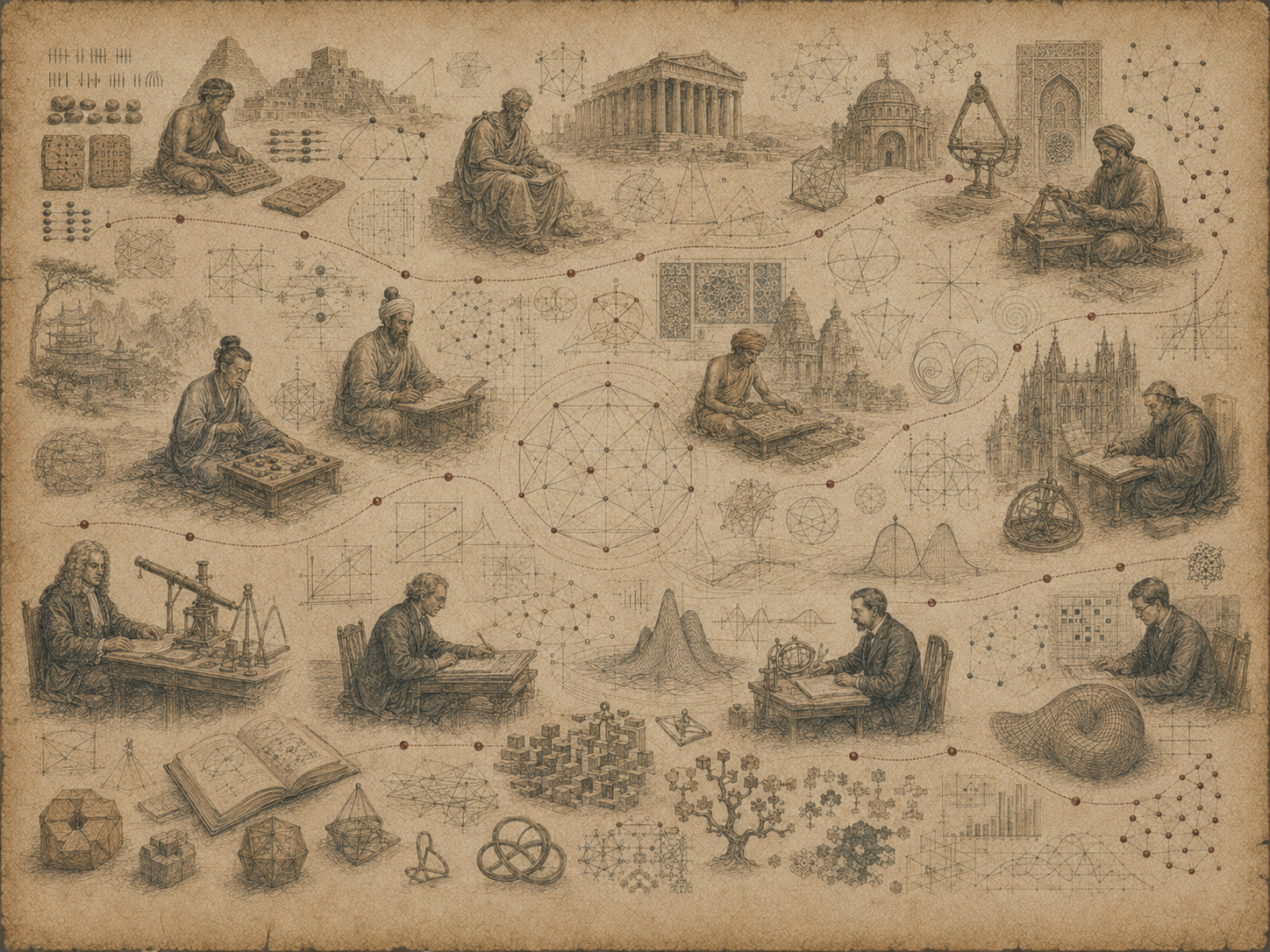
The Historical Question: What Has Mathematics Been Understood To Be?
The historical understanding of mathematics begins with a deceptively simple question: what has mathematics been understood to be? The answer has changed many times. Mathematics has been understood as reckoning, measurement, geometry, celestial order, philosophical demonstration, practical art, commercial technique, symbolic manipulation, natural philosophy, formal logic, structural science, computation, model-building, and machine-verifiable reasoning.
These understandings overlap. Mathematics did not stop being calculation when it became proof. It did not stop being geometry when algebra developed. It did not stop being human reasoning when proof assistants appeared. Historical understanding requires seeing mathematics as layered rather than replaced. Older meanings remain embedded inside newer practices.
\text{mathematics as history}=\text{objects}+\text{media}+\text{methods}+\text{institutions}+\text{meanings}
\]
Interpretation: A historical understanding of mathematics studies not only mathematical objects, but also the media, methods, institutions, and meanings through which those objects become intelligible.
For example, a theorem can be studied as a formal statement, a proof, a classroom topic, a historical artifact, a diagrammatic practice, a computational object, and a philosophical claim. Each perspective reveals something different. The theorem may be timeless in one sense, but its expression, proof, reception, teaching, and use are historical.
| Historical Understanding | Mathematics Appears As | Central Question |
|---|---|---|
| Practical | Counting, measuring, calculating, predicting | What problem must be solved? |
| Deductive | Definitions, postulates, propositions, proofs | What follows from what? |
| Symbolic | Notation, variables, equations, transformations | What form can be manipulated? |
| Structural | Objects, relations, operations, invariants | What structure is preserved? |
| Computational | Algorithms, programs, proof scripts, simulations | What can be executed or checked? |
Historical understanding does not weaken mathematics. It makes mathematics more intelligible by showing how its forms of authority developed.
Mathematics as Both Timeless and Historical
Mathematics creates a distinctive historical puzzle. Mathematical truths can seem timeless, yet mathematical practice is historically situated. The Pythagorean theorem, once proved under its assumptions, does not depend on the politics of a particular century. But the way the theorem is stated, represented, proved, taught, named, transmitted, and culturally credited is historical.
This dual character is central. Mathematics is not simply a mirror of social conditions. But neither is it detached from human activity. Mathematical truth may be independent of who discovers it, but mathematical discovery, notation, pedagogy, canon formation, institutional authority, and application are historical processes.
\text{validity of proof}\neq \text{history of practice}
\]
Interpretation: A proof may establish a result under assumptions, while the historical practice surrounding that proof remains shaped by language, institutions, media, and power.
Confusing these levels creates two opposite mistakes. One mistake treats mathematics as if it has no history, reducing it to finished truths. The other treats mathematics as if it were only a social construction, ignoring the distinctive force of proof, structure, and formal necessity. A serious historical understanding avoids both errors.
| Dimension | Less Historical | More Historical |
|---|---|---|
| Theorem validity | Depends on proof and assumptions | Not reducible to social context |
| Notation | Can express stable relations | Develops through conventions and transmission |
| Proof style | Aims at justified inference | Changes across traditions, media, and standards |
| Canon | May preserve important results | Reflects institutions, translation, language, and power |
| Application | Uses formal structure | Depends on interpretation, values, and consequences |
The historical understanding of mathematics therefore requires two commitments: respect for mathematical validity and attention to the human conditions through which mathematics becomes known.
Practice Before Theory: Counting, Measuring, Recording, Predicting
Mathematics did not begin as an abstract discipline separated from life. It emerged through practice: counting animals, measuring land, recording debt, designing calendars, constructing buildings, predicting celestial cycles, dividing goods, and organizing labor. These practices required stable procedures and representations long before modern symbolic notation or formal proof.
This matters because historical understanding must not judge early mathematics only by later standards. A Mesopotamian table, an Egyptian measurement rule, a Chinese rod-calculation procedure, an Indian astronomical algorithm, or a commercial arithmetic manual may not look like modern mathematical exposition. But each may contain serious mathematical thinking.
\text{repeated practice}\rightarrow \text{stable procedure}\rightarrow \text{mathematical form}
\]
Interpretation: Many mathematical ideas begin as stable procedures for solving recurring practical problems.
Practice also shaped abstraction. Counting requires seeing different objects as instances of the same quantity. Measurement requires units. Calendars require periodicity. Construction requires spatial relation. Trade requires equivalence. Astronomy requires prediction. Each practice pushes thought beyond the immediate object toward a transferable form.
| Practice | Mathematical Form | Historical Meaning |
|---|---|---|
| Counting | Discrete quantity | Objects become comparable through number |
| Measurement | Unit, length, area, volume | Space becomes organized through magnitude |
| Accounting | Debt, exchange, equivalence | Social obligation becomes numerical record |
| Astronomy | Periodicity and prediction | Time becomes mathematically patterned |
| Construction | Geometry, proportion, angle | Material form becomes spatial reasoning |
Historical understanding begins by recognizing that practical mathematics is not merely “applied” after pure mathematics appears. In many cases, practice is where abstraction begins.
Proof and the Historical Making of Mathematical Authority
Proof is one of the central sources of mathematical authority. But proof itself has a history. Different mathematical cultures have justified results through diagrams, procedures, commentaries, examples, transformations, exhaustion arguments, algebraic manipulation, induction, contradiction, formal derivation, and machine-checked proof.
The Euclidean tradition made deductive proof especially influential by organizing mathematics through definitions, postulates, common notions, propositions, and demonstrations. This gave mathematics a powerful architecture of necessity. A result was not merely useful or observed; it followed from assumptions by reasoned steps.
\text{assumptions}+\text{accepted inference}\Rightarrow \text{mathematical authority}
\]
Interpretation: Proof creates mathematical authority by showing how a claim follows from accepted assumptions through valid reasoning.
Yet historical understanding must avoid treating one proof style as the only legitimate mathematical form. Chinese mathematical commentaries, Indian mathematical rules and explanations, Islamic geometric justifications of algebra, medieval logical disputation, Renaissance symbolic technique, and modern formal proof each reveal different relationships between method, explanation, and authority.
| Proof or Justification Style | Historical Context | What It Makes Authoritative |
|---|---|---|
| Geometric demonstration | Greek deductive geometry | Necessity through construction and relation |
| Procedural verification | Scribal, Chinese, commercial, and algorithmic traditions | Reliability through repeatable method |
| Algebraic transformation | Medieval, Renaissance, and modern algebra | Equivalence through symbolic manipulation |
| Limit proof | Analysis and calculus foundations | Control of approximation and infinity |
| Formal derivation | Logic and proof assistants | Machine-checkable inference under rules |
The history of proof shows that mathematical authority is not simply inherited. It is built through changing standards of explanation, representation, and trust.
Notation as Historical Infrastructure
Notation is not decoration. It is infrastructure for thought. A notation system determines what can be written easily, what can be transformed reliably, what can be taught efficiently, and what can be generalized. The historical development of mathematics is inseparable from the development of numerals, diagrams, tables, algebraic symbols, coordinates, functions, matrices, set notation, logical notation, programming languages, and proof scripts.
Modern notation can make older mathematics look simpler than it was. When historians translate a rhetorical algebraic problem into a modern equation, the translation can reveal structure. But it can also mislead readers into thinking that the original author thought in modern symbols. Historical understanding requires distinguishing original practice from modern reconstruction.
\text{historical expression}\neq \text{modern reconstruction}
\]
Interpretation: Modern notation can clarify historical mathematics, but it must not be mistaken for the original form of thought.
Notation also changes mathematical power. Place-value numeration makes arithmetic scalable. Algebraic notation makes unknowns manipulable. Coordinates connect geometry and equations. Set notation makes collections formal. Logical notation makes inference explicit. Code makes procedures executable. Proof scripts make formal derivations checkable.
| Notation or Medium | Historical Function | Mathematical Effect |
|---|---|---|
| Place-value numerals | Compact representation of magnitude | Scalable arithmetic |
| Tables | Organized repeated values and procedures | Computation, astronomy, prediction |
| Diagrams | Visible spatial relation | Geometry, construction, proof |
| Algebraic symbols | Unknowns, variables, operations, equations | General symbolic manipulation |
| Proof scripts | Formal machine-checkable derivations | Verified mathematical infrastructure |
To understand mathematics historically is to understand that symbols are not neutral containers. They are cognitive technologies.
Translation, Transmission, and Transformation
Mathematical knowledge travels through translation, copying, commentary, teaching, trade, conquest, collaboration, and institutional exchange. But transmission is never merely passive. When mathematics moves from one language, medium, or institution to another, it is often reorganized, reinterpreted, extended, or transformed.
Greek mathematical works translated into Arabic, Indian numerals moving through Islamic and European contexts, algebraic traditions moving across languages, astronomical tables traveling across scholarly centers, and modern mathematical software libraries circulating globally all show that mathematics is portable but not contextless.
\text{transmission}=\text{preservation}+\text{translation}+\text{reinterpretation}
\]
Interpretation: Mathematical transmission preserves knowledge, but also changes its language, organization, interpretation, and use.
Translation may introduce new terms. Commentary may clarify or redirect meaning. Pedagogy may simplify. Institutions may canonize some texts and neglect others. Printing may stabilize notation. Digital platforms may accelerate collaboration while creating new dependencies on software infrastructure.
| Mode of Transmission | What It Preserves | What It Can Change |
|---|---|---|
| Translation | Problems, methods, texts, concepts | Terminology, interpretation, emphasis |
| Commentary | Inherited mathematical results | Explanation, proof style, pedagogy |
| Manuscript copying | Textual continuity | Selection, errors, variants, survival |
| Printing | Wider dissemination | Standardization, canon, notation |
| Digital libraries | Code, proofs, datasets, formal artifacts | Infrastructure, dependency, versioning, access |
A historical understanding of mathematics treats transmission as an active process. Mathematical knowledge survives because people copy it, teach it, translate it, dispute it, improve it, and give it new uses.
Global Mathematical Traditions and Multiple Forms of Reasoning
A responsible historical understanding of mathematics must be global. Mathematics did not develop in one place, through one language, or according to one standard of proof. Mesopotamian, Egyptian, Greek, Indian, Chinese, Islamic, African, Indigenous, European, and modern international traditions all contributed to mathematical knowledge in different ways.
This does not mean all traditions are the same. The point is not to flatten difference, but to recognize multiple forms of mathematical reasoning: table-based computation, geometric proof, algorithmic astronomy, algebraic classification, diagrammatic transformation, counting systems, calendar mathematics, architectural proportion, commercial arithmetic, and formal logic.
\text{global history}\neq \text{single-line genealogy}
\]
Interpretation: The history of mathematics should be understood as a network of traditions, transmissions, transformations, and practices rather than as a single linear sequence.
| Tradition or Context | Mathematical Emphasis | Historical Caution |
|---|---|---|
| Mesopotamian | Tables, place value, reciprocal methods, procedures | Do not judge only by later proof standards |
| Egyptian | Measurement, fractions, area, volume, administration | Surviving papyri are partial evidence |
| Greek | Deductive geometry and proof architecture | Do not make Greek proof the whole definition of mathematics |
| Indian | Place value, zero, astronomy, algorithms, trigonometry | Respect genre, commentary, and computational context |
| Chinese | Procedure, configuration, systems, dissection | Procedural verification deserves serious interpretation |
| Islamic | Algebra, trigonometry, translation, astronomy | Transmission was also creative transformation |
Global mathematical history reveals mathematics as a shared human achievement. Its universality is strengthened, not weakened, when its many sources are acknowledged.
Canon Formation and the Politics of Mathematical Memory
Every history has a canon: a set of names, texts, results, and traditions treated as central. Mathematical canons preserve important achievements, but they also exclude. The survival and prestige of mathematical knowledge have depended on manuscript preservation, translation, language hierarchy, institutional authority, colonial power, gender exclusion, class access, and educational systems.
Canon formation is not simply a matter of mathematical importance. It is also a matter of who had access to education, who wrote in dominant languages, whose manuscripts survived, whose results were translated, whose labor was named, and whose practices were dismissed as merely practical, craft-based, or non-theoretical.
\text{mathematical importance}\neq \text{historical visibility}
\]
Interpretation: What becomes visible in mathematical history is shaped not only by intellectual significance, but also by preservation, translation, institutions, and power.
| Canon Risk | Problem | Responsible Response |
|---|---|---|
| Eurocentrism | Mathematics is narrated mainly as Greek-to-European progress | Include multiple global mathematical traditions |
| Great-man history | Collective labor, teaching, translation, and commentary disappear | Study institutions, communities, and transmission networks |
| Textual bias | Surviving written texts are mistaken for all mathematical practice | Attend to material, oral, craft, and pedagogical mathematics |
| Gender exclusion | Women’s mathematical labor is minimized or omitted | Recover barriers, institutions, and hidden forms of contribution |
| Presentism | Older mathematics is judged only by modern notation and standards | Interpret mathematics within historical media and purposes |
A more responsible canon does not discard major achievements. It places them in a wider history of intellectual labor, transmission, exclusion, and reinterpretation.
Foundations and the Changing Meaning of Certainty
The historical understanding of mathematics must also address foundations. For much of mathematical history, certainty was associated with demonstration, especially geometric proof. Later, the development of calculus, non-Euclidean geometry, set theory, symbolic logic, formalism, intuitionism, structuralism, and computability changed the meaning of certainty.
Calculus produced powerful results before its foundations were clarified. Non-Euclidean geometry showed that alternative axiom systems could define coherent mathematical worlds. Set theory made infinity into a formal object while introducing paradoxes. Formal logic made proof itself an object of mathematical study. Gödel’s incompleteness theorems showed limits to the dream of complete formal foundations.
\text{certainty}=\text{claim}+\text{assumptions}+\text{valid reasoning}+\text{scope}
\]
Interpretation: Modern mathematical certainty depends not only on proof, but on explicit assumptions, rules, definitions, and scope.
Foundational debates changed mathematics by making its own authority visible. What is a number? What is a set? What is a function? What is a proof? What is mathematical existence? Can every truth be proved? Can a formal system prove its own consistency? These questions turn mathematics back upon itself.
| Foundational Shift | Older Understanding | Historical Reinterpretation |
|---|---|---|
| Non-Euclidean geometry | Geometry describes one obvious space | Axioms define possible mathematical worlds |
| Set theory | Collections seem intuitive | Unrestricted collection formation can produce paradox |
| Analysis | Continuity and limits seem visually clear | Precise definitions are needed |
| Formal logic | Proof is a human explanatory practice | Proof can be formalized and studied mathematically |
| Incompleteness | Formal systems might secure all mathematics | Formal systems have internal limits |
Foundations reveal that mathematics has a history of questioning its own grounds. Certainty is not abandoned; it is refined.
The Structural Understanding of Mathematics
Modern mathematics is often understood structurally. Instead of treating mathematical objects as isolated things, structural mathematics studies objects through relations, operations, laws, maps, and invariants. A group may consist of numbers, symmetries, permutations, or transformations. A vector space may consist of arrows, functions, signals, or data. A graph may model roads, citations, dependencies, social ties, or circuits.
This structural understanding is historical. It emerged as mathematics moved beyond calculation and geometry into abstract algebra, topology, functional analysis, category theory, mathematical logic, and computer science. The focus shifted from what objects are made of to how they behave under structure-preserving transformations.
\text{structure}=(\text{objects},\text{relations},\text{operations},\text{laws})
\]
Interpretation: A structural understanding of mathematics studies systems according to the relations, operations, and laws that organize them.
The structural understanding also helps explain why mathematics travels across fields. The same structure can appear in different domains. A graph can represent many kinds of networks. A matrix can represent a transformation, dataset, adjacency relation, covariance structure, or system of constraints. A formal system can represent a logic, programming language, or proof environment.
| Structure | What It Organizes | Historical Significance |
|---|---|---|
| Group | Symmetry and operation | Unifies algebra, geometry, and transformations |
| Vector space | Linear combination | Unifies geometry, analysis, physics, and data |
| Topological space | Continuity and nearness | Separates qualitative structure from exact measurement |
| Graph | Nodes and relations | Connects discrete mathematics, networks, and computation |
| Category | Objects and morphisms | Centers structure-preserving transformation |
The structural view does not erase history. It gives historians another question to ask: when did a mathematical practice begin to treat relations, transformations, and invariants as primary?
Mathematics as Model, Method, and Interpretation
Mathematics has also been understood historically as a way of modeling the world. Astronomy, mechanics, optics, engineering, probability, economics, biology, climate science, epidemiology, data science, and artificial intelligence all use mathematical structures to represent systems beyond mathematics itself.
Modeling is not simply applying formulas. A model connects a formal structure to a target system through assumptions and interpretation. The same mathematical form may model different realities. A differential equation may represent motion, disease spread, chemical reaction, population growth, or financial dynamics. A graph may represent a road network, social network, citation network, supply chain, or software dependency structure.
\text{formal structure}+\text{interpretation}+\text{assumptions}\Rightarrow \text{model}
\]
Interpretation: A mathematical model is not merely a formula. It is a formal structure interpreted in relation to a target system under assumptions.
The historical understanding of mathematics must therefore distinguish formal success from interpretive adequacy. A model can be mathematically coherent and still socially, scientifically, or ethically inadequate. A metric can be precise while measuring the wrong thing. An optimization problem can be solved correctly while optimizing an objective that should be challenged.
| Mathematical Form | Modeling Use | Historical and Ethical Question |
|---|---|---|
| Differential equation | Change over time | Which dynamics are included or excluded? |
| Probability distribution | Uncertainty and variation | What interpretation of probability is being used? |
| Graph | Relational systems | What does an edge mean in this context? |
| Optimization model | Decision or allocation | Who chose the objective function? |
| Statistical model | Inference from data | What assumptions shape the inference? |
Mathematics as model is historically powerful because it connects formal reasoning to the world. But it also makes interpretation unavoidable.
Computation and the Historical Reinterpretation of Mathematical Practice
Computation has changed the historical understanding of mathematics. Algorithms existed long before electronic computers, but modern computation made procedures executable at scale. Mathematical objects can now be represented as data structures. Symbolic expressions can be transformed by computer algebra systems. Differential equations can be simulated. Proofs can be encoded in proof assistants. Large finite cases can be checked computationally.
This reinterprets mathematics as both reasoning and infrastructure. A proof may be a human-readable argument, a formal script, a library dependency, and a machine-checked artifact. A theorem may live not only in a journal, but inside a software ecosystem. A mathematical model may be inseparable from code, datasets, numerical methods, and reproducibility standards.
\text{mathematical object}\rightarrow \text{representation}\rightarrow \text{algorithm}\rightarrow \text{artifact}
\]
Interpretation: Computational mathematics turns mathematical ideas into executable, inspectable, reusable artifacts.
Proof assistants represent a particularly important shift. They do not eliminate human creativity, but they change the medium of proof. Humans still choose definitions, formulate theorems, guide strategies, and interpret results. Machines check whether formal derivations follow from specified rules and libraries.
| Computational Form | Historical Reinterpretation | Caution |
|---|---|---|
| Algorithm | Procedure becomes object of mathematical study | Correctness, complexity, and specification matter |
| Simulation | Systems can be explored computationally | Simulation is not proof |
| Computer algebra | Symbolic manipulation becomes automated | Domain assumptions can be hidden |
| Proof assistant | Proof becomes machine-checkable artifact | Formal statement must match intended meaning |
| Mathematical software library | Mathematics becomes reusable infrastructure | Dependencies and trust boundaries matter |
The computational turn adds a new historical layer to mathematics: knowledge as executable formal infrastructure.
How Historical Understanding Changes Mathematical Education
Historical understanding can transform mathematical education. Students often experience mathematics as a finished sequence of procedures. History shows that mathematical ideas were invented, debated, revised, represented, generalized, and formalized. This makes mathematics more human without making it less rigorous.
Historical understanding helps students distinguish a rule from a reason, a symbol from an idea, a proof from a calculation, a model from the world, and a modern reconstruction from an original practice. It also helps students see why abstraction matters. Algebraic notation, for example, is not arbitrary decoration; it is the result of centuries of representational development.
\text{historical learning}=\text{concept}+\text{origin}+\text{representation}+\text{purpose}
\]
Interpretation: Learning mathematics historically connects concepts to the problems, media, purposes, and representations through which they developed.
| Educational Problem | Historical Reframing | Learning Benefit |
|---|---|---|
| Students see symbols as arbitrary | Show notation as historical infrastructure | Symbols become meaningful tools |
| Students memorize procedures | Show how procedures emerged from recurring problems | Methods gain purpose |
| Proof feels artificial | Show proof as a historical answer to authority and certainty | Proof becomes accountable explanation |
| Abstraction feels empty | Show abstraction as preservation of structure | Generalization becomes intelligible |
| Applications seem formulaic | Show modeling as interpretation under assumptions | Students learn responsible mathematical use |
History does not replace practice or proof. It gives practice and proof meaning.
How to Write the History of Mathematics Responsibly
The history of mathematics must be written with methodological care. It is easy to tell a triumphalist story in which mathematics steadily progresses from primitive calculation to modern abstraction. It is also easy to impose current categories backward, translating every older practice into modern notation and then treating that notation as if it were historically original.
Responsible historiography asks what mathematical practice meant in its own context. What media were used? What problems mattered? What counted as explanation? How was knowledge transmitted? Who had access? What was preserved, lost, translated, renamed, or absorbed into later canons?
\text{responsible history}=\text{context}+\text{source criticism}+\text{mathematical care}
\]
Interpretation: Good mathematical history requires both historical context and mathematical understanding.
| Historiographic Principle | Question to Ask | Risk Avoided |
|---|---|---|
| Contextual interpretation | What did this method mean in its own setting? | Presentism |
| Notation awareness | Is this original notation or modern reconstruction? | False modernization |
| Global scope | Which traditions are omitted from the story? | Eurocentrism |
| Source criticism | What survived, and why? | Textual bias |
| Mathematical accuracy | Does the historical account preserve the mathematical content? | Overgeneralization or romanticization |
Responsible mathematical history must hold together two forms of discipline: respect for the mathematics and respect for the historical conditions through which the mathematics became known.
A Mathematical Lens: Object, Medium, Method, Meaning
A useful lens for historical understanding is the sequence: object, medium, method, meaning. Every mathematical practice involves objects of thought, media of representation, methods of reasoning, and meanings assigned within a context.
\text{Object}\rightarrow \text{Medium}\rightarrow \text{Method}\rightarrow \text{Meaning}
\]
Interpretation: Historical understanding asks what is being studied, how it is represented, how reasoning proceeds, and what the practice means in context.
This lens prevents oversimplification. A number is not only an abstract object; it may be a mark on a tablet, a numeral in a place-value system, a commercial record, a proof object, a data value, or a type in a program. A diagram may be a visual aid, a proof device, a construction method, or a model. A proof may be rhetorical, diagrammatic, symbolic, formal, or machine-checkable.
| Lens Element | Historical Question | Example |
|---|---|---|
| Object | What mathematical thing is being studied? | Number, shape, function, set, structure, model |
| Medium | How is it represented? | Tablet, diagram, symbol, table, code, proof script |
| Method | How is reasoning performed? | Procedure, proof, calculation, simulation, formal derivation |
| Meaning | What does the practice signify in context? | Administration, philosophy, science, education, verification |
This lens helps make mathematics historically visible without reducing mathematics to history alone.
Computational Companion Examples
The companion repository for this article should extend the Mathematical Thinking codebase with examples focused on historiographic metadata, object-medium-method-meaning schemas, proof-style catalogs, notation history, transmission maps, canon-risk audits, Haskell typed historiography models, SQL schemas, and responsible historical interpretation workflows.
Python: Object, Medium, Method, Meaning Index
from dataclasses import dataclass
from collections import defaultdict

@dataclass(frozen=True)
class HistoricalMathematicalPractice:
    practice: str
    object_of_thought: str
    medium: str
    method: str
    meaning: str
    caution: str

practices = [
    HistoricalMathematicalPractice(
        practice="scribal calculation",
        object_of_thought="quantity and reciprocal relation",
        medium="tablet and table",
        method="procedure and lookup",
        meaning="administrative and computational reliability",
        caution="do not judge only by later proof standards"
    ),
    HistoricalMathematicalPractice(
        practice="Euclidean geometry",
        object_of_thought="space, figure, relation",
        medium="diagram and proposition",
        method="deductive demonstration",
        meaning="mathematical necessity under assumptions",
        caution="diagrams may hide implicit assumptions"
    ),
    HistoricalMathematicalPractice(
        practice="symbolic algebra",
        object_of_thought="unknowns, equations, operations",
        medium="algebraic notation",
        method="symbolic transformation",
        meaning="generalization across problem families",
        caution="modern notation can distort older practice"
    ),
    HistoricalMathematicalPractice(
        practice="proof assistant formalization",
        object_of_thought="formal theorem and proof object",
        medium="proof script and library",
        method="machine-checked derivation",
        meaning="verified formal infrastructure",
        caution="formal statement must match intended meaning"
    ),
]

by_method = defaultdict(list)
for item in practices:
    by_method[item.method].append(item.practice)

for method, examples in by_method.items():
    print(method, "=>", examples)
R: Historiographic Risk Table
historiographic_risks <- data.frame(
  risk = c(
    "presentism",
    "Eurocentrism",
    "notation anachronism",
    "textual bias",
    "great-person reduction",
    "formal overconfidence"
  ),
  problem = c(
    "older mathematics is judged by modern standards alone",
    "global traditions are reduced to a Greek-European sequence",
    "modern notation is mistaken for original practice",
    "surviving texts are treated as the whole record",
    "institutions, teachers, translators, and communities disappear",
    "formal proof is treated as full interpretation"
  ),
  mitigation = c(
    "interpret practices in historical context",
    "include multiple traditions and transmission networks",
    "distinguish historical expression from modern reconstruction",
    "consider oral, material, craft, and pedagogical practices",
    "study communities, institutions, commentary, and labor",
    "separate proof, specification, model, and consequence"
  )
)

print(historiographic_risks)
Haskell: Typed Historiography Model
{-# OPTIONS_GHC -Wall #-}

data Medium
  = Tablet
  | Papyrus
  | Diagram
  | Manuscript
  | PrintedBook
  | SymbolicNotation
  | Code
  | ProofScript
  deriving (Eq, Show)

data Method
  = Procedure
  | Demonstration
  | SymbolicTransformation
  | FormalDerivation
  | Simulation
  | MachineCheck
  deriving (Eq, Show)

data HistoricalPractice = HistoricalPractice
  { practiceName :: String
  , medium :: Medium
  , method :: Method
  , caution :: String
  } deriving (Eq, Show)

examples :: [HistoricalPractice]
examples =
  [ HistoricalPractice "scribal calculation" Tablet Procedure
      "do not dismiss procedural mathematics as non-theoretical"
  , HistoricalPractice "Euclidean geometry" Diagram Demonstration
      "distinguish diagrammatic reasoning from modern formal proof"
  , HistoricalPractice "symbolic algebra" SymbolicNotation SymbolicTransformation
      "avoid projecting modern notation backward"
  , HistoricalPractice "proof assistant formalization" ProofScript MachineCheck
      "formal verification depends on intended statement and assumptions"
  ]

main :: IO ()
main = mapM_ print examples
SQL: Historical Understanding Schema
CREATE TABLE historical_practice (
  practice_id TEXT PRIMARY KEY,
  practice_name TEXT NOT NULL,
  object_of_thought TEXT NOT NULL,
  medium TEXT NOT NULL,
  method TEXT NOT NULL,
  meaning TEXT NOT NULL,
  caution TEXT NOT NULL
);

CREATE TABLE historiographic_risk (
  risk_id TEXT PRIMARY KEY,
  risk_name TEXT NOT NULL,
  problem TEXT NOT NULL,
  mitigation TEXT NOT NULL
);

CREATE TABLE mathematical_transmission (
  transmission_id TEXT PRIMARY KEY,
  source_context TEXT NOT NULL,
  target_context TEXT NOT NULL,
  preserved_content TEXT NOT NULL,
  transformed_content TEXT NOT NULL,
  interpretation_note TEXT NOT NULL
);

CREATE TABLE notation_history (
  notation_id TEXT PRIMARY KEY,
  notation_or_medium TEXT NOT NULL,
  mathematical_function TEXT NOT NULL,
  historical_effect TEXT NOT NULL,
  anachronism_warning TEXT NOT NULL
);
These examples treat the historical understanding of mathematics as structured knowledge. Mathematical practices can be indexed by object, medium, method, meaning, and caution. Historiographic risks can be made explicit. Transmission can be modeled as preservation plus transformation. Notation can be audited as cognitive infrastructure.
GitHub Repository
The companion repository for this article is designed as a reproducible mathematical-thinking workspace focused on historiographic metadata, object-medium-method-meaning schemas, proof-style catalogs, notation history, transmission maps, canon-risk audits, Haskell typed historiography models, SQL schemas, and responsible historical interpretation workflows.
Complete Code Repository
Companion article folder with Python, R, Julia, SQL, Haskell, Rust, Go, C++, Fortran, and C examples for professional mathematical exploration of historical understanding, notation, proof standards, transmission, global traditions, canon formation, formalization, computation, and responsible mathematical historiography.
Historical Understanding, Power, and Mathematical Responsibility
Mathematics carries authority. Because it appears exact, objective, and universal, it can be used to justify decisions in education, finance, technology, governance, science, infrastructure, and artificial intelligence. Historical understanding helps discipline that authority. It reminds us that mathematical objects may be formal, but mathematical uses are human.
A calculation can be correct and still serve an unjust policy. A model can be elegant and still omit the people most affected by it. A metric can be precise and still reduce complex life to a narrow proxy. A proof can be valid and still say nothing about whether the assumptions should be used in the world. Historical understanding helps separate formal correctness from social meaning.
\text{formal universality}\neq \text{social neutrality}
\]
Interpretation: Mathematical structures may be formally general, but their historical uses, institutions, and consequences are not neutral.
| Responsibility Issue | Historical Insight | Responsible Practice |
|---|---|---|
| Model authority | Models are interpreted under assumptions | State assumptions, scope, and limitations |
| Metric power | Measurement systems reflect choices | Audit what metrics omit |
| Canon exclusion | Mathematical memory is institutionally shaped | Recover marginalized traditions and labor |
| Formal overconfidence | Proof and verification operate within systems | Distinguish proof, model, specification, and use |
| Educational access | Notation and abstraction can exclude | Teach meaning, history, and representation together |
Historical understanding makes mathematics more responsible because it reveals both the power and the limits of formal reasoning.
Why the Historical Understanding of Mathematics Matters
The historical understanding of mathematics matters because mathematics is not only a collection of completed results. It is a human practice of creating durable forms of reasoning. Its history explains how ideas become symbols, how symbols become systems, how systems become proofs, how proofs become institutions, how institutions become canons, how canons shape education, and how mathematical authority enters the world.
Without history, mathematics can appear as an intimidating wall of finished techniques. With history, mathematics becomes a living architecture of inquiry: practical, philosophical, symbolic, structural, computational, and interpretive. Students can see why notation matters. Researchers can see why foundations changed. Modelers can see why assumptions matter. Historians can see why global traditions and source survival matter. Technologists can see why formal verification still requires human judgment.
The historical understanding of mathematics also matters because modern society increasingly relies on mathematical systems: data models, algorithms, statistics, optimization, simulations, risk scores, cryptography, machine learning, and formal verification. These systems inherit the authority of mathematics. Historical understanding helps keep that authority accountable.
Mathematics is timeless in its proofs and historical in its practice. A serious account must hold both truths together. Mathematical validity matters. So do notation, pedagogy, translation, institutions, power, media, and interpretation. To understand mathematics historically is to understand how human beings learned to make reason durable—and how that durability must be used with care.
Related Articles
- What Is Mathematical Thinking? Pattern, Proof, Architecture, and Reason
- The History of Mathematical Thinking from Antiquity to Modernity
- Historical Development and the Unity of Mathematical Ideas
- Foundations, Structure, and the Reimagining of Mathematics
- The Historical Development of Proof
- The Evolution of Algebraic Notation
- Symbols, Language, and Mathematical Representation
- Mathematical Thinking and Proof Assistants
- Mathematical Thinking and AI-Assisted Discovery
- Mathematical Thinking in an Age of Automation
Further Reading
- Boyer, C.B. and Merzbach, U.C. (2011) A History of Mathematics. 3rd edn. Hoboken, NJ: Wiley.
- Cajori, F. (1928) A History of Mathematical Notations, Volume I: Notations in Elementary Mathematics. Chicago: Open Court. Available at: https://archive.org/details/historyofmathema031756mbp
- Corry, L. (2004) Modern Algebra and the Rise of Mathematical Structures. 2nd edn. Basel: Birkhäuser. Available at: https://link.springer.com/book/10.1007/978-3-0348-7917-0
- Gray, J. (2007) Plato’s Ghost: The Modernist Transformation of Mathematics. Princeton: Princeton University Press. Available at: https://press.princeton.edu/books/paperback/9780691136103/platos-ghost
- Joseph, G.G. (2011) The Crest of the Peacock: Non-European Roots of Mathematics. 3rd edn. Princeton: Princeton University Press. Available at: https://press.princeton.edu/books/paperback/9780691135267/the-crest-of-the-peacock
- Katz, V.J. (2009) A History of Mathematics: An Introduction. 3rd edn. Boston: Addison-Wesley.
- Kline, M. (1972) Mathematical Thought from Ancient to Modern Times. New York: Oxford University Press.
- MacTutor History of Mathematics (n.d.) An overview of the history of mathematics. University of St Andrews. Available at: https://mathshistory.st-andrews.ac.uk/HistTopics/History_overview/
- MacTutor History of Mathematics (n.d.) History Topics Index. University of St Andrews. Available at: https://mathshistory.st-andrews.ac.uk/HistTopics/
- Stillwell, J. (2010) Mathematics and Its History. 3rd edn. New York: Springer. Available at: https://link.springer.com/book/10.1007/978-1-4419-6053-5
References
- Avigad, J. (2023) ‘Mathematics and the Formal Turn’. Available at: https://arxiv.org/abs/2311.00007
- Boyer, C.B. and Merzbach, U.C. (2011) A History of Mathematics. 3rd edn. Hoboken, NJ: Wiley.
- Cajori, F. (1928) A History of Mathematical Notations, Volume I: Notations in Elementary Mathematics. Chicago: Open Court. Available at: https://archive.org/details/historyofmathema031756mbp
- Cajori, F. (1929) A History of Mathematical Notations, Volume II: Notations Mainly in Higher Mathematics. Chicago: Open Court. Available at: https://archive.org/details/historyofmathema00cajo_0
- Corry, L. (2004) Modern Algebra and the Rise of Mathematical Structures. 2nd edn. Basel: Birkhäuser. Available at: https://link.springer.com/book/10.1007/978-3-0348-7917-0
- Euclid (1956) The Thirteen Books of Euclid’s Elements, translated by T.L. Heath. 2nd edn. New York: Dover. Available at: https://archive.org/details/EuclidsElementsBooksIIIVolume1Heath
- Gray, J. (2007) Plato’s Ghost: The Modernist Transformation of Mathematics. Princeton: Princeton University Press. Available at: https://press.princeton.edu/books/paperback/9780691136103/platos-ghost
- Horsten, L. (2019) ‘Philosophy of Mathematics’, Stanford Encyclopedia of Philosophy. Available at: https://plato.stanford.edu/entries/philosophy-mathematics/
- Joseph, G.G. (2011) The Crest of the Peacock: Non-European Roots of Mathematics. 3rd edn. Princeton: Princeton University Press. Available at: https://press.princeton.edu/books/paperback/9780691135267/the-crest-of-the-peacock
- Katz, V.J. (2009) A History of Mathematics: An Introduction. 3rd edn. Boston: Addison-Wesley.
- Kline, M. (1972) Mathematical Thought from Ancient to Modern Times. New York: Oxford University Press.
- MacTutor History of Mathematics (n.d.) An overview of the history of mathematics. University of St Andrews. Available at: https://mathshistory.st-andrews.ac.uk/HistTopics/History_overview/
- MacTutor History of Mathematics (n.d.) History Topics Index. University of St Andrews. Available at: https://mathshistory.st-andrews.ac.uk/HistTopics/
- Reck, E. (2019) ‘Structuralism in the Philosophy of Mathematics’, Stanford Encyclopedia of Philosophy. Available at: https://plato.stanford.edu/entries/structuralism-mathematics/
- Stillwell, J. (2010) Mathematics and Its History. 3rd edn. New York: Springer. Available at: https://link.springer.com/book/10.1007/978-1-4419-6053-5
- Weir, A. (2022) ‘Formalism in the Philosophy of Mathematics’, Stanford Encyclopedia of Philosophy. Available at: https://plato.stanford.edu/entries/formalism-mathematics/