
Last Updated May 30, 2026
Algebraic notation is one of the most powerful technologies in the history of mathematical thought. It allows quantities to be named, relationships to be compressed, patterns to be generalized, equations to be transformed, unknowns to be manipulated, and structures to be studied independently of any single numerical example. What now appears ordinary—\(x\), \(y\), \(a\), \(b\), \(+\), \(=\), exponents, parentheses, functions, matrices, variables, operators, and symbolic rules—was not inevitable. It emerged through centuries of linguistic, visual, procedural, philosophical, and technical change.
The evolution of algebraic notation is not simply the story of shorter symbols replacing longer words. It is the story of mathematics becoming increasingly able to reason about form. Rhetorical algebra expressed problems in ordinary language. Syncopated algebra introduced abbreviations. Symbolic algebra allowed operations, unknowns, powers, parameters, and relations to be manipulated as visible objects. Modern notation then extended this symbolic power into functions, matrices, logic, set theory, abstract algebra, computer algebra, programming languages, and machine-checked formal systems.
This article traces algebraic notation from ancient procedural mathematics and rhetorical expression through Diophantus, Indian and Islamic algebraic traditions, medieval abbreviations, Viète’s symbolic breakthrough, Descartes’ notation for powers and analytic geometry, Leibnizian symbolism, Eulerian standardization, nineteenth-century structural algebra, Boolean and logical symbolism, matrix notation, abstract algebra, computer algebra, and contemporary formal systems. It treats notation not as a surface convenience, but as an intellectual infrastructure for abstraction, generalization, proof, computation, and mathematical imagination.
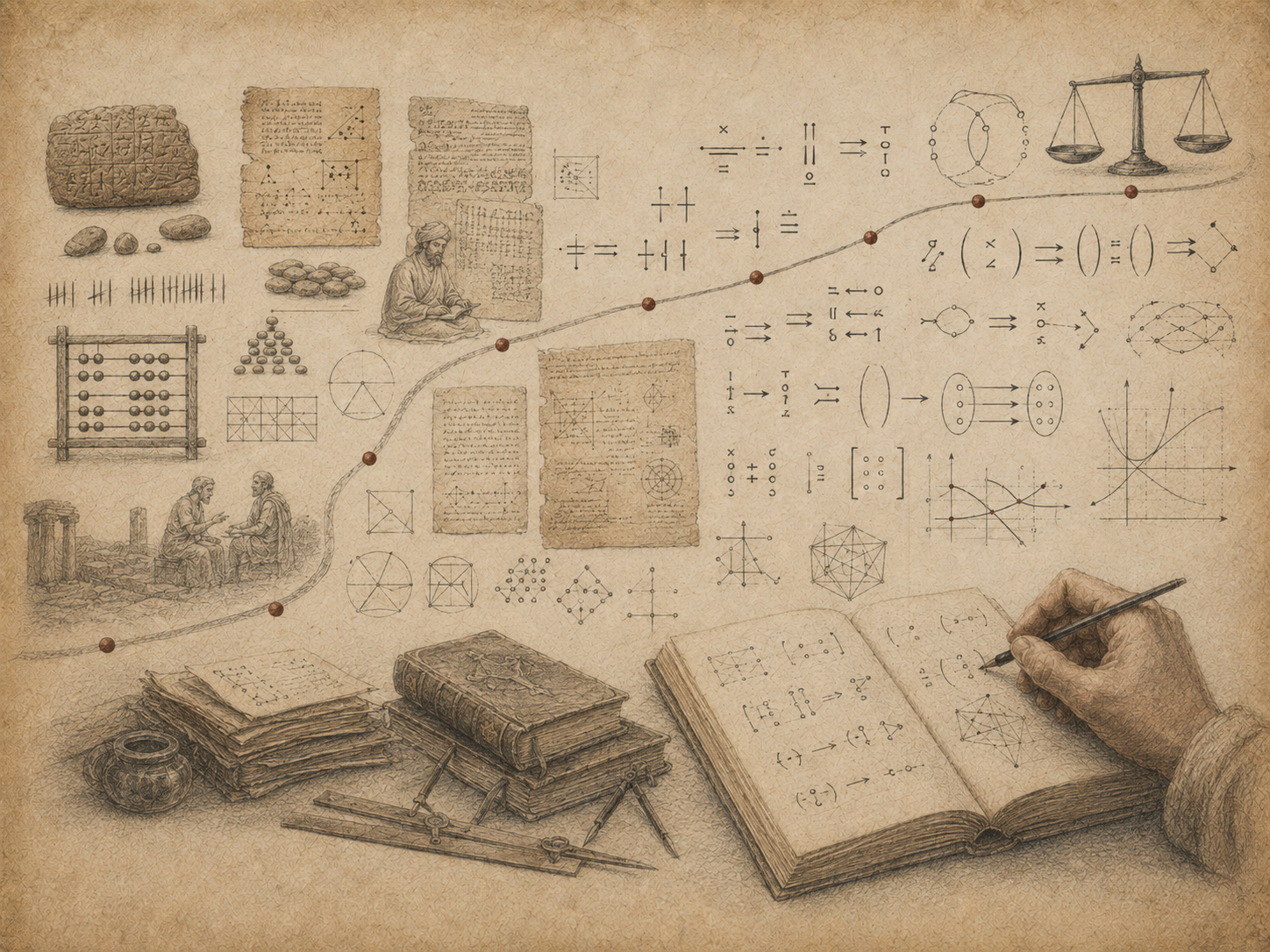
What Algebraic Notation Does
Algebraic notation allows mathematics to speak about relationships in compressed form. Instead of describing a numerical pattern in a sentence, notation allows the pattern to be written as an expression. Instead of solving one problem at a time, notation allows a general form to be manipulated. Instead of treating an unknown as a hidden number, notation allows the unknown to become an object of reasoning.
The equation \(ax+b=c\), for example, is not merely a shorthand for words. It creates a visible structure. The unknown \(x\), the parameters \(a\), \(b\), and \(c\), the operation of multiplication, the operation of addition, and the relation of equality all appear together. The notation allows the equation to be transformed systematically:
ax+b=c \quad \Rightarrow \quad ax=c-b \quad \Rightarrow \quad x=\frac{c-b}{a}
\]
Interpretation: Algebraic notation makes transformations visible. Once quantities and operations are symbolized, reasoning can proceed by manipulating form.
This symbolic form supports abstraction. A rule proven for \(ax+b=c\) is not limited to one numerical case. It applies to a whole class of linear equations, provided the assumptions are respected. Notation therefore gives mathematics a way to move from particular cases to general structures.
| Function of Notation | Mathematical Effect | Example |
|---|---|---|
| Compression | Reduces long verbal statements to symbolic form | \(x+y=z\) |
| Manipulation | Makes transformation rules visible | \(x+3=8\Rightarrow x=5\) |
| Generalization | Represents whole classes of cases | \(ax^2+bx+c=0\) |
| Structural reasoning | Allows form to be studied independently of numbers | Groups, rings, fields, vector spaces |
| Computation | Enables algorithms over symbolic expressions | Computer algebra systems |
Algebraic notation is therefore not a decorative layer placed over mathematics. It is one of the conditions that made modern mathematical thought possible.
Before Symbolic Algebra: Words, Procedures, and Worked Problems
Before symbolic algebra, mathematical relationships were often expressed in words, diagrams, tables, or worked procedures. A problem might describe a quantity, its relation to another quantity, and a method of solution using ordinary language. The unknown was not necessarily represented by a single symbol. Instead, the procedure guided the solver through operations.
This rhetorical form could be highly effective. A mathematical culture can solve sophisticated problems without writing \(x\), \(y\), or \(z\). Babylonian, Egyptian, Indian, Chinese, Islamic, and medieval European mathematical traditions all used procedural and verbal forms in different ways. The absence of modern symbols should not be mistaken for the absence of algebraic thought.
\text{verbal relation}\longrightarrow \text{procedure}\longrightarrow \text{result}
\]
Interpretation: Early algebraic reasoning often moved through stated procedures rather than compact symbolic equations.
The limitation of purely rhetorical expression is not that it cannot reason. It can. The limitation is that form is harder to see. Repeated structures may be hidden inside words. Transformations may depend on memory and training rather than visible symbolic operations. Generality may be present but not as easily inspected.
| Mode of Expression | Strength | Limitation |
|---|---|---|
| Verbal statement | Accessible in ordinary language | Can obscure structure and repeated form |
| Worked example | Shows a method in action | May not expose general proof |
| Geometric diagram | Makes spatial relation visible | May depend on one configuration |
| Table | Organizes repeated values | May not express functional rule explicitly |
| Symbolic expression | Compresses and manipulates structure | Requires learned conventions |
The rise of algebraic notation did not replace mathematical reasoning with symbols. It gave reasoning new tools for visibility, compression, and transformation.
Rhetorical, Syncopated, and Symbolic Algebra
Historians often describe three broad stages in the development of algebraic expression: rhetorical, syncopated, and symbolic algebra. These categories are useful, but they should not be treated as rigid stages that every culture passes through in the same way. They describe tendencies in notation.
Rhetorical algebra uses words. Syncopated algebra uses abbreviations for common objects or operations. Symbolic algebra uses a more systematic set of signs for unknowns, constants, operations, powers, equality, and relations. Symbolic algebra makes it easier to transform expressions according to visible rules.
| Stage | Dominant Form | Example of Mathematical Practice |
|---|---|---|
| Rhetorical algebra | Ordinary language | “The thing and ten are equal to thirty.” |
| Syncopated algebra | Words plus abbreviations | Abbreviated signs for unknown, square, cube, or operation |
| Symbolic algebra | Systematic symbolic notation | \(x+10=30\) |
The movement toward symbolism changed what algebra could do. Once the unknown and its powers could be written compactly, polynomials could be treated as manipulable objects. Once coefficients and parameters could be represented by letters, entire families of equations could be studied. Once equality and operations were standardized, algebra became a general language of transformation.
\text{rhetorical}\rightarrow \text{syncopated}\rightarrow \text{symbolic}
\]
Interpretation: Algebraic notation gradually moved from verbal description toward compact symbolic systems capable of general manipulation.
This transition did not happen evenly. Different traditions developed different notational techniques for different purposes. Some highly advanced mathematics remained rhetorical or semi-symbolic. Modern symbolism became dominant only after long historical layering.
Ancient Near Eastern and Egyptian Procedural Mathematics
Ancient Mesopotamian and Egyptian mathematics did not use modern algebraic notation, but they developed sophisticated procedures for solving problems involving unknown quantities, areas, volumes, fractions, ratios, and numerical relationships. Babylonian tablets show problem types that modern readers may translate into quadratic equations, though the original texts expressed them procedurally rather than through symbolic equations.
For example, a Babylonian problem may describe a rectangle by the sum or difference of its sides and its area. A modern algebraist might write equations such as \(xy=A\) and \(x+y=S\), then solve symbolically. The ancient procedure instead guided the solver through operations on the given quantities.
xy=A,\qquad x+y=S
\]
Interpretation: Modern notation can represent ancient problem structures, but the original reasoning was often procedural rather than written as symbolic equations.
This distinction matters historically. Translating ancient procedures into modern notation can clarify structure, but it can also distort the original practice if the translation makes the text appear more modern than it was. The historian must separate the mathematical structure we can reconstruct from the notation and reasoning actually used.
| Ancient Practice | Modern Algebraic Reconstruction | Historical Caution |
|---|---|---|
| Area-and-side problem | Quadratic equation | Original procedure may not use symbolic unknowns |
| Fractional calculation | Rational arithmetic | Notation and number system differ |
| Reciprocal table | Multiplicative inverse | Table use is not the same as formula use |
| Geometric measurement | Area or volume formula | Rule may be practical rather than deductive |
Ancient procedural mathematics shows that algebraic thought existed before symbolic algebraic notation. The notation evolved later as a way to make such structures more compact, general, and transformable.
Greek Mathematics and Diophantine Abbreviation
Greek mathematics is often associated with geometric proof, but Greek mathematical culture also produced important algebraic work. Diophantus of Alexandria’s Arithmetica is especially significant because it used abbreviated signs for unknown quantities and their powers. This is why Diophantus is often discussed in histories of syncopated algebra.
Diophantine notation did not yet resemble modern algebra. It was not a fully symbolic system for arbitrary parameters and general polynomial manipulation. But it did mark an important shift: the unknown and its powers could be abbreviated and manipulated more compactly than in purely rhetorical expression.
\text{unknown},\quad \text{square of unknown},\quad \text{cube of unknown}
\]
Interpretation: Syncopated algebra begins when recurring algebraic objects receive abbreviated written forms.
Diophantus also influenced later number theory. His problems often concerned rational solutions to equations. Modern “Diophantine equations” are named after him, though the modern field has developed far beyond his notation and methods.
| Feature | Diophantine Importance |
|---|---|
| Abbreviated unknown | Reduced reliance on full verbal expression |
| Powers of unknown | Allowed compact treatment of algebraic forms |
| Problem collections | Organized algebraic reasoning through examples |
| Rational solutions | Influenced later number-theoretic questions |
| Syncopated style | Bridge between rhetorical and symbolic algebra |
Diophantus matters not because he invented modern symbolism, but because his work shows algebra moving toward written compression of recurring mathematical forms.
Indian Algebraic Traditions and Abbreviated Expression
Indian mathematical traditions developed advanced arithmetic, algebra, combinatorics, astronomy, trigonometry, and infinite series. Algebraic reasoning often appeared in verse, procedure, rule, example, and commentary. Abbreviations and technical terms supported compact expression, though the notation differed from later European symbolism.
Mathematicians such as Brahmagupta and Bhāskara II worked with equations, zero, negative numbers, indeterminate problems, quadratic forms, and astronomical computation. The use of words and abbreviations for unknown quantities, colors, powers, and operations contributed to algebraic expression within Sanskrit mathematical culture.
Indian algebraic traditions are important because they challenge a narrow account in which algebraic notation develops only through Greek and European sources. They show that algebraic thought was deeply tied to computation, astronomy, pedagogy, and linguistic form. The written shape of algebra depended on the genres and media of mathematical communication.
| Indian Algebraic Theme | Notation-Historical Importance |
|---|---|
| Unknown quantities | Represented through terms, abbreviations, and contextual markers |
| Zero and negative quantities | Expanded the conceptual range of algebraic calculation |
| Quadratic and indeterminate equations | Supported procedural and general algebraic reasoning |
| Astronomical computation | Required compact, repeatable, and transmissible procedures |
| Verse and commentary | Linked notation to memory, pedagogy, and explanation |
The evolution of algebraic notation should therefore be understood globally. Different mathematical cultures found different ways to mark unknowns, operations, rules, and transformations. Modern symbolism is one outcome of this wider human effort to make mathematical form writable.
Islamic Algebra: Rhetoric, Procedure, and Classification
The word “algebra” itself comes through Arabic mathematical traditions, especially from works associated with al-Khwārizmī. Early Islamic algebra was often rhetorical: equations and solution procedures were described in words rather than modern symbols. Yet these texts played a decisive role in organizing algebra as a systematic discipline.
Al-Khwārizmī classified equation types and gave procedures for solving them. Later Islamic mathematicians developed algebra, geometry, number theory, trigonometry, astronomy, and methods for higher-degree equations. Geometric justification often accompanied algebraic procedure. This mixture of rhetoric, algorithm, classification, and geometry helped transmit and transform algebraic reasoning.
\text{equation type}\rightarrow \text{procedure}\rightarrow \text{geometric or numerical justification}
\]
Interpretation: Islamic algebra organized equation solving through classified forms and procedures, even before modern symbolic notation became standard.
The historical importance of Islamic algebra is not reducible to transmission. It was a site of original mathematical development. Algebraic notation did not become modern overnight, but the classification of equation types and procedural solution methods helped prepare later symbolic generalization.
| Islamic Algebraic Feature | Notation-Historical Significance |
|---|---|
| Equation classification | Organized algebraic problem types |
| Rhetorical procedure | Explained operations in ordinary language |
| Geometric justification | Linked algebraic operations to spatial reasoning |
| Translation and commentary | Moved algebra across languages and institutions |
| Higher algebraic development | Expanded the need for general methods |
Algebraic notation evolved not only from the desire to abbreviate, but from the need to classify and transform increasingly complex equation forms.
Medieval Europe and Cossic Abbreviation
In medieval and Renaissance Europe, algebraic notation developed through commercial arithmetic, abacus schools, Latin translations, vernacular mathematical texts, and cossic notation. The “coss” referred to the unknown thing, and cossic algebra used abbreviations for the unknown and its powers.
This notation was still not fully modern. It often used special signs, words, and abbreviations rather than a uniform symbolic system. But it made algebraic work more compact than purely rhetorical expression. It also helped create an environment in which symbolic algebra could later be systematized.
Italian algebraists such as Cardano, Tartaglia, Ferrari, and Bombelli pushed equation solving forward, especially in cubic and quartic equations. Their work increased the need for notation capable of representing powers, operations, roots, and transformations more efficiently.
| European Development | Notation-Historical Role |
|---|---|
| Abacus schools | Supported practical arithmetic and algebraic training |
| Cossic notation | Used abbreviations for the unknown and powers |
| Commercial arithmetic | Connected algebra to trade, accounting, and problem solving |
| Cubic and quartic solutions | Increased demand for symbolic clarity |
| Printed mathematical books | Helped stabilize notation across readers |
Cossic notation belongs to the syncopated stage of algebra. It shortened expression, but did not yet produce the full symbolic flexibility that Viète and Descartes would help establish.
Viète and the Symbolic Breakthrough
François Viète was central to the emergence of modern algebraic notation because he introduced a systematic use of letters not only for unknowns but also for given quantities. This distinction between unknowns and parameters transformed algebra. Instead of solving only specific numerical equations, algebra could express general forms.
Viète’s notation was not identical to the notation used today. He used vowels for unknown quantities and consonants for given quantities. But the underlying move was decisive: algebra could now operate on species, or general kinds of quantities. This made equations more general and helped turn algebra into a language of form.
A x^2 + Bx + C = 0
\]
Interpretation: Lettered coefficients allow an equation to represent a family of cases rather than one numerical problem.
The power of Viète’s innovation lies in parameterization. Once letters stand for given quantities, algebra can ask how solutions depend on coefficients. It can study forms, identities, transformations, and general solution methods. Modern mathematical modeling depends on this symbolic move.
| Viète’s Contribution | Mathematical Effect |
|---|---|
| Letters for unknowns | Made unknown quantities visible and manipulable |
| Letters for given quantities | Allowed parameterized general forms |
| Symbolic generality | Shifted algebra from cases to structures |
| Analytic art | Presented algebra as a systematic method |
| Influence on later notation | Prepared the ground for Descartes and modern symbolic algebra |
Viète’s work marks one of the great turning points in mathematical notation: the emergence of algebra as a general symbolic language.
Descartes, Exponents, and Analytic Geometry
René Descartes’ La Géométrie helped bring algebraic notation closer to modern form. Descartes used letters near the beginning of the alphabet for known quantities and letters near the end of the alphabet, such as \(x\), \(y\), and \(z\), for unknowns. He also used a more recognizable notation for powers, helping standardize expressions such as \(x^2\), \(x^3\), and higher powers.
Descartes’ notation was tied to a profound mathematical transformation: analytic geometry. Curves could be represented by equations. Geometric problems could be translated into algebraic problems, and algebraic equations could describe geometric forms.
y=x^2
\]
Interpretation: Analytic geometry connects symbolic equations to geometric curves, making algebra a language for spatial form.
This fusion of algebra and geometry changed mathematics permanently. Algebraic notation no longer served only equation solving. It became a coordinate language for space, curves, motion, and later physics, calculus, optimization, and modeling.
| Cartesian Notational Feature | Mathematical Impact |
|---|---|
| \(x,y,z\) for unknowns | Helped establish a lasting convention |
| \(a,b,c\) for known quantities | Supported parameterized reasoning |
| Exponent notation | Made powers compact and transformable |
| Equations for curves | Connected algebra and geometry |
| Symbolic manipulation | Made geometric problems algebraically tractable |
Descartes’ notation is still visible in classrooms, research papers, programming languages, and mathematical models. The ordinary letter \(x\) carries a long historical memory.
Equality, Operations, and the Standardization of Signs
Algebraic notation required more than symbols for unknowns. It also required symbols for operations and relations. The signs \(+\), \(-\), \(=\), \(\times\), \(\div\), radicals, parentheses, inequalities, and exponents developed over time and were not standardized all at once.
The equals sign, introduced by Robert Recorde in the sixteenth century, eventually became one of the most important symbols in mathematics. It made equality visually explicit. But equality itself has multiple meanings: an equation to solve, an identity true for all valid values, a definition, an assignment in programming, or an equivalence relation in abstract mathematics.
a+b=b+a
\]
Interpretation: Notation makes structural laws visible. Here, the commutative law of addition is expressed as a symbolic identity.
Standardized operation signs made algebra more portable. A reader could recognize addition, subtraction, equality, powers, grouping, and roots across texts. This did not happen instantly. Notational competition persisted for centuries. Printing, education, correspondence, textbooks, and institutional authority all shaped which signs became standard.
| Symbol Type | Mathematical Role | Historical Significance |
|---|---|---|
| Operation signs | Represent actions on quantities | Made transformations compact |
| Equality sign | Represents sameness or relation | Stabilized equation writing |
| Exponent notation | Represents repeated multiplication | Compressed powers and polynomials |
| Grouping symbols | Control order of operations | Reduced ambiguity |
| Inequality signs | Represent order relations | Supported analysis, optimization, and estimates |
Standard notation is a social achievement. It requires agreement, repetition, teaching, printing, and use. Symbols become powerful when communities learn to read them the same way.
Leibniz, Euler, and the Expansion of Symbolic Power
Leibniz and Euler were among the great architects of modern mathematical notation. Leibniz’s notation for calculus, especially \(dx\), \(dy\), and \(\int\), made differential and integral reasoning extraordinarily flexible. Euler helped standardize many notational conventions used in analysis, functions, constants, trigonometry, complex numbers, and mathematical writing.
Although calculus notation is not simply algebraic notation, it extended the symbolic habits that algebra made possible. Quantities could vary. Functions could depend on variables. Infinitesimal changes, sums, products, powers, and transformations could be written compactly.
\int f(x)\,dx
\]
Interpretation: Calculus notation extends algebraic symbolism into accumulation, variation, and continuous change.
Euler’s notational influence is difficult to overstate. Symbols such as \(f(x)\), \(e\), \(i\), and \(\pi\) became part of the language of modern mathematics through broad use and standardization. Notation became a medium for mathematical creativity. It did not merely record discoveries; it helped make them possible.
| Notation | Mathematical Use | Broader Effect |
|---|---|---|
| \(dx,dy\) | Differential quantities | Made rates and changes symbolically tractable |
| \(\int\) | Integration | Expressed accumulation and summation-like processes |
| \(f(x)\) | Function notation | Made dependence explicit |
| \(e\) | Natural exponential base | Standardized analysis and growth notation |
| \(i\) | Imaginary unit | Supported complex algebra and analysis |
Leibniz and Euler show that notation evolves through usefulness. Symbols survive when they support powerful thought, elegant manipulation, and broad communication.
Function Notation and the Algebra of Dependence
Function notation changed algebra by making dependence explicit. The expression \(f(x)\) says that a value is produced by applying a rule \(f\) to an input \(x\). This notation supports analysis, modeling, calculus, probability, computer science, and data systems. It separates the function from the variable and makes transformation itself an object of study.
f:A\to B
\]
Interpretation: Modern function notation represents a mapping from a domain \(A\) to a codomain \(B\), making dependence and transformation explicit.
Function notation also changed how mathematics described generality. Instead of focusing only on equations, mathematicians could study mappings, transformations, operators, function spaces, composition, inverse functions, continuity, differentiability, measurability, and computability.
| Function Notation | Meaning | Mathematical Consequence |
|---|---|---|
| \(f(x)\) | Output of function \(f\) at input \(x\) | Makes dependence explicit |
| \(f:A\to B\) | Function from domain to codomain | Clarifies valid inputs and outputs |
| \(f\circ g\) | Function composition | Represents chained transformations |
| \(f^{-1}\) | Inverse function when defined | Studies reversibility |
| \(\mathcal{F}\) | Set or space of functions | Functions become objects of higher-level study |
Function notation is one of the bridges between algebra and modern mathematics. It turns rules into objects and dependence into structure.
Nineteenth-Century Algebra: Structure Beyond Number
In the nineteenth century, algebra changed from the study of equations and symbolic manipulation into the study of structures. Groups, rings, fields, vector spaces, matrices, determinants, transformations, and abstract operations expanded the meaning of algebraic notation. Symbols no longer referred only to numbers or unknown quantities. They could refer to operations, permutations, transformations, classes, and abstract elements.
This shift required notation capable of expressing laws. Instead of asking only how to solve an equation, mathematicians asked what rules an operation satisfies. Is the operation associative? Does it have an identity? Does every element have an inverse? Is multiplication commutative? These questions led to structural algebra.
(a\ast b)\ast c=a\ast(b\ast c)
\]
Interpretation: Abstract algebraic notation can express laws of operations without specifying that the objects are ordinary numbers.
The notation of abstract algebra made structure portable. The same law could apply to numbers, symmetries, matrices, functions, or transformations. Algebra became a language for systems governed by operations.
| Algebraic Structure | Notation | What the Notation Emphasizes |
|---|---|---|
| Group | \((G,\ast)\) | Set with operation, identity, inverses, associativity |
| Ring | \((R,+,\cdot)\) | Two operations with distributive structure |
| Field | \(F\) | Addition, multiplication, and division-like behavior |
| Vector space | \(V\) | Vectors and scalar multiplication |
| Homomorphism | \(\varphi:G\to H\) | Structure-preserving mapping |
Algebraic notation had evolved from representing unknown numbers to representing entire systems of structure.
Matrices, Vectors, and Linear Notation
Matrix and vector notation expanded algebra into multi-dimensional structure. A vector can represent position, force, data, state, feature values, probability distributions, or coefficients. A matrix can represent a system of equations, a linear transformation, a dataset, an adjacency relation, or an operator.
Ax=b
\]
Interpretation: Matrix notation compresses a whole system of linear equations into one symbolic expression.
This compression is not merely convenient. It makes structure visible. Linear systems can be solved, transformed, decomposed, approximated, and interpreted using matrix operations. In modern mathematics, physics, engineering, economics, statistics, data science, and machine learning, matrix notation is indispensable.
| Notation | Meaning | Use |
|---|---|---|
| \(x\in \mathbb{R}^n\) | Vector with \(n\) real components | Data, geometry, state, features |
| \(A\in \mathbb{R}^{m\times n}\) | Matrix with \(m\) rows and \(n\) columns | Linear transformation or data table |
| \(Ax=b\) | Linear system | Solving equations and modeling constraints |
| \(A^{-1}\) | Inverse matrix when defined | Reversing a linear transformation |
| \(\det(A)\) | Determinant | Volume scaling and invertibility |
Matrix notation shows how algebraic notation can turn large systems into manipulable objects. A page of equations becomes one expression. A transformation becomes a symbol. A dataset becomes a matrix.
Algebraic Notation in Logic and Set Theory
Algebraic notation did not remain confined to equations. In the nineteenth and twentieth centuries, symbolic methods transformed logic and set theory. George Boole treated logic algebraically, using symbolic operations to represent classes and propositions. Later symbolic logic developed precise notation for quantifiers, predicates, connectives, membership, implication, equivalence, and formal proof.
\forall x\,(x\in A\Rightarrow x\in B)
\]
Interpretation: Symbolic logic and set notation allow general claims about membership, implication, and inclusion to be written compactly.
Set notation also changed mathematical language. Expressions such as \(x\in A\), \(A\subseteq B\), \(A\cup B\), \(A\cap B\), and \(A\setminus B\) made collections and relations into explicit objects. This notation became central to modern definitions of functions, relations, spaces, structures, and foundations.
| Symbol | Meaning | Mathematical Role |
|---|---|---|
| \(\in\) | Is an element of | Membership |
| \(\subseteq\) | Is a subset of | Inclusion |
| \(\forall\) | For all | Universal quantification |
| \(\exists\) | There exists | Existential quantification |
| \(\Rightarrow\) | Implies | Logical consequence |
Algebraic notation thus helped create symbolic logic, and symbolic logic in turn made proof itself more formal, explicit, and machine-checkable.
Abstract Algebra and Structural Notation
Abstract algebra depends on notation that separates structure from interpretation. A group may consist of numbers, symmetries, permutations, matrices, functions, or transformations. The notation \((G,\ast)\) does not say what the elements are physically. It says that there is a set \(G\) and an operation \(\ast\) satisfying certain laws.
This level of abstraction is historically late because it requires not only symbols but also confidence that symbolic structures can be studied independently of their original meanings. Algebraic notation made that confidence possible. Once operations and laws could be written generally, mathematicians could compare systems that looked different but obeyed similar rules.
\varphi(a\ast b)=\varphi(a)\diamond\varphi(b)
\]
Interpretation: A homomorphism preserves structure between algebraic systems, showing that notation can express relationships between structures, not only quantities.
Abstract algebraic notation also changed proof. Proofs increasingly turned on definitions: group, ring, field, module, ideal, homomorphism, kernel, quotient, isomorphism. The right notation made these definitions visible and reusable.
| Notation | Structural Meaning | Why It Matters |
|---|---|---|
| \(e\) | Identity element | Abstracts the role of zero or one-like elements |
| \(a^{-1}\) | Inverse element | Represents undoing under an operation |
| \(G/H\) | Quotient structure | Compresses equivalence classes into a new object |
| \(\ker\varphi\) | Kernel of a homomorphism | Measures what collapses under a map |
| \(G\cong H\) | Isomorphism | States structural sameness |
Abstract algebra shows the mature power of notation: it can represent systems, transformations, equivalences, and structures at once.
Computer Algebra, Programming, and Formal Languages
In the computer age, algebraic notation entered a new environment. Expressions could be parsed, stored, transformed, simplified, differentiated, integrated, solved, and checked by software. Computer algebra systems such as Macsyma, Mathematica, Maple, SageMath, SymPy, and others treat symbolic expressions as data structures.
A symbolic expression such as \(x^2+2x+1\) can be represented internally as a tree. The operation of factoring becomes a transformation of structure:
x^2+2x+1=(x+1)^2
\]
Interpretation: Computer algebra systems manipulate symbolic forms according to encoded transformation rules.
Programming languages also inherit algebraic notation. Assignment, functions, variables, operators, types, expressions, and equations all reflect the long history of symbolic mathematical writing, even when the meanings differ. In programming, \(=\) may assign rather than assert equality, while \(==\) may test equality. Such differences show that notation must always be interpreted within a language system.
| Computational Context | Notation-Historical Connection | Interpretive Caution |
|---|---|---|
| Computer algebra | Symbolic expressions as data | Simplification depends on assumptions |
| Programming languages | Variables, operators, functions | Syntax may differ from mathematical notation |
| Type systems | Domain and codomain discipline | Types approximate but do not exhaust meaning |
| Proof assistants | Formal syntax and derivation | Formalization choices shape proof |
| Machine learning | Matrix and function notation | Mathematical representation is not full interpretation |
The evolution of algebraic notation continues in code. Mathematical symbols have become computational objects.
Notation, Cognition, and Mathematical Imagination
Notation changes cognition. It affects what mathematicians notice, what students can manipulate, what patterns become visible, and what generalizations seem natural. A good notation lowers cognitive load. A poor notation hides structure. A powerful notation can open an entire field.
For example, exponent notation makes polynomial structure visible. Function notation makes dependence visible. Matrix notation makes systems visible. Set notation makes membership and inclusion visible. Group notation makes operation laws visible. Logical notation makes inference visible. Each notation gives the mind a new handle on abstraction.
\text{notation shapes what mathematics can easily think}
\]
Interpretation: Notation is cognitive infrastructure. It does not determine thought completely, but it strongly shapes mathematical attention and possibility.
| Notation | What It Makes Easier to See | Mathematical Consequence |
|---|---|---|
| \(x\) | Unknown or variable quantity | Equation solving and generality |
| \(x^n\) | Power structure | Polynomial manipulation |
| \(f(x)\) | Dependence and transformation | Functions and analysis |
| \(A\in\mathbb{R}^{m\times n}\) | Matrix dimensions | Linear systems and data representation |
| \((G,\ast)\) | Abstract operation on a set | Structural algebra |
The history of algebraic notation is therefore also a history of mathematical imagination. New symbols made new kinds of thought easier, and sometimes made old limits visible.
A Mathematical Lens: Compression, Manipulation, Generalization, Structure
A useful lens for understanding algebraic notation is the sequence: compression, manipulation, generalization, structure. Notation compresses statements. Compression makes manipulation easier. Manipulation reveals general patterns. General patterns lead to structural thinking.
\text{Compression}\rightarrow \text{Manipulation}\rightarrow \text{Generalization}\rightarrow \text{Structure}
\]
Interpretation: Algebraic notation evolves from shorthand into a system for discovering and reasoning about mathematical structure.
This lens helps explain why notation mattered historically. A shorter symbol was useful, but the deeper transformation was conceptual. The ability to write \(ax^2+bx+c=0\) made it possible to study all quadratic equations of a given form. The ability to write \(f:A\to B\) made it possible to study mappings abstractly. The ability to write \((G,\ast)\) made it possible to compare algebraic systems by their laws.
| Lens Element | Guiding Question | Notation Example |
|---|---|---|
| Compression | What is being shortened? | \(x+3=8\) |
| Manipulation | What transformations are permitted? | \(x+3=8\Rightarrow x=5\) |
| Generalization | What family of cases is represented? | \(ax+b=c\) |
| Structure | What laws govern the system? | \((G,\ast)\) |
| Interpretation | What does the notation mean in context? | Equation, identity, definition, assignment, relation |
Algebraic notation is powerful because it makes form visible. Once form is visible, it can be transformed, generalized, proved, computed, and abstracted.
Computational Companion Examples
The companion repository for this article should extend the Mathematical Thinking codebase with examples focused on notation-history timelines, rhetorical-to-symbolic translation, expression trees, symbolic transformation rules, algebraic notation parsing, polynomial manipulation, Haskell typed expression models, SQL notation-history schemas, and responsible interpretation of notation as intellectual infrastructure. The examples below are compact article-level previews; the repository can expand them into richer professional workflows.
Python: Rhetorical-to-Symbolic Notation Timeline
from dataclasses import dataclass
from collections import defaultdict

@dataclass(frozen=True)
class NotationMilestone:
    period: str
    tradition_or_figure: str
    notation_style: str
    contribution: str
    interpretation: str

milestones = [
    NotationMilestone(
        period="ancient",
        tradition_or_figure="Babylonian problem texts",
        notation_style="procedural",
        contribution="worked methods for algebraic problem types",
        interpretation="algebraic structure can exist before symbolic notation"
    ),
    NotationMilestone(
        period="late antique",
        tradition_or_figure="Diophantus",
        notation_style="syncopated",
        contribution="abbreviations for unknowns and powers",
        interpretation="recurring algebraic objects become compactly writable"
    ),
    NotationMilestone(
        period="medieval",
        tradition_or_figure="Islamic algebra",
        notation_style="rhetorical and procedural",
        contribution="classification and solution of equation types",
        interpretation="algebra organized through verbal procedures"
    ),
    NotationMilestone(
        period="early modern",
        tradition_or_figure="François Viète",
        notation_style="symbolic",
        contribution="letters for unknowns and given quantities",
        interpretation="parameterized generality becomes central"
    ),
    NotationMilestone(
        period="early modern",
        tradition_or_figure="René Descartes",
        notation_style="symbolic and analytic",
        contribution="modern-style unknowns, exponents, and equations for curves",
        interpretation="algebra becomes a language for geometry"
    ),
]

by_style = defaultdict(list)
for item in milestones:
    by_style[item.notation_style].append(item.tradition_or_figure)

for style, examples in by_style.items():
    print(style, "=>", examples)
R: Notation Style Summary
notation_history <- data.frame(
  period = c(
    "Ancient",
    "Late antique",
    "Medieval",
    "Early modern",
    "Seventeenth century",
    "Nineteenth century",
    "Contemporary"
  ),
  style = c(
    "procedural",
    "syncopated",
    "rhetorical algebra",
    "symbolic algebra",
    "analytic geometry",
    "structural algebra",
    "computer algebra"
  ),
  notation_effect = c(
    "method is transmitted through worked operations",
    "unknowns and powers receive abbreviations",
    "equation types are classified verbally",
    "letters represent unknowns and parameters",
    "equations represent curves",
    "operations and structures become objects",
    "symbols become computational data structures"
  )
)

print(notation_history)
Haskell: Typed Algebraic Expression Models
{-# OPTIONS_GHC -Wall #-}

data Expr
  = Var String
  | Const Integer
  | Add Expr Expr
  | Mul Expr Expr
  | Pow Expr Integer
  deriving (Eq, Show)

data NotationStyle
  = Rhetorical
  | Syncopated
  | Symbolic
  | Structural
  | Computational
  deriving (Eq, Show)

pretty :: Expr -> String
pretty expr =
  case expr of
    Var name -> name
    Const n -> show n
    Add a b -> "(" ++ pretty a ++ " + " ++ pretty b ++ ")"
    Mul a b -> "(" ++ pretty a ++ " * " ++ pretty b ++ ")"
    Pow base n -> pretty base ++ "^" ++ show n

example :: Expr
example = Add (Pow (Var "x") 2) (Add (Mul (Const 2) (Var "x")) (Const 1))

main :: IO ()
main = do
  putStrLn (pretty example)
  print Symbolic
  print Computational
SQL: Algebraic Notation Metadata Schema
CREATE TABLE notation_style (
  style_id TEXT PRIMARY KEY,
  name TEXT NOT NULL,
  dominant_medium TEXT NOT NULL,
  mathematical_effect TEXT NOT NULL,
  limitation_note TEXT NOT NULL
);

CREATE TABLE notation_milestone (
  milestone_id TEXT PRIMARY KEY,
  period TEXT NOT NULL,
  tradition_or_figure TEXT NOT NULL,
  style_id TEXT NOT NULL,
  contribution TEXT NOT NULL,
  interpretation_note TEXT NOT NULL,
  FOREIGN KEY (style_id) REFERENCES notation_style(style_id)
);

CREATE TABLE symbol_record (
  symbol_id TEXT PRIMARY KEY,
  symbol_text TEXT NOT NULL,
  meaning_context TEXT NOT NULL,
  mathematical_role TEXT NOT NULL,
  ambiguity_note TEXT NOT NULL
);

CREATE TABLE notation_warning (
  warning_id TEXT PRIMARY KEY,
  topic TEXT NOT NULL,
  warning TEXT NOT NULL,
  mitigation TEXT NOT NULL
);
These examples treat algebraic notation as historical data, symbolic structure, and computational form. A notation can be classified, translated, parsed, transformed, audited, and studied as part of mathematical infrastructure.
GitHub Repository
The companion repository for this article is designed as a reproducible mathematical-thinking workspace focused on algebraic notation history, rhetorical-to-symbolic translation, expression trees, symbolic transformation rules, polynomial manipulation, notation-style classification, Haskell typed expression models, SQL notation-history schemas, and responsible interpretation of notation as intellectual infrastructure.
Complete Code Repository
Companion article folder with Python, R, Julia, SQL, Haskell, Rust, Go, C++, Fortran, and C examples for professional mathematical exploration of algebraic notation, symbolic expression, expression trees, polynomial form, notation history, symbolic transformation, structural algebra, computer algebra, and responsible notation interpretation.
Notation, Access, and Intellectual Power
Notation gives power, but it can also create barriers. A compact symbol can make mathematics clearer for an expert and more opaque for a beginner. A notation can reveal structure while hiding assumptions. It can standardize communication while marginalizing other traditions of expression. It can make abstraction possible while detaching mathematics from historical and practical meaning.
A responsible history of algebraic notation should avoid two mistakes. The first is treating modern notation as the inevitable endpoint of mathematical progress. The second is romanticizing older forms as if symbolic notation were merely a loss. Modern algebraic notation is extraordinarily powerful, but it should be understood historically: as an achievement shaped by culture, pedagogy, printing, institutions, translation, and use.
| Notation Risk | Problem | Responsible Practice |
|---|---|---|
| Presentism | Judges older mathematics only by modern symbols | Interpret notation in historical context |
| Eurocentrism | Centers only European symbolic notation | Include Indian, Chinese, Islamic, Mesopotamian, Egyptian, and other traditions |
| Expert opacity | Compact notation excludes learners | Teach notation as meaning, not decoration |
| Hidden assumptions | Symbols obscure domains and constraints | State definitions, assumptions, and valid transformations |
| Computational overconfidence | Symbolic manipulation is mistaken for interpretation | Audit meaning, context, and consequences |
Notation is intellectual infrastructure. Like all infrastructure, it distributes access, power, and possibility. A serious mathematics education should teach not only how to use symbols, but how symbols came to shape mathematical thought.
Why the Evolution of Algebraic Notation Matters
The evolution of algebraic notation matters because notation changed what mathematics could become. Algebra moved from verbal procedures to symbolic generality. Unknowns became manipulable objects. Coefficients became parameters. Powers became compact expressions. Equations became curves. Functions became mappings. Matrices became systems. Operations became structures. Symbols became data for computers.
Without modern algebraic notation, much of contemporary mathematics would be almost impossible to write, teach, compute, or extend. Calculus, abstract algebra, linear algebra, symbolic logic, differential equations, optimization, probability, statistics, computer science, cryptography, machine learning, and formal verification all rely on inherited symbolic conventions.
But the history also teaches humility. Modern notation can make earlier mathematics look less advanced than it was. It can hide cultural diversity behind standardized symbols. It can make students feel that mathematical meaning lies in marks on a page rather than in relationships, transformations, and structures. To understand notation historically is to recover its purpose.
Algebraic notation is not simply a way to write mathematics. It is a way to think mathematically. Its evolution is one of the central stories of abstraction: the long human effort to make the invisible structure of quantity, relation, operation, and form visible enough to reason with.
Related Articles
- What Makes Algebraic Thinking Distinct?
- Symbols, Language, and Mathematical Representation
- Abstraction and the Power of Generalization
- The Historical Development of Proof
- Proof and the Logic of Mathematical Justification
- Mathematics as the Science of Patterns
- Sets, Relations, and Functions as Modes of Thought
- Logic and the Structure of Formal Inference
- Mathematical Thinking for Computer Science
- The History of Mathematical Thinking from Antiquity to Modernity
Further Reading
- Cajori, F. (1928) A History of Mathematical Notations, Volume I: Notations in Elementary Mathematics. Chicago: Open Court. Available at: https://archive.org/details/historyofmathema031756mbp
- Cajori, F. (1929) A History of Mathematical Notations, Volume II: Notations Mainly in Higher Mathematics. Chicago: Open Court. Available at: https://archive.org/details/historyofmathema00cajo_0
- Katz, V.J. (2009) A History of Mathematics: An Introduction. 3rd edn. Boston: Addison-Wesley.
- Kline, M. (1972) Mathematical Thought from Ancient to Modern Times. New York: Oxford University Press.
- MacTutor History of Mathematics (n.d.) ‘Earliest Uses of Symbols for Variables’. Available at: https://mathshistory.st-andrews.ac.uk/Miller/mathsym/variables/
- MacTutor History of Mathematics (n.d.) ‘François Viète’. Available at: https://mathshistory.st-andrews.ac.uk/Biographies/Viete/
- Stanford Encyclopedia of Philosophy (2011) ‘Descartes’ Mathematics’. Available at: https://plato.stanford.edu/entries/descartes-mathematics/
- Stillwell, J. (2010) Mathematics and Its History. 3rd edn. New York: Springer. Available at: https://link.springer.com/book/10.1007/978-1-4419-6053-5
References
- Boyer, C.B. and Merzbach, U.C. (2011) A History of Mathematics. 3rd edn. Hoboken, NJ: Wiley.
- Cajori, F. (1928) A History of Mathematical Notations, Volume I: Notations in Elementary Mathematics. Chicago: Open Court. Available at: https://archive.org/details/historyofmathema031756mbp
- Cajori, F. (1929) A History of Mathematical Notations, Volume II: Notations Mainly in Higher Mathematics. Chicago: Open Court. Available at: https://archive.org/details/historyofmathema00cajo_0
- Descartes, R. (1954) The Geometry of René Descartes, translated by D.E. Smith and M.L. Latham. New York: Dover.
- Heeffer, A. (2008) ‘The emergence of symbolic algebra as a shift in predominant models’, Foundations of Science, 13, pp. 149–161.
- Katz, V.J. (2009) A History of Mathematics: An Introduction. 3rd edn. Boston: Addison-Wesley.
- Kline, M. (1972) Mathematical Thought from Ancient to Modern Times. New York: Oxford University Press.
- MacTutor History of Mathematics (n.d.) ‘Diophantus of Alexandria’. Available at: https://mathshistory.st-andrews.ac.uk/Biographies/Diophantus/
- MacTutor History of Mathematics (n.d.) ‘Earliest Uses of Symbols for Variables’. Available at: https://mathshistory.st-andrews.ac.uk/Miller/mathsym/variables/
- MacTutor History of Mathematics (n.d.) ‘François Viète’. Available at: https://mathshistory.st-andrews.ac.uk/Biographies/Viete/
- Stanford Encyclopedia of Philosophy (2011) ‘Descartes’ Mathematics’. Available at: https://plato.stanford.edu/entries/descartes-mathematics/
- Stanford Encyclopedia of Philosophy (2009) ‘The Algebra of Logic Tradition’. Available at: https://plato.stanford.edu/entries/algebra-logic-tradition/
- Stillwell, J. (2010) Mathematics and Its History. 3rd edn. New York: Springer. Available at: https://link.springer.com/book/10.1007/978-1-4419-6053-5