
Last Updated May 30, 2026
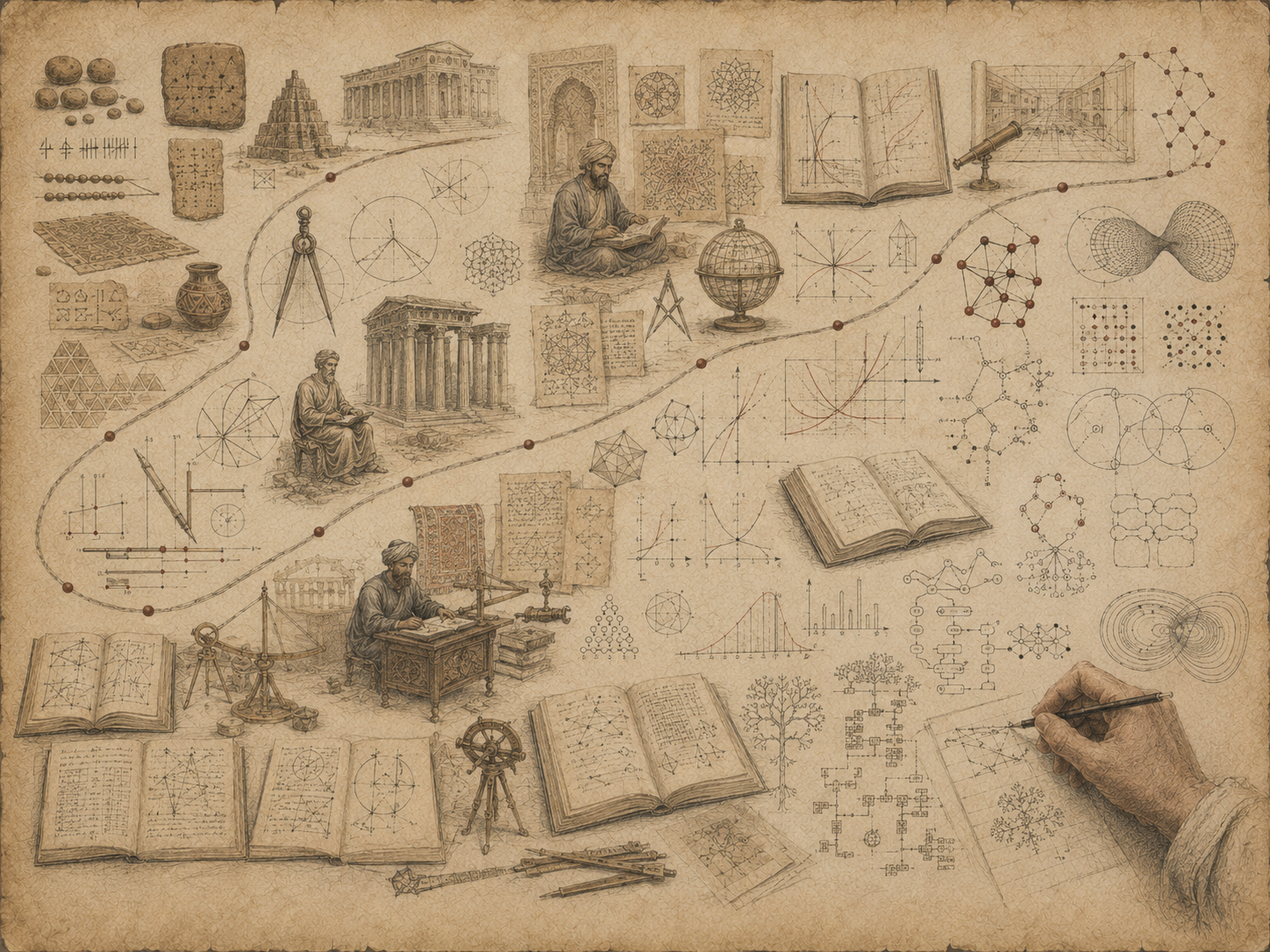
Mathematical thinking did not begin as a finished system of symbols, axioms, proofs, functions, structures, and algorithms. It emerged gradually from counting, measuring, comparing, predicting, constructing, trading, observing the heavens, organizing land, recording debt, designing calendars, modeling motion, and asking why patterns hold. Across antiquity, the medieval world, early modern science, modern abstraction, and contemporary computation, mathematics changed from practical procedure into a deep architecture of pattern, proof, symbolic representation, structural reasoning, and formal verification.
This history is not a simple march from primitive calculation to modern rigor. It is a global story of many mathematical cultures: Mesopotamian place-value computation, Egyptian measurement, Greek deductive geometry, Indian arithmetic and astronomy, Chinese procedural and configurational reasoning, Islamic algebra and trigonometry, medieval scholastic logic, Renaissance symbolic algebra, early modern analytic geometry and calculus, nineteenth-century rigor, non-Euclidean geometry, set theory, mathematical logic, structural abstraction, computer science, proof assistants, and computational mathematics.
To study the history of mathematical thinking is to study how human beings learned to make pattern visible, quantity writable, space intelligible, infinity manageable, uncertainty measurable, change calculable, structure abstract, and reasoning accountable. Mathematics is not only a collection of results. It is a history of intellectual tools: number systems, diagrams, algorithms, symbols, axioms, functions, coordinates, limits, sets, matrices, models, proofs, programs, and formal languages.
What Mathematical Thinking Means Historically
Mathematical thinking is the disciplined use of pattern, quantity, relation, space, form, structure, abstraction, and proof. Historically, it has taken many forms. A scribe calculating grain distribution, a geometer proving a theorem, an astronomer predicting planetary motion, an algebraist transforming equations, a statistician modeling uncertainty, a programmer analyzing an algorithm, and a logician formalizing a proof are all engaged in mathematical thinking, though their tools and standards differ.
The history of mathematics is therefore not merely a list of discoveries. It is a history of changing ways of thinking. At different times, mathematics has been practical craft, administrative technology, sacred calendar science, philosophical discipline, deductive geometry, symbolic language, natural philosophy, engineering tool, abstract structure, computational system, and formal machine-checkable artifact.
\text{mathematical thinking}=\text{pattern}+\text{representation}+\text{reasoning}+\text{generalization}
\]
Interpretation: Mathematical thinking begins when patterns are represented in a form that can be reasoned about, generalized, tested, transformed, or proved.
Historically, mathematical thinking has repeatedly expanded by creating new representational tools. Number systems made quantity portable. Diagrams made space inspectable. Algebraic notation made unknowns manipulable. Coordinates joined algebra and geometry. Calculus made continuous change calculable. Set theory made collections foundational. Matrices made systems compact. Logic made proof formal. Computers made symbolic procedures executable.
| Historical Tool | What It Made Thinkable | Long-Term Consequence |
|---|---|---|
| Number systems | Counting, accounting, comparison, magnitude | Arithmetic, commerce, astronomy, administration |
| Diagrams | Spatial relation, construction, proportion | Geometry, proof, visualization |
| Algebraic notation | Unknowns, variables, equations, transformation | General symbolic reasoning |
| Coordinates | Geometry as equation | Analytic geometry, calculus, modeling |
| Formal logic | Proof as symbolic derivation | Foundations, computer science, proof assistants |
The central historical pattern is this: as representation changes, reasoning changes. Mathematics evolves not only by answering questions, but by creating new languages in which deeper questions can be asked.
Antiquity: Counting, Measuring, Recording, Predicting
The earliest mathematical thinking grew from human needs: counting animals and goods, recording debts, measuring land, dividing food, constructing buildings, marking seasons, and tracking celestial cycles. Mathematics began as embedded reasoning: not separate from life, but woven into agriculture, administration, trade, architecture, ritual, navigation, and timekeeping.
Counting required stable units. Measurement required comparison. Calendars required periodicity. Construction required proportion. Trade required equivalence. Astronomy required pattern across time. Each of these practices created pressure for abstraction: a number could refer to sheep, grain, days, distance, or stars. Once numbers became transferable across contexts, mathematical thinking became more general.
\text{practical need}\rightarrow \text{repeated procedure}\rightarrow \text{general pattern}
\]
Interpretation: Early mathematical abstraction often emerged from practical repetition. Repeated tasks revealed stable forms.
Ancient mathematical thinking was not “pre-mathematical.” It was mathematical in a procedural, embodied, and administrative sense. It involved reliable methods, shared units, written records, tables, approximations, and training. Later proof-based mathematics would transform these practices, but it did not create mathematical reasoning from nothing.
| Ancient Practice | Mathematical Thought Involved | Later Development |
|---|---|---|
| Counting goods | Discrete quantity and one-to-one correspondence | Arithmetic and number theory |
| Measuring land | Length, area, proportion, approximation | Geometry and surveying |
| Calendrical cycles | Periodicity and prediction | Astronomy and modular thinking |
| Building and craft | Symmetry, ratio, angle, construction | Geometric design and engineering |
| Accounting and taxation | Record-keeping, ratios, division, equivalence | Commercial arithmetic and algebra |
The first history of mathematical thinking is therefore the history of pattern becoming durable through record, repetition, and representation.
Mesopotamia and Egypt: Procedure, Tables, and Measurement
Mesopotamian and Egyptian mathematics show the power of rule-based mathematical practice. Mesopotamian scribes used a sexagesimal place-value system, tables, reciprocal calculations, and sophisticated procedures for numerical and geometric problems. Egyptian mathematical papyri preserved methods for fractions, area, volume, proportional calculation, and practical arithmetic.
These traditions often organized mathematics through worked examples rather than abstract theorem-proof sequences. A problem was stated, a method was applied, and a result was produced. The generality was often embedded in the procedure. A modern reader may translate some problems into algebraic equations, but the original mathematical thinking was frequently procedural and table-based rather than symbolic in the modern sense.
\text{table}+\text{procedure}+\text{worked example}\Rightarrow \text{reliable calculation}
\]
Interpretation: Mathematical reliability can be produced through trained procedural systems, even before modern symbolic notation or formal proof.
Mesopotamian mathematics is especially important for understanding place value and computational power. A place-value system allows the same symbols to represent different magnitudes depending on position. That conceptual move made calculation more flexible and scalable. Egyptian mathematics, with its fraction systems and geometric rules, shows a different but equally important tradition of practical quantitative reasoning.
| Tradition | Mathematical Strength | Thinking Style |
|---|---|---|
| Mesopotamian | Place value, tables, reciprocals, equation-like procedures | Computational, tabular, procedural |
| Egyptian | Fractions, measurement, area, volume, practical calculation | Rule-based, administrative, geometric |
| Scribal education | Transmission of methods through training | Example-based and institutional |
The historical lesson is not that mathematics began with proof. It began with durable methods for making quantity reliable.
Greek Mathematics and the Deductive Turn
Greek mathematics introduced one of the most influential transformations in mathematical thinking: the deductive organization of knowledge. Mathematical claims were increasingly presented as propositions derived from definitions, postulates, common notions, and earlier results. Geometry became a discipline of demonstration.
This did not mean Greek mathematics was isolated from earlier mathematical cultures. Greek mathematics developed within a broader Mediterranean and Near Eastern world of exchange. But Greek authors gave proof a distinctive written form. A theorem was not merely an observed pattern or reliable procedure. It required a demonstration showing why it followed from accepted starting points.
\text{definitions}+\text{postulates}+\text{deduction}\Rightarrow \text{theorem}
\]
Interpretation: Deductive mathematical thinking makes claims depend on explicit starting points and justified reasoning steps.
The Greek deductive turn gave mathematics a new ideal of certainty. It also created a new architecture of learning: one proposition could depend on another, and a mathematical field could be built as a sequence of demonstrations. Diagrams remained central, but the diagram was no longer merely visual evidence; it became part of a general argument.
| Feature | Greek Deductive Significance |
|---|---|
| Definition | Clarifies mathematical objects before reasoning begins |
| Postulate | States accepted assumptions or constructions |
| Proposition | Organizes a claim to be proved |
| Diagram | Makes spatial relations available to reasoning |
| Proof | Shows why the claim follows generally |
Greek mathematics changed the meaning of mathematical knowledge. To know a result was not only to compute it, but to understand its necessity within a system of reasoning.
Euclid, Archimedes, and the Architecture of Demonstration
Euclid’s Elements became one of the most influential models of mathematical exposition. It organized geometry and number theory through definitions, postulates, common notions, propositions, and proofs. The power of Euclid was not that every argument met modern formal standards, but that the work modeled mathematics as cumulative deductive architecture.
Archimedes pushed mathematical reasoning into difficult questions of area, volume, equilibrium, approximation, and limiting processes. His method of exhaustion showed how quantities could be bounded by increasingly close approximations. This was not yet modern limit theory, but it expressed a deep concern for rigor in reasoning about curved figures and continuous magnitudes.
L_n \leq A \leq U_n,\qquad U_n-L_n\to 0
\]
Interpretation: Exhaustion-style reasoning anticipates later limit thinking by trapping a quantity between increasingly close bounds.
Euclid and Archimedes represent two enduring modes of mathematical thinking: axiomatic organization and rigorous approximation. One builds a field from definitions and postulates. The other confronts difficult quantities through bounding, construction, and limiting argument.
| Thinker or Tradition | Mathematical Contribution | Mode of Thought |
|---|---|---|
| Euclid | Axiomatic geometric architecture | Deduction from starting assumptions |
| Archimedes | Areas, volumes, exhaustion, mechanics | Rigorous bounding and geometric imagination |
| Apollonius | Conic sections | Systematic study of complex geometric objects |
| Hellenistic astronomy | Geometric models of celestial motion | Mathematical modeling of observed phenomena |
The Greek and Hellenistic legacy made proof, structure, diagram, and model central to mathematical identity.
Indian Mathematical Thought: Number, Algorithm, Astronomy, and Infinity
Indian mathematical traditions made profound contributions to arithmetic, algebra, number systems, zero, negative numbers, combinatorics, trigonometry, astronomy, infinite series, and algorithmic reasoning. Mathematical thinking in these traditions often appeared through rules, verses, examples, astronomical tables, commentary, and procedures rather than Euclidean-style proposition-proof exposition.
The development and transmission of decimal place-value numeration, including zero as a number and placeholder, transformed global mathematics. Place value made arithmetic more compact, scalable, and algorithmic. Indian astronomy also required sophisticated computation, interpolation, trigonometric reasoning, and periodic modeling.
\text{place value}+\text{zero}\Rightarrow \text{scalable arithmetic}
\]
Interpretation: Place-value notation with zero changed the cognitive and computational possibilities of arithmetic.
Indian mathematical thinking is also important because it challenges the assumption that proof, rigor, and generality always take the same form. Justification may appear as derivation, procedure, example, commentary, astronomical adequacy, or what later scholars discuss through terms such as upapatti. The genre of mathematical writing shapes the form of mathematical reasoning.
| Indian Mathematical Theme | Historical Importance | Mode of Thought |
|---|---|---|
| Zero and place value | Enabled compact arithmetic algorithms | Symbolic and computational |
| Algebraic procedures | Handled equations and indeterminate problems | Algorithmic and rule-based |
| Astronomy | Required periodic modeling and computation | Predictive and numerical |
| Trigonometry and series | Advanced approximation and infinite-process reasoning | Analytic and computational |
| Commentary traditions | Explained and justified inherited rules | Interpretive and pedagogical |
Indian mathematics shows that mathematical thinking can be algorithmic, astronomical, symbolic, recursive, and explanatory without being reducible to Greek deductive format.
Chinese Mathematical Thought: Procedure, Configuration, and Systems
Chinese mathematical traditions developed rich methods in arithmetic, geometry, surveying, algebraic procedures, systems of linear equations, root extraction, combinatorics, and calendar science. Texts such as The Nine Chapters on the Mathematical Arts and later commentaries reveal a style of mathematical thinking deeply concerned with procedure, configuration, transformation, and practical problem solving.
Chinese mathematical reasoning often worked through algorithms and arrangements. Counting rods, diagrams, dissection methods, and tabular arrangements made numerical and geometric relationships visible. Liu Hui’s commentary, for example, is important because it shows mathematical explanation embedded in procedure and configuration.
\text{configuration}+\text{operation}+\text{preservation}\Rightarrow \text{verified result}
\]
Interpretation: Chinese mathematical reasoning often justified results by showing how structures were transformed while preserving relationships.
Chinese mathematics is especially significant for the history of systems thinking. Procedures for solving simultaneous linear equations using tabular arrangements anticipate matrix-like reasoning. The method is not expressed in modern matrix notation, but it reveals structured thinking about systems of relations.
| Chinese Mathematical Feature | Historical Importance | Mode of Thought |
|---|---|---|
| Counting rods | Supported positional and operational calculation | Material-symbolic manipulation |
| Procedural algorithms | Organized problem solving through repeatable steps | Algorithmic reasoning |
| Geometric dissection | Explained area and volume through transformation | Visual and configurational |
| Linear systems | Represented multiple constraints together | Systemic and tabular |
| Commentary | Made procedures intelligible and justifiable | Expository and interpretive |
Chinese traditions broaden the history of mathematical thinking by showing that proof-like justification can be procedural, visual, configurational, and commentarial.
Islamic Mathematics: Algebra, Trigonometry, Translation, and Synthesis
Mathematics in the Islamic world played a central role in preserving, translating, extending, and transforming earlier Greek, Indian, Persian, and other mathematical traditions. Scholars working in Arabic and other languages developed algebra, arithmetic, geometry, number theory, astronomy, optics, trigonometry, and mathematical instruments.
The word “algebra” comes through Arabic mathematical writing, especially the work associated with al-Khwārizmī. Islamic algebra organized equation types, solution procedures, and geometric justifications. Islamic trigonometry developed into a sophisticated mathematical discipline, closely tied to astronomy, geography, and religious timekeeping.
\text{translation}+\text{classification}+\text{extension}\Rightarrow \text{mathematical synthesis}
\]
Interpretation: Islamic mathematics shows how mathematical thinking grows through translation, preservation, critique, and creative extension.
This period reminds us that mathematical history is not linear ownership. Mathematics travels through languages, institutions, courts, observatories, schools, manuscripts, commentaries, and practical needs. Algebra, trigonometry, astronomy, and geometry became more powerful because they moved across cultural and linguistic worlds.
| Islamic Mathematical Contribution | Historical Importance | Mode of Thought |
|---|---|---|
| Algebra | Systematic treatment of equation types | Procedural, classificatory, symbolic precursor |
| Trigonometry | Mathematical discipline supporting astronomy | Tabular, geometric, analytic |
| Translation movements | Preserved and transformed Greek and Indian mathematics | Intercultural and scholarly |
| Geometric proof of algebraic rules | Linked procedure to visual demonstration | Hybrid algebraic-geometric reasoning |
| Astronomical computation | Required precision, tables, and models | Predictive and computational |
Islamic mathematics is indispensable to the history of mathematical thinking because it connected procedure, proof, translation, algebra, astronomy, and global transmission.
Medieval Mathematical Thinking: Logic, Computation, and Scholastic Order
Medieval mathematical thinking developed within multiple intellectual environments: Islamic observatories and scholarly centers, Byzantine and Latin manuscript traditions, European universities, abacus schools, commercial arithmetic, astronomy, music theory, architecture, theology, and scholastic logic. Mathematics was not isolated from philosophy or institutional learning.
In the Latin West, the translation of Greek and Arabic texts helped reshape mathematical education. Scholastic logic cultivated formal habits of argument: definition, distinction, objection, response, demonstration, and ordered reasoning. At the same time, practical arithmetic developed through commerce, accounting, navigation, and craft.
\text{logic}+\text{calculation}+\text{institutional learning}\Rightarrow \text{ordered reasoning}
\]
Interpretation: Medieval mathematical thought joined practical computation with logical and institutional forms of disciplined argument.
The medieval world also shows that mathematical thinking has always lived between theory and practice. University logic, commercial arithmetic, astronomical tables, geometric instruments, music theory, architecture, and calendar computation all contributed to mathematical culture.
| Medieval Context | Mathematical Role | Thinking Style |
|---|---|---|
| Scholastic logic | Structured argument and demonstration | Formal and philosophical |
| Commercial arithmetic | Trade, accounting, exchange, interest | Computational and practical |
| Astronomy | Tables, models, calendars, prediction | Model-based and numerical |
| Music theory | Ratio, harmony, proportion | Relational and proportional |
| Architecture and craft | Geometry, proportion, measurement | Constructive and spatial |
Medieval mathematics prepared the ground for early modern transformations by preserving, translating, teaching, applying, and reorganizing mathematical knowledge.
Renaissance Mathematics: Symbol, Perspective, Commerce, and Technique
Renaissance mathematical thinking expanded through printing, commerce, navigation, perspective, engineering, military science, art, and algebraic problem solving. Mathematical knowledge became more widely circulated through printed books, abacus schools, vernacular texts, and technical manuals.
Algebraic notation began moving from rhetorical and syncopated forms toward increasingly symbolic expression. The solution of cubic and quartic equations pushed algebraic technique forward. Perspective geometry connected mathematics to art and visual representation. Navigation and cartography demanded practical trigonometry, measurement, and coordinate-like thinking.
\text{symbol}+\text{print}+\text{technique}\Rightarrow \text{portable mathematical method}
\]
Interpretation: Renaissance mathematics grew through the circulation of methods, symbols, diagrams, and technical applications.
The Renaissance matters because mathematical thinking became more visibly tied to technical power. Mathematics was not only contemplation; it was navigation, artillery, perspective, architecture, bookkeeping, engineering, and statecraft. Symbolic methods expanded because they were useful across domains.
| Renaissance Development | Mathematical Significance | Long-Term Effect |
|---|---|---|
| Printing | Stabilized and circulated notation and diagrams | Standardization of mathematical language |
| Perspective | Linked geometry to visual representation | Projective and spatial thinking |
| Commerce | Supported practical arithmetic and algebra | Financial mathematics and applied calculation |
| Equation solving | Advanced algebraic techniques | Symbolic algebra and polynomial theory |
| Navigation | Required trigonometry, astronomy, and measurement | Mathematical geography and modeling |
The Renaissance helped make mathematical thinking more mobile: across professions, languages, printed pages, instruments, and technical problems.
Early Modern Mathematics: Coordinates, Calculus, and the Mathematical Sciences
Early modern mathematics transformed the relation between mathematics and nature. Analytic geometry joined algebra and geometry. Calculus made continuous change calculable. Mechanics, astronomy, optics, probability, and mathematical physics increasingly relied on mathematical models.
Descartes’ coordinate methods allowed curves to be represented by equations. Newton and Leibniz developed calculus as a language for motion, change, accumulation, and infinitesimal reasoning. Probability theory began to formalize uncertainty. Mathematical thinking became a central tool of modern science.
\text{geometry}\longleftrightarrow \text{algebra},\qquad \text{change}\longleftrightarrow \text{calculus}
\]
Interpretation: Early modern mathematics created new symbolic bridges: equations could describe space, and calculus could describe change.
This period also exposed tensions. Calculus was powerful before its foundations were fully rigorous. Infinitesimals, infinite series, fluxions, differentials, and limiting arguments produced astonishing results but raised philosophical and logical questions. Mathematical thinking often advances through a rhythm of discovery first, rigor later.
| Early Modern Innovation | What It Made Possible | Rigor Challenge |
|---|---|---|
| Analytic geometry | Curves as equations | Relating algebraic and geometric meaning |
| Calculus | Mathematics of change and accumulation | Clarifying infinitesimals and limits |
| Mechanics | Mathematical laws of motion | Connecting model and physical world |
| Probability | Reasoning under uncertainty | Interpreting chance, evidence, and expectation |
| Infinite series | Approximation and representation of functions | Convergence and validity |
The early modern period established mathematics as a language of nature, but also forced mathematics to refine its own foundations.
The Nineteenth Century: Rigor, Analysis, and the Foundations of Infinity
The nineteenth century brought a major transformation in mathematical rigor. Limits, continuity, convergence, real numbers, functions, infinite series, and infinity itself were given more precise treatment. Cauchy, Weierstrass, Dedekind, Cantor, Riemann, Dirichlet, and others helped reshape analysis and foundations.
The shift was not simply technical. It changed the standards of mathematical thought. Intuitive reasoning about curves, motion, and infinitesimals became insufficient in many contexts. Definitions became more precise. Quantifiers became central. Counterexamples showed that intuition could mislead. Infinite sets became mathematical objects requiring disciplined treatment.
\forall \varepsilon>0\;\exists \delta>0\;\bigl(0<|x-a|<\delta\Rightarrow |f(x)-L|<\varepsilon\bigr)
\]
Interpretation: Nineteenth-century rigor transformed intuitive nearness into quantified conditions.
This rigor movement helped modernize mathematical thinking. It showed that mathematical objects may behave differently from visual intuition. A function could be continuous but nowhere differentiable. Infinite processes could converge or diverge in subtle ways. The real line required foundations. Infinity itself had sizes.
| Rigor Development | Mathematical Effect | Thinking Shift |
|---|---|---|
| Epsilon-delta definitions | Clarified limits and continuity | From intuition to quantified precision |
| Real number constructions | Stabilized the continuum | From line intuition to arithmetic foundation |
| Set-theoretic infinity | Compared infinite collections | From vague infinity to structured infinity |
| Pathological examples | Exposed limits of geometric intuition | From visual expectation to formal definition |
| Function theory | Expanded analysis beyond simple formulas | From formula to mapping and behavior |
The nineteenth century made modern mathematical rigor into a defining standard: definitions first, assumptions explicit, proof disciplined, intuition tested.
Non-Euclidean Geometry and the Transformation of Axioms
Non-Euclidean geometry changed the meaning of mathematical truth. For centuries, Euclidean geometry seemed to describe necessary spatial reality. The parallel postulate was debated, but many mathematicians assumed it should be derivable from the other postulates. The discovery of coherent non-Euclidean geometries showed that alternative axiom systems could produce different but internally consistent geometrical worlds.
This was a philosophical and mathematical revolution. Axioms could no longer be understood only as self-evident truths about physical space. They could be assumptions defining a structure. Geometry became plural. Proof became conditional on the system in which it was conducted.
\text{different axioms}\Rightarrow \text{different mathematical worlds}
\]
Interpretation: Non-Euclidean geometry taught mathematics to treat axioms as structural assumptions rather than only obvious truths.
This shift prepared the way for modern axiomatic thinking. Algebra, topology, geometry, logic, and set theory increasingly defined structures through axioms. Instead of asking only what objects are, mathematicians asked what laws they satisfy.
| Older View | Modern Axiomatic View | Consequence |
|---|---|---|
| Geometry describes one obvious space | Geometries are structures defined by axioms | Plural mathematical worlds |
| Axioms are self-evident truths | Axioms are explicit assumptions | Conditional proof |
| Intuition guarantees validity | Formal consistency matters | Rigor over visual expectation |
| Space is fixed | Space can be modeled differently | Modern geometry and relativity |
Non-Euclidean geometry made mathematical thinking more structural, more abstract, and more aware of its assumptions.
Logic, Set Theory, and the Foundations of Mathematical Thought
By the late nineteenth and early twentieth centuries, mathematics began to investigate its own foundations with new intensity. Set theory, symbolic logic, formal systems, logicism, formalism, intuitionism, model theory, proof theory, and computability theory turned mathematical reasoning itself into an object of mathematical study.
Frege, Peano, Russell, Whitehead, Hilbert, Brouwer, Zermelo, Fraenkel, Gödel, Turing, Church, and many others reshaped foundational questions. What is a number? What is a proof? What is a set? Can mathematics be reduced to logic? Can all truths be proved? Can every mathematical problem be decided by a procedure? What are the limits of formal systems?
\text{formal system}=(\text{language},\text{axioms},\text{rules of inference})
\]
Interpretation: Modern foundations made the structure of mathematical reasoning explicit enough to study mathematically.
Gödel’s incompleteness theorems revealed limits within formal systems strong enough to express arithmetic. Turing and Church formalized computation and decidability. Mathematical thinking became self-reflective: it could analyze what can be proved, computed, formalized, or decided.
| Foundational Movement or Concept | Core Question | Historical Impact |
|---|---|---|
| Logicism | Can mathematics be reduced to logic? | Recast arithmetic and foundations |
| Formalism | Can mathematics be secured through formal systems? | Advanced proof theory and metamathematics |
| Intuitionism | Is mathematics grounded in constructive mental activity? | Challenged classical logic and existence proofs |
| Set theory | Can mathematics be organized through collections? | Provided a foundational language |
| Computability | What can be calculated by a formal procedure? | Created theoretical computer science |
The foundational era showed that mathematics is not only a tool for studying the world. It is also a tool for studying the possibilities and limits of reason itself.
Modern Mathematics as the Study of Structure
Modern mathematics increasingly understands itself through structures: groups, rings, fields, vector spaces, manifolds, topological spaces, categories, probability spaces, Hilbert spaces, measure spaces, graphs, networks, algorithms, models, and formal systems. The focus shifts from the intrinsic nature of individual objects to the relations and operations that organize them.
This structural turn is visible across abstract algebra, topology, functional analysis, category theory, mathematical logic, probability, geometry, and computer science. A group may consist of numbers, symmetries, matrices, functions, or transformations. What matters is not what the elements “really are,” but how they behave under operations.
\text{structure}=(\text{objects},\text{relations},\text{operations},\text{laws})
\]
Interpretation: Modern mathematical thinking often studies systems by the relations, operations, and laws that define their structure.
The structural view made mathematics enormously general. The same theorem might apply to many different systems if they share a common structure. This is one reason abstraction became so powerful. It allows mathematics to reveal sameness beneath surface difference.
| Modern Structure | Objects Studied | Thinking Style |
|---|---|---|
| Group | Symmetries, transformations, operations | Law-based abstraction |
| Vector space | Vectors, functions, signals, data | Linear structure |
| Topological space | Continuity, nearness, deformation | Qualitative structure |
| Graph | Nodes and edges | Relational structure |
| Category | Objects and morphisms | Structure-preserving transformation |
The modern structural imagination is one of mathematics’ greatest achievements: it sees pattern not only in numbers or shapes, but in systems of relation.
Computation, Algorithms, and the Computer Age
The twentieth century also transformed mathematical thinking through computation. Algorithms became formal objects. Computability theory defined the limits of mechanical procedure. Complexity theory studied the resources required to solve problems. Numerical analysis, simulation, optimization, information theory, cryptography, data science, machine learning, and computer graphics made computation central to modern mathematics.
Computers did not merely speed up calculation. They changed the kinds of mathematical thinking available. Large finite cases could be checked. Dynamical systems could be simulated. Statistical models could be fitted at scale. Graphs and networks could be analyzed computationally. Symbolic expressions could be manipulated by computer algebra systems. Proofs could be checked by formal tools.
\text{algorithm}=\text{finite procedure transforming input into output}
\]
Interpretation: The computer age made procedures, complexity, data structures, and formal computation central to mathematical thought.
The computer age also changed mathematical evidence. Numerical experiments can suggest conjectures. Simulations can reveal patterns. Computations can verify enormous finite cases. But computation also requires caution: code can be wrong, models can be incomplete, data can be biased, and numerical approximation can mislead.
| Computational Development | Mathematical Role | Interpretive Risk |
|---|---|---|
| Algorithm analysis | Studies procedure and cost | Efficiency may be confused with correctness |
| Simulation | Explores systems too complex for closed-form solution | Model assumptions may be hidden |
| Numerical methods | Approximate solutions to continuous problems | Rounding and stability matter |
| Computer algebra | Manipulates symbolic expressions | Domain assumptions can be missed |
| Machine learning | Finds patterns in data | Pattern may be mistaken for understanding |
Computation made mathematics more experimental, more scalable, and more infrastructural. It also made mathematical responsibility more urgent.
Proof Assistants, Formal Verification, and Machine-Checked Mathematics
In contemporary mathematics, proof assistants and formal verification tools have opened a new chapter in the history of mathematical thinking. Systems such as Lean, Coq, Isabelle/HOL, HOL Light, Agda, and others allow mathematical statements and proofs to be encoded in formal languages and checked by computer.
Machine-checked proof does not eliminate human judgment. Humans still choose definitions, formulate theorems, guide proof strategies, interpret meaning, and decide what matters. But proof assistants make many hidden assumptions explicit and allow formal derivations to be checked with a level of precision beyond ordinary prose proof.
\text{informal proof}\rightarrow \text{formal statement}\rightarrow \text{machine-checked derivation}
\]
Interpretation: Formal verification turns mathematical reasoning into a structured artifact that can be checked by a proof kernel.
This development connects ancient proof culture to modern computation. Euclid organized proof in deductive sequence. Modern logic formalized inference. Computer science formalized computation. Proof assistants join these streams by making proof itself computationally checkable.
| Proof Technology | What It Adds | Remaining Human Role |
|---|---|---|
| Formal language | Precise syntax for mathematical claims | Choosing definitions and statements |
| Proof assistant | Checks proof steps mechanically | Guiding strategy and meaning |
| Formal library | Reusable verified mathematics | Maintaining coherence and scope |
| Automated theorem proving | Searches for derivations | Interpreting and validating results |
| Verified software | Links code to specifications | Ensuring specifications are appropriate |
Machine-checked mathematics is not the end of mathematical thinking. It is a new medium for it: precise, powerful, demanding, and still dependent on human interpretation.
A Global History of Mathematical Thinking and Its Silences
The history of mathematical thinking is often told through a narrow canon: Greece, Europe, calculus, rigor, logic, modern abstraction. That story contains important truths, but it is incomplete. A serious global history must include Mesopotamian computation, Egyptian measurement, Indian numeration and astronomy, Chinese procedures and systems, Islamic algebra and trigonometry, African mathematical traditions, Indigenous mathematical knowledge, commercial arithmetic, craft mathematics, navigation, architecture, and oral or material forms of mathematical reasoning.
The survival of texts is not the same as the full history of thought. Some mathematical knowledge was transmitted orally, materially, ritually, architecturally, or through craft. Some traditions were marginalized by colonialism, language hierarchy, institutional exclusion, and canon formation. Some mathematical practices were absorbed into dominant narratives without proper credit.
\text{mathematical history}\neq \text{surviving elite texts only}
\]
Interpretation: A responsible history of mathematics must attend to lost, marginalized, practical, oral, material, and non-canonical forms of mathematical reasoning.
A global history should not flatten differences. Greek deductive proof, Chinese procedural verification, Indian astronomical computation, Islamic algebraic synthesis, and modern formal logic are not the same. But each belongs to the human history of mathematical thinking.
| Historiographic Risk | Problem | Responsible Practice |
|---|---|---|
| Eurocentrism | Treats mathematics as a primarily Greek-European achievement | Center multiple global traditions |
| Presentism | Judges older mathematics only by modern notation and proof standards | Interpret practices in historical context |
| Textual bias | Equates surviving written texts with all mathematical knowledge | Attend to material, oral, craft, and institutional practices |
| Canon bias | Credits only famous individuals and texts | Include translation, commentary, pedagogy, and collective labor |
| Technological triumphalism | Treats modern formalization as the final form of mathematics | Recognize many valid mathematical practices and purposes |
Mathematical thinking is a shared human inheritance. Its history should be told with precision, humility, and justice.
A Mathematical Lens: Pattern, Representation, Proof, Structure, Computation
A useful lens for the whole history of mathematical thinking is the sequence: pattern, representation, proof, structure, computation. Human beings notice patterns. They invent representations for those patterns. They develop methods of justification. They abstract structures from specific cases. They create procedures and machines for carrying reasoning forward.
\text{Pattern}\rightarrow \text{Representation}\rightarrow \text{Proof}\rightarrow \text{Structure}\rightarrow \text{Computation}
\]
Interpretation: The history of mathematical thinking can be read as the progressive development of tools for seeing, writing, justifying, abstracting, and executing pattern.
This sequence is not strictly linear. Computation existed in antiquity. Structure appears in ancient geometry. Proof appears differently across cultures. Representation and proof continually reshape one another. But the lens helps explain why mathematical history keeps producing new forms of thought.
| Lens Element | Historical Question | Example |
|---|---|---|
| Pattern | What regularity is noticed? | Number cycles, geometric proportions, astronomical periods |
| Representation | How is the pattern made visible? | Numerals, diagrams, tables, symbols, graphs |
| Proof | How is the claim justified? | Procedure, demonstration, induction, formal derivation |
| Structure | What system of relations is being studied? | Groups, spaces, functions, networks, categories |
| Computation | What procedures can be executed? | Algorithms, simulations, computer algebra, proof assistants |
This lens shows why mathematical thinking is both ancient and modern. It began with pattern and continues through formal systems, data structures, and computational proof.
Computational Companion Examples
The companion repository for this article should extend the Mathematical Thinking codebase with examples focused on historical timelines, tradition classification, proof-style mapping, notation evolution, structural abstraction, computational milestones, mathematical-practice warnings, Haskell typed historical models, SQL knowledge schemas, and reproducible outputs for studying mathematical thinking across periods. The examples below are compact article-level previews; the repository can expand them into richer professional workflows.
Python: Historical Timeline and Thinking-Mode Classification
from dataclasses import dataclass
from collections import defaultdict

@dataclass(frozen=True)
class MathematicalMilestone:
    period: str
    tradition: str
    thinking_mode: str
    contribution: str
    interpretation: str

milestones = [
    MathematicalMilestone(
        period="Antiquity",
        tradition="Mesopotamian",
        thinking_mode="procedural computation",
        contribution="place-value calculation, tables, reciprocal methods",
        interpretation="mathematical reliability through trained procedures"
    ),
    MathematicalMilestone(
        period="Classical antiquity",
        tradition="Greek",
        thinking_mode="deductive proof",
        contribution="axiomatic geometry and proposition-proof structure",
        interpretation="mathematical certainty through demonstration"
    ),
    MathematicalMilestone(
        period="Classical to medieval",
        tradition="Indian",
        thinking_mode="algorithmic astronomy and arithmetic",
        contribution="place-value numeration, zero, algebraic procedures, trigonometry",
        interpretation="symbolic and computational power across number and astronomy"
    ),
    MathematicalMilestone(
        period="Classical to medieval",
        tradition="Chinese",
        thinking_mode="procedural and configurational reasoning",
        contribution="linear systems, rod calculation, dissection, commentary",
        interpretation="mathematics as transformation of structured configurations"
    ),
    MathematicalMilestone(
        period="Medieval",
        tradition="Islamic",
        thinking_mode="algebraic-geometric synthesis",
        contribution="algebra, trigonometry, translation, astronomy",
        interpretation="mathematics grows through transmission and creative extension"
    ),
    MathematicalMilestone(
        period="Early modern",
        tradition="European",
        thinking_mode="symbolic modeling",
        contribution="analytic geometry, calculus, mechanics, probability",
        interpretation="mathematics becomes a language of natural science"
    ),
    MathematicalMilestone(
        period="Modern",
        tradition="International",
        thinking_mode="rigor and structure",
        contribution="analysis, set theory, non-Euclidean geometry, abstract algebra",
        interpretation="mathematics studies structures defined by explicit laws"
    ),
    MathematicalMilestone(
        period="Contemporary",
        tradition="Computational",
        thinking_mode="formal and algorithmic reasoning",
        contribution="computer algebra, algorithms, proof assistants, formal verification",
        interpretation="mathematics becomes executable and machine-checkable"
    ),
]

by_mode = defaultdict(list)
for item in milestones:
    by_mode[item.thinking_mode].append(item.tradition)

for mode, traditions in by_mode.items():
    print(mode, "=>", traditions)
R: Period-by-Mode Summary
history_matrix <- data.frame(
  period = c(
    "Antiquity",
    "Classical antiquity",
    "Classical-medieval",
    "Medieval",
    "Renaissance",
    "Early modern",
    "Nineteenth century",
    "Twentieth century",
    "Contemporary"
  ),
  dominant_mode = c(
    "procedure and measurement",
    "deductive geometry",
    "algorithmic and astronomical reasoning",
    "algebraic synthesis and scholastic logic",
    "symbol, commerce, perspective, technique",
    "coordinates, calculus, and modeling",
    "rigor, analysis, and foundations",
    "structure, logic, and computation",
    "formal verification and computational mathematics"
  ),
  representation = c(
    "tables, numerals, units",
    "diagrams and propositions",
    "rules, commentaries, algorithms",
    "manuscripts, translations, equation types",
    "printed symbols and technical diagrams",
    "equations, functions, differentials",
    "quantifiers, limits, sets",
    "structures, formal languages, algorithms",
    "code, proof scripts, verified libraries"
  )
)

print(history_matrix)
Haskell: Typed Historical Models of Mathematical Thinking
{-# OPTIONS_GHC -Wall #-}

data ThinkingMode
  = Procedural
  | Diagrammatic
  | Deductive
  | Algebraic
  | Analytic
  | Structural
  | Computational
  | FormalVerified
  deriving (Eq, Show)

data Milestone = Milestone
  { period :: String
  , tradition :: String
  , mode :: ThinkingMode
  , contribution :: String
  , caution :: String
  } deriving (Eq, Show)

milestones :: [Milestone]
milestones =
  [ Milestone "Antiquity" "Mesopotamian" Procedural
      "place-value computation and tables"
      "do not confuse modern algebraic reconstruction with original notation"
  , Milestone "Classical antiquity" "Greek" Deductive
      "axiomatic geometric proof"
      "deductive proof was not the only historical form of justification"
  , Milestone "Classical-medieval" "Chinese" Procedural
      "systems, rod calculation, and configurational reasoning"
      "procedural verification deserves serious mathematical interpretation"
  , Milestone "Medieval" "Islamic" Algebraic
      "algebra, trigonometry, translation, and astronomy"
      "transmission was also creative transformation"
  , Milestone "Modern" "International" Structural
      "abstract algebra, topology, logic, and foundations"
      "abstraction should be connected to examples and history"
  , Milestone "Contemporary" "Computational" FormalVerified
      "proof assistants and machine-checked mathematics"
      "formal verification still depends on human choices of definitions and meaning"
  ]

main :: IO ()
main = mapM_ print milestones
SQL: Mathematical-Thinking History Schema
CREATE TABLE historical_period (
  period_id TEXT PRIMARY KEY,
  name TEXT NOT NULL,
  approximate_range TEXT NOT NULL,
  dominant_mathematical_mode TEXT NOT NULL,
  interpretation_note TEXT NOT NULL
);

CREATE TABLE mathematical_tradition (
  tradition_id TEXT PRIMARY KEY,
  name TEXT NOT NULL,
  region_or_language_context TEXT NOT NULL,
  primary_media TEXT NOT NULL,
  historiographic_caution TEXT NOT NULL
);

CREATE TABLE mathematical_milestone (
  milestone_id TEXT PRIMARY KEY,
  period_id TEXT NOT NULL,
  tradition_id TEXT NOT NULL,
  contribution TEXT NOT NULL,
  thinking_mode TEXT NOT NULL,
  representation_form TEXT NOT NULL,
  long_term_significance TEXT NOT NULL,
  FOREIGN KEY (period_id) REFERENCES historical_period(period_id),
  FOREIGN KEY (tradition_id) REFERENCES mathematical_tradition(tradition_id)
);

CREATE TABLE historiographic_warning (
  warning_id TEXT PRIMARY KEY,
  topic TEXT NOT NULL,
  warning TEXT NOT NULL,
  mitigation TEXT NOT NULL
);
These examples treat the history of mathematical thinking as structured knowledge. Periods, traditions, representations, proof styles, computational tools, and historiographic cautions can be modeled, compared, audited, and connected without reducing history to a single linear narrative.
GitHub Repository
The companion repository for this article is designed as a reproducible mathematical-thinking workspace focused on historical timelines, mathematical traditions, proof styles, notation evolution, structural abstraction, computational milestones, formalization, historiographic warnings, Haskell typed historical models, SQL knowledge schemas, and responsible interpretation of mathematical history.
Complete Code Repository
Companion article folder with Python, R, Julia, SQL, Haskell, Rust, Go, C++, Fortran, and C examples for professional mathematical exploration of the history of mathematical thinking, global traditions, proof, notation, abstraction, structure, algorithms, computation, formal verification, and responsible historiography.
Mathematics, Power, and Intellectual Justice
Mathematics is often presented as neutral, universal, and detached from power. There is truth in the universality of mathematical structures: a valid proof does not depend on nationality, empire, or social rank. But the history of mathematical knowledge is not socially neutral. Access to education, survival of manuscripts, translation networks, colonial power, institutional prestige, gender exclusion, racial hierarchy, class position, and language dominance have shaped whose mathematics is remembered.
A responsible history of mathematical thinking must hold two truths together. Mathematics can produce forms of knowledge that transcend local circumstance. Yet mathematical cultures are built by people, institutions, languages, technologies, and societies. The theorem may be universal; the history of who gets to produce, transmit, credit, and teach it is not.
| Ethical Issue | Historical Problem | Responsible Practice |
|---|---|---|
| Canon formation | Some traditions are treated as central, others as footnotes | Present mathematics as global and multi-traditional |
| Translation power | Concepts change as they move across languages | Attend to historical terminology and context |
| Gender exclusion | Women’s mathematical labor was often minimized or blocked | Recover excluded contributors and institutional barriers |
| Colonial hierarchy | Non-European knowledge was often appropriated or downgraded | Credit traditions without forcing them into European categories |
| Technological authority | Computation can appear objective while encoding assumptions | Audit models, data, algorithms, and interpretations |
Mathematical thinking becomes more serious, not less, when its history is told honestly. Intellectual justice does not weaken mathematics. It strengthens the account of how mathematics actually became a human achievement.
Why the History of Mathematical Thinking Matters
The history of mathematical thinking matters because it reveals mathematics as a living discipline of representation, reasoning, and transformation. Students often encounter mathematics as a finished wall of symbols. History shows that those symbols were invented, refined, debated, standardized, and extended. Proof was developed. Notation evolved. Rigor deepened. Abstraction expanded. Computation changed what could be explored.
History also makes mathematics more human. It shows that mathematical insight has arisen from scribes, philosophers, astronomers, merchants, teachers, translators, engineers, logicians, programmers, and communities across the world. It shows that mathematics has been practical and philosophical, visual and symbolic, procedural and deductive, local and universal.
For modern society, this history is especially important. Mathematics now shapes data systems, artificial intelligence, finance, infrastructure, climate modeling, epidemiology, cryptography, optimization, logistics, governance, and scientific knowledge. Understanding mathematical thinking historically helps us see both its power and its limits. A model is not the world. A computation is not automatically truth. A proof is not the same as wisdom. A pattern is not necessarily justice.
The history from antiquity to modernity shows mathematics as one of humanity’s great intellectual architectures. It began with counting and measurement, became proof and symbol, expanded into structure and infinity, entered machines and formal systems, and now shapes planetary-scale technical life. To understand that history is to understand how human beings learned to make reason durable.
Related Articles
- What Is Mathematical Thinking? Pattern, Proof, Architecture, and Reason
- Mathematics as the Science of Patterns
- The Historical Development of Proof
- The Evolution of Algebraic Notation
- Symbols, Language, and Mathematical Representation
- Abstraction and the Power of Generalization
- Proof and the Logic of Mathematical Justification
- Logic and the Structure of Formal Inference
- Mathematical Thinking for Computer Science
- Foundations, Structure, and the Reimagining of Mathematics
Further Reading
- Boyer, C.B. and Merzbach, U.C. (2011) A History of Mathematics. 3rd edn. Hoboken, NJ: Wiley.
- Cajori, F. (1928) A History of Mathematical Notations, Volume I: Notations in Elementary Mathematics. Chicago: Open Court. Available at: https://archive.org/details/historyofmathema031756mbp
- Euclid (1956) The Thirteen Books of Euclid’s Elements, translated by T.L. Heath. 2nd edn. New York: Dover. Available at: https://archive.org/details/EuclidsElementsBooksIIIVolume1Heath
- Gray, J. (2007) Plato’s Ghost: The Modernist Transformation of Mathematics. Princeton: Princeton University Press. Available at: https://press.princeton.edu/books/paperback/9780691136103/platos-ghost
- Joseph, G.G. (2011) The Crest of the Peacock: Non-European Roots of Mathematics. 3rd edn. Princeton: Princeton University Press. Available at: https://press.princeton.edu/books/paperback/9780691135267/the-crest-of-the-peacock
- Katz, V.J. (2009) A History of Mathematics: An Introduction. 3rd edn. Boston: Addison-Wesley.
- Kline, M. (1972) Mathematical Thought from Ancient to Modern Times. New York: Oxford University Press.
- MacTutor History of Mathematics (n.d.) An Overview of the History of Mathematics. University of St Andrews. Available at: https://mathshistory.st-andrews.ac.uk/HistTopics/History_overview/
- MacTutor History of Mathematics (n.d.) History Topics Index. University of St Andrews. Available at: https://mathshistory.st-andrews.ac.uk/HistTopics/
- Stillwell, J. (2010) Mathematics and Its History. 3rd edn. New York: Springer. Available at: https://link.springer.com/book/10.1007/978-1-4419-6053-5
References
- Boyer, C.B. and Merzbach, U.C. (2011) A History of Mathematics. 3rd edn. Hoboken, NJ: Wiley.
- Cajori, F. (1928) A History of Mathematical Notations, Volume I: Notations in Elementary Mathematics. Chicago: Open Court. Available at: https://archive.org/details/historyofmathema031756mbp
- Cajori, F. (1929) A History of Mathematical Notations, Volume II: Notations Mainly in Higher Mathematics. Chicago: Open Court. Available at: https://archive.org/details/historyofmathema00cajo_0
- Corry, L. (2004) Modern Algebra and the Rise of Mathematical Structures. 2nd edn. Basel: Birkhäuser. Available at: https://link.springer.com/book/10.1007/978-3-0348-7917-0
- Dauben, J.W. (1990) Georg Cantor: His Mathematics and Philosophy of the Infinite. Princeton: Princeton University Press. Available at: https://press.princeton.edu/books/paperback/9780691024479/georg-cantor
- Euclid (1956) The Thirteen Books of Euclid’s Elements, translated by T.L. Heath. 2nd edn. New York: Dover. Available at: https://archive.org/details/EuclidsElementsBooksIIIVolume1Heath
- Gray, J. (2007) Plato’s Ghost: The Modernist Transformation of Mathematics. Princeton: Princeton University Press. Available at: https://press.princeton.edu/books/paperback/9780691136103/platos-ghost
- Horsten, L. (2007) ‘Philosophy of Mathematics’, Stanford Encyclopedia of Philosophy. Available at: https://plato.stanford.edu/entries/philosophy-mathematics/
- Joseph, G.G. (2011) The Crest of the Peacock: Non-European Roots of Mathematics. 3rd edn. Princeton: Princeton University Press. Available at: https://press.princeton.edu/books/paperback/9780691135267/the-crest-of-the-peacock
- Katz, V.J. (2009) A History of Mathematics: An Introduction. 3rd edn. Boston: Addison-Wesley.
- Kline, M. (1972) Mathematical Thought from Ancient to Modern Times. New York: Oxford University Press.
- MacTutor History of Mathematics (n.d.) An Overview of the History of Mathematics. University of St Andrews. Available at: https://mathshistory.st-andrews.ac.uk/HistTopics/History_overview/
- MacTutor History of Mathematics (n.d.) History Topics Index. University of St Andrews. Available at: https://mathshistory.st-andrews.ac.uk/HistTopics/
- Stillwell, J. (2010) Mathematics and Its History. 3rd edn. New York: Springer. Available at: https://link.springer.com/book/10.1007/978-1-4419-6053-5