
Last Updated May 6, 2026
Anthropocene and planetary boundaries define one of the central challenges of sustainable development: how to improve human wellbeing without destabilizing the Earth systems that make civilization possible. The Anthropocene names a planetary condition in which human activity has become powerful enough to alter climate, biodiversity, land systems, biogeochemical cycles, freshwater dynamics, ocean chemistry, pollution pathways, and the operating conditions of the Earth system itself.
The planetary boundaries framework complements that insight by asking a practical question: within what ecological limits can human societies develop safely? Taken together, these concepts force a major revision in development thought. Prosperity can no longer be judged only by output growth, poverty reduction, or technological advance in isolation. It must also be judged by whether those gains remain compatible with the long-run stability of the Earth system on which all future prosperity depends.
Main Library
Publications
Article Map
Sustainable Development
Related Topic
Planetary Boundaries
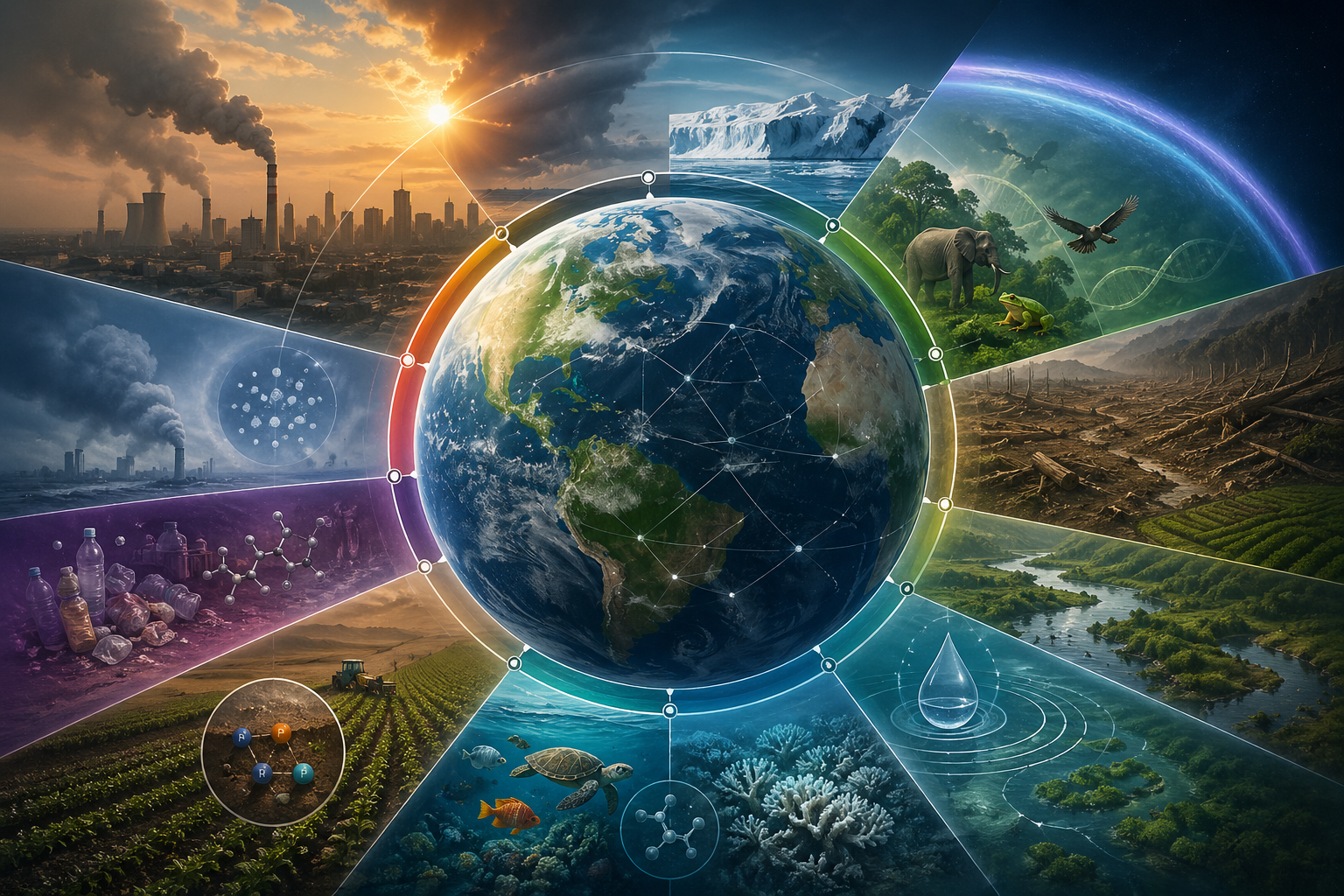
For most of human history, economic activity was too limited in scale to alter Earth-system functioning at the planetary level. That condition no longer holds. Population growth, industrialization, fossil-fuel combustion, synthetic chemical production, intensive agriculture, deforestation, mining, infrastructure expansion, and large-scale urbanization have expanded human influence to the point where multiple planetary processes now show clear signs of destabilization.
This means sustainable development can no longer be understood simply as cleaner growth or better environmental management at the margin. The issue is more fundamental. Human systems have become geologically consequential. The Anthropocene is therefore not merely a dramatic metaphor. It is a recognition that one species, through its economic and technological systems, now helps determine the operating conditions of the planet itself. That fact changes the meaning of development.
Anthropocene and Planetary Boundaries
The term Anthropocene is increasingly used to describe a planetary condition in which human activity has become a dominant force shaping the Earth system. The concept signals a profound shift in scale. Human beings are no longer merely inhabitants of ecological systems; they are active agents altering the climate, oceans, land cover, water cycle, nutrient flows, biodiversity conditions, and the chemistry of the atmosphere and seas. Paul Crutzen’s widely cited 2002 note “Geology of mankind” helped crystallize this idea by arguing that humanity had become a force of geological significance.
The framework of planetary boundaries extends this insight by asking a practical and governance-oriented question: within what ecological limits can human societies develop safely? The original 2009 “safe operating space” framing and the later 2015, 2023, and 2025 updates transformed this into a structured Earth-system framework. The boundaries identify major global processes that regulate the stability and resilience of the Earth system, then ask whether human pressure is pushing those processes beyond safe ranges.
Together, Anthropocene and planetary boundaries provide one of the clearest ways to understand why the economy can no longer be treated as separate from ecology. The central development issue is no longer merely how to produce more wealth, but how to organize prosperity, poverty reduction, infrastructure, public health, food systems, energy systems, and human capability under conditions where economic activity itself can destabilize the regulating systems of the planet. That is what makes this article different from a general sustainability introduction: it places development inside Earth-system science rather than merely beside it.
The distinction matters because “environmental damage” can sound local, incremental, and reversible. Earth-system destabilization is different. It concerns the background conditions that allow agriculture, settlement, public health, infrastructure, markets, and institutions to function. If those conditions become unstable, development becomes more expensive, less predictable, and less secure. The Anthropocene therefore changes the frame of sustainable development from environmental protection as a policy sector to Earth-system stability as a condition of civilization.
This is why the article belongs directly beside What Is Sustainable Development? Meaning, Systems, and Long-Run Viability, Sustainable Development as a Systems Problem, and Planetary Boundaries and Sustainable Development. These pieces share the same core premise: development must be judged by the systems it depends on, not only by the outputs it produces.
From Economic Scale to Planetary Scale
One of the most important messages of sustainable development is that human production has become large enough to threaten the physical systems on which prosperity depends. When billions of people participate in an expanding global economy—consuming energy, land, water, minerals, chemicals, biomass, and manufactured goods—the cumulative impact no longer remains local. It becomes planetary. This is the scale shift at the heart of Anthropocene thinking.
That expansion has produced undeniable gains. Industrialization, infrastructure, medicine, communications, sanitation, agricultural productivity, and energy systems have improved human survival and material welfare across much of the world. But the same processes have also increased atmospheric carbon dioxide, altered nutrient cycles, transformed landscapes, intensified pollution, and weakened the resilience of ecological systems. The issue is not that development has failed to generate benefits. The issue is that the developmental metabolism that created those benefits now operates at a scale capable of destabilizing the environmental background conditions that made them possible.
This scale shift changes how development must be evaluated. Older development thinking could often treat the environment as the background context within which economic and social progress occurred. The Anthropocene requires the opposite move. Economic and social systems must now be treated as forces within the Earth system, capable of reshaping the background itself. Development is no longer simply happening within nature. Development has become one of the forces changing the conditions of nature.
The move from economic scale to planetary scale also exposes a deep asymmetry. The benefits of industrial growth have been distributed unevenly, and so have the burdens of planetary pressure. Wealthy, industrialized societies produced a large share of cumulative emissions and material throughput, while many poorer communities now face acute exposure to climate shocks, food-system instability, water stress, heat, displacement, and ecological degradation. A planetary-scale development problem is therefore not an abstract problem of humanity as a single undifferentiated actor. It is a problem structured by history, power, extraction, and unequal capacity.
This is why Anthropocene analysis is so important for sustainable development. It reframes development from a question of output and welfare within a stable environment to a question of welfare within an environment being actively reshaped by human systems. Once the Earth system itself becomes part of development analysis, long-run viability takes on a much sharper meaning.
Climate Change as a Systemic Signal
Climate change is one of the clearest indicators that humanity has entered the Anthropocene. Carbon dioxide and other greenhouse gases alter the Earth’s energy balance, which in turn affects temperature, hydrology, extreme events, ecosystems, food systems, public health, oceans, infrastructure, and settlement stability. The IPCC AR6 Synthesis Report treats climate change as a system-wide challenge rather than a narrow environmental issue, reflecting how deeply climate now interacts with development, risk, adaptation, and justice.
This matters because climate change demonstrates the basic Anthropocene proposition: human economic activity can destabilize one of the major regulating systems of the planet. Once climate is no longer a stable background condition but a system being actively altered by production, energy use, and land change, development itself must be reevaluated. A growth path that undermines the climatic foundations of future agriculture, public health, housing, labor productivity, and territorial stability cannot be treated as unambiguously successful.
Climate change also reveals the temporal difficulty of Anthropocene governance. Greenhouse gases accumulate. Infrastructure locks in emissions. Delayed mitigation increases future adaptation burdens. The costs of inaction are often transferred to future generations and to communities with the least capacity to absorb them. This is why climate policy cannot be separated from Intergenerational Justice and Long-Term Stewardship, Risk, Shock, and Fragility in Development Systems, and Development Under Deep Uncertainty.
Recent UNEP assessments strengthen this point. The 2025 Emissions Gap Report emphasizes that overshoot must be limited through faster and larger emissions reductions to minimize climate risks and damages and keep returning to 1.5°C by 2100 within reach, even if doing so is extremely difficult. This is a direct reminder that development choices are now inseparable from planetary risk management. The longer high-emission systems continue, the more they narrow the future range of safe and just development pathways.
Climate is therefore not simply one issue among many. It is a signal that the development model has entered a new geophysical context. It shows that the energy foundations of modern prosperity must be transformed if prosperity is to remain viable over time.
Why Planetary Boundaries Matter
If the Anthropocene describes humanity’s new planetary role, the planetary boundaries framework helps define the ecological limits within which that role must be exercised. Its importance lies in shifting sustainability thinking away from local damage control alone and toward the stability conditions of the Earth system as a whole. It asks not merely whether environments are under pressure, but whether human activity is pushing key regulatory systems outside safe ranges.
This is a major advance because it emphasizes risk, thresholds, and interdependence. Crossing a boundary does not mean that catastrophe occurs instantly at one precise line. It means that the system has moved into a zone of higher risk, where abrupt, cascading, or hard-to-reverse change becomes more likely. The framework is precautionary by design. It identifies zones of rising risk before societies push systems so far that reversal becomes difficult, expensive, or impossible.
Planetary boundaries also matter because they prevent sustainability from being reduced to carbon alone. Climate change is central, but the Earth system is regulated by multiple interacting processes: biodiversity, land, freshwater, ocean chemistry, nutrients, pollution, atmospheric aerosols, and ozone chemistry. A development model focused only on emissions could still degrade biodiversity, exhaust freshwater, intensify chemical pollution, or destabilize nutrient cycles. The boundaries framework preserves the multidimensional character of Earth-system stability.
For sustainable development, the boundaries framework introduces a new form of discipline. It asks whether development remains inside a safe operating space. That question is not anti-development. It is a condition for long-run development. Poverty reduction, infrastructure, health, education, and human capability remain indispensable, but they must be pursued through pathways that do not undermine the planetary systems on which future development depends.
The concept of a boundary does not mean that every threshold is known with perfect precision. In many cases, uncertainty remains. But uncertainty is not an argument for delay. In Earth-system governance, uncertainty can strengthen the case for precaution because the consequences of crossing thresholds may be severe, nonlinear, and difficult to reverse. The framework therefore supports long-horizon public reasoning in precisely those domains where waiting for certainty can be dangerous.
The Nine Planetary Boundaries
The planetary boundaries framework identifies nine major Earth-system processes relevant to long-run planetary stability: climate change, biosphere integrity, land-system change, freshwater change, biogeochemical flows, ocean acidification, atmospheric aerosol loading, stratospheric ozone depletion, and novel entities. Each boundary represents a critical process through which human activity can alter the stability and resilience of the Earth system. Together, they make visible the fact that sustainable development cannot be governed through a single environmental variable.
Climate change remains transgressed, with atmospheric greenhouse gases continuing to alter the Earth’s energy balance. Biosphere integrity is outside safe levels because both genetic diversity loss and the decline of functional integrity threaten Earth-system regulation. Land-system change is transgressed because deforestation, land conversion, and degradation weaken ecosystem function, carbon storage, hydrological regulation, and biodiversity. Freshwater change is also transgressed once both blue water and green water disruption are considered. Biogeochemical flows remain transgressed because industrial nitrogen fixation and phosphorus runoff have disrupted nutrient cycles. Novel entities are in the high-risk zone because synthetic chemicals, plastics, and other human-made substances are being released at scales that outpace adequate safety assessment and governance.
Two recent details make the framework especially current. First, the 2023 assessment concluded that six boundaries were transgressed. Second, the 2025 update reports that ocean acidification has now been breached for the first time, pushing another major Earth-system process outside the safe operating space. Meanwhile, stratospheric ozone depletion is now in the safe operating space because ozone-depleting substances were phased out through successful international governance, and atmospheric aerosol loading remains within the safe zone under the current global metric, although regional aerosol effects remain important.
Taken together, these boundaries show that sustainability is not reducible to carbon alone. Climate matters, but so do biodiversity, land systems, water, nutrient cycles, pollution, ocean chemistry, and atmospheric processes. Human prosperity depends on the functioning of an interconnected Earth system rather than a single environmental variable.
| Boundary | Development relevance | Why it matters |
|---|---|---|
| Climate change | Energy, infrastructure, agriculture, health, adaptation, migration | Destabilizes temperature, hydrology, extremes, ecosystems, and settlement conditions. |
| Biosphere integrity | Food systems, ecosystem services, disease regulation, resilience | Weakens the living systems that support agriculture, health, and ecological stability. |
| Land-system change | Urbanization, agriculture, forests, carbon storage, Indigenous lands | Transforms landscapes and reduces forest, habitat, and hydrological function. |
| Freshwater change | Water security, agriculture, sanitation, hydropower, cities | Alters blue water and green water systems essential to life and production. |
| Biogeochemical flows | Fertilizer, agriculture, water quality, fisheries, ecosystems | Disrupts nitrogen and phosphorus cycles, contributing to eutrophication and ecological damage. |
| Ocean acidification | Fisheries, coral reefs, coastal livelihoods, food systems | Changes ocean chemistry, threatening marine ecosystems and coastal development foundations. |
| Novel entities | Chemicals, plastics, industrial systems, health, regulation | Introduces synthetic substances faster than institutions can assess or manage their risks. |
| Atmospheric aerosol loading | Air quality, health, monsoon systems, regional climate | Affects respiratory health, sunlight, precipitation patterns, and regional climate dynamics. |
| Stratospheric ozone depletion | Human health, agriculture, ecosystems, international governance | Demonstrates that coordinated international action can reduce planetary-scale risk. |
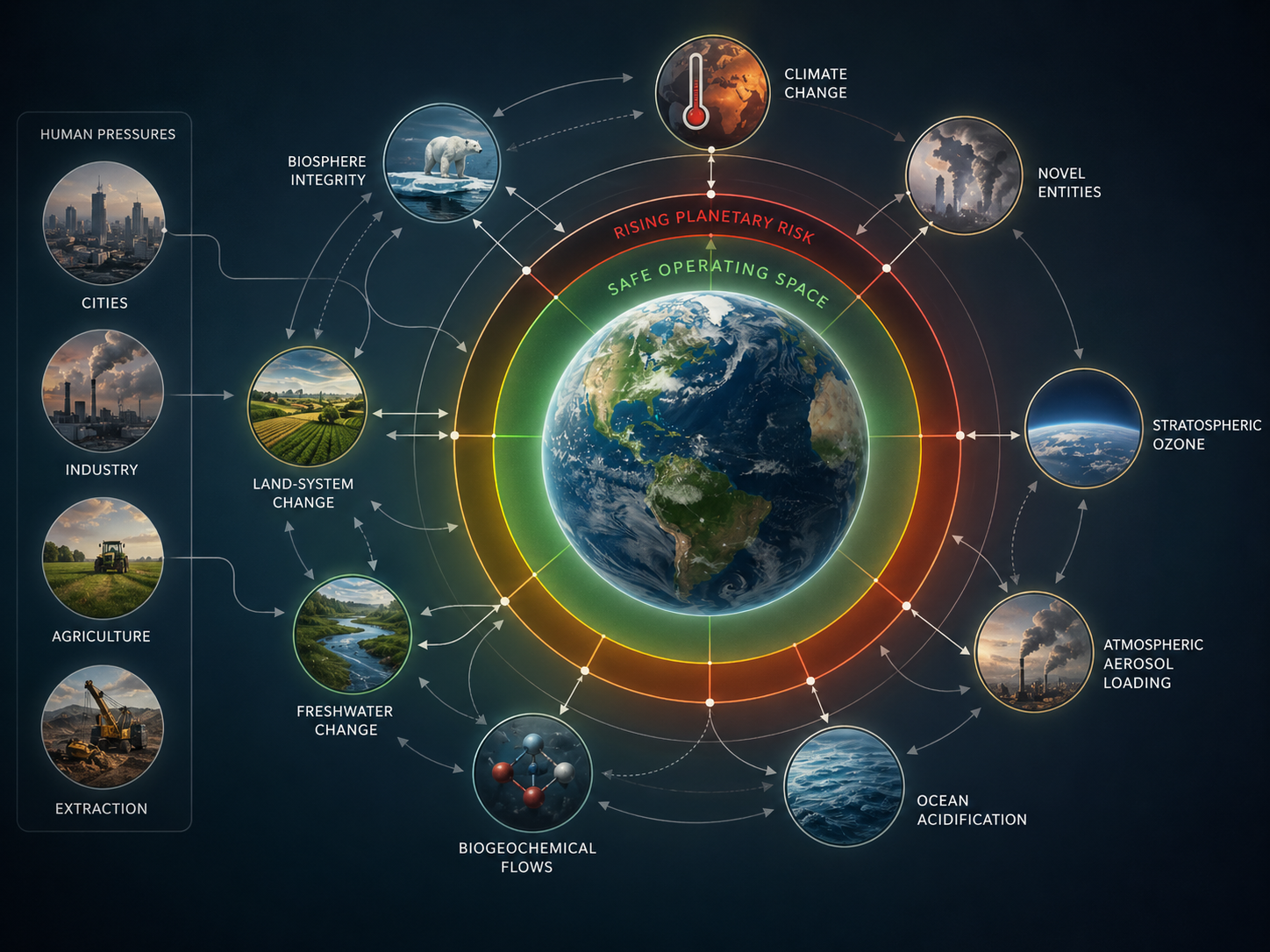
The most important lesson of the nine-boundary framework is that the Earth system is plural and interconnected. A development pathway that addresses emissions while ignoring water, biodiversity, land, nutrients, and pollution remains incomplete. Sustainable development must therefore be ecological in a systems sense, not merely environmental in a narrow sectoral sense.
Overshoot, Risk, and Earth-System Instability
The danger in the Anthropocene is not simply gradual environmental decline. It is the possibility of crossing thresholds that trigger abrupt, cascading, or self-reinforcing shifts. Climate tipping dynamics, ecosystem collapse, freshwater depletion, ocean degradation, biodiversity erosion, and pollution accumulation may interact across scales in ways that reduce resilience and increase systemic fragility. This is why the planetary boundaries framework is built around risk rather than certainty.
Overshoot means that human pressure has moved beyond a boundary or safe range. The significance of overshoot is not only that current conditions are unsafe, but that the capacity to return to safer conditions may become harder over time. The longer systems remain outside safe ranges, the more difficult it can become to reverse damage, restore ecological function, or prevent cascading effects. This is especially important for development because many development systems—food, water, health, infrastructure, housing, public finance—depend on environmental conditions that can be degraded gradually and then disrupted abruptly.
Earth-system instability also creates governance problems. Governments and institutions are often designed around linear assumptions: more investment produces more output, more infrastructure produces more access, more technology produces more efficiency. But Earth-system risk can be nonlinear. A stable pattern can shift unexpectedly when thresholds are crossed. A food system can become fragile when heat, water stress, soil degradation, and fertilizer dependence interact. A city can become vulnerable when extreme heat, energy demand, housing insecurity, and weak public health systems compound one another. Systems that look manageable under average conditions may fail under interacting stress.
Overshoot raises deep justice questions. Those who contribute least to Earth-system destabilization are often among the most exposed to its harms. Climate-vulnerable states, low-income communities, dryland farmers, Indigenous peoples, coastal populations, informal workers, and future generations often bear disproportionate burdens despite contributing comparatively little to cumulative industrial transformation. The Anthropocene is therefore not only a scientific condition. It is also a political and ethical one.
This is why the language of “safe operating space” is so important. It does not describe a luxury environmental preference. It describes a risk boundary for civilization. Sustainable development requires keeping human systems within conditions that allow development itself to remain possible.
Planetary Boundaries and Sustainable Development
Sustainable development is often described as balancing prosperity, inclusion, and environmental sustainability. The planetary boundaries framework sharpens that formulation by clarifying that environmental sustainability is not a moral supplement to development but a precondition for development that endures. Economic growth that destabilizes climate, weakens biodiversity, depletes freshwater, and increases pollution may produce short-term gains while eroding the conditions of future wellbeing.
The 2030 Agenda reinforces this integrated view. It states that the SDGs are integrated and indivisible, balance the economic, social, and environmental dimensions of sustainable development, and seek to ensure that economic, social, and technological progress occurs in harmony with nature. That language aligns closely with Anthropocene thinking: development is no longer adequate if it ignores Earth-system dependencies.
Planetary boundaries do not imply anti-development politics. They imply redesign. Clean energy transitions, regenerative agriculture, circular material systems, biodiversity protection, resilient infrastructure, safe chemical governance, and long-term planning become necessary because development must now be judged by whether it preserves the operating conditions of civilization itself. In that sense, the Anthropocene does not cancel the development project. It redefines it.
This redefinition is particularly important for poverty reduction. Poorer societies still need infrastructure, energy access, food security, public health systems, education, housing, water, sanitation, employment, and institutional capacity. A planetary-boundaries approach cannot be used to deny those needs. Instead, it asks how those needs can be met through development pathways that do not reproduce the high-throughput, high-emission, ecologically destabilizing patterns associated with earlier industrialization. The development question becomes not whether poorer societies may develop, but what kinds of development pathways are just, viable, and supported by global cooperation.
That is why planetary boundaries must be interpreted alongside historical responsibility and differentiated capacity. Wealthy societies with high historical emissions and high material consumption face a different obligation from societies still confronting basic deprivation. Sustainable development requires both ecological realism and developmental justice. It must reduce planetary pressure while expanding human capability where need remains urgent.
Governance in the Anthropocene
Anthropocene governance requires a more integrated, precautionary, and systems-aware mode of political thinking. Environmental issues can no longer be treated as fragmented afterthoughts. Climate policy, food systems, industrial design, transport, public health, urbanization, trade, finance, and chemical regulation are all linked through Earth-system processes. That means governance must become more capable of seeing interdependence and acting across scales.
It must also become more international. Carbon dioxide does not respect borders. Ocean chemistry is not national. Biodiversity decline produces cascading effects beyond the jurisdiction where it begins. Pollution and supply chains travel across legal boundaries. The planetary scale of the problem demands cooperation, monitoring, shared frameworks, finance, technology access, and institutions capable of coordinating action across unequal development conditions.
The ozone case is especially instructive. Stratospheric ozone depletion is now in the safe operating space because ozone-depleting substances were phased out through international cooperation. This does not mean all planetary-boundary problems are equally simple. Climate, biodiversity, land, water, nutrients, and novel entities are deeply embedded in economic systems, food systems, infrastructure, agriculture, energy, and consumption. But the ozone case shows that global environmental governance can matter when science, law, technology, and political commitment align.
Governance in the Anthropocene must also become anticipatory. Waiting for damage to become fully visible can be dangerous when systems contain thresholds, delays, and feedback loops. Public institutions need early-warning systems, scenario planning, boundary monitoring, adaptive regulation, precautionary chemical governance, climate-resilient infrastructure, and mechanisms for learning from evidence. They also need the capacity to coordinate across ministries and sectors, because Earth-system risk does not follow administrative boundaries.
At the same time, governance in the Anthropocene must remain attentive to equity and democratic legitimacy. Transitions away from unsustainable systems create winners and losers unless they are deliberately designed to be just. A credible sustainability strategy therefore requires both ecological realism and social fairness. Humanity now possesses enough power to destabilize the Earth system. The question is whether it can also develop the knowledge, institutions, and ethics to live within planetary boundaries.
Justice, Vulnerability, and Historical Responsibility
The Anthropocene is often described as “the age of humans,” but that phrase can obscure as much as it reveals. Humanity did not enter the Anthropocene as a single equal actor. Industrialization, colonial extraction, fossil-fuel expansion, plantation agriculture, mining, deforestation, unequal trade, and high-consumption development were distributed unevenly across world history. Some societies accumulated wealth and power through development pathways that generated planetary pressure, while others now face constrained development options and high exposure to the resulting risks.
This matters because planetary-boundary governance can become unjust if it treats all actors as equally responsible or equally capable. A low-income country facing energy poverty and climate vulnerability is not in the same position as a high-income economy with high historical emissions and high per-capita consumption. A community facing water stress because of upstream extraction, weak infrastructure, or climate exposure is not in the same position as the actors who profit from the systems producing those pressures. Sustainable development must therefore join boundary awareness with responsibility, capacity, and fairness.
Vulnerability is also produced through social structures. Heat waves, floods, droughts, toxic exposure, food insecurity, and disease risk do not affect all people equally. Housing, income, race, gender, disability, labor conditions, land tenure, citizenship status, and political voice shape who can adapt and who is left exposed. Planetary risk becomes lived risk through social systems. A boundary may be global, but harm is experienced in specific homes, workplaces, cities, farms, coastlines, and bodies.
This is why marginalized voices must remain central in Anthropocene governance. Indigenous communities, small farmers, coastal communities, informal workers, racialized populations, women performing unpaid care labor, and low-income urban residents often possess direct knowledge of ecological change and institutional failure. Their experience is not anecdotal noise beside expert systems. It is evidence about how planetary stress becomes social vulnerability.
A just Anthropocene politics therefore asks more than how to reduce pressure. It asks who produced pressure, who benefited, who is harmed, who decides, who receives support, and who has the power to shape transition. Without that justice frame, planetary boundaries can become technocratic limits imposed on the already vulnerable rather than a framework for transforming the systems that created the crisis.
Measurement, Indicators, and Boundary Visibility
Planetary boundaries depend on measurement, but the measurement problem is complex. Each boundary requires scientific assessment of pressure, state, uncertainty, and risk. Climate change may be represented through atmospheric carbon dioxide concentration and radiative forcing. Biosphere integrity involves genetic diversity and functional integrity. Freshwater change involves both blue water and green water. Novel entities involve chemical and synthetic substances whose cumulative effects are difficult to assess. Boundary measurement therefore requires scientific judgment as well as data.
For development governance, boundary visibility matters because what is invisible is hard to govern. If national development plans measure output, employment, and infrastructure while failing to measure ecological stress, pollution, biodiversity loss, freshwater disruption, or material throughput, then public institutions may mistake short-term growth for progress. Boundary indicators help reveal when development gains are being financed through hidden environmental depletion.
But boundary measurement also has limits. Global metrics can conceal local injustice. A global safe range may not show which communities are exposed first, which ecosystems are damaged most severely, or which groups lack adaptive capacity. A serious sustainable-development approach must therefore connect planetary indicators to local and regional data: heat exposure, water access, pollution burdens, land rights, food insecurity, health impacts, and infrastructure vulnerability.
Measurement also shapes politics. Boundaries can make risk legible, but they can also be misused if detached from justice. A boundary framework that is applied without attention to poverty, historical responsibility, and unequal capacity may become a tool for restricting development claims rather than transforming unsustainable systems. The right use of boundary science is not to freeze global inequality in place. It is to guide just transformation toward development pathways that meet human needs while reducing Earth-system pressure.
This makes measurement part of governance, not merely a technical exercise. Boundary visibility should support public accountability, institutional learning, international cooperation, and democratic debate about development pathways. It should help societies ask not only whether they are growing, but whether that growth remains compatible with the planet’s life-supporting systems.
Why This Matters for Development
The Anthropocene and planetary boundaries matter for development because they redefine the meaning of progress. A society cannot be said to develop successfully if it improves present indicators while undermining the ecological conditions required for future welfare. Growth, infrastructure, consumption, and technological capacity must now be evaluated in relation to climate stability, biodiversity, freshwater, soils, ocean chemistry, pollution, and institutional resilience.
This does not make development less important. It makes development more demanding. Poor communities still need material improvements. Children still need schools, clean water, food, healthcare, housing, safety, and opportunity. Workers still need dignified livelihoods. Cities still need infrastructure. States still need capacity. But these needs must be met through pathways that do not reproduce the ecological overshoot that now threatens the future of development itself.
The Anthropocene therefore forces sustainable development to become more honest. It can no longer rely on the assumption that economic expansion will automatically solve social problems while environmental damage is managed later. Nor can it rely on environmental protection that ignores deprivation and unequal development. The central challenge is to expand human capability within planetary limits and to do so through institutions that are legitimate, inclusive, and capable of long-run coordination.
Planetary boundaries provide one of the clearest scientific languages for this task. They identify the ecological conditions that cannot be treated as external to development. The Anthropocene provides the historical and planetary context: human systems now shape those conditions. Sustainable development is the normative and institutional response: development must be redesigned so that human flourishing and Earth-system stability are no longer treated as separate projects.
This is why the article belongs inside the sustainable development series rather than only inside environmental science. The Anthropocene is a development problem. Planetary boundaries are development constraints. The safe operating space is a condition for long-run human possibility. The task is not simply to protect nature from society. It is to redesign society so that human flourishing remains possible within the Earth system that sustains it.
Mathematical Lens
The Anthropocene can be represented as a condition in which human pressure on Earth-system processes becomes large enough to alter planetary stability. Let \(A\) denote Anthropocene pressure, \(C\) climate forcing, \(B\) biosphere disruption, \(F\) freshwater stress, \(N\) nutrient and novel-entity pressure, and \(L\) land-system change. A simple conceptual form is:
A = \alpha C + \beta B + \gamma F + \delta N + \epsilon L
\]
Interpretation: Anthropocene pressure is cumulative and multidimensional, arising from human impacts on climate, biodiversity, freshwater, nutrients, synthetic substances, and land systems.
This captures the article’s central claim: the Anthropocene is not one isolated environmental problem but the cumulative expansion of human pressure across multiple Earth-system processes.
We can also express boundary transgression risk as:
R_p = \lambda T + \mu I + \nu O
\]
Interpretation: Planetary risk rises when systems move closer to thresholds, when boundary processes interact strongly, and when overshoot becomes more intense.
In this formulation, \(T\) is threshold proximity, \(I\) is interdependence among boundary processes, and \(O\) is overshoot intensity. Higher \(R_p\) means a system is more likely to experience abrupt, cascading, or hard-to-reverse change.
Finally, sustainable development viability under planetary conditions can be represented as:
V = \theta H + \kappa G – \rho E
\]
Interpretation: Sustainable development viability increases with human wellbeing and governance capacity, but declines when Earth-system destabilization pressure rises.
Here, \(H\) is human wellbeing improvement, \(G\) is governance capacity, and \(E\) is Earth-system destabilization pressure. This helps clarify why development must now be judged simultaneously by welfare outcomes and planetary operating conditions.
| Term | Meaning | Interpretive role |
|---|---|---|
| \(A\) | Anthropocene pressure | Represents the cumulative pressure human systems place on Earth-system processes. |
| \(C\) | Climate forcing | Represents greenhouse-gas-driven alteration of the Earth’s energy balance. |
| \(B\) | Biosphere disruption | Represents biodiversity loss, ecosystem decline, and reduced functional integrity. |
| \(F\) | Freshwater stress | Represents disruption of blue water and green water systems. |
| \(N\) | Nutrient and novel-entity pressure | Represents biogeochemical disruption and synthetic chemical or pollution burdens. |
| \(L\) | Land-system change | Represents deforestation, land conversion, and degradation of terrestrial systems. |
| \(R_p\) | Planetary-boundary risk | Represents rising risk from threshold proximity, interdependence, and overshoot. |
| \(V\) | Development viability | Represents whether human development remains compatible with planetary operating conditions. |
The equations are conceptual rather than predictive. Their value is to make visible a core principle of Anthropocene development: human wellbeing, governance capacity, and Earth-system stability must be evaluated together. Development that improves welfare while intensifying planetary destabilization is not secure development. It is development that borrows against the future.
Advanced Python Workflow: Anthropocene and Planetary Boundaries Risk Scoring
This Python workflow models Earth-system pressure and development risk by combining climate forcing, biosphere stress, freshwater change, nutrient disruption, land-system conversion, ocean acidification, novel entities, and governance response. It is designed to operationalize the article’s main claim that development now takes place under planetary-scale constraints.
from __future__ import annotations

import pandas as pd
import numpy as np

INPUT_FILE = "anthropocene_planetary_boundaries_panel.csv"
OUTPUT_FILE = "anthropocene_planetary_boundaries_scores.csv"


def load_data(path: str) -> pd.DataFrame:
    """
    Load a territory-level Anthropocene and planetary-boundary dataset.

    All *_index columns should be normalized to [0, 1].
    Higher values should mean more of the named property.

    Examples:
      - climate_forcing_index: higher = stronger climate forcing
      - biosphere_integrity_stress_index: higher = more biosphere stress
      - governance_response_capacity_index: higher = stronger governance response
      - sustainable_development_alignment_index: higher = stronger alignment
    """
    df = pd.read_csv(path)

    required_columns = [
        "territory_name",
        "country_or_region",
        "territory_type",
        "climate_forcing_index",
        "biosphere_integrity_stress_index",
        "land_system_change_index",
        "freshwater_change_index",
        "biogeochemical_disruption_index",
        "novel_entities_pressure_index",
        "ocean_acidification_pressure_index",
        "aerosol_loading_pressure_index",
        "ozone_depletion_pressure_index",
        "governance_response_capacity_index",
        "sustainable_development_alignment_index",
    ]

    missing = [col for col in required_columns if col not in df.columns]

    if missing:
        raise ValueError(f"Missing required columns: {missing}")

    return df


def validate_indices(df: pd.DataFrame) -> pd.DataFrame:
    """Validate that all *_index fields are complete and normalized to [0, 1]."""
    index_columns = [col for col in df.columns if col.endswith("_index")]

    for col in index_columns:
        if df[col].isna().any():
            raise ValueError(f"Column '{col}' contains missing values.")

        if ((df[col] < 0) | (df[col] > 1)).any():
            raise ValueError(f"Column '{col}' contains values outside [0, 1].")

    return df


def compute_scores(df: pd.DataFrame) -> pd.DataFrame:
    """
    Compute Earth-system pressure, planetary governance capacity,
    and planetary-boundary risk scores.

    Earth-system pressure rises with climate forcing, biosphere stress,
    land change, freshwater change, nutrient disruption, novel entities,
    ocean acidification, aerosol pressure, and ozone-depletion pressure.

    Governance capacity rises with governance response and sustainable
    development alignment, while also reflecting lower climate and biosphere stress.
    """
    df = df.copy()

    df["earth_system_pressure_score"] = (
        0.14 * df["climate_forcing_index"] +
        0.14 * df["biosphere_integrity_stress_index"] +
        0.10 * df["land_system_change_index"] +
        0.10 * df["freshwater_change_index"] +
        0.12 * df["biogeochemical_disruption_index"] +
        0.12 * df["novel_entities_pressure_index"] +
        0.12 * df["ocean_acidification_pressure_index"] +
        0.08 * df["aerosol_loading_pressure_index"] +
        0.08 * df["ozone_depletion_pressure_index"]
    ).clip(lower=0, upper=1)

    df["planetary_governance_capacity_score"] = (
        0.34 * df["governance_response_capacity_index"] +
        0.30 * df["sustainable_development_alignment_index"] +
        0.18 * (1 - df["climate_forcing_index"]) +
        0.18 * (1 - df["biosphere_integrity_stress_index"])
    ).clip(lower=0, upper=1)

    df["planetary_boundary_risk_score"] = (
        0.55 * df["earth_system_pressure_score"] +
        0.25 * (1 - df["planetary_governance_capacity_score"]) +
        0.20 * df["ocean_acidification_pressure_index"]
    ).clip(lower=0, upper=1)

    df["risk_band"] = np.select(
        [
            df["planetary_boundary_risk_score"] >= 0.80,
            df["planetary_boundary_risk_score"] >= 0.60,
            df["planetary_boundary_risk_score"] >= 0.40,
        ],
        [
            "Extreme planetary-boundary risk",
            "High planetary-boundary risk",
            "Moderate planetary-boundary risk",
        ],
        default="Lower planetary-boundary risk",
    )

    return df


def build_summary(df: pd.DataFrame) -> pd.DataFrame:
    """Return a ranked summary table for review or reporting."""
    columns = [
        "territory_name",
        "country_or_region",
        "territory_type",
        "earth_system_pressure_score",
        "planetary_governance_capacity_score",
        "planetary_boundary_risk_score",
        "risk_band",
    ]

    summary = df[columns].copy()

    summary = summary.sort_values(
        by=[
            "planetary_boundary_risk_score",
            "earth_system_pressure_score",
            "planetary_governance_capacity_score",
        ],
        ascending=[False, False, True],
    ).reset_index(drop=True)

    return summary


def main() -> None:
    df = load_data(INPUT_FILE)
    df = validate_indices(df)
    scored = compute_scores(df)
    summary = build_summary(scored)

    summary.to_csv(OUTPUT_FILE, index=False)

    print("Anthropocene and planetary boundaries scoring complete.")
    print(summary.to_string(index=False))


if __name__ == "__main__":
    main()
This workflow is intentionally transparent. It does not claim that planetary-boundary risk can be reduced to a single objective truth. Instead, it makes assumptions visible: climate forcing, biosphere stress, land change, freshwater disruption, nutrient pressure, novel entities, ocean acidification, aerosols, ozone, governance response, and development alignment are treated as distinct components. The purpose is to support structured diagnosis, sensitivity testing, and public reasoning about where development is most exposed to Earth-system destabilization.
Advanced R Workflow: Boundary Transgression, Earth-System Pressure, and Development Risk
This R workflow compares territories across climate, biosphere, land, freshwater, nutrient, pollution, ocean, aerosol, and ozone pressures alongside governance capacity. It is useful for identifying where development is most exposed to Earth-system destabilization and where transition capacity is comparatively stronger.
library(readr)
library(dplyr)

input_file <- "anthropocene_planetary_boundaries_country_panel.csv"
output_file <- "boundary_transgression_earth_system_pressure_summary.csv"

pb_df <- read_csv(input_file, show_col_types = FALSE)

required_cols <- c(
  "territory_name",
  "country_or_region",
  "territory_type",
  "climate_forcing_index",
  "biosphere_integrity_stress_index",
  "land_system_change_index",
  "freshwater_change_index",
  "biogeochemical_disruption_index",
  "novel_entities_pressure_index",
  "ocean_acidification_pressure_index",
  "aerosol_loading_pressure_index",
  "ozone_depletion_pressure_index",
  "governance_response_capacity_index",
  "sustainable_development_alignment_index"
)

missing_cols <- setdiff(required_cols, names(pb_df))

if (length(missing_cols) > 0) {
  stop(paste("Missing required columns:", paste(missing_cols, collapse = ", ")))
}

index_cols <- names(pb_df)[grepl("_index$", names(pb_df))]

invalid_index_cols <- index_cols[
  vapply(
    pb_df[index_cols],
    function(x) any(is.na(x) | x < 0 | x > 1),
    logical(1)
  )
]

if (length(invalid_index_cols) > 0) {
  stop(
    paste(
      "Index columns must be complete and normalized to [0, 1]:",
      paste(invalid_index_cols, collapse = ", ")
    )
  )
}

pb_df <- pb_df %>%
  mutate(
    planetary_pressure_proxy = (
      climate_forcing_index +
      biosphere_integrity_stress_index +
      land_system_change_index +
      freshwater_change_index +
      biogeochemical_disruption_index +
      novel_entities_pressure_index +
      ocean_acidification_pressure_index +
      aerosol_loading_pressure_index +
      ozone_depletion_pressure_index +
      (1 - governance_response_capacity_index) +
      (1 - sustainable_development_alignment_index)
    ) / 11,
    planetary_governance_capacity = (
      governance_response_capacity_index +
      sustainable_development_alignment_index
    ) / 2,
    risk_band = case_when(
      planetary_pressure_proxy >= 0.75 ~ "Extreme planetary-boundary risk",
      planetary_pressure_proxy >= 0.55 ~ "High planetary-boundary risk",
      planetary_pressure_proxy >= 0.35 ~ "Moderate planetary-boundary risk",
      TRUE ~ "Lower planetary-boundary risk"
    )
  )

summary_df <- pb_df %>%
  group_by(country_or_region, territory_type) %>%
  summarise(
    avg_planetary_pressure_proxy = mean(planetary_pressure_proxy, na.rm = TRUE),
    avg_planetary_governance_capacity = mean(planetary_governance_capacity, na.rm = TRUE),
    avg_climate_forcing = mean(climate_forcing_index, na.rm = TRUE),
    avg_biosphere_integrity_stress = mean(biosphere_integrity_stress_index, na.rm = TRUE),
    avg_land_system_change = mean(land_system_change_index, na.rm = TRUE),
    avg_freshwater_change = mean(freshwater_change_index, na.rm = TRUE),
    avg_biogeochemical_disruption = mean(biogeochemical_disruption_index, na.rm = TRUE),
    avg_novel_entities_pressure = mean(novel_entities_pressure_index, na.rm = TRUE),
    avg_ocean_acidification_pressure = mean(ocean_acidification_pressure_index, na.rm = TRUE),
    observations = n(),
    .groups = "drop"
  ) %>%
  mutate(
    regional_risk_band = case_when(
      avg_planetary_pressure_proxy >= 0.75 ~ "Extreme planetary-boundary risk",
      avg_planetary_pressure_proxy >= 0.55 ~ "High planetary-boundary risk",
      avg_planetary_pressure_proxy >= 0.35 ~ "Moderate planetary-boundary risk",
      TRUE ~ "Lower planetary-boundary risk"
    )
  ) %>%
  arrange(desc(avg_planetary_pressure_proxy))

write_csv(summary_df, output_file)

cat("Exported:", output_file, "\n")
print(summary_df)
This workflow helps distinguish Earth-system pressure from governance response. A territory may be exposed to climate forcing, freshwater disruption, biodiversity stress, land conversion, nutrient pressure, pollution, or ocean acidification, but those pressures become more dangerous when governance response and sustainable-development alignment are weak. The workflow therefore treats planetary boundaries as development constraints, not merely environmental indicators.
GitHub Repository
Complete Code Repository
The full code distribution for this article, including planetary-risk scoring workflows, Earth-system diagnostics, SQL materials, optional monitoring support tooling, supporting documentation, and repository structure, is available on GitHub.
Related Articles
- The Brundtland Definition and Its Legacy
- What Is Sustainable Development? Meaning, Systems, and Long-Run Viability
- Sustainable Development as a Systems Problem
- Planetary Boundaries and Sustainable Development
- Climate Change as a Development Constraint
- Growth, Limits, and the Problem of Overshoot
- Ecological Thresholds, Nonlinearity, and Systemic Risk
- Safe Operating Space and the Conditions of Long-Run Development
- Resilience Thinking and Sustainable Development
- Development Under Deep Uncertainty
Further Reading
- Crutzen, P.J. (2002) ‘Geology of mankind’, Nature, 415, p. 23. Available at: https://www.nature.com/articles/415023a
- Rockström, J. et al. (2009) ‘A safe operating space for humanity’, Nature, 461, pp. 472–475. Available at: https://www.nature.com/articles/461472a
- Steffen, W. et al. (2015) ‘Planetary boundaries: Guiding human development on a changing planet’, Science, 347(6223). Available at: https://www.science.org/doi/10.1126/science.1259855
- Richardson, K. et al. (2023) ‘Earth beyond six of nine planetary boundaries’, Science Advances, 9(37), eadh2458. Available at: https://www.science.org/doi/10.1126/sciadv.adh2458
- Stockholm Resilience Centre (2025) Seven of nine planetary boundaries now breached. Stockholm: Stockholm University. Available at: https://www.stockholmresilience.org/news–events/general-news/2025-09-24-seven-of-nine-planetary-boundaries-now-breached.html
- Stockholm Resilience Centre (2025) Planetary Health Check 2025. Stockholm: Stockholm University. Available at: https://www.stockholmresilience.org/publications/publications/2025-11-29-planetary-health-check-2025.html
- Stockholm Resilience Centre (n.d.) Planetary boundaries. Stockholm: Stockholm University. Available at: https://www.stockholmresilience.org/research/planetary-boundaries.html
- IPCC (2023) Climate Change 2023: Synthesis Report. Geneva: Intergovernmental Panel on Climate Change. Available at: https://www.ipcc.ch/report/ar6/syr/
- UNEP (2025) Emissions Gap Report 2025. Nairobi: United Nations Environment Programme. Available at: https://www.unep.org/resources/emissions-gap-report-2025
- United Nations (2015) Transforming our world: the 2030 Agenda for Sustainable Development. New York: United Nations. Available at: https://sdgs.un.org/2030agenda
References
- Crutzen, P.J. (2002) ‘Geology of mankind’, Nature, 415, p. 23. Available at: https://www.nature.com/articles/415023a
- Rockström, J. et al. (2009) ‘A safe operating space for humanity’, Nature, 461, pp. 472–475. Available at: https://www.nature.com/articles/461472a
- Steffen, W., Richardson, K., Rockström, J., Cornell, S.E., Fetzer, I., Bennett, E.M., Biggs, R., Carpenter, S.R., de Vries, W., de Wit, C.A., Folke, C., Gerten, D., Heinke, J., Mace, G.M., Persson, L.M., Ramanathan, V., Reyers, B. and Sörlin, S. (2015) ‘Planetary boundaries: Guiding human development on a changing planet’, Science, 347(6223). Available at: https://www.science.org/doi/10.1126/science.1259855
- Richardson, K., Steffen, W., Lucht, W., Bendtsen, J., Cornell, S.E., Donges, J.F., Drüke, M., Fetzer, I., Bala, G., von Bloh, W., Feulner, G., Fiedler, S., Gerten, D., Gleeson, T., Hofmann, M., Huiskamp, W., Kummu, M., Mohan, C., Nogués-Bravo, D., Petri, S., Porkka, M., Rahmstorf, S., Schaphoff, S., Thonicke, K., Tobian, A., Virkki, V., Wang-Erlandsson, L., Weber, L. and Rockström, J. (2023) ‘Earth beyond six of nine planetary boundaries’, Science Advances, 9(37), eadh2458. Available at: https://www.science.org/doi/10.1126/sciadv.adh2458
- Stockholm Resilience Centre (2025) Seven of nine planetary boundaries now breached. Stockholm: Stockholm University. Available at: https://www.stockholmresilience.org/news–events/general-news/2025-09-24-seven-of-nine-planetary-boundaries-now-breached.html
- Stockholm Resilience Centre (2025) Planetary Health Check 2025. Stockholm: Stockholm University. Available at: https://www.stockholmresilience.org/publications/publications/2025-11-29-planetary-health-check-2025.html
- Stockholm Resilience Centre (n.d.) Planetary boundaries. Stockholm: Stockholm University. Available at: https://www.stockholmresilience.org/research/planetary-boundaries.html
- IPCC (2023) Climate Change 2023: Synthesis Report. Geneva: Intergovernmental Panel on Climate Change. Available at: https://www.ipcc.ch/report/ar6/syr/
- UNEP (2025) Emissions Gap Report 2025. Nairobi: United Nations Environment Programme. Available at: https://www.unep.org/resources/emissions-gap-report-2025
- United Nations (2015) Transforming our world: the 2030 Agenda for Sustainable Development. New York: United Nations. Available at: https://sdgs.un.org/2030agenda