
Last Updated May 22, 2026
Dark traits, virtue, and the moral structure of personality bring personality psychology to one of its most difficult questions: how should the field understand enduring tendencies that are not merely socially inconvenient, but morally consequential? Some stable personality patterns are associated with manipulation, callousness, entitlement, exploitation, aggression, deception, domination, and even enjoyment of others’ suffering. Other enduring patterns are associated with honesty, humility, fairness, restraint, courage, compassion, gratitude, fidelity, and moral reliability. The challenge is not simply to describe these patterns, but to understand how vice-like and virtue-like tendencies are organized within personality structure.
This question matters because personality psychology often presents itself as descriptively neutral. Traits are measured, factor-analyzed, correlated, modeled, and compared. Yet many traits have obvious moral consequences once they enter real relationships, institutions, and forms of power. A manipulative person is not merely “different” from a sincere one. A callous leader is not merely stylistically distinct from a just one. A cruel, exploitative, or predatory personality pattern can shape trust, safety, governance, family life, work, politics, and public harm. Personality is descriptive, but it is not morally empty.
A serious theory of personality must therefore ask how dark traits relate to ordinary personality dimensions, how virtue relates to character, whether low darkness is the same as virtue, and what the moral architecture of personality looks like when destructive and admirable tendencies are taken seriously together. The strongest answer is neither moralism nor value-free neutrality. Personality has morally relevant structure, but moral character is not reducible to trait scores alone. It emerges through the relation among dispositions, motives, judgment, self-command, values, social incentives, and the contexts in which people act.
Main Library
Publications
Article Map
Personality Psychology
Related Topic
Social Psychology
Related Topic
Positive Psychology
Related Topic
Cognitive Psychology
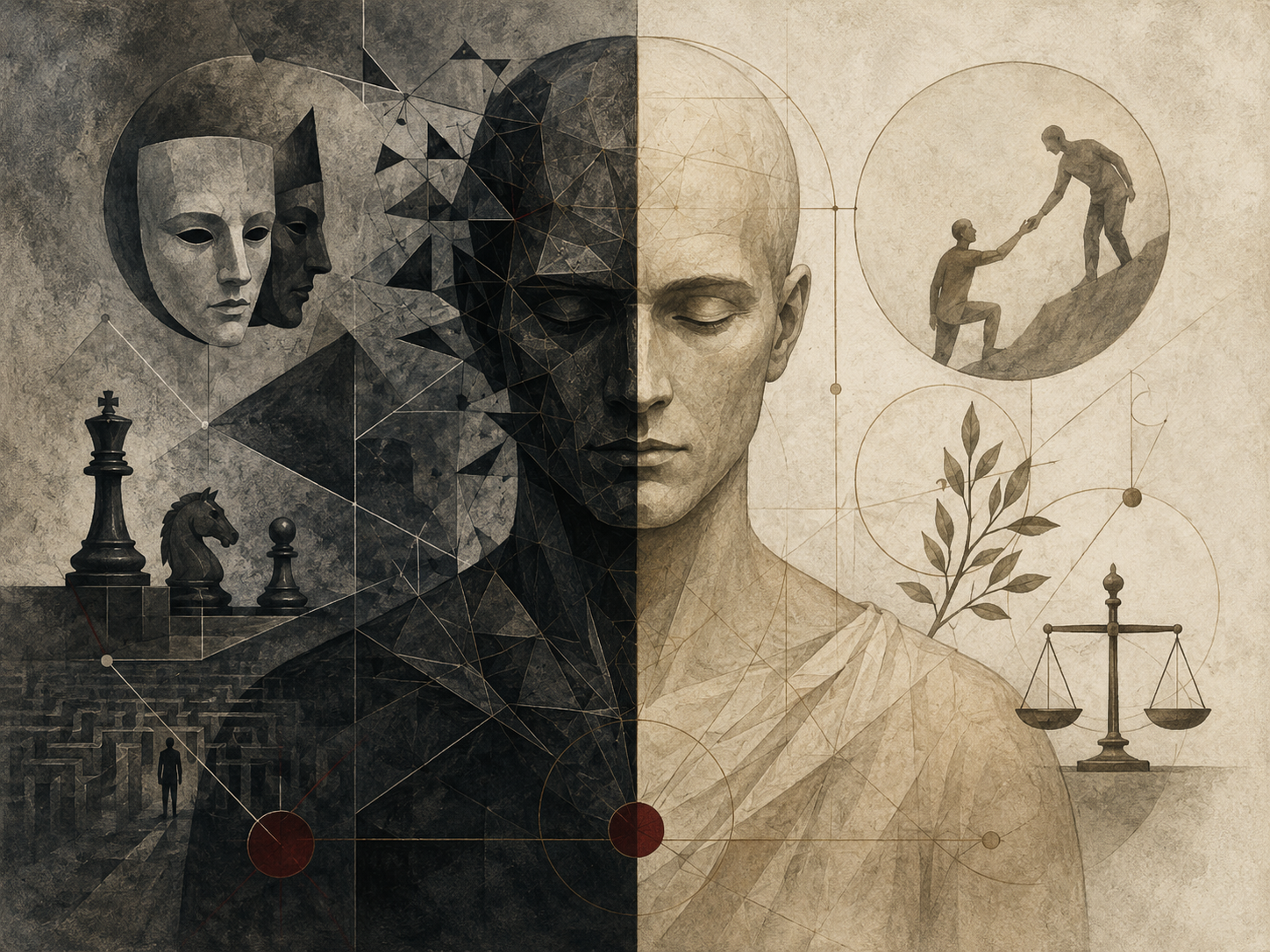
Dark traits and virtue belong together because they force personality psychology to hold description and evaluation in the same frame. Dark-traits research shows how manipulation, callousness, entitlement, sadism, and exploitative self-interest can become stable personality patterns. Virtue and character research asks how honesty, humility, justice, care, courage, and self-command become durable forms of moral reliability. Neither side is complete without the other. A psychology of personality that studies darkness but not virtue becomes a catalog of harm. A psychology of virtue that ignores darkness risks sentimentality.
Why dark traits and virtue belong together
Dark traits and virtue belong together because they name opposing but interrelated ways of thinking about the moral significance of personality. Dark traits describe stable patterns associated with exploitation, antagonism, entitlement, callousness, manipulation, or cruelty. Virtue names stable excellences of character associated with honesty, justice, compassion, courage, humility, fidelity, prudence, and self-command. Personality psychology needs both because the study of moral personhood is incomplete if it can only describe pathology or only celebrate strengths.
The pairing also matters because the moral structure of personality is not symmetrical. The absence of cruelty does not automatically yield compassion. The absence of manipulation does not automatically yield honesty. The absence of vanity does not automatically yield humility. The absence of aggression does not automatically yield courage. Vice-like and virtue-like tendencies are related, but they are not simply mirror images. A person may be low in dark traits without being strongly virtuous, and a socially adaptive person may still remain morally thin.
This distinction is important because many moral failures are not dramatic. People may avoid obvious cruelty while remaining indifferent, cowardly, opportunistic, vain, passive, unreliable, or unwilling to bear cost for the good. Conversely, some forms of virtue require more than non-harm. Honesty may require truthfulness under pressure. Courage may require action despite risk. Justice may require refusing advantageous unfairness. Compassion may require attention to suffering that could easily be ignored. Humility may require accurate self-placement where vanity would be rewarded.
Dark traits and virtue also belong together because both concern stability. A single selfish act does not make a dark personality. A single kind act does not make a virtuous character. Personality psychology is interested in patterns: what people tend to notice, desire, excuse, pursue, avoid, justify, repeat, and become over time. Moral character is not only about isolated choices; it is about the organized tendencies through which choices repeatedly arise.
The moral structure of personality therefore requires a double vision. It must identify destructive tendencies without reducing persons to monsters, and it must identify virtue without turning personality science into inspirational rhetoric. The task is disciplined moral psychology: to describe how enduring dispositions become ethically consequential in action, relationship, and institution.
What dark traits are
Dark traits are subclinical or non-diagnostic personality tendencies associated with morally or socially aversive styles of functioning. They are usually discussed as enduring dispositions rather than isolated behaviors. Their importance lies not only in social unpleasantness, but in their connection to deception, exploitation, entitlement, reduced empathy, dominance, emotional coldness, and morally costly forms of goal pursuit.
The dark-traits framework gives personality psychology a way to study morally troubling individuality without reducing everything to formal disorder categories. Many harmful tendencies operate in ordinary populations, workplaces, relationships, institutions, political movements, and status hierarchies without necessarily meeting criteria for clinical disorder. A person can be manipulative, callous, grandiose, or exploitative in ways that matter greatly for others, even when the behavior remains socially rewarded or institutionally protected.
Dark traits are not merely “bad manners” or interpersonal unpleasantness. They often involve a deeper orientation toward other people as instruments, obstacles, admirers, rivals, prey, or sources of gratification. The moral problem is not simply that such people are difficult to be around. It is that their personality structure may normalize the use of others for self-enhancement, advantage, control, or amusement.
This is why dark traits have implications beyond personality description. They matter for leadership, abuse, deception, workplace exploitation, bullying, coercive control, corruption, online cruelty, intimate betrayal, and institutional harm. Dark personality is not always loud. It can be charming, strategic, polished, and socially successful. It may be rewarded in environments that confuse confidence with competence, ruthlessness with strength, or dominance with leadership.
At the same time, dark-traits research must be careful. These constructs should not become casual insult categories. A person who is self-confident is not automatically narcissistic. A person who is strategic is not automatically Machiavellian. A person who is emotionally restrained is not automatically psychopathic. A person who uses dark-trait language without careful definition risks turning personality science into moral name-calling.
A serious dark-traits framework therefore asks not “who is evil?” but “which enduring tendencies make exploitation, callousness, domination, deception, or cruelty more likely, and under what conditions are those tendencies expressed, rewarded, restrained, or transformed?” That is a stronger and more responsible question.
The Dark Triad and Dark Tetrad
The best-known dark-traits framework is the Dark Triad: Machiavellianism, narcissism, and psychopathy. Machiavellianism emphasizes manipulation, strategic cynicism, long-range calculation, emotional detachment, and instrumental social behavior. Narcissism emphasizes entitlement, self-importance, admiration seeking, grandiose self-focus, status hunger, and vulnerability to humiliation or ego threat. Psychopathy emphasizes callousness, impulsive aggression, fearlessness, low remorse, shallow affect, and poor inhibition. The Dark Tetrad extends the framework by adding everyday sadism, the tendency to take interest in or pleasure from others’ suffering.
These constructs are analytically useful because they isolate recurring forms of moral distortion in personality. Machiavellianism corrupts social intelligence by turning it into manipulation. Narcissism corrupts self-regard by turning it into entitlement and superiority. Psychopathy corrupts agency by detaching action from remorse, empathy, and fear of harm. Sadism corrupts responsiveness to suffering by making another person’s pain interesting, gratifying, or amusing.
Yet these traits are not identical. Their overlap is substantial, but each trait adds something distinctive to the profile of darkness. Machiavellianism may be colder and more calculating. Narcissism may be more status-sensitive and admiration-driven. Psychopathy may be more impulsive, callous, and disinhibited. Sadism may involve a more direct positive attraction to cruelty or humiliation. This is one reason contemporary work often looks for shared cores without collapsing all dark traits into a single undifferentiated “evil factor.”
The distinction also matters for institutions. A narcissistic leader may seek admiration, visibility, and symbolic dominance. A Machiavellian actor may manipulate information and alliances quietly. A psychopathic actor may take reckless risks and show low remorse. A sadistic actor may create climates of fear or humiliation because cruelty itself is rewarding. These patterns may overlap, but they do not produce exactly the same risks.
The Dark Triad and Dark Tetrad are best understood as research constructs, not everyday insult labels. Their value lies in making patterns visible: manipulation, entitlement, callousness, and cruelty can be studied as personality tendencies rather than treated as random moral accidents. Their danger lies in oversimplification: dark-traits language can quickly become dramatic, stigmatizing, or imprecise if detached from measurement and context.
Used carefully, the dark-traits framework helps personality psychology confront a difficult reality: harmful social behavior often has personality structure behind it. Not all harm is accidental, situational, or misunderstood. Some people repeatedly use, dominate, deceive, or injure others because their dispositional system makes such behavior easier, more rewarding, or less morally inhibited.
The shared core of dark personality
One of the central questions in dark-traits research is whether different dark traits share a common core. Machiavellianism, narcissism, psychopathy, and sadism are distinguishable, but they often overlap. That overlap suggests that dark personality may be organized around a deeper antagonistic, exploitative, or self-serving orientation toward others.
Several interpretations are possible. One view emphasizes low empathy and low concern for others. Another emphasizes antagonism, dominance, and hostility. Another emphasizes entitlement and the belief that one deserves more than others. Another emphasizes low Honesty-Humility: a disposition toward insincerity, unfairness, greed, arrogance, and willingness to exploit. Another emphasizes a more general tendency to maximize one’s own utility while disregarding, accepting, or justifying costs to others.
These interpretations are not mutually exclusive. The shared core of darkness may involve several linked features: instrumental treatment of others, weak moral inhibition, entitlement, low humility, low fairness, low guilt, reduced compassion, and a capacity to rationalize harm. The precise weight of each feature may vary by model, measure, and context.
The idea of a shared dark core is useful because it explains why dark traits often travel together. Someone who manipulates others may also feel entitled to do so. Someone who feels entitled may show low remorse when others are harmed. Someone with low remorse may find coercion easier. Someone who enjoys dominance may be more willing to humiliate. These are not identical tendencies, but they can reinforce one another.
Still, a shared-core model should not erase specificity. A cold manipulator is not identical to an impulsive aggressor. A fragile narcissistic personality is not identical to an everyday sadist. A person high in antagonism may not be strategic. A person high in Machiavellianism may not seek attention. The strongest models preserve both common darkness and distinct expressions.
The shared-core question also clarifies the relation between dark traits and virtue. If dark traits share an exploitative or antagonistic core, then virtue cannot be understood only as the absence of each separate dark trait. Virtue must include a positive orientation toward truth, justice, care, humility, restraint, and responsibility. It must resist not only particular dark strategies, but the deeper moral permission structure that makes exploitation acceptable.
Virtue as more than the absence of vice
Virtue should not be treated as merely low darkness. Virtues are relatively stable excellences of character involving right motivation, fitting judgment, disciplined conduct, and ethically appropriate response to others and to circumstance. To be virtuous is not simply to avoid obvious harm. It is to be positively organized toward the good in thought, desire, action, and relationship.
This matters because a morally serious personality theory cannot stop at damage control. A person may be non-exploitative yet still cowardly, indifferent, unreliable, vain, morally passive, or unwilling to act when justice requires cost. Virtue introduces a more demanding standard. It asks what kind of positive moral formation a person has, not merely which harmful tendencies they lack.
Virtue also requires integration. Honesty is not simply blurting out facts without judgment. Courage is not recklessness. Humility is not self-erasure. Compassion is not boundaryless accommodation. Justice is not vengeance. Prudence is not fear. Each virtue requires fitting perception, motive, action, and proportion. A trait-like tendency may support virtue, but virtue requires practical wisdom about when, how, and why a response is right.
This makes virtue harder to model than dark traits. Harmful tendencies are often easier to identify behaviorally: lying, exploiting, dominating, humiliating, betraying, manipulating. Virtue may involve subtler forms of restraint, timing, loyalty, sacrifice, mercy, truthfulness, and courage. It is not always visible in one dramatic act. It is often revealed through what someone refuses to do, what they sustain under pressure, and how they treat people when advantage is possible.
The distinction between low vice and positive virtue also matters for character development. Reducing harmful tendencies is important, but moral formation requires more than inhibition. It requires cultivating good desires, reliable judgment, ethical sensitivity, disciplined habits, and relationships that make moral responsibility more possible. Virtue is not simply the low end of a darkness scale. It is a positive architecture of character.
A mature personality psychology of virtue therefore needs both empirical measurement and philosophical seriousness. It should ask what can be measured, but also what measurement may miss: motive, meaning, practical wisdom, moral aspiration, courage under cost, and the formation of conscience over time.
Honesty-Humility and the moral core of personality
One of the most important developments in recent personality research is the argument that Honesty-Humility captures a particularly central moral dimension of personality. In the HEXACO model, Honesty-Humility is associated with sincerity, fairness, greed avoidance, modesty, and resistance to exploitation. In dark-traits research, low Honesty-Humility is often treated as a major common core underlying dark personality, especially where deceit, entitlement, greed, manipulation, and exploitation are concerned.
This is a powerful finding because it suggests that personality structure contains dimensions that are more morally loaded than the field’s older descriptively neutral language sometimes implied. Some traits are not merely about style or temperament. They concern how a person relates to truth, fairness, status, possession, and other people’s dignity. Honesty-Humility is especially important because it connects moral character to ordinary social reliability: can this person be trusted not to deceive, exploit, inflate themselves, or take more than is fair?
Honesty-Humility also helps explain why dark traits are often socially dangerous even when they are not clinically extreme. A person low in Honesty-Humility may still function well, appear charming, succeed institutionally, and avoid obvious criminality, while repeatedly bending truth, fairness, and reciprocity toward self-interest. The harm may be subtle, cumulative, and protected by status.
At the same time, Honesty-Humility does not exhaust virtue. It may be morally central, but moral character also involves courage, care, justice, practical judgment, gratitude, patience, fidelity, responsibility, and commitment under pressure. A person can be honest and humble yet still fail in courage or compassion. A person can be modest yet passive before injustice. A person can avoid exploitation yet still lack moral imagination.
Honesty-Humility is therefore best understood as a major moral foundation within personality, not the whole of moral life. It identifies a crucial axis: the difference between self-serving exploitation and fair, sincere, non-greedy relation to others. But virtue requires a broader formation of desire, judgment, action, and responsibility.
This makes Honesty-Humility especially valuable for connecting empirical personality science with moral psychology. It gives researchers a measurable construct that captures something ethically substantial without pretending that all of character can be reduced to one trait.
Moral character beyond broad traits
Modern work on moral character increasingly argues that character is related to personality structure without being fully reducible to it. Broad traits can help predict morally relevant behavior, but character usually requires more than descriptive tendency. It involves motives, commitments, evaluative orientation, self-regulation, moral perception, and response to reasons. This is why the same broad trait pattern can take on different moral meaning depending on how it is governed.
Discipline, for example, can support integrity or domination. Emotional restraint can serve fairness or coldness. Social boldness can support courage or predation. Agreeableness can support compassion or conflict avoidance. Openness can support moral imagination or self-indulgent novelty seeking. Extraversion can support public courage or attention hunger. Conscientiousness can support responsibility or rigid control. The moral meaning of a trait depends on what it serves.
This is why moral character requires interpretation beyond trait scores alone. Traits describe recurring tendencies; character asks how those tendencies are ordered by values, commitments, motives, and judgment. A courageous person is not simply low in fear. Courage requires perceiving a worthy good and acting despite risk in a fitting way. A just person is not simply agreeable. Justice may require conflict. A humble person is not simply low in narcissism. Humility requires truthful self-understanding and freedom from inflated self-importance.
Character also has a narrative dimension. People become morally reliable or unreliable over time through repeated choices, social formation, habits, role models, institutions, failures, repairs, and commitments. Personality traits may make some paths easier or harder, but character develops through practice and interpretation. A person may learn to govern dark tendencies, or may learn to rationalize them. A person may cultivate virtue, or may merely perform it when rewarded.
The moral structure of personality therefore has multiple layers. Broad traits provide dispositional tendencies. Dark traits identify exploitative or callous patterns. Virtue-relevant traits identify morally supportive tendencies. Motives reveal what the person is pursuing. Judgment reveals whether the person understands what a situation requires. Habits reveal what the person repeatedly does. Institutions reveal what is rewarded or punished. Character emerges from the whole structure.
A serious personality psychology of moral character must therefore be empirically disciplined but not philosophically thin. It should measure what can be measured, while recognizing that moral character includes meaning, reasons, values, and judgment that cannot be fully captured by a simple inventory score.
Dark traits, relationships, power, and harm
Dark traits matter most where personality enters unequal or consequential relationships. In intimate life, they can support manipulation, coercion, emotional exploitation, betrayal, intimidation, humiliation, strategic withdrawal, or callous disregard. In institutions, they can distort leadership, reward image over integrity, produce climates of fear, and create harm that is strategic rather than merely impulsive. In competitive settings, dark tendencies may even be rewarded in the short term, especially where charm, confidence, ruthlessness, or dominance are mistaken for strength.
This is why dark personality should not be treated as merely a curiosity of edgy traits research. It has implications for trust, governance, organizational culture, abuse, corruption, exploitation, and public life. Dark traits become especially dangerous when paired with power, immunity from accountability, social admiration, or institutional opacity. The same manipulative or callous tendency that is merely unpleasant in an equal relationship can become destructive when attached to authority.
Power changes the moral meaning of personality because it changes the consequences of traits. A manipulative peer may damage a friendship. A manipulative executive may damage an organization. A callous romantic partner may harm one person or family. A callous political actor may harm thousands. A sadistic individual may humiliate those nearby. A sadistic system can normalize cruelty as discipline, entertainment, or control.
Dark traits also operate through plausible deniability. Many harmful personalities do not present as obviously cruel. They may appear charismatic, decisive, witty, confident, visionary, charming, disciplined, or strategically brilliant. The moral danger lies in the gap between surface performance and underlying orientation. When institutions reward appearance over character, they may select for darkness without naming it.
Relationships reveal dark traits because moral life is relational. Manipulation requires someone to manipulate. Entitlement requires someone whose boundaries can be ignored. Callousness becomes visible in response to vulnerability. Sadism becomes visible when another person’s pain is available. Dark personality is therefore not merely an inner style; it is a pattern of relation to others.
A serious moral psychology of dark traits must therefore ask not only who has dark tendencies, but where those tendencies become effective. Which environments reward them? Which relationships conceal them? Which institutions protect them? Which cultures romanticize them? Which accountability structures restrain them? Dark traits are personal, but their harms are social.
Virtue, strengths, and positive moral formation
Virtue research and character-strengths research represent one important effort to articulate the positive moral side of personality. These traditions ask how stable strengths such as honesty, gratitude, kindness, fairness, prudence, perseverance, humility, courage, hope, and self-regulation function in everyday life and contribute to wellbeing, moral action, and flourishing. Their importance lies in refusing the assumption that positive character can be inferred simply from the absence of maladaptation.
Still, there is a conceptual challenge. Character strengths are often measured as trait-like tendencies, but virtues are usually thicker than strengths. A virtue implies not just repeated good behavior, but fitting motive, practical wisdom, moral integration, and right relation to circumstance. A person may perform generous acts for admiration. A person may tell the truth cruelly. A person may show persistence in an unjust cause. A person may appear humble while avoiding responsibility. The outward behavior matters, but motive and judgment matter too.
Positive moral formation therefore requires more than listing strengths. It asks how a person learns to desire the good, perceive what is at stake, regulate selfish impulses, act under pressure, repair harm, and remain faithful to commitments when advantage points elsewhere. Virtue is developmental. It is formed through practice, community, models, correction, narrative, discipline, and moral imagination.
Virtue also has a social ecology. People are more likely to practice honesty where truth is protected. They are more likely to practice courage where dissent is not punished automatically. They are more likely to practice compassion where care is not exploited. They are more likely to practice humility where status systems do not reward grandiosity. Virtue is personal, but it is not formed outside institutions.
This does not mean virtue depends entirely on circumstance. One reason virtue matters is that it can resist corrupting circumstances. The honest person may refuse deceit where deceit is rewarded. The courageous person may speak where silence is safer. The just person may resist group advantage. The compassionate person may protect the vulnerable when cruelty is fashionable. Virtue is partly the power to act well under pressure.
For personality psychology, the key point is that virtue-relevant traits, character strengths, moral motivation, and institutional context must be studied together. Positive moral personality is not merely low darkness, and it is not merely pleasant temperament. It is a structured capacity for ethically reliable action.
The moral structure of personality
The moral structure of personality is best understood as a layered relation among broad traits, dark tendencies, virtue-relevant strengths, motives, values, judgment, habits, and contexts of action. Some features of personality make exploitation easier. Others make honesty and restraint more likely. But moral personhood is not located in one trait alone. It emerges from the organization of the whole person.
This layered view helps avoid two errors. The first is to moralize all personality structure too quickly. Not every trait difference is a moral difference. Introversion is not vice. Emotional sensitivity is not weakness. Assertiveness is not domination. Orderliness is not oppression. The second error is to pretend that moral significance enters only from outside personality. Some personality tendencies clearly shape whether people deceive, exploit, care, repair, dominate, or act justly.
Moral personality therefore requires both descriptive and normative levels. The descriptive level asks what tendencies are stable, measurable, and predictive. The normative level asks what those tendencies mean for truth, justice, care, harm, responsibility, and human flourishing. These levels should not be collapsed. Trait scores alone do not settle moral evaluation. But moral evaluation without trait evidence can become vague or ideological.
The moral structure of personality also includes self-justification. Many harmful personalities are not experienced from the inside as villainous. Manipulation may be framed as intelligence. Entitlement may be framed as deserved recognition. Callousness may be framed as realism. Cruelty may be framed as toughness. Exploitation may be framed as winning. This means moral personality includes the stories people tell about their own motives and actions.
Virtue likewise has an internal structure. A virtuous person is not simply inhibited from wrongdoing. They are oriented toward goods they recognize as worth serving: truth, fairness, care, fidelity, courage, humility, wisdom, or mercy. Their conduct is more integrated because action, motive, judgment, and identity are aligned. This kind of integration is difficult to measure, but it is central to moral character.
A mature personality psychology should therefore treat moral structure as multi-level: trait tendencies, dark dispositions, virtue-relevant strengths, motives, judgment, habits, identity, and institutional context. The question is not only what traits a person has, but what those traits serve, how they are governed, and what kind of person they help form over time.
Culture, status, and the social reward of darkness
Dark traits are not merely private dispositions. Their consequences depend partly on what environments reward. Some social systems amplify manipulativeness, grandiosity, strategic callousness, and dominance by confusing them with competence, charisma, decisiveness, ambition, or strength. Other settings reward cooperation, honesty, humility, fidelity, and care. This means the social meaning of personality is partly institutional.
That point is ethically important. The study of dark traits should not become a way of pathologizing individuals while leaving exploitative systems unexamined. Sometimes vice is personally organized; sometimes it is structurally incentivized. A mature moral psychology of personality must be able to say both.
Many cultures reward polished self-promotion more visibly than quiet integrity. Many organizations reward short-term performance more than moral reliability. Many political systems reward domination, humiliation, and spectacle. Many digital environments reward cruelty when cruelty attracts attention. In such settings, dark traits may not appear deviant. They may appear adaptive.
This creates a serious problem for personality psychology. If dark traits can be rewarded, then social success cannot be treated as evidence of moral character. Some people rise because they are trustworthy, disciplined, and competent. Others rise because they are ruthless, image-conscious, manipulative, or willing to impose costs on others. Without moral analysis, success can conceal darkness.
Culture also shapes which traits are named as dark. Dominance may be admired in one context and condemned in another. Humility may be respected in one setting and dismissed as weakness in another. Emotional restraint may be read as maturity or coldness. Strategic calculation may be read as wisdom or manipulation. This does not mean moral evaluation is arbitrary, but it does mean social interpretation matters.
The social reward of darkness also places responsibility on institutions. Hiring systems, promotion systems, political parties, media ecosystems, schools, religious institutions, families, and professional cultures all shape which personalities gain influence. A society that rewards cruelty should not be surprised when cruel people rise. A society that rewards honesty, humility, competence, and care makes virtue more institutionally viable.
Institutions and the moral selection of personality
Institutions do not merely contain personalities; they select, amplify, restrain, and normalize them. Every organization has a moral ecology. It teaches people which traits are rewarded, which harms are ignored, which virtues are costly, and which forms of self-presentation succeed. Over time, institutional life can either strengthen moral character or reward dark adaptation.
This is why dark traits and virtue cannot be studied only at the individual level. A manipulative person can do more harm in a permissive institution. A virtuous person can be punished in a corrupt one. An honest employee may be marginalized where loyalty to image is valued over truth. A humble leader may be overlooked in cultures that mistake grandiosity for vision. A courageous whistleblower may be isolated where self-protection governs the group.
Institutions also create moral camouflage. A harmful act can be hidden behind policy. Cruelty can be called discipline. Exploitation can be called efficiency. Deception can be called messaging. Domination can be called leadership. Indifference can be called professionalism. When dark traits align with institutional incentives, individual vice becomes system behavior.
This does not remove personal responsibility. Individuals still choose, rationalize, resist, comply, exploit, repair, or refuse. But institutions shape what is easy, visible, rewarded, and punished. A person high in dark traits may be restrained by accountability, transparency, and ethical culture. A person with virtue-relevant traits may be strengthened by institutions that protect truth and care. Conversely, dark traits may flourish where oversight is weak and image is rewarded over integrity.
For personality psychology, the institutional question is essential: which traits do social systems select for? If leadership pipelines reward narcissistic display, organizations may become vulnerable to moral hazard. If political systems reward humiliation and spectacle, sadistic or antagonistic tendencies may gain public expression. If economic systems reward extraction without accountability, Machiavellian strategies may become normalized.
The moral structure of personality therefore extends into the moral structure of institutions. A serious account must ask not only what kind of persons people are, but what kind of persons our systems reward them for becoming.
Mathematical lens: vice, virtue, and moral structure
The moral structure of personality can be represented formally by distinguishing descriptive traits, dark tendencies, virtue-relevant tendencies, motive, judgment, and context. Let a person’s dark-trait profile be:
\mathbf{D}_i = (M_i, N_i, P_i, S_i)
\]
Interpretation: The vector \(\mathbf{D}_i\) represents person \(i\)’s dark-trait profile: Machiavellianism \(M_i\), narcissism \(N_i\), psychopathy \(P_i\), and sadism \(S_i\).
Let a virtue-relevant trait vector be:
\mathbf{V}_i = (H_i, R_i, F_i, K_i)
\]
Interpretation: The vector \(\mathbf{V}_i\) represents virtue-relevant tendencies such as Honesty-Humility \(H_i\), conscientious reliability \(R_i\), fairness orientation \(F_i\), and kindness or compassion \(K_i\). These do not exhaust virtue, but they create a measurable basis for analysis.
A simplified moral-character function can then be written as:
C_i = \alpha + \beta_1\mathbf{V}_i – \beta_2\mathbf{D}_i + \beta_3Motive_i + \beta_4Judgment_i + \beta_5Context_i + \varepsilon_i
\]
Interpretation: Moral character \(C_i\) is modeled as a function of virtue-relevant tendencies, dark traits, motive, practical judgment, and context. The equation makes clear that traits matter, but they do not determine moral character alone.
This distinction matters because moral character cannot be reduced to a simple dark-minus-light score. Motive and judgment are essential. A person may act generously for self-display, tell the truth without charity, show courage without prudence, or appear humble while avoiding responsibility. Traits provide tendencies, but moral character depends on how those tendencies are governed.
A shared dark core can be modeled statistically by treating the Dark Triad or Dark Tetrad traits as indicators of a latent factor \(D^\ast\):
M_i = \lambda_1D^\ast_i + \delta_{1i}, \quad
N_i = \lambda_2D^\ast_i + \delta_{2i}, \quad
P_i = \lambda_3D^\ast_i + \delta_{3i}, \quad
S_i = \lambda_4D^\ast_i + \delta_{4i}
\]
Interpretation: The latent dark core \(D^\ast_i\) captures what Machiavellianism, narcissism, psychopathy, and sadism share, while the residual terms preserve what is distinctive about each trait.
A parallel virtue model can represent a latent virtue-relevant character factor \(V^\ast\):
H_i = \phi_1V^\ast_i + \eta_{1i}, \quad
R_i = \phi_2V^\ast_i + \eta_{2i}, \quad
F_i = \phi_3V^\ast_i + \eta_{3i}, \quad
K_i = \phi_4V^\ast_i + \eta_{4i}
\]
Interpretation: A virtue-relevant latent factor \(V^\ast_i\) captures shared positive moral tendency, while residual terms preserve the difference between honesty, reliability, fairness, and kindness.
Finally, institutions can be represented as moderators. Let \(I_i\) represent institutional incentives that reward or constrain dark traits:
Harm_i = \gamma_0 + \gamma_1\mathbf{D}_i + \gamma_2I_i + \gamma_3(\mathbf{D}_i \times I_i) – \gamma_4A_i + u_i
\]
Interpretation: Harm increases when dark traits are expressed in environments that reward or fail to constrain them. Accountability \(A_i\) can reduce harm by limiting the expression of dark tendencies.
This model expresses a central ethical insight: dark traits are personal, but their consequences depend partly on institutional selection, incentives, and accountability. Personality becomes most dangerous when destructive tendencies find systems that reward them.
R: modeling dark traits, virtue-relevant traits, and moral outcomes
The R example below illustrates how a researcher might examine dark traits, Honesty-Humility, virtue-relevant tendencies, institutional accountability, and morally relevant outcomes such as unethical conduct, prosocial restraint, and harm indicators. The workflow separates dark-trait burden from virtue-relevant structure rather than treating virtue as merely the absence of darkness.
# Dark traits, virtue, and the moral structure of personality
# R workflow for modeling dark traits, virtue-relevant traits, and moral outcomes

# Install packages if needed
# install.packages(c("readr", "dplyr", "ggplot2", "broom", "modelsummary"))

library(readr)
library(dplyr)
library(ggplot2)
library(broom)
library(modelsummary)

# Read data
# Expected columns:
# machiavellianism, narcissism, psychopathy, sadism,
# honesty_humility, conscientious_reliability, fairness_orientation,
# compassion_kindness, moral_identity, practical_judgment,
# institutional_accountability, unethical_behavior,
# prosocial_restraint, harm_indicator
data <- read_csv("dark_traits_virtue_personality.csv")

# Inspect structure
glimpse(data)
summary(data)

# Create composite indices
data <- data %>%
  mutate(
    dark_trait_burden = (
      machiavellianism + narcissism + psychopathy + sadism
    ) / 4,
    virtue_relevant_tendency = (
      honesty_humility + conscientious_reliability +
      fairness_orientation + compassion_kindness
    ) / 4,
    moral_integration_index = (
      virtue_relevant_tendency + moral_identity +
      practical_judgment
    ) / 3,
    dark_accountability_risk = dark_trait_burden *
      (7 - institutional_accountability)
  )

# Correlation matrix
cor_vars <- data %>%
  select(
    machiavellianism,
    narcissism,
    psychopathy,
    sadism,
    honesty_humility,
    conscientious_reliability,
    fairness_orientation,
    compassion_kindness,
    moral_identity,
    practical_judgment,
    institutional_accountability,
    dark_trait_burden,
    virtue_relevant_tendency,
    moral_integration_index,
    unethical_behavior,
    prosocial_restraint,
    harm_indicator
  )

cor_matrix <- cor(cor_vars, use = "pairwise.complete.obs")
print(round(cor_matrix, 2))

# Model 1: unethical behavior predicted by dark and virtue-relevant traits
model_unethical <- lm(
  unethical_behavior ~ machiavellianism + narcissism + psychopathy +
    sadism + honesty_humility + conscientious_reliability +
    fairness_orientation + compassion_kindness,
  data = data
)

# Model 2: prosocial restraint as more than low darkness
model_prosocial <- lm(
  prosocial_restraint ~ dark_trait_burden + virtue_relevant_tendency +
    moral_identity + practical_judgment,
  data = data
)

# Model 3: harm as dark traits moderated by institutional accountability
model_harm <- lm(
  harm_indicator ~ dark_trait_burden * institutional_accountability +
    virtue_relevant_tendency + practical_judgment,
  data = data
)

summary(model_unethical)
summary(model_prosocial)
summary(model_harm)

# Clean coefficient tables
tidy(model_unethical, conf.int = TRUE)
tidy(model_prosocial, conf.int = TRUE)
tidy(model_harm, conf.int = TRUE)

# Compare models
modelsummary(
  list(
    "Unethical Behavior" = model_unethical,
    "Prosocial Restraint" = model_prosocial,
    "Harm and Accountability" = model_harm
  )
)

# Create profile groups
data <- data %>%
  mutate(
    dark_level = if_else(
      dark_trait_burden > median(dark_trait_burden, na.rm = TRUE),
      "higher_darkness",
      "lower_darkness"
    ),
    virtue_level = if_else(
      virtue_relevant_tendency > median(virtue_relevant_tendency, na.rm = TRUE),
      "higher_virtue_relevant",
      "lower_virtue_relevant"
    ),
    moral_profile = paste(dark_level, virtue_level, sep = "_")
  )

profile_summary <- data %>%
  group_by(moral_profile) %>%
  summarise(
    n = n(),
    dark_trait_burden_mean = mean(dark_trait_burden, na.rm = TRUE),
    virtue_relevant_mean = mean(virtue_relevant_tendency, na.rm = TRUE),
    unethical_behavior_mean = mean(unethical_behavior, na.rm = TRUE),
    prosocial_restraint_mean = mean(prosocial_restraint, na.rm = TRUE),
    harm_indicator_mean = mean(harm_indicator, na.rm = TRUE),
    accountability_mean = mean(institutional_accountability, na.rm = TRUE),
    .groups = "drop"
  )

print(profile_summary)

# Plot Honesty-Humility and unethical behavior
ggplot(data, aes(x = honesty_humility, y = unethical_behavior)) +
  geom_point(alpha = 0.6) +
  geom_smooth(method = "lm", se = TRUE) +
  labs(
    title = "Honesty-Humility and Unethical Behavior",
    x = "Honesty-Humility",
    y = "Unethical Behavior"
  )

# Plot dark burden and harm under accountability
ggplot(data, aes(x = dark_trait_burden, y = harm_indicator)) +
  geom_point(alpha = 0.6) +
  geom_smooth(method = "lm", se = TRUE) +
  labs(
    title = "Dark Trait Burden and Harm Indicators",
    x = "Dark Trait Burden",
    y = "Harm Indicator"
  )

# Save processed data and summaries
write_csv(data, "dark_traits_virtue_personality_scored.csv")
write_csv(profile_summary, "dark_traits_virtue_profile_summary.csv")
This workflow is useful because it allows descriptive dark and virtue-relevant dimensions to be studied together while leaving room for the stronger claim that moral character is not reducible to any one of them. It also includes institutional accountability, making clear that dark traits become more consequential in environments that fail to restrain them.
Python: estimating dark–virtue personality structure
The Python example below performs a parallel analysis of dark traits, virtue-relevant tendencies, moral identity, practical judgment, institutional accountability, unethical behavior, prosocial restraint, and harm indicators. It is designed as a reproducible research scaffold, not a moral ranking system.
# Dark traits, virtue, and the moral structure of personality
# Python workflow for modeling dark traits, virtue-relevant traits, and moral outcomes

# Install packages if needed:
# pip install pandas numpy statsmodels

import pandas as pd
import numpy as np
import statsmodels.formula.api as smf

# Read data
# Expected columns:
# machiavellianism, narcissism, psychopathy, sadism,
# honesty_humility, conscientious_reliability, fairness_orientation,
# compassion_kindness, moral_identity, practical_judgment,
# institutional_accountability, unethical_behavior,
# prosocial_restraint, harm_indicator
df = pd.read_csv("dark_traits_virtue_personality.csv")

print(df.head())
print(df.info())
print(df.describe(include="all"))

dark_traits = [
    "machiavellianism",
    "narcissism",
    "psychopathy",
    "sadism",
]

virtue_traits = [
    "honesty_humility",
    "conscientious_reliability",
    "fairness_orientation",
    "compassion_kindness",
]

# Create composite indices
df["dark_trait_burden"] = df[dark_traits].mean(axis=1)

df["virtue_relevant_tendency"] = df[virtue_traits].mean(axis=1)

df["moral_integration_index"] = (
    df["virtue_relevant_tendency"]
    + df["moral_identity"]
    + df["practical_judgment"]
) / 3

df["dark_accountability_risk"] = (
    df["dark_trait_burden"] * (7 - df["institutional_accountability"])
)

# Correlation matrix
corr_vars = (
    dark_traits
    + virtue_traits
    + [
        "moral_identity",
        "practical_judgment",
        "institutional_accountability",
        "dark_trait_burden",
        "virtue_relevant_tendency",
        "moral_integration_index",
        "unethical_behavior",
        "prosocial_restraint",
        "harm_indicator",
    ]
)

print(df[corr_vars].corr(numeric_only=True).round(2))

# Model 1: unethical behavior predicted by dark and virtue-relevant traits
model_unethical = smf.ols(
    "unethical_behavior ~ machiavellianism + narcissism + psychopathy + "
    "sadism + honesty_humility + conscientious_reliability + "
    "fairness_orientation + compassion_kindness",
    data=df,
).fit()

# Model 2: prosocial restraint as more than low darkness
model_prosocial = smf.ols(
    "prosocial_restraint ~ dark_trait_burden + virtue_relevant_tendency + "
    "moral_identity + practical_judgment",
    data=df,
).fit()

# Model 3: harm as dark traits moderated by institutional accountability
model_harm = smf.ols(
    "harm_indicator ~ dark_trait_burden * institutional_accountability + "
    "virtue_relevant_tendency + practical_judgment",
    data=df,
).fit()

print(model_unethical.summary())
print(model_prosocial.summary())
print(model_harm.summary())

# Create moral profile groups
df["dark_level"] = np.where(
    df["dark_trait_burden"] > df["dark_trait_burden"].median(),
    "higher_darkness",
    "lower_darkness",
)

df["virtue_level"] = np.where(
    df["virtue_relevant_tendency"] > df["virtue_relevant_tendency"].median(),
    "higher_virtue_relevant",
    "lower_virtue_relevant",
)

df["moral_profile"] = df["dark_level"] + "_" + df["virtue_level"]

profile_summary = (
    df.groupby("moral_profile")
    .agg(
        n=("moral_profile", "count"),
        dark_trait_burden_mean=("dark_trait_burden", "mean"),
        virtue_relevant_mean=("virtue_relevant_tendency", "mean"),
        unethical_behavior_mean=("unethical_behavior", "mean"),
        prosocial_restraint_mean=("prosocial_restraint", "mean"),
        harm_indicator_mean=("harm_indicator", "mean"),
        accountability_mean=("institutional_accountability", "mean"),
    )
    .reset_index()
)

print(profile_summary)

# Identify dominant dark trait
df["dominant_dark_trait"] = df[dark_traits].idxmax(axis=1)

domain_summary = (
    df.groupby("dominant_dark_trait")
    .agg(
        n=("dominant_dark_trait", "count"),
        dark_trait_burden_mean=("dark_trait_burden", "mean"),
        unethical_behavior_mean=("unethical_behavior", "mean"),
        harm_indicator_mean=("harm_indicator", "mean"),
        virtue_relevant_mean=("virtue_relevant_tendency", "mean"),
    )
    .reset_index()
)

print(domain_summary)

# Save processed data and summaries
df.to_csv(
    "dark_traits_virtue_personality_scored_python.csv",
    index=False,
)

profile_summary.to_csv(
    "dark_traits_virtue_profile_summary_python.csv",
    index=False,
)

domain_summary.to_csv(
    "dark_traits_dominant_domain_summary_python.csv",
    index=False,
)
This kind of analysis helps show how dark traits and virtue-relevant traits can be modeled in the same structure without pretending they are exhaustive of moral personality. It also supports the article’s central distinction: moral character is not merely low darkness; it includes positive orientation, practical judgment, motive, and the social conditions in which personality is expressed.
GitHub Repository
The companion GitHub repository provides reproducible research scaffolding for this article, including synthetic data, dark-traits and virtue-relevant personality modeling examples, documentation, validation materials, and multi-language workflows for examining Machiavellianism, narcissism, psychopathy, sadism, Honesty-Humility, virtue-relevant traits, moral identity, practical judgment, institutional accountability, unethical behavior, prosocial restraint, and harm indicators.
Complete Code Repository
Access the full companion repository for this article, including reproducible analysis materials and multi-language code workflows for dark traits, virtue-relevant personality structure, moral outcomes, institutional accountability, dark-trait burden, Honesty-Humility, ethical behavior, prosocial restraint, and the moral structure of personality.
Responsible interpretation
Dark-traits research requires careful interpretation because its language can easily become sensational, stigmatizing, or morally careless. Machiavellianism, narcissism, psychopathy, sadism, low Honesty-Humility, and related constructs are research concepts, not casual insults. Their value lies in clarifying patterns of manipulation, entitlement, callousness, deception, domination, and cruelty. Their danger lies in turning complex persons into dramatic labels.
The first principle is precision. Dark-trait language should not be used as a substitute for evidence. A person who is confident is not automatically narcissistic. A person who is strategic is not automatically Machiavellian. A person who is emotionally restrained is not automatically psychopathic. A person who makes a cruel joke is not automatically sadistic. Stable patterns, measurement, context, and behavior matter.
The second principle is moral seriousness without moral theater. Dark traits should not be romanticized as cleverness, toughness, “alpha” strength, or leadership edge. But they should also not be inflated into cartoon evil. The strongest analysis asks how personality tendencies support harm, how people justify that harm, how others are affected, and which institutions reward or restrain destructive tendencies.
The third principle is that virtue is not simply low vice. A person may avoid obvious exploitation while still lacking courage, care, fairness, humility, or moral responsibility. Positive moral character requires more than the absence of dark traits. It involves motive, judgment, self-command, habit, and commitment to goods beyond advantage.
The fourth principle is institutional accountability. Dark traits become more consequential where systems reward manipulation, protect status, hide harm, or punish honesty. A personality-centered account should not excuse institutions that select for darkness. Moral psychology must examine both personal disposition and social incentive.
The fifth principle is humility about measurement. Dark traits, virtue-relevant traits, moral identity, and ethical behavior can be studied empirically, but moral character is thicker than any single score. Measurement can clarify tendencies; it cannot exhaust motive, practical wisdom, conscience, responsibility, or the full moral meaning of a life.
This article and its companion code are educational and research-oriented. They do not provide clinical assessment, moral ranking, hiring guidance, legal evaluation, or social sorting. Their purpose is to support disciplined analysis of dark traits, virtue, character, and moral personality without reducing persons to labels or ignoring the real harms that personality can produce.
Conclusion
Dark traits, virtue, and the moral structure of personality belong together because they reveal that personality is not only descriptive but ethically consequential. Some enduring tendencies incline persons toward exploitation, antagonism, deceit, domination, or cruelty. Others orient them toward honesty, humility, fairness, care, courage, restraint, and responsibility. Yet the moral structure of personality is not adequately captured by a simple opposition between darkness and light.
The strongest position is layered. Dark traits matter. Virtue matters. Honesty-Humility matters. But moral character is larger than any one of these alone. It includes stable tendencies, motives, judgment, self-regulation, habits, values, identity, accountability, and the social worlds in which personality is expressed and rewarded. Personality psychology needs empirical precision, but it also needs moral seriousness.
A mature account of dark traits refuses both glamorization and hysteria. A mature account of virtue refuses both sentimentality and thin positivity. Together, they make clear that moral personality is not merely about whether someone is pleasant or unpleasant. It is about how a person is organized in relation to truth, power, vulnerability, advantage, suffering, and the good.
That is why the moral structure of personality matters. It asks not only what people tend to do, but what their tendencies serve; not only how traits predict behavior, but how they shape trust, harm, responsibility, and formation; not only whether darkness can be measured, but whether virtue can be cultivated in persons and protected by institutions.
Related articles
- Traits, Character, and Moral Evaluation
- Values, Strivings, and the Direction of Personality
- Psychodynamic Theories of Personality and the Hidden Structure of Character
- Social-Cognitive Approaches to Personality: Goals, Appraisals, and Self-Regulation
- Selfhood, Agency, and Personal Identity in Personality Psychology
- Maladaptive Personality and the Border Between Normal and Clinical Structure
- Personality Disorders and Dimensional Diagnosis
Further reading
- Paulhus, D.L. and Williams, K.M. (2002) ‘The Dark Triad of personality: Narcissism, Machiavellianism, and psychopathy’, Journal of Research in Personality, 36(6), pp. 556–563.
- Buckels, E.E., Jones, D.N. and Paulhus, D.L. (2013) ‘Behavioral confirmation of everyday sadism’, Psychological Science, 24(11), pp. 2201–2209.
- de Vries, R.E. (2018) ‘Three nightmare traits in leaders’, Frontiers in Psychology, 9, 871.
- Kaufman, S.B., Yaden, D.B., Hyde, E. and Tsukayama, E. (2019) ‘The Light vs. Dark Triad of Personality: Contrasting two very different profiles of human nature’, Frontiers in Psychology, 10, 467.
- Lee, K. and Ashton, M.C. (2018) The H Factor of Personality: Why Some People Are Manipulative, Self-Entitled, Materialistic, and Exploitive—and Why It Matters for Everyone. Waterloo: Wilfrid Laurier University Press.
- Peterson, C. and Seligman, M.E.P. (2004) Character Strengths and Virtues: A Handbook and Classification. New York: Oxford University Press.
- Fowers, B.J., Carroll, J.S. and Leonhardt, N.D. (2023) ‘Is the concept of personality capacious enough to incorporate virtues?’, Journal of Theoretical and Philosophical Psychology.
- McGrath, R.E. (2020) ‘Using the VIA Classification to advance a psychological science of virtue’, Frontiers in Psychology, 11, 2143.
References
- Boman, B. (2024) ‘Big Five, Dark Tetrad, and a “Well-Rounded Personality”’, Current Psychology. Available at: https://pmc.ncbi.nlm.nih.gov/articles/PMC11638271/.
- Buckels, E.E., Jones, D.N. and Paulhus, D.L. (2013) ‘Behavioral confirmation of everyday sadism’, Psychological Science, 24(11), pp. 2201–2209. Available at: https://journals.sagepub.com/doi/10.1177/0956797613490749.
- de Vries, R.E. (2018) ‘Three nightmare traits in leaders’, Frontiers in Psychology, 9, 871. Available at: https://pmc.ncbi.nlm.nih.gov/articles/PMC5994701/.
- Fleeson, W., Furr, R.M., Jayawickreme, E., Meindl, P. and Helzer, E.G. (2014) ‘Character: The prospects for a personality-based perspective on morality’, Social and Personality Psychology Compass, 8(4), pp. 178–191. Available at: https://compass.onlinelibrary.wiley.com/doi/10.1111/spc3.12094.
- Fowers, B.J., Carroll, J.S. and Leonhardt, N.D. (2023) ‘Is the concept of personality capacious enough to incorporate virtues?’, Journal of Theoretical and Philosophical Psychology. Available at: https://pmc.ncbi.nlm.nih.gov/articles/PMC10495770/.
- Garcia, D., Rosenberg, P., Erlandsson, A. and Sikström, S. (2020) ‘How “dirty” is the Dark Triad? Dark character profiles using a character strengths framework’, Current Psychology. Available at: https://pmc.ncbi.nlm.nih.gov/articles/PMC7391971/.
- Kaufman, S.B., Yaden, D.B., Hyde, E. and Tsukayama, E. (2019) ‘The Light vs. Dark Triad of Personality: Contrasting two very different profiles of human nature’, Frontiers in Psychology, 10, 467. Available at: https://pmc.ncbi.nlm.nih.gov/articles/PMC6423069/.
- Lee, K. and Ashton, M.C. (2018) The H Factor of Personality: Why Some People Are Manipulative, Self-Entitled, Materialistic, and Exploitive—and Why It Matters for Everyone. Waterloo: Wilfrid Laurier University Press. Available at: https://www.wlupress.wlu.ca/Books/T/The-H-Factor-of-Personality.
- McGrath, R.E. (2020) ‘Using the VIA Classification to advance a psychological science of virtue’, Frontiers in Psychology, 11, 2143. Available at: https://pmc.ncbi.nlm.nih.gov/articles/PMC7751260/.
- Paulhus, D.L. and Williams, K.M. (2002) ‘The Dark Triad of personality: Narcissism, Machiavellianism, and psychopathy’, Journal of Research in Personality, 36(6), pp. 556–563. Available at: https://www.sciencedirect.com/science/article/abs/pii/S0092656602005056.
- Peterson, C. and Seligman, M.E.P. (2004) Character Strengths and Virtues: A Handbook and Classification. New York: Oxford University Press. Available at: https://www.viacharacter.org/researchers/research-findings/character-strengths-and-virtues.