
Last Updated May 14, 2026
Environmental monitoring for sustainability strategy is the disciplined use of environmental observation, indicators, baselines, thresholds, and feedback systems to align long-term ecological constraints with institutional, organizational, and policy decision-making. It transforms sustainability from a language of aspiration into a practice of evidence-based steering by linking environmental conditions, pressures, risks, outcomes, and accountability to strategy, governance, investment, planning, and adaptation. In this sense, environmental monitoring is not merely a reporting function attached to sustainability. It is the evidentiary infrastructure through which sustainability strategy becomes measurable, comparable, revisable, and publicly accountable.
Sustainability strategy presents a distinctive monitoring challenge because the object of governance is not a single variable but a system of interacting pressures, thresholds, tradeoffs, and delayed consequences. Climate emissions, biodiversity loss, water stress, air pollution, land-use change, resource throughput, waste, toxic exposure, ecosystem degradation, and environmental inequality do not unfold independently. They interact across time, sectors, supply chains, landscapes, communities, and political institutions. A strategy that claims to be sustainable must therefore do more than track isolated performance metrics. It must build an observational logic capable of relating environmental state, human activity, institutional choices, and long-term system resilience.
The deeper significance of environmental monitoring for sustainability strategy lies in the fact that it mediates between ecological reality and strategic intent. Strategies can promise transition, resilience, stewardship, restoration, decarbonization, circularity, or responsible growth, but those promises become credible only when they are tied to observable conditions, defensible indicators, repeatable review, and corrective action. Strong monitoring systems make it harder to confuse narrative progress with environmental progress. Weak systems make it easier to substitute disclosure for change, metrics for meaning, and targets for actual ecological improvement.
Main Library
Publications
Article Map
Environmental Monitoring
Related Topic
Sustainable Development
Related Topic
Data Systems
Related Topic
Risk & Resilience
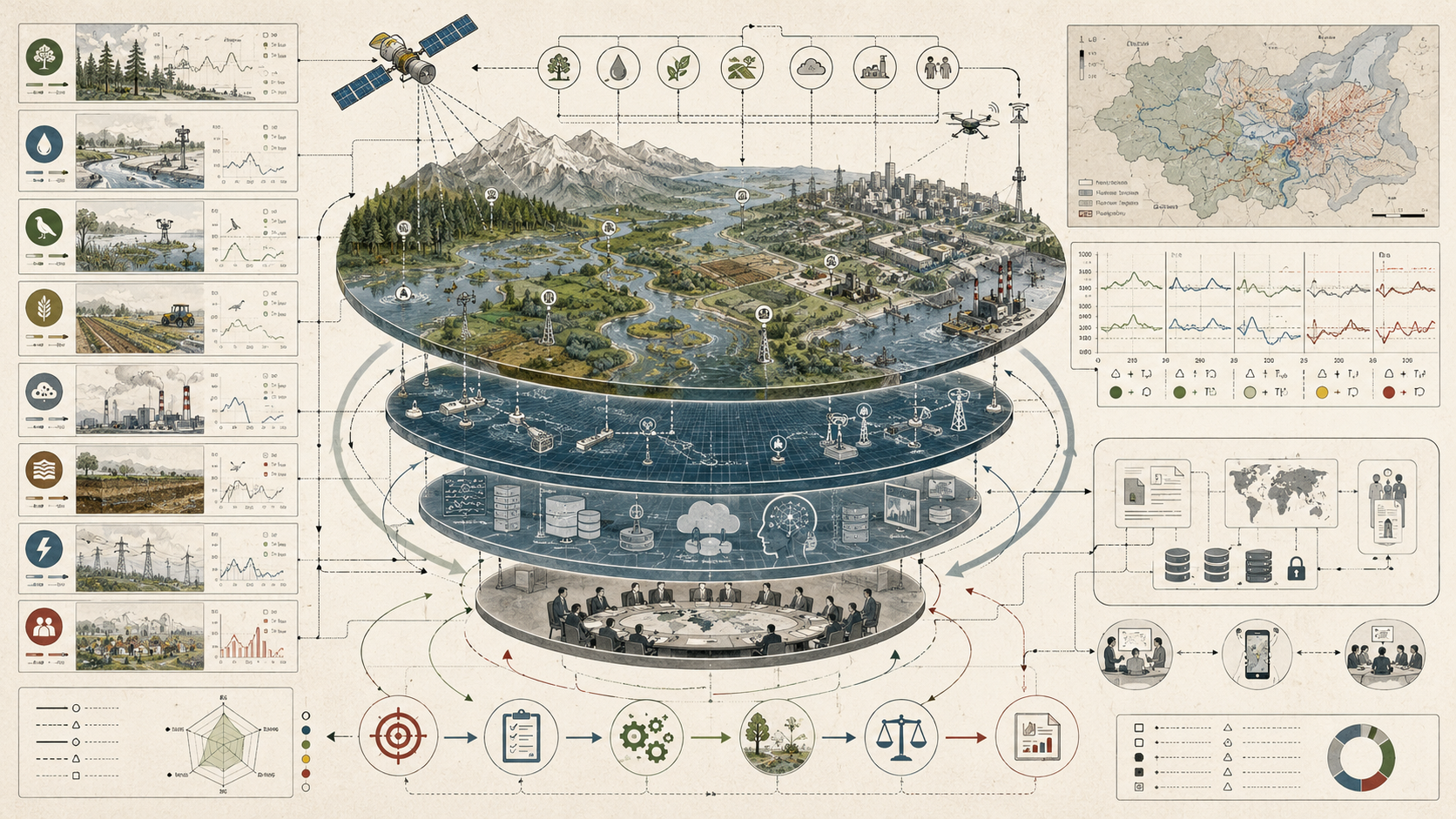
Sustainability becomes governable only when strategy is forced into dialogue with evidence. Environmental monitoring provides that dialogue by showing whether environmental conditions are improving, deteriorating, stabilizing, or being displaced elsewhere. It connects strategic claims to observable trajectories: emissions relative to climate targets, water withdrawals relative to hydrological limits, biodiversity indicators relative to habitat condition, waste and material throughput relative to circularity claims, land-use change relative to ecosystem integrity, and environmental burdens relative to justice commitments. Monitoring is therefore not a passive record of performance. It is the feedback system through which institutions learn whether their sustainability strategy is aligned with the world it claims to protect.
Engineering Problem
The engineering problem is how to design monitoring systems that can connect environmental conditions, institutional choices, sustainability targets, strategic interventions, and long-term outcomes without reducing sustainability to a dashboard of convenient metrics. A useful system must track environmental state, human pressures, governance responses, measured outcomes, threshold proximity, tradeoffs, uncertainty, data lineage, and public accountability. It must support strategic correction, not only scheduled reporting.
This problem is difficult because sustainability strategy operates across interacting systems. A decarbonization strategy may reduce emissions while increasing mineral demand, land pressure, water use, or ecosystem disturbance if poorly designed. A circularity initiative may improve recycling rates while total material throughput continues to rise. A water-efficiency program may reduce intensity while total withdrawals remain above watershed limits. A biodiversity strategy may expand protected-area acreage while habitat connectivity, species abundance, or ecological function continues to decline. A climate-resilience strategy may protect high-value assets while leaving marginalized communities exposed. Monitoring systems must be able to see these contradictions.
Weak systems monitor what is administratively easy: activities, expenditures, policies, pledges, disclosure categories, or isolated performance metrics. Strong systems monitor whether strategic action changes environmental trajectories. They distinguish activity from outcome, target achievement from system improvement, efficiency from absolute pressure reduction, and disclosure from accountability. They also preserve enough uncertainty, context, and baseline information to prevent metrics from becoming detached from ecological reality.
| Engineering Tension | Why It Matters | Required Evidence |
|---|---|---|
| Reporting versus steering | Reporting can summarize performance without changing decisions. | Feedback rules, review cadence, decision log, corrective-action record |
| Indicators versus ecological reality | Indicators simplify complex systems and may omit decisive harms. | Indicator rationale, limitation statement, proxy validation, omitted-risk review |
| Targets versus thresholds | Targets may be institutionally convenient while ecological thresholds remain exceeded. | Baseline, target, threshold, boundary condition, gap analysis |
| Efficiency versus absolute pressure | Efficiency can improve while total environmental load still rises. | Intensity metric, absolute metric, throughput record, rebound-risk assessment |
| Activity versus outcome | Programs, investments, or policies do not guarantee environmental improvement. | Response indicator, outcome indicator, causal pathway, effectiveness review |
| Comparability versus completeness | Comparable indicators improve governance but can omit local or system-specific harms. | Standard indicator map, local-context supplement, environmental justice review |
| Disclosure versus accountability | Published data may not affect incentives, budgets, or governance. | Public review process, board/governance action, audit trail, corrective escalation |
The practical question is therefore: can the monitoring system show whether sustainability strategy is changing environmental outcomes, reducing pressures, respecting thresholds, exposing tradeoffs, and creating accountable feedback rather than merely producing sustainability language?
Reference Architecture
A practical sustainability-monitoring architecture can be understood as a layered evidence-and-feedback system. The exact implementation may involve environmental sensors, emissions inventories, satellite products, ecological surveys, water accounts, waste records, resource-flow data, SDG indicators, dashboards, sustainability reports, governance reviews, scenario models, and public accountability mechanisms. The underlying responsibilities remain consistent: observe, contextualize, compare, interpret, review, adjust, disclose, and learn.
| Layer | Strategic Role | Primary Risk | Evidence Artifact |
|---|---|---|---|
| Observation layer | Measures environmental state, pressures, resource flows, emissions, waste, land, water, biodiversity, and risk conditions. | Sparse data, measurement error, weak coverage, selective visibility | Observation inventory, sensor records, remote-sensing products, environmental accounts |
| Indicator layer | Translates observations into sustainability-relevant measures, metrics, and indices. | Proxy inflation, indicator bias, loss of ecological meaning | Indicator registry, metadata sheet, indicator rationale, limitation statement |
| Baseline and target layer | Defines reference conditions, targets, time horizons, and performance expectations. | Weak baselines, shifting baselines, arbitrary targets, short-termism | Baseline record, target registry, time horizon, threshold comparison |
| Threshold and boundary layer | Compares strategic goals with ecological limits, regulatory limits, planetary boundaries, or local system thresholds. | Target achievement without ecological sufficiency | Threshold registry, boundary assessment, gap-to-threshold analysis |
| Integration layer | Connects indicators across climate, water, land, biodiversity, waste, air, resource use, and environmental justice. | Fragmented dashboards, unobserved tradeoffs, siloed reporting | Integrated indicator model, cross-system matrix, tradeoff register |
| Interpretation layer | Assesses trends, uncertainty, causal pathways, pressure shifts, outcomes, and strategic implications. | Overinterpretation, false progress, weak causal inference | Trend report, uncertainty note, causal pathway review, scenario analysis |
| Feedback and review layer | Uses monitoring results to revise strategy, budgets, operations, investments, and governance mechanisms. | Monitoring without consequence, strategy drift, symbolic transparency | Review record, corrective-action log, budget adjustment, governance decision |
| Accountability layer | Makes evidence available for scrutiny by stakeholders, communities, regulators, boards, researchers, and the public. | Selective disclosure, inaccessible reporting, weak contestability | Public report, audit trail, data portal, review process, stakeholder response |
This architecture makes sustainability monitoring visible as a strategic feedback system rather than as a reporting endpoint. It separates environmental observation from indicator construction, indicator construction from strategic interpretation, and strategic interpretation from governance response. Without those distinctions, sustainability monitoring can become a legitimacy device rather than a learning system.
Implementation Pattern
A rigorous implementation begins by defining the sustainability question, environmental domain, indicator purpose, baseline, target, threshold, time horizon, decision owner, feedback rule, uncertainty treatment, and accountability pathway. The goal is not to create the largest possible dashboard. The goal is to build a monitoring system that can tell whether strategy is producing meaningful environmental change.
| Artifact | Purpose | Typical Format |
|---|---|---|
| Sustainability monitoring objective | Defines the strategic question, environmental domain, decision context, and users. | Markdown, YAML, governance charter |
| Indicator registry | Lists indicators, definitions, units, sources, baselines, targets, thresholds, and review cadence. | CSV, SQL table, YAML, data catalog |
| Baseline record | Defines reference conditions and guards against shifting baselines. | Database table, methodological note, GIS layer |
| Threshold registry | Defines ecological, regulatory, public-health, or system thresholds relevant to strategy. | YAML, policy table, scientific review record |
| Indicator metadata sheet | Documents source, method, uncertainty, limitations, update frequency, and interpretation rules. | JSON, YAML, CSV, Markdown |
| Tradeoff register | Tracks cross-system effects, burden shifting, rebound risk, and unintended consequences. | CSV, risk register, dashboard layer |
| Feedback rulebook | Defines what happens when indicators miss targets, approach thresholds, or reveal tradeoffs. | YAML, governance policy, operating procedure |
| Accountability log | Records review decisions, corrective actions, responsible owners, and follow-up dates. | SQL table, governance log, board/reporting record |
| Public evidence package | Makes monitoring results, methods, caveats, and decisions available for scrutiny. | HTML report, data portal, PDF, open dataset |
The implementation goal is to make sustainability strategy inspectable. A reviewer should be able to see what was measured, why it matters, how it was measured, what baseline was used, what target was chosen, what threshold is relevant, whether the trend is sufficient, what tradeoffs exist, who reviewed the result, and what strategic adjustment followed.
Research-Grade Framing: Monitoring as the Evidence Layer of Sustainability Strategy
A research-grade understanding of environmental monitoring for sustainability strategy begins by treating monitoring as the evidence layer of strategy rather than as an after-the-fact reporting function. Monitoring determines what environmental realities become visible enough to matter in governance. It structures the relationship between aspiration and evidence by deciding which variables are observed, what counts as progress, how uncertainty is handled, and how often strategy is forced to confront outcomes.
This makes monitoring epistemically powerful but also selective. Monitoring systems privilege what can be counted, standardized, compared, and reviewed. Some environmental realities are easier to measure than others. Emissions, withdrawals, waste volumes, or energy consumption may be more readily reported than ecological integrity, cumulative habitat fragmentation, resilience, toxic exposure, informal waste burdens, or intergenerational harm. The result is a recurring strategic bias: institutions can end up monitoring what is administratively tractable rather than what is ecologically decisive.
The challenge, then, is not only to measure more, but to measure strategically enough that monitoring does not reduce sustainability to convenient fragments. Exceptional sustainability monitoring preserves enough ecological and systems depth that strategic review remains connected to real environmental conditions rather than drifting into symbolic performance management. It accepts that indicators are necessary but insufficient; that dashboards are useful but not self-validating; and that accountability depends on whether monitoring results can change decisions.
| Limited Pattern | Stronger Pattern | Why the Shift Matters |
|---|---|---|
| Publish sustainability metrics | Use monitoring evidence to revise strategy and resource allocation | Connects evidence to governance consequence |
| Track activities and programs | Track environmental outcomes and system trajectories | Prevents activity from substituting for progress |
| Measure convenient indicators | Validate indicators against ecological and social meaning | Reduces proxy inflation and dashboard distortion |
| Compare performance to targets | Compare performance to targets, baselines, thresholds, and sufficiency conditions | Distinguishes target achievement from ecological adequacy |
| Report aggregate progress | Disaggregate by place, population, ecosystem, exposure, and burden | Prevents averages from hiding environmental inequality |
| Review annually | Use adaptive feedback loops tied to decision triggers | Allows strategy to respond before failure becomes entrenched |
Sustainability monitoring is therefore not merely a technical measurement problem. It is a governance problem about how institutions are made answerable to ecological conditions and public consequences.
Formal Model: Indicators, Baselines, Thresholds, Feedback, and Accountability
A useful formal model separates environmental state, pressure, response, outcome, threshold proximity, feedback strength, and accountability. Let \(S_t\) represent environmental state at time \(t\), \(P_t\) pressure, \(R_t\) institutional response, \(O_t\) outcome, \(B\) baseline, \(T\) target, and \(\Theta\) threshold or boundary condition. Sustainability monitoring evaluates whether strategic response changes the trajectory of environmental state and pressure in a sufficient direction.
\Delta S = S_t – B
\]
Interpretation: Change in environmental state should be interpreted relative to a baseline. Without a baseline, claims of improvement may be difficult to evaluate.
G_{\mathrm{target}} = T – S_t
\]
Interpretation: The target gap measures how far the current condition remains from the stated target. The target itself should still be tested against ecological sufficiency.
D_{\mathrm{threshold}} = \Theta – S_t
\]
Interpretation: Threshold distance measures proximity to an ecological, regulatory, public-health, or system limit. A strategy can meet an internal target while still remaining too close to or beyond a threshold.
O_t = f(S_t, P_t, R_t, U_t)
\]
Interpretation: Sustainability outcomes depend on environmental state, pressures, institutional responses, and uncertainty. Monitoring should not evaluate responses without checking outcomes.
F_{\mathrm{feedback}} = \frac{N_{\mathrm{corrective\ actions}}}{N_{\mathrm{material\ findings}}}
\]
Interpretation: Feedback strength measures whether material monitoring findings lead to corrective action. Monitoring without strategic consequence is weak feedback.
A_{\mathrm{accountability}} = g(P_{\mathrm{public}}, L_{\mathrm{lineage}}, R_{\mathrm{review}}, C_{\mathrm{correction}})
\]
Interpretation: Accountability depends on public accessibility, data lineage, review mechanisms, and corrective action. Disclosure alone is not accountability.
This formal structure makes sustainability monitoring more precise. It separates target gaps from threshold gaps, response from outcome, and reporting from feedback. The equations are simple by design: their purpose is to make the monitoring architecture inspectable and to prevent sustainability strategy from collapsing into disconnected metrics.
What Is Environmental Monitoring for Sustainability Strategy?
Environmental monitoring for sustainability strategy refers to the systematic observation, measurement, interpretation, and review of environmental conditions and impacts in order to guide long-term strategic decisions. It includes the selection of indicators, establishment of baselines, setting of targets, repeated measurement of change, evaluation of outcomes, and translation of findings into governance, planning, investment, operational adjustment, and public accountability.
Such monitoring may include tracking environmental state variables such as air quality, water quality, land cover, biodiversity status, ecosystem condition, soil health, atmospheric concentration, climate risk, and pollution exposure. It may also measure pressures such as emissions, extraction, land conversion, resource throughput, waste generation, nutrient loading, water withdrawals, energy use, and toxic releases. It may evaluate responses such as restoration, decarbonization, adaptation, circularity, conservation, procurement reform, infrastructure redesign, or pollution-control initiatives. It may review progress against institutional, national, or global sustainability frameworks.
The defining feature of sustainability-oriented monitoring is that it connects observation to strategic choice. It is not simply a technical account of what the environment is doing. It is an interpretive framework for deciding whether current trajectories are compatible with stated sustainability aims and whether strategic interventions are sufficient, misaligned, incomplete, or counterproductive.
Why Monitoring Matters for Sustainability Strategy
Monitoring matters because sustainability cannot be governed credibly without repeatable evidence. Environmental degradation often unfolds gradually, cumulatively, and across multiple systems at once. Without structured monitoring, institutions are prone to overestimate progress, underestimate lag effects, privilege visible initiatives over deeper environmental outcomes, or mistake disclosure for transformation. Monitoring gives strategy temporal depth by showing whether environmental conditions are stabilizing, worsening, or improving relative to stated goals.
It also matters because sustainability strategy is inherently comparative. A current emissions level, water-withdrawal rate, habitat trend, waste profile, resource intensity, or pollution exposure measure is rarely meaningful on its own. It becomes meaningful in relation to a baseline, target, threshold, peer group, historical trajectory, ecological condition, or justice commitment. Monitoring creates the comparative frame in which progress can be distinguished from routine variation, accounting artifact, selective disclosure, or burden shifting.
Most importantly, monitoring matters because strategy without feedback becomes rhetoric. Sustainability strategy is not a static declaration but a process of iterative steering under uncertainty. Environmental monitoring provides the feedback loops that allow institutions to learn whether interventions are producing intended effects, shifting burdens elsewhere, or failing to alter the system-level trajectory that strategy claimed to change.
| Strategic Need | Monitoring Contribution | Risk Without Monitoring |
|---|---|---|
| Evidence-based direction | Shows whether environmental conditions are improving or deteriorating. | Strategy becomes aspirational rather than empirical. |
| Comparability | Relates performance to baselines, targets, thresholds, and frameworks. | Progress claims become difficult to verify. |
| Feedback | Triggers strategic adjustment when results fall short. | Reporting continues while outcomes stagnate. |
| Accountability | Makes evidence available for review and challenge. | Disclosure substitutes for responsibility. |
| Systems awareness | Reveals tradeoffs, spillovers, and cross-domain effects. | Improvement in one area may hide deterioration elsewhere. |
| Justice | Disaggregates environmental burdens and benefits. | Aggregate progress hides unequal exposure or harm. |
Sustainability monitoring matters because it gives institutions fewer places to hide from consequences. It turns environmental commitments into reviewable claims.
State, Pressure, Response, Outcome, and Resilience
Robust environmental monitoring for sustainability strategy usually needs to distinguish among several dimensions rather than compress everything into one dashboard of performance. State refers to the condition of environmental systems themselves: air quality, water quality, land cover, biodiversity status, ecosystem integrity, atmospheric concentrations, hydrological condition, and similar measures. Pressure refers to the human activities and system drivers acting on those environmental states: emissions, extraction, pollution loads, land conversion, resource throughput, waste generation, and infrastructure expansion.
Response refers to the policies, investments, management actions, restoration projects, regulatory interventions, or institutional strategies intended to change environmental outcomes. Outcome refers to whether those responses are actually altering the trajectory of environmental state or risk in the intended direction. Resilience refers to the capacity of the environmental-social system to absorb shock, adapt, or transform without shifting into more harmful or less recoverable states.
These distinctions matter because sustainability strategy frequently fails when responses are monitored more closely than outcomes, or when pressures are monitored without sufficient attention to system state. A strategy may look active while the environment continues to deteriorate. It may reduce one pressure while intensifying another. It may improve efficiency while total throughput rises. Monitoring becomes strategically serious when it can keep these dimensions analytically distinct while also relating them to one another.
| Dimension | Question | Example Indicators |
|---|---|---|
| State | What is the condition of the environmental system? | Air quality, water quality, biodiversity status, land cover, soil health, ecosystem integrity |
| Pressure | What human activities are driving environmental change? | Emissions, extraction, waste, water withdrawal, land conversion, material throughput |
| Response | What actions are being taken? | Restoration investment, pollution-control measures, conservation policy, adaptation plans |
| Outcome | Are responses changing environmental trajectories? | Reduced pollution load, improved habitat condition, lower exposure, declining absolute emissions |
| Resilience | Can systems absorb disturbance, recover, adapt, or transform? | Recovery time, redundancy, ecological buffering, adaptive capacity, threshold distance |
| Equity | Who experiences environmental burdens and benefits? | Exposure disparities, access to environmental services, distribution of adaptation benefits |
A sustainability monitoring system that cannot distinguish state, pressure, response, outcome, resilience, and equity will struggle to tell whether strategy is actually working.
Indicators, Targets, and the Problem of Strategic Representation
Indicators are indispensable to sustainability strategy because they make broad ambitions measurable. Yet indicators also pose a representational problem. They condense complex ecological and socio-environmental processes into manageable units suitable for dashboards, scorecards, reports, and review cycles. This condensation is necessary for governance, but it can also produce strategic distortion if indicators are mistaken for the total reality they stand in for.
The more indicators matter strategically, the more important it becomes to ask what they omit. Are they measuring environmental state or only institutional activity? Are they capturing cumulative effects, lagged harms, threshold proximity, ecological integrity, or cross-system spillovers? Do they illuminate resilience and irreversible loss, or mainly track administratively convenient movement? Do they disaggregate environmental burdens by place and population, or do they hide unequal exposure inside aggregate metrics?
Exceptional monitoring systems use indicators critically. They treat them as strategic instruments that must remain anchored to ecological meaning rather than as self-sufficient truths. The objective is not to abolish indicators, which are indispensable, but to prevent them from becoming substitutes for the environmental realities they are supposed to represent.
| Indicator Question | Why It Matters | Evidence Needed |
|---|---|---|
| What does the indicator represent? | Prevents a proxy from being mistaken for the whole environmental condition. | Indicator rationale, conceptual model, limitation statement |
| What does it omit? | Reveals blind spots and potential strategic distortion. | Omitted-risk review, complementary indicators, expert/community review |
| Is it state, pressure, response, or outcome? | Prevents activity metrics from being mistaken for environmental improvement. | Indicator classification and causal pathway |
| What is the baseline? | Prevents shifting baselines and vague progress claims. | Baseline year, baseline value, method note |
| What is the target? | Defines strategic ambition and review conditions. | Target value, target date, target rationale |
| What threshold or boundary matters? | Tests whether the target is environmentally sufficient. | Ecological threshold, regulatory limit, public-health standard, boundary condition |
| Who is affected? | Connects indicators to environmental justice and public accountability. | Disaggregated exposure, place-based analysis, distributional review |
Indicators discipline strategy only when they remain open to methodological scrutiny. When they become untouchable scoreboard objects, they can begin to protect the strategy from reality rather than expose it to reality.
Feedback Loops, Adaptive Review, and Strategic Steering
Monitoring becomes strategic when it supports feedback. A feedback loop exists when monitoring results change decisions: goals are revised, budgets are redirected, operations are redesigned, targets are tightened, interventions are intensified, or harmful strategies are abandoned. Without feedback, monitoring may still produce reports, but it does not steer.
Feedback loops should be designed before the reporting cycle begins. Institutions should know what happens if an indicator moves in the wrong direction, if a target is missed, if a threshold is approached, if a tradeoff appears, or if a community raises evidence that the monitoring system failed to capture. A dashboard without a feedback rule is a display. A monitoring system with review thresholds, decision owners, accountability deadlines, and corrective action is a governance mechanism.
| Monitoring Finding | Strategic Question | Feedback Response |
|---|---|---|
| Indicator is improving but absolute pressure is rising | Is efficiency masking scale effects? | Review absolute limits, throughput, rebound risk, and demand drivers. |
| Target is met but threshold remains exceeded | Is the target sufficient? | Revise target or add threshold-based governance trigger. |
| Response activity increases but outcome does not improve | Is the intervention ineffective? | Review causal pathway, implementation quality, and alternative strategies. |
| Aggregate progress hides unequal burden | Who is being left behind or harmed? | Disaggregate indicators and revise equity-centered actions. |
| Tradeoff emerges across domains | Is pressure being shifted elsewhere? | Run cross-system review and adjust strategy to reduce burden shifting. |
| Data uncertainty is too high | Can the indicator support decision-making? | Improve monitoring, qualify claims, or suspend high-stakes use. |
Adaptive review is the process through which monitoring becomes learning. It allows strategy to change as evidence changes. In sustainability, this is essential because environmental systems are dynamic, delayed, and often nonlinear. Strategy must be able to learn before failure becomes irreversible.
Tradeoffs, Timescales, and Cross-System Effects
Sustainability strategy is inherently a problem of tradeoffs across time, sectors, and systems. An intervention that improves one indicator may worsen another. A short-term efficiency gain may undermine long-term resilience. A climate-mitigation measure may create land, water, or biodiversity pressure if poorly designed. A circularity program may shift pollution burdens to communities handling waste and recycling. A restoration project may improve a landscape indicator while excluding local users or Indigenous stewardship practices. Monitoring is therefore not only about whether values move in the desired direction. It is about whether the strategic system is shifting burdens across domains, populations, or time horizons.
Timescale is especially important. Some indicators respond rapidly to intervention; others move slowly or only after substantial lag. Biodiversity recovery, ecosystem restoration, soil health, groundwater replenishment, and structural resource transitions often take much longer to emerge than activity-based metrics such as policy adoption, expenditure, or capital deployment. Monitoring systems that overweight short-cycle signals can reward visible motion over substantive transformation.
Cross-system effects matter just as much. Sustainability strategy should not be interpreted as a set of independent objectives but as a governance challenge of linked systems. Monitoring is strongest when it can reveal whether improvement in one domain is being purchased by deterioration elsewhere and whether the strategy is genuinely reducing systemic pressure rather than merely redistributing it.
| Monitoring Risk | Example | Corrective Practice |
|---|---|---|
| Burden shifting | Reducing local emissions by outsourcing resource-intensive production elsewhere. | Use consumption-based and supply-chain indicators alongside territorial indicators. |
| Rebound effect | Efficiency improves but total consumption rises. | Track absolute throughput and demand, not only intensity. |
| Short-term metric bias | Activity indicators improve before ecological outcomes respond. | Separate input, process, output, and outcome indicators. |
| Threshold blindness | Gradual progress remains insufficient relative to ecological limits. | Use threshold-distance and sufficiency indicators. |
| Aggregate masking | Average environmental performance improves while vulnerable communities remain burdened. | Disaggregate indicators by place, exposure, vulnerability, and population group. |
| Single-domain optimization | Climate gains create biodiversity, water, or land-use harms. | Maintain cross-domain tradeoff registers and integrated review. |
Strategic sustainability monitoring is strongest when it reveals uncomfortable interactions. It should make tradeoffs visible before they become locked into policy, infrastructure, supply chains, or land-use patterns.
Governance, Accountability, and Public Review
Monitoring becomes strategic when it supports adaptive review rather than static disclosure. Sustainability strategy should be revisited in light of observed environmental conditions, not merely reported according to schedule. Strong governance systems use monitoring to ask whether assumptions remain valid, whether interventions should be intensified or redesigned, whether targets are sufficient, and whether goals remain aligned with environmental realities.
Accountability matters because monitoring without institutional consequence can devolve into symbolic transparency. Data may be published, indicators may be updated, and dashboards may appear sophisticated while decision premises remain unchanged. The point of environmental monitoring in sustainability strategy is not only to make performance visible, but to make nonperformance harder to ignore and strategic drift harder to maintain.
Public review is especially important where sustainability claims affect communities, ecosystems, funding, regulation, infrastructure, or long-term risk. Environmental monitoring should preserve data lineage, methodological transparency, uncertainty, and review pathways. Communities affected by environmental harm should not be asked to accept sustainability claims that cannot be traced back to observable evidence or challenged through accountable processes.
| Requirement | Question | Evidence |
|---|---|---|
| Lineage | Can reported indicators be traced to source data and transformations? | Data lineage, version history, transformation log |
| Method transparency | Are definitions, methods, and limitations clear? | Indicator metadata, methodology notes, uncertainty statement |
| Governance consequence | Do monitoring findings affect strategy, budgets, or decisions? | Corrective-action log, board review, budget adjustment, policy revision |
| Public accessibility | Can affected publics understand and review evidence? | Plain-language report, open data, accessible dashboard, community review |
| Independent review | Can claims be checked outside the institution making them? | Audit, peer review, regulatory review, public documentation |
| Equity accountability | Are burdens and benefits disaggregated and contestable? | Exposure analysis, distributional metrics, environmental justice review |
Accountability is the difference between a monitoring system that informs strategy and a reporting system that protects strategy from scrutiny.
Global Frameworks, SDGs, and Comparative Sustainability Monitoring
Global sustainability frameworks matter because they provide shared architectures for comparing progress and aligning strategy with broader environmental priorities. The United Nations SDG global indicator framework provides an official structure for monitoring the 2030 Agenda, with refinements and updates over time through the UN Statistical Commission process. Comparative indicator systems help institutions locate their performance within larger environmental trajectories rather than defining sustainability entirely on internal terms.
Environmental sustainability is deeply embedded in global and comparative monitoring systems. The SDG indicator system includes environmental dimensions across climate, water, ecosystems, cities, consumption and production, energy, oceans, land, pollution, and resource use. UNEP’s SDG monitoring work highlights the environmental dimensions of the SDGs and the need to measure progress across climate change, nature and biodiversity loss, pollution, waste, resource management, freshwater, marine systems, and terrestrial ecosystems. OECD environmental indicators provide comparable data on climate change, biodiversity, water resources, air quality, circular economy, ocean resources, and related environmental domains. World Bank environment indicators similarly help situate development within the state of the planet, natural resource use, and observed environmental impacts.
These frameworks do not eliminate the need for local context. They do, however, widen the strategic field. They allow institutions to situate their choices within broader trajectories of pressure, vulnerability, and transition, and they make it harder to define sustainability purely on internal terms. The strongest monitoring systems use global frameworks as reference structures while supplementing them with local ecological, social, and justice-oriented evidence.
| Framework Type | Strategic Use | Limitation to Manage |
|---|---|---|
| SDG indicators | Connect strategy to global sustainable-development goals and comparable indicator structures. | Global indicators may need local interpretation, disaggregation, and ecological specificity. |
| Environmental statistical systems | Provide official, repeatable, and comparable measures across countries or regions. | Official data may lag, omit local exposure, or aggregate away inequality. |
| Corporate or institutional reporting frameworks | Support disclosure, comparability, and governance review. | Disclosure categories may not prove environmental sufficiency or outcome improvement. |
| Planetary-boundary and ecological-threshold approaches | Connect targets to ecological limits and system boundaries. | Translation from global boundaries to local decisions requires careful method. |
| Environmental justice frameworks | Reveal unequal exposure, vulnerability, benefits, and harms. | Requires disaggregated data and community review, not only aggregate indicators. |
Comparative frameworks are most useful when they strengthen accountability rather than standardize away local reality. The goal is not compliance with a reporting structure alone. The goal is better evidence for environmental decision-making.
Failure Modes in Sustainability Monitoring
Environmental monitoring for sustainability strategy can fail in several characteristic ways. It can become too activity-focused, tracking plans and initiatives rather than environmental outcomes. It can become too fragmented, with separate indicator systems that fail to reveal cross-domain interactions. It can become too short-term, rewarding immediately visible movement over slower structural improvement. It can become too disclosure-oriented, producing communication artifacts without altering strategic behavior.
Another common failure mode is proxy inflation: the accumulation of indicators that are easy to measure but weakly connected to the environmental realities strategy claims to address. A related failure is governance insulation, where monitoring exists but does not meaningfully affect budgeting, incentives, planning, or strategic review. In these cases, environmental monitoring becomes a legitimacy device rather than a learning system.
The deepest failure, however, is mistaking metric stability for ecological stability. The environment can deteriorate while an institution’s chosen indicators remain flat, incomplete, or strategically favorable. This is why monitoring systems must remain open to revision, broad enough to detect emerging pressures, and humble enough to recognize that sustainability can be undermined by what a strategy fails to observe as much as by what it observes poorly.
| Failure Mode | Consequence | Prevention |
|---|---|---|
| Activity substitution | Programs and initiatives are mistaken for environmental outcomes. | Separate response indicators from outcome indicators. |
| Proxy inflation | Many metrics create the appearance of rigor while weakly representing ecological conditions. | Validate indicators against environmental meaning and decision use. |
| Threshold blindness | Targets are met while ecological limits remain exceeded. | Compare targets with thresholds, boundaries, and sufficiency conditions. |
| Dashboard fragmentation | Separate indicators fail to show tradeoffs and spillovers. | Use integrated indicator models and tradeoff registers. |
| Short-cycle bias | Fast-moving activity metrics dominate slow ecological outcomes. | Use multi-time-horizon review and lag-aware indicators. |
| Governance insulation | Monitoring results do not change strategy, budgets, or incentives. | Require feedback rules, corrective actions, and accountability deadlines. |
| Aggregate masking | Average progress hides unequal exposure or localized harm. | Disaggregate indicators and conduct environmental justice review. |
Failure modes are not peripheral details. They define whether monitoring systems can discipline strategy or merely decorate it.
Future Directions
The future of environmental monitoring for sustainability strategy lies in stronger integration across indicator systems, wider use of condition- and resilience-oriented measures, better treatment of tradeoffs and spillovers, and more explicit linkage between monitoring results and strategic revision. Official frameworks continue to evolve through indicator review, methodological refinement, and more accessible comparative data systems. At the same time, institutional sustainability strategies face growing pressure to demonstrate environmental outcomes rather than simply disclose commitments.
Artificial intelligence, Earth observation, environmental sensor networks, and interoperable data platforms will likely expand sustainability monitoring capacity. AI may help detect anomalies, summarize indicators, identify tradeoffs, and prioritize review. Earth observation may strengthen monitoring of land cover, ecosystem condition, water, heat, and disaster impacts. Sensor networks may improve local evidence for air, water, soil, and exposure conditions. Interoperable data platforms may allow sustainability indicators to be linked across agencies, organizations, regions, and supply chains. But these technologies will not automatically improve sustainability strategy unless they are embedded in accountable feedback systems.
The deeper challenge is not simply to measure more environmental variables. It is to build monitoring systems that are strategically honest enough to reveal when sustainability strategy is failing, incomplete, insufficient, or shifting pressure elsewhere. Future systems will need stronger provenance, better alignment between environmental state and strategic review, clearer distinctions between observed improvement and institutional aspiration, and stronger public accountability for what monitoring reveals.
Sustainability strategy becomes real only when it is forced into dialogue with environmental evidence. Where monitoring systems are strong, that dialogue can discipline ambition, expose tradeoffs, and support adaptive governance. Where they are weak, sustainability can remain rhetorically expansive while environmentally thin. Environmental monitoring for sustainability strategy is therefore not a peripheral reporting task. It is the central feedback system through which sustainability becomes governable in practice.
Deployment Readiness Gate
Before a sustainability monitoring system is used for strategic planning, public reporting, investment decisions, policy evaluation, organizational governance, or accountability claims, it should pass a readiness gate. This gate should test whether the monitoring system is scientifically meaningful, strategically useful, methodologically transparent, and capable of forcing feedback into decision-making.
| Readiness Area | Required Question | Pass Evidence |
|---|---|---|
| Objective readiness | Is the sustainability question clearly defined? | Monitoring objective, decision context, governance owner |
| Indicator readiness | Are indicators meaningful, classified, and documented? | Indicator registry, metadata sheet, limitation statement |
| Baseline readiness | Are baselines defensible and protected against shifting interpretation? | Baseline record, method note, reference period |
| Threshold readiness | Are targets compared with ecological, regulatory, or public-health thresholds? | Threshold registry, target-gap and threshold-gap analysis |
| Outcome readiness | Does the system track environmental outcomes, not only activities? | State and outcome indicators, causal pathway, effectiveness review |
| Feedback readiness | Do monitoring findings trigger strategic review or corrective action? | Feedback rulebook, corrective-action log, escalation process |
| Tradeoff readiness | Can the system detect burden shifting and cross-system effects? | Tradeoff register, cross-domain review, absolute pressure metrics |
| Accountability readiness | Can evidence be reviewed by affected publics or external reviewers? | Public evidence package, lineage record, audit trail, review process |
This readiness gate prevents sustainability monitoring from becoming a reporting exercise without strategic force. The stronger standard is whether monitoring can identify when strategy is insufficient and compel review before environmental damage deepens.
Data and Configuration Artifacts
A reproducible sustainability monitoring workflow should include explicit artifacts for indicators, baselines, thresholds, data sources, uncertainty, feedback rules, tradeoffs, and accountability. These artifacts allow strategy to be reviewed as an evidence system rather than as a narrative.
| Artifact | Purpose | Suggested Path |
|---|---|---|
| Sustainability monitoring manifest | Defines environmental domains, strategic questions, decision uses, and review owners. | config/sustainability_monitoring_manifest.yml |
| Indicator registry | Lists indicators, categories, units, baselines, targets, thresholds, data sources, and update cycles. | data/indicator_registry.csv |
| Baseline and target table | Stores baseline values, target values, target years, and threshold values. | data/baselines_targets_thresholds.csv |
| Feedback rulebook | Defines corrective actions when indicators miss targets or approach thresholds. | config/feedback_rulebook.yml |
| Tradeoff register | Documents cross-system effects, rebound risks, burden shifting, and unresolved conflicts. | data/tradeoff_register.csv |
| Accountability log | Records review findings, decision owners, corrective actions, and follow-up status. | data/accountability_log.csv |
| Indicator metadata schema | Defines required metadata for each indicator. | schemas/sustainability_indicator.schema.json |
| Public evidence package | Summarizes indicators, methods, gaps, tradeoffs, and corrective actions. | outputs/public_evidence_package.md |
These artifacts help ensure that sustainability strategy is not only described, but testable. They create the foundation for transparent strategic review.
Mathematical Lens: Indicator Integrity, Threshold Distance, Feedback Strength, and Accountability
Several simple metrics can help evaluate the quality of sustainability monitoring systems. These metrics are not substitutes for ecological judgment, public review, or domain expertise, but they make strategic assumptions visible.
G_{\mathrm{target}} = \frac{S_t – T}{B – T}
\]
Interpretation: Target gap compares current state \(S_t\) with target \(T\) relative to baseline \(B\). It helps distinguish real progress from vague directional claims.
D_{\mathrm{threshold}} = \frac{\Theta – S_t}{\Theta}
\]
Interpretation: Threshold distance measures how close the current condition is to a relevant ecological, regulatory, public-health, or system limit.
I_{\mathrm{integrity}} = w_1M + w_2V + w_3L + w_4U + w_5C
\]
Interpretation: Indicator integrity can combine metadata completeness \(M\), validation \(V\), lineage \(L\), uncertainty treatment \(U\), and conceptual relevance \(C\).
F_{\mathrm{feedback}} = \frac{N_{\mathrm{corrective\ actions}}}{N_{\mathrm{material\ findings}}}
\]
Interpretation: Feedback strength measures whether material monitoring findings produce corrective action. Monitoring without consequence is weak feedback.
A_{\mathrm{accountability}} = \frac{N_{\mathrm{publicly\ reviewable\ findings}}}{N_{\mathrm{material\ findings}}}
\]
Interpretation: Accountability can be approximated as the share of material findings that are available for public or external review.
R_{\mathrm{rebound}} = \Delta E_{\mathrm{efficiency}} – \Delta P_{\mathrm{absolute}}
\]
Interpretation: Rebound risk appears when efficiency improves but absolute environmental pressure does not decline accordingly. Strategy should track both intensity and absolute load.
These metrics make the monitoring system itself an object of review. They ask not only whether sustainability indicators are moving, but whether the indicators are meaningful, threshold-aware, feedback-connected, and accountable.
Python Workflow: Sustainability Indicator Integrity and Feedback Scoring
A Python workflow can demonstrate how sustainability indicators can be evaluated for integrity, threshold distance, feedback status, and accountability. The goal is not to create a universal sustainability score, but to keep the evidence dimensions visible.
from dataclasses import dataclass
from typing import List
import pandas as pd

@dataclass
class SustainabilityIndicator:
    indicator_id: str
    domain: str
    indicator_type: str
    current_value: float
    baseline_value: float
    target_value: float
    threshold_value: float
    metadata_score: float
    validation_score: float
    lineage_score: float
    uncertainty_score: float
    conceptual_relevance_score: float
    material_finding: bool
    corrective_action_taken: bool
    publicly_reviewable: bool

def indicator_integrity(indicator: SustainabilityIndicator) -> float:
    return (
        0.20 * indicator.metadata_score +
        0.20 * indicator.validation_score +
        0.20 * indicator.lineage_score +
        0.20 * indicator.uncertainty_score +
        0.20 * indicator.conceptual_relevance_score
    )

def target_gap(indicator: SustainabilityIndicator) -> float:
    denominator = indicator.baseline_value - indicator.target_value
    if denominator == 0:
        return 0.0
    return (indicator.current_value - indicator.target_value) / denominator

def threshold_distance(indicator: SustainabilityIndicator) -> float:
    if indicator.threshold_value == 0:
        return 0.0
    return (indicator.threshold_value - indicator.current_value) / indicator.threshold_value

def review_priority(indicator: SustainabilityIndicator, integrity: float, threshold_dist: float) -> str:
    if threshold_dist <= 0.10:
        return "threshold_proximity_review"
    if integrity < 0.70:
        return "indicator_integrity_review"
    if indicator.material_finding and not indicator.corrective_action_taken:
        return "feedback_failure_review"
    if indicator.material_finding and not indicator.publicly_reviewable:
        return "accountability_review"
    return "routine_monitoring"

indicators: List[SustainabilityIndicator] = [
    SustainabilityIndicator("ghg-absolute-001", "climate", "pressure", 72, 100, 40, 50, 0.90, 0.86, 0.88, 0.82, 0.92, True, True, True),
    SustainabilityIndicator("water-withdrawal-001", "water", "pressure", 88, 100, 70, 75, 0.82, 0.78, 0.75, 0.72, 0.88, True, False, True),
    SustainabilityIndicator("biodiversity-habitat-001", "biodiversity", "state", 0.58, 0.72, 0.80, 0.65, 0.68, 0.62, 0.58, 0.55, 0.90, True, False, False),
    SustainabilityIndicator("waste-diversion-001", "waste", "response", 0.61, 0.30, 0.75, 0.90, 0.86, 0.80, 0.84, 0.76, 0.70, False, False, True),
]

records = []
for indicator in indicators:
    integrity = indicator_integrity(indicator)
    threshold_dist = threshold_distance(indicator)
    records.append({
        "indicator_id": indicator.indicator_id,
        "domain": indicator.domain,
        "indicator_type": indicator.indicator_type,
        "indicator_integrity": round(integrity, 3),
        "target_gap": round(target_gap(indicator), 3),
        "threshold_distance": round(threshold_dist, 3),
        "material_finding": indicator.material_finding,
        "corrective_action_taken": indicator.corrective_action_taken,
        "publicly_reviewable": indicator.publicly_reviewable,
        "review_priority": review_priority(indicator, integrity, threshold_dist)
    })

df = pd.DataFrame(records)
print(df.sort_values(["review_priority", "threshold_distance"]))
This workflow treats sustainability indicators as governed evidence objects. Each indicator is evaluated not only by its value, but by its metadata, validation, lineage, uncertainty, conceptual relevance, threshold position, feedback status, and accountability condition.
R Workflow: Sustainability Progress and Indicator Review Reporting
An R workflow can support sustainability reporting by summarizing target gaps, threshold proximity, indicator type, and review priority. R is especially useful for producing reproducible indicator tables, audit-ready summaries, and strategy-review reports.
library(dplyr)
library(readr)

indicators <- tribble(
  ~indicator_id, ~domain, ~indicator_type, ~current_value, ~baseline_value, ~target_value, ~threshold_value, ~integrity_score, ~material_finding, ~corrective_action_taken,
  "ghg-absolute-001", "climate", "pressure", 72, 100, 40, 50, 0.876, TRUE, TRUE,
  "water-withdrawal-001", "water", "pressure", 88, 100, 70, 75, 0.790, TRUE, FALSE,
  "biodiversity-habitat-001", "biodiversity", "state", 0.58, 0.72, 0.80, 0.65, 0.666, TRUE, FALSE,
  "waste-diversion-001", "waste", "response", 0.61, 0.30, 0.75, 0.90, 0.792, FALSE, FALSE
)

summary_table <- indicators %>%
  mutate(
    target_gap = if_else(
      baseline_value == target_value,
      0,
      (current_value - target_value) / (baseline_value - target_value)
    ),
    threshold_distance = if_else(
      threshold_value == 0,
      0,
      (threshold_value - current_value) / threshold_value
    ),
    review_priority = case_when(
      threshold_distance <= 0.10 ~ "threshold_proximity_review",
      integrity_score < 0.70 ~ "indicator_integrity_review",
      material_finding & !corrective_action_taken ~ "feedback_failure_review",
      TRUE ~ "routine_monitoring"
    )
  ) %>%
  arrange(review_priority, threshold_distance)

print(summary_table)

write_csv(summary_table, "outputs/sustainability_indicator_review_summary.csv")
The R workflow emphasizes that sustainability reporting should include indicator type, target distance, threshold distance, integrity, and feedback status. This prevents a strategy from reporting movement without reviewing whether that movement is sufficient or consequential.
Systems Code: Indicator Registries, Feedback APIs, Dashboards, and Accountability Evidence
Environmental monitoring for sustainability strategy is a full-stack evidence problem. It includes sensor systems, environmental accounts, satellite products, indicator registries, governance workflows, data pipelines, dashboards, public reports, review logs, and audit trails. A serious companion repository should therefore include both analytical workflows and systems-code scaffolding.
| Language / Tool | Role in Companion Repository | Example Use |
|---|---|---|
| Python | Indicator scoring, threshold analysis, feedback status, accountability checks | Sustainability indicator integrity workflow |
| R | Indicator reporting, progress summaries, reproducible review tables | Sustainability progress and review-priority reporting |
| SQL | Indicator registry, baselines, targets, thresholds, accountability log | Auditable sustainability monitoring database schema |
| Go | Lightweight API for indicator status and review triggers | Serve monitoring-system health and review status |
| Rust | Safe validation CLI for indicator metadata and feedback rules | Validate indicator registry completeness |
| C / C++ | Embedded or edge monitoring examples for environmental metrics | Sensor sampling, local threshold checks, event buffering |
| MicroPython | Low-power field sensor prototype | Water, air, or soil monitoring node |
| TinyML | On-device anomaly detection | Local detection of monitoring anomalies or threshold exceedance |
| Bash | Repository setup, validation, and reproducible runs | Run workflows, validate manifests, generate outputs |
This breadth is appropriate because sustainability monitoring requires more than a report. It requires a governed evidence infrastructure that can connect environmental data to decision review and public accountability.
GitHub Repository
A companion repository for this article should translate the sustainability monitoring framework into reproducible technical scaffolding. The repository should include indicator registries, baseline and threshold tables, feedback rules, tradeoff registers, accountability logs, metadata schemas, Python and R workflows, SQL schemas, and systems-code examples for monitoring, validation, and reporting.
Testing and Validation
Testing sustainability monitoring systems requires validating both the data pipeline and the strategic interpretation pipeline. It is not enough to check that metrics can be calculated. The system must test whether indicators are meaningful, baselines are valid, thresholds are justified, data lineage is preserved, uncertainty is visible, tradeoffs are detected, and findings produce governance response.
| Test Type | Purpose | Example Test |
|---|---|---|
| Schema validation | Ensure indicators contain required metadata. | Validate indicator records for unit, baseline, target, threshold, source, and owner. |
| Baseline validation | Ensure baseline values are defensible and not shifted without review. | Compare baseline records with source data and revision history. |
| Indicator integrity review | Evaluate whether indicators represent sustainability-relevant conditions. | Review conceptual relevance, proxy strength, and omitted risks. |
| Threshold validation | Ensure targets are compared with ecological or regulatory limits where relevant. | Test target-gap and threshold-distance calculations. |
| Tradeoff detection | Identify cross-system burden shifting. | Check whether improvement in one domain coincides with deterioration elsewhere. |
| Feedback validation | Ensure material findings generate strategic response. | Match material findings to corrective actions, owners, and deadlines. |
| Accountability test | Ensure evidence is reviewable by appropriate stakeholders or publics. | Verify lineage, methodology, public evidence package, and review pathway. |
Validation should be iterative. A sustainability monitoring system that does not improve when it discovers gaps, tradeoffs, or failures is not truly adaptive.
Operational Signals and Monitoring-System Observability
Sustainability monitoring systems themselves must be monitored. A system that tracks environmental performance but cannot observe its own data quality, update status, review cycle, or feedback failures is operationally weak. Observability should include data freshness, missingness, indicator status, threshold proximity, feedback completion, review overdue status, and public evidence availability.
| Signal | Why It Matters | Failure Indicator |
|---|---|---|
| Data freshness | Determines whether strategy review uses current evidence. | Indicator has not been updated by required date. |
| Metadata completeness | Determines whether indicators are interpretable and reusable. | Missing unit, source, baseline, target, method, or owner. |
| Threshold proximity | Determines whether ecological or regulatory limits require escalation. | Indicator approaches or exceeds threshold without review. |
| Material finding status | Determines whether important findings are being handled. | Material issue exists without assigned corrective action. |
| Feedback closure | Determines whether monitoring produces governance consequence. | Corrective action overdue or unassigned. |
| Tradeoff review status | Determines whether burden shifting is being evaluated. | Indicator improvement in one domain lacks cross-domain review. |
| Public evidence availability | Determines whether findings are reviewable beyond internal systems. | Material findings are not disclosed or are inaccessible. |
System observability protects sustainability monitoring from becoming stale, selective, or performative. It helps ensure that the monitoring system remains accountable to its own purpose.
Engineer and Researcher Checklist
- Define the sustainability question before selecting indicators.
- Classify each indicator as state, pressure, response, outcome, resilience, or equity.
- Document the baseline, target, threshold, unit, source, method, uncertainty, and owner for every material indicator.
- Track absolute environmental pressures alongside intensity or efficiency metrics.
- Compare targets with ecological, regulatory, public-health, or system thresholds where relevant.
- Maintain tradeoff registers to detect burden shifting across domains, populations, and time horizons.
- Disaggregate indicators by place, exposure, vulnerability, and affected population where appropriate.
- Separate activity indicators from outcome indicators.
- Use feedback rules that define corrective action when findings are material.
- Preserve data lineage and version history for public or external review.
- Maintain an accountability log linking findings to decision owners and follow-up dates.
- Review the monitoring system itself for missing indicators, weak proxies, stale data, and governance insulation.
Where This Fits in the Series
This article connects Environmental Monitoring Systems to sustainable development, institutional governance, public accountability, data systems, risk and resilience, ecosystem monitoring, remote sensing, and environmental decision support. Its role is to show how environmental monitoring becomes strategically meaningful when it guides feedback, exposes tradeoffs, compares progress against thresholds, and makes sustainability claims reviewable.
Within the broader series, this article sits near environmental data platforms, environmental analytics and dashboards, monitoring environmental risk and resilience, ecosystem monitoring, land-use change detection, satellite observation, and the future of environmental monitoring systems. It provides the strategic layer that asks whether environmental evidence changes institutional direction. Monitoring becomes sustainability strategy only when it can discipline choices, not merely describe them.
Related articles
- Environmental Monitoring Systems
- Environmental Data Platforms and Decision Support Systems
- Environmental Analytics and Monitoring Dashboards
- Monitoring Environmental Risk and Resilience
- Satellite Observation and Earth System Monitoring
- Ecosystem Monitoring and Ecological Observation
- Land Use Monitoring and Environmental Change Detection
- The Future of Environmental Monitoring Systems
Further reading
- United Nations Statistics Division (2026) SDG Indicators: Global indicator framework for the Sustainable Development Goals and targets of the 2030 Agenda for Sustainable Development. Available at: https://unstats.un.org/sdgs/indicators/indicators-list/
- United Nations Statistics Division (2025) The Sustainable Development Goals Report 2025. Available at: https://unstats.un.org/sdgs/report/2025/
- United Nations Environment Programme (2025) Monitoring Progress on the SDGs. Available at: https://www.unep.org/topics/sustainable-development-goals/monitoring-progress
- United Nations Environment Programme (2026) Measuring Progress: Environment and the SDGs. Available at: https://www.unep.org/interactive/measuring-progress-environment-sdgs
- Organisation for Economic Co-operation and Development (2025) Environment at a Glance Indicators. Available at: https://www.oecd.org/en/publications/environment-at-a-glance-indicators_ac4b8b89-en.html
- Organisation for Economic Co-operation and Development (2026) Environment at a Glance Dashboard. Available at: https://www.oecd.org/en/data/dashboards/environment-at-a-glance.html
- World Bank (2026) World Development Indicators: Environment. Available at: https://datatopics.worldbank.org/world-development-indicators/themes/environment.html
- World Bank (2026) World Development Indicators. Available at: https://wdi.worldbank.org/
- Wilkinson, M.D. et al. (2016) ‘The FAIR Guiding Principles for scientific data management and stewardship’, Scientific Data, 3, 160018. Available at: https://www.nature.com/articles/sdata201618
References
- Organisation for Economic Co-operation and Development (2025) Environment at a Glance Indicators. Available at: https://www.oecd.org/en/publications/environment-at-a-glance-indicators_ac4b8b89-en.html (Accessed: 14 May 2026).
- Organisation for Economic Co-operation and Development (2026) Environment at a Glance Dashboard. Available at: https://www.oecd.org/en/data/dashboards/environment-at-a-glance.html (Accessed: 14 May 2026).
- United Nations Environment Programme (2025) Monitoring Progress on the SDGs. Available at: https://www.unep.org/topics/sustainable-development-goals/monitoring-progress (Accessed: 14 May 2026).
- United Nations Environment Programme (2026) Measuring Progress: Environment and the SDGs. Available at: https://www.unep.org/interactive/measuring-progress-environment-sdgs (Accessed: 14 May 2026).
- United Nations Statistics Division (2025) The Sustainable Development Goals Report 2025. Available at: https://unstats.un.org/sdgs/report/2025/ (Accessed: 14 May 2026).
- United Nations Statistics Division (2026) SDG Indicators: Global indicator framework for the Sustainable Development Goals and targets of the 2030 Agenda for Sustainable Development. Available at: https://unstats.un.org/sdgs/indicators/indicators-list/ (Accessed: 14 May 2026).
- United Nations Statistics Division (2025) Global indicator framework after the 2025 review. Available at: https://unstats.un.org/sdgs/indicators/Global-Indicator-Framework-after-2025-review-English.pdf (Accessed: 14 May 2026).
- United Nations Statistics Division (2026) SDG Indicators metadata repository. Available at: https://unstats.un.org/sdgs/metadata/ (Accessed: 14 May 2026).
- Wilkinson, M.D., Dumontier, M., Aalbersberg, I.J. et al. (2016) ‘The FAIR Guiding Principles for scientific data management and stewardship’, Scientific Data, 3, 160018. Available at: https://www.nature.com/articles/sdata201618 (Accessed: 14 May 2026).
- World Bank (2026) World Development Indicators: Environment. Available at: https://datatopics.worldbank.org/world-development-indicators/themes/environment.html (Accessed: 14 May 2026).
- World Bank (2026) World Development Indicators. Available at: https://wdi.worldbank.org/ (Accessed: 14 May 2026).