
Last Updated May 11, 2026
Data integration and interoperability have become central to modern data systems because organizations rarely operate through one application, one schema, one platform, or one stable representational logic. Instead, they accumulate information across transactional databases, SaaS platforms, APIs, spreadsheets, cloud warehouses, data lakes, operational systems, external registries, sensor networks, reporting tools, and partner exchanges. Each system may function adequately for its local purpose while still contributing to a wider environment of fragmentation. The resulting problem is not simply that data exists in many places. It is that the same entities, events, metrics, identifiers, classifications, and processes are often represented differently across those places, making coordination, comparison, automation, analytics, and governance far more difficult than raw storage volume alone would suggest.
Data integration addresses the problem of bringing disparate data into meaningful relation. Interoperability addresses the problem of enabling systems, processes, and actors to exchange and use information coherently across boundaries. These concerns overlap, but they are not identical. Integration often focuses on assembling, reconciling, transforming, or aligning data into usable structures. Interoperability focuses on the conditions under which different systems can understand, exchange, and act on information with sufficient semantic, technical, operational, and organizational consistency. Together, they form a core part of the infrastructure through which institutions move from isolated data holdings to coordinated informational capability.
Main Library
Publications
Article Map
Data Systems & Analytics
Related Topic
Artificial Intelligence Systems
Related Topic
Intelligent Infrastructure Systems
Related Topic
Economic Systems
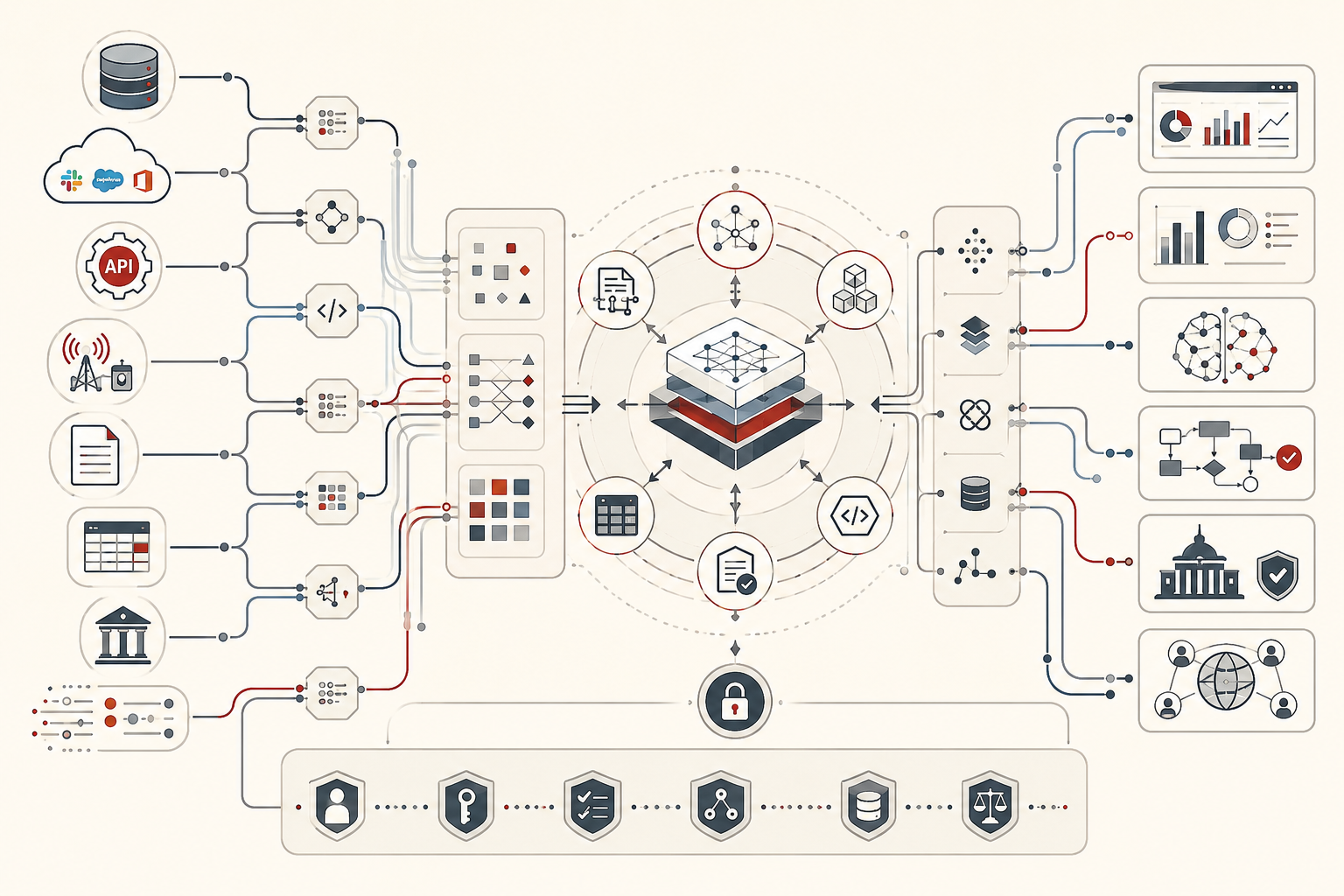
This article builds on themes developed in Database Systems and Data Architecture, Metadata, Data Catalogs, and Lineage, Master Data Management and Entity Resolution, Data Quality Metrics and Observability, Analytics Engineering and Semantic Layers, and Data Security, Privacy, and Access Control. If those articles explain how data is structured, governed, interpreted, monitored, and protected, this article addresses a parallel question: how can multiple systems, domains, and data representations be connected in ways that preserve meaning, utility, and institutional trust?
A unifying thesis: integration as coordination, interoperability as usable coordination
At a rigorous level, data integration should not be understood merely as moving records from one place to another. It is a coordination problem. It asks how heterogeneous representations can be related, aligned, transformed, and combined so that an organization can reason across them. Interoperability goes one step further. It asks whether those coordinated representations can actually be exchanged and used across systems, teams, workflows, and institutional boundaries without collapsing into semantic confusion, excessive manual mediation, unmanaged risk, or brittle point-to-point maintenance.
This distinction matters because organizations often achieve technical connection without achieving interpretive usability. They may replicate tables, sync APIs, stream events, centralize extracts into a warehouse, or publish shared files, yet still remain unable to answer basic cross-system questions consistently. The reason is usually not a lack of pipelines. It is a lack of coherent coordination across schema, meaning, identifiers, timing, quality, governance, and process logic. Integration without interoperability can produce aggregation without understanding. Interoperability without sufficient integration can produce standards without practical analytical value. Mature data environments need both.
Seen in this way, integration and interoperability are not narrow engineering concerns. They are institutional capabilities for making distributed information usable across boundaries of system, function, discipline, jurisdiction, vendor, organization, and time.
Why fragmentation persists
Fragmentation persists because data systems emerge historically rather than architecturally. Organizations adopt applications at different times for different purposes. Business units purchase SaaS tools independently. Legacy systems remain in operation because replacement is costly. New workflows are built on top of old identifiers. Vendors impose their own schemas and API limits. Acquisitions introduce parallel master data and divergent operating definitions. Reporting layers adapt locally to business demand. Compliance processes preserve specific institutional categories. Over time, the organization does not accumulate one system but an ecology of partially connected systems.
In that ecology, local rationality often produces global incoherence. A CRM can optimize for sales workflows. An ERP can optimize for financial control. A support platform can optimize for ticket handling. A sustainability reporting system can optimize for disclosure boundaries. A sensor network can optimize for operational telemetry. Each system can be internally coherent and still incompatible with the others at the level that matters for enterprise analysis, policy coordination, operational synchronization, or public accountability.
This is why fragmentation is not always evidence of failure. It is often the predictable outcome of institutional specialization. The challenge is how to build coordination across that specialization without erasing necessary domain differences. Mature interoperability does not mean pretending that every system sees the world the same way. It means creating enough shared structure, translation, governance, and context that different representations can be used together responsibly.
Data integration and interoperability: distinguishing the terms
Data integration is concerned with combining, reconciling, transforming, or aligning data from multiple sources so that it can support broader operational or analytical use. This may involve ETL or ELT pipelines, data virtualization, replication, federation, event streaming, master-data reconciliation, schema mapping, entity resolution, semantic transformation, API integration, and file-based exchange. The central question is how disparate sources can be brought into meaningful relation.
Interoperability is concerned with whether systems can exchange and use information coherently across boundaries. This includes not only technical compatibility, but also shared or translatable meaning, agreed message structures, identity conventions, protocol expectations, governance practices, access constraints, and workflow alignment. A technically valid exchange is not truly interoperable if the receiving system cannot interpret the message correctly or if the exchanged data cannot be used safely in context.
The difference can be stated simply. Integration is often about assembling data into coordinated form. Interoperability is about enabling coordinated use across systems and actors. One may support the other, but neither guarantees the other automatically. A warehouse can integrate many sources while leaving meaning unresolved. A standard can promote interoperability while failing to create actual analytical usefulness if it is not implemented, governed, and connected to real workflows.
Levels of interoperability
A useful way to think about interoperability is in layers. Technical interoperability concerns protocols, connectivity, transport, and machine-readable exchange. Systems can send and receive data. Syntactic interoperability concerns shared structures and formats: schemas, field arrangements, message envelopes, and serialization conventions. Semantic interoperability concerns shared meaning or reliable translation of meaning: whether the receiving system can interpret the data in a way that preserves intended significance. Organizational interoperability concerns the policies, workflows, governance structures, responsibilities, and institutional agreements that allow systems to use exchanged information effectively in practice.
These layers matter because organizations often stop too early. An API may work perfectly at the transport layer while failing semantically because fields mean different things across systems. A common schema may exist while workflows remain incompatible. A shared terminology may be defined while governance for versioning and change control remains absent. A message may be syntactically valid while exposing more sensitive data than the recipient needs. High-maturity interoperability requires movement across all of these layers rather than success at only one.
The European Interoperability Framework is especially useful here because it treats interoperability as a multi-layered governance problem rather than a mere software-interface problem. Its distinction among legal, organisational, semantic, and technical interoperability helps clarify why durable exchange requires policy alignment, process alignment, meaning alignment, and technical alignment together.
Integration patterns
Organizations use multiple integration patterns depending on architecture, latency requirements, control boundaries, data sensitivity, and business purpose. Batch ETL/ELT remains common for analytical consolidation, where data is periodically extracted and loaded into warehouses, lakehouses, or lakes for transformation. Event-driven integration supports more immediate propagation of changes across systems through streams, topics, or message brokers. API-based integration enables system-to-system exchange through defined interfaces. Data federation or virtualization can provide unified access across distributed sources without full materialization. File-based exchange, though less elegant, remains widespread in regulated, legacy, low-connectivity, or cross-organizational environments.
No pattern is inherently superior in all contexts. Batch consolidation may be entirely appropriate for monthly planning, financial reconciliation, or disclosure workflows. Event-driven architecture may be necessary for operational synchronization, anomaly detection, inventory updates, or low-latency decision support. Federation may reduce duplication in some contexts while introducing performance, governance, or access-control challenges in others. API integration may be clean but constrained by rate limits, contract changes, and vendor semantics. File exchange may be clumsy but durable in institutional contexts where formal transfer, review, and archival requirements matter.
The important question is whether the chosen pattern reflects actual institutional need rather than architectural fashion. Integration architecture should begin with use case, latency, ownership, sensitivity, quality, and governance requirements rather than with the assumption that all data must move in the same way.
Schema mapping and structural alignment
One of the most visible tasks in integration is schema mapping: aligning fields, tables, message structures, and data types across systems. This work is often treated as straightforward plumbing, but it is more consequential than it appears. Every mapping decision implies a judgment about equivalence, transformation, omission, aggregation, decomposition, timing, or authority. If source system A has one customer object and source system B separates account, contact, contract, and subscription, then mapping them is not simply a naming exercise. It is a representational decision.
This is why schema alignment must be understood as both technical and semantic work. Structural equivalence does not guarantee conceptual equivalence. A field named status in two systems may encode different lifecycle meanings. A location field may represent billing address in one environment and operational site in another. A date may represent order creation, invoice issue, fulfillment start, recognition date, sensor timestamp, or reporting period depending on context. Integration succeeds only when structural mapping is supported by interpretive clarity.
Mapping work should therefore be versioned, reviewed, and documented. High-risk mappings—especially those involving identity, classification, lifecycle status, financial recognition, compliance boundaries, health or safety data, or public reporting—should not be hidden inside opaque transformation code. They should be treated as governance artifacts.
Semantic interoperability and the problem of meaning
Semantic interoperability is often the hardest layer because it deals not with whether data can move, but with whether its meaning survives movement. This is difficult because meaning in organizations is rarely static. It is embedded in business rules, classifications, institutional purposes, timing conventions, domain assumptions, reporting obligations, and operational histories. Two systems may exchange a field with the same name while assigning it different significance. One system’s active customer may mean recent purchaser; another’s may mean any account with an open contract. One system’s facility may mean physical site; another’s may mean legal reporting unit. One system’s incident may mean customer complaint; another’s may mean operational hazard.
A sharper way to state the distinction is this: syntactic interoperability lets two systems pass a valid payload; semantic interoperability lets the receiving system use that payload without silently changing its meaning. A JSON message with a field called customer_status can be syntactically valid in both systems, yet semantically unstable if one system treats the values as marketing lifecycle stages and the other treats them as contractual billing states. The exchange “works,” but the meaning does not travel intact.
This is why semantic interoperability depends heavily on metadata, glossaries, controlled vocabularies, master data, lineage, and governance. Without those supports, translation becomes local and unstable. Standards help here. W3C’s DCAT 3 is designed to facilitate interoperability between data catalogs, while SKOS provides a common model for sharing and linking knowledge organization systems such as taxonomies, thesauri, and classification schemes. Those standards do not solve semantic interoperability by themselves, but they provide shared scaffolding for describing assets and concepts more consistently across systems. In that sense, the problems discussed in Metadata, Data Catalogs, and Lineage are not secondary to interoperability. They are among its preconditions.
A mathematical lens for integration and interoperability
Integration and interoperability can also be evaluated through a mathematical lens. The point is not to reduce complex institutional coordination to one number. The point is to make the dimensions of interoperability explicit. A technically connected environment may still be weak if schema mappings are incomplete, semantic translation is unstable, identifiers are fragile, lineage is invisible, or governance is absent.
I_o = f(T, X, S, E, L, G, B)
\]
Interpretation: Interoperability \(I_o\) depends on technical connectivity \(T\), syntactic compatibility \(X\), semantic alignment \(S\), entity coherence \(E\), lineage visibility \(L\), governance maturity \(G\), and boundary control \(B\).
This model clarifies why connectivity alone is insufficient. A system can score well on technical connectivity while scoring poorly on semantic alignment or entity coherence. A shared API can move data quickly, yet still undermine trust if identifiers do not reconcile or if fields are interpreted differently downstream. A robust integration architecture requires strength across multiple dimensions.
A second useful model evaluates mapping risk:
R_m = 1 – (C_s \times C_e \times C_t \times C_g)
\]
Interpretation: Mapping risk \(R_m\) declines when structural compatibility \(C_s\), entity compatibility \(C_e\), temporal compatibility \(C_t\), and governance compatibility \(C_g\) are high. If any dimension is weak, overall risk rises.
This matters because mapping failures rarely come from one source alone. A mapping may be structurally plausible but temporally wrong. A field may be well documented but tied to an unstable identifier. A transformation may be technically correct but governed poorly. Mapping review should therefore examine structural, semantic, temporal, identity, and governance assumptions together.
A third lens connects integration to observability:
V_i = \frac{M_i + Q_i + L_i + A_i}{4}
\]
Interpretation: Visibility \(V_i\) for integration pathway \(i\) can be approximated as the average of metadata coverage \(M_i\), quality monitoring \(Q_i\), lineage capture \(L_i\), and alerting coverage \(A_i\). Low visibility means failures may appear only as downstream confusion.
This mathematical lens supports better governance. Integration pathways should not be reviewed only by whether they execute. They should be evaluated by whether they preserve meaning, reconcile entities, respect boundaries, expose lineage, and remain observable over time.
Python Workflow: Integration and Interoperability Scorecard
The following Python workflow shows how an organization might evaluate integration pathways across technical, syntactic, semantic, identity, organizational, observability, security, and lifecycle dimensions. In a production environment, these inputs might come from a schema registry, catalog, lineage platform, MDM system, API gateway, data quality service, and governance workflow.
#!/usr/bin/env python3
"""
Python Workflow: Integration and Interoperability Scorecard

This compact workflow evaluates integration quality across multiple layers:
technical, syntactic, semantic, identity, organizational, observability,
security, and lifecycle controls.
"""

from __future__ import annotations

from dataclasses import dataclass


@dataclass
class InteroperabilityCheck:
    layer: str
    expected_value: float
    observed_value: float
    status: str


@dataclass
class Mapping:
    mapping_id: str
    source_system: str
    target_model: str
    semantic_risk: str
    status: str


@dataclass
class Payload:
    payload_id: str
    syntax_valid: bool
    semantic_valid: bool
    minimized_payload: bool
    consumer_ready: bool


def status_score(status: str) -> float:
    scores = {
        "pass": 1.0,
        "warn": 0.6,
        "fail": 0.0,
    }
    return scores.get(status, 0.0)


def semantic_risk_score(risk: str) -> float:
    scores = {
        "low": 1.0,
        "medium": 0.7,
        "high": 0.4,
    }
    return scores.get(risk, 0.0)


def mapping_readiness(mapping: Mapping) -> float:
    lifecycle_score = 1.0 if mapping.status == "active" else 0.6
    return round(
        0.65 * semantic_risk_score(mapping.semantic_risk)
        + 0.35 * lifecycle_score,
        3,
    )


def payload_readiness(payload: Payload) -> float:
    return round(
        0.25 * float(payload.syntax_valid)
        + 0.35 * float(payload.semantic_valid)
        + 0.20 * float(payload.minimized_payload)
        + 0.20 * float(payload.consumer_ready),
        3,
    )


def interoperability_score(
    checks: list[InteroperabilityCheck],
    mappings: list[Mapping],
    payloads: list[Payload],
    average_entity_confidence: float,
    lineage_coverage: float,
) -> float:
    check_score = sum(status_score(check.status) for check in checks) / len(checks)
    mapping_score = sum(mapping_readiness(mapping) for mapping in mappings) / len(mappings)
    payload_score = sum(payload_readiness(payload) for payload in payloads) / len(payloads)

    return round(
        0.25 * check_score
        + 0.20 * mapping_score
        + 0.20 * payload_score
        + 0.20 * average_entity_confidence
        + 0.15 * lineage_coverage,
        3,
    )


def main() -> None:
    checks = [
        InteroperabilityCheck("technical", 0.99, 0.995, "pass"),
        InteroperabilityCheck("syntactic", 0.95, 0.875, "warn"),
        InteroperabilityCheck("semantic", 0.90, 0.78, "warn"),
        InteroperabilityCheck("lifecycle", 0.95, 0.75, "fail"),
    ]

    mappings = [
        Mapping("map001", "crm", "customer_model", "low", "active"),
        Mapping("map004", "crm", "customer_model", "high", "active"),
        Mapping("map008", "support", "customer_model", "high", "review"),
    ]

    payloads = [
        Payload("msg001", True, True, True, True),
        Payload("msg003", True, False, False, False),
        Payload("msg005", True, False, True, False),
    ]

    score = interoperability_score(
        checks=checks,
        mappings=mappings,
        payloads=payloads,
        average_entity_confidence=0.907,
        lineage_coverage=0.86,
    )

    print(f"Overall interoperability score: {score}")

    print("\nMapping readiness")
    for mapping in mappings:
        print(mapping.mapping_id, mapping.source_system, mapping_readiness(mapping))

    print("\nPayload readiness")
    for payload in payloads:
        print(payload.payload_id, payload_readiness(payload))


if __name__ == "__main__":
    main()
This workflow distinguishes execution from interoperability. A payload can be syntactically valid and still fail semantic readiness. A mapping can be active and still carry high semantic risk. A lineage graph can exist but cover only part of the environment. Scoring does not replace expert review, but it makes review criteria visible.
R Workflow: Integration Coverage and Interoperability Quality Summary
The following R workflow summarizes integration coverage, mapping risk, interoperability check status, entity-linkage confidence, and payload readiness. It supports a practical governance review: which systems are integrated, where semantic risk is concentrated, which interoperability layers are weak, and whether payloads are truly consumer-ready.
#!/usr/bin/env Rscript

# R Workflow: Integration Coverage and Interoperability Quality Summary
#
# This workflow summarizes mapping coverage, semantic risk, interoperability
# checks, entity-crosswalk confidence, and message payload readiness.

systems <- data.frame(
  system_id = c("crm", "erp", "support", "iot", "sustainability"),
  domain = c("sales", "finance", "service", "operations", "sustainability"),
  system_type = c("saas", "transactional", "saas", "streaming", "registry"),
  stringsAsFactors = FALSE
)

mappings <- data.frame(
  mapping_id = c("map001", "map002", "map004", "map005", "map008"),
  source_system = c("crm", "erp", "crm", "erp", "support"),
  target_model = c("customer_model", "customer_model", "customer_model", "revenue_model", "customer_model"),
  semantic_risk = c("low", "medium", "high", "high", "high"),
  status = c("active", "active", "active", "active", "review"),
  stringsAsFactors = FALSE
)

checks <- data.frame(
  layer = c("technical", "syntactic", "semantic", "organizational", "lifecycle"),
  status = c("pass", "warn", "warn", "pass", "fail"),
  observed_value = c(0.995, 0.875, 0.78, 1.00, 0.75),
  stringsAsFactors = FALSE
)

crosswalk <- data.frame(
  entity_type = c("customer", "customer", "facility", "facility"),
  match_method = c("deterministic_key", "probabilistic_match", "governed_crosswalk", "partial_match"),
  confidence = c(0.99, 0.93, 0.97, 0.78),
  stringsAsFactors = FALSE
)

payloads <- data.frame(
  payload_id = c("msg001", "msg002", "msg003", "msg004", "msg005"),
  syntax_valid = c(TRUE, TRUE, TRUE, TRUE, TRUE),
  semantic_valid = c(TRUE, TRUE, FALSE, TRUE, FALSE),
  minimized_payload = c(TRUE, TRUE, FALSE, TRUE, TRUE),
  consumer_ready = c(TRUE, TRUE, FALSE, TRUE, FALSE)
)

system_summary <- aggregate(
  system_id ~ domain + system_type,
  data = systems,
  FUN = length
)

names(system_summary) <- c("domain", "system_type", "system_count")

mapping_risk <- aggregate(
  mapping_id ~ semantic_risk + status,
  data = mappings,
  FUN = length
)

names(mapping_risk) <- c("semantic_risk", "status", "mapping_count")

check_summary <- aggregate(
  observed_value ~ layer + status,
  data = checks,
  FUN = mean
)

names(check_summary) <- c("layer", "status", "average_observed_value")

crosswalk_summary <- aggregate(
  confidence ~ entity_type + match_method,
  data = crosswalk,
  FUN = mean
)

names(crosswalk_summary) <- c("entity_type", "match_method", "average_confidence")

payload_readiness <- data.frame(
  total_payloads = nrow(payloads),
  syntax_valid = sum(payloads$syntax_valid),
  semantic_valid = sum(payloads$semantic_valid),
  minimized_payloads = sum(payloads$minimized_payload),
  consumer_ready = sum(payloads$consumer_ready)
)

dir.create("outputs", showWarnings = FALSE, recursive = TRUE)

write.csv(system_summary, "outputs/system_summary_r.csv", row.names = FALSE)
write.csv(mapping_risk, "outputs/mapping_risk_summary_r.csv", row.names = FALSE)
write.csv(check_summary, "outputs/interoperability_check_summary_r.csv", row.names = FALSE)
write.csv(crosswalk_summary, "outputs/entity_crosswalk_summary_r.csv", row.names = FALSE)
write.csv(payload_readiness, "outputs/payload_readiness_r.csv", row.names = FALSE)

cat("Wrote integration coverage and interoperability quality outputs.\n")
This workflow makes a critical distinction visible: successful data movement is not the same as consumer readiness. A payload may pass syntax checks while failing semantic validity. A source system may be connected while still lacking governed entity alignment. A mapping may exist while remaining too risky for decision-critical use.
Entities, identifiers, and record linkage
Interoperability is rarely achievable without some degree of entity coherence. Systems need ways of recognizing when different records refer to the same customer, supplier, product, facility, employee, household, legal entity, asset, device, or event. Without that, cross-system integration produces duplication, aggregation error, false trends, and weak analytical trust. This is one reason Master Data Management and Entity Resolution is so closely tied to integration and interoperability.
Identifiers matter enormously here. Some environments rely on stable global keys. Others rely on crosswalk tables, probabilistic matching, deterministic rules, governed linkage, or master-data hubs that preserve relationships among local identifiers. The deeper issue is not merely whether an identifier exists, but whether it is stable, scoped correctly, versioned appropriately, and understood consistently across systems.
Integration problems often look like pipeline problems when they are really identity problems. A warehouse may load successfully while still double-counting customers. A reporting layer may join tables correctly while aggregating facilities under incompatible legal and operational boundaries. A dashboard may show a trend while mixing records that belong to different entity definitions. Entity coherence is therefore not a downstream cleanup issue. It is core integration infrastructure.
Canonical models, shared data models, and their limits
One common response to fragmentation is the creation of canonical or shared data models: intermediate representations intended to normalize multiple source schemas into a common structure. This can be useful because it reduces the number of direct pairwise mappings and provides a reference vocabulary for repeated integration work. Canonical models can also support semantic discipline by making mappings explicit and reusable.
Yet canonical models have limits. They can become overly abstract, too rigid, or too detached from local system needs. If designed without sensitivity to domain nuance, they may flatten meaningful differences in pursuit of standardization. If designed too broadly, they may become difficult to govern and maintain. If imposed without institutional legitimacy, they may reproduce one domain’s view of the world while claiming to be neutral.
A canonical model is therefore not a universal solution. It is one possible coordination device whose value depends on scope, governance, and the actual diversity of the systems being aligned. Strong canonical modeling should preserve necessary local distinctions while defining shared concepts where coordination requires them. The goal is not uniformity for its own sake. The goal is accountable translation.
Data standards and the role of shared conventions
Standards matter because interoperability improves when systems do not invent every exchange pattern independently. Shared conventions around identifiers, vocabularies, metadata, protocols, schemas, and lineage can reduce translation cost and improve predictability. Standards may be sectoral, technical, regulatory, or consortium-driven. In some domains, they become essential because cross-organizational interoperability is impossible without them. In others, internal standards may be sufficient to coordinate multiple business units and platforms.
Sharper standards language helps here. DCAT 3 is not just “a metadata standard”; it is a W3C Recommendation for representing and exchanging catalog information in ways that support interoperability across data catalogs. SKOS is not just “a taxonomy format”; it is a common W3C model for representing knowledge organization systems so that concepts, broader-narrower relations, preferred labels, and alternative labels can be shared more consistently across applications. OpenLineage is not just “lineage tooling”; it is an open specification and framework through which systems can interoperate around lineage metadata, including datasets, jobs, and runs. The European Interoperability Framework is also useful because it explicitly distinguishes legal, organisational, semantic, and technical dimensions of interoperability and frames them as coordinated governance concerns rather than isolated implementation details.
But standards should not be romanticized. Adopting a standard does not automatically produce usable interoperability. Standards still require implementation choices, governance processes, version control, translation layers, and local interpretation. They reduce coordination burden; they do not eliminate it. The question is not simply whether a standard exists, but whether it is implemented in ways that preserve meaning and operational viability.
Analytics integration versus operational integration
It is important to distinguish between integration for analytics and integration for operations. Analytical integration often prioritizes historical completeness, cross-domain comparability, denormalization for performance, stable entity definitions, and time-aware reporting or modeling. Operational integration often prioritizes timeliness, transaction integrity, workflow synchronization, idempotency, and correct action in live systems. The same data may need to be structured differently depending on which goal is primary.
That contrast can be made more explicit. An analytical warehouse may deliberately reshape source data into slowly changing dimensions, historical snapshots, curated marts, or conformed entities so that trends can be compared over time. An operational integration layer may instead need the latest state only, strict event ordering, low-latency propagation, and robust retry logic because the goal is to keep live systems synchronized. One is optimized for retrospective and comparative reasoning; the other for timely and correct execution in ongoing processes.
This distinction matters because organizations sometimes try to solve both problems with one design. A warehouse model optimized for executive trend analysis may not be appropriate as an operational system of interaction. A real-time event stream appropriate for state synchronization may be insufficient as the only basis for audited historical reporting. Mature environments therefore recognize that analytical and operational interoperability overlap but are not identical architectural requirements.
Integration quality and observability
Integration and interoperability require their own quality discipline. A pipeline that executes successfully may still propagate truncated payloads, stale reference data, mismapped fields, replayed events, duplicate records, late-arriving updates, incompatible entity states, or semantic inconsistencies. This is why the concerns developed in Data Quality Metrics and Observability apply directly here. Integrated systems need monitoring for freshness, volume anomalies, schema drift, message failures, reconciliation mismatches, distribution changes, mapping regressions, and lineage coverage. They also need lineage-aware visibility into which downstream assets depend on which integration pathways.
Without observability, integration becomes fragile. Failures may not appear as total outages; they may appear as slowly compounding semantic distortion, missing records, inconsistent hierarchies, unexplained dashboard divergence, or cross-system disagreement. Interoperability should therefore be treated not as a one-time achievement, but as a condition that must be monitored and maintained. OpenLineage is especially relevant here because it gives systems a common way to describe lineage metadata about datasets, jobs, and runs, improving root-cause analysis and change-impact visibility across heterogeneous platforms.
Security, privacy, and boundary management
Interoperability expands information flows, which also expands risk. Every additional interface, replicated dataset, synchronization pathway, and external exchange point introduces new questions about authorization, confidentiality, purpose limitation, minimization, downstream control, and auditability. This is why the concerns developed in Data Security, Privacy, and Access Control are inseparable from integration strategy.
The challenge is not simply whether data can move, but whether it should move in the form, scope, and context proposed. Integration often creates pressure to replicate more than is necessary, expose broader payloads than consumers need, or blur boundaries between operational and analytical access. High-maturity integration therefore requires minimization, scoped interfaces, role- or attribute-aware access, encryption, audit logs, retention discipline, and clear governance over what is exchanged and why.
Boundary management is especially important in cross-domain or cross-institutional environments. A dataset that is acceptable in one operational context may become risky when combined with another. A field that seems harmless in isolation may become sensitive when linked across systems. Interoperability must therefore be designed with privacy, security, and power in view, not as an afterthought.
Organizational interoperability and governance
Even when technical and semantic issues are addressed, interoperability can still fail at the organizational level. Systems may exchange data successfully, yet teams may lack shared ownership, change-management processes, escalation paths, stewardship responsibilities, or dispute-resolution mechanisms. Definitions may exist, but no one may be accountable for updating them. APIs may be published, but versioning and deprecation practices may be unclear. Cross-functional trust may erode because changes are introduced without warning or because one system’s priorities dominate another’s operational reality.
This is why interoperability is ultimately a governance problem as much as a technical one. Durable integration requires agreements about ownership, standards, review, versioning, exception handling, lifecycle management, and the management of legitimate plurality. It requires institutions to coordinate, not just systems to connect.
Organizational interoperability also requires translation between communities of practice. Engineers, analysts, compliance teams, operators, researchers, product managers, and public stakeholders may all interact with the same data differently. Governance should make those differences visible rather than bury them under technical abstraction.
The politics of interoperability
Interoperability is often spoken of as though it were a neutral good, but it has politics. To make systems interoperable is often to decide whose schema becomes central, whose identifiers become authoritative, whose classifications become default, whose workflow is treated as standard, and whose differences are treated as exceptions. Standardization distributes convenience unevenly. What appears as simplification from one vantage point may feel like erasure from another.
This is not an argument against interoperability. It is an argument for treating it honestly. Every shared model and every integration layer embodies choices about what differences matter and which can be normalized away. Mature interoperability work acknowledges that these choices are not value-free and therefore require visible governance rather than hidden technical imposition.
This matters especially when integration affects marginalized communities, public reporting, regulatory systems, health information, housing data, environmental monitoring, labor records, public-benefit systems, or cross-border data exchange. Categories are not merely technical containers. They shape what institutions can see, compare, prioritize, and ignore. Ethical interoperability requires both coordination and humility.
Common failure modes
Organizations often fail in predictable ways.
One failure mode is point-to-point proliferation: many bespoke connections, each locally rational, collectively impossible to govern.
A second is syntactic success without semantic success: messages move, but meaning does not survive translation.
A third is canonical-model overreach: a shared model is made so abstract or universal that it becomes detached from real operational use.
A fourth is identity fragility: systems appear connected until unresolved entity duplication undermines the combined view.
A fifth is governance absence: no clear ownership of mappings, standards, versioning, lineage, or change management.
A sixth is integration without minimization: excessive data is copied and exposed simply because technical movement is possible.
A seventh is brittle dependency chains: a small upstream change ripples through many downstream consumers without adequate observability or version discipline.
An eighth is standardization without legitimacy: one domain’s categories are imposed across others without adequate review, creating hidden semantic and political consequences.
These failures show that interoperability is not guaranteed by connectivity alone.
Implementation principles
Integrate for real use cases, not abstract completeness. Integration work should begin with meaningful operational or analytical needs rather than the assumption that all systems must be unified maximally.
Distinguish technical connection from semantic usability. Successful transport or replication does not prove that exchanged data can be interpreted correctly in the receiving context.
Treat identifiers and entities as core infrastructure. Cross-system coordination depends heavily on governed identity, stable keys, and explicit linkage strategies for shared entities.
Use standards where they reduce real coordination cost. Shared schemas, vocabularies, protocols, and conventions are valuable when they improve reuse and predictability, but they still require governance and translation.
Connect integration to metadata, lineage, and observability. Mappings, dependencies, and downstream impacts should be documented and monitored so that interoperability remains inspectable over time.
Govern boundaries, not just flows. Data exchange should reflect minimization, access constraints, purpose limitation, and accountability rather than assuming that more sharing is always better.
Allow disciplined plurality where unification would distort meaning. Not every local distinction should be collapsed. Interoperability should support coordinated use without erasing necessary domain nuance.
| Control | Purpose | Failure it prevents |
|---|---|---|
| Schema mapping review | Documents structural and semantic translation decisions | Hidden equivalence assumptions and mismapped fields |
| Entity crosswalks | Links local identifiers to governed canonical entities | Duplicate records, aggregation error, and identity confusion |
| Controlled vocabularies | Aligns classifications and terms across systems | Semantic drift and inconsistent category use |
| Lineage events | Tracks datasets, jobs, runs, and downstream dependencies | Untraceable integration failures and weak impact analysis |
| Payload minimization | Limits exchanged data to purpose-specific need | Overexposure and boundary erosion |
| Versioned contracts | Stabilizes APIs, schemas, mappings, and message formats | Brittle integrations broken by unannounced changes |
| Observability checks | Monitors freshness, volume, schema drift, reconciliation, and quality | Silent degradation and downstream ambiguity |
| Governance ownership | Assigns responsibility for mappings, standards, and change control | Unmaintained integration logic and unresolved disputes |
GitHub Repository
This article can be paired with a companion code workflow that models integration and interoperability as a governed coordination problem. The example includes source-system inventories, schema mappings, entity crosswalks, interoperability checks, lineage events, message payloads, SQL schemas, scorecard scripts, typed contracts, governance checklists, mapping review documentation, and multi-language examples across Python, R, Julia, SQL, Go, Rust, C, C++, TypeScript, and Terraform placeholders.
Conclusion
Data integration and interoperability are essential to modern data systems because organizations operate across distributed, heterogeneous, and historically layered information environments. Integration helps bring disparate data into meaningful relation. Interoperability helps ensure that related systems and actors can exchange and use information coherently across boundaries of platform, function, organization, and time.
At a deeper level, these are not merely technical achievements. They are institutional capabilities for coordinated understanding. A mature data environment does not ask only whether records can be moved or queried together. It asks whether meaning survives movement, whether entities remain coherent across boundaries, whether standards and mappings are governable, whether security and privacy boundaries are respected, whether differences are preserved where they matter, and whether the resulting system supports defensible action rather than accumulated ambiguity.
In that sense, integration and interoperability are part of the infrastructure through which distributed information becomes usable institutional knowledge.
Related articles
- Database Systems and Data Architecture
- Metadata, Data Catalogs, and Lineage
- Master Data Management and Entity Resolution
- Data Quality Metrics and Observability
- Analytics Engineering and Semantic Layers
- Data Security, Privacy, and Access Control
Further reading
- Bowker, G.C. and Star, S.L. (1999) Sorting Things Out: Classification and Its Consequences. Cambridge, MA: MIT Press.
- Doan, A., Halevy, A. and Ives, Z. (2012) Principles of Data Integration. Waltham, MA: Morgan Kaufmann.
- Kimball, R. and Ross, M. (2013) The Data Warehouse Toolkit: The Definitive Guide to Dimensional Modeling. 3rd edn. Indianapolis: Wiley.
- Kleppmann, M. (2017) Designing Data-Intensive Applications. Sebastopol: O’Reilly Media.
- Redman, T.C. (2008) Data Driven: Profiting from Your Most Important Business Asset. Boston: Harvard Business Press.
- Zeng, M.L. and Qin, J. (2016) Metadata. 2nd edn. Chicago: ALA Neal-Schuman.
References
- Bowker, G.C. and Star, S.L. (1999) Sorting Things Out: Classification and Its Consequences. Cambridge, MA: MIT Press.
- Doan, A., Halevy, A. and Ives, Z. (2012) Principles of Data Integration. Waltham, MA: Morgan Kaufmann.
- European Commission / Interoperable Europe (n.d.) European Interoperability Framework. Available at: https://interoperable-europe.ec.europa.eu/collection/iopeu-monitoring/european-interoperability-framework
- European Commission / Interoperable Europe (n.d.) Levels of interoperability. Available at: https://interoperable-europe.ec.europa.eu/collection/iopeu-monitoring/solution/european-interoperability-framework-eif-toolbox/levels-interoperability
- Kleppmann, M. (2017) Designing Data-Intensive Applications. Sebastopol: O’Reilly Media.
- OpenLineage (n.d.) About OpenLineage. Available at: https://openlineage.io/docs/
- OpenLineage (n.d.) Object Model. Available at: https://openlineage.io/docs/next/spec/object-model/
- Redman, T.C. (2008) Data Driven: Profiting from Your Most Important Business Asset. Boston: Harvard Business Press.
- W3C (2009) SKOS Simple Knowledge Organization System Reference. Available at: https://www.w3.org/TR/skos-reference/
- W3C (2024) Data Catalog Vocabulary (DCAT) – Version 3. Available at: https://www.w3.org/TR/vocab-dcat-3/
- Zeng, M.L. and Qin, J. (2016) Metadata. 2nd edn. Chicago: ALA Neal-Schuman.