
Last Updated May 11, 2026
Master data management and entity resolution address one of the deepest structural problems in modern data systems: the difficulty of representing the same real-world object consistently across multiple databases, organizational processes, jurisdictions, and analytical contexts. Most institutions do not operate from a single coherent representation of customers, suppliers, products, facilities, employees, legal entities, assets, partners, households, patients, locations, devices, or counterparties. Instead, they accumulate overlapping records across operational platforms, legacy systems, spreadsheets, CRM tools, ERP environments, finance applications, procurement systems, compliance databases, case-management platforms, data warehouses, external registries, and vendor data feeds. Over time, this proliferation produces duplication, inconsistency, semantic drift, conflicting identifiers, unstable hierarchies, and interpretive ambiguity. A customer may appear under different identifiers in billing, support, and marketing systems. A supplier may exist under multiple legal names, trading names, or regional subsidiaries. A facility may be represented differently across maintenance, permitting, sustainability reporting, and asset-management systems. Under these conditions, even simple analytical questions become difficult to answer with confidence.
Master data management, commonly abbreviated as MDM, is the discipline concerned with creating reliable, governed, and semantically stable representations of core organizational entities across a heterogeneous system landscape. Entity resolution is the closely related problem of determining when multiple records refer to the same underlying real-world entity, even when those records differ in completeness, format, quality, timing, legal status, or institutional perspective. Together, these capabilities form a foundation for trustworthy analytics, operational coordination, regulatory compliance, stewardship, interoperability, customer experience, supplier oversight, risk management, and strategic decision-making. They matter whenever an organization needs to unify data across business functions, establish authoritative records, reduce duplication, maintain coherent hierarchies, preserve historical identity, or support high-stakes workflows that depend on knowing whether two records refer to the same thing.
Main Library
Publications
Article Map
Data Systems & Analytics
Related Topic
Artificial Intelligence Systems
Related Topic
Intelligent Infrastructure Systems
Related Topic
Economic Systems
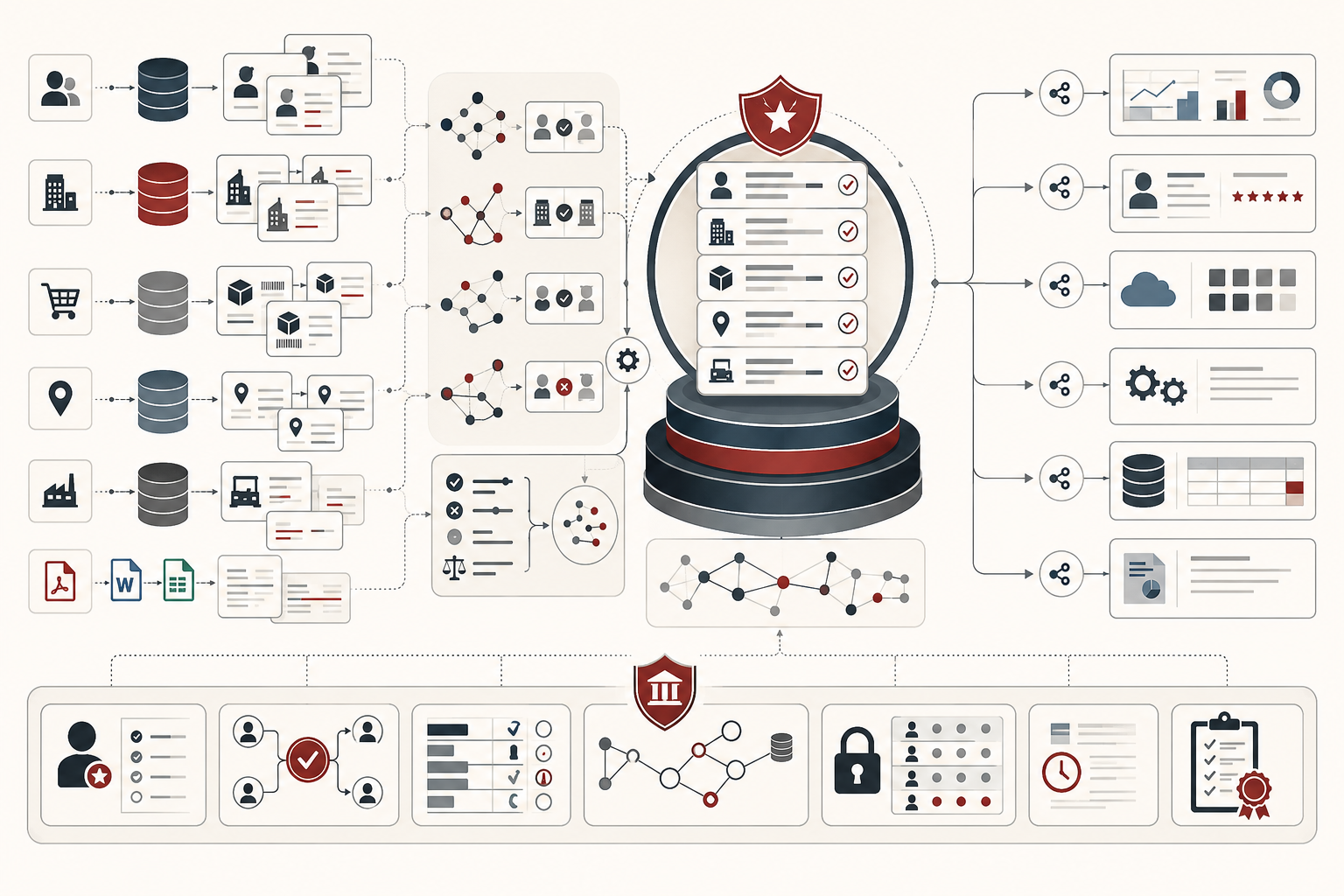
This article builds on the themes developed in Database Systems and Data Architecture, Data Governance and Stewardship, Metadata, Data Catalogs, and Lineage, Data Quality Metrics and Observability, Data Integration and Interoperability, and Analytics Engineering and Semantic Layers. If metadata and lineage help explain what data assets exist, how they are described, and how they move, then master data management addresses an even more fundamental question: what, exactly, are the entities those systems claim to describe, and how can those entities be stabilized across fragmented organizational realities?
Master data management as representational governance
Master data management is often framed as a problem of deduplication or record cleanup, but that description is too narrow for serious data systems work. At a deeper level, MDM is a form of representational governance. It concerns how an organization constructs, maintains, authorizes, and distributes the informational objects around which its activities are organized. These objects are not merely technical rows in a table. They are institutional representations of real-world entities that matter operationally and strategically: customers, suppliers, products, legal entities, facilities, households, patients, assets, locations, employees, and business partners. If those representations are unstable, then reports, dashboards, forecasts, controls, models, and decisions built on top of them inherit that instability.
This point is easy to underestimate because local systems can continue functioning even while global entity coherence deteriorates. A support platform may manage contacts adequately for ticket handling. A finance system may manage billing accounts adequately for invoicing. A procurement application may manage vendors adequately for purchase orders. A sustainability reporting system may manage facility boundaries adequately for disclosure. Each system may succeed within its own bounded purpose. Yet once the organization attempts cross-functional analysis, lifecycle measurement, enterprise risk assessment, supplier oversight, customer unification, fraud detection, or integrated service delivery, those locally sufficient records often fail to align.
Seen in this way, master data management is not a peripheral housekeeping task. It is a condition of analytical realism. It helps determine whether the organization’s data environment refers coherently to the world it seeks to understand, govern, serve, regulate, and improve.
Why master data matters
Most organizations do not suffer from a shortage of data. They suffer from unstable entity representation. They record interactions, transactions, events, sensor readings, workflow states, service histories, legal relationships, invoices, inspections, deliveries, and human activity continuously. But unless those records can be tied back to stable and governed reference entities, the analytical environment remains structurally fragile. Revenue may be split across duplicate accounts. Supplier concentration may be hidden because the same corporate family appears under multiple legal names. Product performance may be mismeasured because identifiers differ across commerce, manufacturing, support, and return systems. Facility-level risk may be obscured because assets are mapped inconsistently across geographic, operational, environmental, and compliance records.
The significance of master data therefore extends well beyond convenience. It affects how organizations measure exposure, assign responsibility, serve customers, understand networks, comply with legal requirements, and evaluate performance through time. Where master entities are unstable, aggregation becomes unreliable, segmentation becomes distorted, lineage becomes harder to interpret, access governance becomes less precise, and interoperability weakens. Where master entities are well managed, data systems become more coherent, comparable, and actionable.
There is also an epistemic dimension. Many managerial and analytical claims assume that the underlying objects of analysis are stable enough to support inference. If a dashboard states that the organization has a certain number of active suppliers, or that a customer segment has a given lifetime value, that claim presupposes the ability to identify suppliers and customers consistently. MDM helps secure that presupposition.
What counts as master data
Master data refers to the relatively stable, high-value entities that are reused across multiple systems and business processes. Unlike transactional data, which captures events such as purchases, inspections, shipments, clicks, payments, logins, readings, or service interactions, master data represents the enduring objects around which those events are organized. Common master data domains include customer, supplier, product, employee, location, asset, material, facility, account, household, patient, citizen, legal entity, and business partner.
What makes an entity “master” is not simply that it is important. It is that the organization needs a governed, reusable, cross-system representation of it. A customer record used only within one local application may be ordinary operational data. A customer entity that must be recognized consistently across CRM, billing, support, marketing, analytics, governance, and compliance contexts becomes master data. The same principle applies to products, suppliers, facilities, legal entities, and other domains. The more an entity must travel across systems, workflows, and institutional boundaries, the more the organization requires disciplined master data practices.
Master data should also be distinguished from reference data. Reference data usually consists of controlled lists, categories, codes, taxonomies, or classifications used to describe other records: country codes, risk classes, currency codes, product categories, legal forms, site types, unit codes, or regulatory classifications. Master data concerns the core entities themselves. A supplier is master data; a supplier risk category is reference data. A facility is master data; a facility type code is reference data. The two are intertwined because strong master records often depend on controlled reference structures, but they are conceptually distinct.
MDM and entity resolution
Master data management and entity resolution are related but not identical. MDM is the broader governance, modeling, process, stewardship, and architectural discipline through which authoritative entity representations are defined, maintained, versioned, and distributed. Entity resolution is the narrower but essential technical and analytical problem of deciding whether multiple records refer to the same underlying entity. Put differently, MDM is the operating capability; entity resolution is one of its central mechanisms.
This distinction matters because organizations sometimes mistake entity matching for the whole of MDM. They purchase a matching engine, run duplicate detection, or merge selected records and assume that they have solved the problem. In reality, matching is only part of the work. Even if duplicates are correctly identified, the organization still needs survivorship rules, ownership structures, hierarchy models, stewardship processes, versioning policies, identifier strategies, publishing mechanisms, privacy controls, and governance review. Without those elements, resolution remains local and temporary rather than institutionalized.
At the same time, MDM cannot succeed without robust entity resolution. If the organization cannot determine when records point to the same supplier, customer, product, facility, or legal entity, then its master representations will remain fragmented. Resolution is therefore one of the key bridges between messy source reality and governed enterprise representation.
The entity resolution problem more deeply
Entity resolution is deceptively difficult because real-world identity is messy, incomplete, and context dependent. Names are misspelled. Addresses change. People use nicknames, alternate spellings, or different contact channels. Organizations operate under parent companies, subsidiaries, trade names, former names, local registrations, or recently merged identities. Products are renamed, repackaged, localized, bundled, or reclassified. Facilities are known by official identifiers, local shorthand, legacy codes, regulatory IDs, and sustainability reporting names simultaneously. In some cases, different entities appear almost identical; in others, the same entity appears dramatically different across systems.
The problem is not merely one of data quality. It is also one of perspective. Different systems may represent the same entity according to different institutional logics. Finance may care about billing responsibility, sales about relationship ownership, compliance about legal identity, operations about service location, sustainability teams about reporting boundaries, and risk teams about ultimate beneficial ownership. These are all meaningful views, yet they do not necessarily align automatically. The “same entity” can therefore be technically the same, legally distinct, operationally grouped, or analytically consolidated depending on the purpose at hand.
This is why entity resolution must be understood as both probabilistic and interpretive. It uses evidence from identifiers, attributes, relationships, hierarchies, temporal patterns, and domain rules to infer sameness. But the threshold for acting on that inference must be calibrated to use case, risk, and governance. Two records that should be linked for enterprise spend analysis may need to remain distinct for legal reporting. Two customer profiles that are useful to household together for marketing may need to remain separate for consent management. Identity is therefore not only discovered; it is governed.
Deterministic, probabilistic, and hybrid matching
Deterministic matching
Deterministic matching relies on exact keys or explicit rules. Records may be considered the same if they share a tax identification number, employee ID, SKU, validated asset number, Legal Entity Identifier, account number, or another stable and high-quality key. Deterministic approaches are attractive because they are relatively transparent and easy to explain. When reliable unique identifiers exist and are consistently maintained, deterministic resolution can be both powerful and governable.
But many environments do not enjoy that luxury. Identifiers may be missing, reused, mistyped, inconsistent across systems, local to particular applications, or unavailable due to privacy or operational constraints. In such cases, deterministic rules alone fail to capture the messy reality of entity identity.
Probabilistic matching
Probabilistic matching evaluates multiple attributes and estimates the likelihood that two records refer to the same entity. Rather than demanding exact equality, it considers partial agreements and weighted evidence across fields such as name, address, date of birth, corporate affiliation, contact information, location, registration number, and relational context. This approach is better suited to messy, incomplete, or inconsistent data. It is especially valuable when no universal key exists.
Yet probabilistic matching introduces new governance challenges. Match thresholds must be calibrated. False positives and false negatives must be evaluated in light of business impact. Scores must be explainable enough for stewards to review borderline cases. In high-stakes domains, organizations must be able to justify why records were linked or left separate. Probabilistic sophistication without institutional explainability can undermine trust.
Hybrid matching
Many mature environments use hybrid strategies that combine deterministic rules, probabilistic scoring, graph evidence, and human adjudication. A hard identifier may trigger an automatic match. A conflicting legal identifier may trigger an automatic non-match. Intermediate cases may be scored probabilistically and routed to stewardship review when confidence falls within a gray zone. Hybrid systems often perform better because they acknowledge that not all records deserve the same decision logic or level of automation.
Graph-based resolution
Some entity resolution problems are best addressed through graph or network methods. Records may be linked not only through field similarity but through shared addresses, parent companies, transaction behavior, household relationships, ownership structures, device associations, or supply-chain connections. Graph-based approaches are especially useful in fraud detection, corporate hierarchy mapping, healthcare identity resolution, public-sector integration, cybersecurity, sanctions screening, and network risk analysis. They also highlight that entity meaning often emerges relationally, not merely through isolated attributes.
Precision, recall, and the politics of matching
Entity resolution always involves trade-offs between precision and recall. Match too aggressively and distinct entities collapse into one, corrupting histories, obscuring obligations, damaging trust, and potentially producing unfair or unsafe outcomes. Match too conservatively and duplicate records persist, undermining unification and distorting analysis. This is not a purely statistical trade-off. It is also a governance decision about acceptable error in a specific institutional context.
Consider a marketing use case, where over-linking household members may be inconvenient but manageable. Contrast that with sanctions screening, clinical identity management, social-service eligibility, financial compliance, or legal reporting, where false merges can have serious consequences. In each domain, the acceptable balance differs. MDM programs therefore need explicit risk-aware policies for match confidence, review thresholds, stewardship escalation, and reversible decision-making.
These trade-offs also reveal the politics of entity identity. Different functions may prefer different thresholds because they bear different costs when errors occur. MDM governance helps mediate these competing priorities by making matching assumptions explicit rather than burying them inside opaque tooling.
A mathematical lens for MDM and entity resolution
Master data management and entity resolution can also be evaluated through a mathematical lens. The goal is not to pretend that entity identity is fully reducible to a score. The goal is to make the components of identity confidence, merge risk, review burden, and governance maturity explicit.
S_{ij} = w_N N_{ij} + w_A A_{ij} + w_I I_{ij} + w_R R_{ij} + w_H H_{ij}
\]
Interpretation: Match score \(S_{ij}\) between records \(i\) and \(j\) can be modeled as a weighted combination of name similarity \(N_{ij}\), address or location similarity \(A_{ij}\), identifier agreement \(I_{ij}\), relationship evidence \(R_{ij}\), and hierarchy or household evidence \(H_{ij}\).
The weights should be explicit:
w_N + w_A + w_I + w_R + w_H = 1
\]
Interpretation: The scoring model should reveal how much each evidence source contributes to match confidence. A legal-entity domain may weight official identifiers heavily, while a householding use case may weight address and relationship evidence more heavily.
A second lens distinguishes match confidence from governance action:
G_{ij} = f(S_{ij}, K_d, C_{ij}, P_{ij}, E_{ij})
\]
Interpretation: Governance action \(G_{ij}\) depends not only on match score \(S_{ij}\), but also on domain criticality \(K_d\), conflict severity \(C_{ij}\), privacy or linkage risk \(P_{ij}\), and explainability \(E_{ij}\). A high score is not automatically a safe merge.
A third lens estimates false-merge risk:
R_m = (1 – S_{ij}) \times K_d \times H_d
\]
Interpretation: False-merge risk \(R_m\) rises when confidence is low, domain criticality \(K_d\) is high, and harm potential \(H_d\) is high. A borderline match in a low-risk marketing sandbox is not equivalent to a borderline match in patient safety, compliance, payroll, or sanctions screening.
Finally, master-data governance maturity can be approximated at the entity level:
M_e = \frac{C_e + V_e + L_e + S_e + H_e + P_e}{6}
\]
Interpretation: Master entity maturity \(M_e\) combines crosswalk confidence \(C_e\), verified identifiers \(V_e\), lineage visibility \(L_e\), survivorship clarity \(S_e\), hierarchy modeling \(H_e\), and privacy-purpose review \(P_e\).
This mathematical lens supports a stronger operating model. It changes the question from “are these records similar?” to “what evidence supports linkage, what action follows from that evidence, what risks are introduced by merging, and what governance controls make the decision explainable?”
Python Workflow: MDM and Entity Resolution Scorecard
The following Python workflow shows how MDM and entity resolution can be reviewed as a governed identity system. It distinguishes candidate match confidence from merge risk, and evaluates master entities using crosswalk confidence, stewardship maturity, verified identifiers, lineage, hierarchy modeling, and privacy risk.
#!/usr/bin/env python3
"""
Python Workflow: MDM and Entity Resolution Scorecard

This compact workflow evaluates candidate matches and master entities
as governed identity objects rather than as simple duplicate records.
"""

from __future__ import annotations

from dataclasses import dataclass


@dataclass
class CandidateMatch:
    candidate_id: str
    left_record_id: str
    right_record_id: str
    entity_type: str
    match_score: float
    recommended_action: str
    review_required: bool


@dataclass
class MasterEntityProfile:
    master_entity_id: str
    linked_record_count: int
    average_link_confidence: float
    review_maturity_score: float
    external_identifier_score: float
    lineage_score: float
    hierarchy_score: float
    privacy_risk: float


def action_risk(action: str) -> float:
    scores = {
        "merge": 0.15,
        "link": 0.30,
        "steward_review": 0.45,
        "possible_link": 0.65,
        "block": 0.90,
    }
    return scores.get(action, 0.50)


def merge_risk(candidate: CandidateMatch) -> float:
    return round(
        (1.0 - candidate.match_score) * 0.55
        + action_risk(candidate.recommended_action) * 0.30
        + (0.15 if candidate.review_required else 0.0),
        3,
    )


def master_entity_governance_score(profile: MasterEntityProfile) -> float:
    return round(
        max(
            0.0,
            0.30 * profile.average_link_confidence
            + 0.20 * profile.review_maturity_score
            + 0.15 * profile.external_identifier_score
            + 0.15 * profile.lineage_score
            + 0.10 * profile.hierarchy_score
            + 0.10 * min(profile.linked_record_count / 3.0, 1.0)
            - profile.privacy_risk,
        ),
        3,
    )


def main() -> None:
    candidates = [
        CandidateMatch(
            candidate_id="cand003",
            left_record_id="rec004",
            right_record_id="rec005",
            entity_type="organization",
            match_score=0.98,
            recommended_action="merge",
            review_required=False,
        ),
        CandidateMatch(
            candidate_id="cand004",
            left_record_id="rec006",
            right_record_id="rec007",
            entity_type="facility",
            match_score=0.84,
            recommended_action="steward_review",
            review_required=True,
        ),
        CandidateMatch(
            candidate_id="cand005",
            left_record_id="rec001",
            right_record_id="rec008",
            entity_type="organization",
            match_score=0.66,
            recommended_action="possible_link",
            review_required=True,
        ),
    ]

    for candidate in candidates:
        print(
            candidate.candidate_id,
            candidate.entity_type,
            "match_score=",
            candidate.match_score,
            "merge_risk=",
            merge_risk(candidate),
        )

    profiles = [
        MasterEntityProfile(
            master_entity_id="mstr_customer_001",
            linked_record_count=4,
            average_link_confidence=0.87,
            review_maturity_score=0.60,
            external_identifier_score=0.00,
            lineage_score=1.00,
            hierarchy_score=1.00,
            privacy_risk=0.12,
        ),
        MasterEntityProfile(
            master_entity_id="mstr_supplier_001",
            linked_record_count=2,
            average_link_confidence=0.99,
            review_maturity_score=1.00,
            external_identifier_score=1.00,
            lineage_score=1.00,
            hierarchy_score=1.00,
            privacy_risk=0.09,
        ),
    ]

    print("\nMaster entity governance")
    for profile in profiles:
        print(
            profile.master_entity_id,
            master_entity_governance_score(profile),
        )


if __name__ == "__main__":
    main()
This workflow makes a crucial governance distinction visible: a probabilistic match score is evidence, not a final institutional decision. Merge, link, block, and steward-review actions should depend on domain risk, explanation, privacy implications, downstream impact, and reversibility—not only similarity.
R Workflow: Master Data, Match Confidence, Survivorship, and Stewardship Summary
The following R workflow summarizes source records, candidate match actions, crosswalk confidence, survivorship rules, hierarchy edges, and stewardship queues. It supports a recurring MDM governance review: which domains are fragmented, which matches need review, where survivorship requires human judgment, and which hierarchies carry important institutional meaning?
#!/usr/bin/env Rscript

# R Workflow: Master Data, Match Confidence, Survivorship, and Stewardship Summary
#
# This workflow summarizes source records, candidate matches, crosswalk
# confidence, survivorship rules, hierarchy edges, and stewardship queues.

source_records <- data.frame(
  record_id = c("rec001", "rec002", "rec003", "rec004", "rec005", "rec006", "rec007"),
  source_system = c("crm", "billing", "support", "procurement", "finance", "facilities", "sustainability"),
  domain = c("customer", "customer", "customer", "supplier", "supplier", "facility", "facility"),
  entity_type = c("organization", "organization", "organization", "organization", "organization", "facility", "facility"),
  stringsAsFactors = FALSE
)

candidates <- data.frame(
  candidate_id = c("cand001", "cand002", "cand003", "cand004", "cand005"),
  entity_type = c("organization", "organization", "organization", "facility", "organization"),
  match_method = c("hybrid", "hybrid", "deterministic_identifier", "hybrid", "probabilistic"),
  match_score = c(0.89, 0.91, 0.98, 0.84, 0.66),
  recommended_action = c("link", "link", "merge", "steward_review", "possible_link"),
  review_required = c(TRUE, TRUE, FALSE, TRUE, TRUE),
  stringsAsFactors = FALSE
)

crosswalk <- data.frame(
  master_entity_id = c(
    "mstr_customer_001",
    "mstr_customer_001",
    "mstr_supplier_001",
    "mstr_supplier_001",
    "mstr_facility_001",
    "mstr_facility_001"
  ),
  link_status = c("active", "review", "active", "active", "active", "review"),
  confidence = c(0.96, 0.66, 0.99, 0.99, 0.90, 0.84),
  stringsAsFactors = FALSE
)

survivorship <- data.frame(
  rule_id = c("surv001", "surv002", "surv003", "surv004"),
  entity_type = c("organization", "organization", "organization", "facility"),
  conflict_action = c(
    "steward_review_on_conflict",
    "latest_verified_value",
    "block_merge_on_conflict",
    "steward_review_on_conflict"
  ),
  review_required = c(TRUE, FALSE, TRUE, TRUE),
  stringsAsFactors = FALSE
)

stewardship <- data.frame(
  review_id = c("rev001", "rev002", "rev003", "rev004"),
  review_type = c(
    "possible_duplicate",
    "contextual_facility_link",
    "legacy_possible_link",
    "hierarchy_validation"
  ),
  priority = c("medium", "high", "low", "high"),
  status = c("in_review", "in_review", "open", "resolved"),
  stringsAsFactors = FALSE
)

source_summary <- aggregate(
  record_id ~ source_system + domain + entity_type,
  data = source_records,
  FUN = length
)

names(source_summary) <- c(
  "source_system",
  "domain",
  "entity_type",
  "record_count"
)

candidate_action_summary <- aggregate(
  candidate_id ~ recommended_action + review_required,
  data = candidates,
  FUN = length
)

names(candidate_action_summary) <- c(
  "recommended_action",
  "review_required",
  "candidate_count"
)

candidate_score_summary <- aggregate(
  match_score ~ entity_type + match_method,
  data = candidates,
  FUN = mean
)

names(candidate_score_summary) <- c(
  "entity_type",
  "match_method",
  "average_match_score"
)

crosswalk_summary <- aggregate(
  confidence ~ master_entity_id + link_status,
  data = crosswalk,
  FUN = mean
)

names(crosswalk_summary) <- c(
  "master_entity_id",
  "link_status",
  "average_confidence"
)

survivorship_summary <- aggregate(
  rule_id ~ entity_type + review_required + conflict_action,
  data = survivorship,
  FUN = length
)

names(survivorship_summary) <- c(
  "entity_type",
  "review_required",
  "conflict_action",
  "rule_count"
)

stewardship_summary <- aggregate(
  review_id ~ priority + status + review_type,
  data = stewardship,
  FUN = length
)

names(stewardship_summary) <- c(
  "priority",
  "status",
  "review_type",
  "review_count"
)

dir.create("outputs", showWarnings = FALSE, recursive = TRUE)

write.csv(source_summary, "outputs/source_summary_r.csv", row.names = FALSE)
write.csv(candidate_action_summary, "outputs/candidate_action_summary_r.csv", row.names = FALSE)
write.csv(candidate_score_summary, "outputs/candidate_score_summary_r.csv", row.names = FALSE)
write.csv(crosswalk_summary, "outputs/crosswalk_summary_r.csv", row.names = FALSE)
write.csv(survivorship_summary, "outputs/survivorship_summary_r.csv", row.names = FALSE)
write.csv(stewardship_summary, "outputs/stewardship_summary_r.csv", row.names = FALSE)

cat("Wrote MDM and entity-resolution governance summaries.\n")
This workflow distinguishes source fragmentation from mastered representation. It also shows why high match scores are not the only governance signal: review status, survivorship logic, hierarchy meaning, and stewardship burden all matter.
Legal entity management, regulatory identity, and cross-border complexity
One of the clearest cases where MDM exceeds simple deduplication is legal entity management. In many organizations, what appears to be “the same company” operationally may consist of multiple legal entities, subsidiaries, tax registrations, branches, regional operating units, or beneficial ownership structures. A supplier may trade under one commercial brand, invoice through another legal entity, and report ultimate ownership through yet another parent structure. In such settings, MDM must distinguish operational convenience from legal precision.
This is where standardized organizational identity systems become especially useful. The Legal Entity Identifier, maintained within the Global LEI System and surfaced through the Global LEI Index, provides standardized reference data for legal entities and can help anchor local records to a globally recognized identifier. For organizations dealing with cross-border counterparties, financial reporting, supplier governance, ownership structures, or complex risk networks, such external identity infrastructure can strengthen master data quality by linking internal records to external reference data.
Cross-border environments add further complexity. Jurisdictional naming standards differ. Entity lifecycle rules differ. Data access, retention, and privacy requirements differ. An organization may need to reconcile local legal registrations, translated names, regional identifiers, and global corporate parents simultaneously. This is one reason MDM cannot be solved solely inside one application boundary. It often requires linking internal records to external registries, controlling jurisdiction-specific semantics, and preserving multiple authoritative views rather than forcing a false universal simplification.
Golden records, systems of record, and authoritative views
The idea of the golden record is central to many MDM discussions. The term usually refers to a curated, trusted representation of an entity assembled from multiple contributing systems. If five systems each hold partial or conflicting information about a supplier or customer, the MDM layer may synthesize those fragments into a single authoritative record. This concept is useful, but it should be handled carefully. There is not always one universally correct representation of an entity.
In practice, organizations often require multiple authoritative views depending on legal, operational, regional, historical, privacy, or analytical context. A legal entity view may differ from an operating hierarchy view. A preferred customer contact view may differ from a billing account view. A sustainability reporting boundary may differ from an operational asset boundary. The master layer therefore cannot always be reduced to one perfectly unified record. Sometimes it is better understood as a governed composition of trusted attributes, relationships, and contextual views.
This raises important distinctions among systems of entry, systems of record, and systems of use. A system of entry is where data is initially captured. A system of record is the authoritative source for a given attribute or domain. A system of use is where the mastered data is consumed operationally or analytically. These may be different systems. MDM succeeds when those roles are clearly defined and when the logic connecting them is transparent.
The deeper lesson is that authority in master data is constructed through governance. It is not simply discovered in raw records. Organizations must decide which sources deserve primacy for which attributes, how conflicts are resolved, when local context overrides central standardization, and how those decisions are documented through metadata and lineage.
Survivorship, versioning, and history
When multiple records contain conflicting values for the same entity, MDM programs need survivorship rules: explicit principles for deciding which values persist in the mastered representation, under what conditions, and with what evidentiary basis. Survivorship may depend on source priority, recency, validation status, completeness, confidence score, contractual authority, or domain-specific rules. A legal name might come from a validated registry. A preferred commercial name might come from CRM. A physical location might rely on recent operational verification. The right rule depends on attribute meaning and usage context.
Versioning is equally important. Master entities change. Customers relocate. Suppliers merge. Products are retired or reclassified. Facilities change ownership or reporting boundaries. Households split. Employees move across legal entities. If MDM systems overwrite values without preserving history, organizations lose the ability to reconstruct prior states, interpret longitudinal trends, or understand how relationships evolved. A mature MDM capability therefore manages not only current authoritative views but temporal validity, effective dates, and change history.
This historical dimension matters especially for audit, analytics, and compliance. A mastered entity is not simply a static record. It is often a versioned institutional object whose identity, attributes, relationships, and authority must be interpretable across time.
Hierarchies, householding, and relationship modeling
Entities rarely exist as isolated records. They exist within relational and hierarchical structures. Customers may belong to households, enterprise groups, or account hierarchies. Suppliers may belong to parent companies, subsidiaries, beneficial ownership networks, or joint ventures. Products may belong to families, bundles, assortments, or bills of materials. Facilities may belong to sites, regions, reporting perimeters, or legal entities. Employees belong to teams, managerial hierarchies, business units, and payroll entities.
This is one reason many MDM initiatives become more complex than expected. What initially appears to be a deduplication problem turns into a modeling problem concerning corporate families, many-to-many relationships, ownership networks, temporal hierarchies, or householding rules. In customer analytics, for example, one may need to distinguish between individual identity, household identity, account identity, and enterprise parent-child structure. In supplier governance, one may need to resolve local vendors into global corporate parents for concentration risk and sustainability oversight. In facility reporting, one may need to connect physical assets to operating units, legal owners, emissions boundaries, and sustainability reporting scopes simultaneously.
These relational concerns show that MDM is not only about “one record per thing.” It is about constructing a coherent representation of how entities relate, aggregate, split, inherit, and change. That makes MDM a close relative of semantic modeling, graph thinking, and knowledge representation rather than a narrow data-cleansing exercise.
Standardization, normalization, and data quality
Entity resolution depends heavily on standardization. Names, addresses, codes, units, formats, abbreviations, and identifiers often need normalization before meaningful comparison is possible. Address elements may need postal standardization. Product descriptions may need token normalization. Company suffixes may need harmonization. Date formats, telephone numbers, legal forms, and localized naming conventions may need controlled transformation. Without this work, match quality deteriorates because superficial variation overwhelms underlying sameness.
At the same time, standardization should not be romanticized. Excessive normalization can erase meaningful distinctions, flatten context, or create artificial sameness where important differences remain. The goal is not to make all records look uniformly tidy. It is to prepare them for reliable comparison and governed interpretation without losing domain-relevant nuance.
MDM is therefore deeply connected to data quality, but not reducible to it. Poor quality increases the difficulty of mastering entities. Conversely, MDM often reveals quality problems more clearly by forcing an organization to confront contradictions across systems. It shows where identifiers are unreliable, where stewards disagree, where business processes produce duplicate capture, and where institutional definitions have drifted apart.
Architectural patterns for MDM
Organizations adopt different architectural models for master data depending on scale, maturity, and system complexity. A centralized hub model maintains mastered records in a dedicated platform that publishes authoritative data outward to consuming systems. This can improve consistency but may become a bottleneck if governance is weak or if latency requirements are high. A registry model maintains identity links and crosswalks among source records without fully centralizing all attributes. This is often lighter and more feasible in fragmented environments, though it may offer less control over attribute harmonization. A coexistence model allows multiple systems to contribute updates under governed synchronization and survivorship rules. This can be flexible but is governance-intensive. A transactional model attempts to embed master data control directly into operational creation and maintenance processes, which can be powerful but difficult to implement across legacy environments.
The trade-offs among these models should be explicit. Hub models are often strongest when cross-domain standardization and centralized stewardship are strategic priorities, but they can introduce latency, organizational resistance, and dependence on a central team. Registry models are often best when system replacement is unrealistic and when identity linkage creates more value than full attribute centralization, but they may leave persistent ambiguity in attribute authority. Coexistence models can accommodate real-world distributed ownership, but they require disciplined synchronization logic and strong governance to avoid oscillating conflicts. Transactional models offer the cleanest control in theory, yet they may demand process redesign that organizations are unwilling or unable to impose.
The correct model depends on institutional realities. A registry approach may be appropriate when full consolidation is politically or technically impractical. A hub may be necessary when cross-domain consistency is strategically critical. Coexistence may suit environments where multiple systems legitimately contribute to the mastered view. No pattern is universally best. What matters is aligning architecture with authority structures, operational workflows, source ownership, and the actual business value sought from mastering.
Governance, stewardship, and operating models
MDM cannot be sustained without governance. Organizations must decide which domains qualify as master data, which systems are authoritative for which attributes, how identifiers are assigned, how match rules are approved, how hierarchies are maintained, how merges and splits are reviewed, and who owns stewardship work. These are rarely questions that one technical team can answer alone. They cut across business functions and often reveal underlying disagreements about definitions, incentives, and responsibility.
Stewardship is especially important for ambiguous cases. Not every match should be automated. Not every hierarchy should be inferred. Not every conflict can be resolved by source priority alone. Human stewards may need to adjudicate borderline matches, validate entity splits after mergers or divestitures, confirm legal relationships, review survivorship exceptions, or manage the lifecycle of entities through change events. Effective MDM therefore depends on an operating model for exception review and continuous maintenance, not merely a one-time technical implementation.
The best operating models make stewardship visible, resourced, and accountable. They define review queues, escalation criteria, quality thresholds, stewardship roles, and service-level expectations. They also connect these processes to metadata, lineage, privacy review, and governance artifacts so that master decisions remain explainable over time.
Metadata, lineage, and master entities
Master data management is inseparable from metadata and lineage. Metadata is required to define entity types, domain boundaries, attribute semantics, stewardship roles, hierarchy logic, survivorship rules, valid values, and policy classifications. Without strong metadata, the mastered layer may be technically centralized but semantically unclear. Lineage is required to understand where source attributes originate, how they were transformed before mastering, what rules were applied during entity resolution, and which downstream systems consume the resulting entities.
This connection matters because MDM decisions have consequences far beyond the master platform itself. A revised entity merge can affect dashboards, financial reports, supplier oversight models, risk calculations, and operational workflows. If lineage is weak, those downstream impacts remain obscure. If metadata is weak, users may not understand what the mastered entity actually represents or how it differs from local source records. W3C’s PROV overview is useful here because it frames provenance as information about entities, activities, and agents involved in producing a data artifact, which is precisely the kind of traceability master data programs need when mastering decisions must remain inspectable rather than opaque.
These themes connect directly to Metadata, Data Catalogs, and Lineage. Master data gains institutional credibility when its rules, sources, review actions, and downstream effects are visible and interpretable.
Entity resolution for analytics, risk, and AI
Entity fragmentation distorts analytics in ways that are often invisible until results are challenged. If the same customer appears under multiple identities, churn, retention, and lifetime value measures become unreliable. If suppliers are unresolved across procurement, payment, compliance, and sustainability systems, concentration risk and environmental exposure may be mismeasured. If facilities are inconsistently represented across maintenance logs, incident systems, emissions reporting, inspections, and asset records, operational analysis and regulatory oversight will be weakened. The same applies in healthcare, public administration, fraud detection, cybersecurity, and financial risk management, where the costs of incorrect identity can be especially high.
Machine learning systems inherit these weaknesses. Features may be engineered against unstable entities. Labels may aggregate inconsistent histories. Evaluation metrics may be skewed by duplicates or incomplete entity consolidation. Recommendation engines, segmentation models, fraud detectors, forecasting systems, and network analytics all assume a meaningful degree of entity coherence. Where that coherence is absent, model quality and model governance both deteriorate.
For this reason, entity resolution should be understood not as peripheral back-office work but as part of the epistemic foundation of analytics and AI. Stable entities are among the preconditions for trustworthy inference.
Privacy, ethics, and identity risk
MDM and entity resolution also raise ethical and privacy concerns. The act of linking records across systems can create a more complete and powerful representation of individuals, households, organizations, or networks than any one source held originally. This may increase operational efficiency, but it also increases surveillance capacity, re-identification risk, inference risk, and the potential for misuse. In regulated environments, entity linking may trigger obligations related to consent, purpose limitation, access control, retention, auditability, data minimization, or contestability.
There is also a fairness dimension. Incorrect merges can collapse distinct people or organizations into one record, while missed links can exclude entities from services, benefits, protections, risk recognition, or accountability. Entity resolution errors are therefore not merely technical mistakes. They can produce materially unequal treatment, flawed controls, unjust outcomes, or institutional blind spots. NIST’s Privacy Framework is relevant here because it treats privacy risk management as an organizational capability rather than a narrow compliance checklist. That framing fits MDM well: identity linkage should be governed as a risk-bearing activity, not treated as a neutral optimization problem.
Ethical MDM requires a simple but demanding principle: the power to link identities must be constrained by purpose, proportionality, transparency, review, and accountability.
Identity resolution limits in regulated and sensitive domains
Some of the clearest limits of entity resolution appear in regulated and highly sensitive settings. Healthcare is a strong example. Patient matching is a core interoperability problem, but it is also safety-critical. ASTP/ONC describes patient matching as linking one patient’s data within and across health systems to obtain a more complete health record. In practice, however, patient identity work must balance completeness, safety, privacy, and explainability. Aggressive linkage may improve continuity of care in some cases while increasing the risk of conflating records in others.
Similar tensions arise in financial crime screening, government identity systems, social service delivery, education records, immigration systems, and cross-border compliance. The more consequential the downstream action, the less acceptable opaque or weakly governed identity linkage becomes. This is why high-maturity MDM programs distinguish between a probable match, an analytically useful linkage, a steward-reviewed relationship, and a legally or operationally authoritative merge. Not every useful connection should become a permanent consolidation.
This distinction is especially important for marginalized communities, public systems, and high-impact decision environments. Identity systems can help people receive services and protections, but they can also intensify surveillance, exclusion, misclassification, or coercive administrative power. MDM therefore belongs inside ethical governance, not only inside technical architecture.
Common failure modes
MDM initiatives often fail in predictable ways. One failure mode is overcentralization without adoption: a master hub is built, but downstream systems continue relying on local identifiers because processes and incentives never changed. Another is premature automation: matching rules are deployed aggressively without sufficient stewardship, producing false merges that damage trust and are difficult to unwind. A third is semantic shallowness: records are merged based on superficial similarity while legally, operationally, or ethically important distinctions remain unmodeled.
A fourth failure mode is governance fatigue: stewardship roles are assigned nominally, but queues, exceptions, and hierarchy maintenance are under-resourced. A fifth is treating MDM as a one-time cleanup project rather than an enduring operating capability. Data is reconciled once, but no process exists for handling new records, mergers, reorganizations, vendor onboarding, product launches, facility changes, household changes, or system migrations. In dynamic organizations, entity quality degrades quickly unless governance and review remain continuous.
A sixth failure mode is trying to master too much too early. Broad enterprise ambition without domain prioritization can paralyze the program before it delivers value. A seventh is ignoring privacy and linkage risk, especially when master data links records across systems in ways that create new exposure. An eighth is mistaking one golden record for universal truth, when multiple authoritative views are necessary for legal, operational, analytical, regional, and reporting purposes.
These failures show that MDM is not simply difficult because the data is messy. It is difficult because organizations are messy: authority is distributed, definitions compete, systems evolve unevenly, and incentives differ by function. MDM is hard precisely because it makes those conditions visible.
Implementation principles for high-maturity MDM
Start with high-value domains
Not every domain requires full-scale MDM at once. Begin where representational instability creates major operational, regulatory, analytical, or strategic cost, such as customer, supplier, product, facility, legal entity, asset, or household domains.
Define identity explicitly
Organizations should document what counts as the same entity, when records may be merged, when distinctions must remain, and how identity differs across legal, operational, analytical, household, and reporting views. Identity rules should never remain implicit.
Treat match confidence and governance action separately
A high similarity score is not the same as a governance-approved merge. Systems should distinguish between probabilistic similarity, recommended links, steward-reviewed matches, contextual relationships, and finalized mastered relationships.
Model hierarchies and relationships early
Many MDM programs fail because they focus only on single-record deduplication. Parent-child structures, householding logic, corporate families, beneficial ownership, many-to-many relationships, and temporal networks are often central to the real business value.
Connect MDM to metadata, lineage, and governance
Master entities should be documented, stewarded, and traceable. Domain definitions, survivorship rules, source authority, lifecycle states, privacy controls, and downstream dependencies should be explicit and discoverable.
Design for stewardship, exception management, and change
Ambiguity will persist. Sustainable MDM programs assume ongoing review, adjudication, split-and-merge handling, hierarchy validation, and historical maintenance rather than imagining total automation.
Measure value beyond match rates
Technical indicators such as duplicate reduction and match confidence matter, but organizations should also track business outcomes such as reporting consistency, hierarchy accuracy, supplier visibility, customer service unification, regulatory traceability, privacy-risk reduction, and cross-system interoperability.
| Control | Purpose | Failure it prevents |
|---|---|---|
| Identity rules | Define when records count as the same entity across contexts | Implicit matching assumptions and inconsistent entity logic |
| Candidate match scoring | Ranks possible links using identifiers, attributes, relationships, and evidence | Purely manual review or opaque automatic merging |
| Steward review queues | Routes ambiguous or high-risk matches for human judgment | False merges, unsafe automation, and unreviewed borderline cases |
| Survivorship rules | Define which source values survive into mastered attributes | Unexplained attribute conflicts and unstable golden records |
| Entity crosswalks | Map local source records to mastered entities over time | Loss of source traceability and weak auditability |
| Hierarchy modeling | Represents parent-child, household, ownership, and operational relationships | Flat deduplication that misses real business structure |
| Provenance and lineage | Records how mastered entities were produced and where they are used | Opaque mastering decisions and weak downstream impact analysis |
| Privacy and linkage review | Assesses risk created by connecting records across systems | Re-identification, over-linkage, surveillance expansion, and unjustified secondary use |
GitHub Repository
This article can be paired with a companion code workflow that models MDM and entity resolution as representational governance. The example includes source records, candidate matches, master entities, entity crosswalks, survivorship rules, hierarchy edges, stewardship queues, external identifiers, privacy-risk records, provenance events, SQL schemas, scorecard scripts, typed contracts, governance checklists, and multi-language examples across Python, R, Julia, SQL, Go, Rust, C, C++, TypeScript, and Terraform placeholders.
Conclusion
Master data management and entity resolution address a foundational challenge of modern data systems: the need to represent core entities coherently across fragmented technological and organizational environments. MDM provides the governance, architecture, stewardship, and operating model for building authoritative entity representations. Entity resolution provides the analytical and technical means of determining when records refer to the same underlying object. Together, they make it possible to reduce duplication, stabilize hierarchies, strengthen interoperability, improve analytics, support privacy-aware governance, and enable accountable decision-making.
At a deeper level, master data management is not merely a data quality activity. It is a discipline of ontological coordination. It determines how an organization defines the objects that its systems, reports, models, and controls are about. Where master entities remain unstable, analytical confidence is fragile and governance becomes imprecise. Where entity identity is governed well, data systems become more coherent, trustworthy, and operationally meaningful. For that reason, MDM belongs at the heart of serious data architecture rather than at its periphery.
Related articles
- Data Systems and Analytics knowledge series
- Database Systems and Data Architecture
- Data Governance and Stewardship
- Metadata, Data Catalogs, and Lineage
- Data Quality Metrics and Observability
- Data Integration and Interoperability
- Predictive Analytics and Machine Learning Models
- Model Evaluation and Performance Metrics
Further reading
- Batini, C. and Scannapieco, M. (2016) Data and Information Quality: Dimensions, Principles and Techniques. Cham: Springer.
- Doan, A., Halevy, A. and Ives, Z. (2012) Principles of Data Integration. Waltham, MA: Morgan Kaufmann.
- Loshin, D. (2009) Master Data Management. Burlington, MA: Morgan Kaufmann.
- Redman, T.C. (2008) Data Driven: Profiting from Your Most Important Business Asset. Boston: Harvard Business Press.
- Silberschatz, A., Korth, H.F. and Sudarshan, S. (2019) Database System Concepts. 7th edn. New York: McGraw-Hill.
- Talburt, J.R. (2011) Entity Resolution and Information Quality. Waltham, MA: Morgan Kaufmann.
References
- ASTP/ONC (2025) Patient Identity and Patient Record Matching. Available at: https://healthit.gov/standards-and-technology/patient-identity-and-patient-record-matching/
- Data Management Association International (2017) DAMA-DMBOK: Data Management Body of Knowledge. 2nd edn. Basking Ridge, NJ: Technics Publications.
- Doan, A., Halevy, A. and Ives, Z. (2012) Principles of Data Integration. Waltham, MA: Morgan Kaufmann.
- GLEIF (n.d.) Introducing the Legal Entity Identifier (LEI). Available at: https://www.gleif.org/en/about-lei/introducing-the-legal-entity-identifier-lei
- GLEIF (n.d.) Global LEI Index. Available at: https://www.gleif.org/lei-data/global-lei-index
- Loshin, D. (2009) Master Data Management. Burlington, MA: Morgan Kaufmann.
- NIST (n.d.) Privacy Framework. Available at: https://www.nist.gov/privacy-framework
- Talburt, J.R. (2011) Entity Resolution and Information Quality. Waltham, MA: Morgan Kaufmann.
- W3C (2013) PROV-Overview. Available at: https://www.w3.org/TR/prov-overview/
- Zeng, M.L. and Qin, J. (2016) Metadata. 2nd edn. Chicago: ALA Neal-Schuman.