
Last Updated May 11, 2026
Analytics engineering and semantic layers have emerged as critical components of modern data systems because they address a persistent institutional problem: the gap between raw data infrastructure and trustworthy analytical use. In many environments, data is successfully ingested, stored, transformed, and exposed through warehouses, lakes, dashboards, notebooks, and reporting tools, yet the final layer of interpretation remains unstable. Analysts define metrics differently across dashboards. Business logic is repeated across spreadsheets, notebooks, ad hoc SQL, semantic models, and BI tools. Teams spend substantial time reconciling numbers that should already agree. Executive reporting becomes vulnerable to semantic inconsistency not because the underlying platform is absent, but because the interpretive layer between modeled data and business consumption has not been governed carefully enough.
Analytics engineering developed in response to this problem. It sits between data engineering and business analysis, focusing on the transformation, modeling, testing, documentation, versioning, and maintenance of analytics-ready datasets. Its purpose is not merely to move data, but to shape raw, heterogeneous, and operationally oriented data into coherent analytical structures that can support reproducible decision-making. Semantic layers complement this work by creating a governed interpretive interface through which metrics, dimensions, entities, relationships, filters, hierarchies, and business definitions can be reused consistently across dashboards, notebooks, applications, APIs, AI interfaces, and reporting environments. Together, analytics engineering and semantic layers help organizations convert raw data availability into analytical coherence.
Main Library
Publications
Article Map
Data Systems & Analytics
Related Topic
Artificial Intelligence Systems
Related Topic
Intelligent Infrastructure Systems
Related Topic
Economic Systems
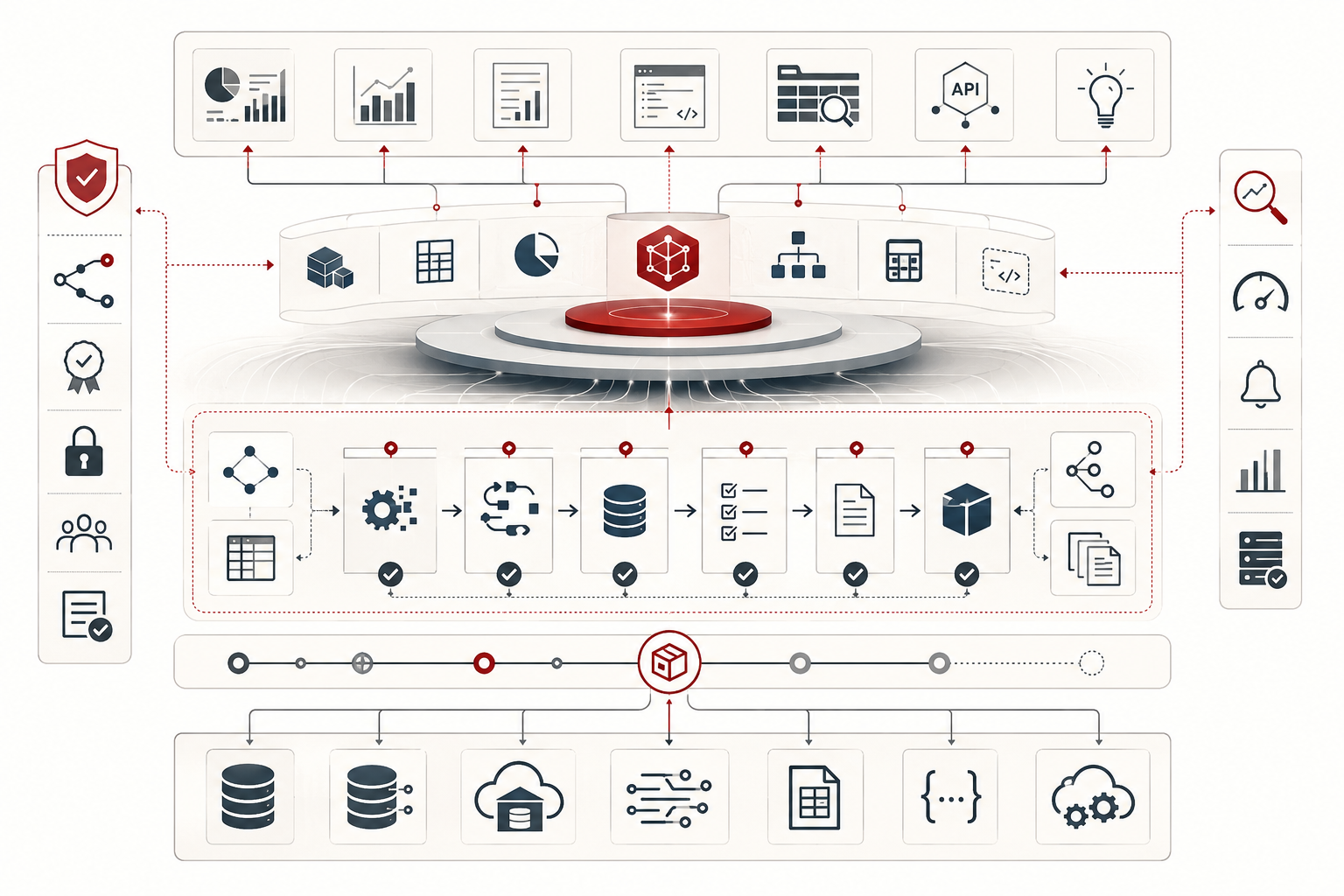
This article builds on themes developed in Database Systems and Data Architecture, Metadata, Data Catalogs, and Lineage, Master Data Management and Entity Resolution, Data Quality Metrics and Observability, Data Products and Self-Service Analytics, and Business Intelligence Systems and Decision Support. If those articles explain how data is structured, described, governed, monitored, productized, and used for decisions, this article addresses the next question: how should data be modeled and interpreted so that analytical outputs remain stable, reusable, and semantically trustworthy across the organization?
A unifying thesis: analytics engineering as semantic governance
Analytics engineering is often described pragmatically as the work of transforming warehouse data into analytics-ready models, but that description understates its deeper importance. At a more rigorous level, analytics engineering should be understood as a form of semantic governance. It establishes the modeled and tested analytical environment through which an organization expresses its business logic in reusable form. It is the layer where raw operational records are turned into entities, dimensions, facts, measures, relationships, and governed metrics that can support consistent analysis rather than one-off extraction.
This matters because analytical disagreement is rarely caused only by missing data. More often, it is caused by unstable interpretation. Different teams calculate active customer, monthly revenue, qualified lead, facility incident, supplier exposure, emissions intensity, or retention differently because the logic for those concepts is scattered across tools and analysts. Analytics engineering addresses that instability by moving key logic out of disposable local artifacts and into governed, versioned, tested, documented, reviewable, and reusable models. In that sense, it is not only a productivity function. It is a discipline for stabilizing analytical meaning.
The semantic layer extends this stabilization outward. If analytics engineering shapes modeled data, the semantic layer defines how analytical consumers interact with it. It makes metrics, hierarchies, filters, dimensions, and business logic available through a shared interpretive contract. For that reason, analytics engineering and semantic layers are best understood together. One governs the construction of analytical models; the other governs the exposure of analytical meaning. The first organizes logic; the second institutionalizes access to that logic.
From data availability to analytical legibility
One of the most important shifts in modern data work is the recognition that data availability does not guarantee analytical legibility. A warehouse may contain thousands of tables, extensive event histories, and rich domain detail, yet still fail to support coherent organizational analysis if consumers cannot determine which model is authoritative, which fields are safe to aggregate, which definitions are shared, which dimensions are compatible, or which metrics are approved for decision-making. The problem is not lack of data. It is lack of governed interpretive structure.
Analytics engineering addresses this by transforming storage into legibility. It does not merely make data queryable. It makes it intelligible in recurring ways. The semantic layer then extends that intelligibility into analytical interfaces by ensuring that the same governed meaning can be reused across multiple downstream tools. This distinction between availability and legibility is crucial. Many organizations have already solved storage. Far fewer have solved interpretation.
Legibility also has an institutional dimension. A model is legible when someone outside the original author can understand its grain, intended use, lineage, assumptions, quality expectations, and limitations. A metric is legible when its definition, calculation logic, time window, owner, version, and decision context are visible. Without that legibility, analytics becomes dependent on tribal memory and individual analysts rather than durable institutional knowledge.
Why analytics engineering emerged
The rise of cloud warehouses, ELT workflows, and software-oriented transformation tooling created a structural opening for analytics engineering. In earlier environments, analytical modeling was often embedded either in ETL pipelines controlled by central engineering teams or in ad hoc reporting logic controlled by analysts inside BI tools. Both arrangements had limitations. Centralized ETL frequently made analytical change slow and dependent on scarce engineering resources. BI-centric logic made analytical output brittle, opaque, difficult to review, and hard to reuse outside the dashboard where it originated.
Analytics engineering emerged as a middle discipline. It brought software development practices—version control, modularity, testing, documentation, dependency management, code review, continuous integration, deployment discipline, and lineage awareness—into the analytical modeling layer. This made it possible for teams to treat transformations, metric definitions, and warehouse models as governed analytical assets rather than informal reporting artifacts. The result was not simply faster dashboard development. It was the creation of a more stable interface between raw data systems and business interpretation.
This shift is historically important because it represents a maturation of analytics from report production into model-based analytical architecture. The organization is no longer just asking for charts. It is building reusable analytical objects that can support many charts, notebooks, decisions, applications, APIs, and AI interfaces without semantic drift at every point of reuse.
What analytics engineering actually does
At a practical level, analytics engineering involves transforming raw source data into analytics-ready structures, testing those structures, documenting them, and maintaining them over time as business logic evolves. This often includes building cleaned staging models, standardized intermediate layers, dimensional models, wide analytical marts, entity definitions, reusable measures, and data tests for integrity and logic. It also includes dependency management, deployment workflows, code review practices, lineage capture, and collaborative modeling standards.
But these tasks should not be misunderstood as purely technical formatting. Analytics engineering performs a translation between operational systems and analytical reasoning. Operational data is usually designed around transactions, process states, application constraints, and system-specific identifiers. Analytical data needs to support aggregation, comparison, trend analysis, entity tracking, cohort logic, time-series reasoning, and decision interpretation. The analytical model is therefore not merely a copy of the operational model. It is a re-articulation of that data in a form suited to inquiry.
This re-articulation introduces judgment. Which entities matter? Which relationships deserve explicit modeling? What level of grain should be preserved? Which business rules define a metric? When should multiple source systems be reconciled into one concept? How should slowly changing entities be represented? What belongs in a shared model rather than a local analysis? Analytics engineering is therefore partly a modeling discipline and partly a governance discipline. It encodes institutional choices about how analytical reality should be structured.
The analytical model as a governed object
One of the most important intellectual moves in analytics engineering is treating analytical models as governed objects rather than temporary query outputs. A modeled table, materialized view, metric definition, semantic model, or reusable mart should not exist only to answer one immediate request. It should exist because it captures a reusable and institutionally meaningful piece of logic. This is what differentiates durable analytical systems from dashboard accumulation.
When analytical models are treated as governed objects, they become subject to standards of design, documentation, testing, ownership, lineage, and maintenance. Teams ask whether the model’s grain is explicit, whether its metrics are stable, whether upstream dependencies are visible, whether field names are semantically intelligible, whether consumers understand its intended use, and whether logic changes are reviewed before deployment. This aligns naturally with the concerns developed in Metadata, Data Catalogs, and Lineage, because modeled analytical assets need to be discoverable, documented, and traceable if they are to function as shared institutional knowledge.
It also aligns with Data Quality Metrics and Observability. If modeled tables and semantic definitions become core analytical infrastructure, then their reliability, freshness, test coverage, and downstream impact must be monitored with the same seriousness as other critical data products.
The semantic layer as an interpretive contract
A semantic layer provides a governed interpretive interface between underlying data models and analytical consumption tools. At its simplest, it defines metrics and dimensions centrally so that dashboards and reports do not reimplement logic independently. At a more advanced level, it can express business entities, hierarchies, calculation logic, filters, access rules, time logic, and relationship semantics in a reusable, tool-aware or tool-agnostic way.
What makes the semantic layer important is not merely convenience. It functions as an interpretive contract. It records what the organization means when it names a metric, dimension, cohort, entity, hierarchy, or filter, and it makes that meaning reusable across interfaces. Without such a contract, analytical environments tend to drift toward local reinterpretation. A revenue metric may be defined differently in finance reporting, sales analytics, and executive dashboards. A customer may mean account in one context, household in another, and active billing relationship in a third. A semantic layer helps surface and manage these differences explicitly rather than allowing them to proliferate silently.
This does not mean that the semantic layer eliminates all disagreement. In complex organizations, multiple legitimate views may exist. But it makes those views governable. It provides a place where definitions can be named, versioned, documented, compared, certified, deprecated, and reused. In that sense, the semantic layer is not simply a metric store. It is a mechanism for analytical semantic control.
Why semantic instability is so damaging
Semantic instability is one of the most corrosive problems in analytics because it undermines trust without always producing visible technical failure. Dashboards load. Queries run. Charts update. Yet the underlying meaning of the metrics may differ enough across teams that decisions become contested or misleading. This form of failure is especially dangerous because it often appears only when conflicting numbers reach a high-stakes setting: executive reviews, board materials, regulatory submissions, strategic planning, financial reporting, public communication, or model evaluation.
Semantic instability also creates hidden labor costs. Analysts spend time reconciling numbers rather than interpreting them. Business stakeholders lose confidence in self-service tools and return to manual extraction. Teams build parallel trusted spreadsheets because they do not believe shared dashboards. Engineering and analytics groups become trapped in repeated arguments over definitions that were never formalized as reusable infrastructure. In this sense, semantic instability is not only a conceptual problem. It is an organizational productivity problem and a governance problem.
The semantic layer is valuable precisely because it seeks to reduce this instability. It does not solve every definitional dispute, but it relocates those disputes into a visible and governable layer where logic can be reviewed, tested, versioned, and documented.
Modeling layers and analytical abstraction
Analytics engineering usually relies on layered modeling rather than one giant transformation step. Raw or source-aligned models preserve fidelity to incoming systems. Staging models standardize types, names, and basic cleanliness. Intermediate models reconcile business logic, relationships, and transformation complexity. Marts or presentation models expose analytics-ready structures organized around entities, facts, dimensions, or functional domains. In some environments, semantic definitions sit on top of these marts as the final interpretive interface.
This layered approach matters because it preserves both traceability and abstraction. If teams collapse every transformation into one reporting table, they lose visibility into how meaning was constructed. If they remain too close to raw operational data, analytical consumers inherit unnecessary complexity. Layering makes it possible to separate concerns: source fidelity, cleaning, business transformation, and analytical presentation. It is therefore both a technical and epistemic design strategy.
The best layered environments also make grain explicit. A model should clearly state what one row represents, what entities and periods are in scope, what joins are safe, and what questions the model is intended to answer. Grain confusion is one of the most common causes of analytical error, and analytics engineering exists partly to reduce that risk.
Metrics, dimensions, and entities
The semantic layer typically organizes analytical meaning around three foundational elements: metrics, dimensions, and entities. Metrics represent quantitatively interpreted measures such as revenue, cost, conversion rate, incident count, emissions intensity, utilization, retention, or risk exposure. Dimensions provide the categories, attributes, or coordinates along which metrics can be analyzed, such as product, customer segment, geography, facility, supplier, time period, channel, or cohort. Entities provide the governed objects about which the organization reasons, such as customer, supplier, product, employee, facility, household, account, asset, transaction, or event.
This structure matters because many analytical errors result from weak separation among these elements. A field that looks like a metric may in fact be an ungoverned operational state. A dimension may not be stable across systems. An entity may be unresolved or inconsistently mastered. Strong semantic layers and analytics engineering practices make these distinctions explicit, which improves both interpretability and reuse.
This also creates a strong connection to Master Data Management and Entity Resolution. A semantic layer built on unresolved or unstable entities will inherit that instability. The quality of the semantic layer therefore depends in part on the entity coherence of the broader data environment.
A mathematical lens for semantic trust
Analytics engineering and semantic layers can also be evaluated through a mathematical lens. The purpose is not to reduce institutional meaning to a simplistic score. The purpose is to make the components of semantic trust explicit. A metric becomes trustworthy when its definition is clear, its grain is stable, its lineage is visible, its tests pass, its owner is known, its usage context is understood, and its alternatives or competing definitions are governed.
T_m = w_C C_m + w_G G_m + w_L L_m + w_Q Q_m + w_O O_m + w_U U_m
\]
Interpretation: Semantic trust \(T_m\) for metric \(m\) is a weighted combination of certification \(C_m\), grain clarity \(G_m\), lineage visibility \(L_m\), quality and test coverage \(Q_m\), ownership \(O_m\), and usage evidence \(U_m\).
The weights should be transparent:
w_C + w_G + w_L + w_Q + w_O + w_U = 1
\]
Interpretation: The scoring model should state how much weight is assigned to each source of trust. A decision-critical finance metric may weight certification, lineage, and testing heavily, while an exploratory product metric may weight usage, iteration, and documented plurality more heavily.
Definition drift can be represented as the degree to which local metric definitions proliferate outside the governed semantic layer:
D_m = \frac{N_m – 1}{N_m}
\]
Interpretation: Definition drift \(D_m\) rises as the number of active local definitions \(N_m\) increases. If there is one governed definition, drift is zero. If many competing definitions exist, drift approaches one.
Semantic reliability can also be evaluated at the model layer:
R_s = \frac{P + L + Q + V}{4}
\]
Interpretation: Semantic reliability \(R_s\) can be approximated as the average of passing model tests \(P\), lineage coverage \(L\), documented quality expectations \(Q\), and version-control discipline \(V\). Low reliability means the semantic layer may look stable while hiding fragile assumptions.
This lens supports better governance because it changes the question from “does the metric exist?” to “is the metric governed, tested, traceable, adopted, and semantically stable enough to support the decisions being made with it?”
Python Workflow: Semantic Layer Trust Scorecard
The following Python workflow shows how a semantic layer can be scored using certification status, definition drift, lineage visibility, usage, and grain clarity. In production, these inputs might come from a transformation framework, semantic layer, catalog, BI metadata, lineage platform, and test-results store.
#!/usr/bin/env python3
"""
Python Workflow: Semantic Layer Trust Scorecard

This compact workflow evaluates semantic metrics as governed analytical
objects rather than as dashboard-local calculations.
"""

from __future__ import annotations

from dataclasses import dataclass


@dataclass
class SemanticMetric:
    metric_id: str
    metric_name: str
    domain: str
    certification_status: str
    grain: str
    lineage_present: bool
    local_definition_count: int
    total_usage: int
    owner_present: bool


def certification_score(status: str) -> float:
    scores = {
        "certified": 1.0,
        "reviewed": 0.7,
        "uncertified": 0.2,
    }
    return scores.get(status, 0.0)


def grain_score(grain: str) -> float:
    return 0.0 if grain in {"", "mixed", "unknown"} else 1.0


def semantic_consistency_score(local_definition_count: int) -> float:
    """
    A simple inverse relationship between local competing definitions
    and semantic consistency.
    """
    return round(1.0 / (1.0 + local_definition_count), 3)


def usage_score(total_usage: int) -> float:
    """
    Normalize observed use into a 0-1 adoption signal.
    A production version should benchmark usage against expected audience.
    """
    return min(total_usage / 500.0, 1.0)


def semantic_trust_score(metric: SemanticMetric) -> float:
    return round(
        0.30 * certification_score(metric.certification_status)
        + 0.20 * semantic_consistency_score(metric.local_definition_count)
        + 0.20 * float(metric.lineage_present)
        + 0.15 * usage_score(metric.total_usage)
        + 0.10 * grain_score(metric.grain)
        + 0.05 * float(metric.owner_present),
        3,
    )


def main() -> None:
    metrics = [
        SemanticMetric(
            metric_id="met_net_revenue",
            metric_name="net_revenue",
            domain="finance",
            certification_status="certified",
            grain="accounting_period",
            lineage_present=True,
            local_definition_count=1,
            total_usage=635,
            owner_present=True,
        ),
        SemanticMetric(
            metric_id="met_order_conversion_rate",
            metric_name="order_conversion_rate",
            domain="commerce",
            certification_status="reviewed",
            grain="session_day",
            lineage_present=True,
            local_definition_count=4,
            total_usage=124,
            owner_present=True,
        ),
        SemanticMetric(
            metric_id="met_legacy_revenue",
            metric_name="legacy_revenue",
            domain="legacy",
            certification_status="uncertified",
            grain="mixed",
            lineage_present=False,
            local_definition_count=6,
            total_usage=63,
            owner_present=True,
        ),
    ]

    for metric in metrics:
        print(
            metric.metric_id,
            metric.metric_name,
            "semantic_trust_score=",
            semantic_trust_score(metric),
        )


if __name__ == "__main__":
    main()
This workflow makes metric governance inspectable. A semantic trust score should not be hidden inside the same dashboards it evaluates. The criteria should be visible enough for analytics engineers, data stewards, metric owners, and business leaders to debate whether the weights reflect the organization’s actual decision risk and governance priorities.
R Workflow: Semantic Metric, Model, and Consumption Summary
The following R workflow summarizes model layers, metric certification, test status, usage, and definition drift. It supports a recurring semantic governance review: which models are active, which metrics are certified, where tests are failing, which metrics are heavily used, and where local definitions have drifted away from the governed semantic layer?
#!/usr/bin/env Rscript

# R Workflow: Semantic Metric, Model, and Consumption Summary
#
# This workflow summarizes analytics models, semantic metrics,
# model tests, metric consumption, and definition drift using base R.

models <- data.frame(
  model_id = c(
    "mod_stg_orders",
    "mod_int_customer_orders",
    "mod_fct_revenue",
    "mod_mart_executive_metrics",
    "mod_legacy_dashboard_logic"
  ),
  layer = c(
    "staging",
    "intermediate",
    "mart",
    "presentation",
    "presentation"
  ),
  lifecycle_status = c(
    "active",
    "active",
    "active",
    "active",
    "deprecated"
  ),
  stringsAsFactors = FALSE
)

metrics <- data.frame(
  metric_id = c(
    "met_net_revenue",
    "met_active_customer",
    "met_weekly_active_user",
    "met_order_conversion_rate",
    "met_legacy_revenue"
  ),
  domain = c(
    "finance",
    "customer",
    "product",
    "commerce",
    "legacy"
  ),
  certification_status = c(
    "certified",
    "certified",
    "certified",
    "reviewed",
    "uncertified"
  ),
  stringsAsFactors = FALSE
)

tests <- data.frame(
  test_id = c("test001", "test002", "test003", "test004", "test005"),
  model_id = c(
    "mod_stg_orders",
    "mod_int_customer_orders",
    "mod_fct_revenue",
    "mod_mart_executive_metrics",
    "mod_legacy_dashboard_logic"
  ),
  status = c("pass", "pass", "pass", "pass", "fail"),
  stringsAsFactors = FALSE
)

usage <- data.frame(
  metric_id = c(
    "met_net_revenue",
    "met_active_customer",
    "met_weekly_active_user",
    "met_order_conversion_rate",
    "met_legacy_revenue"
  ),
  query_count = c(250, 197, 164, 60, 18),
  dashboard_views = c(376, 297, 229, 33, 45),
  notebook_sessions = c(9, 26, 52, 31, 0)
)

drift <- data.frame(
  metric_name = c(
    "net_revenue",
    "active_customer",
    "weekly_active_user",
    "order_conversion_rate",
    "legacy_revenue"
  ),
  local_definition_count = c(1, 3, 2, 4, 6),
  drift_status = c("low", "medium", "medium", "high", "high"),
  stringsAsFactors = FALSE
)

model_layer_summary <- aggregate(
  model_id ~ layer + lifecycle_status,
  data = models,
  FUN = length
)

names(model_layer_summary) <- c(
  "layer",
  "lifecycle_status",
  "model_count"
)

metric_certification_summary <- aggregate(
  metric_id ~ domain + certification_status,
  data = metrics,
  FUN = length
)

names(metric_certification_summary) <- c(
  "domain",
  "certification_status",
  "metric_count"
)

test_summary <- aggregate(
  test_id ~ status,
  data = tests,
  FUN = length
)

names(test_summary) <- c("status", "test_count")

usage$total_usage <- (
  usage$query_count +
  usage$dashboard_views +
  usage$notebook_sessions
)

drift_summary <- aggregate(
  local_definition_count ~ drift_status,
  data = drift,
  FUN = mean
)

names(drift_summary) <- c(
  "drift_status",
  "average_local_definition_count"
)

dir.create("outputs", showWarnings = FALSE, recursive = TRUE)

write.csv(model_layer_summary, "outputs/model_layer_summary_r.csv", row.names = FALSE)
write.csv(metric_certification_summary, "outputs/metric_certification_summary_r.csv", row.names = FALSE)
write.csv(test_summary, "outputs/model_test_summary_r.csv", row.names = FALSE)
write.csv(usage, "outputs/metric_usage_summary_r.csv", row.names = FALSE)
write.csv(drift_summary, "outputs/definition_drift_summary_r.csv", row.names = FALSE)

cat("Wrote semantic metric, model, and consumption summaries.\n")
This workflow distinguishes semantic adoption from semantic trust. A metric can be heavily used but poorly governed. A model can be active but weakly tested. A semantic layer can exist but still suffer definition drift if local dashboard logic continues to proliferate outside governed definitions.
Metrics as institutional claims
A useful advanced perspective is to treat metrics not merely as calculations but as institutional claims. A metric says that a phenomenon has been rendered measurable in a specific way. It embodies assumptions about units, inclusions, exclusions, time boundaries, aggregation logic, entity resolution, business meaning, and decision relevance. For that reason, a metric definition is not only a technical artifact. It is a compact statement of organizational interpretation.
This perspective is important because it explains why metric governance is so central. Two teams may appear to disagree about numbers when they actually disagree about the claims embedded in those numbers. A semantic layer helps here by forcing metrics into explicit, named, reusable forms. It exposes whether active customer means any purchasing customer in the last 12 months, any logged-in user in the last 30 days, any customer with a current contract, or any currently billable account. Once the claim becomes explicit, it can be governed, debated, versioned, and used appropriately rather than remaining buried in local query logic.
Seen this way, semantic layers are not only technical accelerators. They are institutions for disciplined metric authorship.
Facts, dimensions, and the politics of modeling
Much of analytics engineering still operates with concepts inherited from dimensional modeling: fact tables record measurable events or states, while dimension tables provide descriptive context for analysis. These ideas remain useful because they impose discipline on analytical structure. They help teams separate event logic from descriptive classification, preserve grain, and organize models in ways that support clear aggregation. Yet even these seemingly technical decisions are not neutral. They privilege certain views of the organization over others.
To define a fact is to decide what counts as an analytically meaningful event. To define a dimension is to decide which attributes deserve repeated interpretive use. To model one entity as central and another as contextual is to institutionalize a way of seeing the organization. This is why analytics engineering is inseparable from organizational judgment. The model does not merely mirror reality. It selects, organizes, and stabilizes one usable representation of reality for institutional purposes.
This does not make modeling arbitrary. It makes it accountable. The discipline lies in making abstractions explicit, documented, reviewable, and fit for the analytical decisions they are intended to support.
Semantic layers and multiple coexisting truths
One weakness of simplistic semantic-layer discourse is the assumption that there is always one universal business definition waiting to be discovered and encoded. In practice, organizations often contain multiple legitimate analytical truths. Finance may need a stricter revenue definition than growth marketing. Compliance may require a more conservative incident classification than operations. Sustainability reporting may define organizational boundaries differently from facility management. Public reporting may require different aggregation and exclusion rules than internal experimentation. In such cases, the problem is not that one side is wrong and the other is right. The problem is whether those distinctions are visible, governed, and stable.
A mature semantic layer therefore does not merely centralize one canonical answer for every question. It must also support controlled plurality: multiple named and documented definitions where organizational reality genuinely requires them. The goal is not false uniformity. It is disciplined explicitness. A strong semantic environment makes it clear when different metrics or dimensional views coexist, why they exist, and which use cases each one supports.
This point is crucial because semantic governance fails when it confuses legitimate plurality with disorder. The semantic layer should reduce chaos, not erase necessary nuance.
Versioning, testing, and change management
Because analytical logic evolves, analytics engineering requires disciplined change management. New source systems appear. Definitions change. Hierarchies shift. Business stakeholders revise what they mean by a core KPI. Regulatory and reporting requirements evolve. Data products are deprecated. Semantic definitions become obsolete. If these changes are introduced carelessly, analytical continuity collapses. Teams lose the ability to compare time periods, dashboards diverge, and stakeholders stop trusting the system.
Version control and testing help manage this risk. Logic changes should be reviewable. Data tests should validate structural expectations, uniqueness assumptions, referential integrity, accepted value sets, reconciliation outcomes, freshness expectations, and transformation results. Documentation should explain what changed and why. Semantic definitions should be versioned when meaning changes materially rather than overwritten invisibly. Change management in this context is not just software hygiene. It is a way of preserving analytical memory.
This is one reason analytics engineering has strong affinities with software engineering while remaining distinct from it. The goal is not merely code quality. It is interpretive continuity under changing institutional conditions.
Self-service analytics and governed access
One of the recurring promises of modern analytics platforms is self-service. Business users should be able to explore data, build dashboards, and answer questions without depending on specialist teams for every request. That promise is attractive, but it breaks down if semantic foundations are weak. Without governed models and reusable definitions, self-service often becomes distributed inconsistency rather than empowered analysis.
Analytics engineering and semantic layers make self-service more realistic because they reduce the semantic burden placed on each consumer. Instead of reconstructing business logic from raw tables, users can work from curated models and governed measures. This does not eliminate the need for expertise. But it shifts that expertise toward interpretation and decision-making rather than repeated definitional reconstruction. In this sense, the semantic layer is empowering only when it is also governing.
There is therefore a productive tension here. Too little governance and self-service produces metric chaos. Too much rigidity and the analytical environment becomes slow, exclusionary, and unresponsive to domain nuance. Mature systems balance governed core definitions with enough flexibility for exploratory work, localized inquiry, and legitimate plurality.
Semantic layers, tool independence, and portability
One strategic advantage of semantic layers is that they can reduce dependence on any one consumption tool. When core metrics and business logic live only inside dashboards, changing BI tools becomes difficult and semantic consistency becomes fragile. When analytical meaning is expressed in a reusable semantic layer, multiple tools—dashboards, notebooks, applications, APIs, embedded analytics interfaces, and AI-assisted query systems—can consume the same governed definitions.
This matters not only for technical flexibility but for institutional durability. Organizations change tools more often than they change core business concepts. A semantic layer helps preserve those concepts across interface shifts, vendor changes, workflow evolution, and expanding analytical use cases. It turns analytical meaning into a more portable asset.
At the same time, tool independence should not be romanticized. Some semantic logic remains shaped by engine capabilities, query patterns, permissions, caching strategies, and performance trade-offs. The goal is not perfect abstraction from every technical constraint. It is stronger separation between core analytical meaning and disposable presentation logic.
Performance, governance, and the economics of abstraction
Analytics engineering and semantic layers are often presented as cleanly beneficial, but they introduce trade-offs. Rich semantic abstraction can improve consistency while also adding complexity, governance overhead, and sometimes performance costs. Central metric definitions can increase trust while also creating bottlenecks if governance is too centralized or review cycles are too slow. Layered modeling can improve clarity while also increasing the number of assets that teams must document and maintain.
These trade-offs are not signs of failure. They reflect the fact that semantic infrastructure is organizational infrastructure. It requires decisions about authority, ownership, and acceptable complexity. Who is allowed to define a canonical metric? Which domains deserve central modeling and which can remain local? When should a semantic definition be global, and when should multiple valid definitions coexist? These are not merely technical questions. They are governance questions about whose interpretation becomes institutionalized.
There is also an economics of abstraction. Each additional layer, model, and semantic definition promises reuse, but it also creates maintenance obligations. Over-modeling can trap teams in elegant architectures that few people understand. Under-modeling leaves logic scattered and unstable. Mature practice lies in building enough abstraction to stabilize high-value meaning without constructing a semantic bureaucracy that outruns user need.
That is why the politics of abstraction matters. Every semantic layer simplifies. Every model foregrounds some entities and relationships while backgrounding others. A serious analytics engineering practice acknowledges that abstraction is not neutral. It is useful precisely because it is selective, but that selectivity should remain visible and reviewable.
Observability, lineage, and semantic reliability
Once semantic layers and analytical models become shared infrastructure, they must be observed and governed accordingly. A freshness failure in a semantic model may affect dozens of dashboards. A logic change in a central metric may ripple through executive reporting and model evaluation. A broken join in an intermediate model may silently distort a wide range of derived outputs. This is why analytics engineering must connect directly to Data Quality Metrics and Observability.
Testing, lineage, and observability help make semantic infrastructure inspectable. Model tests can validate assumptions. Lineage can show which downstream assets depend on a changed semantic definition. Observability can detect freshness, schema, volume, or distribution failures before they become trust failures in decision settings. Standards for metadata and quality description are relevant here. The W3C Data Catalog Vocabulary (DCAT) – Version 3 supports data catalog interoperability, while the W3C Data Quality Vocabulary (DQV) provides a framework for describing dataset quality. OpenLineage also reinforces the broader value of tracking datasets, jobs, and runs for root-cause analysis and impact analysis. When these disciplines are disconnected, semantic layers can become polished but brittle surfaces. When integrated, they become more reliable institutional assets.
Semantic reliability is therefore not just a matter of correct SQL. It depends on whether meaning changes are visible, dependencies are understood, failures are observable, and downstream impacts can be traced before they distort decisions.
Common failure modes
Organizations often struggle with analytics engineering and semantic layers in predictable ways.
One failure mode is mistaking centralization for semantic clarity. Many definitions are gathered in one place, but they remain vague, overlapping, poorly documented, or under-governed.
A second is building extensive models with weak user adoption. Teams continue using local logic because the shared layer does not reflect how they actually reason about the business.
A third is over-modeling. Analytical environments become so abstract and complex that only a few specialists can understand them.
A fourth is hidden semantic drift. Metrics keep the same names while business logic changes underneath them.
A fifth is poor grain discipline, which leads to duplicated counts, unsafe joins, and unstable aggregations.
A sixth is weak change management, where core metrics are altered without documentation, versioning, or impact analysis.
A seventh is confusing tool features with semantic governance, assuming that BI-calculated fields, dashboard filters, or tool-specific metric layers alone constitute a governed semantic layer.
An eighth is semantic-layer isolation, where metrics are defined but not connected to lineage, tests, data quality indicators, access controls, or product ownership.
These failure modes show that semantic infrastructure is not guaranteed by software procurement. It depends on disciplined modeling, stewardship, adoption, and institutional clarity.
Implementation principles
Model for reuse, not just delivery. Analytical models should capture durable logic that can support many uses, not merely the immediate needs of a single dashboard or stakeholder request.
Make grain explicit. Each model should clearly communicate what one row represents, what entities and periods are in scope, and what types of aggregation or joining are safe.
Govern core metrics as shared claims. Institutionally important metrics should be named, documented, tested, versioned, and exposed through reusable semantic definitions rather than buried in local query logic.
Allow disciplined plurality where needed. When multiple valid definitions exist for legal, operational, financial, public-reporting, or strategic reasons, the semantic layer should make them explicit and governed rather than forcing false uniformity.
Connect semantic definitions to entities and lineage. Metrics and dimensions should be traceable back to mastered entities, modeled sources, and downstream dependencies so that meaning and impact remain inspectable.
Balance governance with analytical flexibility. Core definitions should be stable, but exploratory work and domain nuance should still be possible without forcing every question into premature central standardization.
Treat analytical models as products. Important models and semantic definitions should have owners, documentation, reliability expectations, lifecycle status, and change-management practices comparable to other shared data products.
Design for adoption, not only architectural elegance. A semantic layer succeeds when people actually use and trust it. Usability, discoverability, and relevance matter as much as technical sophistication.
| Control | Purpose | Failure it prevents |
|---|---|---|
| Explicit model grain | Clarifies what each row represents and which joins are safe | Duplicated counts, unsafe aggregation, and grain confusion |
| Certified metrics | Defines reusable business measures with ownership and versioning | Metric drift and conflicting dashboard logic |
| Model testing | Validates nulls, uniqueness, accepted values, freshness, and reconciliation | Silent model failure and unstable downstream outputs |
| Lineage capture | Shows upstream dependencies and downstream impact | Untraceable semantic changes and weak impact analysis |
| Definition drift review | Identifies local definitions competing with governed metrics | Parallel spreadsheets, dashboard-local logic, and unresolved meaning conflict |
| Versioned semantics | Preserves analytical continuity when meanings change | Invisible overwriting of core business logic |
| Disciplined plurality | Allows multiple valid definitions where real institutional differences exist | False uniformity and semantic erasure |
| Adoption monitoring | Tracks whether governed definitions are actually used | Elegant but unused semantic infrastructure |
GitHub Repository
This article can be paired with a companion code workflow that models analytics engineering and semantic layers as semantic governance infrastructure. The example includes a model registry, semantic metric catalog, test results, lineage edges, metric usage events, definition-drift records, SQL schemas, scorecard scripts, typed contracts, governance checklists, semantic metric documentation, and multi-language examples across Python, R, Julia, SQL, Go, Rust, C, C++, TypeScript, and Terraform placeholders.
Conclusion
Analytics engineering and semantic layers are essential to modern data systems because they stabilize the interpretive layer between raw data infrastructure and analytical consumption. Analytics engineering transforms operationally structured data into tested, documented, and reusable analytical models. Semantic layers expose metrics, dimensions, entities, hierarchies, and business logic through a governed interface that supports consistency across dashboards, notebooks, applications, APIs, reports, and AI-enabled analytical workflows.
Together, these capabilities help organizations move beyond dashboard production toward analytical coherence. More deeply, they help preserve semantic trust: the ability of teams to rely on shared metrics and models with justified confidence rather than repeated reconciliation, local reinvention, or interface-level guesswork. In that sense, analytics engineering and semantic layers are not merely workflow optimizations. They are part of the institutional infrastructure required for trustworthy analytics and defensible decision-making.
Related articles
- Data Systems and Analytics knowledge series
- Database Systems and Data Architecture
- Metadata, Data Catalogs, and Lineage
- Master Data Management and Entity Resolution
- Data Quality Metrics and Observability
- Data Products and Self-Service Analytics
- Business Intelligence Systems and Decision Support
Further reading
- Adamson, C. (2010) Star Schema: The Complete Reference. New York: McGraw-Hill.
- Kimball, R. and Ross, M. (2013) The Data Warehouse Toolkit: The Definitive Guide to Dimensional Modeling. 3rd edn. Indianapolis: Wiley.
- Kleppmann, M. (2017) Designing Data-Intensive Applications. Sebastopol: O’Reilly Media.
- Redman, T.C. (2008) Data Driven: Profiting from Your Most Important Business Asset. Boston: Harvard Business Press.
- Zeng, M.L. and Qin, J. (2016) Metadata. 2nd edn. Chicago: ALA Neal-Schuman.
- Zins, C. (2007) ‘Conceptual approaches for defining data, information, and knowledge’, Journal of the American Society for Information Science and Technology, 58(4), pp. 479–493.
References
- Adamson, C. (2010) Star Schema: The Complete Reference. New York: McGraw-Hill.
- dbt Labs (2026) dbt Semantic Layer. Available at: https://docs.getdbt.com/docs/use-dbt-semantic-layer/dbt-sl
- dbt Labs (2026) Semantic models. Available at: https://docs.getdbt.com/docs/build/semantic-models
- Kimball, R. and Ross, M. (2013) The Data Warehouse Toolkit: The Definitive Guide to Dimensional Modeling. 3rd edn. Indianapolis: Wiley.
- Kleppmann, M. (2017) Designing Data-Intensive Applications. Sebastopol: O’Reilly Media.
- OpenLineage (n.d.) About OpenLineage. Available at: https://openlineage.io/docs/
- Redman, T.C. (2008) Data Driven: Profiting from Your Most Important Business Asset. Boston: Harvard Business Press.
- W3C (2016) Data on the Web Best Practices: Data Quality Vocabulary. Available at: https://www.w3.org/TR/vocab-dqv/
- W3C (2024) Data Catalog Vocabulary (DCAT) – Version 3. Available at: https://www.w3.org/TR/vocab-dcat-3/
- Zeng, M.L. and Qin, J. (2016) Metadata. 2nd edn. Chicago: ALA Neal-Schuman.
- Zins, C. (2007) ‘Conceptual approaches for defining data, information, and knowledge’, Journal of the American Society for Information Science and Technology, 58(4), pp. 479–493.