
Last Updated May 11, 2026
Data security, privacy, and access control have become foundational to modern data systems because analytical value and institutional trust depend not only on making data available, but on governing who can access which data, under what conditions, for what purposes, and with what safeguards. In immature environments, security is often treated as a perimeter problem, privacy as a legal afterthought, and access control as a narrow administrative task of granting permissions. In mature environments, these concerns are understood as part of the core architecture of data systems themselves. They shape how data is classified, modeled, segmented, transmitted, monitored, retained, transformed, and exposed across platforms, teams, applications, semantic layers, dashboards, notebooks, APIs, models, and workflows.
This broader view matters because modern data ecosystems are distributed, dynamic, and highly interconnected. Data moves across warehouses, lakes, applications, APIs, notebooks, dashboards, semantic layers, machine-learning pipelines, external sharing environments, and automated service accounts. Every movement, transformation, and exposure point introduces questions of confidentiality, integrity, authorization, identity, purpose limitation, inference risk, and accountability. The problem is not only preventing malicious intrusion. It is also preventing overexposure, misuse, inappropriate inference, silent privilege accumulation, weak segmentation, uncontrolled downstream propagation, and the gradual normalization of access that no longer has a defensible purpose.
Main Library
Publications
Article Map
Data Systems & Analytics
Related Topic
Artificial Intelligence Systems
Related Topic
Intelligent Infrastructure Systems
Related Topic
Economic Systems
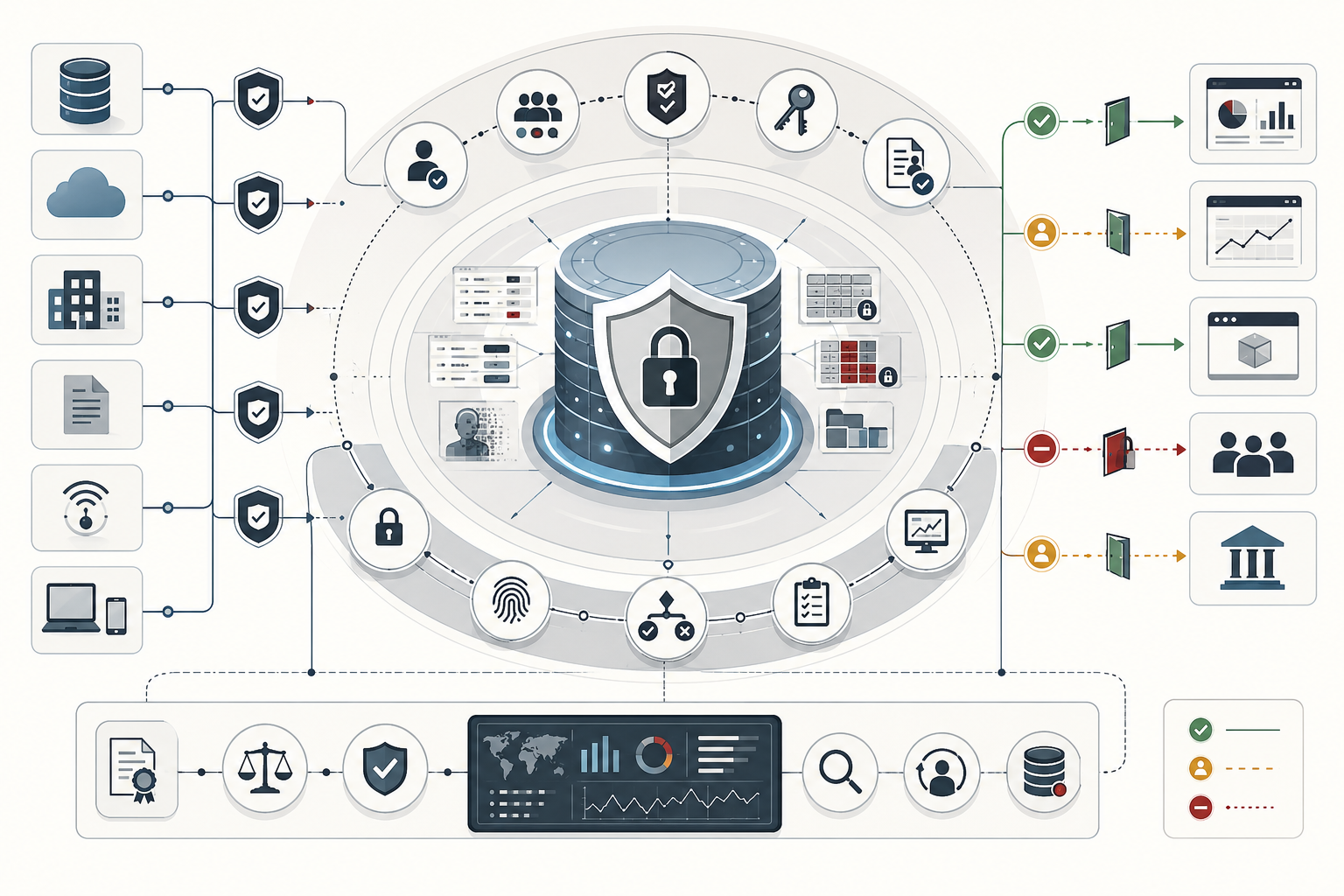
This article builds on the themes developed in Database Systems and Data Architecture, Metadata, Data Catalogs, and Lineage, Data Quality Metrics and Observability, Analytics Engineering and Semantic Layers, and Data Integration and Interoperability. If those articles address how data is structured, described, governed, monitored, integrated, and interpreted, this article addresses the question that shadows all of them: how can organizations secure data, protect privacy, and govern access in ways that preserve both analytical utility and institutional legitimacy?
A unifying thesis: security, privacy, and access as governance of data power
At a sufficiently rigorous level, data security, privacy, and access control should not be treated as three separate administrative domains. They are better understood as overlapping forms of governance over data power. Security governs protection against unauthorized compromise, alteration, destruction, disruption, or exposure. Privacy governs the legitimate and bounded handling of data about people, especially when that data can affect autonomy, dignity, risk, fairness, opportunity, or collective vulnerability. Access control governs the conditions under which actors—human users, service accounts, applications, automated agents, models, pipelines, and external partners—may interact with resources, records, models, systems, or functions.
These domains overlap because the question is not simply whether data is locked down, but whether control over data is proportionate, justified, auditable, and fit for institutional purpose. A system can be technically secure while still violating privacy norms through excessive surveillance or overcollection. It can have privacy language in policy while still allowing overbroad internal access. It can implement formal access roles while failing to reflect real risk because permissions accumulate unchecked over time. It can encrypt data at rest while copying sensitive fields into dashboards, notebooks, extracts, and model features where governance becomes far weaker.
The deeper challenge is therefore not isolated control mechanisms, but coherent governance over how informational power is distributed and exercised. Data systems confer power: the power to observe, combine, infer, profile, decide, automate, exclude, rank, intervene, and remember. Security, privacy, and access control are the mechanisms through which that power is constrained, justified, and made accountable.
Why these concerns belong inside data architecture
Data security and privacy are sometimes treated as overlays applied after a data platform is built. That is usually a mistake. Once a system’s schemas, flows, transformations, replication paths, semantic layers, and sharing patterns are established, many of the most important security and privacy consequences are already embedded in the architecture. Data copied into too many zones becomes harder to control. Weak classification makes downstream policy enforcement inconsistent. Sensitive fields mixed indiscriminately into broad analytical tables create unnecessary exposure. Unclear lineage makes it difficult to know where regulated or confidential information has propagated. Overly broad semantic models can expose more than consumers need to see.
This is why security, privacy, and access control belong inside architectural design rather than outside it. Questions such as where sensitive attributes should reside, when tokenization or masking should occur, how identity should be federated, what access boundary should exist between raw and curated layers, how fine-grained permissions should be enforced, and how sensitive fields should move through semantic models are not merely administrative afterthoughts. They are structural decisions about how the data environment will distribute risk.
The strongest architecture treats controls as design constraints from the beginning. Classification should shape storage and transformation patterns. Purpose limitation should shape what fields are collected and retained. Access-control models should shape how data products, marts, APIs, and dashboards are exposed. Lineage should make sensitive propagation visible. Audit logs should connect identity, action, resource, time, and decision. Security and privacy are not external compliance wrappers. They are part of how a data system is made legitimate.
Security, privacy, and access control: distinguishing the domains
Although tightly connected, these domains should still be distinguished analytically. Security is primarily concerned with protecting systems and data from unauthorized access, misuse, compromise, disruption, and tampering. It includes confidentiality, integrity, availability, resilience, monitoring, detection, response, and recovery. Privacy is concerned with the legitimate collection, use, sharing, retention, inference, and interpretation of data about persons, especially where such handling can create individual or collective harms. Access control is concerned with the mechanisms and policies that determine who may access which resources, with what permissions, under what contextual constraints, for what purpose, and with what oversight.
These distinctions matter because an organization can excel in one domain while remaining weak in another. A system can be hardened against external attack and still expose sensitive internal data too broadly. It can comply with authentication rules while failing to enforce object-level authorization. It can mask direct identifiers while still enabling re-identification through linkage. It can maintain privacy policies while retaining more data than it needs. It can grant access only to employees while ignoring whether those employees still have a legitimate purpose.
The practical lesson is that access should be evaluated through multiple lenses at once. Who is requesting access? What asset is being accessed? How sensitive is it? What action is requested? Is the purpose legitimate? Is the request consistent with role, context, device, workload, and behavior? Will the result expose more information than necessary? Can the decision be audited later? Mature data systems answer these questions before access becomes routine.
The classical triad and its limits
Security discourse often begins with the confidentiality, integrity, and availability triad. The triad remains useful because it captures three core security objectives: keeping information from unauthorized disclosure, protecting it from improper modification, and ensuring it remains available when needed. Yet for modern data systems, the triad is necessary but not sufficient. It says little by itself about purpose limitation, inferential exposure, internal overprivilege, identity assurance, lawful or legitimate basis for use, explainable authorization, or whether access patterns remain appropriate as systems evolve.
That is why mature data governance expands the frame. Confidentiality must be linked to classification and minimization. Integrity must be linked not only to malicious tampering but to trustworthy transformation, lineage, reproducibility, and quality controls. Availability must be balanced with resilience, continuity, and risk-tiered recovery expectations. Privacy adds further dimensions: whether data should have been collected in the first place, whether downstream uses remain appropriate, whether identifiability is controlled adequately, whether retention remains justified, and whether users or subjects are exposed to harms through aggregation and inference even when no overt breach has occurred.
A data system can satisfy narrow security requirements and still be institutionally untrustworthy if it enables unjustified surveillance, uncontrolled secondary use, or opaque automated decision-making. The architecture of trust must therefore include both protection from attackers and protection from misuse by authorized systems and actors.
Data classification as the foundation of control
One of the first requirements of serious security and privacy practice is data classification. Organizations cannot protect everything equally, nor should they. Controls need to reflect the sensitivity, criticality, contractual constraints, regulatory significance, operational importance, and potential harm associated with data assets. Classification gives the environment a vocabulary for making those distinctions visible. Public data, internal data, confidential data, regulated data, restricted data, credentials, secrets, and high-risk personal data should not move through the same workflows with identical handling assumptions.
Classification also connects directly to metadata and lineage. A data asset that is not tagged or classified correctly cannot reliably inherit the right controls downstream. If a restricted field is copied into a curated table, dashboard, model feature, notebook, export, or semantic metric without carrying classification context, the environment loses track of risk. This is one reason metadata systems matter operationally. They are not merely descriptive. They provide the substrate through which classification, policy, stewardship, and access decisions can be attached to actual assets and flows.
Classification should also be revisited over time. Data that appears low risk in isolation may become more sensitive when linked with other assets. Aggregate outputs may become sensitive when broken down by small groups. Operational logs may become personal data when they reveal behavior, location, or work patterns. Mature classification is therefore dynamic rather than static.
Identity, authentication, and authorization
Access control begins with identity, but it does not end there. Identity systems attempt to establish who or what is requesting access. Authentication attempts to verify that claim. Authorization determines what an authenticated subject is allowed to do. These distinctions are basic, yet many environments still conflate them. Strong authentication cannot compensate for weak authorization. Multifactor authentication can reduce risk from compromised credentials, but it does not by itself prevent a valid user from accessing data they should not see.
In data systems, authorization becomes especially important because access is mediated through many surfaces: SQL roles, BI permissions, notebooks, API tokens, application scopes, service accounts, semantic-layer entitlements, object-store policies, model-serving permissions, and row- or column-level rules. The deeper challenge is not just authenticating users well, but aligning entitlements with actual need, context, and risk.
Machine identities deserve special attention. Service accounts, pipeline identities, application tokens, model-serving identities, and automation workflows may have broad and persistent access. They are sometimes treated as background infrastructure rather than as powerful actors. That is dangerous. Automated access can move, transform, expose, or delete large amounts of data quickly. Machine identities therefore need ownership, scope, rotation, monitoring, and review just as human identities do.
Least privilege, separation of duties, and deny by default
Least privilege is one of the most durable principles in security and access governance. Subjects should receive only the permissions needed for their legitimate tasks, and only for the time and scope required. This principle matters because excessive access is one of the most common ways that security, privacy, and compliance risks accumulate silently. People change roles, projects expand, exceptions are granted temporarily and never removed, service accounts gain broad reach, and group memberships produce entitlement inheritance no one fully understands.
Deny-by-default strengthens this posture by requiring explicit justification for access rather than assuming that access is acceptable unless prohibited. This matters in analytical environments where new tables, extracts, dashboards, and notebooks can multiply quickly. Default openness may feel efficient in the short term, but it can normalize broad exposure before classification, minimization, or purpose review has occurred.
Separation of duties adds another layer by ensuring that no single actor can perform a sequence of sensitive actions without oversight. In data systems, this might mean separating administrative role management from approval of sensitive data release, separating production access from code deployment authority, or separating data product certification from the team that benefits from publication. These controls are not bureaucracy for its own sake. They reduce the concentration of unchecked data power.
Access control models: RBAC, ABAC, and beyond
Role-based access control, or RBAC, remains common because it maps permissions to organizational roles. Analysts, stewards, engineers, auditors, executives, operators, and administrators may receive different entitlements according to their functions. RBAC is operationally useful because it is understandable and relatively easy to administer. But it often becomes coarse in complex environments. Roles proliferate, exceptions multiply, and inherited permissions drift away from real need.
Attribute-based access control, or ABAC, attempts to improve precision by evaluating attributes of the subject, resource, action, and context. A request might be allowed only if the user belongs to a particular domain, the data asset has a certain classification, the request occurs from an approved device, the action is read-only, and the purpose aligns with policy. Policy-based and risk-adaptive variants extend this further by making authorization decisions more contextual and dynamic.
No model is universally sufficient. Highly mature environments often combine role structures for manageability with attribute- or policy-based controls for high-risk data and context-sensitive use. The key question is not which acronym is fashionable, but whether the chosen model matches the complexity of the data environment and the sensitivity of the assets being governed. Fine-grained controls are useful only if they remain understandable, auditable, and maintainable.
Zero trust and contextual access
Zero trust has become influential because it challenges the assumption that users or systems should be trusted simply because they are inside a network or possess a broad organizational affiliation. For data systems, this matters because data is no longer accessed only through a single corporate boundary. It is accessed through cloud platforms, federated identities, SaaS analytics tools, notebooks, APIs, service accounts, automated pipelines, embedded applications, and cross-domain collaboration.
Contextual access decisions become increasingly important under these conditions. Access should reflect identity, device posture, workload role, resource sensitivity, network context, location, behavior, time, request purpose, and the type of operation being attempted. A read-only query against a public aggregate is not the same as bulk export of restricted personal data. A dashboard view is not the same as raw table access. A human analyst is not the same as an automated service account. A one-time approved research task is not the same as standing permission.
Zero trust does not eliminate trust. It changes its basis from static placement to continuously evaluated conditions. In mature data systems, access is not granted once and forgotten. It is reviewed, monitored, constrained, and re-evaluated as context changes.
Privacy as more than confidentiality
Privacy should not be reduced to secrecy alone. A dataset can remain confidential in the narrow sense while still creating privacy problems through excessive retention, unbounded reuse, overbroad internal access, inferential profiling, secondary uses detached from original purpose, or harmful aggregation. This is why privacy frameworks increasingly focus on governance, risk management, and data handling practices rather than only on breach prevention.
Privacy risk appears when data processing affects people’s autonomy, dignity, safety, fairness, opportunity, or ability to contest institutional decisions. A system may never leak data publicly and still create privacy harm if it collects more than needed, links data in unexpected ways, profiles people without adequate justification, exposes sensitive patterns internally, or preserves records long after their legitimate use has expired.
For data systems, this means privacy should influence decisions about minimization, purpose binding, de-identification, retention, sharing, and monitoring from the beginning of system design. Privacy is not a disclosure notice pasted onto a platform after deployment. It is a set of design constraints that shape what the platform should collect, preserve, expose, combine, and infer.
A mathematical lens for security, privacy, and access control
Security, privacy, and access control can also be evaluated through a mathematical lens. The purpose is not to turn governance into a simplistic score, but to make the dimensions of risk and control explicit. A data asset’s residual risk depends not only on its sensitivity, but also on classification quality, access scope, minimization, auditability, and downstream propagation.
R_a = S_a \times E_a \times (1 – C_a)
\]
Interpretation: Residual risk \(R_a\) for asset \(a\) depends on sensitivity \(S_a\), exposure \(E_a\), and control effectiveness \(C_a\). Risk rises when sensitive assets are broadly exposed and falls when controls are strong.
Control effectiveness can be represented as a weighted combination of policy dimensions:
C_a = w_L L_a + w_M M_a + w_P P_a + w_A A_a + w_T T_a + w_R R_a’
\]
Interpretation: Control effectiveness \(C_a\) combines least-privilege alignment \(L_a\), minimization \(M_a\), purpose alignment \(P_a\), auditability \(A_a\), tokenization or masking \(T_a\), and entitlement review \(R_a’\). The prime distinguishes review \(R_a’\) from residual risk \(R_a\).
The weights should be explicit:
w_L + w_M + w_P + w_A + w_T + w_R = 1
\]
Interpretation: The scoring model should be transparent about how much weight is assigned to each source of control. A restricted payroll mart may weight least privilege, masking, and auditability heavily, while a public aggregate may weight retention and publication review more heavily.
A third lens helps evaluate privilege accumulation:
D_u = \frac{E_u – J_u}{E_u}
\]
Interpretation: Entitlement drift \(D_u\) for user or principal \(u\) measures the share of entitlements \(E_u\) that no longer have active justification \(J_u\). Drift rises when old roles, inherited groups, or temporary exceptions persist after their purpose expires.
This mathematical lens supports better governance because it makes access review inspectable. The question is not simply whether access exists. It is whether access is proportional to sensitivity, justified by purpose, limited to need, monitored through audit logs, and reviewed over time.
Python Workflow: Security, Privacy, and Access-Control Scorecard
The following Python workflow shows how a data platform can score asset-level governance across classification, purpose alignment, minimization, entitlement review, auditability, anomaly detection, and flow protection. In production, these inputs might come from a data catalog, IAM platform, privacy review workflow, audit logs, lineage system, secrets manager, and warehouse access-control layer.
#!/usr/bin/env python3
"""
Python Workflow: Security, Privacy, and Access-Control Scorecard

This compact workflow evaluates sensitive data assets as governed objects.
It scores whether access is justified, minimized, auditable, reviewed,
and protected as data moves downstream.
"""

from __future__ import annotations

from dataclasses import dataclass


@dataclass
class DataAsset:
    asset_id: str
    classification: str
    sensitivity_score: float
    contains_personal_data: bool
    contains_direct_identifiers: bool


@dataclass
class ControlProfile:
    deny_by_default: bool
    purpose_approved: bool
    minimized_fields: bool
    entitlement_review_current: bool
    audit_logging_enabled: bool
    masking_or_tokenization: bool
    anomaly_monitoring_enabled: bool


def classification_weight(classification: str) -> float:
    weights = {
        "public": 0.10,
        "internal": 0.35,
        "confidential": 0.70,
        "restricted": 0.90,
        "secret": 1.00,
    }
    return weights.get(classification, 0.50)


def control_effectiveness(profile: ControlProfile) -> float:
    return round(
        0.18 * float(profile.deny_by_default)
        + 0.17 * float(profile.purpose_approved)
        + 0.15 * float(profile.minimized_fields)
        + 0.15 * float(profile.entitlement_review_current)
        + 0.15 * float(profile.audit_logging_enabled)
        + 0.12 * float(profile.masking_or_tokenization)
        + 0.08 * float(profile.anomaly_monitoring_enabled),
        3,
    )


def exposure_score(asset: DataAsset) -> float:
    personal = 1.0 if asset.contains_personal_data else 0.0
    identifiers = 1.0 if asset.contains_direct_identifiers else 0.0

    return round(
        0.50 * asset.sensitivity_score
        + 0.25 * classification_weight(asset.classification)
        + 0.15 * personal
        + 0.10 * identifiers,
        3,
    )


def residual_risk(asset: DataAsset, profile: ControlProfile) -> float:
    exposure = exposure_score(asset)
    controls = control_effectiveness(profile)
    return round(exposure * (1.0 - controls), 3)


def main() -> None:
    assets = [
        (
            DataAsset(
                asset_id="asset_customer_raw",
                classification="restricted",
                sensitivity_score=0.95,
                contains_personal_data=True,
                contains_direct_identifiers=True,
            ),
            ControlProfile(
                deny_by_default=True,
                purpose_approved=False,
                minimized_fields=False,
                entitlement_review_current=True,
                audit_logging_enabled=True,
                masking_or_tokenization=True,
                anomaly_monitoring_enabled=True,
            ),
        ),
        (
            DataAsset(
                asset_id="asset_public_metrics",
                classification="public",
                sensitivity_score=0.10,
                contains_personal_data=False,
                contains_direct_identifiers=False,
            ),
            ControlProfile(
                deny_by_default=True,
                purpose_approved=True,
                minimized_fields=True,
                entitlement_review_current=True,
                audit_logging_enabled=True,
                masking_or_tokenization=True,
                anomaly_monitoring_enabled=False,
            ),
        ),
    ]

    for asset, profile in assets:
        print(
            asset.asset_id,
            "exposure=",
            exposure_score(asset),
            "control_effectiveness=",
            control_effectiveness(profile),
            "residual_risk=",
            residual_risk(asset, profile),
        )


if __name__ == "__main__":
    main()
This workflow separates sensitivity from governance. A highly sensitive asset is not automatically unacceptable, but it requires stronger controls. A low-sensitivity asset may still require review if it is combined with other datasets or used in a high-impact decision context. Scoring does not replace judgment, but it makes the review criteria visible.
R Workflow: Security Classification, Privacy Purpose, and Access Review Summary
The following R workflow summarizes classification, policy decisions, entitlement status, privacy-purpose review, and audit anomalies. It supports a recurring governance review: which assets are sensitive, which policies allow access, which entitlements are stale, which privacy purposes require review, and which audit events show anomalous access behavior?
#!/usr/bin/env Rscript

# R Workflow: Security Classification, Privacy Purpose, and Access Review Summary
#
# This workflow summarizes asset classification, policy decisions,
# entitlement status, privacy purpose review, and audit anomalies.

assets <- data.frame(
  asset_id = c(
    "asset_customer_raw",
    "asset_customer_curated",
    "asset_finance_payroll",
    "asset_public_metrics"
  ),
  classification = c(
    "restricted",
    "confidential",
    "restricted",
    "public"
  ),
  contains_personal_data = c(TRUE, TRUE, TRUE, FALSE),
  sensitivity_score = c(0.95, 0.80, 0.98, 0.10),
  stringsAsFactors = FALSE
)

policies <- data.frame(
  policy_id = c("pol001", "pol002", "pol003", "pol004"),
  asset_id = c(
    "asset_customer_raw",
    "asset_customer_raw",
    "asset_customer_curated",
    "asset_finance_payroll"
  ),
  access_type = c("write", "read", "read", "read"),
  decision = c("allow", "deny", "allow", "allow"),
  stringsAsFactors = FALSE
)

entitlements <- data.frame(
  entitlement_id = c("ent001", "ent002", "ent003", "ent004"),
  principal = c(
    "svc_customer_ingest",
    "customer_analyst_group",
    "finance_analyst_group",
    "former_project_group"
  ),
  status = c("active", "active", "active", "stale"),
  temporary_exception = c(FALSE, FALSE, FALSE, TRUE),
  stringsAsFactors = FALSE
)

privacy_purposes <- data.frame(
  purpose_id = c("pur001", "pur002", "pur003", "pur004"),
  asset_id = c(
    "asset_customer_raw",
    "asset_customer_curated",
    "asset_finance_payroll",
    "asset_public_metrics"
  ),
  minimized_fields = c(FALSE, TRUE, TRUE, TRUE),
  retention_aligned = c(TRUE, TRUE, TRUE, TRUE),
  secondary_use_reviewed = c(TRUE, TRUE, TRUE, TRUE),
  status = c("review_required", "approved", "approved", "approved"),
  stringsAsFactors = FALSE
)

audit_events <- data.frame(
  event_id = c("evt001", "evt002", "evt003", "evt004"),
  decision = c("allow", "allow", "deny", "deny"),
  anomaly_flag = c(FALSE, FALSE, TRUE, TRUE),
  stringsAsFactors = FALSE
)

classification_summary <- aggregate(
  asset_id ~ classification + contains_personal_data,
  data = assets,
  FUN = length
)

names(classification_summary) <- c(
  "classification",
  "contains_personal_data",
  "asset_count"
)

policy_summary <- aggregate(
  policy_id ~ decision + access_type,
  data = policies,
  FUN = length
)

names(policy_summary) <- c(
  "decision",
  "access_type",
  "policy_count"
)

entitlement_summary <- aggregate(
  entitlement_id ~ status + temporary_exception,
  data = entitlements,
  FUN = length
)

names(entitlement_summary) <- c(
  "status",
  "temporary_exception",
  "entitlement_count"
)

purpose_summary <- aggregate(
  purpose_id ~ status + minimized_fields + retention_aligned,
  data = privacy_purposes,
  FUN = length
)

names(purpose_summary) <- c(
  "status",
  "minimized_fields",
  "retention_aligned",
  "purpose_count"
)

audit_summary <- aggregate(
  event_id ~ decision + anomaly_flag,
  data = audit_events,
  FUN = length
)

names(audit_summary) <- c(
  "decision",
  "anomaly_flag",
  "event_count"
)

dir.create("outputs", showWarnings = FALSE, recursive = TRUE)

write.csv(classification_summary, "outputs/classification_summary_r.csv", row.names = FALSE)
write.csv(policy_summary, "outputs/policy_summary_r.csv", row.names = FALSE)
write.csv(entitlement_summary, "outputs/entitlement_summary_r.csv", row.names = FALSE)
write.csv(purpose_summary, "outputs/privacy_purpose_summary_r.csv", row.names = FALSE)
write.csv(audit_summary, "outputs/audit_event_summary_r.csv", row.names = FALSE)

cat("Wrote security, privacy, and access review outputs.\n")
This workflow makes governance review operational. It distinguishes allowed access from justified access, active entitlements from stale ones, approved privacy purposes from review-required uses, and ordinary audit events from anomalous behavior. These summaries are simple, but they point toward the recurring review discipline that mature data systems require.
Data minimization, purpose limitation, and retention
One of the strongest ways to reduce privacy and security risk is simply to collect, retain, and expose less data. Data minimization asks whether each field, identifier, behavioral trace, model feature, enrichment, or log entry is actually necessary. Purpose limitation asks whether data collected for one reason is being reused for another without sufficient justification or governance. Retention controls ask whether information is being kept longer than operational, legal, analytical, or public-interest need requires.
These principles are often less glamorous than encryption or zero trust, but they are structurally powerful. Every unnecessary field replicated through the environment creates downstream exposure. Every indefinite retention pattern widens the window of possible misuse. Every unclear purpose weakens the legitimacy of later access decisions. In this sense, minimization is both a privacy principle and a security control.
Minimization also improves analytical discipline. Reducing unnecessary data can simplify governance, improve quality, clarify purpose, reduce storage sprawl, and make access decisions easier to explain. The aim is not to starve analysis of useful information. It is to ensure that collection and exposure remain proportionate to the legitimate purpose claimed.
De-identification, masking, tokenization, and secrets management
Modern data systems often need techniques that reduce exposure without destroying utility. De-identification, pseudonymization, masking, and tokenization are common approaches, though they serve different purposes. Masking may hide sensitive values in interfaces or query results. Tokenization may replace sensitive identifiers with surrogate values while retaining joinability under controlled conditions. Pseudonymization reduces direct identifiability without fully anonymizing data. Aggregation can reduce exposure but may still carry inference risk for small groups. None of these methods should be treated as magic.
Re-identification risk can reappear through linkage, rarity, or auxiliary information. A dataset stripped of direct identifiers may still be revealing when combined with location, timestamp, device, demographic, behavioral, or transaction patterns. The right approach depends on context, threat model, legal or policy obligations, and downstream use.
Secrets management is related but distinct. Credentials, API keys, signing material, tokens, certificates, database passwords, encryption keys, and service-account credentials require centralized storage, rotation, auditing, and controlled retrieval. Secrets should not live in notebooks, local scripts, chat logs, configuration files, spreadsheets, or unprotected environment variables. A system that carefully masks customer data but leaks service credentials remains structurally unsafe.
Row-level, column-level, and purpose-based controls
In analytical platforms, access control increasingly needs granularity beyond simple table-level permissions. Column-level controls may restrict access to direct identifiers, regulated attributes, salary data, clinical fields, confidential commercial terms, or sensitive model features. Row-level controls may limit what a subject can see based on geography, business unit, tenant, jurisdiction, assignment, relationship, or domain. Dynamic masking can provide broader access to non-sensitive fields while obscuring the most sensitive attributes unless additional conditions are met.
Purpose-based controls add another layer. A user may be allowed to access a dataset for support quality review but not for unrelated profiling. A service account may be allowed to process data for an approved model but not export raw records. A researcher may receive de-identified access for a specific project but not indefinite reuse. Purpose-aware governance is harder to implement than static role assignment, but it better reflects the real structure of privacy and legitimacy.
The deeper design question is whether the access model reflects the actual structure of risk. Broad table-level access may be simple to administer but too coarse for environments containing mixed-sensitivity data. Fine-grained controls can improve proportionality, but they also raise complexity and performance questions. Mature systems balance precision, usability, auditability, and maintainability rather than pursuing granularity for its own sake.
Logging, monitoring, and auditability
Security and access control are incomplete without auditability. Organizations need to know not only what policies exist, but who accessed what, when, by what mechanism, under which identity, with what action, under what condition, and with what result. Logging supports incident response, entitlement review, anomaly detection, insider-risk investigation, regulatory accountability, and organizational learning. It also supports deterrence: access that is visible and reviewable is governed differently from access that disappears into opaque infrastructure.
This connects directly to observability. Access patterns themselves can become important signals. Unusual query behavior, abnormal data extraction volume, privilege escalation events, secrets retrieval anomalies, access from unfamiliar contexts, or off-hours access to restricted domains may all indicate risk. High-maturity environments therefore connect access control with observability rather than treating permissions as static configuration alone.
Auditability also requires retention and interpretability of logs. A log that records an event but cannot be linked to an accountable identity, resource, purpose, or policy decision may be insufficient. Mature systems preserve enough context to reconstruct why access occurred and whether it was appropriate.
Security, privacy, and the semantic layer
As semantic layers and analytics engineering mature, they become important security and privacy surfaces in their own right. A semantic layer can simplify governed consumption, but it can also widen exposure if it centralizes sensitive metrics, entities, joins, and derived attributes without adequate controls. Shared analytical models may hide complexity, yet that same abstraction can also obscure where sensitive logic or restricted fields are being inherited.
This means semantic governance and access governance need to be linked. Core metrics should not only be documented and reusable; their sensitivity, permitted audience, downstream exposure implications, and aggregation risks should also be explicit. A customer metric may appear harmless until it can be sliced by small demographic groups. A workforce metric may appear aggregate until it can be filtered to identifiable teams. A location metric may appear operational until it reveals individual movement.
A well-designed semantic layer is therefore not merely a productivity interface. It is also a policy enforcement surface. It should help users consume trustworthy definitions while preventing accidental overexposure through reusable models, dashboards, extracts, APIs, and AI-facing features.
Common failure modes
Organizations often fail in predictable ways.
One failure mode is excessive trust in network location or broad internal affiliation. Users are treated as safe because they are inside the organization, even when their actual need is narrow.
A second is overprivilege through role accumulation and exception creep. Permissions are granted for projects, incidents, migrations, or temporary needs and then never removed.
A third is strong authentication but weak authorization. Users prove who they are, but the system does not adequately restrict what they can access after login.
A fourth is privacy theater: polished policies without minimization, retention control, purpose review, or practical enforcement.
A fifth is security fragmentation: different tools each implement controls locally, but no coherent access model exists across the data estate.
A sixth is silent propagation. Sensitive data is copied into marts, notebooks, extracts, dashboards, semantic layers, AI features, or data products without adequate downstream review.
A seventh is insufficient object-level enforcement. Users or applications access records, objects, dashboards, files, or API resources they should not be able to reach because authorization does not validate ownership or entitlement at the resource level.
An eighth is under-governed machine identity. Service accounts and automated workloads are treated as lower risk than human users even though their access may be broad, persistent, and difficult to monitor.
A ninth is retention by inertia. Data remains available not because it is needed, but because no one has designed lifecycle controls to remove or archive it.
These failures show why security, privacy, and access control must be part of platform architecture rather than a final approval step.
Implementation principles
Classify data before scaling access. Security and privacy controls work better when data assets carry clear sensitivity, regulatory, and stewardship classifications through metadata and lineage.
Authenticate strongly, authorize narrowly. Identity assurance matters, but authorization should still follow least privilege, deny-by-default, and explicit review of sensitive paths.
Design for context, not just membership. Where risk warrants it, access should reflect context such as asset sensitivity, device posture, workload role, request purpose, location, behavior, and time rather than static affiliation alone.
Minimize what you collect, copy, and retain. Reducing unnecessary fields, replicas, and retention windows shrinks both security and privacy exposure structurally.
Make sensitive use auditable. High-risk data access should be logged, reviewable, and attributable to identifiable actors or workloads, with monitoring tied to anomaly detection and incident response.
Treat semantic and analytical layers as control surfaces. Dashboards, semantic models, notebooks, APIs, data products, and AI features can widen exposure just as easily as raw storage layers if access is not governed there as well.
Review entitlements continuously. Permissions should not be assumed correct merely because they were once approved. Role drift, exception creep, inherited access, and persistent service-account privileges require recurring review.
| Control | Purpose | Failure it prevents |
|---|---|---|
| Data classification | Assigns sensitivity, stewardship, and handling expectations | Uncontrolled propagation of sensitive or regulated data |
| Deny by default | Requires explicit justification before access is granted | Implicit openness and unmanaged exposure |
| Least privilege | Limits access to legitimate need, scope, and duration | Role accumulation, exception creep, and overprivilege |
| Purpose limitation | Connects access and use to a legitimate reason | Secondary use detached from original purpose |
| Data minimization | Reduces unnecessary fields, replicas, and retention | Needless privacy and security exposure |
| Masking and tokenization | Reduces direct exposure while preserving limited utility | Excessive visibility of identifiers and sensitive values |
| Audit logging | Records who accessed what, when, how, and why | Untraceable sensitive use and weak accountability |
| Entitlement review | Rechecks whether access remains justified over time | Stale permissions, inherited access, and persistent exceptions |
GitHub Repository
This article can be paired with a companion code workflow that models security, privacy, and access control as a connected governance system. The example includes data-asset classification, access policies, entitlement records, privacy-purpose reviews, audit events, sensitive-data flows, SQL schemas, scorecard scripts, typed contracts, governance checklists, and multi-language examples across Python, R, Julia, SQL, Go, Rust, C, C++, TypeScript, and Terraform placeholders.
Conclusion
Data security, privacy, and access control are essential to modern data systems because they govern how informational power is distributed, constrained, and made accountable. Security protects data and systems from unauthorized compromise. Privacy governs legitimate handling of information about people. Access control determines who may interact with which resources under which conditions. Together, these domains shape whether a data environment is not only useful, but trustworthy.
At a deeper level, they are not merely technical safeguards. They are part of the institutional infrastructure required for legitimate analytics. A mature data system does not ask only whether data can be moved, joined, modeled, or queried. It also asks whether that data should be collected, who should see it, how much should be exposed, how access should be justified, how long information should be retained, how sensitive use should be audited, and whether the resulting uses remain proportionate to the purposes claimed.
In that sense, security, privacy, and access control are inseparable from defensible data governance itself. They do not stand outside analytics. They define the conditions under which analytics can be trusted.
Related articles
- Database Systems and Data Architecture
- Metadata, Data Catalogs, and Lineage
- Data Quality Metrics and Observability
- Analytics Engineering and Semantic Layers
- Master Data Management and Entity Resolution
- Data Integration and Interoperability
Further reading
- Anderson, R. (2020) Security Engineering: A Guide to Building Dependable Distributed Systems. 3rd edn. Indianapolis: Wiley.
- Garfinkel, S. (2015) Database Nation. 2nd edn. Sebastopol: O’Reilly Media.
- Nissenbaum, H. (2009) Privacy in Context: Technology, Policy, and the Integrity of Social Life. Stanford, CA: Stanford University Press.
- Redman, T.C. (2008) Data Driven: Profiting from Your Most Important Business Asset. Boston: Harvard Business Press.
- Schneier, B. (2015) Data and Goliath. New York: W.W. Norton.
- Solove, D.J. (2021) Understanding Privacy. Cambridge, MA: Harvard University Press.
References
- CISA (2023) Zero Trust Maturity Model. Available at: https://www.cisa.gov/resources-tools/resources/zero-trust-maturity-model
- CISA (n.d.) Multifactor Authentication. Available at: https://www.cisa.gov/topics/cybersecurity-best-practices/multifactor-authentication
- NIST (2020) Zero Trust Architecture. NIST Special Publication 800-207. Available at: https://www.nist.gov/publications/zero-trust-architecture
- NIST (2024) The NIST Cybersecurity Framework (CSF) 2.0. Available at: https://csrc.nist.gov/pubs/cswp/29/the-nist-cybersecurity-framework-csf-20/final
- NIST (n.d.) Privacy Framework. Available at: https://www.nist.gov/privacy-framework
- OWASP Cheat Sheet Series (n.d.) Authorization Cheat Sheet. Available at: https://cheatsheetseries.owasp.org/cheatsheets/Authorization_Cheat_Sheet.html
- OWASP Cheat Sheet Series (n.d.) Authentication Cheat Sheet. Available at: https://cheatsheetseries.owasp.org/cheatsheets/Authentication_Cheat_Sheet.html
- OWASP Cheat Sheet Series (n.d.) Insecure Direct Object Reference Prevention Cheat Sheet. Available at: https://cheatsheetseries.owasp.org/cheatsheets/Insecure_Direct_Object_Reference_Prevention_Cheat_Sheet.html
- OWASP Cheat Sheet Series (n.d.) Secrets Management Cheat Sheet. Available at: https://cheatsheetseries.owasp.org/cheatsheets/Secrets_Management_Cheat_Sheet.html