
Last Updated May 10, 2026
Planning, search, and sequential decision systems describe how artificial intelligence systems choose actions over time, not merely predictions at a single moment. A classifier estimates what something is. A forecaster estimates what may happen. A planner asks what should be done next, what sequence of actions may achieve a goal, what tradeoffs exist among alternatives, what uncertainty may arise, and how decisions should adapt as new evidence arrives.
This distinction matters because many AI systems operate inside changing environments. Logistics systems route vehicles. Robots navigate space. Agents call tools. Infrastructure systems allocate resources. Clinical and operational decision-support systems triage cases. Game-playing systems search possible futures. Reinforcement-learning systems learn policies from interaction. In each case, intelligence is not only pattern recognition. It is structured action under constraints, uncertainty, feedback, and consequence.
The central argument is that planning should be treated as a governed systems capability. Search algorithms, policies, agents, optimizers, and sequential decision systems do not merely compute options. They shape action. Responsible planning therefore requires explicit state definitions, action boundaries, objective functions, uncertainty models, safety constraints, human-review gates, monitoring, rollback procedures, and institutional accountability. A plan is never only technical. It is a structured commitment to a possible future.
Main Library
Publications
Article Map
Artificial Intelligence Systems
Related Topic
Data Systems & Analytics
Related Topic
Embedded & Edge Systems
Related Topic
Intelligent Infrastructure Systems
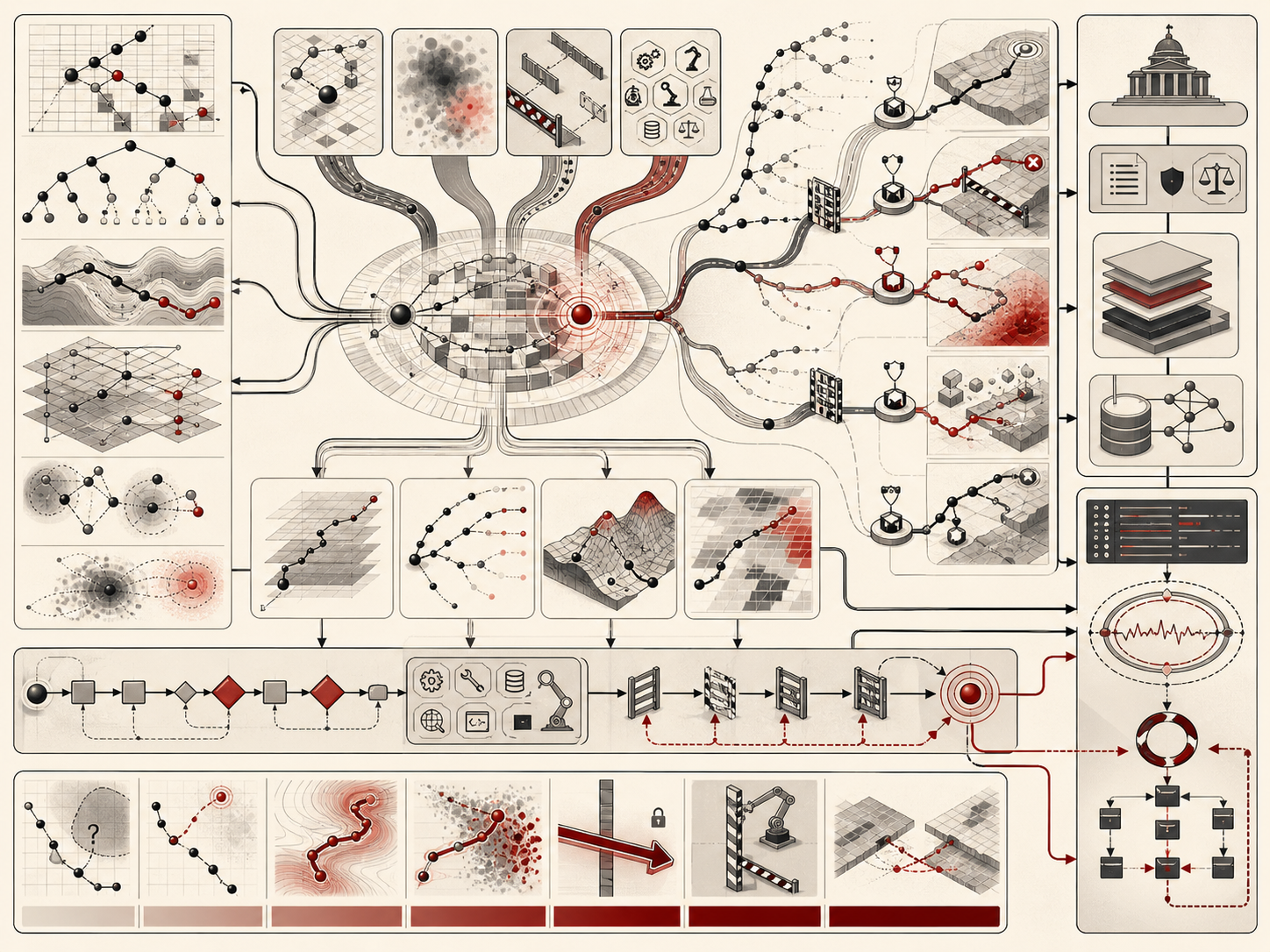
This article develops Planning, Search, and Sequential Decision Systems as an advanced article within the Artificial Intelligence Systems knowledge series. It explains state spaces, action spaces, search, heuristic search, dynamic programming, Bellman recursion, value functions, tree search, Monte Carlo methods, partial observability, reinforcement learning, agent planning, tool-use workflows, safety constraints, rollback design, monitoring, and institutional accountability. Selected Python and R examples appear here, while the full GitHub repository contains expanded computational scaffolding for A* search, policy evaluation, constrained planning, trace logging, risk scoring, rollback readiness, SQL schemas, documentation templates, and reproducible notebooks.
Why Planning Matters
Planning matters because intelligent systems often need to choose actions that unfold across time. A decision made now may open or close future possibilities. A route chosen now may affect later congestion. A tool call made by an agent may change a file, send a message, query a database, trigger a workflow, or expose sensitive information. A robot action may change the physical environment. A resource-allocation decision may affect future demand and fairness.
Planning systems therefore operate with consequences. They require an explicit relationship among goals, states, actions, constraints, costs, rewards, uncertainty, and feedback. The planner must ask not only what is possible, but what is permissible, safe, efficient, reversible, explainable, and accountable.
In AI systems, planning appears in many forms: classical symbolic planning, shortest-path search, heuristic search, constraint satisfaction, dynamic programming, reinforcement learning, model predictive control, Monte Carlo tree search, agent orchestration, workflow automation, and multi-agent coordination. These methods differ technically, but they share a common concern: how to choose actions when outcomes depend on sequences.
Planning is especially important because many real systems are not one-shot decision problems. A hospital does not simply predict which patient is at risk; it must decide who should respond, when, with what evidence, and under what escalation rule. An infrastructure system does not simply classify an incident; it must allocate field teams, protect safety, prioritize regions, and update as new reports arrive. A tool-using AI assistant does not simply answer a question; it may retrieve documents, draft text, run code, modify files, or request human approval. Sequential action changes the governance problem.
The central planning question is therefore not merely “What is the best action?” It is “What sequence of actions should be permitted under uncertainty, with what constraints, what review gates, what monitoring, and what recovery pathway if the plan fails?”
From Prediction to Action
Prediction estimates a property of the world. Planning chooses how to intervene in it. This distinction changes the evaluation problem. A predictive model can be evaluated by comparing predictions with labels. A planning system must be evaluated by the quality, safety, and consequences of action sequences.
| System Type | Primary Question | Example Output | Evaluation Concern |
|---|---|---|---|
| Predictive model | What is likely true? | Risk score, class label, probability. | Accuracy, calibration, fairness, robustness. |
| Optimizer | Which solution maximizes or minimizes an objective? | Schedule, allocation, route, portfolio. | Objective validity, constraints, tradeoffs. |
| Planner | What sequence of actions can achieve a goal? | Plan, path, task sequence, workflow. | Feasibility, safety, reversibility, cost. |
| Reinforcement-learning agent | Which policy performs well through interaction? | Action policy. | Long-term reward, exploration risk, generalization. |
| Tool-using AI agent | Which tools should be called, in what order, under what permissions? | Tool-call workflow. | Authority, validation, monitoring, human review. |
Note: Prediction can support planning, but action selection introduces authority, safety, reversibility, and accountability questions that prediction metrics alone cannot answer.
Prediction can support planning, but it does not replace planning. A model may predict that a case is high risk, but a planning system must decide whether to escalate, gather more evidence, assign staff, delay action, notify stakeholders, abstain, or trigger incident response. The decision depends on costs, constraints, authority, and downstream consequences.
Prediction \neq Action
\]
Interpretation: A prediction estimates a condition; a planning system chooses interventions that change future states.
This distinction becomes critical in high-impact systems. A decision-support system may correctly identify risk but still create harm if the recommended action is unavailable, unfair, irreversible, poorly timed, or outside the system’s authority. A planner that optimizes speed may create unsafe plans if it ignores safety constraints. An agent that optimizes task completion may overuse tools, leak data, or skip human review if its action space is not constrained.
Responsible planning therefore begins by separating three questions: what the system believes, what the system is allowed to do, and what the system should do under governance constraints. Confusing those questions is one of the fastest ways for AI systems to become unsafe.
Search, State Spaces, and Problem Formulation
Search begins with problem formulation. A state-space problem defines an initial state, possible actions, transition rules, a goal test, and a cost function. The search algorithm explores possible paths through the state space until it finds an acceptable solution. This structure appears in route planning, puzzle solving, scheduling, robotics, game playing, workflow automation, and formal planning.
The quality of a search system depends heavily on the representation. If the state omits important variables, the planner may produce unsafe or infeasible plans. If the action set includes actions the system should not take, the planner may choose them. If the cost function ignores risk, fairness, delay, reversibility, or human burden, the resulting plan may optimize the wrong thing.
Search therefore begins before the algorithm. The first governance question is: what world has the designer chosen to represent? The second is: what futures does the planner consider possible? The third is: what futures does the planner treat as desirable?
Representation \rightarrow Search \rightarrow Plan
\]
Interpretation: Search quality depends on how the state space, action space, transition model, goals, and costs are represented before the algorithm begins.
State representation is not neutral. A logistics planner that represents travel time but not worker fatigue may produce efficient but unsafe assignments. A resource allocator that represents cost but not regional equity may create uneven service. A clinical triage system that represents risk but not available intervention capacity may generate alerts without care. A tool-using agent that represents task completion but not permission boundaries may take actions it should only recommend.
Problem formulation is therefore a governance act. It defines what the planner can see, what it can ignore, what it can do, what it must avoid, and what future it is asked to pursue.
Heuristic Search and Informed Exploration
Uninformed search explores without guidance. Informed search uses heuristics to prioritize promising paths. A heuristic estimates remaining cost or distance to the goal. Good heuristics can make search dramatically more efficient. Poor heuristics can mislead the planner, hide better solutions, or create unsafe shortcuts.
A classic example is shortest-path planning. Breadth-first search explores outward level by level. Uniform-cost search prioritizes low path cost. A* search combines the cost already incurred with a heuristic estimate of the remaining cost. The method is powerful because it balances what has already happened with what is expected to happen next.
In AI systems, heuristics may come from rules, learned models, domain knowledge, simulations, value functions, language-model judgments, retrieval results, or human preferences. When heuristics guide consequential action, they must be evaluated and monitored. A heuristic is not neutral. It encodes assumptions about what matters.
f(n)=g(n)+h(n)
\]
Interpretation: A* search ranks node \(n\) by combining the cost already incurred \(g(n)\) with a heuristic estimate \(h(n)\) of the remaining cost to the goal.
Heuristics are useful because search spaces can become enormous. A planner cannot always examine every possible sequence of actions. It needs guidance. But guidance can also become bias. If the heuristic systematically underestimates risk for certain states, overvalues speed, ignores rare events, or fails under distribution shift, the search may appear efficient while becoming brittle or unsafe.
Governed heuristic search should therefore include stress testing. What happens when the heuristic is wrong? What branches are underexplored? Which constraints are treated as hard? Which are merely penalized? Does the heuristic behave differently across contexts, sites, users, or populations? Does it continue to perform after the environment changes?
Sequential Decision-Making Under Uncertainty
Sequential decision systems choose actions over time while observing feedback. The environment may be stochastic, partially observable, delayed, adversarial, or nonstationary. A decision may influence future states, future observations, future rewards, and future options.
Sequential decision-making appears in Markov decision processes, partially observable Markov decision processes, reinforcement learning, bandits, receding-horizon control, robotics, autonomous systems, recommendation systems, resource allocation, and AI agents. The shared challenge is that action quality cannot be evaluated only at the immediate step. The system must consider future consequences.
For governed AI systems, the central question is not only “Which action maximizes expected reward?” It is also: which actions are allowed, reversible, safe, explainable, auditable, fair, privacy-preserving, and appropriate for the system’s authority?
Sequential decision systems also create feedback loops. An action may change future data. A recommendation may shape user behavior. A routing policy may alter demand. A triage system may change which cases receive attention. A workflow agent may modify the documents that future retrieval depends on. When action changes the environment, monitoring must examine not only performance but the system’s effect on the world it later observes.
Action_t \rightarrow State_{t+1} \rightarrow Observation_{t+1} \rightarrow Action_{t+1}
\]
Interpretation: Sequential systems act, observe consequences, update state, and act again, creating feedback loops that can improve or destabilize performance.
Good sequential decision governance should therefore include escalation thresholds, uncertainty-aware abstention, rollback paths, state reconciliation, plan review, outcome monitoring, and periodic review of whether the objective still reflects the institutional purpose.
Dynamic Programming, Bellman Recursion, and Value Functions
Dynamic programming decomposes sequential decisions into smaller subproblems. The Bellman principle states that an optimal policy has optimal substructure: once the first action is chosen and the next state is reached, the remaining decisions should be optimal from that new state onward.
This idea is central to planning, reinforcement learning, and optimal control. Value iteration estimates the value of states. Policy iteration alternates between evaluating a policy and improving it. Q-learning estimates the value of state-action pairs. These methods differ in what they know about the environment, but they share a recursive view of decision-making.
The governance implication is that reward and cost definitions matter deeply. A system that learns to maximize a poorly specified reward may discover strategies that satisfy the metric while violating the purpose. In sequential systems, reward misalignment can compound across time.
V^{*}(s)
=
\max_{a \in \mathcal{A}}
\left[
R(s,a)
+
\gamma
\sum_{s’ \in \mathcal{S}}
P(s’ \mid s,a)V^{*}(s’)
\right]
\]
Interpretation: The optimal value of a state equals the best immediate reward plus discounted expected future value.
Bellman recursion is powerful because it formalizes long-term consequence. But that power depends on the reward function, the transition model, the discount factor, and the represented state. If the system undervalues future harm, ignores vulnerable states, or treats safety as a soft penalty, the resulting policy may be efficient but unacceptable.
Dynamic programming also highlights the importance of discounting. A high discount rate makes future consequences matter less. In some domains that may be reasonable. In others—climate, infrastructure, health, public services, safety-critical systems, and institutional trust—undervaluing the future can produce systematically irresponsible planning.
Tree Search, Monte Carlo Search, and Lookahead
Tree search explores possible future action sequences. Each node represents a state or partial plan. Each branch represents an action. The search may expand promising branches, simulate future outcomes, evaluate terminal states, and backpropagate value estimates.
Monte Carlo tree search uses sampling to estimate the value of possible actions when full search is too expensive. It balances exploration of uncertain branches with exploitation of promising ones. Modern systems may combine learned policy networks, learned value functions, and search, using models to guide lookahead and search to improve action selection.
Tree search is powerful because it makes future consequences explicit. But search is only as valid as its model of the environment. If the simulator, transition model, reward, or heuristic is wrong, the search may confidently explore the wrong future.
Lookahead = Simulate(Futures) + Evaluate(Outcomes) + Select(Action)
\]
Interpretation: Lookahead methods search possible futures, evaluate simulated outcomes, and choose present actions based on expected downstream consequences.
In real systems, tree search raises practical governance questions. How deep should lookahead go? Which futures are excluded? What happens when the search finds a plan that is optimal but unacceptable? How are constraints enforced? How is uncertainty represented? How are irreversible actions handled? What evidence is preserved so that a plan can be audited later?
Search systems also require computational discipline. Deeper search may improve plan quality, but it can increase latency, cost, and complexity. In time-sensitive settings, the system may need bounded planning: enough search to support good action, but not so much that the opportunity to act safely is lost. Human review, fallback rules, and conservative default behavior remain important when the search horizon is limited.
Planning Under Partial Observability
Many real systems do not observe the true state directly. A robot receives sensor data, not reality itself. A clinical model sees recorded observations, not the patient’s full condition. A retrieval-augmented generation system retrieves documents, not the complete knowledge environment. An agent sees tool outputs, not necessarily ground truth. In these cases, planning must operate under partial observability.
Partially observable decision systems maintain beliefs about hidden states. Actions can serve two purposes: achieving goals and gathering information. A good plan may first ask a clarifying question, inspect a sensor, retrieve more evidence, request human review, or run a diagnostic check before taking higher-impact action.
This is important for responsible AI. When uncertainty is high, the right action may be to pause, abstain, observe, verify, or escalate. A planning system that cannot value information may act prematurely.
Belief_t = P(S_t \mid O_{0:t},A_{0:t-1})
\]
Interpretation: Under partial observability, the system maintains a belief about the hidden state \(S_t\) based on past observations and actions.
Partial observability is especially relevant for tool-using agents and decision-support systems. A model may not know whether a file is current, whether a database result is complete, whether a sensor is faulty, whether a retrieved document is trustworthy, or whether a user’s instruction reflects proper authority. In those settings, verification is not optional. It is part of the plan.
A mature planning system should therefore include information-gathering actions. It should be able to ask for clarification, retrieve additional evidence, check permissions, validate inputs, compare sources, request human approval, or delay irreversible action until uncertainty is reduced. Sometimes the most intelligent next action is not to act.
Reinforcement Learning and Learned Policies
Reinforcement learning studies how agents learn policies through interaction with environments. Instead of being given labeled examples of correct actions, the agent receives rewards or penalties after acting. Over time, it learns which actions tend to produce better long-term outcomes.
Reinforcement learning is powerful in games, control, robotics, recommendation, resource allocation, and simulation-based optimization. But it introduces serious governance challenges. Exploration can be risky. Rewards can be misspecified. Simulated training environments may fail to transfer. Learned policies can exploit loopholes. Evaluation can be unstable. Long-term effects may be difficult to observe.
For high-impact settings, reinforcement-learning systems should be evaluated with constrained action spaces, safe exploration, off-policy evaluation, simulation validation, human oversight, monitoring, rollback procedures, and deployment limits. A learned policy should not be treated as safe merely because it achieved high reward in training.
Policy\ Success_{\mathrm{training}} \neq Policy\ Safety_{\mathrm{deployment}}
\]
Interpretation: A policy that performs well in training, simulation, or benchmark evaluation may still fail under real-world uncertainty, constraints, and distribution shift.
Reward design is the central governance problem. If the reward function emphasizes engagement, the agent may learn manipulative recommendations. If it emphasizes speed, it may sacrifice safety. If it emphasizes cost reduction, it may ignore service quality or equity. If it emphasizes short-term gain, it may create long-term harm. In reinforcement learning, values become behavior through the reward signal.
Governed reinforcement learning should therefore separate experimental learning from operational authority. Exploration that is acceptable in simulation may be unacceptable in real environments. High-impact actions should remain constrained, monitored, and subject to human review. When the system acts in the real world, the institution—not the reward function—remains responsible.
Planning in LLM Agents and Tool-Using Systems
Large language model agents introduce a practical new planning problem: how to transform a user goal into a sequence of tool calls, retrieval steps, intermediate reasoning, state updates, validations, and final actions. These systems may search over task decompositions, choose tools, write code, query databases, update documents, schedule events, or coordinate workflows.
Agent planning differs from traditional planning in several ways. The state may include conversation context, retrieved documents, tool outputs, memory, permissions, files, and external systems. Actions may include both low-risk internal operations and high-risk external actions. Observations may be unreliable because tool outputs, web pages, documents, or user-provided content may contain errors or adversarial instructions.
Governed agent planning should include:
- explicit tool permissions;
- read/write separation;
- argument validation;
- state snapshots;
- human approval for high-impact actions;
- rollback paths;
- trace logging;
- failure detection;
- limits on recursive or runaway planning;
- review of plans before execution where consequences are significant.
The key risk in agent planning is that language can become action. A model may move from interpreting a request to executing a workflow. That transition requires governance. Reading a file is different from editing it. Drafting an email is different from sending it. Suggesting a database query is different from running it against production data. Planning systems must separate recommendation, simulation, preparation, and execution.
Read \neq Write \neq Execute
\]
Interpretation: Tool-using AI systems should distinguish information access, modification, and external action, with stronger controls as consequence increases.
Agent planning also requires traceability. An institution should be able to reconstruct the goal, plan, tool calls, arguments, retrieved sources, validation checks, human approvals, final actions, and rollback steps. Without traceability, multi-step agent systems can become difficult to audit precisely when accountability matters most.
Safety, Constraints, and Failure Modes
Planning systems can fail in distinctive ways. A predictive model may be wrong once. A planner may produce a sequence of actions that compounds error. A search system may optimize a narrow objective while violating unstated constraints. An agent may choose a locally sensible tool call that creates downstream risk. A reinforcement-learning policy may exploit loopholes in the reward function.
| Failure Mode | Description | Example | Control Strategy |
|---|---|---|---|
| Invalid state representation | The planner omits variables needed for safe action. | Route plan ignores road closures or emergency constraints. | State validation, domain review, monitoring. |
| Unsafe action space | The planner can choose actions beyond its authority. | Agent sends an external message without approval. | Permission boundaries, approval gates, sandboxing. |
| Reward misspecification | The system optimizes the wrong objective. | Policy maximizes speed while ignoring safety. | Reward review, constraint design, human oversight. |
| Heuristic bias | Search guidance systematically favors poor or unfair paths. | Planner underexplores cases from rare subgroups. | Heuristic auditing, slice evaluation, stress tests. |
| Compounding error | Small errors accumulate across steps. | Multi-step workflow drifts from original goal. | Checkpoints, verification, state reconciliation. |
| Irreversible action | The system takes an action that cannot be undone. | Deletion, payment, publication, or notification without review. | Human approval, staged execution, rollback design. |
| Distribution shift | The learned policy operates outside training conditions. | RL policy fails in real environment after simulation training. | Sim-to-real validation, monitoring, conservative deployment. |
Note: Planning failures often compound across steps, so controls must operate at the level of state, action, policy, trace, and outcome—not only final output.
Planning safety depends on constraints. Some constraints should be hard, meaning the system cannot violate them. Others may be soft, meaning violations are penalized but possible. In high-impact systems, authority, privacy, safety, legal compliance, and human-review requirements often need hard enforcement outside the model.
Safety also depends on reversibility. A planner may choose an efficient path that includes irreversible actions: deleting data, issuing payment, publishing information, notifying stakeholders, changing a medical record, modifying infrastructure settings, or triggering an external workflow. Irreversible actions should require stronger validation, human approval, and rollback planning where rollback is possible.
Governance, Monitoring, and Institutional Accountability
Planning governance defines what the system is allowed to optimize, what actions it may take, what uncertainty requires review, and how the institution responds when plans fail. A planning system should not be deployed simply because it finds efficient action sequences. It should be evaluated for safe action under realistic conditions.
A responsible planning and sequential-decision program should document:
- state representation and known omissions;
- approved and prohibited actions;
- transition assumptions and uncertainty model;
- reward, cost, and constraint definitions;
- heuristic or policy design;
- simulation environment and validation limits;
- human-review and approval gates;
- monitoring signals for plan failure;
- rollback and recovery procedures;
- incident response for unsafe actions;
- audit trails for plans, tool calls, and decisions;
- review cadence and accountable owner.
Institutional accountability means that the organization can reconstruct why a plan was generated, what alternatives were considered, what constraints were applied, what actions were executed, who approved high-impact steps, and what happened afterward. Planning systems require traceability because their consequences unfold over time.
Monitoring should include both planning metrics and outcome metrics. Planning metrics include search depth, constraint violations, risky states, uncertain states, rejected plans, human-review triggers, tool-call failures, and rollback events. Outcome metrics include plan success, harm, delay, cost, fairness, user burden, human overrides, incidents, and downstream effects. A planning system that looks efficient in logs may still fail if real outcomes deteriorate.
Plan \rightarrow Execute \rightarrow Monitor \rightarrow Correct \rightarrow Learn
\]
Interpretation: Accountable planning requires plan generation, controlled execution, monitoring, correction, and institutional learning.
Governance should also define authority. The planner may be allowed to recommend, simulate, schedule, prepare, or execute depending on context. These are not equivalent. A system that may recommend a plan should not automatically be allowed to carry it out. The higher the consequence, the stronger the need for approval gates, logging, review, and rollback.
Limits and Open Problems
Planning, search, and sequential decision systems have important limits. State representations are incomplete: a planner cannot reason about variables it does not represent. Search can optimize the wrong objective: efficient plans may still be unsafe, unfair, brittle, or misaligned. Heuristics can mislead: a heuristic may reduce computation while hiding better or safer paths. Simulated policies may not transfer: policies trained in simulation can fail under real-world conditions.
Rewards can be gamed. Reinforcement-learning systems may exploit loopholes in reward definitions. Sequential errors can compound: small errors can grow across multi-step plans or tool workflows. Partial observability creates hidden risk: a system may act confidently without seeing the true state. High-impact actions require authority controls: irreversible or external actions should not rely on model judgment alone.
Planning systems also raise open questions about responsibility. If a planner recommends an action and a human approves it, who is responsible when the plan fails? If an agent selects a sequence of tool calls that no human reviewed step by step, how should accountability be assigned? If a learned policy changes behavior after retraining, what level of revalidation is required? If a plan affects multiple stakeholders over time, how should the system weigh competing harms and benefits?
Another open problem is objective design. Many real goals are plural: safety, cost, speed, fairness, sustainability, privacy, reliability, dignity, and long-term resilience may all matter. Reducing those goals to a single reward or cost function can be useful for computation but dangerous if treated as a complete ethical representation. Planning systems should therefore preserve room for human judgment, institutional review, and public accountability where values are contested.
The goal is not to make AI planners autonomous by default. The goal is to build planning systems that know their state, respect their action boundaries, represent uncertainty, evaluate alternatives, preserve traces, escalate when appropriate, and remain accountable to human and institutional governance.
Mathematical Lens
A planning problem can be described by states, actions, transitions, costs, and goals.
\mathcal{P}
=
(\mathcal{S},\mathcal{A},T,c,s_0,\mathcal{G})
\]
Interpretation: A planning problem includes states \(\mathcal{S}\), actions \(\mathcal{A}\), transition function \(T\), cost function \(c\), initial state \(s_0\), and goal set \(\mathcal{G}\).
A deterministic plan is a sequence of actions.
\pi_{plan}
=
(a_0,a_1,\ldots,a_{T-1})
\]
Interpretation: A plan specifies actions to take across time. In dynamic environments, the plan may need to be revised after new observations.
A policy maps states to actions.
\pi(a \mid s)
=
P(A_t=a \mid S_t=s)
\]
Interpretation: A policy can be deterministic or stochastic. It specifies how the system chooses actions in each state.
A Markov decision process models stochastic transitions and rewards.
\mathcal{M}
=
(\mathcal{S},\mathcal{A},P,R,\gamma)
\]
Interpretation: An MDP includes states, actions, transition probabilities \(P\), reward function \(R\), and discount factor \(\gamma\).
The value of a policy is expected discounted return.
V^{\pi}(s)
=
\mathbb{E}_{\pi}
\left[
\sum_{t=0}^{\infty}
\gamma^t R(S_t,A_t)
\mid S_0=s
\right]
\]
Interpretation: \(V^{\pi}(s)\) measures expected long-term reward when following policy \(\pi\) from state \(s\).
The optimal value function satisfies a Bellman optimality relationship.
V^{*}(s)
=
\max_{a \in \mathcal{A}}
\left[
R(s,a)
+
\gamma
\sum_{s’ \in \mathcal{S}}
P(s’ \mid s,a)V^{*}(s’)
\right]
\]
Interpretation: The best value of a state equals the best immediate reward plus discounted expected future value.
A* search ranks paths using accumulated cost and heuristic estimated remaining cost.
f(n)
=
g(n)
+
h(n)
\]
Interpretation: \(g(n)\) is the cost to reach node \(n\). \(h(n)\) estimates the remaining cost to the goal. The search prioritizes nodes with low \(f(n)\).
Planning risk can combine outcome, uncertainty, constraint, and reversibility concerns.
R_{plan}
=
w_1 C
+
w_2 U
+
w_3 K
+
w_4 I
+
w_5 L
\]
Interpretation: Plan risk can combine cost \(C\), uncertainty \(U\), constraint violation risk \(K\), impact severity \(I\), and lack of reversibility \(L\), weighted by governance priorities.
A human-review gate can be modeled as a threshold rule.
Review =
\begin{cases}
1, & R_{plan} \geq \tau_R \\
1, & L \geq \tau_L \\
1, & K \geq \tau_K \\
0, & \mathrm{otherwise}
\end{cases}
\]
Interpretation: Human review is triggered when planning risk, irreversibility, or constraint violation risk exceeds governance thresholds.
Variables and System Interpretation
| Symbol or Term | Meaning | Planning Interpretation | Governance Relevance |
|---|---|---|---|
| \(\mathcal{S}\) | State space | Possible conditions the system can represent. | Omitted state variables can hide risk. |
| \(\mathcal{A}\) | Action space | Actions the system may choose. | Must reflect permissions and authority boundaries. |
| \(T\) | Transition function | How actions change states. | Invalid transition assumptions can produce unsafe plans. |
| \(P(s’ \mid s,a)\) | Transition probability | Likelihood of next state \(s’\) after action \(a\). | Supports uncertainty-aware planning. |
| \(R(s,a)\) | Reward function | Value assigned to action outcomes. | Encodes institutional priorities and tradeoffs. |
| \(c\) | Cost function | Penalty assigned to actions, paths, or outcomes. | Must include safety, fairness, delay, burden, and reversibility where relevant. |
| \(\pi\) | Policy | Rule for selecting actions from states. | Determines system behavior over time. |
| \(V^{\pi}\) | Value function | Expected long-term value under policy \(\pi\). | Supports comparison of strategies. |
| \(h(n)\) | Heuristic | Estimated remaining cost from node \(n\). | Can improve efficiency but may introduce bias. |
| \(\gamma\) | Discount factor | Weight given to future rewards. | Encodes how much the system values future consequences. |
| \(R_{plan}\) | Planning risk | Composite risk from cost, uncertainty, constraints, impact, and irreversibility. | Guides review, approval, rollback, and monitoring. |
Note: Planning systems should be evaluated through state representation, action authority, transition assumptions, constraints, uncertainty, reversibility, monitoring, and institutional accountability.
Worked Example: A Governed Sequential Decision System
Consider an AI system that helps allocate field teams after infrastructure incidents. The system receives reports, sensor readings, weather data, resource availability, travel times, priority levels, and safety constraints. It must decide which teams to send where, in what order, and when to request human review.
A governed planning design would include:
- Define states: incident locations, severity, team availability, travel constraints, weather, resource limits, and uncertainty.
- Define actions: dispatch team, delay, request more evidence, escalate, reroute, or mark as resolved.
- Define hard constraints: safety restrictions, legal requirements, team capacity, and authorization rules.
- Define costs and rewards: response time, severity reduction, fairness across regions, travel burden, safety risk, and reversibility.
- Use search or optimization to generate candidate plans.
- Use uncertainty thresholds to trigger human review for ambiguous or high-impact cases.
- Log plan alternatives, selected plan, rejected actions, constraint checks, and approvals.
- Monitor outcomes: response time, unresolved cases, overrides, incidents, and plan deviations.
- Update the planning model only after review of real-world performance and failure cases.
This system is not merely predicting incident severity. It is choosing sequences of action under constraints. That makes planning governance essential.
The example also shows why action boundaries matter. Dispatching a field team may be low risk in one context and high risk in another. Sending a team into a hazardous area, rerouting emergency resources, marking an incident resolved, or overriding regional priority rules may require stronger review. A governed planner should distinguish ordinary actions from high-impact actions, and reversible actions from irreversible ones.
Candidate\ Plans \rightarrow Constraint\ Check \rightarrow Human\ Review \rightarrow Execution \rightarrow Monitoring
\]
Interpretation: Governed planning should generate options, check constraints, route high-risk plans to review, execute under authority controls, and monitor outcomes.
Computational Modeling
Computational modeling can make planning governance more concrete. A search workflow can represent states, actions, blocked paths, risky states, uncertain states, and irreversible actions. A policy-evaluation workflow can compare cost, uncertainty, constraint risk, reversibility risk, traceability, and governance readiness. A monitoring workflow can preserve plan alternatives, executed actions, deviations, review decisions, and outcomes.
The examples below are intentionally lightweight so the article remains readable and WordPress-friendly. They are not production planning systems. Their purpose is to show how planning systems can be evaluated not only by path cost or policy performance, but also by uncertainty, constraints, reversibility, review requirements, and traceability.
A mature planning governance system would connect these ideas to real planning logs, simulation environments, tool-call traces, permission systems, approval workflows, monitoring dashboards, incident records, rollback plans, and institutional review procedures. The code here illustrates the structure of the governance problem: safe planning requires more than finding a path.
Python Workflow: Planning, Search, and Sequential Decision Review
The following Python workflow builds a small grid planning environment, runs A* search, evaluates plan cost, uncertainty, constraint risk, reversibility, and governance risk, then summarizes candidate plans. It is dependency-light so it can be adapted to real planning logs, tool-call traces, simulation outputs, or sequential decision reviews.
"""
Planning, Search, and Sequential Decision Systems

Python workflow:
- Build a simple planning environment.
- Run A* search over a grid with risky and blocked cells.
- Evaluate plan cost, uncertainty, constraint risk, reversibility, and governance risk.
- Produce governance-ready summaries.

This example is intentionally dependency-light. Production systems should connect
planning records to real simulation logs, tool traces, permission systems,
monitoring dashboards, and governance review records.
"""

from __future__ import annotations

from dataclasses import dataclass
from heapq import heappop, heappush
from pathlib import Path
from typing import Dict, Iterable, List, Optional, Tuple

import numpy as np
import pandas as pd


ARTICLE_DIR = Path(__file__).resolve().parents[1] if "__file__" in globals() else Path(".")
OUTPUT_DIR = ARTICLE_DIR / "outputs"
OUTPUT_DIR.mkdir(parents=True, exist_ok=True)

GridPoint = Tuple[int, int]


@dataclass(frozen=True)
class PlanningEnvironment:
    """Grid environment with blocked cells, risky cells, uncertain cells, and irreversible cells."""
    width: int
    height: int
    blocked: frozenset[GridPoint]
    risky: frozenset[GridPoint]
    uncertain: frozenset[GridPoint]
    irreversible: frozenset[GridPoint]


def neighbors(point: GridPoint, environment: PlanningEnvironment) -> Iterable[GridPoint]:
    """Generate valid neighboring grid points."""
    x, y = point

    candidates = [
        (x + 1, y),
        (x - 1, y),
        (x, y + 1),
        (x, y - 1),
    ]

    for candidate in candidates:
        cx, cy = candidate
        in_bounds = 0 <= cx < environment.width and 0 <= cy < environment.height

        if in_bounds and candidate not in environment.blocked:
            yield candidate


def heuristic(point: GridPoint, goal: GridPoint) -> float:
    """Manhattan-distance heuristic."""
    return abs(point[0] - goal[0]) + abs(point[1] - goal[1])


def step_cost(point: GridPoint, environment: PlanningEnvironment) -> float:
    """Cost of entering a grid cell."""
    cost = 1.0

    if point in environment.risky:
        cost += 2.0

    if point in environment.uncertain:
        cost += 1.25

    if point in environment.irreversible:
        cost += 3.0

    return cost


def reconstruct_path(
    came_from: Dict[GridPoint, GridPoint],
    current: GridPoint,
) -> List[GridPoint]:
    """Reconstruct a path from parent pointers."""
    path = [current]

    while current in came_from:
        current = came_from[current]
        path.append(current)

    path.reverse()
    return path


def astar_search(
    start: GridPoint,
    goal: GridPoint,
    environment: PlanningEnvironment,
    risk_weight: float = 1.0,
) -> Optional[List[GridPoint]]:
    """Run A* search with a configurable risk penalty."""
    frontier: list[tuple[float, GridPoint]] = []
    heappush(frontier, (0.0, start))

    came_from: Dict[GridPoint, GridPoint] = {}
    cost_so_far: Dict[GridPoint, float] = {start: 0.0}

    while frontier:
        _, current = heappop(frontier)

        if current == goal:
            return reconstruct_path(came_from, current)

        for next_point in neighbors(current, environment):
            risk_penalty = 0.0

            if next_point in environment.risky:
                risk_penalty += 2.0 * risk_weight

            if next_point in environment.uncertain:
                risk_penalty += 1.25 * risk_weight

            if next_point in environment.irreversible:
                risk_penalty += 3.0 * risk_weight

            new_cost = cost_so_far[current] + 1.0 + risk_penalty

            if next_point not in cost_so_far or new_cost < cost_so_far[next_point]:
                cost_so_far[next_point] = new_cost
                priority = new_cost + heuristic(next_point, goal)
                heappush(frontier, (priority, next_point))
                came_from[next_point] = current

    return None


def evaluate_plan(
    path: List[GridPoint],
    environment: PlanningEnvironment,
    plan_name: str,
) -> dict[str, object]:
    """Evaluate plan cost, risk, uncertainty, reversibility, and governance status."""
    if not path:
        return {
            "plan_name": plan_name,
            "feasible": False,
            "steps": 0,
            "path_cost": np.nan,
            "risky_steps": np.nan,
            "uncertain_steps": np.nan,
            "irreversible_steps": np.nan,
            "planning_risk": 1.0,
            "review_required": True,
            "recommended_action": "reject_infeasible_plan",
            "path": "",
        }

    risky_steps = sum(point in environment.risky for point in path)
    uncertain_steps = sum(point in environment.uncertain for point in path)
    irreversible_steps = sum(point in environment.irreversible for point in path)
    total_cost = sum(step_cost(point, environment) for point in path[1:])

    normalized_cost = min(total_cost / 30, 1.0)
    uncertainty_risk = min(uncertain_steps / max(len(path), 1), 1.0)
    constraint_risk = min(risky_steps / max(len(path), 1), 1.0)
    irreversibility_risk = min(irreversible_steps / max(len(path), 1), 1.0)

    planning_risk = (
        0.30 * normalized_cost
        + 0.25 * uncertainty_risk
        + 0.25 * constraint_risk
        + 0.20 * irreversibility_risk
    )

    review_required = (
        planning_risk > 0.25
        or risky_steps > 0
        or uncertain_steps >= 3
        or irreversible_steps > 0
    )

    recommended_action = "approve_for_execution"

    if irreversible_steps > 0:
        recommended_action = "require_human_approval_before_irreversible_action"
    elif risky_steps > 0:
        recommended_action = "route_to_safety_review"
    elif uncertain_steps >= 3:
        recommended_action = "collect_more_information_before_execution"
    elif planning_risk > 0.25:
        recommended_action = "review_plan_tradeoffs"

    return {
        "plan_name": plan_name,
        "feasible": True,
        "steps": len(path) - 1,
        "path_cost": total_cost,
        "risky_steps": risky_steps,
        "uncertain_steps": uncertain_steps,
        "irreversible_steps": irreversible_steps,
        "planning_risk": planning_risk,
        "review_required": review_required,
        "recommended_action": recommended_action,
        "path": " -> ".join([f"({x},{y})" for x, y in path]),
    }


def create_environment() -> PlanningEnvironment:
    """Create a small planning environment."""
    blocked = frozenset({(2, 1), (2, 2), (2, 3), (5, 4), (6, 4)})
    risky = frozenset({(3, 3), (4, 3), (5, 3), (7, 2)})
    uncertain = frozenset({(1, 4), (3, 4), (4, 4), (6, 2), (6, 3)})
    irreversible = frozenset({(7, 4)})

    return PlanningEnvironment(
        width=9,
        height=6,
        blocked=blocked,
        risky=risky,
        uncertain=uncertain,
        irreversible=irreversible,
    )


def main() -> None:
    """Run planning, search, and governance review."""
    environment = create_environment()
    start = (0, 0)
    goal = (8, 5)

    candidate_configs = [
        ("cost_prioritized_plan", 0.25),
        ("balanced_plan", 1.0),
        ("risk_averse_plan", 2.5),
    ]

    evaluations = []

    for plan_name, risk_weight in candidate_configs:
        path = astar_search(start, goal, environment, risk_weight=risk_weight)
        evaluations.append(evaluate_plan(path or [], environment, plan_name))

    evaluation_table = pd.DataFrame(evaluations)

    governance_summary = pd.DataFrame(
        [
            {
                "plans_reviewed": len(evaluation_table),
                "feasible_plans": int(evaluation_table["feasible"].sum()),
                "plans_requiring_review": int(evaluation_table["review_required"].sum()),
                "minimum_planning_risk": float(evaluation_table["planning_risk"].min()),
                "maximum_planning_risk": float(evaluation_table["planning_risk"].max()),
                "minimum_path_cost": float(evaluation_table["path_cost"].min()),
            }
        ]
    )

    evaluation_table.to_csv(
        OUTPUT_DIR / "python_planning_search_evaluations.csv",
        index=False,
    )

    governance_summary.to_csv(
        OUTPUT_DIR / "python_planning_governance_summary.csv",
        index=False,
    )

    memo = f"""# Planning, Search, and Sequential Decision Governance Memo

Plans reviewed: {int(governance_summary.loc[0, "plans_reviewed"])}
Feasible plans: {int(governance_summary.loc[0, "feasible_plans"])}
Plans requiring review: {int(governance_summary.loc[0, "plans_requiring_review"])}
Minimum planning risk: {governance_summary.loc[0, "minimum_planning_risk"]:.4f}
Maximum planning risk: {governance_summary.loc[0, "maximum_planning_risk"]:.4f}
Minimum path cost: {governance_summary.loc[0, "minimum_path_cost"]:.4f}

Interpretation:
- Search efficiency is not the same as safe planning.
- Candidate plans should be evaluated for cost, uncertainty, constraints, and reversibility.
- Irreversible or high-impact actions should trigger human approval.
- Planning systems should preserve traces for audit, monitoring, and rollback.
"""

    (OUTPUT_DIR / "python_planning_governance_memo.md").write_text(memo)

    print(evaluation_table)
    print(governance_summary.T)
    print(memo)


if __name__ == "__main__":
    main()
This workflow fixes a small planning environment and evaluates candidate A* search configurations under different risk weights. The point is not that a grid world captures real planning complexity. The point is that even a simple planner can be evaluated through cost, uncertainty, risk exposure, irreversibility, review requirements, and traceability. That same governance logic scales to tool-use plans, workflow automation, infrastructure dispatch, robotics, and resource allocation.
R Workflow: Sequential Decision Evaluation Summary
The following R workflow simulates sequential decision evaluation records and summarizes plan cost, uncertainty, constraint risk, reversibility risk, policy performance, and governance review status.
# Planning, Search, and Sequential Decision Systems
# R workflow: sequential decision evaluation summary.

set.seed(42)

n <- 240

records <- data.frame(
  evaluation_id = paste0("PLAN-EVAL-", sprintf("%03d", 1:n)),
  system_type = sample(
    c(
      "heuristic_search",
      "reinforcement_learning",
      "tool_using_agent",
      "workflow_planner",
      "resource_allocator"
    ),
    size = n,
    replace = TRUE
  ),
  plan_cost = runif(n, min = 0.05, max = 0.80),
  uncertainty_risk = runif(n, min = 0.00, max = 0.70),
  constraint_violation_risk = runif(n, min = 0.00, max = 0.40),
  irreversibility_risk = runif(n, min = 0.00, max = 0.35),
  policy_performance = runif(n, min = 0.45, max = 0.98),
  human_review_score = runif(n, min = 0.40, max = 1.00),
  traceability_score = runif(n, min = 0.35, max = 1.00)
)

records$planning_risk <- 0.30 * records$plan_cost +
  0.25 * records$uncertainty_risk +
  0.25 * records$constraint_violation_risk +
  0.20 * records$irreversibility_risk

records$governance_readiness <- 0.45 * records$human_review_score +
  0.55 * records$traceability_score

records$review_required <- records$planning_risk > 0.28 |
  records$constraint_violation_risk > 0.20 |
  records$irreversibility_risk > 0.15 |
  records$uncertainty_risk > 0.45 |
  records$governance_readiness < 0.65

system_summary <- aggregate(
  cbind(
    plan_cost,
    uncertainty_risk,
    constraint_violation_risk,
    irreversibility_risk,
    policy_performance,
    planning_risk,
    governance_readiness,
    review_required
  ) ~ system_type,
  data = records,
  FUN = mean
)

governance_summary <- data.frame(
  evaluations_reviewed = nrow(records),
  review_required = sum(records$review_required),
  mean_policy_performance = mean(records$policy_performance),
  mean_planning_risk = mean(records$planning_risk),
  max_planning_risk = max(records$planning_risk),
  max_constraint_violation_risk = max(records$constraint_violation_risk),
  max_irreversibility_risk = max(records$irreversibility_risk),
  mean_governance_readiness = mean(records$governance_readiness)
)

dir.create("outputs", recursive = TRUE, showWarnings = FALSE)

write.csv(records, "outputs/r_sequential_decision_records.csv", row.names = FALSE)
write.csv(system_summary, "outputs/r_planning_system_summary.csv", row.names = FALSE)
write.csv(governance_summary, "outputs/r_planning_governance_summary.csv", row.names = FALSE)

print("System summary")
print(system_summary)

print("Governance summary")
print(governance_summary)
This R workflow treats planning evaluation as a governance summary rather than a performance leaderboard. A system with high policy performance may still require review if uncertainty, constraint risk, irreversibility, or traceability problems are high. Planning governance should therefore evaluate policy performance and control readiness together.
GitHub Repository
The article body includes selected computational examples so the conceptual and mathematical argument remains readable. The full repository can hold expanded workflows for A* search, value iteration, policy evaluation, constrained planning, receding-horizon control, agent tool planning, simulation-based evaluation, trace logging, risk scoring, rollback readiness, and governance documentation.
From Action Selection to Accountable Planning
Planning, search, and sequential decision systems show why responsible AI cannot stop at prediction. Once an AI system chooses actions, recommends plans, calls tools, allocates resources, or learns policies through interaction, it becomes part of an action architecture. Its outputs are no longer merely labels or probabilities. They are structured interventions in the world.
The central lesson is that planning must be governed as a systems capability. State spaces define what the system can see. Action spaces define what the system can do. Transition models define what futures the system imagines. Rewards and costs define what the system treats as valuable. Constraints define what it must not violate. Monitoring determines whether the institution can detect failure. Traceability determines whether the institution can reconstruct what happened. Human review determines whether authority remains accountable.
This is why search efficiency, policy performance, or long-term reward cannot be treated as sufficient evidence of responsible planning. A plan can be efficient and unsafe. A policy can be high-performing and misaligned. A heuristic can be useful and biased. An agent can complete a task and exceed its authority. A sequential system can optimize a metric while creating hidden future harm.
Responsible planning systems should therefore preserve a disciplined separation between recommendation and execution, simulation and action, permission and capability, reversibility and irreversibility, local optimization and long-term institutional responsibility. The strongest planning systems will not be those that act most autonomously by default. They will be those that know when to plan, when to verify, when to ask, when to stop, when to escalate, and how to preserve accountability across time.
Within the Artificial Intelligence Systems knowledge series, this article belongs near AI Agents, Tool Use, and Workflow Automation, Reinforcement Learning and Adaptive AI Systems, Synthetic Data, Simulation, and AI Evaluation Environments, Calibration, Uncertainty, and Probability in AI Systems, Model Monitoring, Drift, and AI Observability, Human Oversight, Contestability, and AI Accountability, and AI Governance and Regulatory Systems. It provides the action-selection layer for understanding how AI systems move from inference to governed intervention.
Related Articles
- Artificial Intelligence Systems
- AI Agents, Tool Use, and Workflow Automation
- Reinforcement Learning and Adaptive AI Systems
- Synthetic Data, Simulation, and AI Evaluation Environments
- Calibration, Uncertainty, and Probability in AI Systems
- Model Monitoring, Drift, and AI Observability
- Robustness and Adversarial Resilience in Machine Learning
- Artificial Intelligence in Decision Support Systems
- Large Language Models and Foundation Model Systems
- AI Governance and Regulatory Systems
Further Reading
- Russell, S. and Norvig, P. (2022) Artificial Intelligence: A Modern Approach, 4th US edition. Available at: https://aima.cs.berkeley.edu/
- Sutton, R.S. and Barto, A.G. (2018) Reinforcement Learning: An Introduction, 2nd edition. Available at: https://incompleteideas.net/book/the-book-2nd.html
- Bellman, R. (1957) Dynamic Programming. Princeton University Press. Available at: https://www.rand.org/pubs/papers/P550.html
- Hart, P.E., Nilsson, N.J. and Raphael, B. (1968) ‘A Formal Basis for the Heuristic Determination of Minimum Cost Paths’, IEEE Transactions on Systems Science and Cybernetics. Available at: https://ieeexplore.ieee.org/document/4082128
- Kaelbling, L.P., Littman, M.L. and Cassandra, A.R. (1998) ‘Planning and Acting in Partially Observable Stochastic Domains’, Artificial Intelligence. Available at: https://www.sciencedirect.com/science/article/pii/S000437029800023X
- Silver, D. et al. (2016) ‘Mastering the Game of Go with Deep Neural Networks and Tree Search’, Nature. Available at: https://www.nature.com/articles/nature16961
- NIST (2023) Artificial Intelligence Risk Management Framework (AI RMF 1.0). Available at: https://www.nist.gov/publications/artificial-intelligence-risk-management-framework-ai-rmf-10
References
- Bellman, R. (1957) Dynamic Programming. Princeton University Press. Available at: https://www.rand.org/pubs/papers/P550.html
- Hart, P.E., Nilsson, N.J. and Raphael, B. (1968) ‘A Formal Basis for the Heuristic Determination of Minimum Cost Paths’, IEEE Transactions on Systems Science and Cybernetics. Available at: https://ieeexplore.ieee.org/document/4082128
- Kaelbling, L.P., Littman, M.L. and Cassandra, A.R. (1998) ‘Planning and Acting in Partially Observable Stochastic Domains’, Artificial Intelligence. Available at: https://www.sciencedirect.com/science/article/pii/S000437029800023X
- NIST (2023) Artificial Intelligence Risk Management Framework (AI RMF 1.0). Available at: https://www.nist.gov/publications/artificial-intelligence-risk-management-framework-ai-rmf-10
- Russell, S. and Norvig, P. (2022) Artificial Intelligence: A Modern Approach, 4th US edition. Available at: https://aima.cs.berkeley.edu/
- Silver, D. et al. (2016) ‘Mastering the Game of Go with Deep Neural Networks and Tree Search’, Nature. Available at: https://www.nature.com/articles/nature16961
- Sutton, R.S. and Barto, A.G. (2018) Reinforcement Learning: An Introduction, 2nd edition. Available at: https://incompleteideas.net/book/the-book-2nd.html
- Todorov, E. and Li, W. (2005) ‘A Generalized Iterative LQG Method for Locally-Optimal Feedback Control of Constrained Nonlinear Stochastic Systems’. Available at: https://homes.cs.washington.edu/~todorov/papers/TodorovNIPS05.pdf