
Last Updated May 10, 2026
Calibration, uncertainty, and probability in AI systems describe how models express confidence, how reliable that confidence is, and how probabilistic outputs should be used in decisions, monitoring, and governance. A classifier may assign a case a 90 percent probability, a language model may produce a highly confident answer, a risk model may rank users by predicted likelihood, and a decision-support system may recommend action based on thresholded scores. But confidence is not the same as correctness. A trustworthy AI system must ask whether its probabilities correspond to observed reality.
Calibration matters because many AI systems are not only used to rank or classify, but to support decisions under uncertainty. In medicine, finance, infrastructure, environmental monitoring, legal operations, public services, safety systems, and institutional workflows, a probability can shape triage, escalation, resource allocation, human review, abstention, or automation. If the model is overconfident, users may trust wrong predictions. If it is underconfident, useful automation may be blocked. If uncertainty is not monitored, a system can silently drift into unreliable behavior.
The central argument is that probability in AI should be treated as an operational and governance layer, not merely as a model output. Calibrated uncertainty affects threshold design, abstention, human review, monitoring, model comparison, safety controls, fairness review, incident response, and institutional accountability. A model that gives probabilities without calibration, uncertainty decomposition, monitoring, and review is not truly uncertainty-aware. It is merely numerically confident.
Main Library
Publications
Article Map
Artificial Intelligence Systems
Related Topic
Data Systems & Analytics
Related Topic
Risk & Resilience
Related Topic
Institutions & Governance
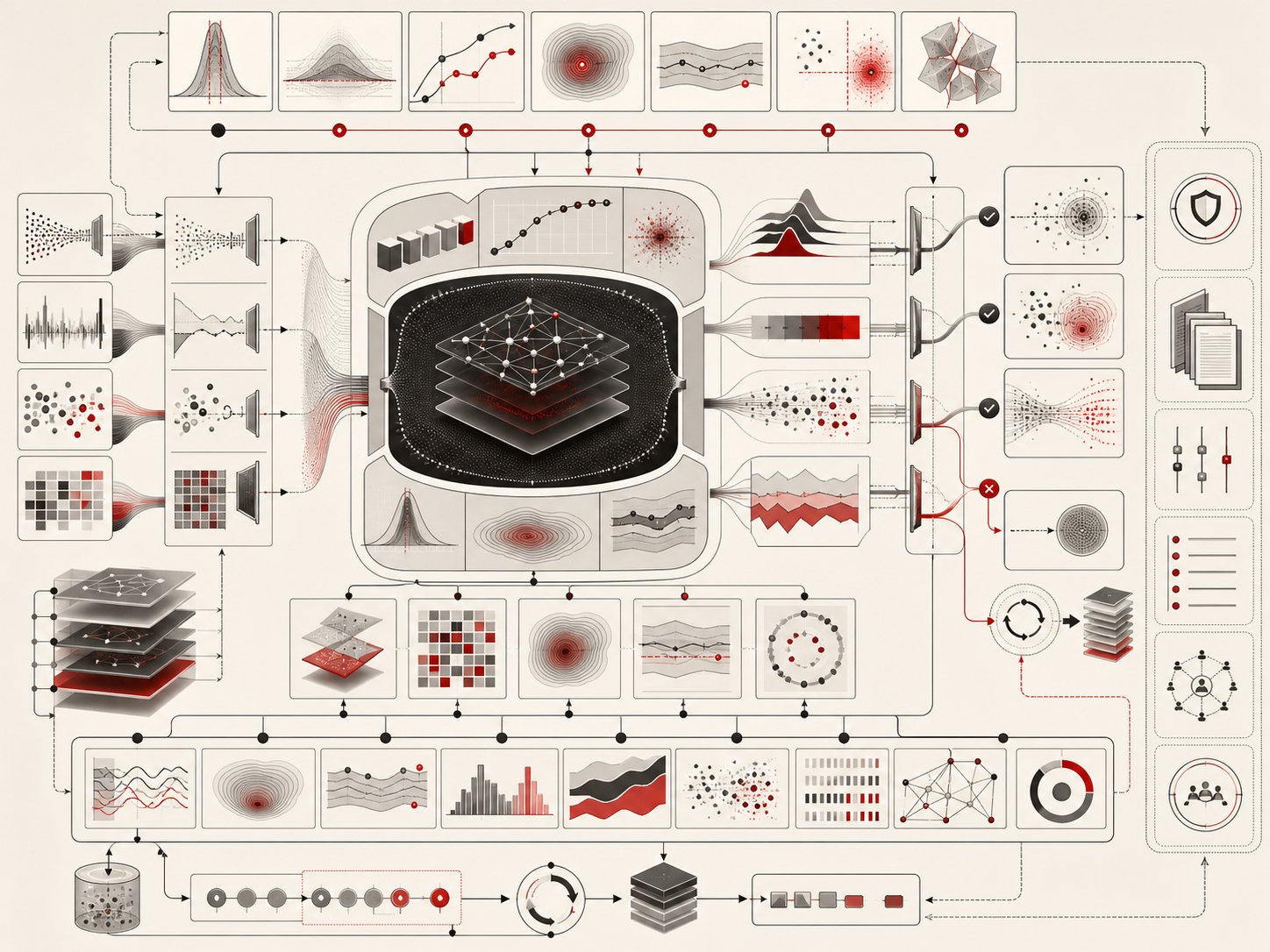
This article develops Calibration, Uncertainty, and Probability in AI Systems as an advanced article within the Artificial Intelligence Systems knowledge series. It explains probabilistic confidence, calibration, reliability diagrams, expected calibration error, Brier score, negative log likelihood, entropy, uncertainty types, threshold design, abstention, conformal prediction, slice-level calibration, deployment monitoring, LLM/RAG/agent uncertainty, human review, and institutional accountability. Selected Python and R examples appear here, while the full GitHub repository contains expanded computational scaffolding for calibration curves, reliability review, slice monitoring, threshold governance, uncertainty routing, SQL schemas, documentation templates, and reproducible notebooks.
Why Calibration Matters
Calibration measures whether predicted probabilities correspond to observed frequencies. If a model assigns 100 cases a probability near 0.80, a calibrated model should be correct on about 80 of those cases, assuming the cases are exchangeable and drawn from the same operating context. Calibration does not mean that every individual prediction is correct. It means that the model’s probability estimates are statistically meaningful.
This matters because probability is often used as a decision input. A hospital triage model, credit-risk model, infrastructure-risk model, fraud detector, content-safety classifier, environmental early-warning system, or AI agent risk gate may use probability thresholds to determine what happens next. A probability above 0.90 may trigger automation. A probability between 0.60 and 0.90 may trigger human review. A probability below 0.30 may trigger no action. If those probabilities are miscalibrated, the threshold policy becomes unreliable.
Calibration also matters for communication. Users interpret confidence scores as signals of reliability. If a system says it is highly confident but is frequently wrong, it can create automation bias. If a system hides uncertainty, users may assume certainty where none exists. Responsible AI systems should communicate uncertainty in ways that are statistically meaningful, context-sensitive, and operationally useful.
Calibration is also a systems question. A probability is not only a number produced by a model; it becomes part of a workflow. It may decide whether a case is escalated, which patient is seen first, which document is retrieved, which transaction is blocked, which inspection is scheduled, which user is reviewed, or whether an AI agent is permitted to call a tool. Once probabilities shape action, calibration becomes part of governance.
The deepest reason calibration matters is that uncertainty is unavoidable. AI systems operate with incomplete data, noisy labels, distribution shift, model limits, ambiguous instructions, partial observability, and institutional constraints. The responsible response is not to pretend that uncertainty can be eliminated. It is to measure uncertainty, communicate it carefully, monitor it continuously, and route uncertain cases into accountable review.
Probability, Confidence, and Uncertainty
Probability, confidence, and uncertainty are related but not identical. A probability is a numerical statement about likelihood. Confidence often refers to the model’s highest predicted class probability or its internal certainty about an output. Uncertainty refers more broadly to what the system does not know, cannot observe, cannot distinguish, or cannot safely infer.
A model can be confident and wrong. A model can be uncertain for good reasons. A model can produce a probability without being calibrated. A model can produce a calibrated probability that is still unsuitable for a specific decision because the cost of error is asymmetric, the use context is high-stakes, or the model is operating under distribution shift.
The practical question is not only “What probability did the model output?” It is also:
- Was the probability calibrated on comparable cases?
- Is the input within the model’s known operating domain?
- Are labels reliable and recent enough to validate calibration?
- Is uncertainty caused by noisy data, insufficient knowledge, or system drift?
- What decision will be made from this probability?
- Who reviews uncertain or high-impact cases?
- How is uncertainty monitored over time?
Confidence \neq Correctness
\]
Interpretation: A model can express high confidence while being wrong. Reliability depends on whether confidence has been calibrated and evaluated against observed outcomes.
In many AI systems, probability is treated as if it were self-explanatory. A dashboard may show a risk score. A classifier may show a confidence percentage. A language system may produce fluent text with no explicit uncertainty. But users need to know what the number means. Is it a calibrated probability, a rank score, a similarity score, a softmax confidence, a heuristic, a retrieval score, or a model-specific internal signal? These are not interchangeable.
Uncertainty governance begins by defining the meaning of each signal. A score that ranks cases may be useful for prioritization but inappropriate as a probability. A softmax output may look probabilistic without being well calibrated. A language model’s verbal confidence may be persuasive without being statistically reliable. A retrieval score may indicate textual similarity without evidentiary support. Responsible systems should not allow these signals to be mistaken for one another.
Types of Uncertainty: Aleatoric, Epistemic, Distributional, and Operational
Uncertainty in AI systems has multiple sources. Different sources require different responses. Some uncertainty is irreducible because the world is noisy or ambiguous. Some uncertainty reflects model ignorance and can be reduced through better data, better modeling, or narrower deployment. Some uncertainty comes from distribution shift. Some comes from the operational environment: retrieval systems, tool calls, workflows, labels, sensors, policies, or infrastructure.
| Uncertainty Type | Meaning | Example | System Response |
|---|---|---|---|
| Aleatoric uncertainty | Irreducible uncertainty from noise or ambiguity in the data-generating process. | A sensor reading is noisy; two valid labels may apply to an ambiguous case. | Represent uncertainty honestly; avoid false precision. |
| Epistemic uncertainty | Uncertainty from limited knowledge, sparse data, or model ignorance. | The model sees a rare case unlike its training examples. | Collect more data, abstain, escalate, or use uncertainty-aware models. |
| Distributional uncertainty | Uncertainty caused by operating outside the training distribution. | A model trained on one population is used on another. | Detect shift, monitor slices, restrict deployment, or retrain responsibly. |
| Measurement uncertainty | Uncertainty from instruments, labels, features, or observation processes. | Labels are delayed, subjective, incomplete, or inconsistently recorded. | Track label quality and data provenance. |
| Operational uncertainty | Uncertainty from workflow, tool, retrieval, prompt, policy, or infrastructure behavior. | A RAG system retrieves stale evidence; an agent tool call fails silently. | Monitor system traces, retrieval quality, tool results, and incidents. |
| Decision uncertainty | Uncertainty about the appropriate action given model output and consequences. | A risk score is moderate, but the cost of a false negative is severe. | Use decision analysis, thresholds, human review, and governance rules. |
Note: Uncertainty is not one thing. Different sources of uncertainty require different technical, operational, and governance responses.
Reducing uncertainty is not always possible. Aleatoric uncertainty may be inherent. Epistemic uncertainty may be reducible with more data or better models. Operational uncertainty may require better instrumentation, logging, access controls, and monitoring. Decision uncertainty may require domain expertise, policy, ethics, and institutional judgment.
Good AI governance should ask which type of uncertainty is present before choosing a response. If uncertainty comes from missing evidence, the system should collect more evidence or ask for human review. If uncertainty comes from distribution shift, the system may need deployment restrictions, recalibration, or retraining. If uncertainty comes from ambiguous policy, a better model will not solve the problem. If uncertainty comes from high consequence, the right response may be human review even when the model is statistically confident.
Uncertainty_{\mathrm{total}}
=
U_{\mathrm{aleatoric}}
+
U_{\mathrm{epistemic}}
+
U_{\mathrm{distributional}}
+
U_{\mathrm{operational}}
+
U_{\mathrm{decision}}
\]
Interpretation: Total uncertainty in an AI system includes noise, model ignorance, distribution shift, operational complexity, and uncertainty about what action should follow.
Calibration Diagnostics and Reliability Diagrams
Calibration diagnostics compare predicted confidence with observed accuracy. A reliability diagram bins predictions by confidence and plots the observed accuracy in each bin. If the model is calibrated, the bins lie near the diagonal relationship where confidence equals accuracy. If the model is overconfident, confidence exceeds accuracy. If it is underconfident, accuracy exceeds confidence.
Reliability diagrams are useful because aggregate accuracy can hide calibration problems. A model can be accurate but poorly calibrated. It may rank cases correctly while assigning probabilities that are too extreme. Conversely, a model can be calibrated but not useful if it is unsharp and assigns nearly the same probability to all cases. Good probabilistic prediction requires both calibration and resolution.
Calibration should also be examined across slices. A model may be calibrated overall but miscalibrated for a subgroup, region, language, product, sensor type, input source, or workflow. Slice-level calibration is especially important when AI systems influence high-impact decisions. Global calibration does not guarantee local reliability.
Calibration diagnostics should therefore be treated as operational diagnostics, not only as model-development metrics. If calibration changes across time, source system, user group, geography, device, language, or workflow, the system’s threshold rules may no longer behave as intended. A high-confidence decision zone can become unsafe if observed accuracy falls below the expected level. A human-review zone can become overloaded if probability distributions shift.
Global\ Calibration \neq Local\ Reliability
\]
Interpretation: A model may appear calibrated overall while remaining miscalibrated for important slices, contexts, sources, or deployment conditions.
A strong calibration review should therefore include bin-level reliability, overall calibration error, slice-level calibration, confidence distribution, label quality, delayed-label analysis, and trend monitoring. Calibration should be interpreted with context: small bins may be noisy, labels may be delayed, and observed outcomes may reflect earlier decision policies. Calibration diagnostics are evidence for review, not mechanical truth.
Proper Scoring Rules and Probabilistic Evaluation
Proper scoring rules evaluate probabilistic forecasts by rewarding honest probability estimates. A scoring rule is proper when the best expected strategy is to report the true predictive distribution. This matters because AI systems should not be evaluated only by whether they selected the correct class. They should also be evaluated by how much probability they assigned to the outcome that actually occurred.
The Brier score and negative log likelihood are common scoring rules for classification. For probabilistic regression and forecasting, continuous ranked probability score and interval scores are often used. These scores help evaluate whether predicted distributions are both accurate and informative.
Scoring rules can reveal problems that accuracy misses. A model that predicts 0.51 for every correct binary classification may have the same accuracy as a model that predicts 0.95 on easy cases and 0.55 on hard cases, but their probabilistic quality differs. In high-stakes decisions, that distinction matters because decisions often depend on how confident the system is.
Proper scoring rules also discourage misleading confidence. If a system is rewarded only for top-class accuracy, it may learn to produce extreme confidence even when uncertainty is high. If it is evaluated probabilistically, overconfident wrong predictions are penalized. This is crucial for systems whose outputs feed escalation, abstention, triage, or automation policies.
Accuracy \neq Probabilistic\ Quality
\]
Interpretation: Accuracy measures whether the top decision is correct; probabilistic evaluation measures whether the model’s confidence is reliable and informative.
Scoring rules should be interpreted alongside calibration and decision utility. A probability model can improve Brier score while remaining poorly calibrated in a high-impact slice. A model can improve log loss while creating unacceptable false-negative risk under a particular threshold. Probabilistic evaluation is necessary, but it is not a substitute for governance, cost-sensitive decision analysis, and domain review.
Methods: Temperature Scaling, Ensembles, Bayesian Models, and Conformal Prediction
Calibration and uncertainty can be improved or represented through several methods. Some methods adjust model outputs after training. Others estimate uncertainty through multiple models, parameter distributions, stochastic passes, or prediction sets. No method solves uncertainty automatically; each method has assumptions, strengths, and limits.
| Method | Purpose | Strength | Limitation |
|---|---|---|---|
| Temperature scaling | Post-process classifier logits to improve calibration. | Simple and often effective for neural-network classification. | Does not fix ranking errors or distribution shift by itself. |
| Platt scaling | Fit a sigmoid calibration model. | Useful for binary classifiers. | Can overfit if validation data are limited. |
| Isotonic regression | Nonparametric calibration mapping. | Flexible calibration curve. | Requires enough calibration data. |
| Deep ensembles | Estimate uncertainty using multiple independently trained models. | Often strong empirical uncertainty estimates. | Computationally more expensive. |
| Bayesian models | Represent uncertainty over parameters or functions. | Principled uncertainty framework. | Approximation and scalability can be difficult. |
| Monte Carlo dropout | Approximate uncertainty through stochastic forward passes. | Practical for some neural networks. | Approximation quality depends on assumptions. |
| Conformal prediction | Produce prediction sets with coverage guarantees. | Model-agnostic and useful for abstention-like workflows. | Coverage depends on exchangeability and calibration data. |
Note: Calibration and uncertainty methods improve specific properties under specific assumptions. They do not eliminate the need for monitoring, slice review, and governance.
Temperature scaling may improve calibration on a validation distribution but fail under shift. Ensembles may express higher uncertainty on out-of-distribution cases but require more computation. Bayesian methods can be elegant but difficult to approximate at scale. Conformal prediction can provide coverage guarantees under assumptions but does not explain why the model is uncertain. Method choice should follow the system’s decision context.
Methods should also be matched to the type of uncertainty. Calibration methods may correct overconfident probabilities without detecting distribution shift. Ensembles may detect some epistemic uncertainty but may not solve label noise. Conformal prediction may provide coverage but may produce large prediction sets when uncertainty is high. Operational uncertainty in RAG systems, tool calls, and workflow automation may require trace monitoring rather than a model-level calibration method.
Responsible use therefore means documenting not only which method was used, but what uncertainty it addresses, what data it was calibrated on, what assumptions are required, what failure modes remain, and how performance will be monitored after deployment.
Decision Thresholds, Abstention, and Human Review
Probability becomes operational when it is tied to action. A threshold may determine whether to approve, reject, escalate, alert, block, recommend, retrieve more evidence, or request human review. Thresholds should not be chosen only for maximum accuracy. They should reflect costs, benefits, fairness, safety, uncertainty, and institutional risk tolerance.
A well-designed uncertainty policy may include multiple zones:
- Low-risk automatic zone: the system acts when confidence is high and impact is low.
- Review zone: the system escalates cases with intermediate probability, high uncertainty, conflicting evidence, or high impact.
- Abstention zone: the system refuses to decide when evidence is insufficient or out of distribution.
- Incident zone: the system pauses or escalates when uncertainty signals indicate drift, data failure, or unsafe behavior.
Abstention is not a weakness. In responsible AI systems, knowing when not to decide is a core capability. An uncertainty-aware system should be able to say: the evidence is insufficient, the input is out of distribution, the confidence is not reliable, the retrieved evidence conflicts, the action is too high-impact, or a human should review this case.
Uncertainty \rightarrow Abstain,\ Review,\ or\ Gather\ Evidence
\]
Interpretation: Uncertainty should trigger operational responses, such as abstention, human review, evidence collection, threshold adjustment, or deployment restriction.
Threshold design also encodes values. A low threshold may catch more true positives but create more false positives, burden, cost, or surveillance. A high threshold may reduce burden but miss cases where failure is severe. In clinical, financial, infrastructure, public-service, safety, or legal settings, threshold policy should be treated as a governance decision, not merely a tuning parameter.
Human review should be designed around uncertainty rather than appended as a symbolic safeguard. Reviewers need access to the model output, relevant evidence, uncertainty indicators, decision consequences, and override authority. If the review zone contains too many cases, workload will degrade review quality. If the review zone is too narrow, high-risk uncertainty may remain automated. Calibration and threshold design should therefore be evaluated together with staffing, workflow, and accountability.
Uncertainty in LLM, RAG, and Agent Systems
Uncertainty in large language models, retrieval-augmented generation systems, and AI agents is more complex than a single probability score. A language model may generate fluent text without calibrated factual confidence. A RAG system may retrieve evidence that is topically similar but not actually supportive. An agent may choose a tool with apparent confidence but pass invalid arguments or act on stale context.
| System Type | Uncertainty Source | Example | Control Strategy |
|---|---|---|---|
| LLM application | Factual, instruction-following, safety, and generation uncertainty. | The model answers fluently without evidence. | Grounding, uncertainty prompts, refusal policies, review for high-impact use. |
| RAG system | Retrieval uncertainty and citation uncertainty. | Retrieved passages are similar but do not support the answer. | Retrieval evaluation, source authority checks, citation-support review. |
| AI agent | Planning, tool-selection, state, and action uncertainty. | The agent chooses a risky tool or misreads tool output. | Permission gates, tool validation, human approval, rollback. |
| Multimodal model | Cross-modal alignment and evidence-conflict uncertainty. | Image evidence conflicts with text evidence. | Conflict detection, modality provenance, human review. |
| Decision-support system | Threshold, cost, and consequence uncertainty. | Moderate probability but severe false-negative cost. | Decision analysis, escalation rules, domain review. |
Note: For open-ended AI systems, uncertainty must be tied to evidence support, retrieval quality, tool validation, source provenance, and action authority—not only model confidence.
For generative systems, uncertainty should be operationalized through evidence support, retrieval confidence, source freshness, tool-call validation, abstention, and human review. A model’s verbal expression of confidence is not enough. Systems need measurable signals and enforceable controls.
RAG systems require a special distinction between retrieval confidence and answer confidence. A passage may be highly similar to a query while failing to support the answer. A citation may point to a source that is authoritative but stale. A retrieved document may contain a malicious instruction. A generated answer may combine supported and unsupported claims. Uncertainty governance for RAG should therefore test retrieval relevance, source quality, citation support, factual grounding, and evidence conflict.
Agent systems require additional controls because uncertainty may produce action. An agent that is unsure about a file, permission, tool result, user intent, or external consequence should not simply continue. It should validate, ask, pause, or route the decision to human review. In agents, uncertainty governance is also authority governance: what the system is allowed to do depends on what it knows, what it can verify, and what harm may follow.
Monitoring Calibration and Uncertainty After Deployment
Calibration can change after deployment. Data drift, label drift, concept drift, prompt changes, retrieval-index updates, tool changes, and user behavior can all alter the relationship between predicted confidence and observed outcomes. A model calibrated at launch may become miscalibrated later.
Production monitoring should track:
- calibration error over time;
- Brier score or log loss when labels arrive;
- confidence distribution;
- prediction entropy;
- abstention rate;
- human override rate;
- uncertainty by slice;
- coverage of prediction sets;
- out-of-distribution signals;
- delayed-label performance;
- RAG source-support and citation reliability;
- agent tool-confidence and validation failures.
Monitoring should not only produce dashboards. It should trigger action. If a model becomes overconfident, thresholds may need adjustment. If uncertainty rises for a slice, deployment boundaries may need review. If labels are delayed, proxy uncertainty signals should be interpreted cautiously. If a RAG system shows low citation support, answer generation should be restricted or escalated.
Monitoring \rightarrow Recalibration,\ Review,\ Restriction,\ or\ Retirement
\]
Interpretation: Calibration monitoring is meaningful only when deterioration triggers operational change, such as recalibration, threshold revision, deployment restriction, or system retirement.
Monitoring must also handle label delay. In many systems, true outcomes arrive days, weeks, months, or years later. A credit outcome, clinical outcome, infrastructure failure, fraud confirmation, legal decision, or environmental event may not be immediately observable. In those cases, institutions need interim signals: confidence distribution shifts, input drift, override rates, complaint rates, incident reports, human-review findings, and source-quality changes.
Post-deployment uncertainty monitoring should be tied to governance ownership. Someone must be responsible for deciding when miscalibration matters, when thresholds are revised, when a model is recalibrated, when a slice is restricted, when human review expands, and when a system is paused. A dashboard without authority is not governance.
Governance, Risk, and Institutional Accountability
Calibration and uncertainty governance defines how probability is used responsibly. It should document what the probability means, how it was calibrated, where calibration data came from, how uncertainty is monitored, which thresholds trigger review, and who owns decisions made from model probabilities.
A responsible calibration and uncertainty program should document:
- model purpose and decision context;
- probability interpretation and calibration method;
- calibration dataset and validation period;
- scoring rules and calibration metrics;
- threshold policy and cost assumptions;
- abstention and escalation rules;
- slice-level calibration review;
- uncertainty monitoring signals;
- label-delay assumptions;
- human-review workflow;
- recalibration and retraining triggers;
- audit-log and governance review cadence.
Institutional accountability means that probability scores should not be allowed to masquerade as certainty. If an AI system produces a probability, the organization should know whether that probability is calibrated, how it was tested, how it is monitored, how it affects decisions, and how users are protected when uncertainty is high.
Governance should also define prohibited uses. A probability score calibrated for ranking may not be valid for absolute risk estimation. A model calibrated on one population may not be approved for another. A confidence score intended for internal routing may not be suitable for user-facing explanation. A language-model answer may not be allowed to stand without source support. Probability governance should prevent scores from being reused beyond their validated meaning.
Probability + Threshold + Consequence = Governance\ Obligation
\]
Interpretation: Once probability scores shape consequential action, institutions must govern how probabilities are calibrated, interpreted, monitored, and reviewed.
Accountability also requires auditability. The institution should be able to reconstruct the model version, input, probability output, uncertainty signal, threshold policy, human-review decision, final action, and outcome. Without those records, calibration problems may be impossible to diagnose after harm occurs.
Common Failure Modes
Calibration and uncertainty failures often arise because organizations treat probability as a technical detail rather than a decision infrastructure. The model may seem accurate, but the confidence scores may be misleading, the thresholds may be poorly designed, the review zone may be under-resourced, or deployment drift may make old calibration evidence obsolete.
| Failure Mode | Description | Likely Consequence | Governance Response |
|---|---|---|---|
| Overconfidence | The model assigns probabilities that are too high relative to observed accuracy. | Users over-trust wrong outputs, increasing automation bias. | Apply calibration review, uncertainty display, threshold revision, and monitoring. |
| Underconfidence | The model assigns probabilities that are too low relative to observed accuracy. | Useful automation may be blocked and review queues may become overloaded. | Review calibration, utility, and threshold policy. |
| Global-only calibration | The model appears calibrated overall but not for important slices. | Subgroups, sources, or contexts receive unreliable probabilities. | Conduct slice-level reliability review and targeted recalibration. |
| Threshold misuse | A probability threshold is chosen without cost, harm, fairness, or workload analysis. | Actions become unsafe, unfair, or operationally unsustainable. | Use decision analysis, domain review, and governance approval. |
| Unmonitored drift | Calibration changes after deployment but the system is not recalibrated. | Probability-driven workflows become unreliable over time. | Monitor calibration, confidence distributions, label quality, and drift. |
| Verbal confidence error | A generative system sounds confident without reliable uncertainty evidence. | Fluent but unsupported claims are mistaken for expertise. | Require grounding, source support, review, and abstention policies. |
| Score reuse beyond validation | A score calibrated for one purpose is reused for another. | Risk estimates are interpreted outside their evidence base. | Document approved uses, prohibited uses, and calibration boundaries. |
Note: Probability failures are often governance failures. A model score becomes risky when its meaning, calibration, threshold policy, and monitoring responsibilities are unclear.
These failure modes are especially dangerous because confidence can appear precise. A number like 0.91 can look more authoritative than a qualitative warning, even when the probability is poorly calibrated or the system is operating outside its validated domain. Responsible AI must prevent numerical precision from becoming institutional overconfidence.
Limits and Open Problems
Calibration, uncertainty, and probability methods have important limits. Calibration is distribution-dependent: a model calibrated on one population may be miscalibrated under shift. Calibration does not guarantee correctness: even a calibrated model can be wrong on individual cases. Calibration does not solve bias: a model may be calibrated but still harmful, unfair, or inappropriate for a decision context.
Confidence is not evidence. High confidence does not prove that a model has used valid sources or sound reasoning. Uncertainty estimates can be miscalibrated; uncertainty models themselves require evaluation. Conformal coverage depends on assumptions; coverage guarantees may weaken under non-exchangeable data or severe distribution shift. Verbal uncertainty is not enough; language models can say they are uncertain without producing statistically reliable uncertainty.
Thresholds encode values. Probability thresholds reflect institutional choices about risk, cost, burden, and accountability. A system that escalates at 0.30 rather than 0.70 is making a policy choice, not merely a statistical choice. In high-impact settings, those choices require explicit justification, not hidden optimization.
Several open problems remain difficult. How should calibration be monitored when labels are delayed or contested? How should institutions evaluate uncertainty in generative systems that do not produce stable probabilities? How should uncertainty be communicated to users without confusing or overwhelming them? How should calibration be maintained when models, prompts, retrieval corpora, user behavior, and operating environments all change at once? How should systems balance calibrated automation with human workload limits?
The goal is not to make every AI system perfectly certain. The goal is to make uncertainty visible, calibrated, monitored, and governed. Probability should support better decisions, not create a false aura of precision. Trustworthy AI systems should know what they know, signal what they do not know, and route uncertain cases into accountable review.
Mathematical Lens
A calibrated binary classifier satisfies a frequency relationship between predicted probability and observed outcome.
P(Y=1 \mid \hat{p}=p) = p
\]
Interpretation: Among cases assigned probability \(p\), the true outcome should occur with frequency \(p\). This is the basic idea of probabilistic calibration.
Expected calibration error summarizes the gap between confidence and accuracy across bins.
\mathrm{ECE}
=
\sum_{b=1}^{B}
\frac{|B_b|}{n}
\left|
\mathrm{acc}(B_b) – \mathrm{conf}(B_b)
\right|
\]
Interpretation: \(B_b\) is a confidence bin. The metric compares bin accuracy with average confidence, weighted by bin size.
The Brier score measures squared error for probabilistic predictions.
\mathrm{Brier}
=
\frac{1}{n}
\sum_{i=1}^{n}
(\hat{p}_i – y_i)^2
\]
Interpretation: Lower values indicate better probabilistic prediction. The Brier score penalizes probabilities that are far from observed outcomes.
Negative log likelihood penalizes confident wrong predictions strongly.
\mathrm{NLL}
=
–
\frac{1}{n}
\sum_{i=1}^{n}
\left[
y_i \log(\hat{p}_i)
+
(1-y_i)\log(1-\hat{p}_i)
\right]
\]
Interpretation: NLL rewards high probability assigned to the observed outcome and strongly penalizes overconfident mistakes.
Entropy measures uncertainty in a predictive distribution.
H(\hat{p})
=
–
\sum_{k=1}^{K}
\hat{p}_k \log(\hat{p}_k)
\]
Interpretation: Entropy is low when probability mass concentrates on one class and high when probability is spread across classes.
Bayesian predictive distributions integrate over uncertainty in model parameters.
p(y \mid x, D)
=
\int
p(y \mid x,\theta)\,
p(\theta \mid D)
\,d\theta
\]
Interpretation: The predictive distribution averages predictions across plausible parameter values \(\theta\), weighted by posterior uncertainty after observing data \(D\).
Conformal prediction aims to produce prediction sets with coverage guarantees under exchangeability.
P(Y_{new} \in C(X_{new})) \geq 1 – \alpha
\]
Interpretation: A conformal prediction set \(C(X_{new})\) is designed to contain the true outcome with probability at least \(1-\alpha\), under the method’s assumptions.
A governance review rule can connect uncertainty to action.
Review =
\begin{cases}
1, & \mathrm{ECE}_{slice} \geq \tau_E \\
1, & H(\hat{p}) \geq \tau_H \\
1, & D_{shift} \geq \tau_D \\
1, & Impact \geq \tau_I \\
0, & \mathrm{otherwise}
\end{cases}
\]
Interpretation: Human review can be triggered by miscalibration, high predictive entropy, distribution shift, or high decision impact.
Variables and System Interpretation
| Symbol or Term | Meaning | AI System Interpretation | Governance Relevance |
|---|---|---|---|
| \(x\) | Input | Feature vector, prompt, image, document, sensor record, or case data. | Must be monitored for quality and shift. |
| \(y\) | Observed outcome | Ground-truth label or measured result. | Needed for calibration and performance review. |
| \(\hat{p}\) | Predicted probability | Model-estimated likelihood of an outcome. | Used in thresholds, triage, abstention, and decision support. |
| \(B_b\) | Calibration bin | Group of cases with similar confidence. | Supports reliability analysis. |
| \(\mathrm{acc}(B_b)\) | Accuracy in bin \(B_b\) | Observed correctness for binned predictions. | Compared with confidence to detect miscalibration. |
| \(\mathrm{conf}(B_b)\) | Average confidence in bin \(B_b\) | Mean predicted probability or confidence score. | Should align with observed accuracy. |
| \(H(\hat{p})\) | Entropy | Uncertainty in the predictive distribution. | Can trigger abstention or human review. |
| \(\theta\) | Model parameters | Weights, coefficients, or learned model state. | Parameter uncertainty affects prediction reliability. |
| \(C(x)\) | Prediction set | Set of plausible outputs for input \(x\). | Supports uncertainty-aware decisions. |
| \(\alpha\) | Error level | Allowed miscoverage probability. | Defines coverage target in conformal workflows. |
| \(\tau\) | Decision threshold | Probability or uncertainty value that triggers action. | Encodes institutional risk tolerance and review policy. |
| \(D_{shift}\) | Distribution shift signal | Evidence that deployment data differ from calibration data. | Can trigger recalibration, restriction, or review. |
Note: Probability outputs become governable only when their meaning, calibration data, uncertainty signals, thresholds, decision consequences, and monitoring responsibilities are documented.
Worked Example: A Calibrated Decision-Support System
Consider a decision-support system that predicts whether incoming cases require urgent review. The model outputs a probability from 0 to 1. The organization uses three action zones: below 0.30, standard processing; 0.30 to 0.75, human review; above 0.75, urgent review. The model is accurate overall, but initial monitoring shows that cases scored near 0.90 are only correct about 0.72 of the time. The model is overconfident.
A responsible response would include:
- Evaluate calibration using reliability diagrams, expected calibration error, Brier score, and log loss.
- Review calibration by case type, source system, geography, and user group.
- Apply a calibration method such as temperature scaling or isotonic regression using a proper validation set.
- Retest calibration and decision-threshold behavior after recalibration.
- Review whether urgent-review thresholds should change given false-positive and false-negative costs.
- Monitor calibration after deployment as labels arrive.
- Escalate cases with high uncertainty, distribution shift, or missing evidence.
- Document the calibration method, calibration data, threshold policy, and governance decision.
This example shows why calibration is not just a model-quality detail. It affects operational workload, decision fairness, resource allocation, and trust.
The same example also shows why recalibration alone is not always enough. If the model is miscalibrated because a new data source has different case mix, the organization may need source-specific thresholds. If the labels are delayed or unreliable, calibration evidence may be incomplete. If the urgent-review team lacks capacity, a threshold change may create a workload problem. If overconfidence is concentrated in a subgroup, the issue may be both technical and equity-related. Probability governance must connect calibration with workflow, resources, and consequences.
Miscalibration \rightarrow Threshold\ Review \rightarrow Workflow\ Review \rightarrow Monitoring
\]
Interpretation: Calibration findings should trigger review of thresholds, human-review capacity, workflow design, and ongoing monitoring—not only model adjustment.
Computational Modeling
Computational modeling can make calibration governance concrete. A calibration workflow can compare predicted probabilities with observed outcomes across bins. A scoring workflow can compute Brier score, negative log likelihood, entropy, and expected calibration error. A slice-review workflow can identify sources, groups, regions, or workflows where probabilities are unreliable. A governance workflow can identify uncertain cases that require human review, recalibration, or deployment restriction.
The examples below are intentionally lightweight and educational. They are not a complete calibration framework, but they show how probabilistic outputs can be transformed into reviewable evidence. The same logic can be applied to prediction logs, decision-support systems, risk scores, retrieval systems, agent traces, and monitoring dashboards.
A mature production workflow would connect these diagnostics to versioned model records, label pipelines, delayed-outcome tracking, threshold policies, human-review queues, incident reports, fairness review, recalibration triggers, and deployment-governance decisions. The goal is not merely to calculate metrics. The goal is to make uncertainty operationally accountable.
Python Workflow: Calibration and Uncertainty Review
The following Python workflow simulates probabilistic model outputs, computes calibration metrics, creates bin-level reliability summaries, scores uncertainty governance risk, and produces governance-ready summaries. It is dependency-light so it can be adapted to real prediction logs.
"""
Calibration, Uncertainty, and Probability in AI Systems

Python workflow:
- Simulate probabilistic predictions and observed labels.
- Compute calibration diagnostics, Brier score, negative log likelihood,
  entropy, uncertainty flags, and bin-level reliability summaries.
- Score governance risk for probability-based AI systems.

This example is dependency-light. Production systems should connect these
records to real prediction logs, label pipelines, monitoring dashboards,
human-review workflows, and governance records.
"""

from __future__ import annotations

from pathlib import Path

import numpy as np
import pandas as pd


RANDOM_SEED = 42
rng = np.random.default_rng(RANDOM_SEED)

OUTPUT_DIR = Path("outputs")
OUTPUT_DIR.mkdir(exist_ok=True)


def sigmoid(values: np.ndarray) -> np.ndarray:
    """Compute logistic sigmoid."""
    return 1 / (1 + np.exp(-values))


def simulate_prediction_logs(n: int = 4000) -> pd.DataFrame:
    """Create synthetic prediction logs with imperfect calibration."""
    source = rng.choice(
        ["standard_queue", "new_source", "high_variance_source", "manual_upload"],
        size=n,
        p=[0.55, 0.18, 0.17, 0.10],
    )

    feature_a = rng.normal(0, 1, n)
    feature_b = rng.normal(0, 1, n)

    source_shift = np.select(
        [
            source == "standard_queue",
            source == "new_source",
            source == "high_variance_source",
            source == "manual_upload",
        ],
        [0.0, 0.35, -0.20, 0.15],
        default=0.0,
    )

    true_logit = 0.9 * feature_a - 0.6 * feature_b + source_shift
    true_probability = sigmoid(true_logit)
    label = rng.binomial(1, true_probability)

    # Simulate overconfident model scores by stretching logits.
    raw_model_logit = 1.55 * true_logit + rng.normal(0, 0.55, n)
    predicted_probability = sigmoid(raw_model_logit)

    entropy = -(
        predicted_probability * np.log(np.clip(predicted_probability, 1e-9, 1))
        + (1 - predicted_probability)
        * np.log(np.clip(1 - predicted_probability, 1e-9, 1))
    )

    uncertainty_zone = np.select(
        [
            predicted_probability < 0.30,
            predicted_probability <= 0.75,
            predicted_probability > 0.75,
        ],
        [
            "standard_processing",
            "human_review",
            "urgent_review",
        ],
        default="human_review",
    )

    return pd.DataFrame(
        {
            "case_id": [f"CASE-{i:05d}" for i in range(n)],
            "source": source,
            "predicted_probability": predicted_probability,
            "true_probability": true_probability,
            "label": label,
            "entropy": entropy,
            "uncertainty_zone": uncertainty_zone,
        }
    )


def calibration_bins(records: pd.DataFrame, bins: int = 10) -> pd.DataFrame:
    """Create bin-level calibration summary."""
    data = records.copy()

    data["probability_bin"] = pd.cut(
        data["predicted_probability"],
        bins=np.linspace(0, 1, bins + 1),
        include_lowest=True,
    )

    grouped = (
        data.groupby("probability_bin", observed=True)
        .agg(
            cases=("case_id", "count"),
            mean_confidence=("predicted_probability", "mean"),
            observed_rate=("label", "mean"),
            mean_entropy=("entropy", "mean"),
        )
        .reset_index()
    )

    grouped["absolute_calibration_gap"] = (
        grouped["observed_rate"] - grouped["mean_confidence"]
    ).abs()

    grouped["weighted_calibration_gap"] = (
        grouped["cases"] / grouped["cases"].sum()
    ) * grouped["absolute_calibration_gap"]

    return grouped


def compute_metrics(records: pd.DataFrame) -> dict[str, float]:
    """Compute core probabilistic evaluation metrics."""
    p = np.clip(records["predicted_probability"].to_numpy(), 1e-9, 1 - 1e-9)
    y = records["label"].to_numpy()

    brier = float(np.mean((p - y) ** 2))
    nll = float(-np.mean(y * np.log(p) + (1 - y) * np.log(1 - p)))

    bins = calibration_bins(records)
    ece = float(bins["weighted_calibration_gap"].sum())

    predicted_label = (p >= 0.5).astype(int)
    accuracy = float(np.mean(predicted_label == y))

    return {
        "brier_score": brier,
        "negative_log_likelihood": nll,
        "expected_calibration_error": ece,
        "accuracy": accuracy,
        "mean_entropy": float(records["entropy"].mean()),
        "urgent_review_rate": float(
            (records["uncertainty_zone"] == "urgent_review").mean()
        ),
        "human_review_rate": float(
            (records["uncertainty_zone"] == "human_review").mean()
        ),
    }


def summarize_slices(records: pd.DataFrame) -> pd.DataFrame:
    """Summarize calibration and uncertainty by source slice."""
    rows = []

    for source, subset in records.groupby("source"):
        metrics = compute_metrics(subset)
        rows.append({"source": source, "cases": len(subset), **metrics})

    summary = pd.DataFrame(rows)

    summary["calibration_review_required"] = (
        (summary["expected_calibration_error"] > 0.08)
        | (summary["brier_score"] > 0.22)
        | (summary["negative_log_likelihood"] > 0.70)
    )

    return summary.sort_values("expected_calibration_error", ascending=False)


def score_governance_risk(records: pd.DataFrame) -> pd.DataFrame:
    """Score calibration and uncertainty governance risk for records."""
    scored = records.copy()

    scored["high_confidence_error_risk"] = np.where(
        scored["predicted_probability"] > 0.85,
        1 - scored["true_probability"],
        0.0,
    )

    scored["uncertainty_review_required"] = (
        (scored["entropy"] > 0.62)
        | (scored["source"].isin(["new_source", "high_variance_source"]))
        | (scored["predicted_probability"].between(0.45, 0.60))
    )

    scored["probability_governance_risk"] = np.clip(
        0.35 * scored["entropy"]
        + 0.30 * scored["high_confidence_error_risk"]
        + 0.20
        * scored["source"].isin(["new_source", "high_variance_source"]).astype(float)
        + 0.15 * scored["predicted_probability"].between(0.45, 0.60).astype(float),
        0,
        1,
    )

    return scored.sort_values("probability_governance_risk", ascending=False)


def main() -> None:
    """Run calibration and uncertainty review."""
    records = simulate_prediction_logs()
    bins = calibration_bins(records)
    metrics = compute_metrics(records)
    slice_summary = summarize_slices(records)
    scored = score_governance_risk(records)

    governance_summary = pd.DataFrame(
        [
            {
                "cases_reviewed": len(records),
                **metrics,
                "slice_review_count": int(
                    slice_summary["calibration_review_required"].sum()
                ),
                "uncertainty_review_cases": int(
                    scored["uncertainty_review_required"].sum()
                ),
                "high_probability_high_risk_cases": int(
                    (scored["high_confidence_error_risk"] > 0.25).sum()
                ),
                "mean_probability_governance_risk": scored[
                    "probability_governance_risk"
                ].mean(),
            }
        ]
    )

    records.to_csv(OUTPUT_DIR / "python_prediction_logs.csv", index=False)
    bins.to_csv(OUTPUT_DIR / "python_calibration_bins.csv", index=False)

    slice_summary.to_csv(
        OUTPUT_DIR / "python_slice_calibration_summary.csv",
        index=False,
    )

    scored.to_csv(
        OUTPUT_DIR / "python_probability_governance_scores.csv",
        index=False,
    )

    governance_summary.to_csv(
        OUTPUT_DIR / "python_calibration_governance_summary.csv",
        index=False,
    )

    memo = f"""# Calibration and Uncertainty Governance Memo

Cases reviewed: {int(governance_summary.loc[0, "cases_reviewed"])}
Accuracy: {governance_summary.loc[0, "accuracy"]:.4f}
Brier score: {governance_summary.loc[0, "brier_score"]:.4f}
Negative log likelihood: {governance_summary.loc[0, "negative_log_likelihood"]:.4f}
Expected calibration error: {governance_summary.loc[0, "expected_calibration_error"]:.4f}
Mean entropy: {governance_summary.loc[0, "mean_entropy"]:.4f}
Human-review rate: {governance_summary.loc[0, "human_review_rate"]:.4f}
Urgent-review rate: {governance_summary.loc[0, "urgent_review_rate"]:.4f}
Slices requiring calibration review: {int(governance_summary.loc[0, "slice_review_count"])}
Cases requiring uncertainty review: {int(governance_summary.loc[0, "uncertainty_review_cases"])}
Mean probability governance risk: {governance_summary.loc[0, "mean_probability_governance_risk"]:.4f}

Interpretation:
- Accuracy alone is insufficient for probability-based AI systems.
- Calibration should be reviewed globally and by operational slice.
- High entropy, new sources, and uncertain decision zones should trigger review.
- Threshold policies should be tied to calibrated probabilities, uncertainty, and decision consequences.
"""

    (OUTPUT_DIR / "python_calibration_governance_memo.md").write_text(memo)

    print(governance_summary.T)
    print(slice_summary)
    print(bins)
    print(memo)


if __name__ == "__main__":
    main()
This workflow illustrates why accuracy is not enough. The simulated model may classify many cases correctly while still being overconfident in important probability ranges. The workflow also shows why slice-level review matters: a new source or high-variance source may require review even if overall metrics appear acceptable.
R Workflow: Calibration Summary and Reliability Review
The following R workflow computes calibration bins, Brier score, negative log likelihood, expected calibration error, entropy, and slice-level reliability summaries.
# Calibration, Uncertainty, and Probability in AI Systems
# R workflow: calibration summary and reliability review.

set.seed(42)

n <- 4000

source <- sample(
  c("standard_queue", "new_source", "high_variance_source", "manual_upload"),
  size = n,
  replace = TRUE,
  prob = c(0.55, 0.18, 0.17, 0.10)
)

feature_a <- rnorm(n, mean = 0, sd = 1)
feature_b <- rnorm(n, mean = 0, sd = 1)

source_shift <- ifelse(
  source == "standard_queue",
  0.0,
  ifelse(
    source == "new_source",
    0.35,
    ifelse(source == "high_variance_source", -0.20, 0.15)
  )
)

sigmoid <- function(x) {
  1 / (1 + exp(-x))
}

true_logit <- 0.9 * feature_a - 0.6 * feature_b + source_shift
true_probability <- sigmoid(true_logit)

label <- rbinom(n, size = 1, prob = true_probability)

raw_model_logit <- 1.55 * true_logit + rnorm(n, mean = 0, sd = 0.55)
predicted_probability <- sigmoid(raw_model_logit)

entropy <- -(
  predicted_probability * log(pmax(predicted_probability, 1e-9)) +
    (1 - predicted_probability) * log(pmax(1 - predicted_probability, 1e-9))
)

records <- data.frame(
  case_id = paste0("CASE-", sprintf("%05d", 1:n)),
  source = source,
  predicted_probability = predicted_probability,
  true_probability = true_probability,
  label = label,
  entropy = entropy
)

records$uncertainty_zone <- ifelse(
  records$predicted_probability < 0.30,
  "standard_processing",
  ifelse(records$predicted_probability <= 0.75, "human_review", "urgent_review")
)

records$probability_bin <- cut(
  records$predicted_probability,
  breaks = seq(0, 1, by = 0.1),
  include.lowest = TRUE
)

calibration_bins <- aggregate(
  cbind(predicted_probability, label, entropy) ~ probability_bin,
  data = records,
  FUN = mean
)

bin_counts <- aggregate(
  case_id ~ probability_bin,
  data = records,
  FUN = length
)

names(bin_counts)[2] <- "cases"
calibration_bins <- merge(calibration_bins, bin_counts, by = "probability_bin")
names(calibration_bins)[2:4] <- c("mean_confidence", "observed_rate", "mean_entropy")

calibration_bins$absolute_calibration_gap <- abs(
  calibration_bins$observed_rate - calibration_bins$mean_confidence
)

calibration_bins$weighted_calibration_gap <- (
  calibration_bins$cases / sum(calibration_bins$cases)
) * calibration_bins$absolute_calibration_gap

brier_score <- mean((records$predicted_probability - records$label)^2)

p <- pmin(pmax(records$predicted_probability, 1e-9), 1 - 1e-9)

negative_log_likelihood <- -mean(
  records$label * log(p) + (1 - records$label) * log(1 - p)
)

expected_calibration_error <- sum(calibration_bins$weighted_calibration_gap)
accuracy <- mean((records$predicted_probability >= 0.5) == records$label)

slice_summary <- aggregate(
  cbind(predicted_probability, label, entropy) ~ source,
  data = records,
  FUN = mean
)

source_cases <- aggregate(case_id ~ source, data = records, FUN = length)
names(source_cases)[2] <- "cases"
slice_summary <- merge(slice_summary, source_cases, by = "source")
names(slice_summary)[2:4] <- c("mean_confidence", "observed_rate", "mean_entropy")

slice_summary$absolute_calibration_gap <- abs(
  slice_summary$observed_rate - slice_summary$mean_confidence
)

slice_summary$calibration_review_required <- slice_summary$absolute_calibration_gap > 0.08

governance_summary <- data.frame(
  cases_reviewed = nrow(records),
  accuracy = accuracy,
  brier_score = brier_score,
  negative_log_likelihood = negative_log_likelihood,
  expected_calibration_error = expected_calibration_error,
  mean_entropy = mean(records$entropy),
  human_review_rate = mean(records$uncertainty_zone == "human_review"),
  urgent_review_rate = mean(records$uncertainty_zone == "urgent_review"),
  slice_review_count = sum(slice_summary$calibration_review_required)
)

dir.create("outputs", recursive = TRUE, showWarnings = FALSE)

write.csv(records, "outputs/r_prediction_logs.csv", row.names = FALSE)
write.csv(calibration_bins, "outputs/r_calibration_bins.csv", row.names = FALSE)
write.csv(slice_summary, "outputs/r_slice_calibration_summary.csv", row.names = FALSE)
write.csv(governance_summary, "outputs/r_calibration_governance_summary.csv", row.names = FALSE)

print("Calibration bins")
print(calibration_bins)

print("Slice summary")
print(slice_summary)

print("Governance summary")
print(governance_summary)
This R workflow mirrors the calibration review logic in a compact form. It produces bin-level reliability summaries and source-level calibration checks, making it easier to see where probability scores may be reliable globally but problematic locally.
GitHub Repository
The article body includes selected computational examples so the conceptual and mathematical argument remains readable. The full repository can hold expanded workflows for calibration curves, reliability diagrams, expected calibration error, Brier score, negative log likelihood, entropy, conformal coverage, threshold policies, slice-level calibration, LLM/RAG/agent uncertainty, monitoring, incident review, and uncertainty governance.
The full code distribution for this article includes Python, R, SQL, Rust, Go, Julia, TypeScript, C++, documentation templates, and advanced notebooks for studying calibration, uncertainty, probability, threshold design, abstention, slice-level reliability, monitoring, and accountable uncertainty governance in AI systems.
From Confidence to Accountable Uncertainty
Calibration, uncertainty, and probability in AI systems show why responsible AI cannot be governed by accuracy alone. A model may classify correctly while expressing the wrong confidence. It may be calibrated overall while failing for a subgroup. It may produce a probability that looks precise but was never validated for the decision being made. It may sound confident in natural language while lacking source support. It may remain reliable at launch and become unreliable under drift.
The central lesson is that confidence must become accountable. Probability scores should have documented meanings, validation evidence, calibration data, threshold policies, uncertainty signals, monitoring plans, and review responsibilities. A probability without calibration is not a reliable probability. A threshold without cost analysis is not a neutral threshold. An uncertainty signal without an operational response is not governance.
This article also shows why uncertainty is not a defect to be hidden. In many cases, uncertainty is the most important signal the system can provide. It can identify cases requiring more evidence, human review, abstention, escalation, or deployment restriction. A system that knows when it does not know may be safer than a system that produces confident outputs everywhere.
Within the Artificial Intelligence Systems knowledge series, this article belongs near Probabilistic Machine Learning and Bayesian AI Systems, Model Monitoring, Drift, and AI Observability, Model Validation, Benchmarking, and Generalization Theory, Artificial Intelligence in Decision Support Systems, Explainable AI and Model Interpretability, Robustness and Adversarial Resilience in Machine Learning, Retrieval-Augmented Generation and AI Knowledge Systems, and AI Governance and Regulatory Systems. It provides the probability-governance layer for understanding how AI systems should communicate uncertainty, support decisions, and remain accountable after deployment.
Related Articles
- Artificial Intelligence Systems
- Probabilistic Machine Learning and Bayesian AI Systems
- Model Monitoring, Drift, and AI Observability
- Model Validation, Benchmarking, and Generalization Theory
- Artificial Intelligence in Decision Support Systems
- Explainable AI and Model Interpretability
- Robustness and Adversarial Resilience in Machine Learning
- AI Safety and System Reliability
- Retrieval-Augmented Generation and AI Knowledge Systems
- AI Governance and Regulatory Systems
Further Reading
- Guo, C., Pleiss, G., Sun, Y. and Weinberger, K.Q. (2017) ‘On Calibration of Modern Neural Networks’, Proceedings of the 34th International Conference on Machine Learning. Available at: https://proceedings.mlr.press/v70/guo17a.html
- Gneiting, T. and Raftery, A.E. (2007) ‘Strictly Proper Scoring Rules, Prediction, and Estimation’, Journal of the American Statistical Association. Available at: https://sites.stat.washington.edu/raftery/Research/PDF/Gneiting2007jasa.pdf
- Lakshminarayanan, B., Pritzel, A. and Blundell, C. (2017) ‘Simple and Scalable Predictive Uncertainty Estimation using Deep Ensembles’, Advances in Neural Information Processing Systems. Available at: https://papers.nips.cc/paper/7219-simple-and-scalable-predictive-uncertainty-estimation-using-deep-ensembles
- Kendall, A. and Gal, Y. (2017) ‘What Uncertainties Do We Need in Bayesian Deep Learning for Computer Vision?’ Available at: https://arxiv.org/abs/1703.04977
- Shafer, G. and Vovk, V. (2008) ‘A Tutorial on Conformal Prediction’, Journal of Machine Learning Research. Available at: https://jmlr.csail.mit.edu/papers/volume9/shafer08a/shafer08a.pdf
- Niculescu-Mizil, A. and Caruana, R. (2005) ‘Predicting Good Probabilities with Supervised Learning’, Proceedings of the 22nd International Conference on Machine Learning. Available at: https://www.cs.cornell.edu/~alexn/papers/calibration.icml05.crc.rev3.pdf
- NIST (2023) Artificial Intelligence Risk Management Framework (AI RMF 1.0). Available at: https://www.nist.gov/publications/artificial-intelligence-risk-management-framework-ai-rmf-10
References
- Brier, G.W. (1950) ‘Verification of Forecasts Expressed in Terms of Probability’, Monthly Weather Review. Available at: https://journals.ametsoc.org/view/journals/mwre/78/1/1520-0493_1950_078_0001_vofeit_2_0_co_2.xml
- Gal, Y. and Ghahramani, Z. (2016) ‘Dropout as a Bayesian Approximation: Representing Model Uncertainty in Deep Learning’, Proceedings of the 33rd International Conference on Machine Learning. Available at: https://proceedings.mlr.press/v48/gal16.html
- Gneiting, T. and Raftery, A.E. (2007) ‘Strictly Proper Scoring Rules, Prediction, and Estimation’, Journal of the American Statistical Association. Available at: https://sites.stat.washington.edu/raftery/Research/PDF/Gneiting2007jasa.pdf
- Guo, C., Pleiss, G., Sun, Y. and Weinberger, K.Q. (2017) ‘On Calibration of Modern Neural Networks’, Proceedings of the 34th International Conference on Machine Learning. Available at: https://proceedings.mlr.press/v70/guo17a.html
- Kendall, A. and Gal, Y. (2017) ‘What Uncertainties Do We Need in Bayesian Deep Learning for Computer Vision?’ Available at: https://arxiv.org/abs/1703.04977
- Lakshminarayanan, B., Pritzel, A. and Blundell, C. (2017) ‘Simple and Scalable Predictive Uncertainty Estimation using Deep Ensembles’, Advances in Neural Information Processing Systems. Available at: https://papers.nips.cc/paper/7219-simple-and-scalable-predictive-uncertainty-estimation-using-deep-ensembles
- Niculescu-Mizil, A. and Caruana, R. (2005) ‘Predicting Good Probabilities with Supervised Learning’, Proceedings of the 22nd International Conference on Machine Learning. Available at: https://www.cs.cornell.edu/~alexn/papers/calibration.icml05.crc.rev3.pdf
- NIST (2023) Artificial Intelligence Risk Management Framework (AI RMF 1.0). Available at: https://www.nist.gov/publications/artificial-intelligence-risk-management-framework-ai-rmf-10
- Shafer, G. and Vovk, V. (2008) ‘A Tutorial on Conformal Prediction’, Journal of Machine Learning Research. Available at: https://jmlr.csail.mit.edu/papers/volume9/shafer08a/shafer08a.pdf