
Last Updated May 29, 2026
Jungian psychology remains one of the most influential and imaginative traditions in modern thought, yet it has also been one of the most persistently criticized. Those criticisms do not come from one direction alone. Some target its weak empirical foundations and the difficulty of testing its core concepts. Others challenge its claims about archetypes, symbolism, and psychic universals as historically vague, methodologically elastic, or difficult to falsify. Still others argue that Jungian thought too often generalized from European, elite, male, Christian, classical, and selectively translated materials while presenting its conclusions as if they described the human psyche as such. Questions of evidence, culture, and universality therefore sit at the center of any serious evaluation of the tradition.
These critiques matter because Jungian psychology has often operated in an ambiguous intellectual position. It is neither simply laboratory psychology nor merely literary symbolism; neither theology nor strict clinical science; neither neutral anthropology nor straightforward philosophy. Its concepts travel across myth, religion, dream, art, psychotherapy, politics, culture, and personal development with unusual freedom. That freedom is part of its appeal, but also part of the reason it attracts criticism. The same theoretical elasticity that allows Jungian psychology to illuminate symbolic life can make it appear imprecise, selective, and too accommodating to interpretations that are difficult to verify or challenge.
The issue of evidence is especially important. Jungian concepts such as the collective unconscious, archetype, anima, animus, synchronicity, complex, compensation, shadow, persona, and individuation have shaped wide areas of intellectual and clinical life, but critics frequently ask whether they can be tested in rigorous ways, operationalized consistently, or distinguished clearly from metaphor, literary patterning, retrospective comparison, or interpretive preference. When a theory can explain almost anything after the fact, critics argue, it risks explaining nothing in a scientifically robust sense. Jungian psychology is therefore often accused of interpretive abundance combined with empirical weakness.
Main Library
Publications
Article Map
Analytical Psychology
Related Topic
Personality Psychology
Related Topic
Foundations of Religion
Related Topic
Comparative Sacred Themes
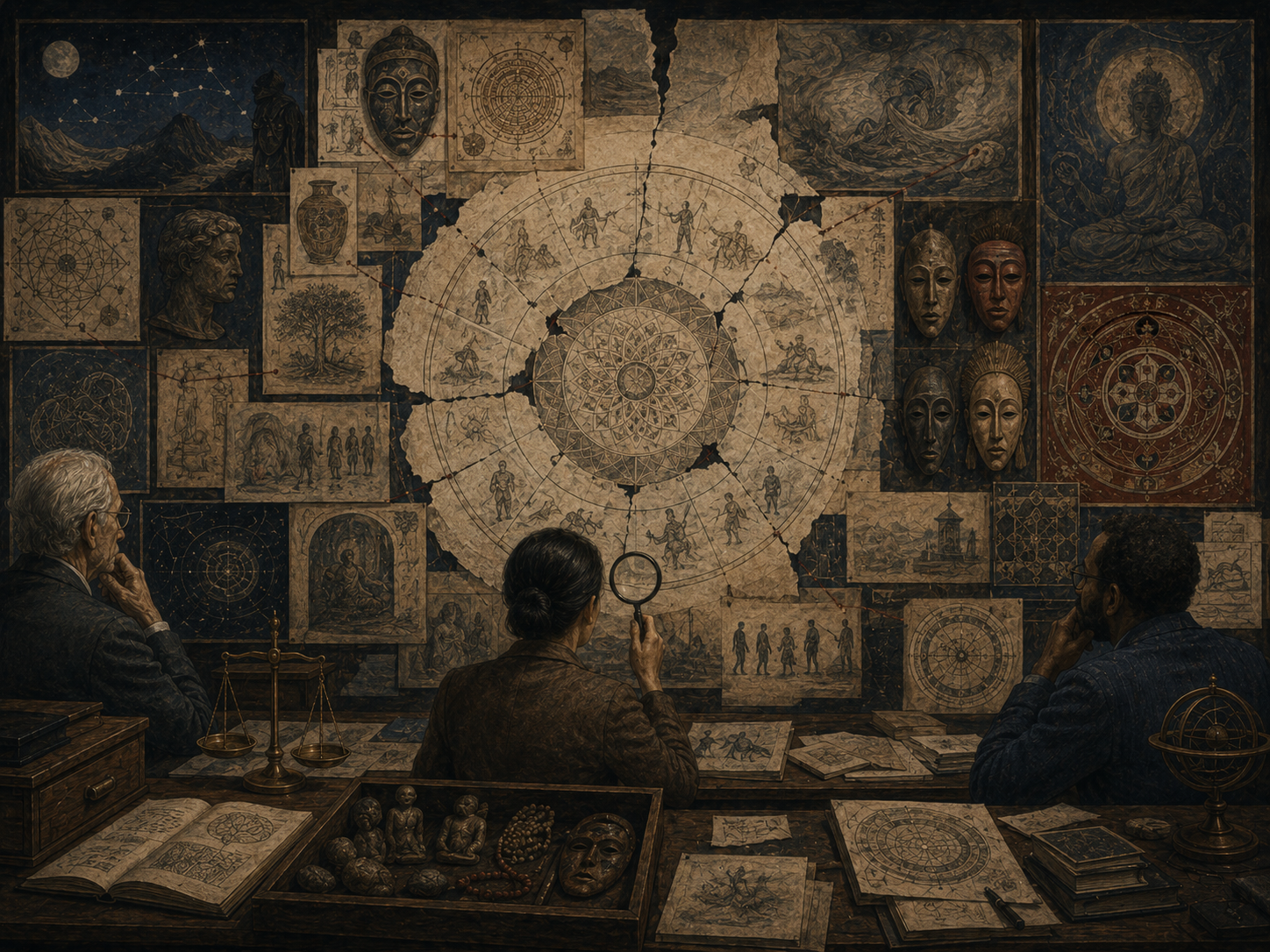
The issue of culture is equally decisive. Jung’s work drew widely from Christian symbolism, alchemy, Gnosticism, classical myth, South Asian traditions, Chinese thought, comparative religion, folklore, and esoteric materials more broadly. Admirers see this as intellectual range; critics often see it as problematic appropriation, flattening of difference, or projection of European interpretive frameworks onto traditions whose own categories are more historically specific than Jung allowed. To say that a symbol recurs across cultures is not yet to show that it carries the same meaning across cultures, nor that it emerges from one universal psychic source rather than from shared embodiment, diffusion, colonial circulation, narrative convenience, ecological pressures, social form, or retrospective comparison.
The issue of universality brings these problems together. Jungian psychology is at its boldest when it claims that certain symbolic patterns, figures, and structures are not merely local products of history, but expressions of deep and enduring features of human psychic life. This claim gives the tradition much of its power. It also makes it vulnerable. Are archetypes genuinely universal, or are they abstractions drawn from selective textual comparison? Are anima and animus psychologically deep truths, or historically contingent gender metaphors elevated into theory? Is individuation a universal developmental task, or a culturally specific ideal shaped by modern Western individualism? Is the collective unconscious a discoverable structure of psyche, or a powerful interpretive model whose ontological status remains unsettled?
These questions do not destroy Jungian thought, but they demand that it be examined more critically than sympathetic readings sometimes permit. A serious contemporary Jungianism cannot survive by insisting that symbolic depth exempts it from scrutiny. It must distinguish clinical usefulness from theoretical truth, metaphor from empirical claim, comparison from equivalence, universality from overgeneralization, and spiritual seriousness from uncritical romanticism. Critique is not merely external attack. It is one of the means by which a tradition clarifies what remains alive in it.
This article examines major critiques of Jungian psychology with special attention to evidence, culture, and universality. It explores empirical objections, methodological concerns, feminist and cultural critiques, questions about race and colonial knowledge, debates over symbolism and archetype, and the challenge of retaining what is valuable in Jungian thought without exempting it from serious scrutiny. It treats critique not as cancellation, but as an essential test of whether a symbolic psychology can remain intellectually serious under contemporary conditions.
Why Critique Matters for Jungian Psychology
Critique matters for Jungian psychology because the tradition makes large claims. It speaks not only about individual dreams or clinical encounters, but about myth, religion, civilization, symbolism, gender, development, and human psychic structure across time and culture. The broader a theory’s ambitions, the more seriously its methods, assumptions, and blind spots must be examined. A psychology that claims access to universal symbolic patterns cannot be excused from questions about evidence, cultural translation, and interpretive power.
This is especially important because Jungian thought has often appealed most strongly to readers who find modern life symbolically thin and empirically reductionist. That appeal is understandable. Much contemporary discourse about mental life can become narrow: symptom lists, productivity advice, behavioral management, cognitive correction, brand identity, or pharmaceutical stabilization. Jungian psychology offers something richer: dream, myth, shadow, symbol, ritual, religious imagination, and inward transformation. But a theory does not become intellectually sound simply because it restores mystery, depth, and meaning. It must still answer hard questions: What counts as evidence? How are concepts defined? What distinguishes insight from projection? How are cultural differences handled? What prevents interpretation from becoming self-confirming?
Critique matters because symbolic richness does not exempt a theory from rigor. In fact, the richer a symbolic theory becomes, the more discipline it needs. Symbols can gather meanings from many directions. A dream image may evoke biography, culture, myth, body, religion, trauma, fantasy, and present conflict at once. This interpretive abundance is one of the reasons depth psychology is powerful. It is also one of the reasons it can become unstable. If every association is admitted and no criteria of restraint are applied, interpretation may expand indefinitely.
Jungian psychology also needs critique because it has been unusually successful outside narrow professional settings. Its language has entered popular culture: shadow work, archetypes, individuation, personality types, synchronicity, anima, animus, and the collective unconscious circulate widely in therapy, coaching, spirituality, literature, media criticism, leadership discourse, online self-help, and creative practice. Once concepts travel so broadly, their ambiguity matters. A careful clinical idea can become a cliché. A symbolic metaphor can become dogma. A subtle critique of ego identity can become a marketable self-development formula. Critique helps distinguish living concepts from inflated slogans.
Critique is also necessary because Jungian psychology is not politically innocent. Concepts of development, primitivity, civilization, masculinity, femininity, religion, race, and cultural symbolism emerged within historically situated intellectual worlds. Some Jungian texts reflect assumptions of their time. Some later Jungians have revised those assumptions significantly. But revision cannot occur if the tradition protects itself through reverence. A serious Jungianism must be able to read Jung critically, not merely defend him.
None of this requires abandoning analytical psychology. Critique does not mean dismissal. It means testing the tradition’s claims against evidence, history, ethical responsibility, cultural specificity, gender critique, clinical knowledge, and philosophical clarity. The strongest traditions are not those without criticism. They are those that can survive criticism by becoming more honest about what they know, what they do not know, and what they should stop claiming.
The Problem of Evidence and Testability
One of the oldest criticisms of Jungian psychology is that many of its core concepts are difficult to test empirically. Scientific psychology typically values operational clarity, replicability, and some capacity to distinguish competing hypotheses. Jungian ideas often resist such procedures. The collective unconscious, archetypes, synchronicity, symbolic compensation, individuation, and many forms of dream interpretation may be suggestive, but critics ask how they are to be measured, falsified, or separated from looser interpretive judgment.
This difficulty does not mean the concepts are useless. It does mean that their epistemic status is often ambiguous. A concept may be clinically resonant, philosophically fertile, culturally illuminating, or hermeneutically powerful without being scientifically robust in the strong sense. Problems arise when Jungian language moves too easily between metaphor, hermeneutics, anthropology, theology, and science while borrowing the authority of each without accepting the demands of any one domain fully.
Evidence in Jungian psychology often takes forms that do not fit neatly into laboratory research: case material, dream sequences, symbolic recurrence, clinical transformation, interpretive coherence, patient associations, comparative mythology, ritual parallels, and phenomenological accounts of inner experience. These forms of evidence are not worthless. But they are not all the same. A compelling case study does not establish a universal structure. A useful interpretation does not prove an ontology. A recurring mythic motif does not settle the cause of recurrence. A patient’s improvement in therapy does not confirm every theoretical claim used by the therapist.
The testability problem becomes sharper when Jungian concepts are phrased as explanatory mechanisms. If archetypes explain recurring symbols, what would count against the claim? If a dream compensates conscious one-sidedness, how can alternative explanations be evaluated? If synchronicity names meaningful coincidence beyond causality, how does one distinguish it from pattern-seeking, probability, memory selection, or narrative construction? If individuation is a developmental process, what measurable indicators would separate it from maturity, self-reflection, identity integration, or culturally preferred selfhood?
A defensible contemporary Jungianism would therefore clarify levels of claim. Some claims are empirical and should be tested as empirical. Some are clinical hypotheses and should be judged by clinical process, outcome, and ethical usefulness. Some are hermeneutic interpretations and should be judged by coherence, contextual fit, and openness to alternative readings. Some are phenomenological descriptions and should be judged by descriptive precision and recognizability. Some are philosophical metaphors and should not pretend to be scientific findings.
| Jungian claim type | Possible value | Critical question | Appropriate discipline |
|---|---|---|---|
| Clinical interpretation | May deepen reflection, clarify projection, and support transformation | Does it fit the patient’s material and remain open to revision? | Clinical follow-up, patient associations, ethical containment |
| Archetypal comparison | May reveal recurring symbolic forms across myths and dreams | Does recurrence prove shared structure, or only resemblance? | Historical, philological, and comparative discipline |
| Therapy outcome claim | May support Jungian treatment as clinically useful | What evidence shows benefit, for whom, under what conditions? | Outcome research, process studies, validated measures |
| Synchronicity claim | May describe meaningful coincidence as lived experience | Is it a phenomenological category or a causal/metaphysical claim? | Clear status distinction, probability awareness, philosophical restraint |
| Collective unconscious claim | May organize thinking about transpersonal symbolic recurrence | Is it an inherited psychic structure, comparative model, or metaphor? | Conceptual clarity and bounded inference |
The critique of evidence and testability does not require Jungian psychology to become a narrow experimental science. It requires the tradition to stop treating all forms of warrant as equivalent. The field becomes more credible when it can say, explicitly, what kind of knowledge is being claimed and what kind of evidence would support or weaken that claim.
Archetypes as Theoretical Power and Empirical Problem
Archetypes are probably the most influential and the most criticized concept in Jungian psychology. They offer a compelling way to think about recurring figures and symbolic structures across myths, dreams, literature, religion, art, fantasy, and ritual life. They help explain why certain images seem to arrive with unusual force: the divine child, great mother, wise elder, trickster, shadow, hero, sacred center, underworld journey, cosmic tree, death-rebirth sequence, and union of opposites. For many readers, archetypal language names something real about the depth and recurrence of symbolic imagination.
But critics argue that archetypes often function as vague explanatory placeholders. A pattern is noticed, named as archetypal, and then treated as explained. The category can become circular: recurring forms are evidence for archetypes, and archetypes are invoked to explain recurring forms. Unless the concept is defined carefully, archetype can become a label that gives the feeling of explanation without providing a testable mechanism.
The empirical problem is intensified by definitional looseness. Are archetypes innate images, inherited structures of potential, narrative attractors, symbolic tendencies, neurocognitive patterns, embodied schemas, affective organizers, developmental templates, cultural recurrences, or interpretive abstractions? Jung and later Jungians have not always answered consistently. That ambiguity has allowed the concept to travel widely, but it has also made the concept difficult to discipline. The very flexibility that gives archetype its interpretive power can weaken its explanatory precision.
Critics also point out that archetypal readings often rely on high-level abstraction. If enough detail is removed, many different figures can be grouped under the same archetypal heading. A mother figure, goddess, earth image, cave, vessel, sea, and landscape may be linked under a great mother pattern. A critic may ask: at what point does comparison become so broad that it stops explaining difference? What is gained by naming a pattern archetypal, and what is lost when specific contexts are subordinated to that name?
There is also the problem of selection. Archetypal examples are often chosen because they fit. The archive of myth, religion, dream, and literature is vast. If the interpreter searches widely enough, supporting examples can almost always be found. This does not mean the pattern is false. It means the method must include disconfirming cases, contextual differences, and alternative explanations. Otherwise, archetypal interpretation risks becoming an elegant form of confirmation bias.
A contemporary defense of archetypes should probably be more modest than classical formulations. Archetypes may be most defensible as recurring symbolic-organizing patterns that emerge from the interaction of embodiment, affect, development, culture, narrative, social structure, and imagination. This formulation preserves the insight that recurring symbolic forms matter, while avoiding overconfident claims about inherited images or universal psychic structures. It makes archetype a model of patterning rather than a master explanation.
Such a revision would not eliminate the power of archetypal thought. It would clarify it. Archetypal language remains valuable when it helps identify recurring patterns without closing interpretation too quickly. It becomes problematic when it turns resemblance into proof, metaphor into mechanism, and symbolic resonance into universal law.
Collective Unconscious or Interpretive Abstraction?
The collective unconscious raises an even sharper challenge. Jung proposed a deeper layer of psyche structured by inherited archetypal forms, helping explain symbolic recurrence beyond personal biography. Critics ask whether this hypothesis identifies an actual psychic structure or merely names a pattern noticed retrospectively in texts, myths, dreams, and cultural materials. In other words, is the collective unconscious a real level of mind, or an abstraction built from comparison?
This question matters because the concept carries large ontological weight. It is one thing to say humans across cultures produce similar symbolic motifs under recurring existential conditions; it is another to posit a transpersonal psychic inheritance underlying those motifs. Jungian psychology often moves between these claims. Critics argue that the stronger claim is insufficiently demonstrated and that the weaker claim can often be explained without invoking a collective unconscious at all.
Several alternative explanations are possible. Similar motifs may arise because human beings share bodies, developmental vulnerabilities, family structures, mortality, sexuality, fear, dependency, dreams, and ecological conditions. Symbols may also spread through trade, migration, conquest, translation, religious transmission, colonial contact, literary borrowing, and shared narrative conventions. Some similarities may be imposed retrospectively by scholars who abstract away the differences. Some may reflect cognitive patterning rather than an inherited symbolic layer. A theory of the collective unconscious must therefore do more than notice recurrence. It must explain why recurrence requires that particular theory.
Critics also note that the collective unconscious can function as a shield against historical explanation. If a symbol appears across traditions, the Jungian interpreter may treat it as archetypal rather than asking about diffusion, power, translation, or shared social conditions. This can weaken historical analysis. It can also flatten cultural difference by making diverse traditions appear as surface variations of one deeper psychic system.
Yet the concept should not be dismissed too quickly. The collective unconscious remains powerful as a way of naming the fact that psychic life exceeds personal biography. People inherit language, stories, religious forms, social fantasies, racialized images, gender myths, political memories, family patterns, and cultural wounds before they consciously understand them. Much of this inheritance is indeed unconscious in a broad sense. The problem is whether this sociocultural and symbolic inheritance should be described as a psychic layer in Jung’s stronger sense.
A more careful approach would distinguish among three uses of the concept. As an ontological claim, the collective unconscious asserts a real inherited psychic structure and carries a high burden of proof. As a comparative model, it helps organize recurring symbolic patterns without necessarily proving their source. As a metaphor, it names the transpersonal dimensions of imagination, culture, memory, and inherited meaning. Confusion arises when these uses are blended without acknowledgment.
| Use of the collective unconscious | Value | Risk | Critical discipline needed |
|---|---|---|---|
| Ontological hypothesis | Offers a strong explanation of transpersonal symbolic recurrence | Requires evidence that is difficult to supply | Clear definition, testable implications, strong alternative-explanation analysis |
| Comparative model | Organizes cross-cultural symbolic patterns | May overstate similarity and understate history | Philology, anthropology, religious studies, historical specificity |
| Clinical heuristic | Helps interpret symbolic material beyond personal biography | May impose theory onto patient experience | Patient associations, clinical humility, process validation |
| Philosophical metaphor | Names inherited symbolic worlds larger than the individual | May borrow scientific authority without scientific warrant | Explicit metaphorical status and conceptual clarity |
The collective unconscious remains one of Jungian psychology’s most evocative ideas. It is also one of its most vulnerable. Its future credibility depends on specifying whether it is being used as hypothesis, model, heuristic, or metaphor. Without that distinction, it risks becoming a grand name for patterns that may have many different causes.
Symbolism, Overinterpretation, and the Risk of Confirmation Bias
Jungian interpretation is often admired for its depth and breadth, but this breadth invites criticism of overinterpretation. When a theory values symbolic resonance, mythic analogy, and amplification, there is a risk that any image can be connected to some archetypal pattern if one searches widely enough. Confirmation bias then becomes a persistent danger. The interpreter finds what the interpretive framework has trained them to see.
This does not invalidate symbolic interpretation. It does mean that interpretive humility is essential. Not every recurring image is archetypal in a strong sense. Not every dream figure belongs to a grand symbolic drama. Not every literary or religious motif reveals timeless psychic structure. Critics of Jungian thought are often at their strongest when they point out how easily symbolic reading can become self-confirming if it lacks criteria of restraint.
Overinterpretation can happen in several ways. A dream image may be amplified through mythological parallels before the dreamer’s own associations have been heard. A symbol may be interpreted as universal before its cultural function has been studied. A clinical pattern may be given archetypal significance when a simpler relational or traumatic explanation would be more appropriate. A myth may be abstracted so heavily that it becomes a mirror for the theory rather than a text with its own structure. A patient may accept an interpretation because of the analyst’s authority rather than because it genuinely clarifies experience.
Confirmation bias is especially powerful in symbolic work because symbolic material is multivalent. It can support many readings. This is why symbolic interpretation needs procedures of friction: attention to context, competing interpretations, patient response, disconfirming evidence, historical specificity, and the possibility that an image may not mean what the interpreter wants it to mean. Without friction, amplification becomes accumulation rather than inquiry.
A disciplined Jungian method would ask several questions before making a strong symbolic claim. What is the immediate context of the image? What are the dreamer’s or speaker’s own associations? What cultural or religious tradition, if any, is involved? What alternative interpretations are possible? What would count as evidence against this reading? Does the interpretation deepen the material, or does it simply display the analyst’s erudition? Does the symbol become more alive through the interpretation, or is it captured by a category?
The problem of overinterpretation also applies to cultural criticism. Jungian readings of film, literature, politics, and religion can be powerful, but they can also become too smooth. A hero narrative is read as individuation; a villain becomes shadow; a feminine figure becomes anima; a descent becomes underworld initiation; a circle becomes Self. Such readings may illuminate real patterns, but they can also reduce complex works to predictable archetypal templates. Good symbolic criticism should surprise the framework as much as confirm it.
The best defense of Jungian interpretation is not to deny this risk, but to build safeguards against it. Symbolic depth remains valuable when it is disciplined by humility. The task is to interpret richly without making every image prove the theory.
Gender Essentialism and the Critique of Anima and Animus
Few areas of Jungian psychology have drawn more sustained contemporary criticism than the concepts of anima and animus. In classical form, these concepts often link interior psychic qualities to binary gender assumptions: feeling, soulfulness, eros, receptivity, and relational inwardness coded as feminine; rationality, logos, judgment, assertive spirit, and abstraction coded as masculine. Critics argue that these formulations reproduce essentialist ideas about sex and gender under the guise of symbolic psychology.
This critique is important because the problem is not only outdated terminology. It is structural. When symbolic categories are mapped onto gender binaries too rigidly, historical stereotypes are elevated into psychological theory. Traits associated with women and men in particular social worlds become described as deep psychic principles. The theory then appears to discover gendered psychic truth while actually reproducing cultural assumptions.
The critique becomes sharper when one asks who benefits from the symbolic coding. If women are associated with eros, feeling, nature, soul, relatedness, and containment, while men are associated with logos, spirit, reason, judgment, and culture, the theory may seem to balance opposites. But it may also reinscribe old hierarchies. Women may be idealized as soul-bearers while excluded from rational authority. Men may be encouraged to integrate feeling while still occupying the normative position of subject. Gender difference becomes metaphysical rather than historical.
Many later Jungians have tried to reinterpret anima and animus more flexibly as figures of alterity, interior mediation, psychic otherness, contrasexual imagination, or the encounter with excluded qualities rather than as gender essence. These revisions matter. They show that Jungian thought can be reworked. But the critique remains powerful because it exposes how easily Jungian universals can encode historically contingent norms.
Contemporary gender theory, feminist psychology, queer theory, trans studies, and social history all challenge the assumption that masculine and feminine can be treated as stable symbolic poles. Gender is lived through bodies, identities, institutions, languages, power relations, law, violence, desire, performance, and historical change. A symbolic psychology that turns gender into timeless polarity risks missing this complexity.
A more defensible Jungian approach would detach the valuable insight from the essentialist frame. The valuable insight is that the psyche encounters otherness within itself, and that people often disown qualities associated with gendered expectations. A man may disown tenderness, dependency, receptivity, or relational vulnerability because those qualities have been culturally feminized. A woman may disown authority, anger, abstraction, or ambition because those qualities have been culturally masculinized. Nonbinary, queer, and trans experiences may reveal even more clearly that psychic otherness cannot be reduced to binary gender categories.
In this revised form, anima and animus may become historically situated figures of psychic otherness rather than universal gender essences. They can be studied as symbolic formations shaped by culture, family, embodiment, desire, power, and personal history. The result is less metaphysically tidy, but more ethically and psychologically credible.
Culture, History, and the Question of Universality
Jungian psychology often speaks in universalizing language. It proposes symbols, archetypes, psychic structures, and developmental tasks that allegedly recur across humanity. Critics respond that human symbolic life is always mediated by language, social order, political history, religious tradition, ecology, technology, trauma, and unequal power. Similarity of image does not by itself establish universality of meaning. A mother figure, trickster figure, sacred child, or underworld descent may appear in many traditions without functioning identically in each.
The universalizing tendency becomes especially problematic when it draws heavily on a selective archive of texts and myths while presenting that archive as representative of humanity at large. Jung’s comparative range was real, but his methods often assumed that broad symbolic correspondences could be read at a high level of abstraction without enough historical or philological specificity. Critics argue that this is precisely where universality becomes too quickly declared rather than rigorously established.
Culture is not merely a surface layer placed over universal psychic contents. Culture shapes what counts as self, person, body, spirit, ancestor, gender, desire, authority, illness, healing, dream, symbol, and reality. In some traditions, dreams may be private psychological events; in others, they may be communal, prophetic, ancestral, diagnostic, or ritually governed. In some contexts, a figure may be symbolic; in others, it may be an actual spiritual presence, a legal authority, a land relation, or a sacred obligation. A universalizing psychology that assumes the modern Western category of psyche may misread worlds in which psyche is not the primary organizing term.
History also matters because symbols change. A symbol may carry different meanings before and after colonization, migration, conversion, enslavement, industrialization, nationalism, or diaspora. A religious image may become a political image. A ritual form may become a marker of resistance. A myth may be reinterpreted under conditions of oppression. A Jungian reading that treats symbols as timeless may miss how history changes symbolic life.
Universality should therefore be treated as a claim with levels. Thin universality may be plausible: human beings everywhere face birth, dependency, fear, sexuality, death, kinship, loss, dreams, conflict, and the need for meaning. It is reasonable that symbolic responses to these conditions recur. Thick universality is harder: the claim that a specific archetypal meaning, psychic structure, or developmental task has the same deep significance across humanity. Thick universality requires far stronger evidence and greater cultural caution.
| Level of claim | Example | Credibility | Risk |
|---|---|---|---|
| Thin recurrence | Many cultures symbolize death, rebirth, center, journey, and transformation | Often plausible | Can be overstated if treated as identical meaning |
| Family resemblance | Different traditions use trickster-like figures to disrupt order | Useful if context is preserved | May flatten differences in function and value |
| Functional convergence | Different rituals mediate passage, mourning, or initiation | Stronger than visual resemblance alone | Still requires historical and ritual specificity |
| Strong archetypal universality | One inherited psychic pattern explains diverse symbolic forms | Most ambitious and most contested | May exceed evidence and erase cultural difference |
| Universal developmental task | Individuation as a human life-task | Suggestive but culturally variable | May reflect modern Western individualism |
Culture and history do not make comparison impossible. They make comparison more demanding. A credible Jungianism can still ask about shared human symbolic patterns, but it must do so with attention to language, power, ritual, social function, and the possibility that difference is not secondary noise but part of the meaning itself.
Comparative Religion, Appropriation, and the Problem of Flattening Difference
Jung’s work on religion and comparative symbolism has been celebrated for opening psychology to sacred texts, rituals, images, and traditions often excluded from modern secular discourse. It has also been criticized for flattening difference. By reading Christian, Gnostic, alchemical, Hindu, Buddhist, Daoist, and other materials through one symbolic-psychological lens, Jung sometimes treated traditions with radically different doctrinal, ritual, legal, philosophical, and communal worlds as if they were all primarily expressions of the same psychic structures.
This can produce interpretive brilliance, but also a kind of appropriation. Traditions become reservoirs of symbolic material for a European depth psychology rather than voices speaking in their own conceptual and historical registers. Critics therefore argue that Jungian comparative work often needs more theological, historical, and area-specific discipline than it originally displayed.
Appropriation in this context does not always mean hostile theft. It can occur through admiration. A tradition may be praised as deep, ancient, symbolic, or spiritually rich while still being translated into categories not its own. Buddhist mandalas become images of psychic wholeness; Daoist texts become evidence for synchronicity; Hindu symbols become diagrams of individuation; alchemical figures become intrapsychic processes; Indigenous ceremonies become archetypal enactments. Some of these readings may illuminate psychological dimensions. The problem arises when the psychological reading becomes dominant enough to displace the tradition’s own meanings.
Religious traditions are not simply symbolic archives. They are living systems of practice, authority, doctrine, law, ritual, memory, discipline, and community. A symbol may be inseparable from liturgy, revelation, lineage, initiation, recitation, ethical obligation, pilgrimage, sacred language, or communal identity. To interpret it only as a psychic image may reduce its reality. The issue is not whether religious symbols have psychological meaning. They often do. The issue is whether psychology has the right to treat psychological meaning as the deepest or final meaning.
Comparative religion also raises the problem of selective reading. Jungian interpretation often gravitates toward materials that look symbolically rich: mandalas, alchemy, mystical texts, myths, esoteric diagrams, visionary experiences, ritual transformations. But religious traditions also include law, ethics, politics, institutions, discipline, scholastic debate, social hierarchy, ordinary practice, and communal obligation. A symbolic psychology that selects only the imaginal material may produce a beautiful but partial religion.
A more responsible approach would distinguish psychological interpretation from theological interpretation, ritual interpretation, historical interpretation, and community interpretation. It would ask what the symbol means within the tradition before asking what it may mean psychologically. It would also accept that some symbols may resist psychological translation, or that psychological translation may be only one secondary layer.
This does not mean Jungian psychology should stop engaging religion. On the contrary, its willingness to take religious symbolism seriously remains one of its great strengths. But a contemporary Jungianism must move from symbolic appropriation toward disciplined dialogue. It must allow religious traditions to speak as more than evidence for Jungian theory.
Coloniality, Race, and the Politics of Depth Psychology
Modern critique also asks how Jungian psychology relates to colonial knowledge structures and racialized assumptions. Some scholars argue that early analytical psychology, like many twentieth-century intellectual traditions, sometimes positioned European consciousness as normatively developed while reading non-European symbolic worlds as more primordial, archaic, mythic, or nearer to the unconscious. Even where Jung admired non-Western traditions, that admiration could coexist with hierarchical assumptions about civilizational development.
This critique matters because depth psychology is not politically innocent. The categories it uses to describe psychic development, primitivity, myth, rationality, and spiritual life are historically entangled with empire, Orientalism, race science, colonial anthropology, missionary translation, and racialized theories of civilization. A contemporary Jungian psychology that wishes to survive serious scrutiny must engage these entanglements directly rather than imagining itself beyond politics because it deals in symbols.
The language of the “primitive” is especially important. In earlier intellectual contexts, non-European cultures were often described as closer to nature, myth, body, image, collectivity, or the unconscious, while European modernity was associated with rational consciousness, differentiation, and development. Even when such language was admiring rather than contemptuous, it often reproduced hierarchy. It positioned non-European peoples as symbolic resources for European self-critique rather than as contemporaries with their own intellectual, spiritual, and political worlds.
Jungian psychology can also be vulnerable to racial abstraction. If a symbol from an African, Indigenous, Asian, or diasporic tradition is read primarily as archetypal, the historical conditions of colonization, enslavement, migration, language loss, land dispossession, racial violence, and cultural survival may disappear. The symbol becomes timeless when part of its meaning may be historical struggle. A ritual becomes an archetypal enactment when it may also be a form of resistance, memory, sovereignty, or communal repair.
Race also matters in clinical and cultural interpretation. Dreams, fantasies, and projections do not occur outside racialized worlds. A patient’s shadow material may be shaped by racial fear, inherited privilege, internalized oppression, cultural memory, or social trauma. Collective projections may attach to racialized bodies. National myths may organize innocence around denial of racial violence. A Jungian psychology that speaks of shadow but does not engage race risks becoming morally evasive.
A critical Jungianism must therefore expand its understanding of the unconscious. The unconscious is not only personal and archetypal. It is also historical, social, racialized, gendered, and institutional. This does not mean reducing psyche to politics. It means refusing to treat psyche as if it were untouched by political history. Symbols carry power. Images organize social fear. Myths justify domination. Projection can become policy. Shadow can become racial panic. Persona can become national innocence.
Engaging coloniality and race does not destroy depth psychology. It deepens it. It forces Jungian thought to confront collective shadow not as a metaphor alone, but as historical reality. It asks whether the tradition can analyze projection, myth, and unconscious fantasy without ignoring the structures through which they become socially dangerous.
Clinical Critique: Does Jungian Therapy Work?
Clinical criticism of Jungian psychology often takes two forms. The first asks whether Jungian psychotherapy has a sufficiently strong evidence base compared with better-studied modalities. The second asks whether its symbolic and interpretive style is appropriate for a wide range of conditions, especially trauma, severe dissociation, psychosis, acute suicidality, or disorders in which grounding and stabilization may matter more immediately than symbolic exploration.
These critiques do not imply that Jungian therapy is ineffective. Many patients find depth-oriented and meaning-centered work profoundly helpful. Long-term therapy, sustained relational attention, symbolic exploration, dream work, and reflection on projection may support forms of change that brief symptom-focused interventions do not always address. But from a contemporary clinical standpoint, critics want clearer outcome data, more differentiated claims about for whom and under what conditions Jungian approaches are most helpful, and more caution about generalizing symbolic methods to cases where clinical containment is the primary need.
Clinical evidence must be interpreted carefully. If Jungian therapy helps, that matters. But improvement in therapy does not automatically validate every theoretical claim in Jungian psychology. A patient may benefit from symbolic interpretation because it gives language to experience, deepens self-reflection, supports emotional containment, strengthens the therapeutic relationship, or creates narrative coherence. Those benefits may not prove archetypes, the collective unconscious, or any specific theory of psychic structure. Clinical usefulness and theoretical truth are related, but not identical.
The critique is also ethical. Symbolic interpretation can be powerful, but it can be harmful when applied prematurely. A traumatized patient may need safety, stabilization, body-based regulation, relational trust, and practical support before symbolic amplification. A psychotic patient may not benefit from interpretations that intensify symbolic meaning without grounding. A suicidal patient may need crisis intervention rather than archetypal reflection. A dissociative patient may require careful pacing rather than immersion in imaginal material. A serious Jungian clinician must know when not to interpret.
At the same time, critics should avoid reducing therapy to measurable symptom change alone. Jungian therapy often aims at meaning, integration, symbolic life, self-knowledge, and transformation across time. These outcomes may be harder to measure, but they are not irrelevant. The clinical challenge is to develop evidence that can capture both symptom outcomes and deeper processes without inflating either.
A mature clinical Jungianism would therefore be differentiated. It would not claim that Jungian therapy is best for all patients or all conditions. It would specify where depth work is appropriate, where it must be modified, where it should be combined with other methods, and where it may be contraindicated. It would engage trauma research, attachment theory, psychotherapy process research, cultural competence, and psychiatric knowledge without abandoning symbolic depth.
The clinical critique should be welcomed because it pushes analytical psychology toward greater care. The question is not whether Jungian therapy can help. It can. The question is how to know when it helps, why it helps, for whom it helps, what risks it carries, and which parts of the theory are supported by clinical evidence rather than merely assumed.
Science, Hermeneutics, and the Status of Jungian Knowledge
One possible response to these criticisms is to clarify that Jungian psychology may function less as natural science and more as hermeneutics, phenomenology, symbolic interpretation, or philosophical anthropology. On this view, the tradition should not be judged solely by experimental criteria because its main task is not prediction and control, but depth of understanding. Critics sometimes accept this move, but then ask that Jungian psychology stop borrowing scientific prestige when convenient.
This is a serious challenge. If Jungian thought is primarily interpretive, then it should be defended as interpretive knowledge: rich, contextual, suggestive, and oriented toward meaning rather than law-like explanation. Many problems arise when it is presented simultaneously as empirical science, symbolic philosophy, cultural anthropology, and spiritual psychology without clear distinctions among those claims.
The status of Jungian knowledge is therefore plural. Some of it is clinical: it concerns what happens in therapy, how patients respond to symbols, how dreams enter treatment, and how projection or complex formation may be recognized. Some of it is hermeneutic: it interprets images, myths, stories, and cultural forms. Some of it is phenomenological: it describes experiences of inner figures, numinosity, dream life, and symbolic crisis. Some of it is philosophical: it proposes broad claims about psyche, meaning, and human life. Some of it attempts to be empirical: especially when it makes claims about therapy outcomes, development, or universal structures.
The difficulty is not pluralism itself. Many complex fields require multiple forms of knowledge. The difficulty is category confusion. A claim may begin as metaphor and be defended as clinical fact. A clinical interpretation may be used to support an ontological theory. A comparative symbolic pattern may be presented as evidence for inherited psychic structure. A phenomenological description may be treated as proof of metaphysical reality. These shifts need to be named.
A more credible Jungian epistemology would assign each claim to its proper domain. When speaking empirically, it would accept empirical discipline. When speaking hermeneutically, it would accept interpretive accountability. When speaking clinically, it would accept therapeutic ethics and outcome scrutiny. When speaking philosophically, it would accept conceptual criticism. When speaking metaphorically, it would not pretend to have proven a mechanism.
| Knowledge mode | Jungian strength | Critical risk | What credibility requires |
|---|---|---|---|
| Science | Can test clinical outcomes and some psychological processes | Overclaiming beyond operational evidence | Clear constructs, methods, and falsifiable claims |
| Hermeneutics | Interprets symbol, myth, dream, and narrative | Self-confirming interpretation | Context, alternatives, disconfirming material, interpretive humility |
| Phenomenology | Describes lived inner experience seriously | Treating intensity as proof | Descriptive precision and critical reflection |
| Clinical practice | Works with suffering, projection, dream, and meaning | Premature or inflated interpretation | Ethical care, outcome attention, patient-centered process |
| Philosophical anthropology | Asks what kind of beings humans are | Universalizing culturally situated assumptions | Conceptual clarity and cultural self-awareness |
Jungian psychology does not need to choose only one knowledge mode. It does need to stop blurring them. Its future credibility depends on methodological honesty: knowing when it is interpreting, when it is hypothesizing, when it is describing, when it is speculating, and when it is making claims that require empirical evidence.
What Remains Valuable After Critique?
Critique does not necessarily nullify Jungian psychology. It can clarify what remains valuable. The tradition continues to offer unusually rich accounts of symbolism, mythic imagination, dreams, religious experience, psychic conflict beyond ordinary rationality, and the need for meaning in psychological life. It also remains powerful wherever symptom language alone feels too thin to capture human inwardness.
What may remain strongest after critique is not the most inflated universal claim, but the more modest insight that human beings think and suffer symbolically; that imagination is not epiphenomenal to psychological life; that dream, myth, ritual, and literary image deserve serious attention; and that people often live through figures, moods, stories, and symbolic worlds that cannot be reduced without remainder to behavior or cognition.
The concept of shadow remains valuable when used carefully. It names the way individuals and groups disown qualities they cannot bear, then encounter them in others with disproportionate intensity. This insight does not require every part of Jungian metaphysics. It remains clinically, ethically, and politically useful. Projection, scapegoating, moral innocence, and collective disavowal remain central problems of human life.
The concept of persona also remains useful. It names the social face, role, adaptation, and performative identity through which people meet the world. Contemporary life, saturated with professional branding, social media performance, institutional role pressure, and identity display, makes persona more relevant rather than less. The critique is not that persona is meaningless, but that it should be understood historically and socially rather than as a timeless structure alone.
Dream work remains valuable when practiced with humility. Dreams can reveal affective, relational, symbolic, and imaginative material not available to ordinary conscious reflection. A critical Jungianism need not abandon dream interpretation. It should simply stop treating every dream as evidence for grand theory. The dream belongs first to the dreamer, the clinical situation, and the life in which it appears.
Individuation also remains valuable if revised. Classical individuation can sound culturally individualistic when framed as the realization of an inner Self apart from social conditions. But a more contemporary version can describe the difficult work of becoming less governed by unconscious projection, inherited roles, false persona, defensive identity, and collective possession. Such a process may include responsibility to others, not withdrawal into private selfhood.
Jungian attention to religion and myth remains valuable when it becomes more historically and theologically disciplined. Modern psychology often lacks language for sacred experience, ritual, symbolic transformation, and spiritual crisis. Jungian psychology helps fill that gap. But it must do so without reducing religious traditions to psychological illustrations.
What remains, then, is substantial: a psychology of symbol, dream, projection, imagination, myth, shadow, persona, meaning, and transformation. What critique removes is the right to overgeneralize, essentialize, appropriate, or claim scientific authority without warrant. This is not a small revision. It is a necessary one.
Toward a More Critical and Culturally Situated Jungianism
A more defensible contemporary Jungianism would likely be more historically explicit, more culturally situated, less universalizing in tone, more cautious with gendered symbolism, more open about the limits of testability, and more clinically differentiated. It would retain respect for symbolic life without treating all recurring forms as proof of archetypal universality. It would read cross-cultural materials with greater philological and political humility. It would clarify when it is making empirical claims and when it is offering interpretive or phenomenological insight.
Such a revision would not destroy the tradition. It might save what is most vital in it. Jungian psychology is most persuasive when it acknowledges that symbol, culture, history, and psyche are entangled in ways too complex for easy universalism, yet too meaningful for reductive dismissal.
A critical Jungianism would begin by distinguishing between Jung as historical figure, Jungian psychology as a tradition, and contemporary symbolic psychology as a revisable field. It would not treat Jung’s formulations as final doctrine. It would ask which concepts remain useful, which need revision, which should be abandoned, and which should be treated as historically important but no longer adequate.
It would also revise its treatment of gender. Anima and animus would be reworked as historically situated images of psychic otherness, relational imagination, and culturally shaped disowned qualities, rather than as universal masculine and feminine essences. Gendered symbolism would be examined through feminist, queer, trans, and historical critique. The psyche would remain symbolic, but gender would no longer be treated as timeless polarity.
A culturally situated Jungianism would also revise comparison. It would no longer treat non-Western traditions as symbolic confirmation of archetypal theory. It would engage them through their own languages, practices, authorities, and histories. It would distinguish resemblance from equivalence, and it would accept that some traditions may challenge Jungian categories rather than fit inside them.
A clinically differentiated Jungianism would integrate trauma research, attachment theory, developmental psychology, psychiatric knowledge, and psychotherapy outcome research. It would ask when symbolic interpretation helps, when it harms, when it should be delayed, and when other methods are necessary. It would treat symbolic depth and clinical safety as partners, not competitors.
A methodologically explicit Jungianism would clarify warrant. It would say: this is a metaphor; this is a clinical hypothesis; this is a hermeneutic interpretation; this is a philosophical claim; this is an empirical claim; this remains speculative. Such distinctions would make the tradition less grandiose, but more trustworthy.
The result would be a Jungianism that is more modest but not smaller. It would remain a depth psychology of symbol, dream, myth, projection, and transformation. But it would become less entitled, less universalizing, less gender-essentialist, less culturally extractive, and more accountable to evidence and history. That may be the form in which the tradition can still matter.
Mathematical Lens
Jungian theory can be modeled as balancing interpretive reach against empirical discipline and cultural specificity. Let \(J_t\) represent overall theoretical credibility at time \(t\), \(I_t\) interpretive breadth, \(E_t\) empirical support, \(C_t\) cultural specificity, \(G_t\) gender-critical revision, and \(M_t\) methodological explicitness. Let \(U_t\) represent unwarranted universalization.
J_t = \alpha + \beta_1 I_t + \beta_2 E_t + \beta_3 C_t + \beta_4 G_t + \beta_5 M_t – \beta_6 U_t + \varepsilon_t
\]
Interpretation: Jungian credibility rises when interpretive breadth is joined to empirical support, cultural specificity, gender-critical revision, and methodological explicitness. It declines when universalization outruns evidence, history, and conceptual discipline.
This captures a central critique: interpretive richness alone cannot secure credibility if claims of universality exceed empirical or historical grounding. A theory may be symbolically powerful and still methodologically weak. It may illuminate experience while overclaiming its explanatory reach.
A second expression can represent overgeneralization risk. Let \(R_t\) represent overgeneralization risk, \(I_t\) interpretive breadth, \(U_t\) universalization, \(C_t\) cultural specificity, \(E_t\) empirical support, and \(M_t\) methodological explicitness.
R_t = \gamma_1 I_t + \gamma_2 U_t – \gamma_3 C_t – \gamma_4 E_t – \gamma_5 M_t + \eta_t
\]
Interpretation: Overgeneralization risk rises when symbolic interpretation expands faster than cultural specificity, empirical support, and methodological clarity. The broader the interpretive claim, the more friction it needs.
A third expression can model concept survival after critique. Let \(V_i\) represent the retained value of Jungian concept \(i\), \(S_i\) symbolic usefulness, \(K_i\) clinical usefulness, \(A_i\) adaptability under revision, and \(P_i\) problematic inherited assumptions.
V_i = \delta_1 S_i + \delta_2 K_i + \delta_3 A_i – \delta_4 P_i + \nu_i
\]
Interpretation: A Jungian concept remains valuable when it continues to illuminate symbol and clinical life while adapting under critique. Its value declines when problematic assumptions remain unrevised.
In network terms, Jungian psychology can be seen as a high-connectivity symbolic system whose explanatory power grows through association, but whose vulnerability also grows when too many heterogeneous materials are linked through one interpretive center without sufficient methodological friction. Critique introduces that friction. It does not necessarily destroy the network. It tests which connections should remain, which should be weakened, and which were never adequately supported.
R Workflow: Simulating Interpretive Breadth, Testability, and Cultural Specificity
The following R workflow simulates a simplified evaluation model for Jungian concepts by balancing interpretive richness against empirical support, cultural specificity, gender-critical revision, methodological explicitness, and universalization risk. The data are synthetic and illustrative. They are not a real evaluation of Jungian concepts, clinical outcomes, cultures, or patients.
# ============================================================
# Critiques of Jungian Psychology: Evidence, Culture, and Universality
# R Workflow: Simulating Interpretive Breadth, Testability,
# Cultural Specificity, and Universalization Risk
# ============================================================

# This workflow uses synthetic data for conceptual demonstration.
# It is not a clinical tool, diagnostic instrument, cultural ranking system,
# or empirical validation of Jungian theory.

library(dplyr)
library(ggplot2)
library(lme4)
library(broom.mixed)

set.seed(2026)

# ------------------------------------------------------------
# 1. Create synthetic panel data for Jungian concept families
# ------------------------------------------------------------

n_concepts <- 240
n_periods <- 18

panel <- expand.grid(
  concept_id = 1:n_concepts,
  time = 1:n_periods
) |>
  arrange(concept_id, time) |>
  mutate(
    concept_family = sample(
      c("archetypes",
        "collective_unconscious",
        "symbolic_interpretation",
        "individuation",
        "anima_animus",
        "synchronicity",
        "shadow",
        "persona",
        "clinical_method"),
      size = n(),
      replace = TRUE
    ),
    interpretive_breadth = rnorm(n(), 0, 1),
    empirical_support = rnorm(n(), 0, 1),
    cultural_specificity = rnorm(n(), 0, 1),
    gender_critical_revision = rnorm(n(), 0, 1),
    methodological_explicitness = rnorm(n(), 0, 1),
    clinical_utility = rnorm(n(), 0, 1),
    symbolic_usefulness = rnorm(n(), 0, 1),
    universalization = rnorm(n(), 0, 1),
    problematic_inherited_assumptions = rnorm(n(), 0, 1)
  )

# ------------------------------------------------------------
# 2. Simulate theoretical credibility
# ------------------------------------------------------------

panel <- panel |>
  mutate(
    credibility_score =
      0.48 * interpretive_breadth +
      0.56 * empirical_support +
      0.62 * cultural_specificity +
      0.50 * gender_critical_revision +
      0.58 * methodological_explicitness +
      0.46 * clinical_utility -
      0.72 * universalization +
      rnorm(n(), 0, 0.50)
  )

# ------------------------------------------------------------
# 3. Simulate overgeneralization risk
# ------------------------------------------------------------

panel <- panel |>
  mutate(
    overgeneralization_risk =
      0.62 * interpretive_breadth +
      0.70 * universalization -
      0.56 * cultural_specificity -
      0.44 * empirical_support -
      0.52 * methodological_explicitness +
      rnorm(n(), 0, 0.50)
  )

# ------------------------------------------------------------
# 4. Simulate retained value after critique
# ------------------------------------------------------------

panel <- panel |>
  mutate(
    retained_value_after_critique =
      0.62 * symbolic_usefulness +
      0.58 * clinical_utility +
      0.54 * methodological_explicitness +
      0.48 * gender_critical_revision -
      0.66 * problematic_inherited_assumptions +
      rnorm(n(), 0, 0.50)
  )

# ------------------------------------------------------------
# 5. Estimate mixed-effects model of credibility
# ------------------------------------------------------------

credibility_model <- lmer(
  credibility_score ~ interpretive_breadth +
    empirical_support +
    cultural_specificity +
    gender_critical_revision +
    methodological_explicitness +
    clinical_utility +
    universalization +
    time +
    (1 | concept_id),
  data = panel
)

summary(credibility_model)

fixed_effects <- broom.mixed::tidy(credibility_model, effects = "fixed")
print(fixed_effects)

# ------------------------------------------------------------
# 6. Model overgeneralization risk
# ------------------------------------------------------------

risk_model <- lm(
  overgeneralization_risk ~ interpretive_breadth +
    universalization +
    cultural_specificity +
    empirical_support +
    methodological_explicitness,
  data = panel
)

summary(risk_model)

# ------------------------------------------------------------
# 7. Summarize by concept family
# ------------------------------------------------------------

concept_summary <- panel |>
  group_by(concept_family) |>
  summarize(
    mean_credibility = mean(credibility_score),
    mean_overgeneralization_risk = mean(overgeneralization_risk),
    mean_retained_value = mean(retained_value_after_critique),
    mean_empirical_support = mean(empirical_support),
    mean_cultural_specificity = mean(cultural_specificity),
    mean_universalization = mean(universalization),
    .groups = "drop"
  ) |>
  arrange(desc(mean_retained_value))

print(concept_summary)

# ------------------------------------------------------------
# 8. Visualize credibility by concept family
# ------------------------------------------------------------

ggplot(concept_summary, aes(x = reorder(concept_family, mean_credibility),
                            y = mean_credibility)) +
  geom_col() +
  coord_flip() +
  labs(
    title = "Synthetic Credibility of Jungian Concepts Under Critique",
    subtitle = "Credibility rises when interpretive breadth is disciplined by evidence, specificity, and revision",
    x = "Concept family",
    y = "Mean credibility score"
  ) +
  theme_minimal()

# ------------------------------------------------------------
# 9. Visualize overgeneralization risk
# ------------------------------------------------------------

ggplot(concept_summary, aes(x = reorder(concept_family, mean_overgeneralization_risk),
                            y = mean_overgeneralization_risk)) +
  geom_col() +
  coord_flip() +
  labs(
    title = "Synthetic Overgeneralization Risk Across Jungian Concept Families",
    subtitle = "Risk rises when universalization and interpretive breadth outrun evidence and cultural specificity",
    x = "Concept family",
    y = "Mean overgeneralization risk"
  ) +
  theme_minimal()

# ------------------------------------------------------------
# 10. Compare high and low methodological explicitness
# ------------------------------------------------------------

explicitness_comparison <- panel |>
  mutate(
    explicitness_group = if_else(
      methodological_explicitness > median(methodological_explicitness),
      "Higher methodological explicitness",
      "Lower methodological explicitness"
    )
  ) |>
  group_by(explicitness_group, time) |>
  summarize(
    mean_credibility = mean(credibility_score),
    mean_overgeneralization_risk = mean(overgeneralization_risk),
    mean_retained_value = mean(retained_value_after_critique),
    .groups = "drop"
  )

ggplot(explicitness_comparison, aes(x = time, y = mean_credibility, group = explicitness_group)) +
  geom_line(linewidth = 1) +
  labs(
    title = "Methodological Explicitness and Synthetic Jungian Credibility",
    x = "Time period",
    y = "Mean credibility score"
  ) +
  theme_minimal()

ggplot(explicitness_comparison, aes(x = time, y = mean_overgeneralization_risk, group = explicitness_group)) +
  geom_line(linewidth = 1) +
  labs(
    title = "Methodological Explicitness and Synthetic Overgeneralization Risk",
    x = "Time period",
    y = "Mean overgeneralization risk"
  ) +
  theme_minimal()

# ------------------------------------------------------------
# Possible extensions
# ------------------------------------------------------------

# 1. Compare archetype, anima/animus, individuation, synchronicity,
#    shadow, persona, and clinical method separately.
# 2. Model feminist critique as a stronger correction term for
#    gender-coded concepts.
# 3. Add trauma-informed clinical safety as another variable.
# 4. Compare symbolic usefulness and testability across schools.
# 5. Estimate when universalization becomes methodologically unstable.
# 6. Add postcolonial critique as a cultural-specificity correction.
# 7. Distinguish interpretive value from empirical validity.
This workflow turns the article’s critical argument into a transparent synthetic model. It shows why critique does not affect all Jungian concepts equally. Some ideas may retain value as symbolic, clinical, or hermeneutic tools even if they are weak as empirical hypotheses. Others require significant revision because their inherited assumptions about gender, culture, universality, or evidence remain too strong. The model also shows why methodological explicitness matters: concepts survive critique better when their claims are clearly bounded.
Python Workflow: Modeling Jungian Critique as a Competing-Claims Network
The following Python workflow models major Jungian claims and critiques as a network of support and tension. The aim is to visualize where the theory’s strongest conceptual pressure points tend to cluster. Claims, critiques, and defenses are treated as different node types, with weighted edges representing reinforcing or challenging relations.
# ============================================================
# Critiques of Jungian Psychology: Evidence, Culture, and Universality
# Python Workflow: Competing-Claims Critique Network
# ============================================================

# This workflow is a conceptual network demonstration.
# It is not a clinical, diagnostic, cultural-ranking, or empirical validation tool.

import networkx as nx
import pandas as pd

# ------------------------------------------------------------
# 1. Create directed graph
# ------------------------------------------------------------

G = nx.DiGraph()

nodes = {
    "archetypes": "claim",
    "collective_unconscious": "claim",
    "symbolic_interpretation": "claim",
    "individuation": "claim",
    "anima_animus": "claim",
    "synchronicity": "claim",
    "shadow": "claim",
    "persona": "claim",
    "empirical_testability": "critique",
    "cultural_specificity": "critique",
    "gender_essentialism": "critique",
    "universalization_risk": "critique",
    "coloniality_race": "critique",
    "confirmation_bias": "critique",
    "clinical_safety": "critique",
    "clinical_utility": "defense",
    "symbolic_usefulness": "defense",
    "phenomenological_depth": "defense",
    "methodological_explicitness": "control",
    "cultural_humility": "control",
    "gender_critical_revision": "control"
}

for node, node_type in nodes.items():
    G.add_node(node, node_type=node_type)

# ------------------------------------------------------------
# 2. Add weighted relationships
# Positive weights intensify or support a relation.
# Negative weights reduce critique pressure or mitigate risk.
# ------------------------------------------------------------

edges = [
    ("archetypes", "universalization_risk", 0.72),
    ("archetypes", "confirmation_bias", 0.48),
    ("archetypes", "symbolic_usefulness", 0.68),

    ("collective_unconscious", "empirical_testability", 0.82),
    ("collective_unconscious", "universalization_risk", 0.70),
    ("collective_unconscious", "cultural_specificity", 0.54),

    ("symbolic_interpretation", "clinical_utility", 0.58),
    ("symbolic_interpretation", "symbolic_usefulness", 0.76),
    ("symbolic_interpretation", "confirmation_bias", 0.52),

    ("individuation", "phenomenological_depth", 0.62),
    ("individuation", "cultural_specificity", 0.50),

    ("anima_animus", "gender_essentialism", 0.84),
    ("anima_animus", "gender_critical_revision", 0.54),

    ("synchronicity", "empirical_testability", 0.78),
    ("synchronicity", "phenomenological_depth", 0.46),

    ("shadow", "clinical_utility", 0.66),
    ("shadow", "symbolic_usefulness", 0.64),

    ("persona", "clinical_utility", 0.52),
    ("persona", "symbolic_usefulness", 0.56),

    ("coloniality_race", "universalization_risk", 0.46),
    ("cultural_specificity", "universalization_risk", -0.52),
    ("cultural_humility", "universalization_risk", -0.58),
    ("cultural_humility", "coloniality_race", -0.42),
    ("gender_critical_revision", "gender_essentialism", -0.64),
    ("methodological_explicitness", "empirical_testability", -0.36),
    ("methodological_explicitness", "confirmation_bias", -0.48),
    ("methodological_explicitness", "universalization_risk", -0.44),
    ("clinical_safety", "clinical_utility", -0.24),
    ("clinical_utility", "empirical_testability", -0.18)
]

for source, target, weight in edges:
    G.add_edge(source, target, weight=weight)

# ------------------------------------------------------------
# 3. Compute network metrics
# ------------------------------------------------------------

degree = nx.degree_centrality(G)
in_degree = nx.in_degree_centrality(G)
out_degree = nx.out_degree_centrality(G)
betweenness = nx.betweenness_centrality(G, weight="weight")

metrics = pd.DataFrame({
    "node": list(G.nodes()),
    "node_type": [G.nodes[n]["node_type"] for n in G.nodes()],
    "degree_centrality": [degree[n] for n in G.nodes()],
    "in_degree_centrality": [in_degree[n] for n in G.nodes()],
    "out_degree_centrality": [out_degree[n] for n in G.nodes()],
    "betweenness_centrality": [betweenness[n] for n in G.nodes()]
}).sort_values(
    ["betweenness_centrality", "degree_centrality"],
    ascending=False
)

print("Critique-network metrics")
print(metrics)

# ------------------------------------------------------------
# 4. Inspect critique pressure by claim
# ------------------------------------------------------------

claim_nodes = [
    node for node, attrs in G.nodes(data=True)
    if attrs["node_type"] == "claim"
]

claim_edges = []

for claim in claim_nodes:
    for _, target, data in G.out_edges(claim, data=True):
        claim_edges.append({
            "claim": claim,
            "target": target,
            "target_type": G.nodes[target]["node_type"],
            "weight": data["weight"]
        })

claim_edge_df = pd.DataFrame(claim_edges).sort_values(
    ["claim", "weight"],
    ascending=[True, False]
)

print("\nClaim outputs")
print(claim_edge_df)

# ------------------------------------------------------------
# 5. Summarize critique and defense links
# ------------------------------------------------------------

claim_summary = (
    claim_edge_df
    .groupby("claim")
    .agg(
        critique_pressure=("weight", lambda x: x[claim_edge_df.loc[x.index, "target_type"].eq("critique")].sum()),
        defense_support=("weight", lambda x: x[claim_edge_df.loc[x.index, "target_type"].eq("defense")].sum()),
        control_revision=("weight", lambda x: x[claim_edge_df.loc[x.index, "target_type"].eq("control")].sum()),
        total_outgoing_weight=("weight", "sum"),
        number_of_links=("weight", "count")
    )
    .reset_index()
    .sort_values("critique_pressure", ascending=False)
)

print("\nSynthetic critique pressure by claim")
print(claim_summary)

# ------------------------------------------------------------
# 6. Inspect controls that reduce critique pressure
# ------------------------------------------------------------

control_nodes = [
    node for node, attrs in G.nodes(data=True)
    if attrs["node_type"] == "control"
]

control_edges = []

for control in control_nodes:
    for _, target, data in G.out_edges(control, data=True):
        control_edges.append({
            "control": control,
            "target": target,
            "target_type": G.nodes[target]["node_type"],
            "weight": data["weight"]
        })

control_df = pd.DataFrame(control_edges).sort_values("weight")

print("\nControls and revision pathways")
print(control_df)

# ------------------------------------------------------------
# Possible extensions
# ------------------------------------------------------------

# 1. Add feminist and postcolonial critique sub-networks.
# 2. Compare early Jung, classical Jungian, archetypal, and post-Jungian variants.
# 3. Separate interpretive value from empirical validity.
# 4. Include evidence-based therapy nodes and psychotherapy outcome data.
# 5. Visualize positive and negative edge structures.
# 6. Add trauma-informed clinical-safety nodes.
# 7. Model which concepts retain value after critique.
This network reflects a central critical point: Jungian psychology is strongest where symbolic interpretation, clinical usefulness, phenomenological depth, and methodological clarity remain connected. It is weakest where broad universal claims are made without sufficient empirical or cultural constraint. The network also shows that critique does not operate only as destruction. Controls such as methodological explicitness, cultural humility, and gender-critical revision can reduce risk while preserving symbolic usefulness.
GitHub Repository
The companion repository extends this article’s critical argument into reproducible, multi-language research scaffolding. It supports synthetic-data simulation, critique-network modeling, structured documentation, SQL schemas, and reusable workflows for examining how interpretive breadth, empirical support, cultural specificity, gender-critical revision, methodological explicitness, universalization risk, and retained conceptual value interact under critique.
| Repository area | Purpose | Use in this article context |
|---|---|---|
python |
Network modeling and tabular analysis | Models Jungian claims, critiques, defenses, and revision controls as a competing-claims network |
r |
Simulation, statistical modeling, and visualization | Simulates credibility, overgeneralization risk, and retained value across Jungian concept families |
sql |
Structured data design and query examples | Stores synthetic concept families, critique variables, credibility scores, and risk measures |
julia |
Numerical simulation and scenario analysis | Can extend critique, credibility, and concept-survival models into dynamic simulations |
c, cpp, fortran, go, rust |
Compiled-language examples and computational scaffolds | Provide simple scoring, reproducibility, and systems-modeling examples for critique analysis |
data, notebooks, outputs, docs |
Inputs, notebooks, generated figures/tables, and documentation | Keep synthetic data, exploratory notebooks, results, method notes, validation plans, and responsible-use documentation organized |
These materials are for synthetic-data research, methods demonstration, conceptual modeling, institutional learning, and reproducible workflows. They are not intended for diagnosis, therapy, psychological assessment, cultural ranking, religious evaluation, employment screening, workplace surveillance, individual performance management, or individual evaluation.
Complete Code Repository
Access the full companion repository for this article, including reproducible analysis materials, synthetic critique-modeling data, competing-claims network workflows, simulation scripts, and multi-language code scaffolding for analytical psychology research.
Conclusion
Critiques of Jungian psychology force the tradition to answer its hardest questions. Can its largest concepts be tested, or are they primarily interpretive? Are its universals genuinely universal, or are they abstractions from selective comparison? Do its symbolic categories reveal human depth, or do they sometimes reproduce historical assumptions about gender, culture, civilization, race, religion, and inner life under the banner of timeless truth? These questions do not destroy Jungian psychology, but they do remove the possibility of treating it as intellectually exempt because it is symbolically rich.
What survives critique may be the most durable part of the tradition: the insistence that human beings do not merely behave and calculate, but dream, symbolize, ritualize, imagine, project, and suffer through images that exceed conscious intention. That insight remains powerful. It explains why Jungian thought continues to matter even when many of its strongest claims require revision. People still live through shadow, persona, fantasy, projection, dream, mythic identification, symbolic loss, spiritual crisis, and the search for meaning. A psychology that can speak to these dimensions retains value.
Yet if Jungian psychology is to remain persuasive, it must carry that insight with more methodological humility, more cultural specificity, more political awareness, greater gender-critical revision, and clearer distinctions among empirical, clinical, hermeneutic, phenomenological, and philosophical claims. It must stop treating universality as an entitlement and begin treating it as a hypothesis that must survive difference. It must stop treating symbolic resonance as proof and begin treating it as an invitation to disciplined inquiry.
Critique, in that sense, is not the enemy of depth psychology. It is one of the conditions under which depth can remain credible. A Jungianism that refuses critique risks becoming a closed symbolic system. A Jungianism that accepts critique may become less grand, but more serious: less universalizing, but more trustworthy; less doctrinal, but more alive; less insulated from evidence and history, but more capable of speaking honestly about psyche, culture, and symbolic life.
The future of Jungian psychology therefore depends not on defending every inherited concept, but on discerning what can still think, heal, illuminate, and transform under critical pressure. The strongest form of the tradition will be the one that can keep its depth without keeping its blind spots.
Related articles
- What Is an Archetype? Pattern, Image, and Psychic Structure
- The Collective Unconscious: Meaning, Scope, and Controversy
- Anima, Animus, and the Problem of Gendered Symbolism
- Analytical Psychology, Religion, and Spiritual Experience
- Analytical Psychology and Literary Interpretation
- Post-Jungian Developments in Clinical Analytical Psychology
- Jung, Freud, and the Divergence of Depth Psychologies
- Analytical Psychology, Symbolism & the Depth Mind
Further reading
- Knox, J. (2003) Archetype, Attachment, Analysis: Jungian Psychology and the Emergent Mind. Hove: Brunner-Routledge. Available via Routledge.
- Roesler, C. (2013) ‘Evidence for the effectiveness of Jungian psychotherapy: A review of empirical studies’, Behavioral Sciences, 3(4), pp. 562–575. Available via MDPI.
- Samuels, A. (1985) Jung and the Post-Jungians. London: Routledge. Available via Routledge.
- Segal, N. (1998) Jung on Literature. London: Routledge.
- Shamdasani, S. (2003) Jung and the Making of Modern Psychology: The Dream of a Science. Cambridge: Cambridge University Press. Available via Cambridge University Press.
- Young-Eisendrath, P. (1997) Gender and Desire: Uncursing Pandora. New York: Knopf.
- Young-Eisendrath, P. and Dawson, T. (eds.) (2008) The Cambridge Companion to Jung. 2nd edn. Cambridge: Cambridge University Press. Available via Cambridge University Press.
References
- Bishop, P. (2002) Jung’s Answer to Job: A Commentary. Hove: Brunner-Routledge.
- Knox, J. (2003) Archetype, Attachment, Analysis: Jungian Psychology and the Emergent Mind. Hove: Brunner-Routledge. Available via Routledge.
- Roesler, C. (2013) ‘Evidence for the effectiveness of Jungian psychotherapy: A review of empirical studies’, Behavioral Sciences, 3(4), pp. 562–575. Available via MDPI.
- Said, E.W. (1978) Orientalism. New York: Pantheon.
- Samuels, A. (1985) Jung and the Post-Jungians. London: Routledge. Available via Routledge.
- Segal, N. (1998) Jung on Literature. London: Routledge.
- Shamdasani, S. (2003) Jung and the Making of Modern Psychology: The Dream of a Science. Cambridge: Cambridge University Press. Available via Cambridge University Press.
- Spivak, G.C. (1988) ‘Can the subaltern speak?’, in Nelson, C. and Grossberg, L. (eds.) Marxism and the Interpretation of Culture. Urbana: University of Illinois Press, pp. 271–313.
- Young-Eisendrath, P. (1997) Gender and Desire: Uncursing Pandora. New York: Knopf.
- Young-Eisendrath, P. and Dawson, T. (eds.) (2008) The Cambridge Companion to Jung. 2nd edn. Cambridge: Cambridge University Press. Available via Cambridge University Press.