
Last Updated May 29, 2026
In analytical psychology, myth and symbol are not decorative remnants of premodern thought. They are enduring forms of psychic expression through which fear, desire, conflict, order, sacrifice, transformation, memory, and the search for meaning become imaginable. Jung’s claim was not simply that myths are interesting stories or that symbols are psychologically suggestive. His deeper claim was that human beings do not live by concepts alone. They also live through images, inherited narratives, ritual forms, dream figures, sacred patterns, collective fantasies, artistic motifs, and symbolic structures that carry more meaning than ordinary explanation can contain.
Myth matters because the psyche often dramatizes its most difficult truths. It does not merely state that a person must confront fear; it imagines the dragon, the abyss, the forest, the monster, the underworld, the trial, the exile, or the night sea journey. It does not merely describe transformation; it imagines death and rebirth, descent and return, dismemberment and reconstitution, wandering and homecoming, chaos and restored order. It does not merely say that consciousness seeks orientation; it imagines the center, the tree, the mandala, the mountain, the temple, the sacred city, the luminous child, or the guide at the threshold.
This is why mythology occupies such a central place in Jungian thought. Myths are not only stories about gods, heroes, monsters, ancestors, tricksters, sacrifice, punishment, kinship, creation, or apocalypse. They are symbolic dramas in which human beings have repeatedly represented psychic situations that exceed ordinary consciousness. The struggle with shadow, the encounter with the guide, the dangerous mother, the wounded child, the devouring abyss, the journey through darkness, the recovery of a center, the union of opposites, the fall into fragmentation, and the hope of renewal recur because imagination is not random. It is patterned.
Main Library
Publications
Article Map
Analytical Psychology
Related Topic
Archetypes
Related Topic
Dream Interpretation
Related Topic
Collective Unconscious
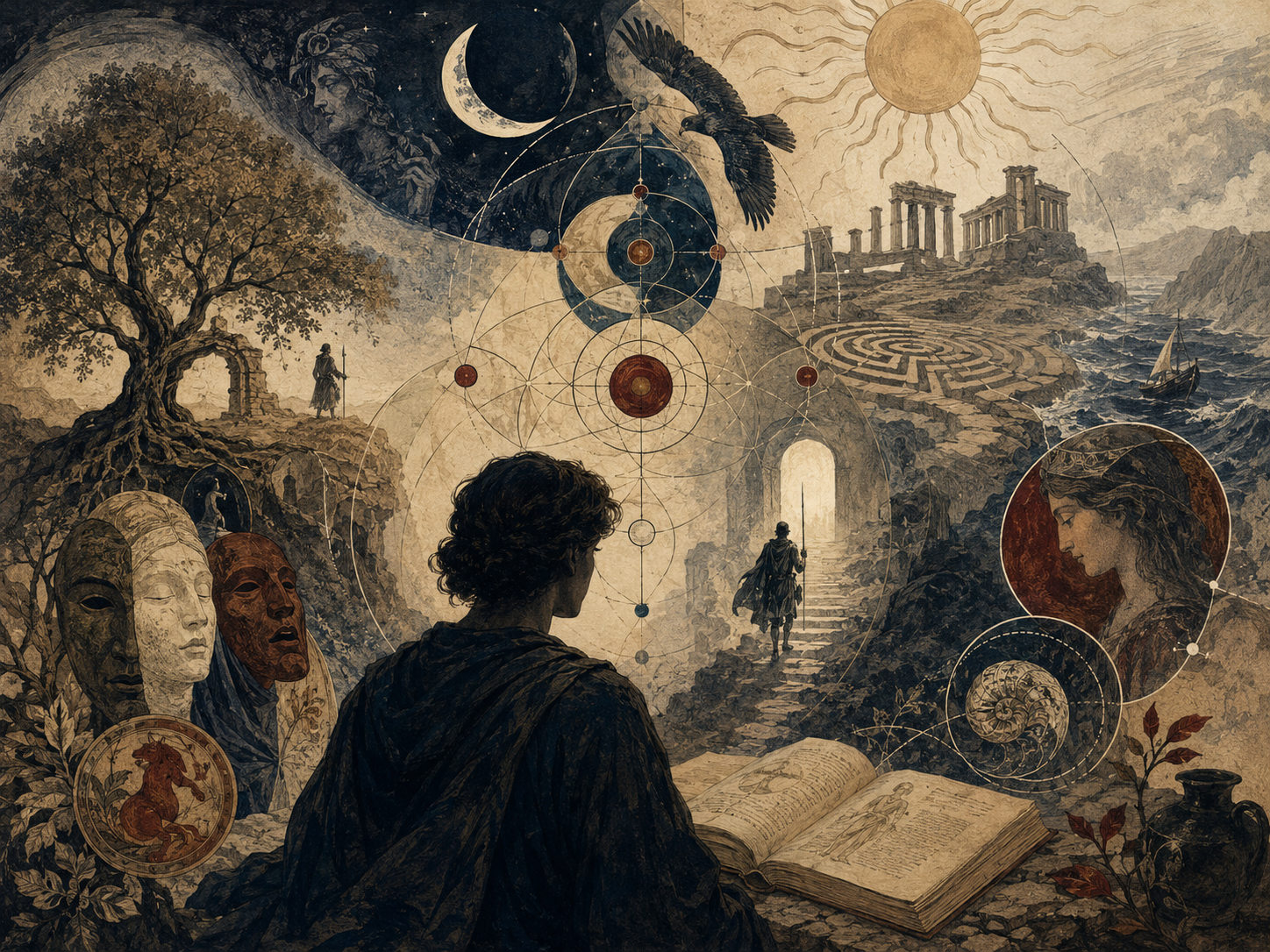
Jung used the language of archetypes to describe this patternedness. Archetypes are not fixed mythic characters floating outside history, nor are they simple inherited pictures. They are recurring structuring potentials of image, affect, relation, and narrative form. They become visible only when embodied in actual symbols, dreams, rituals, myths, works of art, religious traditions, political fantasies, and cultural memories. The archetypal imagination is the psyche’s capacity to give form to experience through such durable symbolic structures.
Yet myth and symbol must be handled carefully. Jungian interpretation becomes weak when it treats every image as universal, every resemblance as proof of equivalence, or every symbolic pattern as detachable from history, ritual, language, ecology, gender, empire, class, race, religion, and power. Mythic recurrence does not erase cultural difference. Religious symbols do not become interchangeable because they share structural motifs. A disciplined account of the archetypal imagination must therefore hold two truths together: symbolic life exhibits recurrence, and every recurrence is historically mediated.
This article examines myth, symbol, and the archetypal imagination in analytical psychology. It explains why Jung treated myth as psychologically significant, how symbols mediate between consciousness and the unconscious, what archetypal imagination reveals about recurring psychic structure, how dreams and myths overlap without becoming identical, why religion and ritual preserve symbolic order, how literature and art transform mythic material, how political myth can become dangerous, and why interpretation must remain disciplined by culture, history, evidence, and ethical caution. Myth is approached here not as primitive error, not as timeless metaphysical proof, and not as free-floating symbolism, but as one of the great languages through which psyche and culture imagine themselves.
Why Myth and Symbol Matter
Myth and symbol matter because human beings do not encounter reality only through facts, concepts, and propositions. They also encounter reality through image, story, pattern, ritual, atmosphere, memory, analogy, and emotionally charged form. A person may know intellectually that they are afraid, but the psyche may present that fear as a dark forest, a pursuing animal, an abyss, or a locked room. A culture may speak politically about renewal, but imagine renewal through flood, purification, sacrifice, conquest, liberation, rebirth, or return to an ancestral order. Symbols and myths give psychic intensity a shape.
This symbolic shaping is not ornamental. It affects perception, feeling, memory, and action. The image through which a person or community understands experience can determine what becomes possible, what becomes forbidden, what is feared, what is sanctified, and what is projected onto others. A myth of heroic struggle is not psychologically equivalent to a myth of mourning. A myth of chosen destiny is not equivalent to a myth of covenantal responsibility. A myth of purification is not equivalent to a myth of reconciliation. Myth organizes emotion into narrative direction.
Analytical psychology matters here because Jung refused the assumption that myth belongs only to the past. Mythic consciousness does not disappear when scientific consciousness develops. It changes location. It appears in dreams, political movements, national stories, cinema, fantasy literature, consumer aspiration, conspiracy thinking, celebrity culture, spiritual longing, therapy, artistic production, and personal identity narratives. Modern people may reject traditional myths while living inside unrecognized symbolic structures.
This is one of Jung’s strongest insights. The modern world often imagines itself disenchanted, but symbolic life continues. It may become more dangerous when disowned because unconscious myth does not announce itself as myth. It presents itself as obvious truth, destiny, grievance, historical mission, moral purity, romantic fate, or apocalyptic necessity. The psyche continues to mythologize even when it no longer admits that it is doing so.
Symbols matter because they mediate what consciousness cannot yet fully grasp. A sign points to something already known; a living symbol opens toward something not yet exhausted by explanation. A dream image, ritual object, sacred story, or recurring mythic pattern may gather affect, memory, contradiction, fear, and hope into a single form. The symbol becomes a vessel. It holds what ordinary language cannot yet separate.
Myth and symbol also matter because they are collective. A person’s dreams may be private, but they often draw on forms that have been shaped by language, family, religion, literature, media, nation, ethnicity, class, gender, ecology, and historical trauma. The psyche imagines through available materials. A symbol is never purely personal or purely universal. It is a meeting point between private experience and inherited form.
For analytical psychology, the task is therefore not to worship myth or dismiss it. The task is to understand how symbolic forms work: how they carry meaning, how they compensate conscious one-sidedness, how they organize conflict, how they can heal, how they can deceive, and how they can become dangerous when projected onto other people or groups. Myth and symbol matter because they are among the deepest ways human beings imagine the real.
What Jung Saw in Myth
Jung saw in myth a record of recurring psychic structures. He did not approach myths primarily as primitive scientific explanations, childish cosmologies, or mere literary inventions. He saw them as symbolic formulations of enduring human situations: conflict with power, relation to origin, exile, desire, taboo, sacrifice, descent, initiation, death, rebirth, fragmentation, divine encounter, temptation, kinship, guilt, order, catastrophe, and transformation. Myth became for him a privileged archive of the psyche’s symbolic self-representation.
This does not mean that Jung simply reduced myths to psychology. His work often moves in psychological directions, but his stronger insight is that myth exists at the intersection of psyche and culture. Myths are not free-floating symbols. They are spoken in languages, preserved by communities, enacted in rituals, embedded in religious systems, shaped by ecological conditions, tied to power, and reinterpreted across time. Yet they also carry psychic force because they dramatize situations that human beings repeatedly face.
Jung was especially interested in the way myths give form to experiences that are too large or too charged for ordinary self-description. The heroic battle may represent the ego’s struggle with chaos, but it may also represent social initiation, ritual violence, masculine formation, political conquest, or imperial fantasy depending on context. The underworld descent may represent depression, grief, encounter with the dead, ritual passage, seasonal renewal, or spiritual trial. The sacred child may represent future possibility, vulnerability, renewal, messianic hope, or infantile longing. Mythic interpretation requires both psychological and historical intelligence.
Jung’s approach also challenged a narrow Enlightenment dismissal of myth. To say that a myth is not scientifically literal is not to say that it is psychologically empty. Myths may carry truth in symbolic rather than empirical form. They may preserve knowledge about fear, maturation, grief, social order, moral danger, psychic inflation, collective violence, and transformation. Their truth lies not in factual correspondence but in symbolic adequacy: their ability to give form to recurrent structures of experience.
At the same time, Jung’s own readings sometimes risk overextension. He could move quickly across traditions, comparing images from religions, myths, alchemy, dreams, and art in ways that illuminate recurrence but sometimes understate difference. This is why contemporary use of Jung must be more historically disciplined. Similarity does not prove sameness. A serpent, tree, flood, mother, child, or sacred center may recur across cultures, but recurrence must be interpreted within actual contexts.
What Jung saw in myth, then, remains powerful when handled carefully. He saw that myths are not dead stories. They are symbolic structures through which psyche and culture imagine danger, order, relation, transformation, and meaning. Their psychological significance does not cancel their historical specificity. Their recurrence does not erase their difference. Their symbolic power does not make them immune from critique.
| Mythic pattern | Possible Jungian reading | Necessary historical caution |
|---|---|---|
| Descent into the underworld | Encounter with shadow, grief, death, unconscious depth, or transformation | Meanings differ across ritual, religious, literary, and political traditions |
| Heroic battle | Ego confrontation with chaos, fear, instinct, or destructive force | Can also encode conquest, violence, gender hierarchy, or nationalist fantasy |
| Sacred child | Future possibility, renewal, vulnerability, or emerging psychic life | Must not be detached from actual traditions of messianism, kinship, lineage, or ritual birth |
| Flood or dissolution | Overwhelming affect, purification, destruction, regression, or renewal | Flood myths are shaped by ecology, catastrophe memory, ritual cosmology, and local history |
| Tree, mountain, or center | Orientation, world order, axial structure, growth, or psychic integration | Sacred geography and cosmology differ profoundly across cultures |
Jung’s contribution is therefore best understood as a method of symbolic attention rather than a license for universalizing shortcuts. He teaches us to ask what psychic work myths perform, while contemporary scholarship reminds us to ask where, when, by whom, and under what conditions those myths are told.
Symbol as Psychic Mediation
The concept of symbol is the hinge of Jung’s approach to myth. In everyday usage, a symbol is often treated as a sign that stands for something else. Jung’s meaning is deeper. A living symbol does not merely point to something already known. It mediates between conscious understanding and what consciousness cannot yet fully grasp. It appears where meaning exceeds explanation but still seeks form.
This is why symbols are so important in dreams, myths, rituals, religion, art, and active imagination. They carry affect, ambiguity, tension, and possibility. A symbol can contain opposites without immediately resolving them. A tree may be rootedness and ascent, body and spirit, ancestry and growth, mortality and renewal. A flood may be destruction and purification, chaos and beginning, drowning and return to origin. A labyrinth may be confusion and initiation, entrapment and path. A mask may be concealment and revelation, persona and sacred role.
A sign can be exhausted by translation. A symbol cannot. If a red traffic light means “stop,” interpretation is simple. If a dream presents a red room, a red animal, a red moon, or a red wound, the image cannot be translated once and for all. Its meaning depends on affect, context, association, symbolic history, bodily feeling, and the dreamer’s life. The symbol remains alive because it continues to generate meaning.
Symbol mediates between conscious and unconscious life. Consciousness tends toward clarity, distinction, and control. The unconscious often presents complexity, contradiction, image, and affective density. The symbol allows the two to meet. It gives the unconscious a form that consciousness can approach without prematurely reducing it. It gives consciousness a way to relate to what would otherwise remain diffuse, overwhelming, or projected.
This mediation is not always comforting. Symbols can disturb. They may bring forward fear, shame, grief, desire, guilt, shadow, bodily truth, or collective trauma. A symbol may reveal that the ego’s story is too narrow. It may challenge a moral identity, expose a hidden dependency, or show that an old form of life has died. Symbols do not exist only to reassure. They can also accuse, disorient, and demand transformation.
Because symbols are powerful, interpretation must be careful. A symbol should not be flattened into a dictionary meaning, but neither should it be inflated into mystical certainty. It should be interpreted through layered attention: personal association, dream context, mythic parallels, cultural history, religious setting, artistic form, social power, and ethical consequence. Jungian interpretation is strongest when it allows a symbol to remain alive long enough for its complexity to emerge.
| Symbolic feature | Meaning in analytical psychology | Interpretive risk | Responsible approach |
|---|---|---|---|
| Ambiguity | The symbol holds multiple meanings at once | Reducing the image to one fixed meaning | Preserve complexity until context clarifies emphasis |
| Affect | The symbol carries emotional force | Mistaking intensity for truth | Ask what affect is being mediated and why |
| Recurrence | The symbol appears across dreams, myths, art, or ritual | Assuming recurrence equals sameness | Compare patterns while preserving difference |
| Transformation | The symbol may reorganize consciousness | Romanticizing symbolic experience | Test transformation through life, relationship, and responsibility |
| Collective depth | The symbol may connect personal life with inherited forms | Detaching symbols from culture and history | Read symbols through language, tradition, power, and context |
Symbol is therefore psychic mediation. It is the form through which the psyche carries what cannot yet be fully conceptualized. Myth is a large-scale symbolic structure. Dream is a private symbolic production. Ritual is symbol enacted. Art is symbol given sensory form. In each case, the symbol makes psychic life encounterable.
The Archetypal Imagination
The archetypal imagination refers to the psyche’s capacity to generate recurring symbolic forms that organize experience. It is not merely fantasy. It is imagination shaped by deep patterns of relation, conflict, transformation, and meaning. Jung’s theory of archetypes gives conceptual language to this phenomenon, though the idea must be handled with precision. Archetypes are not inherited images in a literal sense. They are inherited or recurrent structuring potentials that become visible only through actual symbolic forms.
The archetypal imagination becomes concrete in images: mother, child, shadow, trickster, wise old figure, divine pair, animal guide, flood, tree, serpent, cave, underworld, mountain, center, circle, vessel, road, threshold, fire, sacrifice, rebirth. These are not universal meanings in a dictionary. They are symbolic fields. A mother figure may nurture, devour, bind, protect, destroy, originate, or initiate depending on context. A serpent may heal, tempt, threaten, renew, guard, poison, or reveal. The archetypal imagination provides form, but culture and situation specify meaning.
Jung’s strongest insight is that imagination is patterned without being mechanically fixed. Human beings repeatedly imagine certain relations because psychic life repeatedly confronts certain tensions: birth and death, dependence and separation, desire and prohibition, chaos and order, nature and culture, body and spirit, individual and collective, guilt and repair, power and vulnerability, exile and belonging, shadow and integration. Archetypal symbols condense these tensions into forms that can be seen, told, sung, enacted, feared, worshiped, painted, dreamed, and remembered.
The archetypal imagination is not limited to ancient myth. It continues in modern genres. Superhero films, horror stories, dystopian fiction, fantasy novels, political campaigns, national memorials, therapy narratives, advertising, digital fandoms, and conspiracy myths all draw on recurring symbolic forms. The hero, monster, apocalypse, chosen one, corrupt kingdom, hidden child, world tree, sacred technology, lost origin, devouring system, and redemptive battle remain alive. Modernity changes the costume, not the psychic need for symbolic drama.
Yet the archetypal imagination can also deceive. A symbol may feel universal because it is emotionally powerful, but power does not exempt it from history. Some archetypal narratives have justified domination, patriarchy, colonialism, racial hierarchy, religious violence, nationalist myth, ecological exploitation, and sacrificial politics. The fact that a form is archetypally charged does not make it ethically good. Archetypal intensity can illuminate or possess.
This is why a serious Jungian account must distinguish between archetypal pattern and archetypal inflation. A pattern becomes visible when a recurring symbolic structure helps illuminate psychic or cultural meaning. Inflation occurs when the ego, leader, institution, nation, or movement identifies with the archetype. The person becomes the hero. The nation becomes the chosen people. The enemy becomes absolute evil. The political program becomes sacred destiny. At that point, archetypal imagination stops mediating and begins possessing.
The archetypal imagination therefore requires disciplined interpretation. It reveals that symbols are not arbitrary, but it does not allow us to ignore context. It shows that mythic forms recur, but it does not allow us to treat all traditions as interchangeable. It explains why symbols carry force, but it does not guarantee wisdom. The archetypal imagination is one of the psyche’s deepest powers, and like all deep powers it must be interpreted with humility.
Myth as Psychic Drama
Myth can be understood as psychic drama externalized into narrative form. It stages inward conflict at collective scale. The battle with the dragon may represent a confrontation with chaos, fear, instinct, domination, or destructive power. The descent into the underworld may represent mourning, depression, initiation, encounter with the dead, or transformation through loss. The sacred marriage may represent the reconciliation of opposites. Exile and return may represent estrangement, wandering, and the search for re-centered life. Creation myths may represent the emergence of order from undifferentiated possibility.
Myth dramatizes because psychic conflict is often difficult to state directly. A person may not be able to say, “I am caught between dependence and separation,” but a myth may tell of a child leaving the mother, a hero leaving home, or a wanderer unable to return. A community may not say, “We are afraid of dissolution,” but it may tell flood stories, invasion stories, catastrophe stories, or stories of cosmic disorder. Myth turns psychic tension into narrative movement.
Jung valued this drama because it carries psychic truth in memorable form. A concept can clarify; a myth can move. The mythic image enters memory, ritual, emotion, and imagination. It can be repeated by communities and reinterpreted by individuals. It has durability because it is not only an idea. It is a structure of feeling and action.
Myth also gives collective form to experiences that would otherwise remain private or chaotic. Grief becomes lamentation and descent. Fear becomes monster and trial. Guilt becomes sacrifice and atonement. Transformation becomes death and rebirth. Moral struggle becomes judgment. Social order becomes covenant, kingdom, law, genealogy, taboo, or sacred center. Myth does not merely express these realities; it organizes them into shared symbolic patterns.
But mythic drama can become dangerous when it is literalized or politicized without reflection. If a group imagines itself as the pure hero and another group as the monster, mythic drama can justify violence. If suffering is interpreted as necessary sacrifice demanded by destiny, human lives can be subordinated to symbolic narratives. If political defeat is imagined as cosmic betrayal, ordinary politics becomes apocalyptic struggle. Myth is powerful because it dramatizes. That same power can possess.
A disciplined Jungian reading therefore asks what psychic drama a myth stages and what social uses that staging serves. Does the myth help a person or community face shadow, mortality, guilt, grief, dependence, and transformation? Or does it project shadow outward, sanctify domination, or conceal material interests behind sacred language? Does it mediate psychic tension, or does it intensify possession?
Myth as psychic drama is one of the great resources of human culture. It gives form to experiences that would otherwise remain unbearable or unspoken. But psychic drama requires interpretation because the same symbolic force that illuminates inner life can also organize collective blindness.
Dreams, Myths, and Recurrent Forms
Jung repeatedly connected dreams and myths because both are symbolic productions shaped by recurrent forms. Dreams are immediate, private, unstable, and context-bound. Myths are elaborated, transmitted, ritually embedded, and collectively stabilized. Dreams arise from the psyche of an individual. Myths belong to traditions. Yet both may draw on overlapping structures: descent, flood, guide, child, shadow, center, animal, sacrifice, road, threshold, death, rebirth, and transformation.
This connection is one reason Jung developed the method of amplification. A dream image may become more intelligible when compared cautiously with mythic, religious, artistic, or cultural parallels. A dream of a tree, serpent, cave, child, flood, or circular image may resonate with broader symbolic traditions. Amplification does not replace personal association; it expands the field of meaning. It asks whether the dream image belongs not only to personal memory but also to wider symbolic structures.
The caution is crucial. A dream is not simply a miniature myth. Mythic parallels should not override the dreamer’s life. A serpent in a dream may resonate with healing, danger, temptation, renewal, wisdom, sexuality, or fear, but its meaning depends on the dream context and the person’s associations. A flood may connect to world myths, but it may also refer to grief, panic, family history, bodily overwhelm, ecological anxiety, or recent news. Amplification must deepen interpretation, not replace it.
Dreams may also reveal how myths continue inwardly even when the dreamer has no conscious interest in mythology. A person may dream of descent, trial, guide, sacrificial animal, dark double, ruined temple, or sacred child without planning any mythic imagery. The psyche draws on forms that exceed conscious intention. This does not prove a simple theory of inherited images, but it does show that imagination often organizes itself through recurrent symbolic patterns.
Myths can also help people understand dreams because myths preserve symbolic grammar. They teach how images can carry transformation. They show that descent may precede renewal, that monsters may guard treasure, that guides may be ambiguous, that sacrifices may be dangerous, that thresholds must be crossed, that centers must be found, and that shadow cannot be avoided indefinitely. Mythic literacy gives the dreamer language for symbolic movement.
At the same time, dreams can correct myths. A culture may honor a heroic myth, but an individual dream may expose the hero’s arrogance. A religious tradition may emphasize purity, while a dream brings shadow. A national myth may celebrate victory, while dreams reveal grief, guilt, or fear. Dreams do not merely repeat collective forms. They personalize, distort, challenge, and compensate them.
The relation between dreams and myths is therefore analogical rather than substitutive. They share symbolic structures, but each belongs to a different scale. Dream is private symbolic event. Myth is collective symbolic memory. Jung’s insight was to see that the two can illuminate one another when interpretation remains careful, contextual, and humble.
Religion, Ritual, and Symbolic Order
Religion and ritual matter in Jungian thought because they preserve symbolic forms that orient the psyche toward order, obligation, transformation, death, guilt, mercy, sacrifice, renewal, and relation to what exceeds the ego. Ritual does not merely express belief. It structures experience. Religious symbols do not merely illustrate doctrine. They organize psychic life through repeated acts, images, texts, gestures, rhythms, prohibitions, prayers, calendars, fasts, pilgrimages, initiations, and communal memory.
Jung believed modern persons often suffer when symbolic life collapses into literal disbelief, private sentimentality, or purely rational explanation. The issue is not only whether a doctrine is accepted as fact. It is whether the psyche retains access to symbolic forms capable of carrying mortality, dependence, guilt, forgiveness, grief, gratitude, humility, and wholeness. Religious traditions have historically provided such symbolic containers, even when modern consciousness no longer inhabits them with certainty.
This does not mean Jungian psychology should casually absorb religious symbols into psychology. Religious symbols belong to living traditions. They have theological, ritual, communal, ethical, historical, and linguistic meanings that cannot be reduced to inner processes. A cross, crescent, menorah, mandala, icon, prayer rug, sacred book, altar, pilgrimage site, baptismal water, Eucharistic bread, sacred fire, or mourning rite is not merely a psychological image. It is part of a world of practice and belief.
The Jungian contribution is to ask how such symbols function psychologically without claiming that psychology exhausts them. A ritual may help a person bear grief. A sacred calendar may structure time. A confession may give form to guilt. A pilgrimage may embody transformation. A fast may discipline desire. A chant may regulate affect and deepen belonging. A sacred story may place suffering within a larger symbolic order. These are psychological effects, but they do not erase the religious meanings carried by the tradition itself.
Ritual also matters because symbols need embodiment. A symbol that remains only an idea may lose force. Ritual gives symbol a body: gesture, posture, voice, repetition, touch, taste, sound, place, clothing, architecture, procession, silence, and shared attention. Through ritual, symbolic order becomes lived. The psyche is not only told a meaning; it participates in it.
Yet ritual and religion can also be misused. Symbolic order may become coercive. Sacred narratives may justify exclusion, gender hierarchy, racial domination, violence, or authoritarian control. Ritual can heal, but it can also bind people to fear. Religious symbols can orient the psyche, but they can also be used to sanctify power. Jungian interpretation must therefore remain ethically alert. Symbolic depth is not the same as moral legitimacy.
Religion and ritual reveal that the archetypal imagination is not simply private. It becomes institutional, communal, disciplined, contested, and embodied. Jung’s psychology helps explain why religious symbols continue to matter, but it must approach them with respect for their own traditions and with sensitivity to the people who live them.
Literature, Art, and Cultural Memory
Literature and art continue the work of myth under changing historical conditions. Epic, tragedy, lyric, fairy tale, novel, theater, painting, sculpture, cinema, fantasy, horror, science fiction, music, and digital art preserve, revise, secularize, subvert, and recompose archetypal forms. The old symbolic patterns do not disappear. They are reworked through new genres, new technologies, new anxieties, new injustices, and new possibilities of imagination.
This is why Jungian thought has had a long influence in literary and artistic interpretation. It provides a vocabulary for tracking recurring symbols, but its best use is not to flatten works of art into preexisting archetypal categories. A good Jungian reading does not simply say, “This is the hero,” “This is the shadow,” “This is the mother,” or “This is the Self.” It asks how a work activates, revises, complicates, resists, or breaks a symbolic pattern within its own historical and formal context.
Literature often reveals the ambiguity of archetypal forms more clearly than mythic summaries do. The hero may be noble, tragic, violent, deluded, colonizing, exhausted, or morally compromised. The mother may nurture, devour, protect, abandon, mourn, or survive. The trickster may liberate or destroy. The sacred child may renew or become an object of projection. The journey may lead to wisdom or expose the fantasy of mastery. Art complicates archetypes because art does not have to obey a single symbolic script.
Modern literature and art are especially important because they often reveal broken myth. In modernity, symbols may appear fragmented, ironic, secularized, traumatized, or estranged. The sacred center may be absent. The hero may fail. The guide may be unreliable. The ritual may be empty. The community may be shattered. The old mythic grammar may persist only as longing, parody, nightmare, or ruins. This does not make the work less archetypal. It may reveal the archetypal imagination under conditions of dislocation.
Art also preserves marginalized symbolic memory. Official myth often serves power, but literature, music, oral tradition, visual culture, and performance can preserve the symbolic worlds of oppressed communities, colonized peoples, racialized groups, women, workers, migrants, disabled communities, religious minorities, and communities whose stories have been suppressed. A serious account of cultural memory must attend not only to canonical myths but also to the symbolic forms that survive at the margins.
This is where Jungian interpretation must be broadened. If archetypal criticism studies only familiar European mythic materials, it risks reproducing a narrow symbolic canon. The archetypal imagination is not owned by any one civilization. But neither should symbols from different cultures be extracted as exotic examples. The task is comparative humility: to recognize recurrence while honoring the integrity of each tradition’s language, history, ritual, trauma, and beauty.
Literature and art matter because they show that myth is not static. It is alive where symbolic forms are retold, challenged, mourned, reclaimed, or transformed. The archetypal imagination continues not by repetition alone, but by creative refiguration.
Archetypal Recurrence and Historical Difference
One of the hardest tasks in Jungian interpretation is holding archetypal recurrence together with historical difference. Jung was often strongest when identifying recurring symbolic structures and weakest when moving too quickly across traditions as though similarity of form guaranteed sameness of meaning. Contemporary use of his work must improve on this. Recurrence is real, but recurrence does not erase context.
A flood may recur across cultures, but flood stories may differ in ecological memory, ritual function, divine judgment, agricultural cycle, trauma history, moral teaching, political meaning, and cosmological structure. A mother figure may recur, but motherhood is shaped by kinship systems, gender orders, property relations, theology, childbirth practices, colonization, labor, and family structure. A serpent may recur, but serpent symbolism differs across healing traditions, fertility symbols, danger narratives, wisdom traditions, and demonizing religious polemics.
The archetypal imagination should therefore be understood as pattern within history, not pattern above history. A symbol becomes meaningful through embodiment in a particular world. Language matters. Ritual matters. Social location matters. Power matters. A symbol does not have the same meaning when used by a dominant empire, a colonized people, a persecuted religious minority, a grieving family, a political movement, or a solitary dreamer.
This distinction is especially important when reading religious symbols. Similarity between motifs does not authorize the claim that all religions are “really saying the same thing.” Such a claim can appear generous while erasing doctrinal difference, ritual specificity, lived devotion, historical wounds, and community identity. A disciplined Jungian approach may compare symbolic structures, but it should not collapse traditions into a single psychological abstraction.
Historical difference also guards against analyst projection. Interpreters often see the archetype they expect to see. If every woman becomes the mother, every dark figure becomes shadow, every circle becomes Self, and every journey becomes individuation, interpretation becomes automatic. Real symbols resist automatic reading. They require philology, history, anthropology, theology, literary form, political context, and the humility to admit uncertainty.
| Interpretive mistake | Why it weakens analysis | Better discipline |
|---|---|---|
| Assuming resemblance equals sameness | It erases cultural, ritual, and historical difference | Compare motifs while preserving context-specific meaning |
| Treating archetypes as fixed characters | It turns symbolic fields into stereotypes | Read archetypes as structuring potentials that become concrete in context |
| Ignoring power | It misses how symbols justify domination or preserve resistance | Ask who uses the symbol, against whom, and for what purpose |
| Reducing religion to psychology | It disrespects living traditions and doctrinal specificity | Distinguish psychological function from theological meaning |
| Projecting the interpreter’s framework | It turns interpretation into confirmation | Use historical sources, alternative readings, and methodological restraint |
Archetypal recurrence and historical difference must remain in tension. If recurrence is denied, symbolic life becomes fragmented into isolated facts. If difference is denied, archetypal interpretation becomes imperial abstraction. The strongest Jungian reading is neither flat historicism nor free-floating universalism. It is contextual depth interpretation.
Myth, Symbol, and Individuation
Myth and symbol matter for individuation because individuation requires more than rational self-description. The psyche often develops by encountering itself through symbolic forms that exceed the ego’s preferred language. A person may not be able to explain a transition, but may dream of crossing water. They may not consciously understand grief, but may be drawn into underworld imagery. They may not know that a persona is collapsing, but may dream of masks, costumes, public exposure, or ruined houses. The psyche imagines the task before consciousness can define it.
Mythic images give development scale. Ordinary language may make inner change sound trivial: “I am going through a difficult period.” Mythic imagination may show the same process as descent, exile, initiation, dismemberment, wandering, trial, or return. This does not mean the person is grandiose or special. It means the psyche may need a symbolic drama large enough to contain the emotional reality of transformation.
Individuation often involves relation to recurring mythic patterns. The shadow appears as enemy, monster, double, animal, stranger, or persecutor. The guide appears as elder, animal, teacher, book, voice, ancestor, or improbable helper. The Self appears through mandala, center, city, stone, tree, child, sacred place, or ordering pattern. The anima or animus appears through charged figures of eros, wisdom, danger, mediation, fantasy, or projection. These images become psychologically meaningful when related to the actual life of the person.
Symbols also protect individuation from becoming mere self-improvement. Individuation is not simply becoming more efficient, confident, expressive, or successful. It involves confrontation with shadow, withdrawal of projection, relation to the unconscious, ethical accountability, and reorientation around a wider psychic center. Mythic symbols help give form to this deeper movement. They show that transformation often involves loss, humility, descent, and sacrifice, not only growth and expansion.
At the same time, myth can inflate individuation if handled carelessly. A person may identify with the hero, prophet, chosen one, wounded healer, misunderstood visionary, or sacred child. Such identification can protect narcissism rather than deepen development. A mythic image is not an identity claim. It is a symbolic form to be interpreted. The ego must relate to the image, not become it.
Mythic literacy supports individuation because it helps the person recognize symbolic patterns without being possessed by them. A person who knows the hero pattern may be less likely to mistake every conflict for a heroic trial. A person who understands shadow projection may be less likely to demonize others. A person who recognizes descent imagery may endure difficult transformation without prematurely pathologizing it or romanticizing it. Symbolic literacy creates distance and participation at once.
Myth, symbol, and individuation therefore belong together because the psyche becomes itself through images as well as through insight. The person does not simply analyze development; they live through symbolic forms that shape how development is felt, endured, remembered, and integrated.
Collective Life and Political Myth
The archetypal imagination does not operate only in dreams, religion, literature, or therapy. It also operates in collective life. Nations, movements, institutions, parties, markets, and communities tell stories about origin, purity, betrayal, renewal, enemy, destiny, sacrifice, decline, liberation, and catastrophe. Political myth becomes powerful because it gives collective emotion a symbolic structure. It transforms complexity into drama.
This can be constructive when political myth supports memory, justice, solidarity, mourning, liberation, repair, and public responsibility. Communities need stories that help them remember suffering, honor courage, confront wrongdoing, and imagine shared futures. Not all political myth is false or dangerous. Collective life requires symbolic orientation. People cannot build institutions by data alone.
But political myth becomes dangerous when archetypal intensity fuses with projection and power. The leader becomes savior. The nation becomes chosen. The enemy becomes demon. The past becomes pure origin. The future becomes redemption. Violence becomes cleansing. Compromise becomes betrayal. Ordinary institutions become obstacles to destiny. In such moments, myth no longer mediates collective feeling; it possesses it.
Jung’s framework is useful because it helps explain why political symbols can carry such force. People do not respond only to policy. They respond to symbolic fields: flag, homeland, martyr, border, enemy, lost greatness, sacred soil, invasion, renewal, corruption, sacrifice, humiliation, apocalypse. These images activate affect and identity at depths that rational argument alone may not reach.
Yet symbolic analysis must never replace material analysis. Political myth works through institutions, media systems, economic interests, law, violence, education, memory regimes, technology, and organized power. A Jungian reading that speaks only of archetypes can become politically naïve. The question is not only what symbol is active, but who benefits from it, who is endangered by it, how it circulates, how it is funded, how it is institutionalized, and what forms of violence or exclusion it authorizes.
Political myth also reveals collective shadow. Communities often project disowned traits onto enemies: cruelty, impurity, weakness, decadence, violence, irrationality, corruption, dependency, or betrayal. The enemy becomes the carrier of what the group cannot bear to recognize in itself. This projection can unite a group emotionally while making truth more difficult. The stronger the projection, the harder it becomes to see the other as human.
| Political mythic pattern | Psychological force | Danger when possessed |
|---|---|---|
| Chosen destiny | Gives collective purpose and sacred direction | Can justify domination, exceptionalism, or refusal of accountability |
| Purification | Promises moral renewal and removal of corruption | Can authorize exclusion, cleansing fantasies, or violence |
| Lost golden age | Organizes nostalgia and grief for perceived decline | Can erase historical injustice and fuel reactionary politics |
| Demonic enemy | Condenses fear, anger, and projected shadow | Can dehumanize groups and suspend moral limits |
| Redemptive leader | Personalizes hope, order, and rescue | Can enable authoritarian attachment and collective regression |
Collective life and political myth show that symbolic literacy is not merely personal. It is civic. A society unable to interpret its myths may become governed by them unconsciously. Jungian thought is useful here when it deepens public discernment rather than replacing political, historical, economic, and legal analysis.
Criticisms and Qualifications
The Jungian approach to myth and symbol has faced serious criticism, and those criticisms should strengthen rather than weaken the analysis. Jungian interpretation can become universalizing, insufficiently historical, vulnerable to projection, and overly confident in symbolic parallels. It can treat resemblance as depth, myth as psychology, and archetype as explanation when the actual situation requires historical scholarship, textual analysis, anthropology, theology, political economy, or attention to violence and power.
One major criticism is that archetypal interpretation can flatten difference. If every mother goddess, sacred child, flood, serpent, tree, cave, or descent is treated as the same underlying archetype, the interpretive richness of actual traditions is lost. Symbols become interchangeable examples. This is not depth; it is abstraction. A serious Jungian approach must ask what the image means in this language, this ritual, this community, this historical moment, and this power structure.
A second criticism is that Jungian readings can be hard to falsify. Once an image is labeled archetypal, almost any evidence can be made to fit. If the symbol appears, it proves recurrence. If it does not appear, the interpreter may claim repression or hidden presence. Such interpretive flexibility can become irresponsible. Jungian work requires methodological restraint: not every image is archetypal, not every recurrence is meaningful, and not every symbolic resemblance reveals a deep structure.
A third criticism concerns cultural appropriation. Jungian writers have sometimes drawn from Indigenous, Asian, African, Middle Eastern, and other traditions as symbolic material without adequate respect for living communities, historical trauma, colonial extraction, or ritual specificity. A contemporary approach must do better. Comparative symbolism should not extract images from communities as raw material for Western self-understanding.
A fourth criticism concerns gender and social hierarchy. Some archetypal language has reinforced essentialist ideas about masculinity, femininity, motherhood, anima, animus, heroism, and spiritual development. Symbols are not innocent. They are shaped by social worlds. Jungian interpretation must therefore revise inherited categories where they obscure gender complexity, queer experience, racialized history, disability, class, and unequal power.
A fifth criticism is that symbolic readings can distract from material conditions. Political myths, religious symbols, and cultural narratives do not operate in a vacuum. They are tied to institutions, land, labor, law, violence, money, and social control. A purely symbolic reading of oppression can become evasive. The psyche matters, but so do structures.
| Criticism | Risk | Responsible correction |
|---|---|---|
| Universalizing interpretation | Differences among cultures and traditions disappear | Read recurrence through language, ritual, history, and context |
| Unfalsifiable symbolism | Every image becomes proof of the theory | Keep archetypal claims provisional and compare alternative explanations |
| Cultural appropriation | Symbols are extracted from living communities | Use respectful scholarship and attend to community, power, and history |
| Gender essentialism | Symbols harden into restrictive identity categories | Revise inherited language through contemporary gender-aware interpretation |
| Material evasion | Symbolic analysis replaces structural analysis | Connect myth to institutions, law, economy, violence, and power |
These criticisms do not make Jungian interpretation useless. They clarify its responsible use. The strength of the approach lies in its attention to symbolic recurrence and psychic depth. Its weakness begins when recurrence becomes a substitute for context, scholarship, humility, and ethics.
Mathematical Lens
Myth, symbol, and archetypal imagination can be modeled as recurrent symbolic outputs generated across personal, cultural, historical, and archetypal dimensions. Let \(S_{ij}\) represent a symbolic output in dream, myth, ritual, literary, religious, or political instance \(i\) within context \(j\). A stylized model is:
S_{ij} = \alpha + \beta_1 P_i + \beta_2 C_j + \beta_3 H_j + \beta_4 A_k + \varepsilon_{ij}
\]
Interpretation: \(P_i\) represents personal or local psychic context, \(C_j\) cultural context, \(H_j\) historical condition, and \(A_k\) a latent archetypal pattern. Symbolic output is modeled as the interaction of personal experience, cultural form, historical mediation, and recurrent symbolic structure.
This model prevents a reduction in either direction. Symbolic recurrence is not explained only by personal biography, nor only by culture, nor only by archetype. It emerges through their interaction. A dream image may be personal and archetypal. A religious symbol may be theological, ritual, political, and psychological at once. A political myth may be symbolic and materially organized.
Symbolic recurrence can also be represented through motif networks. Let motifs such as child, mother, guide, flood, serpent, tree, descent, threshold, sacrifice, center, and rebirth be nodes in a graph. Edges represent co-occurrence within texts, dreams, rituals, myths, artworks, or narratives.
G = (V, E), \quad w_{ab} = \sum_{i=1}^{n} \mathbf{1}(a \in S_i \land b \in S_i)
\]
Interpretation: \(G\) is a motif network, \(V\) the set of symbolic motifs, \(E\) the set of co-occurrence relations, and \(w_{ab}\) the weight connecting motifs \(a\) and \(b\). Strong edges indicate repeated symbolic association across a defined corpus.
Archetypal neighborhoods can then be approximated by clustering motifs that repeatedly appear together. This does not prove archetypes, but it helps map symbolic constellations:
M_k = \{v \in V : c(v) = k\}
\]
Interpretation: \(M_k\) represents a symbolic cluster or motif community. A cluster may correspond to recurrent symbolic neighborhoods such as descent-death-rebirth, child-future-renewal, flood-chaos-purification, or center-tree-order.
One may also model the balance between recurrence and contextual specificity:
R_m = \frac{\sigma^2_{\text{between-context}}(m)}{\sigma^2_{\text{total}}(m)}
\]
Interpretation: \(R_m\) estimates how much variation in motif \(m\) is explained by context. A motif may recur broadly, but its meaning may be highly context-dependent. This helps prevent simplistic universalization.
This mathematical lens should not be mistaken for literal proof of Jungian archetypes. It is a conceptual and computational framework for asking better questions. Which motifs recur? Which motifs cluster? Which contexts alter meaning? Which symbols bridge personal and collective corpora? Which images are central in one tradition but peripheral in another? Which political myths intensify around enemy, purity, sacrifice, or renewal? The value lies in making symbolic comparison more transparent, not in replacing interpretation.
R Workflow: Modeling Recurrent Mythic Motifs Across Symbolic Corpora
The following R workflow sketches how recurrent mythic and symbolic motifs might be modeled across myths, dreams, ritual narratives, literary corpora, or political speeches. The goal is not to prove archetypes mechanically, but to map structured recurrence while preserving distinctions among source type, culture group, and historical period.
# ============================================================
# Myth, Symbol, and the Archetypal Imagination
# R Workflow: Recurrent mythic motifs across symbolic corpora
# ============================================================

# This workflow uses synthetic or curated public-domain text data
# for conceptual demonstration. It should not be used to extract,
# appropriate, or decontextualize sacred or community-held materials.

library(tidyverse)
library(tidytext)
library(igraph)
library(ggraph)
library(widyr)

# ------------------------------------------------------------
# 1. Load multi-source symbolic corpus
# ------------------------------------------------------------

# Expected columns:
# doc_id, source_type, culture_group, time_period, title, text

texts <- read_csv("data/raw/myth_symbol_corpus.csv")

# Example source_type values:
# myth, dream_report_synthetic, ritual_text_public_domain,
# literary_text_public_domain, political_speech_public_domain

# ------------------------------------------------------------
# 2. Define a curated motif dictionary
# ------------------------------------------------------------

motif_dictionary <- tribble(
  ~motif, ~term,
  "child_future", "child",
  "child_future", "infant",
  "child_future", "birth",
  "descent_underworld", "descent",
  "descent_underworld", "underworld",
  "descent_underworld", "cave",
  "flood_dissolution", "flood",
  "flood_dissolution", "water",
  "flood_dissolution", "sea",
  "tree_center", "tree",
  "tree_center", "root",
  "tree_center", "branch",
  "serpent_ambivalence", "serpent",
  "serpent_ambivalence", "snake",
  "guide_threshold", "guide",
  "guide_threshold", "threshold",
  "guide_threshold", "road",
  "sacrifice_transformation", "sacrifice",
  "sacrifice_transformation", "blood",
  "sacrifice_transformation", "altar",
  "shadow_enemy", "shadow",
  "shadow_enemy", "enemy",
  "shadow_enemy", "monster",
  "center_order", "center",
  "center_order", "temple",
  "center_order", "circle",
  "rebirth_renewal", "rebirth",
  "rebirth_renewal", "renewal",
  "rebirth_renewal", "return"
)

# ------------------------------------------------------------
# 3. Tokenize and join terms to motifs
# ------------------------------------------------------------

tokens <- texts |>
  unnest_tokens(word, text) |>
  anti_join(stop_words, by = "word") |>
  inner_join(motif_dictionary, by = c("word" = "term"))

motif_counts <- tokens |>
  count(doc_id, source_type, culture_group, time_period, title, motif, name = "count")

# ------------------------------------------------------------
# 4. Summarize motif prevalence by source and context
# ------------------------------------------------------------

motif_summary <- motif_counts |>
  group_by(source_type, culture_group, time_period, motif) |>
  summarize(total = sum(count), .groups = "drop") |>
  arrange(desc(total))

print(motif_summary)

# ------------------------------------------------------------
# 5. Build document-level motif co-occurrence
# ------------------------------------------------------------

motif_pairs <- motif_counts |>
  pairwise_count(
    item = motif,
    feature = doc_id,
    wt = count,
    sort = TRUE,
    upper = FALSE
  ) |>
  filter(n >= 2)

motif_graph <- graph_from_data_frame(
  motif_pairs,
  directed = FALSE
)

# ------------------------------------------------------------
# 6. Detect motif communities
# ------------------------------------------------------------

if (ecount(motif_graph) > 0) {
  motif_clusters <- cluster_louvain(motif_graph)

  cluster_table <- tibble(
    motif = names(membership(motif_clusters)),
    cluster = as.integer(membership(motif_clusters))
  )

  print(cluster_table)
}

# ------------------------------------------------------------
# 7. Visualize symbolic motif network
# ------------------------------------------------------------

ggraph(motif_graph, layout = "fr") +
  geom_edge_link(aes(width = n), alpha = 0.25) +
  geom_node_point(size = 4) +
  geom_node_text(aes(label = name), repel = TRUE) +
  theme_void() +
  labs(
    title = "Symbolic Motif Co-occurrence Network",
    subtitle = "Motifs cluster through repeated co-occurrence across a defined symbolic corpus"
  )

# ------------------------------------------------------------
# 8. Compare recurrence and context-dependence
# ------------------------------------------------------------

context_dependence <- motif_counts |>
  group_by(motif, culture_group) |>
  summarize(total = sum(count), .groups = "drop") |>
  group_by(motif) |>
  mutate(
    motif_total = sum(total),
    context_share = total / motif_total
  ) |>
  arrange(motif, desc(context_share))

print(context_dependence)

# ------------------------------------------------------------
# 9. Export reproducible outputs
# ------------------------------------------------------------

dir.create("outputs/tables", recursive = TRUE, showWarnings = FALSE)
dir.create("outputs/figures", recursive = TRUE, showWarnings = FALSE)

write_csv(motif_summary, "outputs/tables/motif_summary_by_context.csv")
write_csv(motif_pairs, "outputs/tables/motif_cooccurrence_pairs.csv")
write_csv(context_dependence, "outputs/tables/motif_context_dependence.csv")

# ------------------------------------------------------------
# Extensions
# ------------------------------------------------------------

# 1. Compare myth, dream, ritual, literary, and political corpora separately.
# 2. Use lemmatization and multilingual motif dictionaries.
# 3. Track motif shifts by historical period.
# 4. Add sentiment, affect, or moral-emotion coding.
# 5. Compare public-domain religious texts with literary adaptations.
# 6. Detect political-myth clusters such as purity, betrayal, renewal, enemy.
# 7. Combine computational mapping with close reading and historical context.
This workflow helps visualize recurrent symbolic structures without assuming in advance that all recurrence is archetypal in the same sense. It makes comparison possible while preserving the need for close reading, cultural context, and historical qualification.
Python Workflow: Mapping Archetypal Symbol Networks Across Myths and Dreams
The following Python workflow models symbolic motifs as a co-occurrence network across myths, synthetic dream texts, public-domain literature, ritual texts, or political narratives. It is useful for identifying which motifs function as bridge nodes and whether similar symbolic clusters recur across personal and collective corpora. The workflow is conceptual and comparative, not proof of universal archetypes.
# ============================================================
# Myth, Symbol, and the Archetypal Imagination
# Python Workflow: Archetypal symbol network mapping
# ============================================================

from pathlib import Path
from collections import Counter, defaultdict
from itertools import combinations

import pandas as pd
import networkx as nx

# ------------------------------------------------------------
# 1. Load corpus
# ------------------------------------------------------------

# Expected columns:
# doc_id, source_type, culture_group, time_period, title, text

DATA_PATH = Path("data/raw/myth_symbol_corpus.csv")
OUTPUT_DIR = Path("outputs/tables")
OUTPUT_DIR.mkdir(parents=True, exist_ok=True)

df = pd.read_csv(DATA_PATH)

# ------------------------------------------------------------
# 2. Define motif dictionary
# ------------------------------------------------------------

motif_dictionary = {
    "child_future": {"child", "infant", "birth", "newborn"},
    "descent_underworld": {"descent", "underworld", "cave", "depth"},
    "flood_dissolution": {"flood", "water", "sea", "deluge"},
    "tree_center": {"tree", "root", "branch", "forest"},
    "serpent_ambivalence": {"serpent", "snake", "venom"},
    "guide_threshold": {"guide", "threshold", "road", "path"},
    "sacrifice_transformation": {"sacrifice", "altar", "blood"},
    "shadow_enemy": {"shadow", "enemy", "monster", "double"},
    "center_order": {"center", "circle", "temple", "city"},
    "rebirth_renewal": {"rebirth", "renewal", "return", "dawn"},
    "fire_transformation": {"fire", "flame", "ash", "burning"},
    "mask_persona": {"mask", "face", "veil", "costume"},
}

term_to_motif = {}
for motif, terms in motif_dictionary.items():
    for term in terms:
        term_to_motif[term] = motif

# ------------------------------------------------------------
# 3. Extract motif presence by document
# ------------------------------------------------------------

records = []

for _, row in df.iterrows():
    words = str(row["text"]).lower().replace(",", " ").replace(".", " ").split()
    motif_counts = Counter(term_to_motif[word] for word in words if word in term_to_motif)

    for motif, count in motif_counts.items():
        records.append(
            {
                "doc_id": row["doc_id"],
                "source_type": row["source_type"],
                "culture_group": row["culture_group"],
                "time_period": row["time_period"],
                "title": row["title"],
                "motif": motif,
                "count": count,
            }
        )

motif_df = pd.DataFrame(records)

if motif_df.empty:
    raise ValueError("No motifs found. Check corpus text and motif dictionary.")

# ------------------------------------------------------------
# 4. Build motif co-occurrence graph
# ------------------------------------------------------------

G = nx.Graph()

for motif in motif_dictionary:
    G.add_node(motif)

for doc_id, group in motif_df.groupby("doc_id"):
    motifs = sorted(group["motif"].unique())

    for source, target in combinations(motifs, 2):
        if G.has_edge(source, target):
            G[source][target]["weight"] += 1
        else:
            G.add_edge(source, target, weight=1)

# Remove isolated nodes for centrality reporting if desired.
non_isolated_nodes = [node for node, degree in dict(G.degree()).items() if degree > 0]
G_active = G.subgraph(non_isolated_nodes).copy()

# ------------------------------------------------------------
# 5. Compute graph metrics
# ------------------------------------------------------------

degree_centrality = nx.degree_centrality(G_active)
betweenness_centrality = nx.betweenness_centrality(G_active, weight="weight")
eigenvector_centrality = nx.eigenvector_centrality(G_active, weight="weight", max_iter=1000)

metrics_df = pd.DataFrame(
    {
        "motif": list(G_active.nodes()),
        "degree_centrality": [degree_centrality[m] for m in G_active.nodes()],
        "betweenness_centrality": [betweenness_centrality[m] for m in G_active.nodes()],
        "eigenvector_centrality": [eigenvector_centrality[m] for m in G_active.nodes()],
        "weighted_degree": [G_active.degree(m, weight="weight") for m in G_active.nodes()],
    }
).sort_values("betweenness_centrality", ascending=False)

# ------------------------------------------------------------
# 6. Frequency and context tables
# ------------------------------------------------------------

frequency_df = (
    motif_df.groupby("motif", as_index=False)["count"]
    .sum()
    .rename(columns={"count": "frequency"})
    .sort_values("frequency", ascending=False)
)

context_df = (
    motif_df.groupby(["motif", "source_type", "culture_group"], as_index=False)["count"]
    .sum()
    .rename(columns={"count": "context_frequency"})
    .sort_values(["motif", "context_frequency"], ascending=[True, False])
)

# ------------------------------------------------------------
# 7. Compare myth and dream subnetworks
# ------------------------------------------------------------

subnetwork_metrics = []

for source_type, subset in motif_df.groupby("source_type"):
    H = nx.Graph()

    for motif in motif_dictionary:
        H.add_node(motif)

    for doc_id, group in subset.groupby("doc_id"):
        motifs = sorted(group["motif"].unique())

        for source, target in combinations(motifs, 2):
            if H.has_edge(source, target):
                H[source][target]["weight"] += 1
            else:
                H.add_edge(source, target, weight=1)

    active_nodes = [node for node, degree in dict(H.degree()).items() if degree > 0]
    H_active = H.subgraph(active_nodes).copy()

    if len(H_active.nodes()) > 1:
        centrality = nx.degree_centrality(H_active)

        for motif, value in centrality.items():
            subnetwork_metrics.append(
                {
                    "source_type": source_type,
                    "motif": motif,
                    "degree_centrality": value,
                    "weighted_degree": H_active.degree(motif, weight="weight"),
                }
            )

subnetwork_df = pd.DataFrame(subnetwork_metrics)

# ------------------------------------------------------------
# 8. Export results
# ------------------------------------------------------------

motif_df.to_csv(OUTPUT_DIR / "motif_document_counts.csv", index=False)
metrics_df.to_csv(OUTPUT_DIR / "motif_network_metrics.csv", index=False)
frequency_df.to_csv(OUTPUT_DIR / "motif_frequency.csv", index=False)
context_df.to_csv(OUTPUT_DIR / "motif_context_frequency.csv", index=False)
subnetwork_df.to_csv(OUTPUT_DIR / "motif_subnetwork_metrics.csv", index=False)

edge_df = nx.to_pandas_edgelist(G_active)
edge_df.to_csv(OUTPUT_DIR / "motif_network_edges.csv", index=False)

print("Motif frequency")
print(frequency_df)

print("\nNetwork metrics")
print(metrics_df)

print("\nContext frequencies")
print(context_df)

print("\nSubnetwork metrics")
print(subnetwork_df)

# ------------------------------------------------------------
# Extensions
# ------------------------------------------------------------

# 1. Add multilingual tokenization and translation-aware motif dictionaries.
# 2. Use embeddings to detect symbolic similarity beyond exact words.
# 3. Compare source types: myth, synthetic dreams, ritual, literature, politics.
# 4. Detect political-myth clusters around purity, betrayal, enemy, renewal.
# 5. Track motifs by time period and cultural group.
# 6. Pair network metrics with close reading for interpretive validation.
# 7. Use community detection to identify symbolic neighborhoods.
This network approach reflects a key Jungian insight: symbols rarely act alone. They belong to patterned constellations. Mapping those constellations can help distinguish isolated images from recurring symbolic structures while still requiring close reading, historical scholarship, and ethical interpretation.
GitHub Repository
The companion repository extends this article’s argument into reproducible, multi-language research scaffolding. It supports synthetic and public-domain symbolic-corpus workflows, motif dictionaries, myth-and-dream comparison models, archetypal motif networks, context-dependence tables, political-myth analysis examples, structured documentation, SQL schemas, and reusable methods for examining how recurring symbolic forms appear across dreams, myths, rituals, literature, religion, and collective narratives.
| Repository area | Purpose | Use in this article context |
|---|---|---|
python |
Network modeling and symbolic-corpus analysis | Maps motif co-occurrence, bridge symbols, source-type subnetworks, and archetypal symbolic neighborhoods |
r |
Corpus analysis, motif summarization, and visualization | Models recurrent mythic motifs across symbolic corpora while preserving source type, culture group, and historical period |
sql |
Structured data design and query examples | Stores symbolic corpora, motif dictionaries, context metadata, motif counts, co-occurrence pairs, and responsible-use notes |
julia |
Numerical simulation and symbolic-network analysis | Can extend motif recurrence and context-dependence modeling across symbolic neighborhoods |
c, cpp, fortran, go, rust |
Compiled-language examples and computational scaffolds | Provide simple reproducibility and systems-modeling examples for motif counts, co-occurrence weights, and recurrence indices |
data, notebooks, outputs, docs |
Inputs, notebooks, generated figures/tables, and documentation | Keep symbolic-corpus samples, exploratory notebooks, outputs, method notes, validation plans, and responsible-use documentation organized |
These materials are for synthetic-data research, public-domain corpus demonstration, conceptual modeling, symbolic-process analysis, institutional learning, and reproducible workflows. They are not intended to prove archetypes, appropriate sacred traditions, interpret private dreams, classify religions, rank cultures, evaluate communities, automate myth interpretation, or replace historical, anthropological, theological, literary, or clinical expertise.
Complete Code Repository
Access the full companion repository for this article, including reproducible analysis materials, synthetic symbolic-corpus data, myth-and-dream motif workflows, archetypal symbol-network models, context-dependence tables, political-myth analysis scaffolds, and multi-language code examples for analytical psychology research.
Conclusion
Myth, symbol, and the archetypal imagination belong together because the psyche repeatedly gives form to itself through images and dramatic patterns that exceed direct conscious explanation. Jung’s great insight was to take those forms seriously. Myths are not merely old stories. Symbols are not merely ornaments. Archetypes are not decorative abstractions. Together, they reveal that imagination has structure, that psychic life seeks symbolic form, and that human beings continue to live through mythic patterns even when they believe they have left myth behind.
The enduring value of this approach lies in its ability to show that symbols mediate between conscious life and what consciousness cannot yet grasp. A myth may carry grief, fear, guilt, desire, sacrifice, danger, transformation, or hope in a form that individuals and communities can remember. A dream may draw on mythic structures without becoming identical to myth. A ritual may embody symbolic order. A work of art may preserve, fracture, or renew cultural memory. A political movement may awaken archetypal emotion for liberation or for domination.
The enduring danger lies in inflation and abstraction. A symbol is not wise merely because it is ancient. A myth is not universal merely because it resembles another myth. An archetype is not ethically good merely because it is powerful. Jungian interpretation becomes credible only when it holds recurrence and difference, symbol and history, psyche and culture, imagination and institution, archetype and power in disciplined relation.
That discipline is what makes the archetypal imagination still worth studying. It helps explain why certain images return with such force, why stories shape identity, why cultures remember through symbolic forms, why politics can become mythic, why dreams may feel older than the dreamer, and why rational explanation alone often fails to reach the depth at which human beings live. Myth is not simply superstition or literature. It is one of the great symbolic languages through which psyche and culture imagine danger, meaning, order, and transformation.
To read myth and symbol well is therefore to practice a kind of double vision. One must see the recurring pattern and the specific world in which it appears. One must hear the archetypal echo and the historical voice. One must honor symbolic depth without surrendering critical judgment. When held in that tension, myth becomes visible not as an escape from reality, but as one of the deepest ways reality becomes psychologically bearable, culturally transmissible, and imaginatively alive.
Related articles
- What Is an Archetype? Pattern, Image, and Psychic Structure
- The Collective Unconscious: Meaning, Scope, and Controversy
- Dream Interpretation in Analytical Psychology
- Dreams, Compensation, and the Prospective Function
- The Self in Jungian Thought: Totality, Center, and Symbol
- Anima, Animus, and the Problem of Gendered Symbolism
- Active Imagination and the Practice of Symbolic Dialogue
- The Shadow and the Psychology of Disowned Selfhood
- Ego, Consciousness, and Psychic Differentiation
- Analytical Psychology, Symbolism & the Depth Mind
Further reading
- Jung, C.G. (1968) The Archetypes and the Collective Unconscious, trans. R.F.C. Hull. 2nd edn. Princeton, NJ: Princeton University Press. Available via Princeton University Press.
- Jung, C.G. (1969) Symbols of Transformation, trans. R.F.C. Hull. 2nd edn. Princeton, NJ: Princeton University Press. Available via Princeton University Press.
- Jung, C.G. (1989) The Symbolic Life: Miscellaneous Writings, trans. R.F.C. Hull. Princeton, NJ: Princeton University Press. Available via Princeton University Press.
- Neumann, E. (1995) The Origins and History of Consciousness. Princeton, NJ: Princeton University Press. Available via Princeton University Press.
- Cassirer, E. (1946) The Myth of the State. New Haven, CT: Yale University Press. Available via Yale University Press.
- Lincoln, B. (1999) Theorizing Myth: Narrative, Ideology, and Scholarship. Chicago, IL: University of Chicago Press. Available via University of Chicago Press.
- Doty, W.G. (2000) Mythography: The Study of Myths and Rituals. 2nd edn. Tuscaloosa, AL: University of Alabama Press. Available via University of Alabama Press.
- Samuels, A., Shorter, B. and Plaut, F. (1986) A Critical Dictionary of Jungian Analysis. London: Routledge. Available via Routledge.
- Young-Eisendrath, P. and Dawson, T. (eds.) (2008) The Cambridge Companion to Jung. 2nd edn. Cambridge: Cambridge University Press. Available via Cambridge University Press.
References
- Cassirer, E. (1946) The Myth of the State. New Haven, CT: Yale University Press. Available via Yale University Press.
- Doty, W.G. (2000) Mythography: The Study of Myths and Rituals. 2nd edn. Tuscaloosa, AL: University of Alabama Press. Available via University of Alabama Press.
- Jung, C.G. (1960) The Structure and Dynamics of the Psyche, trans. R.F.C. Hull. 2nd edn. Princeton, NJ: Princeton University Press. Available via Princeton University Press.
- Jung, C.G. (1966) Two Essays on Analytical Psychology, trans. R.F.C. Hull. 2nd edn. Princeton, NJ: Princeton University Press. Available via Princeton University Press.
- Jung, C.G. (1968) The Archetypes and the Collective Unconscious, trans. R.F.C. Hull. 2nd edn. Princeton, NJ: Princeton University Press. Available via Princeton University Press.
- Jung, C.G. (1969) Symbols of Transformation, trans. R.F.C. Hull. 2nd edn. Princeton, NJ: Princeton University Press. Available via Princeton University Press.
- Jung, C.G. (1974) Dreams, trans. R.F.C. Hull. Princeton, NJ: Princeton University Press. Available via Princeton University Press.
- Jung, C.G. (1989) The Symbolic Life: Miscellaneous Writings, trans. R.F.C. Hull. Princeton, NJ: Princeton University Press. Available via Princeton University Press.
- Lincoln, B. (1999) Theorizing Myth: Narrative, Ideology, and Scholarship. Chicago, IL: University of Chicago Press. Available via University of Chicago Press.
- Neumann, E. (1995) The Origins and History of Consciousness. Princeton, NJ: Princeton University Press. Available via Princeton University Press.
- Samuels, A., Shorter, B. and Plaut, F. (1986) A Critical Dictionary of Jungian Analysis. London: Routledge. Available via Routledge.
- Shamdasani, S. (2003) Jung and the Making of Modern Psychology: The Dream of a Science. Cambridge: Cambridge University Press. Available via Cambridge University Press.
- Stein, M. (1998) Jung’s Map of the Soul: An Introduction. Chicago, IL: Open Court. Available via Open Court.
- von Franz, M.-L. (1997) Archetypal Dimensions of the Psyche. Boston, MA: Shambhala. Available via Shambhala.
- Young-Eisendrath, P. and Hall, J.A. (eds.) (1991) Jung’s Self Psychology: A Constructivist Perspective. New York: Guilford Press. Available via Guilford Press.
- Young-Eisendrath, P. and Dawson, T. (eds.) (2008) The Cambridge Companion to Jung. 2nd edn. Cambridge: Cambridge University Press. Available via Cambridge University Press.