
Last Updated May 21, 2026
Development, inequality, and the life course belong together because human development does not unfold on a level field. It takes shape through unequal access to safety, nutrition, health care, schooling, housing, time, stability, environmental quality, power, and institutional recognition. These inequalities do not simply surround development from the outside. They enter developmental pathways through stress, opportunity, expectation, cognition, social belonging, health, family life, educational access, neighborhood conditions, and the cumulative structure of risk and support across time.
Developmental psychology is weakest when it treats inequality as background noise and then explains outcomes mainly through personal traits, isolated family choices, or individual motivation. A stronger account begins from structure. People develop in social worlds marked by unequal resources, unequal exposure to harm, unequal access to care, unequal opportunities for repair, and unequal treatment by institutions. Those conditions shape not only material well-being but also stress regulation, learning, identity, health, aspiration, trust, and participation across the life course.
Main Library
Publications
Article Map
Developmental Psychology
Related Topic
Social Psychology
Related Topic
Positive Psychology
Related Topic
Institutions & Governance
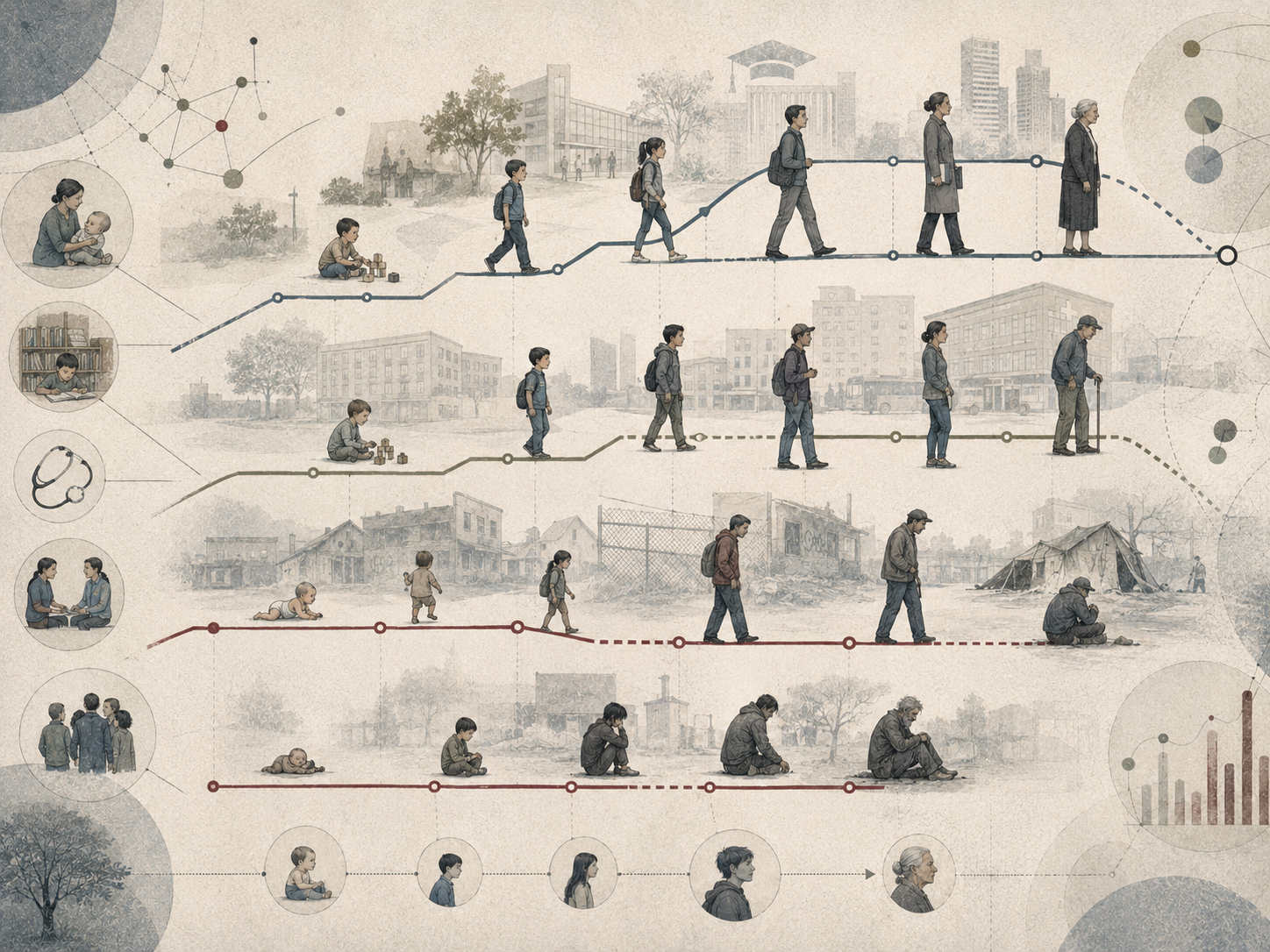
A life-course perspective is essential because inequality is rarely a single event. It is often cumulative. Unequal starting conditions shape later vulnerability and opportunity. Early burdens can become school difficulties, health burdens, institutional distrust, constrained aspirations, unstable work, and unequal aging. Early advantages can become confidence, support networks, better schooling, health protection, occupational opportunity, and greater margin for recovery. Development is therefore not simply a sequence of individual stages. It is a pathway through unequally organized social worlds.
Why Inequality Matters for Development
Inequality matters for development because people do not begin life with equal protection from harm or equal access to opportunity. The conditions into which a child is born influence nutrition, health care, neighborhood safety, housing quality, caregiver stress, environmental exposure, early learning, and the likelihood of being supported rather than punished by institutions. These are not peripheral developmental factors. They are part of the developmental environment itself.
Developmental psychology has often focused on individual capacities: attachment, language, cognition, emotion regulation, self-control, identity, peer relations, moral reasoning, and resilience. These are important. But each develops under conditions that are unequally distributed. A child’s self-regulation may be shaped by sleep, hunger, household stress, exposure to threat, classroom climate, disability support, and caregiver availability. A teenager’s aspiration may be shaped by school quality, transportation, peer networks, institutional trust, neighborhood opportunity, and whether adults treat the future as realistically available.
Inequality therefore matters scientifically because developmental outcomes are too easily overattributed to individual merit, temperament, parenting style, or private decision-making. It matters ethically because unequal structures can burden some lives long before personal choice becomes meaningful. A life-course developmental psychology that ignores inequality risks mistaking structural pattern for private failure.
The developmental question is not only why some individuals succeed under difficult conditions. It is why difficult conditions are unequally distributed in the first place, how they become developmentally consequential, and what forms of support can reduce their long-term effects. A serious account of development must therefore treat inequality as a causal and institutional condition, not merely as a demographic variable in a statistical table.
What Inequality Means in Developmental Terms
In developmental terms, inequality means unequal access to the conditions that support healthy growth and unequal exposure to the conditions that undermine it. It includes income and wealth, but it is not reducible to money. It includes housing security, food security, environmental safety, health care, school quality, transportation, caregiver time, disability services, social protection, neighborhood opportunity, legal protection, institutional respect, and the capacity to recover from setbacks.
Inequality is developmental when it changes the conditions under which capacities emerge. A child with stable housing, adequate nutrition, safe play spaces, responsive care, skilled teachers, and accessible health services is developing under different conditions from a child facing eviction risk, food insecurity, caregiver overwork, environmental hazards, punitive discipline, and limited care access. The difference is not only material. It becomes cognitive, emotional, physiological, social, and institutional.
Developmental inequality also includes unequal exposure to risk. Some children must adapt to chronic stress, neighborhood danger, unstable schooling, family economic strain, discrimination, institutional surveillance, or health burdens. Adaptation under such conditions can be intelligent and necessary, but it may also carry costs. Hypervigilance may be protective in dangerous environments but exhausting in school. Distrust may be reasonable in punitive institutions but can limit access to support. Developmental psychology should therefore avoid describing unequal adaptation as individual deficiency without examining the conditions that made it adaptive.
Finally, inequality includes unequal access to repair. Setbacks are part of life, but not everyone has the same ability to recover from them. Some families can absorb a job loss, health crisis, school problem, or legal issue. Others face cascading consequences from the same event. The life-course significance of inequality often lies in this difference: whether harm remains isolated or becomes cumulative.
The Life-Course Perspective
A life-course perspective matters because inequality unfolds through time. It is not only a condition of childhood, adolescence, adulthood, or old age. It links them. Earlier conditions shape later vulnerability, resilience, identity, health, work, caregiving, and institutional access. Later conditions can intensify, redirect, or repair earlier patterns. Development is therefore best understood as a structured sequence rather than a set of isolated stages.
The life-course perspective emphasizes timing, linked lives, transitions, cumulative exposure, and historical context. Timing matters because the same exposure may have different consequences depending on when it occurs. Linked lives matter because individual development is connected to parents, caregivers, siblings, peers, teachers, partners, children, coworkers, and communities. Transitions matter because school entry, adolescence, employment, parenthood, illness, migration, retirement, and bereavement reorganize developmental demands. Historical context matters because people develop in specific periods shaped by policy, economy, technology, conflict, climate, and culture.
Inequality becomes especially visible through cumulative advantage and cumulative disadvantage. Early advantage can open pathways that produce further advantage: better schools, stronger networks, healthier environments, credentials, stable work, wealth accumulation, and safer aging. Early disadvantage can produce further burden: health strain, school disruption, institutional exclusion, unstable work, debt, caregiving stress, and reduced margin for recovery. These are not mechanical destinies, but they are patterned pathways.
The life-course perspective also prevents the mistake of treating adulthood as a fresh start detached from earlier conditions. Adult health, work, relationships, and aging are shaped by earlier nutrition, schooling, stress, care, environment, and opportunity. Likewise, childhood cannot be understood only in the present. It must be understood in relation to the futures it helps enable or foreclose.
Early Childhood and Unequal Starting Conditions
Early childhood is one of the clearest sites where inequality enters development. Differences in prenatal care, maternal health, nutrition, housing stability, environmental exposure, neighborhood safety, caregiver stress, early language experience, sleep routines, health services, and early learning opportunities can shape developmental pathways before formal schooling begins. Unequal starting conditions are not only economic facts. They become developmental conditions.
The early years are especially important because foundational systems are developing rapidly: sensory processing, attachment, language, motor coordination, emotional regulation, stress response, attention, social trust, and early cognition. These systems are shaped by relationships and environments. A child who receives consistent care, protection, language-rich interaction, play, and health support is not simply receiving more resources. The child is developing within a more protective ecology.
Unequal early environments can produce differences that later institutions misrecognize. A child adapting to stress may be labeled disruptive. A child with limited health care may be labeled inattentive. A child with unstable housing may be treated as inconsistent. A child whose family faces language barriers or bureaucratic exclusion may be seen as less prepared. Developmental psychology must ask how institutional categories transform early inequality into later disadvantage.
At the same time, early inequality should not be interpreted deterministically. Early childhood is important because support can have large effects, not because later life is irrelevant. Early intervention, family support, health care, housing stability, nutrition, disability services, and high-quality early learning can reduce risk. Later support can also matter. The developmental point is urgency without fatalism: unequal starting conditions matter greatly, but they are not the end of the story.
Schooling, Opportunity, and Stratified Development
Schooling is one of the major mechanisms through which inequality is reproduced, challenged, intensified, or repaired. Schools are not only places of instruction. They organize recognition, belonging, discipline, expectation, access, safety, assessment, peer life, adult support, and future possibility. The same grade level can have very different developmental meanings depending on school quality, classroom climate, teacher stability, funding, mental-health support, disability accommodation, enrichment opportunities, and disciplinary practice.
Educational inequality is developmental because learning depends on more than individual effort. It depends on safe classrooms, skilled teachers, stable attendance, transportation, health, sleep, nutrition, language support, accessible materials, trust, and the belief that schooling leads somewhere real. When these conditions are unequal, achievement gaps are not merely differences in ability. They are records of unequal developmental opportunity.
Discipline is especially important. Punitive discipline can turn developmental struggle into institutional exclusion. Children under stress may need support, structure, repair, and relational stability. Instead, they may encounter suspension, stigma, surveillance, or referral into more punitive systems. This is one way inequality becomes cumulative: early stress produces behavior that institutions punish, and punishment then produces more stress, less learning, and weaker institutional trust.
Schools can also interrupt inequality. Strong relationships, inclusive classrooms, restorative practices, accessible mental-health supports, culturally responsive teaching, disability accommodations, after-school opportunities, family engagement, and high expectations with real support can change trajectories. A developmental account of schooling therefore asks not only how children perform, but how institutions structure the conditions under which performance becomes possible.
Health, Stress, and the Embodiment of Inequality
Inequality becomes embodied. Social conditions such as poverty, insecure housing, environmental exposure, limited care access, discrimination, stigma, neighborhood danger, food insecurity, and chronic uncertainty are not only external facts. They affect sleep, stress physiology, immune function, attention, mood, behavior, illness risk, and long-term health. Developmental psychology should therefore understand inequality as something carried through bodies and minds over time.
Stress is central to this process. Short-term stress can be manageable, especially when buffered by supportive relationships. Chronic, unpredictable, or overwhelming stress is different. When stress becomes a persistent condition of development, it can affect emotional regulation, vigilance, concentration, sleep, health behavior, and social trust. The issue is not that individuals are weak. It is that development under chronic strain requires constant adaptation.
Embodiment also links childhood to later life. Early stress and deprivation can shape health pathways that unfold over decades. Childhood nutrition, environmental toxins, neighborhood safety, access to preventive care, and exposure to chronic stress can influence adult health, cognitive aging, disability, and functional ability. Later health inequalities are therefore often life-course inequalities.
This does not mean social conditions become biology in a simplistic or irreversible way. Bodies remain adaptive. Support, treatment, safety, income stability, community connection, and institutional repair can improve health trajectories. But embodiment means that inequality is not only lived as income difference or educational difference. It is lived as fatigue, illness, pain, vigilance, risk, reduced margin for error, and unequal aging.
Family, Work, and Time Under Unequal Conditions
Inequality reorganizes family life through time pressure, unstable work, economic strain, transportation burdens, housing instability, and reduced room for recovery. Caregivers with insecure jobs, limited schedule control, poor transportation, low wages, high debt, or weak access to services may have less time and energy available for support, even when their commitment to children is profound. A developmental analysis should therefore avoid treating family differences as if they emerged outside political economy.
Families do not care in a vacuum. Their developmental capacity is shaped by wages, leave policies, child care access, housing costs, neighborhood safety, health care, school schedules, disability services, immigration systems, and the broader distribution of time. A parent working multiple jobs may not lack love, discipline, or concern. They may lack protected time, institutional support, and economic security.
Time is one of the least visible forms of inequality. Some families have time to read, rest, attend school meetings, navigate services, supervise homework, arrange therapy, drive to activities, and recover after crisis. Other families live under compressed time, where every appointment, delay, illness, or bureaucratic obstacle creates cascading strain. Developmental psychology should recognize time as a resource, not merely a schedule.
This matters because family processes are often interpreted psychologically when they are also structural. Parenting stress, conflict, inconsistent routines, or reduced involvement may reflect economic instability and institutional burden. A serious account of family development asks how care is supported or undermined by work, policy, housing, health care, and community infrastructure.
Adolescence, Aspiration, and Constrained Futures
Adolescence brings inequality into sharper focus because young people become more aware of comparison, status, identity, belonging, and future possibility. They begin to ask, implicitly or explicitly: What kind of life is available to me? Which institutions recognize me? Which futures are realistic? Who gets protected? Who gets punished? Who gets trusted? Who gets encouraged to imagine more?
Aspiration is not only a private psychological trait. It is shaped by visible opportunity. Adolescents develop expectations through schools, neighborhoods, family experiences, peer networks, media, policing, work opportunities, transportation, mentors, college access, health care, and the treatment they receive from adults. Some adolescents are surrounded by institutions that make the future feel open. Others receive repeated signals that the future is narrow, risky, or conditional.
This does not mean adolescents under constraint lack agency. Many show extraordinary creativity, responsibility, and persistence. But agency is always exercised under conditions. A young person who must work to support family, navigate unsafe transportation, care for siblings, avoid neighborhood danger, manage untreated stress, or attend under-resourced schools is not making choices in the same opportunity field as a peer with stable support and institutional access.
Adolescence is also a period when intervention can matter powerfully. Mentoring, school belonging, mental-health support, youth employment, civic participation, arts, sports, college counseling, restorative discipline, and community safety can expand perceived and actual futures. A developmental psychology of inequality should therefore treat adolescence not only as a period of risk but as a period of possible reorientation.
Adulthood, Aging, and Cumulative Advantage
Inequality continues through adulthood and older age because early conditions shape later education, work, health, housing, family responsibilities, savings, social networks, and access to care. Adulthood should not be interpreted as a clean break from earlier development. It is a later phase of pathways already shaped by unequal support, unequal burden, and unequal institutional opportunity.
Cumulative advantage and cumulative disadvantage become visible in adult life. Educational access shapes work. Work shapes income, health insurance, schedule control, stress, and retirement security. Housing shapes neighborhood safety, environmental exposure, school access, and wealth. Health shapes employment, caregiving, mobility, and social participation. Each domain affects the others, creating pathways that can either stabilize or compound inequality.
Aging intensifies many of these patterns. Older adults do not arrive at later life with equal reserves. Some have pensions, savings, stable housing, strong networks, accessible health care, and safe communities. Others enter older age after decades of physically demanding work, low wages, discrimination, caregiving burden, poor health access, and environmental exposure. Later-life vulnerability is therefore often a life-course outcome, not only a feature of old age.
This life-course view also changes how dignity in aging is understood. Functional ability, autonomy, mobility, social connection, and care are shaped by prior conditions and current institutions. A developmental psychology of inequality asks how societies distribute the capacity to age with security, recognition, and participation.
Inequality Across Place, Race, and Institution
Inequality varies across place and institution, not only across households. Development is shaped by geography: rural infrastructure, urban segregation, housing markets, school districts, transportation systems, environmental exposure, health services, broadband access, food systems, public safety, and local employment. The same family may face very different developmental conditions depending on where it lives.
Race and ethnicity also shape development through institutional treatment, historical exclusion, discrimination, residential segregation, wealth gaps, school discipline, health care access, environmental risk, and unequal recognition. These patterns should be discussed carefully: not as biological differences or cultural deficits, but as social and institutional structures that distribute risk and opportunity unequally.
Institutions matter because they interpret people. Schools decide who is gifted, delayed, disruptive, promising, dangerous, or worth supporting. Health systems decide whose pain is believed, whose symptoms are treated, and whose care is accessible. Legal systems decide who is surveilled, punished, protected, or ignored. Welfare systems decide who is eligible, deserving, compliant, or suspect. These classifications become developmental when they shape resources, identity, stress, and future opportunity.
A developmental psychology of inequality must therefore be ecological. It cannot stop at individual traits or family processes. It must examine place, race, class, disability, gender, institutions, policy, and history as developmental conditions. Human growth unfolds inside systems that distribute both support and harm.
Beyond Individual Explanation: Development as Structured Pathway
The deepest lesson is that development should not be explained as though persons and structures were separable. Human beings act, choose, adapt, interpret, resist, and create meaning. But they do so under unequal conditions that shape what actions are possible, what risks are ordinary, what support is available, and what consequences follow from mistakes.
Development is therefore neither wholly determined nor freely self-authored. It is structured pathway. Some pathways are made easier, safer, and more rewarded. Others are made more dangerous, costly, and fragile. Some people receive second chances. Others experience small setbacks as irreversible turning points because institutions provide little room for repair.
This perspective does not deny agency. It situates agency in real conditions. A young person who persists under constraint is exercising agency. A caregiver who supports children under economic strain is exercising agency. An older adult who adapts to illness and isolation is exercising agency. But a developmental science that celebrates agency without examining unequal conditions risks turning resilience into a demand placed on the already burdened.
A better account asks how systems can reduce the need for extraordinary resilience by making ordinary development less precarious. It asks how institutions can widen pathways rather than merely praise those who survive narrow ones. It treats human development as both personal and public, both psychological and structural.
Repair, Policy, and Developmental Justice
If inequality is developmental, then policy is developmental as well. Housing policy, health policy, education policy, labor policy, transportation policy, environmental policy, child care policy, disability policy, and aging policy all shape the conditions under which people grow and live. Developmental psychology therefore has public significance. It helps clarify what kinds of social arrangements support human flourishing across time.
Repair is a central developmental concept. Inequality is not only about unequal starting points; it is also about whether harm can be repaired. A child with a developmental delay may need early support. A student harmed by exclusionary discipline may need relational repair and educational reentry. A family under stress may need income stability, child care, housing, and health care. An adolescent facing constrained futures may need mentoring, belonging, and real institutional pathways. An older adult facing isolation may need accessible environments and social connection.
Developmental justice means organizing institutions so that growth, repair, and participation are not reserved for those already advantaged. It means recognizing that people need different forms of support at different life stages. It means treating early childhood, school transitions, adolescence, work entry, family caregiving, illness, disability, retirement, and aging as developmental periods requiring institutional care.
The practical implication is clear: developmental inequality cannot be solved only by asking individuals to make better choices. Choices matter, but choices are made inside opportunity structures. A developmental policy framework asks how to reduce unequal burden, increase protective conditions, support families, strengthen schools, expand health access, reduce environmental harm, and preserve dignity across the full life course.
An Analytical Framework for Development, Inequality, and the Life Course
A stylized developmental outcome \(D_{it}\) for individual \(i\) at time \(t\) can be written as a function of resources, burdens, supports, context, and prior developmental state. Let \(R_{it}\) represent resource access, \(U_{it}\) represent unequal burden or disadvantage, and \(S_{it}\) represent support or buffering conditions.
D_{it} = \alpha_i + \beta R_{it} – \gamma U_{it} + \delta S_{it} + \varepsilon_{it}
\]
Interpretation: Developmental outcomes are shaped by the balance among opportunity, burden, and protection. Resources and supports improve the developmental pathway, while unequal burdens constrain it.
To express cumulative inequality across the life course, we can sum repeated exposures over time:
D_{it} = \alpha_i + \beta \sum_{\tau=1}^{t} R_{i\tau} – \gamma \sum_{\tau=1}^{t} U_{i\tau} + \delta S_{it} + \varepsilon_{it}
\]
Interpretation: Advantage and disadvantage accumulate. Earlier conditions do not simply disappear between developmental stages.
To model timing-sensitive exposure, let \(w_{\tau}\) weight periods that may be especially consequential, such as early childhood, adolescence, school transitions, illness, migration, or entry into work.
D_{it} = \alpha_i + \beta \sum_{\tau=1}^{t} w_{\tau}R_{i\tau} – \gamma \sum_{\tau=1}^{t} w_{\tau}U_{i\tau} + \delta S_{it} + \varepsilon_{it}
\]
Interpretation: Some periods may have stronger long-term developmental effects than others. Timing and accumulation operate together.
A dynamic model includes prior developmental state:
D_{it} = \rho D_{i,t-1} + \beta R_{it} – \gamma U_{it} + \delta S_{it} + \varepsilon_{it}
\]
Interpretation: Developmental outcomes often depend partly on earlier developmental states. Continuity matters, but current conditions can still redirect the pathway.
A multilevel version recognizes that people develop inside shared contexts such as families, schools, neighborhoods, clinics, workplaces, and policy environments. Let \(j\) represent context.
D_{ijt} = \alpha + u_j + \beta R_{ijt} – \gamma U_{ijt} + \delta S_{ijt} + \varepsilon_{ijt}
\]
Interpretation: Developmental inequality is not only individual. Contexts such as schools, neighborhoods, institutions, and policy systems shape shared developmental conditions.
These equations are simplified, but they clarify the central argument. Inequality is not merely a covariate. It is a developmental structure. It shapes the distribution of resources, burdens, supports, timing, contexts, and repair across the life course.
R: Simulating Life-Course Inequality and Developmental Outcomes
The following R example simulates individuals across repeated waves with resource access, unequal burden, support, timing sensitivity, and community opportunity shaping developmental outcomes. It is synthetic and intended for demonstration.
# Simulating life-course inequality and developmental outcomes
# -----------------------------------------------------------
# This example creates synthetic longitudinal data to demonstrate
# how resources, burdens, supports, timing, and context may shape
# developmental pathways across repeated waves.

suppressPackageStartupMessages({
  library(dplyr)
  library(lme4)
  library(ggplot2)
})

set.seed(2026)

n_people <- 820
n_waves <- 9
n_contexts <- 32

people <- data.frame(
  person_id = 1:n_people,
  context_id = sample(1:n_contexts, n_people, replace = TRUE),
  baseline_resources = rnorm(n_people, 0, 1),
  baseline_burden = rnorm(n_people, 0, 1),
  support_buffer = rnorm(n_people, 0, 1),
  baseline_health = rnorm(n_people, 0, 1)
)

context_df <- data.frame(
  context_id = 1:n_contexts,
  community_opportunity = rnorm(n_contexts, 0, 0.6),
  institutional_support = rnorm(n_contexts, 0, 0.6)
)

panel_data <- people |>
  slice(rep(1:n(), each = n_waves)) |>
  group_by(person_id) |>
  mutate(
    wave = 0:(n_waves - 1),
    early_timing_weight = exp(-0.18 * wave),
    transition_weight = exp(-((wave - 5)^2) / (2 * 1.6^2)),
    current_resources = rnorm(n_waves, baseline_resources, 0.5),
    current_burden = rnorm(n_waves, baseline_burden, 0.6),
    current_support = rnorm(n_waves, support_buffer, 0.5),
    health_status = rnorm(n_waves, baseline_health, 0.5)
  ) |>
  ungroup() |>
  left_join(context_df, by = "context_id") |>
  arrange(person_id, wave)

panel_data <- panel_data |>
  mutate(
    weighted_resources = current_resources * early_timing_weight,
    weighted_burden = current_burden * early_timing_weight,
    transition_support = current_support * transition_weight
  ) |>
  group_by(person_id) |>
  mutate(
    cumulative_resources = cumsum(weighted_resources),
    cumulative_burden = cumsum(weighted_burden)
  ) |>
  ungroup()

panel_data <- panel_data |>
  mutate(
    development_score =
      50 +
      0.75 * wave +
      0.55 * cumulative_resources -
      0.60 * cumulative_burden +
      1.05 * current_support +
      0.85 * transition_support +
      0.75 * health_status +
      0.85 * community_opportunity +
      0.70 * institutional_support +
      rnorm(n(), 0, 2.4)
  )

model <- lmer(
  development_score ~ wave + cumulative_resources + cumulative_burden +
    current_support + transition_support + health_status +
    community_opportunity + institutional_support +
    (1 + wave | context_id/person_id),
  data = panel_data
)

summary(model)

trajectory_summary <- panel_data |>
  group_by(wave) |>
  summarize(
    mean_development = mean(development_score),
    lower = mean(development_score) - 1.96 * sd(development_score) / sqrt(n()),
    upper = mean(development_score) + 1.96 * sd(development_score) / sqrt(n()),
    .groups = "drop"
  )

ggplot(trajectory_summary, aes(x = wave, y = mean_development)) +
  geom_line(linewidth = 1) +
  geom_ribbon(aes(ymin = lower, ymax = upper), alpha = 0.15) +
  labs(
    title = "Simulated Development, Inequality, and the Life Course",
    x = "Wave",
    y = "Average development score"
  ) +
  theme_minimal()

inequality_groups <- panel_data |>
  group_by(person_id) |>
  summarize(
    average_resources = mean(current_resources),
    average_burden = mean(current_burden),
    final_score = development_score[wave == max(wave)],
    .groups = "drop"
  ) |>
  mutate(
    inequality_profile = case_when(
      average_resources >= 0 & average_burden < 0 ~ "higher resources / lower burden",
      average_resources >= 0 & average_burden >= 0 ~ "higher resources / higher burden",
      average_resources < 0 & average_burden < 0 ~ "lower resources / lower burden",
      TRUE ~ "lower resources / higher burden"
    )
  )

ggplot(
  inequality_groups,
  aes(x = inequality_profile, y = final_score)
) +
  geom_boxplot() +
  coord_flip() +
  labs(
    title = "Synthetic Final Development Scores by Inequality Profile",
    x = "Inequality profile",
    y = "Final development score"
  ) +
  theme_minimal()

# Analysts can extend this model by:
# 1. separating education, health, and social outcomes;
# 2. modeling race, place, disability, and policy explicitly;
# 3. adding family and school systems;
# 4. simulating economic shocks and recovery;
# 5. comparing stronger and weaker support ecologies.
This R workflow models inequality as cumulative and contextual. Resources and burdens accumulate across time, supports buffer risk, and community context shapes shared opportunity. The example also includes timing weights to represent the idea that some periods of exposure may be especially consequential.
Python: Modeling Unequal Opportunity and Development Over Time
The following Python example simulates developmental change over time with resources, burden, support, health, timing sensitivity, and community opportunity. It uses a dynamic structure in which prior developmental state influences later developmental state.
# Modeling unequal opportunity and development over time
# -----------------------------------------------------
# This example creates synthetic longitudinal data to demonstrate how
# resources, burdens, supports, timing, and community opportunity can
# shape developmental outcomes across the life course.

from __future__ import annotations

import numpy as np
import pandas as pd
import statsmodels.formula.api as smf
import matplotlib.pyplot as plt

np.random.seed(2026)

n_people = 900
n_periods = 10
n_contexts = 36

people = pd.DataFrame({
    "person_id": np.arange(1, n_people + 1),
    "context_id": np.random.choice(np.arange(1, n_contexts + 1), size=n_people),
    "baseline_resources": np.random.normal(0, 1, n_people),
    "baseline_burden": np.random.normal(0, 1, n_people),
    "support_buffer": np.random.normal(0, 1, n_people),
    "baseline_health": np.random.normal(0, 1, n_people),
})

context_df = pd.DataFrame({
    "context_id": np.arange(1, n_contexts + 1),
    "community_opportunity": np.random.normal(0, 0.6, n_contexts),
    "institutional_support": np.random.normal(0, 0.6, n_contexts),
})

panel = people.loc[people.index.repeat(n_periods)].copy()
panel["time"] = np.tile(np.arange(n_periods), n_people)

panel["early_timing_weight"] = np.exp(-0.16 * panel["time"])
panel["transition_weight"] = np.exp(-((panel["time"] - 6) ** 2) / (2 * 1.8 ** 2))

panel = panel.merge(context_df, on="context_id", how="left")

panel["current_resources"] = np.random.normal(
    panel["baseline_resources"],
    0.6,
    len(panel),
)

panel["current_burden"] = np.random.normal(
    panel["baseline_burden"],
    0.7,
    len(panel),
)

panel["current_support"] = np.random.normal(
    panel["support_buffer"],
    0.6,
    len(panel),
)

panel["health_status"] = np.random.normal(
    panel["baseline_health"],
    0.5,
    len(panel),
)

panel = panel.sort_values(["person_id", "time"]).reset_index(drop=True)

panel["weighted_resources"] = panel["current_resources"] * panel["early_timing_weight"]
panel["weighted_burden"] = panel["current_burden"] * panel["early_timing_weight"]
panel["transition_support"] = panel["current_support"] * panel["transition_weight"]

panel["cumulative_resources"] = panel.groupby("person_id")[
    "weighted_resources"
].cumsum()

panel["cumulative_burden"] = panel.groupby("person_id")[
    "weighted_burden"
].cumsum()

panel["development_score"] = np.nan

for person_id in panel["person_id"].unique():
    person_rows = panel.loc[panel["person_id"] == person_id].copy()
    previous_score = 50 + np.random.normal(0, 3)

    for idx in person_rows.index:
        time = panel.at[idx, "time"]
        resources = panel.at[idx, "current_resources"]
        burden = panel.at[idx, "current_burden"]
        support = panel.at[idx, "current_support"]
        health = panel.at[idx, "health_status"]
        community = panel.at[idx, "community_opportunity"]
        institution = panel.at[idx, "institutional_support"]
        early_weight = panel.at[idx, "early_timing_weight"]
        transition_support = panel.at[idx, "transition_support"]

        current_score = (
            0.68 * previous_score
            + 0.20 * time
            + 1.00 * resources * early_weight
            - 1.15 * burden * early_weight
            + 0.95 * support
            + 0.85 * transition_support
            + 0.75 * health
            + 0.85 * community
            + 0.70 * institution
            + np.random.normal(0, 2.2)
        )

        panel.at[idx, "development_score"] = current_score
        previous_score = current_score

panel["lag_score"] = panel.groupby("person_id")["development_score"].shift(1)
regression_data = panel.dropna(subset=["lag_score"]).copy()

model = smf.ols(
    formula="""
    development_score ~ lag_score + time + current_resources +
    current_burden + current_support + transition_support +
    health_status + community_opportunity + institutional_support +
    early_timing_weight
    """,
    data=regression_data,
).fit(cov_type="HC3")

print(model.summary())

trajectory = panel.groupby("time", as_index=False).agg(
    average_development=("development_score", "mean"),
    standard_error=("development_score", lambda x: x.std() / np.sqrt(len(x))),
    average_resources=("current_resources", "mean"),
    average_burden=("current_burden", "mean"),
    average_support=("current_support", "mean"),
)

trajectory["lower"] = (
    trajectory["average_development"] - 1.96 * trajectory["standard_error"]
)
trajectory["upper"] = (
    trajectory["average_development"] + 1.96 * trajectory["standard_error"]
)

plt.figure(figsize=(8, 5))
plt.plot(trajectory["time"], trajectory["average_development"], linewidth=2)
plt.fill_between(
    trajectory["time"],
    trajectory["lower"],
    trajectory["upper"],
    alpha=0.2,
)
plt.xlabel("Time")
plt.ylabel("Average development score")
plt.title("Simulated Development, Inequality, and the Life Course")
plt.tight_layout()
plt.show()

person_summary = panel.groupby("person_id", as_index=False).agg(
    average_resources=("current_resources", "mean"),
    average_burden=("current_burden", "mean"),
    final_score=("development_score", "last"),
)

person_summary["inequality_profile"] = np.select(
    [
        (person_summary["average_resources"] >= 0) & (person_summary["average_burden"] < 0), (person_summary["average_resources"] >= 0) & (person_summary["average_burden"] >= 0),
        (person_summary["average_resources"] < 0) & (person_summary["average_burden"] < 0),
    ],
    [
        "higher resources / lower burden",
        "higher resources / higher burden",
        "lower resources / lower burden",
    ],
    default="lower resources / higher burden",
)

profile_summary = person_summary.groupby(
    "inequality_profile",
    as_index=False
).agg(
    average_final_score=("final_score", "mean"),
    people=("person_id", "count"),
)

print(profile_summary)

# Analysts can extend this framework by:
# 1. modeling cumulative advantage and disadvantage separately;
# 2. adding policy interventions and shocks;
# 3. separating physical, cognitive, and social outcomes;
# 4. nesting individuals within schools or neighborhoods;
# 5. comparing high- and low-opportunity contexts.
The Python workflow makes the developmental argument computationally explicit. Inequality is modeled as a time-varying and cumulative condition. Resources, burdens, supports, health, institutions, and community opportunity interact with prior developmental state to shape later outcomes.
GitHub Repository
Complete Code Repository
Access the full companion repository for this article, including reproducible analysis materials and multi-language code workflows for life-course inequality, cumulative advantage and disadvantage, timing-sensitive exposure, community opportunity, support buffering, and developmental trajectory modeling.
Conclusion
Development, inequality, and the life course belong together because development is always shaped by unequal conditions of growth, support, exposure, and repair. Inequality enters development through housing, health, nutrition, schooling, family time, environmental quality, neighborhood safety, institutional treatment, work, policy, and aging. It is not merely a background condition. It is one of the structures through which developmental pathways are organized.
The life-course perspective shows why inequality cannot be understood as a single moment. It accumulates. Early conditions shape later opportunities. Schooling can reproduce or interrupt disadvantage. Stress becomes embodied. Family life is shaped by work and time. Adolescence turns inequality into futures imagined or foreclosed. Adulthood and aging reveal the long reach of cumulative advantage and disadvantage.
The strongest developmental psychology therefore does not explain unequal outcomes as though they were mainly private failures. It asks how social worlds distribute developmental conditions. It asks how some pathways are widened while others are narrowed. It asks how institutions can reduce unequal burden, increase support, and preserve the possibility of repair across the life course. In that sense, the life course is not only a record of individual becoming. It is also a record of how societies distribute the chances to become otherwise.
Related Articles
- What Is Developmental Psychology?
- Why Developmental Psychology Matters Today
- Developmental Systems Theory and the Ecology of Human Growth
- Trauma, Adversity, and the Life Course
- Culture and Development Across Societies
- Education, Schooling, and Developmental Formation
- Parenting, Family Systems, and Human Development
- Developmental Psychology knowledge series
Further Reading
- American Psychological Association (n.d.) Children, Youth, Families and Socioeconomic Status. Available at: https://www.apa.org/pi/ses/resources/publications/children-families.
- Braveman, P. and Gottlieb, L. (2014) ‘The social determinants of health: It’s time to consider the causes of the causes’, Public Health Reports, 129(Suppl. 2), pp. 19–31. Available at: https://pmc.ncbi.nlm.nih.gov/articles/PMC3863696/.
- Dannefer, D. (2003) ‘Cumulative advantage/disadvantage and the life course: Cross-fertilizing age and social science theory’, The Journals of Gerontology: Series B, 58(6), pp. S327–S337. Available at: https://doi.org/10.1093/geronb/58.6.S327.
- Elder, G.H., Johnson, M.K. and Crosnoe, R. (2003) ‘The emergence and development of life course theory’, in Mortimer, J.T. and Shanahan, M.J. (eds.) Handbook of the Life Course. Boston: Springer, pp. 3–19. Available at: https://doi.org/10.1007/978-0-306-48247-2_1.
- Hertzman, C. and Boyce, T. (2010) ‘How experience gets under the skin to create gradients in developmental health’, Annual Review of Public Health, 31, pp. 329–347. Available at: https://doi.org/10.1146/annurev.publhealth.012809.103538.
- Marmot, M. et al. (2008) ‘Closing the gap in a generation: Health equity through action on the social determinants of health’, The Lancet, 372(9650), pp. 1661–1669. Available at: https://doi.org/10.1016/S0140-6736(08)61690-6.
- National Academies of Sciences, Engineering, and Medicine (2019) A Roadmap to Reducing Child Poverty. Washington, DC: National Academies Press. Available at: https://doi.org/10.17226/25246.
- World Health Organization (2025) Social Determinants of Health. Available at: https://www.who.int/news-room/fact-sheets/detail/social-determinants-of-health.
References
- American Psychological Association (n.d.) Children, Youth, Families and Socioeconomic Status. Available at: https://www.apa.org/pi/ses/resources/publications/children-families.
- American Psychological Association (n.d.) Poverty and Inequality. Available at: https://www.apa.org/pi/ses/resources/publications/poverty-and-inequality.pdf.
- Braveman, P. and Gottlieb, L. (2014) ‘The social determinants of health: It’s time to consider the causes of the causes’, Public Health Reports, 129(Suppl. 2), pp. 19–31. Available at: https://pmc.ncbi.nlm.nih.gov/articles/PMC3863696/.
- Centers for Disease Control and Prevention (2024) Health Disparities | Adolescent and School Health. Available at: https://www.cdc.gov/healthy-youth/health-disparities/index.html.
- Centers for Disease Control and Prevention (2024) Social Determinants of Health | Public Health Gateway. Available at: https://www.cdc.gov/public-health-gateway/php/about/social-determinants-of-health.html.
- Centers for Disease Control and Prevention (2024) Social Determinants of Health | NCHHSTP Health Equity. Available at: https://www.cdc.gov/health-disparities-hiv-std-tb-hepatitis/about/social-determinants-of-health.html.
- Dannefer, D. (2003) ‘Cumulative advantage/disadvantage and the life course: Cross-fertilizing age and social science theory’, The Journals of Gerontology: Series B, 58(6), pp. S327–S337. Available at: https://doi.org/10.1093/geronb/58.6.S327.
- Elder, G.H., Johnson, M.K. and Crosnoe, R. (2003) ‘The emergence and development of life course theory’, in Mortimer, J.T. and Shanahan, M.J. (eds.) Handbook of the Life Course. Boston: Springer, pp. 3–19. Available at: https://doi.org/10.1007/978-0-306-48247-2_1.
- Hertzman, C. and Boyce, T. (2010) ‘How experience gets under the skin to create gradients in developmental health’, Annual Review of Public Health, 31, pp. 329–347. Available at: https://doi.org/10.1146/annurev.publhealth.012809.103538.
- Marmot, M. et al. (2008) ‘Closing the gap in a generation: Health equity through action on the social determinants of health’, The Lancet, 372(9650), pp. 1661–1669. Available at: https://doi.org/10.1016/S0140-6736(08)61690-6.
- National Academies of Sciences, Engineering, and Medicine (2019) A Roadmap to Reducing Child Poverty. Washington, DC: National Academies Press. Available at: https://doi.org/10.17226/25246.
- National Institutes of Health / NCBI (n.d.) Influences on Early Relational Health. Available at: https://www.ncbi.nlm.nih.gov/books/NBK620251/.
- World Health Organization (2025) Social Determinants of Health. Available at: https://www.who.int/news-room/fact-sheets/detail/social-determinants-of-health.
- World Health Organization (n.d.) Health Equity. Available at: https://www.who.int/health-topics/health-equity.
- World Health Organization (n.d.) Social Determinants of Health. Available at: https://www.who.int/health-topics/social-determinants-of-health.
- World Health Organization (n.d.) What Is a Life Course Approach and Why Is It Needed? Available at: https://www.who.int/teams/maternal-newborn-child-adolescent-health-and-ageing/life-course.
- World Health Organization (n.d.) Countries Enabled to Address Social Determinants of Health Across the Life Course. Available at: https://www.who.int/about/accountability/results/who-results-report-2020-mtr/output/pb-2024-2025/3.1.1.-countries-enabled-to-address-social-determinants-of-health-across-the-life-course.