
Last Updated May 21, 2026
Culture is not an external decoration added to development after biology, cognition, and emotion have already done their work. It is one of the primary social worlds through which human beings learn what development is for, what kinds of selves are valued, how relationships are organized, what children should become, and how growth is interpreted across societies. Developmental psychology is weakest when it treats one cultural pathway as the silent norm and then measures all other societies against it. A stronger account begins from plurality: children everywhere grow through bodies, relationships, language, play, learning, care, institutions, and meaning, but the rhythms, priorities, and valued outcomes of those processes differ across cultural worlds.
Human development is therefore always cultural. Culture shapes caregiving, discipline, schooling, gender expectations, interdependence, autonomy, moral life, migration, religious formation, peer worlds, work, elder care, and the timing and interpretation of developmental tasks. It shapes what counts as maturity, competence, intelligence, responsibility, emotional health, family loyalty, independence, obligation, and flourishing. A developmental theory that does not make culture explicit risks mistaking its own local assumptions for human universals.
Main Library
Publications
Article Map
Developmental Psychology
Related Topic
Social Psychology
Related Topic
Cognitive Psychology
Related Topic
Institutions & Governance
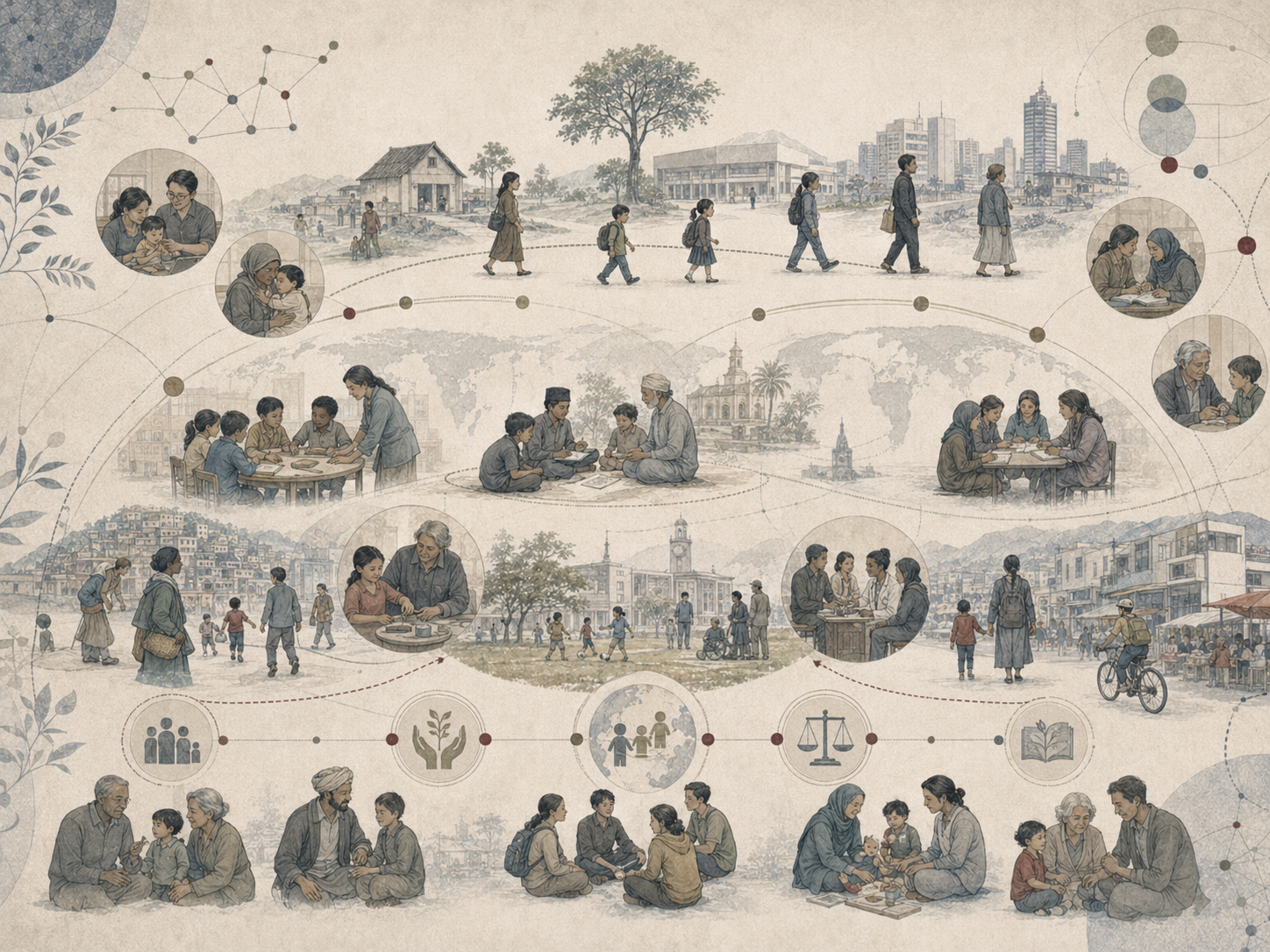
Development concerns growth across the lifespan, but growth always unfolds inside social conditions, institutions, and cultural meanings. Children need health, safety, responsive care, social belonging, and opportunities for learning, yet those needs are organized differently across families, communities, religious traditions, schools, economies, and political systems. Culture matters because it shapes the forms through which developmental support is given, the expectations placed on children, and the criteria by which maturity, competence, and flourishing are judged.
Why Culture Matters for Development
Culture matters because development is never only biological maturation or internal psychological unfolding. Children and adolescents learn what counts as good behavior, proper emotion, mature responsibility, acceptable dependence, meaningful achievement, family loyalty, and desirable adulthood through cultural worlds. Family routines, food practices, sleeping arrangements, work expectations, forms of play, schooling systems, ideas of respect, religious practice, and ritual participation all carry developmental meaning.
Developmental psychology becomes narrower than the human world it studies when it assumes that one society’s expectations are simply human nature in transparent form. A child raised to speak confidently with adults, make individual choices, and treat personal preference as central to identity is learning one cultural pathway. A child raised to attend carefully to elders, share responsibility with siblings, show restraint in public, and place family obligation before personal preference is learning another. Both children are developing through culture.
This matters scientifically because developmental processes can look different depending on the cultural setting being observed. It matters ethically because culturally narrow models often mistake difference for deficit. A child who is quiet with adults, deeply embedded in extended kinship, highly attentive to group obligations, or guided toward interdependence may be developing richly, even if that pathway does not fit an individualistic developmental ideal.
Culture should therefore be studied as patterned diversity, not as one norm with local deviations. Developmental psychology does not need to deny shared human needs in order to take cultural variation seriously. Infants everywhere require care; children everywhere need social worlds; learning everywhere depends on relationship, practice, and meaning. But the social forms through which those needs are met vary, and those variations are developmentally consequential.
What Culture Means in Developmental Psychology
In developmental psychology, culture refers not only to ethnicity, nationality, language, religion, or symbolic tradition, but to the shared practices, meanings, values, expectations, institutions, and forms of life through which development is organized. Culture includes language, parenting beliefs, household structure, division of labor, concepts of childhood, schooling practices, norms of emotion, moral expectations, authority relations, and ideas of what a capable person should be.
Culture is not a thin overlay on development. It is one of the main ways development is structured. It shapes the developmental environment before a child can name it: who holds the infant, how sleep is arranged, how children are disciplined, whether siblings provide care, how adults speak to children, whether children are expected to observe quietly or ask questions, whether autonomy or obedience is emphasized, and how emotional expression is judged.
This broader understanding matters because culture is often misunderstood as an optional variable added only in comparative research. In reality, every developmental study already studies culture, even when it does not name it. A laboratory task, parent questionnaire, school-readiness measure, classroom observation, or child-behavior scale contains assumptions about what counts as attention, maturity, learning, social competence, compliance, independence, or verbal expression.
The only question is whether that cultural frame is made visible or quietly treated as universal. A serious developmental psychology should make culture explicit rather than allowing dominant settings to disappear into the category of normality itself. Cultural analysis therefore improves developmental science by showing where its tools, categories, and expectations are located.
Beyond Universalism and Cultural Blindness
Some developmental processes are widespread across human societies: infants require care, language develops in social worlds, children learn through repetition and relationship, and human growth depends on safety, nourishment, and opportunity. But the social meaning of these processes varies. Universal developmental needs do not imply a universal model of what childhood, competence, maturity, or flourishing should look like.
Cultural blindness often emerges when broad human needs are confused with one preferred pathway for meeting them. A society may value early independence and solo sleep; another may value bodily closeness and shared sleep. A society may emphasize direct verbal negotiation; another may emphasize observation, silence, and respect for hierarchy. A society may define maturity as self-sufficiency; another may define maturity as dependable relational obligation. These are not minor stylistic differences. They organize developmental expectations.
This is why developmental psychology must move beyond simple universalism. It need not abandon comparison, but it must compare carefully. Similar developmental tasks may be organized through different norms, and similar outward behaviors may have different meanings across societies. A child who contributes heavily to household labor, for example, may be burdened in one setting and socially valued in another, though both cases still require attention to well-being, power, safety, and choice.
A culturally serious developmental psychology therefore asks two questions together. First, what human needs and developmental capacities appear broadly shared? Second, how are those needs and capacities organized, interpreted, supported, constrained, or valued within particular cultural worlds? The first question prevents cultural analysis from becoming relativism without human concern. The second prevents human-development theory from becoming disguised provincialism.
The Developmental Niche
One useful way to understand culture and development is through the idea of the developmental niche. A child grows within a culturally organized setting made up of physical and social environments, childcare practices, caregiver beliefs, institutional structures, and symbolic meanings. The niche is not merely where development happens. It is part of how development happens.
A developmental niche includes the people who care for the child, the spaces the child inhabits, the tools and technologies available, the expectations placed on age and gender, the economic roles of children, the languages spoken, the moral teachings emphasized, the school system entered, and the rituals that mark belonging. It also includes less visible conditions: ideas about discipline, shame, pride, obedience, independence, intelligence, disability, emotion, spiritual obligation, and family duty.
This framework helps avoid two errors. The first error is treating development as if children were isolated organisms unfolding from within. The second is treating culture as if it were only a set of explicit values. In reality, culture is lived through routines, objects, spaces, relationships, institutions, and repeated practices. A child learns culture not only when adults explain it, but when daily life makes some behaviors easier, some responses expected, and some futures more imaginable than others.
The developmental niche also changes over time. Migration, schooling, media, policy reform, economic change, climate pressure, and intergenerational conflict can all alter the niche. Children do not simply inherit culture unchanged. They develop inside cultural worlds that are themselves developing.
Caregiving, Family Life, and Developmental Goals
Caregiving is one of the clearest ways culture shapes development. The questions of who cares for children, how close bodily contact should be, how quickly independence should be encouraged, whether infants sleep alone, how discipline is expressed, how siblings participate in care, and what emotional tone is expected in family life all vary across societies. These differences reflect not only parenting style but broader developmental goals.
Some settings emphasize autonomy, choice, verbal self-expression, and early assertion of individual preference. Others emphasize relatedness, restraint, mutual obligation, respect for hierarchy, and sensitivity to social context. Most societies combine autonomy and interdependence in complex ways, but the balance matters because it shapes what caregivers praise, correct, tolerate, or worry about.
These cultural differences do not mean that anything any culture does is equally benign. Harm, violence, deprivation, humiliation, neglect, and coercion remain developmentally consequential. Cultural analysis should never become an excuse for ignoring suffering. But it does mean that developmental psychology must distinguish between genuine developmental threat and culturally different but coherent pathways of care.
Family life organizes developmental goals through everyday practice long before children can describe those goals themselves. A child learns whether maturity means speaking up, holding back, helping younger siblings, negotiating with adults, obeying elders, showing initiative, avoiding shame, pursuing achievement, preserving harmony, caring for grandparents, or leaving home. Culture enters development through these ordinary acts of care, expectation, correction, and recognition.
Language, Learning, and Cultural Worldmaking
Language development is also cultural development. Children do not merely learn vocabulary and grammar; they learn how to speak as a person in a given social world. They learn when to speak, when to listen, how directly to express desire, how to show deference, how to narrate experience, how to ask for help, and what kinds of stories, jokes, explanations, arguments, and silences are valued.
Language becomes one of the main tools through which culture shapes cognition, memory, identity, and social positioning. The stories children hear teach them what counts as a good life, a foolish choice, a respected elder, a dangerous stranger, a heroic act, a shameful failure, or a sacred duty. The forms of address children use teach them how relationships are ranked, softened, respected, or made intimate. The languages children are encouraged or discouraged to speak shape belonging and power.
Learning more broadly is also culturally organized. Some societies prize observation before speech; others encourage constant adult-child verbal exchange. Some place greater weight on imitation, apprenticeship, storytelling, ritual participation, collaborative contribution, or formal instruction. Children may learn by being directly taught, by watching older siblings, by participating in work, by memorizing sacred text, by play, by trial and correction, or by being gradually entrusted with responsibility.
Schooling may amplify or conflict with these earlier learning norms. A child raised to learn through quiet observation may enter a school that rewards quick verbal response. A child raised to speak freely may enter a setting where deference is prized. Developmental psychology gains depth when it studies not only whether children learn, but what modes of learning their cultures cultivate and legitimize.
Schooling, Socialization, and Institutional Formation
Schooling is one of the most important ways culture becomes institutionalized in development. Schools teach curriculum, but they also teach punctuality, discipline, aspiration, competition, cooperation, citizenship, national belonging, authority, and ideas about merit. These lessons are never culturally neutral. A school system may encourage independence, standardized performance, collective discipline, religious identity, national history, entrepreneurial ambition, civic obedience, or critical inquiry depending on the wider society in which it operates.
This matters because developmental outcomes are shaped not only by what families want for children, but by what institutions recognize and reward. A child may move between home and school systems that value different forms of speech, authority, emotion, intelligence, or obligation. Development across societies must therefore be understood partly through the alignment or tension between family culture and institutional culture.
Schooling can also become a site of cultural displacement. Children from minority, migrant, Indigenous, rural, religious, or non-dominant language communities may encounter schools that treat their home practices as inferior, backward, disruptive, or irrelevant. In those cases, schooling is not simply an educational institution. It is a cultural sorting system that can reshape identity, language, family authority, and self-worth.
At its best, schooling can help children move across cultural worlds without demanding self-erasure. It can support multilingual development, respect family knowledge, teach shared civic skills, and widen opportunity. At its worst, it can force children to trade belonging for recognition. Developmental psychology should examine schooling as cultural formation, not merely as achievement production.
Autonomy, Interdependence, and the Social Self
One of the most important cross-societal themes in developmental psychology concerns the relation between autonomy and interdependence. Some societies strongly value independent choice, self-assertion, personal preference, and the development of a distinct individual voice. Others emphasize family obligation, role fulfillment, relational attunement, respect, and the social self. Most actual societies contain mixtures of both, but the balance matters developmentally because it shapes how children learn freedom, responsibility, success, and belonging.
This distinction is not simply philosophical. It affects child-rearing, schooling, adolescence, work expectations, marriage, elder care, and ideas of mature adulthood. A developmental psychology that assumes autonomy is always the apex of development will misread societies in which interdependence is treated as a positive developmental achievement rather than unfinished individuation.
Interdependence should not be romanticized either. Family obligation can support belonging, care, and social responsibility, but it can also become coercive when it denies voice, constrains women and girls, suppresses dissent, or traps individuals in harmful arrangements. Autonomy can support agency and protection from domination, but it can also become isolation, consumer individualism, or neglect of collective responsibility. Culture shapes the balance, tension, and moral language through which these values are lived.
Developmental psychology should therefore avoid simple rankings. The question is not whether autonomy or interdependence is universally superior. The better question is how each is organized, for whom, under what conditions, with what protections, and with what developmental consequences. Mature personhood may involve independence in some domains and obligation in others.
Ritual, Morality, and the Making of Personhood
Culture shapes development not only through everyday routines but through ritual and moral formation. Religious practices, rites of passage, communal celebrations, mourning traditions, initiation, fasting, prayer, storytelling, service, and expectations surrounding gender, age, and obligation teach children what kind of persons they are becoming. Through ritual, societies often mark developmental transitions explicitly, giving social recognition to stages that some psychological models treat as merely internal.
This is important because personhood itself is culturally made. A society may define maturity through economic independence, marital status, initiation, caregiving capacity, moral restraint, spiritual discipline, public contribution, educational attainment, military service, parenthood, or responsibility to elders. Development involves not only internal growth but social recognition of who one has become and what responsibilities now attach to that identity.
Moral development is also culturally organized. Children learn what counts as fairness, loyalty, purity, respect, harm, duty, courage, gratitude, shame, forgiveness, and justice through practices and institutions. A theory of moral development that treats one moral language as universal may miss the way societies organize moral concern differently across family, community, religion, nation, humanity, and the natural world.
Ritual and moral formation also connect development to memory. Children inherit stories of ancestors, martyrs, saints, heroes, victims, founders, migrations, wars, losses, and collective survival. These stories help shape identity and obligation. Culture therefore links development not only to the present environment but to remembered pasts and imagined futures.
Gender, Generation, and Family Obligation
Gender and generation are central to cultural development because societies organize childhood, adolescence, adulthood, parenthood, and aging through roles. Children often learn early what boys and girls are expected to do, how sons and daughters should behave, who cares for younger children, who inherits responsibility, who speaks in public, who performs domestic labor, who is protected, and who is constrained.
These expectations can provide identity and belonging, but they can also reproduce inequality. A girl expected to care for siblings may develop responsibility and competence, but she may also lose educational opportunity. A boy expected to suppress fear may gain social approval, but may also learn emotional restriction. A child expected to obey elders may learn respect, but may also lack protection from harmful authority. Cultural development must therefore examine both meaning and power.
Generational relations also shape development. Some societies treat elders as central sources of wisdom, authority, and moral continuity. Others separate children, adults, and older adults into age-segregated institutions. These arrangements affect learning, care, memory, and the social meaning of aging. Intergenerational development is not only a family matter; it is a cultural structure.
Family obligation becomes especially important in societies where kinship remains the main safety net. Children may develop within dense networks of responsibility that connect siblings, cousins, grandparents, aunts, uncles, and neighbors. This can provide resilience and belonging, but it can also create conflicts when economic pressure, migration, schooling, or changing gender norms alter the balance of obligation. Culture is lived through those negotiations.
Migration, Globalization, and Cultural Transition
Development across societies cannot now be understood without migration and globalization. Many children and families live between cultural worlds, navigating home languages and school languages, family obligation and host-society expectations, inherited traditions and global media, religious continuity and secular institutions, local identity and transnational belonging. Cultural development is often not stable transmission but negotiation, translation, and tension across settings.
Migration can expand developmental possibility, but it can also produce conflict, loss, and identity strain. Children may become interpreters for adults, feel divided between cultural expectations, experience schools that devalue home practices, or face pressure to assimilate. Parents may struggle to preserve authority, language, religion, or family continuity in a new institutional environment. Adolescents may experience the cultural distance between home and peer worlds especially sharply.
At the same time, cultural transition may foster flexibility, hybrid identity, multilingual skill, perspective-taking, and broader repertoires of social understanding. Bicultural or multicultural development is not simply confusion; it can be a complex developmental resource when supported by family, school, community, and institutions. The difficulty often lies less in cultural plurality itself than in hierarchy, discrimination, exclusion, and institutional mismatch.
Globalization also affects children who never migrate. Digital media, consumer culture, educational competition, religious movements, global youth culture, climate anxiety, and transnational family networks all reshape developmental worlds. Culture is therefore not a closed container. It is a field of movement, contact, conflict, imitation, resistance, and recombination.
Inequality, Power, and Whose Development Counts
Culture across societies cannot be studied apart from power. Some developmental pathways are globally privileged and treated as modern, advanced, healthy, rational, or normal, while others are marginalized, exoticized, pathologized, or treated as obstacles to progress. Colonial history, global inequality, race, language hierarchy, migration status, and the international dominance of some research settings over others all shape which children are studied most, which developmental norms are treated as standard, and which forms of life are forced to justify themselves.
This matters because developmental psychology has often generalized from relatively narrow populations while speaking in universal terms. Research based heavily on Western, educated, industrialized, rich, and democratic societies can produce useful insights, but it cannot automatically stand for humanity. When such research becomes the default theory of development, other societies appear only as exceptions or deficits.
A stronger field must ask whose childhoods have counted most in theory-building, whose family systems and educational structures define the norm, and which societies are treated as deviations from a standard they did not set. It must also ask how global economic arrangements shape development across societies: through poverty, migration, labor systems, environmental exposure, conflict, debt, education policy, health infrastructure, and unequal access to care.
Culture is therefore not only a variable in development. It is also part of the politics of developmental knowledge itself. The question is not only how culture shapes children. It is also how developmental science decides which children represent development and which children require explanation.
Measurement, Comparison, and Cultural Validity
Comparative developmental psychology requires careful measurement. A task, scale, interview, or observation protocol designed in one cultural setting may not carry the same meaning in another. Direct eye contact, verbal assertiveness, emotional expressiveness, speed of response, solitary play, compliance with adults, self-description, and independence can all be interpreted differently across societies. Without cultural validity, measurement may confuse difference in meaning with difference in development.
This is especially important when researchers compare intelligence, attachment, parenting, school readiness, moral reasoning, social competence, emotion regulation, or mental health across societies. The same observed behavior can reflect different developmental meanings. Silence may indicate shyness, respect, uncertainty, resistance, or careful attention depending on context. Dependence may indicate immaturity in one framework and proper relatedness in another. Direct disagreement may indicate confidence in one setting and disrespect in another.
Measurement invariance, translation quality, local construct validation, ethnographic grounding, and collaboration with local researchers are therefore not optional refinements. They are core requirements for responsible cross-cultural developmental work. Without them, comparison can become a machine for turning cultural difference into lower scores.
The goal is not to abandon measurement or comparison. It is to make comparison more honest. Developmental science can compare societies, but it must compare constructs that have been interpreted carefully, measured appropriately, and situated within meaningful cultural contexts. Good comparative work asks what is genuinely shared, what is locally organized, and what the measuring instrument may be importing from its own cultural world.
Beyond Comparison: Culture as Developmental Process
The deepest insight is that culture should not be treated only as a category for comparing national groups. Culture is developmental process. It is how meanings are transmitted, revised, contested, embodied, and transformed across generations. Children do not simply absorb culture as static content. They participate in it, resist it, reinterpret it, and sometimes help transform it.
This process view makes developmental psychology more realistic. It allows the field to study continuity and change together: how traditions endure, how children are socialized into them, how new generations alter what those traditions mean, and how institutions respond to cultural change. Culture becomes not a backdrop but one of the central engines of developmental life.
Culture is also relational. It is made through interaction among caregivers, children, peers, teachers, elders, religious leaders, media, institutions, and public authorities. A child’s development may reinforce cultural continuity when they internalize a norm, but it may also produce cultural transformation when they reinterpret that norm under new conditions. Development is one way societies reproduce themselves, but it is also one way societies change.
Development across societies therefore reveals a double truth. Human beings share biological, relational, and social needs, but they become persons through cultural worlds that organize those needs differently. Developmental psychology becomes stronger when it can hold both truths at once.
An Analytical Framework for Culture and Development
A stylized developmental outcome \(D_{it}\) for individual \(i\) at time \(t\) can be written as a function of cultural meaning, family practice, institutional context, and social support:
D_{it} = \alpha_i + \beta C_{it} + \gamma F_{it} + \delta I_{it} + \theta S_{it} + \varepsilon_{it}
\]
Interpretation: Development is shaped through cultural norms and meanings \(C_{it}\), family practices \(F_{it}\), institutional context \(I_{it}\), social support \(S_{it}\), individual differences \(\alpha_i\), and residual variation \(\varepsilon_{it}\).
To represent cross-societal variation more explicitly, let \(j\) represent a society, community, language group, region, school system, or cultural setting:
D_{ijt} = \alpha + u_j + \beta C_{ijt} + \gamma F_{ijt} + \delta I_{ijt} + \theta S_{ijt} + \varepsilon_{ijt}
\]
Interpretation: Developmental outcomes vary not only between persons but also across broader cultural settings. The term \(u_j\) captures shared context-level influences.
To model migration, cultural transition, or dual-context development, we can add home-culture support, host-institution support, and cross-context mismatch:
D_{it} = \alpha_i + \beta H_{it} + \gamma K_{it} – \lambda M_{it} + \theta S_{it} + \varepsilon_{it}
\]
Interpretation: Home-culture support \(H_{it}\), host or school-context support \(K_{it}\), mismatch \(M_{it}\), and social support \(S_{it}\) together shape development across cultural worlds.
Because culture is transmitted through repeated interaction, a dynamic version can include feedback across time:
C_{it} = f(C_{i,t-1}, R_{it}, G_t, I_{it})
\]
Interpretation: Culture is not static inheritance. It is shaped by prior cultural practice \(C_{i,t-1}\), relational interaction \(R_{it}\), generational or historical change \(G_t\), and institutional context \(I_{it}\).
These equations are simplified, but they clarify the article’s central claim. Culture should not be treated as a decorative variable added after development has already been explained. It is part of the structure through which development becomes meaningful, organized, and socially recognized.
R: Simulating Cultural Contexts and Developmental Outcomes
The following R example simulates children across repeated waves with family cultural orientation, institutional fit, social support, society-level climate, and cross-context mismatch shaping developmental outcomes. The example is synthetic and intended for demonstration.
# Simulating cultural contexts and developmental outcomes
# ------------------------------------------------------
# This example creates synthetic longitudinal data to show how family
# cultural orientation, institutional fit, social support, cultural mismatch,
# and society-level climate can shape developmental outcomes over time.

suppressPackageStartupMessages({
  library(dplyr)
  library(lme4)
  library(ggplot2)
})

set.seed(2026)

n_children <- 820
n_waves <- 9
n_societies <- 28

children <- data.frame(
  child_id = 1:n_children,
  society_id = sample(1:n_societies, n_children, replace = TRUE),
  family_orientation = rnorm(n_children, 0, 1),
  institutional_fit = rnorm(n_children, 0, 1),
  cross_context_mismatch = rnorm(n_children, 0, 1),
  social_support = rnorm(n_children, 0, 1),
  bicultural_flexibility = rnorm(n_children, 0, 0.7)
)

society_df <- data.frame(
  society_id = 1:n_societies,
  society_climate = rnorm(n_societies, 0, 0.6),
  institutional_inclusion = rnorm(n_societies, 0, 0.6),
  linguistic_support = rnorm(n_societies, 0, 0.5)
)

panel_data <- children |>
  slice(rep(1:n(), each = n_waves)) |>
  group_by(child_id) |>
  mutate(
    wave = 0:(n_waves - 1),
    current_family = rnorm(n_waves, mean = family_orientation, sd = 0.5),
    current_fit = rnorm(n_waves, mean = institutional_fit, sd = 0.5),
    current_mismatch = rnorm(n_waves, mean = cross_context_mismatch, sd = 0.6),
    current_support = rnorm(n_waves, mean = social_support, sd = 0.5),
    current_flexibility = rnorm(n_waves, mean = bicultural_flexibility, sd = 0.4)
  ) |>
  ungroup() |>
  left_join(society_df, by = "society_id")

panel_data <- panel_data |>
  mutate(
    development_score =
      50 +
      0.75 * wave +
      1.05 * current_family +
      1.00 * current_fit +
      0.95 * current_support +
      0.85 * current_flexibility +
      0.80 * society_climate +
      0.75 * institutional_inclusion +
      0.55 * linguistic_support -
      1.10 * current_mismatch +
      rnorm(n(), 0, 2.4)
  )

model <- lmer(
  development_score ~ wave + current_family + current_fit +
    current_support + current_flexibility + current_mismatch +
    society_climate + institutional_inclusion + linguistic_support +
    (1 + wave | society_id/child_id),
  data = panel_data
)

summary(model)

trajectory_summary <- panel_data |>
  group_by(wave) |>
  summarize(
    mean_development = mean(development_score),
    lower = mean(development_score) - 1.96 * sd(development_score) / sqrt(n()),
    upper = mean(development_score) + 1.96 * sd(development_score) / sqrt(n()),
    .groups = "drop"
  )

ggplot(trajectory_summary, aes(x = wave, y = mean_development)) +
  geom_line(linewidth = 1) +
  geom_ribbon(aes(ymin = lower, ymax = upper), alpha = 0.15) +
  labs(
    title = "Simulated Culture and Development Across Societies",
    x = "Wave",
    y = "Average development score"
  ) +
  theme_minimal()

mismatch_groups <- panel_data |>
  group_by(child_id) |>
  summarize(
    average_mismatch = mean(current_mismatch),
    average_support = mean(current_support),
    final_score = development_score[wave == max(wave)],
    .groups = "drop"
  ) |>
  mutate(
    cultural_condition = case_when(
      average_mismatch < 0 & average_support >= 0 ~ "lower mismatch / higher support",
      average_mismatch >= 0 & average_support >= 0 ~ "higher mismatch / higher support",
      average_mismatch < 0 & average_support < 0 ~ "lower mismatch / lower support",
      TRUE ~ "higher mismatch / lower support"
    )
  )

ggplot(
  mismatch_groups,
  aes(x = cultural_condition, y = final_score)
) +
  geom_boxplot() +
  coord_flip() +
  labs(
    title = "Synthetic Final Development Scores by Cultural Condition",
    x = "Cultural condition",
    y = "Final development score"
  ) +
  theme_minimal()

# Analysts can extend this model by:
# 1. separating autonomy and interdependence dimensions;
# 2. modeling migration and acculturation stress explicitly;
# 3. adding school, neighborhood, religious, and media contexts;
# 4. estimating subgroup differences in institutional fit;
# 5. comparing multiple developmental domains across societies.
This R workflow models culture as a nested and dynamic process. Children are nested within societies, and development is shaped by family practice, institutional fit, support, mismatch, and society-level conditions. The model is synthetic, but it shows how cultural-development questions can be represented without reducing culture to a single national label.
Python: Modeling Cultural Variation and Development Over Time
The following Python example simulates developmental change over time with family cultural orientation, institutional fit, social support, bicultural flexibility, society-level inclusion, and cross-context mismatch.
# Modeling cultural variation and development over time
# ----------------------------------------------------
# This example creates synthetic longitudinal data to demonstrate how
# cultural orientation, institutional fit, support, mismatch, and society-level
# context can shape developmental outcomes across time.

from __future__ import annotations

import numpy as np
import pandas as pd
import statsmodels.formula.api as smf
import matplotlib.pyplot as plt

np.random.seed(2026)

n_children = 850
n_periods = 10
n_societies = 30

children = pd.DataFrame({
    "child_id": np.arange(1, n_children + 1),
    "society_id": np.random.choice(np.arange(1, n_societies + 1), size=n_children),
    "family_orientation": np.random.normal(0, 1, n_children),
    "institutional_fit": np.random.normal(0, 1, n_children),
    "cross_context_mismatch": np.random.normal(0, 1, n_children),
    "social_support": np.random.normal(0, 1, n_children),
    "bicultural_flexibility": np.random.normal(0, 0.7, n_children),
})

society_df = pd.DataFrame({
    "society_id": np.arange(1, n_societies + 1),
    "society_climate": np.random.normal(0, 0.6, n_societies),
    "institutional_inclusion": np.random.normal(0, 0.6, n_societies),
    "linguistic_support": np.random.normal(0, 0.5, n_societies),
})

panel = children.loc[children.index.repeat(n_periods)].copy()
panel["time"] = np.tile(np.arange(n_periods), n_children)
panel = panel.merge(society_df, on="society_id", how="left")

panel["current_family"] = np.random.normal(panel["family_orientation"], 0.6, len(panel))
panel["current_fit"] = np.random.normal(panel["institutional_fit"], 0.6, len(panel))
panel["current_mismatch"] = np.random.normal(panel["cross_context_mismatch"], 0.7, len(panel))
panel["current_support"] = np.random.normal(panel["social_support"], 0.6, len(panel))
panel["current_flexibility"] = np.random.normal(panel["bicultural_flexibility"], 0.5, len(panel))

panel = panel.sort_values(["child_id", "time"]).reset_index(drop=True)
panel["development_score"] = np.nan

for child_id in panel["child_id"].unique():
    subset = panel.loc[panel["child_id"] == child_id].copy()
    previous_score = 50 + np.random.normal(0, 3)

    for idx in subset.index:
        time = panel.at[idx, "time"]
        family = panel.at[idx, "current_family"]
        fit = panel.at[idx, "current_fit"]
        mismatch = panel.at[idx, "current_mismatch"]
        support = panel.at[idx, "current_support"]
        flexibility = panel.at[idx, "current_flexibility"]
        climate = panel.at[idx, "society_climate"]
        inclusion = panel.at[idx, "institutional_inclusion"]
        linguistic = panel.at[idx, "linguistic_support"]

        current_score = (
            0.70 * previous_score
            + 0.18 * time
            + 1.00 * family
            + 0.95 * fit
            + 0.90 * support
            + 0.80 * flexibility
            + 0.75 * climate
            + 0.70 * inclusion
            + 0.50 * linguistic
            - 1.00 * mismatch
            + np.random.normal(0, 2.3)
        )

        panel.at[idx, "development_score"] = current_score
        previous_score = current_score

panel["lag_score"] = panel.groupby("child_id")["development_score"].shift(1)
regression_data = panel.dropna(subset=["lag_score"]).copy()

model = smf.ols(
    formula="""
    development_score ~ lag_score + time + current_family +
    current_fit + current_mismatch + current_support +
    current_flexibility + society_climate +
    institutional_inclusion + linguistic_support
    """,
    data=regression_data,
).fit(cov_type="HC3")

print(model.summary())

trajectory = panel.groupby("time", as_index=False).agg(
    average_development=("development_score", "mean"),
    standard_error=("development_score", lambda x: x.std() / np.sqrt(len(x))),
)

trajectory["lower"] = trajectory["average_development"] - 1.96 * trajectory["standard_error"]
trajectory["upper"] = trajectory["average_development"] + 1.96 * trajectory["standard_error"]

plt.figure(figsize=(8, 5))
plt.plot(trajectory["time"], trajectory["average_development"], linewidth=2)
plt.fill_between(
    trajectory["time"],
    trajectory["lower"],
    trajectory["upper"],
    alpha=0.2,
)
plt.xlabel("Time")
plt.ylabel("Average development score")
plt.title("Simulated Culture and Development Across Societies")
plt.tight_layout()
plt.show()

child_summary = panel.groupby("child_id", as_index=False).agg(
    average_mismatch=("current_mismatch", "mean"),
    average_support=("current_support", "mean"),
    final_score=("development_score", "last"),
)

child_summary["cultural_condition"] = np.select(
    [
        (child_summary["average_mismatch"] < 0) & (child_summary["average_support"] >= 0),
        (child_summary["average_mismatch"] >= 0) & (child_summary["average_support"] >= 0),
        (child_summary["average_mismatch"] < 0) & (child_summary["average_support"] < 0),
    ],
    [
        "lower mismatch / higher support",
        "higher mismatch / higher support",
        "lower mismatch / lower support",
    ],
    default="higher mismatch / lower support",
)

condition_summary = child_summary.groupby(
    "cultural_condition",
    as_index=False
).agg(
    average_final_score=("final_score", "mean"),
    children=("child_id", "count"),
)

print(condition_summary)

# Analysts can extend this framework by:
# 1. modeling migration and bicultural development;
# 2. distinguishing multiple cultural dimensions;
# 3. adding school, religion, peer, and media contexts;
# 4. estimating society-level clustering more explicitly;
# 5. comparing developmental outcomes across cultural settings.
The Python workflow makes the article’s argument computationally explicit: cultural development is not a single variable. It can be represented as a dynamic relation among family orientation, institutional fit, social support, mismatch, flexibility, society-level climate, and prior developmental state.
GitHub Repository
Complete Code Repository
Access the full companion repository for this article, including reproducible analysis materials and multi-language code workflows for cultural-development modeling, cross-context mismatch, institutional fit, family orientation, social support, migration-sensitive analysis, and developmental trajectories across societies.
Conclusion
Culture and development across societies belong together because development is always socialized, interpreted, and institutionally organized through particular cultural worlds. Human beings everywhere grow through care, language, learning, relationship, embodied life, and social belonging, but the goals, meanings, and valued forms of that growth differ across societies.
The strongest developmental psychology does not erase common human needs, but neither does it confuse one society’s pathways with universal destiny. It studies culture not as an afterthought, but as one of the primary developmental processes through which people become intelligible to themselves and to others. Culture organizes caregiving, schooling, language, morality, autonomy, interdependence, obligation, migration, and institutional recognition.
Development across societies reveals that human growth is both shared and culturally made. Children become persons through worlds of meaning that precede them, guide them, constrain them, and are eventually revised by them. A developmental science adequate to humanity must therefore be comparative, historical, culturally grounded, and ethically alert to power. It must ask not only how children develop, but whose developmental worlds have been treated as the measure of all others.
Related Articles
- What Is Developmental Psychology?
- Why Developmental Psychology Matters Today
- Developmental Systems Theory and the Ecology of Human Growth
- Parenting, Family Systems, and Human Development
- Education, Schooling, and Developmental Formation
- Development, Inequality, and the Life Course
- Trauma, Adversity, and the Life Course
- Developmental Psychology knowledge series
Further Reading
- Bronfenbrenner, U. (1979) The Ecology of Human Development: Experiments by Nature and Design. Cambridge, MA: Harvard University Press. Available at: https://www.hup.harvard.edu/books/9780674224575.
- García Coll, C. et al. (1996) ‘An integrative model for the study of developmental competencies in minority children’, Child Development, 67(5), pp. 1891–1914. Available at: https://doi.org/10.2307/1131600.
- Greenfield, P.M., Keller, H., Fuligni, A. and Maynard, A. (2003) ‘Cultural pathways through universal development’, Annual Review of Psychology, 54, pp. 461–490. Available at: https://doi.org/10.1146/annurev.psych.54.101601.145221.
- Henrich, J., Heine, S.J. and Norenzayan, A. (2010) ‘The weirdest people in the world?’, Behavioral and Brain Sciences, 33(2–3), pp. 61–83. Available at: https://doi.org/10.1017/S0140525X0999152X.
- Keller, H. (2018) Culture and Development: A Systematic Relationship. Available at: https://doi.org/10.1016/j.paid.2017.10.001.
- Rogoff, B. (2003) The Cultural Nature of Human Development. Oxford: Oxford University Press. Available at: https://global.oup.com/academic/product/the-cultural-nature-of-human-development-9780195131338.
- Shonkoff, J.P. and Phillips, D.A. (eds.) (2000) From Neurons to Neighborhoods: The Science of Early Childhood Development. Washington, DC: National Academies Press. Available at: https://www.ncbi.nlm.nih.gov/books/NBK225557/.
- Super, C.M. and Harkness, S. (1986) ‘The developmental niche: A conceptualization at the interface of child and culture’, International Journal of Behavioral Development, 9(4), pp. 545–569. Available at: https://doi.org/10.1177/016502548600900409.
- Vygotsky, L.S. (1978) Mind in Society: The Development of Higher Psychological Processes. Cambridge, MA: Harvard University Press. Available at: https://www.hup.harvard.edu/books/9780674576292.
References
- American Psychological Association (n.d.) Developmental Psychology. Available at: https://www.apa.org/education-career/guide/subfields/developmental.
- American Psychological Association (n.d.) Developmental Psychology Journal. Available at: https://www.apa.org/pubs/journals/dev.
- Aguayo, L. and Speyer, L.G. (2021) ‘Cultural socialization in childhood’, available via PMC. Available at: https://pmc.ncbi.nlm.nih.gov/articles/PMC10201603/.
- Bornstein, M.H. (2015) ‘Culture, parenting, and zero-to-threes’, available via PMC. Available at: https://pmc.ncbi.nlm.nih.gov/articles/PMC5865595/.
- Bronfenbrenner, U. (1979) The Ecology of Human Development: Experiments by Nature and Design. Cambridge, MA: Harvard University Press. Available at: https://www.hup.harvard.edu/books/9780674224575.
- García Coll, C. et al. (1996) ‘An integrative model for the study of developmental competencies in minority children’, Child Development, 67(5), pp. 1891–1914. Available at: https://doi.org/10.2307/1131600.
- Greenfield, P.M., Keller, H., Fuligni, A. and Maynard, A. (2003) ‘Cultural pathways through universal development’, Annual Review of Psychology, 54, pp. 461–490. Available at: https://doi.org/10.1146/annurev.psych.54.101601.145221.
- Henrich, J., Heine, S.J. and Norenzayan, A. (2010) ‘The weirdest people in the world?’, Behavioral and Brain Sciences, 33(2–3), pp. 61–83. Available at: https://doi.org/10.1017/S0140525X0999152X.
- Keller, H. (2018) Culture and Development: A Systematic Relationship. Available at: https://doi.org/10.1016/j.paid.2017.10.001.
- National Academies of Sciences, Engineering, and Medicine (2015) Child Development and Early Learning. Available at: https://www.ncbi.nlm.nih.gov/books/NBK310550/.
- Nielsen, M. et al. (2017) ‘The persistent sampling bias in developmental psychology: A call to action’, Journal of Experimental Child Psychology, 162, pp. 31–38. Available at: https://pmc.ncbi.nlm.nih.gov/articles/PMC4685517/.
- Rogoff, B. (2003) The Cultural Nature of Human Development. Oxford: Oxford University Press. Available at: https://global.oup.com/academic/product/the-cultural-nature-of-human-development-9780195131338.
- Shonkoff, J.P. and Phillips, D.A. (eds.) (2000) From Neurons to Neighborhoods: The Science of Early Childhood Development. Washington, DC: National Academies Press. Available at: https://www.ncbi.nlm.nih.gov/books/NBK225557/.
- Shonkoff, J.P. and Phillips, D.A. (eds.) (2000) The Challenge of Studying Culture. Available at: https://www.ncbi.nlm.nih.gov/books/NBK225564/.
- Super, C.M. and Harkness, S. (1986) ‘The developmental niche: A conceptualization at the interface of child and culture’, International Journal of Behavioral Development, 9(4), pp. 545–569. Available at: https://doi.org/10.1177/016502548600900409.
- UNICEF (n.d.) Early Childhood Development. Available at: https://www.unicef.org/early-childhood-development.
- Vygotsky, L.S. (1978) Mind in Society: The Development of Higher Psychological Processes. Cambridge, MA: Harvard University Press. Available at: https://www.hup.harvard.edu/books/9780674576292.
- World Health Organization (n.d.) Promoting Healthy Growth and Development. Available at: https://www.who.int/health-topics/child-health/promoting-healthy-growth-and-development.
- World Health Organization (n.d.) Social Determinants of Health. Available at: https://www.who.int/health-topics/social-determinants-of-health.