
Last Updated May 21, 2026
Prenatal development is the earliest and most consequential phase of human development because it is the period in which the organism first takes form under conditions that are already biological, relational, environmental, institutional, and social. Developmental psychology often begins in infancy because infancy is visible: the infant can be observed, held, soothed, fed, attached to, tested, and studied in direct interaction with caregivers. But development does not begin when psychology becomes observable after birth. It begins earlier, in the formation of the organism itself, through cellular differentiation, placental exchange, fetal growth, maternal physiology, environmental exposure, and the unequal social conditions under which pregnancy is lived.
Prenatal development is therefore not a merely medical preface to psychological life. It is the beginning of developmental timing, biological organization, vulnerability, plasticity, and unequal developmental condition. From implantation and embryogenesis to fetal growth, sensory emergence, maternal stress, nutrition, toxic exposure, infection risk, placental function, prenatal care, and birth preparation, the prenatal period establishes pathways that later development extends, modifies, compensates for, or struggles to repair. Development begins before birth, and any serious developmental psychology must reckon with that fact.
Main Library
Publications
Article Map
Developmental Psychology
Related Topic
Biology
Related Topic
Risk & Resilience
Related Topic
Cognitive Psychology
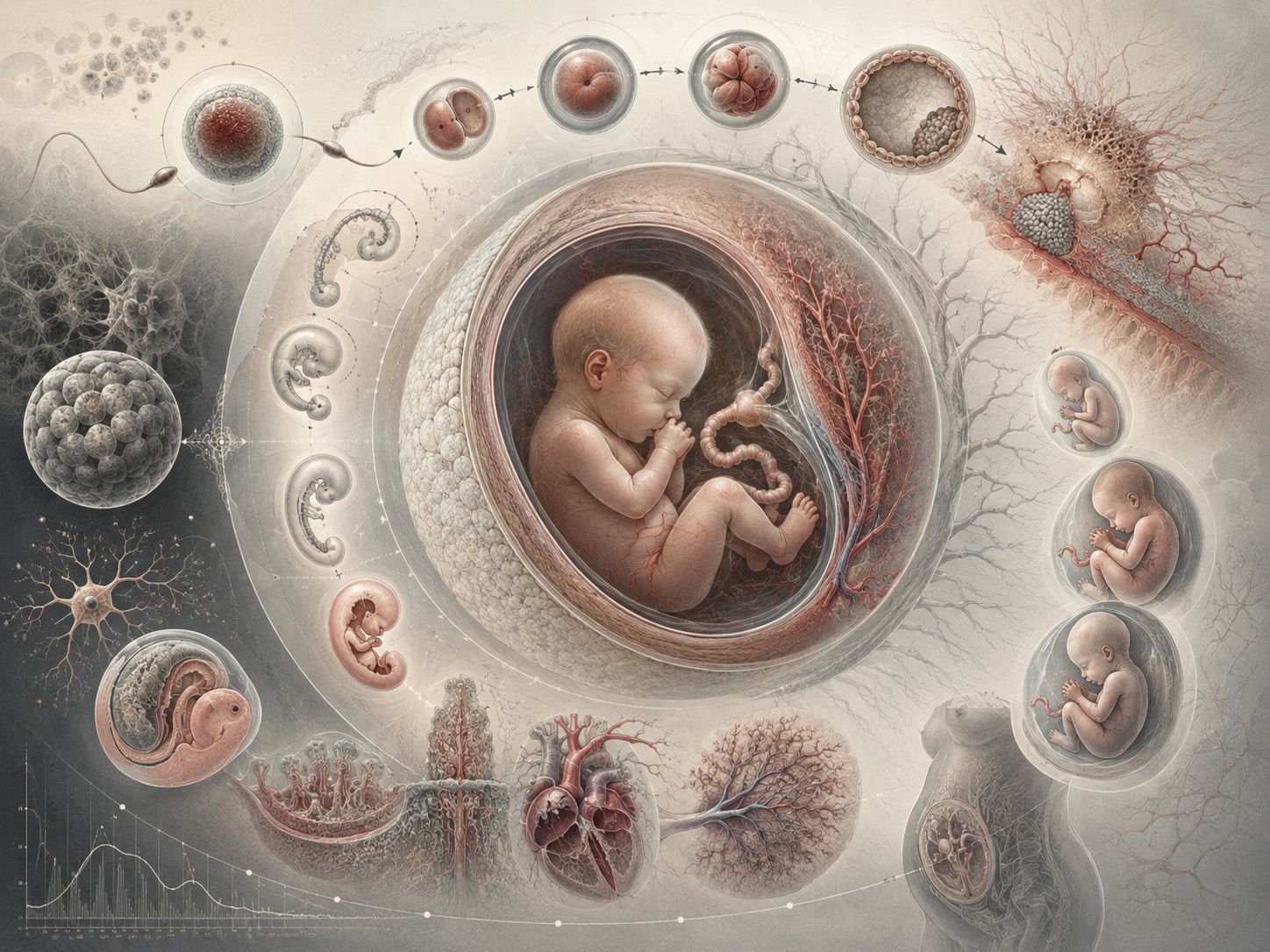
Modern developmental science treats prenatal development as a dynamic process shaped not only by genetic inheritance and embryological sequence, but also by maternal health, prenatal care, stress, nutrition, environmental exposure, medical access, public policy, and broader institutional conditions. The Eunice Kennedy Shriver National Institute of Child Health and Human Development describes pregnancy as a period in which fetal development unfolds through major biological events before, during, and after birth-related care, while the World Health Organization emphasizes that maternal health during pregnancy is inseparable from the long-term well-being of both mother and child. Developmental psychology, at its strongest, interprets these facts not as background biology alone but as the earliest ecology of human becoming.
The prenatal period is also one of the clearest places where the old nature-versus-nurture binary breaks down. Genes matter, but only through expression within a developing biological environment. Maternal physiology matters, but maternal health itself is shaped by nutrition, stress, violence, pollution, healthcare access, labor conditions, housing, social support, and public systems. Environmental exposure matters, but exposure is never merely “external” once it affects the developing organism. Prenatal development is therefore biological and ecological at once: a process of organism formation nested within bodies, relationships, institutions, and unequal environments.
Why Prenatal Development Matters
Prenatal development matters because it is the first developmental environment. Before the infant can attach, speak, imitate, regulate emotion, explore objects, or be socialized, development is already occurring within a system of cellular division, tissue differentiation, placental function, hormonal signaling, maternal physiology, and environmental exposure. This is the earliest phase in which human development is both intensely biological and irreducibly contextual.
The fetus does not develop in an abstract womb untouched by society. Prenatal development is shaped by access to nutrition, prenatal care, safe housing, protection from violence, pollution burden, occupational strain, infection risk, chronic stress, transportation, health insurance, clinical respect, family support, and the organization of health systems. These are not merely external social issues that later influence the child after birth. They are part of the developmental ecology through which prenatal growth occurs.
This is why prenatal development belongs centrally within developmental psychology rather than at its edge. Developmental psychology studies change through time, differential vulnerability, plasticity, timing, context, and the conditions under which later capacities emerge. Prenatal life is where these questions first become visible. The organism is forming. Sensitive periods are already operative. Risk and protection are already unequally distributed. Later developmental outcomes cannot be reduced to the prenatal period, but neither can they be understood as though development begins only when the child becomes socially visible after birth.
Prenatal development also matters because it clarifies the ethical and public-health stakes of developmental science. If the earliest developmental environment is shaped by maternal health, nutrition, care access, stress, environmental exposure, and social protection, then early development is not only a private family matter. It is a public responsibility. A society that fails pregnant people fails development before infancy begins.
What Prenatal Development Is
Prenatal development refers to the period of human development from conception to birth. It includes the earliest cellular divisions, implantation, formation of the embryo, development of major organs and bodily systems, fetal growth, neural development, placental exchange, sensory maturation, movement, and increasing physiological coordination. It is often divided into the germinal, embryonic, and fetal periods, each with different developmental tasks and vulnerabilities.
But prenatal development is more than a sequence of biological stages. It is an early developmental system. It involves genetic inheritance, epigenetic regulation, maternal physiology, placental mediation, environmental exposure, medical care, and social condition. These elements do not operate in isolation. They interact. Nutrition affects biological resources for growth. Stress affects physiology. Toxic exposure can alter developmental pathways. Prenatal care can identify and reduce certain risks. Public-health systems shape whether prevention and intervention are available early enough to matter.
For developmental psychology, prenatal development is important because it establishes the earliest conditions for later development without determining later life in a simplistic way. A serious developmental view avoids both extremes. It does not treat prenatal conditions as irrelevant once the child is born. It also does not treat prenatal risk as destiny. Instead, it asks how early biological organization, timing, vulnerability, support, and inequality shape developmental probability across time.
This distinction is essential. Prenatal development establishes foundations, but foundations are not finished buildings. Later caregiving, nutrition, healthcare, education, social support, community safety, and intervention can matter profoundly. Development is cumulative, but not closed. Prenatal development begins the pathway; it does not exhaust it.
From Conception to Birth
Pregnancy is commonly described as lasting around forty weeks, usually measured from the last menstrual period, and is often organized into three trimesters. Developmental psychology often simplifies prenatal development into three biological periods: the germinal period, the embryonic period, and the fetal period. The germinal period involves conception, cell division, movement toward the uterus, and implantation. The embryonic period involves the earliest formation of major structures and organs. The fetal period involves growth, refinement, maturation, movement, and increasing physiological coordination.
These sequences are sometimes taught as straightforward chronology, but they are better understood as the earliest expression of developmental timing. Different supports and harms matter differently depending on when they occur. A developmental disruption during early organ formation does not have the same meaning as one later in fetal growth. A nutritional shortage, toxic exposure, infection, medication exposure, or severe stressor may carry different developmental implications depending on gestational timing and biological vulnerability.
This is one reason prenatal development belongs in developmental psychology. Timing is not simply a calendar. Timing is part of causation. Some systems are especially vulnerable when they are forming. Others remain plastic later. Some developmental pathways can be modified by later support, while others may leave lasting constraints. The prenatal timeline is therefore not only descriptive. It is analytical.
From conception to birth, development is a sequence of change under condition. The organism does not merely grow larger. It becomes more differentiated, more coordinated, and more capable of sustaining life beyond the womb. Birth is not the beginning of development. It is a major transition in a developmental process already underway.
The Germinal Period: Implantation and the Beginning of Developmental Organization
The germinal period is brief, but developmentally decisive. It begins with fertilization and includes rapid cell division, movement toward the uterus, and implantation. Because this period is so early, it is often treated as outside ordinary psychological concern. Yet it is developmentally important because successful implantation creates the conditions under which later prenatal development can proceed.
The germinal period reveals a central truth about development: early conditions matter even before the developing organism resembles the later infant. Cellular organization, implantation, and the beginning of maternal-embryonic interaction are part of the developmental pathway. Failure at this stage often means development does not continue. Success at this stage establishes the biological relationship through which the embryonic and fetal periods become possible.
Developmental psychology does not need to turn the germinal period into psychology in a narrow mental sense. Its significance is broader. It is the first stage of organism-environment relation. It shows that development begins through dependence, attachment to biological support, and vulnerability to condition. Long before attachment theory describes the infant-caregiver bond, prenatal life already depends on a form of biological embedding.
This is also why preconception health and early pregnancy recognition matter. Many developmental processes begin before pregnancy is confirmed. Public-health approaches that support reproductive health, nutrition, chronic-disease management, substance-use treatment, environmental safety, and access to care before pregnancy are therefore developmental interventions in the broadest sense.
The Embryonic Period and Early Organ Formation
The embryonic period is often presented as the dramatic center of prenatal development because it is when the body’s basic architecture begins to take shape. Major organs and structures begin forming, making this a period of unusually high vulnerability as well as remarkable organization. In developmental terms, this is one of the earliest examples of qualitative reorganization: the organism is not merely getting larger but becoming differentiated.
The possibility of later cognition, emotion, movement, sensory response, physiological regulation, and social life depends on processes that at this stage are still microscopic and largely hidden from ordinary observation. Neural tube development, early cardiac activity, limb formation, facial development, and organ differentiation are not “psychological” in the everyday sense. Yet they are foundational for the later psychological organism. The mind develops in a body whose earliest organization begins here.
For developmental psychology, the significance of the embryonic period lies not only in organ formation itself but in the fact that early conditions can shape later trajectories. This does not mean that embryonic events mechanically determine the whole life course. It means that early biological organization establishes developmental constraints and possibilities that later environments inherit. Later caregiving, medical care, nutrition, therapy, accommodation, education, and community support can still matter enormously, but they operate on a pathway already partially formed.
The embryonic period therefore illustrates the developmental principle of early structure without fatalism. Early formation matters because later functioning builds on earlier differentiation. But development remains a process, not a single event. The same early vulnerability that makes embryonic development consequential also makes prevention, care, and support ethically urgent.
The Fetal Period and the Growth of Complexity
The fetal period is often described as a period of growth, but that phrase can be misleading if it implies mere enlargement. What develops during fetal life is increasing complexity: further maturation of organ systems, changing sensory capacities, movement, neural development, sleep-wake organization, and growing physiological coordination. The fetus gains mass, but also becomes more organized.
From a developmental standpoint, fetal development is continuous and reorganizing. Earlier structures mature. Systems become more coordinated. Growth becomes more differentiated. The developing organism becomes increasingly capable of sustaining life after birth, though that transition still requires enormous support. Prenatal development is therefore not a passive waiting period. It is an active phase of biological organization.
Psychologically, fetal development matters because it precedes later regulation, responsiveness, and adaptation. Prenatal development is not yet socialization in the postnatal sense, but it is part of the developmental history through which later social and psychological life becomes possible. The later infant who cries, feeds, sleeps, orients, calms, startles, and responds to caregivers is not a developmental blank slate. That infant has a prenatal history of growth, physiology, exposure, and timing.
This is why developmental science increasingly treats prenatal and perinatal processes as part of the life-course organization of development. Fetal development is not a separate medical annex to psychology. It is part of the developmental pathway that later psychological life extends.
The Placenta, Maternal-Fetal Exchange, and Developmental Mediation
The placenta is central to prenatal development because it mediates exchange between pregnant person and fetus. Through placental function, the developing organism receives oxygen and nutrients, manages waste exchange, participates in hormonal signaling, and remains connected to the maternal physiological environment. The placenta is not merely a passive support structure. It is part of the developmental system.
This matters because prenatal development is often imagined as though the fetus develops inside a sealed container. That image is misleading. Prenatal development is mediated by exchange. Maternal nutrition, illness, stress physiology, infection, medication, toxic exposure, substance exposure, and metabolic condition may all matter in part because prenatal development occurs through physiological relation. The developing organism is distinct, but not developmentally isolated.
The placenta also complicates simplistic blame narratives. Maternal-fetal exchange is biological, but maternal condition is shaped by social conditions. Access to food, rest, safe housing, healthcare, freedom from violence, environmental protection, and respectful medical treatment affects the conditions of pregnancy. To say prenatal development is shaped by maternal physiology is not to place responsibility solely on the pregnant person. It is to recognize that society shapes physiology through material and institutional conditions.
A developmental psychology attentive to the placenta therefore becomes more ecological. It sees prenatal development as embodied relation: a biological process in which organism formation depends on systems of exchange, protection, and vulnerability that are partly social in origin.
Maternal Health, Prenatal Care, and Developmental Protection
Prenatal development cannot be understood apart from maternal health. WHO defines maternal health as the health of women during pregnancy, childbirth, and the postnatal period, and emphasizes that each stage should support health and well-being for both mother and child. NICHD similarly stresses that prenatal care should begin as soon as pregnancy is known or suspected and ideally be preceded by pre-pregnancy care. Early and regular prenatal care improves the chances of identifying risk, monitoring complications, supporting maternal health, and protecting fetal development.
These are public-health facts, but they are also developmental facts. Prenatal care is one of the institutional means by which risk is monitored, complications are identified, and developmental harm is reduced. It mediates screening, nutritional guidance, monitoring of blood pressure and gestational diabetes, response to infection, medication review, risk counseling, fetal growth assessment, and preparation for birth-related complications.
The significance of prenatal care in developmental psychology is often underestimated because it seems clinical rather than psychological. But prenatal care is part of the developmental environment. It is one of the earliest social protections available to the developing child, though it is administered through care for the pregnant person. Respectful, accessible, culturally competent, and continuous prenatal care is therefore not merely a medical service. It is part of the earliest infrastructure of development.
This point should be framed carefully. Developmental psychology should not use prenatal care language to shame pregnant people who face barriers. Missed or delayed care can reflect poverty, transportation barriers, lack of insurance, mistrust rooted in medical racism, immigration fear, disability barriers, intimate partner violence, rural hospital closure, work constraints, or prior mistreatment by clinicians. The developmental question is not simply whether an individual obtained care. It is whether systems made care accessible, respectful, affordable, and safe.
Stress, Nutrition, Toxic Exposure, and Biological Embedding
One of the most important insights in modern developmental science is that prenatal development is sensitive to conditions that are biological and social at once. Nutrition matters. Chronic stress matters. Exposure to toxins matters. Infection risk matters. Substance exposure matters. Sleep, safety, heat, environmental quality, occupational strain, and chronic disease all may matter. These conditions do not remain outside the body until birth. They can become biologically embedded through the conditions of prenatal development.
Biological embedding does not mean simple determinism. It means that social and environmental conditions can affect biological processes in ways that shape later developmental probabilities. Chronic stress, for example, may influence maternal physiology and fetal development through pathways involving stress hormones, inflammation, sleep disruption, nutrition, blood pressure, and health behavior. Toxic exposure may affect organ formation, growth, or later neurodevelopment depending on substance, dose, timing, and vulnerability. Nutrition provides material resources for growth, but nutritional access is itself shaped by poverty, food systems, healthcare, and public policy.
The first trimester is especially important because early organ formation is highly sensitive to disruption. Yet later pregnancy also matters because fetal growth, brain development, placental function, and physiological coordination continue. Developmental risk should therefore be understood through timing, dose, duration, accumulation, and buffering support. A single exposure does not have the same meaning in every context, and protective conditions may reduce harm.
This is where prenatal development connects directly to later developmental psychology. The same concepts that organize postnatal development—risk, resilience, timing, plasticity, differential susceptibility, and ecological context—are already relevant before birth. Prenatal life is not outside developmental theory. It is one of its earliest and clearest cases.
Timing, Sensitive Periods, and Prenatal Vulnerability
Prenatal development is one of the strongest examples of why timing matters. Developmental timing is not simply the order of events. It is the relation between a biological process and the conditions present while that process is unfolding. A harmful exposure during organ formation may have different implications from the same exposure after those structures are already formed. Nutritional support, medical intervention, infection prevention, and reduction of toxic exposure may also matter differently depending on timing.
This is why sensitive-period thinking is essential. A sensitive period is a time when a developmental system is especially responsive to certain inputs or especially vulnerable to certain disruptions. Prenatal development contains multiple overlapping windows of vulnerability and opportunity. Neural development, organ formation, growth, sensory systems, immune development, and metabolic regulation each unfold across time. There is no single prenatal vulnerability window. There are many developmental processes with different temporal profiles.
Timing also complicates prevention. Some critical developmental events occur before pregnancy is recognized. This is one reason preconception health, early pregnancy testing, accessible healthcare, reproductive autonomy, nutrition support, and environmental regulation matter. Waiting until pregnancy is visible or clinically confirmed may mean that some early developmental processes have already begun.
A serious developmental account therefore treats prenatal timing as both biological and institutional. Biology unfolds according to developmental sequence, but institutions determine whether support arrives in time. Public health is developmental timing translated into social responsibility.
Inequality, Public Health, and the Unequal Conditions of Beginnings
The phrase “earliest foundations of life” can sound universal, but prenatal development is never equally protected. Access to prenatal care, nutrition, clean air, safe water, stable housing, paid leave, transportation, respectful healthcare, environmental protection, and freedom from violence is unequally distributed. Some pregnancies unfold under conditions of relative security and strong support. Others unfold under scarcity, surveillance, pollution, chronic stress, inadequate care, and institutional neglect.
This matters because prenatal development is one of the earliest ways inequality becomes embodied. Development begins within political economy, not outside it. A pregnant person’s exposure to stress, heat, unsafe work, housing instability, food insecurity, racism, medical mistreatment, pollution, and violence can become part of the developmental ecology of the fetus. The child does not choose these conditions. The pregnant person often does not control them. They are structured by social systems.
For developmental psychology, this means nurture begins before birth but is not reducible to maternal affection or private behavior. It includes public systems, healthcare infrastructure, labor policy, environmental regulation, reproductive health access, social protection, and the material conditions under which pregnancy is lived. To speak of prenatal development without speaking of inequality is to turn the earliest developmental environment into an abstraction.
A serious developmental account must recognize that some children begin life under conditions of care and protection, while others begin under conditions of preventable risk. This is not a statement about individual blame. It is a statement about developmental justice. The earliest environment is socially organized, and therefore socially accountable.
Prenatal Development and Later Psychological Life
Prenatal development does not determine later psychological life in any simple way. It would be a serious mistake to turn the prenatal period into a total explanation for all later cognition, temperament, attachment, attention, mental health, disability, or school performance. Developmental psychology rejects that kind of fatalism. Yet it would be equally mistaken to treat prenatal life as irrelevant once the child is born.
The later development of regulation, attention, health, sensory response, stress reactivity, and vulnerability to difficulty unfolds on a foundation partly shaped in prenatal life. Prenatal development may influence later probability without fixing later destiny. This is why the life-course orientation now common in developmental and public-health institutions matters. Earlier conditions do not dictate everything, but they shape the terrain of later possibility.
Prenatal development connects directly to larger developmental themes: nature and nurture, timing, sensitive periods, risk and resilience, biological embedding, maternal health, structural inequality, and the distribution of developmental protection. The prenatal period is the first site in which the old nature-nurture binary visibly fails. Genes matter, but only through expression in a prenatal environment. Environment matters, but always through a developing organism with its own biological sequence and vulnerability.
Later development can amplify, redirect, buffer, or repair early risk. Sensitive caregiving, nutrition, medical care, early intervention, disability support, safe environments, responsive education, and community protection can all matter after birth. But postnatal support is most powerful when prenatal support has not been neglected. Development is cumulative, and the earliest accumulation begins before birth.
Ethics: Maternal Dignity, Blame, and Developmental Responsibility
Prenatal development must be discussed ethically because it is easy for developmental language to become a tool of surveillance or blame. When science emphasizes prenatal risk, public discourse often shifts responsibility onto pregnant people while ignoring the conditions under which pregnancy is lived. That is ethically and scientifically inadequate. Prenatal development is shaped by maternal health, but maternal health is shaped by social systems.
A dignified developmental psychology must therefore make two claims at once. First, prenatal conditions matter. Nutrition, stress, exposure, care access, illness, and timing can influence development. Second, responsibility for prenatal protection is not reducible to individual maternal behavior. Safe pregnancies require accessible healthcare, environmental regulation, paid leave, protection from violence, food security, reproductive autonomy, disability access, respectful clinical care, and community support.
This distinction is especially important for marginalized communities. Medical racism, poverty, immigration enforcement fears, disability discrimination, rural healthcare decline, environmental injustice, and punitive social-service systems can make prenatal care less accessible and less safe. If developmental psychology names prenatal risk without naming structural conditions, it risks blaming the very people most harmed by unequal systems.
An ethical prenatal developmental science should therefore protect both fetal development and maternal dignity. It should support pregnant people rather than police them. It should advocate prevention without moralizing pregnancy. It should treat prenatal care as a right, not a privilege. And it should understand that the first developmental environment is also a human being whose health, autonomy, and dignity matter in their own right.
Methods for Studying Prenatal Development
Studying prenatal development requires methods that can capture timing, exposure, growth, physiology, context, and later outcomes without collapsing correlation into destiny. Researchers may use medical records, ultrasound, biomarkers, birth outcomes, cohort studies, maternal health measures, environmental exposure data, neighborhood data, longitudinal follow-up, and developmental assessments after birth. Each method captures part of the prenatal developmental system, but none is complete alone.
Timing is one of the central methodological challenges. Exposure measured at one point may not reflect exposure during the most sensitive developmental window. Stress may fluctuate. Nutrition may change. Prenatal care may begin late or vary in quality. Environmental exposure may be cumulative, intermittent, or geographically patterned. Gestational age itself is a developmental variable, not just a control.
Longitudinal designs are especially important because prenatal conditions may have subtle or delayed effects that only become visible later in infancy, childhood, adolescence, or adulthood. But longitudinal research must avoid deterministic interpretation. A prenatal risk factor associated with later outcome does not mean every exposed child will experience difficulty or that later support is ineffective. Developmental pathways are probabilistic and modifiable.
Multilevel methods are also essential. Prenatal development is nested within families, neighborhoods, healthcare systems, workplaces, environmental conditions, and policy regimes. A model that treats prenatal risk as only an individual-level variable may miss the systems that distribute risk in the first place. A stronger method studies bodies and systems together.
An Analytical Framework for Prenatal Development
A stylized early developmental outcome for fetus or infant \(i\) can be represented as a function of gestational timing, maternal health, prenatal care, stress, and environmental exposure:
Y_i = \alpha + \beta_1G_i + \beta_2M_i + \beta_3P_i – \beta_4S_i – \beta_5X_i + \varepsilon_i
\]
Interpretation: \(G_i\) represents gestational duration or timing-related developmental maturity, \(M_i\) maternal health status, \(P_i\) prenatal care, \(S_i\) chronic stress burden, and \(X_i\) toxic or adverse environmental exposure. The equation expresses a developmental intuition: prenatal outcomes emerge through multiple interacting conditions rather than a single isolated cause.
To introduce developmental timing more explicitly, fetal development can be modeled across gestational age \(t\):
Y_{it} = \alpha_i + \beta_{1i}t + \beta_{2i}t^2 + \gamma M_{it} + \delta P_{it} – \lambda S_{it} – \mu X_{it} + \varepsilon_{it}
\]
Interpretation: The quadratic term allows nonlinear growth. Prenatal change does not proceed at a constant rate across weeks. Organ formation, differentiation, and later growth have different developmental tempos and vulnerabilities.
To model risk and protection as interacting rather than merely additive, we can write:
Y_i = \alpha + \beta_1M_i + \beta_2S_i + \beta_3(M_i \times S_i) + \beta_4P_i + \varepsilon_i
\]
Interpretation: The effect of stress may depend partly on maternal health, social support, or care conditions. Prenatal risks rarely operate alone, and protective conditions can buffer some forms of vulnerability.
To represent the role of prenatal care as a buffering condition, a moderated risk model can be written as:
Y_i = \alpha + \beta_1R_i + \beta_2C_i + \beta_3(R_i \times C_i) + \varepsilon_i
\]
Interpretation: \(R_i\) represents prenatal risk burden and \(C_i\) represents care access or care quality. A negative interaction term would suggest that care reduces the developmental impact of risk; a weak or absent interaction would suggest that care access is insufficient to buffer the measured burden.
Finally, to reflect inequality at the population level, a multilevel form can be used:
Y_{ij} = \alpha + u_j + \beta_1M_{ij} + \beta_2P_{ij} – \beta_3S_{ij} – \beta_4X_{ij} + \varepsilon_{ij}
\]
Interpretation: \(u_j\) represents contextual effects at the level of healthcare system, neighborhood, region, workplace, or policy environment. Prenatal development is not only a biological process within one body. It is also nested within systems that distribute protection and risk unevenly.
The purpose of this analytical framework is not to reduce prenatal development to equations. It is to clarify the developmental logic: timing, biology, care, exposure, stress, protection, and inequality interact before postnatal development begins.
R: Simulating Prenatal Risk, Support, and Early Developmental Outcomes
The following R example simulates prenatal development across a sample of pregnancies. It models maternal health, prenatal care, chronic stress, toxic exposure, gestational timing, neighborhood context, and an early developmental outcome. The data are synthetic and intended for demonstration only.
# Simulating prenatal risk, support, and early developmental outcomes
# ------------------------------------------------------------------
# This synthetic example models early developmental outcome as a function
# of gestational timing, maternal health, prenatal care, chronic stress,
# toxic exposure, neighborhood context, and risk-protection interactions.

suppressPackageStartupMessages({
  library(dplyr)
  library(ggplot2)
  library(lme4)
})

set.seed(2026)

n <- 1400
n_neighborhoods <- 50

prenatal_data <- data.frame(
  case_id = 1:n,
  neighborhood_context = sample(1:n_neighborhoods, n, replace = TRUE),
  gestational_weeks = round(rnorm(n, mean = 39, sd = 1.8), 1),
  maternal_health = rnorm(n, mean = 0, sd = 1),
  prenatal_care = rnorm(n, mean = 0, sd = 1),
  chronic_stress = rnorm(n, mean = 0, sd = 1),
  toxic_exposure = rnorm(n, mean = 0, sd = 1),
  nutrition_support = rnorm(n, mean = 0, sd = 1),
  social_support = rnorm(n, mean = 0, sd = 1)
)

neighborhoods <- data.frame(
  neighborhood_context = 1:n_neighborhoods,
  healthcare_access = rnorm(n_neighborhoods, mean = 0, sd = 0.6),
  environmental_burden = rnorm(n_neighborhoods, mean = 0, sd = 0.6),
  economic_security = rnorm(n_neighborhoods, mean = 0, sd = 0.5)
)

prenatal_data <- prenatal_data |>
  left_join(neighborhoods, by = "neighborhood_context") |>
  mutate(
    effective_care =
      prenatal_care +
      healthcare_access +
      0.30 * social_support,
    developmental_risk =
      chronic_stress +
      toxic_exposure +
      environmental_burden -
      0.40 * economic_security,
    early_outcome =
      10 +
      0.85 * gestational_weeks +
      1.60 * maternal_health +
      1.35 * effective_care +
      1.10 * nutrition_support +
      0.85 * social_support -
      1.55 * chronic_stress -
      1.45 * toxic_exposure -
      1.10 * environmental_burden +
      0.70 * maternal_health * effective_care -
      0.60 * maternal_health * chronic_stress -
      0.55 * developmental_risk * effective_care +
      rnorm(n, mean = 0, sd = 2.6)
  )

model <- lmer(
  early_outcome ~ gestational_weeks + maternal_health + effective_care +
    nutrition_support + social_support + chronic_stress + toxic_exposure +
    environmental_burden + economic_security +
    maternal_health:effective_care +
    maternal_health:chronic_stress +
    developmental_risk:effective_care +
    (1 | neighborhood_context),
  data = prenatal_data
)

summary(model)

stress_summary <- prenatal_data |>
  mutate(stress_group = ntile(chronic_stress, 4)) |>
  group_by(stress_group) |>
  summarize(
    average_outcome = mean(early_outcome),
    average_care = mean(effective_care),
    average_risk = mean(developmental_risk),
    standard_error = sd(early_outcome) / sqrt(n()),
    .groups = "drop"
  ) |>
  mutate(
    lower = average_outcome - 1.96 * standard_error,
    upper = average_outcome + 1.96 * standard_error,
    group = case_when(
      stress_group == 1 ~ "Lowest stress",
      stress_group == 2 ~ "Moderate-low stress",
      stress_group == 3 ~ "Moderate-high stress",
      TRUE ~ "Highest stress"
    )
  )

ggplot(stress_summary, aes(x = group, y = average_outcome, group = 1)) +
  geom_line(linewidth = 1) +
  geom_point(size = 2) +
  geom_errorbar(aes(ymin = lower, ymax = upper), width = 0.15) +
  labs(
    title = "Simulated Prenatal Stress and Early Developmental Outcome",
    x = "Prenatal stress group",
    y = "Average early developmental outcome"
  ) +
  theme_minimal()

care_summary <- prenatal_data |>
  mutate(care_group = ntile(effective_care, 4)) |>
  group_by(care_group) |>
  summarize(
    average_outcome = mean(early_outcome),
    average_risk = mean(developmental_risk),
    average_gestation = mean(gestational_weeks),
    .groups = "drop"
  )

ggplot(care_summary, aes(x = care_group, y = average_outcome)) +
  geom_line(linewidth = 1) +
  geom_point(size = 2) +
  labs(
    title = "Synthetic Prenatal Care Access and Early Outcome",
    x = "Effective care quartile",
    y = "Average early developmental outcome"
  ) +
  theme_minimal()

# Analysts can extend this framework by:
# 1. modeling trimester-specific exposure;
# 2. separating birth weight, gestational age, and early regulation outcomes;
# 3. adding maternal age, chronic conditions, or infection risk;
# 4. including policy, hospital, or health-system variables;
# 5. estimating nonlinear threshold effects;
# 6. simulating postnatal follow-up after birth.
This simulation highlights a core developmental principle: prenatal outcomes reflect interacting supports and risks, not a single isolated factor. It also makes visible why prenatal care, social support, nutrition, environmental protection, and neighborhood conditions should be treated as part of the developmental ecology.
Python: Modeling Prenatal Conditions and Developmental Pathways
The following Python example simulates prenatal conditions and their relationship to an early developmental score. It includes gestational timing, maternal health, prenatal care, nutrition support, social support, chronic stress, toxic exposure, and neighborhood-level context. The data are synthetic and intended for demonstration only.
# Modeling prenatal conditions and developmental pathways
# ------------------------------------------------------
# This synthetic example models early developmental outcome as a dynamic
# relation among gestational timing, maternal health, prenatal care,
# nutrition, social support, chronic stress, toxic exposure, and neighborhood
# context.

from __future__ import annotations

import numpy as np
import pandas as pd
import statsmodels.formula.api as smf
import matplotlib.pyplot as plt

np.random.seed(2026)

n = 1500
n_neighborhoods = 55

prenatal = pd.DataFrame({
    "case_id": np.arange(1, n + 1),
    "neighborhood_context": np.random.choice(
        np.arange(1, n_neighborhoods + 1),
        size=n
    ),
    "gestational_weeks": np.round(np.random.normal(39, 1.8, n), 1),
    "maternal_health": np.random.normal(0, 1, n),
    "prenatal_care": np.random.normal(0, 1, n),
    "chronic_stress": np.random.normal(0, 1, n),
    "toxic_exposure": np.random.normal(0, 1, n),
    "nutrition_support": np.random.normal(0, 1, n),
    "social_support": np.random.normal(0, 1, n),
})

neighborhoods = pd.DataFrame({
    "neighborhood_context": np.arange(1, n_neighborhoods + 1),
    "healthcare_access": np.random.normal(0, 0.6, n_neighborhoods),
    "environmental_burden": np.random.normal(0, 0.6, n_neighborhoods),
    "economic_security": np.random.normal(0, 0.5, n_neighborhoods),
})

prenatal = prenatal.merge(neighborhoods, on="neighborhood_context", how="left")

prenatal["effective_care"] = (
    prenatal["prenatal_care"]
    + prenatal["healthcare_access"]
    + 0.30 * prenatal["social_support"]
)

prenatal["developmental_risk"] = (
    prenatal["chronic_stress"]
    + prenatal["toxic_exposure"]
    + prenatal["environmental_burden"]
    - 0.40 * prenatal["economic_security"]
)

prenatal["early_outcome"] = (
    10
    + 0.85 * prenatal["gestational_weeks"]
    + 1.60 * prenatal["maternal_health"]
    + 1.35 * prenatal["effective_care"]
    + 1.10 * prenatal["nutrition_support"]
    + 0.85 * prenatal["social_support"]
    - 1.55 * prenatal["chronic_stress"]
    - 1.45 * prenatal["toxic_exposure"]
    - 1.10 * prenatal["environmental_burden"]
    + 0.70 * prenatal["maternal_health"] * prenatal["effective_care"]
    - 0.60 * prenatal["maternal_health"] * prenatal["chronic_stress"]
    - 0.55 * prenatal["developmental_risk"] * prenatal["effective_care"]
    + np.random.normal(0, 2.6, n)
)

model = smf.ols(
    formula="""
    early_outcome ~ gestational_weeks + maternal_health + effective_care +
    nutrition_support + social_support + chronic_stress + toxic_exposure +
    environmental_burden + economic_security +
    maternal_health:effective_care +
    maternal_health:chronic_stress +
    developmental_risk:effective_care
    """,
    data=prenatal
).fit(cov_type="HC3")

print(model.summary())

prenatal["stress_group"] = pd.qcut(
    prenatal["chronic_stress"],
    4,
    labels=["lowest", "moderate_low", "moderate_high", "highest"]
)

stress_summary = prenatal.groupby("stress_group", as_index=False, observed=True).agg(
    average_outcome=("early_outcome", "mean"),
    average_care=("effective_care", "mean"),
    average_risk=("developmental_risk", "mean"),
    standard_error=("early_outcome", lambda x: x.std() / np.sqrt(len(x))),
)

stress_summary["lower"] = (
    stress_summary["average_outcome"] - 1.96 * stress_summary["standard_error"]
)
stress_summary["upper"] = (
    stress_summary["average_outcome"] + 1.96 * stress_summary["standard_error"]
)

plt.figure(figsize=(8, 5))
plt.plot(
    stress_summary["stress_group"].astype(str),
    stress_summary["average_outcome"],
    marker="o"
)
plt.fill_between(
    stress_summary["stress_group"].astype(str),
    stress_summary["lower"],
    stress_summary["upper"],
    alpha=0.15
)
plt.xlabel("Prenatal stress group")
plt.ylabel("Average early developmental outcome")
plt.title("Simulated Prenatal Stress and Early Developmental Outcome")
plt.tight_layout()
plt.show()

prenatal["care_group"] = pd.qcut(
    prenatal["effective_care"],
    4,
    labels=["lowest", "moderate_low", "moderate_high", "highest"]
)

care_summary = prenatal.groupby("care_group", as_index=False, observed=True).agg(
    average_outcome=("early_outcome", "mean"),
    average_risk=("developmental_risk", "mean"),
    average_gestation=("gestational_weeks", "mean"),
)

print(care_summary)

plt.figure(figsize=(8, 5))
plt.plot(
    care_summary["care_group"].astype(str),
    care_summary["average_outcome"],
    marker="o"
)
plt.xlabel("Effective prenatal care group")
plt.ylabel("Average early developmental outcome")
plt.title("Synthetic Prenatal Care Access and Early Outcome")
plt.tight_layout()
plt.show()

# Analysts can extend this model by:
# 1. adding trimester-specific exposures;
# 2. modeling prenatal care as a structured intervention;
# 3. including multilevel neighborhood or health-system effects;
# 4. separating biological and psychological infant outcomes;
# 5. simulating later developmental follow-up after birth;
# 6. estimating how postnatal support modifies prenatal risk trajectories.
The advantage of a model like this is that it makes the developmental logic explicit: prenatal life is shaped by timing, maternal condition, care, exposure, and context, all interacting before postnatal development begins.
GitHub Repository
Complete Code Repository
Access the full companion repository for this article, including reproducible analysis materials and multi-language code workflows for prenatal development, gestational timing, maternal health, prenatal care, chronic stress, toxic exposure, nutrition support, neighborhood context, developmental risk, and early developmental outcomes.
Conclusion
Prenatal development is the earliest foundation of life because it is the first period in which human development is organized through timing, differentiation, vulnerability, protection, and unequal condition. It is not only a biological beginning but also the first developmental environment. Maternal health, prenatal care, nutrition, stress, toxic exposure, placental function, environmental quality, and public systems all shape what is possible before the child enters postnatal social life.
Developmental psychology needs this prenatal lens because it clarifies something essential about the whole field: human development begins in dependence, in context, and under conditions that are never evenly distributed. The prenatal period shows that biology and society are not separate developmental domains. Social conditions can become biological conditions. Biological vulnerability can become a matter of public responsibility. Care, policy, environment, and inequality can affect development before infancy is visible.
The deepest lesson of prenatal development is therefore not simply that early life matters. It is that the earliest foundations of life are already ecological, institutional, and developmental. The organism forms through biological sequence, but also through care, risk, protection, timing, and inequality. Later development extends those beginnings, revises them, and sometimes repairs them, but it never stands apart from them.
Related Articles
- What Is Developmental Psychology?
- Why Developmental Psychology Matters Today
- Nature, Nurture, and the Developmental Question
- Continuity, Discontinuity, and the Logic of Developmental Change
- Critical Periods, Sensitive Periods, and the Timing of Development
- Attachment, Caregiving, and Early Emotional Development
- Self-Regulation and Executive Function Across Development
- Developmental Psychopathology: Risk, Resilience, and Adaptation
- Development, Inequality, and the Life Course
- Lifespan Development from Childhood to Aging
- Developmental Psychology knowledge series
Further Reading
- American Psychological Association (n.d.) Life Span Development. Available at: https://www.apa.org/ed/precollege/topss/lessons/life-development.pdf.
- Centers for Disease Control and Prevention (n.d.) About Birth Defects. Available at: https://www.cdc.gov/birth-defects/about/index.html.
- Centers for Disease Control and Prevention (n.d.) During Pregnancy. Available at: https://www.cdc.gov/pregnancy/during/index.html.
- Eunice Kennedy Shriver National Institute of Child Health and Human Development (n.d.) Pregnancy. Available at: https://www.nichd.nih.gov/health/topics/pregnancy.
- Eunice Kennedy Shriver National Institute of Child Health and Human Development (n.d.) About Pregnancy. Available at: https://www.nichd.nih.gov/health/topics/pregnancy/conditioninfo.
- Eunice Kennedy Shriver National Institute of Child Health and Human Development (n.d.) What Is Prenatal Care and Why Is It Important? Available at: https://www.nichd.nih.gov/health/topics/pregnancy/conditioninfo/prenatal-care.
- National Academies of Sciences, Engineering, and Medicine (2000) From Neurons to Neighborhoods: The Science of Early Childhood Development. Washington, DC: National Academies Press. Available at: https://nap.nationalacademies.org/catalog/9824/from-neurons-to-neighborhoods-the-science-of-early-childhood-development.
- World Health Organization (n.d.) Maternal Health. Available at: https://www.who.int/health-topics/maternal-health.
- World Health Organization (n.d.) Antenatal Care. Available at: https://www.who.int/teams/sexual-and-reproductive-health-and-research-%28srh%29/areas-of-work/maternal-and-perinatal-health/antenatal-care.
- World Health Organization (2016) WHO Recommendations on Antenatal Care for a Positive Pregnancy Experience. Geneva: World Health Organization. Available at: https://www.who.int/publications/i/item/9789241549912.
- World Health Organization (2018) Nurturing Care for Early Childhood Development: A Framework for Helping Children Survive and Thrive. Geneva: World Health Organization. Available at: https://www.who.int/publications/i/item/9789241514064.
References
- American Psychological Association (n.d.) Life Span Development. Available at: https://www.apa.org/ed/precollege/topss/lessons/life-development.pdf.
- Centers for Disease Control and Prevention (n.d.) About Birth Defects. Available at: https://www.cdc.gov/birth-defects/about/index.html.
- Centers for Disease Control and Prevention (n.d.) During Pregnancy. Available at: https://www.cdc.gov/pregnancy/during/index.html.
- Eunice Kennedy Shriver National Institute of Child Health and Human Development (n.d.) Pregnancy. Available at: https://www.nichd.nih.gov/health/topics/pregnancy.
- Eunice Kennedy Shriver National Institute of Child Health and Human Development (n.d.) About Pregnancy. Available at: https://www.nichd.nih.gov/health/topics/pregnancy/conditioninfo.
- Eunice Kennedy Shriver National Institute of Child Health and Human Development (n.d.) What Is Prenatal Care and Why Is It Important? Available at: https://www.nichd.nih.gov/health/topics/pregnancy/conditioninfo/prenatal-care.
- Eunice Kennedy Shriver National Institute of Child Health and Human Development (n.d.) Pre-Pregnancy Care and Prenatal Care. Available at: https://www.nichd.nih.gov/health/topics/factsheets/preconceptioncare.
- Eunice Kennedy Shriver National Institute of Child Health and Human Development (n.d.) Pregnancy and Perinatology Branch. Available at: https://www.nichd.nih.gov/about/org/der/branches/ppb.
- National Academies of Sciences, Engineering, and Medicine (2000) From Neurons to Neighborhoods: The Science of Early Childhood Development. Washington, DC: National Academies Press. Available at: https://nap.nationalacademies.org/catalog/9824/from-neurons-to-neighborhoods-the-science-of-early-childhood-development.
- World Health Organization (n.d.) Maternal Health. Available at: https://www.who.int/health-topics/maternal-health.
- World Health Organization (n.d.) Antenatal Care. Available at: https://www.who.int/teams/sexual-and-reproductive-health-and-research-%28srh%29/areas-of-work/maternal-and-perinatal-health/antenatal-care.
- World Health Organization (2016) WHO Recommendations on Antenatal Care for a Positive Pregnancy Experience. Geneva: World Health Organization. Available at: https://www.who.int/publications/i/item/9789241549912.
- World Health Organization (2018) Nurturing Care for Early Childhood Development: A Framework for Helping Children Survive and Thrive. Geneva: World Health Organization. Available at: https://www.who.int/publications/i/item/9789241514064.
- World Health Organization (2025) WHO Recommendations on Maternal Health. Available at: https://www.who.int/publications/i/item/9789240080591.