
Last Updated May 21, 2026
Lifespan developmental psychology, in the Baltes tradition, is the claim that development is lifelong, multidimensional, multidirectional, plastic, historically embedded, and always shaped by the interplay of gains and losses across the whole course of life. It rejects the older idea that development belongs mainly to childhood while adulthood represents stability and old age represents decline. In its place, Paul Baltes and related lifespan theorists argued for a broader framework: human development extends from conception to death; change differs across domains; every age period contains both growth and limitation; and lives unfold through adaptation within biological, psychological, social, institutional, and historical conditions.
This tradition matters because it gave developmental psychology one of its clearest metatheoretical statements. Development is not a single upward line. It is not reducible to childhood acquisition, adult achievement, or later-life loss. A life is a changing pattern of growth, constraint, plasticity, selection, compensation, historical timing, and contextual support. The Baltes tradition therefore makes developmental psychology more realistic: people gain and lose, adapt and compensate, change and stabilize, and remain developmentally active from early life through old age.
Main Library
Publications
Article Map
Developmental Psychology
Related Topic
Cognitive Psychology
Related Topic
Positive Psychology
Related Topic
Risk & Resilience
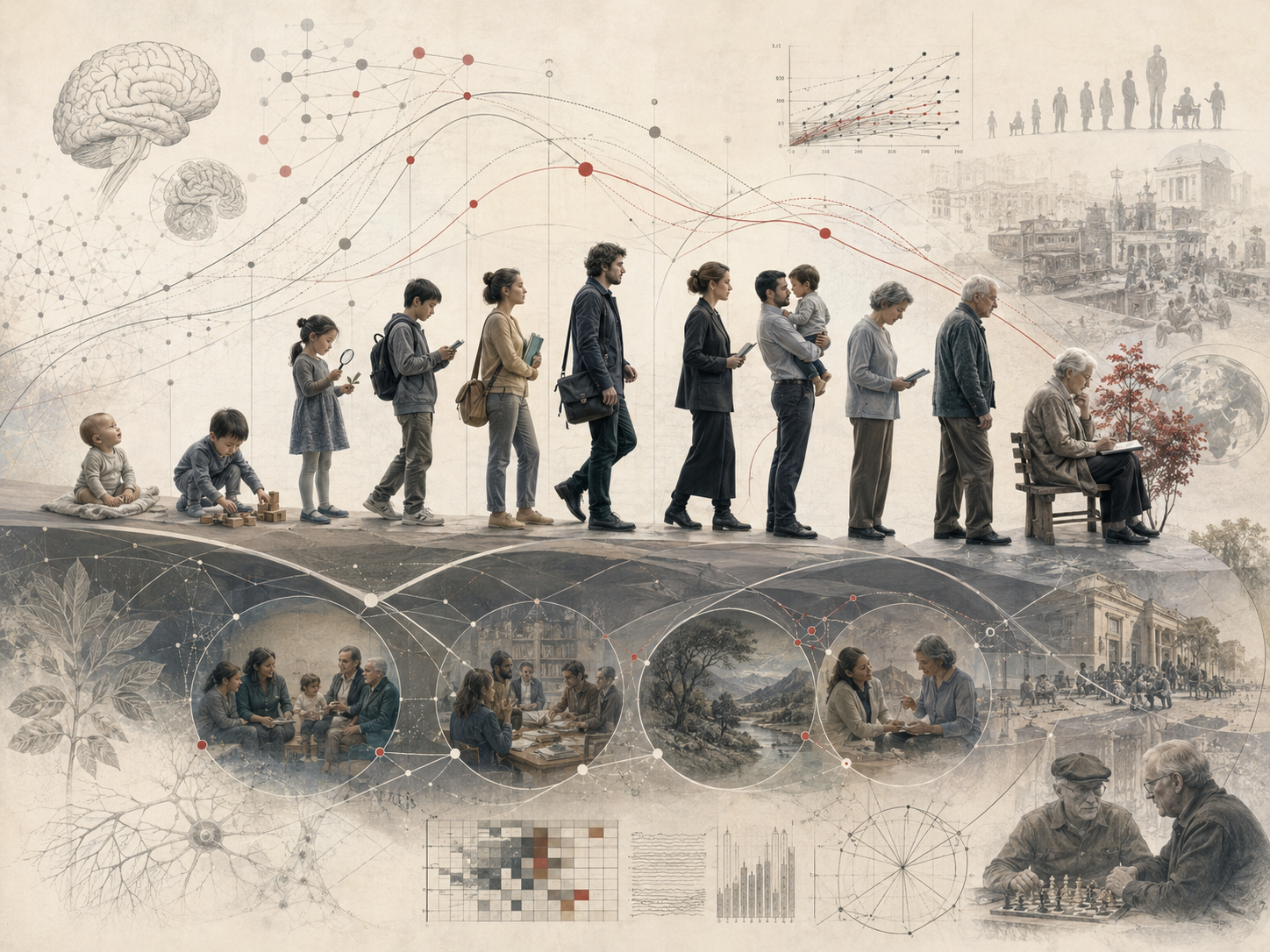
APA’s overview of developmental psychology defines the field as the study of human growth and change across the lifespan, while APA Division 20 describes the lifespan developmental approach as an overarching framework for understanding development from conception to death. Baltes’s classic 1980 and 1987 formulations sharpened that framework by emphasizing interindividual differences, intraindividual plasticity, historical embeddedness, multidirectionality, multidimensionality, and the dynamic relation between growth and decline. Those concepts reshaped developmental thought by making later life, adaptation, compensation, and historical context central rather than peripheral.
The Baltes tradition is especially important because it resists two opposite errors. It refuses the childhood-only model, where development is treated as mostly finished by adulthood. It also refuses the decline-only model, where aging is treated as a simple process of loss. Across the lifespan, development involves gains and losses together. Childhood includes vulnerability as well as growth. Adulthood includes change as well as stability. Later life includes decline in some domains, but also adaptation, selective investment, social wisdom, emotional regulation, and compensatory strategy.
Why the Baltes Tradition Matters
The Baltes tradition matters because it gave developmental psychology a vocabulary for talking about change across the whole life course without reducing development either to childhood growth or to later-life decline. It insisted that no single age period holds a monopoly on development and that different domains may move in different directions at the same time. Development is therefore not one story but many: biological, cognitive, emotional, social, cultural, institutional, and historical pathways unfolding together.
This was a major shift. Earlier developmental models often emphasized childhood and adolescence as the primary periods of formation. Adulthood was treated as the endpoint of development, and aging was often framed mainly as deterioration. Baltes helped reorient the field by arguing that development continues across the whole span of life. Adulthood and later life are not merely aftermath. They are developmental periods in their own right.
The framework also matters because it gives a more truthful account of human experience. People do not simply accumulate capacities until maturity and then lose them uniformly. A person may gain professional judgment while losing physical speed. An older adult may experience sensory decline while gaining emotional selectivity. A young adult may gain independence while losing certain forms of family protection. A child may gain language while struggling with regulation. Development is layered, uneven, and multidirectional.
The Baltes tradition therefore gives developmental psychology a disciplined way to study complexity without abandoning clarity. It treats development as lifelong change under constraint, shaped by gains, losses, context, plasticity, and adaptation. That remains one of the most durable contributions of lifespan developmental psychology.
What Lifespan Developmental Psychology Is
Lifespan developmental psychology studies constancy and change in human behavior, functioning, and adaptation from conception to death. The point is not merely to add adulthood and aging to a child-development model. It is to rethink development itself. Development is not only progressive acquisition. It also includes maintenance, reorganization, compensation, loss, recovery, historical change, and strategic adaptation.
In the Baltes tradition, development is best understood through several core propositions. It is lifelong, because all age periods matter. It is multidimensional, because different domains develop in relation to one another. It is multidirectional, because some capacities increase while others decline or reorganize. It is plastic, because change remains possible under certain conditions. It is historically embedded, because cohorts develop within particular social and historical worlds. It involves gains and losses, because growth always carries tradeoffs. It is contextual, because development is shaped by culture, institutions, relationships, and material conditions.
This framework makes lifespan developmental psychology more than a chronological expansion of the field. It changes the field’s basic questions. Instead of asking only how children become adults, lifespan developmental psychology asks how people change across the whole course of life, how earlier and later experiences interact, how age periods differ, how individuals adapt to shifting resources and constraints, and how historical conditions shape developmental pathways.
It also creates a bridge between developmental psychology, gerontology, education, cognitive science, public health, social policy, and life-course research. The lifespan perspective is not only about age. It is about development as a lifelong, contextually embedded process of change.
Lifelong Development
The first major Baltes proposition is lifelong development. Development does not stop in adolescence or early adulthood. Every stage of life contributes to what the person becomes, and later events can transform the meaning of earlier ones. Childhood matters, but it is not the whole developmental story. Adulthood matters. Later life matters. Aging matters. Development remains active across the whole life course.
This principle changes how developmental questions are asked. Instead of asking only how early experience shapes later outcomes, researchers must also ask how later experience modifies earlier trajectories. Education, work, marriage, migration, illness, caregiving, disability, trauma, recovery, community participation, retirement, bereavement, and aging can all reorganize development. Later life does not merely reveal what earlier life produced. It can introduce new developmental challenges and possibilities.
Lifelong development also means that no age period should be idealized. Childhood is not pure growth. It includes vulnerability, dependence, limitation, and loss. Adulthood is not pure stability. It includes transition, learning, uncertainty, and restructuring. Old age is not pure decline. It includes adaptation, selectivity, meaning-making, social contribution, and continuing psychological development.
The lifespan perspective therefore expands the moral and scientific imagination of developmental psychology. Children are developing persons, but so are adolescents, adults, caregivers, workers, elders, and communities. A life remains developmental as long as the person continues to change in relation to body, context, history, and meaning.
Multidirectionality and Multidimensionality
Baltes argued that development is both multidirectional and multidimensional. Multidirectionality means that different abilities or functions may improve, plateau, decline, or reorganize at different times. Multidimensionality means that development unfolds across multiple interacting domains, including biological, cognitive, emotional, social, motivational, moral, personality, and cultural processes.
This is one of the strongest insights in the Baltes tradition. A single developmental score cannot capture the whole person. An adult may gain practical expertise while losing processing speed. An adolescent may gain abstract reasoning while becoming more vulnerable to peer evaluation. An older adult may lose some sensory acuity while gaining emotional selectivity or narrative wisdom. A child may gain language rapidly while struggling with self-regulation. Development rarely moves in one direction across all domains.
Multidimensionality also means that domains influence one another. Physical health affects cognition. Social belonging affects emotional regulation. Education affects future work and identity. Economic insecurity affects stress physiology, family routines, and opportunity. Cognitive change affects independence and social participation. Emotional development affects decision-making and resilience. Developmental domains are distinguishable, but not isolated.
The Baltes framework therefore encourages researchers to avoid simplistic curves. A life is not one developmental line. It is a pattern of trajectories moving together, sometimes supporting one another, sometimes trading off, sometimes compensating, and sometimes diverging. This is why lifespan developmental psychology is especially useful for studying adulthood and aging, where gains and losses are often simultaneous rather than sequential.
Plasticity and Developmental Potential
Plasticity is another core Baltes proposition. It refers to the openness of development to variation, modification, intervention, and reorganization. Baltes did not treat development as infinitely malleable. Plasticity has limits. Biological aging, prior history, social conditions, illness, trauma, and material constraints all matter. But the lifespan perspective insists that human development remains more open than rigid stage theories or decline narratives suggest.
Plasticity matters because it preserves the possibility of change without denying constraint. A child can recover from some forms of adversity with support. An adult can learn new skills. An older person can adapt to loss through compensation. Cognitive training, physical activity, social engagement, rehabilitation, education, therapy, assistive technology, and supportive environments can all alter trajectories. Development is conditioned by prior life, but not fully closed by it.
Plasticity also varies by domain and timing. Language learning, motor learning, emotional regulation, identity, social skill, memory strategy, and physical adaptation do not have identical windows or constraints. Some forms of plasticity are strongest early; others remain robust later. The lifespan perspective is therefore careful: it does not say all change is equally possible at all ages. It says change remains possible in patterned, domain-specific, context-dependent ways.
Plasticity also has ethical significance. If people can change under better conditions, then development is not only a private achievement. Social environments matter. Access to education, health care, safe housing, meaningful work, assistive technology, social support, and age-friendly institutions all shape whether plasticity can be realized. Developmental potential requires developmental conditions.
Historical Embeddedness and Context
Baltes also emphasized historical embeddedness. People do not develop in abstraction from their historical moment, cultural setting, institutional environment, or cohort location. The same age can carry different developmental meanings depending on war, recession, pandemic, technological change, migration, policy, schooling, labor markets, family norms, medical systems, and cultural expectations.
This principle keeps lifespan theory socially grounded. A person who turns twenty during economic collapse faces different developmental constraints from someone who turns twenty during broad opportunity. A person who ages in a society with strong social protection faces different later-life possibilities from someone aging under isolation, poverty, or inadequate care. A cohort raised with digital media develops under different conditions from a cohort raised before it. Historical time becomes part of development.
Historical embeddedness also prevents the field from mistaking one cohort’s pathway for a universal timetable. Retirement, marriage, education, caregiving, parenthood, work, gender roles, disability, and aging all vary across historical and cultural contexts. Developmental norms are partly historical norms. They should not be treated as timeless facts.
This does not mean biology and age disappear. It means age is lived in history. The biological aging of the body occurs inside social worlds that define opportunity, risk, care, dignity, and meaning. Lifespan developmental psychology therefore studies development as both age-related and historically situated.
Age-Graded, History-Graded, and Nonnormative Influences
Baltes and lifespan theorists often distinguish among age-graded, history-graded, and nonnormative influences. This distinction helps explain why development varies across people and cohorts. Age-graded influences are events or transitions commonly associated with age, such as school entry, puberty, menopause, retirement, or age-related physical change. History-graded influences affect people because of when they live, such as war, technological transformation, economic crisis, public health change, or major policy shifts. Nonnormative influences are less predictable events, such as illness, accident, migration, bereavement, sudden job loss, trauma, or unexpected opportunity.
These categories are useful because they show that development is shaped by multiple time scales. A person develops through biological age, social age, historical period, and individual event history all at once. A fifty-year-old’s development may reflect age-related health changes, a recession, caregiving obligations, workplace transformation, and a recent diagnosis. A child’s development may reflect age-graded schooling, a pandemic, family relocation, and neighborhood change.
The categories also help avoid simplistic age explanations. Not everything that happens to older adults is caused by aging. Some later-life difficulties reflect cohort inequality, medical access, poverty, ageism, or institutional design. Not everything that happens to adolescents is caused by adolescence. Some adolescent outcomes reflect school systems, digital environments, family stress, discrimination, or policy conditions.
A lifespan perspective asks what kind of influence is operating, at what time scale, and in relation to which developmental domain. This makes developmental explanation more precise and more humane.
Gains, Losses, and Adaptation
One of Baltes’s most durable propositions is that development always involves gains and losses. Growth never appears in pure form, and decline is never the whole story. The balance between gains and losses may shift across the life course, but both are always present. This is especially important in later life, where the Baltes framework resisted both decline-only pessimism and naive optimism.
Gains and losses are not limited to old age. Childhood gains in autonomy can come with losses in dependence and protection. Adolescence brings new reasoning, identity, and social possibility, but also vulnerability to peer pressure, risk, and emotional intensity. Adulthood brings independence, work, intimacy, and responsibility, but also constraints of time, role burden, and social expectation. Aging may bring physical and cognitive losses, but also selectivity, perspective, emotional knowledge, and refined priorities.
Adaptation becomes central because development is not only accumulation. It is also reorganization under changing constraints. People adapt by changing goals, reallocating effort, relying on tools, modifying environments, drawing on relationships, selecting priorities, and compensating for limits. Developmental success cannot be measured only by maximizing capacity. Sometimes it lies in rebalancing life under new conditions.
This gain-loss logic makes the Baltes tradition deeply realistic. It does not deny decline, but it refuses to make decline the whole story. It does not celebrate growth as unlimited, but it recognizes that development continues even under constraint. Human development is adaptive, strategic, and unfinished across the lifespan.
Selective Optimization with Compensation
The most widely known applied model associated with Baltes is selective optimization with compensation, often abbreviated SOC. In this framework, successful adaptation involves selecting priorities, optimizing resources in chosen domains, and compensating for losses or limitations through alternative strategies. SOC became especially influential in research on aging, but its logic is broader. People across the lifespan adapt by narrowing, refining, and compensating rather than trying to maximize everything at once.
Selection refers to choosing goals, domains, or commitments. Selection may be elective, as when a person chooses to specialize in a career, relationship, skill, or value. It may also be loss-based, as when illness, aging, disability, or external constraint forces a person to revise goals. Either way, development involves deciding where limited time, energy, attention, and resources will go.
Optimization refers to investing in selected goals. A person practices, seeks support, builds routines, improves skill, uses feedback, and structures the environment to make success more likely. Optimization recognizes that development requires effort and scaffolding. Goals do not maintain themselves.
Compensation refers to finding alternative strategies when capacities, resources, or opportunities decline. A person may use assistive technology, rely on social support, change routines, use memory aids, alter work patterns, reduce complexity, or shift identity toward what remains meaningful. Compensation does not mean failure. It is a form of adaptation.
SOC gives the lifespan perspective operational form. It shows how development continues when unlimited expansion is no longer possible. A person can remain developmentally active by selecting what matters, optimizing what remains possible, and compensating where conditions have changed.
Cognition, Learning, and Lifespan Change
The Baltes tradition is especially important for understanding cognition across the lifespan. Cognitive development does not follow a single curve. Some abilities, such as processing speed or certain forms of working memory, may become more vulnerable with age. Other capacities, such as knowledge, expertise, vocabulary, practical judgment, and strategic reasoning, may remain stable or improve for long periods, depending on health, education, opportunity, and practice.
This distinction helps explain why aging cannot be reduced to cognitive decline. Later-life cognition often involves compensation, selectivity, expertise, and environmental support. An older adult may rely more on accumulated knowledge, routines, notes, tools, social collaboration, or narrowed priorities. These strategies are not merely signs of loss. They are adaptive forms of development.
Lifespan cognition is also shaped by plasticity. Learning does not stop in adulthood. Adults can acquire new skills, languages, technologies, social roles, and habits. Training and practice can improve performance in specific domains. Rehabilitation can support recovery. Cognitive activity, physical health, social engagement, and meaningful participation can support functioning across adulthood and aging.
A lifespan view therefore asks more precise questions than “Does cognition decline?” It asks which cognitive systems change, under what conditions, with what supports, in which domains, and how people compensate. Cognition is developmental because it is shaped by biological aging, education, work, health, technology, culture, and use.
Emotion, Meaning, and Social Development
Lifespan developmental psychology also reshapes the study of emotion and social life. Emotional development is not completed in childhood. People continue to change in how they regulate emotion, understand relationships, interpret meaning, handle loss, maintain commitments, and prioritize social life. Later life may involve reduced social networks, but also greater selectivity, depth, and attention to emotionally meaningful relationships.
This matters because development is often equated with cognitive or physical capacity. The Baltes tradition broadens the picture. A person may experience physical loss while gaining emotional perspective. A person may reduce goals while increasing meaning. A person may withdraw from some activities while deepening others. Social and emotional development can continue through adaptation, grief, caregiving, grandparenthood, friendship, community, spirituality, and reflection.
Meaning becomes especially important across the lifespan because people must interpret change. Development is not only what happens biologically or socially. It is also how people understand their lives. Identity, memory, narrative, value, regret, hope, and purpose shape adaptation. Later-life development often involves integrating gain and loss into a coherent sense of life.
Social development also remains contextual. Loneliness, ageism, retirement systems, housing, transportation, family structure, health care, digital access, and community design all shape whether people can sustain connection. Emotional development is therefore not merely internal maturity. It is supported or constrained by social worlds.
Aging, Adaptation, and Later-Life Development
The Baltes tradition gave developmental psychology a more serious way to think about aging. Aging is not simply decline, but neither is it a simple story of successful positivity. It is a developmental period marked by changing balances of capacity, vulnerability, adaptation, loss, compensation, meaning, and social context.
Later life often involves real constraints: illness, bereavement, sensory change, reduced mobility, cognitive vulnerability, financial insecurity, caregiving needs, and social loss. A humane lifespan theory does not deny these realities. But the Baltes framework also shows that later life involves active development. Older adults adapt, select priorities, use compensatory strategies, maintain relationships, contribute to families and communities, and reorganize identity around changing conditions.
This matters because decline-only narratives can become socially harmful. They can justify exclusion, paternalism, ageism, neglect, and reduced expectations. The Baltes tradition helps counter those narratives by showing that older age remains developmentally meaningful. A person is not less developmental because some capacities decline. Development continues through adaptation to changing capacities.
At the same time, adaptation should not be used to excuse poor conditions. Older adults should not be expected to compensate endlessly for inaccessible housing, inadequate health care, poverty, isolation, or ageist institutions. Lifespan development is personal, but it is also institutional. Successful adaptation requires environments that support dignity, participation, care, and meaning.
Inequality, Institutions, and the Life Course
The Baltes framework is powerful, but later lifespan and life-course scholarship has pushed the field to integrate structural inequality more fully. Development is lifelong, but lives are not equally supported. Education, income, health care, housing, disability access, discrimination, work conditions, family leave, neighborhood safety, environmental exposure, and retirement systems all shape developmental trajectories.
Inequality accumulates across time. Early disadvantage can affect schooling, health, work, stress, family formation, wealth, and later-life security. But cumulative inequality is not only early-life destiny. Institutions continue to shape development across adulthood and aging. A person’s ability to adapt, compensate, learn, recover, or age with dignity depends partly on access to resources and social protection.
This matters for the Baltes tradition because plasticity and compensation require conditions. It is easier to compensate for loss when assistive technology, health care, transportation, social support, safe housing, and income security are available. It is easier to optimize selected goals when education, time, and institutional support exist. It is easier to age well when communities are designed for participation rather than isolation.
A stronger lifespan psychology therefore connects Baltesian principles to inequality, institutions, and policy. Development is lifelong, but it is not equally resourced. The life course is shaped by both personal adaptation and social organization.
Methods for Lifespan Developmental Research
Lifespan developmental psychology requires methods that can study change over time. Cross-sectional studies can compare age groups, but they often confuse age differences with cohort differences. Longitudinal studies can track within-person change, but they are expensive, time-consuming, and vulnerable to attrition. Sequential designs help separate age, cohort, and period effects by combining features of cross-sectional and longitudinal research.
The Baltes tradition encouraged careful attention to interindividual differences and intraindividual change. Interindividual differences ask why people differ from one another. Intraindividual change asks how a person changes over time. Both matter. A lifespan approach is weakened if it studies only average age trends while ignoring variation among people, or only individual differences while ignoring developmental timing.
Multilevel models are especially useful because lifespan data often include repeated observations nested within persons, persons nested within cohorts, and cohorts nested within historical periods or institutions. Growth-curve models can represent trajectories. Mixture models can identify different developmental patterns. Dynamic models can study reciprocal processes. Intervention studies can test plasticity. Qualitative and mixed-methods approaches can capture meaning, adaptation, and narrative change.
The methodological challenge is to match the theory’s complexity without becoming vague. Lifespan developmental research should specify domains, time scales, contexts, mechanisms, and outcomes. The Baltes framework is broad, but strong research must make it operational.
Strengths and Limits of the Baltes Framework
The Baltes framework remains powerful because it is broad enough to connect childhood, adolescence, adulthood, and later life within one developmental logic. It offers a language for change that is more realistic than fixed-stage models and more humane than decline narratives. It helped integrate developmental psychology with aging research, intervention science, cognitive training, adaptation, and life-course thinking.
Its strongest contribution is metatheoretical clarity. Lifelong development, multidirectionality, multidimensionality, plasticity, historical embeddedness, contextualism, and gains-and-losses thinking together provide a durable framework for studying human lives. Few developmental theories have offered such a comprehensive vocabulary for the entire life course.
Its limits are also worth naming. Because it is a broad framework, it can sometimes be more orienting than predictive. It tells researchers what to look for, but specific mechanisms still need to be modeled. It can also underemphasize power and political economy if used without later life-course scholarship. Historical embeddedness must include more than cohort; it must include institutions, inequality, policy, racism, disability, gender, labor, and environmental conditions.
The best use of the Baltes framework is therefore not to treat it as complete, but to treat it as foundational. It gives developmental psychology a serious lifespan architecture. Later work can extend that architecture by adding stronger attention to social structure, global variation, health inequality, disability, technology, and institutional design.
An Analytical Framework for the Lifespan Perspective
A stylized developmental outcome \(D_{it}\) for individual \(i\) at time \(t\) can be modeled as a function of time, plasticity, contextual support, loss, and residual variation:
D_{it} = \alpha_i + \beta_i t + \gamma P_{it} + \delta C_{it} – \lambda L_{it} + \varepsilon_{it}
\]
Interpretation: \( \alpha_i \) is initial developmental organization, \( \beta_i \) is person-specific time-related change, \(P_{it}\) represents plasticity or intervention responsiveness, \(C_{it}\) represents contextual support, and \(L_{it}\) represents developmental loss or constraint.
To express multidirectionality, gains and losses can be modeled separately:
D_{it} = \alpha_i + \beta_1G_{it} – \beta_2K_{it} + \gamma C_{it} + \varepsilon_{it}
\]
Interpretation: \(G_{it}\) represents gains and \(K_{it}\) represents losses. Development is not a one-way increase in capacity; it is a changing balance of gain, loss, support, and adaptation.
To model selective optimization with compensation explicitly, adaptation \(A_{it}\) can be written as a function of selection, optimization, and compensation:
A_{it} = \theta_1S_{it} + \theta_2O_{it} + \theta_3Q_{it} + \varepsilon_{it}
\]
Interpretation: \(S_{it}\) represents selection, \(O_{it}\) represents optimization, and \(Q_{it}\) represents compensation. Successful adaptation is often strategic rather than unlimited.
Because development is historically and socially embedded, a multilevel form is often more realistic:
D_{ijt} = \alpha + u_j + \beta t + \gamma P_{ijt} + \delta C_{ijt} – \lambda L_{ijt} + \varepsilon_{ijt}
\]
Interpretation: The term \(u_j\) captures cohort, institutional, or historical-context effects. Development unfolds within shared social and historical conditions, not private time alone.
To represent domain-specific multidimensionality, multiple developmental domains can be modeled together:
\mathbf{D}_{it} =
\begin{bmatrix}
D^{cognitive}_{it} \\
D^{social}_{it} \\
D^{physical}_{it} \\
D^{emotional}_{it}
\end{bmatrix}
\]
Interpretation: Development is multidimensional. Cognitive, social, physical, and emotional domains may change in different directions at the same time.
These equations are simplified, but they clarify the Baltesian insight: development across the lifespan is shaped by age-related change, contextual support, plasticity, historical location, gains, losses, and strategic adaptation.
R: Simulating Lifespan Change, Plasticity, and Compensation
The following R example simulates individuals across repeated periods with gains, losses, contextual support, plasticity, compensatory capacity, cohort context, and selective optimization with compensation. The data are synthetic and intended for demonstration only.
# Simulating lifespan change, plasticity, and compensation
# -------------------------------------------------------
# This synthetic example models development as a function of gains, losses,
# plasticity, contextual support, compensation, cohort context, and SOC processes.

suppressPackageStartupMessages({
  library(dplyr)
  library(lme4)
  library(ggplot2)
})

set.seed(2026)

n_people <- 900
n_periods <- 12
n_cohorts <- 6

people <- data.frame(
  id = 1:n_people,
  cohort_id = sample(1:n_cohorts, n_people, replace = TRUE),
  baseline_dev = rnorm(n_people, 50, 8),
  plasticity = rnorm(n_people, 0, 1),
  context_support = rnorm(n_people, 0, 1),
  compensatory_capacity = rnorm(n_people, 0, 1),
  health_resource = rnorm(n_people, 0, 0.8)
)

cohorts <- data.frame(
  cohort_id = 1:n_cohorts,
  historical_support = rnorm(n_cohorts, 0, 0.6),
  institutional_security = rnorm(n_cohorts, 0, 0.6)
)

panel_data <- people |>
  slice(rep(1:n(), each = n_periods)) |>
  group_by(id) |>
  mutate(
    time = 0:(n_periods - 1),
    gains = rnorm(n_periods, mean = 0.9 - 0.05 * time, sd = 0.5),
    losses = rnorm(n_periods, mean = 0.2 + 0.07 * time, sd = 0.5),
    current_support = rnorm(n_periods, mean = context_support, sd = 0.6),
    current_comp = rnorm(n_periods, mean = compensatory_capacity, sd = 0.6),
    selection = rnorm(n_periods, mean = 0.3 + 0.04 * time, sd = 0.5),
    optimization = rnorm(n_periods, mean = 0.5, sd = 0.5),
    compensation = rnorm(n_periods, mean = compensatory_capacity + 0.05 * time, sd = 0.5)
  ) |>
  ungroup() |>
  left_join(cohorts, by = "cohort_id")

panel_data <- panel_data |>
  mutate(
    soc_index =
      0.35 * selection +
      0.35 * optimization +
      0.30 * compensation,
    development_score =
      baseline_dev +
      0.25 * time +
      1.10 * gains -
      1.00 * losses +
      0.90 * plasticity +
      1.00 * current_support +
      0.80 * current_comp +
      0.65 * health_resource +
      0.75 * historical_support +
      0.70 * institutional_security +
      0.90 * soc_index +
      0.35 * plasticity * current_support -
      0.30 * losses * compensation +
      rnorm(n(), 0, 2.6)
  )

model <- lmer(
  development_score ~ time + gains + losses + plasticity +
    current_support + current_comp + health_resource +
    historical_support + institutional_security + soc_index +
    plasticity:current_support + losses:compensation +
    (1 + time | cohort_id/id),
  data = panel_data
)

summary(model)

trajectory_summary <- panel_data |>
  group_by(time) |>
  summarize(
    mean_development = mean(development_score),
    mean_gains = mean(gains),
    mean_losses = mean(losses),
    mean_soc = mean(soc_index),
    standard_error = sd(development_score) / sqrt(n()),
    .groups = "drop"
  ) |>
  mutate(
    lower = mean_development - 1.96 * standard_error,
    upper = mean_development + 1.96 * standard_error
  )

ggplot(trajectory_summary, aes(x = time, y = mean_development)) +
  geom_line(linewidth = 1) +
  geom_ribbon(aes(ymin = lower, ymax = upper), alpha = 0.12) +
  labs(
    title = "Simulated Lifespan Development in the Baltes Tradition",
    x = "Time",
    y = "Average development score"
  ) +
  theme_minimal()

cohort_summary <- panel_data |>
  group_by(cohort_id) |>
  summarize(
    historical_support = mean(historical_support),
    institutional_security = mean(institutional_security),
    average_development = mean(development_score),
    average_soc = mean(soc_index),
    .groups = "drop"
  )

ggplot(cohort_summary, aes(x = institutional_security, y = average_development)) +
  geom_point() +
  geom_smooth(method = "lm", se = TRUE) +
  labs(
    title = "Synthetic Cohort Context and Lifespan Development",
    x = "Institutional security",
    y = "Average development score"
  ) +
  theme_minimal()

# Analysts can extend this model by:
# 1. separating cognitive, emotional, social, and physical domains;
# 2. adding policy or historical shocks;
# 3. modeling cohort differences more explicitly;
# 4. estimating different trajectories for childhood, adulthood, and later life;
# 5. simulating intervention effects on plasticity;
# 6. modeling SOC processes as mediators of adaptation.
This R workflow treats lifespan development as multidirectional and historically embedded. Gains, losses, plasticity, support, compensation, health resources, cohort context, and SOC processes are modeled as interacting developmental conditions rather than isolated predictors.
Python: Modeling Gains, Losses, and Adaptation Across the Lifespan
The following Python example simulates developmental change across time using gains, losses, plasticity, support, compensation, cohort context, and SOC adaptation. It includes prior developmental state to represent path dependence.
# Modeling gains, losses, and adaptation across the lifespan
# ----------------------------------------------------------
# This synthetic example models development as a dynamic relation among
# gains, losses, plasticity, contextual support, compensation, cohort context,
# selective optimization with compensation, and prior developmental state.

from __future__ import annotations

import numpy as np
import pandas as pd
import statsmodels.formula.api as smf
import matplotlib.pyplot as plt

np.random.seed(2026)

n_people = 950
n_periods = 12
n_cohorts = 6

people = pd.DataFrame({
    "id": np.arange(1, n_people + 1),
    "cohort_id": np.random.choice(np.arange(1, n_cohorts + 1), size=n_people),
    "baseline_dev": np.random.normal(50, 8, n_people),
    "plasticity": np.random.normal(0, 1, n_people),
    "context_support": np.random.normal(0, 1, n_people),
    "comp_capacity": np.random.normal(0, 1, n_people),
    "health_resource": np.random.normal(0, 0.8, n_people),
})

cohorts = pd.DataFrame({
    "cohort_id": np.arange(1, n_cohorts + 1),
    "historical_support": np.random.normal(0, 0.6, n_cohorts),
    "institutional_security": np.random.normal(0, 0.6, n_cohorts),
})

panel = people.loc[people.index.repeat(n_periods)].copy()
panel["time"] = np.tile(np.arange(n_periods), n_people)
panel = panel.merge(cohorts, on="cohort_id", how="left")

panel["gains"] = np.random.normal(0.9 - 0.05 * panel["time"], 0.5, len(panel))
panel["losses"] = np.random.normal(0.2 + 0.07 * panel["time"], 0.5, len(panel))
panel["current_support"] = np.random.normal(panel["context_support"], 0.7, len(panel))
panel["current_comp"] = np.random.normal(panel["comp_capacity"], 0.7, len(panel))
panel["selection"] = np.random.normal(0.3 + 0.04 * panel["time"], 0.5, len(panel))
panel["optimization"] = np.random.normal(0.5, 0.5, len(panel))
panel["compensation"] = np.random.normal(panel["comp_capacity"] + 0.05 * panel["time"], 0.5, len(panel))

panel["soc_index"] = (
    0.35 * panel["selection"]
    + 0.35 * panel["optimization"]
    + 0.30 * panel["compensation"]
)

panel = panel.sort_values(["id", "time"]).reset_index(drop=True)
panel["development_score"] = np.nan

for person_id in panel["id"].unique():
    subset = panel.loc[panel["id"] == person_id].copy()
    previous_score = subset["baseline_dev"].iloc[0] + np.random.normal(0, 2)

    for idx in subset.index:
        time = panel.at[idx, "time"]
        gains = panel.at[idx, "gains"]
        losses = panel.at[idx, "losses"]
        plasticity = panel.at[idx, "plasticity"]
        support = panel.at[idx, "current_support"]
        comp = panel.at[idx, "current_comp"]
        health = panel.at[idx, "health_resource"]
        historical = panel.at[idx, "historical_support"]
        institutional = panel.at[idx, "institutional_security"]
        soc = panel.at[idx, "soc_index"]
        compensation = panel.at[idx, "compensation"]

        current_score = (
            0.70 * previous_score
            + 0.20 * time
            + 1.05 * gains
            - 1.00 * losses
            + 0.90 * plasticity
            + 0.95 * support
            + 0.80 * comp
            + 0.65 * health
            + 0.75 * historical
            + 0.70 * institutional
            + 0.90 * soc
            + 0.35 * plasticity * support
            - 0.30 * losses * compensation
            + np.random.normal(0, 2.5)
        )

        panel.at[idx, "development_score"] = current_score
        previous_score = current_score

panel["lag_score"] = panel.groupby("id")["development_score"].shift(1)
regression_data = panel.dropna(subset=["lag_score"]).copy()

model = smf.ols(
    formula="""
    development_score ~ lag_score + time + gains + losses +
    plasticity + current_support + current_comp + health_resource +
    historical_support + institutional_security + soc_index +
    plasticity:current_support + losses:compensation
    """,
    data=regression_data,
).fit(cov_type="HC3")

print(model.summary())

trajectory = panel.groupby("time", as_index=False).agg(
    average_development=("development_score", "mean"),
    average_gains=("gains", "mean"),
    average_losses=("losses", "mean"),
    average_soc=("soc_index", "mean"),
    standard_error=("development_score", lambda x: x.std() / np.sqrt(len(x))),
)

trajectory["lower"] = trajectory["average_development"] - 1.96 * trajectory["standard_error"]
trajectory["upper"] = trajectory["average_development"] + 1.96 * trajectory["standard_error"]

plt.figure(figsize=(8, 5))
plt.plot(trajectory["time"], trajectory["average_development"], marker="o")
plt.fill_between(
    trajectory["time"],
    trajectory["lower"],
    trajectory["upper"],
    alpha=0.15,
)
plt.xlabel("Time")
plt.ylabel("Average development score")
plt.title("Simulated Lifespan Development in the Baltes Tradition")
plt.tight_layout()
plt.show()

cohort_summary = panel.groupby("cohort_id", as_index=False).agg(
    historical_support=("historical_support", "mean"),
    institutional_security=("institutional_security", "mean"),
    average_development=("development_score", "mean"),
    average_soc=("soc_index", "mean"),
)

print(cohort_summary.sort_values("average_development", ascending=False))

# Analysts can extend this framework by:
# 1. distinguishing cognitive, physical, emotional, and social outcomes;
# 2. modeling childhood, adulthood, and later-life periods separately;
# 3. adding policy shocks or cohort-specific historical events;
# 4. modeling selective optimization with compensation as a mediator;
# 5. simulating interventions that alter plasticity or compensation;
# 6. comparing unequal institutional conditions across cohorts.
The Python workflow makes the Baltesian claim explicit: development is path-dependent, multidirectional, historically embedded, and shaped by gains, losses, support, plasticity, and compensation. It is a synthetic teaching scaffold, not a causal estimate from real individuals or cohorts.
GitHub Repository
Complete Code Repository
Access the full companion repository for this article, including reproducible analysis materials and multi-language code workflows for lifespan developmental psychology, the Baltes tradition, gains and losses, plasticity, compensation, cohort context, selective optimization with compensation, and adaptation across the life course.
Conclusion
Lifespan developmental psychology and the Baltes tradition matter because they gave the field a rigorous way to think about development as lifelong, multidirectional, multidimensional, plastic, contextual, historically embedded, and inseparable from gains and losses. This framework helped move developmental psychology beyond the child-only model and toward a full life-course science.
The deepest contribution of the Baltes tradition is that it made human development more realistic. A life is not a single upward line. It is a changing pattern of growth, loss, adaptation, compensation, support, and possibility, shaped by history, institutions, biological change, relationships, and the strategic efforts people make under constraint.
That insight remains foundational. Human beings develop from conception to death, but not in one direction and not under equal conditions. Across the lifespan, people select, optimize, compensate, learn, lose, recover, reinterpret, and adapt. Development is not completed in childhood, and aging is not merely decline. A life remains developmental because change, meaning, constraint, and possibility remain part of human existence until the end.
Related Articles
- What Is Developmental Psychology?
- Why Developmental Psychology Matters Today
- Lifespan Development from Childhood to Aging
- Adult Development and the Psychology of Life Stages
- Aging, Adaptation, and Development in Later Life
- Wisdom, Meaning, and Development in Later Life
- Developmental Systems Theory and the Ecology of Human Growth
- Development, Inequality, and the Life Course
- Developmental Psychology knowledge series
Further Reading
- Alwin, D.F. (2012) ‘Integrating varieties of life course concepts’, available via PMC. Available at: https://pmc.ncbi.nlm.nih.gov/articles/PMC3307990/.
- APA Division 20 (n.d.) Lifespan Developmental Approach. Available at: https://www.apadivisions.org/division-20/education/lifespan-developmental.
- Baltes, P.B., Reese, H.W. and Lipsitt, L.P. (1980) ‘Life-span developmental psychology’, Annual Review of Psychology, 31, pp. 65–110. Available at: https://pubmed.ncbi.nlm.nih.gov/7362217/.
- Baltes, P.B. (1987) ‘Theoretical propositions of life-span developmental psychology: On the dynamics between growth and decline’, Developmental Psychology, 23(5), pp. 611–626. Available at: https://www.imprs-life.mpg.de/25277/022_baltes_1987.pdf.
- Baltes, P.B. and Baltes, M.M. (1990) Successful Aging: Perspectives from the Behavioral Sciences. Cambridge: Cambridge University Press. Available at: https://doi.org/10.1017/CBO9780511665684.
- Freund, A.M. and Baltes, P.B. (2002) ‘Life-management strategies of selection, optimization, and compensation: Measurement by self-report and construct validity’, Journal of Personality and Social Psychology, 82(4), pp. 642–662. Available at: https://doi.org/10.1037/0022-3514.82.4.642.
- Lindenberger, U. (2014) ‘Human cognitive aging: Corriger la fortune?’, Science, 346(6209), pp. 572–578. Available at: https://doi.org/10.1126/science.1254403.
- Riediger, M. and Freund, A.M. (2006) ‘Focusing and restricting: Two aspects of motivational selectivity in adulthood’, Psychology and Aging, 21(1), pp. 173–185. Available at: https://doi.org/10.1037/0882-7974.21.1.173.
- Willis, S.L. and Schaie, K.W. (2009) ‘Cognitive training and plasticity: Theoretical perspective and review’, available via PMC. Available at: https://pmc.ncbi.nlm.nih.gov/articles/PMC3607292/.
References
- Alwin, D.F. (2012) ‘Integrating varieties of life course concepts’, available via PMC. Available at: https://pmc.ncbi.nlm.nih.gov/articles/PMC3307990/.
- American Psychological Association (n.d.) Developmental Psychology. Available at: https://www.apa.org/education-career/guide/subfields/developmental.
- American Psychological Association (n.d.) Developmental Psychology. Available at: https://www.apa.org/pubs/journals/dev.
- APA Division 20 (n.d.) Lifespan Developmental Approach. Available at: https://www.apadivisions.org/division-20/education/lifespan-developmental.
- Baltes, P.B., Reese, H.W. and Lipsitt, L.P. (1980) ‘Life-span developmental psychology’, Annual Review of Psychology, 31, pp. 65–110. Available at: https://pubmed.ncbi.nlm.nih.gov/7362217/.
- Baltes, P.B. (1987) ‘Theoretical propositions of life-span developmental psychology: On the dynamics between growth and decline’, Developmental Psychology, 23(5), pp. 611–626. Available at: https://www.imprs-life.mpg.de/25277/022_baltes_1987.pdf.
- Baltes, P.B. and Baltes, M.M. (1990) Successful Aging: Perspectives from the Behavioral Sciences. Cambridge: Cambridge University Press. Available at: https://doi.org/10.1017/CBO9780511665684.
- Freund, A.M. and Baltes, P.B. (2002) ‘Life-management strategies of selection, optimization, and compensation: Measurement by self-report and construct validity’, Journal of Personality and Social Psychology, 82(4), pp. 642–662. Available at: https://doi.org/10.1037/0022-3514.82.4.642.
- Lindenberger, U. (2014) ‘Human cognitive aging: Corriger la fortune?’, Science, 346(6209), pp. 572–578. Available at: https://doi.org/10.1126/science.1254403.
- Riediger, M. and Freund, A.M. (2006) ‘Focusing and restricting: Two aspects of motivational selectivity in adulthood’, Psychology and Aging, 21(1), pp. 173–185. Available at: https://doi.org/10.1037/0882-7974.21.1.173.
- Willis, S.L. and Schaie, K.W. (2009) ‘Cognitive training and plasticity: Theoretical perspective and review’, available via PMC. Available at: https://pmc.ncbi.nlm.nih.gov/articles/PMC3607292/.