
Last Updated May 3, 2026
Transcendentalism and American Moral Imagination explores the literary and philosophical movement through which nineteenth-century American writers reimagined selfhood, conscience, nature, spiritual authority, democratic possibility, and the ethical responsibilities of individual life. Emerging in response to inherited religious forms, social conformity, market expansion, political compromise, slavery, territorial growth, and the unsettled moral energies of a rapidly changing republic, Transcendentalism treated literature not merely as expression, but as a means of awakening perception, enlarging moral vision, and recovering a deeper relation between the human person, the natural world, and the demands of truth. In this tradition, literary thought became inseparable from questions of inward freedom, civic responsibility, reform, spiritual seriousness, and the search for a more just society.
This category approaches Transcendentalism not simply as a circle of influential New England writers or a brief episode in antebellum intellectual history, but as one of the deepest efforts in American literary culture to respond to moral crisis through language, perception, and self-transformation. The republic proclaimed liberty while sustaining slavery. It celebrated democratic promise while submitting more fully to commerce, expansion, conformity, and public compromise. It inherited religious seriousness while losing confidence in inherited authority. Transcendentalist writing enters this unstable landscape and asks whether literature might become a form of ethical awakening—one capable of rejoining inner life to moral obligation and public ideals to lived truth.
Current Space
Literature & Cultural Memory
Related Topic
Tragedy, Drama, and Collective Memory
At the center of the movement lies a demanding moral anthropology. The self is not understood merely as social role, legal person, private preference, or isolated consciousness. It is a morally educable being, inwardly receptive, spiritually exposed, and responsible for distinguishing truth from habit, conviction from conformity, vocation from vanity, and conscience from convenience. This is why Transcendentalism cannot be reduced to inspirational individualism. It is a disciplined literature of self-scrutiny, asking what kind of person one must become in order to live truthfully in a damaged world.
Transcendentalism also belongs to the larger history of American contradiction. It arises from a republic that imagined itself as a moral experiment while remaining entangled with slavery, Indigenous dispossession, gender hierarchy, market discipline, religious uncertainty, and expansionist confidence. Its greatest texts therefore carry both aspiration and tension. They insist that inward freedom matters, but they also reveal how difficult it is to translate inward awakening into structural justice. The movement’s power lies partly in this incompletion: it gives American literature a language of conscience, reform, nature, dissent, and moral seriousness while leaving later readers to test the limits of that language against history.
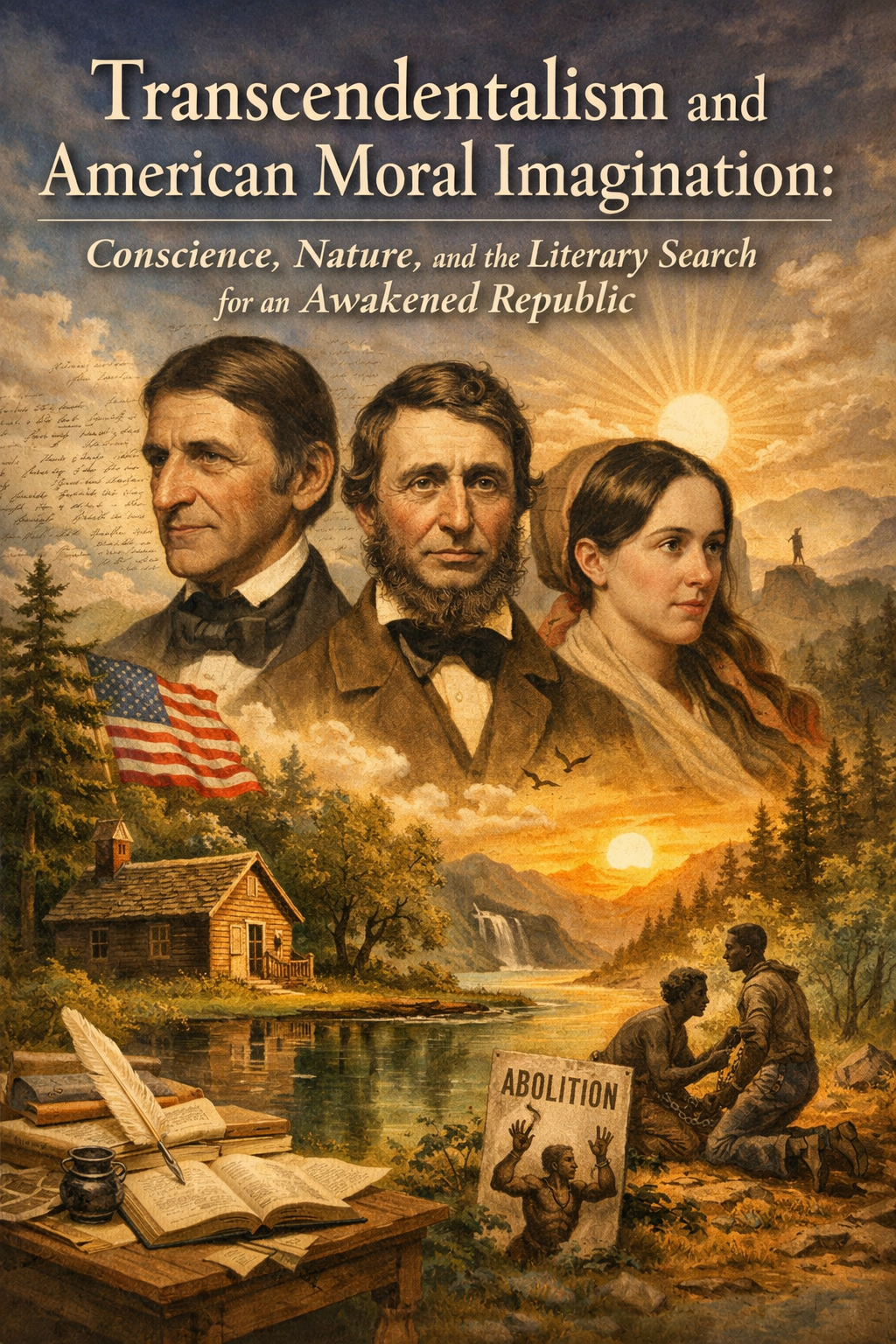
This category examines the writings, ideas, practices, and afterlives of Transcendentalism through essays, journals, lectures, letters, poetry, reflective prose, reform writing, educational thought, comparative religion, abolitionist argument, and public moral speech. It considers the movement’s engagements with self-reliance, abolition, education, nonconformity, friendship, solitude, civil disobedience, labor, simplicity, gender, spiritual inheritance, and the relation between inner life and public duty. It also explores how Transcendentalism drew from European Romanticism, Protestant and Unitarian inheritances, classical thought, and Asian religious and philosophical traditions while developing a distinctly American form of literary idealism.
By linking literature to spirituality, reform, ecology, selfhood, democratic aspiration, moral dissent, and the unresolved project of American justice, Transcendentalism and American Moral Imagination illuminates one of the deepest currents in American intellectual and literary history. Its central question remains urgent: how can a person, a community, or a republic become awake enough to live according to the truths it professes?
Why This Field Matters
Transcendentalism matters because it represents one of the most serious attempts in American literary history to imagine a morally awakened person within a spiritually unsettled democracy. It arises at a moment when inherited authority seemed both insufficient and still unavoidable: Protestant moral language remained powerful, but orthodoxy had weakened; the republic spoke of liberty while sustaining slavery; market society promised expansion while deepening moral distraction; democratic life widened public possibility while intensifying conformity, ambition, and compromise. Transcendentalist writing enters this unstable world and asks whether literature might help recover a truer standard of life.
Its answer is not merely theoretical. The movement proposes that perception itself may be reformed; that conscience may resist social pressure; that nature may restore moral proportion; that inward authority may become the ground of dissent; and that literary form may train attention, seriousness, and freedom. This is why the movement remains central to American moral imagination. It makes literature answerable to life, but also asks life to become worthy of what literature can discern.
The field also matters because Transcendentalism helped establish several enduring American languages: the language of self-reliance, the language of civil disobedience, the language of spiritual individuality, the language of ecological attention, and the language of moral reform grounded in conscience. These languages have had long afterlives, sometimes noble and sometimes simplified. They appear in environmental thought, democratic dissent, educational theory, reform politics, countercultural spirituality, and critiques of materialist society. To study Transcendentalism is therefore to study one of the major sources of American idealist vocabulary.
Yet the field must also be read critically. Transcendentalism’s language of universality emerged from a particular historical and social location. Its confidence in inward authority could become ethically powerful, but it could also risk abstraction from structural injustice. Its critique of conformity could awaken public responsibility, but it could also be misread as self-protective individualism. Its openness to global traditions could enlarge American thought, but it also involved selective appropriation and partial understanding. These tensions do not make the movement less important. They make it more necessary to read with scholarly care.
Moral Imagination and the Crisis of the Republic
Moral imagination is one of the central concepts of this pillar, and it deserves explicit definition. In the Transcendentalist context, moral imagination names the capacity to perceive ethical truth beyond convention, to imagine the self and society otherwise, to connect inward perception to public obligation, and to give literary form to ideals reality has not yet fulfilled. It is not fantasy, sentiment, or abstraction detached from life. It is the imaginative faculty by which a person or culture sees more than custom allows.
This matters especially in the context of the nineteenth-century republic. Transcendentalism emerges not in a morally settled nation, but in one whose highest principles and lived structures were increasingly at odds. The language of democracy existed beside slavery, market reduction, expansionist confidence, and forms of public complacency. Moral imagination becomes necessary under such conditions because inherited speech no longer suffices. Literature must help recover the ability to perceive contradiction, judge more deeply, and imagine another standard of civic and spiritual life.
The movement’s moral imagination is therefore not private idealism alone. It is an effort to think from within contradiction. How can a republic that speaks of freedom confront bondage? How can a person surrounded by conformity remain answerable to conscience? How can nature disclose scale and truth in a society increasingly organized by commerce, ambition, and utility? How can inherited religious seriousness survive when inherited doctrines no longer satisfy the awakened mind?
These questions give Transcendentalism its urgency. Its greatest writing does not merely propose elevated ideas. It tries to create a new moral atmosphere in which readers can feel the inadequacy of inherited life and the possibility of another order of perception.
The Self as Moral Being
At the center of Transcendentalism lies a demanding account of the self. The self is not simply a bundle of appetites, a social role, or a political abstraction. It is a morally educable being, inwardly receptive, spiritually exposed, and responsible for resisting false forms of authority. This self is not sovereign in any shallow sense. It is obligated—to truth, to conscience, to discipline, to perception, and to a form of inward honesty that refuses to hide behind custom.
This moral anthropology gives the movement its seriousness. Selfhood here is not self-display. It is a site of testing. The individual must learn to distinguish convention from conviction, fashion from insight, appetite from vocation, compliance from moral freedom. Transcendentalism therefore treats the self not as a private refuge, but as the first field of ethical struggle.
This is why the movement’s language of individuality should not be flattened into modern self-expression. The Transcendentalist self is not simply invited to be authentic. It is summoned to become more truthful, more awake, more responsible, and more resistant to degraded forms of life. Freedom is inseparable from discipline. Insight is inseparable from conduct. Inwardness becomes meaningful only when it transforms perception, relation, and action.
At the same time, this account of the self contains unresolved tensions. The language of moral universality sometimes underestimates how race, gender, class, labor, and social position shape the conditions under which inward freedom can be exercised. A serious reading must therefore hold together the movement’s powerful account of conscience with the historical limits of its social imagination.
Conscience, Nonconformity, and Inward Authority
Few movements in American letters place greater weight on conscience than Transcendentalism. Yet conscience here is not mere preference or mood. It is an inward authority that calls the individual to resist inherited falsity, social deadness, institutional compromise, and the comfort of compliance. Nonconformity is therefore not performance for its own sake. It is the outward sign of fidelity to a truth that may be morally costly.
This is one of the movement’s enduring powers. It gives American literature a language for principled refusal: refusal of hollow respectability, refusal of political evasion, refusal of spiritual diminishment, refusal of complicity disguised as moderation. At its best, Transcendentalism turns inward authority into ethical challenge rather than self-licensed exemption.
The language of conscience becomes especially important when private conviction confronts public injustice. In this tradition, the individual cannot simply dissolve moral responsibility into law, majority opinion, church authority, custom, or state command. The person must ask whether obedience itself has become a form of complicity. This question moves from Emersonian self-reliance toward Thoreau’s resistance to civil government and toward broader forms of abolitionist and reformist witness.
Yet conscience must also be disciplined. A movement that honors inward authority must confront the danger of mistaking impulse for truth or isolation for moral clarity. Transcendentalism is strongest when conscience is joined to humility, attention, reform, and responsibility to others.
Vision, Discipline, and the Labor of Attention
Transcendentalism is often misread as a literature of intuition without rigor, but its strongest texts are saturated with discipline. Moral vision in this tradition is not accidental inspiration. It requires attention, self-scrutiny, repetition, inward labor, and habits of seriousness. The awakened self must be formed. Freedom is not simply spontaneity. It is disciplined freedom.
This is one reason journals, walking, observation, solitude, reading, conversation, and daily experiment matter so much in the movement. They are not decorative lifestyle elements. They are practices of formation. Transcendentalism is powerful because it joins vision to discipline, inspiration to habit, and moral insight to a sustained labor of attention.
Attention is one of the movement’s hidden disciplines. To see the world truthfully requires withdrawal from dulling forms of habit. The eye must be trained; the mind must be cleared; the conscience must be made responsive. In this sense, Transcendentalist literature is not simply a literature of ideas. It is a literature of perception. It asks readers to notice what their social world has taught them not to see.
This disciplined attention also explains the movement’s continuing relevance for ecological and ethical thought. To attend carefully to a pond, a field, a season, a neighbor, a political injustice, or a daily habit is to resist abstraction. Moral life begins when perception becomes answerable to reality.
Nature as Revelation and Moral Medium
Nature in Transcendentalist writing is never merely scenery. It is one of the movement’s central languages of truth. The natural world becomes a medium of revelation, analogy, moral restoration, and resistance to the deadening effects of social life. Forest, pond, field, season, weather, morning, solitude, and animal presence all become occasions for re-seeing the world and the self within it.
This does not mean that nature is treated as simple innocence. Rather, it becomes a field in which proportion, relation, transience, discipline, beauty, and inward renewal can be apprehended with unusual force. Nature counteracts the false scale of market society and public vanity. It offers not escape from moral life, but another way of entering it more truthfully.
For Emerson, nature often discloses correspondence: the visible world becomes a symbolic and spiritual medium through which mind and world are brought into relation. For Thoreau, nature is more stubbornly particular: ice, beans, birds, ponds, tracks, weather, woodlots, and seasons demand exact observation. These different approaches reveal the range of Transcendentalist nature writing. Nature can be emblem, teacher, discipline, companion, corrective, and mystery.
The ecological afterlife of the movement depends on this seriousness of attention. Transcendentalism does not provide modern environmental science, but it helps form a moral and literary basis for seeing the natural world as more than resource, property, scenery, or utility. It teaches that how one sees nature is inseparable from how one understands the self.
The Ordinary Life as a Site of Seriousness
One of the most important achievements of Transcendentalism is its revaluation of the ordinary. Walking, reading, building, gardening, dwelling, teaching, observing, conversing, writing in a journal, refusing excess, simplifying one’s manner of life—these are not peripheral acts. They become morally charged forms of living. The movement finds significance not only in principles, but in habits, modes of attention, and the shape of a day.
This matters because it gives Transcendentalism a lived texture that abstractions alone cannot convey. It is not only a literature of high idealist declaration. It is also a literature of how to live under moral aspiration: how to order the day, how to resist distraction, how to see, how to dwell, how to keep one’s inward life answerable to one’s conduct.
Walden is central here because it turns ordinary life into experiment. Food, shelter, clothing, fuel, labor, economy, solitude, reading, visitors, and seasons all become part of a moral inquiry. The question is not simply how little one can live with, but what forms of life make perception, freedom, and responsibility possible. Simplicity becomes a way of recovering scale.
The ordinary also matters because democratic culture depends on everyday conduct. Transcendentalism asks whether moral seriousness can enter the common day rather than remain confined to churches, lectures, reforms, or heroic moments. Its answer is that a life becomes truthful through repeated acts of attention.
Literary Forms, Style, and the Rhetoric of Awakening
Transcendentalism is not only a set of ideas. It is also a set of literary forms and styles. The essay, the lecture, the journal, the notebook, the sermon-like meditation, the aphorism, the reflective poem, the public address, the reform tract, the letter, and the morally charged fragment all matter here. These forms allow the movement to think in motion. They preserve the cadence of inquiry, the abruptness of insight, the force of exhortation, and the unfinished character of moral self-examination.
Style itself is part of the movement’s authority. Emerson’s aphoristic leaps, Thoreau’s exacting observational prose, Fuller’s intellectual urgency, Parker’s prophetic rhetoric, Alcott’s conversational idealism—these are not just vehicles for thought. They are moral performances. The music, compression, elevation, and interruption of Transcendentalist prose are part of how it awakens, challenges, and unsettles its readers.
The lecture is especially important because Transcendentalism belongs to a public culture of spoken thought. Ideas circulated through halls, lyceums, clubs, conversations, journals, and reform meetings. Literature did not remain sealed inside books. It entered public speech as exhortation, provocation, and moral experiment. The movement’s prose often retains this oral energy: it calls, challenges, startles, and urges.
The journal also matters because it preserves thought before system. It records perception in formation. Transcendentalism often resists closed doctrine because its literary forms privilege awakening over finality. Its authority lies not in systematic completion, but in the power to keep moral perception alive.
Emerson, Thoreau, and the Centers of the Movement
Emerson and Thoreau stand near the center of Transcendentalism, but they should not be collapsed into one voice. Emerson provides the movement’s speculative altitude: an aphoristic, idealizing, often luminous language of self-reliance, spiritual correspondence, intellectual independence, and moral awakening. He is the movement’s great theoretician of inward authority and one of the decisive stylists of American moral prose.
Thoreau, by contrast, subjects idealism to stricter tests of practice, observation, labor, place, and resistance. He is more suspicious of abstraction for its own sake, more exact in his attention to environment and habit, and often more severe in translating conviction into embodied conduct. Together, Emerson and Thoreau form two distinct but related centers of the movement: one speculative and generative, the other exacting, practical, ecological, and resistant.
Emerson’s importance lies partly in his power to release thought from inherited constraint. His prose has a liberating intensity, repeatedly urging readers to trust perception, refuse dead convention, and recover relation to the Over-Soul, nature, genius, and moral law. Thoreau’s importance lies in his refusal to leave such language untested. He asks what self-reliance costs, what resistance requires, what simplicity demands, and how one might live deliberately rather than merely speak ideally.
The tension between them is productive. Emerson gives Transcendentalism its expansive vocabulary; Thoreau gives it a discipline of experiment. Emerson awakens; Thoreau verifies. Emerson opens the horizon; Thoreau walks it.
Margaret Fuller and the Expansion of Moral Intelligence
Margaret Fuller is indispensable to any serious account of Transcendentalism. She expands the movement’s moral and intellectual range through her writing on self-culture, conversation, women’s authority, education, reform, criticism, and the relation between inward growth and social transformation. Fuller does not merely join an existing circle. She alters the scale of its questions.
Through Fuller, the movement confronts the inadequacy of any moral language that speaks of selfhood and freedom while leaving gendered inequality intact. She also broadens Transcendentalism’s social intelligence by insisting that conversation, relation, and the cultivation of others are as important as solitary insight. Her presence keeps the category from shrinking into a narrower story of masculine self-reliance and restores its fuller moral ambition.
Fuller’s importance also lies in her understanding of intellectual life as social practice. Her conversations, criticism, and reform writing show that moral awakening is not simply achieved through solitude or private intuition. It may also require dialogue, education, friendship, and the enlargement of public intelligence. Her work asks what forms of culture allow women and men to become fully human.
In this sense, Fuller exposes one of the movement’s central tests: whether claims about universal selfhood can survive contact with social inequality. Her writing insists that the language of freedom must be judged by whom it includes, whom it educates, and whom it allows to speak with authority.
Abolition, Slavery, and the Crisis of American Conscience
If Transcendentalism is a movement of conscience, then slavery is one of the central historical tests of its seriousness. The language of inward authority, spiritual dignity, and moral independence cannot remain abstract in a republic built in part on bondage. Abolition therefore belongs at the center of this category, not at its margins. It is one of the decisive points where Transcendentalist moral imagination was forced to confront the structural violence of American life.
This gives the movement both power and tension. Its best moments reveal literature becoming ethically dangerous to the status quo, turning from self-culture toward antislavery witness, protest, and public condemnation. Its weaker moments reveal the limitations of idealism when not fully joined to structural clarity. Any strongest-sense account of Transcendentalism must therefore treat abolition as one of the principal grounds on which its moral language proved either adequate or evasive.
Thoreau’s resistance to civil government, Emerson’s later antislavery addresses, Theodore Parker’s reform preaching, and the wider abolitionist context show that conscience becomes historically meaningful when it refuses cooperation with injustice. The question is not simply whether one privately disapproves of slavery, but whether one’s conduct, speech, money, citizenship, and obedience support or resist the slave power.
At the same time, abolition exposes the limits of a movement often associated with white New England intellectual culture. The enslaved, formerly enslaved, Black abolitionist, and Indigenous perspectives that reveal the full violence of American life cannot be treated as background. Transcendentalism must be placed within the broader moral and political archive of antebellum reform, where its language of conscience intersects with more direct traditions of Black witness, resistance, and liberation struggle.
Religious Inheritance and Spiritual Departure
Transcendentalism emerges through both continuity with and departure from inherited religious worlds. It inherits Protestant seriousness, biblical cadence, moral discipline, and the demand that life answer to ultimate truth. It also arises from Unitarian critique of orthodoxy and dissatisfaction with forms of religion that had become too external, rationalized, or spiritually thin. The movement therefore cannot be understood either as simple secularization or as orthodox renewal.
Its spiritual significance lies in this threshold position. Transcendentalism departs from formal doctrinal constraint, yet it does not abandon moral or metaphysical seriousness. It seeks a religion of inward experience, moral intuition, spiritual receptivity, and living relation to truth. This makes it one of the most important nineteenth-century experiments in post-orthodox seriousness.
The movement’s religious imagination often relocates authority from institution to experience, from inherited doctrine to inward perception, from formal creed to spiritual responsiveness. Yet this relocation does not abolish seriousness. It intensifies the demand that the individual become answerable to truth without relying on external structures alone. In this sense, Transcendentalism is not irreligion but religious revision.
This revisionary spirituality also shaped American literary form. The sermon becomes essay; the devotional meditation becomes nature writing; the prophetic address becomes reform lecture; the spiritual diary becomes journal and notebook. Transcendentalism transforms religious inheritance into literary practice.
Friendship, Conversation, and Moral Community
Although Transcendentalism is often remembered for solitude, it is also a movement of conversation, correspondence, friendship, circles, and intellectual companionship. Ideas here are tested not only in isolation but in encounter. Lectures, clubs, journals, reform networks, shared reading, and personal relations all help constitute the movement’s moral world.
This matters because moral imagination in Transcendentalism is not purely solitary. Friendship becomes one of its ethical forms, a mode of mutual enlargement and correction. Conversation becomes a medium of self-culture and social possibility. The movement’s vision of freedom is therefore more communal than stereotypes of rugged individualism often allow.
The Transcendentalist circle was sustained by periodicals, letters, visits, reform meetings, educational experiments, and intellectual friendships. These networks show that inward authority does not emerge in a vacuum. It is nurtured by conversation and challenged by other minds. Even solitude is often prepared by community: the solitary thinker carries voices, books, arguments, and friendships into the woods.
At the same time, the movement’s communities were imperfect. Gender, race, class, temperament, and institutional position shaped who could speak, lead, publish, and be remembered. A serious account must therefore treat Transcendentalist community as both aspiration and historical formation.
Education, Self-Culture, and Experiments in Living
Transcendentalism is deeply invested in education, though not in a narrow institutional sense alone. It asks how a person might be formed—through reading, attention, discipline, conversation, solitude, observation, labor, and moral testing—into someone capable of inward freedom. Self-culture here is not ornamental refinement. It is the ethical labor of becoming worthy of conscience.
This concern extends beyond books into experiments in living. Alternative schooling, communal projects, disciplined simplicity, and resistance to social routine all become part of the movement’s practical horizon. Figures such as Bronson Alcott help make this clear, showing that Transcendentalism also lives in pedagogical experiment, communal aspiration, and attempts to embody moral vision in institutions and daily practice.
Education in this tradition is not merely the transfer of information. It is the formation of perception, character, and moral independence. It asks what kind of habits allow a person to see truthfully, resist conformity, cultivate judgment, and participate in a more serious public life. This gives Transcendentalist education a lasting connection to democratic culture: a republic depends on the inward formation of its citizens.
Yet educational idealism also reveals the movement’s fragility. Many experiments struggled to survive ordinary pressures of money, labor, administration, disagreement, and social inequality. The gap between ideal and institution is part of the history. Transcendentalism repeatedly asks how vision might be embodied, and repeatedly discovers how hard embodiment is.
Labor, Economy, and the Critique of Materialism
Transcendentalism emerges within a society increasingly shaped by commerce, acquisitiveness, industrial acceleration, status anxiety, and the reduction of value to utility. Its critique of materialism is therefore not incidental. It is one of the movement’s central acts of dissent. The market does not simply create wealth; it threatens to deform perception, degrade inward life, and teach the self to value accumulation over integrity.
This is why simplicity, labor, frugality, and resistance to excess matter so much in the tradition. They are not only personal preferences. They are ethical and literary counter-practices against a world increasingly organized by measurement, exchange, and display. Transcendentalism asks whether a life can remain morally serious under commercial conditions that reward distraction, status, and compromise.
Thoreau’s economic reflections in Walden are central because they transform cost, labor, shelter, clothing, and food into moral categories. The issue is not poverty as romantic pose, but dependency as spiritual danger. How much of one’s life is spent maintaining appearances? How much freedom is surrendered to unnecessary wants? How does a culture of accumulation make inward life shallow?
The movement’s critique of materialism remains powerful, though it must also be read historically. Simplicity looks different from positions of privilege and positions of deprivation. The challenge is to preserve Transcendentalism’s critique of acquisitiveness while recognizing that material security, labor conditions, and social justice cannot be solved by inward discipline alone.
Walking, Wandering, and the Geography of Thought
Movement matters deeply to the Transcendental imagination. Walking, wandering, sauntering, retreating from social crowding, crossing fields, circling ponds, moving through weather and season—these are not merely incidental activities. They are ways of thinking. The path becomes a form of inward clarification. The body in motion helps loosen the rigidities of social routine and restore scale, attention, and relation.
This geographical dimension gives the movement one of its most durable forms. Thought is not only seated, institutional, or urban. It is also ambulatory, environmental, and solitary without being empty. The landscape becomes a companion to reflection, and motion through space becomes one of the movement’s ways of making freedom experiential.
Walking is also a discipline of exposure. It removes the thinker from domestic enclosure, economic routine, and social expectation. It places the body within weather, distance, terrain, and chance encounter. For Thoreau especially, walking is not recreation alone. It is a philosophical and moral practice that restores contact with the wild, the local, and the unpossessed.
The geography of thought also complicates the movement’s idealism. Place is never empty. New England landscapes carry Indigenous histories, agricultural transformation, settlement, property, and environmental change. A contemporary reading of Transcendentalist walking must therefore attend both to the movement’s power of perception and to the histories its landscape imagination did not always fully see.
Individuality, Universality, and Democratic Culture
One of the deepest tensions within Transcendentalism lies in its relation between singular experience and universal truth. The movement trusts the individual self because it believes that the deepest inward life opens onto realities larger than the self: justice, truth, beauty, moral law, spiritual order. This makes individuality more than personality. It becomes a possible gateway to universality.
That tension also shapes its relation to democracy. Transcendentalism is not democratic merely because it praises the individual. It imagines democracy as a culture of self-respecting, morally serious persons capable of resisting corruption and spiritual deadness. Yet it is also wary of mass society, flattening opinion, and the pressure of conformity. Its democratic vision is therefore aspirational and critical at once: a hope for a republic worthy of awakened persons, and a suspicion that existing public life often falls short of that standard.
This dual relation to democracy is one of the movement’s most important features. Transcendentalism gives American literature a language of equality grounded in the moral dignity of the person, but it also fears the tyranny of custom, the mediocrity of public opinion, and the deadening effects of social imitation. Its democratic ideal is therefore demanding rather than merely celebratory.
The challenge is that claims to universality must be tested against history. Whose individuality is recognized? Whose conscience is heard? Whose access to self-culture is protected? Whose experience is treated as universal? These questions keep Transcendentalism from becoming sentimental and make it a continuing field of critical inquiry.
Global Sources and Comparative Imaginations
Transcendentalism draws from a wide range of inheritances: European Romanticism, classical thought, Protestant and Unitarian moral culture, and Asian religious and philosophical traditions. These sources help shape the movement’s language of inwardness, moral receptivity, nature, spiritual discipline, and intellectual enlargement. Yet a serious category must approach this breadth carefully. Influence here is not simple borrowing. It involves translation, selection, idealization, partial understanding, and imaginative reconfiguration.
This comparative dimension matters because it places Transcendentalism within a larger nineteenth-century search for alternatives to narrow doctrinal or materialist worlds. At the same time, it raises questions about appropriation, simplification, and the selective use of non-Western traditions within an American intellectual framework. A strongest-sense pillar must hold both the movement’s openness and its limits in view.
Emerson and Thoreau’s engagements with Hindu, Buddhist, Confucian, Islamic, and other sources were mediated through translations, anthologies, Orientalist scholarship, missionary knowledge, and nineteenth-century comparative frameworks. These engagements could enlarge American thought, but they could also detach texts from living traditions and historical contexts. The movement’s comparative imagination therefore requires both appreciation and critique.
This makes global sources central rather than ornamental. Transcendentalism’s moral imagination was never purely local. It was shaped by transatlantic and transnational reading, even when those readings were partial. The movement belongs to the history of American literature, but also to the wider history of modern spiritual comparison.
Limits, Failure, and the Unfinished Project of Idealism
No serious account of Transcendentalism should treat it as a finished moral answer. Its strengths are inseparable from its tensions. It can move toward democratic seriousness, yet sometimes speaks in tones of intellectual elevation that risk social narrowing. It can critique materialism, yet may not always grasp the full structural force of economic life. It can proclaim universality while emerging from historically specific forms of privilege. It can honor conscience while underestimating the ways conscience itself is shaped by position and power.
It is also, in a deeper sense, a literature of incomplete realization. Self-culture does not automatically produce justice. Moral insight does not guarantee political transformation. Awakened individuals still inhabit damaged institutions. This incompletion is part of the tradition’s seriousness. Transcendentalism remains important not because it solved the moral crises of American life, but because it gave those crises a powerful language of aspiration, scrutiny, dissent, and renewal.
The movement’s failures should not be treated as reasons to dismiss it. They are interpretive openings. They show where idealist language meets history, where inward awakening must confront public structure, where universal claims must be tested by excluded voices, and where reform requires more than noble perception.
Transcendentalism is therefore best understood as an unfinished moral project. Its value lies not in offering a complete doctrine, but in forcing American literature to ask whether the self, the republic, and the world might be seen more truthfully.
Afterlives: Ecology, Resistance, and American Idealism
Transcendentalism extends far beyond its nineteenth-century moment. Its afterlives can be traced in environmental thought, civil resistance, educational ideals, moral dissent, spiritual individualism, critiques of materialism, and later attempts to join inward seriousness with public responsibility. Its language of conscience and nonconformity continues to shape American ideals of resistance to the state, opposition to social deadness, and fidelity to moral principle under pressure.
At the same time, its afterlife also includes the ambiguities of American idealism itself: the hope that inward transformation may renew public life, and the recurring danger that moral vision may become detached from material analysis or collective accountability. This makes Transcendentalism not only historically important but continuously relevant as a tradition through which American culture has imagined both its noblest possibilities and some of its most revealing limitations.
Ecology is one of the most significant afterlives. Thoreau’s careful attention to place, season, species, and local observation has made him central to environmental thought, while Emerson’s symbolic nature writing helped establish a spiritual language for the relation between mind and world. Later environmental writing inherits both the promise and the problems of this legacy: attention to nature as moral teacher, but also the need to confront environmental justice, Indigenous presence, land history, and ecological science.
Civil resistance is another major afterlife. Thoreau’s argument against cooperation with injustice became part of a long global genealogy of dissent. Yet the afterlife of civil disobedience also reminds readers that conscience must be joined to collective struggle, political organization, and historical clarity. Transcendentalism’s continuing relevance depends on reading it not as escape from politics, but as a demanding language for moral responsibility within politics.
Major Questions of Interpretation
This pillar is organized around several large interpretive questions. What kind of self does Transcendentalism imagine, and what does that self owe to truth, conscience, and others? What is moral imagination, and how does literature cultivate it under conditions of national contradiction? How does nature function as a medium of revelation rather than mere setting? In what ways do essay, lecture, journal, aphorism, and reflective prose shape the movement’s authority? How do Emerson, Thoreau, Fuller, Alcott, Parker, and other figures differ in their understanding of freedom, reform, religion, and public duty?
The pillar also asks what happens when Transcendentalist idealism confronts slavery, state violence, gender inequality, market society, religious uncertainty, and democratic conformity. How should the movement’s language of inward authority be read beside the structural injustices of antebellum America? How did its comparative imagination engage Asian religious and philosophical traditions, and where did that engagement remain partial? Why does this tradition remain one of the central languages through which American literature thinks selfhood, conscience, ecology, reform, education, and resistance?
These questions keep the category from becoming a familiar celebration of inspirational nonconformity. They open it as a field of literary, moral, religious, ecological, political, and rhetorical inquiry. Transcendentalism and American Moral Imagination is not simply about a movement of ideas. It is about one of the most serious efforts in American letters to ask what an awakened life and an awakened society might require.
Expanded Article Architecture
The following structure gathers the pillar into a long-range architecture suitable for a major literature and cultural memory knowledge series. It is designed to support foundational essays, author studies, close readings, moral and political themes, ecological afterlives, comparative religious sources, reform traditions, and critical reassessments of American idealism. All entries below should be treated as planned unless already completed elsewhere on the site.
Foundations of the Field
- Transcendentalism and the Moral Demands of American Literature (planned)
- Why Transcendentalism Matters in American Intellectual History (planned)
- Literature, Conscience, and the Search for Inward Freedom (planned)
- The Moral Imagination of the Nineteenth-Century Republic (planned)
- Transcendentalism as Spiritual and Literary Revolt (planned)
- What the Movement Asked of the Self (planned)
- American Idealism and the Problem of Moral Awakening (planned)
- Transcendentalism Beyond Inspirational Individualism (planned)
Moral Imagination, Selfhood, and Conscience
- Moral Imagination in Transcendentalist Writing (planned)
- Self-Reliance and the Ethics of Inward Authority (planned)
- Conscience Against Conformity (planned)
- The Morally Educable Self in Transcendentalist Thought (planned)
- Nonconformity as Ethical Discipline (planned)
- Individual Freedom and the Burden of Truthfulness (planned)
- Character, Vocation, and Moral Independence (planned)
- Inwardness, Discipline, and the Formation of Moral Personhood (planned)
Vision, Discipline, and Everyday Life
- Vision and Discipline in the Transcendental Imagination (planned)
- The Ordinary Life as a Site of Moral Seriousness (planned)
- Attention, Habit, and the Discipline of Perception (planned)
- Daily Life Against Social Deadness (planned)
- Simplicity, Conduct, and the Shape of a Moral Day (planned)
- How Transcendentalism Revalued the Ordinary (planned)
- Journaling, Observation, and the Practice of Self-Formation (planned)
- Deliberate Living as Literary and Moral Experiment (planned)
Nature, Ecology, and the Visible World
- Nature as Moral Medium in Transcendentalist Writing (planned)
- Perception, Landscape, and Spiritual Renewal (planned)
- Emerson’s Nature and the Reenchantment of the Visible World (planned)
- Thoreau and the Ethics of Attention (planned)
- Ecology Before Environmentalism (planned)
- Nature Against Materialism and Social Deadness (planned)
- Season, Weather, and the Moral Scale of the Natural World (planned)
- Walden Pond and the Literary Making of Ecological Attention (planned)
- Nature, Property, and the Limits of Pastoral Idealism (planned)
Forms, Style, and Literary Authority
- The Essay as Moral Experiment (planned)
- Journals, Notebooks, and the Discipline of Reflection (planned)
- The Lecture and the Public Life of Thought (planned)
- Aphorism, Fragment, and the Authority of Insight (planned)
- Poetry and the Compression of Moral Vision (planned)
- Emersonian Style and the Music of Moral Prose (planned)
- Why Form Matters in Transcendentalism (planned)
- The Rhetoric of Awakening in American Moral Prose (planned)
Emerson, Thoreau, and the Movement’s Centers
- Emerson and the Language of Spiritual Independence (planned)
- Thoreau and the Ethics of Resistance (planned)
- Emerson and Thoreau: Convergence and Difference (planned)
- Speculation, Practice, and the Testing of Idealism (planned)
- Walking, Dwelling, and Moral Experiment in Thoreau (planned)
- What Emerson Saw That Thoreau Tested (planned)
- Emerson’s Self-Reliance and the Problem of Moral Authority (planned)
- Thoreau’s Walden and the Discipline of Deliberate Life (planned)
- Civil Disobedience and the Moral Limits of the State (planned)
Margaret Fuller and the Expansion of the Tradition
- Margaret Fuller and the Moral Expansion of Transcendentalism (planned)
- Conversation, Education, and Intellectual Authority (planned)
- Woman in the Nineteenth Century and the Ethics of Equality (planned)
- Fuller, Self-Culture, and Public Life (planned)
- Gender and the Limits of Moral Universalism (planned)
- Why Fuller Must Be Central to the Movement (planned)
- Conversation as Feminist and Moral Practice (planned)
- Margaret Fuller and the Public Life of Intellectual Women (planned)
Abolition, Slavery, and Public Conscience
- Transcendentalism and the Crisis of Slavery (planned)
- Abolition as the Test of American Moral Imagination (planned)
- Conscience Against the Slave State (planned)
- Literature, Reform, and Antislavery Witness (planned)
- The Limits of Idealism Before Structural Injustice (planned)
- What Moral Seriousness Required in Antebellum America (planned)
- Thoreau, John Brown, and the Extremity of Conscience (planned)
- Emerson, Reform, and the Language of Antislavery Judgment (planned)
- Black Abolitionist Witness and the Limits of Transcendentalist Idealism (planned)
Religion, Spirituality, and Moral Inheritance
- From Unitarian Rationality to Transcendental Spirituality (planned)
- Protestant Inheritance and Post-Orthodox Seriousness (planned)
- Biblical Cadence and Secularizing Vision (planned)
- Religion Without Dogmatic Closure (planned)
- The Sacred in Everyday Perception (planned)
- Spiritual Freedom and the Critique of Formalism (planned)
- The Divinity School Address and the Crisis of Religious Authority (planned)
- The Over-Soul, Moral Intuition, and American Spiritual Idealism (planned)
Community, Education, and Experiments in Living
- Friendship as Moral Relation in Transcendentalist Thought (planned)
- Conversation and the Social Life of Self-Culture (planned)
- Reform Circles and the Public Career of Ideas (planned)
- Solitude and Community in Productive Tension (planned)
- Bronson Alcott and Educational Experiment (planned)
- How Transcendentalism Built Intellectual Community (planned)
- Brook Farm, Communal Idealism, and the Difficulty of Embodied Reform (planned)
- Education as the Formation of Moral Perception (planned)
Economy, Labor, and Simplicity
- Transcendentalism and the Critique of Materialism (planned)
- Labor, Simplicity, and Moral Economy (planned)
- Commerce, Status, and the Deadening of Perception (planned)
- Utilitarianism and the Reduction of Value (planned)
- Why Simplicity Became a Moral Practice (planned)
- Market Society and the Threat to Inward Life (planned)
- Walden’s Economy and the Ethics of Need (planned)
- Work, Freedom, and the Critique of Respectable Success (planned)
Walking, Place, and Mobility
- Walking as Moral and Literary Practice (planned)
- Sauntering, Solitude, and the Geography of Thought (planned)
- Landscape, Motion, and the Formation of Perception (planned)
- Place, Freedom, and the Open Air of Reflection (planned)
- Thoreau and the Ethics of Movement (planned)
- How Motion Became a Form of Thinking (planned)
- New England Place and the Memory of American Idealism (planned)
- Walking, Property, and the Question of the Commons (planned)
Democracy, Universality, and Critique
- Transcendentalism and Democratic Culture (planned)
- Individual Experience and Universal Moral Claims (planned)
- The Promise and Suspicion of the Mass Public (planned)
- American Idealism and Democratic Aspiration (planned)
- Universal Language and Historical Privilege (planned)
- Why the Movement Must Be Read Critically (planned)
- The Republic as Moral Experiment in Transcendentalist Thought (planned)
- Conformity, Majority Opinion, and the Problem of Democratic Mediocrity (planned)
Comparative Sources and Intellectual Horizons
- European Romanticism and American Idealism (planned)
- Classical Thought in the Transcendental Imagination (planned)
- Asian Religious and Philosophical Sources in Transcendentalist Writing (planned)
- Translation, Appropriation, and Spiritual Comparison (planned)
- The Global Horizon of Nineteenth-Century American Thought (planned)
- How Transcendentalism Reconfigured Inherited Traditions (planned)
- The Bhagavad Gita, Emerson, and the Uses of Sacred Comparison (planned)
- Orientalism, Selective Reading, and the Limits of Transcendentalist Universality (planned)
Afterlives, Failure, and Continuing Relevance
- Failure and Incompletion in Transcendentalist Idealism (planned)
- Civil Disobedience and the Genealogy of Resistance (planned)
- Transcendentalism and Environmental Thought (planned)
- Education, Simplicity, and the Ethics of Attention (planned)
- Spiritual Individualism in American Culture (planned)
- Transcendentalism After Transcendentalism (planned)
- The Enduring Moral Uses of Idealism (planned)
- Ecology, Reform, and the Afterlife of Thoreau (planned)
- From Transcendentalism to American Counterculture (planned)
- Idealism, Responsibility, and the Future of Moral Imagination (planned)
Major Authors and Deep-Dive Studies
- Ralph Waldo Emerson and the Architecture of Inward Authority (planned)
- Henry David Thoreau and the Ethics of Deliberate Life (planned)
- Margaret Fuller and the Moral Expansion of American Thought (planned)
- Bronson Alcott and the Pedagogy of Idealism (planned)
- Theodore Parker and the Prophetic Politics of Conscience (planned)
- Elizabeth Peabody and the Institutional Life of Reform (planned)
- Orestes Brownson, Dissent, and the Tensions of Transcendentalist Reform (planned)
- Walt Whitman and the Democratic Afterlife of Transcendentalist Selfhood (planned)
- Emily Dickinson and the Interior Recasting of Spiritual Authority (planned)
Closing Perspective
Transcendentalism and American Moral Imagination reveals one of the deepest efforts in American literary history to join inward seriousness to public ethical life. It preserves a tradition in which selfhood is morally charged, conscience resists conformity, nature becomes revelatory, literature serves awakening, and reform emerges not as abstract program alone but as the outward demand of inward truth. The movement remains powerful because it refuses to let the self rest comfortably inside either inherited authority or modern compromise.
This is what makes the category so important within Literature & Cultural Memory. Transcendentalism does not merely offer a philosophy of self-expression. It asks what a life answerable to conscience, nature, justice, and moral discipline might require; how literature can enlarge perception; and whether a republic can become worthy of its highest ethical claims. As a long-range knowledge series, this pillar is meant to follow those questions across texts, figures, tensions, failures, and afterlives, showing how one of the central traditions of American literary idealism continues to shape the language of reform, ecology, freedom, and moral awakening.
The movement’s deepest value may lie in the fact that it remains unfinished. Its questions continue to press against American life: what does conscience require when institutions are compromised? What forms of attention can resist distraction and materialism? How should spiritual seriousness survive without dogmatic closure? What does nature teach when the natural world is threatened? How can inward freedom become public responsibility rather than private escape? Transcendentalism endures because it leaves readers with a demanding moral grammar for asking whether life, literature, and society can become more truthful.
Related Reading
- Literature & Cultural Memory
- Poetry, Memory, and Imagination
- Classical Literature and Civilizational Memory
- Religious Studies
- Ethics and Moral Philosophy
- Environment, Place, and Ecological Knowledge
- Religion and Ecology
- Liberalism and Its Traditions
Further Reading
- Myerson, J., Petrulionis, S.H. and Walls, L.D. (eds.) (2010) The Oxford Handbook of Transcendentalism. Oxford: Oxford University Press. https://academic.oup.com/edited-volume/28154
- Mott, W.T. (ed.) (2014) Ralph Waldo Emerson in Context. Cambridge: Cambridge University Press. https://www.cambridge.org/core/books/ralph-waldo-emerson-in-context/110C5572BAF007DCDC1305EAFC6E2810
- Myerson, J. (ed.) (2000) Transcendentalism: A Reader. New York: Oxford University Press. https://global.oup.com/academic/product/transcendentalism-9780195122138
- Versluis, A. (1993) American Transcendentalism and Asian Religions. New York: Oxford University Press. https://global.oup.com/academic/product/american-transcendentalism-and-asian-religions-9780195076585
- Gougeon, L. (1990) Virtue’s Hero: Emerson, Antislavery, and Reform. Athens, GA: University of Georgia Press.
- Robinson, D.M. (1993) Emerson and the Conduct of Life: Pragmatism and Ethical Purpose in the Later Work. Cambridge: Cambridge University Press.
- Richardson, R.D., Jr. (1995) Emerson: The Mind on Fire. Berkeley: University of California Press.
- Richardson, R.D., Jr. (1986) Henry Thoreau: A Life of the Mind. Berkeley: University of California Press.
- Marshall, M. (ed.) (1979) The Selected Letters of Margaret Fuller. Ithaca, NY: Cornell University Press.
- Capper, C. (1992) Margaret Fuller: An American Romantic Life. Volume I: The Private Years. New York: Oxford University Press.
- Gura, P.F. (2007) American Transcendentalism: A History. New York: Hill and Wang.
- Goodman, R.B. (2017) The Civic Imagination: Democratic Citizenship in the American Literary Tradition. Oxford: Oxford University Press.
- Buell, L. (1995) The Environmental Imagination: Thoreau, Nature Writing, and the Formation of American Culture. Cambridge, MA: Harvard University Press.
- Walls, L.D. (2017) Henry David Thoreau: A Life. Chicago: University of Chicago Press.
- Cheyfitz, E. (2006) The Disinformation Age: The Collapse of Liberal Democracy in the United States. New York: Routledge.
References
- Emerson, R.W. (1983) Essays & Lectures. New York: Library of America. https://www.loa.org/books/40-essays-amp-lectures/
- Emerson, R.W. (n.d.) Ralph Waldo Emerson. Library of America. https://www.loa.org/writers/263-ralph-waldo-emerson/
- Emerson, R.W. (1841) Essays: First Series. Boston, MA: James Munroe and Company.
- Emerson, R.W. (1844) Essays: Second Series. Boston, MA: James Munroe and Company.
- Emerson, R.W. (1836) Nature. Boston, MA: James Munroe and Company.
- Emerson, R.W. (1838) ‘The American Scholar’, in Nature; Addresses, and Lectures. Boston, MA: James Munroe and Company.
- Emerson, R.W. (1844) ‘The Poet’, in Essays: Second Series. Boston, MA: James Munroe and Company.
- Thoreau, H.D. (2008) Walden; or, Life in the Woods. New York: Library of America. https://www.loa.org/writers/224-henry-david-thoreau/
- Thoreau, H.D. (n.d.) On Civil Disobedience. Library of America. https://www.loa.org/books/on-civil-disobedience-paperback/
- Thoreau, H.D. (1849) ‘Resistance to Civil Government’, in Aesthetic Papers. Boston, MA: The Editor.
- Thoreau, H.D. (1862) ‘Walking’, in The Atlantic Monthly, June.
- Fuller, M. (2025) Margaret Fuller: Collected Writings. New York: Library of America. https://www.loa.org/books/collected-writings/
- Fuller, M. (n.d.) Margaret Fuller. Library of America. https://www.loa.org/writers/673-margaret-fuller/
- Fuller, M. (1845) Woman in the Nineteenth Century. New York: Greeley and McElrath.
- Parker, T. (1841) A Discourse of Matters Pertaining to Religion. Boston, MA: Charles C. Little and James Brown.
- Alcott, A.B. (1938) The Journals of Bronson Alcott. Edited by O. Shepard. Boston, MA: Little, Brown and Company.
- Myerson, J., Petrulionis, S.H. and Walls, L.D. (eds.) (2010) The Oxford Handbook of Transcendentalism. Oxford: Oxford University Press. https://academic.oup.com/edited-volume/28154
- Mott, W.T. (ed.) (2014) Ralph Waldo Emerson in Context. Cambridge: Cambridge University Press. https://www.cambridge.org/core/books/ralph-waldo-emerson-in-context/110C5572BAF007DCDC1305EAFC6E2810
- Versluis, A. (1993) American Transcendentalism and Asian Religions. New York: Oxford University Press.