
Last Updated May 3, 2026
Russian myth, epic, and folklore constitute a major field of cultural, religious, literary, historical, ecological, and performative inquiry in which sacred nature, heroic endurance, household protection, saints, spirits, forest worlds, ritual danger, women’s lament, holy foolishness, moral suffering, and communal memory converge. This is not a single canon preserved in one authoritative mythological corpus. It is a layered narrative world formed through pre-Christian East Slavic belief, heroic oral tradition, folk Christianity, seasonal ritual, village storytelling, monastic and saintly legend, vernacular demonology, domestic protection, lament, local sacred geography, frontier memory, imperial contact zones, and later literary and artistic reworkings of mythic material. In these traditions, forests, rivers, bathhouses, thresholds, ovens, icons, saints, curses, prophecies, enchanted roads, heroic trials, holy fools, wandering dead, comic reversals, and apocalyptic anxieties remain deeply intertwined.
This knowledge series treats Russian myth, epic, and folklore as a civilizational archive rather than as a narrow body of quaint folk survivals. One layer concerns the pre-Christian East Slavic world: divine forces, sacred nature, seasonal cycles, fertility, thunder, household protection, ancestral memory, and the symbolic order of forest, field, river, hearth, threshold, and sky. Another layer concerns the oral heroic traditions of byliny, bogatyr legends, warrior memory, and regional epic performance, especially around figures such as Ilya Muromets, Dobrynya Nikitich, and Alyosha Popovich, but also around distinct regional worlds such as Kiev, Novgorod, and the northern preservation zones. A third layer concerns folktale and vernacular supernatural belief: witches, forest spirits, water beings, household guardians, revenants, prophetic dreams, cursed places, magical journeys, shape-shifting beings, ritual specialists, healers, and the morally charged border between the visible and invisible. A fourth layer concerns Christian and post-Christian transformation: saints’ legends, miracle stories, monastic landscapes, holy fools, pilgrimage, miracle-working icons, sacred suffering, folk eschatology, sectarian memory, and ritual practices that reshaped earlier materials without fully erasing them.
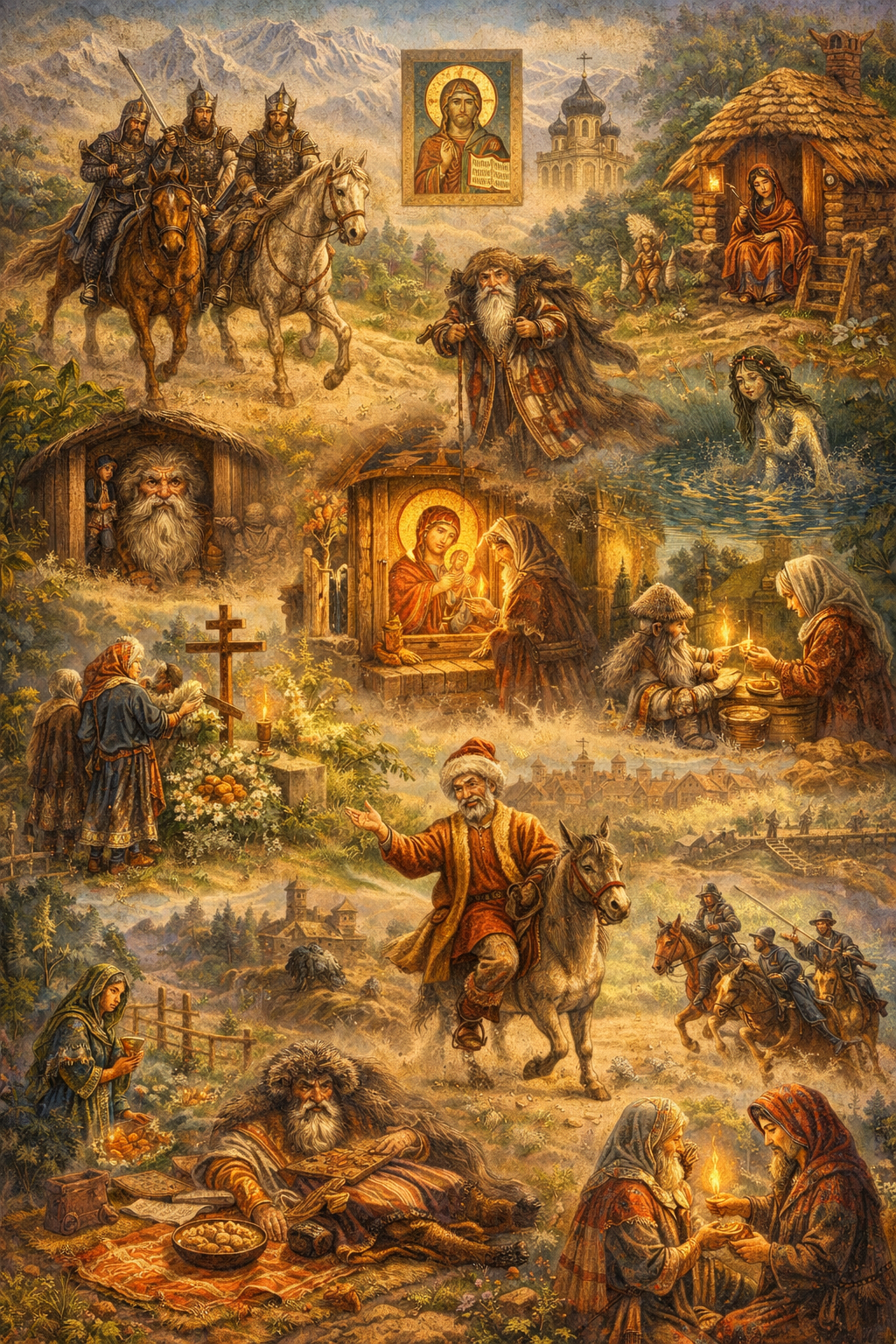
A fullest account must recognize that “Russian” is not a simple or self-contained category. The mythic and folkloric traditions associated with Russia were shaped not only in the East Slavic core but also through northern oral cultures, forest and river ecologies, steppe frontiers, Cossack worlds, Siberian expansion, imperial borderlands, and long contact with Finno-Ugric, Uralic, Turkic, Baltic, Mongol, Caucasian, and other neighboring peoples. This does not dissolve the coherence of Russian tradition, but it does mean that Russian myth, epic, and folklore emerged in a contact zone of multiple landscapes, peoples, and symbolic systems. Russian narrative worlds must therefore be studied as historically layered and regionally differentiated rather than as a single timeless village mythology.
The category also includes the immense symbolic afterlife of folklore in literature, music, painting, ballet, opera, illustration, religious imagination, nationalist scholarship, Soviet adaptation, émigré memory, modern fantasy, and ideological appropriation. Russian myth often survives not only in oral memory or ritual practice but in reimagined forms: in chronicles, hagiography, Romantic nationalism, Symbolist fascination, fairy-tale illustration, folkloric opera, ethnographic preservation, Soviet children’s culture, religious revival, contemporary fantasy, and comparative Slavic studies. This does not make the tradition less mythic. It shows that Russian mythic worlds persisted through reinterpretation, carrying forward older symbolic structures even as their meaning shifted across religious, political, artistic, and ideological epochs.
What makes this field so important is the intensity with which it joins land, suffering, sanctity, danger, endurance, wonder, and historical memory. A forest may conceal both threat and revelation. A hut at the edge of the woods may mark the boundary between worlds. A saint may carry traces of older sacred functions while becoming a Christian protector. A bogatyr may defend not only a prince but a moral imagination of land and people. A folktale heroine may reveal the ethical intelligence of patience, courage, and endurance under impossible conditions. A village ritual may preserve cosmological patterns long after official theology has changed. A memorial meal may bind the living to the dead. A comic fool may expose the vanity of worldly hierarchy more sharply than a sermon. Russian myth, epic, and folklore are therefore best approached not as scattered tales, but as a major archive of cultural intelligence linking cosmology, communal memory, sacred fear, domestic life, moral testing, ritual continuity, and imaginative survival.
Why This Field Matters
Russian myth, epic, and folklore deserve serious study because they preserve one of the richest narrative archives in Europe for understanding how a civilization imagines the relation between landscape, suffering, sanctity, danger, endurance, and communal survival. The field reveals how human life is imagined in relation to forces larger than the individual: forest, winter, fate, saint, icon, ancestor, household spirit, curse, memory, death, and divine judgment.
The field also matters because it shows how pre-Christian cosmologies survive not through intact systems alone but through ritual memory, local belief, symbolic residue, demonology, seasonal custom, and Christian reinterpretation. The older sacred world is not always visible as doctrine. It survives in gestures, taboos, beings, places, thresholds, weather patterns, funeral customs, spring rites, household protections, and recurring narrative structures.
Russian folklore preserves forms of social memory often absent from dynastic or political history: village fears, women’s laments, heroic longing, folk ritual, domestic protection, sacred dread, comic inversion, peasant wisdom, anxieties around death, and the ethics of survival under harsh conditions. These traditions allow readers to see how ordinary communities interpreted danger, poverty, winter severity, illness, birth, marriage, death, and uncertain power.
The field also broadens mythology itself. Russian myth is not preserved primarily as a single classical canon of gods and divine genealogies. It survives through oral performance, belief practice, ritual, iconography, domestic custom, folk Christianity, supernatural ecology, heroic song, fairy tale, lament, and recurrent literary afterlife. Its importance lies in this density of forms. Russian myth, epic, and folklore show that mythology can be a way of living in a morally charged world, not only a collection of ancient stories.
The Problem of the Archive
A research-grade account must begin with the archive itself. Russian myth, epic, and folklore do not survive in one ancient pagan scripture, one official mythology, or one stable literary canon. They are dispersed across chronicles, byliny, folktales, ritual songs, charms, laments, saints’ lives, apocryphal texts, village custom, seasonal rites, wedding songs, funeral practices, icon legends, pilgrimage accounts, ethnographic collections, children’s lore, literary adaptations, visual art, music, opera, and modern scholarly reconstruction.
The archive is mediated. Pre-Christian East Slavic belief is known through later Christian sources, comparative Slavic materials, ritual survivals, place-lore, language, folk belief, and later ethnographic collection. This creates real limits. Responsible scholarship cannot reconstruct a complete ancient Russian pagan system with false certainty. Yet it can identify recurring symbolic structures: thunder, fertility, household protection, sacred trees, ancestors, water beings, forest beings, seasonal cycles, and the charged boundaries between settlement and wilderness.
The archive is also performative and regional. Heroic epics were sung, not simply written. Fairy tales were told in social settings. Laments were performed by women in ritual contexts. Seasonal customs belonged to village calendars. Saints’ legends were tied to pilgrimage, icons, monasteries, and local sacred geography. Northern oral traditions preserved different materials from central or southern traditions; frontier and Siberian contexts generated other forms of narrative contact.
Interpretation must therefore ask not only what a story says, but who told it, where it was performed, how it was recorded, what religious framework reshaped it, what regional setting sustained it, what gendered practice carried it, and what later literary or political uses transformed it. The archive is not merely a warehouse of motifs. It is a field of performance, ritual, memory, mediation, and power.
Myth Without a Single Canon
Russian myth, epic, and folklore are best approached as a plural and historically adaptive field rather than as a single mythology. There is no one complete Russian mythological handbook equivalent to a classical mythographic corpus. Instead, myth survives through layers: pre-Christian East Slavic symbolic structures, heroic epic, folktale, vernacular demonology, folk Christianity, saint legend, ritual practice, domestic belief, seasonal custom, literary reworking, and visual afterlife.
This absence of a single canon is not a weakness. It is the structure of the field. Russian mythic imagination lives in recurring beings, places, rituals, images, gestures, and story-patterns: Baba Yaga’s hut, the domovoi at the threshold, the rusalka by the water, the bogatyr on horseback, the holy fool in the city, the saint in the wilderness, the icon in the home, the forest as ordeal, the oven as domestic center, the bathhouse as danger, the cemetery as porous border, and the spring festival as renewal.
Genre matters. A bylina does different work from a wonder tale. A saint’s life does different work from a charm. A wedding lament does different work from a comic tale. A Soviet fairy-tale film does different work from an oral village narrative. A literary use of Baba Yaga is not identical to Baba Yaga in folktale tradition. The field must preserve these differences rather than flattening them into one generic “Russian myth.”
This pillar therefore treats mythology broadly but carefully: as a field of stories, beings, practices, places, performances, rituals, symbols, objects, and artistic afterlives through which communities imagine fate, danger, sacred power, moral endurance, household continuity, death, and the unseen.
The Civilizational Frame of Russian Myth, Epic, and Folklore
The phrase “Russian myth, epic, and folklore” is useful because it names a field broader than formal mythology alone and deeper than modern national culture. It points to a narrative world formed across the lands of the East Slavs and later Russian cultural formations: forests, river systems, northern zones, steppe frontiers, monasteries, peasant villages, princely courts, pilgrimage routes, provincial oral cultures, imperial borderlands, and diasporic memory.
This is not a claim of uniformity. It is a claim that these worlds participate in overlapping symbolic systems of sacred nature, heroic memory, household protection, supernatural fear, ritual repetition, and moral endurance. The Russian narrative world is built from forest and field, icon and hearth, saint and spirit, bogatyr and fool, winter and spring, road and village, monastery and cemetery.
At the earliest recoverable layers lie the pre-Christian East Slavic worlds of thunder, fertility, solar and seasonal order, sacred trees, ancestral continuity, domestic protection, and the charged relation between human settlement and the dangerous vitality of nature. Because these worlds were later recorded incompletely and often through Christian or antiquarian mediation, caution is necessary. Yet the symbolic field remains clear enough: sky and storm, forest and field, winter and spring, hearth and threshold, fate and blessing all carry cosmological weight.
Over time these worlds were reshaped by Christianity, princely state formation, monastic culture, pilgrimage, hagiography, apocalyptic preaching, imperial expansion, peasant continuity, sectarian memory, and literary interpretation. The result was not a clean replacement of one worldview by another, but a stratified narrative order in which saints took root in older landscapes, household protections absorbed Christian formulas, older supernatural beings persisted in vernacular memory, and epic heroes became linked to dynastic or sacred history. The proper object of study is therefore not an imagined pure pagan mythology, but a long-duration narrative archive in which older Slavic, Christian, communal, imperial, and artistic layers continually interact.
Plurality, Layering, and Narrative Transformation
No fullest account can proceed as though Russian myth, epic, and folklore belonged to one fixed and homogeneous worldview. The field is internally plural. Northern Russian oral cultures preserve different emphases from central agrarian zones. Novgorodian legendary materials differ from Kievan heroic memory. Forest regions, river communities, monastic zones, steppe frontiers, Cossack worlds, and Siberian expansions all generate distinct symbolic intensities.
Heroic byliny, wonder tales, demonology, saint legends, ritual songs, apocryphal narratives, seasonal customs, children’s lore, and literary folklore do not perform the same functions, even when they share motifs. Christian sacred narrative did not simply erase earlier symbolic systems; it absorbed, contested, reframed, and lived alongside them. Later literary uses of folklore do not merely preserve oral tradition unchanged; they transform it through philosophical, political, aesthetic, and national reinterpretation.
This layered condition is especially important for avoiding reduction. To describe Russian myth only as pagan Slavic belief misses the immense shaping force of Orthodoxy, icons, saints, holy fools, pilgrimage, monasticism, and vernacular eschatology. To describe it only as Christian folk culture erases the persistence of forest spirits, household beings, fertility symbolism, ritual dread, and older cosmological structures. To describe it only through literature misses the vitality of village performance, oral tale, women’s ritual song, healing speech, household protection, seasonal inversion, and communal memorial practice.
The result is a narrative archive best understood as a contact zone of sacred inheritances and symbolic worlds: pre-Christian Slavic cosmology, heroic oral tradition, Orthodox Christianity, monastic and saintly culture, peasant ritual life, domestic and women’s traditions, northern and frontier performance zones, sectarian and apocalyptic memory, and literary afterlife. Russian myth, epic, and folklore are therefore not merely repositories of old tales. They are major instruments through which a civilization has made fate, land, sanctity, suffering, danger, history, and moral endurance intelligible.
Pre-Christian East Slavic Inheritances
The earliest layers of Russian myth survive in fragmentary but powerful forms: chronicles, later reconstructions, ritual practice, comparative Slavic materials, folk survivals, language, place-lore, and symbolic residues embedded in later folklore. These include storm and thunder divinity, fertility patterns, solar and seasonal symbolism, sacred trees, ancestral continuity, household protection, and the living agency of land and natural force.
Responsible treatment requires caution because no single complete pagan canon survives. Figures such as Perun and Veles are important to Slavic reconstruction, but the Russian folkloric archive does not preserve a systematic theology in the manner of a classical written mythology. What survives most powerfully are patterns: storm versus earth, sky versus underworld, village versus wilderness, hearth versus threshold, winter death versus spring renewal, ancestor nearness, and the living danger of natural spaces.
Pre-Christian inheritance also persists through ritual time. Spring renewal, midsummer fire and water symbolism, harvest customs, winter danger, divination practices, fertility rites, and memorial observances preserve older rhythms within later Christianized calendars. Feast days and saints may absorb functions that once belonged to older powers, while vernacular practice often preserves layers that formal doctrine does not fully control.
The pre-Christian layer therefore matters not because it can be reconstructed without uncertainty, but because it reveals the deep ecological and cosmological grammar of Russian folklore. The world is inhabited, dangerous, fertile, morally charged, and ritually negotiated.
Nature, Sacred Danger, and the Living World
Forest, river, marsh, winter field, snow road, bathhouse, village edge, and northern wilderness are never inert settings in Russian folklore. They are charged environments full of concealment, temptation, blessing, danger, revelation, and nonhuman presence. Russian mythic imagination treats landscape as morally and spiritually active.
The forest is especially important. It is a place of trial, danger, exile, initiation, and encounter. It hides Baba Yaga’s hut, wandering children, magical animals, dangerous spirits, ascetics, saints, robbers, and transformative ordeals. To enter the forest is often to leave ordinary social order and enter a world where identity is tested.
Water is equally charged. Rivers, lakes, wells, and marshes may carry healing, death, fertility, danger, and the presence of water beings. Rusalki, vodyanoy figures, drowned persons, liminal maidens, and other beings gather around aquatic spaces because water marks the boundary between life and death, settlement and wilderness, purity and peril.
Winter gives Russian folklore a distinctive severity. Snow roads, frozen landscapes, hunger, distance, and darkness intensify the moral drama of endurance. Nature is not sentimentalized. It is powerful, beautiful, dangerous, and often indifferent. Folklore gives communities a way of narrating life within that exposed world.
Thresholds Between the Visible and Invisible
Doors, ovens, bathhouses, crossroads, forest paths, riverbanks, graveyards, windows, village boundaries, and the edges of settlement function as threshold zones where spirits, the dead, saints, or uncanny forces may enter ordinary life. Much of Russian folklore is structured by such liminality.
The threshold is dangerous because it is neither fully inside nor outside. The bathhouse, for example, can be a place of cleansing and danger, domestic routine and supernatural risk. The oven can be a domestic center, a place of warmth, birth, nourishment, hiding, or symbolic transformation. The crossroads may expose the traveler to fate, spirit, or moral uncertainty.
Ritual protections often concentrate around thresholds because they are points of vulnerability. Doors, windows, cradles, stables, beds, wells, and field edges require blessing, gesture, charm, icon, taboo, or caution. The boundary of the household is also the boundary of moral and spiritual order.
Threshold symbolism reveals a basic structure of Russian folklore: ordinary life is surrounded by forces that can cross into it. The task of ritual and story is to know when the boundary is open, how it can be guarded, and what happens when it fails.
Household Protection, Kinship, and Ancestral Continuity
The home is a sacred and vulnerable space in Russian folklore. Protective beings, rituals, prayers, icons, taboos, domestic customs, and inherited gestures reveal the deep importance of kinship, fertility, continuity, and defense against misfortune. The household is not merely private. It is a ritual and cosmological unit.
The domovoi is especially important as a household being connected to domestic continuity, family order, ancestral presence, and the moral condition of the home. He may protect, warn, punish, or disturb, depending on how the household lives. The domovoi’s presence suggests that the home itself is inhabited by a more-than-human relation.
Domestic protections also include icon corners, prayers, charms, ritual breads, threshold gestures, care around childbirth, wedding customs, and memorial practices for the dead. These practices show how Christianity, ancestor memory, household spirit belief, and practical fear can coexist within lived tradition.
Kinship extends beyond the living. Ancestors remain ritually significant; the dead must be remembered properly; family continuity must be guarded through birth, marriage, food, blessing, and burial. Russian household folklore therefore reveals a world in which family, house, spirit, icon, ancestor, and ritual action form a single moral environment.
Byliny and Heroic Epic Tradition
Among the most important formations in the field are the byliny, the heroic oral songs associated especially with Kievan and northern cycles. These epics preserve worlds of bogatyrs, princely courts, impossible feats, giant adversaries, local loyalties, border defense, moral duty, and communal memory. They stand at the intersection of oral performance, dynastic imagination, sacredized heroism, and regional identity.
The byliny are not merely tales of combat. They ask what strength is for. The hero may possess extraordinary force, but force alone is not enough. Heroism is measured by service, endurance, loyalty, patience, restraint, defense of land, and willingness to bear burdens beyond ordinary life. The bogatyr is not simply powerful; he is obligated.
Oral performance is central. Epic memory is carried by singers, formulas, regional variants, and the sound of recitation. Northern preservation zones are especially important because they maintained epic materials in performance long after the historical worlds described by the songs had changed. The oral archive is therefore not frozen history. It is memory continually reperformed.
The byliny belong at the center of Russian mythic study because they reveal how heroic narrative becomes a moral language of land, people, service, strength, and historical imagination.
Ilya Muromets, Bogatyrs, and the Burden of Strength
Ilya Muromets is one of the central heroic figures of Russian epic tradition. His stories join bodily transformation, delayed strength, humility, service, spiritual undertone, defense of land, and the burden of extraordinary power. He is not merely born as a perfect warrior. His heroic identity emerges through healing, calling, and obligation.
Ilya’s strength is morally significant because it is directed toward protection. He stands between the people and destructive forces: raiders, monsters, giants, enemies, and chaos. Yet his heroism is often marked by patience and endurance rather than glamour alone. The hero carries weight, waiting, suffering, and duty.
Dobrynya Nikitich and Alyosha Popovich add moral variety to the bogatyr world. Dobrynya often appears with courtly, diplomatic, dragon-slaying, or refined associations, while Alyosha may bring cunning, ambiguity, wit, and less straightforward heroism. Together, the bogatyrs show that Russian epic does not present one model of heroic identity. Strength, cleverness, loyalty, service, and moral ambiguity all belong to the tradition.
The bogatyr world therefore provides an archive of heroic ethics. It asks how power should serve the land, what dangers threaten community, and how extraordinary strength becomes legitimate only when placed under moral obligation.
Kievan, Novgorodian, and Northern Epic Worlds
A strongest account must distinguish among different epic subworlds. Kievan cycles emphasize princely order, defense, service, and heroic relation to Vladimir’s court. The city becomes a symbolic center of rule, feast, obligation, and contested authority. The hero’s service is directed toward a moral imagination of land and polity.
Novgorodian materials often preserve more mercantile, urban, adventurous, and sometimes socially different sensibilities. Figures such as Sadko belong to a world of trade, wealth, music, sea, risk, and supernatural encounter that differs from the heavily martial tone of many Kievan materials. Novgorod introduces alternative epic energies: movement, commerce, water, skill, and social mobility.
Northern oral preservation zones are crucial for understanding how epic memory survived. The north preserved archaic tones, performance traditions, and variant forms that became central to later scholarship. These traditions remind us that epic is not simply about the medieval past; it is also about the later communities that carried, reshaped, and remembered it.
Russian epic is therefore regionally varied, not monolithic. Kiev, Novgorod, and the northern performance world each contribute different meanings to the larger heroic archive.
Wonder Tale and Fairy-Tale Tradition
Russian fairy tales and wonder tales preserve enchanted forests, magical helpers, Baba Yaga, shape-shifting princes and princesses, trials of patience and courage, dangerous bargains, cursed households, firebirds, grey wolves, hidden kingdoms, and journeys to distant realms. These tales are not simply children’s stories. They are concentrated expressions of Russian cosmology, ethics, fear, and hope.
The wonder tale often begins in loss, lack, exile, poverty, danger, or family rupture. A child leaves home. A fool is mocked. A daughter is persecuted. A prince must travel beyond ordinary geography. A hero or heroine enters a world where ordinary rules fail and symbolic intelligence becomes necessary.
Magical helpers play a crucial role. Animals, old women, horses, wolves, firebirds, dolls, or strange beings may assist the protagonist when ordinary social power is insufficient. Help is often given to those who show humility, kindness, patience, courage, or ritual correctness. Folktale ethics are not always moralistic, but they are rarely arbitrary.
The Russian wonder tale therefore belongs at the heart of the pillar. It reveals a world in which danger and grace are interwoven, and where the weak, foolish, patient, or despised may possess the deepest path to transformation.
Baba Yaga, Ivan the Fool, and the Ethics of Enchantment
Baba Yaga is one of the most powerful figures in Russian folklore because she resists simple classification. She is witch, guardian, tester, helper, devourer, old woman, forest power, death figure, maternal distortion, and liminal authority. Her hut on chicken legs stands at the boundary between ordinary life and the otherworldly forest.
To encounter Baba Yaga is to enter a zone of trial. The visitor must know how to speak, act, ask, endure, and sometimes serve. She may threaten destruction or provide the means for success. Her ambiguity is central. She embodies the forest as both danger and knowledge.
Ivan the Fool belongs to a different but equally important structure. He appears weak, stupid, lazy, or socially insignificant, yet often succeeds where the clever and powerful fail. His foolishness becomes a critique of worldly calculation. In many tales, simplicity, humility, luck, kindness, or openness to wonder triumph over rank and rational control.
Together, Baba Yaga and Ivan the Fool reveal the moral logic of enchantment. The world is not mastered by force alone. It must be approached through ritual speech, humility, patience, cunning, courage, and the willingness to pass through humiliation or danger without losing one’s deeper orientation.
Spirits of Forest, Water, Field, Bathhouse, and House
One of the most distinctive features of Russian folklore is the density of its supernatural ecology. The domovoi, leshy, rusalka, vodyanoy, bannik, kikimora, and other beings structure a world in which landscape and dwelling are inhabited by agencies requiring caution, respect, ritual awareness, and moral intelligence.
The leshy belongs to the forest and may confuse, mislead, imitate, punish, or reveal. The vodyanoy and rusalka traditions gather around water, drowning, fertility, danger, and the uneasy relation between beauty and death. The bannik makes the bathhouse a place of cleansing and threat. The kikimora may disturb domestic order. These beings map the invisible life of the environment.
Such figures should not be reduced to decorative supernatural characters. They encode practical and moral relations to place. Forest, water, bathhouse, field, and house are all inhabited spaces. Each requires proper behavior. Folklore teaches how to move through a world that is alive with forces beyond ordinary human control.
The supernatural ecology of Russian folklore therefore reveals a relational cosmology. Human beings do not occupy empty space. They live among powers, presences, thresholds, and beings whose cooperation or hostility shapes survival.
Witchcraft, Healing, Charms, and the Folklore of Danger
Folk narratives preserve powerful traditions concerning witches, envy, curse speech, protective charms, herbal knowledge, ritual specialists, healing women, ominous dreams, revenants, night terrors, and uncanny visitations. These belong to the practical cosmology of danger and defense that shaped everyday life.
Illness, infertility, livestock loss, crop failure, love trouble, envy, and sudden misfortune often appear not merely as physical events but as spiritually and socially meaningful disruptions. Folk healing responds through herbs, spoken formulas, gestures, prayers, icons, ritual specialists, and protective acts. The body is never fully separate from household, community, morality, and unseen force.
Charms reveal the practical power of speech. Words can protect, bind, heal, curse, reveal, or redirect danger. Spoken formulas often combine Christian vocabulary with older structures of command, comparison, and symbolic transfer. The charm is not simply language; it is language as ritual action.
Witchcraft and healing traditions therefore show how Russian folklore managed vulnerability. They reveal a world where danger is named, negotiated, and ritually answered, even when it cannot be fully controlled.
Saint Legend, Hagiography, and Monastic Narrative
Christian narrative traditions preserve miracle-working saints, ascetics in wilderness, holy fools, visionary monks, sacred springs, icons, relics, monasteries, and pilgrimage routes as centers of moral and supernatural power. These traditions are indispensable for understanding sanctified geography and spiritual psychology in Russian narrative worlds.
Russian saint legend often joins wilderness and holiness. Monks and ascetics enter forests, northern landscapes, caves, or remote places and transform danger into sanctity. The saint’s presence may tame wild space, heal illness, protect communities, rebuke rulers, reveal divine judgment, or create a new sacred center. Christian holiness becomes landscape-making.
Hagiography also provides models of endurance, humility, obedience, suffering, miracle, repentance, and spiritual authority. It gives narrative form to a world in which sanctity may stand above worldly power. The saint’s weakness may be stronger than the prince’s command; the ascetic’s poverty may be more powerful than the city’s wealth.
This Christian layer must not be treated as a later covering placed over “real” mythology. It is part of the Russian mythic archive itself. Saints, icons, monasteries, and miracle stories shaped how communities imagined sacred power in history and place.
Holy Fools, Icons, and Sacred Suffering
The holy fool, or yurodivy, is one of the most distinctive figures in Russian sacred imagination. The holy fool rejects ordinary social dignity in order to expose deeper truth. Through madness-for-Christ, voluntary humiliation, prophetic speech, shocking action, or apparent absurdity, the holy fool critiques worldly power and reveals the instability of social judgment.
Holy foolishness is not merely eccentricity. It is a spiritual inversion. The person who appears lowest may be closest to truth; the ruler who appears powerful may be morally exposed. The holy fool’s body becomes a sign that divine wisdom may appear as social humiliation.
Icons are equally central to Russian sacred narrative. Miracle-working icons protect cities, heal bodies, avert disaster, guide armies, and anchor pilgrimage. They are not merely images in a decorative sense. In Orthodox sacred culture, icons are relational presences, mediating nearness, memory, prayer, and divine protection.
Sacred suffering binds these traditions together. Russian narrative worlds often treat suffering as spiritually charged, though not simply desirable. Suffering can reveal humility, expose injustice, test endurance, or open a path to sanctity. The holy fool and the icon both show how sacred power may appear through weakness, image, wound, and reversal.
Folk Christianity, Miracle-Working Icons, and Vernacular Eschatology
A fullest account must include domestic icon practice, local holy days, vernacular understandings of sin and purity, apotropaic blessing, pilgrimage to miracle-working images, end-time anxiety, and the blending of liturgical Christianity with local protective cosmologies. Folk Christianity is not simply official Orthodoxy diluted into peasant practice. It is a lived religious world where doctrine, custom, fear, ritual, and local memory interact.
Miracle-working icons and saints’ shrines often become centers of local sacred geography. They organize pilgrimage, healing, vows, gratitude, and communal identity. A village or town may remember itself through a holy image or miracle story, just as a family may structure domestic sacred life through an icon corner.
Vernacular eschatology also matters. Apocalyptic signs, end-time fears, Antichrist legends, sectarian anxieties, Old Believer memory, and popular visions of judgment shaped how communities imagined history under sacred pressure. The future was not merely chronological; it was morally charged.
This layer reveals one of the field’s deepest tensions: the ordinary world is unstable because it is always open to judgment, miracle, danger, and revelation. Folk Christianity gives that instability a ritual and narrative language.
Death Ritual, Memorial Practice, and the Returning Dead
Funeral custom, commemorative meals, mourning practice, anxieties over improper burial, grave visitation, and the management of the dead form a major structuring layer of Russian folklore. The passage between life and death is ritually dangerous and narratively fertile.
The dead are not absent from the narrative universe. They remain socially and ritually consequential. Proper rites help move the dead into their appropriate condition; improper passage may produce danger, haunting, revenant return, or communal unease. Burial is therefore not only a disposal of the body. It is a moral and cosmological transition.
Memorial meals bind the living and the dead through food, prayer, memory, and repetition. The table becomes a place where kinship extends across death. The cemetery likewise remains a site of relation, fear, petition, grief, and obligation.
Russian death folklore reveals a profound concern with boundaries. The living must remember the dead, but also help them remain properly dead. The dead must be honored, but their unresolved return may threaten the living. Ritual mediates the dangerous nearness of those who have crossed the threshold.
Calendar Custom, Seasonal Song, and Agrarian Ritual Folklore
Maslenitsa, Ivan Kupala, harvest observance, winter ritual cycles, spring songs, divination customs, wedding ritual, funeral observance, and communal performance all belong to the mythic life of Russian culture. Through repetition, inversion, song, fertility symbolism, blessing, and taboo, calendar time becomes cosmologically charged.
Seasonal ritual preserves the deep relation between human community and natural cycle. Winter danger, spring renewal, midsummer fire and water, harvest abundance, and memorial periods all structure the symbolic life of the year. The community does not simply observe time; it ritually participates in time’s transformation.
Festive inversion is especially important. Carnival-like practices, masking, parody, excess, and ritual disorder allow communities to release tension and renew social order. The world is temporarily unsettled so that it can be restored.
Seasonal folklore therefore reveals mythology as time-practice. The ritual year organizes fear, fertility, death, renewal, courtship, labor, hunger, celebration, and communal continuity. The calendar is one of the great narrative structures of Russian folk life.
Women, Oral Tradition, and Domestic Story Worlds
No fullest treatment of Russian folklore is adequate without giving central place to women as singers, mourners, healers, storytellers, ritual actors, guardians of domestic custom, and transmitters of fear, blessing, and endurance. Wedding laments, lullabies, mourning songs, household sayings, fertility customs, protective rites, and domestic tales preserve emotional and cosmological textures often absent from formal heroic or ecclesiastical archives.
These are not secondary materials. They are among the principal means by which kinship, suffering, gendered expectation, vulnerability, and continuity were narrated and lived. Women’s ritual speech often carries the emotional truth of transition: leaving home, entering marriage, bearing children, mourning the dead, surviving poverty, and guarding the household against misfortune.
Women also occupy decisive symbolic roles inside folktale and legendary worlds. Wise maidens, persecuted daughters, stepmothers, witches, grieving mothers, prophetic women, hidden brides, and patient heroines all carry moral and cosmological weight. Their speech may warn against danger, preserve ancestral memory, or reveal truths hidden from men of rank or force.
In Christian traditions, female saints, holy mothers, and women’s devotional acts likewise preserve a moral imagination of care, humility, and suffering that complicates more overtly heroic narrative modes. Russian folklore cannot be understood if the archive remains centered only on bogatyrs, priests, rulers, or male storytellers. The domestic and female archive is one of its foundations.
Sacred Geography, Forest Worlds, Saints, and Local Memory
No serious treatment of Russian myth, epic, and folklore can ignore the role of sacred geography. Forest clearings, village edges, old roads, burial grounds, bathhouses, riverbanks, springs, monasteries, chapels, crossroads, caves, and northern landscapes are not merely settings. They are narrative institutions in their own right. Around them gather miracle stories, local fears, pilgrimages, vows, hauntings, moral warnings, legends of rescue, tales of the dead, and memories of sanctity or danger.
This is especially important in traditions shaped by Christian sacred culture without being reducible to it. A monastery may sanctify a wilderness already charged with older symbolic meanings. A saint may convert a dangerous place into a site of protection or healing. A spring may be both naturally uncanny and spiritually blessed. A forest may conceal both demonic risk and ascetic revelation.
Russian sacred geography thus reveals the interpenetration of pagan residue, Christian sanctification, and popular narrative memory. The same place may carry multiple layers: older fear, saintly miracle, local legend, pilgrimage, Soviet memory, literary association, and contemporary heritage.
Place in these traditions is not neutral. It is morally weighted and spiritually alive. The hut, church, river crossing, snow road, cemetery, bathhouse, and deep forest each belong to different narrative economies of protection, danger, revelation, and memory. To map Russian mythic worlds is therefore to map a civilization’s lived relationship to landscape itself.
Frontier, Cossack, Siberian, and Imperial Contact-Zone Narratives
Russian mythic identity also developed through frontier movement, Cossack story worlds, Siberian expansion, and contact with non-Slavic peoples. These zones generated new legends of land, wilderness, danger, conquest, survival, exile, mobility, and cultural encounter. A full pillar must acknowledge empire as a narrative environment as well as a political one.
Cossack traditions bring frontier freedom, martial identity, river worlds, oath, rebellion, song, and borderland memory into the Russian folkloric archive. They complicate a purely village-centered account of folklore by adding mobility, militarized community, and ambivalent relations to state authority.
Siberian expansion and northern contact zones introduce other layers: vast forests, tundra, exile routes, Indigenous encounters, spirit worlds, local adaptation, and imperial extraction. Russian folklore in these spaces cannot be separated from colonial and imperial histories. Stories of wilderness and survival may also contain histories of domination, displacement, and contact.
Frontier narratives therefore deepen the field’s ethical complexity. They reveal how mythic imagination travels with expansion, how local landscapes reshape Russian symbolic life, and how empire becomes part of folklore’s historical burden.
Literary, Artistic, and Political Afterlives
A fullest account must include the reactivation of mythic material in Pushkin, Gogol, Rimsky-Korsakov, Vasnetsov, Bilibin, Symbolist and Silver Age writers, Soviet folklore adaptation, émigré memory, and contemporary revivalist or fantastical uses of Slavic mythology. Russian myth survives not only in oral preservation but through continual artistic reanimation.
Pushkin’s fairy-tale works, Gogol’s uncanny Ukrainian and Russian-inflected worlds, Rimsky-Korsakov’s folkloric operas, Vasnetsov’s heroic paintings, and Bilibin’s illustrations all transformed folk materials into national, artistic, and literary forms. These works shaped how later readers imagined Russian folklore, sometimes more powerfully than oral tradition itself.
The Symbolists and Silver Age writers re-enchanted folklore through metaphysical, aesthetic, and apocalyptic concerns. Soviet culture adapted folklore in contradictory ways: preserving and popularizing fairy-tale forms while reshaping them through secular, ideological, national, or children’s-cultural frameworks. Folklore became both heritage and instrument.
This afterlife requires careful interpretation. Artistic adaptation can preserve mythic force, but it can also romanticize, nationalize, sanitize, politicize, or weaponize folklore. A research-grade pillar must study both the original folk contexts and the later cultural systems that remade them.
Ritual, Material Culture, Performance, and the Embodied Life of Story
Stories in Russian tradition do not survive only in recorded texts or remembered plots. They also survive in ritual and material form: icons, amulets, embroidered protections, ritual breads, wedding objects, domestic thresholds, votive offerings, grave customs, sacred springs, festival masks, household fires, bathhouse practices, tools, toys, songs, and repeated embodied gestures. Communities do not merely remember stories intellectually. They inhabit them through song, seasonal repetition, blessing, lament, procession, protection, touch, and taboo.
This material dimension matters because it reveals how folklore and sacred narrative enter everyday negotiations with illness, fertility, death, hunger, weather, envy, childbirth, travel, and the unseen. A protective formula may condense cosmology into speech. An icon corner may structure sacred domestic space. A wedding lament may turn social transition into mythic drama. A funeral custom may mediate between memory of the dead and fear of their restless return.
Performance is equally important. The bylina singer, the storyteller, the mourner, the healer, the ritual participant, the festival performer, and the child learning a proverb all participate in the continuation of folklore. Story is not only content. It is an event, an act, a voice, a gesture, and a social relationship.
A fullest treatment must therefore attend not only to stories as verbal artifacts but to story as embodied social life.
Ethics, Symbolism, and the Moral Imagination
The narrative traditions of Russian myth, epic, and folklore repeatedly ask what it means to live faithfully under conditions of hardship, uncertainty, moral danger, spiritual exposure, social hierarchy, winter severity, historical violence, and death. Their symbols are morally dense. The forest may signify testing, danger, freedom, or revelation. The hearth may represent continuity, kinship, and fragile shelter. The saint’s icon may turn fear into protection. The witch may externalize envy, danger, or ungoverned power. The hero may embody strength burdened by service. The fool may reveal wisdom concealed beneath humiliation. The patient heroine may disclose endurance as a higher form of courage than force.
These narratives also contain political intelligence, though often indirectly. Epic traditions reflect on rightful rule, princely weakness, defense of the people, local loyalty, and the moral cost of power. Folklore reflects on scarcity, fear, labor, gendered vulnerability, and the uneven distribution of suffering. Saintly and holy-fool traditions question worldly authority by elevating humility, madness-for-God, or voluntary poverty above status and command.
The tension between official order and deeper moral truth is one reason the field remains so revealing. The prince may fail; the fool may see; the saint may rebuke; the peasant may endure; the witch may expose social fear; the heroine may succeed through patience rather than domination; the dead may return when the living fail to complete moral obligations.
At their highest level, these traditions show how Russian civilization has thought through story. They disclose a cosmology of land and season, an ethics of endurance and kinship, a theology of suffering and sanctity, a demonology of everyday danger, a poetics of wonder and lament, and a persistent symbolic effort to make visible the forces that shape human life beneath the surface of history.
Major Questions of Interpretation
This pillar is organized around several major questions. How should Russian myth, epic, and folklore be studied when its archive includes fragmentary pre-Christian survivals, heroic oral song, Orthodox sacred culture, saint legend, village custom, demonology, women’s lament, healing charms, children’s lore, literary fairy tales, Soviet adaptation, and modern revival? How can the field be read without reducing it to generic Slavic paganism, Orthodox piety, peasant superstition, or literary ornament alone?
The pillar also asks how landscape becomes narrative. Why do forest, river, bathhouse, hearth, village edge, cemetery, snow road, monastery, and icon corner carry such symbolic force? How do bogatyrs turn strength into service? How does Baba Yaga test moral intelligence? How do holy fools critique power? How do rusalki, domovoi, leshy, and vodyanoy make ecology relational? How do women’s laments preserve emotional histories that heroic song may obscure?
These questions keep the category from becoming a simple inventory of familiar figures. They open Russian myth, epic, and folklore as a field of oral, ritual, religious, ecological, gendered, performative, artistic, political, and comparative inquiry. The tradition is not only a collection of stories. It is a major archive through which communities have imagined fate, land, danger, sanctity, suffering, household continuity, and moral endurance.
Expanded Article Architecture
The following structure gathers the pillar into a long-range architecture suitable for a major mythology knowledge series. It is designed to support pre-Christian East Slavic reconstruction, heroic byliny, bogatyr ethics, wonder tales, Baba Yaga, Ivan the Fool, supernatural ecology, folk Christianity, saints, holy fools, domestic ritual, women’s lament, death practice, seasonal custom, sacred geography, frontier memory, literary afterlife, Soviet adaptation, and modern cultural transformation. All entries below should be treated as planned unless already completed elsewhere on the site.
Foundations and Source Problems
- What Is Russian Myth, Epic, and Folklore? (planned)
- The Problem of Sources in Russian Mythology and Folklore (planned)
- Russian Myth Without a Single Canon (planned)
- Pre-Christian East Slavic Myth and the Problem of Reconstruction (planned)
- Oral Tradition, Ritual Practice, and the Survival of Mythic Memory (planned)
- How to Read Russian Folklore Without Reducing It to Paganism, Orthodoxy, or Literature Alone (planned)
- Ethnography, Collection, and the Archive of Russian Folk Culture (planned)
Pre-Christian East Slavic Symbolic Worlds
- Perun, Thunder, and the Sacred Violence of the Sky (planned)
- Veles, Cattle, Earth, and the Underworld in Slavic Imagination (planned)
- Thunder, Fertility, Forest, and Field in Early East Slavic Belief (planned)
- Sacred Trees, Ancestors, and Household Protection in Slavic Tradition (planned)
- Solar Cycles, Seasonal Time, and the Ritual Life of the Year (planned)
- From Pagan Cosmology to Folk Christianity in the Russian World (planned)
Byliny, Bogatyrs, and Heroic Epic
- What Are the Byliny? (planned)
- Ilya Muromets and the Burden of Heroic Strength (planned)
- Dobrynya, Alyosha, and the Moral Variety of the Bogatyrs (planned)
- Kiev, Novgorod, and the Regional Worlds of Russian Epic (planned)
- Northern Oral Tradition and the Preservation of the Byliny (planned)
- Heroism, Service, and the Defense of the Land in Russian Epic (planned)
- Sadko, Novgorod, Music, Wealth, and the Sea-King’s World (planned)
Wonder Tale, Enchantment, and Folktale Ethics
- Baba Yaga and the Forest of Trial (planned)
- The Russian Wonder Tale and the Moral Logic of Enchantment (planned)
- Ivan the Fool, Comic Wisdom, and Sacred Simplicity (planned)
- Firebirds, Grey Wolves, and Magical Helpers in Russian Folklore (planned)
- Princesses, Persecuted Daughters, and the Ethics of Patience (planned)
- Enchanted Kingdoms, Impossible Tasks, and the Journey Beyond the Village (planned)
- Propp, Structure, and the Interpretation of Russian Wonder Tales (planned)
Supernatural Ecology and Vernacular Demonology
- Domovoi, Leshy, Rusalka, and the Supernatural Ecology of Russian Folklore (planned)
- Bathhouse, Crossroads, Riverbank: Threshold Spaces in Vernacular Belief (planned)
- Witches, Curses, Healers, and the Folklore of Everyday Danger (planned)
- Charms, Herbal Knowledge, and Ritual Protection in Village Russia (planned)
- The Rusalka, Water, Fertility, and Dangerous Death (planned)
- The Domovoi and the Sacred Vulnerability of the Home (planned)
- The Leshy and the Moral Geography of the Forest (planned)
Folk Christianity, Saints, Icons, and Sacred Suffering
- Saints, Icons, and Miracle in Russian Sacred Narrative (planned)
- Holy Fools and the Spiritual Critique of Worldly Power (planned)
- Monasteries, Wilderness, and the Sacred Geography of Russia (planned)
- Pilgrimage, Miracle-Working Icons, and Folk Christianity (planned)
- Apocrypha, Vision, and Eschatological Imagination in Popular Religion (planned)
- Old Believers, Sectarian Memory, and Apocalyptic Folk Religion (planned)
- Sacred Suffering, Humility, and the Moral Imagination of Russian Christianity (planned)
Seasonal Ritual, Life-Cycle Custom, and Village Performance
- Maslenitsa, Ivan Kupala, and the Ritual Year in Russian Folklore (planned)
- Winter Ritual, Spring Renewal, and the Seasonal Symbolism of Time (planned)
- Harvest Custom, Fertility, and the Agrarian Sacred Calendar (planned)
- Wedding Ritual, Song, and the Mythic Drama of Transition (planned)
- Funeral Rite, Memorial Meal, and the Nearness of the Dead (planned)
- Festival Masking, Inversion, and the Renewal of Social Order (planned)
Women, Domestic Worlds, and Moral Witness
- Wedding Song, Lullaby, and Women’s Oral Tradition in Russia (planned)
- Lament, Mourning, and Female Moral Witness in Russian Folklore (planned)
- The Village, the Hearth, and the Moral Imagination of Home (planned)
- Mothers, Brides, Witches, and Wise Maidens in Russian Folktale (planned)
- Women Healers, Charm Speech, and Domestic Protection (planned)
- Female Saints, Suffering, and Sacred Care in Russian Narrative (planned)
Death, Ancestors, and the Dangerous Dead
- The Dead, the Returning Dead, and the Fear of Improper Passage (planned)
- Cemetery Lore, Grave Visitation, and Memorial Practice (planned)
- Revenants, Restless Souls, and the Ritual Management of Death (planned)
- Ancestor Memory, Kinship, and the Social Life of the Dead (planned)
- Food, Prayer, and the Memorial Table in Russian Folk Religion (planned)
Small Forms, Children’s Lore, and Everyday Speech
- Children’s Lore, Proverbs, and Riddles in Russian Oral Culture (planned)
- Charms, Blessings, Curses, and the Power of Spoken Words (planned)
- Comic Tales, Peasant Wit, and the Exposure of False Power (planned)
- Omens, Dreams, and Everyday Signs in Russian Folk Belief (planned)
- Small Forms and the Survival of Russian Folk Intelligence (planned)
Frontier, Empire, and Contact Zones
- Frontier Russia, Cossack Legend, and the Story World of Expansion (planned)
- Siberia, Contact Zones, and the Mythic Imagination of Empire (planned)
- Finno-Ugric, Uralic, Turkic, and Steppe Contacts in Russian Folklore (planned)
- Rivers, Roads, Exile Routes, and the Geography of Russian Expansion (planned)
- Imperial Folklore, Colonial Memory, and the Ethics of Interpretation (planned)
Literary, Artistic, and Political Afterlives
- Russian Folklore in Pushkin, Gogol, Rimsky-Korsakov, Vasnetsov, and Bilibin (planned)
- The Symbolists, the Silver Age, and the Re-enchantment of Folklore (planned)
- Soviet Adaptation and the Political Uses of Folk Narrative (planned)
- Folkloric Opera, Ballet, Illustration, and the Visual Life of Myth (planned)
- Russian Myth in Modern Fantasy, Revival, and Popular Culture (planned)
- Myth, Folklore, and Civilizational Memory in Russia (planned)
- Russian Myth, Epic, and Folklore in Comparative Perspective (planned)
- Why Russian Myth, Epic, and Folklore Still Matter (planned)
Closing Perspective
Russian myth, epic, and folklore reveal one of the great layered narrative archives of Europe and Eurasia. They preserve pre-Christian East Slavic symbolic structures, thunder and fertility worlds, household spirits, forest danger, water beings, heroic byliny, bogatyr ethics, Baba Yaga, Ivan the Fool, wonder tales, saints, icons, holy fools, village rituals, women’s laments, funeral customs, seasonal cycles, monastic landscapes, frontier memory, literary re-enchantment, Soviet adaptation, and modern afterlife.
This is what makes the category so important within Mythology. Russian traditions show how mythology can survive through oral epic, village ritual, domestic protection, folk Christianity, seasonal time, sacred geography, women’s song, artistic reinterpretation, and political afterlife. They also show why mythology must be studied through landscape, religion, gender, performance, empire, literature, ritual, and moral endurance, not only through story summary.
The strongest reason to study this field is that it clarifies how communities turn hardship into symbolic memory. The forest tests; the saint protects; the fool exposes power; the icon gathers fear into prayer; the bogatyr carries strength as burden; the rusalka reveals dangerous death; the domovoi guards the home; the lament gives grief moral voice; the ritual year returns the community to cosmic rhythm. These traditions do not belong only to the past. They continue to shape how Russian and East Slavic cultural memory imagines fate, land, suffering, sanctity, danger, and endurance.
Related Reading
- Mythology
- South Slavic Myth, Epic, and Folklore
- Yiddish Legend, Folklore, and Sacred Imagination
- Russian Thought
- Russian Literature and Philosophical Intensity
- Norse Mythology
- Celtic Mythology
- Turkic and Ottoman Myth, Epic, and Folklore
- Culture, Meaning, and Symbolism
- Comparative Sacred Themes
Primary Sources
Epic, Chronicle, and Medieval Materials
- Russian byliny and heroic songs, especially materials concerning Ilya Muromets, Dobrynya Nikitich, Alyosha Popovich, Sadko, Kievan cycles, Novgorodian cycles, and northern oral preservation zones.
- Medieval Russian chronicles and tales, used with attention to Christian framing, dynastic memory, hagiographic context, and the limits of reconstructing pre-Christian belief through later sources.
- Apocryphal narratives, saints’ lives, miracle accounts, monastic stories, pilgrimage materials, and miracle-working icon legends central to Russian sacred narrative.
Folktale, Wonder Tale, and Supernatural Belief
- Russian wonder tales and folktales collected by Aleksandr Afanas’ev and later folklorists, especially materials concerning Baba Yaga, Ivan the Fool, magical helpers, firebirds, grey wolves, enchanted kingdoms, and family trials.
- Vernacular supernatural traditions concerning the domovoi, leshy, rusalka, vodyanoy, bannik, kikimora, witches, revenants, prophetic dreams, cursed places, and dangerous thresholds.
- Charms, healing formulas, herbal practices, protective speech, omens, curses, and ritual responses to illness, envy, childbirth, travel, and household danger.
Ritual, Song, and Domestic Practice
- Wedding songs, laments, lullabies, mourning songs, seasonal songs, children’s lore, proverbs, riddles, blessings, curses, and small-form oral culture preserved in regional collections.
- Maslenitsa, Ivan Kupala, harvest customs, winter rites, spring renewal practices, divination customs, funeral meals, memorial observances, and village ritual calendars.
- Domestic icon practice, hearth customs, threshold protections, bathhouse rituals, memorial meals, grave visitation, ritual breads, embroidery, and household protections.
Artistic, Literary, and Modern Afterlives
- Literary and artistic reworkings of Russian folklore in Pushkin, Gogol, Rimsky-Korsakov, Vasnetsov, Bilibin, Symbolist writers, Silver Age art, Soviet adaptations, and modern fantasy or revivalist uses.
- Ethnographic, philological, musicological, art-historical, and comparative folklore collections documenting Russian oral tradition, folk belief, ritual life, and artistic transformation.
- Regional archives documenting northern performance, Cossack legends, Siberian contact-zone narratives, Old Believer memory, and local sacred geography.
Further Reading
- Kononenko, N. (2022) ‘Byliny: Russian Folk Epic’, in The Oxford Handbook of Slavic and East European Folklore. Oxford: Oxford University Press.
- The Oxford Handbook of Slavic and East European Folklore (2022). Oxford: Oxford University Press. A major scholarly reference point for East Slavic, Slavic, and comparative folklore traditions.
- Merrill, J. (2024) ‘Folk Genres’, in The New Cambridge History of Russian Literature. Cambridge: Cambridge University Press.
- Propp, V. (1968) Morphology of the Folktale. 2nd edn. Austin: University of Texas Press.
- Propp, V. (1984) Historical Roots of the Wondertale. Bloomington: Indiana University Press.
- Propp, V. (1997) Russian Folk Lyrics. Bloomington: Indiana University Press.
- Johns, A. (2004) Baba Yaga: The Ambiguous Mother and Witch of the Russian Folktale. New York: Peter Lang.
- Ivanits, L.J. (1989) Russian Folk Belief. Armonk, NY: M.E. Sharpe.
- Bailey, J. and Ivanova, T. (eds.) (1998) An Anthology of Russian Folk Epics. Armonk, NY: M.E. Sharpe.
- Zenkovsky, S.A. (ed.) (1974) Medieval Russia’s Epics, Chronicles, and Tales. New York: Dutton.
- ‘The Saint’ (2024), in The New Cambridge History of Russian Literature. Cambridge: Cambridge University Press.
- Paert, I. (2004) ‘Penance and the Priestless Old Believers in Modern Russia, 1771–c.1850’, Studies in Church History.
- Oinas, F.J. (1973) ‘Folklore and Politics in the Soviet Union’, Slavic Review.
- Haney, J. (1999) The Complete Russian Folktale. Armonk, NY: M.E. Sharpe.
- Hubbs, J. (1988) Mother Russia: The Feminine Myth in Russian Culture. Bloomington: Indiana University Press.
- Warner, E. (2002) Russian Myths. Austin: University of Texas Press.
References
- Bailey, J. and Ivanova, T. (eds.) (1998) An Anthology of Russian Folk Epics. Armonk, NY: M.E. Sharpe.
- Haney, J. (1999) The Complete Russian Folktale. Armonk, NY: M.E. Sharpe.
- Hubbs, J. (1988) Mother Russia: The Feminine Myth in Russian Culture. Bloomington: Indiana University Press.
- Ivanits, L.J. (1989) Russian Folk Belief. Armonk, NY: M.E. Sharpe.
- Johns, A. (2004) Baba Yaga: The Ambiguous Mother and Witch of the Russian Folktale. New York: Peter Lang.
- Kononenko, N. (2022) ‘Byliny: Russian Folk Epic’, in The Oxford Handbook of Slavic and East European Folklore. Oxford: Oxford University Press.
- Merrill, J. (2024) ‘Folk Genres’, in The New Cambridge History of Russian Literature. Cambridge: Cambridge University Press.
- Oinas, F.J. (1973) ‘Folklore and Politics in the Soviet Union’, Slavic Review, 32(1), pp. 45–58.
- Paert, I. (2004) ‘Penance and the Priestless Old Believers in Modern Russia, 1771–c.1850’, Studies in Church History, 40, pp. 290–302.
- Propp, V. (1968) Morphology of the Folktale. 2nd edn. Austin: University of Texas Press.
- Propp, V. (1984) Historical Roots of the Wondertale. Bloomington: Indiana University Press.
- Propp, V. (1997) Russian Folk Lyrics. Bloomington: Indiana University Press.
- The Oxford Handbook of Slavic and East European Folklore (2022). Oxford: Oxford University Press.
- ‘The Saint’ (2024), in The New Cambridge History of Russian Literature. Cambridge: Cambridge University Press.
- Warner, E. (2002) Russian Myths. Austin: University of Texas Press.
- Zenkovsky, S.A. (ed.) (1974) Medieval Russia’s Epics, Chronicles, and Tales. New York: Dutton.