
Last Updated May 4, 2026
Metaphysics examines the most fundamental questions about reality, being, existence, identity, change, causation, possibility, time, space, mind, matter, and the basic structure of what there is. As a major category within the Philosophy knowledge series, this pillar studies metaphysics not as speculative excess detached from the world, but as disciplined inquiry into the deepest conditions of intelligibility: what kinds of things exist, what it means for something to be real, how things persist or change, what causes or grounds phenomena, and how reality is structured at its most basic level.
Metaphysics has historically been understood as the study of being as such, the first causes of things, and the ultimate constitution of reality. In later philosophy, its scope widened to include questions of substance, essence, universals, modality, time, persistence, persons, freedom, explanation, and the relation between appearance and reality. Contemporary philosophy still treats metaphysics as the branch most centrally concerned with what exists and what the most general features of reality are, even where the very possibility of metaphysical knowledge remains contested.
This category includes ontology, substance and essence, identity and persistence, causation, grounding, modality, time and space, mind and matter, universals and particulars, realism and anti-realism, metaphysical explanation, freedom and determinism, and the relation between metaphysics, science, theology, and lived human self-understanding. It asks not only what exists, but how what exists is structured, how different levels of reality relate, what counts as explanation, and whether reality is fundamentally material, mental, relational, processual, causal, contingent, necessary, divine, empty, emergent, or something more complex still.
Metaphysics is especially important to the broader architecture of philosophy because it provides one of the deepest conceptual foundations for inquiry as a whole. Metaphysical questions sit behind debates about the person, justice, nature, technology, consciousness, scientific explanation, moral responsibility, social institutions, time, death, and the meaning of the real itself. Even critiques of metaphysics remain, in an important sense, responses to metaphysical questions.
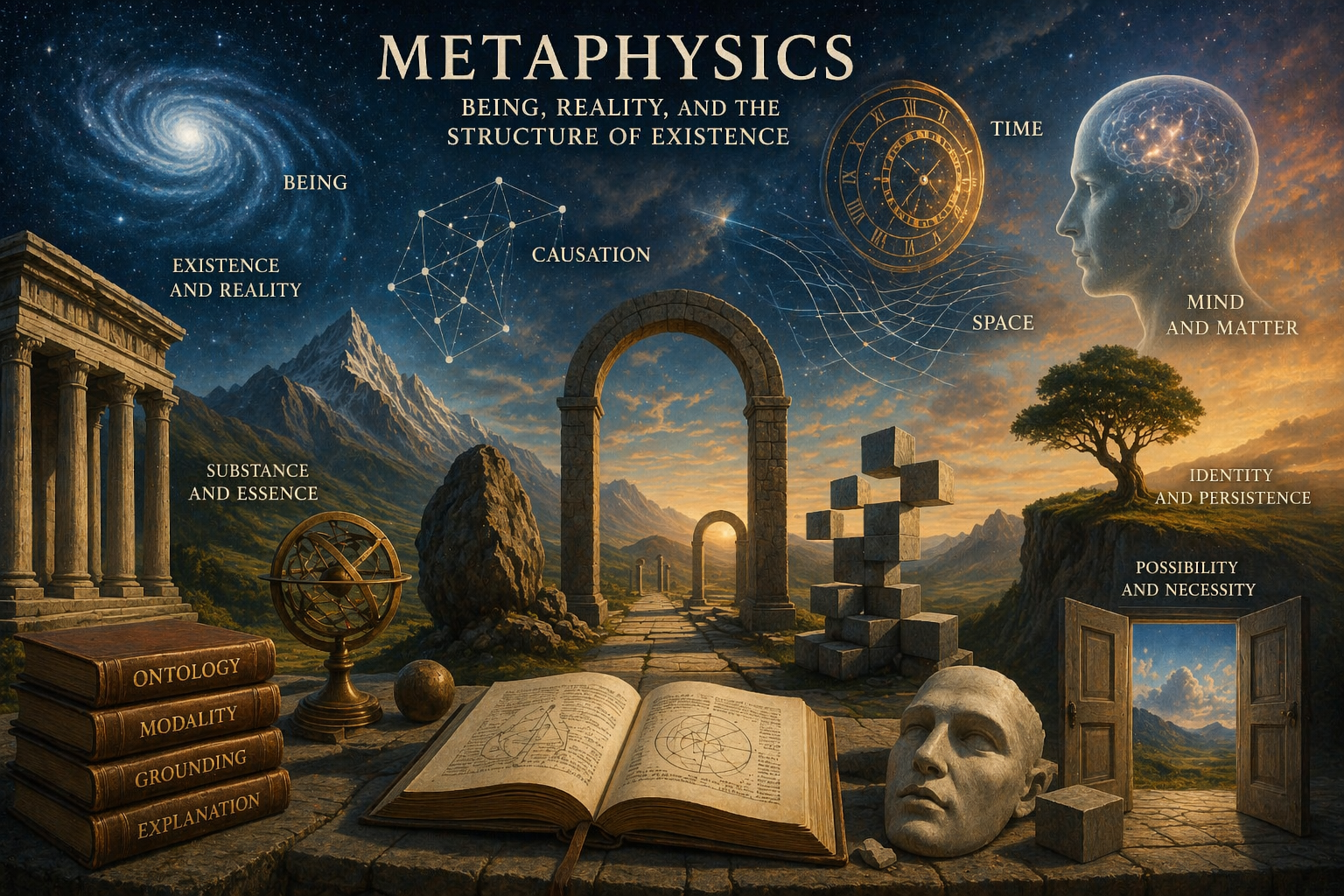
The goal of this pillar is not to treat metaphysics as a relic of premodern speculation or as an unbounded license for abstraction. It is to show why metaphysics remains philosophically indispensable precisely because every serious inquiry presupposes some account of what exists, what counts as explanation, what persists through change, what is possible, what is necessary, what is real, and how reality is structured. Even the claim that metaphysics should be rejected is itself entangled with assumptions about language, knowledge, world, thought, and the limits of intelligibility.
Metaphysics therefore belongs at the center of philosophical study. It is not merely one branch among others. It is a discipline of background clarification. It asks what must be true, or at least what must be assumed, for science, ethics, politics, theology, psychology, law, and ordinary human experience to make sense. It investigates the architecture beneath inquiry: being, structure, dependence, possibility, identity, causation, time, agency, consciousness, and world.
Why Metaphysics Matters
Metaphysics matters because every inquiry into the world presupposes some answer, explicit or implicit, to questions about what exists and how reality is structured. Science asks what kinds of things populate nature and what kinds of laws, entities, fields, systems, processes, or structures explain observable phenomena. Ethics asks what sorts of beings persons are and what kinds of value, responsibility, freedom, and obligation are real. Political philosophy asks whether institutions, states, laws, rights, groups, and collective agents have reality beyond individual persons. Philosophy of mind asks what consciousness is and whether it can be reduced to matter. Even skepticism about ultimate reality still presupposes some framework for distinguishing appearance, concept, experience, and world.
This matters because metaphysics is not simply about remote abstractions. It shapes how human beings understand identity, freedom, responsibility, agency, causation, explanation, and the boundaries of the possible. Questions about whether persons persist through time, whether causes are real, whether properties are objective, whether social entities exist, whether time flows, or whether freedom can coexist with determinism have consequences beyond technical philosophy. They affect moral judgment, legal reasoning, theology, political responsibility, ecological thought, medicine, artificial intelligence, and the interpretation of science.
Metaphysics also matters because every culture and intellectual tradition has some way of organizing the real. Some traditions emphasize substance and essence. Others emphasize process, relation, emptiness, manifestation, harmony, divine necessity, or the interdependence of beings. These differences are not merely linguistic. They shape how communities imagine selfhood, nature, causation, mortality, obligation, and the place of human beings within the wider order of things.
Within a broader intellectual architecture concerned with philosophy, systems, politics, ethics, religion, science, and reality, metaphysics provides one of the deepest foundations. Without it, many other inquiries remain conceptually underdescribed. With it, the background assumptions of thought become visible and open to criticism.
What Is Metaphysics?
Metaphysics is classically associated with the study of being as such and the first causes of things. Aristotle’s work later known as the Metaphysics helped define the field, even though the title itself was attached by later editors. Since then, metaphysics has been understood in multiple but related ways: as the study of being, the study of the most general features of reality, the inquiry into what there is, and the analysis of the basic structure of existence.
In contemporary philosophy, metaphysics is often closely linked to ontology, though the two are not always treated as identical. Ontology asks what exists. Metaphysics often asks the broader follow-up questions: what kind of existence those things have, what their most general features are, how they persist, how they depend on one another, how they are individuated, and how different aspects of reality are related. This is why metaphysics now encompasses issues such as modality, grounding, time, persistence, personhood, laws, causation, powers, realism, social ontology, and scientific explanation in addition to classical questions about being and cause.
Metaphysics therefore should not be reduced to a single problem. It is better understood as the philosophical investigation of reality at its deepest level: what it means to be, what the world fundamentally contains, and how what exists hangs together. It is concerned with the most general forms of intelligibility: object and property, whole and part, cause and effect, actual and possible, necessary and contingent, universal and particular, mind and body, identity and difference, appearance and reality, one and many, finite and infinite.
At its best, metaphysics is neither fantasy nor empty abstraction. It is disciplined conceptual work about the commitments already implied by thought, science, experience, and practice. It asks what reality must be like for our most serious inquiries to make sense.
What This Pillar Covers
This pillar is designed as a comprehensive foundation for the study of metaphysics. It combines classical questions about being and first principles with contemporary debates over ontology, grounding, modality, causation, time, identity, mind, realism, science, theology, and comparative metaphysical traditions.
Being and Ontology
The most basic metaphysical question is what there is. Ontology asks what kinds of entities exist: objects, properties, relations, events, numbers, minds, institutions, laws, absences, possibilities, social facts, or worlds. Metaphysics then asks how those entities exist and how they relate to one another.
Substance, Essence, and Structure
Metaphysics asks whether things possess underlying substances, forms, essences, natures, powers, or structures that make them what they are. These questions shape debates over nature, persons, categories, scientific classification, social identity, and the difference between accidental and necessary features.
Identity, Change, and Persistence
Reality appears to involve both continuity and change. Metaphysics asks what allows a thing, person, institution, or organism to remain itself through alteration. This includes questions about personal identity, bodily continuity, memory, narrative, material replacement, and temporal existence.
Causation, Grounding, and Explanation
Metaphysics investigates not only what exists, but how what exists is connected. Causation explains change across time. Grounding explains dependence and priority. Constitution, emergence, levels, and laws all belong to this wider inquiry into explanation.
Modality and Possibility
Metaphysics asks what it means for something to be possible, necessary, impossible, contingent, or actual. Modal reasoning is central to logic, science, ethics, theology, political imagination, and counterfactual explanation.
Time, Space, and Appearance
Time and space structure ordinary experience, but metaphysics asks whether they are fundamental, relational, emergent, subjective, objective, or theory-dependent. These questions shape how philosophers understand change, memory, causation, mortality, embodiment, and history.
Mind, Matter, and Personhood
The metaphysics of mind asks what consciousness is, whether mind is reducible to matter, whether persons are bodies, souls, patterns, narratives, organisms, agents, or something more complex, and what follows for dignity, responsibility, and selfhood.
Realism, Anti-Realism, and Metaphysical Method
Metaphysics must also examine its own ambition. Does it describe mind-independent reality, clarify conceptual schemes, map scientific commitments, or expose confusions generated by language? Realism and anti-realism define one of the major methodological debates in the field.
Metaphysics Across Traditions
Metaphysical inquiry is not confined to the Western canon. Chinese, Islamic, Persian, Indian, Buddhist, mystical, Indigenous, African, and other traditions have developed powerful accounts of being, process, relation, manifestation, emptiness, divine reality, harmony, personhood, and world.
Major Intellectual Lineages
The study of metaphysics draws on several major intellectual traditions. One foundational lineage centers on being itself: the question of what it means for something to be and whether being is said in one way or many. Classical Greek metaphysics framed this through substance, form, matter, actuality, potentiality, and first principles, while later medieval traditions extended it through essence, existence, necessity, contingency, divine simplicity, and the relation between created beings and divine reality.
A second lineage centers on ontology and individuation. In this tradition, metaphysics asks what kinds of entities exist, how objects are individuated, what distinguishes particulars from universals, and what sort of inventory of reality is philosophically defensible. Debates over nominalism, realism, naturalism, abstraction, social ontology, and ontological commitment all belong here.
A third lineage centers on persistence, change, and modality. This tradition asks how things remain themselves through alteration, what makes change intelligible, and how possibility, necessity, contingency, and counterfactual structure relate to actuality. It is central to the metaphysical analysis of time, identity, agency, lawfulness, and historical continuity.
A fourth lineage centers on causation, dependence, and explanation. Classical metaphysics asked about causes and first principles; contemporary metaphysics has widened the issue to include grounding, constitution, metaphysical priority, powers, emergence, and layered forms of explanation that are not reducible to simple event-causation alone.
A fifth lineage centers on mind, selfhood, and the relation between consciousness and world. Here metaphysics intersects with philosophy of mind, theology, phenomenology, existential thought, psychology, cognitive science, and spiritual anthropology in asking what persons are, what sort of beings minds might be, and whether subjectivity belongs to the structure of reality or merely to one region within it.
A sixth lineage includes anti-metaphysical, skeptical, and critical responses. Some philosophers argue that metaphysics exceeds the limits of knowledge, mistakes grammar for ontology, or constructs illusory problems out of language and abstraction. Kant, logical positivism, ordinary language philosophy, pragmatism, phenomenology, and later analytic critiques all reshaped the field by forcing metaphysics to justify its methods and limits.
Taken together, these lineages show that metaphysics is not a single doctrine but a field of argument about being, explanation, identity, dependence, possibility, and the architecture of the real. Its enduring importance lies in the fact that no serious inquiry can avoid assumptions about what reality is ultimately like.
Being, Ontology, and the Question of What There Is
One of the most basic metaphysical questions is simply: what is there? Ontology addresses this question directly. Are there only material objects? Do numbers exist? Are properties real? What about relations, absences, possibilities, fictional characters, nations, institutions, moral facts, laws of nature, or social categories? Philosophers disagree not only about the answers, but about how the question itself should be framed.
This matters because ontology determines what kinds of explanations are available. A sparse ontology seeks to explain the world with as few kinds of entities as possible. A richer ontology may allow for abstractions, structures, powers, levels of reality, or irreducible forms that cannot be eliminated without loss. Debates over realism, nominalism, naturalism, idealism, structuralism, and metaphysical pluralism all depend on what kinds of things one is willing to count as real.
Ontology also exposes one of philosophy’s oldest tensions: whether the world is more basic than our classifications, or whether our classifications partly determine what counts as an object of thought. The question of what there is is therefore never purely inventory-like. It is inseparable from deeper issues of explanation, concept, language, science, and reality.
Metaphysics must also distinguish between different modes of being. Material objects, mathematical entities, social institutions, mental states, fictional entities, and divine reality, if any, may not exist in the same way. A sophisticated ontology therefore does not merely count entities. It asks what kinds of existence are possible and what forms of dependence, construction, abstraction, or grounding different entities require.
Substance, Essence, and the Structure of Things
Metaphysics has long asked whether things possess an underlying substance, essence, or nature that makes them what they are. Classical metaphysics often framed this in terms of substance: that which exists in itself rather than as a property of something else. Closely related is the question of essence: what is necessary to a thing’s identity as the kind of thing it is.
This matters because essence structures explanation. If things have essential natures, then not all of their features are equally fundamental. Some properties are accidental; others define what the thing is. Debates over essence shape philosophy of nature, philosophy of mind, metaphysics of persons, philosophy of biology, social ontology, and even political thought when thinkers ask whether entities such as states, genders, institutions, species, rights, or persons have stable natures or are historically constructed.
Even philosophers who reject strong essentialism must still explain what makes categories hold together, what individuates entities, and why some changes preserve identity while others destroy it. Questions of substance and essence therefore continue to animate contemporary metaphysics even when they appear in new vocabularies such as structure, function, kind, organization, system, power, process, or pattern.
Substance metaphysics also raises the problem of independence. What exists in its own right, and what exists only in another? Are objects more basic than properties? Are relations more basic than objects? Are processes more basic than substances? These questions shape whether reality is imagined as a world of things, fields, events, systems, networks, or relations.
Identity, Change, and Persistence
Another central metaphysical problem concerns identity through change. How can a thing remain the same thing while undergoing alteration? What makes a person the same person over time? Is persistence a matter of substance, continuity, structure, memory, body, function, relation, narrative, or social recognition? These questions are basic to metaphysics because reality appears to involve both endurance and transformation.
This matters because identity is not only a technical issue. It shapes moral and legal responsibility, theories of personhood, memory, ownership, political continuity, inheritance, biological identity, and the very intelligibility of change. If a thing changes completely, in what sense is it the same thing? If a person loses memory, body, or social role, what persists? If an institution changes its members, rules, location, or mission, is it still the same institution?
Metaphysics remains indispensable here because everyday language assumes sameness across time, while philosophy asks what could possibly make that assumption true. The problem of persistence therefore sits at the intersection of ontology, time, embodiment, social recognition, and selfhood.
Identity also raises the problem of criteria. Different kinds of things may persist in different ways. Organisms, artifacts, persons, texts, nations, rituals, ecosystems, and digital objects may not share one single persistence condition. A strong metaphysics of identity must therefore account for plurality without dissolving identity into mere convention.
Causation, Grounding, and Explanation
Metaphysics does not only ask what exists. It asks how what exists is connected. Causation has long been central to this inquiry: how events, things, powers, or processes bring about other events, things, powers, or processes. More recently, philosophers have also distinguished metaphysical explanation or grounding from ordinary causal explanation, asking what makes certain facts obtain in a more basic sense and what relations of dependence structure the world beneath surface appearances.
This matters because not all explanation is causal in the same way. The existence of a law may explain a verdict; the constitution of an object may explain its persistence; the structure of a set may explain a property of its members; an institutional fact may depend on social practices without being reducible to a single event. Grounding theories try to capture these relations of dependence, priority, and metaphysical determination. They ask not just what caused something, but what more fundamentally accounts for it.
For a systems-oriented philosophical architecture, this is especially important. Many explanations in science, politics, ethics, law, ecology, and social theory presuppose layered realities in which some facts depend on others without being reducible to them. Metaphysics supplies the vocabulary for thinking about those layers.
Causation also raises questions about powers, laws, probability, counterfactuals, and intervention. Are causes regularities, productive powers, relations of dependence, processes, mechanisms, or features of explanation? Are laws of nature governing principles, descriptions of regularities, expressions of powers, or structural constraints? These questions connect metaphysics directly to scientific reasoning.
Possibility, Necessity, and Modal Reality
Metaphysics also asks what it means for something to be possible, necessary, impossible, contingent, or actual. Modal metaphysics investigates the basis of modal claims: when we say something could have been otherwise, or must be the case, what makes those claims true or false? Are possibilities grounded in possible worlds, essences, laws, powers, concepts, divine intellect, imagination, or structures of reason?
This matters because possibility and necessity are built into everyday and scientific reasoning. We distinguish what happened from what could have happened, what must hold from what merely does hold, what is contingent from what is necessary. These distinctions shape logic, ethics, political theory, theology, engineering, design, counterfactual reasoning, responsibility, and scientific explanation. Without some account of modality, many forms of reasoning about agency, law, design, structural possibility, and alternative futures would become unintelligible.
Modal metaphysics therefore expands the scope of reality beyond what is merely actual. It asks whether reality includes structured possibilities and, if so, what their ontological status is. The actual world may be only one way things could have been. But if possibilities are real in some sense, metaphysics must explain what kind of reality they possess.
Modality also matters existentially. Human beings live by imagining what could be otherwise: different actions, different futures, different institutions, different forms of life. Political, ethical, religious, and scientific imagination all depend on modal structure. Metaphysics therefore gives philosophical depth to the difference between necessity, fate, contingency, freedom, and transformation.
Time, Space, and the World of Appearance
Time and space are among the most basic frameworks of experience, yet metaphysics asks whether they are fundamental features of reality, relations among things, forms of intuition, emergent structures, or artifacts of physical theory rather than common sense. Is time something that flows? Are past and future equally real? Is the present metaphysically privileged? Is space a container, a network of relations, or a feature of the way embodied beings encounter a world?
This matters because our deepest intuitions about change, persistence, causation, agency, and history depend on time and space. The metaphysics of time affects how we think about freedom, memory, mortality, responsibility, and future generations. The metaphysics of space affects how we think about bodies, objects, place, distance, environment, embodiment, and physical organization. Even ordinary perception is conceptually shaped by assumptions about temporal sequence and spatial location.
Metaphysics is therefore not optional here. If time and space are not exactly as they appear, philosophy must explain both the reality beneath appearance and the structure of appearance itself. This is especially important in relation to physics, where relativity and quantum theory have challenged common-sense assumptions about simultaneity, locality, and the structure of spacetime.
Time and space also matter for existential and ethical life. Mortality, memory, historical responsibility, ecological obligation, and intergenerational justice all presuppose some account of temporality. Place, land, home, exile, territory, and embodiment all presuppose some account of spatial existence. Metaphysics gives these assumptions philosophical form.
Universals, Particulars, and the Problem of Properties
When many different things share a feature, what explains that sharing? Are redness, triangularity, justice, humanity, mass, charge, or life real universals? Or are there only particular things that resemble one another? This classical metaphysical problem concerns the status of properties and the relation between what is individual and what is repeatable.
This matters because the problem of universals lies beneath classification, science, language, and knowledge. If properties are real, they may help explain regularity and intelligibility. If only particulars exist, then similarity, predication, and category formation require a different account. The debate shapes metaphysics, logic, epistemology, philosophy of science, aesthetics, ethics, and theories of lawfulness.
For a research-grade pillar, this theme is indispensable because it shows how even simple descriptive language rests on deep ontological assumptions. To say that two things are both just, red, human, living, or conscious is already to enter metaphysical terrain.
The debate also matters for social and moral thought. If justice, dignity, personhood, or rights are treated as real properties, metaphysics supports one kind of philosophical architecture. If they are treated as constructed, relational, historically contingent, or practice-dependent, a different architecture follows. Metaphysics therefore shapes how abstraction connects to lived reality.
Mind, Body, and the Nature of Personhood
Metaphysics also asks what kind of beings persons are. Are minds reducible to physical processes? Is consciousness fundamental, emergent, relational, embodied, functional, spiritual, or irreducible? What relation holds between body, thought, selfhood, memory, agency, and world? Classical and modern philosophy have repeatedly returned to these questions because personhood sits at the intersection of ontology, identity, causation, value, and experience.
This matters because the metaphysics of mind shapes ethics, law, political thought, medicine, theology, technology, and spiritual anthropology. Responsibility presupposes some account of agency. Dignity presupposes some account of personhood. Memory, freedom, accountability, and harm all depend on what sort of beings persons are and how mental life relates to bodily existence.
Metaphysics is especially crucial here because theories of the person often determine what counts as harm, what persists through time, and what it means to live well or die well. The problem of mind and body is therefore not a side issue. It is one of the deepest centers of metaphysical inquiry.
This theme has renewed importance in an age of artificial intelligence, neuroscience, cognitive science, biotechnology, and digital identity. Questions about machine intelligence, brain states, consciousness, personhood, embodiment, simulation, and agency all depend on metaphysical assumptions. The metaphysics of mind is therefore both ancient and urgent.
Realism, Anti-Realism, and the Status of the World
Metaphysics continually returns to the question of realism: whether the world has a determinate structure independent of our conceptual schemes, linguistic practices, or capacities for recognition. Anti-realist and critical responses challenge strong versions of this picture, arguing that at least some metaphysical claims depend more heavily on conceptual frameworks, practices, languages, or epistemic conditions than realists admit.
This matters because realism is not merely an abstract position. It affects how philosophers understand truth, objectivity, science, mathematics, morality, religion, and the legitimacy of metaphysics itself. If reality is strongly mind-independent, metaphysics may aim to describe it. If not, metaphysics may need to become more modest, therapeutic, phenomenological, pragmatic, or framework-relative.
The realism debate thus becomes a debate about the ambition of philosophy. It asks whether metaphysics discovers the world’s structure, constructs conceptual order, clarifies practice, or negotiates between the two.
A serious metaphysics pillar must therefore include both constructive metaphysics and critique of metaphysics. It must ask not only what reality is like, but how we could know, describe, or responsibly theorize reality without confusing language, model, culture, or method for the world itself.
Metaphysics and Science
Metaphysics has never been wholly separate from science. Historically, what counted as metaphysics was closely entangled with natural philosophy. In contemporary philosophy, the relation has become more complex. Some philosophers see metaphysics as continuous with science, asking what ontology is best supported by physics, biology, cosmology, cognitive science, or systems theory. Others argue that metaphysics asks questions science alone cannot settle, especially questions about explanation, modality, grounding, abstraction, personhood, value, and the conceptual structure of theories themselves.
This matters because modern metaphysics must remain answerable to the best available knowledge without surrendering its distinct philosophical role. Scientific theories may describe how phenomena behave, while metaphysics asks what sort of reality such descriptions imply. It therefore functions both as a partner to science and as a reflective inquiry into the assumptions science may leave implicit.
Physics raises questions about spacetime, fields, laws, causation, locality, probability, and the nature of matter. Biology raises questions about organism, function, emergence, teleology, species, life, and levels of organization. Cognitive science raises questions about mind, representation, consciousness, agency, and embodiment. Systems theory raises questions about complexity, emergence, feedback, and interdependence.
For this category, the intersection is especially important because systems thinking, environmental modeling, technology, artificial intelligence, and philosophy of reality all depend on some understanding of what levels of description reveal and what kinds of explanation count as fundamental.
Metaphysics and the History of Philosophy
Metaphysics has shaped philosophy from its earliest formations. Greek philosophy asked about substance, change, form, matter, actuality, potentiality, and first principles. Medieval philosophy extended these questions through theology, divine being, essence and existence, necessity, contingency, and the structure of creation. Early modern philosophy transformed metaphysics through debates over mind and matter, causation, substance, God, freedom, and the conditions of knowledge. Later philosophy often criticized metaphysics, yet in doing so it continued to wrestle with the very problems metaphysics had named.
This matters because the history of philosophy is in large part a history of metaphysical argument. Questions about being, causation, personhood, time, world, and reality do not disappear when philosophical styles change. They are reformulated. Even movements that reject classical metaphysics often retain powerful assumptions about reality, structure, subjectivity, worldhood, or intelligibility.
A strong metaphysics pillar should therefore treat the history of the field not as background, but as part of the argument itself. Philosophical traditions inherit, revise, and contest metaphysical frameworks rather than simply abandoning them.
The history of metaphysics is also a history of limits. Plato, Aristotle, Avicenna, Aquinas, Suhrawardi, Spinoza, Leibniz, Hume, Kant, Hegel, Heidegger, Whitehead, Wittgenstein, Quine, and contemporary analytic metaphysicians all ask, in different ways, how far metaphysical thought can go and what disciplines it must obey.
Metaphysics Beyond the West
Metaphysical inquiry is not confined to the Western canon. Chinese traditions developed accounts of reality shaped by relation, process, harmony, pattern, transformation, and the ordering of heaven, earth, and human life. Islamic philosophy and theology examined being, necessity, contingency, causation, soul, divine reality, and the structure of existence in ways deeply connected to both Greek inheritance and Qur’anic thought. Persian and mystical traditions often explored metaphysical questions through illumination, emanation, graded reality, manifestation, and the relation between visible and invisible worlds.
Indian philosophical traditions developed sophisticated accounts of self, consciousness, substance, causation, perception, liberation, emptiness, non-duality, and the relation between appearance and ultimate reality. Buddhist metaphysics raised profound questions about impermanence, no-self, dependent arising, emptiness, causation, and the critique of substantial being. African, Indigenous, and other philosophical traditions often emphasize relation, ancestry, land, spirit, personhood, community, life-force, or world as living order rather than inert object.
This matters because a research-grade treatment of metaphysics should not equate metaphysical inquiry with one civilizational vocabulary alone. Different traditions organize questions of reality through different conceptual grammars: substance, process, essence, manifestation, harmony, dependence, divine necessity, emptiness, relation, ancestry, or graded being. These differences do not diminish metaphysics. They widen it.
For a broader philosophy architecture, this is especially important. It allows metaphysics to function not only as a classical philosophical pillar, but as a bridge across Greek, Islamic, Chinese, Persian, Indian, Buddhist, mystical, Indigenous, African, and comparative philosophical traditions.
Moral, Political, and Existential Stakes
Metaphysics may seem remote from practical life, yet its stakes are profound. The way one understands persons affects law and ethics. The way one understands causation affects responsibility and policy. The way one understands time affects historical judgment, obligation to future generations, and the meaning of mortality. The way one understands mind and matter affects medicine, technology, dignity, and the interpretation of consciousness.
This matters because metaphysics supplies the background assumptions of public and moral reasoning. A society built on strong materialism may understand human agency differently from one shaped by spiritual anthropology, relational ontology, or process metaphysics. A politics grounded in atomistic individualism differs from one grounded in thicker conceptions of personhood, dependence, relation, land, community, or worldhood.
Metaphysics also shapes how human beings interpret death, suffering, hope, responsibility, and the possibility of transformation. Whether reality is ultimately mechanical, personal, purposive, empty, relational, divine, emergent, or unknowable changes the emotional and ethical atmosphere in which human life is understood.
Metaphysics therefore belongs not only to abstract philosophy, but to the lived questions of freedom, mortality, institution, knowledge, technology, ecological belonging, and meaning. Its deepest questions are often also the most existentially charged.
Core Themes in Metaphysics
One major theme in metaphysics is being itself. What does it mean for something to exist, and are all modes of existence the same?
A second theme is structure. Metaphysics asks whether reality is made up of substances, processes, relations, fields, levels, powers, forms, systems, or some combination of these.
A third theme is identity and persistence. It asks what makes a thing or person remain itself through time and change.
A fourth theme is explanation. Metaphysics examines causation, grounding, dependence, constitution, emergence, and the conditions under which something counts as explained.
A fifth theme is modality. It studies possibility, necessity, contingency, counterfactual structure, and the architecture of what could be otherwise.
A sixth theme is time and space. It asks whether time and space are fundamental, relational, emergent, experiential, or theory-dependent.
A seventh theme is mind and personhood. It asks what consciousness is, what persons are, and how mental and physical realities relate.
An eighth theme is realism. It asks whether reality is independent of thought and language, and if so in what way.
A ninth theme is metaphysical method. It asks whether metaphysics should be analytic, scientific, phenomenological, historical, comparative, theological, or therapeutic.
Finally, metaphysics raises the question of intelligibility itself: why the world appears orderable by reason, and whether that order belongs to things, concepts, practices, divine mind, scientific models, or some complex relation among them.
Expanded Article Architecture
The following structure gathers the metaphysics pillar into a long-range article architecture. It expands the original article list into a fuller publication map while keeping the focus scholarly, historically grounded, conceptually serious, and connected to broader philosophy, science, religion, and systems thinking.
Foundations of Metaphysics
- What Is Metaphysics in Philosophy? (planned)
Introduces metaphysics as the philosophical study of being, existence, reality, first principles, and the most general structure of what there is. - Why Metaphysics Still Matters (planned)
Explains why metaphysical questions remain indispensable for science, ethics, politics, theology, mind, personhood, and the interpretation of reality. - Metaphysics as First Philosophy (planned)
Studies the classical idea that metaphysics investigates the deepest principles underlying all other forms of inquiry. - Metaphysics, Ontology, and the Structure of Inquiry (planned)
Clarifies the relationship between metaphysics and ontology while showing how each shapes philosophical explanation. - Appearance and Reality in Metaphysical Thought (planned)
Examines the distinction between how things appear and what reality may be like beneath or beyond appearance. - Metaphysical Method: Analysis, Science, History, and Speculation (planned)
Explores different methods in metaphysics, from conceptual analysis and scientific realism to phenomenology and historical reconstruction.
Being, Existence, and Ontology
- Being, Existence, and the Question of What There Is (planned)
Studies the basic ontological question of what exists and how different kinds of entities may be counted as real. - Ontology and the Structure of Reality (planned)
Examines ontology as the philosophical inventory of reality and the study of the categories into which reality is organized. - Modes of Being and Degrees of Reality (planned)
Explores whether material objects, abstract entities, minds, social facts, and divine realities exist in the same way or in different modes. - Ontological Commitment and the Problem of What We Must Believe Exists (planned)
Studies how theories commit us to entities and how philosophers decide what belongs in a serious ontology. - Sparse Ontology and Rich Ontology (planned)
Compares minimalist approaches to reality with richer accounts that include properties, relations, powers, structures, or abstract entities. - Social Ontology and the Reality of Institutions (planned)
Examines whether nations, laws, money, corporations, offices, rights, and institutions are real and how social facts depend on collective practices.
Substance, Essence, Form, and Nature
- Substance, Essence, and the Nature of Things (planned)
Introduces the classical and contemporary debate over whether things possess underlying natures that make them what they are. - Form, Matter, Actuality, and Potentiality (planned)
Studies the Aristotelian framework of form and matter, actuality and potentiality, and its influence on later metaphysics. - Essence and Existence in Metaphysical Thought (planned)
Examines the distinction between what a thing is and that it is, especially in medieval and Islamic philosophical traditions. - Natural Kinds and the Metaphysics of Classification (planned)
Studies whether categories in science and ordinary life reflect real divisions in nature or human classificatory practices. - Essentialism and Its Critics (planned)
Examines arguments for and against the claim that things possess necessary defining natures. - Powers, Dispositions, and the Active Structure of Things (planned)
Explores whether objects and properties contain real powers or dispositions that explain causal behavior.
Identity, Change, and Persistence
- Identity, Change, and Persistence Through Time (planned)
Introduces the problem of how things remain the same while undergoing change. - The Ship of Theseus and the Metaphysics of Material Replacement (planned)
Uses the classical puzzle of replacement to examine identity, parts, continuity, and persistence. - Personal Identity, Memory, and the Continuity of the Self (planned)
Studies what makes a person the same person over time, including memory, body, psychology, narrative, and social recognition. - Endurance, Perdurance, and Four-Dimensionalism (planned)
Compares major theories of persistence, including objects enduring wholly through time or persisting through temporal parts. - Identity, Death, and the Boundary of Personhood (planned)
Examines how metaphysical theories of identity shape questions of death, survival, responsibility, and moral status. - Institutional Identity and Historical Continuity (planned)
Studies how institutions, traditions, communities, and political orders persist through change.
Causation, Grounding, and Explanation
- Causation, Grounding, and Metaphysical Explanation (planned)
Introduces the difference between causal explanation and metaphysical dependence or grounding. - What Is Causation? Regularity, Powers, and Production (planned)
Compares major theories of causation, including regularity theories, counterfactual theories, process theories, and powers-based accounts. - Grounding and the Structure of Dependence (planned)
Studies grounding as a relation of metaphysical priority that explains what makes facts obtain. - Constitution, Composition, and the Problem of Parts and Wholes (planned)
Examines how parts compose wholes and whether wholes are reducible to their parts. - Emergence and Levels of Reality (planned)
Studies whether higher-level phenomena such as life, mind, society, and institutions are reducible or genuinely emergent. - Laws of Nature and the Metaphysics of Order (planned)
Examines whether laws of nature govern reality, describe regularities, express powers, or reflect structural constraints. - Explanation in Systems, Science, and Philosophy (planned)
Connects metaphysical explanation to systems thinking, layered causation, feedback, complexity, and scientific modeling.
Modality, Possibility, and Necessity
- Possibility, Necessity, and Modal Reality (planned)
Introduces modality as the study of what could be, what must be, what cannot be, and what merely happens to be actual. - Possible Worlds and the Architecture of Alternatives (planned)
Examines possible-worlds semantics and the metaphysical status of alternative ways reality could have been. - Essence, Modality, and Necessary Truth (planned)
Studies the relationship between what things are and what must be true of them. - Counterfactuals and the Structure of What Could Have Happened (planned)
Explores counterfactual reasoning and its role in causation, responsibility, science, and historical explanation. - Contingency, Fate, and the Limits of Necessity (planned)
Examines the philosophical meaning of contingency and why not everything that happens had to happen. - Modal Imagination and Political Possibility (planned)
Studies how metaphysical thinking about possibility shapes moral imagination, institutional design, and visions of alternative futures.
Time, Space, and Worldhood
- Time, Space, and the Conditions of Appearance (planned)
Studies time and space as frameworks of experience, reality, physics, and metaphysical interpretation. - Does Time Flow? Presentism, Eternalism, and the Growing Block (planned)
Compares major theories of time and the status of past, present, and future. - Memory, Mortality, and the Metaphysics of Time (planned)
Examines how time shapes memory, death, responsibility, hope, and existential self-understanding. - Space, Place, and Embodied Reality (planned)
Studies space and place as metaphysical conditions for embodiment, worldhood, distance, land, and belonging. - Spacetime, Relativity, and Metaphysical Common Sense (planned)
Examines how modern physics challenges ordinary assumptions about space, time, simultaneity, and reality. - Worldhood, Horizon, and the Structure of Experience (planned)
Explores phenomenological and existential approaches to world, appearance, and the conditions under which things show up as meaningful.
Universals, Particulars, Properties, and Relations
- Universals, Particulars, and the Problem of Properties (planned)
Introduces the problem of how many different things can share one feature or property. - Realism and Nominalism About Universals (planned)
Compares theories that treat universals as real with those that reduce properties to names, resemblances, or concepts. - Tropes, Resemblance, and Particularized Properties (planned)
Studies trope theory and other attempts to explain properties without universal entities. - Relations and the Structure Between Things (planned)
Examines whether relations are real and whether they are more fundamental than objects themselves. - Properties in Science, Ethics, and Social Life (planned)
Explores how metaphysical debates about properties shape scientific classification, moral categories, and social concepts.
Mind, Matter, Consciousness, and Personhood
- Mind, Matter, and the Metaphysics of Personhood (planned)
Introduces the metaphysical question of what persons are and how mental life relates to physical reality. - Metaphysics and the Problem of Consciousness (planned)
Studies consciousness as a metaphysical problem involving subjectivity, experience, embodiment, and explanation. - Dualism, Materialism, and the Mind-Body Problem (planned)
Compares major theories of the relation between mental and physical reality. - Emergent Mind and the Limits of Reduction (planned)
Examines whether consciousness can emerge from physical systems without being reducible to them. - Embodiment, Agency, and the Situated Self (planned)
Studies persons as embodied, relational, situated beings rather than isolated mental substances. - Artificial Intelligence, Consciousness, and Metaphysical Personhood (planned)
Examines whether artificial systems could possess mind, agency, consciousness, or moral status. - Death, Survival, and the Metaphysics of the Self (planned)
Studies philosophical questions about death, survival, soul, memory, continuity, and personal identity.
Freedom, Determinism, and Agency
- Freedom, Determinism, and Agency (planned)
Introduces the metaphysical debate over whether human freedom can coexist with causal determination. - Free Will, Responsibility, and the Structure of Choice (planned)
Studies how theories of freedom shape moral judgment, law, blame, praise, and accountability. - Compatibilism and the Reconciliation of Freedom and Causation (planned)
Examines attempts to show that freedom and determinism need not be mutually exclusive. - Hard Determinism, Fatalism, and the Denial of Free Will (planned)
Studies theories that deny freedom or reinterpret human agency under necessity. - Libertarian Free Will and Agent Causation (planned)
Explores theories that defend genuine alternative possibility and agent-level causal power. - Freedom, Neuroscience, and the Metaphysics of Agency (planned)
Connects metaphysical debates over agency to neuroscience, decision-making, embodiment, and responsibility.
Realism, Anti-Realism, and Metaphysical Method
- Realism, Anti-Realism, and Metaphysical Debate (planned)
Introduces the question of whether metaphysics describes mind-independent reality or conceptual frameworks. - Scientific Realism and the Metaphysics of Theories (planned)
Studies whether successful scientific theories reveal the real structure of the world. - Conceptual Schemes and the Limits of Metaphysical Objectivity (planned)
Examines whether metaphysical claims depend on human languages, practices, or conceptual frameworks. - Kant and the Critique of Traditional Metaphysics (planned)
Studies Kant’s challenge to metaphysical knowledge and his account of the conditions of experience. - Wittgenstein, Language, and the Dissolution of Metaphysical Problems (planned)
Examines approaches that treat some metaphysical problems as confusions generated by language. - Quine, Ontology, and the Logic of Commitment (planned)
Studies Quine’s approach to ontology, language, science, and what theories commit us to saying exists.
Metaphysics and Science
- Metaphysics and Science (planned)
Introduces the relation between metaphysical inquiry and scientific explanation. - Metaphysics of Physics: Fields, Particles, Laws, and Spacetime (planned)
Examines the metaphysical questions raised by contemporary physics, including matter, field, law, locality, and spacetime. - Metaphysics of Biology: Life, Function, Organism, and Species (planned)
Studies biological metaphysics through life, teleology, function, organism, species, emergence, and evolution. - Metaphysics of Systems and Complexity (planned)
Connects metaphysics to complexity, emergence, feedback, systems, organization, and levels of reality. - Metaphysics in an Age of Systems and Complexity (planned)
Explores why complex systems challenge simple reductionist accounts of causation and reality. - Naturalism and the Limits of Scientific Metaphysics (planned)
Studies whether metaphysics should be constrained by science or whether philosophy retains independent questions.
Classical Greek and Roman Metaphysics
- Aristotle and the Foundations of Metaphysics (planned)
Studies Aristotle’s account of being, substance, cause, form, matter, actuality, potentiality, and first philosophy. - Plato, Form, and the Architecture of Reality (planned)
Examines Plato’s theory of forms, participation, knowledge, and the relation between sensible things and intelligible reality. - Parmenides, Being, and the Problem of Change (planned)
Studies the radical claim that being is one and unchanging, and its impact on later metaphysics. - Heraclitus, Flux, and the Metaphysics of Becoming (planned)
Explores change, process, conflict, and order in Heraclitean metaphysical thought. - Stoic Metaphysics: Logos, Body, Fate, and World Order (planned)
Studies Stoic accounts of material reality, divine reason, causation, fate, and cosmic order. - Neoplatonism, Emanation, and the One (planned)
Examines Plotinus and later Neoplatonic metaphysics of unity, emanation, intellect, soul, and return.
Medieval, Islamic, and Theological Metaphysics
- Metaphysics, Theology, and First Principles (planned)
Studies the relationship between metaphysics and theology in questions of God, creation, necessity, and ultimate explanation. - Metaphysics in Islamic Philosophy (planned)
Introduces Islamic metaphysical thought through being, necessity, contingency, causation, intellect, soul, and divine reality. - Avicenna, Necessary Being, and Essence-Existence Metaphysics (planned)
Studies Avicenna’s distinction between essence and existence and his account of necessary being. - Al-Ghazali, Causation, and the Limits of Philosophy (planned)
Examines al-Ghazali’s critique of philosophical necessity and his influence on debates about causation and divine agency. - Averroes, Aristotle, and the Defense of Philosophical Metaphysics (planned)
Studies Averroes’ Aristotelian metaphysics and his defense of philosophical reasoning. - Aquinas, Being, Participation, and Divine Simplicity (planned)
Examines Aquinas’s metaphysics of being, essence, existence, participation, causation, and God. - Creation, Contingency, and the Metaphysics of Dependence (planned)
Studies creation as a metaphysical relation of dependence rather than merely a temporal beginning.
Chinese, Indian, Buddhist, and Comparative Metaphysics
- Chinese Metaphysics, Pattern, and Harmony (planned)
Introduces Chinese metaphysical traditions through pattern, relation, harmony, transformation, heaven, earth, and human life. - Dao, Process, and the Metaphysics of Natural Order (planned)
Studies Daoist metaphysical themes of way, spontaneity, non-coercion, transformation, and the limits of conceptual control. - Neo-Confucian Li and Qi: Pattern, Vital Force, and Moral Reality (planned)
Examines Neo-Confucian accounts of pattern, material force, moral cultivation, and cosmic order. - Indian Metaphysics: Self, Substance, Consciousness, and Liberation (planned)
Introduces major Indian metaphysical debates over self, reality, causation, consciousness, and liberation. - Buddhist Metaphysics: Impermanence, No-Self, and Dependent Arising (planned)
Studies Buddhist critiques of substance through impermanence, no-self, causation, and interdependence. - Emptiness and the Metaphysics of Non-Substantial Reality (planned)
Examines emptiness as a critique of inherent existence and a framework for relational reality. - Comparative Metaphysics and the Problem of Translation (planned)
Studies how metaphysical concepts change across languages, traditions, and intellectual worlds.
Mystical, Persian, and Illuminationist Metaphysics
- Mystical Metaphysics and the Structure of Reality (planned)
Introduces mystical approaches to reality through manifestation, union, presence, interiority, and the visible-invisible relation. - Persian Metaphysics, Illumination, and Graded Reality (planned)
Studies Persian and illuminationist accounts of light, hierarchy, presence, and the gradation of being. - Suhrawardi and the Metaphysics of Light (planned)
Examines Suhrawardi’s illuminationist philosophy and its account of knowledge, being, and light. - Ibn Arabi, Being, Manifestation, and Divine Reality (planned)
Studies Ibn Arabi’s metaphysical language of unity, manifestation, divine names, and the relation between God and world. - Mulla Sadra and the Primacy of Existence (planned)
Examines Mulla Sadra’s metaphysics of existence, substantial motion, and the gradation of reality. - Metaphysics of the Visible and Invisible (planned)
Explores metaphysical accounts that distinguish sensory reality from hidden, intelligible, spiritual, or unseen orders.
Modern, Existential, and Process Metaphysics
- Descartes, Mind, Matter, and Modern Metaphysics (planned)
Studies Cartesian dualism, substance, certainty, and the modern framing of mind and matter. - Spinoza, Substance, God, and Nature (planned)
Examines Spinoza’s monism, necessity, attributes, modes, and the identity of God and nature. - Leibniz, Monads, Possibility, and Sufficient Reason (planned)
Studies Leibniz’s metaphysics of monads, possible worlds, necessity, and explanation. - Hume, Causation, and the Critique of Necessary Connection (planned)
Examines Hume’s challenge to causal necessity and its influence on modern metaphysics. - Hegel, Becoming, and the Metaphysics of Spirit (planned)
Studies Hegel’s dynamic metaphysics of contradiction, development, history, and absolute spirit. - Heidegger, Being, and the Forgetting of Metaphysics (planned)
Examines Heidegger’s question of being and his critique of the Western metaphysical tradition. - Whitehead and Process Metaphysics (planned)
Studies reality as process, event, relation, creativity, and becoming rather than static substance. - Existential Metaphysics: Being, Death, Freedom, and World (planned)
Explores metaphysical themes in existential thought, including finitude, choice, worldhood, absurdity, and mortality.
Metaphysics, Ethics, Politics, and Human Life
- Metaphysics and Ethics: Personhood, Value, and Moral Reality (planned)
Studies how metaphysical assumptions about persons, value, freedom, and reality shape ethical thought. - Metaphysics and Political Philosophy: Institutions, Power, and Collective Reality (planned)
Examines the metaphysical status of states, laws, rights, institutions, peoples, and collective agents. - Metaphysics of Law, Rights, and Normative Order (planned)
Studies whether legal and moral norms have objective reality, social reality, or practice-dependent existence. - Metaphysics of Technology and Artificial Worlds (planned)
Explores digital objects, simulations, artificial intelligence, virtual spaces, and the ontology of technological systems. - Ecological Metaphysics: Relation, Land, Life, and Interdependence (planned)
Studies relational and ecological accounts of reality that challenge atomistic or purely mechanistic metaphysics. - Metaphysics, Mortality, and the Search for Meaning (planned)
Examines how metaphysical views shape human responses to death, suffering, hope, and the meaning of existence.
Closing Perspective
Metaphysics remains indispensable because human beings cannot think, act, know, judge, build, worship, remember, or imagine without some account of reality. Every science presupposes an ontology. Every ethics presupposes some account of persons and value. Every politics presupposes some account of institutions, agency, and collective life. Every religion presupposes some account of visible and invisible reality. Every critique of metaphysics presupposes some view of language, world, knowledge, and the limits of thought.
This does not mean metaphysics is easy, final, or immune from criticism. It means the opposite. Metaphysics is necessary because the deepest assumptions of inquiry must be examined rather than left hidden. The field asks what exists, what depends on what, what persists, what changes, what is possible, what is necessary, what is real, and how the world becomes intelligible at all.
The strongest reason to study metaphysics is that it trains thought at the deepest level. It teaches that reality is not exhausted by appearances, that concepts carry ontological commitments, that explanations require structure, and that every serious question eventually touches the architecture of being. Metaphysics is therefore not an escape from the world. It is one of the most demanding ways of asking what kind of world there is.
Related Reading
- Philosophy — for the broader category structure connecting metaphysics, ethics, political philosophy, epistemology, and major philosophical traditions.
- Ontology — for deeper study of being, existence, categories, entities, and the question of what there is.
- Time, Change, and Causation — for persistence, temporal reality, causation, change, and metaphysical explanation.
- Mind, Matter, and Consciousness — for philosophy of mind, personhood, consciousness, embodiment, and the mind-body problem.
- Freedom, Agency, and Determinism — for free will, causation, responsibility, agency, and the structure of choice.
- Greek and Roman Thought — for Plato, Aristotle, Stoicism, Neoplatonism, form, substance, cause, and cosmic order.
- Islamic and Mystical Thought — for being, necessity, contingency, divine reality, illumination, and mystical metaphysics.
- Chinese Thought — for Dao, pattern, harmony, transformation, relation, and process-oriented metaphysical traditions.
- Existential Thought — for being, death, freedom, absurdity, meaning, and worldhood.
Further Reading
- Aristotle (1998) Metaphysics. Translated by H. Lawson-Tancred. London: Penguin Classics.
- Bird, A. and Tobin, E. (2022) ‘Natural Kinds’, in Zalta, E.N. and Nodelman, U. (eds.) The Stanford Encyclopedia of Philosophy. Available at: https://plato.stanford.edu/entries/natural-kinds/.
- Britannica (n.d.) Metaphysics. Available at: https://www.britannica.com/topic/metaphysics.
- Cameron, R.P. (2024) ‘Truthmakers’, in Zalta, E.N. and Nodelman, U. (eds.) The Stanford Encyclopedia of Philosophy. Available at: https://plato.stanford.edu/entries/truthmakers/.
- Internet Encyclopedia of Philosophy (n.d.) Modal Metaphysics. Available at: https://iep.utm.edu/mod-meta/.
- Lewis, D. (1986) On the Plurality of Worlds. Oxford: Blackwell.
- Loux, M.J. and Crisp, T.M. (2017) Metaphysics: A Contemporary Introduction. 4th edn. New York: Routledge.
- Schaffer, J. (2016) ‘Grounding in the Image of Causation’, Philosophical Studies, 173, pp. 49–100.
- Sider, T. (2011) Writing the Book of the World. Oxford: Oxford University Press.
- Stanford Encyclopedia of Philosophy (n.d.) Metaphysics. Available at: https://plato.stanford.edu/entries/metaphysics/.
- Stanford Encyclopedia of Philosophy (n.d.) Aristotle’s Metaphysics. Available at: https://plato.stanford.edu/entries/aristotle-metaphysics/.
- Stanford Encyclopedia of Philosophy (n.d.) Metaphysical Explanation. Available at: https://plato.stanford.edu/entries/metaphysical-explanation/.
- van Inwagen, P. and Sullivan, M. (eds.) (2023) Metaphysics. 6th edn. New York: Routledge.
- Williams, D.C. (1953) ‘On the Elements of Being’, The Review of Metaphysics, 7(1), pp. 3–18.
References
- Berto, F. and Jago, M. (2023) ‘Impossible Worlds’, in Zalta, E.N. and Nodelman, U. (eds.) The Stanford Encyclopedia of Philosophy. Available at: https://plato.stanford.edu/entries/impossible-worlds/.
- Britannica (n.d.) Metaphysics. Available at: https://www.britannica.com/topic/metaphysics.
- Britannica (n.d.) Aristotle: Physics and metaphysics. Available at: https://www.britannica.com/biography/Aristotle/Physics-and-metaphysics.
- Goff, P., Seager, W. and Allen-Hermanson, S. (2022) ‘Panpsychism’, in Zalta, E.N. and Nodelman, U. (eds.) The Stanford Encyclopedia of Philosophy. Available at: https://plato.stanford.edu/entries/panpsychism/.
- Hofweber, T. (2023) ‘Logic and Ontology’, in Zalta, E.N. and Nodelman, U. (eds.) The Stanford Encyclopedia of Philosophy. Available at: https://plato.stanford.edu/entries/logic-ontology/.
- Internet Encyclopedia of Philosophy (n.d.) Kant: Metaphysics. Available at: https://iep.utm.edu/kantmeta/.
- Internet Encyclopedia of Philosophy (n.d.) Modal Metaphysics. Available at: https://iep.utm.edu/mod-meta/.
- Markosian, N. (2024) ‘Time’, in Zalta, E.N. and Nodelman, U. (eds.) The Stanford Encyclopedia of Philosophy. Available at: https://plato.stanford.edu/entries/time/.
- Robinson, H. (2023) ‘Dualism’, in Zalta, E.N. and Nodelman, U. (eds.) The Stanford Encyclopedia of Philosophy. Available at: https://plato.stanford.edu/entries/dualism/.
- Stanford Encyclopedia of Philosophy (n.d.) Aristotle’s Metaphysics. Available at: https://plato.stanford.edu/entries/aristotle-metaphysics/.
- Stanford Encyclopedia of Philosophy (n.d.) Metaphysical Explanation. Available at: https://plato.stanford.edu/entries/metaphysical-explanation/.
- Stanford Encyclopedia of Philosophy (n.d.) Metaphysics. Available at: https://plato.stanford.edu/entries/metaphysics/.
- Stanford Encyclopedia of Philosophy (n.d.) Plato’s Middle Period Metaphysics and Epistemology. Available at: https://plato.stanford.edu/entries/plato-metaphysics/.
- Stanford Encyclopedia of Philosophy (n.d.) Realism about Metaphysics. Available at: https://plato.stanford.edu/entries/realism-about-metaphysics/.