
Last Updated May 3, 2026
Comparative Sacred Themes examines the recurring moral, symbolic, ritual, metaphysical, legal, ecological, psychological, and civilizational patterns through which religious traditions have addressed creation, death, sacrifice, purity, justice, suffering, salvation, revelation, wisdom, sacred time, community, law, transcendence, invisible beings, the body, the soul, the natural world, and the meaning of human life. As a major category within the Religious Studies knowledge series, it studies these themes first through primary religious texts, lived practices, ritual forms, oral traditions, sacred art, community memory, and internal interpretive traditions, and only after that through modern scholarship and comparative analysis.
Religious traditions differ profoundly in doctrine, cosmology, ritual, law, language, metaphysical structure, historical development, and institutional form. Yet across these differences, human beings repeatedly return to certain sacred questions. Why is there something rather than nothing? What is the moral structure of the world? Why do suffering, evil, violence, and death exist? What do human beings owe to one another, to ancestors, to the dead, to God, to gods, to the cosmos, to the land, or to the more-than-human world? What does purification mean? What is sacrifice for? How is justice imagined? What is salvation, liberation, awakening, harmony, covenant, enlightenment, mercy, or right relation? What becomes of the person after death? What forms of knowledge are revealed, inherited, contemplated, or practiced into view?
This category studies these recurring questions without erasing the distinctiveness of the traditions that answer them. Creation is not the same as emanation. Revelation is not the same as enlightenment. Salvation is not the same as liberation. Heaven is not the same as ancestorhood. Dharma is not the same as covenant. Jinn are not the same as demons, and angels are not the same as ancestral spirits. Yet comparison remains necessary because religious traditions often confront overlapping human conditions: birth, death, grief, fear, desire, wrongdoing, community, power, suffering, moral obligation, sacred presence, and the search for ultimate meaning. Comparative Sacred Themes is designed to hold recurrence and difference together.
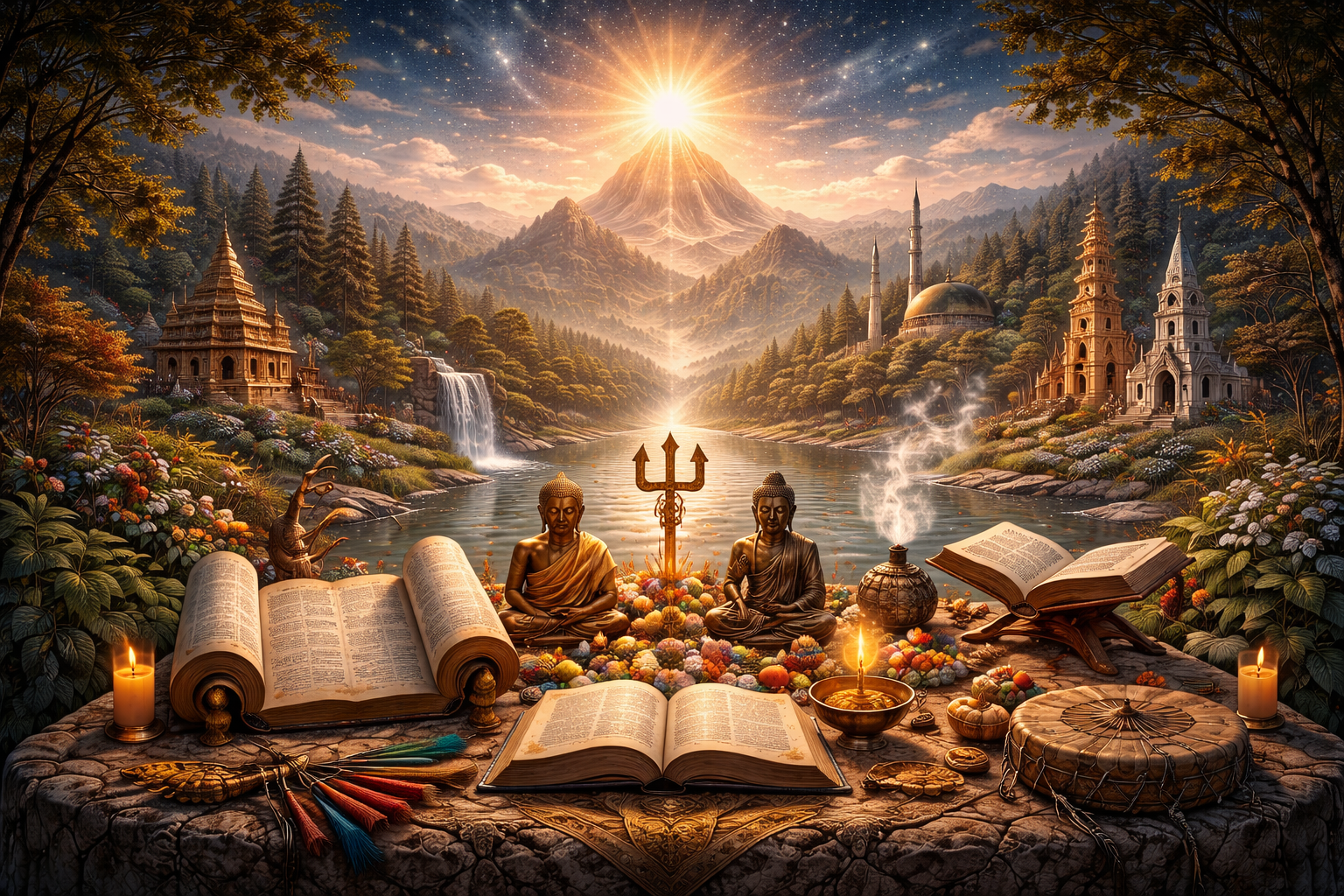
This category includes creation and origin, flood and destruction, law and covenant, suffering and evil, sacrifice and offering, purity and pollution, death and afterlife, pilgrimage and sacred geography, prophecy and revelation, wisdom and self-cultivation, apocalypse and renewal, compassion and justice, asceticism and restraint, body and soul, angels and demons, ancestors and spirits, heaven and hell, sacred kingship, sacred language, the moral ordering of community, and the religious interpretation of nature, history, power, and human destiny. It treats comparison not as a flattening exercise, but as a disciplined method for identifying patterns, contrasts, tensions, and moral structures across the world’s religious traditions.
Comparative Sacred Themes is especially important to the broader architecture of this site because it provides a bridge-category linking individual religious civilizations to the larger questions they repeatedly confront. In this respect, the category connects not only to Foundations of Religion, but also to Abrahamic Traditions, Persian Traditions, South Asian Traditions, East Asian Traditions, Indigenous and Oral Traditions, Mysticism and Contemplative Traditions, Religion and Law, Religion and Society, Religion and Ecology, Mythology, and Philosophy.
The goal of this pillar is not to imply that all religions say the same thing in different language. It is to take difference seriously while also recognizing that religious traditions are often responding to overlapping existential conditions and moral problems. A mature comparative approach must therefore hold together two truths at once: sacred themes recur widely, and the meanings attached to them may differ radically. Comparison without difference becomes cliché. Difference without comparison becomes fragmentation. This category is designed to avoid both errors.
This pillar also has a methodological responsibility. Comparative work has often been shaped by colonial categories, missionary polemic, Orientalist simplification, universalizing theories, and the tendency to treat some traditions as normative while treating others as data. Comparative Sacred Themes therefore begins from humility: each tradition should first be encountered through its own languages, texts, rituals, communities, and interpretive lineages. Only then can comparison become intellectually honest.
Why Comparative Sacred Themes Matter
Comparative Sacred Themes matter because religious traditions do not develop in a vacuum. They arise in different languages, landscapes, ecologies, political orders, ritual systems, and civilizational settings, yet they often confront recognizably recurrent questions about life, death, moral obligation, transcendence, suffering, sexuality, law, fate, purification, violence, justice, memory, community, invisible beings, and redemption. Comparison allows these recurring questions to become visible. It helps reveal where traditions converge structurally, where they diverge metaphysically, and where similar symbols conceal radically different sacred worlds.
This matters because comparison deepens rather than cheapens religious study when practiced carefully. It can show, for example, that flood narratives are not all saying the same thing, but that destruction-and-renewal is nevertheless a recurrent sacred pattern. It can show that sacrifice appears across traditions, yet may signify covenant, reciprocity, purification, nourishment of gods, devotion, repentance, substitution, ethical surrender, or symbolic transformation depending on the tradition. It can show that heaven, paradise, liberation, ancestorhood, and rebirth all respond to death, yet imagine personhood and destiny in profoundly different ways.
For the broader architecture of this site, this pillar matters because it provides one of the clearest ways to connect world traditions without collapsing them into generic spirituality. It makes visible the repeated moral and symbolic problems to which religious civilizations have responded. It also creates a bridge between Religious Studies, Mythology, Philosophy, Psychology, Religion and Law, Religion and Society, Religion and Ecology, and Mysticism and Contemplative Traditions.
The value of this category is therefore architectural as well as interpretive. It helps readers move across traditions without losing orientation. Instead of treating religions as isolated containers, it asks readers to notice the recurring human problems that generate sacred forms: origin, death, guilt, suffering, power, memory, law, place, purification, sacrifice, hope, and the longing for a world rightly ordered.
The Problem of Comparison
Comparison is necessary, but it is also dangerous. Poor comparison turns religions into interchangeable expressions of universal human feeling. It strips texts, rituals, communities, metaphysics, and histories from their particular settings. It can also privilege one tradition’s categories as though they were neutral, forcing others to fit frameworks they did not produce. Terms such as God, salvation, worship, revelation, law, soul, sacrifice, religion, priesthood, mysticism, or liberation do not travel without distortion.
For that reason, comparative work must proceed with discipline. It must begin from how traditions understand themselves, how their primary texts organize reality, how ritual and doctrine shape meaning, how communities embody practice, and how internal interpretive traditions explain sacred categories. Only then can comparison become serious rather than superficial. The task is not to search for sameness alone, but to ask how similar human problems generate different sacred forms.
Comparison also has a history. Modern comparative religion emerged through scholarship, missionary encounter, colonial classification, philology, anthropology, Orientalist imagination, and later academic efforts to take traditions seriously in their own terms. That history matters because comparison can either illuminate or dominate. It can make patterns visible, or it can turn living traditions into specimens arranged under foreign categories. A responsible comparative pillar must therefore be explicit about method.
Done well, comparison becomes a method of intellectual honesty. It reveals both recurrence and irreducibility. It shows that human beings ask overlapping questions, but not always with the same assumptions about truth, time, selfhood, transcendence, embodiment, authority, or moral order. The best comparison does not erase difference. It makes difference more precise.
Myth, Symbol, and Recurrent Sacred Pattern
Religious traditions frequently organize meaning through myth and symbol rather than abstract doctrine alone. Fire, flood, mountain, tree, desert, river, temple, exile, ascent, darkness, light, blood, bread, water, garden, wilderness, ladder, cave, sky, serpent, bird, ocean, city, body, mirror, and threshold recur across traditions because they condense moral and cosmic meaning into memorable form. Such symbols are not ornamental. They are intellectual, ritual, and affective carriers of religious worlds.
This matters because recurrent sacred themes often become visible first at the level of symbol. Mountains repeatedly signify ascent, revelation, nearness to the sacred, danger, or cosmic axis. Water may signify life, purification, chaos, rebirth, boundary crossing, divine blessing, or ancestral continuity. Food may mean communion, sacrifice, covenant, abundance, dependence, restraint, hospitality, or moral discipline. Fire may purify, destroy, reveal, illuminate, judge, or transform.
Yet symbolic recurrence must never be mistaken for sameness of doctrine. A river in one tradition may be ancestral and territorial; in another, purifying; in another, eschatological; in another, metaphorical for wisdom or grace. A serpent may be wisdom, danger, fertility, healing, temptation, chaos, or cosmic power depending on its symbolic world. A mountain may be the place of law, divine encounter, ascetic withdrawal, pilgrimage, ancestral presence, or cosmic center.
Comparative Sacred Themes therefore studies myth and symbol as recurring structures of meaning whose differences matter as much as their repetition. Symbols recur because certain human experiences recur, but traditions build sharply different sacred architectures out of the same symbolic materials.
Creation, Origin, and Cosmic Beginning
Questions of origin stand near the center of religious thought. How did the world begin, if it began at all? Is reality created by a personal God, generated through cosmic process, born from sacrifice, structured by emanation, emerging from primordial chaos, remembered through ancestral action, or understood as beginningless? Does creation establish moral order, or is order something achieved against disorder? Is the world fundamentally good, tragic, impermanent, sacred, fallen, mixed, or cyclical?
These questions matter because they shape everything that follows. A created world implies one kind of dependence and obligation; an eternal cosmos implies another; a world of interdependent arising implies another still; a world formed through ancestral action implies another. Origin stories are not merely narrative beginnings. They encode anthropology, cosmology, power, gender, law, ritual, ecological relation, and the moral structure of existence.
Creation themes also reveal how traditions imagine the relation between order and chaos. Some traditions begin with divine speech, others with cosmic waters, primordial sacrifice, creative combat, generative desire, emanation, separation of heaven and earth, ancestral travel, or the ordering of a world already in motion. These narratives may legitimate kingship, ritual sacrifice, gender roles, sacred geography, ecological obligation, or human responsibility.
A serious comparative approach should therefore place creation and origin among the most foundational sacred themes. Traditions differ sharply here, yet all must in some way address the mystery of why human beings find themselves in a world that is at once ordered, dangerous, beautiful, fragile, and morally demanding.
Flood, Destruction, and World Renewal
Flood, destruction, and renewal appear across many sacred traditions, though the meanings vary widely. A flood may represent divine judgment, cosmic reset, memory of catastrophe, purification of corruption, renewal after disorder, survival of a righteous remnant, ancestral transition, or the dangerous power of primordial waters. Destruction may be punitive, cyclical, purifying, tragic, necessary, or apocalyptic. Renewal may mean restoration, rebirth, covenant, new creation, moral warning, or the continuation of life after devastation.
This theme matters because it reveals how traditions interpret catastrophe. Destruction is rarely only physical. It is moralized, ritualized, narrated, and remembered. Catastrophe asks whether the world is governed by justice, whether human wrongdoing has cosmic consequence, whether the divine judges history, whether the cosmos periodically renews itself, or whether life persists through cycles of destruction and regeneration.
Flood narratives also show the methodological difficulty of comparison. Similar narrative structures can conceal very different sacred claims. One tradition may emphasize divine judgment and covenant after the flood. Another may emphasize cosmic recurrence. Another may preserve ecological memory of water, land, and survival. Another may treat flood as mythic symbol of chaos and renewal. The pattern recurs, but the meaning changes.
For this site’s wider architecture, destruction-and-renewal themes connect Comparative Sacred Themes to Mythology, Religion and Ecology, Religious Studies, and Risk and Resilience. Sacred traditions have long asked how human beings should live after catastrophe. That question remains urgent in a world facing ecological and political instability.
Law, Order, and Sacred Obligation
Religious traditions repeatedly ask what binds human beings and what makes obligation sacred. Some answer through divine command, covenant, or revealed law. Others answer through dharma, right relation, virtue, ritual order, karmic consequence, ancestral duty, cosmic harmony, monastic discipline, communal memory, or the disciplined harmonization of life with a larger pattern. The central issue is not only what the rule is, but why the rule binds.
This matters because law and obligation reveal how religious communities imagine moral order. Religious law may organize family life, food, sexuality, worship, time, purity, charity, governance, land, inheritance, speech, education, or economic exchange. Even traditions that are not strongly legalistic often preserve structured disciplines of obligation through ritual, ethical teaching, monastic rule, teacher lineage, customary law, or inherited protocol.
Comparison here is especially illuminating. It reveals that sacred order is one of the most recurrent themes in religion, but that the sources and forms of this order differ dramatically. Some are covenantal, some cosmic, some ritual, some communal, some juridical, some ancestral, some philosophical, and some contemplative. A commandment, a vow, a taboo, a monastic rule, a dharma obligation, an ancestral law, and a practice of self-cultivation are all normative, but they do not belong to the same legal universe.
This theme links directly to Religion and Law. Sacred obligation is one of the places where religious worlds become durable social orders. It is also one of the places where hierarchy, reform, dissent, mercy, conscience, and institutional power become most visible.
Sacrifice, Offering, and the Logic of Exchange
Sacrifice is one of the most ancient and widespread sacred themes. Across traditions, human beings offer food, animals, incense, grain, drink, prayer, money, labor, fasting, celibacy, renunciation, pilgrimage hardship, service, praise, or symbolic self-surrender. These offerings may feed gods, express gratitude, avert danger, restore balance, purify guilt, mark covenant, honor ancestors, sustain cosmic order, or enact surrender before what exceeds the self.
This matters because sacrifice reveals how traditions imagine exchange between human beings and the sacred. It also reveals the transition from material offering to ethical or spiritualized sacrifice in many traditions. What begins as blood, grain, or smoke may later become prayer, charity, repentance, disciplined self-offering, service to the poor, contemplative surrender, or symbolic participation in divine life. Yet the underlying sacred question remains: what must be given, and why?
Sacrifice also reveals the moral ambiguity of religious practice. It can generate gratitude, humility, reciprocity, and repair. It can also legitimate violence, hierarchy, exclusion, or the destruction of animals and bodies in the name of sacred order. Traditions often debate sacrifice internally: whether it is necessary, whether it should be purified, whether it should be replaced by prayer or ethics, whether obedience matters more than offering, or whether the deepest sacrifice is the transformation of the self.
A mature comparative treatment should therefore ask not only whether sacrifice exists, but how it is transformed, contested, moralized, interiorized, restricted, or abolished within different religious worlds. Sacrifice is rarely just about the object offered; it is about the order restored, relationship affirmed, guilt addressed, danger confronted, or sacred relation renewed through offering.
Purity, Pollution, and Boundary
Many religious traditions distinguish between clean and unclean, pure and polluted, lawful and defiling, blessed and profane. These distinctions often structure bodily practice, food, sexuality, death, ritual preparation, sacred space, social proximity, caste, priesthood, gender, and the handling of blood, waste, illness, birth, and burial. Purity systems are therefore not marginal curiosities. They are central ways religions mark boundary and moral order.
This matters because purity is often social as well as ritual. It can organize proximity and exclusion, hierarchy and danger, gendered roles and ritual authority, illness and stigma, kinship and caste, death and mourning, sacred space and ordinary space. At times purity disciplines preserve reverence, care, preparation, and sacred order; at other times they naturalize domination or stigma.
Purity also bridges religion and ecology. Water, soil, bodily substances, food, animals, waste, disease, and pollution often appear in religious systems as morally charged materials. Modern environmental pollution is not identical with ritual impurity, but the symbolic overlap is powerful. Traditions that understand contamination as moral injury may provide deep languages for thinking about poisoned rivers, desecrated burial grounds, polluted neighborhoods, and damaged sacred landscapes.
Comparative Sacred Themes must therefore treat purity with seriousness. It is one of the clearest recurring ways religious communities embody moral worlds through material and bodily distinction. It reveals how cosmology is translated into habit, prohibition, ritual, architecture, social order, and everyday discipline.
Suffering, Evil, and the Problem of Disorder
Few questions are more persistent across religions than why suffering exists and how disorder enters human life. Is suffering punishment, test, ignorance, attachment, karma, tragic finitude, demonic opposition, social injustice, colonial violence, structural oppression, cosmic imbalance, or an unavoidable feature of impermanent existence? Is evil personal, metaphysical, social, moral, privative, demonic, psychological, or institutional? What counts as an adequate response: endurance, protest, repentance, liberation, detachment, compassion, repair, justice, exorcism, or solidarity?
This matters because the meaning assigned to suffering shapes ethics, hope, and social order. A tradition that explains suffering as karmic consequence may treat responsibility differently from one that explains it as covenantal testing, demonic attack, ignorance, attachment, or structural injustice. A tradition that allows lament and protest before God constructs moral agency differently from one that seeks release from attachment and illusion. A tradition that interprets suffering through social oppression may produce different forms of activism than one that treats suffering primarily as spiritual training.
Comparison here reveals both universality and radical divergence. Suffering is everywhere; explanations are not. Some traditions locate disorder in sin, others in ignorance, others in imbalance, others in desire, others in cosmic conflict, others in social domination, and others in the fragility of embodied life. These differences matter because they shape whether communities respond with compassion, resignation, reform, blame, revolt, discipline, or care.
This makes suffering and evil one of the most intellectually demanding sacred themes in the category. It is also one of the most socially consequential, because explanations of suffering often determine who is comforted, who is blamed, who is protected, and who is abandoned.
Death, Ancestorhood, and the Afterlife
All religious traditions must in some way respond to death. Some focus on judgment, heaven, hell, resurrection, paradise, purgation, liberation, rebirth, or dissolution. Others foreground ancestorhood, ritual continuity, karmic transition, the sacred management of the dead, reincarnation, spirit presence, or communal memory. Death is thus never merely biological. It is a test of how a tradition imagines selfhood, moral order, continuity, and the boundary between visible and invisible worlds.
This matters because societies are often organized through how they bury, mourn, feed, remember, fear, or honor the dead. Funeral rites, ancestor offerings, mourning periods, grave visitation, memorial prayer, cremation, pilgrimage, relic veneration, martyr memory, and eschatological teaching all reveal how sacred themes of death move through social life. The dead remain socially powerful: they bless, haunt, judge, intercede, accuse, protect, or continue in memory depending on the tradition.
Death also reveals deep differences in religious anthropology. If the person is an immortal soul, death means one thing. If the person is a changing stream of aggregates, it means another. If the dead become ancestors, another. If resurrection awaits, another. If liberation ends the cycle of rebirth, another. If memory and ritual relation sustain continuity, another. Comparative study must respect these differences rather than reduce all afterlife beliefs to survival anxiety.
Comparative Sacred Themes therefore treats death and afterlife as one of the deepest points of both commonality and difference across religious civilizations. The dead remain among the living not only through memory, but through ritual, law, inheritance, sacred geography, moral accountability, and social order.
Salvation, Liberation, Awakening, and Right Relation
Religious traditions differ sharply in how they imagine the ultimate repair of the human condition. Some speak of salvation, others liberation, awakening, enlightenment, moksha, nirvana, deification, paradise, reconciliation, harmony, covenantal faithfulness, cosmic renewal, ancestral continuity, or right relation. These terms cannot be collapsed into one another. Each carries a different account of what is wrong with human life and what would count as its healing.
This theme matters because it reveals the deep structure of each tradition’s anthropology and metaphysics. If the basic problem is sin, salvation requires one kind of response. If the problem is ignorance, it requires another. If the problem is attachment, another. If the problem is karmic bondage, another. If the problem is alienation from land, ancestors, or right relation, another. If the problem is disorder in community, another. The cure reveals the diagnosis.
Comparison here is especially valuable because it prevents the vocabulary of one tradition from dominating the others. “Salvation” is not a neutral term for every religious goal. “Liberation” is not the same as forgiveness. “Awakening” is not the same as paradise. “Right relation” is not the same as metaphysical union. Yet all belong to the wider sacred problem of how human beings move from disorder toward restoration, truth, freedom, reconciliation, or fullness.
For this pillar, salvation and liberation themes connect strongly to Mysticism and Contemplative Traditions, Philosophy, Psychology, and Religion and Law. They reveal how traditions imagine the final meaning of discipline, devotion, ritual, knowledge, ethical action, divine mercy, and communal life.
Wisdom, Revelation, and Sacred Knowledge
Religions repeatedly ask how truth is known. Is sacred knowledge revealed through prophets, scriptures, angels, visions, teachers, sages, contemplation, law, enlightenment, ancestral memory, ritual performance, dreams, or disciplined study? Does wisdom come from obedience, inner transformation, right practice, inherited commentary, philosophical reasoning, mystical union, oral transmission, or encounter with transcendence? These questions determine not only doctrine but authority.
This matters because sacred knowledge is never merely informational. It is embodied in lineages, canons, educational systems, rituals of transmission, institutions of interpretation, and practices of memory. Revelation and wisdom may therefore function very differently. One tradition may emphasize divine speech; another ethical insight; another contemplative realization; another inherited oral memory; another teacher lineage; another philosophical discernment; another ritual enactment.
Sacred knowledge also raises the question of access. Who may know? Who may interpret? Who may teach? Is knowledge public, secret, initiated, written, oral, contemplative, priestly, prophetic, ancestral, or communal? Some knowledge is universalized; some is restricted by caste, gender, initiation, office, season, lineage, age, or ritual status. The social life of sacred knowledge is therefore inseparable from power.
For comparative study, wisdom and revelation are among the richest sacred themes because they disclose how traditions imagine truth itself and how human beings become authorized to speak it. They also reveal whether truth is thought of as gift, achievement, discipline, remembrance, awakening, law, or relation.
Pilgrimage, Place, and Sacred Geography
Religious traditions often map holiness onto geography. Mountains, rivers, deserts, shrines, temples, tombs, forests, cities, battlefields, springs, caves, islands, burial grounds, pilgrimage routes, and ancestral territories become sites of memory, revelation, healing, mourning, covenant, danger, or divine presence. Pilgrimage is not simply travel. It is movement through sacred geography that reorders time, body, and community.
This matters because sacred place organizes religion spatially. It ties metaphysics to land, memory to route, devotion to hardship, community to shared orientation, and identity to place. Sacred geography can also become a site of exclusion, conflict, possession, and political struggle when territory is sacralized and contested. Holy places are rarely neutral. They are remembered, claimed, protected, mourned, fought over, commercialized, desecrated, restored, and regulated.
Place also reveals a major difference between traditions. Some traditions center sacred cities; others ancestral territories; others pilgrimage mountains; others rivers; others temples; others portable sacred texts; others the gathered community itself. The sacred may be tied to one place, many places, no fixed place, or a network of remembered and ritually activated sites.
Comparative Sacred Themes should therefore treat pilgrimage and sacred place as recurring structures through which religions make the world itself meaningful, navigable, and morally charged. Place is often where myth, law, mourning, ecology, and politics meet most visibly.
Time, History, Apocalypse, and Renewal
Religions differ sharply in how they imagine time. Some emphasize cyclical recurrence, cosmic ages, rebirth, ritual renewal, seasonal return, or ancestral continuity. Others emphasize sacred history, covenantal progression, prophecy, messianic expectation, apocalypse, final judgment, or cosmic renovation. Still others combine cyclical and historical elements in complex ways. Time is therefore never merely chronological. It is morally and cosmologically structured.
This matters because the shape of time determines the shape of hope, fear, memory, and obligation. Apocalyptic traditions mobilize urgency differently from cyclical traditions. Traditions focused on ritual renewal may interpret crisis differently from those expecting final consummation or cosmic decline. Societies are organized around calendars, fasts, feasts, sabbaths, jubilees, commemorations, pilgrimages, ancestral cycles, and eschatological horizons.
Sacred time also governs public life. Religious calendars shape school schedules, political ceremonies, agricultural cycles, national holidays, mourning periods, fasting seasons, and communal memory. Time becomes social architecture. It tells communities when to remember, repent, celebrate, rest, mourn, harvest, sacrifice, or prepare.
Comparison here helps reveal how religions construct historical consciousness and how sacred time enters politics and imagination. It also clarifies why renewal may mean restoration in one tradition, liberation in another, awakening in another, cosmic reset in another, and end-times judgment in yet another.
Justice, Compassion, and the Moral Order
Religious traditions repeatedly ask what human beings owe to one another and how moral order should be imagined. Justice may appear as covenantal righteousness, divine command, compassion, mercy, karma, right rule, social harmony, nonviolence, almsgiving, solidarity, liberation, punishment, restitution, forgiveness, or repair. Compassion may be central, but compassion itself is not interpreted identically across traditions.
This matters because justice and compassion sit at the intersection of ethics, law, social order, and transcendence. A tradition may emphasize distributive obligation, mercy, punishment, forgiveness, discipline, social hierarchy, universal care, nonviolence, caste duty, liberation from oppression, or covenantal accountability in different combinations. Religious morality is therefore not reducible to goodness in the abstract. It is structured through concrete visions of what order, injury, debt, duty, mercy, and healing mean.
Justice themes also reveal how traditions treat the vulnerable: the poor, stranger, widow, orphan, prisoner, debtor, refugee, enemy, outsider, animal, ancestor, future generation, or land itself. Some traditions universalize moral concern; others structure obligation through community, covenant, caste, kinship, ritual status, or hierarchy. Comparison must therefore ask not only what a tradition praises, but who is included within the circle of moral responsibility.
Comparative Sacred Themes should thus make justice and compassion one of its central axes, especially because these themes connect directly to Religion and Law, Religion and Society, Religion and Ecology, and Stewardship Ethics. They are among the clearest points where theology becomes public consequence.
Asceticism, Discipline, and Self-Transformation
Many religious traditions regard ordinary appetite as morally or spiritually unreliable. They respond through fasting, celibacy, silence, poverty, meditation, pilgrimage, renunciation, bodily discipline, vigil, dietary restriction, monastic rule, ritual purity, prayer, almsgiving, or service. Asceticism is therefore one of the great recurring sacred themes: the attempt to reorder the self by reordering desire.
This matters because religions do not only explain reality. They train persons. The sacred life is often imagined as requiring transformed appetite, disciplined time, restraint of impulse, purification of memory, attention to speech, and the reformation of the body. Yet the meanings of such discipline vary widely. One tradition may seek holiness, another liberation from attachment, another solidarity with the poor, another ritual purity, another social distinction, another concentration, another obedience to divine command, another alignment with cosmic order.
Asceticism also reveals the social ambiguity of discipline. It can produce humility, self-mastery, moral seriousness, ecological restraint, and spiritual freedom. It can also become punitive, elitist, anti-body, socially exclusive, or a tool of control when imposed unequally. A comparative treatment must therefore ask who disciplines whom, for what purpose, under what authority, and with what effects.
Comparison here reveals both shared suspicion of ungoverned desire and very different visions of what disciplined life is for. Asceticism may be world-renouncing, world-reordering, or world-serving depending on the sacred horizon in which it is embedded.
Body, Soul, Self, and Personhood
Religious traditions repeatedly grapple with the nature of the human person. Is the human being body and soul, self and illusion, psyche and spirit, embodied consciousness, social role, breath, image of God, karmic continuity, ancestral relation, divine spark, moral agent, or relational being? What survives death, if anything? What is purified, saved, judged, liberated, healed, resurrected, reborn, remembered, or transformed?
This matters because anthropology shapes ritual, ethics, medicine, law, gender, death, education, sexuality, and social order. A tradition that emphasizes immortal soul organizes life differently from one that emphasizes non-self, karmic process, ancestor continuity, resurrection, embodied relationality, or divine image. These differences reach into mourning, medical care, sexuality, asceticism, gender roles, punishment, healing, and political order.
The body is especially important because it is never merely biological within religious systems. It may be purified, veiled, circumcised, baptized, disciplined, fed, fasted, buried, cremated, healed, resurrected, marked, initiated, sacrificed, adorned, or treated as a temple, prison, vehicle, illusion, inheritance, or site of divine presence. Religious anthropology is therefore embodied.
Comparative Sacred Themes places personhood among the core questions through which broader sacred worlds can be interpreted. How a tradition imagines the person often determines how it imagines suffering, responsibility, freedom, obligation, community, and ultimate destiny.
Invisible Worlds: Spirits, Angels, Demons, Jinn, and Ancestors
Many religious traditions imagine reality as inhabited by beings beyond ordinary human perception: angels, demons, jinn, gods, spirits, ancestors, saints, devas, bodhisattvas, kami, orisha, yazatas, daevas, ghosts, guardians, tricksters, and other unseen powers. These beings are not peripheral decorations. They often organize moral danger, divine mediation, protection, temptation, healing, possession, revelation, cosmic conflict, ritual obligation, and the relation between visible and invisible worlds.
This theme matters because it reveals that many traditions do not imagine reality as a flat material field. The unseen world may be filled with divine messengers, ancestral presences, harmful spirits, protective beings, demonic opposition, celestial hierarchies, or morally ambiguous powers. These beings may carry revelation, test humans, protect communities, inhabit landscapes, accuse the living, serve divine command, or threaten disorder.
Comparative work here must be especially careful. Gabriel in Abrahamic traditions is not the same kind of being as a local land spirit, an ancestor, a demon, a jinn, a bodhisattva, or an orisha. Christian demons, Islamic jinn, Zoroastrian daevas, Buddhist devas, Shinto kami, African ancestral presences, and Indigenous more-than-human beings belong to distinct metaphysical and ritual worlds. They can be compared structurally, but not equated carelessly.
Invisible-world themes also connect to ritual practice. Exorcism, blessing, divination, ancestor offerings, protective amulets, sacred names, pilgrimage, healing, dream interpretation, and liturgical invocation all presume that human life is entangled with powers beyond ordinary sight. Comparative Sacred Themes therefore treats unseen beings as a major cross-cultural sacred theme, not as superstition or marginal folklore.
Community, Hierarchy, and Sacred Belonging
Religion almost always constructs belonging. It defines who is inside and outside, who is initiated, who is pure, who speaks with authority, who may interpret, who may lead, who is protected, who is excluded, and who may cross boundaries. Communities are formed through covenant, caste, peoplehood, monastic vows, congregational membership, kinship, ritual initiation, lineage, temple networks, sectarian affiliation, ancestral descent, or shared ritual life.
This matters because sacred belonging is never merely sentimental. It is structured through hierarchy, authority, law, memory, space, body, and boundary. Religious communities can preserve solidarity, care, language, dignity, and moral memory. They can also naturalize unequal status, regulate bodies, racialize outsiders, sacralize political exclusion, or make dissent appear as betrayal of sacred order.
Comparative Sacred Themes must therefore treat community as both gift and danger. Belonging can heal isolation, transmit memory, support the vulnerable, and organize moral life. It can also produce exclusion, persecution, communal violence, caste hierarchy, sectarian hostility, gender restriction, or nationalist sacralization. The sacred power of belonging is precisely why it requires critical attention.
For this site, this theme is especially important because it connects directly to Religion and Society, Religion and Law, Global Governance, and the unequal treatment of communities under broader systems of power. Belonging is one of the places where sacred meaning and institutional force become most visible.
Religious Difference and Comparative Method
The final task of this pillar is methodological: how should sacred themes be compared without destroying difference? The answer is not to abandon comparison, but to discipline it. Traditions must first be read from within their own texts, rituals, institutions, languages, practices, and interpretive lineages. Similar terms must not be assumed to mean the same thing. Themes should be compared at the level of structure, problem, symbolic pattern, ritual function, or moral question rather than forced into identical doctrinal categories.
This matters because comparative study is most valuable when it reveals both family resemblance and irreducible distinction. Creation is not the same as emanation. Revelation is not the same as enlightenment. Purity is not the same as holiness. Sacrifice is not the same as charity. Justice is not the same as harmony. Salvation is not the same as liberation. Ancestorhood is not the same as resurrection. Yet all belong within the larger field of recurring sacred themes through which human beings have tried to order life.
Comparative method must also be historically honest. Traditions do not meet as equals in modern academic space. Some have been universalized; some have been marginalized; some have been treated as philosophy; some as superstition; some as civilization; some as folklore; some as danger; some as heritage. A responsible comparative pillar must therefore include the politics of classification and the unequal authority granted to different sacred worlds.
This makes Comparative Sacred Themes one of the intellectual centers of the Religious Studies architecture. It does not replace the study of traditions. It connects them through the recurring questions that make comparison meaningful at all.
Major Questions of Interpretation
This pillar is organized around several major questions. What sacred themes recur across traditions, and why? How do creation, death, sacrifice, purity, law, suffering, salvation, revelation, wisdom, sacred place, time, community, and invisible worlds appear across different religious civilizations? What does comparison reveal that tradition-specific study alone may not reveal?
The pillar also asks how difference should be preserved. When does comparison illuminate structure, and when does it flatten doctrine? How should terms such as God, soul, law, salvation, mysticism, sacrifice, purity, revelation, and religion be handled when traditions do not use them in the same way? How can comparative study avoid turning one tradition’s categories into the hidden standard for all others?
Finally, the pillar asks how sacred themes shape social life. How do recurring religious patterns become laws, rituals, institutions, calendars, bodies, hierarchies, moral movements, ecological duties, and political claims? How do sacred themes justify power, and how do they become resources for critique, repair, and liberation?
These questions keep Comparative Sacred Themes from becoming a generic survey. The category studies recurrence and difference as a disciplined method for understanding how religious traditions make human life meaningful, ordered, contested, and sacred.
Comparative Sacred Themes Pillar Map
The following article map is designed as a serious research agenda for the Comparative Sacred Themes pillar, with emphasis on recurring sacred patterns, tradition-specific difference, comparative rigor, moral consequence, and civilizational breadth.
Comparative Sacred Themes is organized to move from method, myth, symbol, and sacred pattern into creation, destruction, law, sacrifice, purity, suffering, death, salvation, revelation, sacred place, time, justice, asceticism, personhood, invisible worlds, community, hierarchy, and comparative extensions across religion, mythology, law, ecology, society, and mysticism. The goal is to make comparison intellectually useful without turning sacred difference into interchangeable spirituality.
Foundational Frames
- What Are Comparative Sacred Themes? (planned)
Introduces the category as a disciplined study of recurring sacred questions across traditions without erasing doctrinal, ritual, and metaphysical difference. - How to Compare Religions Without Flattening Them (planned)
Establishes a careful comparative method grounded in primary texts, internal interpretation, lived practice, and historical specificity. - Myth, Symbol, and Sacred Pattern (planned)
Studies recurring symbols such as fire, water, mountain, tree, river, desert, body, light, and darkness across religious worlds. - Difference, Recurrence, and Comparative Method (planned)
Explores how comparison can reveal patterns while preserving irreducible difference among traditions. - The Problem of Universal Religion (planned)
Critiques the temptation to treat all religions as expressions of one universal spirituality detached from history, doctrine, and practice. - Comparative Religion After Colonial Categories (planned)
Examines how comparative study can avoid reproducing colonial, missionary, Orientalist, or civilizational hierarchies.
Cosmos, Origin, and Order
- Creation and Cosmic Beginning Across Traditions (planned)
Compares creation, emanation, cosmic process, primordial chaos, ancestral formation, and beginningless worlds. - Chaos, Flood, and World Renewal (planned)
Studies flood, destruction, purification, catastrophe, survival, covenant, and renewal as recurring sacred patterns. - Cosmic Order, Disorder, and Sacred Repair (planned)
Explores how traditions imagine the world as ordered, corrupted, imbalanced, fallen, impermanent, or needing restoration. - Law, Covenant, Dharma, and Sacred Obligation (planned)
Compares divine command, covenant, dharma, ancestral law, ritual order, karma, and moral obligation. - Time, Apocalypse, and Cyclical Return (planned)
Studies sacred time, calendars, apocalypse, cosmic cycles, judgment, renewal, and historical consciousness. - Sacred Kingship, Rule, and Cosmic Legitimacy (planned)
Examines the recurring link between political authority, cosmic order, divine sanction, and sacred responsibility.
Life, Death, and Transformation
- Suffering, Evil, and Moral Disorder (planned)
Compares explanations of suffering, evil, ignorance, sin, karma, attachment, demonic opposition, and structural injustice. - Death, Judgment, Ancestorhood, and Afterlife (planned)
Studies death, burial, ancestorhood, resurrection, rebirth, heaven, hell, judgment, liberation, and memorial practice. - Salvation, Liberation, Awakening, and Right Relation (planned)
Compares ultimate repair across traditions without reducing distinct goals to one shared concept. - Asceticism, Discipline, and Self-Transformation (planned)
Explores fasting, celibacy, renunciation, silence, pilgrimage, monastic rule, meditation, and the discipline of desire. - Healing, Purification, and Sacred Restoration (planned)
Studies ritual healing, confession, purification, exorcism, repentance, reconciliation, and communal repair. - Ecstasy, Vision, and Sacred Encounter (planned)
Examines visionary experience, dream, trance, revelation, divine encounter, and discernment across traditions.
Ritual, Symbol, and Sacred Practice
- Sacrifice, Offering, and Sacred Exchange (planned)
Studies offerings of animals, food, incense, prayer, money, service, renunciation, and symbolic self-surrender. - Purity, Pollution, and Boundary (planned)
Examines clean and unclean, sacred and profane, bodily purity, pollution, caste, gender, death, food, and ritual preparation. - Pilgrimage, Sacred Place, and Ritual Movement (planned)
Explores sacred geography, pilgrimage routes, holy cities, mountains, rivers, shrines, tombs, and ancestral territories. - Food, Fasting, and the Moral Ordering of Appetite (planned)
Studies diet, feasting, fasting, lawful food, vegetarianism, sacrifice, hospitality, and the religious discipline of consumption. - Water, Fire, Blood, and Sacred Materiality (planned)
Compares recurring sacred substances and their roles in purification, sacrifice, life, judgment, and transformation. - Ritual Clothing, Marking, and the Sacred Body (planned)
Examines veiling, robes, sacred marks, circumcision, tonsure, adornment, modesty, initiation, and visible religious belonging.
Knowledge, Self, and Moral Community
- Wisdom, Revelation, and Sacred Knowledge (planned)
Compares prophecy, scripture, enlightenment, oral memory, teacher lineage, contemplation, philosophy, and ritual transmission. - Body, Soul, Self, and Personhood (planned)
Studies competing accounts of the human person, including soul, non-self, image of God, karmic continuity, ancestor relation, and embodied consciousness. - Justice, Mercy, Compassion, and Moral Order (planned)
Examines moral obligation, mercy, nonviolence, righteousness, liberation, social repair, and the protection of the vulnerable. - Community, Hierarchy, and Sacred Belonging (planned)
Studies covenant, caste, peoplehood, initiation, lineage, sect, congregation, kinship, and the boundaries of sacred community. - Sacred Language, Names, and the Power of Speech (planned)
Explores mantra, divine names, scripture, oral recitation, blessing, curse, prophecy, sacred sound, and performative speech. - Gender, Sexuality, and Sacred Order (planned)
Compares how traditions regulate bodies, purity, reproduction, family, desire, authority, and gendered forms of sacred belonging.
Invisible Worlds and Sacred Powers
- Angels, Demons, Jinn, Spirits, and Ancestors (planned)
Compares invisible beings across traditions while preserving the distinct metaphysical worlds in which they appear. - Heaven, Hell, Paradise, Purgation, and Rebirth (planned)
Studies afterlife worlds, moral consequence, judgment, purification, rebirth, liberation, and ultimate destiny. - Possession, Exorcism, and Ritual Protection (planned)
Explores ritual responses to harmful powers, spirit presence, demonic danger, healing, and protection. - Ancestors, Memory, and the Living Dead (planned)
Examines ancestor veneration, burial, offerings, lineage, memory, and the continuing social presence of the dead. - Saints, Sages, Bodhisattvas, and Holy Persons (planned)
Compares religious figures who mediate sacred power, wisdom, compassion, protection, teaching, or intercession.
Comparative Extensions
- Religion and Ecology Through Comparative Sacred Themes (planned)
Connects creation, kinship, sacred land, animals, purity, ecological grief, and environmental justice across traditions. - Religion and Law Through Comparative Sacred Themes (planned)
Compares sacred obligation, covenant, dharma, ancestral law, jurisprudence, moral authority, and communal order. - Mysticism and Contemplation as Comparative Sacred Themes (planned)
Studies silence, union, awakening, remembrance, emptiness, deification, discipline, and transformation across contemplative traditions. - Mythology and Religion: Overlap and Difference (planned)
Explores how myth and religion intersect without reducing sacred traditions to story alone. - Religion and Society Through Comparative Sacred Themes (planned)
Examines how sacred themes shape family, education, hierarchy, nationalism, media, social movements, and public life. - Comparative Sacred Themes and the Study of Power (planned)
Studies how sacred categories authorize, critique, protect, or contest social and political power. - Why Comparative Sacred Themes Still Matter (planned)
Concludes the series by explaining how careful comparison deepens religious literacy, moral analysis, and civilizational understanding.
This structure allows the category to remain comparative while preserving the distinctive metaphysical, ritual, legal, ecological, and moral worlds of the traditions it draws into conversation. It also strengthens the broader Religious Studies architecture by linking individual traditions to the recurring sacred questions that shape human life across civilizations.
Closing Perspective
Comparative Sacred Themes gives Religious Studies one of its most important integrative frameworks. It does not replace the study of particular traditions. It allows those traditions to be brought into disciplined conversation around recurring questions: creation, death, suffering, law, sacrifice, purity, wisdom, justice, time, personhood, invisible worlds, sacred place, and ultimate transformation. These questions recur because human beings repeatedly confront the same existential conditions, but traditions answer them through radically different sacred worlds.
The strongest reason to study this field is that it prevents both isolation and flattening. Without comparison, traditions can appear as sealed containers with no shared human questions. Without difference, comparison becomes shallow sameness. Comparative Sacred Themes holds the two together. It asks what recurs, what differs, what cannot be translated easily, and what those differences reveal about the moral and metaphysical imagination of human communities.
For the broader Sustainable Catalyst architecture, this pillar is essential. It strengthens Religious Studies while linking to Mythology, Philosophy, Religion and Law, Religion and Society, Religion and Ecology, Mysticism and Contemplative Traditions, and the major civilizational tradition pillars. Comparative Sacred Themes shows how sacred worlds organize human life through symbols, rituals, laws, bodies, places, communities, invisible powers, moral duties, and visions of final meaning.
Related Reading
- Religious Studies
- Foundations of Religion
- Abrahamic Traditions
- Persian Traditions
- South Asian Traditions
- East Asian Traditions
- Indigenous and Oral Traditions
- Mysticism and Contemplative Traditions
- Religion and Law
- Religion and Society
- Religion and Ecology
- Mythology
- Foundations of Religion
- Philosophy
- Metaphysics
- Ethics & Moral Philosophy
- Poetry, Memory, and Imagination
Primary Texts and Tradition-Grounded Sources
- Abrahamic traditions: Hebrew Bible, New Testament, Qur’an, Hadith, rabbinic literature, patristic writings, Christian theological and liturgical sources, Islamic tafsir and fiqh, mystical texts, prayer books, legal traditions, and devotional materials concerning creation, law, revelation, angels, demons, judgment, mercy, sacrifice, and salvation.
- Persian and Iranian traditions: Avesta, Gathas, Pahlavi texts, Zoroastrian ritual and eschatological sources, Manichaean fragments, Shahnameh materials, Persian Sufi poetry, Shi‘i devotional traditions, and philosophical texts concerning truth, cosmic struggle, angels, demons, kingship, light, judgment, and final renewal.
- South Asian traditions: Vedas, Upanishads, Mahābhārata, Rāmāyaṇa, Bhagavad Gītā, Puranas, Buddhist suttas and sutras, Jain Agamas, Guru Granth Sahib, dharma literature, yoga and tantric texts, bhakti poetry, and philosophical sources concerning selfhood, karma, liberation, suffering, sacred sound, nonviolence, and ritual practice.
- East Asian traditions: Dao De Jing, Zhuangzi, Confucian classics, Buddhist texts, Shinto materials, Chan and Zen teachings, ritual manuals, poetry, and sources concerning harmony, cultivation, emptiness, ancestors, nature, sacred order, and moral formation.
- Indigenous and oral traditions: community-authorized oral teachings, public narratives, ceremonial materials, sacred geography, land-based law, ancestor memory, ecological knowledge, ritual practice, and Indigenous interpretive traditions handled with respect for protocol, consent, and knowledge sovereignty.
- African and diasporic traditions: public oral traditions, ritual teachings, praise poetry, divination systems, ancestor traditions, orisha and spirit traditions, diasporic religious materials, and community-grounded sources concerning embodiment, offering, spirit presence, moral order, and communal continuity.
- Comparative ritual and mythic materials: liturgical texts, ritual manuals, pilgrimage accounts, sacred art, mythic narratives, festival traditions, funeral rites, purity systems, sacrificial practices, and community-based interpretations of recurring sacred themes.
Internal Interpretive Traditions
- Textual traditions: theologians, jurists, sages, exegetes, philosophers, commentators, rabbis, ulema, canonists, monks, pandits, teachers, and lineage-based interpreters.
- Ritual traditions: liturgical authorities, priests, monks, nuns, ritual specialists, healers, hereditary custodians, temple communities, shrine keepers, chanters, and ceremonial communities.
- Oral and communal traditions: storytellers, elders, language keepers, devotional communities, Indigenous custodians, families, and institutions of memory that preserve sacred pattern through practice rather than text alone.
- Contemplative traditions: spiritual directors, Sufi teachers, monastic lineages, meditation masters, gurus, contemplative communities, and practitioners who interpret transformation through discipline and practice.
- Legal and ethical traditions: religious courts, moral theologians, halakhic authorities, jurists, dharma interpreters, monastic rule traditions, and communities that organize sacred obligation in social life.
- Modern community traditions: interfaith organizations, religious educators, public theologians, Indigenous scholars, community historians, social-movement leaders, and faith-based institutions interpreting sacred themes under contemporary conditions.
Modern Scholarship
- Armstrong, K. A History of God.
- Bell, C. Ritual: Perspectives and Dimensions.
- Douglas, M. Purity and Danger.
- Durkheim, É. The Elementary Forms of Religious Life.
- Eliade, M. The Sacred and the Profane.
- Flood, G. An Introduction to Hinduism.
- Lincoln, B. Discourse and the Construction of Society.
- Otto, R. The Idea of the Holy.
- Paden, W.E. Religious Worlds.
- Smith, J.Z. Imagining Religion.
- Smart, N. The World’s Religions.
- Stroumsa, G.G. A New Science: The Discovery of Religion in the Age of Reason.
- Tweed, T.A. Crossing and Dwelling.
- van Gennep, A. The Rites of Passage.
Further Reading
- Armstrong, K. (1993) A History of God. New York: Ballantine Books.
- Bell, C. (1997) Ritual: Perspectives and Dimensions. Oxford: Oxford University Press.
- Douglas, M. (1966) Purity and Danger: An Analysis of Concepts of Pollution and Taboo. London: Routledge.
- Durkheim, É. (2008) The Elementary Forms of Religious Life. Oxford: Oxford University Press.
- Eliade, M. (1959) The Sacred and the Profane: The Nature of Religion. New York: Harcourt.
- Flood, G. (1996) An Introduction to Hinduism. Cambridge: Cambridge University Press.
- Lincoln, B. (1989) Discourse and the Construction of Society: Comparative Studies of Myth, Ritual, and Classification. Oxford: Oxford University Press.
- Otto, R. (1958) The Idea of the Holy. Oxford: Oxford University Press.
- Paden, W.E. (1994) Religious Worlds: The Comparative Study of Religion. Boston: Beacon Press.
- Smart, N. (1998) The World’s Religions. 2nd edn. Cambridge: Cambridge University Press.
- Smith, J.Z. (1982) Imagining Religion: From Babylon to Jonestown. Chicago: University of Chicago Press.
- Stroumsa, G.G. (2010) A New Science: The Discovery of Religion in the Age of Reason. Cambridge, MA: Harvard University Press.
- Tweed, T.A. (2006) Crossing and Dwelling: A Theory of Religion. Cambridge, MA: Harvard University Press.
- van Gennep, A. (1960) The Rites of Passage. Chicago: University of Chicago Press.
References
- Armstrong, K. (1993) A History of God. New York: Ballantine Books.
- Bell, C. (1997) Ritual: Perspectives and Dimensions. Oxford: Oxford University Press.
- Britannica (n.d.) Comparative Religion. Available at: https://www.britannica.com/topic/comparative-religion (Accessed: 11 April 2026).
- Britannica (n.d.) Eschatology. Available at: https://www.britannica.com/topic/eschatology (Accessed: 11 April 2026).
- Britannica (n.d.) Myth. Available at: https://www.britannica.com/topic/myth (Accessed: 11 April 2026).
- Britannica (n.d.) Purification Rite. Available at: https://www.britannica.com/topic/purification-rite (Accessed: 11 April 2026).
- Britannica (n.d.) Ritual. Available at: https://www.britannica.com/topic/ritual (Accessed: 11 April 2026).
- Britannica (n.d.) Sacrifice. Available at: https://www.britannica.com/topic/sacrifice-religion (Accessed: 11 April 2026).
- Douglas, M. (1966) Purity and Danger: An Analysis of Concepts of Pollution and Taboo. London: Routledge.
- Durkheim, É. (2008) The Elementary Forms of Religious Life. Oxford: Oxford University Press.
- Eliade, M. (1959) The Sacred and the Profane: The Nature of Religion. New York: Harcourt.
- Flood, G. (1996) An Introduction to Hinduism. Cambridge: Cambridge University Press.
- Lincoln, B. (1989) Discourse and the Construction of Society: Comparative Studies of Myth, Ritual, and Classification. Oxford: Oxford University Press.
- Otto, R. (1958) The Idea of the Holy. Oxford: Oxford University Press.
- Paden, W.E. (1994) Religious Worlds: The Comparative Study of Religion. Boston: Beacon Press.
- Smart, N. (1998) The World’s Religions. 2nd edn. Cambridge: Cambridge University Press.
- Smith, J.Z. (1982) Imagining Religion: From Babylon to Jonestown. Chicago: University of Chicago Press.
- Stanford Encyclopedia of Philosophy (n.d.) Religion. Available at: https://plato.stanford.edu/entries/religion/ (Accessed: 11 April 2026).
- Stroumsa, G.G. (2010) A New Science: The Discovery of Religion in the Age of Reason. Cambridge, MA: Harvard University Press.
- Tweed, T.A. (2006) Crossing and Dwelling: A Theory of Religion. Cambridge, MA: Harvard University Press.
- van Gennep, A. (1960) The Rites of Passage. Chicago: University of Chicago Press.