
Last Updated May 3, 2026
Persian Traditions examines the religious, philosophical, literary, mystical, ritual, imperial, and civilizational worlds that emerged from Iranian and Persian history through sacred texts, priestly lineages, imperial institutions, metaphysical speculation, ethical reflection, poetic imagination, ritual practice, and enduring struggles over truth, justice, kingship, cosmic order, spiritual refinement, and the destiny of the soul. As a major category within the Religious Studies knowledge series, it studies these traditions first through primary texts and internal interpretive lineages, and only after that through modern scholarship.
The Persian and Iranian religious world is one of the great civilizational streams in the history of religion. It includes the Zoroastrian inheritance of cosmic dualism, truth, fire, purity, judgment, and eschatological struggle; the imperial and sacred symbolism of Achaemenid, Parthian, and Sasanian rule; the religious ferment that produced movements such as Manichaeism and Mazdakism; the epic memory preserved in the Shahnameh; and the later Persianate Islamic worlds of philosophy, Shi‘i devotion, mystical poetry, illuminationist metaphysics, ethical refinement, and interior spiritual discipline. Across these formations, Persian traditions repeatedly return to questions of moral struggle, sacred sovereignty, spiritual purification, justice, apocalypse, wisdom, beauty, and the relation between earthly rule and transcendent order.
This category is especially important because Persian traditions stand at the crossroads of multiple civilizational worlds. They shaped and were shaped by Mesopotamian, Greek, Jewish, Christian, Islamic, Central Asian, Turkic, and South Asian inheritances. They also provided one of the great bridges between pre-Islamic religious imagination and Islamic-era intellectual and spiritual life. In that sense, Persian traditions are not a narrow national archive, but a major civilizational field in which religion, empire, poetry, philosophy, law, cosmology, sacred memory, and metaphysical imagination repeatedly converged.
Current Space
Religious Studies
Related Topic
Abrahamic Traditions
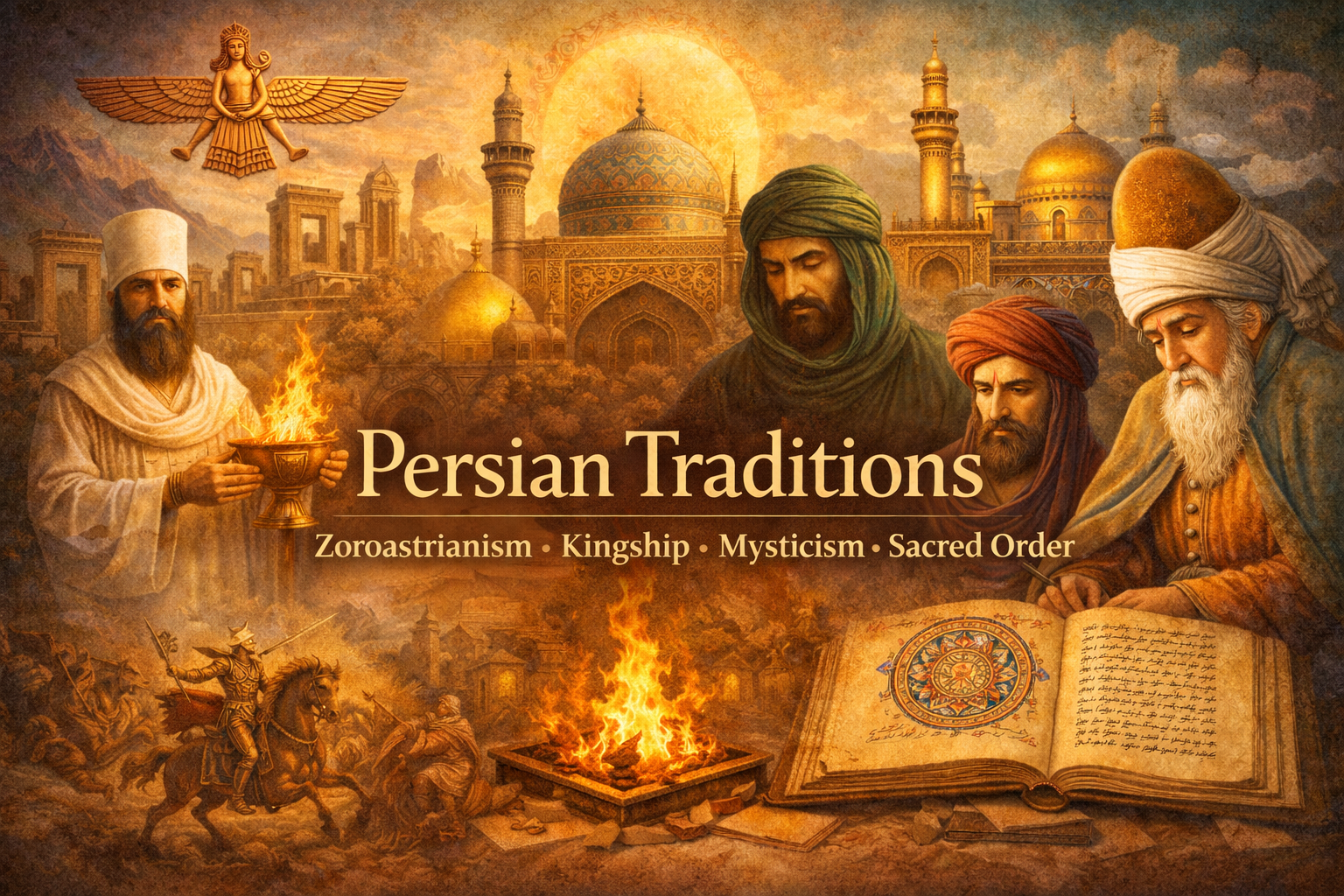
Persian Traditions therefore links naturally to Abrahamic Traditions, Religious Studies, Philosophy, Mysticism and Contemplative Traditions, Religion and Law, Mythology, Persian Myth, Folklore, and Epic Tradition, Persian Thought, and Global Governance. It also strengthens the broader site by showing how moral cosmology, kingship, apocalyptic expectation, mystical inwardness, philosophical illumination, and poetic spirituality can coexist within a single long civilizational tradition.
The goal of this pillar is not to reduce Persian religious history to Zoroastrianism alone, nor to absorb Persian traditions entirely into later Islam. It is to take the Persian and Iranian religious world seriously as a long and internally varied field of sacred imagination, ritual practice, political theology, philosophical reflection, poetic memory, and spiritual refinement. By doing so, this category recovers one of the major foundations of Eurasian religious history.
This pillar also treats “Persian” as a civilizational and linguistic category rather than as a simple ethnic or national label. Some of the earliest religious materials are more accurately described as Iranian; some later cultural formations are Persianate rather than narrowly Persian; and many of the Islamic-era developments unfolded across multilingual worlds shaped by Arabic, Persian, Turkic, Sanskritic, and Central Asian contexts. The category remains useful because it allows the site to follow a long stream of religious and philosophical imagination from ancient Iranian sacred order to medieval Persianate Islam and beyond.
Why Persian Traditions Matter
Persian traditions matter because they preserve one of the most powerful and enduring religious imaginations in world history: a vision in which truth and falsehood, purity and corruption, justice and disorder, light and darkness, kingship and moral accountability, inner refinement and cosmic destiny are all placed within a single dramatic field. Few civilizational traditions have reflected so deeply on moral struggle as a structure of reality itself.
They also matter because Persian religious history cannot be contained within a single doctrinal system. Zoroastrianism is central, but not exhaustive. Persian traditions include imperial ritual and sacred kingship, apocalyptic and dualistic cosmology, prophetic and reform movements, mystical poetry, philosophical illumination, Shi‘i devotion, Sufi interiority, and Islamic-era reinterpretations of older Iranian themes. This gives the category unusual breadth. It touches myth, law, empire, metaphysics, ritual, poetry, eschatology, and ethical discipline all at once.
Finally, Persian traditions matter because they sit at a crucial historical crossroads. The Iranian world shaped later Jewish, Christian, and Islamic religious imagination in ways that remain debated but significant, especially around angels, demons, apocalypse, judgment, resurrection, cosmic conflict, and the final defeat of evil. Later, Persianate Islam became one of the richest zones of philosophical, mystical, and poetic development in the Islamic world. To study Persian traditions is therefore to study a major civilizational mediator in the history of religion.
For the broader architecture of this site, Persian Traditions serves as a bridge between Religious Studies, Philosophy, Mythology, Mysticism, Law, and Global Governance. It shows how sacred order can become imperial order, how metaphysics can become poetry, how mystical refinement can become ethical discipline, and how civilizational memory can preserve older symbolic worlds even after profound religious transformation.
Iranian and Persian: The Problem of Category
The terms “Iranian” and “Persian” overlap but are not identical. “Iranian” is often the broader and historically deeper category, especially when referring to pre-Islamic religious developments, Zoroastrianism, and the wider cultural world that extended beyond what later became specifically Persian in language and court culture. “Persian,” by contrast, often names a more particular linguistic, literary, courtly, and civilizational formation, especially in the Islamic and Persianate periods.
For practical purposes, however, Persian Traditions is a useful category because it is legible, elegant, and broad enough to hold pre-Islamic Iranian religion, Zoroastrian theology, imperial sacred order, Persianate Islamic philosophy, Shi‘i devotion, Sufi poetic spirituality, and later cultural memory. The key is to remember that the category names a long civilizational stream rather than a single religious identity.
This pillar therefore uses “Persian Traditions” as a capacious category while recognizing that some of its earliest and most foundational layers are more accurately described as Iranian. The category is less about strict nomenclature than about preserving a historically grounded civilizational continuum. That continuum runs from ancient Iranian sacred order through Zoroastrian liturgy, imperial ideology, epic memory, Islamic philosophy, Persian poetry, Shi‘i devotional history, and mystical metaphysics.
This distinction also helps avoid two common errors. The first is treating Persian traditions as if they were only pre-Islamic and therefore ended with Islamization. The second is treating Persianate Islamic culture as if it simply erased older Iranian symbolic forms. The actual history is more complex. Older themes of light, kingship, justice, cosmic struggle, and moral purification continued to echo, transform, and reappear within later Persianate religious and literary worlds.
The Avesta, Gathas, and the Zoroastrian Scriptural World
The primary textual foundation of ancient Persian religious tradition lies in the Avesta, the surviving body of Zoroastrian scripture, and especially in the Gathas, the ancient hymns associated with Zarathushtra himself. The Avesta preserves liturgical, devotional, legal, and cosmological layers, while the Gathas give the tradition its earliest and most intense prophetic voice. Through these texts, the Persian religious world is heard first as sacred speech: praise, invocation, moral exhortation, and alignment with truth.
This scriptural world is not organized like a single closed canon in the later Abrahamic sense. It is liturgical, recitational, cumulative, priestly, and historically layered. The Yasna embeds the Gathas within ritual action; the Khordeh Avesta preserves daily prayer and devotional continuity; the Vendidad preserves ritual, legal, purity, and mythic materials; and later Middle Persian traditions extend and interpret older materials. Taken together, these sources show that Persian religion was always simultaneously textual, oral, ritual, and priestly.
That primary-source structure matters for this pillar because it keeps Persian Traditions grounded in the religion’s own surviving sacred materials rather than in later summaries alone. The Avesta is not merely evidence about ancient Iran. It is itself the scriptural heart of one of the world’s oldest enduring religious traditions.
At the same time, the fragmented survival of the Avesta reminds us that Persian religious history must be reconstructed with care. Much has been lost. Much survives through later priestly transmission. Much is mediated by Middle Persian commentary, comparative philology, archaeology, and later religious practice. A scholarly pillar must therefore respect both the sacred authority of the texts within Zoroastrian tradition and the historical difficulty of reconstructing ancient Iranian religion from incomplete materials.
Zoroaster, Truth, and the Moral Structure of Reality
Zoroaster, or Zarathushtra, stands near the beginning of one of the great moral revolutions in religious history. Whether treated as prophet, reformer, or revealer, he represents a decisive sharpening of religious life around truth, choice, and responsibility. In the Zoroastrian world, the contest between truth and lie is not merely social or psychological. It belongs to the structure of reality itself. To align with truth is to participate in cosmic order; to choose falsehood is to deepen corruption.
This makes Zoroastrianism one of the most morally charged religious systems of the ancient world. Human beings are not passive spectators in a mythic drama beyond their control. They are moral actors whose thoughts, words, and deeds matter in a universe marked by conflict between rightness and disorder. This gives Persian traditions one of their most enduring themes: reality itself is ethically contoured.
That ethical seriousness distinguishes Persian religion from more purely sacrificial or cyclical religious forms. Zoroaster’s legacy is not only theology. It is a moral cosmology in which truth must be chosen, preserved, spoken, protected, and embodied. Religious life becomes an active participation in the defense of order against falsehood, corruption, violence, and decay.
This is one reason Persian traditions remain so important for comparative religion. They show a world in which the moral life is not peripheral to cosmology. Ethics is not only human conduct; it is alignment with the deepest structure of existence. To live truthfully is to participate in the repair and maintenance of the world.
Asha, Druj, and the Cosmic Drama of Truth
The contrast between asha and druj is one of the central structures of Zoroastrian thought. Asha can be translated imperfectly as truth, order, rightness, righteousness, or cosmic integrity. Druj names lie, deception, disorder, distortion, and the forces that corrupt rightful existence. These terms are not merely abstract. They organize the moral, ritual, cosmic, and social world of Zoroastrian religion.
In this framework, truth is not only accurate speech. It is the right ordering of reality. Falsehood is not only incorrect statement. It is disorder introduced into the world. This gives ordinary moral life cosmic significance. Speech, ritual purity, agricultural labor, care for creation, treatment of the dead, and communal obligation all become part of the struggle between order and corruption.
The drama of asha and druj also clarifies the distinctive Persian contribution to moral dualism. Zoroastrian dualism is not a simple fascination with opposites. It is a religious effort to explain why reality is marked by conflict while also affirming that evil is not ultimate. The world is a battlefield of truth and lie, but it is not condemned to endless opposition. The movement of history tends toward judgment, purification, and final renovation.
This framework remains one of the most important gifts of Persian traditions to the wider study of religion. It shows how a civilization can imagine the moral life as participation in cosmic repair.
Fire, Purity, and Sacred Order
Fire is one of the most recognizable features of Zoroastrian tradition, but its significance is often misunderstood. Fire is not worshipped as a god in itself. Rather, it functions as a visible sign of purity, illumination, sacred presence, truth, and rightly ordered worship. It is a medium through which reverence, clarity, and ritual integrity become sensible.
This symbolism belongs to a wider concern with purity. Purity in Persian religious life is not mere taboo or external scruple. It is bound to a larger sense that corruption, decay, pollution, and falsehood threaten both moral and cosmic order. Ritual care, bodily discipline, liturgical precision, and priestly custodianship therefore become part of the struggle to keep the world aligned with truth rather than disorder.
The combination of fire and purity gives Persian traditions one of their most memorable religious sensibilities: holiness as luminous clarity, protected order, and disciplined maintenance of what must not be allowed to fall into chaos. Fire is not simply symbolic decoration. It condenses a complete religious grammar of illumination, reverence, purity, and cosmic alignment.
This also makes Zoroastrian ritual an important comparative case for the study of material religion. Sacred fire, ritual implements, liturgical sound, priestly preparation, and purity observance show how theology becomes embodied in practice. The sacred is guarded not only through doctrine but through attention, discipline, and repeated ritual care.
Judgment, Afterlife, and Final Renovation
One of the most powerful contributions of Zoroastrianism to the wider history of religion lies in its eschatological seriousness. The soul is judged. Moral action carries consequences beyond death. Evil does not simply persist forever in unresolved balance. There is movement toward reckoning, purification, and final restoration. This gives Persian traditions a strong sense of history as morally unfinished and oriented toward eventual resolution.
The imagery of judgment and final renovation transforms ethics into destiny. Human choices matter because the world itself is moving toward a decisive clarification of truth and falsehood. The afterlife is not merely an extension of personal survival. It is part of the moral architecture of reality. The human soul, the condition of the world, and the ultimate defeat of evil are all connected.
This eschatological imagination becomes one of the major reasons Persian religion matters comparatively. It offers one of the clearest ancient models of cosmic conflict culminating in renewal rather than endless recurrence. Later religious traditions across Eurasia would grapple with similar structures of judgment, apocalypse, resurrection, and final victory over evil. Whatever the exact lines of influence, Persian traditions occupy a major place in the long history of how human beings imagined the moral fate of the world.
Final renovation also gives Persian religion a powerful account of hope. The world is wounded, but not abandoned. Evil is real, but not final. Human beings must choose truth within a conflicted order, yet their choices participate in a larger divine movement toward restoration.
Angels, Demons, and the Persian Contribution to the Unseen World
Persian traditions are especially important for the comparative study of angels, demons, and the unseen world. Zoroastrian thought developed a rich structure of divine and anti-divine beings: Amesha Spentas, yazatas, daevas, fravashis, demonic forces, and cosmic adversaries. These beings are not merely decorative mythological figures. They express a moral universe in which truth, protection, worship, disorder, deception, and spiritual danger are organized within the larger struggle between asha and druj.
The Amesha Spentas represent holy immortals or divine attributes associated with the ordered life of creation. Yazatas function as worthy-of-worship beings linked to reverence, cosmic maintenance, and sacred order. Fravashis connect the tradition to ancestral and protective dimensions of existence. Daevas, by contrast, become associated with deception, disorder, and anti-sacred power within Zoroastrian religious imagination.
This unseen world matters for Abrahamic comparison because Persian traditions helped shape, or at least stood near, some of the broader late antique conversations around angelology, demonology, apocalypse, resurrection, judgment, and the moral structure of invisible reality. The exact lines of influence remain debated and must be handled carefully, but the importance of the Iranian world as a major source of eschatological and angelological imagination is undeniable.
For this site’s wider architecture, this section connects naturally to Abrahamic Traditions, especially the study of Gabriel, Michael, Satan, Iblis, demons, jinn, Heaven, Hell, and judgment. Persian traditions show that the unseen world is not a minor curiosity. It is often one of the main ways religious civilizations imagine moral conflict, divine order, protection, temptation, and the final destiny of creation.
Sacred Kingship, Empire, and Imperial Order
Persian traditions cannot be separated from kingship and empire. From the Achaemenid world onward, rule in Iran was never merely political. It carried religious and cosmological weight. Kingship was bound to justice, order, truth, and the maintenance of a world aligned with rightness rather than disorder. The ruler was not simply a secular administrator, but a figure whose legitimacy was tied to larger cosmic and moral claims.
This relation between religion and rule deepened under later imperial formations, especially the Sasanians, where Zoroastrian institutions and royal power became more closely aligned. Priestly authority, sacred law, and political sovereignty could reinforce one another, creating a civilizational order in which empire itself became a bearer of religious meaning.
At the same time, this bond between sacred order and imperial authority requires critical interpretation. Political theology can stabilize justice, but it can also sanctify hierarchy. It can bind the ruler to moral responsibility, but it can also make power appear cosmically authorized. Persian traditions are therefore important not only because they illuminate sacred kingship, but because they help us examine the risks and responsibilities of religiously charged sovereignty.
This makes Persian traditions particularly important for the site because they offer a major case study in political theology. They show how sacred order, cosmic truth, imperial authority, and moral legitimacy can become mutually entangled. In this respect, Persian traditions belong not only to Religious Studies, but also to Global Governance, Religion and Law, and Institutions & Governance.
Manichaeism, Mazdakism, and Religious Ferment
The Persian religious world also generated movements that reveal extraordinary spiritual and social experimentation. Manichaeism, founded by Mani, produced one of the most ambitious universal religious systems of late antiquity, combining dualism, prophetic succession, asceticism, cosmology, scriptural production, missionary expansion, and transregional religious synthesis. It shows that Persian religious imagination could move far beyond national or imperial boundaries into a consciously universal religious project.
Manichaeism is especially important because it joined Iranian, Christian, Buddhist, and Mesopotamian elements into a dramatic cosmology of light and darkness. Its missionary reach extended across Roman, Iranian, Central Asian, and Chinese worlds. This makes it one of the great examples of premodern religious globalization: a tradition born from the Iranian world but not confined to it.
Mazdakism, though less fully preserved and often filtered through hostile reports, represents another important moment of religious and ethical ferment. Associated with critique of hierarchy, social injustice, and the moral corruption of concentrated power, it reveals that Persian religious history also included radical ethical and social challenge from within. Whether reconstructed cautiously as religious reform, social movement, or contested memory, Mazdakism belongs to the history of religion and justice.
These movements matter because they show Persian traditions as dynamic, contested, and inventive. They are not merely conservative or imperial. They also generate critique, reform, universalism, ascetic experimentation, and social challenge. This makes the Persian religious world much richer than a simple story of orthodoxy and dynasty.
The Shahnameh, Epic Memory, and Civilizational Identity
The Shahnameh gives Persian traditions one of their most powerful non-canonical but civilizationally foundational texts. Ferdowsi’s epic is not scripture in the formal liturgical sense, yet it preserves a long Persian memory of kingship, struggle, order, heroism, catastrophe, moral failure, and continuity from mythical beginnings into historical loss. It is one of the great literary vessels through which Iranian civilizational identity survived and was rearticulated after the Arab conquest.
This matters because Persian religious and civilizational life cannot be read only through formal theology or ritual law. Epic memory also preserves sacred and moral imagination. The Shahnameh keeps alive older images of righteous rule, heroic trial, cosmic struggle, tragic kingship, filial conflict, civilizational ruin, and the fragility of moral order. It is one of the places where Persian traditions retain their mythic and historical self-consciousness most vividly.
For this site, the Shahnameh is especially valuable because it shows how religion, mythology, political order, and literature can remain interwoven. Persian Traditions are not only doctrinal; they are also epic, poetic, and symbolic worlds of memory. The epic imagination preserves moral questions that theology alone cannot exhaust: What makes a king legitimate? What does heroic strength cost? How does civilization fall? How does memory survive conquest?
The Shahnameh also links this pillar to Persian Myth, Folklore, and Epic Tradition and Persian Poetry and Cultural Memory. It belongs simultaneously to Religious Studies, Mythology, Literature, and Political Thought because it carries a civilizational memory in which sacred order, heroic action, and historical grief remain inseparable.
Persianate Islam and the Reordering of Tradition
With the coming of Islam, the Persian world did not disappear. It was reordered. Persianate Islam became one of the great zones in which Islamic religion, law, philosophy, courtly culture, poetic language, historical memory, and mystical spirituality developed with exceptional intensity. Persian language became a vehicle not only of literature, but of religious imagination, ethical reflection, metaphysical subtlety, and devotional refinement.
What makes Persianate Islam especially significant is that it did not simply replace earlier Iranian religious worlds with something wholly foreign. Rather, it absorbed, transformed, and reinterpreted older symbols of kingship, light, wisdom, refinement, justice, and sacred order within an Islamic framework. This does not mean simple continuity, but it does mean that Persian civilization remained a major producer of religious meaning after Islamization.
Persianate Islam also became transregional. It shaped Central Asia, South Asia, Anatolia, the Ottoman world, Mughal India, and many literary and courtly environments far beyond Iran itself. Persian became a language of poetry, administration, ethics, metaphysics, Sufi instruction, and elite culture across much of the Islamic world.
For that reason, Persian traditions must include Islamic Persia, not as a separate afterthought, but as one of the category’s central chapters. Persianate Islam is where older Iranian sensibilities and Islamic revelation meet in productive and often beautiful tension.
Shi‘ism, Martyrdom, and Sacred History
Shi‘i Islam became central to Persian religious history, especially from the Safavid period onward, and it brought with it a distinctive structure of sacred memory, authority, suffering, and redemptive history. Through the Imams, martyrdom, loyalty, and the memory of Karbala, religion becomes charged with mourning, justice, fidelity, and the moral interpretation of history through suffering.
This Shi‘i structure matters because it intensifies several themes already resonant in Persian traditions: sacred legitimacy, the struggle between truth and corrupt power, the sanctification of memory, and the moral significance of historical suffering. Karbala becomes not only an event, but a template for reading oppression, loyalty, sacrifice, grief, and hope.
In Persian history, Shi‘ism also became linked to institutions, state formation, ritual performance, scholarly authority, pilgrimage, devotional poetry, and public mourning. This creates a religious world in which theology, emotion, politics, memory, and ritual embodiment are tightly woven together.
In this respect, Persian Shi‘ism is not just a sectarian variation within Islam. It is one of the great spiritual and civilizational forms through which sacred history, political injustice, grief, devotion, and eschatological expectation are woven into religious life. It gives Persian traditions a deep culture of mourning, fidelity, and sacred remembrance.
Sufism, Poetry, and the Interior Life
Few traditions have shaped the spiritual imagination of the Islamic world more deeply than Persian Sufism and mystical poetry. Here the language of love, longing, annihilation of ego, divine beauty, intoxication, remembrance, and inward refinement becomes a primary mode of religious expression. Poetry is not merely ornament; it becomes a vehicle for metaphysical insight, ethical transformation, and spiritual discipline.
Figures such as Rumi, Attar, Sa‘di, and Hafiz turned Persian into one of the great languages of spiritual literature. Through them, Persian traditions became a central archive of contemplative and poetic religion. The divine-human relation could be imagined not only through law or doctrine, but through longing, subtlety, beauty, and the difficult work of self-transformation.
Persian Sufism is especially important because it reveals how symbolic language can carry theological depth without becoming simple doctrine. Wine, tavern, beloved, moth, flame, garden, nightingale, journey, poverty, annihilation, and union all become symbolic forms through which the soul’s relation to God is explored. Such language must be read carefully: it is neither reducible to literal romance nor detached from Islamic devotional discipline.
This is one reason Persian traditions connect so strongly to Mysticism and Contemplative Traditions. Persian Sufi worlds reveal how inner life, metaphysical symbolism, moral discipline, and literary power can converge into a major religious form.
Persian Philosophy, Illumination, and Metaphysical Order
Persian traditions also include major contributions to philosophy, especially in metaphysics, cosmology, psychology, epistemology, and illuminationist thought. The Islamic-era Persian intellectual world absorbed Greek philosophy, but did not merely repeat it. Thinkers working in Persianate and broader Islamic contexts transformed metaphysical inheritance through questions of light, emanation, being, knowledge, soul, hierarchy, imagination, and spiritual ascent.
Illuminationist currents, especially associated with Suhrawardi, reveal the distinctive Persian capacity to join philosophy to symbolic imagination, sacred hierarchy, and visionary order. Here metaphysics is not severed from spiritual refinement. Knowledge itself becomes luminous and transformative. Later Persian philosophical traditions continue to develop subtle accounts of being, gradation, soul, and the structure of reality.
Mulla Sadra represents another major moment in Persian metaphysical thought. His work deepens the philosophical investigation of existence, motion, soul, knowledge, and spiritual transformation. In this tradition, being is not treated as a dead abstraction. It is dynamic, graded, and spiritually consequential.
This makes Persian traditions central to future work in Philosophy, Metaphysics, and Islamic Mystical Thought. They offer a major example of how philosophical reasoning, symbolic thought, and spiritual aspiration can be joined rather than divided.
Law, Ethics, and the Ordering of Society
Persian traditions are not merely speculative or mystical. They are also deeply concerned with the ordering of society. In Zoroastrian contexts, purity, ritual maintenance, and moral conduct are inseparable from communal order. In Persianate Islamic worlds, jurisprudence, political ethics, advice literature, and courtly codes help structure the relation between religious norm and social power.
Advice literature for rulers, ethical mirrors for princes, legal reasoning, and religious instruction all show that Persian traditions repeatedly sought to connect inward virtue with public order. This is another reason the category should not be romanticized as purely poetic or mystical. It is also a tradition of governance, obligation, pedagogy, and the disciplined shaping of society.
Persian ethical literature often turns on the relation between self-mastery and public justice. A ruler who cannot govern himself cannot govern others rightly. A society without truthfulness, moderation, generosity, and justice becomes vulnerable to disorder. This ethical-political pattern links Zoroastrian moral cosmology, Persian advice literature, Islamic ethics, and Sufi discipline in a long arc of reflection on moral order.
For this site, Persian Traditions is therefore a valuable bridge to Religion and Law and Global Governance. It reveals how sacred vision and political order can reinforce, critique, and reshape one another.
Eschatology, Apocalypse, and the Fate of the World
One of the most distinctive features of Persian religious imagination is its eschatological seriousness. The world is not simply what it is; it is a field moving toward judgment, purification, restoration, or final reckoning. In Zoroastrianism, this takes clear form in final renovation, moral testing, and the defeat of evil. In later traditions, especially in Shi‘i and apocalyptic currents, sacred history continues to be read through expectation, hidden justice, delayed fulfillment, and final righting of wrong.
This gives Persian traditions unusual depth in the study of time and destiny. History is not a neutral sequence. It is morally charged and spiritually unfinished. That structure helps explain why Persian religious worlds so often join suffering, justice, kingship, and eschatological hope.
Apocalyptic imagination can be dangerous when it becomes politically weaponized, but it can also preserve moral protest against the apparent permanence of injustice. Persian traditions repeatedly insist that falsehood does not have the last word. Whether in Zoroastrian final renovation, Manichaean cosmic drama, Shi‘i expectation, or Sufi interior transformation, the world is understood as a site of struggle moving toward unveiling, reckoning, or purification.
For comparative religion, this is enormously important. Persian traditions are among the major civilizational sites where apocalypse, moral destiny, and cosmic conflict become central to how communities imagine the end and meaning of history.
Persian Traditions in Comparative Religion
Persian traditions occupy a major place in comparative religion because they complicate simple civilizational boundaries. They are not merely “Eastern” or “Western,” not simply ancient or medieval, not exclusively Zoroastrian or Islamic, not only imperial or mystical. They stand between Mesopotamia, Greece, India, Central Asia, the Abrahamic world, and Islamic civilization. This makes them one of the great hinge traditions in the history of sacred imagination.
Their comparative importance is especially clear in debates over eschatology, angelology, demonology, resurrection, judgment, paradise, hell, cosmic dualism, and the final defeat of evil. Persian religious worlds were part of the wider environment in which Jewish, Christian, Manichaean, Islamic, and later mystical ideas developed and interacted. The precise historical pathways should be handled carefully, but the comparative significance of Iranian religion is unmistakable.
Persian traditions are also important for the study of religion and empire. The Achaemenid and Sasanian worlds show how sacred legitimacy, imperial administration, and cosmic order can be connected. Later Persianate Islamic courts show how literary refinement, political authority, Sufi culture, and philosophical thought could circulate across vast regions.
Finally, Persian traditions are essential for understanding how poetry can become religious thought. In many traditions, theology and philosophy are separated from literature. In Persian worlds, poetry often becomes one of the highest vehicles for metaphysical, ethical, and mystical reflection. This is one of the reasons Persian traditions remain so enduringly powerful: they join sacred seriousness with beauty.
Major Questions of Interpretation
This pillar is organized around several major questions. How should Persian Traditions be studied when the category includes ancient Iranian religion, Zoroastrian scripture, imperial kingship, Manichaeism, Mazdakism, epic memory, Persianate Islam, Shi‘i sacred history, Sufism, poetry, philosophy, illuminationism, and modern civilizational memory? How can the field preserve continuity without flattening difference?
The pillar also asks how sacred order becomes political order. How does truth become a cosmological principle? How does fire become a sign of purity and divine presence? How does judgment become a structure of moral history? How does kingship become sacred? How does epic memory preserve religious and civilizational identity? How does Islam reorder the Persian world without erasing older forms of imagination? How do Shi‘i mourning and Sufi love transform Persian religious life?
These questions keep Persian Traditions from becoming a simple survey. The goal is not to list names and movements, but to build a serious interpretive framework for one of the great religious and philosophical streams of world history. Persian traditions matter because they repeatedly ask how truth, beauty, justice, light, power, and the soul belong together.
Persian Traditions Pillar Map
The following article map is designed as a serious research agenda for the Persian Traditions pillar, with emphasis on primary texts, internal lineages, civilizational continuity, and transformation from pre-Islamic Iran to Persianate Islamic worlds.
Persian Traditions is organized to move from foundational category questions into Zoroastrian scripture, ancient Iranian moral cosmology, sacred kingship, religious ferment, epic memory, Persianate Islam, Shi‘i sacred history, Sufism, philosophical illumination, ethics, eschatology, and comparative religion. The goal is to keep the category civilizational without making it vague: each article should clarify a specific tradition, text, concept, figure, ritual, or historical transformation within the wider Persian and Iranian sacred world.
Foundational Frames
- What Are Persian Traditions? (planned)
Introduces Persian Traditions as a Religious Studies category spanning ancient Iranian religion, Zoroastrianism, Persianate Islam, philosophy, mysticism, poetry, and sacred kingship. - Iranian and Persian Religious History (planned)
Clarifies the distinction between Iranian, Persian, and Persianate categories across pre-Islamic and Islamic periods. - Truth, Kingship, and Cosmic Order in the Persian World (planned)
Examines the recurring relationship between moral truth, royal legitimacy, cosmic order, and sacred authority. - Persian Traditions and the History of Religion (planned)
Places Persian traditions within global religious history, including Zoroastrian, Manichaean, Islamic, and comparative Abrahamic contexts. - Persian Traditions Between Mythology, Religion, and Philosophy (planned)
Shows how Persian sacred worlds move across epic, ritual, metaphysics, poetry, and civilizational memory.
Zoroastrian and Pre-Islamic Iranian Worlds
- Zoroastrianism (planned)
Introduces Zoroastrian theology, ritual, scripture, moral dualism, purity, judgment, and final renovation. - The Avesta (planned)
Studies the surviving Zoroastrian scriptural corpus as liturgy, sacred speech, ritual archive, and theological source. - The Gathas (planned)
Examines the ancient hymns associated with Zarathushtra and their moral vision of truth, choice, and divine order. - Khordeh Avesta and the Daily Life of Prayer (planned)
Explores daily prayer, devotional continuity, liturgical practice, and the lived rhythm of Zoroastrian piety. - Asha, Druj, and Cosmic Dualism (planned)
Studies truth and lie as the central moral-cosmic opposition within Zoroastrian thought. - Fire, Purity, and Sacred Order (planned)
Explains fire as a sign of purity, order, illumination, reverence, and ritual integrity. - Judgment, Afterlife, and Final Renovation (planned)
Examines the soul’s judgment, eschatological purification, and the final restoration of creation. - Amesha Spentas, Yazatas, Daevas, and the Unseen World (planned)
Studies divine beings, protective forces, demonic opposition, and the moral structure of invisible reality. - Achaemenid and Sasanian Religious Kingship (planned)
Explores imperial legitimacy, sacred kingship, Zoroastrian institutions, and the political theology of Persian rule.
Religious Ferment and Alternative Movements
- Manichaeism (planned)
Studies Mani’s universal religion of light and darkness, prophetic succession, asceticism, scripture, and transregional mission. - Mazdakism and the Ethics of Social Order (planned)
Examines Mazdakite memory, social critique, justice, hierarchy, and the contested history of religious reform. - Dualism, Asceticism, and Universal Religion in Late Antiquity (planned)
Places Manichaeism and related movements within broader late antique religious experimentation. - Religious Dissent and Political Anxiety in the Sasanian World (planned)
Explores how alternative religious movements challenged or unsettled imperial and priestly authority.
Epic Memory and Civilizational Identity
- The Shahnameh (planned)
Introduces Ferdowsi’s epic as a civilizational archive of kingship, heroism, tragedy, and Iranian memory. - Epic Memory and the Preservation of Iran (planned)
Examines how epic poetry preserved pre-Islamic memory after Islamization and political rupture. - Rostam, Heroism, and the Moral Burden of Strength (planned)
Studies the epic hero as a figure of power, loyalty, tragedy, and civilizational defense. - Kingship, Justice, and Ruin in Persian Epic (planned)
Explores how Persian epic narrates the fragility of rule, the danger of pride, and the collapse of order. - Persian Literature and Sacred Imagination (planned)
Connects epic, lyric, mystical, and ethical literature to broader religious and philosophical questions.
Persianate Islamic Worlds
- Persianate Islam (planned)
Studies the transformation of Persian religious and literary worlds under Islamic revelation, law, philosophy, and civilization. - Islamization and the Reordering of Persian Sacred Memory (planned)
Examines continuity, rupture, adaptation, and reinterpretation after the coming of Islam. - Persian as a Language of Islamic Thought (planned)
Explores Persian as a vehicle for theology, Sufism, ethics, poetry, administration, and transregional religious culture. - Persianate Courts, Adab, and Religious Refinement (planned)
Studies courtly culture, ethical formation, literary cultivation, and sacred-political order. - Persianate Islam Across Central Asia, Anatolia, and South Asia (planned)
Traces the spread of Persianate religious, literary, and political culture beyond Iran.
Shi‘ism and Sacred History
- Shi‘ism in Persian History (planned)
Introduces the formation, institutionalization, and devotional depth of Shi‘i Islam in Persian history. - Karbala, Mourning, and Sacred Memory (planned)
Studies Karbala as sacred history, moral protest, martyrdom, grief, and ritual remembrance. - The Imams, Authority, and Sacred Guidance (planned)
Examines Shi‘i understandings of spiritual authority, knowledge, lineage, and divine guidance. - Safavid Iran and the Making of a Shi‘i Religious Order (planned)
Explores the Safavid transformation of Persian religious identity, institutions, and political theology. - Mourning, Ritual Performance, and the Ethics of Witness (planned)
Studies lament, procession, passion performance, memory, and embodied devotion.
Sufism, Poetry, and Interior Religion
- Persian Sufism and the Language of Love (planned)
Explores longing, remembrance, annihilation of ego, beauty, and the symbolic language of divine love. - Rumi, Attar, Sa‘di, and Hafiz (planned)
Introduces the major Persian poets whose works became central to Islamic mystical and ethical imagination. - The Masnavi and the Teaching Power of Story (planned)
Studies Rumi’s narrative method, spiritual pedagogy, and symbolic teaching. - The Conference of the Birds and the Journey of the Soul (planned)
Examines Attar’s allegorical vision of spiritual quest, annihilation, and self-knowledge. - Persian Ethical and Advice Literature (planned)
Connects spiritual refinement, social ethics, kingship, pedagogy, and moral discipline. - Poetry as Theology in Persian Religious Imagination (planned)
Explores how poetic form becomes a vehicle of metaphysical and devotional insight.
Philosophy and Metaphysical Inquiry
- Persian Philosophy and Illuminationism (planned)
Introduces Persian and Islamic philosophical traditions centered on light, being, knowledge, and spiritual hierarchy. - Suhrawardi and the Metaphysics of Light (planned)
Studies illuminationist philosophy as a synthesis of reasoning, symbolic imagination, and visionary metaphysics. - Mulla Sadra and the Deepening of Persian Metaphysics (planned)
Examines existence, substantial motion, soul, knowledge, and the dynamic structure of being. - Being, Soul, and Hierarchy in Persian Thought (planned)
Explores gradations of existence, spiritual ascent, cosmology, and metaphysical order. - Persian Philosophy Between Greek Inheritance and Islamic Revelation (planned)
Studies how Persianate philosophers transformed Greek thought within Islamic intellectual worlds. - Light, Knowledge, and Spiritual Vision in Persian Metaphysics (planned)
Connects light symbolism, epistemology, spiritual perception, and religious philosophy.
Law, Ethics, and Political Theology
- Persian Traditions, Law, and Sacred Order (planned)
Studies law, ritual norm, purity, justice, and communal order across Zoroastrian and Islamic Persian worlds. - Mirrors for Princes and the Ethics of Rule (planned)
Examines advice literature, kingship, justice, self-mastery, and political morality. - Religion, Empire, and Sacred Kingship (planned)
Studies Persian political theology from ancient imperial rule to later Persianate courts. - Justice, Tyranny, and Moral Legitimacy in Persian Thought (planned)
Explores how Persian traditions critique unjust rule and connect legitimacy to moral order. - Ritual Purity, Social Order, and Religious Discipline (planned)
Connects purity systems to ritual maintenance, communal life, and sacred responsibility.
Eschatology, Apocalypse, and the Fate of the World
- Apocalypse, Eschatology, and Cosmic Conflict (planned)
Studies Persian contributions to the religious imagination of final judgment, cosmic struggle, and renewal. - Final Renovation in Zoroastrian Tradition (planned)
Examines the defeat of evil, purification of creation, and restoration of the world. - Heaven, Hell, Judgment, and the Soul in Persian Religion (planned)
Explores afterlife, moral consequence, and the soul’s destiny across Persian religious contexts. - Shi‘i Eschatology, Hidden Justice, and Sacred Expectation (planned)
Studies expectation, return, justice, and sacred history in Persian Shi‘i contexts. - Persian Traditions and Abrahamic Eschatology (planned)
Compares Iranian eschatological themes with Jewish, Christian, and Islamic traditions.
Comparative Themes
- Persian Traditions and the Abrahamic Religions (planned)
Studies intersections with Jewish, Christian, and Islamic traditions around apocalypse, angelology, judgment, and sacred history. - Persian Traditions and South Asian Religious Worlds (planned)
Explores Persianate influence, Indo-Persian culture, Sufi transmission, and Mughal religious worlds. - Persian Traditions and Central Asian Sacred History (planned)
Examines Iranian, Turkic, Islamic, and Central Asian intersections in religion, poetry, and political memory. - Epic Memory and Civilizational Identity (planned)
Compares epic as a vehicle of cultural survival, moral order, and sacred-political memory. - Why Persian Traditions Still Matter (planned)
Concludes the series by connecting Persian religious history to modern questions of meaning, justice, beauty, power, and spiritual life.
This structure allows the category to remain civilizational and comparative while making room for distinct religious formations, pre-Islamic inheritances, Islamic transformations, and later philosophical and mystical developments. It also connects Persian Traditions to the wider site architecture by linking Zoroastrian moral cosmology, Persianate Islam, Shi‘i sacred memory, Sufi poetry, illuminationist metaphysics, epic identity, and political theology.
Closing Perspective
Persian Traditions gives Religious Studies one of its richest long-duration archives. It begins with ancient Iranian sacred order, Zoroastrian truth, fire, purity, judgment, and final renovation. It continues through sacred kingship, imperial ideology, Manichaean universalism, Mazdakite reform memory, the epic imagination of the Shahnameh, Persianate Islam, Shi‘i mourning, Sufi poetry, illuminationist philosophy, advice literature, and eschatological hope.
The strongest reason to study Persian traditions is that they join beauty to moral seriousness. They do not treat truth as merely abstract, nor poetry as merely decorative, nor kingship as merely administrative, nor mysticism as merely private. Truth becomes cosmic order. Fire becomes visible purity. Kingship becomes moral burden. Poetry becomes metaphysics. Mourning becomes sacred memory. Philosophy becomes illumination. Eschatology becomes hope that falsehood will not finally prevail.
For the broader Sustainable Catalyst architecture, this pillar is also strategically important. It strengthens Religious Studies while linking to Philosophy, Mythology, Mysticism, Literature, Global Governance, and Comparative Sacred Themes. Persian traditions show how a civilization can think through the deepest questions of religion: What is truth? What corrupts the world? What makes power legitimate? What becomes of the soul? How should human beings live when history is unfinished and justice remains delayed?
Related Reading
- Religious Studies
- Foundations of Religion
- Abrahamic Traditions
- South Asian Traditions
- Mysticism and Contemplative Traditions
- Religion and Law
- Religion and Society
- Comparative Sacred Themes
- Mythology
- Persian Myth, Folklore, and Epic Tradition
- Persian Poetry and Cultural Memory
- Persian Thought
- Islamic Mystical Thought
- Metaphysics
- Global Governance
Primary Texts
- Avesta: The surviving Zoroastrian scriptural corpus, including liturgical, ritual, devotional, legal, and cosmological materials.
- Gathas: The ancient hymns associated with Zarathushtra, central for understanding truth, choice, and moral responsibility in early Zoroastrian thought.
- Yasna: A central liturgical text in which the Gathas are embedded within ritual performance.
- Khordeh Avesta: A collection of daily prayers and devotional materials important for lived Zoroastrian practice.
- Vendidad: A Zoroastrian text preserving ritual, purity, legal, mythic, and anti-demonic materials.
- Pahlavi religious texts: Middle Persian writings that preserve later Zoroastrian interpretation, cosmology, law, eschatology, and priestly reflection.
- Bundahishn: A major Middle Persian cosmological text important for creation, cosmic structure, evil, and final restoration.
- Denkard: A major Middle Persian compendium preserving Zoroastrian theology, doctrine, and priestly tradition.
- Shahnameh: Ferdowsi’s epic of kingship, heroism, mythic memory, civilizational identity, and historical loss.
- Manichaean fragments: Textual remains preserving Mani’s teachings, cosmology, ethics, and transregional religious synthesis.
- Persian Sufi poetry and major mystical texts: Rumi, Attar, Sa‘di, Hafiz, and related spiritual literature.
- Shi‘i devotional and historical sources: Texts and traditions concerning the Imams, Karbala, mourning, pilgrimage, sacred authority, and eschatological expectation.
- Illuminationist and Persian philosophical texts: Works associated with Suhrawardi, Mulla Sadra, and broader Persianate philosophical traditions.
Internal Interpretive Traditions
- Zoroastrian traditions: priestly liturgical traditions, Avestan recitation, Pahlavi exegesis, ritual law, purity practice, eschatological commentary, priestly transmission, and modern Zoroastrian community interpretation.
- Ancient Iranian imperial traditions: royal inscriptions, imperial ideology, sacred kingship, justice language, and political theology associated with Achaemenid and Sasanian rule.
- Manichaean traditions: scriptural fragments, missionary memory, dualist cosmology, ascetic ethics, and late antique religious synthesis.
- Persianate Islamic traditions: Qur’anic interpretation, Persian theological writing, Shi‘i devotional literature, Sufi commentarial traditions, illuminationist philosophy, ethical and advice literature, Persian poetic interpretation, and courtly adab.
- Shi‘i Persian traditions: Imami theology, devotional mourning, Karbala memory, Safavid religious history, clerical authority, pilgrimage, eschatological expectation, and ritual performance.
- Sufi and poetic traditions: Persian mystical poetry, lodge culture, spiritual instruction, symbolic interpretation, ethics of self-refinement, and metaphysical allegory.
- Philosophical traditions: falsafa, illuminationism, transcendent philosophy, metaphysics of being, philosophy of light, soul theory, and the relation between reason and spiritual vision.
Modern Scholarship
- Boyce, M. Zoroastrians: Their Religious Beliefs and Practices.
- Boyce, M. A History of Zoroastrianism.
- Stausberg, M. Zoroastrianism.
- Hintze, A., studies on Zoroastrian ritual, Avesta, and Avestan philology.
- Skjærvø, P.O., studies on Zoroastrianism, Old Iranian religion, and Iranian languages.
- Gnoli, G., studies on Iranian religion and Zoroastrian identity.
- Shaked, S., studies on Zoroastrianism, dualism, and Iranian religious history.
- Corbin, H. History of Islamic Philosophy.
- Nasr, S.H. Islamic Art and Spirituality.
- Nasr, S.H. Three Muslim Sages.
- Amanat, A., studies on Iranian history, Shi‘ism, and apocalyptic imagination.
- Dabashi, H. Persophilia: Persian Culture on the Global Scene.
- Yarshater, E. and others, studies in Iranian and Persian civilization.
- Marcotte, R., work on Suhrawardi and Islamic philosophy.
- Rizvi, S., work on Mulla Sadra and later Islamic philosophy.
- Lewis, F., work on Rumi and Persian literary spirituality.
- Davis, D., work on the Shahnameh and Persian epic memory.
Further Reading
- Boyce, M. (2001) Zoroastrians: Their Religious Beliefs and Practices. London: Routledge.
- Boyce, M. (1975–1991) A History of Zoroastrianism. Leiden: Brill.
- Corbin, H. (2001) History of Islamic Philosophy. London: Kegan Paul.
- Dabashi, H. (2015) Persophilia: Persian Culture on the Global Scene. Cambridge, MA: Harvard University Press.
- Davis, D. (2006) Epic and Sedition: The Case of Ferdowsi’s Shahnameh. Washington, DC: Mage Publishers.
- Hinnells, J.R. (2005) The Zoroastrian Diaspora: Religion and Migration. Oxford: Oxford University Press.
- Lewis, F.D. (2000) Rumi: Past and Present, East and West. Oxford: Oneworld.
- Nasr, S.H. (1987) Islamic Art and Spirituality. Albany, NY: State University of New York Press.
- Nasr, S.H. (1964) Three Muslim Sages: Avicenna, Suhrawardi, Ibn ‘Arabi. Cambridge, MA: Harvard University Press.
- Stausberg, M. (2002) Zoroastrianism. Vol. 1: Introduction to the History of the Religion. Stuttgart: Kohlhammer.
- Yarshater, E. (ed.) (1983–present) Encyclopaedia Iranica. New York: Encyclopaedia Iranica Foundation.
References
- Avesta.org (n.d.) AVESTA — Zoroastrian Archives. Available at: https://www.avesta.org/ (Accessed: 10 April 2026).
- Avesta.org (n.d.) Yasna. Available at: https://www.avesta.org/yasna/yasna.htm (Accessed: 10 April 2026).
- Avesta.org (n.d.) Khordeh Avesta. Available at: https://www.avesta.org/ka/ka.htm (Accessed: 10 April 2026).
- Avesta.org (n.d.) Vendidad. Available at: https://www.avesta.org/vendidad/vd_eng.htm (Accessed: 10 April 2026).
- Boyce, M. (2001) Zoroastrians: Their Religious Beliefs and Practices. London: Routledge.
- Boyce, M. (1975–1991) A History of Zoroastrianism. Leiden: Brill.
- Corbin, H. (2001) History of Islamic Philosophy. London: Kegan Paul.
- Dabashi, H. (2015) Persophilia: Persian Culture on the Global Scene. Cambridge, MA: Harvard University Press.
- Davis, D. (2006) Epic and Sedition: The Case of Ferdowsi’s Shahnameh. Washington, DC: Mage Publishers.
- Encyclopaedia Britannica (n.d.) Zoroastrianism. Available at: https://www.britannica.com/topic/Zoroastrianism (Accessed: 10 April 2026).
- Encyclopaedia Iranica (n.d.) Avesta. Available at: https://www.iranicaonline.org/articles/avesta-holy-book (Accessed: 10 April 2026).
- Encyclopaedia Iranica (n.d.) Zoroaster. Available at: https://www.iranicaonline.org/articles/zoroaster-index (Accessed: 10 April 2026).
- Encyclopaedia Iranica (n.d.) Šāh-nāma. Available at: https://www.iranicaonline.org/articles/sah-nama/ (Accessed: 10 April 2026).
- Hinnells, J.R. (2005) The Zoroastrian Diaspora: Religion and Migration. Oxford: Oxford University Press.
- Lewis, F.D. (2000) Rumi: Past and Present, East and West. Oxford: Oneworld.
- Marcotte, R. (2007) ‘Suhrawardi’, Stanford Encyclopedia of Philosophy. Available at: https://plato.stanford.edu/entries/suhrawardi/ (Accessed: 10 April 2026).
- Nasr, S.H. (1987) Islamic Art and Spirituality. Albany, NY: State University of New York Press.
- Nasr, S.H. (1964) Three Muslim Sages: Avicenna, Suhrawardi, Ibn ‘Arabi. Cambridge, MA: Harvard University Press.
- Rizvi, S. (2009) ‘Mulla Sadra’, Stanford Encyclopedia of Philosophy. Available at: https://plato.stanford.edu/entries/mulla-sadra/ (Accessed: 10 April 2026).
- Stausberg, M. (2002) Zoroastrianism. Vol. 1: Introduction to the History of the Religion. Stuttgart: Kohlhammer.
- Yarshater, E. (ed.) (1983–present) Encyclopaedia Iranica. New York: Encyclopaedia Iranica Foundation. Available at: https://www.iranicaonline.org/ (Accessed: 10 April 2026).