
Last Updated May 3, 2026
Foundations of Religion examines the conceptual, historical, textual, ritual, institutional, symbolic, and lived structures through which religious traditions have interpreted reality, organized communal life, transmitted sacred memory, and articulated humanity’s relation to the sacred. As a foundational category within the Religious Studies knowledge series, it provides the analytical and comparative framework needed to study religion not merely as private belief, but as a complex field of meaning, practice, authority, ritual, embodiment, law, memory, sacred transmission, and civilizational order across time and place.
Religion has shaped some of the most enduring human reflections on creation, law, suffering, death, moral obligation, sacred order, ultimate reality, liberation, salvation, communal belonging, historical destiny, and the structure of the cosmos. Yet religion cannot be understood through doctrine alone, nor through scripture alone, nor through ritual alone, nor through social function alone. It emerges at the intersection of myth, ritual, text, institution, interpretation, devotion, law, sacred geography, material culture, oral transmission, embodied practice, and historical struggle. To study religion seriously is therefore to ask how sacred worlds are constituted, how they authorize truth, how they organize communal life, how they define boundaries of belonging, and how they endure, fracture, adapt, and transform across time.
This content pillar provides the conceptual groundwork for the wider study of Abrahamic Traditions, South Asian Traditions, East Asian Traditions, Indigenous and Oral Traditions, Mysticism and Contemplative Traditions, Religion and Law, Religion and Society, Religion and Ecology, and Comparative Sacred Themes. It also links outward to Mythology, Philosophy, Cultural Anthropology, Global Governance, and Sustainable Systems because religion has never belonged to belief alone. It has shaped law, art, memory, ecological relation, political legitimacy, moral imagination, social hierarchy, resistance, violence, care, and collective survival.
Current Space
Religious Studies
Related Topic
Abrahamic Traditions
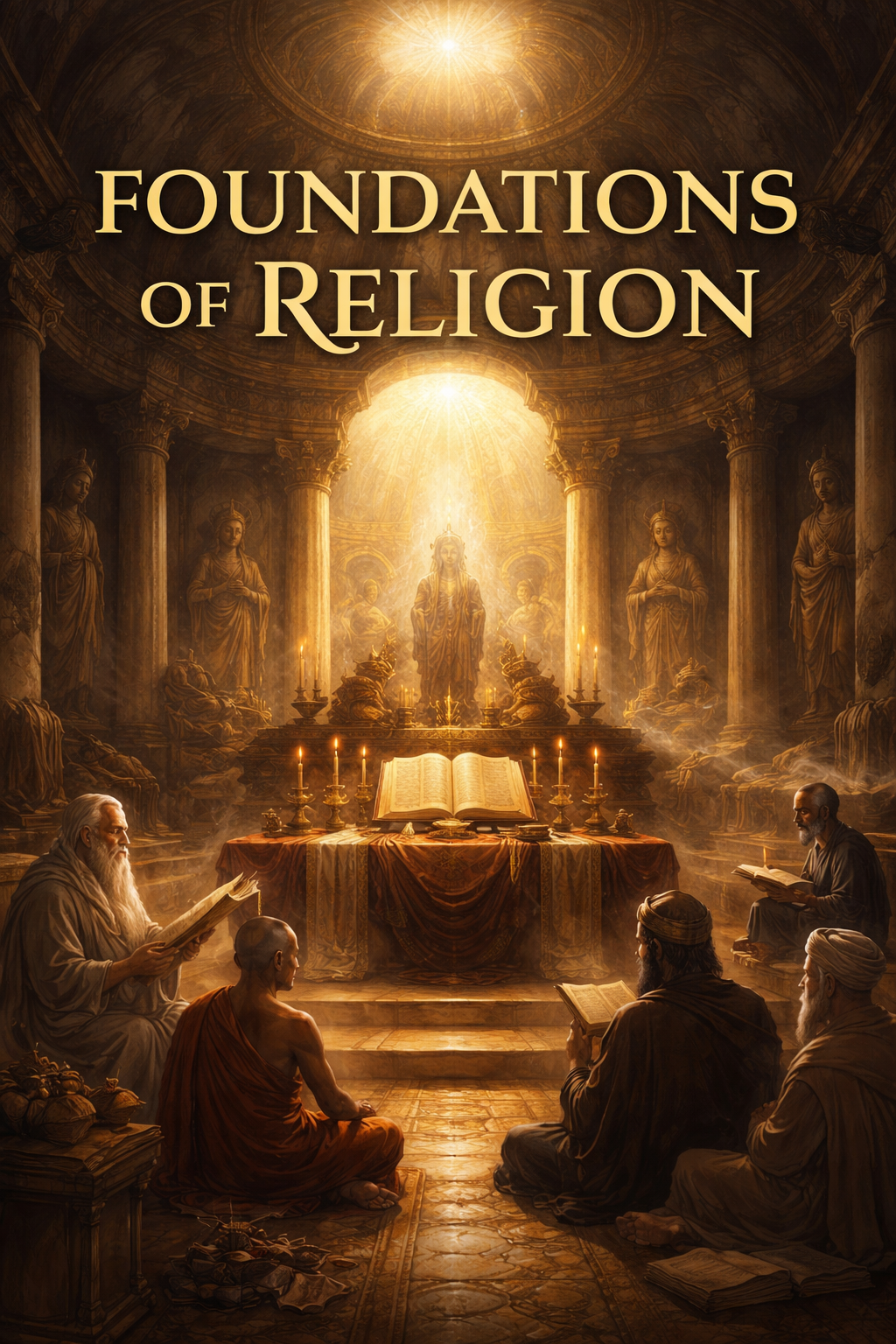
Foundations of Religion matters because religion remains one of the principal ways human beings have interpreted ultimacy, organized moral worlds, legitimized authority, transmitted memory, ritualized suffering and hope, and situated themselves within a cosmos understood to be charged with meaning. A serious study of religion therefore requires not only historical range, but conceptual clarity, interpretive discipline, and attention to the unequal distributions of power through which “religion” itself has been defined, translated, classified, protected, governed, marginalized, or suppressed.
This pillar approaches religion as a field of inquiry rather than as apologetics, polemic, secular dismissal, or confessional instruction. It does not assume that religion can be reduced to belief, nor that one model of scriptural tradition can stand in for the whole range of human sacred life. Instead, it treats religion as a domain in which texts, rituals, institutions, landscapes, bodies, material objects, communities, commentarial traditions, devotional practices, historical wounds, and struggles over authority must all be taken seriously.
At the same time, Foundations of Religion is not neutral in the sense of being indifferent to power. It recognizes that religious traditions have sustained beauty, meaning, mercy, moral discipline, memory, and solidarity, but also hierarchy, exclusion, violence, patriarchy, caste, colonial domination, sectarian hostility, and state power. A rigorous foundations framework must be able to hold both devotion and domination, reverence and critique, sacred continuity and historical harm. It should make room for faith as lived reality while also examining the institutions, classifications, and political conditions through which religion becomes socially powerful.
Why Foundations of Religion Matters
Religion has never been only a matter of inward conviction. Across civilizations, religious traditions have shaped calendars, legal cultures, burial and mourning practices, moral vocabularies, ideas of kinship and authority, rituals of sovereignty, sacred geographies, institutions of teaching, artistic forms, systems of charity, rules of purity, dietary practices, contemplative disciplines, pilgrimage routes, and narratives through which communities understand origin, destiny, suffering, obligation, judgment, liberation, and hope. In many societies, religion has supplied not merely answers to metaphysical questions but the symbolic and institutional architecture of public life.
For that reason, a foundations framework must begin with questions more basic than any single tradition. Before turning to Judaism, Christianity, Islam, Hindu traditions, Buddhism, Jainism, Sikhism, Confucian traditions, Daoism, Indigenous sacred worlds, or new religious movements, it is necessary to ask what scholars mean by religion itself, what counts as scripture, how canon is formed, what ritual does, how authority is transmitted, how sacred space and sacred time are marked, how interpretation becomes institutionalized, and how traditions persist or change under the pressures of empire, reform, colonization, nationalism, secularism, capitalism, migration, digital media, and modern state power.
This conceptual groundwork also guards against reductionism. Religion cannot be reduced to text alone, because many sacred traditions depend profoundly on ritual, oral transmission, bodily discipline, land relation, sacred performance, ancestral memory, healing practice, and material culture. It cannot be reduced to inward belief alone, because religions have historically shaped institutions, law, hierarchy, resistance, memory, and moral imagination on a civilizational scale. Nor can it be reduced to one universal pattern, because traditions differ profoundly in their understandings of revelation, cosmos, authority, liberation, salvation, sacred obligation, moral cultivation, ancestral continuity, and relation to the more-than-human world.
A rigorous foundations approach therefore makes possible both sympathy and critique, breadth and precision, historical depth and comparative clarity. It allows religion to be studied as lived meaning without romanticizing it, as power without reducing it to domination, as tradition without freezing it in the past, and as a field of human seriousness without assuming that all religious worlds answer the same questions in the same way.
The Problem of Definition
No issue in the academic study of religion is more basic or more contested than the question of definition. At first glance, religion may appear easy to identify. Traditions possess sacred texts, rituals, moral teachings, clergy, shrines, temples, churches, mosques, monasteries, pilgrimages, festivals, and stories of gods, spirits, ancestors, liberation, revelation, salvation, or cosmic order. Yet once inquiry moves beyond a small cluster of familiar traditions, the category becomes unstable. Some traditions center belief in divine beings; others center ritual or law. Some depend on canonized scripture; others rely primarily on oral transmission, lineage, sacred performance, discipline, land, or inherited practice. Some foreground transcendence; others emphasize cosmological balance, ancestral continuity, moral cultivation, liberation from suffering, right relation, or ritual harmony.
Attempts to define religion have therefore tended to emphasize one dimension at the expense of others. Substantive definitions focus on what religion is about: gods, spirits, the holy, the sacred, the transcendent, the absolute, or ultimate concern. Functional definitions focus on what religion does: organize moral life, transmit memory, legitimate authority, ritualize death, sustain solidarity, or stabilize symbolic worlds. Experiential definitions emphasize awe, dependence, wonder, dread, conversion, mystical union, reverence, or the encounter with sacred power. Institutional definitions attend to priesthoods, temples, law, doctrine, education, ritual offices, and communal reproduction. Critical definitions ask whether “religion” is itself a modern category shaped by colonial, Protestant, legal, and academic assumptions.
These tensions do not make the category useless. They make it intellectually serious. To study religion well is to recognize that the term names neither one essence nor one single function, but a historically layered field of practices, claims, institutions, symbols, experiences, classifications, and forms of life. A foundations framework must therefore resist the temptation to define religion too narrowly while still preserving enough conceptual coherence to make comparison possible.
The most responsible approach is not to begin with one rigid definition, but to treat religion as a family of overlapping phenomena: sacred narratives, ritual practices, moral worlds, institutions of authority, systems of interpretation, relations with invisible or ultimate realities, sacred objects, embodied disciplines, communal identities, and claims about the order of existence. This approach makes room for scripture-centered traditions and oral traditions, monotheistic traditions and non-theistic traditions, institutional religions and place-based sacred worlds, philosophical traditions and popular devotional practices. It keeps the category open without making it empty.
Religion as a Field of Study
Religious Studies emerged not as a single method but as a contested and interdisciplinary field. It intersects with history, philology, anthropology, philosophy, sociology, psychology, literary interpretation, archaeology, legal history, political theory, gender studies, colonial studies, media studies, ecology, and the study of material culture. At different times, scholars have treated religion as mythic consciousness, sacred order, ritual structure, textual tradition, contemplative discipline, moral community, civilizational inheritance, political technology, colonial category, embodied practice, or field of lived experience.
This plurality is not a weakness. It reflects the complexity of religion itself. Religious life includes texts and commentaries, but also gestures and postures, food rules and festivals, architecture and icons, music and chant, law and authority, grief and pilgrimage, ecological relation and sacred landscape, charisma and bureaucracy, orthodoxy and dissent, memory and reform. No single discipline captures all of these dimensions.
For that reason, Foundations of Religion must be methodologically self-aware. It should not simply summarize traditions, but ask what kinds of evidence are being used and what those forms of evidence reveal or obscure. A textual method may illuminate theology or canon while missing lived religion. A historical method may clarify development while underplaying ongoing ritual power. A philosophical method may sharpen concepts while flattening embodied practice. A sociological method may reveal institutions while missing the force of devotion. A genealogical method may expose structures of power while struggling to account for reverence, metaphysical commitment, or religious experience on its own terms.
The field advances not by erasing these tensions, but by making them visible and productive. A mature study of religion asks not only what traditions teach, but how they are lived, who interprets them, what institutions sustain them, how they change under pressure, and how categories such as religion, myth, magic, superstition, secularism, spirituality, culture, and heritage have been historically produced.
Major Approaches to the Study of Religion
Historical and Philological Approaches
Historical and philological inquiry examines the formation, transmission, redaction, translation, and interpretation of sacred texts, along with the historical settings in which traditions develop. This approach asks when a text was composed, how it circulated, how it was canonized, how variants emerged, how commentary shaped reception, and how religious communities used texts in law, doctrine, liturgy, and memory. It remains indispensable wherever scripture, commentary, manuscript history, oral recitation, or textual interpretation play central roles.
Comparative and Civilizational Approaches
Comparative inquiry seeks to illuminate recurring religious problems across traditions without erasing difference. It asks how civilizations have addressed ultimacy, sacred order, death, law, sacrifice, purity, authority, liberation, salvation, moral cultivation, ritual discipline, and the relation between visible and invisible worlds. Done carefully, comparison clarifies contrast as much as similarity. It becomes strongest when grounded in history, language, social setting, and institutional form rather than abstract universalism.
Phenomenology of Religion
Phenomenological approaches have sought to describe the structures of religious experience and the recurring forms through which the sacred appears in ritual, symbol, myth, sacrifice, initiation, sacred time, and sacred space. Their enduring value lies in taking religious meaning seriously on its own terms rather than reducing it at once to economics, politics, pathology, or social function. Their limitation lies in the danger of overgeneralizing the sacred as though all traditions shared one timeless structure.
Hermeneutics and Commentarial Traditions
Many religious worlds become intellectually rich through interpretation. Hermeneutic inquiry examines how traditions read, gloss, debate, transmit, and authorize sacred texts and teachings. It is concerned with exegesis, commentary, legal interpretation, allegory, doctrinal refinement, translation, and the institutions that regulate legitimate meaning. This approach is indispensable wherever scripture, tradition, and authority are inseparable.
Ritual and Symbolic Approaches
Ritual and symbolic inquiry emphasizes the ways religion is enacted through repeated forms, sacred gestures, processions, offerings, liturgies, bodily disciplines, and symbolic objects. It asks how ritual creates order, marks thresholds, forms communal memory, and transforms ordinary actions into sacred acts. This approach is especially important because religions are lived through bodies, spaces, rhythms, sounds, substances, and materials as much as through propositions.
Anthropological and Lived-Religion Approaches
Anthropological and lived-religion approaches direct attention to everyday practice: shrines, household rituals, healing, food, dress, music, pilgrimage, gendered labor, dreams, vows, local saints, oral tradition, popular devotion, religious objects, and the ways ordinary people inhabit sacred worlds. These approaches challenge elite-centered accounts that treat formal doctrine as the whole of religion. They show that religion is often most visible in repeated practice, local authority, material presence, and embodied habit.
Genealogical and Critical Approaches
Genealogical and critical approaches ask how the category of religion itself was historically produced and how it has been shaped by imperial power, missionary translation, law, education, census, museum collection, academic classification, and state administration. This mode of inquiry is not the whole of the field, but it remains important because any serious foundations framework must ask who has had the power to define religion, which traditions were rendered visible by that definition, and which were distorted, diminished, or excluded.
The Sacred and the Ordinary
One of the recurring questions in the study of religion is how communities distinguish sacred orders from ordinary ones. Sacredness may attach to persons, places, times, texts, objects, words, gestures, foods, mountains, rivers, ancestors, relics, images, laws, or forms of conduct. It may be experienced as holiness, purity, divine nearness, ancestral presence, cosmic balance, ritual danger, moral obligation, or ultimate concern. The sacred is not one thing everywhere, but many religious worlds organize life by differentiating ordinary activity from charged forms of relation.
The distinction between sacred and ordinary is rarely just conceptual. It is marked by behavior. Shoes may be removed. Bodies may be washed. Food may be prepared in a certain way. Speech may change. Silence may be required. A book may be handled with reverence. A mountain may be approached through pilgrimage. A shrine may demand offerings. A grave may require memory. Sacredness is therefore not merely an idea; it is enacted through bodily discipline, social expectation, spatial arrangement, and inherited forms of care.
At the same time, the sacred may not always be sharply separated from the ordinary. In many traditions, the sacred saturates daily life. Cooking, washing, planting, greeting, mourning, sex, childbirth, work, travel, and hospitality may all be religiously charged. A foundations framework must therefore avoid assuming that religion always withdraws from everyday life into specialized institutions. In many sacred worlds, the ordinary is precisely where ultimate meaning is tested.
Ritual, Symbol, and Sacred Order
Religious worlds are not constructed by ideas alone. They are enacted through ritual. Prayer, sacrifice, liturgy, pilgrimage, fasting, chanting, mourning, initiation, ablution, meditation, procession, seasonal observance, divination, confession, healing, vow-making, and rites of passage shape bodies, spaces, calendars, and communal memory. Ritual does not merely express belief after the fact. It creates ordered worlds through repetition, stylization, symbolic differentiation, and embodied participation.
This is why ritual must be treated as constitutive rather than decorative. Through ritual, communities mark birth, puberty, marriage, illness, death, harvest, war, repentance, enthronement, initiation, mourning, and renewal. Ritual gives form to transitions that might otherwise remain socially and emotionally unmanageable. It does not eliminate uncertainty; it makes uncertainty inhabitable by placing it within symbolic order.
Symbol is equally central. Religions work through condensed forms that gather memory, cosmology, authority, and moral imagination into shared patterns of meaning. Water, fire, mountain, desert, tree, light, blood, bread, path, throne, wheel, river, gate, veil, cross, crescent, circle, altar, book, robe, relic, bell, drum, candle, incense, and food are never merely objects when ritually charged. They become nodes in broader symbolic orders that organize how communities understand origin, danger, transition, purity, presence, death, and renewal.
Symbols also allow religious worlds to hold multiple meanings at once. A river may be water, boundary, purification, danger, exile, passage, fertility, and sacred memory. A meal may be nourishment, kinship, sacrifice, covenant, hospitality, thanksgiving, or memorial. A garment may be modesty, rank, renunciation, identity, discipline, or divine service. Foundations of Religion must therefore treat ritual and symbol not as secondary ornaments of doctrine but as fundamental elements of religious life itself.
Myth, Narrative, and Religious Worldmaking
Myth is not the opposite of truth in the study of religion. In scholarly usage, myth refers to powerful narratives that organize worlds: stories of origin, creation, divine action, cosmic struggle, sacred law, ancestral memory, fall, liberation, covenant, exile, incarnation, enlightenment, judgment, apocalypse, return, or renewal. Myths give shape to reality by explaining where the world comes from, what kind of beings humans are, what powers govern existence, why suffering exists, and what obligations bind the living.
Religious narratives do more than explain. They orient. They provide communities with models of conduct, memory, warning, hope, and identity. A creation story may establish obligations to land. A liberation story may structure political memory. A martyr story may teach endurance. A pilgrimage story may organize sacred geography. A prophetic story may authorize law. A cosmic battle may explain evil. A story of divine mercy may sustain hope under suffering.
Religious worldmaking also occurs through repeated retelling. A story told once is not the same as a story recited annually in liturgy, dramatized in ritual, painted in icons, sung in festivals, embodied in pilgrimage, or interpreted across centuries of commentary. The power of sacred narrative often lies not only in its content but in its ritual recurrence. Communities live inside stories by telling them again and again under changing historical conditions.
This is why Foundations of Religion connects closely to Mythology. Mythological traditions are not peripheral to religion; in many cases they are among the main structures through which sacred worlds become intelligible. A mature framework must therefore study myth as worldmaking, memory, authority, moral imagination, and symbolic order.
Sacred Time, Sacred Space, and the Religious Imagination
Religious traditions often organize time through calendars, festivals, fasts, sabbaths, pilgrimages, commemorations, liturgical cycles, mourning periods, initiations, and seasonal rites. Sacred time does not merely divide the year. It reorders memory. It makes past events present, renews covenants, marks cosmic rhythms, and teaches communities how to inhabit history. A festival may recall creation, liberation, revelation, sacrifice, harvest, martyrdom, divine incarnation, enlightenment, or ancestral return.
Sacred space is equally important. Temples, churches, mosques, shrines, monasteries, synagogues, altars, graveyards, sacred groves, mountains, rivers, caves, pilgrimage routes, household altars, and ancestral lands all organize religious life materially. Sacred space is not merely a backdrop for belief. It shapes movement, posture, sound, social hierarchy, memory, access, exclusion, and encounter.
Some sacred spaces are monumental; others are intimate. A cathedral, mosque, or temple may display cosmic order through architecture. A household shrine may hold the sacred within domestic life. A grave may bind the living to the dead. A spring may heal. A mountain may be approached only through discipline. A forest, river, or desert may be sacred not because it was built by humans but because it is understood as a living site of presence, origin, or obligation.
Foundations of Religion must therefore treat time and space as religious media. Traditions do not merely hold beliefs inside neutral settings. They construct sacred worlds through calendars, paths, buildings, landscapes, thresholds, repeated gestures, and remembered places.
Scripture, Canon, and Sacred Transmission
Many religious traditions are profoundly shaped by sacred texts, but scripture is never simply “there.” Texts become scripture through reception, repetition, canonization, liturgical use, educational institutions, memorization, recitation, commentary, translation, preservation, and claims about revelation or authoritative memory. Canon formation is therefore a historical and political process as much as a theological one. It includes selection and exclusion, preservation and loss, translation and standardization, hierarchy and debate.
Some traditions place extraordinary emphasis on textual preservation, recitation, memorization, interpretation, and law. Others maintain more porous relations between written text, oral lineage, ritual expertise, visionary authority, initiatory knowledge, or communal memory. Even where scripture is central, the text does not float free from institutions. It is read in schools, recited in liturgy, glossed by commentators, litigated by jurists, translated by empires, regulated by reformers, and embodied through performance and discipline.
Foundations of Religion must therefore distinguish between text and tradition. The existence of a sacred book does not eliminate the need for interpretation. Nor does the absence of a fixed canon imply the absence of authority. Sacred transmission may occur through chant, lineage, recitation, shrine practice, pilgrimage, mythic performance, craft knowledge, initiation, ancestral story, elder teaching, monastic discipline, or ritual repetition.
A serious foundations framework must be able to account for the full range of these forms. Otherwise, it risks treating scripture-centered religions as the norm and all other traditions as deficient approximations. Sacred transmission is broader than writing. It includes bodies, voices, places, teachers, objects, gestures, and communities.
Interpretation, Commentary, and Authority
No scripture interprets itself without a community. Religious traditions develop priests, rabbis, monks, jurists, theologians, shamans, exegetes, saints, teachers, elders, reformers, ritual specialists, and institutional structures that authorize, regulate, or contest interpretation. The struggle over meaning is therefore inseparable from the struggle over authority. Who may interpret? In what language? Under what rules? With what relation to lineage, doctrine, ritual competence, gender, caste, ordination, initiation, scholarship, charisma, or moral status?
Commentary traditions are often where religions become intellectually elaborate. Exegesis, hermeneutics, legal interpretation, doctrinal debate, mystical commentary, allegory, grammar, scholastic distinction, narrative expansion, and translational labor all mediate the relation between foundational revelation and changing historical circumstance. These traditions keep scripture alive, but they also diversify it. The history of religion is therefore full of interpretive disputes over literal and allegorical meaning, orthodoxy and heresy, innovation and fidelity, inclusion and exclusion.
Translation intensifies these issues. Sacred concepts rarely move from one language to another without loss, compression, distortion, or strategic adaptation. Colonial translation, missionary translation, state classification, and modern academic terminology have all reshaped how religions are understood both by outsiders and by practitioners themselves. Terms such as God, religion, law, scripture, soul, spirit, idol, caste, magic, superstition, mysticism, and secularism carry histories that can clarify or distort depending on context.
Interpretation is therefore not a secondary technical matter. It is one of the central engines of religious history. Traditions endure because they are interpreted; they fracture because interpretation is contested; they adapt because communities keep re-reading inherited materials under new conditions.
Religion, Law, and Normative Order
Religion often shapes law, norm, duty, obligation, discipline, and communal regulation. In some traditions, religious law governs ritual purity, marriage, inheritance, diet, commerce, punishment, prayer, sexuality, education, and public authority. In others, religious norms are carried through custom, taboo, ancestral law, monastic discipline, ethical codes, ritual obligation, or communal expectation rather than through codified legal systems.
The relation between religion and law is never simple. Law may be understood as divine command, cosmic order, communal discipline, priestly regulation, ethical training, ancestral inheritance, or state-administered religious identity. Religious law can protect community and transmit moral order, but it can also enforce hierarchy, gender inequality, exclusion, surveillance, or coercion. A serious foundations framework must therefore study law as both sacred discipline and social power.
Religious normativity also extends beyond formal legal codes. Purity rules, pilgrimage obligations, initiation requirements, dress practices, dietary restrictions, mourning customs, moral teachings, vows, and everyday habits can shape life just as powerfully as written law. Religion often governs through repeated practice and social expectation as much as through formal command.
This is why Foundations of Religion links directly to Religion and Law. Religious traditions do not merely produce beliefs about ultimate reality. They also produce normative worlds: systems of obligation through which communities define what it means to live rightly.
Religion, Institution, and Community
Religion persists through institutions as well as ideas. Monasteries, temples, churches, mosques, synagogues, shrines, legal schools, pilgrimage networks, guilds, lineages, charitable bodies, educational centers, lay associations, ritual offices, reform movements, councils, courts, and devotional organizations preserve doctrine, regulate practice, distribute authority, transmit memory, and define communal boundaries. Institution is therefore not the accidental shell of religion. It is one of the main ways religion becomes durable in history.
Community matters equally. Religious life is shaped through belonging, repetition, shared calendars, domestic practice, moral discipline, mutual recognition, and collective memory. Communities tell members what counts as transgression, holiness, impurity, duty, sacrifice, or redemption. They also generate internal tensions between elites and laity, reform and continuity, charisma and bureaucracy, center and margin, purity and accommodation, public authority and private devotion.
Institutional religion can sustain extraordinary forms of care: education, hospitals, charity, hospitality, mutual aid, mourning support, ethical formation, and protection of vulnerable groups. It can also preserve domination: clerical abuse, exclusion, caste hierarchy, patriarchy, sectarian boundary-making, forced conformity, and complicity with state violence. The same institutional durability that allows religious memory to survive can also make reform difficult.
A mature framework must therefore be able to hold both devotion and domination, communal beauty and institutional harm, sacred continuity and the struggle for reform. Religion is never only individual interiority. It becomes historical through community, institution, conflict, and memory.
Lived Religion, Material Religion, and Embodied Practice
One of the most important correctives in recent scholarship has been the move away from text-exclusive models of religion. Oral tradition, sacred performance, domestic ritual, material objects, healing practice, foodways, soundscapes, landscapes, pilgrimage routes, relics, icons, clothing, bodily discipline, and devotional labor all shape religious worlds in ways that cannot be captured by canonical texts alone.
Lived religion directs attention to the everyday and embodied dimensions of sacred life: household altars, shrine visits, prayer routines, mourning practices, feast days, local saints, vernacular cosmologies, protective amulets, seasonal processions, popular vows, devotional economies, sacred labor, informal spiritual authority, and the practices through which ordinary people inhabit sacred worlds. It asks not only what traditions officially teach, but what people do, fear, hope, touch, sing, wear, eat, carry, and repeat.
Material religion asks how objects, spaces, substances, and media mediate religious presence and power. Books, icons, relics, beads, incense, candles, food, water, garments, masks, drums, altars, shrines, statues, amulets, architecture, digital media, and landscape forms can all participate in religious life. Objects are not always passive symbols. They may be touched, kissed, feared, carried, venerated, buried, washed, consumed, hidden, or protected.
Even highly textual traditions are lived through bodies, spaces, sounds, and things. A scripture is recited by a voice, held by hands, placed in a sacred location, memorized by a body, and interpreted within a community. Foundations of Religion must therefore move beyond an archive-only model and treat religion as simultaneously textual, oral, material, embodied, and social.
Oral Tradition, Ancestral Memory, and Place-Based Religion
Oral tradition is not an inferior substitute for writing. In many religious worlds, sacred knowledge is sung, recited, danced, performed, remembered, enacted, initiated, or tied to land. Oral transmission may carry creation stories, genealogies, ritual instructions, moral teachings, ancestral law, ecological knowledge, healing practice, and sacred geography with extraordinary precision and authority.
Place-based religion challenges assumptions that religion must be portable, textual, or institutionally centralized. Mountains, rivers, caves, forests, burial grounds, ancestral lands, springs, deserts, and pilgrimage routes can function as sacred archives. In such contexts, religious memory is not simply located in a book or doctrine; it is embedded in land, route, story, naming, and obligation.
Ancestral memory also expands the field. Many traditions understand the living and the dead as bound through ritual, kinship, land, offering, burial, and moral responsibility. Ancestors may be remembered, consulted, honored, feared, or understood as continuing members of the community. The boundary between religion, kinship, history, and place becomes difficult to separate.
This is especially important for Indigenous and Oral Traditions, but the point extends much more widely. Oral and place-based traditions reveal that religion can be held in landscape, body, voice, memory, and relationship. A foundations framework that cannot account for these forms is too narrow.
Religion, Power, and Social Boundaries
Religion often defines belonging. It marks who is inside and outside, pure and impure, initiated and uninitiated, orthodox and heretical, saved and unsaved, ritually qualified and disqualified, native and foreign, permitted and forbidden. These boundaries may sustain community identity and continuity, but they may also justify exclusion, domination, persecution, hierarchy, or violence.
Power operates through religious language in many ways. Rulers claim divine sanction. Priests regulate access to sacred rites. Reformers challenge institutions in the name of purified truth. Empires classify subject populations by religion. States regulate religious dress, marriage, education, conversion, blasphemy, sacred sites, and minority rights. Communities police gender, sexuality, caste, race, lineage, and doctrinal conformity through religious frameworks.
At the same time, religion can also resist power. Prophets rebuke kings. Monastics withdraw from imperial values. Liberation movements draw on sacred narratives. Enslaved, colonized, exiled, and marginalized communities reinterpret religious traditions as sources of dignity and resistance. Rituals of mourning can become political memory. Sacred law can protect the vulnerable. Religious imagination can challenge the false inevitability of domination.
Foundations of Religion must therefore study religion as a field where power is produced, contested, sanctified, resisted, and reimagined. Religion is not automatically oppressive, nor automatically liberating. It is a domain in which moral language, sacred authority, institutional durability, and social struggle meet.
Colonialism, Classification, and Critique
Modern knowledge about religion was not produced in a vacuum. Colonial empires, missionary movements, census regimes, legal codification, orientalist scholarship, museum collection, educational systems, and administrative categorization all helped shape the modern study of religion. Traditions were often translated into Western categories such as scripture, clergy, church, belief, idolatry, superstition, law, tribe, sect, magic, or cult, even where those categories only partially fit local realities.
This history matters because classification has consequences. To name a set of practices a “religion” may secure legal recognition, but it may also distort those practices by forcing them into frameworks modeled on Protestant assumptions about belief, text, or private conscience. Traditions grounded in land, ritual, caste, lineage, kingship, sacred performance, healing, possession, or ancestral continuity have often been misunderstood when measured against scriptural monotheism as the implicit norm.
Colonial classification also altered religious life itself. Communities sometimes redefined their own traditions in response to missionary critique, census categories, colonial law, reform movements, print culture, or nationalist pressure. What outsiders classified became part of how insiders organized, defended, standardized, or transformed their traditions.
A research-grade foundations framework must therefore include critique. It must ask who has had the power to define religion, whose traditions were rendered legible or illegible by those definitions, and how the study of religion can avoid reproducing older hierarchies under new theoretical language. This critical reflex is not the whole field, but it is part of the field’s maturity.
Modernity, Secularization, and Pluralism
No religion remains untouched by modernity. Traditions encounter industrialization, scientific authority, colonial administration, print culture, nationalism, individualism, constitutionalism, migration, mass education, digital media, market society, and modern state law. These changes alter how religion is organized, represented, contested, and lived. Some traditions react defensively, others reform creatively, others institutionalize themselves anew within modern categories such as denomination, minority religion, spirituality, heritage, culture, identity, or ethics.
The concept of secularization has long tried to describe these transformations, but it is itself debated. In some contexts, secularization refers to declining religious authority. In others, it refers to institutional differentiation between religion and state. In others, it describes the relocation of sacred energies into national, political, moral, therapeutic, or consumer forms. Modern societies are not simply post-religious; they are often religiously reconfigured.
Pluralism complicates this further. Traditions no longer appear only in isolated civilizational settings but in shared legal, urban, digital, and educational spaces where comparison, conflict, translation, and hybridization intensify. Religious freedom, minority rights, public symbols, interfaith encounter, conversion, secular law, religious nationalism, and spiritual individualism all become part of the modern religious field.
Foundations of Religion must therefore examine not only ancient sacred orders but modern conditions under which religion is reclassified, privatized, politicized, commodified, revived, globalized, or contested. The modern world has not eliminated religion. It has changed the conditions under which religion appears, speaks, organizes, and becomes publicly visible.
Religion, Ecology, and the More-Than-Human World
Religion has often structured human relationships with land, water, animals, plants, weather, mountains, rivers, forests, ancestors, and cosmic order. Sacred geographies, creation stories, ritual calendars, agricultural rites, food laws, animal ethics, pilgrimage routes, and cosmological narratives all shape how communities understand the more-than-human world. Religion is therefore deeply relevant to ecology, not only as environmental ethics but as a historical force in how humans inhabit Earth.
Some traditions imagine the natural world as creation entrusted to human care. Others understand land as ancestor, relative, divine body, sacred presence, ritual field, or moral teacher. Some religious systems have justified human dominion; others have cultivated restraint, reciprocity, nonviolence, ritual exchange, or reverence for life. No single religious ecological ethic exists. The field is plural, contested, and historically shaped.
Contemporary ecological crisis has intensified interest in religion and ecology. Climate change, extinction, pollution, water scarcity, land dispossession, and environmental injustice have forced renewed attention to sacred land, intergenerational responsibility, Indigenous ecological knowledge, religious environmental movements, and the ways spiritual traditions can either challenge or reinforce extractive systems.
This is why Foundations of Religion links directly to Religion and Ecology and to the broader Sustainable Systems architecture. Religion is not only about human beings and invisible worlds. It also shapes how communities relate to the Earth, to nonhuman life, and to the moral limits of extraction.
Religion, Suffering, and Moral Imagination
Religious traditions repeatedly confront suffering: illness, death, grief, injustice, exile, poverty, violence, guilt, impermanence, sin, oppression, disaster, and the apparent absence of order. Religion does not answer suffering in one way. It may interpret suffering as test, consequence, illusion, participation in sacred history, opportunity for compassion, result of injustice, mystery, karmic condition, exile, purification, or a problem that resists explanation.
Because suffering is so central to human life, religious traditions often develop practices for mourning, healing, confession, lament, repentance, endurance, protest, consolation, and hope. These practices are not secondary to doctrine. They are among religion’s most important social functions. Funerals, prayers for the dead, lamentations, healing rites, confession, pilgrimage, fasts, and memorial practices give form to experiences that might otherwise remain unbearable.
At the same time, religious interpretations of suffering can be harmful when they justify abuse, sanctify oppression, blame victims, or discourage resistance to injustice. A mature foundations framework must therefore distinguish between religious meaning-making that sustains dignity and religious meaning-making that conceals domination.
Religion’s moral imagination lies partly in this tension. It helps communities ask why suffering exists, how people should respond to it, what obligations the living have toward one another, and whether history is ultimately open to justice, liberation, judgment, compassion, or redemption.
Why Foundations Must Remain Comparative
Foundations of Religion is not a substitute for close study of particular traditions. Comparison without depth becomes superficial. Yet close study without comparison can leave basic categories unexamined. Comparison becomes strongest when it is disciplined, historically aware, linguistically careful, and sensitive to asymmetry. It should not flatten traditions into interchangeable versions of the same sacred pattern. It should clarify differences while identifying recurring problems that traditions address: ultimacy, order, suffering, obligation, death, memory, legitimacy, purity, transformation, sacred presence, moral authority, and the possibility of transcendence.
For this reason, Foundations of Religion serves as a hinge category within Religious Studies. It prepares the way for more focused work in Abrahamic Traditions, South Asian Traditions, East Asian Traditions, and Indigenous and Oral Traditions, while also linking to thematic inquiry in Mysticism and Contemplative Traditions, Religion and Law, Religion and Society, Religion and Ecology, and Comparative Sacred Themes.
The goal is not to create a bland universal theory of religion. It is to build a disciplined comparative grammar: a way to ask better questions, avoid reductive assumptions, recognize power, and move responsibly among traditions that differ in form, history, authority, and sacred imagination.
Major Questions of Interpretation
This pillar is organized around several major questions. What is religion, and why has the category been so difficult to define? How should scholars study traditions that differ radically in their relation to gods, texts, law, ritual, ancestors, land, liberation, salvation, or sacred order? How can the field take religious meaning seriously without becoming apologetic, and how can it critique power without reducing religion to domination?
The pillar also asks how sacred worlds are transmitted. How do texts become scripture? How do rituals create order? How do oral traditions preserve memory? How do sacred places organize belonging? How do commentarial traditions regulate meaning? How do institutions preserve authority? How do colonial, legal, academic, and political systems classify religion? How do modernity, secularization, pluralism, and digital life reshape religious belonging?
These questions keep Foundations of Religion from becoming a mere introduction to “world religions.” The goal is not to list traditions, but to establish the conceptual, historical, methodological, and ethical framework through which traditions can be studied rigorously. Foundations of Religion is therefore not the simplest part of Religious Studies. It is one of the most important, because it determines the quality of every comparison that follows.
Expanded Article Architecture
The following architecture gives Foundations of Religion a serious long-range research structure. It moves from definition and method to sacred order, scripture, interpretation, community, law, lived practice, critique, modernity, ecology, suffering, and comparison. All entries below should be treated as planned unless already completed elsewhere on the site.
Concepts, Definitions, and the Field
- What Is Religion? (planned)
Introduces the problem of defining religion across belief, ritual, institution, sacred order, authority, and lived practice. - The Concept of Religion and the Problem of Definition (planned)
Examines substantive, functional, experiential, institutional, and critical definitions of religion. - Religion as Belief, Practice, Institution, and World (planned)
Shows why religion must be studied as a complex form of life rather than as private belief alone. - Religion, Culture, and the Limits of Category (planned)
Explores where religion overlaps with culture, law, kinship, philosophy, ethnicity, and identity. - Religious Studies as a Field of Inquiry (planned)
Introduces the history, methods, debates, and disciplinary boundaries of Religious Studies.
Methods and Approaches
- Methods in Religious Studies (planned)
Surveys historical, philological, anthropological, philosophical, sociological, ritual, and critical approaches. - Phenomenology and the Search for Sacred Structure (planned)
Examines the attempt to describe recurring forms of religious experience and sacred order. - Hermeneutics, Interpretation, and Religious Meaning (planned)
Explores how traditions read, comment, translate, and authorize meaning. - Comparison, Civilizations, and the Study of Religion (planned)
Develops a disciplined approach to comparison that preserves difference and avoids flattening traditions. - Critical Theory and the Study of Religion (planned)
Examines power, classification, ideology, colonialism, gender, race, caste, and institutional authority.
Sacred Order, Ritual, and Symbol
- The Sacred and the Profane (planned)
Studies the distinction between sacred and ordinary orders in ritual, space, time, and social life. - Ritual, Symbol, and Sacred Order (planned)
Explains how ritual creates meaning through repetition, embodiment, gesture, and symbolic form. - Myth, Memory, and Religious Worldmaking (planned)
Shows how sacred narratives organize origin, duty, suffering, death, and cosmic order. - Sacred Time, Sacred Space, and the Religious Imagination (planned)
Examines calendars, pilgrimage, sacred geography, festivals, architecture, and ritual recurrence. - Sacrifice, Offering, and the Logic of Sacred Exchange (planned)
Studies the symbolic and social role of offering, gift, renunciation, and ritual exchange. - Purity, Pollution, and Ritual Boundary (planned)
Examines how traditions organize danger, holiness, bodily discipline, and communal boundaries.
Scripture, Canon, and Sacred Transmission
- Scripture, Revelation, and Sacred Authority (planned)
Introduces how texts become sacred and how revelation, memory, and authority are linked. - Canon Formation and the Making of Sacred Texts (planned)
Explores selection, exclusion, preservation, standardization, and the politics of canon. - Oral Tradition, Recitation, and Sacred Memory (planned)
Examines non-textual and performance-based transmission of sacred knowledge. - Translation, Commentary, and the Politics of Meaning (planned)
Studies how sacred concepts change as they move across languages and institutions. - Text, Performance, and the Embodied Life of Scripture (planned)
Shows how scripture is recited, sung, memorized, displayed, touched, worn, and ritualized.
Interpretation, Authority, and Dispute
- Religion and Interpretation (planned)
Examines how communities regulate meaning through teachers, institutions, commentaries, and debate. - Orthodoxy, Heresy, and the Boundaries of Belief (planned)
Studies how traditions define legitimate doctrine and exclude rival interpretations. - Charisma, Prophecy, and Religious Authority (planned)
Explores prophets, saints, gurus, elders, reformers, mystics, and charismatic authority. - Tradition, Reform, and Religious Change (planned)
Examines how religions adapt while claiming continuity with inherited authority. - Schism, Sect, and the Fragmentation of Sacred Community (planned)
Studies religious division, dissent, reform movements, and contested legitimacy.
Religion, Law, Institution, and Community
- Religion, Institution, and Community (planned)
Explains how religious institutions preserve memory, regulate practice, and define belonging. - Religion and Law (planned)
Studies sacred law, moral order, jurisprudence, custom, discipline, and state recognition. - Priests, Monks, Jurists, Elders, and Ritual Specialists (planned)
Examines religious offices and the social organization of sacred authority. - Ritual Community, Belonging, and Boundary (planned)
Explores how communities form identity through calendars, rites, food, dress, and discipline. - Religion, Charity, Care, and Social Obligation (planned)
Studies religious institutions of giving, mutual aid, hospitality, education, and care.
Lived Religion, Material Religion, and Embodiment
- Lived Religion and Everyday Sacred Practice (planned)
Studies religion as practiced through households, bodies, objects, local customs, and ordinary life. - Material Religion and the Power of Sacred Objects (planned)
Examines icons, relics, beads, amulets, books, garments, food, images, and sacred media. - Pilgrimage, Devotion, and Embodied Religious Practice (planned)
Explores movement, discipline, vow, sacred geography, and the body in religious life. - Food, Fasting, Feast, and Religious Discipline (planned)
Examines how eating and not eating become sacred practices and markers of belonging. - Sound, Chant, Music, and Religious Atmosphere (planned)
Studies sonic practices that shape devotion, memory, trance, community, and sacred space. - Clothing, Modesty, Identity, and Sacred Discipline (planned)
Explores dress as embodied theology, boundary, discipline, and public religious presence.
Oral, Indigenous, Ancestral, and Place-Based Traditions
- Oral Tradition, Ancestral Memory, and Sacred Transmission (planned)
Examines oral knowledge as a disciplined religious archive rather than a lesser form of writing. - Place-Based Religion and Sacred Geography (planned)
Studies land, mountain, river, forest, burial ground, and pilgrimage route as sacred archive. - Ancestral Presence, Kinship, and the Religious Life of the Dead (planned)
Explores ancestor veneration, burial, memory, kinship, and relations between living and dead. - Indigenous Sacred Worlds and the Ethics of Interpretation (planned)
Develops protocols for studying Indigenous traditions without extraction or homogenization. - Ritual Ecology and the More-Than-Human World (planned)
Examines religious relations with animals, plants, waters, weather, and landscapes.
Religion, Power, and Critique
- Religion, Empire, and Colonial Classification (planned)
Studies how empires, missions, law, census, and scholarship shaped the modern category of religion. - Religion, Race, Caste, Gender, and Social Hierarchy (planned)
Examines how religious systems have both sustained and challenged unequal social orders. - Religion and Violence (planned)
Explores sacrifice, war, persecution, martyrdom, sectarian conflict, and sacred legitimation of force. - Religion and Resistance (planned)
Studies prophetic critique, liberation traditions, anti-colonial movements, and sacred justice. - Religion, Nationalism, and Political Identity (planned)
Examines how sacred symbols and institutions are used to form nations, borders, and collective memory.
Modernity, Secularization, and Pluralism
- Religion and Modernity (planned)
Examines how modern institutions, science, print, migration, capitalism, and states transform religion. - Secularization, Pluralism, and the Post-Religious Question (planned)
Studies debates over secularization, religious decline, public religion, and spiritual reconfiguration. - Religious Freedom, Minority Rights, and the Modern State (planned)
Explores law, recognition, conscience, religious dress, conversion, and public religion. - Religion, Media, and Digital Sacred Life (planned)
Examines online ritual, digital authority, virtual community, livestreamed worship, and religious media. - Spirituality, Wellness, and the Reclassification of Religion (planned)
Studies modern spiritual language, therapeutic religion, consumer practice, and post-institutional sacred life.
Religion, Ecology, Suffering, and Moral Imagination
- Religion and Ecology (planned)
Studies sacred land, creation, stewardship, reciprocity, environmental ethics, and ecological crisis. - Religion, Suffering, and the Problem of Meaning (planned)
Examines theodicy, karma, lament, salvation, liberation, grief, and religious responses to pain. - Death, Mourning, and the Ritual Care of the Dead (planned)
Explores funerals, memorials, afterlife, ancestor memory, and the social meaning of death. - Mercy, Justice, and Moral Obligation Across Religious Traditions (planned)
Studies compassion, law, charity, justice, forgiveness, and the formation of ethical life. - Hope, Apocalypse, Liberation, and Sacred Futures (planned)
Examines end-times, messianism, liberation, renewal, and religious imagination of the future.
Comparative Sacred Themes
- Creation, Origin, and Cosmic Order Across Religious Traditions (planned)
Compares how traditions narrate the beginning and structure of reality. - Revelation, Enlightenment, Liberation, and Salvation (planned)
Studies distinct models of ultimate transformation and sacred knowledge. - Prayer, Meditation, Contemplation, and Devotional Practice (planned)
Compares disciplined forms of attention, speech, silence, and presence. - Pilgrimage, Exile, Return, and Sacred Journey (planned)
Examines movement as religious formation and symbolic transformation. - Comparative Sacred Themes: A Framework for Religious Studies (planned)
Establishes the broader comparative method for thematic study across traditions.
Closing Perspective
Foundations of Religion establishes the conceptual grammar for the Religious Studies architecture. It asks what religion is, how sacred worlds are made, how rituals order life, how texts become scripture, how traditions authorize interpretation, how institutions preserve memory, how power shapes classification, and how religion continues to matter under modern, plural, secular, ecological, and technological conditions.
This pillar is necessary because tradition-specific study becomes stronger when its basic categories are clear. Abrahamic traditions cannot be studied well without understanding revelation, scripture, law, prophecy, commentary, and communal authority. South Asian traditions require attention to ritual, liberation, caste, devotion, philosophy, and embodied discipline. East Asian traditions complicate Western assumptions about religion, ethics, ritual, state, and cosmological order. Indigenous and oral traditions demand a framework that respects land, memory, ancestors, oral sovereignty, and non-textual transmission. Mystical and contemplative traditions require attention to experience, discipline, language, silence, and authority.
The strongest reason to build this pillar is that religion remains one of the great human systems for organizing meaning. It can console and control, liberate and dominate, preserve memory and enforce hierarchy, sanctify violence and inspire mercy, bind communities and exclude outsiders, deepen ecological responsibility and justify extraction. To study religion seriously is to study the human struggle to live in relation to what is understood as ultimate, sacred, authoritative, or more-than-ordinary. Foundations of Religion provides the intellectual structure for that study.
Related Reading
- Religious Studies
- Abrahamic Traditions
- South Asian Traditions
- East Asian Traditions
- Indigenous and Oral Traditions
- Mysticism and Contemplative Traditions
- Religion and Law
- Religion and Society
- Religion and Ecology
- Comparative Sacred Themes
- Mythology
- Philosophy
- Cultural Anthropology
- Global Governance
- Sustainable Systems
Core Sources and Research Gateways
Reference Gateways
- Stanford Encyclopedia of Philosophy, “The Concept of Religion.” A strong philosophical gateway into definitional debates around religion: https://plato.stanford.edu/entries/concept-religion/
- Stanford Encyclopedia of Philosophy, “Philosophy of Religion.” Useful for metaphysical, epistemological, and philosophical approaches to religious claims: https://plato.stanford.edu/entries/philosophy-religion/
- Stanford Encyclopedia of Philosophy, “Comparative Philosophy of Religion.” Useful for careful comparison across traditions without reducing them to one model: https://plato.stanford.edu/entries/religion-comparative/
- Encyclopaedia Britannica, “Religion.” Useful as a general reference overview of religion as a broad historical and conceptual field: https://www.britannica.com/topic/religion
- Encyclopaedia Britannica, “Ritual.” Useful for basic conceptual grounding in ritual practice and religious action: https://www.britannica.com/topic/ritual
- Encyclopaedia Britannica, “Secularism.” Useful for introductory context on secularization, secular politics, and modern religious classification: https://www.britannica.com/topic/secularism
Core Theoretical Texts
- Émile Durkheim, The Elementary Forms of Religious Life. Foundational for religion as social fact, ritual community, and collective representation.
- Rudolf Otto, The Idea of the Holy. Important for the phenomenological language of awe, dread, mystery, and the numinous.
- Mircea Eliade, The Sacred and the Profane. Influential for sacred space, sacred time, mythic recurrence, and religious symbolism, though best read critically.
- Clifford Geertz, “Religion as a Cultural System.” Important for symbolic and anthropological approaches to religion as a system of meaning.
- Catherine Bell, Ritual Theory, Ritual Practice and Ritual: Perspectives and Dimensions. Essential for modern ritual studies.
- Talal Asad, Genealogies of Religion. Foundational for critical study of religion as a category shaped by power, discipline, and history.
- Jonathan Z. Smith, Imagining Religion. Important for comparison, classification, and the constructed nature of scholarly categories.
- Russell T. McCutcheon, Manufacturing Religion. A major critical work on sui generis religion and the politics of scholarly nostalgia.
- Kevin Schilbrack, ed., The Oxford Handbook of the Study of Religion. A major contemporary handbook for theoretical, methodological, and comparative approaches.
Tradition-Specific Foundations
- Abrahamic traditions: Torah, Hebrew Bible, New Testament, Qur’an, Hadith, rabbinic commentary, church fathers, Islamic jurisprudence, theology, mysticism, and devotional practice.
- South Asian traditions: Vedas, Upanishads, Bhagavad Gita, epics, Puranas, Buddhist canons, Jain texts, Sikh scripture, ritual traditions, philosophical schools, devotional movements, and oral traditions.
- East Asian traditions: Confucian classics, Daoist texts, Buddhist scriptures, ritual manuals, ancestral practices, shrine traditions, state cults, monastic institutions, and local religious practice.
- Indigenous and oral traditions: community-authorized oral histories, sacred narratives, ceremonial protocols, land-based knowledge, ancestral memory, ritual practice, and living knowledge systems.
- Mystical and contemplative traditions: Sufi texts, Christian mystical writing, Jewish Kabbalah, Buddhist meditation manuals, Hindu devotional and yogic traditions, Daoist inner cultivation, and comparative contemplative practice.
Further Reading
- Asad, T. (1993) Genealogies of Religion: Discipline and Reasons of Power in Christianity and Islam. Baltimore: Johns Hopkins University Press.
- Bell, C. (1992) Ritual Theory, Ritual Practice. New York: Oxford University Press.
- Bell, C. (1997) Ritual: Perspectives and Dimensions. New York: Oxford University Press.
- Durkheim, É. (1912/2008) The Elementary Forms of Religious Life. Oxford: Oxford University Press.
- Eliade, M. (1959) The Sacred and the Profane: The Nature of Religion. New York: Harcourt.
- Flood, G. (1999) Beyond Phenomenology: Rethinking the Study of Religion. London: Cassell.
- Geertz, C. (1973) ‘Religion as a Cultural System’, in The Interpretation of Cultures. New York: Basic Books.
- Grimes, R.L. (2014) The Craft of Ritual Studies. New York: Oxford University Press.
- Lincoln, B. (2012) Gods and Demons, Priests and Scholars: Critical Explorations in the History of Religions. Chicago: University of Chicago Press.
- McCutcheon, R.T. (1997) Manufacturing Religion: The Discourse on Sui Generis Religion and the Politics of Nostalgia. New York: Oxford University Press.
- Morgan, D. (2010) Religion and Material Culture: The Matter of Belief. London: Routledge.
- Orsi, R.A. (2005) Between Heaven and Earth: The Religious Worlds People Make and the Scholars Who Study Them. Princeton: Princeton University Press.
- Otto, R. (1923) The Idea of the Holy. Oxford: Oxford University Press.
- Schilbrack, K. (ed.) (2020) The Oxford Handbook of the Study of Religion. Oxford: Oxford University Press.
- Smith, J.Z. (1982) Imagining Religion: From Babylon to Jonestown. Chicago: University of Chicago Press.
- Smith, W.C. (1962) The Meaning and End of Religion. New York: Macmillan.
- Tweed, T.A. (2006) Crossing and Dwelling: A Theory of Religion. Cambridge, MA: Harvard University Press.
References
- Asad, T. (1993) Genealogies of Religion: Discipline and Reasons of Power in Christianity and Islam. Baltimore: Johns Hopkins University Press.
- Bell, C. (1992) Ritual Theory, Ritual Practice. New York: Oxford University Press.
- Bell, C. (1997) Ritual: Perspectives and Dimensions. New York: Oxford University Press.
- Durkheim, É. (1912/2008) The Elementary Forms of Religious Life. Oxford: Oxford University Press.
- Eliade, M. (1959) The Sacred and the Profane: The Nature of Religion. New York: Harcourt.
- Encyclopaedia Britannica (n.d.) ‘Religion’. Available at: https://www.britannica.com/topic/religion
- Encyclopaedia Britannica (n.d.) ‘Ritual’. Available at: https://www.britannica.com/topic/ritual
- Encyclopaedia Britannica (n.d.) ‘Secularism’. Available at: https://www.britannica.com/topic/secularism
- Flood, G. (1999) Beyond Phenomenology: Rethinking the Study of Religion. London: Cassell.
- Geertz, C. (1973) ‘Religion as a Cultural System’, in The Interpretation of Cultures. New York: Basic Books.
- Grimes, R.L. (2014) The Craft of Ritual Studies. New York: Oxford University Press.
- Lincoln, B. (2012) Gods and Demons, Priests and Scholars: Critical Explorations in the History of Religions. Chicago: University of Chicago Press.
- McCutcheon, R.T. (1997) Manufacturing Religion: The Discourse on Sui Generis Religion and the Politics of Nostalgia. New York: Oxford University Press.
- Morgan, D. (2010) Religion and Material Culture: The Matter of Belief. London: Routledge.
- Orsi, R.A. (2005) Between Heaven and Earth: The Religious Worlds People Make and the Scholars Who Study Them. Princeton: Princeton University Press.
- Otto, R. (1923) The Idea of the Holy. Oxford: Oxford University Press.
- Schilbrack, K. (ed.) (2020) The Oxford Handbook of the Study of Religion. Oxford: Oxford University Press.
- Smith, J.Z. (1982) Imagining Religion: From Babylon to Jonestown. Chicago: University of Chicago Press.
- Smith, W.C. (1962) The Meaning and End of Religion. New York: Macmillan.
- Stanford Encyclopedia of Philosophy (2022) ‘The Concept of Religion’. Available at: https://plato.stanford.edu/entries/concept-religion/
- Stanford Encyclopedia of Philosophy (2022) ‘Philosophy of Religion’. Available at: https://plato.stanford.edu/entries/philosophy-religion/
- Stanford Encyclopedia of Philosophy (2024) ‘Comparative Philosophy of Religion’. Available at: https://plato.stanford.edu/entries/religion-comparative/
- Tweed, T.A. (2006) Crossing and Dwelling: A Theory of Religion. Cambridge, MA: Harvard University Press.