
Last Updated May 6, 2026
Chinese myth, folklore, and legend still matter because they preserve one of the world’s richest symbolic archives for thinking about how cosmos, society, landscape, memory, and moral order fit together. They are not merely a storehouse of old stories or a decorative remnant of a vanished past. They remain significant because they carry forward long civilizational reflections on flood and exile, heaven and earth, ancestors and ghosts, dragons and sacred mountains, ritual obligation and communal belonging, divine repair and human responsibility, local gods and public memory, women and spirit power, regional traditions and modern reinvention. These traditions continue to matter wherever people ask how order emerges from danger, how memory outlives rupture, and how a culture sustains meaning across generations.
They matter also because Chinese mythic culture has never been confined to a single book, a single doctrine, or a single medium. Within the long continuity of Chinese civilization, mythic materials survived in dispersed but persistent forms: classical texts, ritual calendars, temple culture, oral storytelling, opera, painting, household custom, seasonal observance, regional traditions, sacred geography, popular religion, and modern media reinvention. That distributed survival is itself historically important. It shows how a civilization can preserve symbolic depth even without one closed mythological canon. Chinese myth, folklore, and legend are therefore valuable not only for what they say, but for how they endure: through repetition, adaptation, social practice, and the continuing ability of inherited forms to become meaningful again.
Article Map
Chinese Myth, Folklore & Legend
Related Topic
Comparative Perspective
Series context: This article is part of the Chinese Myth, Folklore & Legend knowledge series. For the broader category structure, return to the Mythology category.
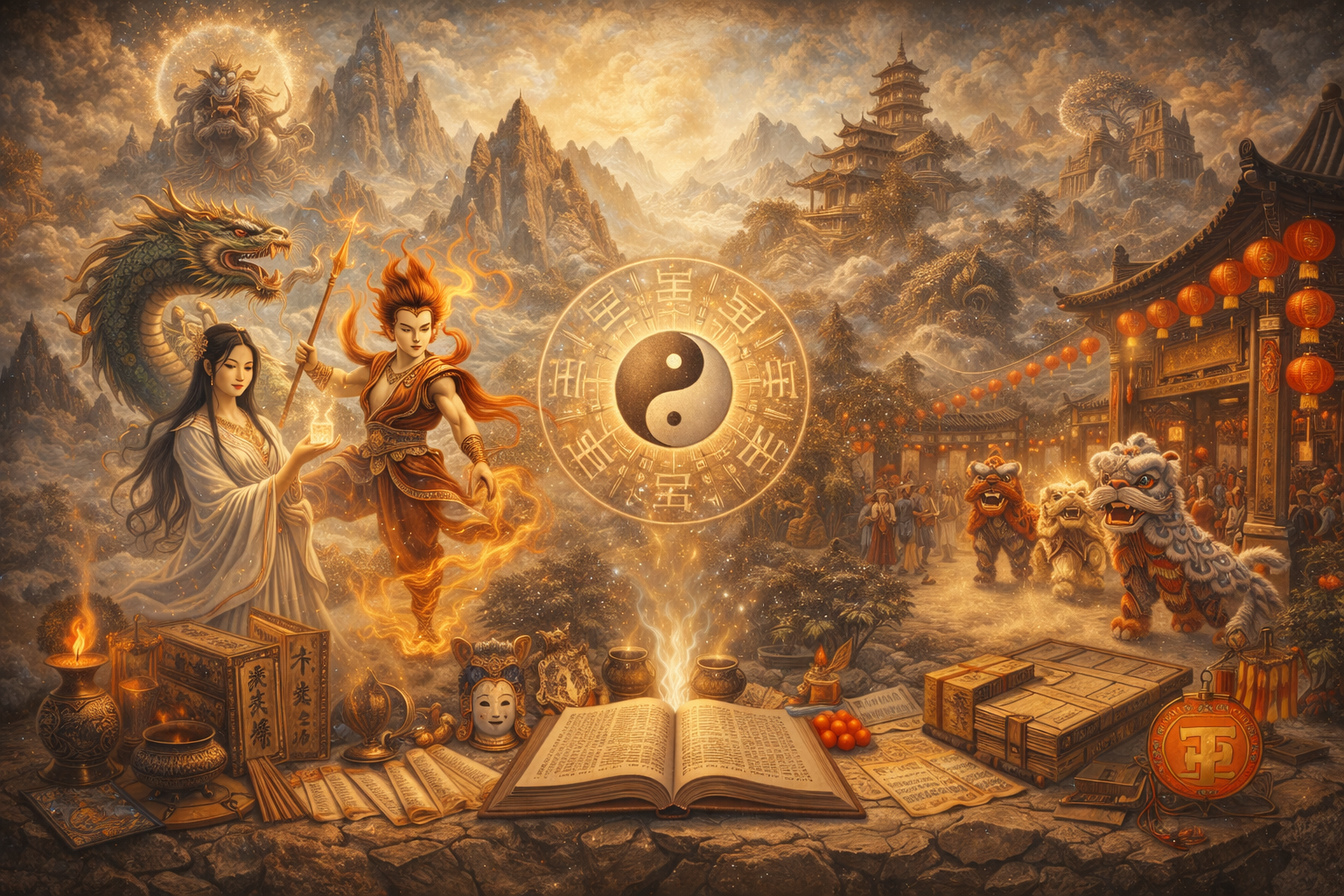
To say that these traditions still matter is not to claim that they should be romanticized, frozen, or treated as untouched survivals from a pure past. The opposite is true. They matter because they show how symbolic inheritance actually works: through selective memory, reinterpretation, translation, ritual repetition, aesthetic transformation, and contested renewal. Myth survives by being carried; folklore survives by being practiced; legend survives by being retold. In each case, the old material remains alive only when it continues to enter social life.
This article closes the Chinese Myth, Folklore & Legend sequence by asking what the whole archive contributes now. Its answer is not only cultural, but intellectual. Chinese myth matters because it expands the study of mythology itself. It teaches that mythic continuity can be fragmentary and still profound, local and still civilizational, ritual and still theoretical, ancient and still adaptive. It shows that symbolic life does not require one master canon in order to possess depth. It can also live through a distributed field of texts, images, festivals, voices, sacred places, and media afterlives.
Why Old Stories Remain Alive
Stories endure when they continue to answer questions that a society has not outgrown. Chinese myth, folklore, and legend still matter because the questions they stage are still with us: how order emerges from chaos, how humans should live between heaven and earth, what binds a community across generations, why flood, exile, ghosts, sacred mountains, ancestors, dangerous transformations, and divine protectors continue to haunt the imagination. These are not obsolete questions. They are perennial ones.
What changes over time is not the disappearance of these questions, but the media through which they are asked. A myth first preserved in a classical text may later reappear in temple art, vernacular fiction, opera, animation, or game design. A ritual calendar may continue to structure memory long after its original cosmology has been partially secularized. A legendary figure may survive because later generations discover new moral, emotional, political, or aesthetic uses for that figure. Chinese myth matters because it has repeatedly demonstrated this capacity for renewal.
This continuity is one of the clearest reasons the archive remains alive. Myth does not survive by being sealed off from history. It survives because history keeps giving old forms new pressure and new relevance. Chinese traditions preserve this process with unusual clarity. They show that permanence and adaptation are not opposites, but mutually sustaining conditions of cultural life.
That is why old stories remain alive even when their original worlds have changed. A dragon may no longer be read in exactly the same way across every audience, but it still carries water, power, transformation, auspiciousness, and cultural recognition. A fox spirit may shift from cautionary tale to feminist reinterpretation, but it still carries the charge of transformation and ambiguity. A flood hero may move from ancient political theology into ecological reflection, but the problem of water, governance, and order remains legible. Myth endures because it can be reactivated.
A Civilizational Archive Without a Single Canon
One reason Chinese myth is especially important is that it challenges a narrow idea of what mythology ought to look like. Many readers approach myth expecting a stable pantheon, a clear genealogy of gods, and a few dominant epic containers. Yet the Chinese mythic archive survives in a more distributed and difficult form. Rather than a single closed book of gods, it appears through layers of textual, ritual, performative, regional, and visual tradition that often have to be read together.
This distributed character is one of the great strengths of the tradition. Mythic materials survive in the Shanhaijing, the Chu Ci, the Huainanzi, dynastic memory, Daoist symbolism, Buddhist adaptation, local cults, sea-goddess traditions, regional epics, seasonal festivals, strange tales, vernacular novels, visual arts, and living performance systems. The archive’s power lies not in uniformity but in depth and recurrence. Chinese myth still matters because it teaches how symbolic continuity can be maintained through plurality.
That makes it intellectually important beyond Chinese studies alone. It shows that mythology need not be preserved in one monumental canon to be foundational. It can instead survive through distributed repetition across many institutions of memory. Chinese myth is one of the strongest demonstrations that fragmentation does not imply weakness. It can, under the right civilizational conditions, become another mode of endurance.
This also changes the task of interpretation. One cannot simply ask, “Where is the Chinese equivalent of Homer?” or “Where is the single Chinese mythology book?” Those questions impose an external expectation on a differently organized archive. Better questions ask how myth survives across genres, how ritual and landscape preserve meanings that texts do not fully contain, how later novels consolidate older fragments, and how local traditions carry memory outside elite writing.
Myth as Cosmology, Memory, and Order
Chinese myth matters because it preserves a distinctive way of ordering the world. In many traditions, myth is remembered above all through divine personalities and dramatic conflict. In Chinese materials, myth often overlaps with cosmology, sacred geography, moral-political order, correlative thinking, and ritual continuity. Heaven, earth, ruler, ancestor, season, mountain, river, and ritual life are frequently linked. Myth therefore becomes a way of thinking structurally about relation rather than only narratively about event.
This is part of what gives Chinese myth its continuing intellectual value. It preserves a model of thought in which nature, society, and symbolic order are not radically separated. That does not make it automatically modern or automatically superior. But it does make it newly legible in a time when questions of ecology, systems thinking, and civilizational continuity have become urgent again. Stories of flood control, sacred mountains, seasonal timing, dragons, divine repair, and celestial mandate still matter because they encode a long reflection on how disorder becomes governable and how life remains embedded in larger patterns.
Primary Source
於是女媧煉五色石以補蒼天,斷鼇足以立四極。殺黑龍以濟冀州,積蘆灰以止淫水。Then Nüwa smelted stones of five colors to mend the blue sky, cut off the legs of the great turtle to set up the four pillars, killed the black dragon to save Jizhou, and piled reed ash to stop the overflowing waters.Huainanzi 淮南子, “Lan Ming Xun” 覽冥訓. Available at: https://ctext.org/huainanzi/lan-ming-xun
This passage matters because it shows myth as cosmic repair: the world is not only created, but restored after collapse, flood, fire, and predation.
What survives in these traditions is therefore not only narrative content but a model of intelligibility. Chinese myth offers one of the world’s most sustained symbolic explorations of relation: between cosmos and polity, ritual and memory, land and legitimacy, ancestry and moral order. That is one reason the archive remains so intellectually fertile.
Such myths also remind modern readers that order is not automatic. It must be repaired, cultivated, ritualized, governed, remembered, and renewed. Whether through Nüwa’s cosmic repair, Yu’s flood control, Mazu’s maritime protection, or the ritual ordering of seasonal festivals, the Chinese mythic archive repeatedly returns to the fragility of order and the human responsibility to sustain it.
Folklore, Legend, and the Life of Communities
Chinese myth still matters not only at the level of cosmology, but at the level of communal life. Oral traditions, songs, rituals, household practices, temple processions, and locally rooted customs have long served as living carriers of knowledge and identity. That insight is crucial for Chinese folklore and legend, where so much survives through festival, performance, sacred geography, domestic rite, and regionally specific forms of storytelling. Myth is not only what a civilization once believed. It is also what communities continue to enact.
This means folklore and legend matter because they preserve social texture that elite texts alone cannot fully capture. They hold onto local gods, ghost stories, spirit worlds, regional epics, sea cults, calendrical customs, and forms of emotional memory that might otherwise be flattened out of history. When a tradition such as Mazu devotion or a local storytelling form continues, what survives is not only a narrative but a whole pattern of relation: between community and danger, past and present, sacred protection and daily labor.
Living Heritage Source
Oral traditions and expressions pass on “knowledge, cultural and social values and collective memory.”UNESCO Intangible Cultural Heritage, “Oral traditions and expressions.” Available at: https://ich.unesco.org/en/oral-traditions-and-expressions-00053
This heritage framing helps explain why folklore and legend should be treated as living transmission, not as static residue from the past.
This is one of the strongest reasons folklore remains indispensable. It preserves not only ideas but social atmospheres. It shows how memory is carried through repeated acts of participation, how symbolic forms anchor belonging, and how communities recognize themselves in inherited rites and stories. Chinese legend still matters because it remains embedded in lived forms of association.
Folklore also preserves voices that formal literary canons often overlook. Local practitioners, ritual specialists, singers, storytellers, elders, artisans, puppeteers, opera performers, temple communities, and regional tradition-bearers all participate in the survival of mythic memory. Without them, the archive becomes thinner, more textual, and less socially alive. Folklore matters because it keeps myth connected to practice.
Ritual, Repetition, and Living Transmission
Ritual repetition is one of the main ways Chinese mythic memory survives. A story that is only read may remain important, but a story that is performed, sung, processed, offered to, painted, danced, and ritually revisited becomes socially durable in another way. Temple festivals, Mazu processions, New Year rites, Qiang seasonal ceremonies, Tibetan opera, shadow puppetry, and popular religious observances all show how myth lives through repeated public action.
Repetition does not mean mechanical sameness. Each repetition can adjust to a new historical moment, a new community need, a new performer, a new audience, or a new media environment. The rite returns, but never in exactly the same world. This is why ritual continuity matters: it allows symbolic forms to persist while still absorbing historical change. The repeated act becomes a bridge between past and present.
Living Heritage Source
Mazu is described as “the most influential goddess of the sea in China.”UNESCO Intangible Cultural Heritage, “Mazu belief and customs.” Available at: https://ich.unesco.org/en/RL/mazu-belief-and-customs-00227
Mazu traditions show how mythic memory becomes public through temples, oral traditions, religious ceremonies, folk practices, and communal protection.
This kind of living transmission is especially important because it resists the idea that myth belongs only to ancient texts. A goddess, ancestor, ghost, dragon, or heroic figure may be textually recorded, but its social life often depends on repeated performance and recognition. The myth is not only preserved in a book. It is preserved in calendars, routes, offerings, processions, songs, costumes, images, and shared anticipation.
Ritual also makes memory bodily. People walk, bow, sing, carry, cook, burn incense, wear costumes, gather at thresholds, prepare seasonal foods, visit temples, and tell stories in specific places. These practices are not marginal to folklore. They are the means by which folklore becomes real to communities across time.
Landscape, Ecology, and Sacred Place
Chinese myth, folklore, and legend still matter because they preserve ways of thinking about land as meaningful. Mountains, rivers, seas, caves, islands, western realms, fields, forests, and pilgrimage routes are not merely backgrounds for stories. They are often active structures of memory. The Shanhaijing maps extraordinary beings and sacred substances across terrain. Yu the Great’s flood-control cycle binds water management to political order. Dragon traditions link weather, rain, river, sea, and power. Qiang New Year and other regional rites show how ritual life can organize reverence for nature.
This matters in the present because modern ecological crises have made inherited symbolic relationships to land newly important. Myth is not environmental science, and it should not be confused with it. But myth can preserve cultural memory of dependence, vulnerability, seasonality, and the need to live within larger patterns. Chinese mythic traditions are especially rich in this respect because they often refuse a sharp divide between cosmic order, political order, and environmental order.
Sacred geography also protects memory from abstraction. A myth attached to a mountain, river, temple, island, or pilgrimage route is not only an idea. It becomes located. Place allows memory to be revisited, walked, painted, named, and ritually renewed. This is one reason sacred geography remains so powerful: it gives symbolic continuity a physical anchor.
At the same time, sacred place can be vulnerable. Urbanization, tourism, displacement, environmental damage, political control, and commercialization can all alter how places are remembered and used. The preservation of mythic landscape therefore involves more than storytelling. It involves the protection of cultural ecologies in which stories, rites, and places remain mutually meaningful.
Ancestors, Ghosts, and the Moral Life of Memory
Chinese myth and folklore remain important because they preserve a moral understanding of memory. Ancestors are not merely figures of the past, and ghosts are not merely frightening supernatural beings. They represent the unfinished relation between the living and the dead. Ancestor rites, ghost stories, underworld imagery, festival observances, filial narratives, and stories of revenants all suggest that memory is a form of obligation. The dead continue to matter because the living are not self-created.
This is one of the reasons ghost and ancestor traditions remain so powerful. They dramatize the consequences of neglect, injustice, improper burial, broken kinship, wrongful death, or emotional debts left unresolved. The ghost is often not simply a monster. It may be a claim upon memory. It asks the living to recognize what has been denied, forgotten, or left unsettled.
Ancestor traditions similarly tie identity to continuity. They remind communities that the present is inherited, not invented from nothing. This does not mean ancestor reverence should be romanticized as socially uncomplicated. It has often been tied to hierarchy, patriarchy, lineage power, and exclusion. Yet it also preserves a strong account of intergenerational responsibility in a world where modern life often weakens inherited obligations without replacing them with equally deep forms of memory.
Chinese ghost and ancestor traditions matter now because they offer symbolic languages for grief, debt, continuity, and repair. They remind readers that memory is not passive. It must be tended, interpreted, ritualized, and sometimes confronted.
Dragons, Flood, and the Problem of Order
Dragons and flood traditions remain among the most important symbolic resources in Chinese myth because they organize the relation between danger and order. Dragons carry meanings of water, rain, transformation, sovereignty, vitality, and cosmic power. Flood traditions dramatize overwhelming disorder and the need for human labor, sage action, or divine intervention to restore survivable conditions. Together, they show that Chinese myth often thinks through the management of force rather than the elimination of force.
This is especially clear in the Yu the Great cycle. Yu is not simply saved from flood. He works through flood. The mythic emphasis falls on channeling, dredging, traveling, coordinating, and ordering water. That gives the flood tradition continuing relevance as a symbolic account of environmental governance. The world is dangerous, but it can be made habitable through disciplined labor and legitimate order.
Dragons belong to this same symbolic field. They are not merely monsters to be slain. They may be rain-bringers, water powers, imperial signs, auspicious creatures, local presences, and embodiments of transformation. Their power is ambivalent because water itself is ambivalent: necessary for life, dangerous in excess, politically important, and ritually charged.
These traditions still matter because modern societies remain vulnerable to the same structural question: how does a community live with forces larger than itself? Flood, storm, climate, river, sea, infrastructure, and governance remain linked. Chinese myth does not provide technical answers, but it preserves an old symbolic recognition that order depends on the disciplined relation between human society and environmental power.
Women, Spirits, and the Power of Thresholds
Chinese myth and legend also remain important because they preserve complex images of gendered power. Goddesses, spirit-women, fox spirits, snake women, ghost lovers, divine mothers, demonized queens, female immortals, ritual mediators, and heroic daughters occupy some of the most charged thresholds in the archive. They appear where human and nonhuman, domestic and wild, sacred and dangerous, erotic and moral, protective and disruptive cannot be cleanly separated.
This matters because such figures reveal both the imaginative force and the social anxieties of the traditions that preserve them. Nüwa repairs the cosmos. Mazu protects maritime communities. Guanyin’s feminized compassion becomes salvific presence. Xiwangmu governs immortality and sacred distance. White Snake tests whether love can cross species and social boundaries. Fox spirits reveal fascination with transformation and fear of female autonomy. Ghost-women expose unresolved grief and moral debt.
These traditions should be read critically. Many are shaped by patriarchal anxieties, male-authored fantasies, or moral frameworks that regulate female desire and agency. Yet they also preserve forms of female power that cannot be erased: cosmic repair, protection, healing, haunting, transformation, devotion, and resistance. The archive both constrains and remembers.
That is why women and spirit traditions still matter. They reveal the tensions that societies often hide: dependence on feminine repair, fear of feminine autonomy, reverence for maternal protection, anxiety over desire, and recognition that the excluded or unsettled may return with power. These figures keep the mythic archive ethically and emotionally alive.
Regional Plurality and the Many Voices of the Archive
Chinese myth, folklore, and legend matter because the archive is not singular. It includes Han classical materials, Daoist and Buddhist recastings, regional epics, Qiang ritual worlds, Tibetan opera, Regong arts, Mongolian Khoomei, Kirgiz Manas, Uyghur Muqam, Dong Grand Song, Korean-ethnic farmers’ dance, Hezhen Yimakan storytelling, sea-goddess traditions, temple festivals, and many other local and minority traditions. This plurality is not a decorative supplement. It is one of the archive’s defining realities.
Regional traditions matter because they preserve forms of memory that dominant textual canons often miss. A community may carry history through song, epic recitation, ritual dance, landscape practice, sacred art, or oral storytelling rather than through a classical written source. That does not make the tradition less intellectually serious. It means its archive is embodied, performed, local, and vulnerable in different ways.
Living Heritage Source
Yimakan plays a key role in preserving the Hezhen mother tongue, religion, beliefs, folklore, and customs.UNESCO Archives, “Hezhen Yimakan Storytelling.” Available at: https://www.unesco.org/archives/multimedia/document-2208
This example shows why living oral traditions matter: they carry language, belief, folklore, memory, and community identity together.
This plurality also creates ethical responsibility. Regional and minority traditions should not be absorbed into a generic civilizational narrative that erases their specificity. Tibetan, Qiang, Mongolian, Kirgiz, Uyghur, Dong, Korean-ethnic, Hezhen, Tu, and other traditions each require careful, source-sensitive interpretation. Their presence expands the field of Chinese myth, but it should not flatten them into one voice.
What regional plurality teaches is that the mythic archive of China is not a single center radiating outward. It is a many-layered field of interaction, preservation, marginalization, revival, and transformation. Chinese myth still matters because it forces readers to take plurality seriously as a condition of cultural memory itself.
Why Chinese Myth Matters Now
Chinese myth matters now because modernity has not made symbolic inheritance irrelevant. On the contrary, accelerated modernization often makes the question of inheritance more urgent. When languages disappear, ritual forms thin out, local expressive practices weaken, or everyday life is flattened into platform circulation and instrumental speed, mythic traditions reveal what is at stake in cultural loss. Chinese myth and folklore matter in the present partly because they make visible the fragility of memory-bearing institutions.
They also matter because they offer alternatives to cultural amnesia. In an era dominated by speed, abstraction, and global media homogenization, mythic traditions preserve thicker temporal depth. They remind people that a society is not only an economy or a state, but also a symbolic order sustained through memory, ritual, imagination, and inherited forms of relation. Chinese legend still matters because it continues to give shape to belonging, grief, aspiration, justice, protection, and wonder in ways that purely instrumental vocabularies often cannot.
This does not mean myth should be romanticized as a cure for modern dislocation. It means that myth preserves resources modern life repeatedly finds itself needing: continuity, symbolic density, ritualized memory, and languages for vulnerability and transformation. Chinese traditions remain powerful because they still supply those resources.
They also matter because they help readers resist a shallow idea of progress. Modernity often imagines the past as something to escape, but mythic traditions show that inheritance can remain generative. The question is not whether societies should return to the past. They cannot. The question is how they can carry forward symbolic resources without turning them into propaganda, nostalgia, or empty branding.
Modernity, Media, and Reinvention
Chinese myth still matters because it has proved unusually capable of reinvention. It has not remained trapped in antiquarian scholarship or museum display. It continues to live in children’s stories, television serials, film, animation, museums, festivals, visual culture, streaming platforms, games, fan art, and digital media. That reinvention does not mean the archive has become superficial. It means myth has retained cultural velocity. The same figures and themes can move from classical text to popular animation, from temple fair to streaming platform, from thangka or print to game environment.
This adaptability is one reason the archive matters so much. Traditions that cannot be translated into new forms often become museum objects only. Chinese myth, by contrast, repeatedly demonstrates that survival is not the same as static preservation. It survives by moving, borrowing, condensing, expanding, and becoming legible to new audiences. That pattern has run from vernacular storytelling to modern screen culture. It is one of the central reasons Chinese myth remains culturally potent rather than merely historically interesting.
Modern reinvention also clarifies something larger: myth remains alive when a culture continues to discover new media through which to stage old questions. Chinese traditions show this with unusual consistency. The archive does not endure by refusing change. It endures because change becomes one of its conditions of continuity.
At the same time, modern reinvention requires critical reading. Films, games, and streaming series do not simply revive myth. They select, simplify, commercialize, aestheticize, and sometimes nationalize it. They make some figures newly visible while leaving others obscure. The modern afterlife of myth is therefore creative and political at once. Its value lies not in purity, but in the evidence it provides that old symbolic forms still possess generative power.
Why This Archive Matters Beyond China
Chinese myth, folklore, and legend matter beyond China because they enlarge the study of mythology itself. They show that a major civilizational archive need not be organized around one master epic or one fixed pantheon to be intellectually foundational. They show how myth can survive through fragment, commentary, ritual, sacred geography, local cult, visual symbol, oral performance, regional plurality, and media ecology. In that sense, Chinese myth is not merely one regional tradition among many. It is also a challenge to overly narrow models of how myth works.
They also matter because they preserve a distinct answer to a universal problem: how human beings make the world meaningful. Chinese traditions do this through heaven and earth, ancestor and sage, dragon and flood, mountain and immortality, underworld and bureaucracy, temple and festival, mother goddess and fox spirit, opera and epic, print and performance. Taken together, they form not a pile of survivals but a living intellectual and symbolic inheritance.
That is why Chinese myth, folklore, and legend still matter. They remain one of the great ways humanity has imagined order, danger, memory, obligation, and transformation. They matter not only because they preserve China’s past, but because they continue to expand what the study of myth can see. They teach that symbolic life can be ancient and adaptive, local and civilizational, fragmented and enduring at once.
Beyond China, this archive also helps correct comparative habits formed around more familiar mythological models. It asks scholars and readers to treat ritual, geography, performance, local cult, and later reinvention as central rather than secondary. It teaches that myth is not only a story about origins, but a whole system through which cultures sustain meaningful relation across time.
Source History and Interpretive Caution
A careful reading of why Chinese myth still matters must distinguish among many kinds of evidence: early classical sources, transmitted texts, philosophical works, ritual traditions, local cults, oral storytelling, temple practices, opera, shadow puppetry, visual art, regional heritage, modern media, UNESCO documentation, museum records, scholarship, and living communities. These source types do not all speak in the same voice, and none should be mistaken for the whole archive.
It is also important not to romanticize continuity. Some traditions survive because communities sustain them; others survive because institutions preserve or repackage them; still others are endangered by language loss, displacement, commercialization, censorship, religious pressure, or generational change. Continuity is not automatic. It is produced through labor, memory, and power.
Modern heritage sources are useful, but they require caution. UNESCO records can document the significance of oral traditions, rituals, festivals, and safeguarding concerns, but they do not fully capture lived practice. Official recognition does not equal community control. Museum preservation does not replace ritual use. Media adaptation does not replace local tradition. Each form of preservation has value, but each also changes what it preserves.
Finally, Chinese myth should not be treated as one unified doctrine. It is a plural archive containing contradictions: elite and popular, textual and oral, Han and non-Han, local and imperial, sacred and commercial, patriarchal and resistant, ancient and modern. Its continuing importance lies partly in that complexity. It still matters because it refuses to become simple.
Related Reading
- Chinese Myth, Folklore & Legend
- The Problem of Sources in Chinese Mythology
- Chinese Myth in Comparative Perspective
- Modern China and the Reinvention of Myth in Film, Television, and Digital Media
- The Gesar Epic and the Plural Narrative Worlds of China
- Temple Festivals, Popular Religion, and the Social Life of Legend
- From Classical Text to Folkloric Archive: How Chinese Myth Survived
Primary Sources
- Shanhaijing 山海經 / Classic of Mountains and Seas. Useful as a primary source for sacred geography, strange beings, mythic landscapes, mountains, rivers, and the spatial organization of early Chinese mythic knowledge. Chinese Text Project edition available at: https://ctext.org/shan-hai-jing
- Huainanzi 淮南子, “Lan Ming Xun” 覽冥訓. Useful as a primary source for Nüwa’s cosmic repair, flood control, dragon-slaying, and mythic thinking about world-restoration after collapse. Chinese Text Project edition available at: https://ctext.org/huainanzi/lan-ming-xun
- Chu Ci 楚辭 / Songs of Chu. Useful as a primary poetic source for early mythic questioning, heavenly order, divine beings, southern religious imagination, and the fragmentary survival of ancient Chinese mythic materials. Chinese Text Project edition available at: https://ctext.org/chu-ci
- Shujing 書經 / Book of Documents. Useful as a primary source for sage-kingship, flood memory, political order, heavenly mandate, and the fusion of mythic memory with early political theology. Chinese Text Project edition available at: https://ctext.org/shang-shu
- Wu Cheng’en 吳承恩, attributed (n.d.) Xiyouji 西遊記 / Journey to the West. Useful as a primary vernacular-fiction source for Sun Wukong, Buddhist-Daoist cosmology, demons, pilgrimage, transformation, and later media reinvention. Chinese Text Project edition available at: https://ctext.org/xiyouji
- Xu Zhonglin 許仲琳, attributed (n.d.) Fengshen yanyi 封神演義 / Investiture of the Gods. Useful as a primary vernacular-fiction source for Nezha, Jiang Ziya, Daji, gods-and-demons fiction, divine warfare, and the mythologizing of dynastic change. Chinese Text Project edition available at: https://ctext.org/fengshen-yanyi/ens
- Pu Songling 蒲松齡 (n.d.) Liaozhai zhiyi 聊齋誌異 / Strange Tales from a Chinese Studio. Useful as a primary source for fox spirits, ghosts, supernatural intimacy, anomaly, moral ambiguity, and late imperial strange-tale imagination. Project Gutenberg edition of Herbert A. Giles’s translation available at: https://www.gutenberg.org/files/43629/43629-h/43629-h.htm
- UNESCO Intangible Cultural Heritage (n.d.) “Oral traditions and expressions.” Useful as primary institutional framing for oral traditions as living vehicles of knowledge, cultural values, social values, and collective memory. Available at: https://ich.unesco.org/en/oral-traditions-and-expressions-00053
- UNESCO Intangible Cultural Heritage (2009) “Mazu belief and customs.” Useful as primary institutional documentation of Mazu devotion, oral traditions, religious ceremonies, folk practices, temple networks, and female maritime protection. Available at: https://ich.unesco.org/en/RL/mazu-belief-and-customs-00227
- UNESCO Intangible Cultural Heritage (2024) “Hezhen Yimakan storytelling.” Useful as primary institutional documentation of oral storytelling, Hezhen language transmission, heroic narratives, folklore, customs, and safeguarding concerns. Available at: https://ich.unesco.org/en/RL/hezhen-yimakan-storytelling-02224
- UNESCO Intangible Cultural Heritage (2009) “Gesar epic tradition.” Useful as primary institutional documentation of Tibetan, Mongolian, and Tu epic performance, oral transmission, living heritage, thangka painting, opera, and communal identity. Available at: https://ich.unesco.org/en/RL/gesar-epic-tradition-00204
- UNESCO Intangible Cultural Heritage (2009) “Qiang New Year festival.” Useful as primary institutional documentation of Qiang ritual ecology, shibi priests, sacred trees, offerings, seasonal gratitude, and communal renewal. Available at: https://ich.unesco.org/en/RL/qiang-new-year-festival-02155
Further Reading
- Encyclopaedia Britannica (n.d.) “Chinese literature.” Available at: https://www.britannica.com/art/Chinese-literature
- Encyclopaedia Britannica (n.d.) “Chinese mythology.” Available at: https://www.britannica.com/topic/Chinese-mythology
- Encyclopaedia Britannica (n.d.) “Myth and the arts.” Available at: https://www.britannica.com/topic/myth/Myth-and-the-arts
- Encyclopaedia Britannica (n.d.) “Myth: Relation of myths to other narrative forms.” Available at: https://www.britannica.com/topic/myth/Relation-of-myths-to-other-narrative-forms
- Oxford University Press (n.d.) Handbook of Chinese Mythology. Available at: https://global.oup.com/academic/product/handbook-of-chinese-mythology-9780195332636
- UNESCO Intangible Cultural Heritage (n.d.) “Oral traditions and expressions.” Available at: https://ich.unesco.org/en/oral-traditions-and-expressions-00053
- UNESCO Intangible Cultural Heritage (n.d.) “ICH and mother languages.” Available at: https://ich.unesco.org/en/ich-and-mother-languages-00555
- UNESCO Intangible Cultural Heritage (2009) “Mazu belief and customs.” Available at: https://ich.unesco.org/en/RL/mazu-belief-and-customs-00227
- UNESCO Intangible Cultural Heritage (2024) “Hezhen Yimakan storytelling.” Available at: https://ich.unesco.org/en/RL/hezhen-yimakan-storytelling-02224
- UNESCO Archives (2010) “Hezhen Yimakan Storytelling.” Available at: https://www.unesco.org/archives/multimedia/document-2208
- Birrell, A. (1993) Chinese Mythology: An Introduction. Baltimore: Johns Hopkins University Press.
- Birrell, A. (1999) The Classic of Mountains and Seas. London: Penguin Classics.
- Campany, R.F. (1996) Strange Writing: Anomaly Accounts in Early Medieval China. Albany: State University of New York Press.
- Major, J.S., Queen, S.A., Meyer, A.S. and Roth, H.D. (2010) The Huainanzi: A Guide to the Theory and Practice of Government in Early Han China. New York: Columbia University Press.
- Poo, M.-C. (1998) In Search of Personal Welfare: A View of Ancient Chinese Religion. Albany: State University of New York Press.
- Yang, L., An, D. and Turner, J.A. (2005) Handbook of Chinese Mythology. Oxford: Oxford University Press.
References
- Birrell, A. (1993) Chinese Mythology: An Introduction. Baltimore: Johns Hopkins University Press.
- Birrell, A. (1999) The Classic of Mountains and Seas. London: Penguin Classics.
- Campany, R.F. (1996) Strange Writing: Anomaly Accounts in Early Medieval China. Albany: State University of New York Press.
- Chinese Text Project (n.d.) Chu Ci 楚辭. Available at: https://ctext.org/chu-ci
- Chinese Text Project (n.d.) Fengshen yanyi 封神演義. Available at: https://ctext.org/fengshen-yanyi/ens
- Chinese Text Project (n.d.) Huainanzi 淮南子, “Lan Ming Xun” 覽冥訓. Available at: https://ctext.org/huainanzi/lan-ming-xun
- Chinese Text Project (n.d.) Liaozhai zhiyi 聊齋誌異. Project Gutenberg edition of Herbert A. Giles’s translation available at: https://www.gutenberg.org/files/43629/43629-h/43629-h.htm
- Chinese Text Project (n.d.) Shanhaijing 山海經. Available at: https://ctext.org/shan-hai-jing
- Chinese Text Project (n.d.) Shangshu 尚書 / Book of Documents. Available at: https://ctext.org/shang-shu
- Chinese Text Project (n.d.) Xiyouji 西遊記. Available at: https://ctext.org/xiyouji
- Encyclopaedia Britannica (n.d.) “Chinese literature.” Available at: https://www.britannica.com/art/Chinese-literature
- Encyclopaedia Britannica (n.d.) “Chinese mythology.” Available at: https://www.britannica.com/topic/Chinese-mythology
- Encyclopaedia Britannica (n.d.) “Myth and the arts.” Available at: https://www.britannica.com/topic/myth/Myth-and-the-arts
- Encyclopaedia Britannica (n.d.) “Myth: Relation of myths to other narrative forms.” Available at: https://www.britannica.com/topic/myth/Relation-of-myths-to-other-narrative-forms
- Major, J.S., Queen, S.A., Meyer, A.S. and Roth, H.D. (2010) The Huainanzi: A Guide to the Theory and Practice of Government in Early Han China. New York: Columbia University Press.
- Oxford University Press (n.d.) Handbook of Chinese Mythology. Available at: https://global.oup.com/academic/product/handbook-of-chinese-mythology-9780195332636
- Poo, M.-C. (1998) In Search of Personal Welfare: A View of Ancient Chinese Religion. Albany: State University of New York Press.
- UNESCO Archives (2010) “Hezhen Yimakan Storytelling.” Available at: https://www.unesco.org/archives/multimedia/document-2208
- UNESCO Intangible Cultural Heritage (n.d.) “ICH and mother languages.” Available at: https://ich.unesco.org/en/ich-and-mother-languages-00555
- UNESCO Intangible Cultural Heritage (n.d.) “Oral traditions and expressions.” Available at: https://ich.unesco.org/en/oral-traditions-and-expressions-00053
- UNESCO Intangible Cultural Heritage (2009) “Gesar epic tradition.” Available at: https://ich.unesco.org/en/RL/gesar-epic-tradition-00204
- UNESCO Intangible Cultural Heritage (2009) “Mazu belief and customs.” Available at: https://ich.unesco.org/en/RL/mazu-belief-and-customs-00227
- UNESCO Intangible Cultural Heritage (2009) “Qiang New Year festival.” Available at: https://ich.unesco.org/en/RL/qiang-new-year-festival-02155
- UNESCO Intangible Cultural Heritage (2024) “Hezhen Yimakan storytelling.” Available at: https://ich.unesco.org/en/RL/hezhen-yimakan-storytelling-02224
- Yang, L., An, D. and Turner, J.A. (2005) Handbook of Chinese Mythology. Oxford: Oxford University Press.