
Last Updated May 6, 2026
In modern China, myth survives not by remaining fixed, but by being continually reinvented across new media systems. It does not stay sealed inside classical texts, temple ritual, regional opera, shadow puppetry, seasonal festival, or decorative art alone. Film, television, animation, streaming platforms, video games, social media, fan culture, merchandise, and global distribution have become some of the most important arenas through which Chinese mythic figures now circulate. Sun Wukong, Nezha, White Snake, Yang Jian, Chang’e, Mazu, Jiang Ziya, Daji, Erlang Shen, and many other legendary figures continue to live because they are repeatedly reimagined in forms that speak to contemporary audiences: as rebellious heroes, psychologically conflicted antiheroes, visually spectacular fantasy protagonists, franchise icons, gaming avatars, and digitally shareable cultural symbols.
This matters because reinvention is not secondary to the tradition. In the Chinese case, myth has long survived through adaptation across media: from classical allusion to vernacular fiction, from opera to print, from temple festival to painting, from shadow puppetry to animation. Modern screen and digital media do not break from that pattern so much as intensify it. They introduce new aesthetics, new industrial scales, new platform infrastructures, new audience expectations, and global circulation, but they continue an older process by which mythic memory is stabilized, altered, redistributed, and made socially legible again. What modern media preserve is therefore not just old stories, but the capacity of myth to become new without ceasing to be recognizably itself.
Series context: This article is part of the Chinese Myth, Folklore & Legend knowledge series. For the broader category structure, return to the Mythology category.
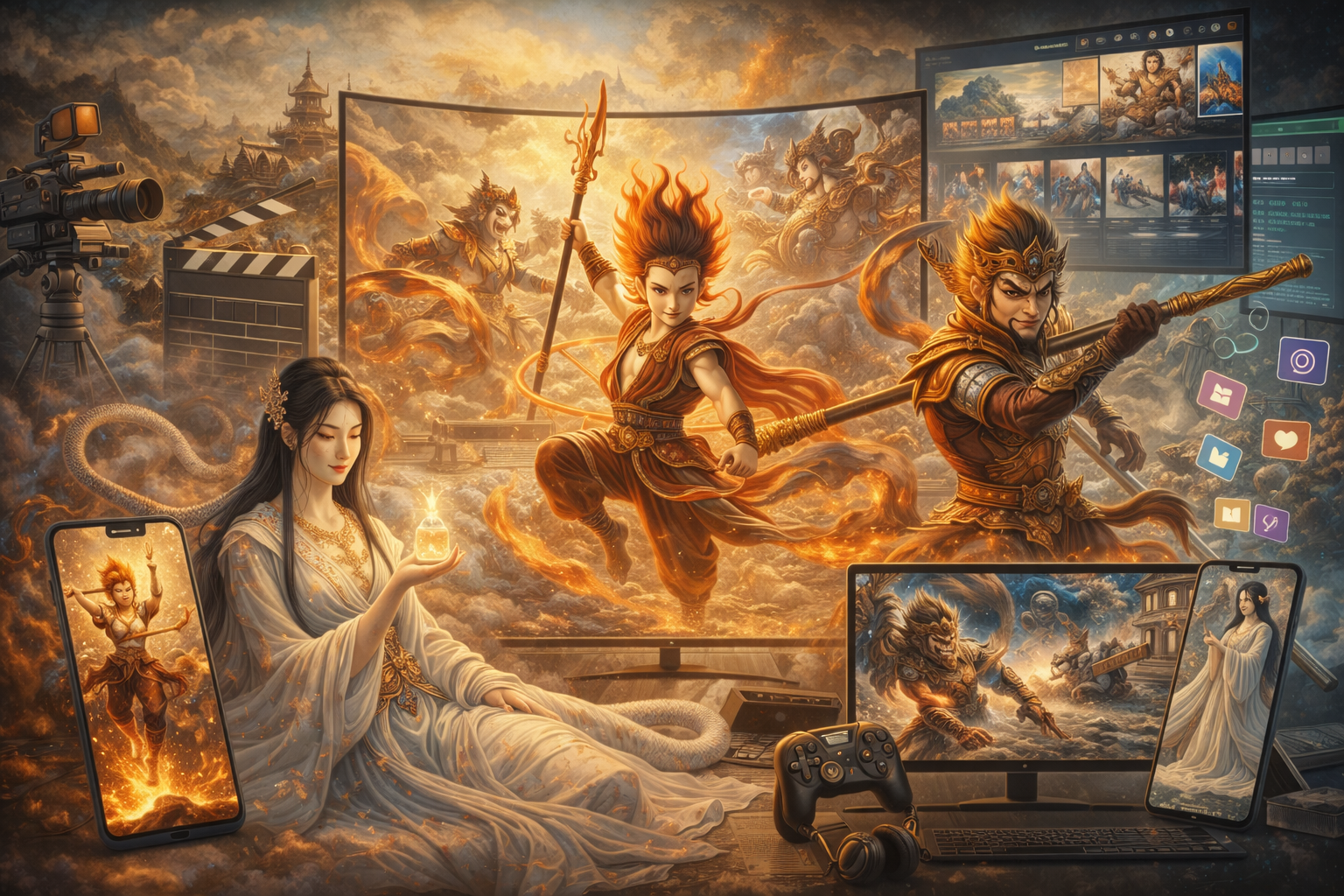
Modern mythic reinvention is therefore best understood as remediation: the movement of inherited symbolic material into new media forms that change how the material is seen, heard, felt, circulated, and remembered. A mythic figure who once lived in a Ming novel may reappear as a television character, animated protagonist, streaming fantasy heroine, game boss, fan-art subject, box-office phenomenon, or global meme. Each form selects different parts of the archive. Each makes some meanings more visible and others less visible. Each teaches audiences what the myth is supposed to feel like now.
That process is especially visible in the modern afterlives of Nezha, White Snake, and Sun Wukong. Nezha becomes a rebellious child fighting imposed destiny. White Snake becomes a romantic and visually immersive fantasy world centered on love, cultivation, and female agency. Sun Wukong becomes a screen hero, action-game ancestor, rebellious icon, and digital combat framework. These reinventions are not random. They reveal what modern audiences and industries find newly usable in older mythic forms: selfhood, destiny, trauma, spectacle, moral ambiguity, national style, and playable worlds.
From Traditional Transmission to Modern Remediation
Chinese myth did not enter modern media from a position of textual purity. Even before cinema and television, the archive was already dynamic. Early mythic materials were dispersed across classical sources, ritual traditions, anomaly collections, vernacular fiction, opera, festival culture, painting, print, decorative art, and local performance. This background is essential because it means modern media did not invent adaptation; they accelerated and amplified an already existing pattern of recombination.
Modern remediation changes the scale, speed, visibility, and economics of that process. A story once carried through print, oral storytelling, temple performance, or local opera can now circulate through blockbuster animation, streaming catalogues, social-media clips, fan edits, international subtitling, video-game environments, promotional campaigns, and platform algorithms. The modern question is therefore not whether Chinese myth has been “faithfully preserved,” but how mythic figures are made legible to contemporary publics through new combinations of image, sound, pacing, character psychology, industrial branding, and franchise logic.
This is why remediation matters as an interpretive concept. Each medium does more than repeat inherited content. It selects, compresses, stylizes, and reorients the archive. A legendary figure survives because a new medium discovers a new use for that figure. Modern media do not merely transmit myth forward. They reorganize what counts as mythically salient in the present.
The same figure can therefore mean different things in different media. Sun Wukong in a classical chapter, a Peking opera excerpt, a children’s cartoon, a television serial, an animated feature, and an action role-playing game is recognizably continuous, but not identical. Each version makes a different Wukong available. The myth persists because no single version can exhaust him.
The Modern Screen as a Mythic Stage
The modern screen has become one of the main stages on which Chinese myth is performed. Cinema, television, animation, streaming, and gaming all create screen worlds, but each screen organizes myth differently. Film compresses myth into spectacle, emotional arc, and visual climax. Television extends myth through serialized repetition. Animation intensifies transformation and impossible movement. Streaming reorganizes myth through discoverability, catalogue placement, and global subtitling. Games transform myth into playable environment, combat system, quest structure, and interactive world.
This screen-based stage differs from the temple stage or opera stage, but it inherits much from them. It still depends on recognizable characters, visual codes, repeated scenes, dramatic confrontations, stylized movement, music, costuming, and audience expectation. Modern media often appear technologically new, but their narrative logic frequently resembles older performance traditions. They remake myth by changing the apparatus of performance rather than eliminating performance altogether.
The screen also changes the scale of recognition. A local festival may gather a community; a television serial may gather a national audience; a streaming film may gather transnational viewers; a game may gather a global player community. Mythic figures that once circulated through regional performance now move across platform economies. Their survival is tied to distribution infrastructures as much as to storytelling.
This makes modern myth both more visible and more unstable. Visibility brings recognition, investment, and renewed cultural life. But platform visibility also encourages simplification, branding, genre labeling, and algorithmic packaging. The screen preserves myth by changing it, and that transformation must be read critically.
Myth on Screen: Nezha, White Snake, and Sun Wukong
Three figures are especially useful for thinking about modern reinvention: Nezha, White Snake, and Sun Wukong. Each comes from an older mythic or literary tradition, yet each has been repeatedly reshaped to fit modern sensibilities. None enters screen culture as a neutral inheritance. They are selected precisely because they are flexible enough to absorb new themes such as selfhood, rebellion, romance, trauma, destiny, alienation, moral choice, and the struggle to define oneself against imposed identity.
Nezha is an especially clear example. Traditionally associated with divine warfare, rebellious energy, and conflict with cosmic and familial authority, Nezha has proven unusually adaptable to modern storytelling. Contemporary animation recasts him not simply as a divine child-warrior, but as a psychologically legible outsider: misunderstood, stigmatized, overdetermined by prophecy, and compelled to assert agency against an imposed fate. His old mythic structure remains present, but its emotional center shifts toward selfhood and self-definition.
White Snake undergoes a different kind of reinvention. The older legend centers on love, transgression, cultivation, religion, and the unstable boundary between human and nonhuman life. In modern animation and streaming-era fantasy, however, the White Snake world often becomes a platform for expanded world-building. Character relationships are re-centered, side figures become protagonists, and the older tale opens outward into franchise logic, sequel logic, and visually immersive fantasy environments. Myth here becomes not only a preserved story, but a universe available for extension.
Sun Wukong may be the most globally mobile of all. Because Journey to the West already offered an episodic, visually rich, tonally elastic narrative world, Wukong adapts easily to television, film, animation, and gaming. He is trickster, fighter, rebel, comic force, and spiritual problem all at once. Those qualities make him ideal for modern reinterpretation because they translate readily into spectacle-driven media while still preserving an older mythic density.
Nezha: Destiny, Rebellion, and the Modern Outsider Hero
Nezha’s modern success depends on a striking transformation of emphasis. In older narrative traditions, Nezha is already rebellious, violent, divine, dangerous, and connected to cosmic conflict. He fights dragons, confronts authority, dies and is reborn, and enters the gods-and-demons world of Investiture of the Gods. Modern animation retains this energy but shifts its emotional focus. Nezha becomes not only a supernatural child-warrior but a stigmatized outsider resisting a destiny imposed by others.
This shift is crucial because it allows the myth to speak to contemporary concerns about identity, social judgment, family expectation, and self-definition. The old mythic structure of divine destiny becomes a modern psychological problem. Is Nezha cursed by origin, or can he choose his own moral path? Is he monster, child, hero, demon, or something else? Modern retellings draw power from that instability.
Primary Source Context
夫人懷孕三年零六個月,尚未生育。The lady had been pregnant for three years and six months, and still had not given birth.Fengshen yanyi 封神演義 / Investiture of the Gods, Nezha birth episode. Chinese Text Project edition available at: https://ctext.org/fengshen-yanyi/ens
The miraculous and troubling birth tradition already marks Nezha as extraordinary before modern animation reframes him as an outsider struggling against imposed destiny.
The 2019 Ne Zha and 2025 Ne Zha 2 demonstrate how this reframing can become industrially powerful. These films show that mythic adaptation can operate at blockbuster scale while remaining rooted in inherited symbolic material. Nezha’s rebellion becomes commercially legible because it is also emotionally legible. Viewers do not need to know every earlier source to understand the modern problem: a child marked as dangerous insists on becoming more than what others fear.
The extraordinary box-office success of Ne Zha 2 also changes the stakes of mythic adaptation. It shows that Chinese animation can turn classical and vernacular myth into mass-market spectacle on a global scale. Nezha’s reinvention is therefore not only a narrative event. It is an industrial and cultural event that reshapes expectations about what Chinese myth-based media can do.
White Snake: Romance, Female Agency, and Fantasy World-Building
The White Snake tradition enters modern media with a different set of symbolic resources. Its central problem is not rebellion against destiny in the same form as Nezha, but the relationship between love, species boundary, cultivation, feminine agency, religious authority, and social recognition. The snake woman seeks human intimacy, but her nonhuman power makes that intimacy unstable. The legend’s emotional force lies in the tension between fear and sympathy.
Modern animation has found enormous potential in this tension. White Snake can be rendered as romantic heroine, supernatural cultivator, tragic wife, warrior, sister, memory-bearer, and fantasy protagonist. Her world can expand beyond the older moralized plot into visually immersive realms of demons, spirits, underworlds, towers, magical cities, and female-centered companionship. In this way, modern media reframe White Snake not only as a legend of transgression but as a platform for fantasy world-building.
This expansion is especially important because it gives new prominence to female agency within the mythic archive. The older legend often turns around whether White Snake may be accepted as wife, mother, or cultivated being. Modern versions can shift attention toward her own desire, memory, struggle, and world. Side figures such as Xiaoqing can become central. Female bonds can become as important as conjugal recognition. The legend opens into new emotional and political possibilities.
At the same time, modern White Snake media still depend on the older question that makes the story durable: can the human world recognize virtue when virtue appears in nonhuman form? Animation can make White Snake beautiful, heroic, tragic, and sympathetic, but the underlying mythic tension remains. Her power is intimate because it is unstable. She belongs to the household and to the supernatural world, and modern media continue to profit from that double belonging.
Sun Wukong: Trickster, Rebel, and Digital Combat Body
Sun Wukong has become one of the most adaptable mythic figures in global media because his classical form is already modular. He is born from stone, trained in magical arts, rebellious against Heaven, punished under a mountain, redeemed through pilgrimage, and repeatedly tested through demon encounters. He is comic and terrifying, loyal and disruptive, spiritual and impulsive, divine and animal. This complexity gives modern media many possible Wukongs to choose from.
Primary Source
內育仙胞,一日迸裂,產一石卵,似圓毬樣大。因見風,化作一個石猴,五官俱備,四肢皆全。Within it an immortal embryo was nourished. One day it burst open and produced a stone egg, round as a ball. When it met the wind, it transformed into a stone monkey, complete in its five senses and whole in its four limbs.Xiyouji 西遊記 / Journey to the West, chapter 1. Chinese Text Project edition available at: https://ctext.org/xiyouji/ch1
The stone-birth scene gives Sun Wukong a mythic body that is already elemental, supernatural, and visually adaptable, making him unusually available for animation, television, and gaming.
Television often emphasizes Wukong’s episodic adventures and recognizability. Animation emphasizes speed, transformation, humor, and combat. Film can make him tragic, spectacular, comic, or rebellious. Games convert his staff, transformations, enemies, and journey structure into playable systems. In each case, Wukong remains familiar while becoming technically and emotionally different.
The game medium is especially revealing because it turns Wukong’s mythic body into a combat body. Staff fighting, dodging, transformation, boss encounters, relics, pilgrimage terrain, and lore fragments allow players to inhabit a mythic world through action. This is not merely a retelling of Journey to the West. It is an interactive reorganization of the archive around movement, difficulty, exploration, and mastery.
Wukong’s modern afterlife therefore demonstrates the difference between preservation and activation. A text preserves him as narrative. A screen activates him as image. A game activates him as action. The myth survives because each medium finds a new way to make the Monkey King move.
Television, Seriality, and the Long Life of Legend
Television has been one of the most important modern carriers of Chinese myth because serialized form suits legendary material especially well. Myths and long narrative traditions often work episodically: monsters appear in sequence, trials accumulate, characters transform over time, and moral or cosmic conflict unfolds through repeated encounters. Television takes advantage of this structure by allowing mythic worlds to unfold gradually, sustaining attachment through repetition rather than through the compression of feature-film runtime.
This is especially true for Journey to the West-derived materials. Because the classical novel itself proceeds episodically, television seriality can preserve something of its narrative rhythm even when adapting it for new audiences. Modern television has therefore functioned less as a passive reproducer of myth than as an environment where older legendary material can be redistributed in socially memorable form, entering childhood memory, collective quotation, household viewing, and everyday cultural reference. The screen serial becomes a new version of public storytelling.
Television also alters tone. It often domesticates or popularizes mythic material, making divine beings and supernatural figures emotionally available through recurring actors, recognizable visual motifs, familiar musical themes, and repeated scenes. In this respect, television can soften the distance between myth and ordinary life. What was once remote sacred or literary material becomes part of routine viewing culture. That routinization matters because it turns myth into something collectively remembered through repetition rather than occasional ceremonial encounter alone.
At the same time, television adaptation is selective. It may simplify theology, reduce regional variation, standardize costumes, stabilize one version of a character, or frame the myth in ways acceptable to contemporary broadcasting norms. The result is neither pure preservation nor pure distortion. It is a powerful modern form of canon-making. For many audiences, a television version can become the remembered version.
Animation and the New Mythic Visual Language
Animation has become one of the most powerful modern media for Chinese myth because it can stage transformation, divine combat, monsters, underworlds, celestial weapons, spiritual energy, impossible landscapes, and metamorphic bodies with unusual freedom. Where live action must negotiate material plausibility, animation can embrace transformation as a basic visual principle. This makes it particularly well suited to Nezha, White Snake, Yang Jian, Sun Wukong, Jiang Ziya, and other mythic figures whose stories depend on shape-shifting, cosmic violence, supernatural travel, or spectacular divine imagery.
Modern animation also changes characterization. Mythic figures are increasingly translated into a visual grammar of speed, transformation, special moves, emotional expressivity, youthful rebellion, stylized combat, and psychologically legible struggle. This does not mean the myth disappears. It means myth is rendered intelligible through a contemporary language of motion and feeling. Older cosmological frameworks may be compressed, but their symbolic energy is redirected into action, conflict, and visual intensity.
The recent cycle of myth-inspired fantasy animation is especially important because it suggests the emergence of something like a mythic cinematic universe. Classical figures become available for recombination, reinterpretation, spin-off development, sequel expansion, and commercial extension. In this mode, modern media do not simply retell inherited stories; they build interoperable worlds out of the archive.
That world-building function marks a major shift in emphasis. Earlier traditions often transmitted a story through textual continuity or performance repetition. Contemporary animation can instead preserve myth by making its figures scalable: portable across sequels, franchises, visual styles, fan communities, and platform ecosystems. Myth becomes modular without becoming empty.
Streaming Platforms and the Recoding of Myth
Streaming platforms add another layer to modern mythic transmission. They do not only distribute films and series. They classify, recommend, subtitle, translate, thumbnail, rank, and repackage them. A Chinese mythic film may appear to a global viewer under categories such as fantasy, action, animation, anime, family adventure, international cinema, martial arts, or myths and legends. These platform labels shape interpretation before the viewer even begins the story.
This recoding matters because myth becomes discoverable through platform logic. A viewer may not search for White Snake, Nezha, or Sun Wukong as part of Chinese literary history. They may encounter these figures through recommendation systems, genre tags, trailers, short clips, or algorithmic similarity to other fantasy media. The platform does not erase the mythic archive, but it reframes it through consumer pathways.
Streaming also changes global reception. Subtitles, dubbing, regional availability, thumbnail design, title translation, and platform promotion all influence how myth travels. A story dense with Chinese references may become internationally legible through emotion, spectacle, romance, or action rather than through full recognition of its source tradition. This creates both opportunity and loss. More viewers encounter the myth, but often through simplified entry points.
For this reason, streaming should be treated as a cultural actor, not a neutral pipe. It changes how myth is categorized, consumed, and remembered. The platform is now part of the mythic afterlife.
Digital Platforms, Gaming, and Interactive Myth
Digital media push reinvention even further by making myth interactive, searchable, remixable, and globally distributable. Streaming services help recirculate Chinese mythic films beyond their initial domestic release, while platform categorization reframes them for international discoverability. Social platforms then fragment those works into clips, reactions, fan edits, commentary threads, memes, and visual motifs that circulate independently from the full narrative. Myth becomes increasingly modular and shareable.
Video games go further still. Once myth enters the game medium, it is no longer only watched or read; it is explored, fought through, navigated, and inhabited through player action. Legendary travel and combat become experiential structure. The player enters a mythic world not as spectator alone but as agent, and this shifts the relation between archive and audience in fundamental ways.
This interactivity changes the nature of mythic reception. Digital myth is not only narrated; it is traversed. Environments, bosses, lore fragments, item descriptions, visual design, difficulty, online strategy guides, livestreams, walkthroughs, fan wikis, and community discussion all become part of how the myth is encountered. The result is a new kind of public mythmaking in which players, streamers, commentators, and fan communities participate directly in the story’s afterlife.
Gaming also changes authority. In a novel, the reader receives a narrative sequence. In a game, the player may miss, discover, replay, master, or interpret the world through action. The archive becomes spatial and procedural. Mythic knowledge is no longer only what the story says; it is what the player learns to do.
Black Myth: Wukong and the Playable Classical Archive
Black Myth: Wukong is one of the most important modern examples of interactive Chinese myth because it transforms the Journey to the West inheritance into an action role-playing game environment. The game does not simply retell the novel. It converts mythic material into combat, exploration, boss design, environmental storytelling, creature design, weapon use, transformation, and lore discovery. The classical archive becomes playable.
This is a major shift. A player does not merely learn that Sun Wukong wields a staff, transforms, confronts monsters, and traverses dangerous worlds. The player experiences those possibilities as mechanics. Mythic attributes become abilities. Legendary enemies become encounters. Sacred or monstrous landscapes become navigable space. The journey becomes a system.
The game’s significance also lies in global reception. Black Myth: Wukong demonstrated that Chinese mythic material could become a high-profile global gaming event, not only a regional cultural product. Its success showed that mythological depth, high production values, difficult combat, and global platform distribution could combine to make a classical Chinese narrative world commercially and culturally visible to international players.
At the same time, the game also shows the risks of playable myth. A player may know the mechanics before knowing the source. The visual and combat experience may overshadow the religious, literary, or ethical complexity of the older tradition. But that has always been part of adaptation: every medium foregrounds some meanings and hides others. The game’s importance lies in proving that the classical archive can become interactive without becoming irrelevant.
World-Building, Franchises, and the Mythic Cinematic Universe
Modern animation and digital media increasingly treat Chinese myth not only as a collection of stories but as a source for world-building. This is a major transformation. Older tales often center on single episodes, legendary figures, or moral conflicts. Modern media industries ask whether those figures can sustain sequels, spin-offs, linked worlds, expanded character arcs, merchandise, games, and platform ecosystems.
This franchise logic can be seen in modern adaptations of Nezha, White Snake, Yang Jian, Jiang Ziya, and Sun Wukong. Characters once embedded in different textual and performative traditions are increasingly available for recombination within shared visual styles and commercial universes. The archive becomes a reservoir of intellectual property, but also a reservoir of symbolic possibility.
Franchise logic changes the meaning of mythic continuity. A sequel does not only continue a plot; it expands a brand-world. A side character can become a protagonist. A villain can become sympathetic. A background cosmology can become a setting for new conflict. A legendary figure can be redesigned for a younger audience, a global audience, or a gaming audience. Mythic tradition becomes a system of expandable assets.
This process should be read neither cynically nor naively. Commercial world-building can flatten older traditions into marketable spectacle, but it can also keep mythic figures alive for audiences who might never approach classical texts. The key interpretive question is not whether franchise adaptation is “authentic” in a simple sense, but what kinds of mythic meaning it preserves, suppresses, commercializes, or newly creates.
Fans, Memes, and Participatory Afterlives
Modern mythic reinvention does not happen only through studios and platforms. It also happens through fans. Fan art, memes, cosplay, commentary videos, reaction clips, fan fiction, edits, livestreams, and social-media debates all participate in the ongoing life of mythic figures. A character such as Nezha, White Snake, or Sun Wukong may circulate as official media, but also as fan emotion, joke, identity marker, aesthetic style, and shared reference.
This participatory afterlife is important because it returns myth to a communal mode of transmission. In older contexts, communities retold stories through performance, festival, oral narration, visual art, and local adaptation. In digital contexts, communities retell stories through remix, commentary, and circulation. The medium has changed, but the social logic remains familiar: myth survives because people use it together.
Memes may seem trivial, but they can preserve recognition. A visual joke, repeated expression, cropped scene, or fan-made comparison can keep a mythic figure circulating beyond the original work. Fan art can emphasize emotional or aesthetic qualities neglected by official versions. Fan fiction can expand relationships, repair endings, or imagine alternative moral outcomes. These practices are part of the myth’s modern social life.
Of course, participatory culture also fragments meaning. A character may become detached from source context and circulate as style, attitude, or meme-template. But that is not entirely new. Door-god prints, opera excerpts, New Year images, and decorative motifs also allowed mythic figures to circulate outside full narrative context. Digital culture accelerates an older process of symbolic shorthand.
National Culture, Global Circulation, and Commercial Mythmaking
Modern reinvention also raises questions about nation, prestige, and market power. Myth-based blockbusters and games are not only cultural texts; they are also industrial events. Their success turns legendary material into a resource for national cultural confidence, commercial competition, technological capacity, and soft-power visibility. Myth here becomes part of a public argument about what Chinese cultural modernity can produce at scale.
At the same time, global circulation changes the meaning of these works. The more Chinese myth travels outward, the more its density of reference becomes both asset and obstacle. A work may gain international attention because of its visual energy, emotional universality, combat design, or commercial success while still remaining partly opaque to viewers unfamiliar with its mythological background. Reinvention therefore involves translation as well as spectacle. Global visibility does not erase local density.
Commercial mythmaking can simplify, nationalize, or stylize older traditions, but it can also extend their reach dramatically. The crucial question is not whether commercialization “corrupts” myth in the abstract. It is how industrial media select certain themes, heroes, and aesthetics as representative of the mythic past, and how those selections shape what future audiences take Chinese myth to be. The commercial sphere is now part of the archive’s active remaking.
The success of Ne Zha 2 is especially significant because it showed that a Chinese myth-based animated film could compete at extraordinary global box-office scale. That does not mean every viewer received the film as mythology, nor does it mean commercial success equals interpretive depth. But it does mean that myth has become part of high-stakes cultural industry. Legendary figures now carry revenue, national pride, platform strategy, and global visibility alongside older symbolic meanings.
Heritage Politics, Censorship, and Market Selection
Modern mythic media also need to be read through the politics of heritage, regulation, and market selection. Not every myth travels equally well through contemporary media industries. Some figures are more adaptable because they can be framed as heroic, family-friendly, spectacular, patriotic, rebellious in controlled ways, spiritually legible, or commercially expandable. Others may be too religious, too politically sensitive, too regionally specific, too dark, too erotic, or too difficult to package for broad release.
This means modern media do not simply inherit the archive. They filter it. They select figures and themes that can pass through production systems, regulatory environments, marketing departments, platform rules, and audience expectations. Nezha’s rebellion, for example, can be framed as self-definition rather than political revolt. Wukong’s unruliness can become action charisma. White Snake’s transgression can become romantic fantasy. The archive is shaped by what can be safely and profitably remade.
Heritage politics also matter because mythic media often participate in broader claims about cultural continuity. A film, series, or game may be celebrated as a revival of traditional culture, a sign of national creativity, or a proof that older stories remain modern. Such claims may be sincere, but they are also strategic. Tradition becomes a language of legitimacy for contemporary cultural production.
This does not invalidate modern reinvention, but it does require critical reading. The myth that reaches the screen is not simply the myth that survived. It is the myth that survived selection, funding, design, regulation, distribution, and branding. Modern myth is alive, but its life is mediated by power.
Global Translation and the Problem of Mythic Density
When Chinese myth-based media circulate globally, translation becomes more than language substitution. It becomes cultural mediation. Names, titles, cosmological concepts, religious references, jokes, moral assumptions, kinship structures, cultivation ideas, demon categories, heavenly bureaucracies, and intertextual references may not travel easily. A subtitle can translate a sentence, but it cannot automatically translate a whole mythic ecology.
This creates the problem of mythic density. Works based on Journey to the West, Investiture of the Gods, White Snake, Nezha, or Yang Jian often assume a background familiarity that international viewers may not possess. A Chinese audience may recognize a figure, weapon, relationship, or plot inversion immediately; a global viewer may experience it as generic fantasy. The myth is present, but its resonance may be unevenly distributed.
Modern media solve this problem in different ways. Some lean into spectacle and emotional clarity, allowing viewers to follow the story without full background knowledge. Others include exposition, redesigned character arcs, or universal themes such as rebellion, friendship, love, destiny, and selfhood. Games may teach the myth through lore fragments, bestiaries, environmental design, and repeated encounters. Streaming platforms may rely on genre classification rather than cultural explanation.
The result is a layered reception. Domestic viewers, diaspora viewers, Sinophone audiences, global fantasy fans, gamers, critics, and casual streamers may all encounter the same work differently. Modern Chinese myth is therefore not only reinvented by producers. It is reinterpreted by audiences with unequal access to the archive.
Source History and Interpretive Caution
A careful reading of modern mythic reinvention must distinguish among several layers: classical and vernacular source material, older performance traditions, twentieth-century television and animation, contemporary blockbuster cinema, streaming-platform distribution, games, fan culture, industry journalism, box-office data, official store descriptions, and academic interpretation. These sources do not all do the same work. A Ming novel, a Netflix listing, a game store page, a box-office report, a film review, and a fan wiki all illuminate different parts of the modern mythic system.
It is also important not to reduce modern adaptations to their source texts. Black Myth: Wukong is inspired by Journey to the West, but it is not the novel. Ne Zha and Ne Zha 2 draw from Nezha traditions and the wider Fengshen world, but they reorganize those materials for modern animation. White Snake and Green Snake belong to the White Snake tradition, but they also create new cinematic and streaming-era fantasy worlds. Adaptation should be read as interpretation, not merely reproduction.
Modern industry sources require caution. Box-office reports can establish scale, but they cannot explain cultural meaning by themselves. Reviews can interpret films, but they reflect particular critical contexts. Store pages and platform listings can document availability, genre framing, and marketing language, but they are promotional. Academic and historical sources are needed to connect modern works to older mythic transmission.
Finally, one should avoid treating modern media as either betrayal or salvation. They are neither simple corruption of old myth nor pure revival. They are sites of struggle, selection, creativity, simplification, expansion, commercialization, and new audience formation. The modern archive is messy because the living archive has always been messy. That is one of the reasons it remains alive.
Why Modern Reinvention Matters for Chinese Myth, Folklore, and Legend
Modern reinvention matters because it demonstrates that Chinese myth is not a dead archive waiting to be decoded. It remains productive because it can be translated into new media logics without losing its symbolic charge. Nezha can become a rebellious child hero for modern animation; White Snake can become a fantasy world capable of expansion; Sun Wukong can become an action-role-playing framework; Yang Jian can become a cinematic antihero; and all of them can continue to carry traces of older cosmologies, moral tensions, and legendary associations.
It also matters because modern media make visible a truth that has run through the whole pillar: Chinese myth has always survived through plural transmission. Classical text, oral performance, opera, print, painting, temple ritual, television seriality, blockbuster animation, streaming, gaming, and fan remix all belong to one long history of remediation. The medium changes, but the underlying pattern remains. Myth survives because it moves.
For that reason, film, television, and digital media should not be treated as merely late appendices to a more authentic older tradition. They are now part of the tradition’s ongoing life. Modern China has not abandoned myth. It has given myth new bodies, new speeds, new audiences, new markets, and new futures.
In doing so, it has made especially visible what the whole archive suggests: myth remains alive when a culture continues to find new forms through which to imagine itself. The question is not whether the modern form is identical to the old one. It cannot be. The better question is what the transformation reveals: which figures still speak, which anxieties return, which desires are newly foregrounded, and which mythic worlds continue to generate meaning under the conditions of modern media.
Related Reading
- Chinese Myth, Folklore & Legend
- Opera, Vernacular Fiction, and the Transmission of Myth
- Myth in Painting, Print, and Decorative Art
- Women, Spirits, and Gendered Power in Chinese Legend
- The White Snake Tradition and the Legend of Love, Transgression, and Cultivation
- Nezha, Rebellion, and Divine Warfare in Chinese Legend
- Sun Wukong and the Mythic Afterlives of Journey to the West
Primary Sources
- Wu Cheng’en 吳承恩, attributed (n.d.) Xiyouji 西遊記 / Journey to the West. Useful as the primary vernacular-fiction source for Sun Wukong, pilgrimage, demons, transformation, episodic trial structure, and the classical narrative world later adapted into television, film, animation, and gaming. Chinese Text Project edition available at: https://ctext.org/xiyouji
- Wu Cheng’en 吳承恩, attributed (n.d.) Xiyouji 西遊記, chapter 1. Useful for Sun Wukong’s stone birth, early rebellion, and the elemental visual structure that later media repeatedly rework. Chinese Text Project edition available at: https://ctext.org/xiyouji/ch1
- Xu Zhonglin 許仲琳, attributed (n.d.) Fengshen yanyi 封神演義 / Investiture of the Gods. Useful as a primary vernacular-fiction source for Nezha, Yang Jian, Jiang Ziya, Daji, divine warfare, magic weapons, and the broader gods-and-demons archive modern animation draws upon. Chinese Text Project edition available at: https://ctext.org/fengshen-yanyi/ens
- Jingshi tongyan 警世通言 / Stories to Caution the World, “Bai niangzi yongzhen Leifeng ta” 白娘子永鎮雷峰塔 / “Madame White Is Kept Forever under Thunder Peak Pagoda.” Useful as an important literary witness to the White Snake tradition before modern animation and streaming-era fantasy remediations.
- Ne Zha (2019), directed by Jiaozi / Yang Yu. Useful as a major modern animated reinterpretation of Nezha as outsider, rebellious child, and destiny-resisting hero. Industry and critical coverage available through Variety: https://variety.com/2019/film/reviews/nezha-review-1203384829/
- Ne Zha 2 (2025), directed by Jiaozi / Yang Yu. Useful as a major contemporary case of Chinese myth-based animation becoming a record-setting global box-office event. Box Office Mojo record available at: https://www.boxofficemojo.com/title/tt34956443/
- White Snake (2019), directed by Amp Wong and Zhao Ji. Useful as a modern animated reworking of the White Snake tradition, romantic fantasy, cultivation, and supernatural female agency. GKIDS page available at: https://gkids.com/films/white-snake/
- Green Snake / White Snake 2: The Tribulation of the Green Snake (2021), directed by Amp Wong. Useful as a streaming-era expansion of the White Snake world with special attention to Xiaoqing, female agency, memory, and fantasy world-building. Netflix listing available at: https://www.netflix.com/title/81504698
- Black Myth: Wukong (2024), developed by Game Science. Useful as a primary interactive-media source for the playable transformation of Journey to the West-derived mythology into action role-playing game design, combat, exploration, and environmental lore. Official PlayStation listing available at: https://www.playstation.com/en-us/games/black-myth-wukong/
- New Gods: Yang Jian (2022), directed by Zhao Ji. Useful as part of the modern animated reworking of the Fengshen and gods-and-demons archive into new cinematic world-building. Variety coverage available at: https://variety.com/2022/film/asia/new-gods-yang-jian-us-release-gkids-1235349893/
Further Reading
- Encyclopaedia Britannica (2026) “Journey to the West.” Available at: https://www.britannica.com/topic/Journey-to-the-West
- Chinese Text Project (n.d.) Xiyouji 西遊記. Available at: https://ctext.org/xiyouji
- Chinese Text Project (n.d.) Fengshen yanyi 封神演義. Available at: https://ctext.org/fengshen-yanyi/ens
- BFI (2025) “NE ZHA 2: the demonic wunderkind returns for a convoluted Chinese odyssey.” Available at: https://www.bfi.org.uk/sight-and-sound/reviews/ne-zha-2-demonic-wunderkind-returns-convoluted-chinese-odyssey
- Reuters (2025) “Chinese film Nezha 2 becomes highest-grossing animated film globally.” Available at: https://www.reuters.com/lifestyle/chinese-film-nezha-2-becomes-highest-grossing-animated-film-globally-2025-02-18/
- Reuters (2025) “English version of animated Chinese hit ‘Ne Zha 2’ heading to theaters.” Available at: https://www.reuters.com/business/media-telecom/english-version-animated-chinese-hit-ne-zha-2-heading-theaters-2025-07-09/
- Variety (2019) “Animation Is Film Review: ‘Ne Zha’.” Available at: https://variety.com/2019/film/reviews/nezha-review-1203384829/
- Variety (2019) “China Box Office: ‘Nezha’ Breaks Animation Records on Opening Weekend.” Available at: https://variety.com/2019/film/asia/china-box-office-nezha-animation-records-1203282716/
- Variety (2022) “GKIDS Acquires North American Rights to ‘New Gods: Yang Jian’.” Available at: https://variety.com/2022/film/asia/new-gods-yang-jian-us-release-gkids-1235349893/
- Variety (2025) “How China’s ‘Ne Zha 2’ Became Biggest Animated Movie.” Available at: https://variety.com/2025/film/box-office/ne-zha-2-biggest-animated-movie-box-office-china-1236318940/
- Box Office Mojo (n.d.) “Top Lifetime Grosses.” Available at: https://www.boxofficemojo.com/chart/top_lifetime_gross/?area=XWW
- Box Office Mojo (n.d.) “Ne Zha 2.” Available at: https://www.boxofficemojo.com/title/tt34956443/
- PlayStation (2024) “Black Myth: Wukong.” Available at: https://www.playstation.com/en-us/games/black-myth-wukong/
- Steam (2024) “Black Myth: Wukong.” Available at: https://store.steampowered.com/app/2358720/Black_Myth_Wukong/
- Netflix (2021) “Green Snake.” Available at: https://www.netflix.com/title/81504698
- GKIDS (n.d.) “White Snake.” Available at: https://gkids.com/films/white-snake/
- Teo, S. (2013) Chinese Martial Arts Cinema: The Wuxia Tradition. Edinburgh: Edinburgh University Press.
- Yeh, E.Y. and Davis, D.W. (2008) Taiwan Film Directors: A Treasure Island. New York: Columbia University Press.
- Zhang, Y. (ed.) (2012) A Companion to Chinese Cinema. Malden, MA: Wiley-Blackwell.
References
- BFI (2025) “NE ZHA 2: the demonic wunderkind returns for a convoluted Chinese odyssey.” Available at: https://www.bfi.org.uk/sight-and-sound/reviews/ne-zha-2-demonic-wunderkind-returns-convoluted-chinese-odyssey
- Box Office Mojo (n.d.) “Ne Zha 2.” Available at: https://www.boxofficemojo.com/title/tt34956443/
- Box Office Mojo (n.d.) “Top Lifetime Grosses.” Available at: https://www.boxofficemojo.com/chart/top_lifetime_gross/?area=XWW
- Chinese Text Project (n.d.) Fengshen yanyi 封神演義. Available at: https://ctext.org/fengshen-yanyi/ens
- Chinese Text Project (n.d.) Xiyouji 西遊記. Available at: https://ctext.org/xiyouji
- Chinese Text Project (n.d.) Xiyouji 西遊記, chapter 1. Available at: https://ctext.org/xiyouji/ch1
- Encyclopaedia Britannica (2026) “Journey to the West.” Available at: https://www.britannica.com/topic/Journey-to-the-West
- GKIDS (n.d.) “White Snake.” Available at: https://gkids.com/films/white-snake/
- Netflix (2021) “Green Snake.” Available at: https://www.netflix.com/title/81504698
- PlayStation (2024) “Black Myth: Wukong.” Available at: https://www.playstation.com/en-us/games/black-myth-wukong/
- Reuters (2025) “Chinese film Nezha 2 becomes highest-grossing animated film globally.” Available at: https://www.reuters.com/lifestyle/chinese-film-nezha-2-becomes-highest-grossing-animated-film-globally-2025-02-18/
- Reuters (2025) “English version of animated Chinese hit ‘Ne Zha 2’ heading to theaters.” Available at: https://www.reuters.com/business/media-telecom/english-version-animated-chinese-hit-ne-zha-2-heading-theaters-2025-07-09/
- Steam (2024) “Black Myth: Wukong.” Available at: https://store.steampowered.com/app/2358720/Black_Myth_Wukong/
- Teo, S. (2013) Chinese Martial Arts Cinema: The Wuxia Tradition. Edinburgh: Edinburgh University Press.
- Variety (2019) “Animation Is Film Review: ‘Ne Zha’.” Available at: https://variety.com/2019/film/reviews/nezha-review-1203384829/
- Variety (2019) “China Box Office: ‘Nezha’ Breaks Animation Records on Opening Weekend.” Available at: https://variety.com/2019/film/asia/china-box-office-nezha-animation-records-1203282716/
- Variety (2022) “GKIDS Acquires North American Rights to ‘New Gods: Yang Jian’.” Available at: https://variety.com/2022/film/asia/new-gods-yang-jian-us-release-gkids-1235349893/
- Variety (2025) “How China’s ‘Ne Zha 2’ Became Biggest Animated Movie.” Available at: https://variety.com/2025/film/box-office/ne-zha-2-biggest-animated-movie-box-office-china-1236318940/
- Yeh, E.Y. and Davis, D.W. (2008) Taiwan Film Directors: A Treasure Island. New York: Columbia University Press.
- Zhang, Y. (ed.) (2012) A Companion to Chinese Cinema. Malden, MA: Wiley-Blackwell.