
Last Updated May 9, 2026
Fishing cats, wetland loss, and the hidden infrastructure of resilience belong together because the decline of a wetland specialist is rarely only a wildlife story. It is also an environmental science story about hydrology, land use, mangrove degradation, flood buffering, water quality, carbon storage, fisheries, coastal protection, ecological connectivity, and the natural systems that make human resilience possible. The fishing cat (Prionailurus viverrinus) lives at the boundary between land and water. Its survival depends on marshes, mangroves, floodplains, reed beds, riverbanks, tidal creeks, fish-rich wetlands, and densely vegetated aquatic edges. When those systems are drained, polluted, fragmented, converted, or cut off from their hydrological rhythms, the loss is not only biological. It is infrastructural.
Wetlands are often treated as empty land awaiting conversion: places to drain, fill, dredge, embank, farm, urbanize, mine, industrialize, or convert into aquaculture. Environmental science shows the opposite. Wetlands are working landscapes and seascapes. They slow water, filter pollutants, store carbon, buffer storm surge, recharge groundwater, support fisheries, sustain biodiversity, regulate local climate, and protect communities from hazards that would otherwise require costly engineered substitutes. The fishing cat makes this hidden infrastructure visible because it cannot survive where wetland function has been hollowed out.
Main Library
Publications
Current Library
Environmental Science
Related Topic
Biodiversity
Related Topic
Freshwater Change
Related Topic
Living Systems
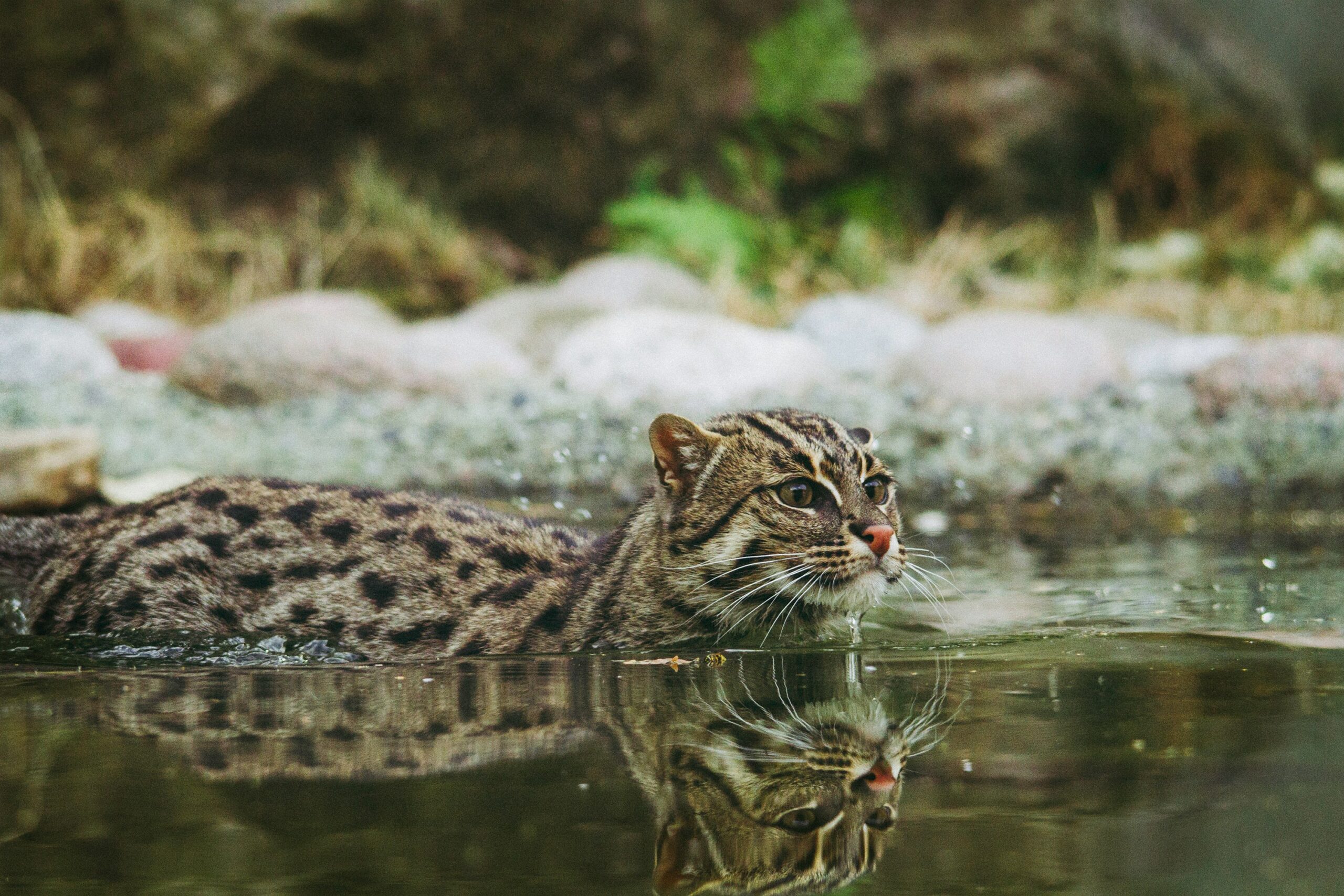
This article uses the fishing cat as an environmental indicator, not as sentimental ornament. It examines how a specialized wetland predator reveals broader patterns of wetland degradation, habitat fragmentation, mangrove loss, ecological compression, human-wildlife conflict, water-system disruption, and declining natural infrastructure. The central argument is that wetland conservation is not separate from environmental security. Protecting wetlands protects biodiversity, but it also protects water, food, climate stability, coastal safety, public health, and community resilience.
Why the Fishing Cat Matters
The fishing cat matters because it is a living signal of wetland condition. It is not simply a rare animal with an unusual relationship to water. It is a species whose ecology depends on the same systems that protect people: marshes, mangroves, tidal creeks, floodplains, riverine vegetation, aquatic prey populations, and functioning hydrological cycles. When fishing cats decline, disappear, or become confined to fragmented patches, the deeper warning is that wetland systems themselves are losing structure and function.
Environmental science often works through indicators. Water temperature can indicate ecosystem stress. Macroinvertebrates can indicate stream health. Coral bleaching can indicate marine heat stress. Bird migration can indicate seasonal disruption. The fishing cat can be read in a similar way. Its presence suggests that wetland habitat, prey availability, cover, water access, and ecological connectivity remain at least partly intact. Its absence, especially from places where suitable habitat once existed, raises questions about drainage, pollution, prey depletion, human disturbance, road mortality, fragmentation, hunting, aquaculture expansion, and coastal development.
This does not mean the fishing cat is a perfect indicator. No species can summarize the full complexity of a wetland. But the fishing cat is powerful because it connects visible wildlife decline to environmental processes that are often ignored until they fail. People may notice a charismatic animal more readily than they notice the slow loss of floodplain storage, mangrove root structure, sediment trapping, groundwater recharge, or nutrient cycling. The species becomes an entry point into the system.
The fishing cat also matters because it lives close to people. Its range overlaps with densely populated regions of South and Southeast Asia where wetlands are converted for agriculture, aquaculture, transport infrastructure, settlements, and industry. Its conservation therefore cannot be separated from land use, livelihoods, water governance, coastal planning, pollution control, and community stewardship.
The core lesson is not that society should protect wetlands only because a cat lives there. The stronger lesson is that a cat adapted to wetlands reveals the hidden dependence of human communities on the same ecological infrastructure.
Wetlands as Environmental Systems
Wetlands are transitional systems where water, soil, vegetation, climate, sediments, nutrients, wildlife, and human activity interact. They include marshes, swamps, peatlands, floodplains, mangroves, estuaries, tidal flats, lagoons, deltas, wet grasslands, freshwater lakeshores, river margins, and seasonally inundated landscapes. Their defining feature is not simply that they are wet. It is that water shapes their soils, plants, chemistry, productivity, and ecological function.
This water-driven character makes wetlands biologically rich and environmentally powerful. Wetland soils can store carbon for long periods, especially in peatlands and mangrove sediments. Wetland plants slow water and trap sediment. Root systems stabilize banks and coastlines. Microbial communities transform nutrients and help regulate water chemistry. Shallow aquatic habitats support fish, amphibians, crustaceans, mollusks, insects, birds, reptiles, mammals, and complex food webs.
Wetlands also connect systems that are often treated separately. They connect freshwater and coastal environments. They connect land use and water quality. They connect upstream agriculture with downstream fisheries. They connect storms with flood storage. They connect carbon cycles with soil saturation. They connect biodiversity with food security. They connect ecological degradation with infrastructure risk.
This is why wetland loss has consequences beyond the wetland boundary. Drain a marsh, and flood peaks may rise elsewhere. Clear mangroves, and storm surge may reach farther inland. Pollute a wetland, and toxins may move through aquatic food webs. Fragment wetland habitat, and species movement, genetic exchange, and prey availability may decline. Channelize a river, and floodplain function may be lost. Convert tidal wetlands to hard infrastructure, and coastal resilience may weaken.
Environmental science therefore treats wetlands as functional systems. Their value cannot be measured only by acreage. A small wetland in the right place may filter runoff, support breeding habitat, reduce flood risk, recharge groundwater, and connect habitat patches. A large wetland may lose function if hydrology is cut off, pollution is severe, invasive species dominate, or surrounding land use prevents ecological renewal.
The fishing cat belongs to this functional understanding. It survives where wetland systems still provide cover, prey, water, movement corridors, and enough ecological continuity to support a semi-aquatic predator.
Built for Water: The Ecology of a Wetland Specialist
The fishing cat is a medium-sized wild felid native to South and Southeast Asia. It is closely associated with wetlands, river edges, marshes, mangroves, swamps, reed beds, floodplains, and other aquatic habitats. Unlike the common image of cats as water-averse animals, the fishing cat is strongly adapted to life near water. It swims well, hunts in shallow aquatic environments, and feeds on fish along with amphibians, crustaceans, birds, rodents, reptiles, mollusks, and other prey depending on habitat.
Its ecological specialization gives the species its distinctiveness and its vulnerability. A forest cat may shift across wooded habitats if some patches are degraded. A generalist predator may use farms, scrublands, edges, or settlements. The fishing cat is more tightly linked to wetland function. It needs aquatic prey, vegetated cover, access to water, low enough disturbance, and connected habitat. When wetlands are drained, polluted, fragmented, or converted into hard-edged development, the fishing cat cannot simply become a grassland or urban species.
This specialization is an environmental-science lesson. Species are not isolated units floating above landscapes. They are expressions of habitat structure, hydrology, food webs, disturbance regimes, and land-use history. A fishing cat population is therefore not only a count of animals. It is a record of wetland continuity.
The species also complicates simplistic conservation imagery. It does not live only in pristine wilderness. Fishing cats may occupy working landscapes, human-dominated wetlands, agricultural mosaics, aquaculture edges, and community-managed areas where enough ecological function remains. This makes conservation both more difficult and more promising. It is more difficult because conflict, roads, pollution, and land conversion are close. It is more promising because wetland protection can be integrated with community stewardship, fisheries management, habitat corridors, local monitoring, and land-use planning.
To protect the fishing cat, environmental science must ask questions larger than species protection alone. Are wetlands connected? Is water quality sufficient? Are fish populations intact? Are mangroves and marshes protected? Are road crossings safe? Are local communities included? Are aquaculture systems polluting adjacent habitat? Are land-use policies treating wetlands as ecological infrastructure or vacant land?
The fishing cat is built for water. Its future depends on whether societies preserve the living water systems that built it.
Wetland Loss and Ecological Compression
Wetland loss is one of the clearest examples of ecological compression: the process by which human development squeezes living systems into smaller, more fragmented, more polluted, and less functional spaces. Wetlands are drained for agriculture, filled for housing, dredged for ports, converted for aquaculture, fragmented by roads, polluted by industry, altered by dams, simplified by embankments, and stressed by climate change. The result is not only habitat loss. It is the compression of hydrological and ecological function.
For fishing cats, this compression reduces available habitat and increases contact with people. As wetlands shrink, cats may move through villages, fish ponds, roads, and agricultural edges. They may prey on fish in aquaculture systems or be blamed for losses. They may be killed in retaliation, hit by vehicles, trapped, or displaced. What appears as human-wildlife conflict is often a symptom of habitat conversion.
Ecological compression also weakens population viability. Small habitat patches may not support enough individuals. Isolated populations may lose genetic diversity. Fragmented wetlands may prevent dispersal. Roads may create mortality barriers. Pollution may reduce prey quality. Human disturbance may reduce breeding success. The species becomes vulnerable not because one wetland disappears, but because many forms of pressure converge.
Wetland loss also compresses human resilience. Floodwaters that once spread across marshes are forced into channels, roads, drains, or settlements. Pollutants that wetlands once filtered may move into rivers, groundwater, lagoons, and coastal waters. Carbon stored in saturated soils may be released when wetlands are drained. Fisheries may decline when nursery habitats disappear. Coastal communities may become more exposed when mangrove buffers are cleared.
This is why wetland loss should not be treated as a narrow conservation issue. It is an environmental systems issue. It affects biodiversity, hydrology, climate mitigation, disaster risk, livelihoods, water quality, food systems, and public infrastructure.
Ecological compression is especially dangerous because it can appear gradual. A wetland is not always lost at once. It may be reduced by many small roads, ponds, drains, clearings, settlements, pollutants, and embankments. Each individual change may seem manageable. Together, they can transform a living system into a fragmented landscape where both wildlife and human communities lose resilience.
Mangroves, Coasts, and Climate Resilience
Mangroves are among the most important wetland systems for both biodiversity and climate resilience. They grow where land, freshwater, saltwater, tides, sediment, and coastal weather meet. Their roots slow waves, trap sediments, stabilize shorelines, create nursery habitat, store carbon, support fisheries, and provide shelter for many species. For fishing cats, mangrove systems can provide dense cover, aquatic prey, and movement corridors along coastal wetlands.
Mangrove loss is therefore a double loss. It removes habitat for wetland-dependent species and weakens coastal protection for human communities. When mangroves are cleared, shorelines can become more exposed to storm surge, erosion, saltwater intrusion, and wave energy. Communities may then depend more heavily on engineered defenses, emergency response, and costly reconstruction after storms. In some places, hard infrastructure becomes necessary because natural infrastructure has already been removed.
The climate dimension is especially important. Mangroves and other coastal wetlands can store large amounts of carbon in soils and sediments. When they are drained, excavated, degraded, or converted, stored carbon can be released and future sequestration capacity is reduced. The climate value of mangroves is therefore not only in the trees visible above ground, but also in the saturated soils below them.
Mangroves also support food systems. Many fish, crustaceans, and mollusks depend on mangrove and estuarine habitats during part of their life cycles. Degrading these habitats can reduce fishery productivity, which affects livelihoods and food security. This connects fishing cat conservation to human fishing communities: both depend on functioning aquatic food webs.
The Sundarbans illustrate the scale of the issue. This vast mangrove region shared by India and Bangladesh is a globally significant coastal wetland, a biodiversity refuge, a carbon-rich ecosystem, a storm buffer, and a human landscape shaped by tides, cyclones, rivers, sediments, and livelihoods. Fishing cats living in such environments are part of a larger coastal resilience system. Their vulnerability reflects the vulnerability of mangrove ecosystems under sea-level rise, storm intensification, salinity shifts, land conversion, and development pressure.
Mangrove protection should therefore be understood as climate adaptation, biodiversity conservation, disaster-risk reduction, food-system support, and environmental justice at the same time.
Hydrology, Water Quality, and Natural Filtration
Wetlands are hydrological systems. Their ecological value depends on how water moves, pauses, spreads, drains, infiltrates, evaporates, and returns. Change the hydrology, and the wetland changes. Drainage, embankments, canals, roads, dams, groundwater withdrawal, flood-control structures, and land conversion can all disrupt wetland function even when some vegetation remains.
For fishing cats, hydrology shapes prey, cover, movement, and breeding conditions. Seasonal flooding can support fish populations and wetland productivity. Tidal flows can sustain mangrove food webs. Floodplain connectivity can allow aquatic species to move between channels, ponds, marshes, and seasonal water bodies. If wetlands are cut off from water, overdrained, polluted, or converted into simplified ponds, the food web that supports the fishing cat may decline.
Hydrology also determines water-quality function. Wetlands can slow runoff, trap sediments, transform nutrients, retain pollutants, and reduce downstream contamination. Vegetation, soils, microbes, and water residence time all matter. A wetland with intact hydrology can act as a living filter. A degraded wetland may lose that capacity or become a source of pollution.
This water-quality function is often invisible in economic decision-making. A wetland may be undervalued until it is gone, after which communities face higher water-treatment costs, worse downstream water quality, degraded fisheries, algal blooms, or increased contamination risk. The loss becomes visible only after the ecosystem service has been removed.
Pollution also flows back into biodiversity. Industrial discharge, agricultural runoff, sewage, pesticides, plastics, heavy metals, and aquaculture chemicals can alter wetland chemistry and food webs. Predators such as fishing cats may be affected indirectly through reduced prey abundance, contamination in aquatic organisms, or disturbance from human activity.
Environmental science therefore treats wetland conservation as water governance. Protecting fishing cat habitat requires more than preventing hunting or designating protected areas. It requires protecting water flows, reducing pollution, maintaining seasonal inundation, preventing hydrological isolation, and monitoring changes in water quality and wetland condition.
The question is not only whether a wetland still exists on a map. The question is whether water still moves through it in ways that sustain life.
Biodiversity, Food Webs, and Ecological Integrity
Biodiversity gives wetlands their functional depth. Fish, amphibians, crustaceans, mollusks, insects, birds, reptiles, mammals, plants, fungi, microbes, and soil organisms all participate in wetland food webs. These relationships support nutrient cycling, prey availability, decomposition, pollination, water filtration, sediment stabilization, and ecological renewal.
The fishing cat is one visible member of this food web, but it depends on many less visible organisms. Fish populations depend on water quality, vegetation structure, dissolved oxygen, seasonal flows, spawning habitat, aquatic insects, plankton, and predator-prey balance. Amphibians depend on water chemistry, breeding pools, temperature, and low enough pollution. Mangrove systems depend on sediments, tidal exchange, root structure, crabs, mollusks, detritus, and microbial processes. Remove enough of these relationships, and the predator declines even if some habitat appears visually intact.
This is why ecological integrity matters. A wetland is not healthy simply because it is wet. It must retain enough structure, species diversity, functional diversity, water movement, habitat complexity, and ecological connectivity to support the relationships that make it a living system. A drained, polluted, or simplified wetland may still contain water but lose its ecological capacity.
Food-web disruption can also create feedback effects. If fish populations decline, fishing cats may move into areas where conflict with people increases. If wetland vegetation is removed, prey species may decline and cats may lose cover. If pollution reduces amphibians or aquatic invertebrates, multiple food-web links weaken. If overfishing reduces prey availability, predators may become more vulnerable.
Biodiversity loss should therefore be understood as a decline in ecological options. The fewer species, functions, habitats, and response pathways remain, the harder it becomes for the system to recover from disturbance. Wetlands with rich biodiversity can respond to stress in more ways. Simplified wetlands have fewer pathways for renewal.
The fishing cat reveals this problem because it is high enough in the wetland food web to register broader degradation. Protecting it requires protecting the ecological conditions beneath it.
Urbanization, Aquaculture, and Habitat Fragmentation
Urbanization and aquaculture are major forces reshaping fishing cat habitat. Across parts of South and Southeast Asia, wetlands are converted into roads, settlements, industrial zones, ports, shrimp ponds, fish farms, drainage systems, and transport corridors. These changes often occur in pieces, but their cumulative effect is landscape transformation.
Urban expansion fragments wetlands into smaller patches separated by roads, buildings, canals, embankments, fences, and hard infrastructure. Fragmentation reduces movement, increases edge disturbance, raises vehicle mortality risk, and isolates populations. Fishing cats may still appear in some human-dominated landscapes, but their long-term survival depends on whether habitat patches remain connected and functional.
Aquaculture creates a more complex relationship. Fish ponds and shrimp farms may attract fishing cats because they contain prey. But aquaculture can also replace natural wetlands, remove vegetation, pollute surrounding water, alter salinity, introduce chemicals, reduce habitat complexity, and intensify conflict when cats are blamed for economic losses. A pond is not the same as a wetland. It may provide food in the short term while failing to support the broader ecological functions of marshes, mangroves, floodplains, or tidal creeks.
Transportation infrastructure can be especially damaging. Roads through wetlands create mortality risk, noise, light, edge disturbance, drainage changes, and barriers to movement. For a species that may move along waterways and wetland edges, roads can become lethal lines across the landscape. Wildlife crossings, speed reduction, wetland-sensitive routing, and habitat connectivity planning can reduce these risks, but only if they are included early in infrastructure design.
Industrial development adds further pressure through land conversion, pollution, waste, water withdrawal, dredging, and shoreline modification. Once wetlands are fragmented by multiple uses, restoration becomes harder. Hydrology may be altered, land ownership complicated, pollution sources dispersed, and political pressure for continued development strong.
Environmental science therefore asks planners to evaluate cumulative effects. A single road, pond, factory, or housing project may be assessed narrowly. But fishing cat habitat is lost through accumulation: many small conversions that collectively erase wetland continuity. The correct unit of analysis is not only the project site. It is the wetland landscape.
Human-Wildlife Conflict as a Symptom of Habitat Loss
Human-wildlife conflict is often described as conflict between people and animals, but in many cases it is better understood as conflict produced by habitat loss, livelihood pressure, land-use change, and weak governance. Fishing cats may be killed when they are perceived as threats to fish ponds, small livestock, or household safety. But these encounters often intensify because wetland habitats have been fragmented, prey availability has changed, and cats are forced closer to people.
This distinction matters. If conflict is treated only as animal behavior, responses may focus on removal, punishment, fencing, or retaliatory killing. If conflict is treated as a systems problem, responses can address habitat protection, compensation, fish-pond design, community education, safe livestock practices, ecological corridors, local monitoring, and wetland restoration.
Fishing cats are sometimes misunderstood as dangerous animals. Misidentification and fear can increase persecution. Community-based conservation can reduce harm by explaining species behavior, documenting ecological roles, and involving residents in monitoring. Where local people become stewards of wetland habitat, conservation becomes less external and more grounded in lived landscape knowledge.
Livelihoods must also be taken seriously. It is not enough to tell fish farmers, fishers, or wetland communities to tolerate losses without support. Conservation that ignores economic vulnerability can deepen resentment and fail in practice. Compensation systems, conflict-prevention design, alternative livelihood support, participatory wetland management, and community benefit-sharing can reduce pressure.
Human-wildlife conflict also reveals environmental justice questions. Communities living near wetlands may depend on them for food, fuel, grazing, fishing, transport, and cultural life. They may also face restrictions imposed by distant conservation authorities or development projects that damage wetlands while blaming local users. A just approach distinguishes between subsistence use, industrial conversion, speculative development, and destructive extraction.
The fishing cat does not simply create conflict. Its presence reveals contested land-water systems where ecology, livelihood, development, and governance overlap. Reducing conflict requires repairing that relationship, not merely managing the animal.
Wetlands as Natural Infrastructure
Wetlands are natural infrastructure because they perform functions that societies otherwise try to engineer: flood control, water filtration, shoreline stabilization, carbon storage, groundwater recharge, storm buffering, heat moderation, fisheries support, and habitat provision. They do not replace all built infrastructure, but they reduce pressure on it and often perform more adaptively than hard systems alone.
The phrase “natural infrastructure” is useful because it shifts wetlands from the category of scenery into the category of public function. A marsh is not unused land if it stores floodwater. A mangrove is not empty coast if it reduces wave energy and supports fisheries. A floodplain is not wasted space if it keeps water out of homes downstream. A peatland is not marginal terrain if it stores carbon and regulates hydrology.
This frame also reveals the cost of wetland conversion. When wetlands are destroyed, societies may need more levees, seawalls, drainage systems, water-treatment plants, disaster assistance, insurance payouts, and reconstruction. These costs are often not charged to the developers, industries, or policies that destroyed the wetland. The result is a hidden subsidy: private gain from conversion paired with public cost from lost ecosystem function.
Fishing cats help expose that accounting failure. Their decline shows that wetland function is being lost at the ecological level. But the same degradation often foreshadows human costs: flood damage, water pollution, fishery decline, coastal erosion, heat exposure, and reduced climate resilience.
Natural infrastructure also has limits. Wetlands can be overwhelmed if development pressure, pollution, climate stress, or hydrological disruption becomes too severe. Calling wetlands infrastructure should not mean reducing them to services for humans alone. They are living systems with intrinsic ecological value and complex relationships beyond human utility. But recognizing their infrastructural role can help correct the destructive assumption that only concrete, steel, pipes, pumps, and walls count as serious public assets.
The strongest resilience strategies often combine ecological and engineered systems: restored wetlands with drainage planning, mangroves with risk-sensitive coastal zoning, floodplains with early warning, water-quality protection with treatment infrastructure, and habitat corridors with community stewardship.
Protecting the fishing cat’s habitat is therefore also protecting a form of infrastructure that grows, adapts, filters, absorbs, stores, shelters, and renews.
Environmental Justice and Wetland Conversion
Wetland conversion is often an environmental justice issue because the benefits and costs of development are unevenly distributed. Developers, industries, infrastructure investors, urban consumers, and distant markets may benefit from wetland drainage or coastal conversion, while local communities bear increased flood risk, declining fisheries, pollution, displacement, livelihood loss, and reduced access to common resources.
In many regions, wetlands are used by fishers, farmers, pastoralists, Indigenous communities, women collecting resources, informal workers, and households that depend on local ecosystems for food, fuel, materials, and income. When wetlands are converted, these users may lose access without meaningful compensation or political voice. The damage can be framed as progress even when the costs are transferred to those with less power.
Environmental justice also applies to conservation. Wetland protection must not become exclusionary in ways that criminalize local communities while leaving large-scale destructive industries untouched. Effective wetland governance should distinguish between community stewardship and industrial conversion, between subsistence use and extractive degradation, between local dependence and external profit.
Fishing cat conservation can support justice when it strengthens wetland protection, community monitoring, livelihood security, pollution control, and land-use accountability. It can undermine justice if it is imposed without consent, ignores local knowledge, or treats residents as threats rather than partners.
This is why the article’s environmental science framing matters. Wetlands are not isolated “nature” outside society. They are social-ecological systems. Their future depends on law, livelihoods, land tenure, infrastructure planning, water governance, community stewardship, scientific monitoring, and historical power relations.
A just wetland strategy should ask several questions. Who depends on the wetland? Who benefits from conversion? Who is exposed to flood and pollution after degradation? Who has authority to decide? Whose knowledge counts? Who monitors the ecosystem? Who receives restoration funding? Who is blamed when conflict occurs?
The fishing cat gives these questions a living form. Its habitat is disappearing through decisions made by people and institutions. Protecting that habitat requires changing those decisions, not simply admiring the species.
Restoration, Protection, and Wise Use
Wetland protection should begin with avoidance: preventing destruction before restoration becomes necessary. Restoration is valuable, but it cannot always recreate the complexity of an intact wetland. Hydrology, soil formation, microbial communities, seed banks, mangrove structure, fish nurseries, tidal exchange, and species relationships take time. Some losses are difficult or impossible to reverse within human planning horizons.
Where wetlands remain, protection should focus on hydrological integrity, habitat connectivity, pollution control, sustainable livelihoods, and local stewardship. Legal designation alone is not enough if upstream pollution, road construction, drainage, aquaculture expansion, or land speculation continue to degrade function.
Where wetlands are degraded, restoration must be more than symbolic planting. Planting mangroves in unsuitable hydrological conditions, for example, may fail if tidal exchange, sediment supply, salinity, and species selection are ignored. Effective restoration requires ecological diagnosis: what function has been lost, what stressors remain, what hydrological processes must be repaired, and how recovery will be monitored.
Community involvement is essential. Local residents often know seasonal water patterns, fish movements, conflict locations, plant communities, illegal clearing, and changes in wildlife presence. Citizen science, community patrols, participatory mapping, and local conservation groups can make wetland governance more grounded and durable.
Monitoring should include both ecological and social indicators. For fishing cat landscapes, relevant indicators may include wetland extent, habitat connectivity, water quality, mangrove condition, prey abundance, road mortality, conflict incidents, fishing cat camera-trap detections, community attitudes, livelihood impacts, and governance response.
The Ramsar idea of “wise use” is useful here because it recognizes wetlands as ecosystems that can support human wellbeing when managed sustainably. The goal is not to freeze wetlands outside human life. The goal is to prevent destructive use that erodes the ecological foundation of both biodiversity and human security.
Restoration and protection should therefore be understood as environmental governance. They require law, science, finance, community legitimacy, monitoring, and long-term maintenance. The fishing cat can serve as a flagship, but the real object of protection is the wetland system.
What the Fishing Cat Reveals About Environmental Science
The fishing cat reveals five important environmental science lessons.
First, species decline is often system decline. A vulnerable wetland predator is not only a conservation concern. It is evidence that hydrology, habitat connectivity, prey systems, water quality, land-use planning, and human-wetland relationships are under stress.
Second, specialization creates vulnerability under rapid environmental change. The fishing cat’s adaptation to aquatic habitats makes it ecologically remarkable, but it also means wetland degradation directly threatens its survival. Specialized species often reveal environmental change earlier and more sharply than generalists.
Third, natural infrastructure is often invisible until lost. Wetlands absorb floodwater, filter pollutants, store carbon, support fisheries, and protect coasts. These functions are undervalued because they do not always appear as market transactions. Their loss becomes visible through disaster damage, declining water quality, higher infrastructure costs, and ecological collapse.
Fourth, conservation and human resilience are not opposites. Protecting fishing cat habitat can also protect floodplains, mangroves, water quality, fisheries, carbon-rich soils, and coastal communities. The false choice between wildlife and people often hides the fact that both depend on the same living systems.
Fifth, environmental science must be justice-aware. Wetland loss is produced by policy, markets, infrastructure, land tenure, pollution, and uneven power. Conservation that ignores social realities will be weak. Development that ignores ecological realities will be dangerous. The stronger path is integrated wetland governance that protects biodiversity, livelihoods, water, climate resilience, and public accountability together.
The fishing cat is therefore not merely a symbol. It is a quiet diagnostic. It asks whether societies can see value in the systems that do not look like infrastructure but perform infrastructure’s deepest work. It asks whether development can be judged not only by what is built, but by what living systems are destroyed to build it.
The lesson is straightforward: when wetlands disappear, resilience disappears with them.
Mathematical Lens
A wetland natural-infrastructure resilience score can be represented as a function of habitat integrity, hydrological function, biodiversity, water-quality regulation, carbon storage, coastal protection, community stewardship, and governance capacity, reduced by land-conversion pressure, pollution, fragmentation, hydrological disruption, climate stress, and conflict pressure. Let \(W_r\) represent wetland resilience:
W_r = \alpha H_i + \beta F_h + \gamma B_d + \delta Q_w + \epsilon C_s + \zeta P_c + \eta S_c + \theta G_w – \lambda L_c – \mu P_o – \nu F_g – \xi D_h – \rho C_l – \sigma X_h
\]
Interpretation: Wetland resilience rises when habitat integrity, hydrological function, biodiversity, water-quality regulation, carbon storage, coastal protection, stewardship, and governance are strong. It declines when land conversion, pollution, fragmentation, hydrological disruption, climate stress, and human-wildlife conflict intensify.
A fishing cat habitat suitability score can be represented as:
S_f = \frac{H_i + F_h + B_d + P_a + C_v + K_m}{6} – \frac{F_g + P_o + R_m + X_h}{4}
\]
Interpretation: Fishing cat habitat suitability improves with intact habitat, hydrological function, biodiversity, prey availability, vegetative cover, and movement corridors. It declines with fragmentation, pollution, road mortality, and conflict pressure.
A natural-infrastructure loss gap can be represented as:
G_n = E_s – R_e
\]
Interpretation: The natural-infrastructure gap \(G_n\) grows when ecosystem-service loss \(E_s\) exceeds ecological restoration and protection effort \(R_e\). A widening gap suggests that built infrastructure and public systems may face rising costs as wetland functions decline.
| Term | Meaning | Environmental interpretation |
|---|---|---|
| \(W_r\) | Wetland resilience | Represents the wetland system’s capacity to sustain ecological and human-supporting functions. |
| \(H_i\) | Habitat integrity | Represents marsh, mangrove, floodplain, reed bed, and riparian habitat condition. |
| \(F_h\) | Hydrological function | Represents flooding, tidal exchange, groundwater recharge, flow connectivity, and water retention. |
| \(B_d\) | Biodiversity | Represents species, functional, genetic, and habitat diversity. |
| \(Q_w\) | Water-quality regulation | Represents filtration, nutrient transformation, sediment trapping, and pollutant reduction. |
| \(C_s\) | Carbon storage | Represents carbon held in wetland biomass, peat, soils, and mangrove sediments. |
| \(P_c\) | Coastal protection | Represents storm buffering, erosion control, shoreline stabilization, and wave-energy reduction. |
| \(S_c\) | Stewardship capacity | Represents community monitoring, local knowledge, participatory management, and livelihood-compatible conservation. |
| \(G_w\) | Wetland governance | Represents legal protection, enforcement, planning, financing, restoration, and public accountability. |
| \(L_c\) | Land-conversion pressure | Represents drainage, filling, urbanization, agriculture, aquaculture, roads, and industrial development. |
| \(P_o\) | Pollution pressure | Represents nutrient runoff, sewage, industrial discharge, aquaculture chemicals, plastics, and toxins. |
| \(F_g\) | Fragmentation | Represents habitat isolation, road barriers, patch loss, and disrupted movement corridors. |
| \(D_h\) | Hydrological disruption | Represents dams, embankments, drainage, channelization, water withdrawal, and tidal restriction. |
| \(C_l\) | Climate stress | Represents sea-level rise, salinity shifts, cyclones, heat, drought, flood volatility, and changing precipitation. |
| \(X_h\) | Human-wildlife conflict pressure | Represents retaliatory killing, fear, livestock or fish-pond conflict, and weak coexistence mechanisms. |
The equations are conceptual rather than predictive. Their purpose is to make the environmental systems logic explicit: fishing cat conservation depends on wetland function, and wetland function depends on hydrology, biodiversity, water quality, land use, climate pressure, community stewardship, and governance.
Advanced Python Workflow: Wetland Natural-Infrastructure Scoring
This Python workflow scores wetland natural-infrastructure condition using habitat integrity, hydrological function, biodiversity, water-quality regulation, carbon storage, coastal protection, stewardship capacity, governance capacity, land-conversion pressure, pollution pressure, fragmentation pressure, hydrological disruption, climate stress, and human-wildlife conflict pressure.
from __future__ import annotations

import pandas as pd
import numpy as np

INPUT_FILE = "wetland_natural_infrastructure_panel.csv"
OUTPUT_FILE = "wetland_natural_infrastructure_scores.csv"


def load_data(path: str) -> pd.DataFrame:
    """
    Load a wetland natural-infrastructure dataset.

    All *_index columns should be normalized to [0, 1].
    Higher values should mean more of the named property.

    Examples:
      - habitat_integrity_index: higher = stronger wetland habitat condition
      - hydrological_function_index: higher = stronger natural water movement and retention
      - land_conversion_pressure_index: higher = greater drainage, filling, aquaculture,
        urbanization, or infrastructure pressure
      - human_wildlife_conflict_index: higher = greater conflict or persecution pressure
    """
    df = pd.read_csv(path)

    required_columns = [
        "wetland_name",
        "region",
        "wetland_type",
        "habitat_integrity_index",
        "hydrological_function_index",
        "biodiversity_index",
        "water_quality_regulation_index",
        "carbon_storage_index",
        "coastal_protection_index",
        "stewardship_capacity_index",
        "governance_capacity_index",
        "land_conversion_pressure_index",
        "pollution_pressure_index",
        "fragmentation_pressure_index",
        "hydrological_disruption_index",
        "climate_stress_index",
        "human_wildlife_conflict_index",
    ]

    missing = [col for col in required_columns if col not in df.columns]

    if missing:
        raise ValueError(f"Missing required columns: {missing}")

    return df


def validate_indices(df: pd.DataFrame) -> pd.DataFrame:
    """Validate that all index fields are complete and normalized to [0, 1]."""
    index_columns = [col for col in df.columns if col.endswith("_index")]

    for col in index_columns:
        if df[col].isna().any():
            raise ValueError(f"Column '{col}' contains missing values.")

        if ((df[col] < 0) | (df[col] > 1)).any():
            raise ValueError(f"Column '{col}' contains values outside [0, 1].")

    return df


def compute_scores(df: pd.DataFrame) -> pd.DataFrame:
    """
    Compute wetland natural-infrastructure capacity,
    degradation pressure, and fishing-cat habitat suitability.
    """
    df = df.copy()

    df["natural_infrastructure_capacity_score"] = (
        0.15 * df["habitat_integrity_index"] +
        0.16 * df["hydrological_function_index"] +
        0.13 * df["biodiversity_index"] +
        0.13 * df["water_quality_regulation_index"] +
        0.11 * df["carbon_storage_index"] +
        0.10 * df["coastal_protection_index"] +
        0.11 * df["stewardship_capacity_index"] +
        0.11 * df["governance_capacity_index"]
    ).clip(lower=0, upper=1)

    df["wetland_degradation_pressure_score"] = (
        0.20 * df["land_conversion_pressure_index"] +
        0.17 * df["pollution_pressure_index"] +
        0.18 * df["fragmentation_pressure_index"] +
        0.17 * df["hydrological_disruption_index"] +
        0.16 * df["climate_stress_index"] +
        0.12 * df["human_wildlife_conflict_index"]
    ).clip(lower=0, upper=1)

    df["wetland_resilience_score"] = (
        0.72 * df["natural_infrastructure_capacity_score"] -
        0.28 * df["wetland_degradation_pressure_score"]
    ).clip(lower=0, upper=1)

    df["fishing_cat_habitat_proxy"] = (
        0.22 * df["habitat_integrity_index"] +
        0.20 * df["hydrological_function_index"] +
        0.18 * df["biodiversity_index"] +
        0.16 * df["water_quality_regulation_index"] +
        0.12 * df["stewardship_capacity_index"] +
        0.12 * df["governance_capacity_index"] -
        0.18 * df["fragmentation_pressure_index"] -
        0.16 * df["pollution_pressure_index"] -
        0.14 * df["human_wildlife_conflict_index"]
    ).clip(lower=0, upper=1)

    df["natural_infrastructure_gap"] = (
        df["natural_infrastructure_capacity_score"] -
        df["wetland_degradation_pressure_score"]
    )

    df["wetland_condition_band"] = np.select(
        [
            df["wetland_resilience_score"] >= 0.80,
            df["wetland_resilience_score"] >= 0.60,
            df["wetland_resilience_score"] >= 0.40,
        ],
        [
            "Strong wetland natural-infrastructure condition",
            "Moderate wetland natural-infrastructure condition",
            "Limited wetland natural-infrastructure condition",
        ],
        default="Severely degraded or high-risk wetland condition",
    )

    return df


def build_summary(df: pd.DataFrame) -> pd.DataFrame:
    """Return a ranked summary table for wetland natural-infrastructure review."""
    columns = [
        "wetland_name",
        "region",
        "wetland_type",
        "natural_infrastructure_capacity_score",
        "wetland_degradation_pressure_score",
        "wetland_resilience_score",
        "fishing_cat_habitat_proxy",
        "natural_infrastructure_gap",
        "wetland_condition_band",
    ]

    return (
        df[columns]
        .sort_values(
            by=[
                "wetland_resilience_score",
                "fishing_cat_habitat_proxy",
                "wetland_degradation_pressure_score",
            ],
            ascending=[False, False, True],
        )
        .reset_index(drop=True)
    )


def main() -> None:
    df = load_data(INPUT_FILE)
    df = validate_indices(df)
    scored = compute_scores(df)
    summary = build_summary(scored)

    summary.to_csv(OUTPUT_FILE, index=False)

    print("Wetland natural-infrastructure scoring complete.")
    print(summary.to_string(index=False))


if __name__ == "__main__":
    main()
This workflow is not a substitute for field ecology, hydrological modeling, camera-trap surveys, water-quality monitoring, or community knowledge. It is a structured diagnostic scaffold for comparing wetland condition, degradation pressure, and fishing-cat habitat suitability across sites.
Advanced R Workflow: Wetland Habitat and Resilience Diagnostics
This R workflow summarizes wetland natural-infrastructure condition by region and wetland type. It can support environmental science teaching, wetland conservation planning, preliminary habitat screening, restoration prioritization, and systems-oriented discussion of biodiversity and resilience.
library(readr)
library(dplyr)

input_file <- "wetland_natural_infrastructure_panel.csv"
region_output_file <- "wetland_region_summary.csv"
type_output_file <- "wetland_type_summary.csv"

wetland_df <- read_csv(input_file, show_col_types = FALSE)

required_cols <- c(
  "wetland_name",
  "region",
  "wetland_type",
  "habitat_integrity_index",
  "hydrological_function_index",
  "biodiversity_index",
  "water_quality_regulation_index",
  "carbon_storage_index",
  "coastal_protection_index",
  "stewardship_capacity_index",
  "governance_capacity_index",
  "land_conversion_pressure_index",
  "pollution_pressure_index",
  "fragmentation_pressure_index",
  "hydrological_disruption_index",
  "climate_stress_index",
  "human_wildlife_conflict_index"
)

missing_cols <- setdiff(required_cols, names(wetland_df))

if (length(missing_cols) > 0) {
  stop(paste("Missing required columns:", paste(missing_cols, collapse = ", ")))
}

index_cols <- names(wetland_df)[grepl("_index$", names(wetland_df))]

invalid_index_cols <- index_cols[
  vapply(
    wetland_df[index_cols],
    function(x) any(is.na(x) | x < 0 | x > 1),
    logical(1)
  )
]

if (length(invalid_index_cols) > 0) {
  stop(
    paste(
      "Index columns must be complete and normalized to [0, 1]:",
      paste(invalid_index_cols, collapse = ", ")
    )
  )
}

wetland_df <- wetland_df %>%
  mutate(
    natural_infrastructure_capacity_proxy = (
      habitat_integrity_index +
        hydrological_function_index +
        biodiversity_index +
        water_quality_regulation_index +
        carbon_storage_index +
        coastal_protection_index +
        stewardship_capacity_index +
        governance_capacity_index
    ) / 8,
    wetland_degradation_pressure_proxy = (
      land_conversion_pressure_index +
        pollution_pressure_index +
        fragmentation_pressure_index +
        hydrological_disruption_index +
        climate_stress_index +
        human_wildlife_conflict_index
    ) / 6,
    wetland_resilience_proxy = (
      natural_infrastructure_capacity_proxy +
        (1 - wetland_degradation_pressure_proxy)
    ) / 2,
    fishing_cat_habitat_proxy = (
      habitat_integrity_index +
        hydrological_function_index +
        biodiversity_index +
        water_quality_regulation_index +
        stewardship_capacity_index +
        governance_capacity_index +
        (1 - fragmentation_pressure_index) +
        (1 - pollution_pressure_index) +
        (1 - human_wildlife_conflict_index)
    ) / 9,
    natural_infrastructure_gap = natural_infrastructure_capacity_proxy -
      wetland_degradation_pressure_proxy,
    wetland_condition_band = case_when(
      wetland_resilience_proxy >= 0.75 ~ "Strong wetland natural-infrastructure condition",
      wetland_resilience_proxy >= 0.55 ~ "Moderate wetland natural-infrastructure condition",
      wetland_resilience_proxy >= 0.35 ~ "Limited wetland natural-infrastructure condition",
      TRUE ~ "Severely degraded or high-risk wetland condition"
    )
  )

region_summary <- wetland_df %>%
  group_by(region) %>%
  summarise(
    avg_wetland_resilience = mean(wetland_resilience_proxy, na.rm = TRUE),
    avg_fishing_cat_habitat = mean(fishing_cat_habitat_proxy, na.rm = TRUE),
    avg_natural_infrastructure_capacity = mean(natural_infrastructure_capacity_proxy, na.rm = TRUE),
    avg_degradation_pressure = mean(wetland_degradation_pressure_proxy, na.rm = TRUE),
    avg_habitat_integrity = mean(habitat_integrity_index, na.rm = TRUE),
    avg_hydrological_function = mean(hydrological_function_index, na.rm = TRUE),
    avg_biodiversity = mean(biodiversity_index, na.rm = TRUE),
    avg_water_quality_regulation = mean(water_quality_regulation_index, na.rm = TRUE),
    avg_carbon_storage = mean(carbon_storage_index, na.rm = TRUE),
    avg_coastal_protection = mean(coastal_protection_index, na.rm = TRUE),
    avg_land_conversion_pressure = mean(land_conversion_pressure_index, na.rm = TRUE),
    avg_pollution_pressure = mean(pollution_pressure_index, na.rm = TRUE),
    avg_fragmentation_pressure = mean(fragmentation_pressure_index, na.rm = TRUE),
    avg_hydrological_disruption = mean(hydrological_disruption_index, na.rm = TRUE),
    avg_climate_stress = mean(climate_stress_index, na.rm = TRUE),
    avg_human_wildlife_conflict = mean(human_wildlife_conflict_index, na.rm = TRUE),
    sites = n(),
    .groups = "drop"
  ) %>%
  arrange(desc(avg_wetland_resilience))

type_summary <- wetland_df %>%
  group_by(wetland_type) %>%
  summarise(
    avg_wetland_resilience = mean(wetland_resilience_proxy, na.rm = TRUE),
    avg_fishing_cat_habitat = mean(fishing_cat_habitat_proxy, na.rm = TRUE),
    avg_natural_infrastructure_capacity = mean(natural_infrastructure_capacity_proxy, na.rm = TRUE),
    avg_degradation_pressure = mean(wetland_degradation_pressure_proxy, na.rm = TRUE),
    avg_habitat_integrity = mean(habitat_integrity_index, na.rm = TRUE),
    avg_hydrological_function = mean(hydrological_function_index, na.rm = TRUE),
    avg_biodiversity = mean(biodiversity_index, na.rm = TRUE),
    avg_water_quality_regulation = mean(water_quality_regulation_index, na.rm = TRUE),
    avg_carbon_storage = mean(carbon_storage_index, na.rm = TRUE),
    avg_coastal_protection = mean(coastal_protection_index, na.rm = TRUE),
    avg_land_conversion_pressure = mean(land_conversion_pressure_index, na.rm = TRUE),
    avg_pollution_pressure = mean(pollution_pressure_index, na.rm = TRUE),
    avg_fragmentation_pressure = mean(fragmentation_pressure_index, na.rm = TRUE),
    avg_hydrological_disruption = mean(hydrological_disruption_index, na.rm = TRUE),
    avg_climate_stress = mean(climate_stress_index, na.rm = TRUE),
    avg_human_wildlife_conflict = mean(human_wildlife_conflict_index, na.rm = TRUE),
    sites = n(),
    .groups = "drop"
  ) %>%
  arrange(desc(avg_degradation_pressure))

write_csv(region_summary, region_output_file)
write_csv(type_summary, type_output_file)

cat("Wetland region summary exported to:", region_output_file, "\n")
print(region_summary)

cat("\nWetland type summary exported to:", type_output_file, "\n")
print(type_summary)
This workflow helps compare wetland types and regions by ecological condition, degradation pressure, and fishing-cat habitat suitability. It is best used as a transparent teaching and planning scaffold rather than as a final conservation decision model.
Related Articles
- Biodiversity Loss and Ecological Resilience
- Regenerative Resilience and the Repair of Living Systems
- Freshwater Change and Earth System Risk
- Land-System Change and Ecological Transformation
- Biosphere Integrity and the Stability of Life Systems
- Clean Drinking Water, Desalination, and Water-Supply Resilience
- Water Security, Drought, Flood, and Resilience
- Path Dependence, Lock-In, and Resilience Traps
Further Reading
- Convention on Wetlands (2025) Global Wetland Outlook 2025: Valuing, Conserving, Restoring and Financing Wetlands. Available at: https://www.global-wetland-outlook.ramsar.org/
- IUCN SSC Cat Specialist Group (n.d.) Living Species: Fishing Cat. Available at: https://www.catsg.org/living-species-fishingcat
- IPBES (2019) Global Assessment Report on Biodiversity and Ecosystem Services: Summary for Policymakers. Available at: https://files.ipbes.net/ipbes-web-prod-public-files/inline/files/ipbes_global_assessment_report_summary_for_policymakers.pdf
- Millennium Ecosystem Assessment (2005) Ecosystems and Human Well-being: Wetlands and Water Synthesis. Available at: https://www.millenniumassessment.org/documents/document.358.aspx.pdf
- Barbier, E.B. (2011) ‘Wetlands as natural assets’, Hydrological Sciences Journal, 56(8), pp. 1360–1373. Available at: https://doi.org/10.1080/02626667.2011.629787
- Barbier, E.B. et al. (2011) ‘The value of estuarine and coastal ecosystem services’, Ecological Monographs, 81(2), pp. 169–193. Available at: https://doi.org/10.1890/10-1510.1
- Alongi, D.M. (2014) ‘Carbon cycling and storage in mangrove forests’, Annual Review of Marine Science, 6, pp. 195–219. Available at: https://doi.org/10.1146/annurev-marine-010213-135020
- Spalding, M.D., McIvor, A.L., Tonneijck, F.H., Tol, S. and van Eijk, P. (2014) Mangroves for Coastal Defence: Guidelines for Coastal Managers and Policy Makers. Available at: https://www.nature.org/media/oceansandcoasts/mangroves-for-coastal-defence.pdf
- Mishra, R. et al. (2022) ‘Fishing cat Prionailurus viverrinus distribution and habitat suitability in Nepal’, Ecology and Evolution. Available at: https://pmc.ncbi.nlm.nih.gov/articles/PMC9034449/
References
- Alongi, D.M. (2014) ‘Carbon cycling and storage in mangrove forests’, Annual Review of Marine Science, 6, pp. 195–219. Available at: https://doi.org/10.1146/annurev-marine-010213-135020
- Barbier, E.B. (2011) ‘Wetlands as natural assets’, Hydrological Sciences Journal, 56(8), pp. 1360–1373. Available at: https://doi.org/10.1080/02626667.2011.629787
- Barbier, E.B. et al. (2011) ‘The value of estuarine and coastal ecosystem services’, Ecological Monographs, 81(2), pp. 169–193. Available at: https://doi.org/10.1890/10-1510.1
- Convention on Wetlands (2025) Global Wetland Outlook 2025: Valuing, Conserving, Restoring and Financing Wetlands. Available at: https://www.global-wetland-outlook.ramsar.org/
- IPBES (2019) Global Assessment Report on Biodiversity and Ecosystem Services: Summary for Policymakers. Available at: https://files.ipbes.net/ipbes-web-prod-public-files/inline/files/ipbes_global_assessment_report_summary_for_policymakers.pdf
- IUCN SSC Cat Specialist Group (n.d.) Living Species: Fishing Cat. Available at: https://www.catsg.org/living-species-fishingcat
- Millennium Ecosystem Assessment (2005) Ecosystems and Human Well-being: Wetlands and Water Synthesis. Available at: https://www.millenniumassessment.org/documents/document.358.aspx.pdf
- Mishra, R. et al. (2022) ‘Fishing cat Prionailurus viverrinus distribution and habitat suitability in Nepal’, Ecology and Evolution. Available at: https://pmc.ncbi.nlm.nih.gov/articles/PMC9034449/
- Spalding, M.D., McIvor, A.L., Tonneijck, F.H., Tol, S. and van Eijk, P. (2014) Mangroves for Coastal Defence: Guidelines for Coastal Managers and Policy Makers. Available at: https://www.nature.org/media/oceansandcoasts/mangroves-for-coastal-defence.pdf