
Last Updated May 5, 2026
Few ideas in the Chinese political imagination have been more consequential than the Mandate of Heaven. The concept does not simply describe a ruler’s authority. It places rule within a moral and cosmic order in which legitimacy depends upon virtue, public welfare, ritual adequacy, and responsiveness to the condition of the people. Under the sign of Heaven’s mandate, sovereignty is never merely possession. It is conditional, judged, and potentially revocable. The ruler does not govern because power is self-justifying. He governs because Heaven has entrusted order to him, and that trust can be lost.
The Mandate of Heaven, tianming 天命, therefore belongs not only to political theory but to the mythic imagination of rule. It makes political history narratable as moral history. Dynastic rise and fall become more than military success or failure. They become signs of deeper judgment. A house may receive the Mandate because it restores order, nourishes the people, conducts ritual properly, and acts in accordance with Heaven. A house may lose the Mandate because it becomes cruel, indulgent, negligent, oppressive, ritually deficient, or destructive toward the people. The doctrine’s force lies in this conditionality: legitimate power must continually justify itself by how it governs.
Article Map
Chinese Myth, Folklore & Legend
Related Topic
Yao, Shun & Sage-Kingship
Series context: This article is part of the Chinese Myth, Folklore & Legend knowledge series. It should be read alongside What Is Chinese Myth, Folklore & Legend?, The Problem of Sources in Chinese Mythology, The Yellow Emperor and the Mythic Politics of Chinese Origins, Yao, Shun, and the Sage-Kings in Legendary History, and Yu the Great, Flood Control, and the Birth of Political Order. Within that sequence, the Mandate of Heaven gathers many earlier themes into a single governing idea: cosmic order, moral authority, political legitimacy, succession, environmental responsibility, and the welfare of the people all become intelligible within one framework of rule.
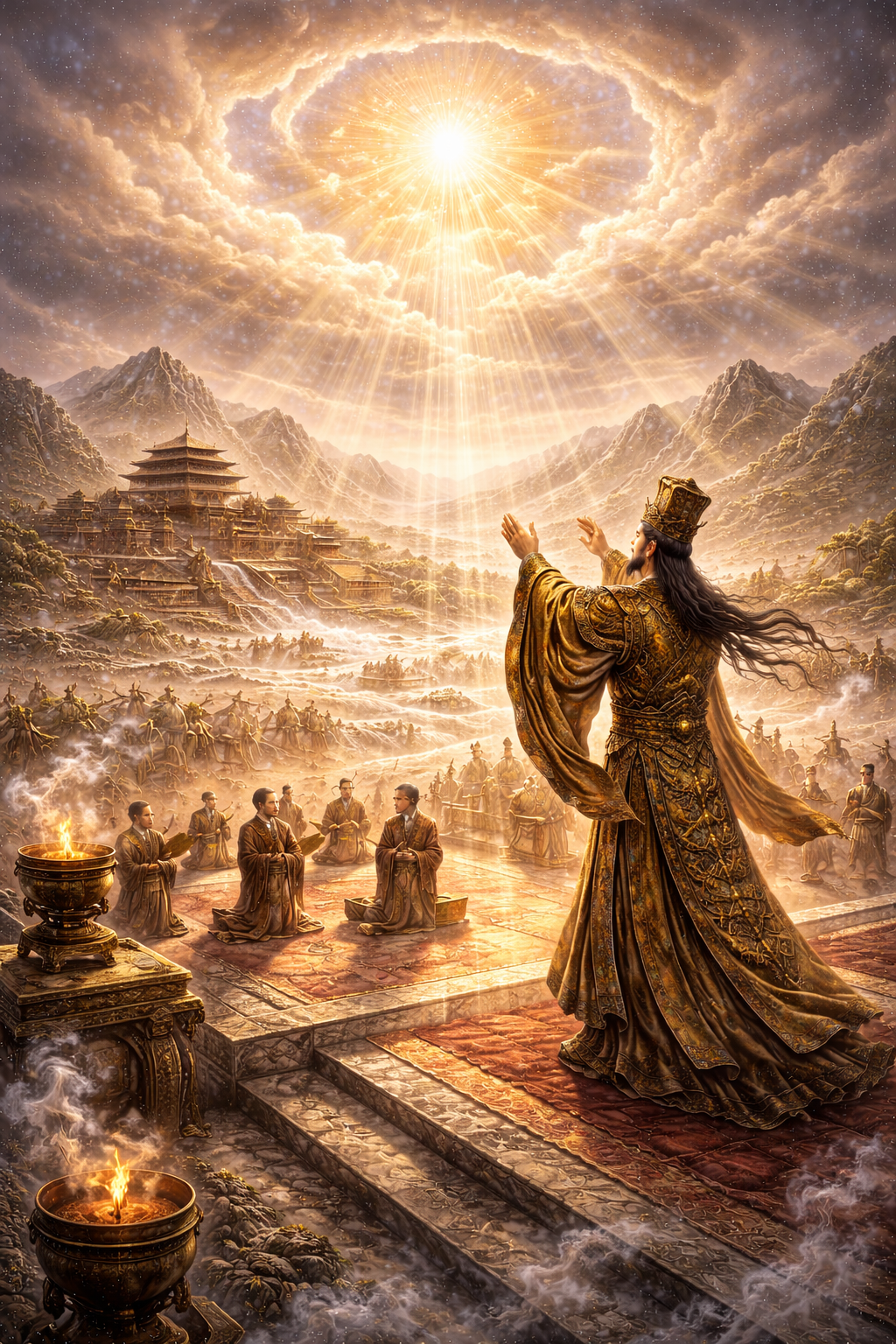
The most important point of departure is the Zhou political and textual world. Later summaries often describe the Mandate of Heaven as the doctrine by which the Zhou justified their conquest of the Shang, and that is broadly correct. But the transmitted sources show something more precise and more powerful. They do not merely claim that Heaven arbitrarily preferred one house to another. They insist that Heaven’s judgment is linked to virtue, misconduct, ritual responsibility, and the condition of the people. In the Great Declaration, the future Zhou king states that Heaven sees as the people see and hears as the people hear. In the Counsels of Gao-yao, Heaven distinguishes the virtuous and punishes the guilty. In Mengzi, these formulations become the basis for a political philosophy in which Heaven’s favor is legible through public response, moral quality, ritual acceptance, and the success or failure of government.
The Mandate is therefore not a doctrine of unconditional divine right. It is a moral-political relation among Heaven, ruler, people, ritual, and public order. It gives sovereignty sacred gravity, but it also places sovereignty under judgment. This double structure explains its durability. The Mandate elevates rule, but also makes rule answerable.
What Is the Mandate of Heaven?
The Mandate of Heaven, tianming 天命, is the idea that political authority is conferred by Heaven and must be justified by virtue, proper governance, ritual adequacy, and responsiveness to the people. It came to prominence in early Zhou political thought as a way of explaining why the Shang could lose rule and the Zhou could rightly receive it. But in the transmitted tradition, the concept quickly becomes larger than dynastic apologetic. It becomes one of the central principles through which Chinese civilization imagines the relation between cosmos and politics.
This is what gives the doctrine its enduring force. The Mandate does not reduce rule to ancestry alone, nor does it reduce Heaven to blind fate. It insists that government exists under judgment. The ruler may be elevated, but he is not beyond review. Heaven’s grant is conditional, and its continuity depends upon the ruler’s conduct. This conditionality is what separates the Mandate from any simple doctrine of unconditional divine right.
At the same time, the Mandate is not modern electoral legitimacy in ancient dress. Heaven does not function as a democratic institution, and the people are not described as sovereign in the modern constitutional sense. The doctrine is older and more cosmological. Yet it gives the condition of the people real political and moral significance. Public suffering, disorder, oppression, and failed governance can be read as evidence that a ruler has lost alignment with Heaven.
The Mandate therefore works through a double claim. First, rule belongs within a sacred and moral order greater than human force. Second, the ruler’s relation to that order can be judged by visible effects: virtue, peace, ritual correctness, public welfare, and the people’s response. This makes the Mandate one of the most powerful ancient frameworks for thinking political accountability.
Heaven (Tian) and the Moral Order of Rule
To understand the Mandate, one must first understand that Heaven, Tian 天, in the early Chinese archive is not merely the physical sky. It is a morally charged principle of order, judgment, authority, and cosmic regularity. Heaven can authorize, observe, approve, punish, and withdraw favor. It is not simply a place above the world; it is the name for a moral-cosmic structure within which political authority becomes meaningful.
This is one reason the idea proved so durable. A ruler under Heaven is not simply a possessor of force. He is a participant in a cosmic-moral arrangement. Political authority is therefore inseparable from ethics. Heaven’s command is not meaningful if it does not distinguish between worthy and unworthy rule.
This does not mean that Heaven is easy to define. In the transmitted tradition, Tian can carry multiple registers: sky, cosmic order, moral authority, ancestral or supreme power, and impersonal pattern. The Mandate of Heaven draws strength from this layered meaning. It gives political rule sacred sanction without reducing Heaven to a merely human legal authority.
That ambiguity also explains the doctrine’s flexibility. Heaven can be invoked ritually, morally, politically, and historiographically. It can authorize a dynasty, judge its failure, sanction replacement, and provide a language through which later thinkers debate virtue, succession, public order, and responsibility.
The Zhou Conquest and the Language of Legitimacy
The doctrine of the Mandate of Heaven becomes historically visible in the political language surrounding the Zhou overthrow of the Shang. The crucial point is that conquest required moral explanation. It was not enough to say that the Zhou were stronger. They had to explain why the Shang had ceased to deserve rule and why Zhou victory was more than opportunistic rebellion.
The transmitted declarations present that explanation through a language of corruption, cruelty, neglect, Heaven’s anger, and public suffering. The fall of a house is not narrated as random misfortune. It is narrated as forfeiture. The rise of the successor is not narrated as mere seizure. It is narrated as receipt of the Mandate. In this way, dynastic change becomes morally intelligible.
Primary Source
今商王受,弗敬上天,降災下民。沈湎冒色,敢行暴虐……皇天震怒,命我文考,肅將天威。Now Shou, king of Shang, does not revere Heaven above and brings calamity down upon the people below. Abandoned to drunkenness and reckless desire, he dares to practice violent cruelty. Great Heaven was moved to anger and commanded my deceased father Wen to display Heaven’s awe.Shangshu, “Great Declaration I” 泰誓上.
The Zhou justification of conquest is framed not as naked victory, but as a response to Shang misrule, public suffering, and Heaven’s moral judgment.
This passage is central because it joins three domains: Heaven, ruler, and people. The Shang ruler’s failure is not only ritual irreverence toward Heaven; it is also injury to the people. Heaven’s anger is therefore linked to human suffering. Political legitimacy is lost when the ruler violates both cosmic reverence and public care.
The Zhou argument should still be read critically. It is a victor’s political theology, a justification of conquest by the new ruling house. But source criticism does not make the doctrine insignificant. It reveals why the doctrine mattered: political change needed moral and cosmic explanation. The Mandate of Heaven gave that explanation a form that would shape Chinese political thought for centuries.
Heaven Sees Through the People
One of the most important formulations in all of Chinese political thought appears in the Great Declaration II: “Heaven sees as my people see; Heaven hears as my people hear.” This sentence is decisive because it ties cosmic judgment to human experience. Heaven does not remain sealed off in transcendence. Its discernment is mediated through the condition and perception of the people.
Primary Source
天視自我民視,天聽自我民聽。Heaven sees as my people see; Heaven hears as my people hear.Shangshu, “Great Declaration II” 泰誓中.
This compact statement gives the Mandate its most powerful accountability logic. Heaven’s judgment is not detached from the people’s experience of rule.
The significance of this claim can hardly be overstated. It means that public distress is not politically incidental. It is evidence. A ruler who loses the people’s trust may be understood as having lost Heaven’s favor. Conversely, the welfare and moral response of the people become signs through which the legitimacy of rule can be judged. Heaven is thus not merely above the political order. It is reflected within it.
This does not mean that the people directly appoint rulers in a modern political sense. The doctrine remains embedded in a hierarchical and cosmological worldview. Yet it does mean that the people’s condition matters profoundly. Their suffering can testify against a ruler. Their acceptance can help reveal Heaven’s will. Their experience becomes a political sign.
This is one of the reasons Mengzi later finds the formulation so important. It allows Heaven’s will to be interpreted through public order, ritual acceptance, and social response rather than through private revelation alone. Heaven may not speak in ordinary language, but the condition of the people can show whether rule is aligned with Heaven.
Virtue, Punishment, and Political Judgment
The Counsels of Gao-yao preserves another crucial set of formulations: Heaven graciously distinguishes the virtuous; Heaven punishes the guilty; Heaven hears and sees as the people hear and see. These statements matter because they make clear that the Mandate is not only a language of succession. It is a language of moral differentiation. Rule does not continue because office has inertia. It continues because virtue justifies it.
Primary Source
天命有德,五服五章哉;天討有罪,五刑五用哉。政事懋哉懋哉!天聰明,自我民聰明;天明畏,自我民明威。Heaven appoints the virtuous: are there not the five garments and five decorations? Heaven punishes the guilty: are there not the five punishments, each used for its purpose? The work of government must be earnest, earnest. Heaven hears and sees through the people’s hearing and seeing; Heaven’s bright approval and awe are shown through the people’s bright approval and awe.Shangshu, “Counsels of Gao-yao” 皋陶謨.
The passage links Heaven, virtue, punishment, government, and the people’s perception. Political judgment is moral, administrative, and public at once.
This passage gives the Mandate an administrative dimension. Heaven’s judgment is not vague sentiment. It is connected to honors, punishments, offices, ceremonies, and the seriousness of government. Politics, in this view, is a domain under ethical and cosmic scrutiny. Rank and penalty are not merely state techniques; they are instruments that should correspond to Heaven’s differentiation of virtue and guilt.
The passage also repeats the link between Heaven’s perception and the people’s perception. This does not make Heaven reducible to popular opinion. Rather, it means that Heaven’s moral order is visible through the public world. The condition of the people, the justice of government, and the ruler’s conduct all disclose whether political order remains aligned with Heaven.
This is why the Mandate binds administration to morality. A ruler cannot claim Heaven while governing negligently. The work of government must be earnest because it is not merely human management; it is the earthly enactment of a cosmic-moral responsibility.
Mandate, Succession, and the Problem of Worth
The Mandate of Heaven bears directly on the problem of succession. If authority is conditional, then the transfer of rule cannot be justified solely by lineage. The question of worth remains central. This is one reason later political thought repeatedly turned back to the legendary succession from Yao to Shun and from Shun to Yu. Those stories became canonical because they dramatized the problem of how authority should pass: by blood alone, by worth, by public acceptance, or by some complex relation among them.
Mengzi makes this explicit in the Wan Zhang chapters. When asked whether Yao gave the realm to Shun, Mengzi rejects the idea that a ruler can simply transfer the realm by private will. Heaven gave it; the people gave it. Yet Heaven does not speak in ordinary words. It shows its will through the person’s conduct, administration, ritual acceptance, and the people’s response.
Primary Source
曰:「天與之。」……曰:「否。天不言,以行與事示之而已矣。」He replied, “Heaven gave it to him.” Asked whether Heaven gave the command in explicit words, he said, “No. Heaven does not speak; it simply shows it through conduct and affairs.”Mengzi, “Wan Zhang I” 萬章上.
Mengzi interprets succession through Heaven’s silent judgment. Heaven’s will is disclosed through conduct, public affairs, ritual recognition, and social acceptance.
This makes the Mandate a profoundly political concept rather than a purely mystical one. Heaven’s will is not a private oracle whispered to the powerful. It must become visible through the public world. Does the candidate conduct affairs well? Do the people repose under him? Do the spirits accept his sacrifices? Do the political actors of the realm recognize him? These are the signs through which Heaven’s gift becomes legible.
The same passage also helps explain why the Mandate could be used to think both merit succession and hereditary succession. Mengzi later argues that when Heaven gives the realm to the worthy, it is given to the worthy; when Heaven gives it to the son, it is given to the son. The key issue is not mechanical inheritance, but the alignment of succession with Heaven, public response, and the continuing order of the realm.
Yao, Shun, Yu, and the Prehistory of the Mandate
The Mandate of Heaven is often associated above all with Zhou political doctrine, but its moral logic reaches back into the legendary world of Yao, Shun, and Yu. Those rulers are remembered as exemplary not because they held office by inert inheritance, but because rule followed worth, discernment, public duty, ritual competence, administrative ability, and the capacity to secure the realm. In that sense, the legendary sage-kings form the ethical prehistory of the Mandate even before the full Zhou language of tianming becomes explicit.
This continuity matters for the larger architecture of the series. Yao and Shun establish the model of morally tested kingship. Yu shows that environmental mastery and the securing of habitable life are conditions of legitimate authority. The Mandate then gathers such themes into an explicit doctrine: Heaven grants rule where virtue and effective care for the people are present, and it withdraws rule where they are absent.
The legendary sequence also reveals why the Mandate is not only about dynastic overthrow. It is also about the ordinary question of worthiness. Yao’s refusal to privilege an unworthy son, Shun’s tested virtue, and Yu’s flood-control labor all show that legitimacy must be demonstrated. The ruler must be able to carry public responsibility. The Mandate gives that demonstration cosmic meaning.
Yu’s place is especially important because it ties legitimacy to material achievement. It is not enough to be virtuous in inward disposition. Rule must become effective care for the conditions of life. Flood control, food security, administrative order, and public welfare all become signs of whether Heaven’s trust is being fulfilled.
The Son of Heaven and the Center of the World
The Mandate also gives rise to one of the most enduring political titles in Chinese civilization: the Son of Heaven, tianzi 天子. This title does not mean that the ruler is divine in a simple personal sense. It means that he occupies a mediating place between cosmic order and human society. He stands at the center not because he is absolutely autonomous, but because he bears delegated responsibility under Heaven.
This center is ritual as much as political. The ruler is responsible for sacrifice, calendrical order, territorial coherence, and the maintenance of harmony between heaven, earth, ancestors, spirits, officials, and people. The Mandate therefore does not merely authorize command. It imposes a burden of alignment. The ruler must hold the center in a way worthy of Heaven.
This is why the Mandate belongs to the mythic imagination of rule. It makes the political center a sacredly charged position. The ruler is not only administrator, judge, or military commander. He is the figure through whom the relation between Heaven and the human world is ritually and politically enacted.
Yet this exalted status also increases accountability. A ruler who claims to be Son of Heaven cannot treat rule as private possession. The higher the title, the greater the burden. To stand under Heaven is to stand within judgment.
Ritual, Sacrifice, and Heaven’s Recognition
The Mandate is not only an ethical doctrine. It is also a ritual doctrine. In Mengzi, Heaven’s acceptance of Shun is shown partly through sacrifice: he is made to preside over sacrifices, and the spirits are pleased. He is also made to preside over affairs, and affairs are well governed. This pairing is crucial. Ritual acceptance and administrative success together reveal Heaven’s will.
That structure helps explain why early Chinese rulership cannot be divided cleanly into “religious” and “political” spheres. The ruler’s legitimacy depends on conducting affairs well and maintaining proper relations with spirits, ancestors, Heaven, and ritual order. Good government and good ritual belong to one field of responsibility.
Ritual also provides a visible form for political authority. Sacrifices, ancestral rites, calendrical observances, and court ceremonies do not merely decorate power. They enact power’s place within a larger order. A ruler who fails ritually risks failing politically because ritual is one of the means by which the ruler’s alignment with Heaven is displayed.
This is why the Mandate cannot be reduced to simple popular approval or military success. The people’s condition matters, but so do ritual forms, inherited ceremonies, and sacred recognition. Heaven’s mandate is a total framework of legitimacy: moral, public, ritual, administrative, and cosmic.
Omens, Disaster, and the Signs of Misrule
The Mandate also shaped how later Chinese political culture interpreted omens, disasters, floods, droughts, eclipses, famines, rebellions, and social disorder. If Heaven judges rulers, then events in the natural and human world may become signs of misrule or warning. Disaster is not automatically proof of guilt in any simple sense, but it becomes politically interpretable. The world is read as morally responsive.
This sign-reading logic has deep roots in the same symbolic field explored throughout Chinese myth and legend. Floods in the Yu tradition test political capacity. Drought and storm in mythic war reveal cosmic imbalance. The calendar in the Yao tradition ties rule to heavenly order. The Mandate extends this pattern into dynastic history: disorder in the world may signal disorder in rule.
Such a system can be ethically powerful because it makes rulers answerable for public suffering. It prevents power from treating famine, flood, or social unrest as meaningless misfortune. Yet it can also be dangerous if applied mechanically, because natural disasters may be over-moralized or used in political struggle. The doctrine’s interpretive force therefore requires caution.
The deeper point is that the Mandate makes the ruler responsible for the condition of the realm. Weather, harvest, justice, ritual, and public peace all become part of the evidence by which rule is judged. This is one reason the concept remained so consequential: it offered a symbolic language for connecting cosmic, ecological, and political disorder.
Revocability, Rebellion, and the Loss of Rule
One of the most radical dimensions of the Mandate of Heaven is that it is revocable. If authority depends upon virtue and care for the people, then there must be circumstances under which rule can be lost. This principle is what made the doctrine so politically powerful. It provided a moral explanation for dynastic collapse and a framework within which rebellion could be interpreted not as sheer treason, but as the historical sign that Heaven’s favor had shifted.
This does not mean that every revolt was thereby justified. The doctrine is not a license for chaos. Its logic is stricter: order remains central, but order itself must be morally warranted. A house that has become destructive, negligent, or tyrannical may forfeit the very basis on which it ruled. Dynastic replacement then appears not as an aberration, but as the restoration of proper relation between Heaven and the human realm.
The Zhou use of the doctrine against the Shang is the foundational example. Shang misrule is described as cruelty toward the people and irreverence toward Heaven. Zhou conquest is presented as Heaven’s command rather than mere ambition. Later dynastic histories would repeatedly use similar logic to explain the fall of one house and the rise of another.
The revocability of the Mandate is therefore both stabilizing and destabilizing. It stabilizes rule by giving legitimacy sacred depth. It destabilizes unjust rule by insisting that sacred depth can be withdrawn. This tension is precisely what made the doctrine so enduring. It gave authority a foundation while denying that authority was unconditional.
Mythic Imagination and Political Theology
The Mandate of Heaven belongs to the mythic imagination of rule because it narrates politics within a cosmic drama of worthiness, failure, transfer, and judgment. It is not merely an administrative theory. It is a political theology. Heaven watches, evaluates, grants, and withdraws. The people become the medium through which that judgment is known. The ruler becomes the bearer of a charge larger than himself. Dynastic change becomes narratively meaningful.
This mythic structure is precisely why the Mandate endured. It made political history legible as moral history. It allowed success and failure, peace and catastrophe, continuity and rupture, to be interpreted within one symbolic framework. Power did not simply happen. It was judged.
At the same time, the Mandate’s mythic quality does not make it irrational or merely decorative. It is a way of binding political authority to standards that exceed the ruler’s will. In that sense, it is one of the great ancient frameworks for thinking legitimacy as conditional accountability. Its theological language carries political force.
The Mandate also helps explain why Chinese myth, folklore, and legendary history cannot be separated from political thought. Huangdi, Yao, Shun, Yu, the Zhou conquest, the Son of Heaven, omens, disasters, and dynastic change all belong to the same symbolic field. Myth gives political order an origin, a moral horizon, and a theory of failure.
Source History and Interpretive Caution
A scholarly reading of the Mandate requires attention to the sources and their later reception. The Shangshu provides core classical formulations linking Heaven, virtue, punishment, government, and the people’s perception. Mengzi systematizes and philosophically develops these ideas in a later argumentative context. Historiographical and philosophical traditions after the Zhou continue to elaborate the doctrine. Later summaries correctly describe the doctrine as arising in early Zhou political legitimation, but the transmitted texts must remain the primary basis for analysis.
This means that the Mandate should not be flattened into a slogan. It is neither an empty ideological cover for conquest nor a purely abstract metaphysical principle. It is a historically situated doctrine that became one of the most powerful ways Chinese civilization imagined the moral conditions of political order.
It is also important not to translate the Mandate too quickly into modern categories. It is not simply democracy, divine right, social contract, constitutionalism, or popular sovereignty, though it overlaps with some concerns later associated with political accountability. Its own structure is older, ritualized, and cosmological. Heaven authorizes; the ruler governs; the people’s condition reveals; ritual confirms; disorder warns; history judges.
Read in this way, the Mandate becomes a major example of how mythic-political language can preserve a serious theory of responsibility. It allows rule to be sacred without becoming unconditional, and it allows political change to be justified without reducing legitimacy to force.
Why the Mandate Still Matters
The Mandate of Heaven still matters because it preserves a political idea of enduring seriousness: rule must justify itself morally, not merely factually. Power alone is not enough. The ruler must remain answerable to standards beyond force, and the suffering or flourishing of the people becomes evidence in that judgment.
It also matters because it binds together domains often separated in modern analysis. Cosmos, morality, succession, rebellion, ritual, administration, environmental order, and public welfare all appear as parts of the same order. Under the Mandate of Heaven, the imagination of rule becomes inseparable from the question of whether the world is being rightly governed.
The Mandate matters, too, because it shows how myth can become political accountability. A concept rooted in Heaven and dynastic history becomes a way of judging rulers. The very language that elevates sovereignty also limits it. That tension remains one of the doctrine’s greatest intellectual achievements.
Finally, the Mandate matters because it completes a major arc in the Chinese mythic-political sequence. Pangu separates the world; Nüwa repairs it; Fuxi patterns it; Shennong nourishes it; Huangdi consolidates it; Yao and Shun moralize its rule; Yu makes it materially governable; the Mandate of Heaven explains how rule can be granted, tested, lost, and transferred. It is the concept through which cosmic order becomes political responsibility.
Related Reading
- Chinese Myth, Folklore & Legend
- What Is Chinese Myth, Folklore & Legend?
- The Problem of Sources in Chinese Mythology
- The Yellow Emperor and the Mythic Politics of Chinese Origins
- Yao, Shun, and the Sage-Kings in Legendary History
- Yu the Great, Flood Control, and the Birth of Political Order
- Shennong and the Invention of Agriculture, Medicine, and Rule
- Chinese Thought
Primary Sources
- Chinese Text Project (n.d.) Shangshu: Great Declaration I 尚書:泰誓上. Available at: https://ctext.org/shang-shu/great-declaration-i
- Chinese Text Project (n.d.) Shangshu: Great Declaration II 尚書:泰誓中. Available at: https://ctext.org/shang-shu/great-declaration-ii
- Chinese Text Project (n.d.) Shangshu: Counsels of Gao-yao 尚書:皋陶謨. Available at: https://ctext.org/shang-shu/counsels-of-gao-yao
- Chinese Text Project (n.d.) Mengzi: Wan Zhang I 孟子:萬章上. Available at: https://ctext.org/mengzi/wan-zhang-i
- Chinese Text Project (n.d.) Shangshu: Canon of Yao 尚書:堯典. Available at: https://ctext.org/shang-shu/canon-of-yao/ens
- Chinese Text Project (n.d.) Shangshu: Canon of Shun 尚書:舜典. Available at: https://ctext.org/shang-shu/canon-of-shun/ens
- Chinese Text Project (n.d.) Shiji: Wudi benji 史記:五帝本紀 / Annals of the Five Emperors. Available at: https://ctext.org/shiji/wu-di-ben-ji/ens
Further Reading
- Chinese Text Project (n.d.) Shangshu: Great Declaration I. Available at: https://ctext.org/shang-shu/great-declaration-i
- Chinese Text Project (n.d.) Shangshu: Great Declaration II. Available at: https://ctext.org/shang-shu/great-declaration-ii
- Chinese Text Project (n.d.) Shangshu: Counsels of Gao-yao. Available at: https://ctext.org/shang-shu/counsels-of-gao-yao
- Chinese Text Project (n.d.) Mengzi: Wan Zhang I. Available at: https://ctext.org/mengzi/wan-zhang-i
- Encyclopaedia Britannica (n.d.) “Tianming.” Available at: https://www.britannica.com/topic/tianming
- Encyclopaedia Britannica (n.d.) “Tian.” Available at: https://www.britannica.com/topic/tian
- Stanford Encyclopedia of Philosophy (2023) “Social and Political Thought in Chinese Philosophy.” Available at: https://plato.stanford.edu/entries/chinese-social-political/
- Stanford Encyclopedia of Philosophy (2015) “Metaphysics in Chinese Philosophy.” Available at: https://plato.stanford.edu/entries/chinese-metaphysics/
- Pines, Y. (2002) Foundations of Confucian Thought: Intellectual Life in the Chunqiu Period, 722–453 B.C.E. Honolulu: University of Hawai‘i Press.
- Lewis, M.E. (1999) Writing and Authority in Early China. Albany: State University of New York Press.
- Nylan, M. (2001) The Five “Confucian” Classics. New Haven: Yale University Press.
References
- Chinese Text Project (n.d.) Mengzi: Wan Zhang I. Available at: https://ctext.org/mengzi/wan-zhang-i
- Chinese Text Project (n.d.) Shangshu: Canon of Shun. Available at: https://ctext.org/shang-shu/canon-of-shun/ens
- Chinese Text Project (n.d.) Shangshu: Canon of Yao. Available at: https://ctext.org/shang-shu/canon-of-yao/ens
- Chinese Text Project (n.d.) Shangshu: Counsels of Gao-yao. Available at: https://ctext.org/shang-shu/counsels-of-gao-yao
- Chinese Text Project (n.d.) Shangshu: Great Declaration I. Available at: https://ctext.org/shang-shu/great-declaration-i
- Chinese Text Project (n.d.) Shangshu: Great Declaration II. Available at: https://ctext.org/shang-shu/great-declaration-ii
- Chinese Text Project (n.d.) Shiji: Wudi benji. Available at: https://ctext.org/shiji/wu-di-ben-ji/ens
- Encyclopaedia Britannica (n.d.) “Tian.” Available at: https://www.britannica.com/topic/tian
- Encyclopaedia Britannica (n.d.) “Tianming.” Available at: https://www.britannica.com/topic/tianming
- Lewis, M.E. (1999) Writing and Authority in Early China. Albany: State University of New York Press.
- Nylan, M. (2001) The Five “Confucian” Classics. New Haven: Yale University Press.
- Pines, Y. (2002) Foundations of Confucian Thought: Intellectual Life in the Chunqiu Period, 722–453 B.C.E. Honolulu: University of Hawai‘i Press.
- Stanford Encyclopedia of Philosophy (2015) “Metaphysics in Chinese Philosophy.” Available at: https://plato.stanford.edu/entries/chinese-metaphysics/
- Stanford Encyclopedia of Philosophy (2023) “Social and Political Thought in Chinese Philosophy.” Available at: https://plato.stanford.edu/entries/chinese-social-political/