
Last Updated May 5, 2026
Yu the Great occupies a decisive place in Chinese legendary history because he stands at the point where environmental mastery, territorial ordering, embodied labor, and political legitimacy converge. If Yao and Shun embody sage-kingship as moral, ritual, and administrative rule, Yu marks the transformation of that ideal into a more concrete political achievement: the successful control of floodwaters and the conversion of a threatened landscape into a governable world. In the transmitted tradition, Yu is not remembered chiefly as a contemplative sage or a distant cosmic figure. He is remembered as the one who labored across the land, traversed mountains and rivers, opened channels, disciplined waters, and thereby made political order materially possible.
Yu therefore belongs to one of the most important transitions in the Chinese mythic-political imagination. Under his name, rulership becomes environmental, infrastructural, territorial, and public. A ruler’s worth is tested not merely by lineage, ritual status, or moral speech, but by whether the land can sustain life. Flood control is not a background episode in Yu’s story. It is the condition of his authority. To control water is to make settlement, agriculture, movement, tribute, communication, and governance possible. Yu’s myth is therefore one of the great ancient statements that political legitimacy begins where life is made habitable.
Article Map
Chinese Myth, Folklore & Legend
Related Topic
Yao, Shun & Sage-Kingship
Series context: This article is part of the Chinese Myth, Folklore & Legend knowledge series. It should be read alongside What Is Chinese Myth, Folklore & Legend?, The Problem of Sources in Chinese Mythology, The Yellow Emperor and the Mythic Politics of Chinese Origins, Yao, Shun, and the Sage-Kings in Legendary History, and Heaven, Mandate, and the Mythic Imagination of Rule. Within that sequence, Yu marks the point at which the legitimacy of rule is tested not merely by virtue, ritual, or succession, but by the ability to answer environmental catastrophe through disciplined labor and spatial intelligence.
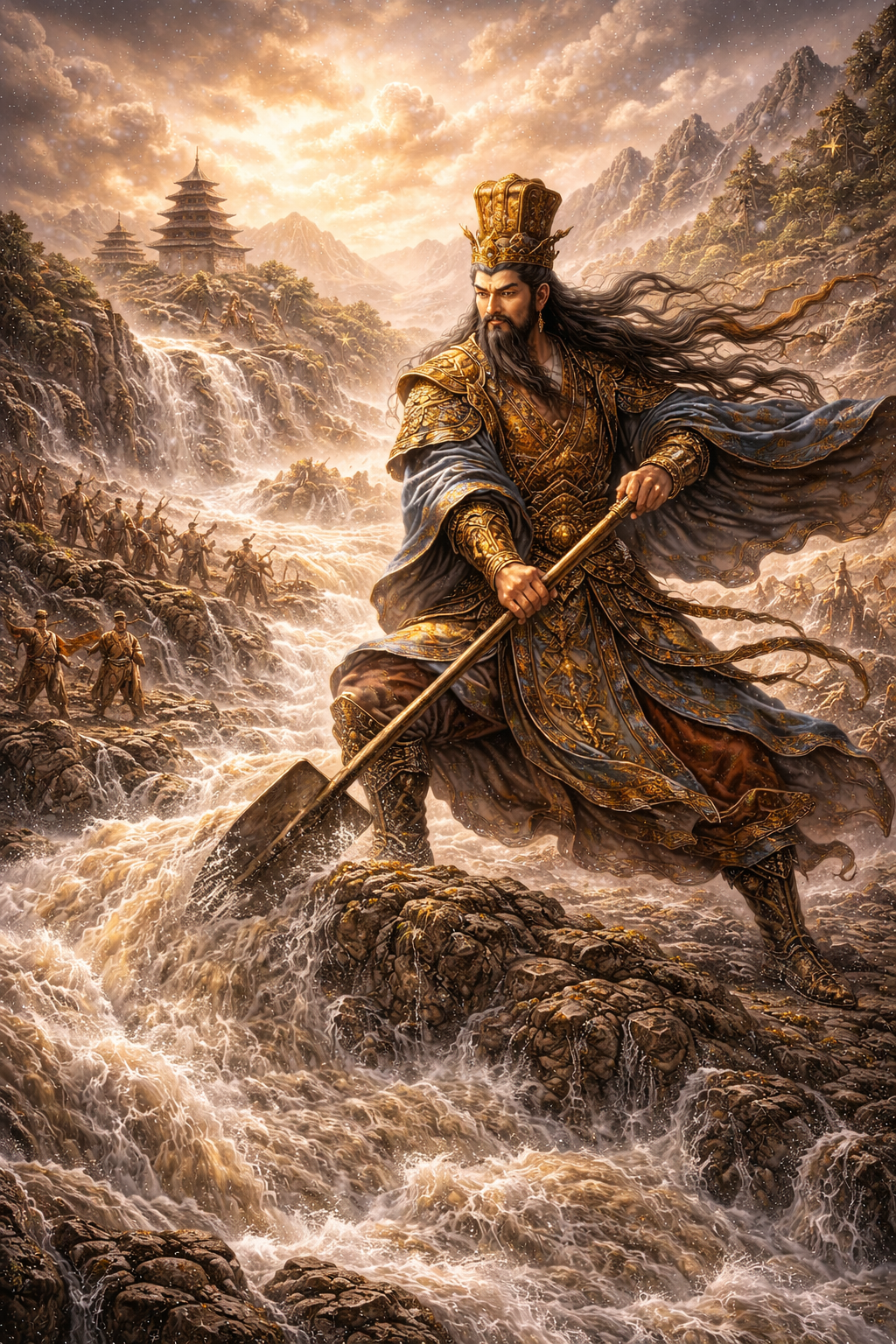
The primary archive gives Yu unusual importance. In the Canon of Shun, the emperor commands Yu to regulate the waters and land because the flood remains a threat to the people. In the Counsels of the Great Yu, Yu is framed through political and moral language: good government lies in nourishing the people, while water, fire, metal, wood, earth, and grain must be properly ordered. In the Tribute of Yu, the landscape itself becomes organized through the memory of Yu’s labor: provinces, rivers, mountains, soils, tribute routes, and territorial distinctions are all described through a geography shaped by flood control and classification. In the Shiji, Sima Qian turns these traditions into a larger narrative of succession and state formation, showing how Yu’s mastery of water becomes the basis for the birth of dynastic order.
Yu therefore belongs to one of the most consequential intersections in early Chinese thought: the place where myth, geography, administration, ecology, moral effort, and political theology become mutually reinforcing. He is not only a legendary flood hero. He is the figure through whom the land itself becomes politically legible.
Who Is Yu the Great?
Yu the Great is remembered as the ruler who brought flood under control and, in doing so, made durable political order possible. In the transmitted record, he first appears as a delegated figure entrusted with a practical task of enormous consequence: to regulate waters that had overflowed their bounds and threatened the life of the people. Yet the force of the tradition quickly exceeds technical administration. Yu becomes the exemplar of governing labor, the figure whose bodily effort across the land gives form to the realm itself.
This is why Yu matters within legendary history. He is not simply one more sage-king in a line of worthy rulers. His authority is tied to a specific, material, and consequential success. He secures the conditions under which the people may dwell, cultivate, travel, exchange, and be governed. Under his name, rulership becomes hydraulic, territorial, and infrastructural. He stands at the threshold between moral exemplarity and the actual making of a governable world.
Yu’s story is also distinctive because it ties greatness to labor rather than distance. The ruler or future ruler is not imagined only in the palace, temple, or court. He is imagined moving through mud, mountains, water, routes, and provinces. His political body is a working body. His authority comes from the fact that he undergoes the land directly and reorganizes it for common life.
That laboring quality makes Yu one of the most materially serious figures in Chinese mythology. He does not create the cosmos like Pangu, repair the heavens like Nüwa, teach symbolic order like Fuxi, or establish agriculture like Shennong. He makes the landscape governable. His myth insists that civilization depends on the disciplined ordering of water, land, movement, and survival.
Flood as a Political Problem
In the early Chinese archive, flood is never only a natural event. It is a political problem because it threatens the material conditions of life and therefore the possibility of legitimate rule. Unchecked water destroys settlement, cultivation, communication, burial, ritual, roads, boundaries, grain, and the stability of households. If water cannot be brought into right relation with land, no enduring human order can exist.
This framing gives flood control an importance that is both practical and symbolic. Practically, floodwaters threaten the people. Symbolically, they represent disorder exceeding measure. A ruler who cannot master the waters cannot convincingly claim to order the realm. Yu’s later greatness emerges from this premise. He does not inherit a stable world; he helps create one. The control of water becomes one of the earliest and most powerful tests of political competence.
Flood also links Yu’s myth to a wider Chinese understanding of rulership as environmental responsibility. Governance is not only command over people. It is the management of relations among terrain, water, food, labor, roads, channels, tribute, and seasonal life. Yu’s myth makes this insight narratively vivid. The ruler’s authority is measured by whether the land can hold life.
This is why the flood tradition belongs at the center of Chinese legendary history. It joins ecology and statecraft. Water becomes the medium through which the moral worth of rule is tested. The question is not merely who has the right title, but who can make the world livable.
Gun, Failure, and the Inherited Task
Yu’s story is inseparable from the failure of Gun, his father. In the Shiji, Yao seeks someone who can control the flood. Gun is recommended and employed, but after years of effort the waters do not subside and the work fails. Shun later inspects Gun’s work, judges it inadequate, and punishes him. Yu is then appointed to continue the task. The result is a powerful narrative structure: Yu’s greatness begins in inherited failure.
This inherited failure matters because it gives Yu’s labor moral urgency. He is not merely solving a technical problem. He is answering a broken public obligation associated with his own family line. The flood is both a landscape crisis and a memory of failed service. Yu’s later severity toward himself, his long absence from home, and his relentless work across the land make sense within this frame. He carries the burden of a task that already cost his father his life and reputation.
The Gun-Yu sequence also distinguishes two models of response to catastrophe. Gun’s failure is remembered as inadequate control; Yu’s success is remembered as channeling, traversing, measuring, and opening the land. In later interpretation, this contrast often becomes a contrast between blocking water and guiding it. Whether or not every technical detail belongs to early strata of the tradition, the symbolic opposition is clear: lasting order comes not from crude suppression, but from understanding the movement of the world.
Yu’s greatness therefore begins with a disciplined response to failure. He does not deny the catastrophe; he studies it, moves through it, and reorganizes the land so that water can be conducted rather than merely opposed. In this sense, Yu’s myth is one of the earliest Chinese stories of learning from failed governance.
Yu in the Canon of Shun
The Canon of Shun provides the earliest central statement of Yu’s mandate within the received classical archive. Shun names the need for someone who can assist the affairs of rule, and Yu is identified as the minister of works. He is then charged with regulating the waters and land. This moment is crucial because it casts Yu first as a servant of ordered government before he becomes a founder in his own right. His legitimacy begins with commission, responsibility, and task rather than with inherited title alone.
Primary Source
舜曰:「咨,四岳!有能奮庸熙帝之載,使宅百揆亮采,惠疇?」僉曰:「伯禹作司空。」帝曰:「俞,咨!禹,汝平水土,惟時懋哉!」Shun said, “Ah, Four Mountains! Is there someone who can vigorously assist the affairs of the emperor, take charge of the hundred offices, and make each work shine?” All replied, “Bo Yu is minister of works.” The emperor said, “Yes. Ah, Yu! You have regulated the waters and the land; now be diligent in this.”Shangshu, “Canon of Shun” 舜典.
The passage presents Yu as an appointed public servant before he becomes a founding figure. His authority begins in responsibility for water, land, and administrative work.
The text also situates Yu within a wider administrative order that includes agriculture, instruction, communications, ritual, punishments, and public offices. This matters because Yu’s work is not isolated from governance as a whole. Water control belongs to an emerging vision of ordered rule in which ministers are appointed to answer specific dimensions of disorder. Yu’s later preeminence rests on the fact that his charge concerns the most foundational of these: the habitability of the land itself.
This passage also clarifies why Yu is not simply a flood hero in the narrow sense. He is tied to the office of public works. The terrain, waters, and infrastructural conditions of life are not outside government; they are central to it. Yu’s myth therefore gives political dignity to work that might otherwise be treated as merely technical.
In the Canon of Shun, the sage-king does not solve everything himself. He recognizes, appoints, and organizes those who can address specific tasks. Yu’s greatness emerges from that administrative world, but his success eventually transforms him from official to founder.
The Counsels of the Great Yu and the Ethics of Rule
The Counsels of the Great Yu deepens Yu’s significance by presenting him not only as a technician of flood control, but as a political and ethical figure. The text ties good government to nourishing the people, ordering resources, correcting virtue, benefiting use, and enriching life. Yu’s importance is therefore not only that he solves a physical problem, but that his political wisdom understands the conditions of public welfare.
Primary Source
禹曰:「於!帝念哉!德惟善政,政在養民。水、火、金、木、土、穀,惟修;正德、利用、厚生、惟和。」Yu said, “Ah! Emperor, attend to this. Virtue lies in good government; government lies in nourishing the people. Water, fire, metal, wood, earth, and grain must be properly ordered; correcting virtue, benefiting use, and enriching life must be brought into harmony.”Shangshu, “Counsels of the Great Yu” 大禹謨.
The passage makes Yu’s political thought material and ethical at once. Good rule is measured by the ordering of resources and the nourishment of the people.
This passage is one of the strongest textual anchors for Yu’s broader meaning. Water control is part of a larger vision of government as the ordering of life-supporting conditions. Water, fire, metal, wood, earth, and grain are not abstract categories. They name the material powers through which people live. To govern well is to order these powers without allowing them to become destructive, wasted, or unjustly distributed.
The phrase “government lies in nourishing the people” is especially important. It places public welfare at the center of political virtue. Rule is not legitimate simply because it is ancient, hereditary, ritualized, or victorious. It is legitimate insofar as it sustains life. Yu’s mythic authority is inseparable from this practical moral standard.
This also explains why Yu remains such a powerful figure for later reflection. His story joins the ethics of care with the techniques of governance. The ruler must be virtuous, but virtue must become policy, labor, infrastructure, food security, and stable relations among the forces that sustain life.
The Tribute of Yu and the Ordering of Space
The Tribute of Yu is indispensable because it turns flood control into geography. The text describes provinces, mountains, rivers, marshes, soils, products, fields, tribute routes, and territorial distinctions in a form that presents the realm as already territorially intelligible. Yu’s labor is remembered not only as hydraulic intervention, but as the making of differentiated space. The land is divided, characterized, ranked, and connected. Political order appears as cartographic order.
Primary Source
禹別九州,隨山濬川,任土作貢。禹敷土,隨山刊木,奠高山大川。Yu divided the nine provinces, followed the mountains and dredged the rivers, and assigned tribute according to the soils. Yu spread order through the land, followed the mountains cutting through the timber, and determined the great mountains and rivers.Shangshu, “Tribute of Yu” 禹貢.
The passage presents Yu as a territorial organizer. Flood control becomes the classification of land, rivers, mountains, soils, and tribute.
This is an extraordinary development in the mythic-political imagination. Under Yu’s name, the realm ceases to be simply a threatened environment and becomes a describable administrative world. Waterways, terrains, and regional products enter a structured relation to authority. Governance requires knowledge of space, not only command over persons.
Yu is therefore a founder of territorial intelligibility as much as a controller of flood. His legacy is inscribed not only in memory of action, but in the very way the realm is imagined as knowable and governable. The Tribute of Yu turns landscape into administrative memory.
This also makes Yu central to the relation between myth and geography. The Shanhaijing preserves strange and sacred geography; the Tribute of Yu preserves ordered political geography. Both treat land as meaningful, but they do so differently. Yu’s landscape is not primarily a world of marvels. It is a world of waters, soils, products, routes, and obligations brought into relation by public labor.
Labor, Mobility, and the Body of Government
Yu’s legendary authority is inseparable from movement. He is remembered as one who traveled the land in person, crossing mountains, following rivers, dredging channels, marking terrain, and laboring in the field of public necessity rather than remaining confined to ceremonial centrality. This mobility is politically meaningful. It suggests that rule worthy of the name cannot remain distant from the terrain it claims to order. The ruler or minister must know the land bodily.
The Shiji preserves the most vivid form of this tradition. Yu works with Yi and Houji, orders labor, surveys mountains, determines rivers, and spends thirteen years away from home. The famous image of passing his own door without entering condenses the tradition’s view of public responsibility. The ruler’s body is subordinated to the needs of the realm.
Primary Source
禹乃遂與益、后稷奉帝命,命諸侯百姓興人徒以傅土,行山表木,定高山大川。禹傷先人父鯀功之不成受誅,乃勞身焦思,居外十三年,過家門不敢入。Yu then, together with Yi and Houji, received the emperor’s command and ordered the lords and people to raise laborers to work the land, traverse the mountains and mark the trees, and determine the great mountains and rivers. Grieving that his father Gun had been punished because his work had failed, Yu exhausted his body and distressed his mind, lived away for thirteen years, and passed the gate of his home without daring to enter.Shiji, “Annals of the Xia” 夏本紀.
The passage makes Yu’s authority embodied. His legitimacy is tied to labor, mobility, grief, public obligation, and the refusal to place private comfort above the work of ordering the land.
That emphasis distinguishes Yu from more purely ritual or annalistic rulers. His body becomes the medium through which the world is made governable. The tradition repeatedly imagines him in exertion, in passage, in work. Government under Yu is not an abstraction. It is enacted across rivers, channels, embankments, provinces, and routes of movement.
The story of passing his home without entering is powerful, but it should be read carefully. It should not be romanticized as a simple demand that public service erase family life. Its mythic function is to show that Yu’s authority comes from extraordinary responsibility under extraordinary conditions. The point is not ordinary neglect; it is the extremity of public crisis. In Yu’s legend, the flood is so serious that the future ruler must become almost entirely a body of work.
Tools, Measurement, and Infrastructural Intelligence
Yu’s work is not presented as brute strength alone. The tradition repeatedly emphasizes tools, routes, seasons, vehicles, measurement, and adaptation to terrain. In the Shiji, he travels by carriage on dry land, boat on water, sledge in muddy places, and spiked footwear in mountains. He carries marking-line, compass, and square. These details matter because they define Yu as an intelligent worker, not merely a heroic sufferer.
Yu’s greatness lies in knowing that different terrains require different methods. Water, mud, mountain, and dry land are not interchangeable. Each requires a fitting technique. This is one of the most important aspects of his myth: the land becomes governable only when its differences are recognized. Yu’s rule is adaptive because the landscape itself is varied.
Measurement also gives Yu’s work political force. The marking-line, compass, and square suggest more than practical surveying. They symbolize the conversion of terrain into ordered space. Channels, provinces, routes, tribute, and fields all depend on the ability to measure, distinguish, and connect. Yu’s tools are instruments of statecraft.
This makes Yu an early mythic figure of infrastructural intelligence. He does not conquer water by refusing its nature. He learns how water moves, how land slopes, how routes connect, how fields can be cultivated, and how surplus can be redistributed. His mythic achievement is technical, ecological, and administrative at once.
In this sense, Yu complements Shennong. Shennong teaches agriculture and plant knowledge; Yu organizes the landscape that makes sustained agriculture possible. Grain requires fields, but fields require controlled water. The agrarian world depends on hydraulic order.
Yu and the Birth of Dynastic Order
The Shiji gives Yu’s story a still larger significance by linking his flood-control achievement to succession and the founding of the Xia. In Sima Qian’s arrangement, Yu is not only the great minister who answers the flood. He is also the figure through whom sage-rule begins to harden into dynastic order. The shift matters because it marks a transformation in political imagination: from exemplary service under prior sage-kings to the beginning of hereditary kingship.
This transformation gives Yu an unusual dual status. He remains a sage-like laboring ruler, but he is also remembered as the threshold of a new political form. He is central to debates about legitimacy, succession, and the relationship between merit and inheritance. In later thought, the contrast between the abdication model associated with Yao and Shun and the dynastic beginning associated with Yu becomes highly significant.
Yu belongs to both worlds: the world of earned authority and the world of founding rule. His authority is earned through flood control, public labor, and service. Yet his memory also opens toward the Xia, where rulership becomes linked to dynastic continuity. That doubleness is part of what makes Yu so consequential for later Chinese political reflection.
This also means that Yu’s myth is not politically simple. He can be invoked as a model of merit, labor, and public service, but he also stands at the beginning of hereditary order. The tradition preserves a tension rather than erasing it. Yu’s greatness legitimates the transition, but the transition itself changes the nature of succession.
Flood Control and Political Legitimacy
No aspect of Yu’s myth is more important than the proposition that political legitimacy depends on securing the material conditions of life. Flood control in his case is not symbolic ornament around kingship. It is the basis of kingship. A ruler who cannot answer water cannot feed, protect, settle, or organize a people. Yu’s success therefore becomes the most concrete possible proof of worthiness to rule.
This is one reason Yu remained so powerful in later Chinese political imagination. He represents an ideal of government in which infrastructure, environmental management, and public welfare are inseparable from legitimacy itself. His myth suggests that order is not measured solely by lineage, ceremony, or victory in war. It is measured by whether the land can hold human life.
Yu’s political legitimacy is also collective. He does not work alone in the archive. He works with Yi, Houji, lords, laborers, officials, and communities. His myth may concentrate achievement in one figure, but the work itself presupposes organized labor. Flood control is a public project. This makes Yu not only a hero but a coordinator of collective effort.
The legend therefore preserves an infrastructural model of sovereignty. Political order is not simply declared. It is built through channels, routes, dredging, surveying, redistribution, and the taming of destructive force. Yu’s authority is credible because it is materially enacted.
Yu Between Legend, History, and Statecraft
Yu is best read as legendary history. The Shangshu gives him normative and administrative force; the Tribute of Yu spatializes that force into a territorial world; the Shiji narrates him within a larger story of ancient rulership and dynastic foundation. None of these texts should be mistaken for transparent eyewitness history in the modern sense. But neither should they be reduced to free-floating fable. They are transmitted constructions of political antiquity with clear statecraft implications.
This matters because Yu’s significance lies precisely in the overlap between mythic narrative and political reasoning. He is the figure through whom the control of nature becomes part of the story a civilization tells about the legitimacy of rule. To study Yu is therefore to study the making of infrastructural sovereignty in legendary form.
Source criticism is especially important here. The Canon of Shun, Counsels of the Great Yu, Tribute of Yu, and Shiji do not all do the same thing. One appoints Yu to the task; one moralizes governance; one maps and classifies the land; one narrates Yu’s labor and dynastic significance. Together they produce a layered Yu: minister, flood controller, moral counselor, territorial organizer, laboring sage, and dynastic founder.
This layeredness should be preserved rather than flattened. Yu’s power as a mythic figure comes from the fact that he can hold together ecology, work, rule, territory, morality, and dynastic memory. He is one of the clearest examples in Chinese tradition of how myth can preserve administrative ideals, territorial reasoning, and the ethics of public responsibility.
Modern Ecological and Political Readings
Yu’s story remains especially powerful for modern readers because it joins environmental crisis to political legitimacy. Flood control in the ancient archive is not simply an engineering problem. It is a test of whether government can protect the conditions of life. That gives Yu’s myth enduring relevance for thinking about infrastructure, climate vulnerability, disaster governance, watershed management, public works, and the responsibilities of political authority.
At the same time, Yu should not be turned too quickly into a modern environmental technocrat. His world is legendary, ritualized, and politically symbolic. The point is not to claim that ancient flood-control narratives are the same as modern environmental policy. The point is that Yu’s myth preserves a deep political intuition: rule is judged by how it responds to material danger.
Yu also complicates modern ideas of heroism. His greatness is not charismatic speech, battlefield victory, or private enlightenment. It is persistent public work. His myth honors the slow, exhausting, collective, technical labor required to make a damaged landscape livable. That is a different kind of heroism from conquest, and in many ways a more demanding one.
The story also raises difficult questions. When does public labor become public burden? How should large infrastructural projects balance human settlement, ecological change, and political authority? How do societies remember technical work as moral achievement? Yu’s myth does not answer these questions in modern terms, but it gives them ancient narrative form.
Why Yu Still Matters
Yu still matters because he condenses one of the deepest propositions in Chinese political mythology: order must be materially enacted. A ruler’s worth is shown not only in moral language, ritual correctness, or ancestral claim, but in whether he can make the world habitable, traversable, and secure. Yu’s greatness lies in turning catastrophe into a governed landscape.
He also matters because his story binds together domains modern analysis often separates. Environment, infrastructure, administration, virtue, territory, labor, and succession all converge in his figure. Under Yu’s name, the birth of political order is inseparable from the management of water. That is why he remains indispensable to any serious account of Chinese legendary history, early state formation, and the mythic imagination of rulership.
Yu matters, too, because he gives mythic dignity to maintenance and public works. He does not merely found by proclaiming. He founds by opening channels, measuring terrain, coordinating labor, and exhausting himself in service to the people. In his tradition, infrastructure is not invisible. It is the very sign of legitimate rule.
Finally, Yu matters because he marks the threshold between sage-kingship and dynastic memory. Yao and Shun imagine virtue and succession through worth; Yu carries that world into the question of hereditary rule and political foundation. He is therefore both the culmination of the sage-king sequence and the beginning of another political imagination. His legend stands where flood, land, labor, and sovereignty meet.
Related Reading
- Chinese Myth, Folklore & Legend
- What Is Chinese Myth, Folklore & Legend?
- The Problem of Sources in Chinese Mythology
- Yao, Shun, and the Sage-Kings in Legendary History
- The Yellow Emperor and the Mythic Politics of Chinese Origins
- Shennong and the Invention of Agriculture, Medicine, and Rule
- Heaven, Mandate, and the Mythic Imagination of Rule
- Chinese Thought
Primary Sources
- Chinese Text Project (n.d.) Shangshu: Canon of Shun 尚書:舜典. Available at: https://ctext.org/shang-shu/canon-of-shun/ens
- Chinese Text Project (n.d.) Shangshu: Canon of Shun 尚書:舜典, Chinese text. Available at: https://ctext.org/shang-shu/canon-of-shun/zh
- Chinese Text Project (n.d.) Shangshu: Counsels of the Great Yu 尚書:大禹謨. Available at: https://ctext.org/shang-shu/counsels-of-the-great-yu/ens
- Chinese Text Project (n.d.) Shangshu: Counsels of the Great Yu 尚書:大禹謨, Chinese text. Available at: https://ctext.org/shang-shu/counsels-of-the-great-yu/zh
- Chinese Text Project (n.d.) Shangshu: Tribute of Yu 尚書:禹貢. Available at: https://ctext.org/shang-shu/tribute-of-yu/ens
- Chinese Text Project (n.d.) Shangshu: Tribute of Yu 尚書:禹貢, Chinese text. Available at: https://ctext.org/shang-shu/tribute-of-yu/zh
- Chinese Text Project (n.d.) Shiji: Xia benji 史記:夏本紀 / Annals of the Xia. Available at: https://ctext.org/shiji/xia-ben-ji/ens
- Chinese Text Project (n.d.) Shiji: Xia benji 史記:夏本紀, Chinese text. Available at: https://ctext.org/shiji/xia-ben-ji/zh
- Chinese Text Project (n.d.) Shiji: Wudi benji 史記:五帝本紀 / Annals of the Five Emperors. Available at: https://ctext.org/shiji/wu-di-ben-ji/ens
Further Reading
- Chinese Text Project (n.d.) Shangshu: Canon of Shun. Available at: https://ctext.org/shang-shu/canon-of-shun/ens
- Chinese Text Project (n.d.) Shangshu: Counsels of the Great Yu. Available at: https://ctext.org/shang-shu/counsels-of-the-great-yu/ens
- Chinese Text Project (n.d.) Shangshu: Tribute of Yu. Available at: https://ctext.org/shang-shu/tribute-of-yu/ens
- Chinese Text Project (n.d.) Shiji: Annals of the Xia. Available at: https://ctext.org/shiji/xia-ben-ji/ens
- Stanford Encyclopedia of Philosophy (2023) “Social and Political Thought in Chinese Philosophy.” Available at: https://plato.stanford.edu/entries/chinese-social-political/
- Encyclopaedia Britannica (n.d.) “Yu.” Available at: https://www.britannica.com/topic/Yu-Chinese-mythological-emperor
- Nylan, M. (2001) The Five “Confucian” Classics. New Haven: Yale University Press.
- Lewis, M.E. (2006) The Flood Myths of Early China. Albany: State University of New York Press.
- Major, J.S., Queen, S.A., Meyer, A.S. and Roth, H.D. (2010) The Huainanzi: A Guide to the Theory and Practice of Government in Early Han China. New York: Columbia University Press. Available at: https://cup.columbia.edu/book/the-huainanzi/9780231142045
- Puett, M. (2002) To Become a God: Cosmology, Sacrifice, and Self-Divinization in Early China. Cambridge, MA: Harvard University Asia Center.
References
- Chinese Text Project (n.d.) Shangshu: Canon of Shun. Available at: https://ctext.org/shang-shu/canon-of-shun/ens
- Chinese Text Project (n.d.) Shangshu: Canon of Shun, Chinese text. Available at: https://ctext.org/shang-shu/canon-of-shun/zh
- Chinese Text Project (n.d.) Shangshu: Counsels of the Great Yu. Available at: https://ctext.org/shang-shu/counsels-of-the-great-yu/ens
- Chinese Text Project (n.d.) Shangshu: Counsels of the Great Yu, Chinese text. Available at: https://ctext.org/shang-shu/counsels-of-the-great-yu/zh
- Chinese Text Project (n.d.) Shangshu: Tribute of Yu. Available at: https://ctext.org/shang-shu/tribute-of-yu/ens
- Chinese Text Project (n.d.) Shangshu: Tribute of Yu, Chinese text. Available at: https://ctext.org/shang-shu/tribute-of-yu/zh
- Chinese Text Project (n.d.) Shiji: Xia benji. Available at: https://ctext.org/shiji/xia-ben-ji/ens
- Chinese Text Project (n.d.) Shiji: Xia benji, Chinese text. Available at: https://ctext.org/shiji/xia-ben-ji/zh
- Chinese Text Project (n.d.) Shiji: Wudi benji. Available at: https://ctext.org/shiji/wu-di-ben-ji/ens
- Encyclopaedia Britannica (n.d.) “Yu.” Available at: https://www.britannica.com/topic/Yu-Chinese-mythological-emperor
- Lewis, M.E. (2006) The Flood Myths of Early China. Albany: State University of New York Press.
- Major, J.S., Queen, S.A., Meyer, A.S. and Roth, H.D. (2010) The Huainanzi: A Guide to the Theory and Practice of Government in Early Han China. New York: Columbia University Press. Available at: https://cup.columbia.edu/book/the-huainanzi/9780231142045
- Nylan, M. (2001) The Five “Confucian” Classics. New Haven: Yale University Press.
- Puett, M. (2002) To Become a God: Cosmology, Sacrifice, and Self-Divinization in Early China. Cambridge, MA: Harvard University Asia Center.
- Stanford Encyclopedia of Philosophy (2023) “Social and Political Thought in Chinese Philosophy.” Available at: https://plato.stanford.edu/entries/chinese-social-political/